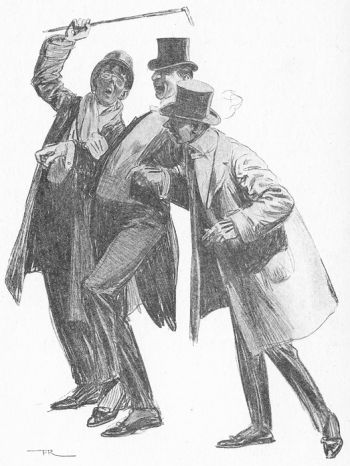
FRANK REYNOLDS. I.
Reading edition
It has been said of Tolstoy, anatomising the grim skeleton of human nature, that his writings are more like life than life itself. Of Frank Reynolds, with gently satirical pen and pencil depicting the superficial humours of modern life, it might be said that his drawings, too, are more humanly natural than real flesh and blood. It is the peculiar faculty of the true observer that his eye pierces straight to the heart of what he sees, and his mind, disregarding mere detail, thereby receives and retains a clear perception of the essential, which those of less clear and direct vision fail to grasp more than momentarily, though they hail it with instant recognition when in its naked simplicity it is set before them. The process is unconscious, or at least but semi-conscious; for your professed observer has never that keen insight which, being native, is not to be acquired by even the most assiduous practice, and alone permits of truthful analysis.
In the making of the genuine humorist the faculty of observation is the first necessity. Consider the great pictorial humorists, whether dead or living, whose names are familiar in the mouth as household words. That they gained acknowledgment by masterly handling of the medium in which they chose to work is not to be denied. It is by the peculiar distinction of his technique, indeed, that the work of each, in a general way, is called to mind. But this fame was not achieved solely upon purely artistic merits. Charles Keene, George du Maurier, Phil May, Raven Hill, Bernard Partridge—it is rather for the happy fidelity of their transcripts from life than for the artistic sureness of their hands that they are and will be remembered.
It is the possession of just that subtle power of quiet but comprehensive observation which has obtained for Frank Reynolds the unique position which he occupies amongst the humorous artists of to-day.
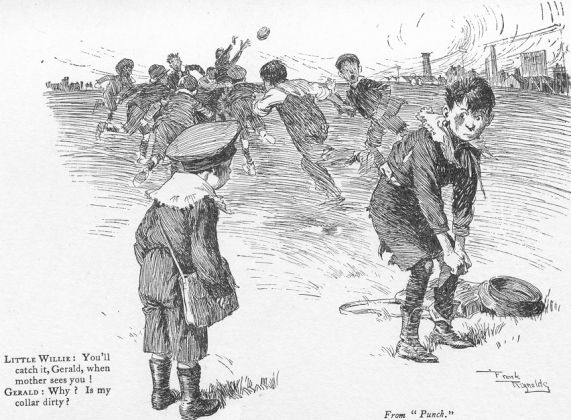
For unique his position is. Other men are as funny as he, perhaps funnier. For when a determined man sets out with a fixed and unshakeable resolve to tickle your fancy, there is no limit to the means he may adopt to catch you unawares, and it shall go hard with him but he extorts from you a laugh, however tardy. Frank Reynolds makes no such desperate efforts. One might say, indeed, that he makes no effort at all. His simple method is to set down—with the most refined and delicate art—just one of those little scenes or incidents which everyone may every day everywhere witness.

Spectators of such a scene in real life, it is possible—probable, in fact—that we were in no way edified or amused. Not the veriest ghost of a smile, it is likely, flickered across our faces. But reproduced by the subtle humour of the artist, the inherent comedy of the situation stands revealed, and we chuckle. And our enjoyment is the greater for the skill with which the means are concealed by which this magical transformation is effected. We feel that we have discovered the comedy ourselves, not that it has been shown to us. The characters are so perfectly natural, so precisely as we know them and have seen them day after day. The secret lies in the artist's power of restraint. He exaggerates, he caricatures,—he must do so to bring his point home to our dull wits. But he does it with such nicety that the exaggeration and the caricature are unnoticed. Indeed, the terms are misleading. It is better to say that he emphasises.
Frank Reynolds reminds me, if he will forgive my saying so, of a certain profane 'bus-driver whom I have the privilege to number amongst my acquaintance. With this close student of human nature I have had the good fortune to enjoy frequent conversations, and many are the gestures which I recall of the whip-hand towards the pavement, accompanied by the remark (in effect), "Lumme, what funny things a bloke do see!" I confess freely that often I should entirely miss, but for the observant jerk of the whip, the said "funny thing"; and it is just that service which the friendly busman renders to me, as it appears to my mind, that Frank Reynolds performs for the community at large. It is precisely those commonplace "funny things," whether they be persons, scenes, incidents, conversations, or casual remarks, that happen under our very noses, which he excels in depicting; and it is precisely the commonplace familiarity of them that invests them with their peculiar flavour and charm.
THE INTRODUCTION. Time Sketch: London Sketch Club.
Of the fine qualities of Frank Reynolds' technique the reader can judge for himself from the varied specimens of the artist's work which are reproduced in the present volume. His pencil drawings represent, perhaps, his more familiar style, one reason of the association of his name with this medium in the public mind being the comparative rarity of its use for the purposes of reproduction. Certainly it will be conceded that pencil, soft and amenable, with its opportunities for delicate manipulation, is admirably adapted to the interpretation of those refined shades of meaning and expression which constitute the characteristic charm of Reynolds' drawings, and of his masterly handling of it there can be no two opinions.
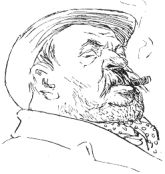
His early drawings for publication were in line, and it was not until his work in the illustrated press had appeared for some time that he began to substitute pencil for pen-and-ink. His first experiments in pencil were made at the Friday evening meetings of the London Sketch Club, and it was at the suggestion of a fellow member of that cheery coterie, his friend John Hassall, that he adopted the softer medium for the purposes of reproduction.
The excellence of his pencil drawings notwithstanding, it is in pen-and-ink that Frank Reynolds appears to me to be at his best. There is a quality about his work in this medium which gives it a peculiar distinction. Always instinct with the most subtle and delicate feeling, there are occasions when his expressive line does more than satisfy. It arrests: revealing in its simple transcription of pose or expression a significance which had previously escaped our shallow observation, but of which the truth is forced upon us. By comparison, one feels that, despite the fine finish of his pencil work, in the latter medium he loses, to a certain extent, the opportunities for that incisive sureness—so suited to his own unerring vision—which pure line affords him. Consider the drawing (on page 32) of the girl singing in a Paris café. There is no dependence on aught extraneous for the achievement of the effect sought. Yet here, if ever, a human soul is laid bare in all its naked tragedy.
WORKING PARIS AT LUNCHEON. From "Paris and some Parisians"
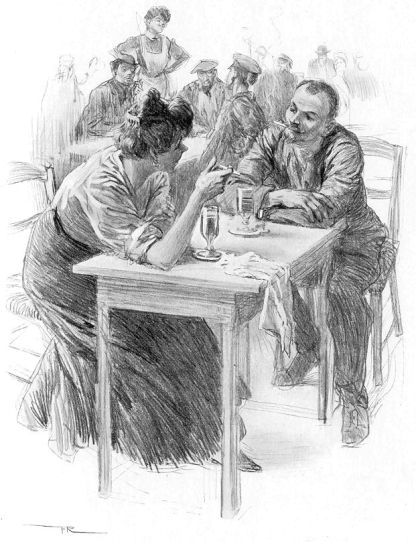
For sheer power in the art of drawing, Frank Reynolds has few equals and no betters. As a draughtsman pure and simple, he seems to me well-nigh perfect, whether he has pen, pencil, or stump of charcoal in his hand. It is the great merit of his work, as it appears to me, that it depends for the achievement of its intention solely on its own intrinsic qualities. It has no tricks, no mannerisms, no "fakements" to distract the attention and conceal weaknesses. It is straightforward, direct in its appeal, self-reliant in its challenge.
To quote the words of a critic of discernment, as he passed from drawing to drawing, "Frank Reynolds is right, right—right every time." This is praise to which one can hardly add.
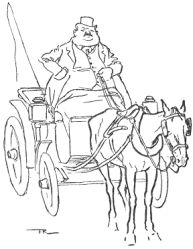
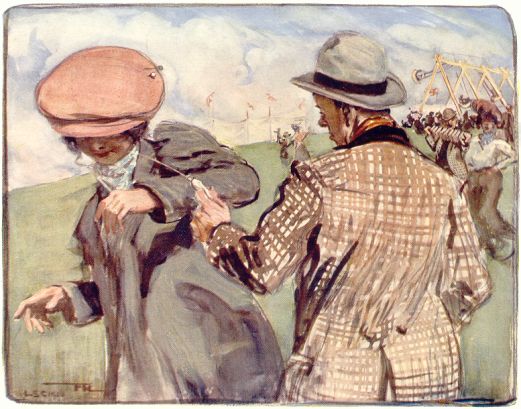
THE DARE-DEVILS. From "Social Pests."