Front matter (continued 5)
Reading edition
We turned to the left, so as to cut across her bows. Five minutes' pull would have brought us up to her. The officer waved his cap and I my hat. 'If they could only see us, they might back to us in a moment.' But they did not see us, or if they did, they paid us no attention. I returned to the 'Urgent,' discomfited, but grateful to the fine fellows who had wrought so hard to carry out my wishes.
Glad of the quiet, in the sober afternoon I took a walk towards Europa Point. The sky darkened and heavy squalls passed at intervals. Private theatricals were at the Convent, and the kind and courteous Governor had sent cards to the eclipse party. I failed in my duty in not going. St. Michael's Cave is said to rival, if it does not outrival, the Mammoth Cave of Kentucky. On the 28th Mr. Crookes, Mr. Carpenter, and myself, guided by a military policeman who understood his work, explored the cavern. The mouth is about 1,100 feet above the sea. We zigzagged up to it, and first were led into an aperture in the rock, at some height above the true entrance of the cave. In this upper cavern we saw some tall and beautiful stalactite pillars.
The water drips from the roof charged with bicarbonate of lime. Exposed to the air, the carbonic acid partially escapes, and the simple carbonate of lime, which is hardly at all soluble in water, deposits itself as a solid, forming stalactites and stalagmites. Even the exposure of chalk or limestone water to the open air partially softens it. A specimen of the Redbourne water exposed by Professors Graham, Miller, and Hofmann, in a shallow basin, fell from eighteen degrees to nine degrees of hardness. The softening process of Clark is virtually a hastening of the natural process. Here, however, instead of being permitted to evaporate, half the carbonic acid is appropriated by lime, the half thus taken up, as well as the remaining half, being precipitated. The solid precipitate is permitted to sink, and the clear supernatant liquid is limpid soft water.
We returned to the real mouth of St. Michael's Cave, which is entered by a wicket. The floor was somewhat muddy, and the roof and walls were wet. We soon found ourselves in the midst of a natural temple, where tall columns sprang complete from floor to roof, while incipient columns were growing to meet each other, upwards and downwards. The water which trickles from the stalactite, after having in part yielded up its carbonate of lime, falls upon the floor vertically underneath, and there builds the stalagmite. Consequently, the pillars grow from above and below simultaneously, along the same vertical. It is easy to distinguish the stalagmitic from the stalactitic portion of the pillars. The former is always divided into short segments by protuberant rings, as if deposited periodically, while the latter presents a uniform surface. In some cases the points of inverted cones of stalactite rested on the centres of pillars of stalagmite. The process of solidification and the consequent architecture were alike beautiful.
We followed our guide through various branches and arms of the cave, climbed and descended steps, halted at the edges of dark shafts and apertures, and squeezed ourselves through narrow passages. From time to time we halted, while Mr. Crookes illuminated with ignited magnesium wire, the roof, columns, dependent spears, and graceful drapery of the stalactites. Once, coming to a magnificent cluster of icicle-like spears, we helped ourselves to specimens. There was some difficulty in detaching the more delicate ones, their fragility was so great. A consciousness of vandalism, which smote me at the time, haunts me still; for, though our requisitions were moderate, this beauty ought not to be at all invaded. Pendent from the roof, in their natural habitat, nothing can exceed their delicate beauty; they live, as it were, surrounded by organic connections. In London they are curious, but not beautiful. Of gathered shells Emerson writes:
I wiped away the weeds and foam, And brought my sea-born treasures home But the poor, unsightly, noisome things Had left their beauty on the shore, With the sun, and the sand, and the wild uproar.
The promontory of Gibraltar is so burrowed with caverns that it has been called the Hill of Caves. They are apparently related to the geologic disturbances which the rock has undergone. The earliest of these is the tilting of the once horizontal strata. Suppose a force of torsion to act upon the promontory at its southern extremity near Europa Point, and suppose the rock to be of a partially yielding character; such a force would twist the strata into screw-surfaces, the greatest amount of twisting being endured near the point of application of the force. Such a twisting the rock appears to have suffered; but instead of the twist fading gradually and uniformly off, in passing from south to north, the want of uniformity in the material has produced lines of dislocation where there are abrupt changes in the amount of twist. Thus, at the northern end of the rock the dip to the west is nineteen degrees; in the Middle Hill, it is thirty-eight degrees; in the centre of the South hill, or Sugar Loaf, it is fifty-seven degrees. At the southern extremity of the Sugar Loaf the strata are vertical, while farther to the south they actually turn over and dip to the east.
The rock is thus divided into three sections, separated from each other by places of dislocation, where the strata are much wrenched and broken. These are called the Northern and Southern Quebrada, from the Spanish 'Tierra Quebrada,' or broken ground. It is at these places that the inland caves of Gibraltar are almost exclusively found. Based on the observations of Dr. Falconer and himself, an excellent and most interesting account of these 'caves, and of the human remains and works of art which they contain, was communicated by Mr. Busk to the meeting of the Congress of Prehistoric Archaeology at Norwich, and afterwards printed in the 'Transactions' of the Congress. [Footnote: In this essay Mr. Busk refers to the previous labours of Mr. Smith, of Jordan Hill, to whom we owe most of our knowledge of the geology of the rock.] Long subsequent to the operation of the twisting force just referred to, the promontory underwent various changes of level. There are sea-terraces and layers of shell-breccia along its flanks, and numerous caves which, unlike the inland ones, are the product of marine erosion. The Ape's Hill, on the African side of the strait, Mr. Busk informs me has undergone similar disturbances. [Footnote: No one can rise from the perusal of Mr. Busk's paper without a feeling of admiration for the principal discoverer and indefatigable explorer of the Gibraltar caves, the late Captain Frederick Brome.]
-----
In the harbour of Gibraltar, on the morning of our departure, I resumed a series of observations on the colour of the sea. On the way out a number of specimens had been collected, with a view to subsequent examination. But the bottles were claret bottles, of doubtful purity. At Gibraltar, therefore, I purchased fifteen white glass bottles, with ground glass stoppers, and at Cadiz, thanks to the friendly guidance of Mr. Cameron, I secured a dozen more. These seven-and-twenty bottles were filled with water, taken at different places between Oran and Spithead.
And here let me express my warmest acknowledgments to Captain Henderson, the commander of H.M.S. 'Urgent,' who aided me in my observations in every possible way. Indeed, my thanks are due to all the officers for their unfailing courtesy and help. The captain placed at my disposal his own coxswain, an intelligent fellow named Thorogood, who skilfully attached a cord to each bottle, weighted it with lead, cast it into the sea, and, after three successive rinsings, filled it under my own eyes. The contact of jugs, buckets, or other vessels was thus avoided; and even the necessity of pouring out the water, afterwards, through the dirty London air.
The mode of examination applied to these bottles has been already described. [Footnote: See "On Dust and Disease".] The liquid is illuminated by a powerfully condensed beam, its condition being revealed through the light scattered by its suspended particles. 'Care is taken to defend the eye from the access of all other light, and, thus defended, it becomes an organ of inconceivable delicacy.' Were water of uniform density perfectly free from suspended matter, it would, in my opinion, scatter no light at all. The track of a luminous beam could not be seen in such water. But 'an amount of impurity so infinitesimal as to be scarcely expressible in numbers, and the individual particles of which are so small as wholly to elude the microscope, may, when examined by the method alluded to, produce not only sensible, but striking, effects upon the eye.'
The results of the examination of nineteen bottles filled at various places between Gibraltar and Spithead, are here tabulated:
No. Locality Colour of Sea Appearance in Luminous beam
1 Gibraltar Harbour. Green Thick with fine particles
2 Two miles from Gibraltar Clearer green Thick with very fine particles
3 Off Cabreta Point Bright green Still thick, but less so
4 Off Cabreta Point Black-indigo Much less thick, very pure
5 Off Tarifa Undecided Thicker than No. 4
6 Beyond Tarifa Cobalt-blue Much purer than No. 5
7 Twelve miles from Cadiz . Yellow-green Very thick
8 Cadiz Harbour Yellow-green Exceedingly thick
9 Fourteen miles from Cadiz Yellow-green Thick, but less so
10 Fourteen miles from Cadiz Bright green Much less thick
11 Between Capes St. Mary and Vincent. Deep indigo Very little matter, very pure
12 Off the Burlings. Strong green. Thick, with fine matter
13 Beyond the Burlings . Indigo Very little matter, pure
14 Off Cape Finisterre. Undecided. Less pure
15 Bay of Biscay Black-indigo. Very little matter, very pure
16 Bay of Biscay Indigo Very fine matter. Iridescent
17 Off Ushant Dark green. A good deal of matter
18 Off St. Catherine's . Yellow-green Exceedingly thick
19 Spithead Green Exceedingly thick
Here we have three specimens of water, described as green, a clearer green, and bright green, taken in Gibraltar Harbour, at a point two miles from the harbour, and off Cabreta Point. The home examination showed the first to be thick with suspended matter, the second less thick, and the third still less thick. Thus the green brightened as the suspended matter diminished in amount.
Previous to the fourth observation our excellent navigating lieutenant, Mr. Brown, steered along the coast, thus avoiding the adverse current which sets in, through the Strait, from the Atlantic to the Mediterranean. He was at length forced to cross the boundary of the Atlantic current, which was defined with extraordinary sharpness. On the one side of it the water was a vivid green, on the other a deep blue. Standing at the bow of the ship, a bottle could be filled with blue water, while at the same moment a bottle cast from the stern could be filled with green water. Two bottles were secured, one on each side of this remarkable boundary. In the distance the Atlantic had the hue called ultra-marine; but looked fairly down upon, it was of almost inky blackness — black qualified by a trace of indigo.
What change does the home examination here reveal? In passing to indigo, the water becomes suddenly augmented in purity, the suspended matter becoming suddenly less. Off Tarifa, the deep indigo disappears, and the sea is undecided in colour. Accompanying this change, we have a rise in the quantity of suspended matter. Beyond Tarifa, we change to cobalt-blue, the suspended matter falling at the same time in quantity. This water is distinctly purer than the green. We approach Cadiz, and at twelve miles from the city get into yellow-green water; this the London examination shows to be thick with suspended matter. The same is true of Cadiz harbour, and also of a point fourteen miles from Cadiz in the homeward direction. Here there is a sudden change from yellow-green to a bright emerald-green, and accompanying the change a sudden fall in the quantity of suspended matter. Between Cape St. Mary and Cape St: Vincent the water changes to the deepest indigo, a further diminution of the suspended matter being the concomitant phenomenon.
We now reach the remarkable group of rocks called the Burlings, and find the water between the shore and the rocks a strong green; the home examination shows it to be thick with fine matter. Fifteen or twenty miles beyond the Burlings we come again into indigo water, from which the suspended matter has in great part disappeared. Off Cape Finisterre, about the place where the 'Captain' went down, the water becomes green, and the home examination pronounces it to be thicker. Then we enter the Bay of Biscay, where the indigo resumes its power, and where the home examination shows the greatly augmented purity of the water. A second specimen of water, taken from the Bay of Biscay, held in suspension fine particles of a peculiar kind; the size of them was such as to render the water richly iridescent. It showed itself green, blue, or salmon-coloured, according to the direction of the line of vision. Finally, we come to our last two bottles, the one taken opposite St. Catherine's lighthouse, in the Isle of Wight, the other at Spithead. The sea at both these places was green, and both specimens, as might be expected, were pronounced by the home examination to be thick with suspended matter.
Two distinct series of observations are here referred to — the one consisting of direct observations of the colour of the sea, conducted during the voyage from Gibraltar to Portsmouth: the other carried out in the laboratory of the Royal Institution. And here it is to be noted that in the home examination I never knew what water was placed in my hands. The labels, with the names of the localities written upon them, had been tied up, all information regarding the source of the water being thus held back. The bottles were simply numbered, and not till all of them had been examined, and described, were the labels opened, and the locality and sea-colour corresponding to the various specimens ascertained. The home observations, therefore, must have been perfectly unbiassed, and they clearly establish the association of the green colour with fine suspended matter, and of the ultramarine colour, and more especially of the black-indigo hue of the Atlantic, with the comparative absence of such matter.
So much for mere observation; but what is the cause of the dark hue of the deep ocean? [Footnote: A note, written to me on October 22, by my friend Canon Kingsley, contains the following reference to this point: 'I have never seen the Lake of Geneva, but I thought of the brilliant dazzling dark blue of the mid-Atlantic under the sunlight, and its black-blue under cloud, both so solid that one might leap off the sponson on to it without fear; this was to me the most wonderful thing which I saw on my voyages to and from the West Indies.']
A preliminary remark or two will clear our way towards an explanation. Colour resides in white light, appearing when any constituent of the white light is withdrawn. The hue of a purple liquid, for example, is immediately accounted for by its action on a spectrum. It cuts out the yellow and green, and allows the red and blue to pass through. The blending of these two colours produces the purple. But while such a liquid attacks with special energy the yellow and green, it enfeebles the whole spectrum. By increasing the thickness of the stratum we may absorb the whole of the light. The colour of a blue liquid is similarly accounted for. It first extinguishes the red; then, as the thickness augments, it attacks the orange, yellow, and green in succession; the blue alone finally remaining. But even it might be extinguished by a sufficient depth of 'the liquid.
And now we are prepared for a brief, but tolerably complete, statement of that action of sea-water upon light, to which it owes its darkness. The spectrum embraces three classes of rays — the thermal, the visual, and the chemical. These divisions overlap each other; the thermal rays are in part visual, the visual rays in part chemical, and vice versa. The vast body of thermal rays lie beyond the red, being invisible. These rays are attacked with exceeding energy by water. They are absorbed close to the surface of the sea, and are the great agents in evaporation. At the same time the whole spectrum suffers enfeeblement; water attacks all its rays, but with different degrees of energy. Of the visual rays, the red are first extinguished. As the solar beam plunges deeper into the sea, orange follows red, yellow follows orange, green follows yellow, and the various shades of blue, where the water is deep enough, follow green. Absolute extinction of the solar beam would be the consequence if the water were deep and uniform. If it contained no suspended matter, such water would be as black as ink. A reflected glimmer of ordinary light would reach us from its surface, as it would from the surface of actual ink; but no light, hence no colour, would reach us from the body of the water.
In very clear and deep sea-water this condition is approximately fulfilled, and hence the extraordinary darkness of such water. The indigo, already referred to, is, I believe, to be ascribed in part to the suspended matter, which is never absent, even in the purest natural water; and in part to the slight reflection of the light from the limiting surfaces of strata of different densities. A modicum of light is thus thrown back to the eye, before the depth necessary to absolute extinction has been attained. An effect precisely similar occurs under the moraines of glaciers. The ice here is exceptionally compact, and, owing to the absence of the internal scattering common in bubbled ice, the light plunges into the mass, where it is extinguished, the perfectly clear ice presenting an appearance of pitchy blackness. [Footnote: I learn from a correspondent that certain Welsh tarns, which are reputed bottomless, have this inky hue.]
The green colour of the sea has now to be accounted for; and here, again, let us fall back upon the sure basis of experiment. A strong white dinner-plate had a lead weight securely fastened to it. Fifty or sixty yards of strong hempen line were attached to the plate.
My assistant, Thorogood, occupied a boat, fastened as usual to the davits of the 'Urgent,' while I occupied a second boat nearer the stern of the ship. He cast the plate as a mariner heaves the lead, and by the time it reached me it had sunk a considerable depth in the water. In all cases the hue of this plate was green. Even when the sea was of the darkest indigo, the green was vivid and pronounced. I could notice the gradual deepening of the colour as the plate sank, but at its greatest depth, even in indigo water, the colour was still a blue-green. [Footnote: In no case, of course, is the green pure, but a mixture of green and blue.]
Other observations confirmed this one. The 'Urgent' is a screw steamer, and right over the blades of the screw was an orifice called the screw-well, through which one could look from the poop down upon the screw. The surface-glimmer, which so pesters the eye, was here in a great measure removed. Midway down, a plank crossed the screw-well from side to side; on this I placed myself and observed the action of the screw underneath. The eye was rendered sensitive by the moderation of the light; and, to remove still further all disturbing causes, Lieutenant Walton had a sail and tarpaulin thrown over the mouth of the well. Underneath this I perched myself on the plank and watched the screw. In an indigo sea the play of colour was indescribably beautiful, and the contrast between the water, which had the screw-blades, and that which had the bottom of the ocean, as a background, was extraordinary. The one was of the most brilliant green, the other of the deepest ultramarine. The surface of the water above the screw-blade was always ruffled. Liquid lenses were thus formed, by which the coloured light was withdrawn from some places and concentrated upon others, the water flashing with metallic lustre. The screw-blades in this case played the part of the dinner-plate in the former case, and there were other instances of a similar kind. The white bellies of porpoises showed the green hue, varying in intensity as the creatures swung to and fro between the surface and the deeper water. Foam, at a certain depth below the surface, was also green. In a rough sea the light which penetrated the summit of a wave sometimes reached the eye, a beautiful green cap being thus placed upon the wave, even in indigo water.
But how is this colour to be connected with the suspended particles? Thus. Take the dinner-plate which showed so brilliant a green when thrown into indigo water. Suppose it to diminish in size, until it reaches an almost microscopic magnitude. It would still behave substantially as the larger plate, sending to the eye its modicum of green light. If the plate, instead of being a large coherent mass, were ground to a powder sufficiently fine, and in this condition diffused through the clear sea-water, it would also send green light to the eye. In fact, the suspended particles which the home examination reveals, act in all essential particulars like the plate, or like the screw-blades, or like the foam, or like the bellies of the porpoises. Thus I think the greenness of the sea is physically connected with the matter which it holds in suspension.
We reached Portsmouth on January 5, 1871. Then ended a voyage which, though its main object was not realised, has left behind it pleasant memories, both of the aspects of nature and the kindliness of men.
.
.
.
.
--------------------
.
.
VII. NIAGARA.
[Footnote: A Discourse delivered at the Royal Institution of Great Britain, April 4, 1873.]
It is one of the disadvantages of reading books about natural scenery that they fill the mind with pictures, often exaggerated, often distorted, often blurred, and, even when well drawn, injurious to the freshness of first impressions. Such has been the fate of most of us with regard to the Falls of Niagara. There was little accuracy in the estimates of the first observers of the cataract. Startled by an exhibition of power so novel and so grand, emotion leaped beyond the control of the judgment, and gave currency to notions which have often led to disappointment.
A record of a voyage in 1535 by a French mariner named Jacques Cartier, contains, it is said, the first printed allusion to Niagara. In 1603 the first map of the district was constructed by a Frenchman named Champlain. In 1648 the Jesuit Rageneau, in a letter to his superior at Paris, mentions Niagara as 'a cataract of frightful height.' [Footnote: From an interesting little book presented to me at Brooklyn by its author, Mr. Holly, some of these data are derived: Hennepin, Kalm, Bakewell, Lyell, Hall, and others I have myself consulted.] In the winter of 1678 and 1679 the cataract was visited by Father Hennepin, and described in a book dedicated 'to the King of Great Britain.' He gives a drawing of the waterfall, which shows that serious changes have taken place since his time. He describes it as 'a great and prodigious cadence of water, to which the universe does not offer a parallel.' The height of the fall, according to Hennepin, was more than 600 feet. 'The waters,' he says, 'which fall from this great precipice do foam and boil in the most astonishing manner, making a noise more terrible than that of thunder. When the wind blows to the south its frightful roaring may be heard for more than fifteen leagues.' The Baron la Hontan, who visited Niagara in 1687, makes the height 800 feet. In 1721 Charlevois, in a letter to Madame de Maintenon, after referring to the exaggerations of his predecessors, thus states the result of his own observations: 'For my part, after examining it on all sides, I am inclined to think that we cannot allow it less than 140 or 150 feet,' — a remarkably close estimate. At that time, viz. a hundred and fifty years ago, it had the shape of a horseshoe, and reasons will subsequently be given for holding that this has been always the form of the cataract, from its origin to its present site.
As regards the noise of the fall, Charlevois declares the accounts of his predecessors, which, I may say, are repeated to the present hour, to be altogether extravagant. He is perfectly right. The thunders of Niagara are formidable enough to those who really seek them at the base of the Horseshoe Fall; but on the banks of the river, and particularly above the fall, its silence, rather than its noise, is surprising. This arises, in part, from the lack of resonance; the surrounding country being flat, and therefore furnishing no echoing surfaces to reinforce the shock of the water. The resonance from the surrounding rocks causes the Swiss Reuss at the Devil's Bridge, when full, to thunder more loudly than the Niagara.
On Friday, November 1, 1872, just before reaching the village of Niagara Falls, I caught, from the railway train, my first glimpse of the smoke of the cataract. Immediately after my arrival I went with a friend to the northern end of the American Fall. It may be that my mood at the time toned down the impression produced by the first aspect of this grand cascade; but I felt nothing like disappointment, knowing, from old experience, that time and close acquaintanceship, the gradual interweaving of mind and nature, must powerfully influence my final estimate of the scene. After dinner we crossed to Goat Island, and, turning to the right, reached the southern end of the American Fall. The river is here studded with small islands. Crossing a wooden bridge to Luna Island, and clasping a tree which grows near its edge, I looked long at the cataract, which here shoots down the precipice like an avalanche of foam. It grew in power and beauty. The channel spanned by the wooden bridge was deep, and the river there doubled over the edge of the precipice, like the swell of a muscle, unbroken. The ledge here overhangs, the water being poured out far beyond the base of the precipice. A space, called the Cave of the Winds, is thus enclosed between the wall of rock and the falling water.
Goat Island ends in a sheer dry precipice, which connects the American and Horseshoe Falls. Midway between both is a wooden hut, the residence of the guide to the Cave of the Winds, and from the hut a winding staircase, called Biddle's Stair, descends to the base of the precipice. On the evening of my arrival I went down this stair, and wandered along the bottom of the cliff. One well-known factor in the formation and retreat of the cataract was immediately observed. A thick layer of limestone formed the upper portion of the cliff. This rested upon a bed of soft shale, which extended round the base of the cataract. The violent recoil of the water against this yielding substance crumbles it away, undermining the ledge above, which, unsupported, eventually breaks off, and produces the observed recession.
At the southern extremity of the Horseshoe is a promontory, formed by the doubling back of the gorge excavated by the cataract, and into which it plunges. On the promontory stands a stone building, called the Terrapin Tower, the door of which had been nailed up because of the decay of the staircase within it. Through the kindness of Mr. Townsend, the superintendent of Goat Island, the door was opened for me. From this tower, at all hours of the day, and at some hours of the night, I watched and listened to the Horseshoe Fall. The river here is evidently much deeper than the American branch; and instead of bursting into foam where it quits the ledge, it bends solidly over, and falls in a continuous layer of the most vivid green. The tint is not uniform; long stripes of deeper hue alternating with bands of brighter colour. Close to the ledge over which the water rolls, foam is generated, the light falling upon which, and flashing back from it, is sifted in its passage to and fro, and changed from white to emerald-green. Heaps of superficial foam are also formed at intervals along the ledge, and are immediately drawn into long white striae. [Footnote: The direction of the wind with reference to the course of a ship may be inferred with accuracy from the foam-streaks on the surface of the sea.] Lower down, the surface, shaken by the reaction from below, incessantly rustles into whiteness. The descent finally resolves itself into a rhythm, the water reaching the bottom of the fall in periodic gushes. Nor is the spray uniformly diffused through the air, but is wafted through it in successive veils of gauze-like texture. From all this it is evident that beauty is not absent from the Horseshoe Fall, but majesty is its chief attribute. The plunge of the water is not wild, but deliberate, vast, and fascinating. From the Terrapin Tower, the adjacent arm of the Horseshoe is seen projected against the opposite one, midway down; to the imagination, therefore, is left the picturing of the gulf into which the cataract plunges.
The delight which natural scenery produces in some minds is difficult to explain, and the conduct which it prompts can hardly be fairly criticised by those who have never experienced it. It seems to me a deduction from the completeness of the celebrated Thomas Young, that he was unable to appreciate natural scenery. 'He had really,' says Dean Peacock, 'no taste for life in the country; he was one of those who thought that no one who was able to live in London would be content to 'live elsewhere.' Well, Dr. Young, like Dr. Johnson, had a right to his delights; but I can understand a, hesitation to accept them, high as they were, to the exclusion of
That o'erflowing joy which Nature yields To her true lovers.
To all who are of this mind, the strengthening of desire on my part to see and know Niagara Falls, as far as it is possible for them to be seen and known, will be intelligible.
On the first evening of my visit, I met, at the head of Biddle's Stair, the guide to the Cave of the Winds. He was in the prime of manhood — large, well built, firm and pleasant in mouth and eye. My interest in the scene stirred up his, and made him communicative.
Turning to a photograph, he described, by reference to it, a feat which he had accomplished some time previously, and which had brought him almost under the green water of the Horseshoe Fall. 'Can you lead me there to-morrow?' I asked. He eyed me enquiringly, weighing, perhaps, the chances of a man of light build, and with grey in his whiskers, in such an undertaking. 'I wish,' I added, 'to see as much of the fall as can be seen, and where you lead I will endeavour to follow.' His scrutiny relaxed into a smile, and he said, 'Very well; I shall be ready for you to-morrow.'
On the morrow, accordingly, I came. In the hut at the head of Biddle's Stair I stripped wholly, and re-dressed according to instructions, — drawing on two pairs of woollen pantaloons, three woollen jackets, two pairs of socks, and a pair of felt shoes. Even if wet, my guide assured me that the clothes would keep me from being chilled; and he was right. A suit and hood of yellow oilcloth covered all. Most laudable precautions were taken by the young assistant who helped to dress me to keep the water out; but his devices broke down immediately when severely tested.
We descended the stair; the handle of a pitchfork doing, in my case, the duty of an alpenstock. At the bottom, the guide enquired whether we should go first to the Cave of the Winds, or to the Horseshoe, remarking that the latter would try us most. I decided on getting the roughest done first, and he turned to the left over the stones. They were sharp and trying. The base of the first portion of the cataract is covered with huge boulders, obviously the ruins of the limestone ledge above. The water does not distribute itself uniformly among these, but seeks out channels through which it pours torrentially. We passed some of these with wetted feet, but without difficulty. At length we came to the side of a more formidable current. My guide walked along its edge until he reached its least turbulent portion. Halting, he said, 'This is our greatest difficulty; if we can cross here, we shall get far towards the Horseshoe.'
He waded in. It evidently required all his strength to steady him. The water rose above his loins, and it foamed still higher. He had to search for footing, amid unseen boulders, against which the torrent rose violently. He struggled and swayed, but he struggled successfully, and finally reached the shallower water at the other side. Stretching out his arm, he said to me, 'Now come on.' I looked down the torrent, as it' rushed to the river below, which was seething with the tumult of the cataract. De Saussure recommended the inspection of Alpine dangers, with the view of making them familiar to the eye before they are encountered; and it is a wholesome custom in places of difficulty to put the possibility of an accident clearly before the mind, and to decide beforehand what ought to be done should the accident occur. Thus wound up in the present instance, I entered the water. Even where it was not more than knee-deep, its power was manifest. As it rose around me, I sought to split the torrent by presenting a side to it; but the insecurity of the footing enabled it to grasp my loins, twist me fairly round, and bring its impetus to bear upon my back. Further struggle was impossible; and feeling my balance hopelessly gone, I turned, flung myself towards the bank just quitted, and was instantly, as expected, swept into shallower water.
The oilcloth covering was a great incumbrance; it had been made for a much stouter man, and, standing upright after my submersion, my legs occupied the centre of two bags of water. My guide exhorted me to try again. Prudence was at my elbow, whispering dissuasion; but, taking everything into account, it appeared more immoral to retreat than to proceed. Instructed by the first misadventure, I once more entered the stream. Had the alpenstock been of iron it might have helped me; but, as it was, the tendency of the water to sweep it out of my hands rendered it worse than useless. I, however, clung to it by habit. Again the torrent rose, and again I wavered; but, by keeping the left hip well against it, I remained upright, and at length grasped the hand of my leader at the other side. He laughed pleasantly. The first victory was gained, and he enjoyed it. 'No traveller,' he said, 'was ever here before.' Soon afterwards, by trusting to a piece of drift-wood which seemed firm, I was again taken off my feet, but was immediately caught by a protruding rock.
We clambered over the boulders towards the thickest spray, which soon became so weighty as to cause us to stagger under its shock. For the most part nothing could be seen; we were in the midst of bewildering tumult, lashed by the water, which sounded at times like the cracking of innumerable whips. Underneath this was the deep resonant roar of the cataract. I tried to shield my eyes with my hands, and look upwards; but the defence was useless. The guide continued to move on, but at a certain place he halted, desiring me to take shelter in his lee, and observe the cataract. The spray did not come so much from the upper ledge, as from the rebound of the shattered water when it struck the bottom. Hence the eyes could be protected from the blinding shock of the spray, while the line of vision to the upper ledges remained to some extent clear. On looking upwards over the guide's shoulder I could see the water bending over the ledge, while the Terrapin Tower loomed fitfully through the intermittent spray-gusts. We were right under the tower. A little farther on the cataract, after its first plunge, hit a protuberance some way down, and flew from it in a prodigious burst of spray; through this we staggered. We rounded the promontory on which the Terrapin Tower stands, and moved, amid the wildest commotion, along the arm of the Horse-hoe, until the boulders failed us, and the cataract fell into the profound gorge of the Niagara River.
Here the guide sheltered me again, and desired me 'to look up; I did so, and could see, as before, the green gleam of the mighty curve sweeping over the "dipper ledge, and the fitful plunge of the water, as the spray between us and it alternately gathered and disappeared. An eminent friend of mine often speaks of the mistake of those physicians who regard man's ailments as purely chemical, to be met by chemical remedies only. He contends for the psychological element of cure. By agreeable emotions, he says, nervous currents are liberated which stimulate blood, brain, and viscera. The influence rained from ladies' eyes enables my friend to thrive on dishes which would kill him if eaten alone. A sanative effect of the same order I experienced amid the spray and thunder of Niagara. Quickened by the emotions there aroused, the blood sped exultingly through the arteries, abolishing introspection, clearing the heart of all bitterness, and enabling one to think with tolerance, if not with tenderness, on the most relentless and unreasonable foe. Apart from its scientific value, and purely as a moral agent, the play was worth the candle. My companion knew no more of me than that I enjoyed the wildness of the scene; but as I bent in the shelter of his large frame he said, 'I should like to see you attempting to describe all this.' He rightly thought it indescribable. The name of this gallant fellow was Thomas Conroy.
We returned, clambering at intervals up and down, so as to catch glimpses of the most impressive portions of the cataract. We passed under ledges formed by tabular masses of limestone, and through some curious openings formed by the falling together of the summits of the rocks. At length we found ourselves beside our enemy of the morning. Conroy halted for a minute or two, scanning the torrent thoughtfully. I said that, as a guide, he ought to have a rope in such a place; but he retorted that, as no traveller had ever thought of coming there, he did not see the necessity of keeping a rope. He waded in. The struggle to keep himself erect was evident enough; he swayed, but recovered himself again and again. At length he slipped, gave way, did as I had done, threw himself towards the bank, and was swept into the shallows. Standing in the stream near its edge, he stretched his arm towards me. I retained the pitchfork handle, for it had been useful among the boulders. By wading some way in, the staff could be made to reach him, and I proposed his seizing it. 'If you are sure,' he replied, 'that, in case of giving way, you can maintain your grasp, then I will certainly hold you.' Remarking that he might count on this, I waded in, and stretched the staff to my companion. It was firmly grasped by both of us. Thus helped, though its onset was strong, I moved safely across the torrent. All danger ended here. We afterwards roamed sociably among the torrents and boulders below the Cave of the Winds. The rocks were covered with organic slime, which could not have been walked over with bare feet, but the felt shoes effectually prevented slipping. We reached the cave and entered it, first by a wooden way carried over the boulders, and then along a narrow ledge, to the point eaten deepest into the shale. When the wind is from the south, the falling water, I am told, can be seen tranquilly from this spot; but when we were there, a blinding hurricane of spray was whirled against us. On the evening of the same day, I went behind the water on the Canada side, which, after the experiences of the morning, struck me as an imposture.
Still even this latter is exciting to some nerves. Its effect upon himself is thus vividly described by Bakewell, jun.: 'On turning a sharp angle of the rock, a sudden gust of wind met us, coming from the hollow between the fall and the rock, which drove the spray directly in our faces, with such force that in an instant we were wet through. When in the midst of this shower-bath the shock took away my breath: I turned back and scrambled over the loose stones to escape the conflict. The guide soon followed, and told me that I had passed the worst part. With that assurance I made a second attempt; but so wild and disordered was my imagination that when I had reached half way I could bear it no longer.' [Footnote: 'Mag. of Nat. Hist.,' 1830, pp. 121, 122.]
To complete my knowledge I desired to see the fall from the river below it, and long negotiations were necessary to secure the means of doing so. The only boat fit for the undertaking had been laid up for the winter; but this difficulty, through the kind intervention of Mr. Townsend, was overcome. The main one was to secure oarsmen sufficiently strong and skilful to urge the boat where I wished it to be taken. The son of the owner of the boat, a finely-built young fellow, but only twenty, and therefore not sufficiently hardened, was willing to go; and up the river, it was stated, there lived another man who could do anything with the boat which strength and daring could accomplish. He came. His figure and expression of face certainly indicated extraordinary firmness and power. On Tuesday, November 5, we started, each of us being clad in oilcloth. The elder oarsman at once assumed a tone of authority over his companion, and struck immediately in amid the breakers below the American Fall. He hugged the cross freshets instead of striking out into the smoother water. I asked him why he did so, and he replied that they were directed outwards, not downwards. The struggle, however, to prevent the bow of the boat from being turned by them, was often very severe.
The spray was in general blinding, but at times it disappeared and yielded noble views of the fall. The edge of the cataract is crimped by indentations which exalt its beauty. Here and there, a little below the highest ledge, a secondary one juts out; the water strikes it and bursts from it in huge protuberant masses of foam and spray. We passed Goat Island, came to the Horseshoe, and worked for a time along its base, the boulders over which Conroy and myself had scrambled a few days previously lying between us and the cataract. A rock was before us, concealed and revealed at intervals, as the waves passed over it. Our leader tried to get above this rock, first on the outside of it. The water, however, was here in violent motion. The men struggled fiercely, the older one ringing out an incessant peal of command and exhortation to the younger. As we were just clearing the rock, the bow came obliquely to the surge; the boat was turned suddenly round and shot with astonishing rapidity down the river. The men returned to the charge, now trying to get up between the half-concealed rock and the boulders to the left. But the torrent set in strongly through this channel. The tugging was quick and violent, but we made little way. At length, seizing a rope, the principal oarsman made a desperate attempt to get upon one of the boulders, hoping to be able to drag the boat through the channel; but it bumped so violently against the rock, that the man flung himself back and relinquished the attempt.
We returned along the base of the American Fall, running in and out among the currents which rushed from it laterally into the river. Seen from below the American Fall is certainly exquisitely beautiful, but it is a mere frill of adornment to its nobler neighbour the Horseshoe. At times we took to the river, from the centre of which the Horseshoe Fall appeared especially magnificent. A streak of cloud across the neck of Mont Blanc can double its apparent height, so here the green summit of the cataract shining above the smoke of spray appeared lifted to an extraordinary elevation. Had Hennepin and La Hontan seen the fall from this position, their estimates of the height would have been perfectly excusable.
-----
From a point a little way below the American Fall, a ferry crosses the river, in summer, to the Canadian side. Below the ferry is a suspension bridge for carriages and foot-passengers, and a mile or two lower down is the railway suspension bridge. Between ferry and bridge the river Niagara flows unruffled; but at the suspension bridge the bed steepens and the river quickens its motion. Lower down the gorge narrows, and the rapidity and turbulence increase. At the place called the 'Whirlpool Rapids' I estimated the width of the river at 300 feet, an estimate confirmed by the dwellers on the spot. When it is remembered that the drainage of nearly half a continent is compressed into this space, the impetuosity of the river's rush may be imagined. Had it not been for Mr. Bierstädt, the distinguished photographer of Niagara, I should have quitted the place without seeing these rapids; for this, and for his agreeable company to the spot, I have to thank him. From the edge of the cliff above the rapids, we descended, a little, I confess, to a climber's disgust, in an 'elevator,' because the effects are best seen from the water level.
Two kinds of motion are here obviously active, a motion of translation and a motion of undulation — the race of the river through its gorge, and the great waves generated by its collision with, and rebound from, the obstacles in its way. In the middle of the river the rush and tossing are most violent; at all events, the impetuous force of the individual waves is here most strikingly displayed. Vast pyramidal heaps leap incessantly from the river, some of them with such energy as to jerk their summits into the air, where they hang momentarily suspended in crowds of liquid spherules. The sun shone for a few minutes. At times the wind, coming up the river, searched and sifted the spray, carrying away the lighter drops, and leaving the heavier ones behind. Wafted in the proper direction, rainbows appeared and disappeared fitfully in the lighter mist. In other directions the common gleam of the sunshine from the waves and their shattered crests was exquisitely beautiful. The complexity of the action was still further illustrated by the fact, that in some cases, as if by the exercise of a local explosive force, the drops were shot radially from a particular centre, forming around it a kind of halo.
The first impression, and, indeed, the current explanation of these rapids is, that the central bed of the river is cumbered with large boulders, and that the jostling, tossing, and wild leaping of the water there, are due to its impact against these obstacles. I doubt this explanation. At all events, there is another sufficient reason to be taken into account. Boulders derived from the adjacent cliffs visibly cumber the sides of the river. Against these the water rises and sinks rhythmically but violently, large waves being thus produced. On the generation of each wave, there is an immediate compounding of the wave-motion with he river-motion. The ridges, which in still water would proceed in circular curves round the centre of disturbance, cross the river obliquely, and the result is that at the centre waves commingle, which have really been generated at the sides. In the first instance, we had a composition of wave-motion with river-motion; here we have the coalescence of waves with waves. Where crest and furrow cross each other, the motion is annulled; where furrow and furrow cross, the river is ploughed to a greater depth; and where crest and crest aid each other, we have that astonishing leap of the water which breaks the cohesion of the crests, and tosses them shattered into the air. From the water level the cause of the action is not so easily seen; but from the summit of the cliff the lateral generation of the waves, and their propagation to the perfectly obvious. If this explanation be correct, the phenomena observed at the Whirlpool Rapids form one of the grandest illustrations of the principle of interference. The Nile 'cataract,' Mr. Huxley informs me, offers more moderate examples of the same action.
At some distance below the Whirlpool Rapids we have the celebrated whirlpool itself. Here the river makes a sudden bend to the north-east, forming nearly a right angle with its previous direction. The water strikes the concave bank with great force, and scoops it incessantly away. A vast basin has been thus formed, in which the sweep of the river prolongs itself in gyratory currents. Bodies and trees which have come over the falls, are stated to circulate here for days without finding the outlet. From various points of the cliffs above, this is curiously hidden. The rush of the river into the whirlpool is obvious enough; and though you imagine the outlet must be visible, if one existed, you cannot find it. Turning, however, round the bend of the precipice to the north-east, the outlet comes into view.
The Niagara season was over; the chatter of sightseers had ceased, and the scene presented itself as one of holy seclusion and beauty. I went down to the river's edge, where the weird loneliness seemed to increase. The basin is enclosed by high and almost precipitous banks — covered, at the time, with russet woods. A kind of mystery attaches itself to gyrating water, due perhaps to the fact that we are to some extent ignorant of the direction of its force. It is said that at certain points of the whirlpool, pine-trees are sucked down, to be ejected mysteriously elsewhere. The 'water is of the brightest emerald-green. The gorge through which it escapes is narrow, and the motion of the river swift though silent. The surface is steeply inclined, but it is perfectly unbroken. There are no lateral waves, no ripples with their breaking bubbles to raise a murmur; while the depth is here too great to allow the inequality of the bed to ruffle the surface. Nothing can be more beautiful than this sloping liquid mirror formed by the Niagara, in sliding from the whirlpool.
The green colour is, I think, correctly accounted for in the last Fragment. While crossing the Atlantic in 1872-73 I had frequent opportunities of testing the explanation there given. Looked properly down upon, there are portions of the ocean to which we should hardly ascribe a trace of blue; at the most, a mere hint of indigo reaches the eye. The water, indeed, is practically black, and this is an indication both of its depth and of its freedom from mechanically suspended matter. In small thicknesses water is sensibly transparent to all kinds of light; but, as the thickness increases, the rays of low refrangibility are first absorbed, and after them the other rays. Where, therefore, the water is very deep and very pure, all the colours are absorbed, and such water ought to appear black, as no light is sent from its interior to the eye. The approximation of the Atlantic Ocean to this condition is an indication of its extreme purity.
Throw a white pebble into such water; as it sinks it becomes greener and greener, and, before it disappears, it reaches a vivid blue-green. Break such a pebble into fragments, each of these will behave like the unbroken mass; grind the pebble to powder, every particle will yield its modicum of green; and if the particles be so fine as to remain suspended in the water, the scattered light will be a uniform green. Hence the greenness of shoal water. You go to bed with the black Atlantic around you. You rise in the morning, find it a vivid green, and correctly infer that you are crossing the bank of Newfoundland. Such water is found charged with fine matter in a state of mechanical suspension. The light from the bottom may sometimes come into play, but it is not necessary. A storm can render the water muddy, by rendering the particles too numerous and gross. Such a case occurred towards the close of my visit to Niagara. There had been rain and storm in the upper lake-regions, and the quantity of suspended matter brought down quite extinguished the fascinating green of the Horseshoe.
Nothing can be more superb than the green of the Atlantic waves, when the circumstances are favourable to the exhibition of the colour. As long as a wave remains unbroken no colour appears; but when the foam just doubles over the crest, like an Alpine snow-cornice, under the cornice we often see a display of the most exquisite green. It is metallic in its brilliancy. But the foam is necessary to its production. The foam is first illuminated, and it scatters the light in all directions; the light which passes through the higher portion of the wave alone reaches the eye, and gives to that portion its matchless colour. The folding of the wave, producing as it does a series of longitudinal protuberances and furrows which act like cylindrical lenses, introduces variations in the intensity of the light, and materially enhances its beauty.
-----
We have now to consider the genesis and proximate destiny of the Falls of Niagara. We may open our way to this subject by a few preliminary remarks upon erosion. Time and intensity are the main factors of geologic change, and they are in a certain sense convertible. A feeble force acting through long periods, and an intense force acting through short ones, may produce approximately the same results. To Dr. Hooker I have been indebted for some specimens of stones, the first examples of which were picked up by Mr. Hackworth on the shores of Lyell's Bay, near Wellington, in New Zealand. They were described by Mr. Travers in the 'Transactions of the New Zealand Institute.' Unacquainted with their origin, you would certainly ascribe their forms to human workmanship. They resemble knives and spear-heads, being apparently chiselled off into facets, with as much attention to symmetry as if a tool, guided by human intelligence, had passed over them. But no human instrument has been brought to bear upon these stones. They have been wrought into their present shape by the wind-blown sand of Lyell's Bay. Two winds are, dominant here, and they in succession urged the sand against opposite sides of the stone; every little particle of sand chipped away its infinitesimal bit of stone, and in the end sculptured these singular forms. [Footnote: 'These stones, which have a strong resemblance to works of human art, occur in great abundance, and of various sizes, from half-an-inch to several inches in length. A large number were exhibited showing the various forms, which are those of wedges, knives, arrow-heads, &c., and all with sharp cutting edges.
'Mr. Travers explained that, notwithstanding their artificial appearance, these stones were formed by the cutting action of the wind-driven sand, as it passed to and fro over an exposed boulder-bank. He gave a minute account of the manner in which the varieties of form are produced, and referred to the effect which the erosive action thus indicated would have on railway and other works executed on sandy tracts.
'Dr. Hector stated that although, as a group, the specimens on the table could not well be mistaken for artificial productions, still the forms are so peculiar, and the edges, in a few of them, so perfect, that if they were discovered associated with human works, there is no doubt that they would have been referred to the so-called "stone period."' — Extracted from the Minutes of the Wellington Philosophical Society, February 9, 1869.]
The Sphynx of Egypt is nearly covered up by the sand of the desert. The neck of the Sphynx is partly cut across, not, as I am assured by Mr. Huxley, by ordinary weathering, but by the eroding action of the fine sand blown against it. In these cases Nature furnishes us with hints which may be taken advantage of in art; and this action of sand has been recently turned to extraordinary account in the United States. When in Boston, I was taken by my courteous and helpful friend, Mr. Josiah Quincey, to see the action of the sand-blast. A kind of hopper containing fine silicious sand was connected with a reservoir of compressed air, the pressure being variable at pleasure. The hopper ended in a long slit, from which the sand was blown. A plate of glass was placed beneath this slit, and caused to pass slowly under it; it came out perfectly depolished, with a bright opalescent glimmer, such as could only be produced by the most careful grinding. Every little particle of sand urged against the glass, having all its energy concentrated on the point of impact, formed there a little pit, the depolished surface consisting of innumerable hollows of this description.
But this was not all. By protecting certain portions of the surface, and exposing others, figures and tracery of any required form could be etched upon the glass. The figures of open iron-work could be thus copied; while wire-gauze placed over the glass produced a reticulated pattern. But it required no such resisting substance as iron to shelter the glass. The patterns of the finest lace could be thus reproduced; the delicate filaments of the lace itself offering a sufficient protection. All these effects have been obtained with a simple model of the sand-blast devised by my assistant. A fraction of a minute suffices to etch upon glass a rich and beautiful lace pattern. Any yielding substance may be employed to protect the glass. By diffusing the shock of the particle, such substances practically destroy the local erosive power. The hand can bear, without inconvenience, a sand-shower which would pulverise glass. Etchings executed on glass with suitable kinds of ink are accurately worked out by the sandblast. In fact, within certain limits, the harder the surface, the greater is the concentration of the shock, and the more effectual is the erosion. It is not necessary that the sand should be the harder substance of the two; corundum, for example, is much harder than quartz; still, quartz-sand can not only depolish, but actually blow a hole through a plate of corundum. Nay, glass may be depolished by the impact of fine shot; the grains in this case bruising the glass, before they have time to flatten and turn their energy into heat.
And here, in passing, we may tie together one or two apparently unrelated facts. Supposing you turn on, at the lower part of a house, a cock which is fed by a pipe from a cistern at the top of the house, the column of water, from the cistern downwards, is set in motion. By turning off the cock, this motion is stopped; and, when the turning off is very sudden, the pipe, if not strong, may be burst by the internal impact of the water. By distributing the turning of the cock over half a second of time, the shock and danger of rupture may be entirely avoided. We have here an example of the concentration of energy in time. The sand-blast illustrates the concentration of energy in space. The action of flint and steel is an illustration of the same principle. The heat required to generate the spark is intense; and the mechanical action, being moderate, must, to produce fire, be in the highest degree concentrated. This concentration is secured by the collision of hard substances. Calc-spar will not supply the place of flint, nor lead the place of steel, in the production of fire by collision. With the softer substances, the total heat produced may be greater than with the hard ones, but, to produce the spark, the heat must be intensely localised.
We can, however, go far beyond the mere depolishing of glass; indeed I have already said that quartz-sand can wear a hole through corundum. This leads me to express my acknowledgments to General Tilghman, [Footnote: The absorbent power, if I may use the phrase, exerted by the industrial arts in the United States, is forcibly illustrated by the rapid transfer of men like Mr. Tilghman from the life of the soldier to that of the civilian. General McClellan, now a civil engineer, whom I had the honour of frequently meeting in New York, is a most eminent example of the same kind. At the end of the war, indeed, a million and a half of men were thus drawn, in an astonishingly short time, from military to civil life.] who is the inventor of the sand-Blast. To his spontaneous kindness I am indebted for some beautiful illustrations of his process. In one thick plate of glass a figure has been worked out to a depth of three eighths of an inch. A second plate, seven eighths of an inch thick, is entirely perforated. In a circular plate of marble, nearly half an inch thick, open work of most intricate and elaborate description has been executed. It would probably take many days to perform this work by any ordinary process; with the sand-blast it was accomplished in an hour. So much for the strength of the blast; its delicacy is illustrated by this beautiful example of line engraving, etched on glass by means of the Blast.
This power of erosion, so strikingly displayed when sand is urged by air, renders us better able to conceive its action when urged by water. The erosive power of a river is vastly augmented by the solid matter carried along with it. Sand or pebbles, caught in a river vortex, can wear away the hardest rock potholes' and deep cylindrical shafts being thus produced. An extraordinary instance of this kind of erosion is to be seen in the Val Tournanche, above the village of this name. The gorge at Handeck has been thus cut out. Such waterfalls were once frequent in the valleys of Switzerland; for hardly any valley is without one or more transverse barriers of resisting material, over which the river flowing through the valley once fell as a cataract. Near Pontresina, in the Engadin, there is such a case; a hard gneiss being there worn away to form a gorge, through which the river from the Morteratsch glacier rushes. The barrier of the Kirchet above Meyringen is also a case in point. Behind it was a lake, derived from the glacier of the Aar, and over the barrier the lake poured its excess of water. Here the rock, being limestone, was in part dissolved; but added to this we had the action of the sand and gravel carried along by the water, which, on striking the rock, chipped it away like the particles of the sand-Blast. Thus, by solution and mechanical erosion, the great chasm of the Finsteraarschlucht was formed. It is demonstrable that the water which flows at the bottoms of such deep fissures once flowed at the level of their present edges, and tumbled down the lower faces of the barriers. Almost every valley in Switzerland furnishes examples of this kind; the untenable hypothesis of earthquakes, once so readily resorted to in accounting for these gorges, being now for the most part abandoned. To produce the Canons of Western America, no other cause is needed than the integration of effects individually infinitesimal.
And now we come to Niagara. Soon after Europeans had taken possession of the country, the conviction appears to have arisen that the deep channel of the river Niagara below the falls had been excavated by the cataract. In Mr. Bakewell's 'Introduction to Geology,' the prevalence of this belief has been referred to. It is expressed thus by Professor Joseph Henry in the 'Transactions of the Albany Institute:' [Footnote: Quoted by Bakewell.] 'In viewing the position of the falls, and the features of the country round, it is impossible not to be impressed with the idea that this great natural raceway has been formed by the continued action of the irresistible Niagara, and that the falls, beginning at Lewiston, have, in the course of ages, worn back the rocky strata to their present site.' The same view is advocated by Sir Charles Lyell, by Mr. Hall, by M. Agassiz, by Professor Ramsay, indeed by most of those who have inspected the place.
A connected image of the origin and progress of the cataract is easily obtained. Walking northward from the village of Niagara Falls by the side of the river, we have to our left the deep and comparatively narrow gorge, through which the Niagara flows. The bounding cliffs of this gorge are from 300 to 350 feet high. We reach the whirlpool, trend to the north-east, and after a little time gradually resume our northward course. Finally, at about seven miles from the present falls, we come to the edge of a declivity, which informs us that we have been hitherto walking on table-land. At some hundreds of feet below us is a comparatively level plain, which stretches to Lake Ontario. The declivity marks the end of the precipitous gorge of the Niagara. Here the river escapes from its steep mural boundaries, and in a widened bed pursues its way to the lake which finally receives its waters.
The fact that in historic times, even within the memory of man, the fall has sensibly receded, prompts the question, How far has this recession gone? At what point did the ledge which thus continually creeps backwards begin its retrograde course? To minds disciplined in such researches the answer has been, and will be — At the precipitous declivity which crossed the Niagara from Lewiston on the American to Queenston on the Canadian side. Over this transverse barrier the united affluents of all the upper lakes once poured their waters, and here the work of erosion began. The dam, moreover, was demonstrably of sufficient height to cause the river above it to submerge Goat Island; and this would perfectly account for the finding by Sir Charles Lyell, Mr. Hall, and others, in the sand and gravel of the island, the same fluviatile shells as are now found in the Niagara River higher up. It would also account for those deposits along the sides of the river, the discovery of which enabled Lyell, Hall, and Ramsay to reduce to demonstration the popular belief that the Niagara once flowed through a shallow valley.
The physics of the problem of excavation, which I made clear to my mind before quitting Niagara, are revealed by a close inspection of the present Horseshoe Fall. We see evidently that the greatest weight of water bends over the very apex of the Horseshoe. In a passage in his excellent chapter on Niagara Falls, Mr. Hall alludes to this fact. Here we have the most copious and the most violent whirling of the shattered liquid; here the most powerful eddies recoil against the shale. From this portion of the fall, indeed, the spray sometimes rises without solution of continuity to the region of clouds, becoming gradually more attenuated, and passing finally through the condition of true cloud into invisible vapour, which is sometimes reprecipitated higher up. All the phenomena point distinctly to the centre of the river as the place of greatest mechanical energy, and from the centre the vigour of the fall gradually dies away towards the sides. The Horseshoe form, with the concavity facing downwards, is an obvious and necessary consequence of this action. Right along the middle of the river the apex of the curve pushes its way backwards, cutting along the centre a deep and comparatively narrow groove, and draining the sides as it passes them. [Footnote: In the discourse the excavation of the centre and drainage of the sides action was illustrated by a model devised by my assistant, Mr. John Cottrell.] Hence the remarkable discrepancy between the widths of the Niagara above and below the Horseshoe. All along its course, from Lewiston Heights to its present position, the form of the fall was probably that of a horseshoe; for this is merely the expression of the greater depth, and consequently greater excavating power, of the centre of the river. The gorge, moreover, varies in width, as the depth of the centre of the ancient river varied, being narrowest where that depth was greatest.
The vast comparative erosive energy of the Horseshoe Fall comes strikingly into view when it and the American Fall are compared together. The American branch of the river is cut at a right angle by the gorge of the Niagara. Here the Horseshoe Fall was the real excavator. It cut the rock, and formed the precipice, over which the American Fall tumbles. But since its formation, the erosive action of the American Fall has been almost nil, while the Horseshoe has cut its way for 600 yards across the end of Goat Island, and is now doubling back to excavate its channel parallel to the length of the island. This point, which impressed me forcibly, has not, I have just learned, escaped the acute observation of Professor Ramsay. [Footnote: His words are: 'Where the body of water is small in the American Fall, the edge has only receded a few yards (where most eroded) during the time that the Canadian Fall has receded from the north corner of Goat Island to the innermost curve of the Horseshoe Fall.' — Quarterly Journal of Geological Society, May 1859.] The river bends; the Horseshoe immediately accommodates itself to the bending, and will follow implicitly the direction of the deepest water in the upper stream. The flexures of the gorge are determined by those of the river channel above it. Were the Niagara centre above the fall sinuous, the gorge would obediently follow its sinuosities. Once suggested, no doubt geographers will be able to point out many examples of this action. The Zambesi is thought to present a great difficulty to the erosion theory, because of the sinuosity of the chasm below the Victoria Falls. But, assuming the basalt to be of tolerably uniform texture, had the river been examined before the formation of this sinuous channel, the present zigzag course of the gorge below the fall could, I am persuaded, have been predicted, while the sounding of the present river would enable us to predict the course to be pursued by the erosion in the future.
But not only has the Niagara River cut the gorge; it has carried away the chips of its own workshop. The shale, being probably crumbled, is easily carried away. But at the base of the fall we find the huge boulders already described, and by some means or other these are removed down the river. The ice which fills the gorge in winter, and which grapples with the boulders, has been regarded as the transporting agent. Probably it is so to some extent. But erosion acts without ceasing on the abutting points of the boulders, thus withdrawing their support and urging them gradually down the river. Solution also does its portion of the work. That solid matter is carried down is proved by the difference of depth between the Niagara River and Lake Ontario, where the river enters it. The depth falls from 72 feet to 20 feet, in consequence of the deposition of solid matter caused by the diminished motion of the river. [Footnote: Near the mouth of the gorge at Queenston, the depth, according to the Admiralty Chart, is 180 feet; well within the gorge it is 132 feet.]
.
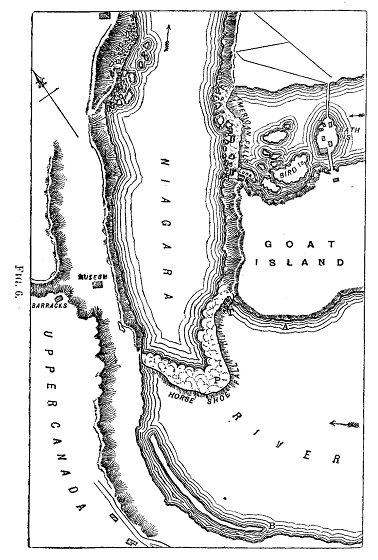
The annexed highly instructive map has been reduced from one published in Mr. Hall's 'Geology of New York.' It is based on surveys executed in 1842, by Messrs. Gibson and Evershed. The ragged edge of the American Fall north of Goat Island marks the amount of erosion which it has been able to accomplish, while the Horseshoe Fall was cutting its way southward across the end of Goat Island to its present position. The American Fall is 168 feet high, a precipice cut down, not by itself, but by the Horseshoe Fall. The latter in 1842 was 159 feet high, and, as shown by the map, is already turning eastward, to excavate its gorge along the centre of the upper river. P is the apex of the Horseshoe, and T marks the site of the Terrapin Tower, with the promontory adjacent, round which I was conducted by Conroy. Probably since 1842 the Horseshoe has worked back beyond the position here assigned to it.
In conclusion, we may say a word regarding the proximate future of Niagara. At the rate of excavation assigned to it by Sir Charles Lyell, namely, a foot a year, five thousand years or so will carry the Horseshoe Fall far higher than Goat Island. As the gorge recedes it will drain, as it has hitherto done, the banks right and left of it, thus leaving a nearly level terrace between Goat Island and the edge of the gorge. Higher up it will totally drain the American branch of the river; the channel of which in due time will become cultivable land. The American Fall will then be transformed into a dry precipice, forming a simple continuation of the cliffy boundary of the Niagara gorge. At the place occupied by the fall at this moment we shall have the gorge enclosing a right angle, a second whirlpool being the consequence. To those who visit Niagara a few millenniums hence I leave the verification of this prediction. All that can be said is, that if the causes now in action continue to act, it will prove itself literally true.
-----
Fig. 6.
POSTSCRIPT.
A year or so after I had quitted the United States, a man sixty years of age, while engaged in painting one of the bridges which connect Goat Island with the Three Sisters, slipped through the rails of the bridge into the rapids, and was carried impetuously towards the Horseshoe Fall. He was urged against a rock which rose above the water, and with the grasp of desperation he clung to it. The population of the village of Niagara Falls was soon upon the island, and ropes were brought, but there was none to use them. In the midst of the excitement, a tall powerful young fellow was observed making his way silently through the crowd. He reached a rope; selected from the bystanders a number of men, and placed one end of the rope in their hands. The other end he fastened round himself, and choosing a point considerably above that to which the man clung, he plunged into the rapids. He was carried violently downwards, but he caught the rock, secured the old painter and saved him. Newspapers from all parts of the Union poured in upon me, describing this gallant act of my guide Conroy.
.
.
.
.
--------------------
.
.
VIII. THE PARALLEL ROADS OF GLEN ROY.
[Footnote: A discourse delivered at the Royal Institution of Great Britain on June 9, 1876.]
THE first published allusion to the Parallel Roads of Glen Roy occurs in the appendix to the third volume of Pennant's 'Tour in Scotland,' a work published in 1776. 'In the face of these hills,' says this writer, 'both sides of the glen, there are three roads at small distances from each other and directly opposite on each side. These roads have been measured in the complete parts of them, and found to be 26 paces of a man 5 feet 10 inches high. The two highest are pretty near each other, about 50 yards, and the lowest double that distance from the nearest to it. They are carried along the sides of the glen with the utmost regularity, nearly as exact as drawn with a line of rule and compass.'
The correct heights of the three roads of Glen Roy are respectively 1150, 1070, and 860 feet above the sea. Hence a vertical distance of 80 feet separates the two highest, while the lowest road is 210 feet below the middle one.
These 'roads' are usually shelves or terraces formed in the yielding drift which here covers the slopes of the mountains. They are all sensibly horizontal and therefore parallel. Pennant accepted as reasonable the explanation of them given by the country people in his time. They thought that the roads 'were designed for the chase, and that the terraces were made after the spots were cleared in lines from wood, in order to tempt the animals into the open paths after they were rouzed, in order that they might come within reach of the bowmen who might conceal themselves in the woods above and below.'
In these attempts of 'the country people' we have an illustration of that impulse to which all scientific knowledge is due — the desire to know the causes of things; and it is a matter of surprise that in the case of the parallel roads, with their weird appearance challenging enquiry, this impulse did not make itself more rapidly and energetically felt. Their remoteness may perhaps account for the fact that until the year 1817 no systematic description of them, and no scientific attempt at an explanation of them, appeared. In that year Dr. MacCulloch, who was then President of the Geological Society, presented to that Society a memoir, in which the roads were discussed, and pronounced to be the margins of lakes once embosomed in Glen Roy. Why there should be three roads, or why the lakes should stand at these particular levels, was left unexplained.
To Dr. MacCulloch succeeded a man, possibly not so learned as a geologist, but obviously fitted by nature to grapple with her facts and to put them in their proper setting. I refer to Sir Thomas Dick-Lauder, who presented to the Royal Society of Edinburgh, on the 2nd of March, 1818, his paper on the Parallel Roads of Glen. Roy. In looking over the literature of this subject, which is now copious, it is interesting to observe the differentiation of minds, and to single out those who went by a kind of instinct to the core of the question, from those who erred in it, or who learnedly occupied themselves with its analogies, adjuncts, and details. There is no man, in my opinion, connected with the history of the subject, who has shown, in relation to it, this spirit of penetration, this force of scientific insight, more conspicuously than Sir Thomas Dick-Lauder. Two distinct mental processes are involved in the treatment of such a question. Firstly, the faithful and sufficient observation of the data; and secondly, that higher mental process in which the constructive imagination comes into play, connecting the separate facts of observation with their common cause, and weaving them into an organic whole. In neither of these requirements did Sir Thomas Dick-Lauder fail.
Adjacent to Glen Roy is a valley called Glen Gluoy, along the sides of which ran a single shelf, or terrace, formed obviously in the same manner as the parallel roads of Glen Roy. The two shelves on the opposing sides of the glen were at precisely the same level, and Dick-Lauder wished to see whether, and how, they became united at the head of the glen. He followed the shelves into the recesses of the mountains. The bottom of the valley, as it rose, came ever nearer to them, until finally, at the head of Glen Gluoy, he reached a col, or watershed, of precisely the same elevation as the road which swept round the glen.
The correct height of this col is 1170 feet above the sea; that is to say, 20 feet above the highest road in Glen Roy.
From this col a lateral branch-valley — Glen Turrit — led down to Glen Roy. Our explorer descended from the col to the highest road of the latter glen, and pursued it exactly as he had pursued the road in Glen Gluoy. For a time it belted the mountain sides at a considerable height above the bottom of the valley; but this rose as he proceeded, coming ever nearer to the highest shelf, until finally he reached a col, or watershed, looking into Glen Spey, and of precisely the same elevation as the highest road of Glen Roy.
He then dropped down to the lowest of these roads, and followed it towards the mouth of the glen. Its elevation above the bottom of the valley gradually increased; not because the shelf rose, but because it remained level while the valley sloped downwards. He found this lowest road doubling round the hills at the mouth of Glen Roy, and running along the sides of the mountains which flank Glen Spean. He followed it eastwards.
PARALLEL ROADS OF GLEN ROY. After a Sketch by Sir Thomas Dick-Lauder.
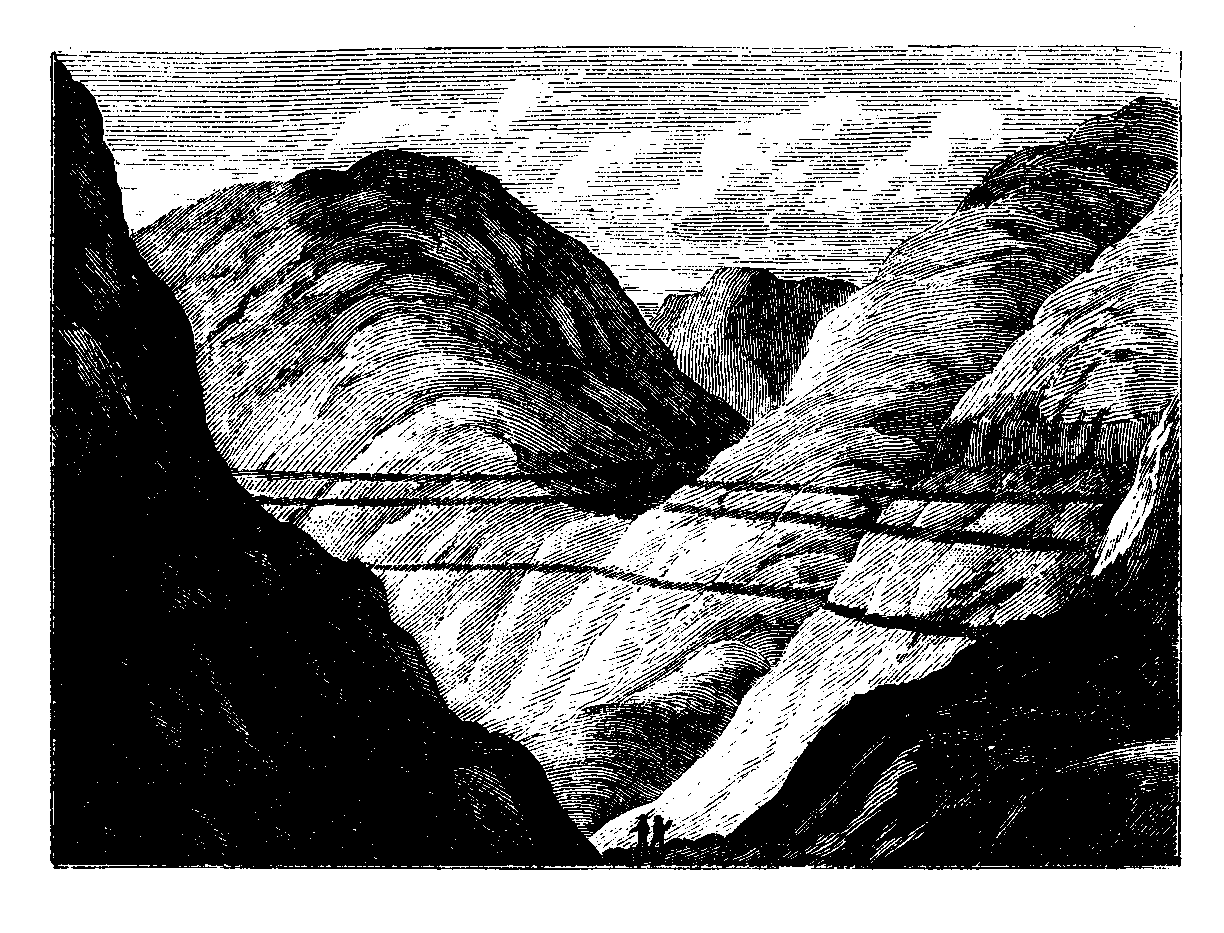
The bottom of the Spean Valley, like the others, gradually rose, and therefore gradually approached the road on the adjacent mountain-side. He came to Loch Laggan, the surface of which rose almost to the level of the road, and beyond the head of this lake he found, as in the other two cases, a col, or watershed, at Makul, of exactly the same level as the single road in Glen Spean, which, it will be remembered, is a continuation of the lowest road in Glen Roy.
Here we have a series of facts of obvious significance as regards the solution of this problem. The effort of the mind to form a coherent image from such facts may be compared with the effort of the eyes to cause the pictures of a stereoscope to coalesce. For a time we exercise a certain strain, the object remaining vague and indistinct. Suddenly its various parts seem to run together, the object starting forth in clear and definite relief. Such, I take it, was the effect of his ponderings upon the mind of Sir Thomas Dick-Lauder. His solution was this: Taking all their features into account, he was convinced that water only could have produced the terraces. But how had the water been collected? He saw clearly that, supposing the mouth of Glen Gluoy to be stopped by a barrier sufficiently high, if the waters from the mountains flanking the glen were allowed to collect, they would form behind the barrier a lake, the surface of which would gradually rise until it reached the level of the col at the head of the glen. The rising would then cease; the superfluous water of Glen Gluoy discharging itself over the col into Glen Roy. As long as the barrier stopping the mouth of Glen Gluoy continued high enough, we should have in that glen a lake at the precise level of its shelf, which lake, acting upon the loose drift of the flanking mountains, would form the shelf revealed by observation.
So much for Glen Gluoy. But suppose the mouth of Glen Roy also stopped by a similar barrier. Behind it also the water from the adjacent mountains would collect. The surface of the lake thus formed would gradually rise, until it had reached the level of the col which divides Glen Roy from Glen Spey. Here the rising of the lake would cease; its superabundant water being poured over the col into the valley of the Spey. This state of things would continue as long as a sufficiently high barrier remained at the mouth of Glen Roy. The lake thus dammed in, with its surface at the level of the highest parallel road, would act, as in Glen Gluoy, upon the friable drift overspreading the mountains, and would form the highest road or terrace of Glen Roy.
And now let us suppose the barrier to be so far removed from the mouth of Glen Roy as to establish a connection between it and the upper part of Glen Spean, while the lower part of the latter glen still continued to be blocked up. Upper Glen Spean and Glen Roy would then be occupied by a continuous lake, the level of which would obviously be determined by the col at the head of Loch Laggan. The water in Glen Roy would sink from the level it had previously maintained, to the level of its new place of escape. This new lake-surface would correspond exactly with the lowest parallel road, and it would form that road by its action upon the drift of the adjacent mountains.
In presence of the observed facts, this solution commends itself strongly to the scientific mind. The question next occurs, What was the character of the assumed barrier which stopped the glens? There are at the present moment vast masses of detritus in certain portions of Glen Spean, and of such detritus Sir Thomas Dick-Lauder imagined his barriers to have been formed. By some unknown convulsion, this detritus had been heaped up. But, once given, and once granted that it was subsequently removed in the manner indicated, the single road of Glen Gluoy and the highest and lowest roads of Glen Roy would be explained in a satisfactory manner.
To account for the second or middle road of Glen Roy, Sir Thomas Dick-Lauder invoked a new agency. He supposed that at a certain point in the breaking down or waste of his dam, a halt occurred, the barrier holding its ground at a particular level sufficiently long to dam a lake rising to the height of, and forming the second road. This point of weakness was at once detected by Mr. Darwin, and adduced by him as proving that the levels of the cols did not constitute an essential feature in the phenomena of the parallel roads. Though not destroyed, Sir Thomas Dick-Lauder's theory was seriously shaken by this argument, and it became a point of capital importance, if the facts permitted, to remove such source of weakness. This was done in 1847 by Mr. David Milne, now Mr. Milne-Home. On walking up Glen Roy from Roy Bridge, we pass the mouth of a lateral glen, called Glen Glaster, running eastward from Glen Roy. There is nothing in this lateral glen to attract attention, or to suggest that it could have any conspicuous influence in the production of the parallel roads. Hence, probably, the failure of Sir Thomas Dick-Lauder to notice it. But Mr. Milne-Home entered this glen, on the northern side of which the middle and lowest roads are fairly shown. The principal stream running through the glen turns at a certain point northwards and loses itself among hills too high to offer any outlet. But another branch of the glen turns to the south-east; and, following up this branch, Mr. Milne-Home reached a col, or watershed, of the precise level of the second Glen Roy road. When the barrier blocking the glens had been so far removed as to open this col, the water in Glen Roy would sink to the level of the second road. A new lake of diminished depth would be thus formed, the surplus water of which would escape over the Glen Glaster col into Glen Spean. The margin of this new lake, acting upon the detrital matter, would form the second road. The theory of Sir Thomas Dick-Lauder, as regards the part played by the cols, was re-riveted by this new and unexpected discovery.
I have referred to Mr. Darwin, whose powerful mind swayed for a time the convictions of the scientific world in relation to this question. His notion was — and it is a notion which very naturally presents itself — that the parallel roads were formed by the sea; that this whole region was once submerged and subsequently upheaved; that there were pauses in the process of upheaval, during which these glens constituted so many fiords, on the sides of which the parallel terraces were formed. This theory will not bear close criticism; nor is it now maintained by Mr. Darwin himself. It would not account for the sea being 20 feet higher in Glen Gluoy than in Glen Roy. It would not account for the absence of the second and third Glen Roy roads from Glen Gluoy, where the mountain flanks are quite as impressionable as in Glen Roy. It would not account for the absence of the shelves from the other mountains in the neighbourhood, all of which 'would have been clasped by the sea had the sea been there. Here then, and no doubt elsewhere, Mr. Darwin has shown himself to be fallible; but here, as elsewhere, he has shown himself equal to that discipline of surrender to evidence which girds his intellect with such unassailable moral strength.
But, granting the significance of Sir Thomas Dick-Lauder's facts, and the reasonableness, on the whole, of the views which he has founded on them, they will not bear examination in detail. No such barriers of detritus as he assumed could have existed without leaving traces behind them; but there is no trace left. There is detritus enough in Glen Spean, but not where it is wanted. The two highest parallel roads stop abruptly at different points near the mouth of Glen Roy, but no remnant of the barrier against which they abutted is to be seen. It might be urged that the subsequent invasion of the valley by glaciers has swept the detritus away; but there have been no glaciers in these valleys since the disappearance of the lakes. Professor Geikie has favoured me with a drawing of the Glen Spean 'road' near the entrance to Glen Trieg. The road forms a shelf round a great mound of detritus which, had a glacier followed the formation of the shelf, must have been cleared away. Taking all the circumstances into account, you may, I think, with safety dismiss the detrital barrier as incompetent to account for the present condition of Glen Gluoy and Glen Roy.
Hypotheses in science, though apparently transcending experience, are in reality experience modified by scientific thought and pushed into an ultra experiential region. At the time that he wrote, Sir Thomas Dick-Lauder could not possibly have discerned the cause subsequently assigned for the blockage of these glens. A knowledge of the action of ancient glaciers was the necessary antecedent to the new explanation, and experience of this nature was not possessed by the distinguished writer just mentioned. The extension of Swiss glaciers far beyond their present limits, was first made known by a Swiss engineer named Venetz, who established, by the marks they had left behind them, their former existence in places which they had long forsaken. The subject of glacier extension was subsequently followed up with distinguished success by Charpentier, Studer, and others. With characteristic vigour Agassiz grappled with it, extending his observations far beyond the domain of Switzerland. He came to this country in 1840, and found in various places indubitable marks of ancient glacier action. England, Scotland, Wales, and Ireland he proved to have once given birth to glaciers. He visited Glen Roy, surveyed the surrounding neighbourhood, and pronounced, as a consequence of his investigation, the barriers which stopped the glens and produced the parallel roads to have been barriers of ice. To Mr. Jamieson, above all others, we are indebted for the thorough testing and confirmation of this theory.
And let me here say that Agassiz is only too likely to be misrated and misjudged by those who, though accurate within a limited sphere, fail to grasp in their totality the motive powers invoked in scientific investigation. True he lacked mechanical precision, but he abounded in that force and freshness of the scientific imagination which in some sciences, and probably in some stages of all sciences, are essential to the creator of knowledge. To Agassiz was given, not the art of the refiner, but the instinct of the discoverer, and the strength of the delver who brings ore from the recesses of the mine. That ore may contain its share of dross, but it also contains the precious metal which gives employment to the refiner, and without which his occupation would depart.
Let us dwell for a moment upon this subject of ancient glaciers. Under a flask containing water, in which a thermometer is immersed, is placed a Bunsen's lamp. The water is heated, reaches a temperature of 212°, and then begins to boil. The rise of the thermometer then ceases, although heat continues to be poured by the lamp into the water. What becomes of that heat? We know that it is consumed in the molecular work of vaporization. In the experiment here arranged, the steam passes from the flask through a tube into a second vessel kept at a low temperature. Here it is condensed, and indeed congealed to ice, the second vessel being plunged in a mixture cold enough to freeze the water. As a result of the process we obtain a mass of ice. That ice has an origin very antithetical to its own character. Though cold, it is the child of heat. If we removed the lamp, there would be no steam, and if there were no steam there would be no ice. The mere cold of the mixture surrounding the second vessel would not produce ice. The cold must have the proper material to work upon; and this material — aqueous vapour — is, as we here see, the direct product of heat.
It is now, I suppose, fifteen or sixteen years since I found myself conversing with an illustrious philosopher regarding that glacial epoch which the researches of Agassiz and others had revealed. This profoundly thoughtful man maintained the fixed opinion that, at a certain stage in the history of the solar system, the sun's radiation had suffered diminution, the glacial epoch being a consequence of this solar chill. The celebrated French mathematician Poisson had another theory. Astronomers have shown that the solar system moves through space, and 'the temperature of space' is a familiar expression with scientific men. It was considered probable by Poisson that our system, during its motion, had traversed portions of space of different temperatures; and that, during its passage through one of the colder regions of the universe, the glacial epoch occurred. Notions such as these were more or less current everywhere not many years ago, and I therefore thought it worth while to show how incomplete they were. Suppose the temperature of our planet to be reduced, by the subsidence of solar heat, the cold of space, or any other cause, say one hundred degrees. Four-and-twenty hours of such a chill would bring down as, snow nearly all the moisture of our atmosphere. But this would not produce a glacial epoch. Such an epoch would require the long-continued generation of the material from which the ice of glaciers is derived. Mountain snow, the nutriment of glaciers, is derived from aqueous vapour raised mainly from the tropical ocean by the sun. The solar fire is as necessary a factor in the process as our lamp in the experiment referred to a moment ago. Nothing is easier than to calculate the exact amount of heat expended by the sun in the production of a glacier. It would, as I have elsewhere shown, [Footnote: 'Heat a Mode of Motion,' fifth edition, chap. vi.: Forms of Water, §§ 55 and 56.] raise a quantity of cast iron five times the weight of the glacier not only to a white heat, but to its point of fusion. If, as I have already urged, instead of being filled with ice, the valleys of the Alps were filled with white-hot metal, of quintuple the mass of the present glaciers, it is the heat, and not the cold, that would arrest our attention and solicit our explanation. The process of glacier making is obviously one of distillation, in which the fire of the sun, which generates the vapour, plays as essential a part as the cold of the mountains which condenses it. [Footnote: In Lyell's excellent 'Principles of Geology,' the remark occurs that 'several writers have fallen into the strange error of supposing that the glacial period must have been one of higher mean temperature than usual.' The really strange error was the forgetfulness of the fact that without the heat the substance necessary to the production of glaciers would be wanting.]