Front matter (continued 4)
Reading edition
But the observations also revealed the danger incurred in experiments of this nature; showing that without an amount of care far beyond that hitherto bestowed upon them, such experiments left the door open to errors of the gravest description. It was especially manifest that the chemical method employed by Schultze in his experiments, and so often resorted to since, might lead to the most erroneous consequences; that neither acids nor alkalies had the power of rapid destruction hitherto ascribed to them. In short, the employment of the luminous beam rendered evident the cause of success in experiments rigidly conducted like those of Pasteur; while it made equally evident the certainty of failure in experiments less severely carried out.
Dr. Bennett's Experiments.
But I do not wish to leave an assertion of this kind without illustration. Take, then, the well-conceived experiments of Dr. Hughes Bennett, described before the Royal Society of Surgeons in Edinburgh on January 17, 1868. [Footnote: 'British Medical Journal,' 13, pt. ii. 1868.] Into flasks containing decoctions of liquorice-root, hay, or tea, Dr. Bennett, by an ingenious method, forced air. The air was driven through two U-tubes, the one containing a solution of caustic potash, the other sulphuric acid. 'All the bent tubes were filled with fragments of pumice-stone to break up the air, so as to prevent the possibility of any germs passing through in the centre of bubbles.' The air also passed through a Liebig's bulb containing sulphuric acid, and also through a bulb containing gun-cotton.
It was only natural for Dr. Bennett to believe that his 'bent tubes' entirely cut off the germs. Previous to the observations just referred to, I also believed in their efficacy. But these observations destroy any such notion. The gun-cotton, moreover, will fail to arrest the whole of the floating matter, unless it is tightly packed, and there is no indication in Dr. Bennett's memoir that it was so packed. On the whole, I should infer, from the mere inspection of Dr. Bennett's apparatus, the very results which he has described — a retardation of the development of life, a total absence of it in some cases, and its presence in others.
In his first series of experiments, eight flasks were fed with sifted air, and five with common air. In ten or twelve days all the five had fungi in them; whilst it required from four to nine months to develop fungi in the others. In one of the eight, moreover, even after this interval no fungi appeared. In a second series of experiments there was a similar exception. In a third series the cork stoppers used in the first and second series were abandoned, and glass stoppers employed. Flasks containing decoctions of tea, beef, and hay were filled with common air, and other flasks with sifted air. In every one of the former fungi appeared and in not one of the latter. These experiments simply ruin the doctrine that Dr. Bennett finally espouses.
In all these negative cases, the prepared air was forced into the infusion when it was boiling hot. Dr. Bennett made a fourth series of experiments, in which, previous to forcing in the air, he permitted the flasks to cool. Into four bottles thus treated he forced prepared air, and after a time found fungi in all of them. What is his conclusion? Not that the boiling hot liquid, employed in his first experiments, had destroyed such germs as had run the gauntlet of his apparatus; but that air which, previous to being sealed up, had been exposed to a temperature of 212°, is too rare to support life. This conclusion is so remarkable that it ought to be stated in Dr. Bennett's own words. 'It may be easily conceived that air subjected to a boiling temperature is so expanded as scarcely to merit the name of air, and that it is more or less unfit for the purpose of sustaining animal or vegetable life.'
Now numerical data are attainable here, and as a matter of fact I live and flourish for a considerable portion of each year in a medium of less density than that which Dr. Bennett describes as scarcely meriting the name of air. The inhabitants of the higher Alpine chalets, with their flocks and herds, and the grasses which support these, do the same; while the chamois rears its kids in air rarer still. Insect life, moreover, is sometimes exhibited with monstrous prodigality at Alpine heights.
In a fifth series of experiments sixteen bottles were filled with infusions. Into four of them, while cold, ordinary unheated and unsifted air was pumped. In these four bottles fungi were developed. Into four other bottles, containing a boiling infusion, ordinary air was also pumped — no fungi were here developed. Into four other bottles containing an infusion which had been boiled and permitted to cool, sifted air was pumped — no fungi were developed. Finally, into four bottles containing a boiling infusion sifted air was pumped no fungi were developed. Only, therefore, in the four cases where the infusions were cold infusions, and the air ordinary air, did fungi appear.
Dr. Bennett does not draw from his experiments the conclusion to which they so obviously point. On them, on the contrary, he founds a defence of the doctrine of spontaneous generation, and a general theory of spontaneous development. So strongly was he impressed with the idea that the germs could not possibly pass through his potash and sulphuric acid tubes, that the appearance of fungi, even in a small minority of cases, where the air had been sent through these tubes, was to him conclusive evidence of the spontaneous origin of such fungi. And he accounts for the absence of life in many of his experiments by an hypothesis which will not bear a moment's examination. But, knowing that organic particles may pass unscathed through alkalies and acids, the results of Dr. Bennett are precisely what ought wider the circumstances to be expected. Indeed, their harmony with the conditions now revealed is a proof of the honesty and accuracy with which they were executed.
The caution exercised by Pasteur both in the execution of his experiments, and in the reasoning based upon them, is perfectly evident to those who, through the practice of severe experimental enquiry, have rendered themselves competent to judge of good experimental work. He found germs in the mercury used to isolate his air. He was never sure that they did not cling to the instruments he employed, or to his own person. Thus when he opened his hermetically sealed flasks upon the Mer de Glace, he had his eye upon the file used to detach the drawn-out necks of his bottles; and he was careful to stand to leeward when each flask was opened. Using these precautions, he found the glacier air incompetent, in nineteen cases out of twenty, to generate life; while similar flasks, opened amid the vegetation of the lowlands, were soon crowded with living things. M. Pouchet repeated Pasteur's experiments in the Pyrenees, adopting the precaution of holding his flasks above his head, and obtaining a different result. Now great care would be needed to render this procedure a real precaution. The luminous beam at once shows us its possible effect. Let smoking brown paper be placed at the open mouth of a glass shade, so that the smoke shall ascend and fill the shade. A beam sent through the shade forms a bright track through the smoke. When the closed fist is placed underneath the shade, a vertical wind of surprising violence, considering the small elevation of temperature, rises from the band, displacing by comparatively dark air the illuminated smoke. Unless special care were taken such a wind would rise from M. Pouchet's body as he held his flasks above his head, and thus the precaution of Pasteur, of not coming between the wind and the flask, would be annulled.
Let me now direct attention to another result of Pasteur, the cause and significance of which are at once revealed by the luminous beam. He prepared twenty one flasks, each containing a decoction of yeast, filtered and clear. He boiled the decoction so as to destroy whatever germs it might contain, and, while the space above the liquid was filled with pure steam, he sealed his flasks with a blow-pipe. He opened ten of them in the deep, damp caves of the Paris Observatory, and eleven of them in the courtyard of the establishment. Of the former, one only showed signs of life subsequently. In nine out of the ten flasks no organisms of any kind were developed. In all the others organisms speedily appeared.
Now here is an experiment conducted in Paris, on which we can throw obvious light in London. Causing our luminous beam to pass through a large flask filled with the air of this room, and charged with its germs and its dust, the beam is seen crossing the flask from side to side. But here is another similar flask, which cuts a clear gap out of the beam. It is filled with unfiltered air, and still no trace of the beam is visible. Why? By pure accident I stumbled on this flask in our apparatus room, where it had remained quiet for some time. Acting upon this obvious suggestion I set aside three other flasks, filled, in the first instance, with mote-laden air. They are now optically empty. Our former experiments proved that the life-producing particles attach themselves to the fibres of cotton-wool. In the present experiment the motes have been brought by gentle air-currents, established by slight differences of temperature within our closed vessels, into contact with the interior surface, to which they adhere. The air of these flasks has deposited its dust, germs and all, and is practically free from suspended matter.
I had a chamber erected, the lower half of which is of wood, its upper half being enclosed by four glazed window-frames. It tapers to a truncated cone at the top. It measures in plan 3 ft. by 2 ft. 6 in., and its height is 5 ft. 10 in. On February 6 it was closed, every crevice that could admit dust, or cause displacement of the air, being carefully pasted over with paper. The electric beam at first revealed the dust within the chamber as it did in the air of the laboratory. The chamber was examined almost daily; a perceptible diminution of the floating matter being noticed as time advanced. At the end of a week the chamber was optically empty, exhibiting no trace of matter competent to scatter the light. Such must have been the case in the stagnant caves of the Paris Observatory. Were our electric beam sent through the air of these caves its track would be invisible; thus showing the indissoluble association of the scattering of light by air and its power to generate life.
I will now turn to what seems to me a more interesting application of the luminous beam than any hitherto described. My reference to Professor Lister's interpretation of the fact, that air which has passed through the lungs cannot produce putrefaction, is fresh in your memories. 'Why air,' said he, 'introduced into the pleural cavity, through a wounded lung, should have such wholly different effects from that entering through a permanently open wound, penetrating from without, was to me a complete mystery, till I heard of the germ -theory of putrefaction, when it at once occurred to me that it was only natural that the air should be filtered of germs by the air passages, one of whose offices is to arrest inhaled particles of. dust, and prevent them from entering the air-cells.'
Here is a surmise which bears the stamp of genius, but which needs verification. If, for the words 'it is only natural' we were authorised to write 'it is perfectly certain,' the demonstration would be complete. Such demonstration is furnished by experiments with a beam of light. One evening, towards the close of 1869, while pouring various pure gases across the dusty track of a luminous beam, the thought occurred to me of using my breath instead of the gases. I then noticed, for the first time, the extraordinary darkness produced by the expired air, towards the end of the expiration. Permit me to repeat the experiment in your presence. I fill my lungs with ordinary air and breathe through a glass tube across the beam. The condensation of the aqueous vapour of the breath is shown by the formation of a luminous white cloud of delicate texture. We abolish this cloud by drying the breath previous to its entering the beam; or, still more simply, by warming the glass tube. The luminous track of the beam is for a time uninterrupted by the breath, because the dust returning from the lungs makes good, in great part, the particles displaced. After a time, however, an obscure disk appears in the beam, the darkness of which increases, until finally, towards the end of the expiration, the beam is, as it were, pierced by an intensely black hole, in which no particles whatever can be discerned. The deeper air of the lungs is thus proved to be absolutely free from suspended matter. It is therefore in the precise condition required by Professor Lister's explanation. This experiment may be repeated any number of times with the same result. I think it must be regarded as a crowning piece of evidence both of the correctness of Professor Lister's views and of the impotence, as regards vital development, of optically pure air. [Footnote: Dr. Burden Sanderson draws attention to the important observation of Brauell, which shows that the contagium of a pregnant animal, suffering from splenic fever, is not found in the blood of the foetus; the placental apparatus acting as a filter, and holding back the infective particles. ]
.
Application of Luminous beams to Water.
The method of examination here pursued is also applicable to water. It is in some sense complementary to that of the microscope, and may, I think, materially aid enquiries conducted with that instrument. In microscopic examination attention is directed to a small portion of the liquid, and the aim is to detect the individual particles. By the present method a large portion of the liquid is illuminated, the collective action of the particles being revealed, by the scattered light. Care is taken to defend the eye from the access of all other light, and, thus defended, it becomes an organ of inconceivable delicacy. Indeed, an amount of impurity so infinitesimal as to be scarcely expressible in numbers, and the individual particles of which are so small as wholly to elude the microscope, may, when examined by the method alluded to, produce not only sensible, but striking, effects upon the eye.
We will apply the method, in the first place, to an experiment of M. Pouchet intended to prove conclusively that animalcular life is developed in cases where no antecedent germs could possibly exist. He produced water from the combustion of hydrogen in air, justly arguing that no germ could survive the heat of a hydrogen flame. But he overlooked the fact that his aqueous vapour was condensed in the air, and was allowed as water to trickle through the air. Indeed the experiment is one of a number by which workers like M. Pouchet are differentiated from workers like Pasteur. I will show you some water, produced by allowing a hydrogen flame to play upon a polished silver condenser, formed by the bottom of a silver basin, containing ice. The collected liquid is pellucid in the common light; but in the condensed electric beam it is seen to be laden with particles, so thick-strewn and minute as to produce a continuous luminous cone. In passing through the air the water loaded itself with this matter; and the deportment of such water could obviously have no influence in deciding this great question.
We are invaded with dirt not only in the air we breathe, but in the water we drink. To prove this I take the bottle of water intended to quench your lecturer's thirst; which, in the track of the beam, simply reveals itself as dirty water. And this water is no worse than the other London waters. Thanks to the kindness of Professor Frankland, I have been furnished with specimens of the water of eight London companies. They are all laden with impurities mechanically suspended. But you will ask whether filtering will not remove the suspended matter? The grosser matter, undoubtedly, but not the more finely divided matter. Water may be passed any number of times through bibulous paper, it will continue laden with fine matter. Water passed through Lipscomb's charcoal filter, or through the filters of the Silicated Carbon Company, has its grosser matter removed, but it is thick with fine matter. Nine-tenths of the light scattered by these suspended particles is perfectly polarised in a direction at right angles to the beam, and this release of the particles from the ordinary law of polarisation is a demonstration of their smallness. I should say by far the greater number of the particles concerned in this scattering are wholly beyond the range of the microscope, and no ordinary filter can intercept such particles. It is next to impossible, by artificial means, to produce a pure water. Mr. Hartley, for example, some time ago distilled water while surrounded by hydrogen, but the water was not free from floating matter. It is so hard to be clean in the midst of dirt. In water from the Lake of Geneva, which has remained long without being stirred, we have an approach to the pure liquid. I have a bottle of it here, which was carefully filled for me by my distinguished friend Soret. The track of the beam through it is of a delicate sky-blue; there is scarcely a trace of grosser matter.
The purest water that I have seen — probably the purest which has been seen hitherto — has been obtained from the fusion of selected specimens of ice. But extraordinary. precautions are required to obtain this degree of purity. The following apparatus has been constructed for this purpose: Through the plate of an air-pump passes the shank of a large funnel, attached to which below the plate is a clean glass bulb. In the funnel is placed a block of the most transparent ice, and over the funnel a glass receiver. This is first exhausted and refilled several times with air, filtered by its passage through cotton-wool, the ice being thus surrounded by pure moteless air. But the ice has previously been in contact with mote-filled air; it is therefore necessary to let it wash its own surface, and also to wash the bulb which is to receive the water of liquefaction. The ice is permitted to melt, the bulb is filled and emptied several times, until finally the large block dwindles to a small one. We may be sure that all impurity has been thus removed from the surface of the ice. The water obtained in this way is the purest hitherto obtained. Still I should hesitate to call it absolutely pure. When condensed light is sent through it, the track of the beam is not invisible, but of the most exquisitely delicate blue. This blue is purer than that of the sky, so that the matter which produces it must be finer than that of the sky. It may be and indeed has been, contended that this blue is scattered by the very molecules of the water, and not by matter suspended in the water. But when we remember that this perfection of blue is approached gradually through stages of less perfect blue; and when we consider that a blue in all respects similar is demonstrably obtainable from particles mechanically suspended, we should hesitate, I think, to conclude that we have arrived here at the last stage of purification. The evidence, I think, points distinctly to the conclusion that, could we push the process of purification still farther, even this last delicate trace of blue would disappear.
Chalk-water. Clark's Softening Process.
But is it not possible to match the water of the Lake of Geneva here in England? Undoubtedly it is. We have in England a kind of rock which constitutes at once an exceedingly clean recipient and a natural filter, and from which we can obtain water extremely free from mechanical impurities. I refer to the chalk formation, in which large quantities of water are held in store. Our chalk hills are in most cases covered with thin layers of soil, and with very scanty vegetation. Neither opposes much obstacle to the entry of the rain into the chalk, where any organic impurity which the water may carry in is soon oxidised and rendered harmless. Those who have scampered like myself over the downs of Hants and Wilts will remember the scarcity of water in these regions. In fact, the rainfall, instead of washing the surface and collecting in streams, sinks into the fissured chalk and percolates through it. When this formation is suitably tapped, we obtain water of exceeding briskness and purity. A large glass globe, filled with the water of a well near Tring, shows itself to be wonderfully free from mechanical impurity. Indeed, it stands to reason that water wholly withdrawn from surface contamination, and percolating through so clean a substance, should be pure. It has been a subject much debated, whether the supply of excellent water which the chalk holds in store could not be rendered available for London. Many of the most eminent engineers and chemists have ardently recommended this source, and have sought to show, not only that its purity is unrivalled, but that its quantity is practically inexhaustible. Data sufficient to test this are now, I believe, in existence; the number of wells sunk in the chalk being so considerable, and the quantity of water which they yield so well known.
But this water, so admirable as regards freedom from mechanical impurity, labours under the disadvantage of being rendered very hard by the carbonate of lime which it holds in solution. The chalk-water in the neighbourhood of Watford contains about seventeen grains of carbonate of lime per gallon. This, in the old terminology, used to be called seventeen degrees of hardness. This hard water is bad for tea, bad for washing, and it furs our boilers, because the lime held in solution is precipitated by boiling. If the water be used cold, its hardness must be neutralised at the expense of soap, before it will give a lather. These are serious objections to the use of chalk-water in London. But they are successfully met by the fact that such water can be softened inexpensively, and on a grand scale. I had long known the method of softening water called Clark's process, but not until recently, under the guidance of Mr. Homersham, did I see proof of its larger applications. The chalk-water is softened for the supply of the city of Canterbury; and at the Chiltern Hills it is softened for the supply of Tring and Aylesbury. Caterham also enjoys the luxury.
I have visited all these places, and made myself acquainted with the works. At Canterbury there are three reservoirs covered in and protected, by a concrete roof and layers of pebbles, both from the summer's heat and the winter's cold. Each reservoir holds 120,000 gallons of water. Adjacent to these reservoirs are others containing pure slaked lime — the so-called 'cream of lime.' These being filled with water, the lime and water are thoroughly mixed by air forced by an engine through apertures in the bottom of the reservoir. The water soon dissolves all the lime it is capable of dissolving. The mechanically suspended lime is then allowed to subside to the bottom, leaving a perfectly transparent lime-water behind.
The softening process is this: Into one of the empty reservoirs is introduced a certain quantity of the clear lime-water, and after this about nine times the quantity of the chalk-water. The transparency immediately disappears — the mixture of the two clear liquids becoming thickly turbid, through the precipitation of carbonate of lime. The precipitate is crystalline and heavy, and in about twelve hours a layer of pure white carbonate of lime is formed at the bottom of the reservoir, with a water of extraordinary beauty and purity overhead. A few days ago I pitched some halfpence into a reservoir sixteen feet deep at the Chiltern Hills. This depth hardly dimmed the coin. Had I cast in a pin, it could have been seen at the bottom. By this process of softening, the water is reduced from about seventeen degrees of hardness, to three degrees of hardness. It yields a lather immediately. Its temperature is constant throughout the year. In the hottest summer it is cool, its temperature being twenty degrees above the freezing point; and it does not freeze in winter if conveyed in proper pipes. The reservoirs are covered; a leaf cannot blow into them, and no surface contamination can reach the water. It passes direct from the main into the house tap; no cisterns are employed, and the supply is always fresh and pure. This is the kind of water which is supplied to the fortunate people of Tring, Caterham, and Canterbury.
-----
The foregoing article, as far as it relates to the theory which ascribes epidemic disease to the development of low parasitic life within the human life, was embodied in a discourse delivered before the Royal Institution in January 1870. In June 1871, after a brief reference to the polarisation of light by cloudy matter, I ventured to recur to the subject in these terms: What is the practical use of these curiosities? If we exclude the interest attached to the observation of new facts, and the enhancement of that interest through the knowledge that facts often become the exponents of laws, these curiosities are in themselves worth little. They will not enable us to add to our stock of food, or drink, or clothes, or jewellery. But though thus shorn of all usefulness in themselves, they may, by carrying thought into places which it would not otherwise have entered, become the antecedents of practical consequences. In looking, for example, at our illuminated dust, we may ask ourselves what it is. How does it act, not upon a beam of light, but upon our own bodies? The question then assumes a practical character. We find on examination that this dust is mainly organic matter — in part living, in part dead. There are among it particles of ground straw, torn rags, smoke, the pollen of flowers, the spores of fungi, and the germs of other things. But what have they to do with the animal economy? Let me give you an illustration to which my attention has been lately drawn by Mr. George Henry Lewes, who writes to me thus:
'I wish to direct your attention to the experiments of von Recklingshausen should you happen not to know them. They are striking confirmations of what you say of dust and disease. Last spring, when I was at his laboratory in Wuerzburg, I examined with him blood that had been three weeks, a month, and five weeks, out of the body, preserved in little porcelain cups under glass shades. This blood was living and growing. Not only were the Amoeba-like movements of the white corpuscles present, but there were abundant evidences of the growth and development of the corpuscles. (I also saw a frog's heart still pulsating which had been removed from the body I forget how many days, but certainly more than a week). There were other examples of the same persistent vitality, or absence of putrefaction. Von Recklingshausen did not attribute this to the absence of germs — germs were not mentioned by him; but when I asked him how he represented the thing to himself, he said the whole mystery of his operation consisted in keeping the blood free from dirt. The instruments employed were raised to a red heat just before use; the thread was silver thread and was similarly treated; and the porcelain cups, though not kept free from air, were kept free from currents. He said he often had failures, and these he attributed to particles of dust having escaped his precautions.'
Professor Lister, who has founded upon the removal or destruction of this 'dirt' momentous improvements in surgery, tells us the effect of its introduction into the blood of wounds. The blood would putrefy and become fetid; and when you examine more closely what putrefaction means, you find the putrefying substance swarming with infusorial life, the germs of which have been derived from the atmospheric dust.
We are now assuredly in the midst of practical matters; and with your permission I will refer once more to a question which has recently occupied a good deal of public attention. As regards the lowest forms of life, the world is divided, and has for a long time been divided, into two parties, the one affirming that we have only to submit absolutely dead matter to certain physical conditions, to evolve from it living things; the other (without wishing to set bounds to the power of matter) affirming that, in our day, life has never been found to arise independently of pre-existing life. I belong to the party which claims life as a derivative of life. The question has two factors — the evidence, and the mind that judges of the evidence; and it may be purely a mental set or bias on my part that causes me throughout this long discussion, to see, on the one side, dubious facts and defective logic, and on the other side firm reasoning and a knowledge of what rigid experimental enquiry demands. But, judged of practically, what, again, has the question of Spontaneous Generation to do with us? Let us see. There are numerous diseases of men and animals that are demonstrably the products of parasitic life, and such diseases may take the most terrible epidemic forms, as in the case of the silkworms of France, referred to at an earlier part of this article. Now it is in the highest degree important to know whether the parasites in question are spontaneously developed, or whether they have been wafted from without to those afflicted with the disease. The means of prevention, if not of cure, would be widely different in the two cases.
But this is not all. Besides these universally admitted cases, there is the broad theory, now broached and daily growing in strength and clearness — daily, indeed, gaining more and more of assent from the most successful workers and profound thinkers of the medical profession itself — the theory, namely, that contagious disease, generally, is of this parasitic character. Had I any cause to regret having introduced this theory to your notice more than a year ago, that regret should now be expressed. I would certainly renounce in your presence whatever leaning towards the germ theory my words might then have betrayed. But since the time referred to nothing has occurred to shake my conviction of the truth of the theory. Let me briefly state the grounds on which its supporters rely. From their respective viruses you may plant typhoid fever, scarlatina, or small-pox. What is the crop that arises from this husbandry? As surely as a thistle rises from a thistle seed, as surely as the fig comes from the fig, the grape from the grape, the thorn from the thorn, so surely does the typhoid virus increase and multiply into typhoid fever, the scarlatina virus into scarlatina, the small-pox virus into small-pox. What is the conclusion that suggests itself here? It is this: That the thing which we vaguely call a virus is to all intents and purposes a seed. Excluding the notion of vitality, in the whole range of chemical science you cannot point to an action which illustrates this perfect parallelism with the phenomena of life — this demonstrated power of self-multiplication and reproduction. The germ theory alone accounts for the phenomena.
In cases of epidemic disease, it is not on bad air or foul drains that the attention of the physician of the future will primarily be fixed, but upon disease germs, which no bad air or foul drains can create, but which may be pushed by foul air into virulent energy of reproduction. You may think I am treading on dangerous ground, that I am putting forth views that may interfere with salutary practice. No such thing. If you wish to learn the impotence of medical practice in dealing with contagious diseases, you have only to refer to the Harveian oration for 1871, by Sir William Gull. Such diseases defy the physician. They must run their course, and the utmost that can be done for them is careful nursing. And this, though I do not specially insist upon it, would favour the idea of their vital origin. For if the seeds of contagious disease be themselves living things, it may be difficult to destroy either them or their progeny, without involving their living habitat in the same destruction.
It has been said, and it is sure to be repeated, that I am quitting my own métier, in speaking of these things. Not so. I am dealing with a question on which minds accustomed to weigh the value of experimental evidence are alone competent to decide, and regarding which, in its present condition, minds so trained are as capable of forming an opinion as regarding the phenomena of magnetism or radiant heat. 'The germ theory of disease,' it has been said, 'appertains to the biologist and the physician.' Where, I would ask in reply, is the biologist or physician, whose researches, in connection with this subject, could for one instant be compared to those of the chemist Pasteur? It is not the philosophic members of the medical profession who are dull to the reception of truth not originated within the pale of the profession itself. I cannot better conclude this portion of my story than by reading to you an extract from a letter addressed to me some time ago by Dr. William Budd, of Clifton, to whose insight and energy the town of Bristol owes so much in the way of sanitary improvement.
'As to the germ theory itself,' writes Dr. Budd, that is a matter on which I have long since made up my mind. From the day when I first began to think of these subjects I have never had a doubt that the specific cause of contagious fevers must be living organisms.
'It is impossible, in fact, to make any statement bearing upon the essence or distinctive characters of these fevers, without using terms which are of all others the most distinctive of life. Take up the writings of the most violent opponent of the germ theory, and, ten to one, you will find them full of such terms as "propagation," "self-propagation," "reproduction," 61 self-multiplication," and so on. Try as he may — if he has anything to say of those diseases which is characteristic of them — he cannot evade the use of these terms, or the exact equivalents to them. While perfectly applicable to living things, these terms express qualities which are not only inapplicable to common chemical agents, but, as far as I can see, actually inconceivable of them.'
.
.
Cotton-wool Respirator.
Once, then, established within the body, this evil form of life, if you will allow me to call it so, must run its course. Medicine as yet is powerless to arrest its progress, and the great point to be aimed at is to prevent its access to the body. It was with this thought in my mind that I ventured to recommend, more than a year ago, the use of cotton-wool respirators in infectious places. I would here repeat my belief in their efficacy if properly constructed. But I do not wish to prejudice the use of these respirators, by connecting them indissolubly with the germ theory. There are too many trades in England where life is shortened and rendered miserable by the introduction of matters into the lungs which might be kept out of them. Dr. Greenhow has shown the stony grit deposited in the lungs of stonecutters. The black lungs of colliers is another case in point. In fact, a hundred obvious cases might be cited, and others that are not obvious might be added to them. We should not, for example, think that printing implied labour where the use of cotton-wool respirators might come into play; but the fact is that the dust arising from the sorting of the type is very destructive of health. I went some time ago into a manufactory in one of our large towns, where iron vessels are enamelled by coating them with a mineral powder, and subjecting them to a heat sufficient to fuse the powder. The organisation of the establishment was excellent, and one thing only was needed to make it faultless. In a large room a number of women were engaged covering the vessels. The air was laden with the fine dust, and their faces appeared as white and bloodless as the powder with which they worked. By the use of cotton-wool respirators these women might be caused to breathe air as free from suspended matter as that of the open street. Over a year ago a Lancashire seedsman wrote to me, stating that during the seed season his men suffered horribly from irritation and fever, so that many of them left his service. He asked for help, and I gave him my advice. At the conclusion of the season, this year, he wrote to inform me that he had folded a little cotton-wool. in muslin, and tied it in front of the mouth; and that with this simple defence he had passed through the season in comfort, and without a single complaint from his men.
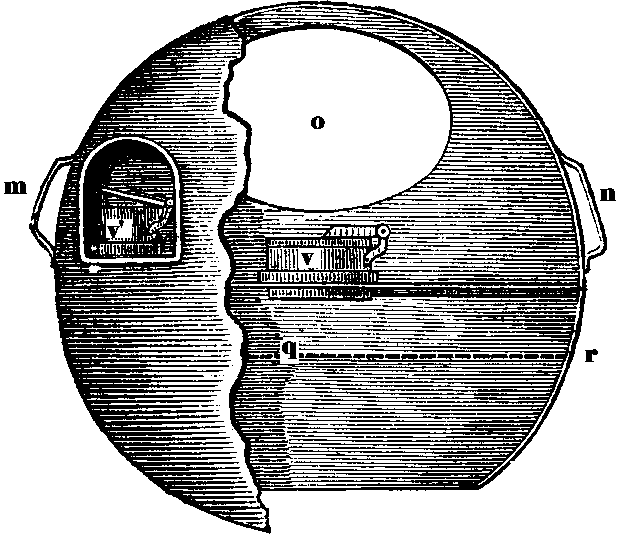
Against the use of such a respirator the obvious objection arises, that it becomes wet and heated by the breath. While casting about for a remedy for this, a friend forwarded to me from Newcastle a form of respirator invented by Mr. Carrick, a hotel-keeper at Glasgow, which, by a slight modification, may be caused to meet the case perfectly. The respirator, with its back in part removed, is shown in fig. 4. Under the partition of wire-gauze q r, is a space intended by Mr. Carrick for 'medicated substances,' and which may be filled with cotton-wool. The mouth is placed against the aperture o, which fits closely round the lips, and the filtered air enters the mouth through a light valve v, which is lifted by the act of inhalation.
During exhalation this valve closes; the breath escapes by a second valve, v', into the open. air. The wool is thus kept dry and cool; the air in passing through it being filtered of everything it holds in suspension. The respirator has since taken other forms.
FIG. 4.
-----
Fireman's Respirator.
We have thus been led by our first unpractical experiments into a thicket of practical considerations. But another step is possible. Admiring, as I do, the bravery of our firemen, and hearing that smoke was a more serious enemy than flame itself, I thought of devising a fireman's respirator.
Our fire-escapes are each in charge of a single man, and it would be of obvious importance to place it in the power of each of those men to penetrate through the densest smoke, into the recesses of a house, and there to rescue those who would otherwise be suffocated or burnt. Cotton-wool, which so effectually arrested dust, was first tried; but, though found soothing in certain gentle kinds of smoke, it was no match for the pungent fumes of a resinous fire. For the purpose of catching the atmospheric germs, M. Pouchet spread a film of glycerine on a plate of glass, urged air against the film, and examined the dust which stuck to it. The moistening of the cotton-wool with
glycerine was a decided improvement; still the respirator only enabled us to remain in dense smoke for three or four minutes, after which the irritation became unendurable. Reflection suggested that, besides the smoke, there must be numerous hydrocarbons produced, which, being in a state of vapour, would be very imperfectly arrested by the cotton-wool. These, in all probability, were the cause of the residual irritation; and if these could be removed, a practically perfect respirator might possibly be obtained.
I state the reasoning exactly as it occurred to my mind. Its result will be anticipated by many present. All bodies possess the power of condensing, in a greater or less degree, gases and vapours upon their surfaces, and when the condensing body is very porous, or in a fine state of division, the force of condensation may produce very remarkable effects. Thus, a clean piece of platinum-foil placed in a mixture of oxygen and hydrogen so squeezes the gases together as to cause them to combine; and if the experiment be made with care, the heat of combination may raise the platinum to bright redness. The promptness of this action is greatly augmented by reducing the platinum to a state of fine division. A pellet of 'spongy platinum,' for instance, plunged into a mixture of oxygen and hydrogen, causes the gases to explode instantly. In virtue of its extreme porosity, a similar power is possessed by charcoal. It is not strong enough to cause the oxygen and hydrogen to combine like the spongy platinum, but it so squeezes the more condensable vapours, and acts with such condensing power upon the oxygen of the air, as to bring both within the combining distance, thus enabling the oxygen to attack and destroy the vapours in the pores of the charcoal. In this way, effluvia of all kinds may be virtually burnt up; and this is the principle of the excellent charcoal respirators invented by Dr. Stenhouse. Armed with one of these, you may go into the foulest-smelling places without having your nose offended.
But, while powerful to arrest vapours, the charcoal respirator is ineffectual as regards smoke. The smoke-particles get freely through the respirator. With a number of such respirators, tested in a proper room, from half a minute to a minute was the limit of endurance. This might be exceeded by Faraday's simple method of emptying the lungs completely, and then filling them before going into a smoky atmosphere. In fact, each solid smoke particle is itself a bit of charcoal, and carries on it, and in it, its little load of irritating vapour. It is this, far more than the particles of carbon themselves, that produces the irritation. Hence two causes of offence are to be removed: the carbon particles which convey the irritant by adhesion and condensation, and the free vapour which accompanies the particles. The cotton-wool moistened with glycerine I knew would arrest the first; fragments of charcoal I hoped would stop the second. In the first fireman's respirator, Mr. Carrick's arrangement of two valves, the one for inhalation, the other for exhalation, was preserved. But the portion of the respirator which holds the filtering and absorbent substances, was prolonged to a depth of four or five inches (see fig. 5.) Under the partition of wire-gauze q r at the bottom of the space which fronts the mouth was placed a layer of cotton-wool, c, moistened with glycerine; then a thin layer of dry wool, c'; then a layer of charcoal fragments; and finally a second thin layer of dry cotton-wool. The succession of the layers may be changed without prejudice to the action. A wire-gauze cover, shown in plan under fig. 5, keeps the substances from falling out of the respirator. A layer of caustic lime may be added for the absorption of carbonic acid; but in the densest smoke that we have hitherto employed, it has not been found necessary, nor is it shown in the figure. In a flaming building, indeed, the mixture of air with the smoke never permits the carbonic acid to become so dense as to be irrespirable; but in a place where the gas is present in undue quantity, the fragments of lime would materially mitigate its action.
In a small cellar-like chamber with a stone flooring and stone walls, the first experiments were made. We Placed there furnaces containing resinous pine-wood, lighted the wood, and, placing over it a lid which prevented too brisk a circulation of the air, generated dense volumes of smoke. With our eyes protected by suitable glasses, my assistant and I have remained for half an hour and more in smoke so dense and pungent that a single inhalation, through the undefended mouth, would be perfectly unendurable. We might have prolonged our stay for hours.
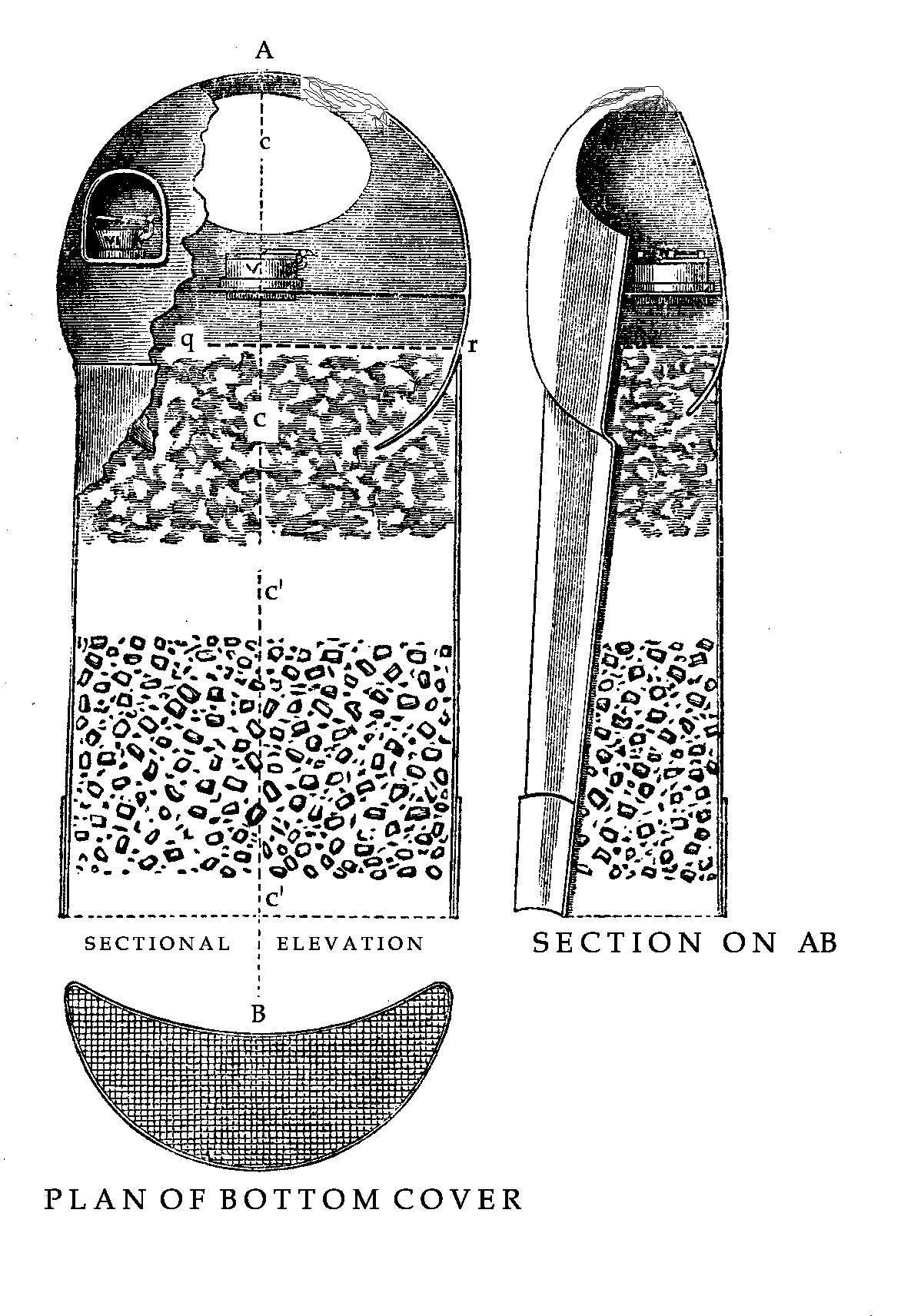
FIG. 5.
Having thus far perfected the instrument, I wrote to the chief officer of the Metropolitan Fire Brigade, asking him whether such a respirator would be of use to him. His reply was prompt; it would be most valuable. He had, however, made himself acquainted with every contrivance of the kind in this and other countries, and had found none of them of any practical use. He offered to come and test it here, or to place a room at my disposal in the City. At my request he came here, accompanied by three of his men. Our small room was filled with smoke to their entire satisfaction. The three men went successively into it, and remained there as long as Captain Shaw wished them. On coming out they said that they had not suffered the slightest inconvenience; that they could have remained all day in the smoke. Captain Shaw then tested the respirator with the same result, and he afterwards took great interest in the perfecting of the instrument.
-----
Various ameliorations and improvements have recently been introduced into the smoke respirator. The hood of Captain Shaw has been improved upon by the simple and less expensive mouthpiece of Mr. Sinclair; and this, in its turn, has been simplified and improved by my assistant Mr. John Cottrell. The respirator is now in considerable demand, and it has already done good practical service. Care is, however, necessary, in moistening the wool with glycerine. It must be carefully teazed, so that the individual fibres may be moistened, and clots must be avoided. I cannot recommend the layers of moistened flannel which, in some cases, have been used instead of cotton-wool: nothing equals the wool, when carefully treated.
An experiment made last year brought out very conspicuously the necessity of careful packing, and the enormous comparative power of resisting smoke irritation possessed by our firemen, and the able officer who commands them. Having heard from Captain Shaw that, in some recent very trying experiments, he had obtained the best effects from dry cotton-wool, and thinking that I could not have been mistaken in my first results, which proved the dry so much inferior to the moistened wool and its associated charcoal, I proposed to Captain Shaw to bring the matter to a test at his workshops in the City. He was good enough to accept my proposal, and thither I went on May 7, 1874. The smoke was generated in a confined space from wet straw, and it was certainly very diabolical.
At this season of the year I am usually somewhat shorn of vigour, and therefore not in the best condition for severe experiments; still I wished to test the matter in my own person. With a respirator which had been in use some days previously, and which was not carefully packed, I followed a fireman into the smoke, he being provided with a dry-wool respirator. I was compelled to quit the place in about three minutes, while the fireman remained there for six or seven minutes.
I then tried his respirator upon myself, and found that with it I could not remain more than a minute in the smoke; in fact the first inhalation provoked coughing.
Thinking that Captain Shaw himself might have lungs more like mine than those of his fireman, I proposed that we should try the respirators together; but he informed me that his lungs were very strong. He was, however, good enough to accede to my request. Before entering the den a second time I repacked my respirator, with due care, and entered the smoke in company with Captain Shaw. I could hear him breathe long slow inhalations; his labour was certainly greater than mine, and after the lapse of seven minutes I heard him cough. In seven and a half minutes he had to quit the place, thus proving that his lungs were able to endure the irritation seven times as long as mine could bear it. I continued in the smoke, with hardly any discomfort, for sixteen minutes, and certainly could have remained in it much longer. The advantage arising from the glycerine was thus placed beyond question.
During this time I was in a condition to render very material assistance to a person in danger of suffocation.
Helmholtz on Hay Fever.
In my lecture on Dust and Disease in 1870, I referred to an experiment made by Helmholtz upon himself which strikingly connected hay fever with animalcular life. About a year ago I received from Professor Binz of Bonn a short, but important paper, embracing Helmholtz's account of his observation, to which Professor Binz has added some remarks of his own. The paper, being mainly intended for English medical men, was published in English, and though here and there its style might be amended, I think it better to publish it unaltered.
From what I have observed (says Professor Binz) of recent English publications on the subject of hay fever, I am led to suppose that English authorities are inaccurately acquainted with the discovery of Professor Helmholtz, as far back as 1868, of the existence of uncommon low organisms in the nasal secretions in this complaint, and of the possibility of arresting their action by the local employment of quinine. I therefore purpose to republish the letter in which he originally announced these facts to myself, and to add some further observations on this topic. The letter is as follows :— [Footnote: Cf. Virchow's 'Archiv.' vol. xlvi. p. 100]
'I have suffered, as well as I can remember, since the year 1847, from the peculiar catarrh called by the English "hay fever," the speciality of which consists in its attacking its victims regularly in the hay season (myself-between May 20 and the end of June), that it ceases in the cooler weather, but on the other hand quickly reaches a great intensity if the patients expose themselves to heat and sunshine. An extraordinary violent sneezing then sets in, and a strongly corrosive thin discharge, with which much epithelium is thrown off. This increases, after a few hours, to a painful inflammation of the mucous membrane and of the outside of the nose, and excites fever with severe headache and great depression, if the patient cannot withdraw himself from the heat and the sunshine. In a cool room, however, these symptoms vanish as quickly as they come on, and there then only remains for a few days a lessened discharge and soreness, as if caused by the loss of epithelium. I remark, by the way, that in all my other years I had very little tendency to catarrh or catching cold, while the hay fever has never failed during the twenty-one years of which I have spoken, and has never attacked me earlier or later in the year than the times named. The condition is extremely troublesome, and increases, if one is obliged to be much exposed to the sun, to an excessively severe malady.
'The curious dependence of the disease on the season of the year suggested to me the thought that organisms might be the origin of the mischief. In examining the secretion I regularly found, in the last five years, certain vibrio-like bodies in it, which at other times I could not observe in my nasal secretion. . . . They are very small, and can only be recognised with the immersion-lens of a very good Hartnack's microscope. It is characteristic of the common isolated single joints that they contain four nuclei in a row, of which two pairs are more closely united. The length of the joints is 0.004 millimetre. Upon the warm objective-stage they move with moderate activity, partly in, mere vibration, partly shooting backwards and forwards in the direction of their long axis; in lower temperatures they are very inactive. Occasionally one finds them arranged in rows upon each other, or in branching series. Observed some days in the moist chamber, they vegetated again, and appeared somewhat larger and more conspicuous than immediately after their excretion. It is to be noticed that only that kind of secretion contains them which is expelled by violent sneezings; that which drops slowly does not contain any. They stick tenaciously enough in the lower cavities and recesses of the nose.
'When I saw your first notice respecting the poisonous action of quinine upon infusoria, I determined at once to make an experiment with that substance, thinking that these vibrionic bodies, even if they did not cause the whole illness, still could render it much more unpleasant through their movements and the decompositions caused by them. For that reason I made a neutral solution of sulphate of quinine, which did not contain much of the salt (1·800), but still was effective enough, and caused moderate irritation on the mucus membrane of the nose. I then lay flat on my back, keeping my head very low, and poured with a pipette about four cubic centimetres into both nostrils. Then I turned my head about in order to let the liquid flow in all directions.
'The desired effect was obtained immediately, and remained for some hours; I could expose myself to the sun without fits of sneezing and the other disagreeable symptoms coming on. It was sufficient to repeat the treatment three times a day, even under the most unfavourable circumstances, in order to keep myself quite free. [Footnote: There is no foundation for the objection that syringing the nose could not cure the asthma which accompanies hay fever; for this asthma is only the reflex effect arising from the irritation of the nose. — B.] There were then no such vibrios in the secretion. If I only go out in the evening, it suffices to inject the quinine once a day, just before going. After continuing this treatment for some days the symptoms disappear completely, but if I leave off they return till towards the end of June.
'My first experiments with quinine date from the summer of 1867; this year (1868) I began at once as soon as the first traces of the illness appeared, and I have thus been able to stop its development completely.
'I have hesitated as yet in publishing the matter, because I have found no other patient [Footnote: Helmholtz, now Professor of Physics at the University of Berlin, is, although M.D., no medical practitioner. — B.] on whom I could try the experiment. There is, it seems to me, no doubt, considering the extraordinary regularity in the recurrence and course of the illness, that quinine had here a most quick and decided effect. And this again makes my hypothesis very probable, that the vibrios, although of no specific form but a very frequent one, are at least the cause of the rapid increase of the symptoms in warm air, as heat excites them to lively action.
I should be very glad if the above lines would induce medical men in England — the haunt of hay fever — to test the observation of Helmholtz. To most patients the application with the pipette may be too difficult or impossible; I have therefore already suggested the use of Weber's very simple but effective nose-douche. Also it will be advisable to apply the solution of quinine tepid. It can, further, not be repeated often enough that quinine is frequently adulterated, especially with cinchona, the action of which is much less to be depended upon.
Dr. Frickhoefer, of Schwalbach, has communicated to me a second case in which hay fever was cured by local application of quinine. [Footnote: Cf. Virchow's 'Archiv.' (1870), vol. li. p. 176.] Professor Busch, of Bonn, authorises me to say that he succeeded in two cases of 'catarrhus aestivus' by the same method: a third patient was obliged to abstain from the use of quinine, as it produced an unbearable irritation of the sensible nerves of the nose. In the autumn of 1872 Helmholtz told me that his fever was quite cured, and that in the meantime two other patients had, by his advice, tried this method, and with the same success. [Footnote: Prof. Helmholtz, whom I had the pleasure of meeting in Switzerland last year, then told me that he was quite convinced that hay fever was produced by the pollen afloat in early summer in the atmosphere.]
.
.
.
.
--------------------
.
.
VI. VOYAGE TO ALGERIA TO OBSERVE THE ECLIPSE.
1870.
THE opening of the Eclipse Expedition was not propitious. Portsmouth, on Monday, December 5, 1870, was swathed by fog, which was intensified by smoke, and traversed by a drizzle of fine rain. At six P.M. I was on board the 'Urgent.' On Tuesday morning the weather was too thick to permit of the ship's being swung and her compasses calibrated. The Admiral of the port, a man of very noble presence, came on board. Under his stimulus the energy which the weather had damped appeared to become more active, and soon after his departure we steamed down to Spithead. Here the fog had so far lightened as to enable the officers to swing the ship.
At three P.M. on Tuesday, December 6, we got away, gliding successively past Whitecliff Bay, Bembridge, Sandown, Shanklin, Ventnor, and St. Catherine's Lighthouse. On Wednesday morning we sighted the Isle of Ushant, on the French side of the Channel. The northern end of the island has been fretted by the waves into detached tower-like masses of rock of very remarkable appearance. In the Channel the sea was green, and opposite Ushant it was a brighter green. On Wednesday evening we committed ourselves to the Bay of Biscay. The roll of the Atlantic was full, but not violent. There had been scarcely a gleam of sunshine throughout the day, but the cloud-forms were fine, and their apparent solidity impressive. On Thursday morning the green of the sea was displaced by a deep indigo blue. The whole of Thursday we steamed across the bay. We had little blue sky, but the clouds were again grand and varied — cirrus, stratus, cumulus, and nimbus, we had them all. Dusky hair-like trails were sometimes dropped from the distant clouds to the sea.
These were falling showers, and they. sometimes occupied the whole horizon, while we steamed across the rainless circle which was thus surrounded. Sometimes we plunged into the rain, and once or twice, by slightly changing our course, avoided a heavy shower. From time to time perfect rainbows spanned the heavens from side to side. At times a bow would appear in fragments, showing the keystone of the arch midway in air, and its two buttresses on the horizon. In all cases the light of the bow could be quenched by a Nicol's prism, with its long diagonal tangent to the arc. Sometimes gleaming patches of the firmament were seen amid the clouds. When viewed in the proper direction, the gleam could be quenched by a Nicol's prism, a dark aperture being thus opened into stellar space.
At sunset on Thursday the denser clouds were fiercely fringed, while through the lighter ones seemed to issue the glow of a conflagration. On Friday morning we sighted Cape Finisterre — the extreme end of the arc which sweeps from Ushant round the Bay of Biscay. Calm spaces of blue, in which floated quietly scraps of cumuli, were behind us, but in front of us was a horizon of portentous darkness. It continued thus threatening throughout the day. Towards evening the wind strengthened to a gale, and at dinner it was difficult to preserve the plates and dishes from destruction. Our thinned company hinted that the rolling had other consequences. It was very wild when we went to bed. I slumbered and slept, but after some time was rendered anxiously conscious that my body had become a kind of projectile, with the ship's side for a target. I gripped the edge of my berth to save myself from being thrown out. Outside, I could hear somebody say that he had been thrown from his berth, and sent spinning to the other side of the saloon. The screw laboured violently amid the lurching; it incessantly quitted the water, and, twirling in the air, rattled against its bearings, causing the ship to shudder from stem to stern. At times the waves struck us, not with the soft impact which might be expected from a liquid, but with the sudden solid shock of battering-rams. 'No man knows the force of water,' said one of the officers,' until he has experienced a storm at sea.' These blows followed each other at quicker intervals, the screw rattling after each of them, until, finally, the delivery of a heavier stroke than ordinary seemed to reduce the saloon to chaos. Furniture crashed, glasses rang, and alarmed enquiries immediately followed. Amid the noises I heard one note of forced laughter; it sounded very ghastly. Men tramped through the saloon, and busy voices were heard aft, as if something there had gone wrong.
I rose, and not without difficulty got into my clothes. In the after-cabin, under the superintendence of the able and energetic navigating lieutenant, Mr. Brown, a group of blue-jackets were working at the tiller-ropes. These had become loose, and the helm refused to answer the wheel. High moral lessons might be gained on shipboard, by observing what steadfast adherence to an object can accomplish, and what large effects are heaped up by the addition of infinitesimals. The tiller-rope, as the blue-jackets strained in concert, seemed hardly to move; still it did move a little, until finally, by timing the pull to the lurching of the ship, the mastery of the rudder was obtained. I had previously gone on deck. Round the saloon-door were a few members of the eclipse party, who seemed in no mood for scientific observation. Nor did I; but I wished to see the storm. I climbed the steps to the poop, exchanged a word with Captain Toynbee, the only member of the party to be seen on the poop, and by his direction made towards a cleat not far from the wheel. [Footnote: The cleat is a T-shaped mass of metal employed for the fastening of ropes.] Round it I coiled my arms. With the exception of the men at the wheel, who stood as silent as corpses, I was alone.
I had seen grandeur elsewhere, but this was a new form of grandeur to me. The 'Urgent' is long and narrow, and during our expedition she lacked the steadying influence of sufficient ballast. She was for a time practically rudderless, and lay in the trough of the sea. I could see the long ridges, with some hundreds of feet between their crests, rolling upon the ship perfectly parallel to her sides. As they approached, they so grew upon the eye as to render the expression 'mountains high' intelligible. At all events, there was no mistaking their mechanical might, as they took the ship upon their shoulders, and swung her like a pendulum. The deck sloped sometimes at an angle which I estimated at over forty-five degrees; wanting my previous Alpine practice, I should have felt less confidence in my grip of the cleat. Here and there the long rollers were tossed by interference into heaps of greater height. The wind caught their crests, and scattered them over the sea, the whole surface of which was seething white. The aspect of the clouds was a fit accompaniment to the fury of the ocean. The moon was almost full — at times concealed, at times revealed, as the scud flew wildly over it. These things appealed to the eye, while the ear was filled by the groaning of the screw and the whistle and boom of the storm.
Nor was the outward agitation the only object of interest to me. I was at once subject and object to myself, and watched with intense interest the workings of my own mind. The 'Urgent' is an elderly ship. She had been built, I was told, by a contracting firm for some foreign Government, and had been diverted from her first purpose when converted into a troop-ship. She had been for some time out of work, and I had heard that one of her boilers, at least, needed repair. Our scanty but excellent crew, moreover, did not belong to the 'Urgent,' but had been gathered from other ships. Our three lieutenants were also volunteers. All this passed swiftly through my mind as the steamer shook under the blows of the waves, and I thought that probably no one on board could say how much of this thumping and straining the 'Urgent' would be able to bear. This uncertainty caused me to look steadily at the worst, and I tried to strengthen myself in the face of it.
But at length the helm laid hold of the water, and the ship was got gradually round to face the waves. The rolling diminished, a certain amount of pitching taking its place. Our speed had fallen from eleven knots to two. I went again to bed. After a space of calm, when we seemed crossing the vortex of a storm, heavy tossing recommenced. I was afraid to allow myself to fall asleep, as my berth was high, and to be pitched out of it might be attended with bruises, if not with fractures. From Friday at noon to Saturday at noon we accomplished sixty-six miles, or an average of less than three miles an hour. I overheard the sailors talking about this storm. The 'Urgent,' according to those that knew her, had never previously experienced anything like it. [Footnote: 'There is, it will be seen, a fair agreement between these impressions and those so vigorously described by a scientific correspondent of the 'Times.']
All through Saturday the wind, though somewhat sobered, blew dead against us. The atmospheric effects were exceedingly fine. The cumuli resembled mountains in shape, and their peaked summits shone as white as Alpine snows. At one place this resemblance was greatly strengthened by a vast area of cloud, uniformly illuminated, and lying like a névé below the peaks. From it fell a kind of cloud-river strikingly like a glacier. The horizon at sunset was remarkable — spaces of brilliant green between clouds of fiery red, Rainbows had been frequent throughout the day, and at night a perfectly continuous lunar bow spanned the heavens from side to side. Its colours were feeble; but, contrasted with the black ground against which it rested, its luminousness was extraordinary.
Sunday morning found us opposite to Lisbon, and at midnight we rounded Cape St. Vincent, where the lurching seemed disposed to recommence. Through the kindness of Lieutenant Walton, a cot had been slung for me. It hung between a tiller-wheel and a flue, and at one A.M. I was roused by the banging of the cot against its boundaries. But the wind was now behind us, and we went along at a speed of eleven knots. We felt certain of reaching Cadiz by three. But a new lighthouse came in sight, which some affirmed to be Cadiz Lighthouse, while the surrounding houses were declared to be those of Cadiz itself. these statements, the navigating lieutenant changed his course, and steered for the place. A pilot came on board, and he informed us that we were before the mouth of the Guadalquivir, and that the lighthouse was that of Cipiòna. Cadiz was still some eighteen miles distant.
We steered towards the city, hoping to get into the harbour before dark. But the pilot who would have guided us had been snapped up by another vessel, and we did not get in. We beat about during the night, and in the morning found ourselves about fifteen miles from Cadiz. The sun rose behind the city, and we steered straight into the light. The three-towered cathedral stood in the midst, round which swarmed apparently a multitude of chimney-stacks. A nearer approach showed the chimneys to be small turrets. A pilot was taken on board; for there is a dangerous shoal in the harbour. The appearance of the town as the sun shone upon its white and lofty walls was singularly beautiful. We cast anchor; some officials arrived and demanded a clean bill of health. We had none. They would have nothing to do with us; so the yellow quarantine flag was hoisted, and we waited for permission to land the Cadiz party. After some hours' delay the English consul and vice-consul came on board, and with them a Spanish officer ablaze with gold lace and decorations. Under slight pressure the requisite permission had been granted. We landed our party, and in the afternoon weighed anchor. Thanks to the kindness of our excellent paymaster, I was here transferred to a more roomy berth.
Cadiz soon sank beneath the sea, and we sighted in succession Cape Trafalgar, Tarifa, and the revolving light of Ceuta. The water was very calm, and the moon rose in a quiet heaven. She swung with her convex surface downwards, the common boundary between light and shadow being almost horizontal. A pillar of reflected light shimmered up to us from the slightly rippled sea. I had previously noticed the phosphorescence of the water, but tonight it was stronger than usual, especially among the foam at the bows. A bucket let down into the sea brought up a number of the little sparkling organisms which caused the phosphorescence. I caught some of them in my hand. And here an appearance was observed which was new to most of us, and strikingly beautiful to all. Standing at the bow and looking forwards, at a distance of forty or fifty yards from the ship, a number of luminous streamers were seen rushing towards us. On nearing the vessel they rapidly turned, like a comet round its perihelion, placed themselves side by side, and, in parallel trails of light, kept up with the ship. One of them placed itself right in front of the bow as a pioneer. These comets of the sea were joined at intervals by others. Sometimes as many as six at a time would rush at us, bend with extraordinary rapidity round a sharp curve, and afterwards keep us company. I leaned over the bow, and scanned the streamers closely. The frontal portion of each of them revealed the outline of a porpoise. The rush of the creatures through the water had started the phosphorescence, every spark of which was converted by the motion of the retina into a line of light. Each porpoise was thus wrapped in a luminous sheath. The phosphorescence did not cease at the creature's tail, but was carried many porpoise-lengths behind it.
To our right we had the African hills, illuminated by the moon. Gibraltar Rock at length became visible, but the town remained long hidden by a belt of haze, through which at length the brighter lamps struggled. It was like the gradual resolution of a nebula into stars. As the intervening depth became gradually less, the mist vanished more and more, and finally all the lamps shone through it They formed a bright foil to the sombre mass of rock above them. The sea was so calm and the scene so lovely that Mr. Huggins and myself stayed on deck till near midnight, when the ship was moored. During our walking to and fro a striking enlargement of the disk of Jupiter was observed, whenever the heated air of the funnel came between us and the planet. On passing away from the heated air, the flat dim disk would immediately shrink to a luminous point. The effect was one of visual persistence. The retinal image of the planet was set quivering in all azimuths by the streams of heated air, describing in quick succession minute lines of light, which summed themselves to a disk of sensible area.
At six o'clock next morning, the gun at the Signal Station on the summit of the rock, boomed. At eight the band on board the 'Trafalgar' training-ship, which was in the harbour, struck up the national anthem; and immediately afterwards a crowd of mite-like cadets swarmed up the rigging. After the removal of the apparatus belonging to the Gibraltar party we went on shore. Winter was in England when we left, but here we had the warmth of summer. The vegetation was luxuriant — palm-trees, cactuses, and aloes, all ablaze with scarlet flowers. A visit to the Governor was proposed, as an act of necessary courtesy, and I accompanied Admiral Ommaney and Mr. Huggins to 'the Convent,' or Government House. We sent in our cards, waited for a time, and were then conducted by an orderly to his Excellency. He is a fine old man, over six feet high, and of frank military bearing. He received us and conversed with us in a very genial manner. He took us to see his garden, his palms, his shaded promenades, and his orange-trees loaded with fruit, in all of which he took manifest delight. Evidently 'the hero of Kars' had fallen upon quarters after his own heart. He appeared full of good nature, and engaged us on the spot to dine with him that day.
We sought the town-major for a pass to visit the lines. While awaiting his arrival I purchased a stock of white glass bottles, with a view to experiments on the colour of the sea. Mr. Huggins and myself, who wished to see the rock, were taken by Captain Salmond to the library, where a model of Gibraltar is kept, and where we had a useful preliminary lesson. At the library we met Colonel Maberly, a courteous and kindly man, who gave us good advice regarding our excursion. He sent an orderly with us to the entrance of the lines. The orderly handed us over to an intelligent Irishman, who was directed to show us everything that we desired to see, and to hide nothing from us. We took the 'upper line,' traversed the galleries hewn through the limestone; looked through the embrasures, which opened like doors in the precipice, towards the hills of Spain; reached St. George's hall, and went still higher, emerging on the summit of one of the noblest cliffs I have ever seen.
Beyond were the Spanish lines, marked by a line of white sentry-boxes; nearer were the English lines, less conspicuously indicated; and between both was the neutral ground. Behind the Spanish lines rose the conical hill called the Queen of Spain's Chair. The general aspect of the mainland from the rock is bold and rugged. Doubling back from the galleries, we struck upwards towards the crest, reached the Signal Station, where we indulged in 'shandy-gaff' and bread and cheese. Thence to O'Hara's Tower, the highest point of the rock. It was built by a former Governor, who, forgetful of the laws of terrestrial curvature, thought he might look from the tower into-the port of Cadiz. The tower is riven, and it may be climbed along the edges of the crack. We got to the top of it; thence descended the curious Mediterranean Stair — a zigzag, mostly of steps down a steeply falling slope, amid palmetto brush, aloes, and prickly pear.
Passing over the Windmill Hill, we were joined at the 'Governor's Cottage' by a car, and drove afterwards to the lighthouse at Europa Point. The tower was built, I believe, by Queen Adelaide, and it contains a fine dioptric apparatus of the first order, constructed by Messrs. Chance, of Birmingham. At the appointed hour we were at the Convent. During dinner the same genial traits which appeared in the morning were still more conspicuous. The freshness of the Governor's nature showed itself best when he spoke of his old antagonist in arms, Mouravieff. Chivalry in war is consistent with its stern prosecution. These two men were chivalrous, and after striking the last blow became friends for ever. Our kind and courteous reception at Gibraltar is a thing to be remembered with pleasure.
On December 15 we committed ourselves to the Mediterranean. The views of Gibraltar with which we are most acquainted represent it as a huge ridge; but its aspect, end on, both from the Spanish lines and from the other side, is truly noble. There is a sloping bank of sand at the back of the rock, which I was disposed to regard simply as the débris of the limestone. I wished to let myself down upon it, but had not the time. My friend Mr. Busk, however, assures me that it is silica, and that the same sand constitutes the adjacent neutral ground. There are theories afloat as to its having been blown from Sahara. The Mediterranean throughout this first day, and indeed throughout the entire voyage to Oran, was of a less deep blue than the
Atlantic. Possibly the quantity of organisms may have modified the colour. At night the phosphorescence was startling, breaking suddenly out along the crests of the waves formed by the port and starboard bows. Its strength was not uniform. Having flashed brilliantly for a time, it would in part subside, and afterwards regain its vigour. Several large phosphorescent masses of weird appearance also floated past.
On the morning of the 16th we sighted the fort and lighthouse of Marsa el Kibir, and beyond them the white walls of Oran lying in the bight of a bay, sheltered by dominant hills. The sun was shining brightly; during our whole voyage we had not had so fine a day. The wisdom which had led us to choose Oran as our place of observation seemed demonstrated. A rather excitable pilot came on board, and he guided us in behind the Mole, which had suffered much damage the previous year from an unexplained outburst of waves from the Mediterranean. Both port and bow anchors were cast in deep water. With three huge hawsers the ship's stem was made fast to three gun-pillars fixed in the Mole; and here for a time the 'Urgent' rested from her labours.
M. Janssen, who had rendered his name celebrated by his observations of the eclipse in India in 1868, when he showed the solar flames to be eruptions of incandescent hydrogen, was already encamped in the open country about eight miles from Oran. On December 2 he had quitted Paris in a balloon, with a strong young sailor as his assistant, had descended near the mouth of the Loire, seen M. Gambetta, and received from him encouragement and aid. On the day of our arrival his encampment was visited by Mr. Huggins, and the kind and courteous Engineer of the Port drove me subsequently, in his own phaeton, to the place. It bore the best repute as regards freedom from haze and fog, and commanded an open outlook; but it was inconvenient for us on account of its distance from the ship. The place next in repute was the railway station, between two and three miles distant from the Mole. It was inspected, but, being enclosed, was abandoned for an eminence in an adjacent garden, the property of Mr. Hinshelwood, a Scotchman who had settled some years previously as an Esparto merchant in Oran. [Footnote: Esparto is a kind of grass now much used in the manufacture of paper.] He, in the most liberal manner, placed his ground at the disposition of the party. Here the tents were pitched, on the Saturday, by Captain Salmond and his intelligent corps of sappers, the instruments being erected on the Monday under cover of the tents.
Close to the railway station runs a new loopholed wall of defence, through which the highway passes into the open country. Standing on the highway, and looking southwards, about twenty yards to the right is a small bastionet, intended to carry a gun or two. Its roof I thought would form an admirable basis for my telescope, while the view of the surrounding country was unimpeded in all directions. The authorities kindly allowed me the use of this bastionet. Two men, one a blue-jacket named Elliot, and the other a marine named Hill, were placed at my disposal by Lieutenant Walton; and, thus aided, on Monday morning I mounted my telescope. The instrument was new to me, and some hours of discipline were spent in mastering all the details of its manipulation.
Mr. Huggins joined me, and we visited together the Arab quarter of Oran. The flat-roofed houses appeared very clean and white. The street was filled with loiterers, and the thresholds were occupied by picturesque groups. Some of the men were very fine. We saw many straight, manly fellows who must have been six feet four in height. They passed us with perfect indifference, evincing no anger, suspicion, or curiosity, hardly caring in fact to glance at us as we passed. In one instance only during my stay at Oran was I spoken to by an Arab. He was a tall, good-humoured fellow, who came smiling up to me, and muttered something about 'les Anglais.' The mixed population of Oran is picturesque in the highest degree: the Jews, rich and poor, varying in their costumes as their wealth varies; the Arabs more picturesque still, and of all shades of complexion — the negroes, the Spaniards, the French, all grouped together, each race preserving its own individuality, formed a picture intensely interesting to me.
On Tuesday, the 20th, I was early at the bastionet. The night had been very squally. The sergeant of the sappers had taken charge of our key, and on Tuesday morning Elliot went for it. He brought back the intelligence that the tents had been blown down, and the instruments overturned. Among these was a large and valuable equatorial from the Royal Observatory, Greenwich. It seemed hardly possible that this instrument, with its wheels and verniers and delicate adjustments, could have escaped uninjured from such a fall. This, however, was the case; and during the day all the overturned instruments were restored to their places, and found to be in practical working order. This and the following day were devoted to incessant schooling. I had come out as a general stargazer, and not with the intention of devoting myself to the observation of any particular phenomenon. I wished to see the whole — the first contact, the advance of the moon, the successive swallowing up of the solar spots, the breaking of the last line of crescent by the lunar mountains into Bailey's beads, the advance of the shadow through the air, the appearance of the corona and prominences at the moment of totality, the radiant streamer; of the corona, the internal structure of the flames, a glance through a polariscope, a sweep round the landscape with the naked eye, the reappearance of the soar limb through Bailey's beads, and, finally, the retreat of the lunar shadow through the air.
I was provided with a telescope of admirable definition, mounted, adjusted, packed, and most liberally placed at my disposal by Mr. Warren De La Rue. The telescope grasped the whole of the sun, and a considerable portion of the space surrounding it. But it would not take in the extreme limits of the corona. For this I had lashed on to the large telescope a light but powerful instrument, constructed by Ross, and lent to me by Mr. Huggins. I was also furnished with an excellent binocular by Mr. Dallmeyer. In fact, no man could have been more efficiently supported.
It required a strict parcelling out of the interval of totality to embrace in it the entire series of observations. These, while the sun remained visible, were to be made with an unsilvered diagonal eye-piece, which reflected but a small fraction of the sun's light, this fraction, being still further toned down by a dark glass. At the moment of totality the dark glass was to be removed, and a silver reflector pushed in, so as to get the maximum of light from the corona and prominences The time of totality was distributed as follows:
1. Observe approach of shadow through the air: totality.
2. Telescope 30 seconds.
3. Finder 30 seconds.
4. Double image prism 15 seconds.
5. Naked eye. 10 seconds.
6. Finder or binocular 20 seconds.
7. Telescope. 20 seconds.
8. Observe retreat of shadow.
In our rehearsals Elliot stood beside me, watch in hand, and furnished with a lantern. He called out at the end of each interval, while I moved from telescope to finder, from finder to polariscope, from polariscope to naked eye, from naked eye back to finder, from finder to telescope, abandoning the instrument finally to observe the retreating shadow. All this we went over twenty times, while looking at the actual sun, and keeping him in the middle of the field. It was my object to render the repetition of the lesson so mechanical as to leave no room for flurry, forgetfulness, or excitement. Volition was not to be called upon, nor judgment exercised, but a well-beaten path of routine was to be followed. Had the opportunity occurred, I think the programme would have been strictly carried out.
But the opportunity did not occur. For several days the weather had been ill-natured. We had wind so strong As to render the hawsers at the stern of the 'Urgent' as rigid as iron, and to destroy the navigating lieutenant's sleep. We had clouds, a thunder-storm, and some rain. Still the hope was held out that the atmosphere would cleanse itself, and if it did we were promised air of extraordinary limpidity. Early on the 22nd we were all at our posts. Spaces of blue in the early morning gave us some encouragement, but all depended on the relation of these spaces to the surrounding clouds. Which of them were to grow as the day advanced? The wind was high, and to secure the steadiness of my instrument I was forced to retreat behind a projection of the bastionet, place stones upon its stand, and, further, to avail myself of the shelter of a sail. My practised men fastened the sail at the top, and loaded it with boulders at the bottom. It was tried severely, but it stood firm.
The clouds and blue spaces fought for a time with varying success. The sun was bidden and revealed at intervals, hope oscillating in synchronism with the changes of the sky. At the moment of first contact a dense cloud intervened; but a minute or two afterwards the cloud had passed, and the encroachment of the black body of the moon was evident upon the solar disk. The moon marched onward, and I saw it at frequent intervals; a large group of spots were approached and swallowed up. Subsequently I caught sight of the lunar limb as it cut through the middle of a large spot. The spot was not to be distinguished from the moon, but rose like a mountain above it. The clouds, when thin, could be seen as grey scud drifting across the black surface of the moon; but they thickened more and more, and made the intervals of clearness scantier. During these moments I watched with an interest bordering upon fascination the march of the silver sickle of the sun across the field of the telescope. It was so sharp and so beautiful. No trace of the lunar limb could be observed beyond the sun's boundary. Here, indeed, it could only be relieved by the corona, which was utterly cut off by the dark glass. The blackness of the moon beyond the sun was, in fact, confounded with the blackness of space.
Beside me was Elliot with the watch and lantern, while Lieutenant Archer, of the Royal Engineers, had the kindness to take charge of my note-book. I mentioned, and he wrote rapidly down, such things as seemed worthy of remembrance. Thus my hands and mind were entirely free; but it was all to no purpose. A patch of sunlight fell and rested upon the landscape some miles away. It was the only illuminated spot within view. But to the north-west there was still a space of blue which might. reach us in time. Within seven minutes of totality another space towards the zenith became very dark. The atmosphere was, as it were, on the brink of a precipice, being charged with humidity, which required but a slight chill to bring it down in clouds. This was furnished by the withdrawal of the solar beams: the clouds did come down, covering up the space of blue on which our hopes had so long rested. I abandoned the telescope and walked to and fro in despair. As the moment of totality approached, the descent towards darkness was as obvious as a falling stone. I looked towards a distant ridge, where the darkness would first appear. At the moment a fan of beams, issuing from the hidden sun, was spread out over the southern heavens. These beams are bars of alternate light and shade, produced in illuminated haze by the shadows of floating cloudlets of varying density. The beams are practically parallel, but by an effect of perspective they appear divergent, having the sun, in fact, for their point of convergence. The darkness took possession of the ridge referred to, lowered upon M. Janssen's observatory, passed over the southern heavens, blotting out the beams as if a sponge had been drawn across them. It then took successive possession of three spaces of blue sky in the south-eastern atmosphere. I again looked towards the ridge. A glimmer as of day-dawn was behind it, and immediately afterwards the fan of beams, which had been for more than two minutes absent, revived. The eclipse of 1870 had ended, and, as far as the corona and flames were concerned, we had been defeated.
Even in the heart of the eclipse the darkness was by no means perfect. Small print could be read. In fact, the clouds which rendered the day a dark one, by scattering light into the shadow, rendered the darkness less intense than it would have been had the atmosphere been without cloud. In the more open spaces I sought for stars, but could find none. There was a lull in the wind before and after totality, but during the totality the wind was strong. I waited for some time on the bastionet, hoping to get a glimpse of the moon on the opposite border of the sun, but in vain. The clouds continued, and some rain fell. The day brightened somewhat afterwards, and, having packed all up, in the sober twilight Mr. Crookes and myself climbed the heights above the fort of Vera Cruz. From this eminence we had a very noble view over the Mediterranean and the flanking African hills. The sunset was remarkable, and the whole outlook exceedingly fine.
The able and well-instructed medical officer of the 'Urgent,' Mr. Goodman, observed the following temperatures during the progress of the eclipse:
Hour Deg.
11.45 56
11.55 55
12.10 54
12.37 53
12.39 52
12.43 51
1.5 52
1.27 53
1.44 56
2.10 57
The minimum temperature occurred some minutes after totality, when a slight rain fell.
The wind was so strong on the 23rd that Captain Henderson would not venture out. Guided by Mr. Goodman, I visited a cave in a remarkable stratum of shell-breccia, and, thanks to my guide, secured specimens. Mr. Busk informs me that a precisely similar breccia, is found at Gibraltar, at approximately the same level. During the afternoon, Admiral Ommaney and myself drove to the fort of Marsa el Kibir. The fortification is of ancient origin, the Moorish arches being still there in decay, but the fort is now very strong. About four or five hundred fine-looking dragoons were looking after their horses, waiting for a lull to enable them to embark for France. One of their officers was wandering in a very solitary fashion over the fort. We had some conversation with him. He had been at Sedan, had been taken prisoner, but had effected his escape. He shook his head when we spoke of the termination of the war, and predicted its long continuance. There was bitterness in his tone as he spoke of the charges of treason so lightly levelled against French commanders.
The green waves raved round the promontory on which the fort stands, smiting the rocks, breaking into foam, and jumping, after impact, to a height of a hundred feet and more into the air. As we returned our vehicle broke down through the loss of a wheel. The Admiral went on board, while I remained long watching the agitated sea. The little horses of Oran well merit a passing word. Their speed and endurance, both of which are heavily drawn upon by their drivers, are extraordinary.
The wind sinking, we lifted anchor on the 24th. For some hours we went pleasantly along; but during the afternoon the storm revived, and it blew heavily against us all the night. When we came opposite the Bay of Almeria, on the 25th, the captain turned the ship, and steered into the bay, where, under the shadow of the Sierra Nevada, we passed Christmas night in peace. Next morning 'a rose of dawn' rested on the snows of the adjacent mountains, while a purple haze was spread over the lower hills. I had no notion that Spain possessed so fine a range of mountains as the Sierra Nevada. The height is considerable, but the form also is such as to get the maximum of grandeur out of the height. We weighed anchor at eight A.M., passing for a time through shoal water, the bottom having been evidently stirred up. The adjacent land seemed eroded in a remarkable manner. It has its floods, which excavate these valleys and ravines, and leave those singular ridges behind. Towards evening I climbed the mainmast, and, standing on the cross-trees, saw the sun set amid a blaze of fiery clouds. The wind was strong and bitterly cold, and I was glad to slide back to the deck along a rope, which stretched from the mast-head to the ship's side. That night we cast anchor beside the Mole of Gibraltar.
On the morning of the 27th, in company with two friends, I drove to the Spanish lines, with the view of seeing the rock from that side. It is an exceedingly noble mass. The Peninsular and Oriental mail-boat had been signalled and had come. Heavy duties called me homeward, and by transferring myself from the 'Urgent' to the mail-steamer I should gain three days. I hired a boat, rowed to the steamer, learned that she was to start at one, and returned with all speed to the 'Urgent.' Making known to Captain Henderson my wish to get away, he expressed doubts as to the possibility of reaching the mail-steamer in time. With his accustomed kindness, he however placed a boat at my disposal. Four hardy fellows and one of the ship's officers jumped into it; my luggage, hastily thrown together, was tumbled in, and we were immediately on our way. We had nearly four miles to row in about twenty minutes; but we hoped the mail-boat might not be punctual. For a time we watched her anxiously; there was no motion; we came nearer, but the flags were not yet hauled in. The men put forth all their strength, animated by the exhortations of the officer at the helm. The roughness of the sea rendered their efforts to some extent nugatory: still we were rapidly approaching the steamer. At length she moved, punctual almost to the minute, at first slowly, but soon with quickened pace.