Peace Talk and War on the Bozeman Trail, 1866-68
Reading edition
Officials at Washington now decided to try peaceful measures with the Indians of the Fort Laramie region, and General Connor was succeeded in command by General Wheaton. Emissaries were sent to the tribes, inviting them to a general peace council at Fort Laramie in June 1866.
In March of that year, Col. Henry Maynadier, then in command at Fort Laramie, reported, as auguring success of the peace council, that Spotted Tail, head chief of the Brule Sioux, had brought in the body of his daughter for burial among the whites at Fort Laramie. Her name was Ah-ho-ap-pa, which is Sioux for wheat flour, although modern poets have referred to her as Fallen Leaf. In the summer of 1864, she was a familiar figure at Fort Laramie. While she haughtily refused the crackers, coffee, and bacon doled out to the Indian women and children at that time, she spent long hours on a bench by the sutler’s store watching the white man’s way of life. She was particularly fond of watching the guard mount and the dress parade, and the officer in charge was often especially decked out in sash and plumes for her benefit. She refused to marry one of her own people, attempted to learn English, and told her people they were fools for not living in houses and making peace with the whites. When the Sioux went on the warpath in 1864, however, Spotted Tail and his daughter were with them and spent the next year in the Powder River country. There the hard life weakened her, and she sickened and died during the following cold winter.
Having promised to carry out her express wish to be buried at Fort Laramie, her father led the funeral procession on a journey of 260 miles. Colonel Maynadier responded gallantly to Spotted Tail’s request. In a ceremony which combined all the pageantry of the military and the primitive tradition of the Sioux, her body was placed in a coffin on a raised platform a half mile north of the parade grounds. Thus, a long step had been taken toward winning the friendship of a great chief.
18
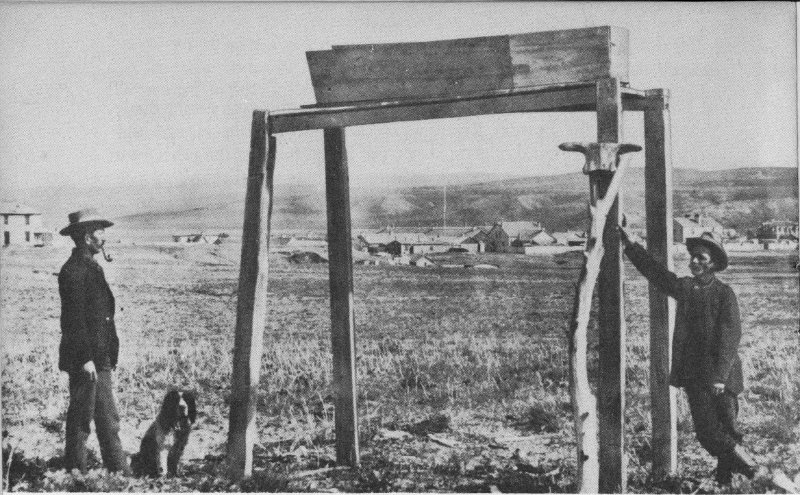
The grave of Spotted Tail’s daughter near Fort Laramie, about 1881. Courtesy Wyoming Historical Department.
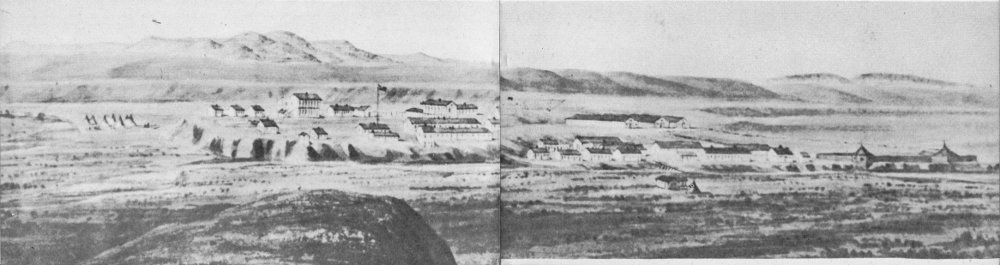
Fort Laramie in 1867. From a sketch by Anton Schoenborn.
By June, a good representation of Brule and Oglala Sioux being present, the commissioners set about negotiating a treaty. In the meantime, unfortunately, the War Department sent out an expedition instructed to open the Bozeman Trail through the Powder River country to the Montana gold mines. Colonel Carrington and his troops arrived at Fort Laramie in the midst of the negotiations and caused serious unrest among the Indians. One chief commented, “Great Father send us presents and wants new road, but white chief goes with 19 soldiers to steal road before Indian say yes or no,” and a large faction, led by Red Cloud and Man-Afraid-of-His-Horses, withdrew in open opposition to all peace talk. Nevertheless, the remaining Indians agreed to a treaty which provided for the opening of the Bozeman Trail.
In late June the troops under Colonel Carrington marched up the trail, garrisoned Camp Connor (later moved and named Fort Reno), and began building Fort Phil Kearny at the foot of the Bighorn Mountains and Fort C. F. Smith farther north in Montana. Immediately, it became evident that the peace treaty was meaningless. Fort Phil Kearny was the scene of almost daily Indian attacks on traders, wagon trains, wood-cutting parties, and troops. These attacks were climaxed on December 21 when Capt. William Fetterman and 80 men were led into an ambush and annihilated by Indians led by Crazy Horse and Red Cloud. The fort and its remaining garrison were in danger of being overwhelmed, and the nearest aid lay at Fort Laramie, 236 miles away. At midnight, John “Portugee” Phillips, trader and scout, slipped out into a blizzard on the colonel’s favorite horse and in 4 days made his way across the storm-swept, Indian-infested plains to Fort Laramie in one of the truly heroic rides of American history. While his gallant mount lay dying on the parade ground, Phillips interrupted a gay Christmas night party in “Old Bedlam” to deliver his message, and a relief expedition was soon on its way.
The severe weather made an attempted winter campaign against the Indians unsuccessful, and there was no important fighting until summer. On August 2, 1867, the Indians again attacked a woodcutting party near Fort Phil Kearny, but the small detachment led by Captain Powell was armed with the new 1866 Springfield breech-loading rifles and fought off repeated charges by the Indians in the famous Wagon Box Fight.
20
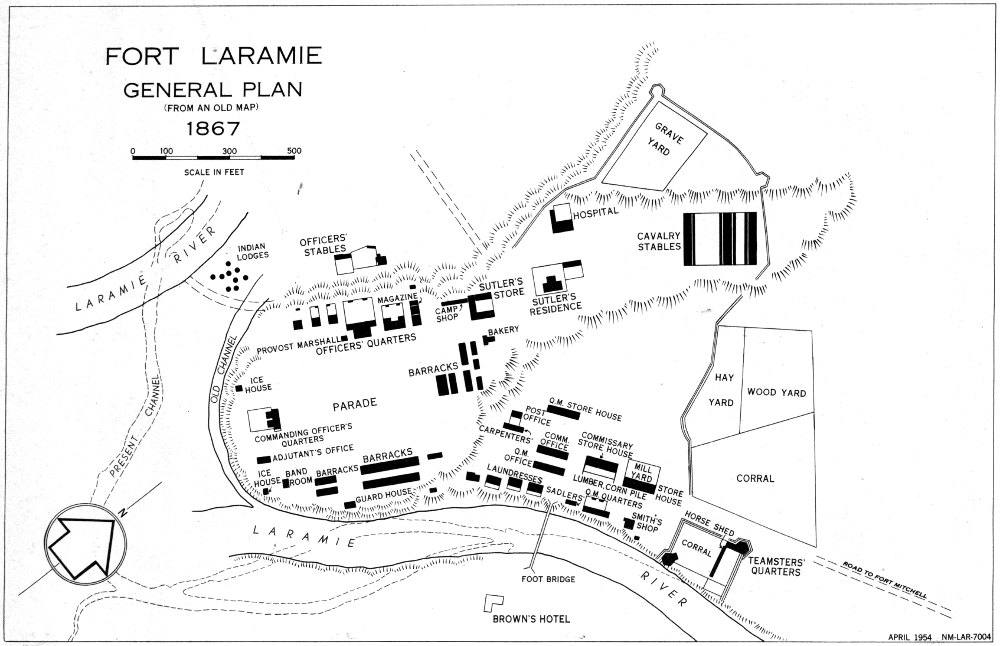
FORT LARAMIE GENERAL PLAN (FROM AN OLD MAP) 1867 APRIL 1954 NM-LAR-7004
INDIAN LODGES
OFFICERS’ STABLES
HOSPITAL
GRAVE YARD
CAVALRY STABLES
PROVOST MARSHALL
OFFICERS’ QUARTERS
MAGAZINE
CAMP SHOP
SUTLER’S STORE
SUTLER’S RESIDENCE
BAKERY
BARRACKS
ICE HOUSE
BARRACKS
PARADE
COMMANDING OFFICER’S QUARTERS
ADJUTANT’S OFFICE
ICE HOUSE
BAND ROOM
BARRACKS
BARRACKS
GUARD HOUSE
Q.M. STORE HOUSE
POST OFFICE
CARPENTERS’
COMM. OFFICE
COMMISSARY STORE HOUSE
MILL YARD
STORE HOUSE
Q.M. OFFICE
LUMBER, CORN PILE
LAUNDRESSES
SADLERS’
Q.M. QUARTERS
SMITH’S SHOP
HORSE SHED
CORRAL
TEAMSTERS’ QUARTERS
HAY YARD
WOOD YARD
CORRAL
FOOT BRIDGE
BROWN’S HOTEL
21