Last Years of the Army Post, 1877-90
Reading edition
Beginning in the late 1870’s, other changes took place around Fort Laramie. With the Indians removed to reservations, ranchers and other settlers came in, and great herds of cattle replaced the buffalo on the Wyoming plains. To many of these settlers the fort on the Laramie was a supply center, as well as insurance against Indian outbreaks and lawless white men.
28
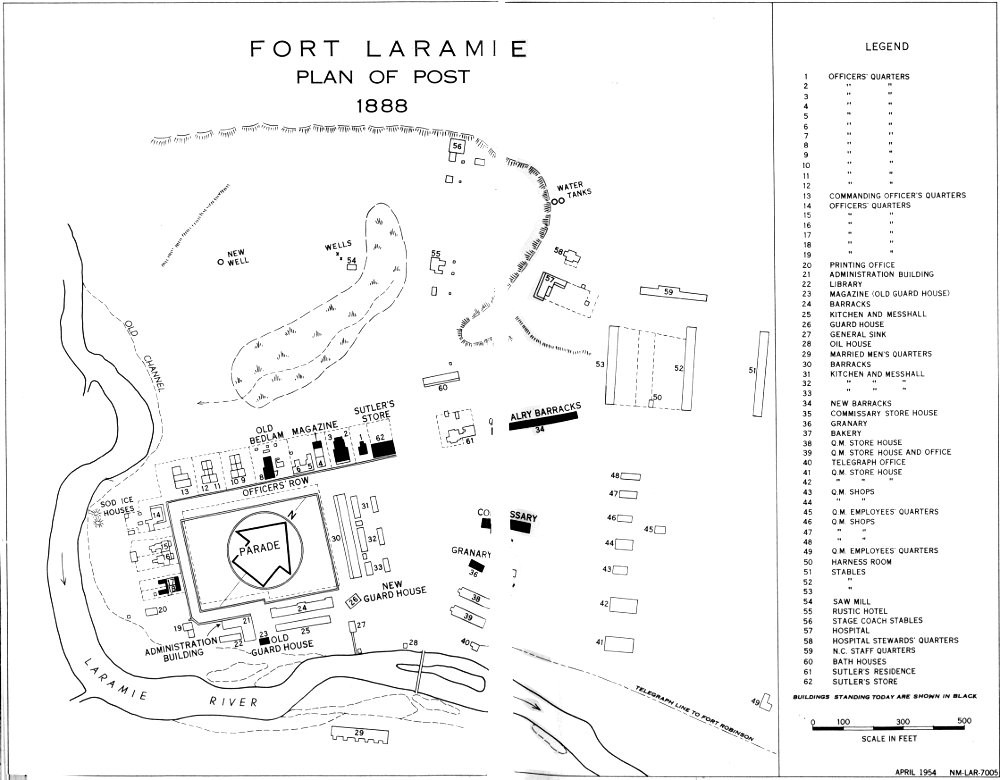
FORT LARAMIE PLAN OF POST 1888
LEGEND
1 OFFICERS’ QUARTERS
2 ” ”
3 ” ”
4 ” ”
5 ” ”
6 ” ”
7 ” ”
8 ” ”
9 ” ”
10 ” ”
11 ” ”
12 ” ”
13 COMMANDING OFFICER’S QUARTERS
14 OFFICERS’ QUARTERS
15 ” ”
16 ” ”
17 ” ”
18 ” ”
19 ” ”
20 PRINTING OFFICE
21 ADMINISTRATION BUILDING
22 LIBRARY
23 MAGAZINE (OLD GUARD HOUSE)
24 BARRACKS
25 KITCHEN AND MESSHALL
26 GUARD HOUSE
27 GENERAL SINK
28 OIL HOUSE
29 MARRIED MEN’S QUARTERS
30 BARRACKS
31 KITCHEN AND MESSHALL
32 ” ” ”
33 ” ” ”
34 NEW BARRACKS
35 COMMISSARY STORE HOUSE
36 GRANARY
37 BAKERY
38 Q.M. STORE HOUSE
39 Q.M. STORE HOUSE AND OFFICE
40 TELEGRAPH OFFICE
41 Q.M. STORE HOUSE
42 ” ” ”
43 Q.M. SHOPS
44 ” ”
45 Q.M. EMPLOYEES’ QUARTERS
46 Q.M. SHOPS
47 ” ”
48 ” ”
49 Q.M. EMPLOYEES’ QUARTERS
50 HARNESS ROOM
51 STABLES
52 ”
53 ”
54 SAW MILL
55 RUSTIC HOTEL
56 STAGE COACH STABLES
57 HOSPITAL
58 HOSPITAL STEWARDS’ QUARTERS
59 N.C. STAFF QUARTERS
60 BATH HOUSES
61 SUTLER’S RESIDENCE
62 SUTLER’S STORE
BUILDINGS STANDING TODAY ARE SHOWN IN BLACK
30
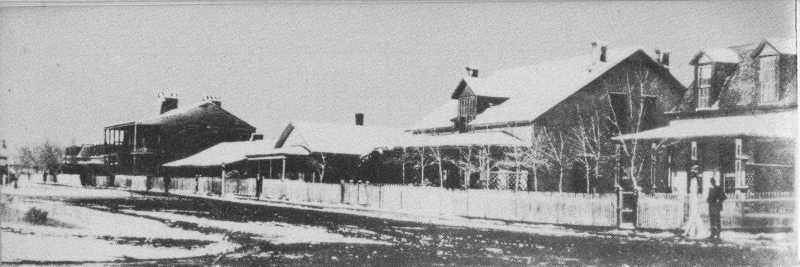
Officers’ row in the winter of 1889. Courtesy U. S. Signal Corps.
During these same years, Fort Laramie was assuming a false air of permanence as many of the old buildings of frame, log, and adobe construction were replaced by sturdy new structures with lime-concrete walls. A water system changed the parade ground from a gravelly flat to a tree-shaded greensward. The last cavalry unit to be stationed at the fort rode away in 1883 with Col. Wesley Merritt. Part of the Seventh Infantry, commanded by Colonel Gibbon, then garrisoned the post.
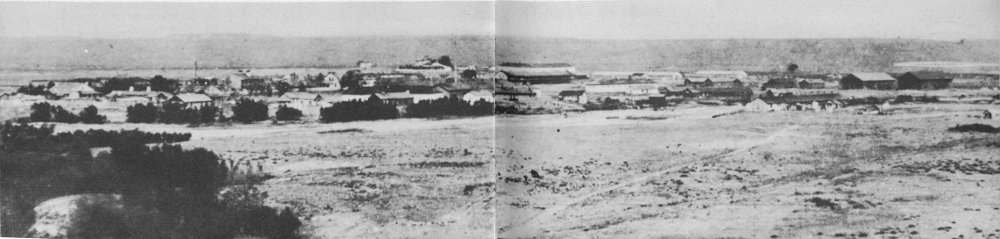
General view of Fort Laramie in 1889. Courtesy U. S. Signal Corp.
Fort Laramie’s importance had been threatened by construction of the Union Pacific Railroad 100 miles to the south. Its fate was now sealed by construction, in the late 1880’s, of the Northwestern Line 50 miles to the north. This made Fort Robinson the logical guardian of the Indian reservations to the north, and by 1886 Col. Henry Merriam, then commanding officer of the Seventh Infantry and Fort Laramie, was ready to agree that further development of the old post was unwise. Not until August 31, 1889, however, was abandonment of the proud old fort decreed. At the request of Wyoming’s Governor Warren, troops remained at the post until March 2, 1890, when the last two companies of the Seventh Infantry marched away. A few men were left to ship movable property, while a detachment from Fort 31 Robinson dismantled some of the structures and on April 9, 1890, auctioned off the buildings and fixtures. At that auction, Lt. C. M. Taylor of the Ninth Cavalry sold the buildings of historic Fort Laramie at prices ranging from $2.50 to $100. Thirty-five lots of buildings and much miscellaneous furniture and fixtures brought a total of $1,395.