Early Fur Trade on the Platte, 1812-30
Reading edition
American and French Canadian fur traders and trappers, exploring the land, traveled the North Platte Route intermittently for over two decades before the original fort was established at the mouth of the Laramie River. First to mention the well-wooded stream flowing into the North Platte River from the southwest was Robert Stuart, leader of the seven “Returning Astorians” on their path-breaking journey from Astoria at the mouth of the Columbia River to St. Louis, by way of South Pass in the Rockies and the valley of the Platte, during the winter of 1812-13. They journeyed eastward over what was to become the greatest roadway to the West, thus entitling them to recognition as the discoverers of the Oregon Trail.
Records of actual fur trade activity in this area for the next 10 years are extremely meager, but many geographical names bear witness to 2 the gradual westward movement of the beaver hunters, some of them undoubtedly of Canadian origin. Among them was Jacques La Ramee who, according to tradition, was killed by Indians in 1821 on the stream which now bears his name and which was destined to become the setting of Fort Laramie. Famous only in death, his name was to be given also to a plains region, a peak, a mountain range, a town, a city, and a county in Wyoming.
In 1823, Jim Bridger, Jedediah Smith, and other enterprising trappers of the Rocky Mountain Fur Co., going overland from the upper Missouri, rediscovered South Pass and the lush beaver country west of the Continental Divide. In 1824, while taking furs back to “the States,” a band of “mountain men” under Thomas Fitzpatrick became the first Americans of record to pass the mouth of the Laramie after the Astorians. For 15 years thereafter the St. Louis traders sent supply trains up the North Platte route to the annual trappers’ rendezvous, usually held in the valleys of the Green or Wind Rivers. In 1830, William Sublette, with supplies for the rendezvous on the Wind River, took the first wagons over the greater part of what was to become the Oregon Trail.
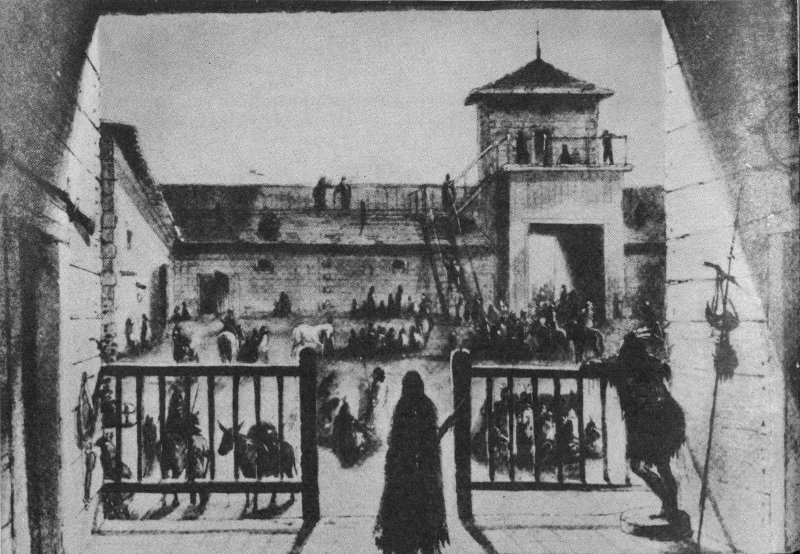
The Interior of Fort William in 1837. From a painting by A. J. Miller in the Walter’s Art Gallery.
The Laramie and its tributaries were also the homes of the prized beaver, and much trading was done at the pleasant campsites near its mouth. Here, too, was the junction with the trappers’ trail to Taos.
3