Texas Trees
Reading edition
LIMBER PINE (Rocky Mountain White Pine) Pinus flexilis var. flexilis James
Limber pine is abundant in the Rocky Mountains and in scattered areas over much of the West. In Texas, limber pine may be found in the Guadalupe and Davis Mountains of West Texas.
As the name indicates, the branches and twigs are especially flexible and tough, often light purple in color. The branches form a rounded tree top or head. The trunk is stout and noticeably tapered.
The needle-like LEAVES are in clusters of five. They are stiff and stout, about 2 to 3 inches long, and arranged in clusters or tufts near the ends of the branches. They stay on the twig for five or six years.
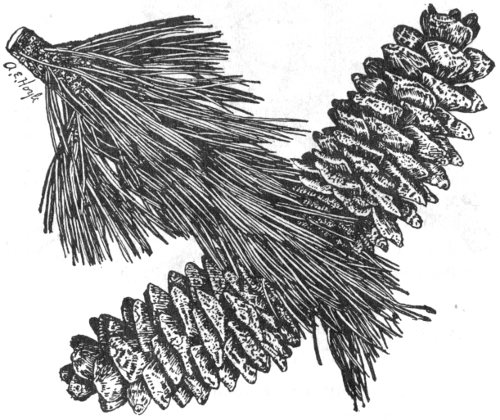
LIMBER PINE (Fruit and leaves, one-third natural size)
The “FRUIT”, a cone, is relatively short or stocky, mostly from 3 to 6 inches long, made up of rounded rather thick scales, some turned forward and some backward. The cone is short-stalked. As with all the pines, the seeds mature at the end of the second season of growth.
The WOOD is relatively soft, close-grained, slightly yellowish or reddish. It is not cut in quantity and the trees are usually rather limby and short-bodied, which largely accounts for the small commercial use.
18
PINYON (Nut Pine) Pinus edulis Engelm.
Pinyon is found as scattered trees or in small groves over the mountains and canyons in the western part of the state to elevations of 8,000 feet. It is a small tree, grows on warm slopes or in sheltered locations, and forms a bushy top with orange-colored branchlets.
The needle-like LEAVES grow in bundles of two (rarely 3); whereas in Pinus cembroides Zucc., the Mexican Pinyon, there are usually three needles per cluster. The dark green needles are approximately one inch long, stiff, stout, and curved. They remain on the tree from 5 to 8 years.
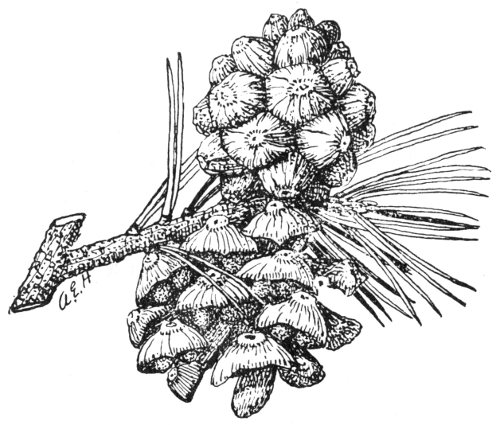
PINYON (Natural size)
Like all the pines, it has male and female “FLOWERS” separate on the same tree. The “FRUIT”, a cone, is rounded, about 1 to 2 inches across, and produces large seeds or “nuts”, from ½ to ¾ inch long. The seeds are rich in food value and form an important article of diet for the Indians. The seeds are gathered and sold widely as fancy “nuts” in many larger towns and cities.
The WOOD is light, soft, close-grained, and pale brown, used for fuel and sometimes as fencing. A close relative P. cembroides is found scattered in the Texas cedar breaks.
19
PONDEROSA PINE (Western Yellow Pine) Pinus ponderosa Laws.
Ponderosa pine is the most important commercial pine of the Southwest and many parts of the Rocky Mountain region. It reaches the southeastern limit of its range in the Guadalupe and Davis Mountains of West Texas where it is scattered and of little commercial value. It is favored as an ornamental in the Texas Panhandle.
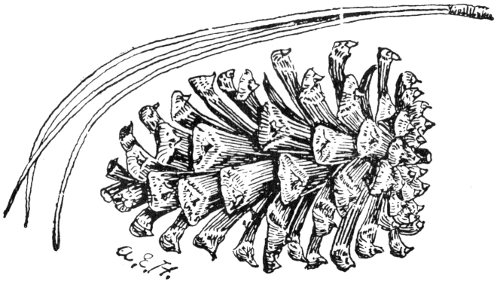
PONDEROSA PINE (Fruit and leaves, one-half natural size)
The needle-like LEAVES are in bundles of three and are mostly 5 to 8 inches long. The needles, massed toward the ends of naked branches, remain on the tree about 3 years.
The “FRUIT”, a short-stalked cone, is oval-shaped, reddish-brown, and armed with stout recurved prickles.
The WOOD of this species, from trees in the commercial part of its range, is of excellent quality for lumber. The wood is hard, strong, and rather fine grained. The heartwood is light reddish-white and the sapwood nearly white. Lumber from this tree is widely used for house construction and furniture.
20
LOBLOLLY PINE Pinus taeda L.
This fast-growing yellow pine is the most abundant and valuable species in Southeast Texas from Orange County west to Walker and Waller Counties. The species is also abundant northward to the Oklahoma line. Loblolly pine also constitutes the pine of the “Lost Pine Region” in the vicinity of Bastrop.
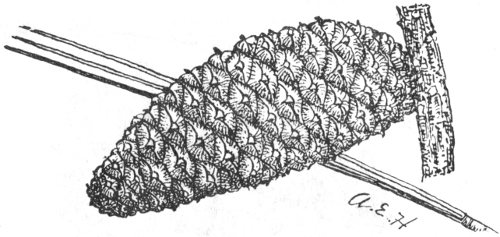
LOBLOLLY PINE (Fruit and leaves, one-half natural size)
Loblolly invades abandoned fields rapidly. For this reason it is often called old field pine. In the virgin forest of Texas, loblolly pine was most common along banks of streams. It is still the dominant pine on moist sites, but may also be found in relatively dry sites.
The dark-colored BARK is deeply furrowed and often attains a thickness of as much as 2 inches on large-sized trees. The needle-like LEAVES, 6 to 9 inches long, are borne three (occasionally two) in a cluster. In the spring bright green clumps of needles grow at the end of branches and give the tree a luxuriant appearance. The “FRUIT”, a cone, ripens in the autumn of the second year and is 3 to 5 inches long. Many seeds with wings an inch long are shed during the fall and early winter.
The resinous WOOD is coarse-grained. There is marked contrast, as in other yellow pines, between the bands of springwood and summerwood. The wood of second-growth trees has a wide range of uses such as building material, box shooks, barrel staves, basket veneers, pulpwood, lath, mine props, piling, and fuel.
21
SHORTLEAF PINE (Yellow Pine) Pinus echinata Mill.
Shortleaf pine is an important pine over a wide area in Northeast Texas, and is common in other parts of the “Piney Woods.” Essentially a tree of the hilly section, growing in pure stands and in mixture with hardwoods, the mature tree has a tall straight stem and an oval crown, reaching a height of about 100 feet and a diameter of about 2½ feet. Unlike other southern pines, young shortleaf pine trees may reproduce by sprouts when cut or burned back.
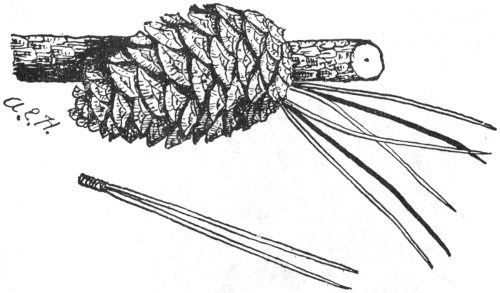
SHORTLEAF PINE (Fruit, natural size; leaves, two-thirds natural size)
The BARK is brownish-red, broken into rectangular plates; it is thinner and lighter-colored than that of loblolly pine.
The needle-like LEAVES are in clusters of two or three (3 to 5 inches long), slender, flexible, and dark blue-green. The “FRUIT”, a cone, or bur, the smallest of the Texas pines, are 1½ to 2½ inches long, oblong, with small sharp prickles; are generally clustered, and often hold to the twigs for 3 or 4 years. The small mottled seeds have a wing which is broadest near the center.
The WOOD of old trees is rather heavy and hard, yellow-brown or orange, fine-grained, and less resinous than that of the other important Southern pines. It is used for finishing, general construction, veneers, paper pulp, excelsior, cooperage, mine props, and other purposes.
22
LONGLEAF PINE Pinus palustris Mill.
Young longleaf pine with its single upright stem, candle-like silvery buds, and long, shiny leaves form a handsome tree. In later youth the stalwart, sparingly-branched sapling, with heavy twigs and gray bark, attracts immediate attention. Mature trees have tall, straight trunks, 1-3 feet in diameter and open irregular crowns.
Longleaf pine grows in sandy soils from Orange County, north to Sabine County and west to Trinity County. A hybrid cross between longleaf and loblolly pine is often found in this range and is known as Sonderegger pine.
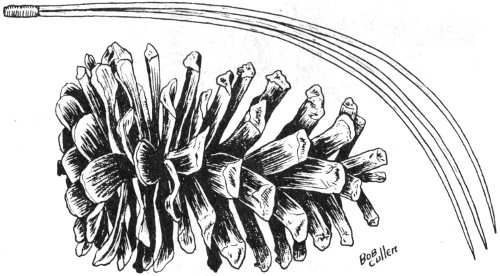
LONGLEAF PINE (Fruit and leaves, one-third natural size)
The needle-like LEAVES are grey-green, from 10 to 15 inches long, in clusters of three, and gathered toward the ends of the thick, scaly, twigs. The “FLOWERS”, appearing in early spring before the new leaves, are a deep rose-purple, the male in prominent, short, dense clusters and the female in inconspicuous groups of two to four. Unlike other Southern pines, common to Texas, this species grows in a “grass” stage for 2 to 5 years during which time it resembles a clump of grass. Once longleaf pine starts its height growth, it grows rapidly.
The “FRUIT”, a cone bur, is 6 to 10 inches long, and slightly curved, the thick scales armed with small curved prickles. The cones usually fall soon after the seed ripens, leaving their bases attached to the twigs.
The WOOD is heavy, hard, strong, tough and durable. It is used for construction. Naval stores such as turpentine and rosin are obtained from the tree.
23
SLASH PINE Pinus elliottii var. elliottii
Slash pine is not a native of Texas, its natural range in the United States being along the coast from South Carolina to eastern Louisiana. The initial planting of slash pine in East Texas was made on the E. O. Siecke State Forest near Kirbyville in 1926. It has been widely planted in East Texas, and has been so successful in its growth and adaptability to the region that it is now accepted as a forest tree of the State. It is much favored for reforestation by planting because of its exceedingly rapid height growth, good survival, and comparative freedom from tip-moth damage.
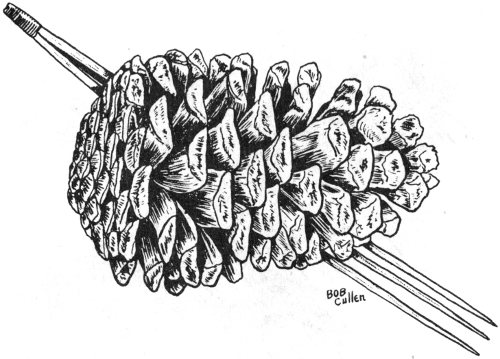
SLASH PINE (One-half natural size)
In its native habitat a mature tree ranges to 100 feet high, with a roundtopped head and a trunk 1 to 3 feet in diameter.
The BARK ranges in thickness from ¾ to 1 inch, separating freely on the surface into large thin scales.
The needle-like LEAVES occur in clusters of 2 and 3, are from 8 to 12 inches long, and lustrous. The “FLOWERS” appear in late winter, the male dark purple, the female pink, the “FRUIT”, a cone usually 4 to 6 inches long, is brown and glossy, the thin scales armed with fine prickles.
Slash pine WOOD is exceedingly hard, very strong, durable, coarse grained, rich, dark orange color, with thick, nearly white sapwood. In this respect it is similar to longleaf, being sold as such, and used for the same purpose. Naval stores, lumber, pulpwood and other products can be produced from this tree.
24
DOUGLAS-FIR Pseudotsuga menziesii var. glauca (Belssn.) Franco
This valuable timber tree of the western United States reaches its extreme southeastern limit in the mountains of West Texas. It is a small tree locally but in the Pacific Northwest Douglas-fir reaches a height of 250 feet and a diameter of 10 to 12 feet.
The needle-like LEAVES are linear, more or less flattened, about an inch in length, bluish green, and arranged closely in spirals around the stem. They remain on the twigs for many years. The buds are a rich reddish-brown and pointed.
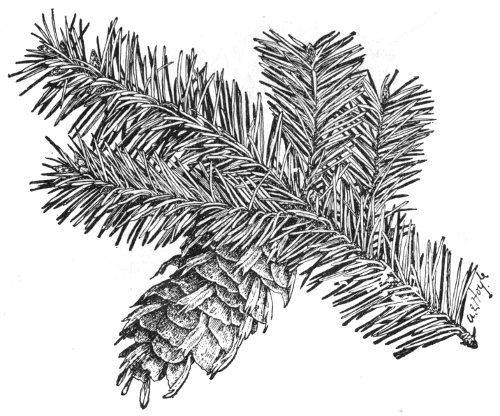
DOUGLAS-FIR (Fruit and leaves, one-half natural size)
The “FRUIT”, a cone, unlike that of true firs, hangs downward and is easily identified by the protruding bracts, or “straws.” The mature cones are 2 to 4 inches long, and brownish-red.
The WOOD is moderately light, reddish tinted and surrounded by nearly white sapwood. It varies widely in respect to density, quality and width of sapwood. Much high grade plywood is made from this species. Young Douglas-firs are sold as Christmas trees.
25
BALDCYPRESS Taxodium distichum (L.) Rich.
Baldcypress grows in swamps which are flooded for prolonged periods, and on wet stream banks and bottomlands. It occurs in East Texas west to the Nueces River. The straight trunk has numerous ascending branches, and narrow conical outline. In old age the tree generally has a broad fluted, or buttressed base, a smooth slowly tapering trunk and a broad, open, flat top of a few heavy branches and numerous small branchlets. Virgin-growth timber attains heights up to 130 feet and diameters up to 10 feet.
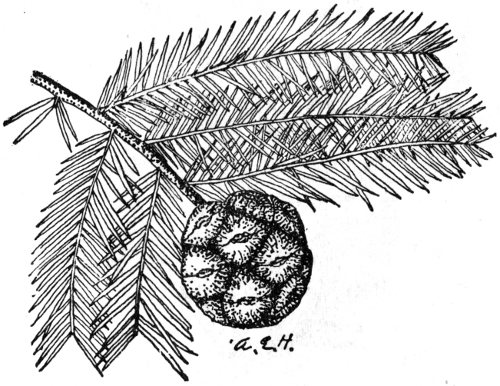
BALDCYPRESS (Cone and leaves, seven-eighths natural size)
The BARK is silvery to cinnamon-red, finely divided by numerous longitudinal fissures. The light green LEAVES about ½ to ¾ inch long, are arranged in feather-like fashion along two sides of small branchlets which fall in the autumn with the leaves still attached.
The “FRUIT”, a rounded cone, is about one inch in diameter, with thick irregular scales.
The WOOD is light, soft, easily worked, with a light sap wood and dark-brown heartwood. It is particularly durable in contact with the soil. Cypress is in demand for exterior trim of buildings, greenhouse planking, boat and ship building, shingles, posts, poles, and crossties.
26
ASHE JUNIPER (Mexican Juniper--Mountain Cedar) Juniperus ashei Buchholz
In Central and West Texas are found no less than nine species of cedars or junipers, including one eastern, one southern, and seven western species. Of these, the most abundant and important is the Mexican juniper. This tree often forms extensive low forests or dense breaks on the limestone hills and slopes of the Edwards Plateau and Grand Prairie.
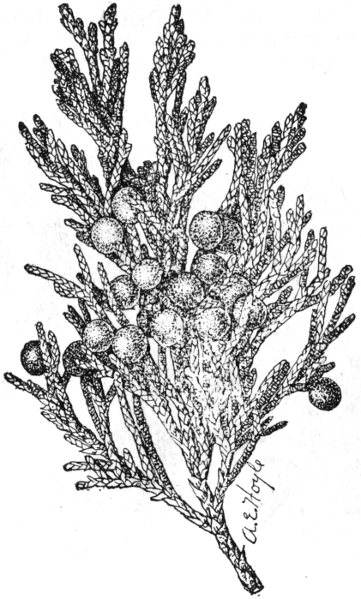
ASHE JUNIPER (Berry-like fruit and leaves, two-thirds natural size)
The trunk is covered with shreddy, brown or reddish-brown BARK. The LEAVES are dark blue-green, small, opposite or arranged in 3’s, scale like, blunt pointed, and fringed with minute teeth. On vigorous young plants the leaves are sharp pointed and longer, up to ½ inch long.
The “FRUIT”, a nearly round, dark blue, berry-like cone is covered with glaucous bloom; has a thin, pleasant-scented, sweet flesh, enclosing 1 or 2 seeds; and ripens in one season.
The WOOD is light, hard, light brown, close-grained but weak. It is extensively used for fence posts and fuel. The tree is sometimes planted as an ornamental.
27
EASTERN REDCEDAR Juniperus virginiana L.
Redcedar is scattered through East Texas, usually on gravelly ridges and rocky hillsides of the uplands.
There are two kinds of LEAVES, usually both on the same tree. The most common is dark green, minute, and scale-like, clasping the twig in four ranks, so that the twig appears square. The other kind, usually appearing on young growth, or vigorous shoots, is awl-shaped, quite sharp-pointed, spreading, and whitened.
The BARK is thin, reddish-brown, turning ashy-gray on exposed surfaces, and peels off in long shred-like strips. The trunk is usually more or less grooved.
The male and female FLOWERS blooming in February or March, are at the end of minute twigs on separate trees.
The “FRUIT” which matures in one season is pale blue, ¼ inch in diameter, and berry-like, the sweet flesh enclosing one or two seeds.
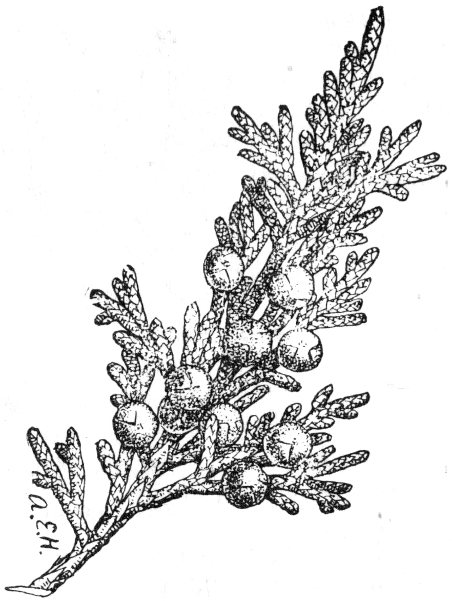
EASTERN REDCEDAR (Fruit and leaves, three-fourths natural size)
The HEARTWOOD is distinctly red, and the sapwood white, this color combination making very striking effects when finished as cedar chests, closets, and interior woodwork. The wood is aromatic, soft, strong, and of even texture, very durable in contact with the soil, and in great demand for posts, poles, and rustic work.
Since redcedar spreads the cedar-rust of apples, it is inadvisable to plant this tree in or near orchards, or anywhere in regions devoted to commercial apple production.
28
BLACK WALNUT Juglans nigra L.
This valuable forest tree occurs on rich bottomlands and moist fertile hillsides as far west as the San Antonio River. It may attain a height of nearly 100 feet with a straight stem, clear of branches for half of its height.
The BARK is thick, dark brown in color, and divided by rather deep fissures into rounded ridges.
The LEAVES are alternate, compound, 1 to 2 feet long, consisting of from 15 to 23 leaflets of a yellowish-green color. The leaflets are about 3 inches long, extremely tapering at the end, and toothed along the margin.
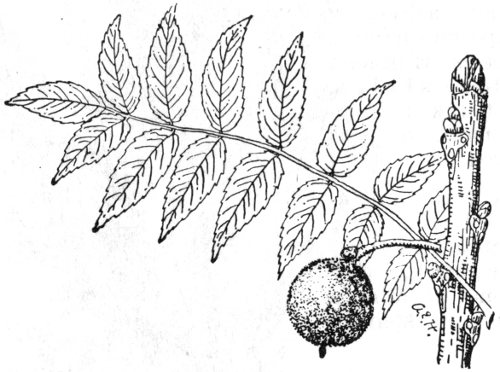
BLACK WALNUT (Leaf, one-fifth natural size; fruit, one-fourth natural size; twig, about natural size)
The FRUIT is a nut, borne singly or in pairs, and enclosed in a solid green husk which does not split open, even after the nut is ripe. The nut itself is black with a very hard, thick, finely ridged shell, enclosing a rich, oily, edible kernel.
The HEARTWOOD is heavy, hard and strong. Its rich chocolate-brown color, freedom from warping, and checking, susceptibility to a high polish, and durability make it highly prized for furniture and cabinet work and gunstocks. Walnut is easily propagated from the nuts, and should be more widely planted and grown for timber and nuts.
LITTLE WALNUT or TEXAS WALNUT (Juglans microcarpa Berlandier) is found on limestone banks of streams in western Texas. The stumps supply a beautiful veneer.
29
PECAN Carya illinoensis (Wangenh.) K. Koch
Pecan, the “State tree” of Texas, is found native in the state from the Piney Woods west throughout Central Texas, centering in the watershed of the Colorado River. It makes an excellent shade tree and is very valuable for the nut crop it bears. Many varieties are planted in orchards. The pecan is a tall-growing tree, attaining heights of over 100 feet. When grown in the open it forms a large, rounded, symmetrical top.
The outer BARK is rough, hard, tight, but broken into scales; on the limbs it is smooth at first but later tends to scale or divide as the bark grows old.
The LEAVES resemble those of the other hickories and the black walnut. They are made up of 9 to 17 leaflets, each oblong, toothed and long-pointed, and 4 to 8 inches long by about 2 inches wide.
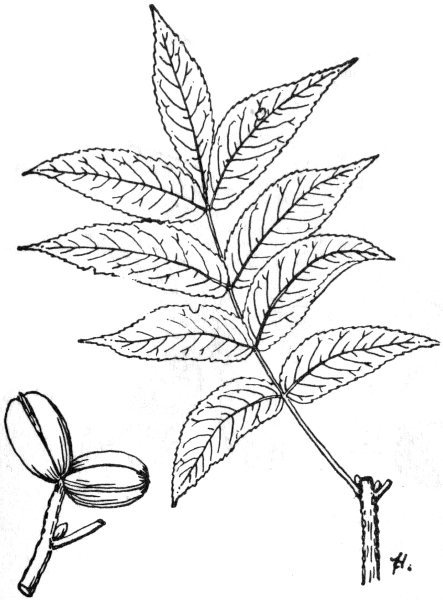
PECAN (Leaf, one-sixth natural size; fruit, one-third natural size)
The FLOWERS appear in early spring and hang in tassels from 2 to 3 inches long. The FRUIT is a nut 1 to 2 inches long, and ½ to 1 inch in diameter, in a thin husk which opens along its grooved seams when the fruit ripens in the fall. The nuts vary in size and thickness of shell. Cultivated varieties are sold on the market in large quantities.
The WOOD is heavy, hard, brittle, not strong, and of little value except for fuel and wagon stock. Some wood is satisfactory for making softball bats.
30
BITTERNUT HICKORY (Pignut) Carya cordiformis (Wangenh.) K. Koch
Bitternut, the only hickory with bright yellow buds, is a tall slender tree with a broad pyramidal crown, attaining a height of 100 feet and a diameter of 2 to 3 feet. It is found in the eastern part of the state on moist rich soils, and is not abundant.
The BARK on the trunk is granite-gray, faintly tinged with yellow, less rough than in most hickories, yet broken into thin, plate-like scales.
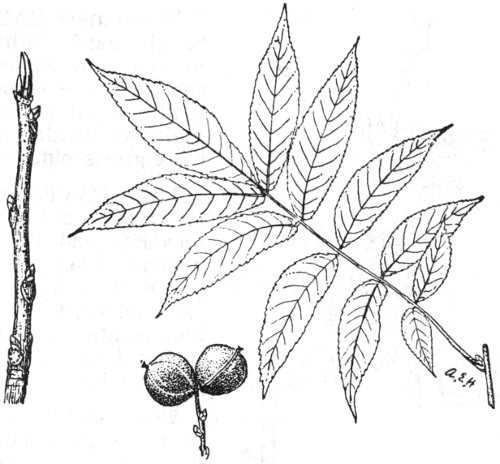
BITTERNUT HICKORY (Twig, one-half natural size; leaf and fruit, one-third natural size)
The bright yellow winter BUDS are compressed and scurfy. The LEAVES are alternate, compound, from 6 to 10 inches long, and composed of 5 to 11 leaflets. The individual leaflets are smaller and more slender than those of the other hickories.
The male and female FLOWERS are on the same tree. The FRUIT is about 1 inch long and thin-husked, while the nut has a thin, smoothish, gray, brittle shell. The kernel is bitter.
The WOOD is hard, strong, and heavy; reddish-brown in color, and often called red hickory. It has the same uses as the other hickories but is said to be inferior.
31
WATER HICKORY Carya aquatica (Michx. f.) Nutt.
This tree, as its name indicates, grows in bottomlands and rich, wet woods. It is found throughout the eastern portion of the state. It is not a large hickory, seldom attaining a height of 100 feet or a diameter of 2 feet. It is slender, with upright branches forming a narrow head. It is easily distinguished from other hickories by its reddish-brown winter buds which are covered with yellow glands that fall off easily.
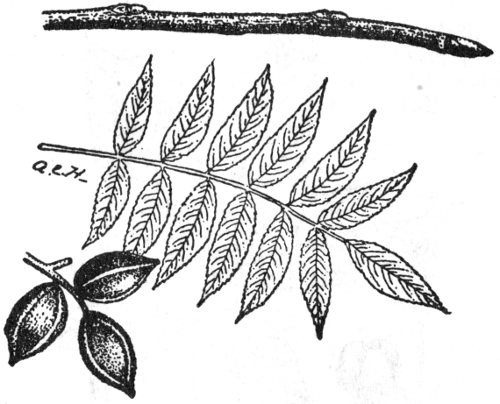
WATER HICKORY (Fruit and twig, two-thirds natural size; leaf, one-fourth natural size)
The light brown BARK separates freely into long, loose, thick, plate-like scales.
LEAVES are alternate, compound, 9 to 15 inches long, with 7 to 13 slender leaflets. The FLOWERS are like those of other hickories. The FRUIT, often borne in clusters of 3 or 4, is a rather oblong nut, conspicuously four-angled, with a thin, red-brown hull that splits tardily. The nut itself is nearly as broad as long, four-angled and ridged, with a thin shell and bitter kernel.
The WOOD is heavy, strong, close grained, brown, and rather brittle. Probably used only for fuel.
32
SHAGBARK HICKORY Carya ovata (Mill.) K. Koch
Shagbark hickory is found from eastern Texas to Florida and north to the St. Lawrence River and Minnesota. It is a large tree of commercial importance reaching 100 feet in height and 2 to 3 feet in diameter. It thrives best on rich, damp soil.
The BARK of the trunk is rougher than on other hickories, light gray and separating into thick plates which are only slightly attached to the tree. The large terminal winter buds are egg-shaped, the persistent outer bud-scales having narrow tips.
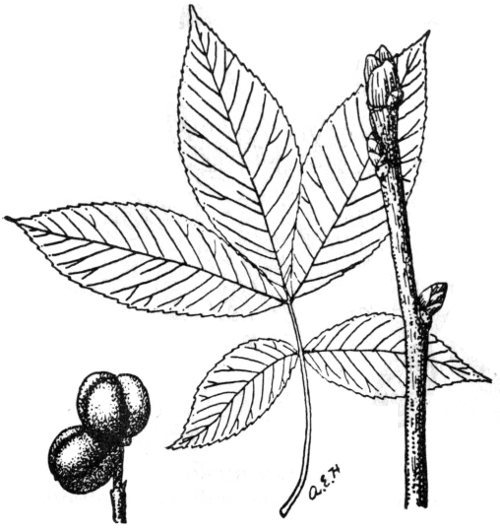
SHAGBARK HICKORY (Leaf, one-third natural size; twig, one-half natural size; fruit, one-fourth natural size)
The LEAVES are alternate, compound, from 8 to 15 inches long and composed of 5, rarely 7, obovate to ovate leaflets. The twigs are smooth or clothed with short hairs.
The male and female FLOWERS open after the leaves have attained nearly full size.
The FRUIT is borne singly or in pairs and is globular. The husk is thick and deeply grooved at the seams. The nut is pale, the shell thin, and the kernel sweet. It is sold in commercial quantities.
The WOOD is heavy, hard, tough, and strong. It is used in the manufacture of agricultural implements, tool handles, wagons, and sports equipment.
33
MOCKERNUT HICKORY Carya tomentosa Nutt.
Mockernut, white, or bigbud hickory, is common on well-drained soils in the eastern part of the state. It is a short-limbed tree up to 60 feet high and 1 to 2 feet in diameter.
The BARK is dark gray, hard, closely and deeply furrowed, often apparently cross-furrowed or netted. The winter BUDS are large, round or broadly egg-shaped, and covered with downy, hard scales. The outer, dark scales fall off readily in the autumn. The recent shoots are short, stout and more or less covered with a downy growth.
The LEAVES are large, strong-scented, and hairy; composed of 7 to 9 obovate to oblong, pointed leaflets pale to orange-brown on the lower surface. The leaves turn a beautiful yellow in the fall.
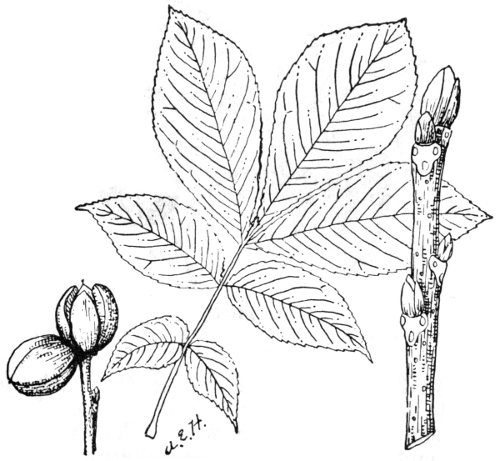
MOCKERNUT HICKORY (Leaf, one-fifth natural size; twig, two-thirds natural size; fruit, one-third natural size)
The FLOWERS are of two kinds on the same tree; the male in three-branched catkins, the female in clusters of 2 to 5. The FRUIT is oval, nearly round or slightly pear-shaped with a very thick, strong-scented husk which splits nearly to the base when ripe. The nut sometimes has 4 to 6 ridges; is reddish-brown, thick shelled, and has a small, sweet kernel.
The WOOD is heavy, hard, tough, and strong. It is white except for the comparatively small, dark-brown heart, hence the name white hickory. It is used for the same purpose as shagbark hickory and makes an excellent fuel.
34
BLACK HICKORY Carya texana Buckl.
This is a common hickory in northern and eastern Texas, growing on hillsides and sandy uplands with post and black jack oaks. It is distinguished by its rusty brown hairs found on the young leaves and branches. It forms a tree 60 to 75 feet high, with a trunk 2 feet in diameter.
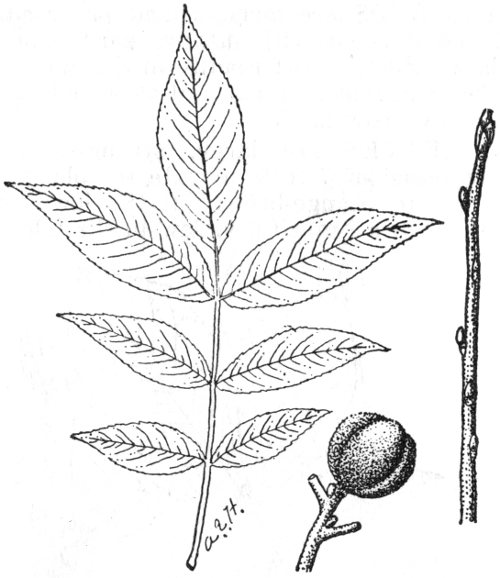
BLACK HICKORY (Leaf, one-fourth natural size; fruit, one-third natural size; twig, three-fourths natural size)
The BARK is dark gray or nearly black, deeply divided into rough ridges, or it may be irregularly fissured and separated into thin scales. The winter buds are ovoid and covered with rusty hairs mixed with silvery scales.
The LEAVES, 8 to 12 inches long with 5 to 7, usually 7, leaflets and rusty-hairy slender petioles, are dark green, lustrous above; much paler beneath. The FLOWERS are similar to other hickories.
The FRUIT is obovoid, narrow, or abruptly contracted into a short stalk at the base, with a husk ¹/₁₂ to ⅙ inch thick, splitting to the middle or nearly to the base. The sweet-seeded nut is nearly obovoid to oblong, rounded at the ends, compressed and slightly four-angled, with a shell ⅙ to ⅕ inch thick.
The hard, brittle WOOD is used chiefly for fuel.
35
CORKWOOD Leitneria floridana Chapm.
This lightest of all native woods in the United States grows in river swamps near the Gulf, about the mouth of the Brazos River. It is a small tree reaching a height of 20 feet, or a shrub, depending upon the location and natural conditions. The base is usually swollen. The straight, gradually tapering trunk is crowned with a loose, open-topped head. The young branchlets are coated with hairs which later drop, leaving a smooth, dark, red-brown stem.
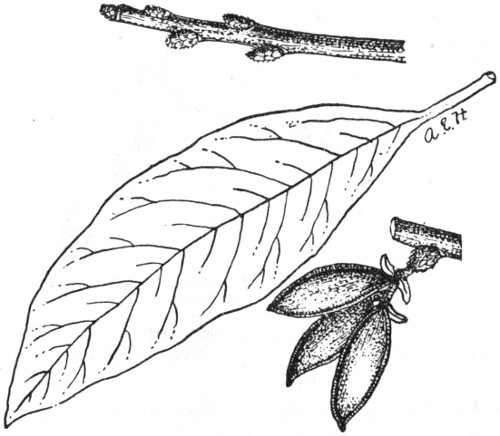
CORKWOOD (Leaf, one-half natural size; fruit and winter twig, natural size)
The simple, alternate LEAVES are from 4 to 6 inches long and about 2 inches wide, borne on petioles 1 or 2 inches long. The leaves are shiny above.
The FLOWERS are in catkins of two kinds or sexes, the male about 1½ inches long, the female about ¾ inch long. Both kinds are borne on the same tree and appear about the first of March. The FRUIT is solitary or in clusters of 2 to 4, each about ½ to ¾ inch long, and ripens when the leaves are about one-half grown. The WOOD is soft, exceedingly light, generally uniform in texture and of a pale yellow color. It is used as a substitute for cork for floats on fishing nets.
36
EASTERN COTTONWOOD Populus deltoides (Bartr.)
This cottonwood is found along streams throughout the state. The tree is easily propagated by cutting and grows rapidly, hence it has been widely planted to get shade quickly. The tree is often unsatisfactory for shade because it begins to shed its leaves by midsummer. The cotton-bearing seeds from the pistillate tree are often a nuisance. The soft wood is easily broken by winds; and the rank growth of the roots often results in stopping drain pipes and cracking and lifting sidewalks.
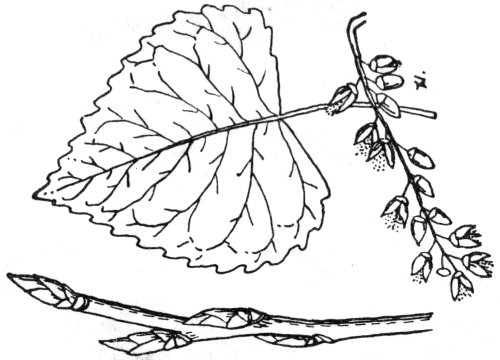
EASTERN COTTONWOOD (Leaf, one-half natural size; twig, one-third natural size)
The LEAVES are simple, alternate, broadly ovate or triangular, pointed, square at the base, and coarsely toothed on the edges, 3 to 5 inches across each way, covered with soft white hairs on the under side, supported by flattened slender petioles, 2 to 3 inches long. The winter buds are covered with chestnut-brown, resinous scales. The male and female FLOWERS are in catkins on separate trees and appear before the leaves. The FRUIT, a capsule, contains a number of seed with white silky hairs which permit the winds to carry the seed for long distances.
The WOOD is soft, light-weight, warps easily upon drying, but is used for many purposes, sometimes as a substitute for yellow poplar and linden.
Three other species of Southern cottonwood occur in western Texas. One species, P. sargentii Dode, which has long pointed leaves, is found in the Panhandle.
37
BLACK WILLOW Salix nigra Marsh.
Black willow is found along streams throughout the state. It rarely grows taller than 50 feet and is frequently found growing singly or in clumps along the water courses. In winter the easily separable bright reddish-brown or golden, naked twigs are quite conspicuous.
The BARK is deeply divided into broad, flat ridges which separate into thick plate-like scales. On old trees it becomes shaggy. In color it varies from light brown tinged with orange, to nearly black.
The LEAVES are from 3 to 6 inches long, and less than ½ inch wide; the tips are greatly tapered and the entire margin finely toothed. The leaves are bright green on both sides, turning pale yellow in the early autumn.
The FLOWERS are in catkins, the male and female on separate trees.
The FRUIT is a capsule containing numerous minute seeds with long silky hairs which enable them to be blown long distances.
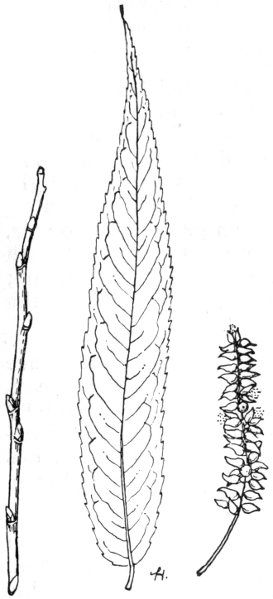
BLACK WILLOW (Leaf, two-thirds natural size; fruit and twig, natural size)
The WOOD is soft, light, and not strong. A high grade of charcoal, used in the manufacture of gunpowder, is obtained from willow wood, and it is the chief wood used in manufacture of artificial limbs.
38
AMERICAN HORNBEAM (Blue Beech) Carpinus caroliniana Walt.
American hornbeam or blue beech, also known as ironwood and water beech, is a small slow-growing, bushy tree with a spreading top of slender, crooked or drooping branches. It is found along streams and in low ground, usually in the shade of other trees. Its height is usually from 20 to 30 feet and its diameter 4 to 8 inches, although it sometimes grows larger.
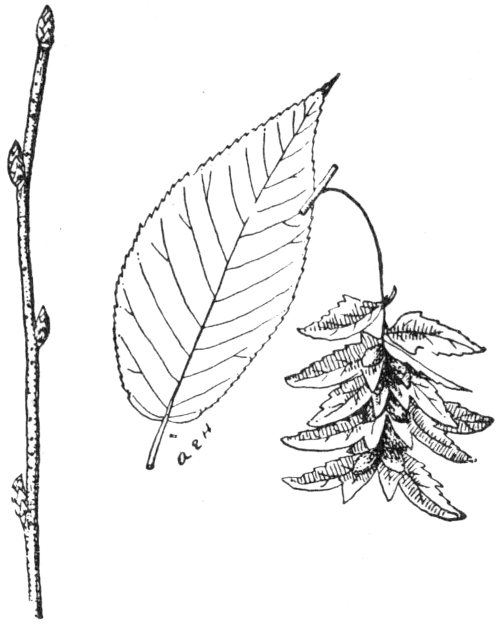
AMERICAN HORNBEAM (Leaf and fruit, one-half natural size; twig, natural size)
The TRUNK is fluted with irregular ridges or “muscles” extending up and down the tree. The BARK is smooth, light brownish-gray to dark bluish-gray in color, sometimes marked with dark bands extending horizontally on the trunk.
The LEAVES are simple, alternate, oval, long-pointed, doubly toothed along the margin, and 1 to 3 inches long. They resemble those of the black or sweet birch, but are smaller.
The FLOWERS are borne in catkins separately on the same tree; the male catkin about 1½ inches long, the female, about ¾ of an inch, with small, leaf-like, three-lobed green scales. The FRUIT is a nutlet about ⅓ inch long. It falls, attached to the leaf-like scale which acts as a wing aiding its distribution by the wind.
The WOOD is tough, close-grained, heavy, and strong. It is sometimes selected for use for levers, tool handles, wooden cogs, mallets, wedges, etc. The tree is of little commercial importance and often occupies space in the woods that should be utilized by more valuable species.
39
EASTERN HOPHORNBEAM (Ironwood) Ostrya virginiana (Mill.) K. Koch
The tree gets its common names from the qualities of its wood and the hop-like fruit. It is a small, slender, generally round-topped tree, from 20 to 30 feet high and 7 to 10 inches in diameter. The top consists of long slender branches, commonly drooping toward the ends. It is found mostly on rather dry soils throughout the uplands of the eastern part of the state.
The BARK is mostly light, gray-brown, or reddish-brown, and finely divided into thin scales.
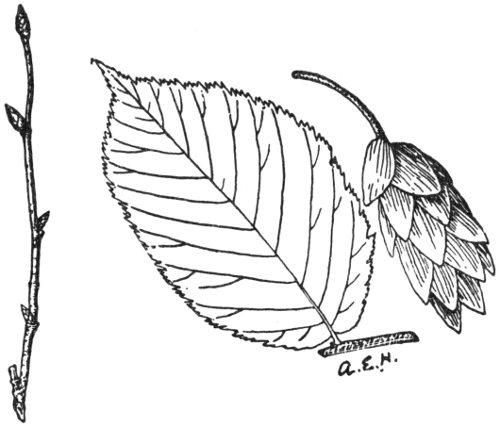
EASTERN HOPHORNBEAM (Twig, three-fifths natural size; leaf and fruit, one-half natural size)
The LEAVES are simple, alternate, generally oblong with narrow tips, sharply doubly toothed along the margin, and from 2 to 3 inches long.
The FLOWERS are of two kinds on the same tree; the male, in drooping catkins which form the previous summer, the female, in erect catkins on the newly formed twigs. The FRUIT, which resembles that of the common hop vines, consists of a branch of leafy bracts 1 to 2 inches long containing a number of flattened ribbed nutlets.
The WOOD, strong, hard, durable, light brown to white, with thick, pale sapwood, is often used for handles of tools, mallets, and other small articles.
40
RIVER BIRCH (Red Birch) Betula nigra L.
This is the only native birch found at low elevations in the South. It occurs in East Texas and, as the name implies, in the deep, rich soils along the borders of streams, ponds, lakes, and swamps.
The BARK provides a ready means of identifying this tree. It varies from reddish-brown to cinnamon-red in color, and peels back in tough papery layers. These layers persist on the trunk, presenting a very ragged and quite distinctive appearance. Unlike the bark of other birches the thin paper layers are usually covered with a gray powder. On older trees, the bark on the main trunk becomes thick, deeply furrowed, and a reddish-brown color.
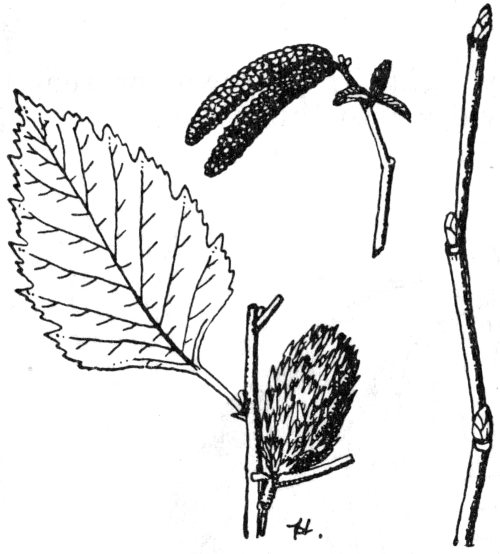
RIVER BIRCH (Twig, natural size; leaf and fruit, one-half natural size; male flower, one third natural size)
The LEAVES are simple, alternate, 2 to 3 inches long, more or less oval in shape, with double-toothed edge. The upper surface is dark green and the lower a pale yellowish green.
The FLOWERS are in catkins, the two kinds growing on the same tree. The FRUIT is cone-shaped about one inch long, and densely crowded with little winged nutlets that ripen from May to June.
The WOOD is strong and fairly close-grained. It has been used to some extent in the manufacture of wooden-ware, in turnery, and for wagon hubs. However, this tree is scattered in its distribution and is not of commercial importance.
41
AMERICAN BEECH Fagus grandifolia Ehrh.
Beech is found in East Texas to the Trinity River on the bottomland of streams and the margins of swamps. It is one of the most beautiful of all trees, in summer or winter.
The simple, alternate, oblong-ovate LEAVES are 3 to 4 inches long, pointed at the tip, and coarsely toothed and hairy along the margin. When mature, they are almost leathery in texture. The beech produces a dense shade. The light brown winter buds are long, slender, and pointed.
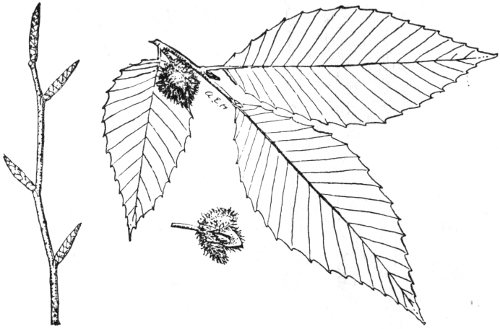
AMERICAN BEECH (Fruit, leaves, and twig, one-half natural size)
The BARK is, perhaps, the most distinctive characteristic, as it maintains an unbroken, light gray surface throughout its life.
The little, brown, three-sided FRUITS or beechnuts are almost as well known as chestnuts. The nuts are in pairs in a prickly involucre. The kernel is sweet and edible. The fallen fruit, known as mast, is a favorite food of wildlife.
The WOOD of the beech is hard, strong, and tough, though it will not last long on exposure to weather or in the soil. The tree is of economic importance as a lumber tree, the wood being used for furniture, flooring, carpenters’ tools, and novelty wares.
42
ALLEGHENY CHINKAPIN Castanea pumila Mill.
Chinkapins may grow as trees or form shrubby thickets; consequently their identification is at times confusing.
Some taxonomists credit East Texas with one species and a variety. Others list four species. Further study is needed.
C. pumila grows in dry woods, sandy ridges, and on borders of swamps from Florida to East Texas north to Ark., Tenn., Pa., and N. J. It may grow into a small tree 10 to 30 feet high and may reach 50 feet. If burned back by fires, it may send out stolons or sprouts and form dense shrubby growths. BRANCHLETS pubescent, gradually changing to a lustrous olive-green or orange-brown, then darker. The LEAVES are 4 to 6 inches long, 1½ to 2 inches wide, oblong to ovate and acute, the margin coarsely toothed with slender, rigid, spreading or incurved teeth. Base of leaf unequal, either rounded or wedge-shaped. Leaf at first tomentose above and below, later yellow-green above and whitish-downy below. Petiole short, stout, and flattened on the upper side. FRUIT a single brown, ovoid, pointed, plump, sweet, edible nut, ¾ to 1 inch long, encased in a bur covered with erect, crowded spines approximately ¾ inch long. WOOD light, hard, strong, coarse-grained; used for fence posts and railway ties. Of little economic importance because of its relative scarcity. C. pumila is a nut-producing tree of potential commercial importance.
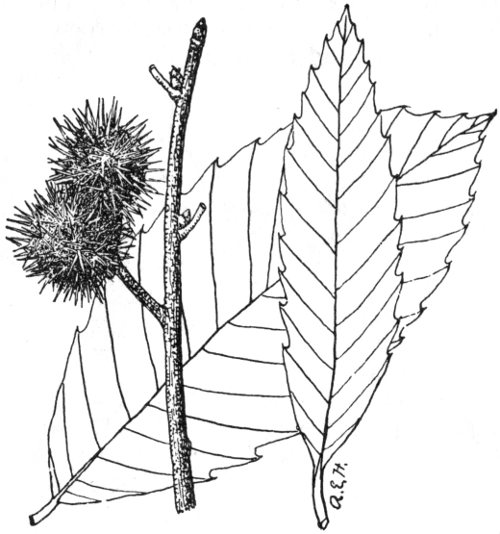
ALLEGHENY CHINKAPIN (Fruit, leaves and twig, two-thirds natural size)
ASHE CHINKAPIN (C. pumila var. ashei Sudw.) is a small tree of dry sandy soils. Leaves are felt-like below. This variety is distinguished by its bur which has scattered, forked, and horizontally divergent bristles. The surface of the bur has smooth areas free of bristles.
A variation of chinkapin with leaves 3 to 4 inches long and lustrous below is frequently described as FLORIDA CHINKAPIN (C. alnifolia var. floridana Sarg.)
43
SHUMARD OAK (Spotted Oak) Quercus shumardii Buckl.
This species, one of the largest Southern red oaks, was named for Benjamin F. Shumard, an early state geologist of Texas. SHUMARD OAK is found in the eastern part of the state on well-drained alluvial soils and on fertile slopes. It forms a tall, wide-spreading, rather open head. The BARK is dark, rough, divided into ridges, and usually from 1 to 1½ inches thick. It seldom comprises the principal species of any forest stands, but more often occurs as individual trees. It attains a diameter of more than 3 feet and a height of more than 100 feet, but is usually smaller.
Winter BUDS covered with gray, smooth scales, while the buds of Texas oak (page 44) are covered with red, densely pubescent scales.
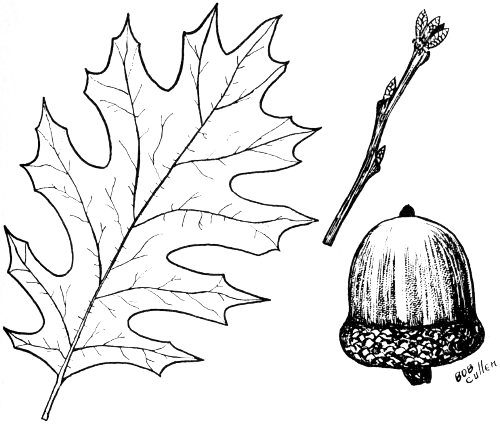
SHUMARD OAK (Twig and leaf, one-half natural size; fruit, natural size)
The LEAVES are deciduous, simple, alternate 6 to 8 inches long by 4 to 5 inches wide; 7-lobed, rarely 5, and each lobe 2 or 3-lobed or deeply toothed. The lobes are frequently thicker than is shown in the drawing. The leaves are smaller and more deeply lobed than those of the black oak. Leaves smooth except for dense tufts of pale hairs at the axils of the veins below.
The FRUIT is a small acorn, about ⅔ inch in diameter and ¾ to 1¼ inches long, set in a shallow saucer-like cup.
The WOOD is heavy, hard, strong, close-grained, and light reddish-brown in color, and commercially important for lumber and cross ties.
The variety shumardii has leaves with narrow lobes, a rougher, dark grayish bark, and deeper cups to the acorns. It is the more common form in Texas.
44
TEXAS OAK Quercus shumardii var. texana (Buckl.) Ashe
Texas oak is found on the dry limestone hills and ridges, and in the more fertile soils at their base, in Central and western Texas to the Edwards Plateau. It is rarely over 30 feet tall or 10 inches in diameter.
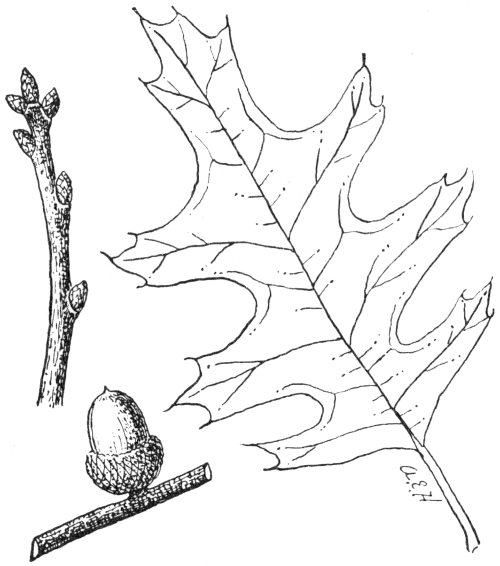
TEXAS OAK (Leaf, two-thirds natural size; fruit, and twig, natural size)
The BARK is light brown, red-tinged, deeply ridged, and broken into plate-like scales.
The LEAVES are deciduous 2½ to 3 inches wide, 3 to 3½ inches long; widest above the middle; divided into 5 to 7 lobes, with the terminal lobe 3-lobed; dark green and shiny above, pale-shiny below; petiole slender, about 1 inch long.
The FRUIT is short-stemmed, usually single, ¼ to ¾ inch long and broad, varying to nearly 1 inch long and ⅓ inch broad, set in a cup that covers one-third or less of the fruit, reddish-brown and often streaked with dark lines.
The WOOD is most useful for fuel.
GRAVES OAK (Q. gravesii Sudw.) is found in the Davis and Chisos Mountains of southwestern Texas.
45
BLACK OAK Quercus velutina Lam.
Black oak, also called yellow oak, reaches 80 feet in height and 1 to 3 feet in diameter. It grows in East Texas, and in the hills and canyons near the mouth of the Pecos River. The crown is irregularly shaped and wide, with a clear trunk for 20 feet or more on large trees. The BARK on the very young trunks is smooth and dark brown, but soon becomes thick and black with deep furrows and rough broken edges. The bright yellow color and bitter taste of the inner bark are distinguishing characteristics.
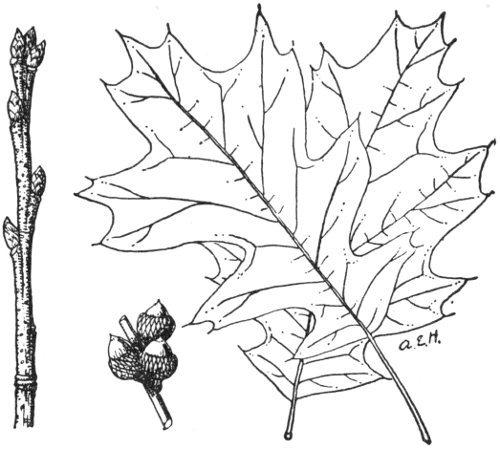
BLACK OAK (Twig and fruit, one-half natural size; leaf, one-third natural size)
The LEAVES are deciduous, alternate, simple, 5 to 10 inches long and 3 to 8 inches wide, shallow or deeply lobed, the shape varying greatly. When mature, the leaves are dark green and shiny on the upper surface, pale on the lower, more or less covered with a scurfy yellow or orange down, and with conspicuous rusty brown hairs in the forks of the veins.
The FRUIT matures the second season. The light brown nut is from ½ to 1 inch long, more or less hemispherical in shape, and from one-half to three-fourths enclosed in the thin, dark brown, scaly cup. The yellow kernel is bitter.
The WOOD, used and marketed as red oak, is hard, heavy, strong, coarse-grained, and checks easily. It is a bright red-brown with a thin outer edge of paler sapwood.
46
SOUTHERN RED OAK Quercus falcata Michx.
Southern red oak, commonly known as red oak and formerly as Spanish oak, usually reaches a height of 80 feet and diameter of 3 feet, although larger trees are found. It grows on dry hills in the eastern part of the state to the Brazos River, while three varieties are found in richer, more moist locations. Its large spreading branches form a broad, round, open top. The BARK is rough, not deeply furrowed, and varies from light gray on younger trees to dark gray or almost black on older ones.
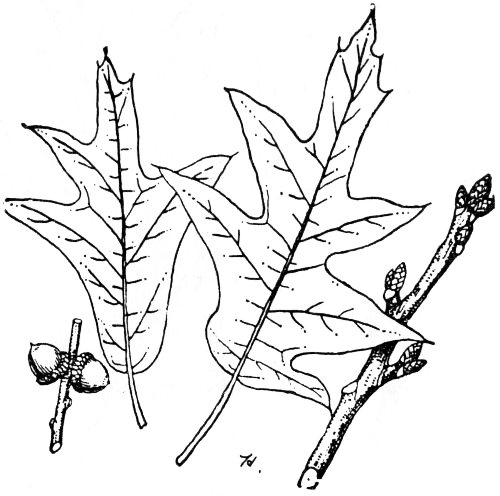
SOUTHERN RED OAK (Leaf and fruit, one-third natural size; twig, one-half natural size)
The LEAVES are deciduous, with pear-shaped or irregular, rounded or narrow bristle-tipped lobes, the central lobe often longest. Variety pagodaefolia Ell., (Cherrybark Oak) has more numerous lobes. All leaves have brown or gray down beneath.
The staminate FLOWERS appear as catkins 3-5 inches long in April while the leaves unfold. The FRUIT ripens the second year. The small, rounded, ½ inch long acorn is set in a thin saucer-shaped cup that tapers to a short stalk.
The WOOD is heavy, hard, strong, coarse-grained, and valuable for lumber. The bark is rich in tannin. The tree is also desirable for shade and ornamental use.
47
BLACKJACK OAK Quercus marilandica Muenchh.
The occurrence of blackjack oak is said to indicate poor soil since it often occurs on dry or poorly drained, gravelly, clay, or sandy upland soils where few other forest trees thrive. This perhaps accounts chiefly for its slow rate of growth. It is found in those parts of the state that support a natural tree growth, as far west as Callahan County. The tree sometimes reaches a height of 50 or 60 feet and a diameter of 16 inches, but it is usually much smaller. Its hard, stiff, drooping branches form a dense crown which usually contains many persistent dead twigs.
The BARK is rough, very dark, often nearly black, and “blocky”; inner bark bright orange or yellow.
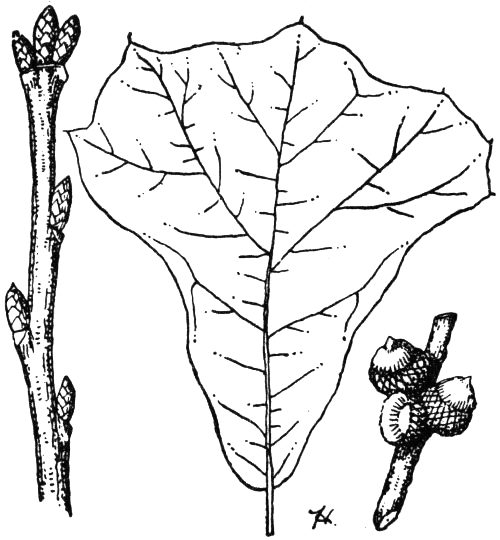
BLACKJACK OAK (Twig, two-thirds natural size; leaf and fruit, one-third natural size)
The LEAVES are deciduous, tawny-pubescent, of leathery texture, dark green on the upper surface, lighter underneath, broadly wedge-shaped, and variable in shape, 4 to 10 inches long and about the same in width. The FRUIT is an acorn about ¾ inch long, yellow-brown and often striped, enclosed for half its length or more in a thick, light-brown cup. The acorns mature at the end of the second season; flesh of cotyledons yellow.
The WOOD is heavy, hard and strong. It is used for firewood and is made into charcoal.
48
WATER OAK Quercus nigra L.
Water oak is native along the borders of swamps and streams and on rich bottomlands in Texas as far west as the Colorado River. It has been widely planted along streets and in parks as a shade tree. When fully grown this tree reaches a height of about 80 feet and a diameter exceeding 1 to 3 feet. The BARK is smooth, light brown tinged with red, and has many smooth, thin scales over the surface. Water oak can be best distinguished from the willow oak—a close associate, but longer-lived—by the differences in the general shape and size of leaves.
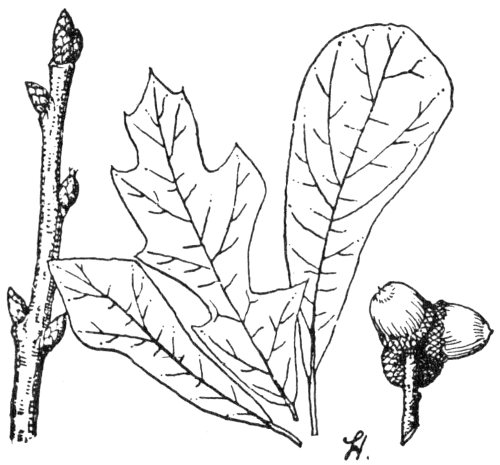
WATER OAK (Leaf, one-third natural size; twig and fruit, one-half natural size)
The LEAVES are simple, quite variable in shape, mostly oblong, broader near the point, and more narrow at the base, giving a wedge-shaped effect, often slightly three-lobed at the outer end, thin, and of a dull bluish-green color, paler below than above; mostly smooth, and usually 2 or 3 inches long and 1 to 2 inches wide; remain green for some time, then turn yellow and gradually fall from the tree during the winter.
The FLOWERS appear in April when the leaves begin to unfold. The FRUIT, an acorn, matures at the end of the second season. The acorn is from ½ to ⅔ inch long and nearly as broad, light brown or yellowish-brown and often striped, enclosed at the base only in a thin saucer-shaped cup.
The WOOD is heavy, hard, and strong, light brown in color, with lighter-colored sapwood. The wood is utilized chiefly for crossties and fuel.
49
WILLOW OAK (Pin Oak) Quercus phellos L.
Willow oak, also called water oak, and pin oak, occurs in the eastern part of the state to the Brazos River. It is frequently found in lowlands and along the borders of rivers and swamps, but often also on rich sandy uplands. It is a beautiful and long-lived tree, and desirable for roadsides, lawns and parks.
The BARK is generally smooth and of a reddish-brown color; with age, the bark becomes slightly roughened and divided by narrow ridges.
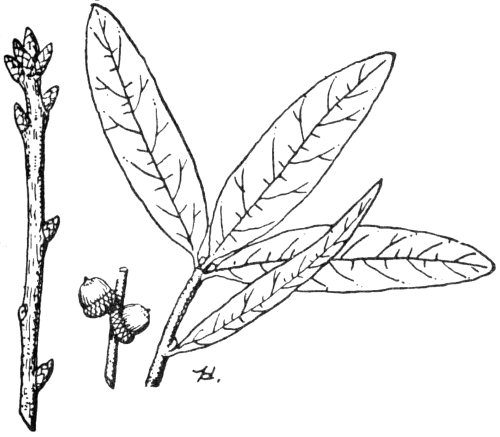
WILLOW OAK (Twig, one-half natural size; leaf and fruit, one-third natural size)
The slender willow-like LEAVES on a tree whose habit of growth is manifestly that of an oak, make the tree easy to identify in the forest. The deciduous leaves are 2 to 5 inches long and ½ to 1 inch wide, smooth, light green and shiny above, but dull and usually smooth below; alternate in arrangement on the twig and borne on a short stout petiole.
The FRUIT, small acorns, closely set along the stem, matures at the end of the second year. The nut is a light yellow-brown hemisphere, about ½ inch in diameter, its base scarcely enclosed in the shallow, pale greenish-red or reddish-brown cup. The nuts are eaten as food by bluejays, grackles (blackbirds), several other species of birds, and by rodents.
The WOOD is not separated commercially from other species in the red oak group. It is heavy, strong, rather coarse-grained, light brown tinged with red, and not durable when exposed to the weather. It is used locally for crossties, bridge planks, barn sills, and general construction.
50
BLUEJACK OAK (Sandjack Oak) Quercus incana Bartr.
This species, which grows on dry sand hills, is usually no more than 25 feet in height and 5 or 6 inches in diameter; ranging mainly through East Texas extending as far west as the Brazos River and scattering in Central and Northwest Texas.
The BARK is similar to that of blackjack, being divided into thick nearly square blocks 1 to 2 inches in length and covered with small dark brown or nearly black scales slightly tinged with red.
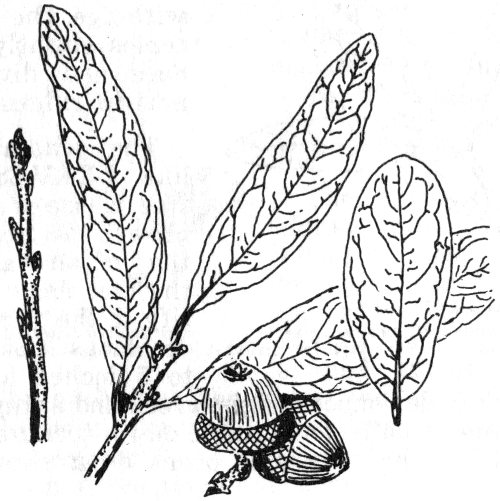
BLUEJACK OAK (Leaves, twigs, and fruit about two-thirds natural size)
The LEAVES of this tree are oblong-lanceolate, pale blue-green above, almost white beneath; 2 to 5 inches in length and 1 to l½ inches in width with a stout yellow midrib. The tree is most attractive in early spring when it is covered with the light red flowers and young leaves.
ACORNS are produced in great profusion, sessile, or on a short stock. They are rounded at the ends, striate, and about ½ inch in length, and mature at the end of the second year.
The WOOD is hard, strong, close-grained, light brown, tinged with red. It has a dark colored sapwood. The wood is of no value except for fuel.
There are several hybrids of this species reported in Texas.
51
EMORY OAK Quercus emoryi Torr.
In the canyons and on the southern slopes of the Davis and Chisos Mountains occurs this interesting oak with glossy, spiny, “holly-like” leaves, and sweet, edible acorns. A small round-topped tree up to 30 or 40 feet in height, the emory oak has drooping branches and slender, decidedly reddish branchlets.
The LEAVES are mostly persistent, oblong, pointed, smooth or sharply toothed along the margin, thick, very glossy green, about 2 inches long and less than 1 inch wide.
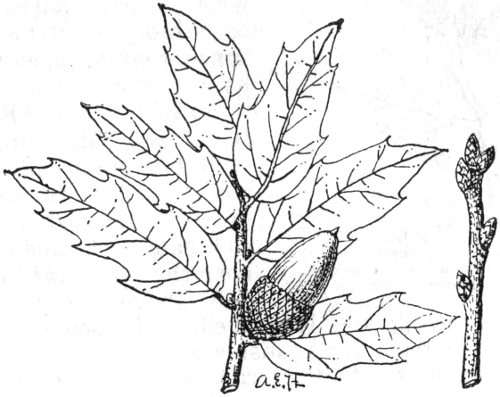
EMORY OAK (Leaf three-fourths natural size; fruit and twig, three-fourths natural size)
The acorn, or FRUIT, is borne close to the branchlet and matures in one season. It is oblong in shape, ½ inch or more in length, with a dark brown or nearly black nut enclosed for about one-third its length in a narrow cup. The latter is lined with dense gray fuzz or “tomentum.”
The WOOD is heavy, strong, somewhat brittle, close-grained, dark brown, with light brown sapwood tinged with red. The acorns are an important article of food for Mexicans and Indians.
MEXICAN BLUE OAK (Q. oblongifolia Torr.), closely resembling emory oak, is a smaller tree and does not occur at the higher elevations (over 6,000 ft.) where emory oak may be found.
GRAY OAK (Quercus grisea Liebm.) occurs in the Trans-Pecos area in Texas. This species is a scrub or small tree 20 to 30 feet high, but sometimes reaching a height of 65 feet.
52
LIVE OAK Quercus virginiana Mill.
Live oak range extends from southeastern Virginia through the lower Coastal Plain of the Atlantic and Gulf States; in Texas, from the mouth of the Rio Grande north to the Red River and west to the Guadalupe Mountains, also in southern Mexico and Cuba. It is a tree of striking character from its wide-spreading habit; sometimes reaching more than 100 feet in spread; with a short stout trunk, 3 to 4 feet in diameter, dividing in several large limbs with nearly horizontal branches, forming a low, dense, round-topped head. Its height is commonly from 40 to 50 feet. The BARK on the trunk and large branches is dark brown tinged with red, and slightly furrowed. It grows to largest size on the rich hammocks and low ridges near the coast and only a few feet above the water level. Slow-growing and long-lived, it is one of the most desirable trees for roadside and ornamental planting throughout most of its range. It is one of the very few trees that is apparently immune to cotton root-rot.
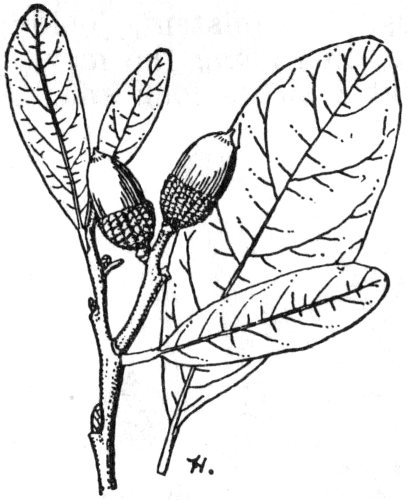
LIVE OAK (Leaf, natural size; fruit and twig, one-half natural size)
The LEAVES are simple, persistent, thick, leathery, oblong, smooth above, pale and silvery white beneath; from 2 to 4 inches in length and 1 to 2 inches in breadth.
The FRUIT is an acorn about 1 inch long and ⅓ inch wide, borne on a long stem or peduncle; it is oblong, dark brown and lustrous, and set in a top-shaped, downy cup of a light reddish-brown color. The acorn matures at the end of the first season.
The WOOD is very heavy, hard, strong and tough, light brown or yellow, with nearly white, thin sapwood. It was formerly largely used in ship building.
53
MOHRS OAK (Shin Oak) Quercus mohriana Buckl.
Over a wide section of Central Texas, on inferior soils, are found four or more species of “shin” oaks, so called from their low-growing bushy habit. Mature trees vary from 3 to 18 feet high. These are considerably alike in foliage and fruit. The “oak shinneries” form a forest cover in Central Texas that affords watershed protection on the head waters of some of the state’s main rivers.
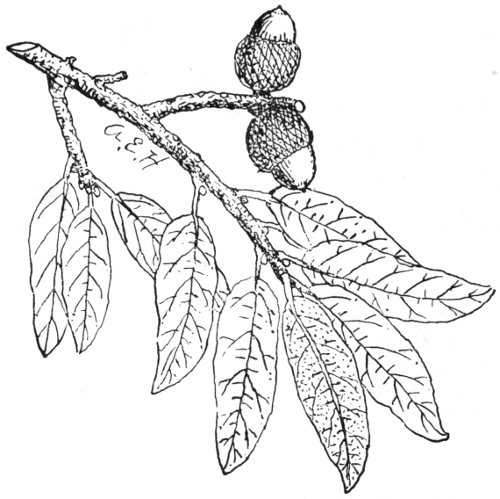
MOHRS OAK (Fruit, natural size; leaf, two-thirds natural size)
The tree has a thin, pale-colored BARK, rough, with deep furrows running up and down the tree.
The deciduous LEAVES of the above small-tree species of shin oak are elliptical, pointed or rounded at the end, smooth or wavy or sometimes lobed or slightly toothed along the margin. They are thick, gray-green, dense hairy beneath, about 3 inches long by 1 inch wide.
The acorns, or FRUIT, occur solitarily or in pairs, on very short peduncles, and mature in one season. They are small, deeply enclosed in a relatively heavy cup, thin toward the outer end.
The WOOD of Mohrs oak is not of economic importance.
54
DURAND OAK (Durand White Oak) Quercus durandii Buckl.
This oak is found on the well-drained soil of river bottoms from the coast region of East Texas to the bottoms of the Guadalupe River (Victoria County) and inland to San Saba County, and the Dallas area.
It forms a tree 60 to 90 feet high with a tall trunk 2 to 3 feet in diameter; comparatively small branches, the lower horizontal, the upper ascending, forming a dense, round-topped, handsome head.
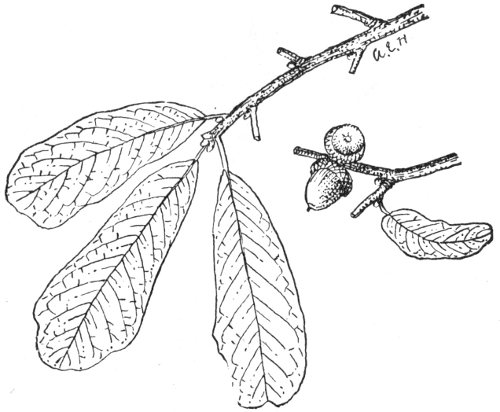
DURAND OAK (Leaves and fruit, one-half natural size)
The BARK is thin, light gray or nearly white and broken into loose appressed scales.
The deciduous LEAVES are 2½ to 7 inches long, yellow-green, thin, smooth on the edges, three-lobed toward the tip, or irregularly lobed, the three forms appearing on different branches of the same tree.
The FRUIT, an acorn, solitary or in pairs on a very short peduncle, is nearly egg-shaped, pale chestnut-brown, shinning, ½ to ¾ inch long, and barely enclosed at the base in the thin saucer-shaped cup. The acorn matures in one season.
The WOOD is hard and heavy and is used largely as fuel.
55
WHITE OAK Quercus alba L.
Within its natural range, which includes practically the entire eastern half of the United States, the white oak is one of the most important timber trees. Found in East Texas to the Brazos River, it commonly reaches a height of 80 feet and a diameter of 3 feet. It is found on high quality soils. Grown in a dense stand it has a long, straight trunk, free of side branches for over half of its height. In the open, it develops a short trunk and broad crown with far-reaching limbs.
The BARK is thin, light ashy gray and covered with loose scales or broad plates.
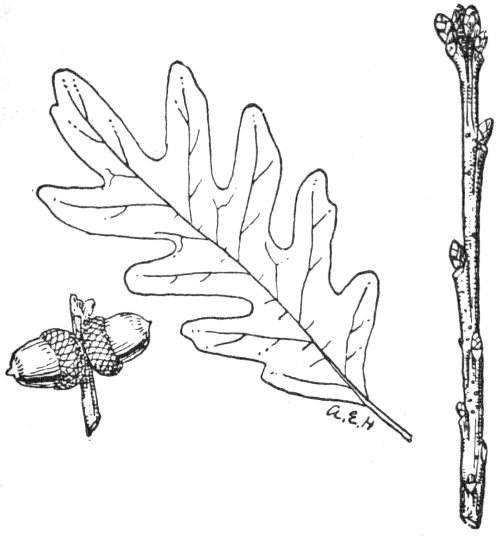
WHITE OAK (Twig, one-half natural size; leaf and fruit, one-third natural size)
The deciduous LEAVES are alternate, simple, 5 to 9 inches long and about half as broad. They are deeply divided into 5 to 9 rounded, finger-like lobes. The young leaves are a soft silvery-gray or yellow or red while unfolding, later becoming bright green and lustrous or dull above and much paler and glaucous below. The FRUIT, an acorn maturing in one season, is ¾ to 1 inch long, light brown, and about one-fourth enclosed in a warty cup. The acorn is relished by hogs and other livestock.
The WOOD is heavy, strong, hard, tough, close-grained, durable, and light brown in color. The uses are many, including construction, watertight barrels, furniture, wagons, implements, interior finish, flooring, and fuel. Although white oak is slow growing, it is valuable for forest, highway and ornamental planting.
56
POST OAK Quercus stellata Wangenh.
Post oak of Texas is usually a medium-sized tree, with a rounded crown, commonly reaching a height of 50 feet and a diameter of 1 foot, but sometimes considerably larger. It is the common oak in Central Texas and occurs frequently in East Texas. It occurs most abundantly on the poorer upland soils that have poor drainage.
The deciduous LEAVES are usually 4 to 5 inches long and nearly as broad, deeply five-lobed with broad rounded divisions, the lobes broadest at the ends. They are thick and somewhat leathery, dark green and shiny on the upper surface, lighter green and rough hairy beneath.
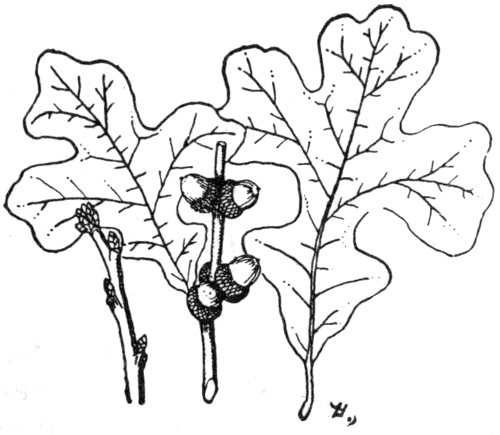
POST OAK (Leaf and twig, one-third natural size; fruit, one-fourth natural size)
The FLOWERS, like those of the other oaks, are of two kinds on the same tree, the male in drooping clustered catkins, the female inconspicuous. The FRUIT, an oval acorn ½ to 1 inch long, is set in a rather small cup which has thin scales and may or may not be stalked. The fruit matures in one season.
The WOOD is heavy, hard, close-grained, light to dark brown, and durable in contact with the soil. It is used for crossties and fence posts, and occasionally for furniture and lumber.
Aside from the typical form, two varieties are found in the state. The variety margaretta (Ashe) Sarg. is the common post oak of eastern Texas.
57
BUR OAK (Mossy-Cup Oak) Quercus macrocarpa Michx.
Bur oak occurs throughout the eastern part of the state and as far west as Callahan and Menard Counties, in rich bottomlands along streams, or on rich hillsides along spring-fed rivers. The name alludes to the fringe around the cup of the acorn, which is sometimes large. The tree usually has a broad top of heavy spreading branches and a relatively short body. In maturity it attains a diameter of 5 feet or more and a height of over 80 feet.
The branches frequently have conspicuous corky ridges after the second year.
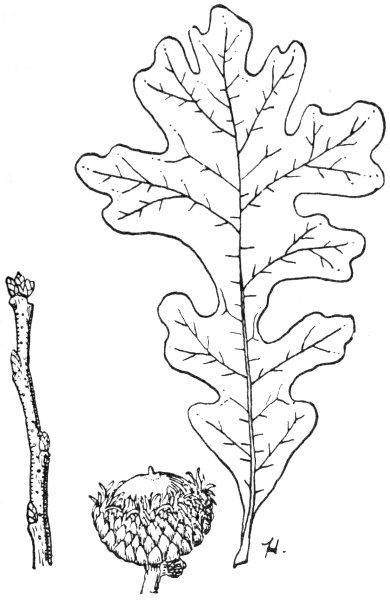
BUR OAK (Illustrations, one-third natural size)
The BARK is light gray and is usually broken up into small narrow flakes. The deciduous LEAVES resemble somewhat those of the common white oak, but are much larger and have a pair of deep indentations on their border near the base, and wavy notches on the broad, middle and upper portions of the leaf. They range from 6 to 12 inches long and 3 to 6 inches wide. The FRUIT, or acorn, is set deeply in the fringed cup. The fruit is usually 1 inch or more in diameter but varies widely in respect to size and the degree to which the nut is enclosed in the mossy-fringed cup. The fruit matures in one season.
The WOOD is heavy, hard, strong, tough and durable. It is used for much the same purposes as the other white oaks—for lumber, crossties, and fuel.
58
OVERCUP OAK Quercus lyrata Walt.
Overcup oak, sometimes known as the swamp post oak or water white oak, becomes a large tree with small, often pendulous branches. It is found in moist, rich bottomlands in East Texas to the Navasota River Valley.
The LEAVES are deciduous, 7 to 9 inches long, 1 to 4 inches broad, oblong, wider toward the point, narrowed at the base, dark green above, often whitish beneath, with 7 to 9 distinct pointed lobes. They frequently turn to a bright scarlet or to scarlet and orange in the fall. The BARK is rough, flaky, and gray tinged with red.
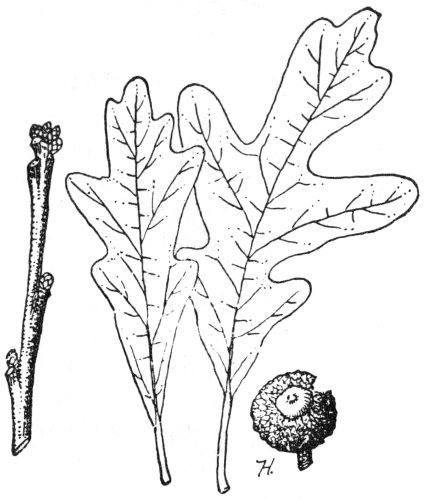
OVERCUP OAK (Leaf and fruit, one-third natural size; twig, two-thirds natural size)
The FLOWERS open with the unfolding of the leaves. The FRUIT, an acorn, ripens in one season. The large rounded or somewhat flattened acorn, an inch or more across and ½ to 1 inch high, is nearly covered by the ovate or nearly spherical cup, which is thickened at the base but gradually grows thinner, often irregularly split at the margin of the cup.
The WOOD is heavy, hard, strong, and durable and is used for the same purposes as that of white oak.
59
SWAMP CHESTNUT OAK Quercus michauxii Nutt.
This species, also called basket oak and cow oak, is distinguished by having a wavy leaf-margin, a large fruit which is sessile or very short stalked, and by the fact that it occurs in its greatest abundance in bottomlands. It is confined chiefly to the eastern part of the state as far west as the Trinity River.
In the appearance of its bark and branches it closely resembles the ordinary white oak, but the leaf lacks deep indentations and the acorn is usually larger. The tree attains heights of about 100 feet and diameters of about 4 feet.
The LEAVES are deciduous, obovate or oblong ovate, notched on the edge somewhat like the chinkapin oak, but the lobes are rounded instead of pointed. They vary from 4 to 8 inches in length, are downy beneath and turn a rich crimson in the fall. The BARK is very light gray, and on old trees is broken into broad flakes or divided into strips.
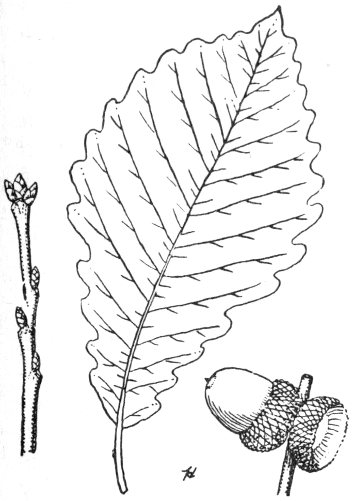
SWAMP CHESTNUT OAK (Twig, one-half natural size; fruit and leaf, one-third natural size)
The acorn, or FRUIT, matures in one season and attains a diameter of more than an inch and a length of 1½ inches. The acorn is a bright, shiny brown and set in a rather shallow cup. The acorn is frequently eaten by cows and this fact gives the tree one of its common names.
The WOOD is heavy, hard, tough, strong, and takes an excellent polish. It is used in manufacturing lumber, veneer, boards (shakes), water-tight barrels, fuel, fence posts, and baskets.
60
CHINKAPIN OAK Quercus muhlenbergii Engelm.
This oak, also known as chestnut oak, occurs over the eastern part of the state and west to the Guadalupe River; also on the Guadalupe Mountains. It grows on most classes of soils, except in swamps, and is tenacious on shallow, dry, limestone soil. The BARK is light gray, and breaks up in the short narrow flakes on the main trunk and old limbs.
It reaches a height of 20 to 50 feet. The straight, shapely trunk bears a round-topped head composed of small branches, which makes it an attractive shade tree.
The LEAVES are deciduous, oblong, 3 to 6 inches in length, 1½ to 3 inches wide, equally toothed or notched on the edges, resembling the leaves of chestnut oak. The FRUIT, which ripens in the fall of the first season, is light to dark brown when ripe, and edible if roasted. This acorn is ½ to nearly 1 inch long, usually less than 1 inch in diameter, and set in a shallow cup.
The WOOD is heavy, hard, strong, durable, and takes an excellent polish. It is used for barrels, fencing, crossties, fuel, and occasionally for furniture.
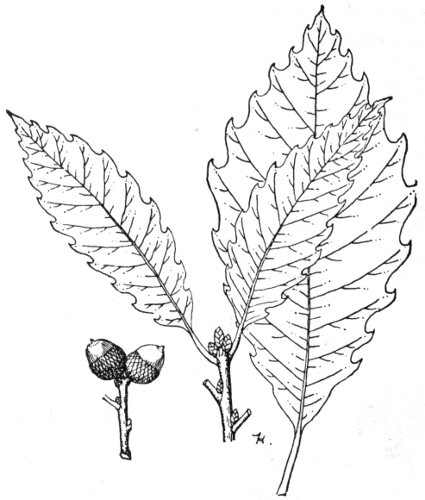
CHINKAPIN OAK (Leaf, one-half natural size; twig and fruit, one-third natural size)
61
AMERICAN ELM (White Elm) Ulmus americana L.
The range of this famous American shade tree extends west to the Dakotas and southward to Coke County, Texas. Within this vast area, it is generally common except in the high mountains and wet bottomlands. It reaches an average height of 60 feet and a diameter of 3 feet. The BARK is dark gray, divided into irregular flat-topped, thick ridges, and is generally firm. An incision into an outer ridge of bark will show alternate brown and cream colored layers. A cross section of slippery elm bark is uniformly cream or tan colored.
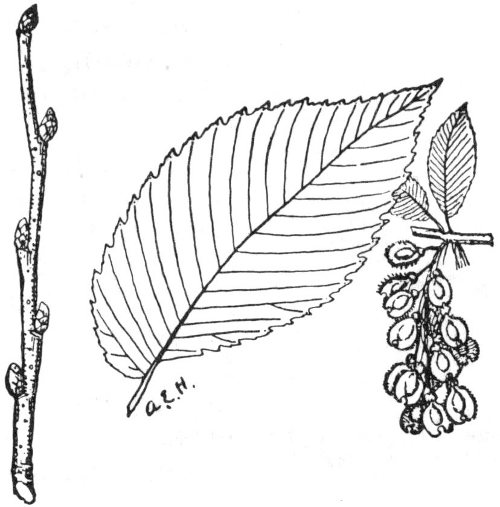
AMERICAN ELM (Twig, one-half natural size; leaf and fruit, one-third natural size)
The LEAVES are alternate, simple, 4 to 6 inches long, rather thick, somewhat lopsided, double toothed on the margin, and either smooth or scabrous above and soft pubescent or glabrate below. The leaf veins are very pronounced and run in parallel lines from the midrib to the leaf margin.
The FLOWERS are small, perfect, greenish, on slender pedicels, soon pendulous, and appear before the leaves. The FRUIT ripens in the spring and is a light green, oval-shaped samara (winged fruit) with the seed portion in the center and surrounded entirely by a wing. A deep notch in the end of the wing is distinctive of the species.
The WOOD is heavy, hard, strong, tough, and difficult to split. It is used for hubs of wheels, saddle trees, veneer for baskets and crates, and slack cooperage.
American elm is rapidly being destroyed in the East and Midwest by the Dutch elm disease and by phloem necrosis.
62
WINGED ELM Ulmus alata Michx.
Winged elm gets its common name from the thin corky growth or “wings”, usually found on smaller branches. These “wings” generally end abruptly at the leaf nodes as contrasted by the cedar elm (p. 63) whose “wings” are generally continuous. On large rapidly growing trees the wings are often absent. It occurs in eastern Texas south to the valley of the Guadalupe River, on dry uplands, and in moist soils along streams and swamps. It grows rapidly in moist situations, and may also be planted along roadsides in relatively dry, poor locations. It is comparatively free from disease, though not long-lived. Winged elm is a medium-sized tree 40 to 50 feet in height and rarely as large as 2 feet in diameter. It forms a rather open, round-topped head.
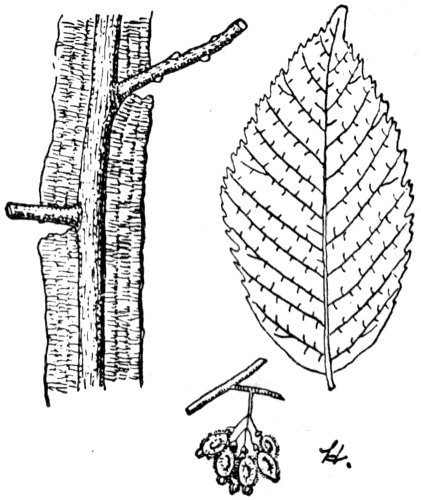
WINGED ELM (Leaf and fruit, one-third natural size; twig, one-half natural size)
The BARK is light brown tinged with red, and divided by irregular shallow fissures into flat ridges.
The LEAVES are simple alternate, 2 to 4 inches long and 1 to 2 inches broad, coarsely double-toothed, thick, dark green and smooth above, and pale and pale-pubescent or glabrous below with auxiliary hairs and prominent veins. The leaves are small and pointed at the tip, which distinguishes them from the small blunt leaves of the cedar elm.
The FLOWERS appear in early spring, long before the leaves unfold. The FRUIT ripens in the spring about the time the leaves appear; it is winged, tipped with two, small, incurved arms or beaks; oblong, reddish-brown; about ⅓ inch long, with a long, slender pedicel at the base, and covered with white hairs.
The WOOD is very similar to that of the other elms—heavy, hard, and difficult to split. It is occasionally used for hubs and mauls. Formerly, rope made of the inner bark was used for binding the covers to cotton bales.
63
CEDAR ELM Ulmus crassifolia Nutt.
Cedar elm is distributed widely over the state, near streams, in deep rich soil, and on dry, limestone hills. It is the most common elm tree of Texas, extending to the Pecos River. It forms a tree up to 75 feet high with a tall straight trunk 2 to 3 feet in diameter, and with an inversely conic round-topped head and drooping branches. It reaches its largest size on the bottomlands of the Guadalupe and Trinity Rivers.
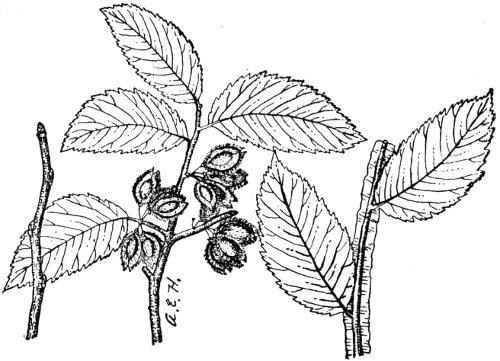
CEDAR ELM (Illustrations, three-fourths natural size)
The BARK is light-brown tinged with red, deeply fissured, with flattened, scaly ridges. The young twigs are finely velvet and reddish, sometimes developing thin corky wings which continue around the leaf nodes.
The LEAVES are small, the largest less than 2 inches long, often double toothed and usually rather blunt at the tip. Their upper surface is dark green and rough, while the lower surface and petiole are hairy.
The FLOWERS, which appear in the autumn, are in small short-pedicelled clusters at the axils of the leaves. The FRUIT, an oval-shaped samara slightly more than ¼ inch long, is hairy all over, especially on the edges and is deeply notched at the tip.
The WOOD is reddish-brown, brittle, and with a thick layer of lighter colored sapwood. The wood is sometimes used in the manufacture of hubs, furniture, and fencing.
64
SLIPPERY ELM (Red Elm) Ulmus rubra Muhl.
Slippery elm, or red elm, is found in the eastern and southern parts of the state as far as the upper Guadalupe and Leon Rivers in Kerr and Comal Counties. It is found principally on the banks of streams and on low hillsides in rich soil. It is a tree of small to moderate size, but noticeably wide-spreading. It is usually less than 40 feet in height and 6 inches in diameter, although trees of larger dimensions are occasionally found.
The BARK on the trunk is frequently 1 inch thick, dark grayish-brown on the surface, uniformly tan or cream colored in cross section, and broken by shallow fissures into flat ridges. The inner bark is used to some extent for medicinal purposes and, when chewed, affords a slippery mucilaginous substance, whence the tree gets its name.
The LEAVES are simple, alternate on the stem, 4 to 6 inches in length, sharp-pointed, their bases unsymmetrical, doubly toothed on the edges, thick, dark green, and very rough above, pubescent below.
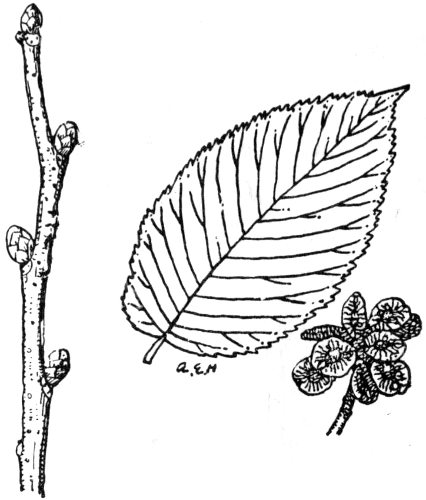
SLIPPERY ELM (Leaf and fruit, one-third natural size; twig, one-half natural size)
The FLOWERS appear in early spring and are nearly sessile. The FRUIT, a samara, ¾ inch long and ½ inch in diameter, consists of a seed surrounded by a thin, broad, greenish wing. The fruit ripens when the leaves are about half grown. The margin of the fruit is not ciliate.
The WOOD is close-grained, tough, strong, heavy, hard, and moderately durable in contact with the soil. Slippery elm and American elm are sold commercially as “soft elm,” and have similar uses.
65
PLANER TREE (Water Elm) Planera aquatica (Walt.) Gmel.
Planer tree or water elm is found on low wet lands along the streams of the eastern part of the state as far west as Brazos and Matagorda Counties. It forms a small spreading tree with a low broad head 30 to 40 feet in height and with a maximum trunk diameter of 20 inches.
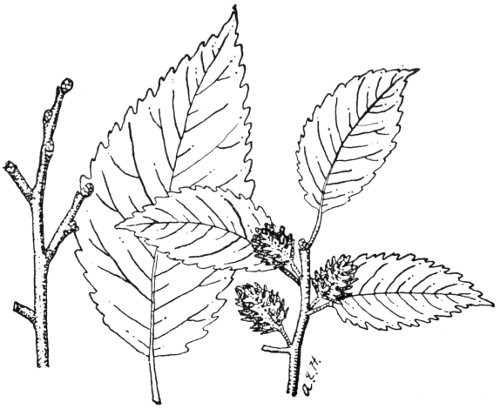
PLANER TREE (Illustrations, nearly natural size)
The BARK is light brown or gray, about ¼ inch thick, and separates into large scales.
The LEAVES resemble those of the small-leaved elms. They are 2 to 2½ inches long, ¾ to 1 inch wide on a short petiole, dark dull green above and paler on the lower surface, and have yellowish veins.
The FLOWERS appear with the leaves in March or early April. The small flowers are sometimes perfect; occasionally the male and female flowers are borne separately on the same tree. The FRUIT is a peculiar, rounded, shaggy-appearing structure, about ⅜ inch long. It consists of a nut-like center covered with soft and irregular wing-like outgrowths which extend out on all sides from the center.
The WOOD is light brown, coarse-grained and soft, very light in weight, and has a broad zone of nearly white sapwood. The wood has little economic value.
66
HACKBERRY Celtis occidentalis L.
Hackberry is found over eastern Texas on various types of soil. It is usually a medium-sized to large tree, becoming 60 to 100 feet or more high and 10 to 20 inches in diameter. Its limbs are often crooked and angular and bear a head made of slender, pendant branches or short, bristly, stubby twigs. In the open, the crown is generally symmetrical. It makes an excellent shade tree.
The BARK is brownish-gray, one inch or more thick, and generally very rough with many scale-like or warty projections of dead bark.
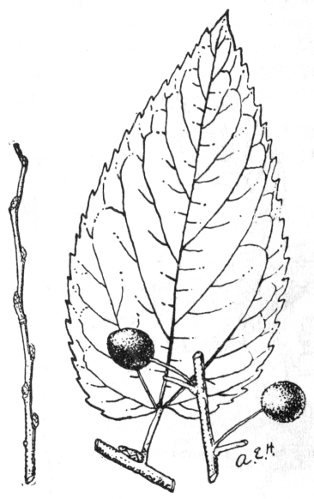
HACKBERRY (Leaf and fruit, two-thirds natural size; twig, one-half natural size)
The LEAVES are simple, ovate, alternate, one-sided, 2 to 4 inches long, thick, very rough above, green on both surfaces, and the edges toothed toward the long point. The FLOWERS are inconspicuous, and the two kinds are borne on the same tree. They appear in April or May, and are of a creamy greenish color. The FRUIT is a round, somewhat oblong, drupe or berry, dark purple, ⅓ inch in diameter, ripening in September. The peduncle (fruit stem) is much longer than the petiole of the leaf. It has a thin, purplish skin, and sweet yellowish flesh. The berries frequently hang on the tree most of the winter.
The WOOD is heavy, rather soft, weak, and decays readily when exposed. It is used chiefly for fuel, and occasionally for lumber.
The range of this hackberry extends far into the northern and northeastern parts of the United States.
67
SUGARBERRY (Sugar Hackberry) Celtis laevigata Willd.
Sugarberry is distributed widely over the eastern half of the state. It occurs most abundantly and attains greatest size in rich alluvial soil, but thrives on various soil types. The species may grow 30 to 50 feet high and 10 to 20 inches in diameter, though sometimes much larger. Its limbs are spreading or pendulous, forming a broad head. Its branchlets are slender, light green, glabrous or pubescent when young, and bright reddish-brown during their first winter.
The BARK is pale gray and covered with prominent excrescences.
The LEAVES are simple, oblong-lanceolate, one-sided, 2½ to 5 inches long, thin, smooth, with the edges entire.
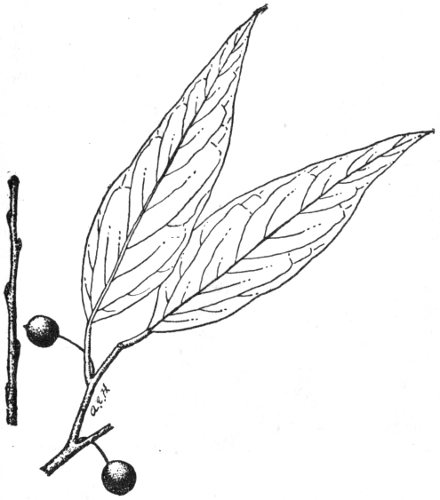
SUGARBERRY (Leaf, fruit, and twig, three-fourths natural size)
The FLOWERS, not conspicuous, are borne on slender, smooth peduncles in April or May, and are of a creamy-greenish color. The FRUIT is short-oblong to pear shaped, orange-red or yellow, ¼ inch in diameter, and ripens in September. The peduncle of the fruit is shorter or slightly longer than the petiole of the leaf.
The WOOD is soft, weak, close-grained, and light yellow, and is used occasionally for flooring and furniture, but chiefly for fuel.
68
RED MULBERRY Morus rubra L.
Red mulberry occurs in eastern Texas and west to the canyon of Devils River, Valverde County. It prefers rich moist soils. It is a small tree, rarely 50 feet high and 2 feet in diameter, often growing in the shade of larger trees.
The BARK is rather thin, dark grayish-brown, and peels off in long narrow flakes.
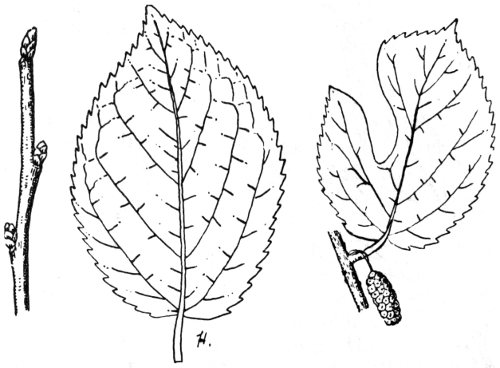
RED MULBERRY (Twig, two-thirds natural size; leaves and fruit, one-third natural size)
The LEAVES are alternate, thin, rounded or somewhat heart-shaped, toothed, pointed, 3 to 5 inches long, rough hairy above and soft hairy beneath. Some of the leaves are mitten-shaped or lobed.
The FLOWERS are of two kinds, on the same or different trees, in long drooping catkins, the female catkins shorter, appearing with the leaves.
The multiple FRUIT is edible, dark purple or black when ripe, and ¾ to 1 inch long.
The WOOD is rather light, soft, not strong, light orange-yellow, and the heartwood is durable in contact with the soil. It is chiefly used for fence posts.
The TEXAS MULBERRY (Morus microphylla Buckl.) is found in West Texas and south from the Colorado River. Its leaves are rarely longer than 1½ inches.
The WHITE MULBERRY (Morus alba L.) a native of China, has become naturalized in the United States.
69
OSAGE-ORANGE (Bois-d’arc) Maclura pomifera (Raf.) Schneid.
Osage-orange, “bodark”, hedge apple, or mock orange is native to eastern and Central Texas; attaining its largest size in the valley of the Red River in the northeast part of the state. It commonly reaches a height of 20 to 40 feet and a diameter of 4 to 12 inches. The BARK is thin, gray, sometimes tinged with yellow; on old trees it is divided into strips or flakes. It contains tannin and has been used for tanning leather. The twigs are armed with stout, straight thorns ⅜ to 1 inch long.
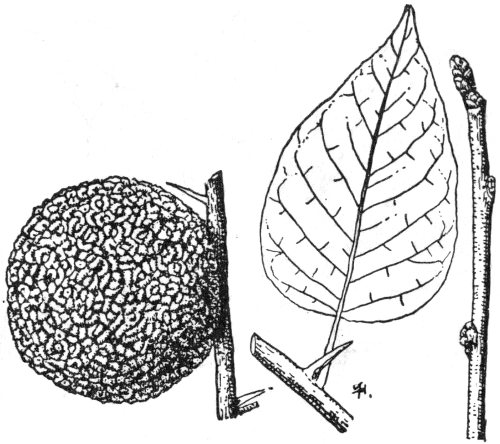
OSAGE-ORANGE (Leaf and fruit, one-fourth natural size; leaf and twig, nearly one-half natural size)
The LEAVES are simple, alternate, oval-pointed and lustrous green on the upper surface, 3 to 5 inches long and 2 to 3 inches wide, and entire. The leaves turn bright yellow in the autumn.
The yellowish FLOWERS appear in May; two kinds on the same tree—the male flowers in a linear cluster and the female flowers a rounded ball. The FRUIT is globular, from 2 to 5 inches in diameter, resembling a rough, green orange.
The WOOD is heavy, exceedingly hard, very strong, and very durable in contact with the soil. The heartwood is bright orange in color, turning brown upon exposure. It is largely used for posts. The Indians prized the wood for bows and war clubs. The tree is planted for windbreaks and hedges. The bark of the roots supply a yellow dye.
70
SOUTHERN MAGNOLIA (Evergreen Magnolia) Magnolia grandiflora L.
Magnolia is one of the best-known trees in the eastern part of the state. No other tree excels it in the combined beauty of leaves and flowers. Occurring naturally in rich moist soil on the borders of river swamps and nearby uplands in the Coastal Plain to the valley of the Brazos River, it has been widely cultivated for its ornamental value. In its natural habitat, it attains heights generally of 60 to 80 feet and trunk diameters up to 4 feet. The dense pyramidal head, or crown, is made up of numerous small spreading branches and branchlets.
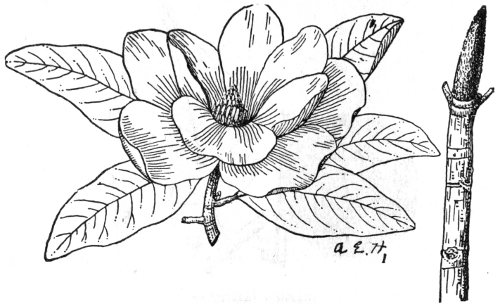
SOUTHERN MAGNOLIA (Leaf and flower, one-fourth natural size; twig, one-half natural size)
The LEAVES are evergreen, thick, leathery, elliptical or oval, dark green and shiny above, rusty or silvery beneath, and mostly from 5 to 8 inches long, and 2 to 3 inches wide, with prominent midribs. They remain on the tree for approximately 2 years.
The large FLOWERS are 6 to 8 inches broad, with pure white petals surrounding a splash of bright purple in the center, and have a pleasing fragrance.
The FRUIT is a rounded or oval aggregate 3 to 4 inches long containing many seeds, each enclosed in a follicle. These open in the fall and display the bright red seeds dangling on slender threads.
The WOOD is moderately heavy, hard, and of a creamy color. It is used chiefly for furniture, Venetian blinds, and fuel.
71
SWEETBAY (Sweetbay Magnolia) Magnolia virginiana L.
Sweetbay, better known locally as white or swampbay, is found in the southern part of the Texas pine belt to western Montgomery County, in swamps and rich, moist soils. Often appearing as a clump of sprouts in open woods, in dense forests it grows as a tree 60 to 90 feet high, and up to 3 feet in diameter.
The bark is light gray; the branchlets silky-white.
The LEAVES are simple, oblong, pale green above and hairy-white beneath, 4 to 6 inches long, 1 to 2 inches wide, remaining on sprout growth to spring, usually dropping from older trees in the fall.
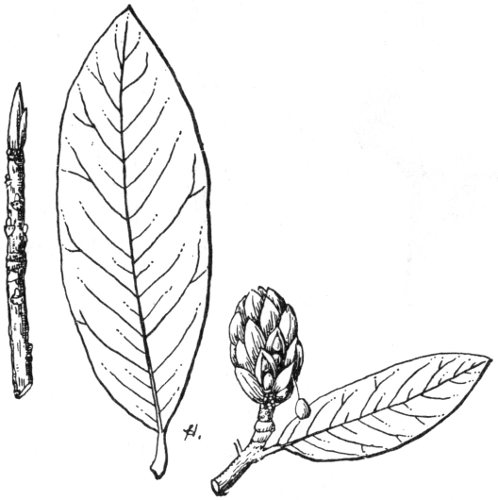
SWEETBAY (Leaf, one-third natural size; twig, two-thirds natural size; fruit, one-fourth natural size)
The fragrant FLOWERS, with 9 to 12 creamy-white petals on slender smooth stems, measure 2 to 3 inches across. They continue to open during several weeks of spring and early summer. The FRUIT aggregate or “bur” is oval-shaped, dark red or brown, about 2 inches long, and contains scarlet seeds which are usually oval, flattened, and less than ½ inch long.
The WOOD is soft, creamy white to reddish, and is used for furniture, boxes, woodenware, and venetian blinds.
72
PAWPAW Asimina triloba (L.) Dunal
This odd and attractive tree does not grow abundantly in Texas and seems to be little known. It is found near streams in the extreme east portion of the state and in greater abundance in Harrison and Grayson Counties. It is seldom over 30 feet high with a trunk 8 or 10 inches in diameter.
The BARK on young trees and branches is a smooth, clean brown; on older trees becoming blotched with gray, and bearing a few small wart-like excrescences.
The LEAVES are obovate—lanceolate, 8 to 12 inches long, light, bright green above and paler below.
The FLOWERS are strikingly characteristic. The three light green, hairy sepals are early deciduous. The outer three petals are a rich brownish-purple and deeply veined. The inner three petals are pointed, glandular, and erect.
The FRUIT is an oblong berry 3 to 6 inches long, and contains a number of large, brown seeds. When ripe it falls to the ground, turning dark brown. The deep yellow flesh is palatable, though some people do not care for its unique flavor. The tree blooms and bears as a shrub or tree.
The WOOD is light, weak, and spongy, yellow in color, and is of no known value.
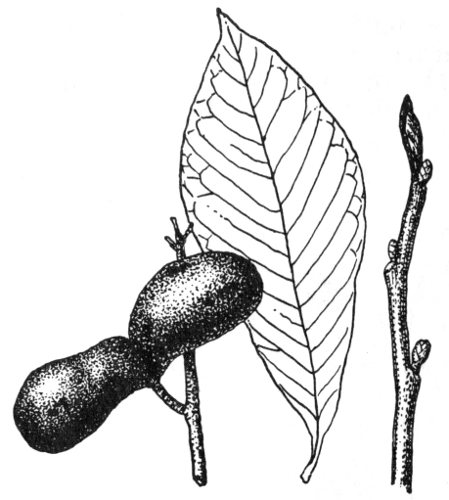
PAWPAW (Leaf, one-fourth natural size; twig, two-thirds natural size)
73
REDBAY Persea borbonia (L.) Spreng.
Redbay is native to the Atlantic and Gulf Coast states from Virginia to southeastern and southern Texas and is a member of the Laurel family. In all, about 100 species of Persea are found in North and South America.
Redbay grows to 70 feet in height and 3 feet in diameter, with a well-shaped head of erect, stout, dark green branches. It grows in moist, rich soils along the streams and in swamps and sometimes in drier soils along with longleaf pine, over the coastal region.
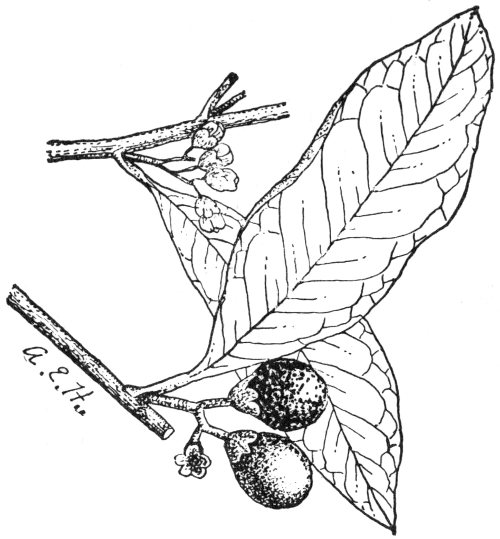
REDBAY (Illustrations, two-thirds natural size)
The aromatic LEAVES are oblong, thick or leathery, up to 4 inches in length and 1½ inches in width, bright green with the margin entire and with a narrow, orange-colored midrib. They remain green over the first winter. The yellowish-white FLOWERS are in small clusters.
The FRUIT is a nearly round, rather fleshy, shiny, dark blue or nearly black drupe, about ½ inch long. It ripens in the autumn and contains a large rounded stone.
The WOOD is heavy, hard, strong, bright red, with thin, lighter colored sapwood. It is used for cabinet-making, and interior house finish, and has been used for boat construction.
SILKBAY (Persea humilis Nash) is a dwarf or low growing shrub or tree 6 to 10 feet in height occurring in southern Texas.
74
SASSAFRAS Sassafras albidum (Nutt.) Nees
This small tree with aromatic leaves and twigs is usually not over 40 feet in height or a foot in diameter. It is common in Texas west to the Brazos River on the drier soils, and is one of the first broad-leaved trees to grow on abandoned fields, where the seeds are dropped by birds. The species is closely related to the camphor tree of Japan. The BARK is red-brown and deeply furrowed while the bark of the twigs is bright green.
The LEAVES are unusual in that they vary widely in shape on the same tree, or even on the same twig. Some are oval and entire, 4 to 6 inches long; others have one lobe, resembling a mitten; while still others are divided at the outer end into 3 distinct lobes.
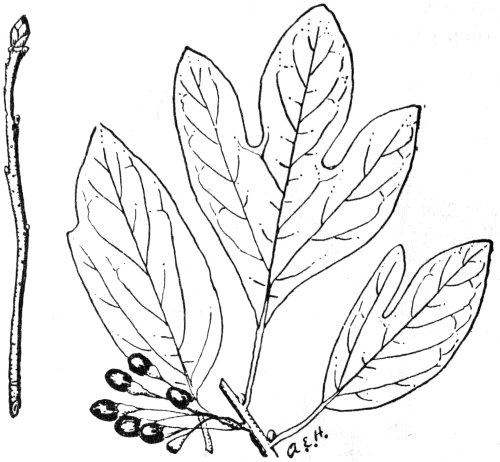
SASSAFRAS (Twig, one-half natural size; leaf and fruit, one-third natural size)
The FLOWERS are clustered, greenish-yellow, and open with the first unfolding of the leaves. The male and female flowers are usually on different trees. The FRUIT is an oblong, dark blue or black lustrous drupe surrounded at the base by what appears to be a small orange-red or scarlet cup at the end of the scarlet peduncle.
The WOOD is light, soft, weak, brittle, and durable in the soil; the heartwood is dull orange-brown. It is used for posts and crossties. The bark of the roots yields the very aromatic oil of sassafras much used for flavoring candies and various commercial products. The bark of the root is sold in small bundles for making sassafras tea.
75
WITCH-HAZEL Hamamelis virginiana L.
This tall-growing shrub which has the peculiar habit of blooming in the late fall and ripening its fruit in early spring is native to the extreme eastern portion of Texas, being found on rich soils of streams or along the borders of the forest.
The BARK is smooth, white, gray, and mottled with light brown.
The LEAVES are usually obovate, 3 to 5 inches long, prominently veined, with a wavy margin, very irregular at the base, bright green above and slightly paler below. They are generally smooth.
The odd, yellow FLOWERS are borne in clusters along the branch, with long, very narrow twisted petals. They develop during November, December, and January, the time depending somewhat on the weather, and possess a refreshing fragrance. The FRUIT is a hard, tough, two-celled capsule, with two beaks. It divides in half, each half containing a shiny black seed. In the late summer or early autumn the capsules pop open, discharging the seeds.
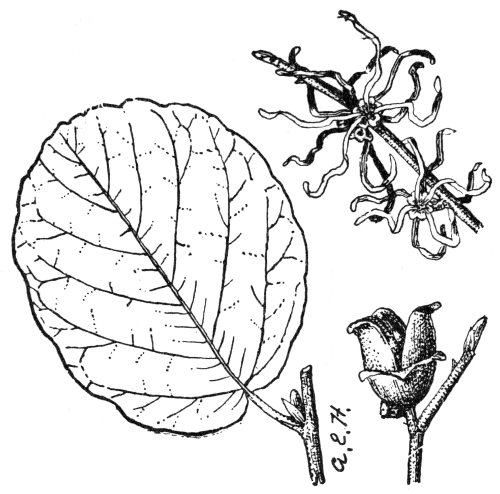
WITCH-HAZEL (Leaf, one-half natural size; flower and fruit, natural size)
The WOOD is hard and close-grained. The trees do not grow large enough to be of commercial value.
An analgesic extract used in lotions and balms is obtained from the inner bark by distillation.
76
SWEETGUM (Redgum) Liquidambar styraciflua L.
Sweetgum is a valuable and sometimes troublesome forest tree in East Texas. It occurs on rich river bottoms and in swamps subject to frequent overflow, as well as on the dried uplands, as far west as the San Jacinto River Basin. The BARK is a light gray, roughened by corky scales, later becoming deeply furrowed. After the second year the twigs often develop corky projections of bark, which give them a winged appearance.
The simple, alternate star-shaped LEAF with its 5 to 7 points or lobes, is 5 to 7 inches across and aromatic. In the fall its coloring ranges from pale yellow through orange and red to a deep bronze.
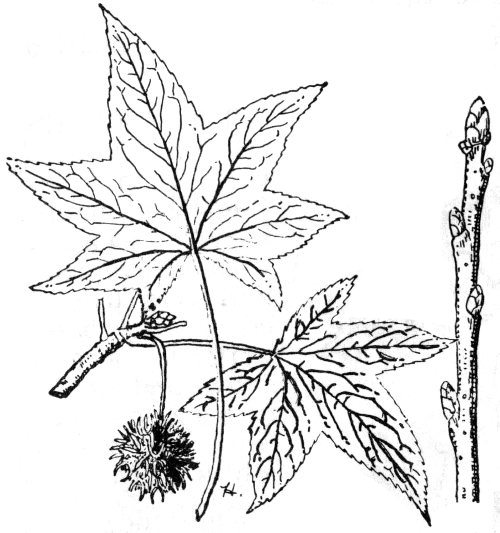
SWEETGUM (Leaf and fruit, one-third natural size; twig, two-thirds natural size)
The FLOWERS of both sexes appear on the same tree and open with the leaves. The FRUIT, a head an inch or more in diameter, is made up of many capsules with projecting spines. It hangs on the tree late into the winter.
The WOOD is moderately hard, close-grained, and not durable on exposure. The reddish-brown heartwood, which suggests the name red gum, is not present to any appreciable extent in logs under 16 inches in diameter. The wood is extensively used for flooring, interior finish, paper pulp, and veneers for baskets of all kinds.
In the uplands, this species competes aggressively with the more valuable Southern pines. The control of sweetgum is, therefore, a problem. This attractive species should be more widely planted for ornamental use.
77
AMERICAN SYCAMORE Plantanus occidentalis L.
American sycamore, also called planetree and buttonwood, is considered the largest hardwood tree in North America. It occurs throughout eastern Texas to Zavalla County. It is most abundant and reaches its largest size along streams and on rich bottomlands. It grows rapidly and occasionally attains a height of 140 to 170 feet and a diameter of 10 to 11 feet.
The BARK of the sycamore is a characteristic feature; on the younger trunk and large limbs it is smooth, greenish-gray in color. The outer bark of limbs and upper trunk flakes off in large patches and exposes the nearly white younger bark. Near the base of old trees, the bark becomes thick, dark brown and divided by deep furrows.
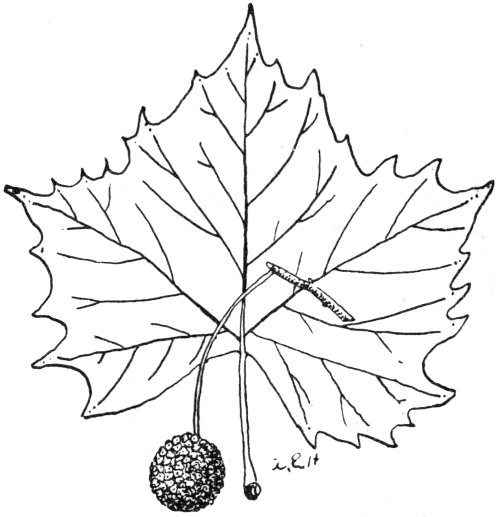
AMERICAN SYCAMORE (Fruit and leaf, one-third natural size)
The LEAVES are simple, alternate, 4 to 7 inches long and about as broad; light green and smooth above, and paler below. The base of the petiole is hollow and in falling off exposes the winter bud. The multiple FRUIT forms a ball about 1 inch in diameter, which hangs on its flexible peduncle—3 to 5 inches long. During early spring the fruit ball breaks up, and the small nutlets are scattered widely by the wind.
The WOOD is hard and moderately strong, but decays rapidly in the ground. It is used for butchers’ blocks, tobacco boxes, furniture, and interior finish.
78
HAWTHORN (Haw) Crataegus L.
Hawthorn, as treated here, represents about 30 different species and varieties distributed throughout the state. Members of the group occur on the poorest and richest soils, on the shallowest and deepest, and on the limestone hills as well as on the rich bottom and swamp lands. Most of the forms have a common likeness in possessing thorns and bearing white blossoms and red or yellow fruit. Some species are planted as ornamental trees, but otherwise the group is of little commercial value.
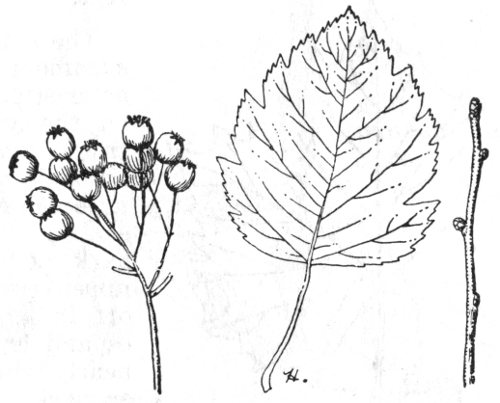
HAWTHORN (Leaf and twig, two-thirds natural size; fruit, one-half natural size)
The BARK is generally thin, gray in color, and on the old stems broken up into thin, narrow scales.
The LEAVES are simple, alternate, mostly oval or wedge-shaped, notched on the edges, and usually from 2 to 3 inches long.
The FLOWERS are white, some fragrant and others with a slightly unpleasant odor; they appear in early spring. The FRUIT varies from globular to oblong, from ¼ to ¾ inch in diameter; some when ripe have a pulpy, sweet, edible flesh, surrounding from 1 to 5 bony seeds.
The WOOD is strong, tough, heavy, hard, but rarely used for any purpose.
Many species of birds are attracted to these trees and bushes by the fruit and for the protection offered for nesting. Blueberry hawthorn, C. brachyacanthu, fruit ripens in the late summer and is valuable for deer food. The fruit of most species ripens in the fall, and one or two varieties yield a fruit highly prized for making jelly.
79
RIVERFLAT HAWTHORN (Mayhew) Crataegus opaca Hook. and Arn.
This species is a native of East Texas, being found as far west as the Trinity River. It grows along rivers at the edges of swamps and ponds, where water stands a part of the year. These trees often form extensive thickets. The FRUIT of this haw, unlike other Texas haws, matures in late April or May. After the fruit is gone, it is more difficult to distinguish it from other haws. It is of low, spreading habit, sometimes becoming a tree 20 to 30 feet high and about a foot in diameter. It usually bears a few thorns about 1 inch long on branches two years old.
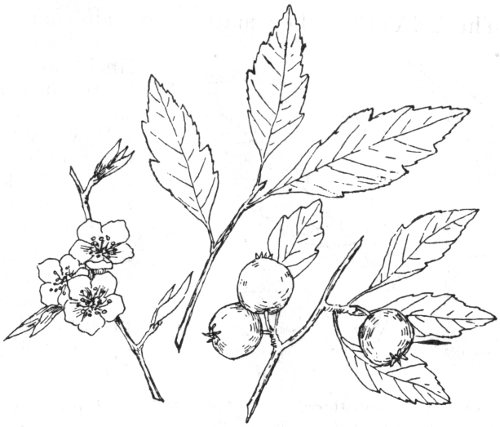
RIVERFLAT HAWTHORN (Leaves, flowers, and fruit, one-half natural size)
On old trees the BARK is deeply fissured and divided into dark brown, persistent scales. The wood has no commercial value.
The LEAVES are about 2 inches long, pointed, narrowing toward the stem, finely toothed from the middle of the tip, sometimes slightly lobed, dull green, and rather downy beneath.
The FLOWERS appearing in March are the largest of Crataegus, 1 inch in diameter, white, and borne in clusters of only 2 or 3. The FRUIT, an unusually large haw, is sometimes nearly an inch in diameter. When fully ripe, these haws are scarlet, lustrous, mellow, and pleasantly acid. The fruit is gathered in large quantities for making mayhaw jelly.
80
MEXICAN PLUM Prunus mexicana S. Wats.
This common wild plum is a small tree reaching 20 to 25 feet in height and 8 to 10 inches in diameter. Uncommonly it attains only large shrub size.
The BARK is dark, varying from gray to nearly black. There are curling scales on young branches but on old trunks the bark becomes rough and deeply furrowed.
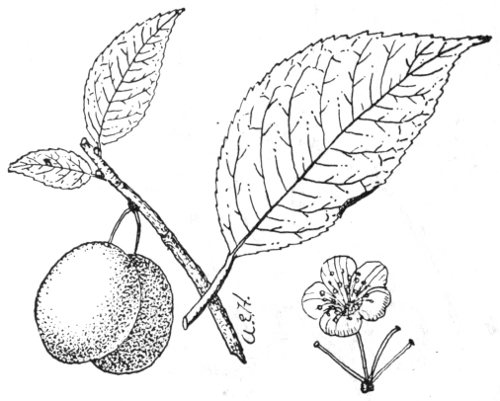
MEXICAN PLUM (Leaf, three-fourths natural size; flowers and fruit, one-half natural size)
The LEAVES, when mature, are alternate, oval, abruptly pointed, finely and doubly toothed along the margin, dark yellow-green, smooth and shiny, thick and firm, 2 to 3 inches long by 1 to 2 inches wide, narrowed or rounded at the base and prominently veined on both surfaces.
The white FLOWERS appear in numerous small clusters in March before the leaves. With a profusion of flowers, this tree is one of the delights of early spring in the woods. The FRUIT, or plum, which ripens in late summer, is dark purple-red color with a bluish “bloom”, about 1¼ inches in diameter, and varies widely in its palatability. The stone is about ¾ inch long, and smooth. The dorsal edge is ridged; the ventral edge grooved.
This species of plum does not sucker to form thickets, is drought resistant, and has been used for grafting stock for the production of commercial plums.
81
FLATWOODS PLUM (Black Sloe) Prunus umbellata Ell.
This shrub or small tree with a short, often crooked, or inclining trunk and a flat-topped head and slender branches is rarely over 20 feet high. Branchlets at first covered with a dense, pale pubescence, soon become smooth and bright red during the first year and dull dark brown the second year. It occurs throughout the eastern portion of the state.
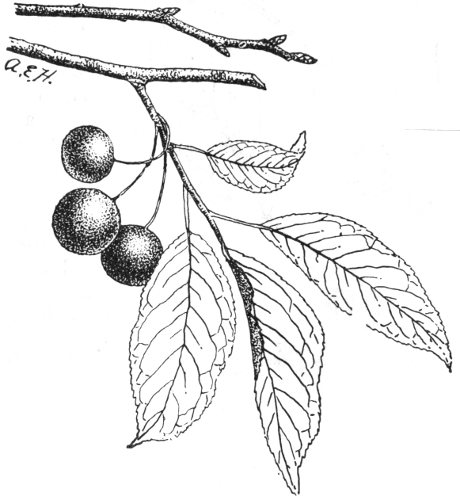
FLATWOODS PLUM (Two-thirds natural size)
BARK ¼ inch thick, dark brown, almost black, and broken diagonally into small, hard, appressed, persistent scales. LEAVES bright bronze-green with red margins and petiole when they unfold; at maturity, usually less than 2½ inches long, ovate-lanceolate to oblong with a rounded or slightly cordate base; leaf thin, dark green above, paler below; usually furnished with two large dark glands at the base; margins finely and sharply serrate with incurved teeth.
Small white FLOWERS appearing in umbels of 3 or 4 flowers before the leaves. Flowers ⅔ inch in diameter. FRUIT a drupe on a stem ½ to 1 inch long, round, ½ inch in diameter, and with a tough, black, yellow, or bright red skin covered with a glaucous bloom, and with thick, acid flesh. Stone flattened, brittle-walled, and wrinkled. Dorsal edge grooved; ventral edge with conspicuous ridge. The fruit is relished by deer.
82
BLACK CHERRY Prunus serotina Ehrh.
A medium-sized tree, up to about 70 feet high and 1 to 3 feet in diameter, black cherry is found in eastern Texas and in the mountains of West Texas. The forest-grown trees have long clear trunks with little taper. Open-grown trees have short trunks with many branches and irregular spreading crowns. The BARK on branches and young trunks is smooth and bright reddish-brown, marked by conspicuous, narrow, white, horizontal lines, and has a bitter almond taste. On the older trunks the bark becomes rough and broken into thick, irregular plates.
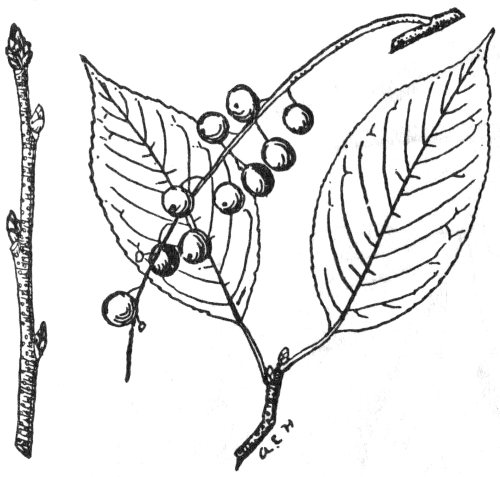
BLACK CHERRY (Leaf and fruit, one-third natural size; twig, two-thirds natural size)
The LEAVES are alternate, simple, oval to lance-like in shape, 2 to 6 inches long and 1-1½ inches wide, with fine, incurved serrations, shiny above, and paler beneath. Cattle eating wilted leaves may be fatally poisoned.
The FRUIT is a dull purplish-black drupe, about as large as a pea, and is borne in long hanging panicles. The fruit ripens in late summer, is edible though slightly bitter, and is relished by wildlife.
The WOOD is reddish-brown with yellowish sapwood, moderately heavy, hard, strong, fine-grained, and does not warp or split in seasoning. With the exception of black walnut, cherry lumber has a greater unit value than any other hardwood of the eastern United States. Cherry is prized for furniture.
The SOUTHWESTERN BLACK CHERRY, Prunus serotina var. rufula (Woot. and Standl.) McVaugh is found in the Guadalupe Mountains of West Texas. At least five other cherry species are native to Texas. All have shrubby growth.
83
CAROLINA LAURELCHERRY Prunus caroliniana (Mill.) Ait.
Called by many local names such as cherry laurel, wild peach, and mock orange, this species is native to the eastern portion of the state to the valley of the Guadalupe River, where it is found on deep rich moist bottomlands. It is apparently free from disease and quite adaptable for landscape planting. It is usually a small tree but sometimes reaches a height of 50 to 60 feet and 18 inches in diameter when cultivated. The partially withered leaves and young branches can be fatal to animals browsing upon them, owing to presence of poisonous hydrocyanic acid.
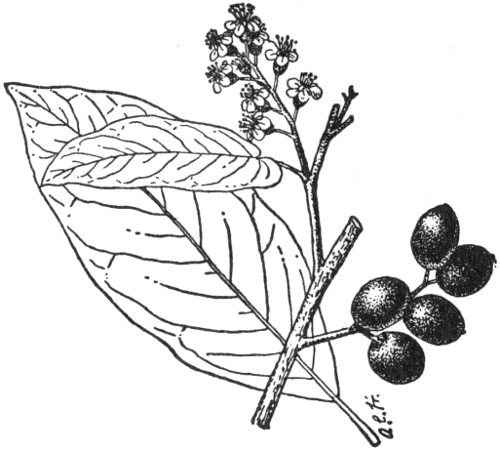
CAROLINA LAURELCHERRY (Two-thirds natural size)
The BARK is rather smooth, gray, and marked by almost black blotches.
The LEAVES are persistent, oblong-lanceolate, with a few tiny sharp teeth along the margins, dark lustrous green above, paler below. They cling until the second year.
The small white FLOWERS come in clusters, in early spring. The FRUIT, a lustrous black drupe, ripens in autumn, and clings until the following spring. The fruit is eaten by some birds.
The WOOD is heavy, hard, strong, close-grained, rich brown in color, with a thick, lighter colored sapwood.
84
EBONY BLACKBEAD (Texas Ebony) Pithecellobium flexicaule (Benth.) Coult.
This beautiful evergreen occurs as a small tree or shrub in South Texas from Matagorda Bay and south into Mexico. Its short spreading branches, forming a wide, round head, carry stout zigzag brachlets, dark reddish-brown or light gray, armed with persistent stipular spines ¼ to ½ inch long.
The LEAVES, about 2 inches long, are feather-like (twice pinnate) with sessile, leathery leaflets that are dark green and shiny on the upper surface, paler on the lower surface, and ¼ to ⅓ inch long.
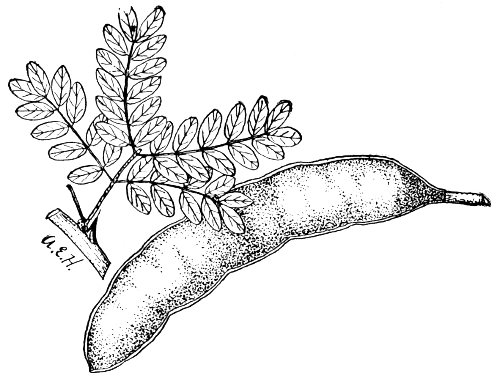
EBONY BLACKBEAD (Leaf and fruit, two-thirds natural size)
The FLOWERS are light yellow or cream colored, fragrant, and bloom from June to August in dense cylindric or interrupted spikes 1½ inches long.
The FRUIT ripens in the fall and remains on the branches until after the flowering season the following year. It is a flattened, curved, hairy pod, 4 to 6 inches long, and about 1 inch wide.
The WOOD is very heavy, hard, close-grained, dark red-brown tinged with purple, almost indestructible when used for fence posts, and valued for cabinet work.
The tree is considered the most valuable species in the lower Rio Grande Valley. Mexicans use the seed as a substitute for coffee.
85
CATCLAW ACACIA (Una de Gato) Acacia greggii A. Gray
Found on dry gravelly mesas, the sides of low canyons and the banks of mountain streams in the Rio Grande Valley and westward, this small tree rarely reaches a height of 30 feet, and has a trunk up to 12 inches in diameter. The top or head consists of numerous spreading branches and smooth pale brown or red branchlets, armed with stout curved spines.
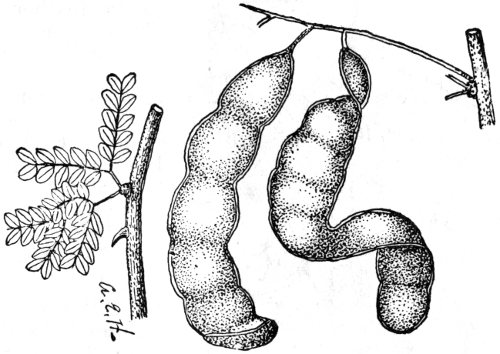
CATCLAW ACACIA (Fruit and leaves, one-half natural size)
The small, bipinnately compound LEAVES with 1 to 3 pinnae, the leaflets of which are about ¼ inch long.
The fragrant yellow FLOWERS appear during the summer in dense, oblong, pubescent spikes, usually 2 to 3 in a cluster at the end of a branch.
The FRUIT matures by midsummer into a twisted or distorted pod, 2 to 4 inches long by about ¾ inch wide. The pod is smaller between each of the 6 to 8 seeds, which are nearly round, flattened, dark brown and shiny. The pods hang unopened on the branches until the winter or the following spring.
The WOOD is heavy, hard, strong, close-grained, durable, and clear brown or red in color.
86
GREGG LEADTREE Leucaena greggii S. Wats.
This small, beautiful tree grows wild in western Texas from the upper San Saba River to Devil’s River. It grows along the banks of streams and in moist ravines, and reaches a size of 15 to 20 feet in height and 4 to 5 inches in diameter.
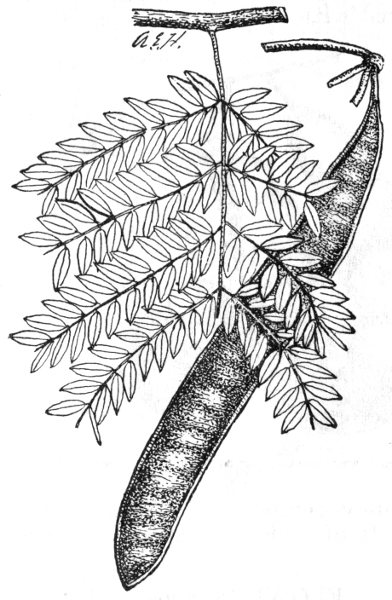
GREGG LEADTREE (Leaf and fruit, two-thirds natural size)
The LEAVES are finely and doubly compound; with 10 to 14 feather-like pinnae, each containing from 30 to 60 small leaflets, arranged along opposite sides of the rachis. Each leaflet is elliptical, grayish-green or bluish-green, smooth, and about ⅓ inch long.
The white FLOWERS are clustered in dense round heads, about 1 inch in diameter, borne on a long peduncle. Each tiny flower has protruding hairs which give the head a fuzzy appearance.