Forest Trees of Texas How To Know Them
Reading edition
Eighth Edition Ninth Printing October, 1990
TEXAS FOREST SERVICE A PART OF THE TEXAS A&M UNIVERSITY SYSTEM COLLEGE STATION, TEXAS
BULLETIN 20 APRIL, 1963
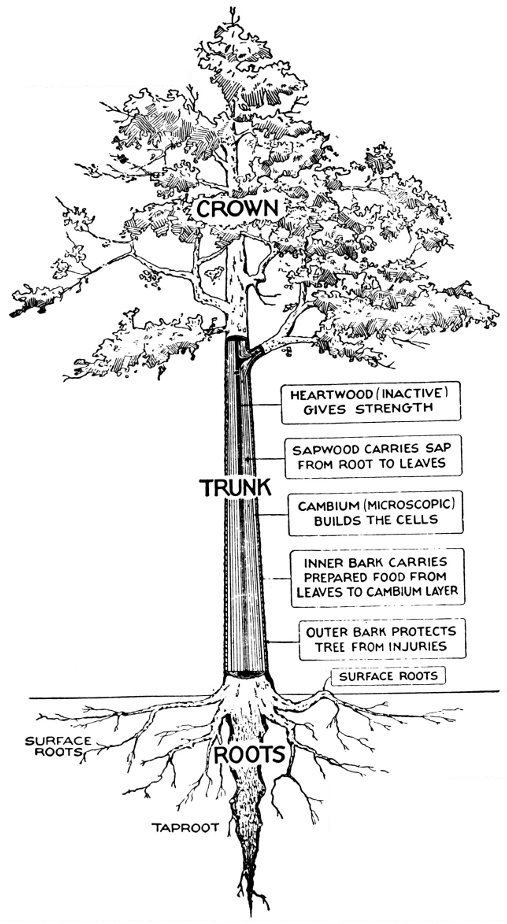
CROWN TRUNK HEARTWOOD (INACTIVE) GIVES STRENGTH SAPWOOD CARRIES SAP FROM ROOT TO LEAVES CAMBIUM (MICROSCOPIC) BUILDS THE CELLS INNER BARK CARRIES PREPARED FOOD FROM LEAVES TO CAMBIUM LAYER OUTER BARK PROTECTS TREE FROM INJURIES ROOTS SURFACE ROOTS TAPROOT
Tree increases each year in height and spread of branches by adding on new growth of twigs
Air supplies carbon the principal food of the tree taken in on under surface of leaves.
Leaves prepare the food obtained from air and soil and give off moisture by transpiration. Light and heat are necessary for the chemical changes
The breathing pores of the entire tree,—on leaves, twigs, branches, trunk and roots take in oxygen. Flooding, poisonous gases, or smoke may kill a tree
Root tips or root hairs take up water containing small quantity of minerals in solution
The buds, root tips, and cambium layer are the growing parts of the tree. Water containing a small quantity of minerals in solution is absorbed by the roots, carried up through the sapwood to the leaves and there combined with carbon from the air to make food. This food is carried by the inner bark to all growing parts of the tree, even down to the root tips
2
ACKNOWLEDGMENTS
The first edition of Forest Trees of Texas—How to Know Them was assembled by W. R. Matoon and C. B. Webster in 1928. The sections, “Trees as Mankind’s Friends”, “Studying a Tree”, “Other Texas Trees”, drawings of twigs, leaves and fruits, and the glossary were incorporated into the fourth and fifth editions by S. L. Frost and D. A. Anderson. The sixth and seventh editions were edited by H. E. Weaver and W. A. Smith, respectively. Some of the drawings used in this publication were made available by the United States Forest Service.
The eighth edition was revised and edited by John A. Haislet to conform with the nomenclature in Check List of Native and Naturalized Trees of the United States (Including Alaska), Agriculture Handbook No. 41, prepared under the direction of the United States Forest Service Tree and Range Plant Committee. D. A. Anderson’s “A Guide to the Identification of the Principal Trees and Shrubs of Texas” was revised and incorporated in the eighth edition to give it greater utility to the non-technical student of trees.
3