STUDYING TREES
Reading edition
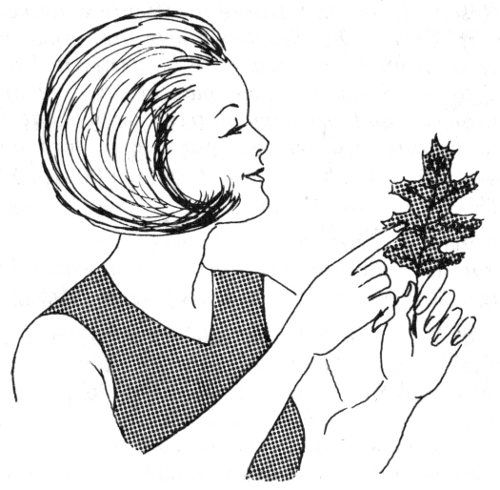
Trees, like people, become friends only when we have become well acquainted with them and have a knowledge of the characteristics that make them something special to us. This bulletin about the trees of Texas may be used as a handy reference for identifying trees you do not know, or it may be used as the basis for developing tree friends. The following is a guide or lesson plan that will help make a friend of each tree studied.
9
I. Object of Study
Each kind of tree has certain identifying characteristics which mark it as being different from other kinds of species of trees. By careful observation and examination these identifying points may be learned and you can feel that you know the tree.
II. Source of Study Material
1. The locality in which you live probably has some trees you know. Why do you know them? Start by studying these trees and make them fast friends.
2. You also will find some trees you are not sure about or do not know; next, study these one by one until you are sure you will always know them.
3. Wherever you may be or whenever you see a tree you do not know, observe it carefully, collect enough facts and sample material to study until you learn to know it.
4. Books, articles, pictures and references will help to learn some trees you cannot actually see but which are of interest to you.
III. Approach to Tree Study
1. One tree should be studied at a time as a general rule although it may be an advantage to select somewhat similar trees and study them by comparisons.
2. Field study of the growing tree is the most satisfactory. Observe a number of the same kind of trees as there are individual variations in some characteristics.
3. If possible collect for reference and further study samples of leaves, twigs, bark, wood, flowers and fruit. BE CAREFUL in collecting samples. It is better not to have samples than to deface or injure the tree. No one will object to your studying their trees if you do no damage.
IV. Procedure
1. General
(a) First observe the tree as a whole taking into consideration all the points that attract your attention. Very often there will be some one thing that either alone or in relation to other points attracts your attention. That feature when studied may be the key to your really learning to know the tree.
(b) The suggestions that follow as to observations of various parts of the tree do not limit the study of those points for perhaps you will learn to know the tree from some feature not listed.
2. Form of tree
Note the size, shape and branching habit; observe its location in relation to other trees that might affect its form.
10
3. Bark
Observe thickness, roughness, type of fissures and color of bark. Studying the bark as a means of winter identification is particularly worthwhile.
4. Leaves
Study type, size, shape and variations on the same tree; note arrangement on twigs; describe by the blade, stalk, margin, venation, base and tip; know their texture and color.
5. Twigs
Note lateral arrangement on branches; observe whether flexible or stocky and whether rough or smooth; study differences between new growth and old; learn any distinctive color, smell, or taste; cut a cross-section and note size, shape, color and size of pith; note presence or absence of lenticels.
6. Buds
Like bark, the buds are helpful in winter identification. Note size, scale coverings, and shape. Observe arrangement and position on twigs; compare terminal and lateral buds.
7. Leaf-scars
Study scars left by falling leaves as to size, form, position and occurrence; note bundle-scars (appear as marks in scar) as to number, shape, size, and arrangement.
8. Flowers
Study promptly at proper season; trees vary widely in flowering habits; observe as to size, form, shape of parts, color and arrangement; and learn whether the tree has one or two kinds of flowers—if two, whether male and female flowers are on same tree.
9. Fruit
Study of fruit also is seasonal. When it is available, observe type, form, structure and method of distribution.
10. Wood
Identification of trees by wood forms a separate study but often field identification of trees can be aided by observation of distinctive points about the wood such as color, taste and general structure.
11. Habitat
An interesting and often useful help in tree identification is to note the growing habits of trees, whether in dry or moist places, what other species same type sites, whether it grows better in open places or in more sheltered locations and the like.
11
V. Summary
If you have followed through on your study of a tree, covering the eleven points listed, you will really know the tree for all time. However, even if you cannot or do not make your study as thoroughly as is suggested, you should at least select enough distinctive characteristics about the tree to study that you will be able to identify it both in the summer and the winter seasons.
VI. References
Your school and public library should have one or more books on trees. You will find books on southern trees most helpful. While it is impractical to provide a complete list of books on trees, the partial list below is furnished for your information, with the understanding that no discrimination is intended:
Fernald, M. L. Gray’s Manual of Botany. Eighth edition. American Book Company, 1950.
Green, C. H. Trees of the South. The University of North Carolina Press, 1939.
Harrar, E. S., Harrar, J. G. Guide to Southern Trees. Whittlesey House, 1946.
Kearney, T. H., Peebles, R. H. Arizona Flora. University of California Press, 1951.
Sargent, C. S. Manual of the Trees of North America. Second Edition. Houghton Mifflin Co., 1922 (at ).
Vines, R. A. Native East Texas Trees. Houston Museum of Natural History, 1953.
Vines, R. A. Trees, Shrubs and Woody Vines of the Southwest. The University of Texas Press, 1960.
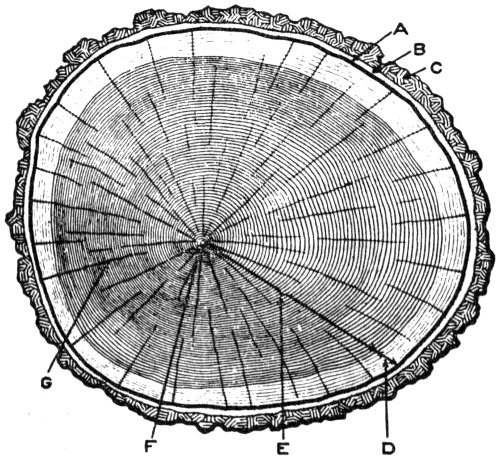
Cross Section of the Trunk of an Oak Tree.
A. Cambium
B. Inner bark
C. Outer bark
D. Sapwood
E. Heartwood
F. Pith
G. Ray
12
TWIG FEATURES
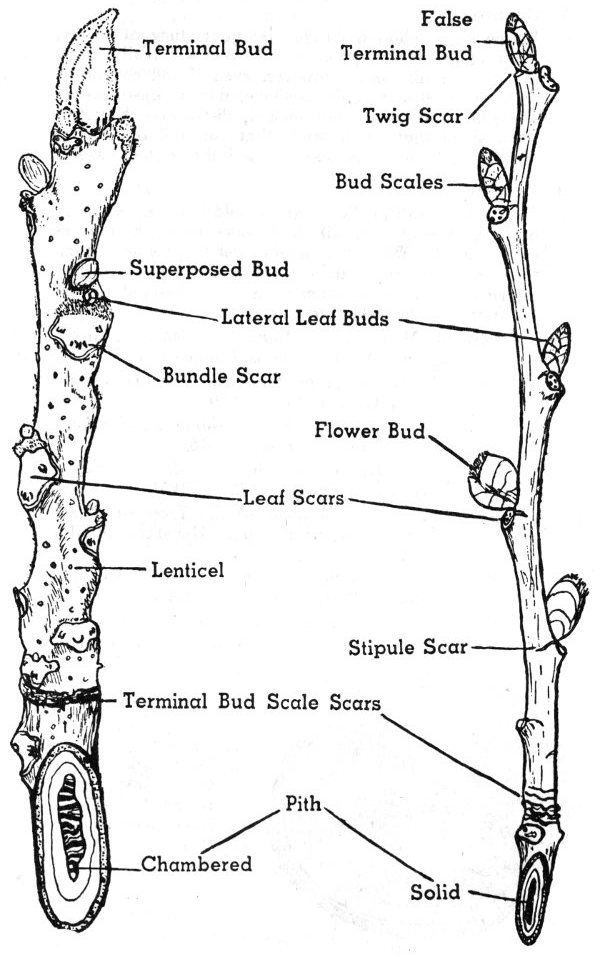
Terminal Bud False Terminal Bud Twig Scar Bud Scales Superposed Bud Lateral Leaf Buds Bundle Scar Flower Bud Leaf Scars Lenticel Stipule Scar Terminal Bud Scale Scars Pith Chambered Solid
13
TWIGS AND LEAVES
TYPES OF TWIG BRANCHING
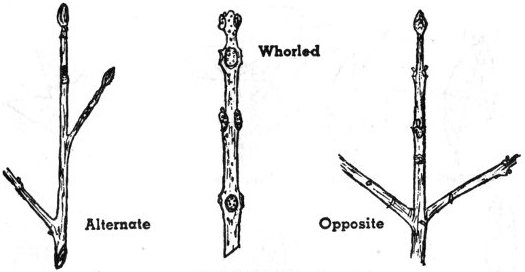
Alternate Whorled Opposite
LEAF TYPES
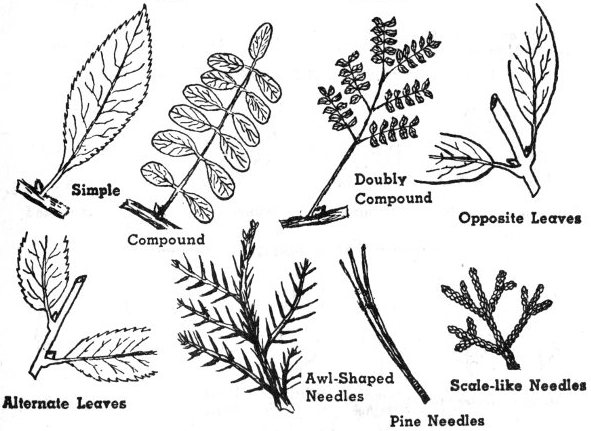
Simple Compound Doubly Compound Opposite Leaves Alternate Leaves Awl-Shaped Needles Pine Needles Scale-like Needles
PARTS OF LEAF
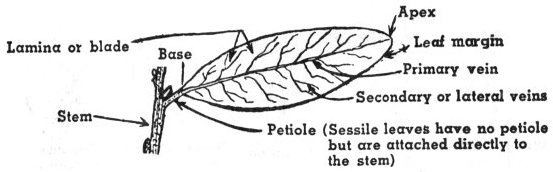
Lamina or blade Base Stem Apex Leaf margin Primary vein Secondary or lateral veins Petiole (Sessile leaves have no petiole but are attached directly to the stem)
14
LEAF SHAPES
LEAF FORMS
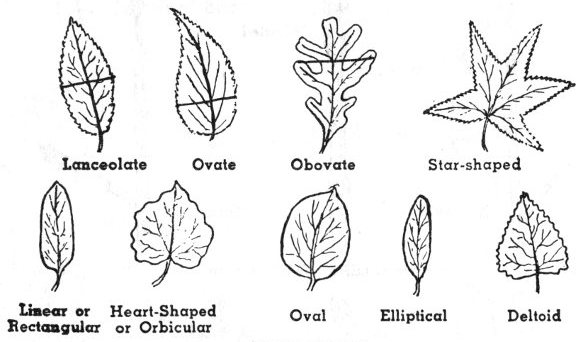
Lanceolate Ovate Obovate Star-shaped Linear or Rectangular Heart-Shaped or Orbicular Oval Elliptical Deltoid
LEAF APEXES
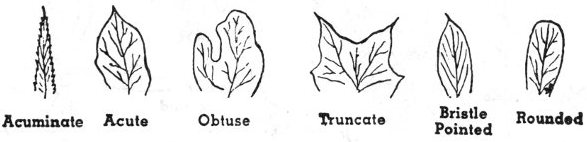
Acuminate Acute Obtuse Truncate Bristle Pointed Rounded
LEAF MARGINS
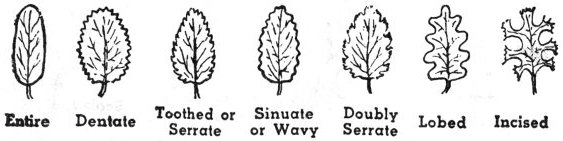
Entire Dentate Toothed or Serrate Sinuate or Wavy Doubly Serrate Lobed Incised
LEAF BASES
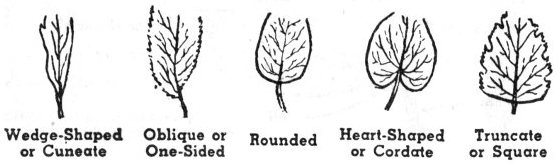
Wedge-Shaped or Cuneate Oblique or One-Sided Rounded Heart-Shaped or Cordate Truncate or Square
15
THE COMPLETE FLOWER
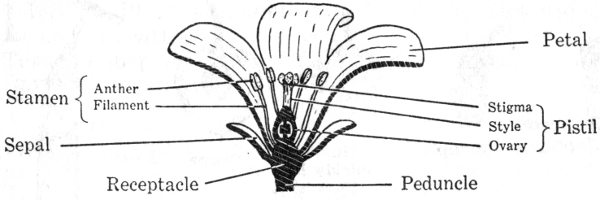
Stamen Anther Filament Sepal Receptacle Petal Pistil Stigma Style Ovary Peduncle
Sepals collectively designated as calyx.
Petals collectively designated as corolla.
The ripened ovary comprises the fruit.
Ripened ovules of the ovary comprise the seed of the fruit.
A flower lacking either calyx, corolla, stamens, or pistil is an incomplete flower. If the male and female flower parts occur in separate flowers on the same tree the species is said to be monoecious. If the male and female flowers occur on separate trees, the species is said to be dioecious.
FLOWER CLUSTERS
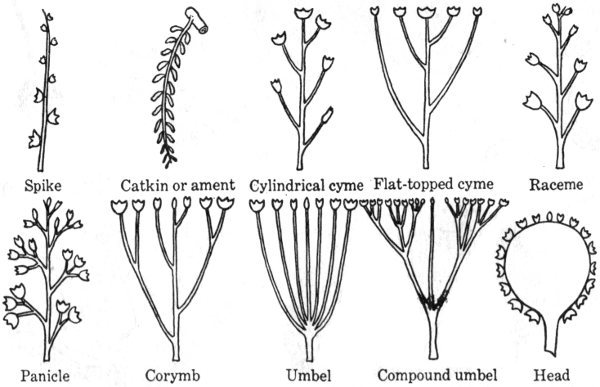
Spike Catkin or ament Cylindrical cyme Flat-topped cyme Raceme Panicle Corymb Umbel Compound umbel Head
16
COMMON TYPES OF FRUITS AND SEEDS
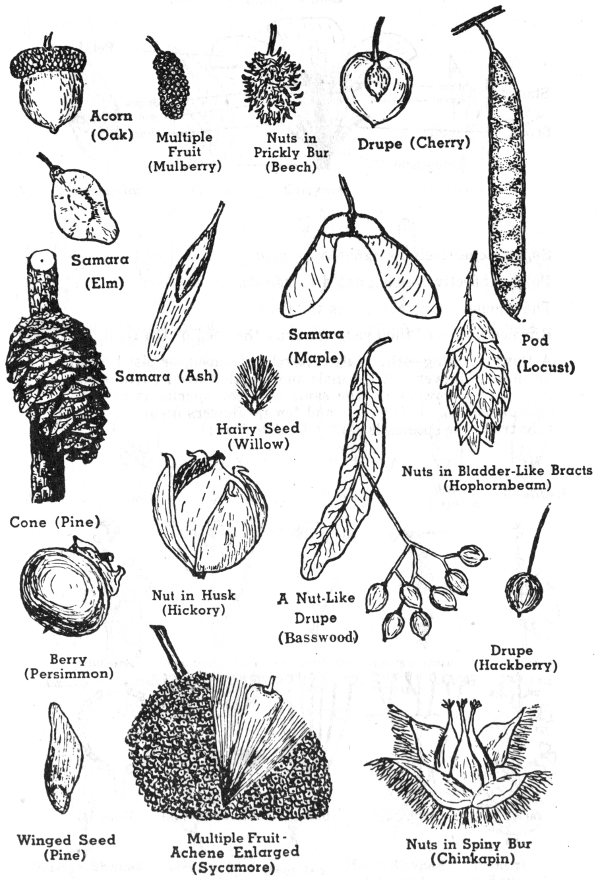
Acorn (Oak) Multiple Fruit (Mulberry) Nuts in Prickly Bur (Beech) Drupe (Cherry) Pod (Locust) Samara (Elm) Samara (Ash) Samara (Maple) Cone (Pine) Hairy Seed (Willow) Nuts in Bladder-Like Bracts (Hophornbeam) Berry (Persimmon) Nut in Husk (Hickory) A Nut-Like Drupe (Basswood) Drupe (Hackberry) Winged Seed (Pine) Multiple Fruit—Achene Enlarged (Sycamore) Nuts in Spiny Bur (Chinkapin)
17