FOR THE WHITE CHRIST (continued 6)
Reading edition
The Franks discreetly refrained from following their king; and Floki the Crane, who alone of those present could have overtaken the flying couple, headed back such of the younger Northmen as chose to consider the manner of the king's leaving a challenge to race.
So, followed neither by Frank nor viking, Karl drove on with his fair prize into the forest. As the gnarled trunks of the giant oaks shut out from view the last glimpse of field and dwelling, Fastrada's downcast eyes shone with sapphire tints, and though far from wearied by her mad race with Hardrat, she leaned more heavily upon the arm of the king.
A little later, the two were standing face to face in the centre of the river, a league beyond the viking camp. Karl was staring at the maiden with a bewildered look as he listened to her pleading words: "Ah, stay, my lord! You break my heart! I thought--I thought you 'd take me to wife."
Karl smiled, half incredulously.
"How then, silly maiden," he said; "have you forgotten who sits beside me on the throne?"
Fastrada's drooping eyelids quivered, and her face whitened; but she betrayed no sign of anger or jealousy.
"I 've not forgotten, dear lord," she whispered. "Yet I thought-- I 've heard of kingly rights. Is there--was there not a custom that the king might take to himself two wives?"
"By my sword, fair one, you 'd make a Merwing of me! Is it not enough that you have won my love?"
"No, sire, no! It is not enough for me!" cried the girl.
"Then what would you have?" asked Karl, wonderingly.
Before she answered, the girl raised her eyes to his, and flung out her arms.
"Ah, how I love you, dear lord!" she half whispered. "But you forgo your ancient right,--you 'll not seat two with you on your throne. I see only one way that joy may come to me,--ay, and why not? Why should not I have my turn?"
"How then?" demanded Karl. "Speak out."
"Ah, dear lord, do not be harsh! It is my love that forces my lips to speak, and so--and so--I will say it, though it kill me! Dear lord, if you will not make me joint sharer of your throne with the one who now sits beside you, I would--I would that she might give place to me,--as the Lombard's daughter gave way to her--as Himiltrude gave way to the princess--"
"Ha!" cried Karl. He drew back a step, and stood staring at her, overcome with amazement at her audacity.
For a moment the girl straightened before his angry wonder with a gesture almost of defiance. But then her eyes sank, and her whole body drooped forward.
"Pardon me, dear sire!" she pleaded faintly. "Forgive the love which carried me beyond reason. I could not stay my tongue, dear lord. I was mad!"
Softened by the girl's words and timid look, Karl relaxed his frown.
"Daughter of Rudulf," he said, "it is I who am at fault. You are far other than I thought,--I own it with shame! Here, then, is an end; for as to your foolish dream, that may never be. No woman lives who can thrust from my heart the daughter of Childebrand."
"Then all is over, dear lord; I may not hope?"
"All is over, maiden."
For a while the girl stood silent, one of her skate-runners tapping gently on the ice. But then, forcing as it were the words from her lips, she murmured hurriedly: "Your Majesty, is it not best I should be returning?"
"Not you alone, maiden! Whoever's afield should be seeking shelter. Already the oak-tops moan with the coming storm. But fear nothing. We shall soon be warming our knees by the cheery hall-fire."
"But how, sire, of those who-- Ah, Holy Mother forgive me! I forgot; in my love and joy, I forgot! Kosru the leech-- Oh, hasten, sire! The lads and Rothada,--they are on the river, and with them our gracious dame!"
"Hildegarde!" roared Karl, in angry alarm.
"The queen," echoed Fastrada, and she shrank back in real fear of the king's threatening gesture. But he advanced, only to motion her up the river.
"To the villa!" he commanded. "Tell the Danes their vala is in peril! Bid the counts join with them! I go to meet the skaters."
With the words, Karl wheeled past the cowering girl, and drove away down the river at headlong speed.
Instantly Fastrada sprang erect and glared after him.
"Hai!" she hissed. "Let him go; let him rush to share the fate of the others! The hungry fangs await him! Merry's the feast I 've set for Odin's dogs!--king's kin and king; ay, and my false hero! All's merry in the bleak wood! Hark to the moaning oaks! My mother's spell has roused the storm-fiends,--the sky darkens. Soon the gnawed bones will lie wrapped in a snowy shroud! And now I shall go to her. She shall unriddle that old foretelling,--'a king, grey of eye.' The Merwing Wolf rode the tree; Pepin's son rushes to meet his bane; who, then, may it be? Adelchis the Lombard, idling in the Kaiser's hall, or that drunken Hardrat? More likely he,--the white-bristled boar! I had thought to crush him when the time came; but now-- Ah, would that Pepin's son had lent a willing ear! He at least was a world-hero, with whom might be named no warrior other than my sea-king. And now they are death-doomed. Ai! my bright hero bleeds! Olvir! Oh, Olvir!"
Writhing in tearless anguish, the girl stumbled to the river's edge. With feverish haste she tore loose the skate-thongs from her buskins, and, leaping up the bank, fled wildly into the heart of the forest.
CHAPTER X
Thou shalt hear the wolves howling.
LAY OF GUDRUN.
When the little party, whose leader he had considered himself, glided away into the forest, Olvir had thought to limit the trip to three leagues at the utmost. But he failed to consider the queen's humor.
After her long confinement within the bower, Hildegarde's fair face glowed with almost feverish delight as she felt the ice glide away beneath her feet, and she swayed her body to the skate-stroke with the grace of a Greek dancer. Upborne by Liutrad's powerful grasp, she soon lost all thought of fatigue and distance, and floated on--on--through the white sunlight, her face serene with dreamy contentment. Her enjoyment was at its height when Olvir, hand in hand with Rothada, glided up beside her, a troubled look in his dark eyes.
"Stay, Dame Hildegarde," he called out. "I beg you to turn back before it is too late. The storm-light is boding, and we 're already too far from hearth and roof-tree."
Hildegarde threw out her hand in a gesture of vexation very unlike her usual gentle bearing.
"Leave croaking to the ravens!" she cried. "How soon will your storm sweep upon us?"
"That I cannot say, dear dame. I know nothing of your Rhineland."
"I might guess," said Liutrad, in response to the queen's glance. "Yet why not ask Gerold? None should know better than he."
"Brother!" called Hildegarde; and when the young Swabian came circling back to her side, she pointed skywards. "It seems that our Norse hero is fearful of the storm-boding. He would have it that we wander too far afield."
"Ah, Olvir; so you still fret at the storm-light," laughed Gerold, and he cast a careless glance at the sky.
"In old Norway such a boding would bring the wind howling about our ears within an hour," rejoined Olvir.
"Here it will come with the sundown," said Gerold. "There is yet no moaning in the oak-tops."
"Enough!" cried his sister. "Rejoin the lads. We 'll fare on."
Though far from satisfied, Olvir made no further protest. Saluting the queen, he at once fell back with Rothada to their former position in the rear. Surely Gerold should know. If he gave assurance of safety, why need an outlander doubt? And it was very pleasant to glide on into the forest depths, side by side with the little vala. Having done his part, he could now put away all thought of mishap, and give himself over to joy.
Constant practice with Olvir through all the happy days of Yule had gained for Rothada a skate-stroke which in lightness and grace all but equalled that of Hildegarde herself. With the light staff-spear balanced in her left hand, and scarf and cloak floating back from her shoulders, the king's daughter skimmed over the ice-street with all the airy freedom of a bird. But for the glint of the upcurving skate-runners as her slender foot peeped from beneath her skirt, Olvir might well have fancied that her flight was winged. Life and love had driven the last trace of cloister pallor from her rounding cheeks, and beamed from her eyes with the tender radiance of perfect trust and joy.
The loveliness of his princess set every fibre of Olvir's being atingle with rapture. His black eyes gazed down adoringly upon her lissome body and dainty foot; upon the glossy braids which lay entwined with bright ribbons down her heaving bosom; upon the flower-like face beneath its jewelled cap; most of all, upon the soft eyes, half-veiled by the tresses wind-blown across the white forehead.
Mile after mile, the forest glided past in an endless maze of gnarled trunks and leafless branches; but, like the queen, the lovers were lost to all sense of time and distance. Gradually the space between them had lessened. Now Rothada's hand was upon Olvir's shoulder; his arm was clasped about her waist, and he was softly chanting to her of the fells and fiords, of the salmon leaping in the torrents, and the crimson glow of the midnight sun.
When at last Hildegarde gave the word to turn, the lovers halted with the others, and stood before them without altering their pose. Neither would have become aware of Hildegarde's look of surprise or of Liutrad's and Gerold's smiles, had not young Karl cried out in boyish glee: "See, mother, Rothada and Count Olvir! Sister will wed our lord father's bright Dane hawk, and he 'll never fly away to his frost-white eyry."
"The dear Christ grant that such may be the outcome, child," replied Hildegarde; and she gazed, with a tender smile, at Rothada's downbent head. "Now that your sister gives proof of her love, all should go well. Count Olvir has only to accept baptism."
"Baptism, dear dame! Should you not rather say, the yoke of priestly rule?"
"Olvir, Olvir! put aside your stubborn pride! You little know how hard it is for our lord to give his sweet maiden into another's keeping. If, then, he holds you in such friendship, should you not be willing to bend to Christ?"
"That I already do, Dame Hildegarde," replied Olvir, gravely. "But let us spare ourselves now. We are afield, and should give ourselves over to joy."
"Lord Olvir speaks well, mother," exclaimed Pepin, flourishing his javelin. "Lead on again! We may yet chance upon an elk or bear."
"No, sister; about and homeward!" cried Gerold, in sudden alarm. "Hear the moaning in the oak-tops! How can I ever forgive myself? The storm's upon us, and we so far from shelter!"
"I alone am at fault," said Hildegarde. "Had I given heed to Olvir's warning, by now we should have been within sight of home. Lend your aid to the lads, brother. If you tire, Liutrad will take your place."
"Beside me, lads!" cried Gerold, impatiently.
The boys darted in to grasp the ends of the Swabian's crossed spear, and with a shout all three struck out on the homeward race. After them glided Hildegarde and Liutrad with long, easy strokes, while Olvir, his arm still clasped about his little princess, swept her along in the wake of the others like a cluster of thistledown upborne by the breeze.
Spurred on by his alarm, Gerold steadily increased the pace, until the air whistled in the ears of the skaters, and the long miles melted away beneath their flashing ice-blades in swift succession. Few skaters, however, could long sustain so rapid a stroke, and Gerold at last found that he had overestimated his strength. Unhampered, he might have held on without slackening to the very end of the course; but his strength and training were now offset by the weight of the two boys. Little more than half the homeward course had been covered when his strokes began to flag, and he found himself compelled to ease the pace. Liutrad was quick to heed his friend's distress.
"Ho, gossip!" he called; "you 're all but winded. Leave Pepin to me, and fall behind. I 'll lead for a while."
"Lead, then! I must give way," panted Gerold, and reluctantly he slackened speed for the Northman to pass. At the moment, however, Pepin uttered a wild view-halloo, and dashed aside toward the river-bank, followed hotly by young Karl.
"A wolf!" sang out Liutrad, at sight of the gaunt black beast bounding silently along the bank among the alders.
"Ho! see the cowardly brute make off!" shouted Gerold, as the wolf leaped away into the forest.
"Cowardly?" repeated Hildegarde. "It seems to me very bold of the lone beast to follow an armed party in midday."
"Greyleg fares ill in the winter woods," answered Liutrad, in a careless tone, and he beckoned to the disappointed young hunters. "Hasten, lads! If we find ourselves within a league of the villa before the storm bursts, we shall be doing well."
"God grant no worse befall us!" muttered Olvir, half aloud, and as the boys circled back to their new places in the party, he drew his war-bow from its case and strung it, ready for instant use. But at Rothada's startled look, he smiled, and said lightly: "Now I dare Greyleg to peer out the second time. He shall find his bane without waiting for the spears of bairns."
"He will do well to overtake us again, Olvir, now that Liutrad leads."
"True, dear heart. Few even in the North can out-ride Liutrad on the ice-steeds, and his bigness breaks the wind for those of us who follow. Lean more to the stroke, dear one, and waste no breath in words."
Obediently Rothada bent forward on his supporting arm, while Olvir, freed from her inquiring gaze, searched the river-banks with his glance, and turned his head as though straining to catch the first note of some distant cry. He had not long to wait.
So faint that at first even the listening ear could scarcely tell it from the moaning of the oak boughs, down the wind came floating that most dismal of all sounds,--the long-drawn howl of a wolf. Olvir's face grew tense, and his grip on the war-bow tightened as he glanced down at Rothada. But he held on after the others, without a word, though howl after howl was borne to his ears by the freshening breeze.
CHAPTER XI
--Oft Wyrd preserveth
Undoomed earl--if he doughty be.
BEOWULF.
At first none other than Olvir gave heed to the dreary cry; for now the storm's forerunners came soughing through the leafless treetops. A half-mile, however, and the howls had merged into one continuous note that rose and fell on the breeze like the wail of fiends in torment. Even Rothada's untrained ear caught the appalling sound as it swelled out with a sudden flaw of the wind. The girl cowered and pressed closer to her companion. Nor was she alone in her fear. With all their boyish pride, her brothers cried out in dread, and Gerold turned as pale as his sister. Liutrad slackened speed, and looked instinctively to Olvir.
"Hearken, earl!" he called. "The wolf-pack is before us! Should we not turn back?"
"Heu!" shouted Gerold; "turn--turn and fly while there's yet time!"
"Where?" rejoined Olvir,--"to perish in the forest? The storm lowers. Our only hope is ahead. Let us only sweep by the pack, and we may yet gain safety. At the worst, we can mount an oak till Floki brings aid. Lead on, son of Erling! Already we glide through the midst of the horde. Look back!"
A cry of terror burst from all others than Liutrad as they stared back over their shoulders. From the point of the last bend, not a hundred paces behind them, a dozen gaunt beasts were breaking cover to leap out upon the ice. Even as the skaters looked about, other bands of the silent pursuers sprang into the open from either bank, and a dry snapping in the alders drew the eye to half-hidden forms flitting through the thickets abreast of the party.
Suddenly a huge grey wolf leaped out from the left bank, several yards in the lead of the skaters. The beast made no attempt to attack the quarry. Hardly even did he look at them, but bounded along on the ice-edge, whining like a young dog. The strange actions of the beast, coupled with the silence of the gathering pack, struck Liutrad's stout heart with a fear little less intense than that of his companions.
"Tyr! the beasts are upon us!" he shouted, and, gripping Hildegarde and Pepin fast in his giant grasp, he bent far over and drove into the teeth of the freshening wind at racing speed. At his heels followed Gerold with young Karl, keen to hold the vantage of the wind-break offered by the great body of the Northman.
Olvir, however, did not join in the mad rush. With a word of assurance to Rothada, he freed his hold of her and plucked an arrow from his quiver. With the twang of the bow the grey leader of the wolf-pack uttered a yell and leaped high in the air, pierced through and through by the Norse arrow. Even as the beast fell dying, Olvir was back at Rothada's side, and his arm linked in hers with a grip of steel.
"Ho, dear heart!" he cried cheerily; "now will Odin's dogs whet their fangs on the bones of their leader, while we race away up the ice-street. Bend now--yet farther! The others outstrip us."
"Christ save us!" gasped Rothada, despairingly.
Olvir's face contracted with a pang of keenest anguish; but his voice rang out almost gaily: "How now, king's daughter; where is your trust? No wolf should overtake us though we had ten leagues to cover."
"I trust my hero!" replied the girl, and the words gave added force to the Northman's swift strokes. But as he whirled his precious charge away from the silent pursuers, the dismal howling in the forest ahead swelled out with fearful distinctness.
Louder and yet louder resounded the yelling chorus, until the air quivered with the hideous din, and even Liutrad faltered, half fearing to advance. But then Olvir shot forward in the lead, and his call rang out bold and clear: "On! on, wolf-racers! We outstrip the chase! At yonder bend we 'll know the worst,--beyond is the howling pack. If we cannot pass, turn in to the cleft oak on the point. Its boughs will house us safe from Greyleg."
"We follow, ring-breaker!" shouted Liutrad, and all dashed on at racing speed, their hearts leaping with renewed hope. Every stroke left the grim pursuers farther to the rear.
But now they were sweeping around the river's bend, and the outcry before them rose to a deafening clamor. Dreadful as was the sound, it yet failed to prepare them for the scene that burst upon their startled gaze. Even Olvir's face whitened, and his lips moved in quick prayer. A little way beyond the bend, the river's bank and the ice-edge was black with a dense mass of wolves, yelling and fighting and tearing at the snow in mad frenzy.
"God save us! they 're werwolves!" cried Gerold.
Hildegarde turned her despairing gaze about till it rested on young Karl.
"To the oak! to the oak, brother!" she screamed. "Save my boy!"
But Olvir pointed ahead with a forceful gesture: "Hold, fools! Follow me on! We'll dash by the mad fiends. Beyond is safety!"
Again the sea-king's words brought hope to his companions. Swifter than ever their skate-blades spurned the glassy surface, and they swept on around the bend at their utmost speed.
Such was the frenzy of the wolves in their weird saturnalia that at first they failed to heed the swiftly approaching skaters. But as the fugitives came flying past, the young wolves on the edge of the pack sighted the quarry, and yelled out the view-cry. Another moment, and the whole pack was swarming down the bank and out upon the ice, to head off the quarry.
So swiftly, however, were the skaters skimming past that all but a few of the foremost wolves were hopelessly outdistanced. Only a dozen or so of those farthest upstream succeeded in coming near the fugitives, and even of these the leader alone came within fair distance for the quarry leap. With a yell, the beast crouched, and flung himself at Hildegarde; but at the same instant Liutrad swerved aside with his charges, and Gerold, driving along a few paces behind the Northman, straightened up and cast his heavy boar-spear through the body of the leaping beast.
In a twinkling the Swabian had whirled young Karl past the writhing, snarling brute, and all were echoing the boy's shrill cry of triumph. Though the wolf-pack yelled at their very heels, every hungry fang was now behind them.
"God be praised!" gasped Hildegarde. "The worst is past."
"We go free!" echoed Gerold, panting yet joyful; "we go free, out of their very jaws! Let the cheated fiends follow in their place!"
But Olvir was silent, and his glance shifted uneasily from the horde of yelling pursuers to the maiden at his side. There was little exultation in his tense white face. One peril had been passed, but another now threatened. Rothada was gasping for breath. Notwithstanding his aid, she was almost outdone. Her strokes faltered, and Olvir could feel the wild throbbing of her heart. Though she made no complaint, he saw that the strain was more than she could bear. His despairing gaze glanced from the oak-tops to the lowering sky.
"Not that! not that!" he muttered. "Already the storm is upon us. She would perish of cold on the shelterless boughs before Floki comes. By Thor, we hold our own with the wood-fiends! Could we keep to the pace a little longer-- Yet I cannot bear her up alone!"
"Ah, Olvir!" gasped Rothada, "my strength fails; I can go no farther. Loose me; loose me, and save the others, dearest! I but drag you back--to death!"
Olvir gazed down upon the girl, his dark eyes misty with infinite love and tenderness; and with the soul-calm came sudden clearness. A flush rose in his pale cheeks, and his eyes flashed with hopeful fire.
"Liutrad! Gerold!" he shouted; "the princess faints! Skate abreast, that you may bear her up between you. Soon you may ease your stroke. I go to play with the dogs of Odin."
"God forbid!" cried Liutrad. "Let me be the one to stay them."
"And gorge their jaws! No, lad; you own the greater strength; I the greater fleetness. Each to his part!"
"Let Pepin come beside me," said Hildegarde. "He can hold to my hand."
"I 'll drag little, dear mother," replied the boy. "I 'm still strong."
"And I, mother," echoed Karl, with boyish pride.
"You 're brave lads, both," answered Gerold. "Slacken more, Liutrad. Now, Pepin, cross over to your mother--so; well done! We 're ready, Olvir."
"None too soon!" rejoined Olvir, and he fell back until Liutrad caught the fainting maiden from his grasp.
Borne up between the two young warriors, Rothada had now only to lean her weight upon their strong arms, and glide onwards, swept along by their powerful strokes. The pace was still swift enough to hold the hundred strokes gained over the horde at the first. Olvir was quick to heed the fact, and his face shone as he circled about the others for a farewell view.
"All's well!" he called cheerily. "Hold on only a little longer, and you may ease the pace."
Still smiling, he plucked an arrow from his quiver, and swept around on his daring mission. In another moment he was skimming at arrowy speed straight into the face of the pack, his gold-red hair streaming, his face bright and eager with the joy of battle.
Once and again the war-bow twanged, and two of the grey leaders sprang high in the death-leap. But, heedless of their dead, the pack swept on over the writhing bodies to meet the slayer. Already the rash skater was upon them. Another instant, and he would be struggling in their midst. But even as the lolling tongues drew in for the leap-bite, and the fiery eyes gleamed red with baleful joy, the mad quarry wheeled like a striking hawk, and shot away to the right from under their very jaws. In their eagerness, many of the foremost wolves leaped at the Northman; but their jaws clashed together through empty air, and they fell sprawling upon the ice, to be overrun by their fellows.
Wild with baffled fury, the whole pack swerved to follow the fleeing quarry as he swept slantingly across the broad expanse of the river. Olvir could have asked no more. Skimming along just beyond reach of the foam-dripping jaws, he gazed back at his ferocious pursuers with a mocking smile.
"Follow! follow me, dogs of Odin!" he jeered. "I 'll lead you a merry dance; to and fro,--a game of ice-tag. So; we near the bank. Now across to the other side; and as we go, I 'll play on my one-stringed harp. You shall have music to your singing!"
Circling on the very edge of the ice-rim, Olvir swept obliquely back across the river. But as he turned, his smile gave way to sudden grimness, and he raised his hand to his quiver. Then the war-bow began to twang its answer to the yelling beasts, and arrow after arrow drove into their midst with vengeful force. Hardly a shaft flew wide of its mark; yet they followed so swiftly one upon the other that the quiver was emptied and the last shaft whirring from the string before the flying bowman had crossed the channel.
"Thor!" he shouted in fierce joy. "We 've played a merry game, white-fangs; now for a merrier!"
Deftly the bow was unstrung and slipped into its case, and then the bared blade of Al-hatif glittered in the sea-king's upraised hand. But as he swerved out again from the alder thickets, he first glanced up the river after his fleeing companions. Briefly as the terrible play had lasted, the others had already gained many more yards over the horde. While their peril, however, was lessening, his had suddenly doubled. Not all the wolves had followed him in his second turn across the river. A hundred or more, running straight onward, had put themselves in advance of the doubling quarry. The foremost were already circling around to hedge him in.
It was no time to falter. Putting out the very utmost of his skill and strength, Olvir dashed toward the fast-closing line at a speed that dropped the following wolves to the rear as though they had been at a stand.
"Ho, dogs!" he shouted. "Skate to paw; sword to fang! I come; I come to your blood-game!"
An outburst of ferocious yells answered the boastful shout, and from right and left the beasts sprang in to meet him. But again Olvir wheeled with hawk-like quickness. Two strokes, and he was before a gap in the line guarded by a single grey leader. Once again he wheeled, to dart through the gap. Swiftly as he came, the old wolf saw his purpose, and crouched low. But, even as the beast leaped, Olvir swerved and shot safely past him; and, in the passing, Al-hatif whistled in a slashing upstroke. Greyleg fell upon the ice, never to leap again.
With a wild shout, Olvir dashed out from the death-trap, and, undaunted by his close escape, turned for a third race across the river. But as he wheeled, a great gust of wind came roaring through the oaks, and the air suddenly grew thick with driven snow. Instantly Olvir sheathed his reddened blade, and, with his shoulder to the quartering gale, drove straight up the river at a speed which Floki himself might not have equalled.
Soon the baffled pursuers fell to the rear. Their yells died away in the roaring of the storm, and the snow swept between in a swirling, blinding mist. But if the white storm-veil hid the Northman from his pursuers, it blotted out no less completely all view of his companions. For a while he kept on at racing speed, until he thought he should be upon them. Then he slackened his stroke, and shouted into the white gloom. No answer came back but the loud complaint of the straining oaks and the shriek and roar of the blast through the lashing boughs.
Again Olvir shouted, his face dark with sudden misgiving; still no answer. With a bitter cry, he wheeled to circle about in the dense whirl. But then the air quivered with the blast of a hunting-horn, so clear and loud that it might have been blown within arm's length.
"None bore horns! It must be Floki!" he cried, and he drove straight into the teeth of the gale. The fierce-driving snow blinded him; but he kept on, groping with outstretched hands. Suddenly a white figure swept past before him, so near that he could almost touch it. He wheeled to follow, and at once saw that it was linked in line with other figures. His heart leaped with thanksgiving. Here were all six,--maid and dame, bairns and warriors,--all safe; ay, and with one added to their number! Not even Liutrad was so big and strong as the skater who drove along at the far end of their line, his massive shoulder braced against the wind.
"The king!" shouted Olvir, as he swung in to join himself to the near end of the line.
A welcoming hail burst from the lips of the skaters, and as they felt the thrust of Olvir's tireless stroke, they swept on with added speed. Even Rothada found new strength in the joy of her hero's presence, and, no longer contented with gliding, she joined in the swinging stroke of the others.
CHAPTER XII
Now behold the fourth rede:
If ill witch thee bideth,
Woe-begetting by the way,
Good going farther
Rather than guesting,
Though thick night be upon thee.
LAY OF SIGRDRIFA.
Though the blast struck quartering in the faces of the skaters, the brunt of its force was broken by the king's body; so that the others, dragged on by his bull-strength and Olvir's wiry vigor, held to a pace which lost none of the distance they had gained on the wolf-pack before the storm burst.
"Thor!" shouted Liutrad, hoarse but joyful. "We cheat both werwolves and storm-fiends! We shall soon be sitting by the glowing hearth!"
"God grant it!" replied Karl. "Yet you crow too soon, lad. There's a turn ahead will bring us into the teeth of the wind. Even now we should be swerving."
"Saint Michael!" gasped Gerold. "We can never drive against this blast!"
"No, by Thor!" called back Olvir. "Even now we can scarce hold our own--and behind comes the horde! We are doomed if we linger on the ice. To the bank, lord king! There's no other way!"
"A hard truth, Dane hawk! Yet it is better to freeze than to be torn by ravening beasts. Heu! I know of a hut among the oaks. To the forest! The pack runs blind, with neither sight nor scent. They 'll follow the river and pass us by."
"To the bank!" shouted Liutrad and Gerold; and the line of skaters swung around to glide inshore. Blinded by the whirling flakes, they drove upon the low bank before aware of its nearness. Staggering and half falling, they stumbled across the rough ice-rim, and flung themselves down upon the bank to tear at their skate-thongs.
Olvir did not wait to untie knots. Even as he loosed his grip on young Karl, he drew his silver-hilted dagger. In a twinkling he had freed both himself and the boy, and was springing to the side of Rothada. Thrusting her skates with his own and young Karl's into his empty quiver, he drew the maiden to her feet. The others had all freed themselves, and sprang up together.
"Leave no scent for the wood-fiends! Hold to your skates, and follow me!" commanded Karl. Flinging his younger son upon his shoulder, he grasped Hildegarde by the hand, and rushed headlong in among the oaks.
Liutrad caught up Pepin as the king had taken his brother, and dashed away after their leader. Olvir and Gerold, with Rothada between them, followed as closely upon his heels. They were none too quick. Hardly had they covered a hundred paces, when behind them a sudden burst of fierce yells rang out across the wind.
"God save us! they 've turned!" gasped Rothada; while Gerold gripped his sword-hilt and loosened the blade in its sheath, in readiness for his last fight. But the yelling cry died away as quickly as it had swelled out. The wolf-pack had overshot the snow-swept trail, and were racing on around the river-bend. For many minutes, however, the king led on into the forest without slackening his swift stride. He did not check himself until Hildegarde stumbled and half fell.
"Dear lord, I am very weary," she sighed.
Halting so abruptly that Liutrad almost ran upon him, Karl caught his queen in his free arm, and drew her close.
"Rest, sweetheart," he said gently. "We are safe for a time."
"A long time, lord king," added Liutrad. "Even should the pack turn, they 'd do well to hunt us out in this wild flurry."
All the party drew close together, and stood panting, while the shrieking storm-fiends swirled the snow about them in dizzy eddies. Soon, however, Olvir felt Rothada shiver beneath his cloak.
"Lead on, lord king," he said. "To linger here is death! Lead on to your hut."
Karl raised his head, and peered around through the driving snow.
"By my sword, Olvir," he muttered; "you ask what is beyond my skill. Here among the trees the blast swirls down from every quarter. Who could guide through such a storm?"
"Then we must wander blindly. If we stand, we shall perish of cold."
"Follow, then. We 'll try at a venture."
"Stay, sire!" warned Gerold. "What comes behind you?"
Karl turned sharply to stare at the huge form which loomed up out of the snow-mist and drifted by within a spear-length. As it passed, the great shape swung about its steaming muzzle to sniff at the party, and then it lumbered on at the same leisurely gait.
"A bear!" muttered Karl; and he drew back to shield his helpless charges.
Liutrad sprang before him with brandished spear.
"White biorn!" he cried,--"white biorn! What does the berg-rider in Frank Land?"
"Were I yet heathen," rejoined Olvir, "I 'd say we look upon the king's sprite."
"It is--it is, earl! No beast could pass so quietly. Follow your guardian sprite, sire! It leads you to safety!"
"Would you have me follow a forest fiend? And yet, beast or sprite, we can do no better! Come, then; our guide vanishes."
"Lead on, sire," answered Olvir; and all hurried in pursuit of the dim white figure. Once close upon it, they slackened their pace, and silently followed the wraith-like guide as it lumbered steadily onward into the forest.
Half a league or more had been passed, and both Hildegarde and Rothada were nearly outspent, when the strange guide swerved suddenly and disappeared. At the same moment a dark object, broader than any oak, loomed before the wanderers. They advanced, turning a little to one side, and there, only a few paces before them, they saw a red spot glowing in the dark barrier.
"The hut!" cried Karl.
Gerold sprang ahead, and, thrusting open a loose corner of the window parchment, peered into the hut. The others would have hurried past him to the rude door just beyond; but he uttered a low cry, and stepped before the king with outstretched hands.
"Stay, sire, stay!" he muttered in a hushed tone. "Better wolf and storm than witch-cheer! Look within!"
Startled by the warning, Karl and then Liutrad peered through the broken parchment, and each in turn drew back with the same look which distended the eyes of the Swabian. Last of all, Olvir put his eye to the hole. The first glance showed him a squalid little room whose walls of rotting logs stood out grimy and bare in the glow of the driftwood fire. The rafters of the low thatch were veiled by the smoke, indriven by the wind, which eddied through the roof-hole and sent little whirls of snowflakes hissing into the flames.
Crouched upon the rude hearth, across the fire from each other, were two women; and Olvir instantly recognized the one on the left as Fastrada. She sat with her head thrust forward, gazing keenly across at her hearth-mate.
After the maiden, Olvir felt little surprise when his glance turned to the tall woman who sat rocking to and fro on the edge of the hearth and crooning a strange song, while weasels played about her feet and ran up and down her outstretched arms. It was the girl's mother, the Wend mate of the old Grey Wolf.
The woman's head was uncovered, and Olvir stared with keen curiosity at her black hair and aquiline features. Her dark oval face still showed traces of great beauty; but age and witch-deeds had stained and withered her cheeks and caused the once beautiful eyes to sink deep into their sockets. Even without the weasels, the look of malignant joy on the witch's face would have set most hearts to quaking. But Olvir was smiling, half pityingly, at the dread which even the king had betrayed, when the witch chanced to turn so that the firelight struck upon her cheek. At the sight he started and almost cried out. It seemed to him that a red adder had thrust up from beneath the woman's neckband and laid its venomous head upon her cheek. When he stared more closely, however, he saw that the snake-head, though perfect in outline, was only a crimson blotch upon the witch's skin. He drew back with a grim laugh.
"No wonder she hid her face," he muttered. "What woman would not, with such a mark? But now--ho, lord king; why do we linger? Let us hasten in."
"In!" rejoined Gerold,--"a witch den!"
"She is Fastrada's mother,--the wife of Count Rudulf. She will gladly give hearth-cheer to her husband's lord. Come."
"Hold, Olvir. If we go, I lead," said Karl; and he thrust ahead to the hut door. He found the latch-string in and the door fast barred. His knock must have resounded through the narrow room like the beating of a hammer; but though he waited for an answer, all was silence within.
The king did not knock again. Setting down the half-frozen boy from his shoulder, he threw his weight against the door. Before the shock, it flew violently inwards, its bar snapped short in the socket. Having thus cleared the way, the king drew Hildegarde and the boy to him, and stooped to pass beneath the lintel. As the others pushed after him into the warm interior, they saw Fastrada start up and stand glaring at them with the horror of one who looks upon some grisly spectre.
The Wend woman had shrouded herself about in her grey cloak, and sat quietly in her place, staring at the forceful guests from the depths of her hood. Of the weasels nothing was to be seen but a pair of fiery little eyes peering out from the folds of the cloak upon her bosom. The witch was the first to speak.
"Odin bear witness," she said in a tone of quiet scorn. "It is very fitting that he who thus breaks in on helpless women calls himself King of the Franks."
"And over-lord of your lord, Wend wife. Make way by the fire for us."
"I make way for no one,--much less for Pepin's son," came back the hissing retort.
The king's brows met in a stern frown.
"That we shall soon see, woman," he said. "Liutrad, put this hag from the hearth."
"I, lord king!" muttered the young giant, and his ruddy face whitened. But then, crossing himself, he advanced resolutely upon the dreaded alruna. None the less, his relief was plain to be seen when the Wend woman rose and withdrew to the far end of the hut, without waiting to be forced.
Then at last, as the shivering guests crowded about the fire, Fastrada found her tongue. Springing forward, she threw herself at Hildegarde's feet, and loudly protested her delight: "My gracious dame--sweet queen! You're safe! safe! and the bairns and the little maiden--all alike have escaped the cruel--the cruel storm!"
"And the wolf-pack!" rejoined Pepin, proudly.
"Holy Mother!--wolves?"
"Nor was aid sent us, maiden," said Karl, sternly.
Fastrada half rose, and flung out her hands.
"Forgive me, sire!" she murmured. "I, too, was lost; I, too, wandered in the storm. Only a little while since I came upon this unholy den. Blessed be the saints who brought you to end my fears!"
"Why fears, maiden? Should any mother, however much a witch, harm her own child?"
Fastrada hung her head, visibly disconcerted by the answer. Her reply came haltingly, and in a tone almost too low to be heard: "Your Majesty, should I bear--should I suffer for her deeds? It is too much! Even my horror-- Ah, let her witchcraft meet with the just dooming of the king's law! She is no mother to me!"
"Ay, girl, no longer am I mother to you!" hissed out the Wend woman, and she glided around to the open door. At the threshold she turned, and, flinging back her hood, faced all openly. The twitching muscles of her sallow cheek gave to the crimson adder-head a fearful semblance of life, and the horror lost nothing by the malignant fury of her look and the sibilance in her low-pitched voice.
"So," she hissed; "the sly trull is bent upon saving herself. Having been caught in company with the Wend witch, she seeks to cast off the mother who bore her! Let her be content; she has proved herself a changeling. The daughter of the Snake could not be mother to a child so base and cowardly as to deny the bond of kinship. No longer is she blood of my blood or bone of my bone. I go; but, as parting gift, I leave her my curse,--the curse of one who was a mother. She shall taste of power, and it shall be as ashes in her mouth; she shall hunger for love, and hate shall wither her heart. Woe to her!"
Pausing, with upraised hand, the witch shifted her hateful gaze from her cowering daughter to the startled group about the fire.
"As for you, storm-guests," she went on, "learn that the witch-wife has gifts for all. To Pepin's son I give toil and sweat and bloody victory. Joy to the crusher of free folk! None may withstand the world-hero. Hoary-headed, he dies in the straw; for no longer are there foes to withstand him in battle. And then I see the storm gather in the frozen North. The dragons swim the salt waves; they fall upon Frank Land, ravening with fangs of steel and with flaming breath. The kin of Pepin's son flee as hares. Thor smites the White Christ! The Frank realm shatters in fragments!"
"Hold, fiend-wife!" roared Karl; and he turned threateningly upon the woman, all dread of her witchcraft forgotten in his deep anger. But she met him with a look which even his imperious will could not withstand. He stood spellbound, transfixed by the cold glitter of her sunken eyes. For a little she held him powerless,--him, the world-hero, king of half Europe. Then her thin white lips curled scornfully, and she turned from him to the others.
"Enough of Pepin's son," she scoffed. "As to these Norse curs, false alike to their folk and their gods, my curse is needless. The gods whom they have betrayed will exact full vengeance. But I put my curse on the brood of the bloody Frank,--maiden, bairns, and bed-mate,--all who stand before me. May the king's sons never wear crown; may the nun-maid lose her bright hero; may the fair queen know beforetime--"
The woman paused, and looked darkly from Hildegarde to her daughter. She was yet gloating upon the two when Rothada rose and came to her with outstretched arms.
"Ah, dame, good dame, be still!" she cried. "Christ forgive you the evil words! Turn to Him; cast out the hatred from your heart before your own curses creep in to wither it!"
"Hei! what is this?" muttered the woman; and she drew back in bewilderment. Her eyes glared into the pleading eyes of the king's daughter with a look almost of terror. Suddenly, without a word, she turned and rushed out into the storm.
CHAPTER XIII
Until that Guiki
With gold arrayed me
And gave me to Sigurd.
LAY OF GUDRUN.
For a while the deserted guests stood staring at one another, and there was dread in the eyes of even Liutrad and the king. Olvir alone showed no fear. If he had dared the power of the Wend witch in the depths of Fulda Wood, he would not yield awe to her now. Presently he burst into a scornful laugh.
"Thor!" he jeered. "The witch-wife flees before a child,--a fearsome witch!"
"By the rood!" muttered Karl, and he drew in a deep breath; "they say true who name Rudulf's wife a heathen alruna."
But Hildegarde gathered the two trembling boys in her arms, and looked across at Olvir with a grateful smile.
"Dear lord," she said, "our bright Dane speaks truth. Witch or no, the Wend woman has fled before our little maiden. What need have we to fear the curse of one so powerless?"
"Here is yet more comfort for those who have faith in spells," added Olvir. "At the king's belt swings Ironbiter, my father's sword, upon whose blade are magic runes, cut by Otkar himself. They are pledged to guard the wielder against all witchcraft and evil."
Gerold shook his head doubtingly, and drew closer to the fire. "I have more faith in Christian signs. Yet though I marked the cross while she spoke, and twice since, I say freely that I would sooner face an aurochs bull naked-handed than stand again before that witch. Thank God, she is gone!"
"Into the storm, brother!" murmured Hildegarde, pityingly. "May the dear Christ save her body from wolf and cold, and her soul from hatred!"
At the fervent prayer, Fastrada stared up at the queen as her mother had stared at Rothada. But when she met Hildegarde's mild eyes, radiant with spiritual light, her gaze sank again to the hearth at her feet, and a dark flush overspread her face. Karl, who alone gave heed to the girl's shame, mistook its cause, and his own face reddened with a guilty flush.
"God bless you, dear wife!" he muttered. "What curse can bring harm upon so gracious a soul? But as to that Wend witch, should she escape the storm and wolf-pack, let her beware the law. Though twice over the wife of Rudulf and mother of this maiden, I will enforce against her to the utmost the just doom for evil spells and witcheries. Enough for the time of the hag and her curses. She has gone out among her storm-fiends; let them cherish her. We will warm our knees by her hearth. Fetch wood for the fire!"
As Gerold and Liutrad sprang up to bring fagots from the far end of the hut, Olvir led Rothada about to the fire, and sought a new bar for the door, which was swaying to and fro with the eddying draught. Before making it fast, however, he peered out in search of the Wend woman. He might as well have sought to look through a fog on the narrow seas.
Though the first fury of the wind had spent its force, the snow was now falling with greater thickness than ever. For all Olvir could tell, their grim hostess might have been lurking within a dozen yards of the doorway. He hesitated on the threshold, and was about to shout, when his quick ear caught another note than the creak and soughing of the oak-tops.
"Floki!--The laggard comes at last!" he said, and he faced about to the steaming group around the fire. "Listen, lord king! I hear horns. My vikings come in search of their vala."
Horn in hand, Karl sprang out beside the Northman, and blew the trysting-note. Three times he repeated the call, and then at last an answering note came blaring down the wind. Off toward the river other horns caught up and re-echoed the call. The searchers were beating through the forest. Guided by frequent blasts of the king's horn, they gathered quickly through the white snow-mist.
Soon the nearest horn resounded within a spear-throw, and Olvir flung open the door, that the red firelight might glow out into the storm. Hardly had he done so, when a gigantic white figure leaped out of the swirling snow-mist, and halted within two paces of the doorway, to lean, panting, upon the long shaft of a halberd.
"Greeting, Floki," said Olvir, in a very quiet tone. "You come over-late to the skating."
"Forgive, earl!" replied the tall viking. "Let the king say if the storm did not burst before the signs boded; and, more, we 've had a game on the way."
"Saint Michael!" cried Karl; "you 're torn, man,--you bleed! The wolves!"
"They had their chase, lord king; now they rest on the ice. Only a few turned back before us. After the blood-game, we spread out from either bank. A witling could have guessed that you 'd tricked the grey dogs in the flurry."
"Come within," said Olvir. "The others draw near. I 'll bind up your shoulder while they gather."
"Let be, ring-breaker. I would not bring blood before the queen and our little vala. It is only a flesh nip, and can wait. Here come those whom I outran. Make ready the women and bairns, and we 'll bear all to the king's burg."
"Better for them to linger by the warm hearth till the storm is spent," said Olvir.
But Karl struck his fist into his open palm.
"No! by all the fiends, no!" he swore. "We linger no longer under this unholy roof. Ho! within there,--Liutrad--Gerold! Cast the brands among the fagots, and let all come out. Guests arrive; we should have hearth-cheer for all."
Obedient to the king's command, the young men swept the blazing brands from the hearthstone across to the high-heaped stack of fuel. Quickly the flames licked in among the dry fagots, and spread to right and left. Then, puzzled, but satisfied that they had done the king's will, the young men followed the others from the hut. As they passed the threshold, a dozen vikings came leaping out of the white swirl, wild with delight at sight of their little vala.
In the midst of the rejoicings, the fire within the hut burst hissing through the sodden thatch, and poured out overhead in a torrent of smoke and flames. Then the red tongues began to thrust between the half-rotted logs of the wall; for the hut within was dry as tinder. The leeward wall soon became a solid sheet of flame.
As all drew back from the blazing hut, a second band of vikings came shouting through the forest, guided by the horns. Hot after these ran half a hundred Franks and Northmen, with Fulrad, the valiant old churchman, at their head, brandishing a boar-spear.
At sight of the abbot, Karl beckoned to him, and called imperiously for the shouting to cease. When both Franks and vikings had gathered in a ring of wondering listeners, he laid his hand on Olvir's shoulder, and raised his voice high and clear above the uproar of the storm.
"Listen, liegemen and vikings! It is fitting that friends should return gift for gift. This day my Dane hawk has given to me a gift beyond price,--the lives of my queen and children. Had not the hero turned back to play with death in the teeth of the wolf-pack, all my loved ones would have met their fate on the frozen stream. Now, therefore, I pledge to the son of Thorbiorn the hand of my daughter Rothada, and, that none may doubt my faith, the maiden shall plight her troth with the hero. Whenever he has fulfilled the terms I have set for him, they shall wed. Fulrad will receive their vows."
A great shout of mingled astonishment and delight burst from the lips of the snow-shrouded onlookers. But all fell silent again as Olvir and Rothada clasped hands.
So, their hearts brimming over with love and joy, sea-king and king's daughter plighted their troth before the priest, in the midst of the swirling storm. Out of the jaws of the wolf-pack, they had won not only life, but joy.
When the vows were spoken, and the abbot had blessed the betrothed, the Franks joined full-voiced in the shouts of the vikings. For the time at least there was only one among all present who did not share in the joy of the lovers. While all others pressed forward about them, Fastrada alone drew back, cold and silent, and with another look than friendliness in her narrow-lidded gaze.
Deft hands had already lashed together spear-shafts and branches for litters to bear the women; and now Hildegarde and the two maidens were placed on the swaying seats. Brawny warriors perched the king's sons on their shoulders; and all marched away through the whirling snow, to the accompaniment of blaring horns and the wild shouts of the vikings.
CHAPTER XIV
An ill day, an ill woman,
And most ill hap!
LAY OF GUDRUN.
Never had Olvir or Rothada known a happier winter. As betrothed lovers they were allowed much greater freedom than would otherwise have been held seemly. Hildegarde often invited the Northman, with Gerold and Liutrad, to her bower, and there the lovers would sit by the hour in a quiet window-nook, watching the games of the king's children. Sometimes the young men and the bower-maidens joined in the play, and there was wild merriment in the bower. At other times the presence of the king restrained the roisterers to more sedate amusements.
But Olvir was not always left in peace with his betrothed. The many churchmen at Thionville, with Alcuin at their head, were untiring in their efforts to convince him of the divine right of the Pope and Holy Church. Over and over again, Olvir stated the high ideals of life which he had gathered from the Gospels by his own reading, but the pious churchmen had no ears for such heresy. Who so sacrilegious as to dispute the dogmas of the wise and holy Augustine? Even Karl was puzzled and annoyed by Olvir's failure to accept the argument of "authority."
But though Olvir found it no great task to withstand the priests, his position was not so easy when he came to the well-wishers who appealed to his heart instead of his head. Hildegarde had masses sung for his conversion, so great was her concern. Between his wish to gratify both king and queen and his desire to win his bride, Olvir came far nearer to losing the struggle than through any arguing of the priests. Yet through it all he held fast to his first stand, even at the times when Karl himself, roused by the failures of his churchmen, took part in the dispute and sought to sweep away the defences of the Northman by the sheer force of his giant will.
So the winter months slipped by, and at last in sunny nooks the earth began to peer through the holes in its white coverlet. Then the Moselle burst its fetters and rolled free in the sunshine, while Ostara of the Saxons came sauntering up from the Southlands, blowing open the leaf-buds with her fragrant breath and strewing behind her a trail of early blossoms.
Never had the outer conditions of the land seemed more in keeping with the quiet joy and peace of the Pascal season. The plans of Alcuin and Karl for a general educational movement throughout the kingdom were well under way, and gave promise of speedy fruition,--to the glory of the king and the uplifting of his subjects.
Into the midst of this peace and quiet the war-storm burst from the Saxon forests without forewarning. On the very eve of Easter Sunday, a messenger from Count Rudulf came riding in hot haste, with word that Wittikind was back again from the North, followed by a host of Nordalbingians.
Further tidings of disaster were not long delayed. From all parts of Saxon Land messengers came flying, with report of fire and sword, bloodshed and sacrilege. The wild forest-folk, Eastphalians, Westphalians, and Engern, had risen to a man, and, under the leadership of Hessi and Alf and Bruno, were rushing to join the standard of the indomitable Wittikind. Last of all came riders from Teutoric, Count of the Frisian Mark. The Frisians were marching eastwards across their fenlands, everywhere slaying and burning, like their Saxon kinsmen. All beyond the Rhine, from Thuringia to the North Sea, the land was aflame.
Such were the fearful tidings which were to bring sorrow to many a Frankish hearthside and shatter the great king's fond dream of peace. Olvir's forebodings of what Verden should bring forth had been verified even more fully than he had expected. It was the hour of promise for Wittikind, son of Wanekind. All the internecine bitterness and jealousies of the tribes had melted away in the heat of their common fury against the Frank. For the first time in the long struggle, the utterly free forest-dwellers had forgotten the narrow boundaries of their shires, and placed themselves willingly under a common leader.
Yet, bitter as was his disappointment, Karl took up the renewal of the war with unflinching resolve to bend the stiff-necked heathen to his will. Riders were sent flying with the arrow-bode to all parts of the kingdom, while the king and his war-counts set about the planning of a campaign in the North greater than any that had ever gone before.
By the end of April the first of the war-levies had gathered at Cologne, where they were to be joined by the king. The first of May had been fixed as the day for the start, and on the evening before, all the high counts sat down to a farewell supper with the royal family. It was only the king's customary meal of four dishes and the roast, yet the occasion gave to it a distinction lacked by many a state feast.
Among the greater number of the guests the talk was all of the coming warfare,--of the long marches through the forests and over the broad heaths of Saxon Land; of possible battles, and the certain speedy overthrow of Wittikind. The gay Franks, many of whom were to find bloody death-beds under the Saxon beeches or in the yellow gorse, jested away the fears of their fair benchmates, and boasted how they would return, covered with glory and laden with the loot of the heathen.
But while most of the guests spent the meal-time in jests and boasting, there were a few who had little desire for merriment. Karl himself, though far other than disheartened that he was on the eve of the death-grapple with the fiercest and most stubborn of his many foes, was in no mood for gaiety. Had not the ravaging of the Saxons been enough to sober his thoughts, there were rumors of fresh plots against him at the court of Duke Tassilo of Bavaria, while old Barnard, his uncle, had sent word from Italy of renewed attempts by Adelchis the Lombard to obtain a fleet and host at Constantinople from the Empress Irene.
But the king was affected most of all by the coming separation from his wife and children. Though it was intended that they should rejoin him in Saxon Land so soon as the full gathering of the Frankish host safeguarded the mark from Saxon raiders, his affection would not suffer him to part from his family without great reluctance.
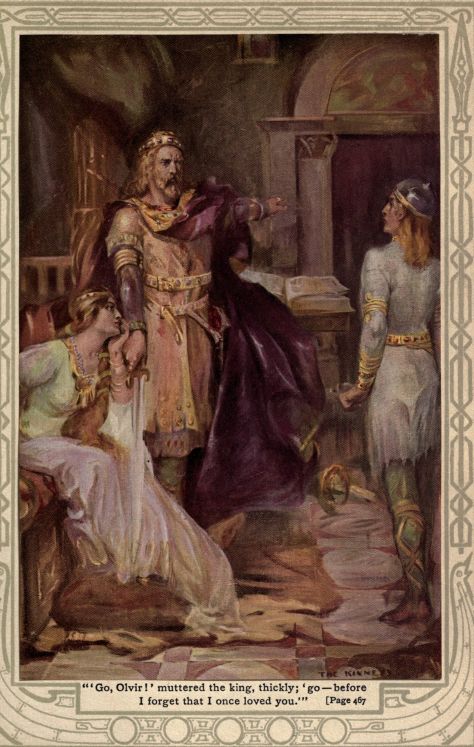
"'Go, Olvir!' muttered the king, thickly; 'go--before I forget that I once loved you.'" (Page 467)
Saddened as were Karl and Hildegarde by the thought of parting, their grief could not compare with that of Olvir and his little princess. Though the king left love behind, before him he saw glory and power; and even Hildegarde could look forward with pleasure to the success of her dear lord. Olvir, however, in leaving love, left all that he held dear. The expected battles, which lured on so many others with their promise of blood-stained honors, meant no more to him than an unwilling rendering of his duty to the king.
"God grant, dear heart, that we meet the Saxons at once!" he burst out after a long silence. "A single great battle may shatter their war-earl's power, and end the bloody strife. With Wittikind crushed, the most stubborn of the forest-folk may well give up the struggle as hopeless."
"If only they might bend to our Lord Christ without so much as one battle!" sighed Rothada.
"If only they might, little vala!" echoed Olvir. "But the best we can look for is a pitched battle, and the more terrible the slaughter, the more hope for peace to follow."
"That is a fearful saying, Olvir!"
"The truth of sword-rule. But this is no time, dearest, to fret our spirits with such thoughts. We have enough to sadden us in our parting."
"Oh, my hero! If I were not so selfish, I would seek to lighten your heart. But I sit here, heavy with sorrow, while all others are gay. See; even Fastrada has put away her brooding, and makes merry with Gerold and the pages, as once I used to do."
"She may well rejoice! War is as welcome to her as to my vikings; and no doubt she is merry that we are to be parted."
"Dear hero, you should speak evil of no one."
"True, sweetheart; I should not judge even the witch's daughter. Yet her laughter lacks the ring of that which springs from a kindly heart. Nor do I like the manner in which she looks at the king."
"Surely, Olvir, you misjudge the maiden. All during Lent she has been very kind and gentle. Look; here are the mushrooms which she told Pepin and Karl to gather for our mother."
"Loki,--a Roman dish! Yet the act was to be praised," admitted Olvir, and he stared curiously at the salver borne past by one of the pages. "I see it was not enough of honor to the ugly elf-stools that they should be gathered by a king's sons. They must be served in a golden bowl with a spoon of silver."
"Do not mock, dear. The cook is from Ravenna, and very skilled in his art. He bakes the spoon with the food, and if there should chance to be any poisonous mushroom with the others, he knows that the spoon will blacken."
"Better trust to good flesh and grain, and leave such dishes to the Romans and Greeks," rejoined Olvir, and he turned with sudden remembrance to his neglected trencher.
But his appetite, always moderate, was soon satisfied, and he was turning again to Rothada, when, startling as a thunderbolt from a clear sky, the king's voice broke in upon the laughter of the guests, harsh and strained with alarm: "Bring water! bring water quickly! The queen is ill! Mother of God, she swoons!"
In the sudden hush which followed, all heard the sibilant voice of Fastrada echoing the king's cry: "The queen swoons! Run, fetch the leech!--Kosru, the leech!"
Then all at the table sprang up together, and Liutrad and Worad rushed away in search of the Magian. With his own hands Karl had laid his queen upon the dais. About his stooping form gathered the dames and maidens; while the lords, grave and silent with anxiety, drew together at the far end of the hall. Olvir followed Rothada to the outer line of the women; but Gerold alone pushed in through their midst.
As the Swabian knelt beside his sister, Liutrad came thrusting Kosru before him into the hall. The Magian was deathly pale, and trembled visibly as Liutrad and Worad bore him forward between them. Yet he had not lost his power of speech.
"Stay!" he interposed in a quavering voice, as, at a sign from the king, Fastrada and the other bower-maidens sought to raise the queen. "Stay, maidens! I would first learn what our gracious dame has eaten."
"What we have all eaten," replied Karl, quickly.
"But more, lord king," called out Olvir. "How of the elf-stools?"
"The mushrooms!" muttered Gerold, and he sprang up to point out the little golden bowl, still on the board beside his sister's trencher.
Kosru tottered forward and clutched the bowl in his claw-like fingers. Breathlessly the onlookers watched while he sniffed at the shreds in the bottom of the dish and placed one of them upon his tongue. Almost instantly he spewed it out again.
"Ahriman!" he cried, and he turned to the king, his face a sickly yellow.
"Speak out!" commanded Karl, sternly.
"Ai! I feared it, lord king. Queen Hildegarde has eaten poisonous fungi."
"Yet the silver was untarnished. I saw it myself."
"But listen, lord king," replied the leech, so huskily that few could follow his words; "the test is not certain. There is a most deadly fungus, so like the harmless kind--"
"Who gathered the venomous mess?" demanded Karl, harshly.
"Your two eldest sons, sire," replied Fastrada.
"King of Heaven!" The great Frank's head bent forward, and he signed to the bower-maidens: "Bear her hence."
Out of the great hall and through the long corridors to her bower, they bore the swooning queen. The guests, following at a respectful distance, waited without the door, where they could soonest hear any word sent out from the sick-chamber.
Within the bower, husband and brother knelt side by side at the foot of Hildegarde's couch, wrestling in agonized prayer; while around them the maidens and tiring-women stood silently weeping, or, at the bidding of the leech, glided hastily about in the service of their beloved mistress.
But though Kosru made trial of drug after drug, all alike failed to rouse Hildegarde from her death-like stupor. Hour by hour the night dragged through its dreary length, and Kosru began to shake his head.
With all but infinite slowness, the grey dawn came stealing in upon the silent watchers,--the dawn of the last day that Hildegarde, the beloved queen, should abide with her dear lord. As the first red arrows of sunrise shot up the eastern sky, Rothada glided out from the bower and came to place her hand in Olvir's. Her face was very sad, and tears shone in the violet eyes.
"All is over!" murmured Olvir, in a broken whisper. But Rothada shook her head.
"No, no; she still breathes. Yet the leech has given up all hope. He promises only to rouse her before the end. He has already given the drug. I come to call Abbot Fulrad for the last offices of Holy Church."
Groans of despair burst from the lips of the waiting liegeman; but Olvir turned silently, and went with Rothada to the chapel. They halted in the doorway, and gazed out over the kneeling congregation to the high altar. There was no need of word or sign. Very solemnly Fulrad took up the vessel of sacred oil, and came down from the chancel. As he passed from among them the soft-voiced choristers sobbed out the wailing notes of the Miserere, and the grief-stricken congregation prostrated themselves in hopeless sorrow. But only Rothada and Olvir followed the abbot along the silent passages and in through the entrance to the bower.
Within the sick-room there had been a change. Beside the couch were gathered all the king's children, and Hildegarde, very faint, but fully conscious, was taking the last farewell of her dear ones. The end was very near.
Fulrad raised his tear-stained face, and advanced, with all the solemnity of his office, to administer the last rites of Holy Church. Tremulous but clear, his voice pronounced the words of the sacrament, and with the holy oil he anointed the head and hands and feet of the dying queen. Then, the holy rite ended, he turned and went back to the chapel. As the slow, heavy tread of his sandals died away down the passage, Karl rose up and signed to the sobbing attendants.
"Let all go out but those of kin," he said.
Obediently the maidens and women took a last look at their mistress, and crept away to seek comfort for their grief in the chapel. Behind them followed Fastrada and Kosru the leech, with downcast eyes; while last of all came Olvir, his dark face aglow with the spiritual light that shone in the eyes of Hildegarde. He paused at the door, overcome with yearning to linger inside; and as Fastrada and the cowering leech glided out before him, his wish was answered by the king: "Turn again, Olvir. She speaks your name."
In a moment the Northman was back beside Rothada. Hildegarde had kissed her own children for the last time, and, at a sign from Karl, they were being led from the bower. She now turned her gaze to the grief-stricken figure of Pepin Hunchback, and all bent forward to catch her faintly murmured words: "Son of Himiltrude,--no less my son. Cherish him, dear lord!"
"As God gives me wisdom, beloved," answered Karl.
The boy bent and kissed the lips of the gentle dame who had been to him as his own mother; then, sobbing bitterly, he ran from the bower. In his place knelt Rothada, and on either side of her Gerold and Olvir. Already Hildegarde's mild eyes were darkening; but she turned her gaze to the three, and a smile shone on her pallid cheeks.
"Gerold--brother," she whispered, "God has blessed you. Yours shall ever be a life of honor. Rothada--Olvir, my daughter--my son,--love is yours. Be happy, as I have been happy with my dear lord. Karl--come to me--"
Silently the three rose and gave place to the king. He knelt and drew his beloved into his great arms, and she nestled to him with the sigh of a tired child.
Then the others went softly out of the bower, and left the king alone with his dead.
CHAPTER XV
All the field with the blood of the fighters
Flowed, from whence first the great
Sun-star of morning-tide,
Lamp of the Lord God,
Lord everlasting,
Glode over earth, till the glorious creature
Sunk to her setting.
BATTLE OF BRUNANBURH.
With all the solemn pomp of church and state they bore the dead queen through the budding woods to Metz, and there laid her to rest in the crypt of the great domchurch,--the Basilica of Saint Arnulf her forefather. The beggar crouching on the steps saw the great king pass in with bowed head and fingers tugging at his beard, and knew that there is a grief which comes to both high and low, which enters alike palace halls and the hovel of the serf.
But deep as was Karl's sorrow, once that he had turned away from the tomb of his beloved queen, he set about the opening of the Saxon campaign with added determination. Used as were his liegemen to the tremendous energy of his movements, never before had they seen him bend all to his will with such resistless force. To put away the anguish of his grief, he threw himself headlong into the war-game, and welcomed the fresh tidings of ravages which served to inflame his wrath against the forest-dwellers.
He did not return to the ill-omened villa, but moved the court direct to Mayence. Leaving there the royal household in the charge of Queen Bertrada his mother, who came from Saint Denis at his asking, he embarked with his war-counts for Cologne in Olvir's long-ships.
Yet with all his eagerness to meet and crush the harrying forest-wolves, the first day of summer found him encamped at the Lippespring with but thirty thousand warriors,--only a few more than those with whom he had set out from Cologne. The greater part of the expected levies had been delayed by lack of forage and by the all but impassable morasses which covered the land during the heavy spring rains.
Far from damping his ardor, however, the delay and disappointment had served only to harden his resolve and call out his energy. Already he had swept across the mark from the Ems to the Weser, and back again to Paderborn, devastating all the southern shires of Westphalia. Where he had passed, the Saxon hamlets, scattered through the vast woods and on the broad heaths, were left as heaps of smouldering ruins. Their defenders lay slain among the ashes; while all others of their inhabitants whom the Franks could take thrall--man and woman and child--were being dragged away to exile and slavery in the South.
Had the forces of Wittikind been united, even so great a leader as Karl could not have thus harried the land unchecked. But the Frisians were yet making their way around the north of the Teutoburger Wald, and Bruno and Hessi had marched with their tribesmen, the Eastphalians and Engern, to foray along the northern borders of Thuringia. So, with only his Westphalians and Nordalbingians, Wittikind, no less wily than intrepid, had withdrawn into the hills which form the southern termination of the Teutoburger Wald, and awaited attack near where the Roman Varus perished with his legions. Though his host was smaller than the Frank's, it held the vantage of position.
Before he learned of the delayed levies, the king had sent Olvir into Thuringia, to aid Count Rudulf against the harrying Engern and Eastphalians. But when the vikings had marched clear across the forest land to the Saale, they found that the Grey Wolf and his little host of five thousand Thuringians had gone north and west into Eastphalia, worrying the rearguard of the retreating Saxons.
Eager to bring word to the king before Hessi and Bruno could join their large host to that of the war-earl, Olvir marched straight across country to Paderborn. But he reached the Lippespring with even his iron followers outspent, only to learn that Karl had met the war-earl on his chosen ground, and forced the passage of the mountains. Stubbornly as the Westphalians and their Nordalbingian allies had fought, the Franks had driven them back through their sacred forests, and wrested the holy Burg of Teu from their grasp.
Defeated but unrouted, Wittikind had withdrawn with his host along the farther slope of the mountains, to meet his Frisian allies on the Haze bank; and there, upon the arrival of his belated levies, Karl had followed, to give him battle the second time.
Such were the tidings that were poured into the ears of the eager sea-wolves as they lay panting after their long chase. Nor had they rested two days before Count Gerold came racing to the Lippespring with word of the first great battle on the Haze bank. By forced marches, the king had come upon the Saxon host before the juncture of Hessi and Bruno. The forest-dwellers, surprised in their camp, had been driven across the Haze, with great slaughter. But the outworn Franks were unable to follow up their victory, and Karl, learning in the night that Hessi and Bruno were about to join the war-earl, at once set to replacing and strengthening the broken war-hedges of the captured camp.
The immense host of the united Saxons now outnumbered the Franks by ten thousand men. The Grey Wolf had not yet come up with his Thuringians when Gerold left the Haze, and his whereabouts were unknown. There was pressing need for every man who could swing sword. But Gerold might have spared himself the urging. The vikings were wild to take part in the blood-game. There were no laggards when, at dawn, Olvir gave the word to start.
Freshened by their rest, they swept over the hills, past the Teutoburg and through the wooded valley country along the base of the Teutoburger Wald, like wolves on a blood-trail. Even horsemen could not have outdistanced them on that first day's march. Night fell upon them, but the beams of the rising moon glinted on the bright steel of their war-gear as they trailed across the open glades. When at last they flung themselves down among the alders, to gnaw at their cold food and stretch out for a half-night's rest, Gerold sprang from his horse, with the welcome call that the Frankish camp could not be distant over three hours' march.
But when, at dawn, the vikings would have rushed on swifter than ever, Olvir checked them. If the hosts had again joined battle, it was well he should bring his sea-wolves into the field unwearied. So, chafing at the restraint, like hounds in leash, yet bending to the will of their earl, the vikings swung on at the pace he set, until through the oak forest there came rumbling a sound like the bellow of angry bulls. It was the deep battle-note of the Saxons, roaring in the hollow of their shields.
After that, Olvir no longer thought to hold his followers. Silent, but with eyes gleaming and blades bared, the sea-wolves broke into a run, and charged hotly after Gerold and their earl. It was not long before they had burst out from the oak forest and were rushing across a stretch of yellow gorse toward the war-hedges of the Frankish camp, on the nearer bank of the Haze.
A belt of trees shut out all view of the battle which raged on the farther side of the stream; but above the dull rumble of the Saxon shield-roar sounded the furious shouts of the Franks, the harsh braying of horns, the shrilling of the Saxon fifes, and the terrific clash of shields and helmets struck by the whirling blades.
The Frankish host had left the shelter of the war-hedges to meet the Saxons in the open field; but the ghastly heaps of Saxon slain which half choked the bed of the Haze showed that the Franks had not been the first to attempt the crossing.
"Look, lad!" shouted Olvir. "It must be old Rudulf has come before us. The king has driven back the attacking foe, and followed after, across the stream."
"If such has-- Saint Michael! Who are those come flying from the field?--the Neustrians! God grant we 're not too late--"
"None too late for the sword-play!" answered the Northman, his nostrils quivering, and then, silent as his men, he led the way past the Frankish camp. As they skirted the war-hedges, the charging warriors were greeted by a welcoming hail from the frightened camp-followers within, and Pepin Hunchback came racing out to meet Olvir and Gerold.
"Turn back, king's son! We go into battle," commanded Gerold. But Pepin urged his horse close in beside Zora, and rode along with Olvir.
"Hero," he pleaded, "let me go with you. My father left me to hold the camp. What place is that for a king's son?"
"Come, then, king's son," answered Olvir, and the boy's face flushed with joy. Then his horse leaped with Zora into the Haze, and close after dashed the vikings, panting with eagerness for the blood-game. As they floundered across the stream, the glimpse which they caught of the retreating Neustrians down the bank served only to whet their temper the keener.
But on the farther side, Olvir wheeled the red mare, and sprang to the ground.
"Hold, men!" he commanded. "Form wedge. Afoot, Gerold. You 'll stand behind me at the fore, with Floki and Liutrad. The king's son rides beside the 'Gleam'--stay! he himself shall bear the banner. Put Zora and the count's horse in the midst. So; well done! Now for Odin's game. Keep close, all. When my wedge strikes, it should be with the weight of every man linked to his fellows."
"Lead on, son of Thorbiorn!" croaked Floki, and the men burst into a roar: "Lead on! Lead on, ring-breaker! Haoi!"
Al-hatif glittered above the sea-king's head, and he sprang about, to lead his band at a half run through the screening coppice. A few swift strides, and he burst from the thickets into full view of the battle. Before him on the trampled gorse heath stretched out the vast disordered mass of the battling hosts, locked fast in the death-grapple and reeling to and fro with the stress of their mighty struggles.
The Saxon warriors--Eastphalian, Westphalian, Nordalbingian, and Engern--were mingled in a shapeless horde, which sought to thrust back and overthrow the equally disarrayed mass of the Frankish footmen. But to the left, the Frisians, most stubborn of all fighters, stood firm in orderly array against the ferocious attack of the Grey Wolf and his Thuringians, while across on the far side of the battlefield, where the left wing of the Saxons had been thrust back, could be seen the Frankish horse, with Karl himself in command, vainly striving to break the ranks of the mail-clad Danes in Wittikind's shieldburg.
Here was the key to the battle-scheme. None need tell Olvir where to strike. The first glance had shown him how the battle went. He must strike, and strike quickly. Already the Franks were giving back before the Saxon wolf-horde, and even as the vikings burst from the coppice after their leader, from the willows on their right a Frankish horn sounded the retreat, and Count Hardrat came leaping into the open, to fall headlong among the yellow gorse.
Bewildered and dismayed by the call to flight, the last ranks of the Neustrians wavered and broke, and the yelling Saxons leaped forward to slay the fugitives. But at sight of the band of mailed warriors who came charging from the thicket not a spearthrow distant, they halted and closed up their ranks to meet the coming shock. As well might they have thought to check the mad rush of an aurochs herd. The vikings, though still locked in solid ranks, were now charging at full run.
As they swept down upon the Saxons, arrows streamed from their midst into the thick of the enemy; but they cast no spears until their leader was within twenty paces of the Saxon line. Then at last Al-hatif swung up, and a deadly flight of darts and javelins whirred into the dense mass of the Saxons. Pierced through their half-mailed war-jerkins of wolf and boar hide, scores of the forest-men fell dead or wounded, and the wedge hurled forward to strike the line where weakened by their fall.
"Thor aid! Thor aid!" roared out the viking battle-shout, and then, with a frightful rending crash, the wedge smashed in among the Saxons. Fiercely as the forest-men leaped to meet the attack, they were like children before the mailed vikings, who numbered in their midst many of the most famous champions of the North. Through the rift opened by Olvir and Floki, the Northmen followed hotly, roaring in grim delight as they hewed wider the battle-path.
To the very heart of the Saxon host the wedge charged without a check in its terrible course, and the ground behind it was covered with fallen warriors. Here and there a steel-mailed figure lay among the trampled corpses, but for every such one there was to be counted a dozen of slain Saxons. Even the savage Nordalbingians were appalled by such slaughter, and sought to give way before the vikings, thinking that they would swerve and pass through to the Frankish lines, where Worad and Amalwin were bending every effort to hold their own. But the Norse wedge crashed on its way straight for the rear of the Danish shieldburg.
A few more brief moments of bloody slaughter, and then Northman was face to face with Northman. Here was no longer the formless horde of half-armed berserks, to be hewn down like cattle by the viking blades, but Danes trained in shieldburg and armed like their assailants in scale-hauberks or mail-serks.
As the Danes faced about to meet the rear attack, Olvir thrust forward through the last ranks of the Saxons, smiling like a guest newly come to the feast. Protected alike against point and edge by his threefold mail, the blue steel of his helmet, and the little blade-glancing shield, he had come through the midst of the Saxons without a wound.
At either flank of their earl, Floki and Liutrad swung their great weapons with unflagging vigor. At every stroke of the young giant's axe, a man went down, cleft through shield and helmet; while the long-shafted blade of the strutting Crane rose and fell with still more deadly effect. Floki did not strike downwards, but whirled his halberd with a peculiar backhanded stroke, as erratic as the man's nature.
Unlike their earl, neither had come scatheless from amongst the Saxons, nor had Gerold. The young Swabian was gashed in the shoulder and thigh by thrusting spears, and the bell-like rim of his casque had been broken by a sling-stone, which, had it been aimed a handsbreadth lower, would have beaten in his face. Liutrad's serk beneath his axe-arm showed a long rent, where a sword had bitten through to the bone,--the blow of a berserk-mad Nordalbingian. But the look of Floki was most terrible of all. His cheek had been laid open by a glancing sword-stroke, and the wound gave to his long wry face an aspect of ghastly grotesqueness. As yet, however, none of the three felt his wounds, and all alike sprang eagerly after Olvir, as he rushed upon the Danish shieldwall.
"Hei, vikings, follow!" croaked Floki. "Leave the cattle. Here are men!"
"Men--Danes--sons of Thor!" echoed Olvir. "After me, sea-wolves! Here are players. Hail, Danes--folk of Sigfrid! Odin calls you!"
"Hail, bairn! Get thee to Godheim!" shouted a Dane of vast girth, and he leaped forward from the shieldburg to meet the Norse earl.
"Lead me! I follow--in good time," rejoined Olvir, tauntingly.
The Dane whirled up his two-bladed axe, and struck with all his might. Even Olvir's skill could not have warded such a blow. It was a shield-smashing stroke, such as Liutrad was swinging. But it whirled down through empty air, and the great blade buried itself deep in the turf. Olvir had flung himself forward beneath the descending weapon and on past the massive figure of the wielder. As he darted by, Al-hatif stabbed up beneath the Dane's shield. The champion fell groaning upon his axe. Without a backward glance, Olvir sprang forward to break the Danish shieldwall. Before they could comprehend his deadly mode of attack, two more Danes went down from the blinding stabs of Al-hatif, and then Liutrad and Gerold and Floki were again at his back.
On one side a little space had been left clear by the opening out of the Saxons. This was a rare chance for the sharp-eyed Crane, who leaped sideways, and, with a full-armed sweep, sent his halberd whistling low among the legs of the foremost Danes. It was like a scythe in the wheat. The one blow crippled in its sweep no less than four warriors, whose sudden fall left a gap in the wall of interlocked shields. Before the gap could be closed, Olvir had leaped into the opening, and was putting forth his utmost effort to pierce the second rank of the Danes.
Close at his shoulders pressed Liutrad and Gerold, while Floki stood back for a second leg-shearing. But, though locked so closely in their ranks that they could not leap above the terrible halberd, the Danes were too crafty to be caught as at first. Three or four instantly crouched to catch the stroke on their shields, and one, a skilled swordsman, thrust out his blade to meet the haft of the halberd. Neither his parry nor the intervening shields could entirely break the blow. The swordsman's blade was dashed aside, his shield shattered into fragments, and he himself hurled back among his fellows, a mangled corpse. But his skill was not without avail to those beside him. The halberd shaft, notched by his sword-edge, broke short off with the force of the blow.
"Faul!" croaked Floki, and, hurling the splintered shaft into the midst of the shieldburg, he drew his sword--a blade half a span longer than Ironbiter and little less weighty. He sprang forward none too soon. Gerold had thrust himself in the way of a stroke aimed from the side at Olvir, and the fierce blow, cleaving through his shield, had dinted his helmet, and sent him reeling backwards, half-stunned.
"Way, lad, way!" growled the Northman. Plucking the Swabian back, he leaped upon the Danes in a berserk rage.
Closing upon their leaders, the vikings now struck the shieldburg with the full weight of their charge, and the force of the shock drove the wedge's point well into the opening cleft by Olvir and his shoulder-mates. Gerold, still dazed, was dragged back beside the "Gleam" just in time to see young Pepin struck down by a sling-stone which burst the lad's helmet. As a warrior caught the gold-starred banner from the opening hand of the king's son, Gerold gave command that the boy be lashed to his horse and taken back into the midst of the wedge. He himself thrust forward again, that he might not lose his share of the fighting. He found the wedge-leaders steadily cutting their way deeper toward the heart of the shieldburg.
But it was steel biting steel. Once the impetus of the viking charge was lost, the advance became very slow. Even at the wedge's point, the movement, though sure, meant for every step gained a matter of fiercest struggle. Olvir and Floki yet fought as at first; but Liutrad, for all his massive young strength, was glad enough for a time to give place to Gerold.
If, however, the viking wedge failed to burst open the shieldburg at once, the slaughter they had wrought among the Saxons and their presence in the Danish rear were not without effect on both friend and foe. The fleeing Neustrians had turned again, and the Saxons, disconcerted by the viking charge, no longer pressed so fiercely upon the Franks, who immediately followed up the slight show of weakness by renewed efforts to regain their lost ground.
With the attack of the vikings, Wittikind, who had been trying to single out his royal opponent, on the farther side of the shieldburg, quickly heeded the greater danger of the fresh attack, and hastened to the rear to aid in checking the in-thrusting wedge.
Slowly but steadily, Olvir was piercing a rift for his followers into the steel core of the shieldburg, when the Danish ranks before him opened, and in the gap towered up the terrible figure of the Saxon war-earl. He had time only for a glimpse of the Saxon's bearded face and glaring blue eyes; then a blade more ponderous than Ironbiter whirled down upon him.
Unable to avoid the blow, Olvir raised his shield to meet it. Never had he tilted the little buckler with greater skill. But his arm was somewhat wearied, and the Saxon struck with a force that only Otkar Jotuntop himself might have exceeded. Though the blow glanced aside, it beat the shield down upon Olvir's helmet with stunning violence. As he stood there, dazed and blinking, Liutrad thrust a protecting shield above his head, while Gerold flung himself upon the Saxon. As the Swabian leaped, he cut fiercely at Wittikind's neck. But the Saxon caught the blow on his sword, and as Gerold's shield clashed upon his own, he hurled the leaper backwards.
"Teu! Teu!" he roared, and he whirled his great blade to cut down the reeling Swabian. But then Liutrad swung up his axe, and dealt the war-earl a crashing two-handed blow. Driven by all the massive strength of the wielder, the heavy blade split the Saxon's shield, and sent him staggering back as though struck by Thor's hammer.
Even as the Danes pressed in before their war-earl, their close-set ranks heaved and staggered with the force of a tremendous shock from beyond. The Frankish horsemen had withdrawn from the battle-line, and, led by the king himself, had hurled upon the shieldburg in a charge more impetuous than any that had gone before.
Galloping in the lead of his heavy horsemen, Karl spurred his charger full against the wall of locked shields. A dozen spear-points glanced from his shield or splintered upon his scale hauberk. Then his heavy stallion struck the shieldwall like a war-ram, and burst through, trampling upon the overthrown Danes. From all sides ready blades were brandished to cut down the royal leader. But not even the halberds could beat through the king's guard. His grey eyes flamed with white fire, and he shouted joyfully, as Ironbiter swirled down to right and left: "Heu! heu! Christ reigns! Down with the fiend-gods! Follow me, Franks!"
"Heu! heu! Christ and king!" shouted the horsemen, and, fired by the example of their leader, they burst through the Dane wall in a dozen places. In a twinkling, the close ranks of the shieldburg were rent asunder, and Danes and Franks were mingled in a wildly furious struggle.
Berserk-mad, Wittikind turned again from the Northmen, and rushed to meet the Frank king as he came plunging through the heart of the shieldburg.
"The king!" he roared; "about him, men!"
With a fierce shout, the Danes rallied and thrust in behind Karl with such desperate valor that he was cut off from the horsemen, with scarce a dozen followers. At once the mailed champions closed in on the handful of riders, and hewed them down with axe and halberd. Karl alone sat his saddle when the Danish ranks opened, and the war-earl came leaping for his vengeance. The first blow of his sword split the skull of the king's stallion, and Karl was hurled forward at the feet of the Saxon.
In the fall, the hilt of Ironbiter, slippery with blood, was wrenched from his grasp. He saw Wittikind's whirling sword, and sprang up to grip him fast about the body. Unable to strike, the Saxon in turn gripped the king. For a little, the Danes held back, while the giant leaders bent and strained to overthrow one another. But the Frank had the vantage of the hold. A bear would have smothered in that hug. Already Wittikind's face was blackening, when a Dane sprang in and struck the crowned helmet of the king with his war-hammer.