FOR THE WHITE CHRIST (continued 4)
Reading edition
"How so?"
"With an Arab, red bodes anger. I had it from Otkar."
"You look for treachery?"
"For all evil from one who shoots viper shafts. This red cloak is no good omen. Yet I am pledged to the king to hold the poisoner in peace."
"Floki might pick a quarrel with him. I myself would as lief try my axe on his swaddled skull. If these swart folk fight in single combat, one of us will soon make an end of him."
"No, lad; he is a haughty man. He might fight me, but not my follower; and I am bound by my word."
"Then we must wait and watch."
"Ay," muttered Olvir; and he stared hard at Kasim, who, being addressed by the king, was reluctantly turning away his gaze from the Afranj maiden.
When, with friendly dignity, Karl had acknowledged the vali's gifts, he turned to his daughter and her companion.
"The Saracen shall see how we of the North honor women," he said. "Take up the silken rolls and bring them before the maidens. When the child has made her choice, the daughter of Rudulf may take what she will."
Both girls cried out their delight, and Fastrada met the king's smiling look with a glance that stirred his ardent nature to the depths. A subtle change shadowed his stately features, and for a little he gazed at the girl as Kasim had gazed. Her eyes fell before his; and while she yet held them demurely downcast, Rothada's voice rang out again in childish delight. Olvir had chosen for her a white silk, embroidered in violet and gold.
At his daughter's cry, Karl turned suddenly about in his saddle and stared, frowning, at the walls of Pampeluna. The blinking vali before him saw his lips move, and caught the words which he muttered; but only Fulrad, that abbot learned in Holy Writ, might have divined his meaning,--"He that ruleth himself is greater--is greater--!"
Olvir, though so watchful of his Saracen kinsman, noted the strange look on the king's face. But then, in common with the greater number of the Franks, his attention was drawn by Fastrada. Two rolls of scarlet silk already lay in the girl's litter; yet, not content with these, she had seized upon a gorgeous purple. Her cry of gratified vanity fixed upon her the looks of all around.
Most maidens would have drooped their heads in modest shame at thus being made the centre of observation; not so the Thuringian. The rich coloring of her cheeks heightened, though not with shame, and her eyes sparkled like sapphires. Waving aside the attendants, she unrolled the purple silk, and, with a daring glance at the king, wrapped herself about in the folds of the imperial color.
Many of the Franks cried out their admiration of the maiden's gracefulness; but the few who were quick enough to perceive the audacious allusion of her act took good care to preserve silence. Karl, however, maintained his stern observation of the city battlements, and the girl, foiled of her expected triumph, shifted her attack to Olvir. Here again she was to meet with disappointment. The young Northman returned her half-defiant, half-alluring look with an indifferent glance, and recalled his attention to Rothada.
The Thuringian's cheek paled. She let the folds of the purple silk slip from about her, and bowed forward in the litter, with hot eyes and thin-drawn lips, deaf to the murmured compliments of the courtiers. The strong white teeth gleamed between her tightened lips, and soon another look than suffering stole into her face.
In her sudden fury, the girl raised her head to transfix the Northman with her glance; and, instead, she met the solemn gaze of Roland's blue eyes.
From the giving of the silks to this decisive moment, the count had been watching her every look and action with closest attention. Until she bent her head, not even the slightest change in her expression had escaped him. And now, his gaze sharpened to the utmost keenness by the intensity of his feeling, he saw, as it were, the girl's dark troubled soul stand out bare before its lovely mask. The Frank shuddered, and crossed himself hastily.
At this moment the king suddenly recalled to mind Vali Kasim, who still stood bowing before him with Oriental obsequiousness. He smiled, and raised his hand. "Again we render thanks for your gifts, Count Kasim."
"Bismillah! I rejoice that my glorious lord is pleased. It is for me to serve him in all things. Therefore, I have brought my learned geber, Kosru the Magian, to make certain that your Majesty shall enjoy health and full strength while you honor our land with your gracious presence."
"Health!" repeated Karl, and he smiled as he drew up his massive figure. But then his glance chanced to rest on Rothada, and he signed to the Magian to join the royal suite. "It is well. The maidens may have need of leechcraft in a strange land. Our chamberlain will have command to make fitting return for your gifts, lord count."
"It is not for gifts I ask, most gracious sultan."
"What, then?" demanded Karl, his keen grey eyes fixed upon the Saracen's impassive face.
Kasim salaamed to the ground before replying. "My lord and sultan is gracious; he opens my lips. Let him not be offended. I have said that the people of my city are consumed with fear of the mighty Afranj; they tremble lest the fierce giants of the North be loosed in their midst."
"So--you would have me forego the placing of my wardens in your burg. How shall it be held when all your warriors are withdrawn?"
"The walls are high, O sultan. The townfolk will bar out my lord's foes and my foes. Can my lord doubt that they will hold fast for the sultan of their own faith?"
"How, lord vali," demanded Anselm, the Count Palatine; "if your folk are so friendly, why should they seek to be rid of us? I would not be the one to speak of mishap; yet here is bitter truth, sire: Should not God and the holy saints give your Majesty victory; should we fare homeward, a war-broken host; would these timorous Navarrese then open their gates to give succor; or would they not rather seek our harm, to gain favor with the pagan king?"
Kasim smiled blandly, and would have spoken again, had not Karl held up his hand for silence. For a little, the king gazed at the thousand and more Saracen horsemen massed together in dense ranks on the spot where they had been halted by the cry of their chief. Then he glanced up at the burg on the height and back to the little maiden behind him.
"O sultan of sultans--" began Kasim; but again Karl held up a restraining hand.
"I cannot grant your wish, lord count," he said. "I must hold to the compact. Count Olvir, you will guard this stronghold with your vikings, and Rothada and her companion shall remain here in your care. It had been wiser to have left the maidens at Casseneuil."
Olvir frowned with disappointment at this unexpected turn of events.
"It was not to sit behind stone walls, lord king, that I joined your host," he protested.
"Yet I ask it of you, my Dane hawk," replied Karl, gravely. "For a time, at least, I ask you to shield this little maid, who is more precious to me than all the old Goth realm."
"For her sake," muttered Olvir, half reluctantly.
Karl spoke in a lowered voice: "For her sake, lad! I would not ask the service but for her. Would that I had not brought her across the mountains! I look for treason from this fawning hound. I must safeguard the maiden and this stronghold at all cost."
"Enough, lord king!" exclaimed Olvir. "I give you willing service."
CHAPTER XXII
Blithe then grew the breaker of rings.
BEOWULF.
Early two months had passed since from the loftiest tower of Pampeluna's citadel Olvir had watched the Frankish warriors wind away across the green plateau, on their southward march to the Ebro. In all the dreary weeks of waiting no tidings had come back from the invading host,--not a word to tell whether Karl was battling for the old Goth realm on the Ebro's banks, or, finding Abd-er-Rahman too cautious to encounter him near Saragossa, had ventured on south to Toledo or to Cordova itself, in search of the fierce but wily old Emir of Andalus.
Whatever might be the truth as to the movements of the host, there could be no doubt that trickery was rife in its rear; for Karl most certainly had sent more than one messenger northward, and death or capture at the hands of the king's Saracen allies could alone account for their failure to bring tidings to Pampeluna.
At the end of the first month Floki was for taking a score or so of men, and going in search of the Franks; but Olvir told him that he would not risk one man, much less a score, to fall into the traitors' snare. Instead, he set about strengthening the defences of the citadel, and levied on the townfolk for food, until the storerooms were filled to overflowing. The old Roman cisterns already held enough water to last out a six months' siege.
That he could hold the citadel against all comers Olvir had no doubt; but his warriors were far too few for him to man the burg walls. He had to content himself with a watch at each gate of half a hundred warriors, who, he planned, could hold their posts secure against any chance band of the enemy, or, in the event of an attack in force, could check the first assault, and so save the citadel from the possibility of a surprise.
In his vigilant watch over the safety of the citadel, the young Northman found little time to spend in the society of Rothada's miniature court. Yet it was not seldom that he saw the little princess; for she often sought him out with the complaint that Fastrada was closeted with the wizened old Magian leech whom the king her father had left to care for her, and that she was weary of playing with the pages and the tiring-women.
On the morning of the day which opened the ninth week of waiting, Olvir came riding up to the great door of the citadel, after his round of the burg gates, and as he dismounted in the shadow of the archway, smilingly unlashed a roll of cloth from his saddle. Then he beckoned to one of the door wardens and said briefly: "The mare frets with so much stall-standing. Take her for a run across the Arga."
Overjoyed at the chance, the man sprang into the saddle, and Zora started down the steep path, picking her steps daintily but with a quickness that showed her impatience at the restraints on coursing within the burg.
A little later Olvir climbed out upon the roof of the citadel's main tower, the roll of cloth still in his hand. For a while he swept with his glance the neighboring heights and the broad harvest fields on the plain below the burg. All lay calm and peaceful in the hot sunshine, and his gaze turned with his thoughts to the cloth in his hand. Half smiling, he peered within its folds, and began to pace slowly to and fro across the narrow space of the roof.
"By the hair of Sif!" he chuckled, "I 'll wager it's a gift to delight any maid!"
But his pleasant musing was cut short by the sound of a sibilant voice in the upper room of an adjoining tower.
"Loki!" he muttered. "Can I never get beyond earshot of that woman?"
Frowning, he moved over to the farther battlement, and turned his face away toward the barren fells which lay between him and the mysterious South. But though he sought to fix his thoughts on the host which had vanished behind those desolate hills and crags, he could not shut out the sound of that sibilant voice or the shrill, cackling answers of Kosru, the old Magian leech.
"Of a surety, man,"--Fastrada was speaking,--"you are a warlock of note. Strange you have already wandered over Rhine! You must come again, and farther,--to my Thuringian home. My mother will give you fair welcome. Though a woman of the roving Wends, she is skilled in herbs and magic spells. At her bidding the storm-wind rises. She rules the forest sprites,--kobolds and nixies,--even the fiend-gods of the Saxons."
"I do not claim to rule the storm-wind, maiden." The leech's voice was raised in shrill protest.
"Yet you do not lack knowledge of powerful spells," came back the quick response. "Tell me again of that which saved you from the wolves in Fulda Wood."
"It was a little thing, maiden, for a geber whose learning has saved the lives of princes. Yet the most learned might well have perished in the fangs of those fierce children of Ahriman. Only by chance did I have the magic drug to throw behind me and stay them, while the Jew and I fled on to the Christian monastery."
"But the drug? You did not tell me--"
"A foul-smelling resin from Arabia. Others than I have tested its charm over the grey demons of the forest. It will stay the wolf-pack on a hot trail, or draw them from so far as they may scent its odor. But as to black magic--" The voice of the leech sank to a whisper.
For a time the words of neither speaker were audible. Then Fastrada's voice vibrated on the air, sharp and distinct: "How! Even the Magian chief? Listen, leech; stand my friend, and I pledge you sure gain in the king's court. My word carries favor among his lords."
"A bargain, maiden! Help me to a fair standing in the court of Karolah, and I give you a talisman of greatest potency,--a ring set with the magic stone whose hues shift and change even as the tints of your eyes."
"Its powers--?"
"To the weak it brings destruction; to the strong, honors--"
"And love?"
"Love, if already he does not love another."
"Another? Then I am safe! He will come back--he will come back to me! Give me the spell-stone, leech--now! A day may lose all! I swear to befriend you!"
"I do not doubt, maiden. But the ring is in your own land,--at Metz on the Moselle, pledged to a Jew trader, Yusuf Ben Israel. It is a heavy debt,--four ounces of gold."
"I will pay it gladly for such a ring. Here is what will win the spell-stone from the greedy Jew. Ai! you may well eye the bright clasp. It was my first gift from him!"
Olvir sprang up from his seat on the battlement as though stung.
"Loki!" he muttered. "The witch's daughter thinks to creep back into my heart with the aid of spells and evil craft. I have wasted my pity. Sooner would I cherish an adder than that fair-faced werwolf."
He turned to descend out of ear-shot of the sibilant voice, only to pause as it pierced the air in a hissing whisper: "Hist, leech! Some one mounts the other tower. Let us go down."
"The trolls flee before the light-elf!" murmured Olvir, and he stepped forward, smiling, as Rothada sprang gaily into view up the last steps of the narrow stairway. In a moment she was beside him, her face raised for his greeting. But when, instead of kissing her forehead, Olvir bent to her lips, she drew back with a startled look, and a faint blush crept into her cheeks.
Never had the little maiden appeared so winsome as when she stood thus, half shrinking before him, overcome by a shyness whose source was a mystery to her child mind. In her play with the pages, she had dressed herself in a Saracen woman's street costume, several of which had been found in the citadel. Swathed from head to foot in the uncouth gown, with her face framed about by the brown folds, she appeared for all the world like a spring blossom just bursting from its dull husk. Olvir was quick to see the resemblance.
"By Ostara, little maid!" he exclaimed; "had I come upon you so out in the woodland, I 'd have fancied you the elf of the violets. Surely no flower-elf could be more winsome!"
"Oh, Olvir!" protested the girl, and her blushing face bent yet lower. Her bosom rose and fell quickly, and she glanced shyly at the smiling Northman. But then, overcome by wonder at her strange emotion, she looked up at him in bewilderment.
"What is this, dear hero?" she murmured. "When you speak kindly to me, my very heart sings with gladness, and yet I fear--I am ashamed."
The eyes of the young sea-king sparkled like black gems, and he bent to kiss her again. But as his gaze met hers, he paused, checked by her trustful innocence, and a quick flush reddened his dark cheeks.
"I am not worthy!" he said, half aloud. "Who am I to open life's mysteries to this little dove?"
"What is it, Olvir?" persisted Rothada. "Will you not speak out and answer me? Why do I not feel so when Dame Hildegarde and my father, who are no less kind--"
"Why--ah, why?" repeated Olvir. "But wait, child. Do not fret your little heart over such mysteries. Wait and ask your questions of the gracious queen who has shown to you a mother's love. We 'll be merry and care-free while we may. See; here is a gift I 've brought you from the booths of the Saracen tradefolk."
Flinging open the roll in his hand, Olvir drew out from its wrappings a silken bodice, worthy even a king's daughter. Strange as was its shape, Rothada forgot all her shyness and bewilderment as she gazed at its beautiful embroidery, wrought in pearls and gold-thread. Never before had she set eyes on such graceful designs. She needed little urging to fling aside her brown cloak and slip on the gay blue kirtle.
"Saint Petronella bless you, dear hero!" she cried in her delight. "Truly, it is a king's gift! I feel as beautiful as the bower-maidens. If you like, you can kiss me again--on the mouth."
"Like!" echoed Olvir, almost in a whisper, and he thrust out a gentle finger to lift her chin. Yet before he could stoop to meet her pouting lips, she sprang aside and pointed out over the battlements.
"The horses! the beautiful horses!" she shrieked. "Oh, look, Olvir,--thousands of horsemen racing!"
CHAPTER XXIII
Feeder of foul deeds,
Fey do I deem thee.
LAY OF SIGURD.
Even as the Northman spun about at the cry of the little maiden, his hands were loosening the horn at his belt. His glance rested but a moment on the torrent of Saracen spearmen which was pouring out across the green plain from behind the nearest hill.
"By Thor! three thousand and more, if a man!" he cried, and with the words the horn was raised to his lips. As its warning note blared down to the very donjons of the citadel, he bent out over the battlements, and stared across the roofs of the Saracen quarter to the open space about the Ebro Gate. Even as he looked, a shrill battle-cry rent the air,--"Allah acbar! Allah acbar!"--and in a twinkling all the space about the distant gateway was swarming with armed Saracens, the turbaned warriors surging in a wild mob into the great arch of the gateway.
Olvir's nostrils dilated. "Thor!" he muttered. "The Crane will do well to close the gate with those stinging gnats behind him."
"Oh, Olvir! are they fighting--all those fierce warriors?--and Floki has so few! He will be slain! Hasten--"
"He must fare for himself, king's daughter. But never fear! The horsemen have yet a bow-shot to race, and--heya! look; there's proof the gate is barred."
Great as was the distance, the dry, smokeless air was so clear that Rothada could see with startling distinctness the battle-ebb of the attacking mob as they fell back before the counter-charge of the vikings in the archway. Suddenly the little band rushed into view, their weapons flashing in fierce strokes. The deep viking battle-shout rolled out above the shrill yells of the Moslems, and the giant warriors, forming swiftly in a wedge, hurled themselves like a huge barbed spear-point straight through the thick of the mob.
"Haoi! there's fighting, king's daughter!" shouted Olvir, his eyes aflame. But Rothada shrank back, and pressed her hands upon her eyes, to shut out the cruel sight.
"What! So fearful of a little bloodshed?" he exclaimed. "But I forget. You 're still a cloister-dove. Come down and hide with your pages. I must look to the door when Floki comes knocking."
"Holy Mother! Why must there be so much of war and slaying?" wailed the girl.
"Ask the priests of your White Christ," retorted Olvir, and taking her hand, he led her quickly down the tower stair.
Having left the little princess in the care of her tiring-woman, he ran from post to post of the citadel's defences, that he might see with his own eyes whether every man was in his appointed position. Last of all, he mounted the great arch above the entrance, whose oaken doors stood ajar to welcome the retreating gate wardens.
At sight of his earl, a watchman who had climbed the main tower shouted down to him: "Ho, ring-breaker! Floki's gate swings open. The Asiamen ride into the burg."
"What of Floki?" demanded Olvir.
"I cannot see. But the other wardens gather in the great square. Ho! there come the Crane and his men, a horde of swart curs yelping at their heels. The bands join, and the Asiamen run to shelter. Now the Crane turns this way."
"Good!" said Olvir. "They have little more than a bow-shot to come, and the crooked lanes will check the horsemen."
It was none too soon, however, that the men of the gate watches swung up the steep path after Floki and Liutrad, and poured through the archway into the citadel court. As the ponderous doors swung to behind them, the vanguard of the Saracen host came racing into view, hot on their trail. But when they saw that their quarry had reached cover, the swarthy riders contented themselves with a derisive yell, and wheeled swiftly about to seek shelter from the arrows of the vikings.
Olvir hastened down into the court.
"Well done! well done, vikings!" he greeted the returned warriors. "You had brisk play for a time, old Crane. What of the slain?"
"Go ask the Asiamen, earl," replied Floki, with a dry chuckle. "We have none to name, though you can see enough of scratches among my men. The black cats do not lack claws."
"I give thanks they are no sharper. Had your gate been opened when you first left it--"
"The traitors did well to open it at all. I clenched the chain-hooks with a sledge. For all their treachery, the curs gained nothing but scathe."
"Yet we can count one man fated. Tell me, Liutrad; did not Ottar pass out your gate upon my mare, to ride across the Arga?"
"He passed the gate, earl, but not to cross the river. I heard him say that he was minded to ride around the burg to the Ebro Gate."
"Loki! my Zora,--my matchless mare!"
"Ho, earl!" called down a warrior on the wall; "here comes one waving a green branch. Shall I loose an arrow at the swart hound? He is like Earl Kasim as two peas."
"Hold!" commanded Olvir, and he ascended quickly to the parapet, Floki and Liutrad at his heels. As they gained the top and leaned with him over the battlements, they saw Kasim Ibn Yusuf, branch in hand, riding up the steep ascent. Poisoner or not, there could be no doubt as to the man's boldness.
"Thor smite me!" gasped Liutrad. "Zora!--he rides Zora!"
"It is a taunt," croaked Floki. "None but a fated man would venture such a deed. Let me drive an arrow through his hide, and the mare is yours again, ring-breaker."
Olvir was white with anger; but he shook his head.
"No," he lisped; "he bears a peace-branch,--he is a herald, and peace-holy,--the foul poisoner!"
"May Hel's hand soon grip him!" growled Floki; and then all three stood silent, glaring down on the approaching rider.
As he came within speaking distance, the Moslem peered up at the Norse chiefs, and waved his green branch in mocking salute.
"Greeting, kinsman!" he called. "I have returned to my city with a few friends, and so I am here to beg your hospitality for the night. Come down, I pray you, and join us in the market-place. What! you are silent? Is it thus you greet a guest? How speaks the Koran: 'For the weary guest, food and a bed; for the stranger in your gates, a wife and the queen of your drove.' Already you have made gift of the choice mare. The groom who brought her you will find, arrow-pierced, beyond the hill. He rode heedless into our very midst. I have besought you for food and shelter; for wife, I might name that fair houri who rode with Karolah's daughter--"
"Stay a little, dog," lisped Olvir, in a voice ominously gentle. "First, tell me whether you come as envoy."
The vali raised his branch, and answered jeeringly: "I, Kasim Ibn Yusuf, envoy of the Beni Al Abbas, come riding from Saragossa, to tell you how I have outwitted the great Karolah and ridden over his camp."
"That is a lie, adder!"
"No; by the beard of the Prophet! In the dusk of evening we rode over Karolah's tent and trampled his bright banner in the dust. Now will you come forth with your braggart giants and meet my friends in the game of swords?"
"I am content to lie at ease for the night," rejoined Olvir, quietly, though his eyes were blazing.
"What! is my kinsman so backward when it comes to blows? I have heard that he besought Karolah for the forefront in battle. Yet it may be he is chilled by so long sitting behind the stone. I will try a last word to stir his cold blood. When I rode over Karolah's camp, Vali Al Huseyn opened to me the gates of Saragossa and shut them in the face of the Afranj. But when Karolah named the city's ransom, he demanded that I also should be delivered over to him. Urged to the treachery by my own wife's father, the false vali assented. I was forewarned none too soon to escape from Saragossa in the night. And yet, with all my haste, let it be known to you, son of Gulnare, that I found time to force the gate of the Balatt Al Arabi and bestow on your mother's father a scratch which all the skill of Kosru my geber could not heal."
"Enough, poisoner!" lisped Olvir, almost in a whisper. "If you value life, go--go quickly!"
Though the softly uttered words barely reached his ear, the Arab could see the look on the Northman's white face. Without a word, he wheeled Zora, and clattered down the slope at headlong speed.
"Ho, the murderous nithing!" jeered Liutrad. "He flees as from the Fenris-wolf."
"None too fast to outstrip an arrow," growled Floki. "Give the word, earl! My fingers itch to drive a dart into his swart back."
"No!" gasped Olvir; and he stood glaring after the fugitive, while the cold sweat gathered and ran down his white face. "Hel seize the foul murderer! He--he, my blood kin's slayer--has named me nithing!--and I cannot leave this cursed rock heap!"
"Thor! Must we then lie idle for the sake of a Roman keep?"
"And for the vala's sake!" added Liutrad, quickly.
"I am not one to forget the maid," grumbled Floki. "But a hundred men can hold the keep while we go out to the blood-game."
"No," broke in Olvir, harshly. "Far rather would I meet death than swallow the taunts of that poisoner. Yet Karl the Frank gave over this keep into my charge, and I hold the hard stones fast till Karl the Frank comes again. Wait till he knocks at the burg gates. It will then be for us to go out and open them to him."
A smile of terrible joy lit up the face of the sea-king, and he turned eagerly to the southward, as though he already saw the vanguard of the Frankish host.
CHAPTER XXIV
With guile the great one
Would they beguile.
SONG OF ATLI.
When it became known through the citadel that there would be no sorties against the Asiamen until the coming of the Frankish host, the towers at once were crowded with watchers, all gazing southward along the Ebro road. But a bitter disappointment lay before the war-eager vikings.
Toward mid-afternoon there was a great stir in the Saracen quarters, and soon all the Moslem folk of the burg--mounted and afoot, or drawn in their heavy-laden ox-carts--began to move in a steady stream along the streets and out through the Arga Gate. Before nightfall the last cart had creaked over the Arga bridge, and was trailing away on the Astorga road.
Floki was like a baited bear.
"Hei! ring-breaker," he grumbled; "the dogs seek a new kennel. It must be they know the Franks are coming. Now is the time to strike the poisoner,--now, before he slips through our fingers. He will flee to-night on the trail of these slow-moving tradefolk."
"And what if it be a lure to draw us into the open? No, old Crane! If the swart dogs linger till the Franks come, we will make blood-play for them. Not now."
The last drop in the bitter cup was drained when at dawn the Saracen spearmen were seen leisurely riding westward on the Astorga road. Astride their swift desert coursers, they well knew their safety from the pursuit of any kaffir force.
An hour or so after their rearguard had disappeared four thousand Frankish horsemen came plodding north upon the Ebro road, their heavy war-chargers so weary that they could not be spurred out of a walk.
"They have done their best," admitted Olvir, half reluctantly, and choosing the first hundred men in the courtyard, he marched out to meet the Franks. There was none to bar the way. The Saracens were all gone, taking with them the Jews, and the Navarrese townfolk wisely kept out of the path of the fierce Northerners.
But there was some delay in the Saracen quarter, where the vikings scattered to see whether any loot was to be found in the deserted houses. As it proved, nearly everywhere the owners had fled in such haste that all manner of rich plunder lay ready to the hand of the first comer.
In vain Olvir sought to recall the eager looters from their search. Hardly a score appeared after repeated blasts of his horn; but, spurred on by his desire to hear the tidings of the Frankish host, he advanced with this scant following.
The delay had been considerable, and before Olvir could reach the great archway of the burg gate a horseman on a black Arab stallion came racing through the dark tunnel. In two leaps the splendid courser was beside him, and Count Roland was springing from the saddle, to grasp his shoulders.
"Brother!" the Frank almost shouted. "Brother!--you 're safe--the poisoner did not take you unawares! We rode night and day to overtake the traitors; but the horses of my men--Thank God, I find you safe!"
There was no resisting the heartfelt joy of the Frank. It swept away at a breath every trace of the grievance between the friends. Olvir gazed earnestly into the radiant eyes of his captor.
"No less am I glad to see you, brother," he said. But even at that moment his face clouded: "I thirst for your tidings, king's kin! No word have I heard since the host fared south,--only, the poisoner mocked me with evil tales. What of my mother's father? Is it true he met his fate--?"
"True, Olvir! The wretch struck him with a poisoned blade. We came with Al Huseyn to hunt out the traitor, but found only the dying count."
"And none stopped the murderer?"
"He was already gone, brother. It was at twilight. He and his following rode out of Saragossa before Al Huseyn could send word to the gates, and the swart hounds burst through our beleaguering lines in the darkness. I could not leave your dying kinsman,--and it was well. He intrusted me with your inheritance,--this pouch of gem-stones, and a book in Arabic script, which he said contained the wisdom of Plato, the old Greek sage. The book is on my saddle; the gems have not left my bosom since the noble count gave them into my charge."
Olvir took the heavy pouch, and, thrusting in his fist, drew out a handful of flashing gems,---rubies and emeralds and sapphires.
"Here's honor to the dead!" he exclaimed, as he held out the precious stones to Roland.
"In his honor!" replied the Frank, gravely, and he took the gift as freely as it was offered. But as the gems rolled into his palm, he picked out a great pearl, and handed it back to the giver.
"Keep this for the little princess, brother," he said.
"It is a gift for a bride, if it has mates," murmured Olvir.
"A fitting betrothal gift from a sea-king to a princess! Now that our bitterness is past, only one thing is lacking to round out my happiness. Two more years or so, and your little may--"
"Say no more, brother. That pure snow-blossom,--and I, the bloody-fanged wolf! Not a day has gone by since I saw in her eyes-- But tell me! Is it true the poisoner rode over the king's camp?"
"I must own he told you truth. We were watching for treachery, and yet the wily fox caught us unawares. When our smaller host came faring from Barcelona, Count Barnard rode across the Ebro half a day in the lead, and the king was holding war-council with him, when, in the twilight, the pagan spearmen burst upon the royal guard. Only by good chance did I bring up the horsemen in time to save our lord king."
"Thor! You 've not lacked sword-play. But what of Abd-er-Rahman, that old Omyyad lion?"
"Ask the South Wind; it alone may tell you. He proved too wary a lion to show himself within hail of the Ebro; while, for our part, with treachery in our rear, we would have been mad to fare south into the enemy's country."
"Treachery?"
"When we marched down the Ebro valley to Saragossa, the false vali of the burg closed the gates against us, though the noble Al Arabi sought to hold him to his compact. So we laid siege to the burg until Count Barnard came with the eastern host, and the poisoner sought to slay the king. Before that, messengers had come, by way of Narbonne and Barnard's host, with word from Count Rudulf that the Saxons threatened an uprising. The king at once sent Gerold and Worad Rhineward at the head of a thousand horsemen. They took the longer but safer road by way of Narbonne; for the whole land swarmed with the bands of our treacherous allies."
"That I foreboded," said Olvir. "No messenger came through with tidings."
"Small wonder! Of all our Saracen allies, your noble kinsman Al Arabi alone kept troth. We had had enough to sicken us of the Southland without old Rudulf's warnings. Already our host was wasting from fever and famine, and so, as Abd-er-Rahman would not come to give us battle, there was naught to do but to take the wergild which Vali Al Huseyn had offered to ransom his burg. The host is already following my trail."
Olvir flung out a hand toward the south: "By Loki! a bitter warfaring has it been for more than one. I have drunk a cup of gall; no less the great king--"
"Gall would have been honey to him beside that bitter draught. But see; here come my laggard riders."
"Your riders! Halt them, brother; let them camp outside the walls. They 've already had their share of war-loot, while my men have not fingered a penny. Ours should be the plunder of the Saracen houses."
"But the Christian townfolk--?"
"King Karl shall levy their wergild. We will not break a Christian door. I can trust my sea-wolves even in the looting."
"It is well, brother. The horsemen shall camp outside the burg. They shall guard the gates, but not enter," replied Roland, and, raising his horn, he blew a ringing call to halt.
So the weary weeks of war-vigil came to an end, and few other than the townfolk of Pampeluna grumbled at the half-week which lapsed before the main host of the Franks, with its huge over-burdened ox-train, came trailing out of the South.
Throughout the days of waiting the weary horsemen were well content to lie about their camps and feast on the good fare sent out by the luckless townfolk; while up in the citadel the vikings made exact allotment of their Moslem loot, and in the heat of the reckless gaming which followed forgot how they had been cooped up for months like nun-women, and cheated of the merry sword-play.
The days of idleness, of wassail and gaming, were soon cut short. On the morning that the main host reached Pampeluna, King Karl called the councillors of the city before him, and told them that their burg should no longer serve as an eyry for the treacherous Saracen hawks. He would exact no wergild,--no ransom; but the citadel and walls of the burg should be razed to the ground.
There was no appeal from the hard decree. Within an hour the city walls swarmed with thousands of Frankish warriors, armed with mattock and battering-ram. Soon the battlements were crashing down, to shatter one upon the other.
But the task was not one to be accomplished in a day, even by hordes of brawny Northerners. While the greater number toiled at battering down the walls and casting the loosened stones into the Arga, others scoured the country for miles around, levying tribute and hostages wherever they went.
Among the first of these forays was one led by Count Hardrat in the direction of Astorga. When he returned, he reported that no trace of the Moslems had been found. Yet, for such a fruitless faring, he seemed highly satisfied over its outcome, and he had no little to say apart with the beautiful daughter of the Grey Wolf.
The nearer the time set for the homeward faring approached, the more frequently was Hardrat to be seen with Fastrada; but as he was well known to be a suitor for the maiden's hand, his attention aroused no comment other than pleasant raillery.
When at last the plunder-burdened host trailed away from the dismantled city, up the valley of the Arga, Hardrat had no other choice than to join his command. But Kosru the Magian rode in closest attendance upon Fastrada, up the Zubiri, and across the wooded hills, into the glen of Roncesvalles.
That evening, as Fastrada rested with others of the court on the turf before the royal pavilion, Hardrat approached the king's seat and knelt haltingly to kiss his lord's knee. Karl smiled, and reached out his hand instead.
"What would our brave count ask?" he said.
"No great favor to grant, sire, yet one upon which I have set my heart," answered the Thuringian, hurriedly. "Since Count Gerold left, the men of Duke Tassilo's levy have marched at random. Among them is a warrior who fought beside me at Pavia--"
"A small favor," replied Karl, carelessly. "You wish to command the Bavarians. If that is all--"
"I take heart to ask a greater favor, sire. Since your Majesty put me over the Austrasians, my command has not led the host. I have swung sword for your Majesty in more than one hard fight."
"Your service is not forgotten. If such is your wish, you shall lead the host back across the mountains."
Hardrat bowed, but stood hesitating.
"What more?" asked Karl. "What other favor can I grant my bold hero?"
"None other to me, sire, but one to a maiden. The daughter of Rudulf wishes to be among the first to look out upon the northern slopes."
"There is nothing to hinder. The maiden shall have her wish."
"I thank your Majesty doubly," said the Thuringian, and he withdrew hastily, as though he feared that the king might recall the lightly spoken favors.
"A gruff man, but trusty," muttered Karl to Anselm, the Count Palatine, who stood by his seat. "For all his drunkenness, there are few bolder than my forest hero."
"That may well be, sire," rejoined Anselm, dryly. He was about to add more, when Roland and Olvir came racing down the valley through the twilight, Olvir mounted on a black Arab courser, the gift of his sword-brother. The hoofs of the horses ploughed up the turf before the king as the riders drew rein. Roland leaped off at once.
"Tidings, sire!" he cried. "I bring tidings, both good and bad. A messenger has come through the pass; he follows with the written word."
"Speak your tidings,--the ill first. The good may sweeten the bitter."
"This, then, sire: The Saxon wolves harry the Rhine bank from Cologne to the Moselle,--Wittikind and his wild followers. No burg or host has checked their advance across the country of the Hessians. It is feared that Fulda may already lie in ashes. The heathen ravage with fire and sword, slaughtering all, even to the women and babes."
Those nearest the king heard the grinding of his teeth, and caught the flash of his eye through the gloom. Yet he spoke in a calm voice: "Truly, you bear bitter tidings! Give us now the sweet."
"In a word, sire, the queen is safe past her time. Two strong-limbed king's sons await your Majesty at Casseneuil."
"And will wait long!" whispered Hardrat in the ear of Fastrada. The girl clutched his sleeve.
"Hark to the king's answer!" she hissed.
But there was no need to strain the ear. Through the gathering night the king's voice rang out, clear and joyful: "Ho, my liegemen, here is honey to sweeten the sour wine! We shall taste of both. We will not linger in the morning for the plodding oxen to overtake us. The sooner the host crosses the pass, the quicker the wains can follow. Hardrat, with the Austrasians and Bavarians, will march an hour before dawn. Roland, with the horse, will wait as foreguard for the treasure and baggage."
"With Roland before and Steward Eggihard in the rear, sire, the treasure could not well be safer," observed Abbot Fulrad.
"There is no question of danger. It is speed we should bear in mind," said Karl.
"Then they must sharpen the goads, sire," remarked Roland. "The host will be lolling about camp in the Nive valley even before Eggihard brings his oxen within view of my waiting riders."
"There will be need, sire, to urge on the drovers," said Count Anselm. "Give me leave to so lend aid."
"A good service, lord judge. Look to it that no pilferers lay hand on goods or gold, to slip away into the forest. Many of the drovers are of Vascon blood. Choose whom you wish to aid in your watch. Who comes?"
"The tidings-bearer, lord king," replied Olvir.
"So. Bring lights."
A dozen courtiers ran to fetch brands from the nearest fire. As they returned, a gnarl-faced Vascon stepped forward in the light of their torches, and knelt to present to the king a sealed parchment. Fulrad took the message, and, at a sign from Karl, broke the seal. But the king turned to the messenger, who had risen and was about to slip away.
"Hold, man," he said. "Where do you come from?"
The Vascon halted, and stood hesitating, as though he but partly understood the question. Then he answered in a harsh voice: "Casseneuil, Frank king."
"You have rendered good service," said Karl. "Our steward shall see to it that you have fitting reward."
A strange smile passed across the Vascon's stolid face, like a flicker of the torchlight, and he turned quietly away into the darkness. Olvir caught the man's look, but then his attention was drawn by Abbot Fulrad.
"Here are three several messages, sire," observed the priest. "The first is from Count Teutoric, who sends word that Rudulf is gone against the Sorbs; that the Saxons are ravaging in the Rhinegau, and that he is marching against them with all speed from the Frisian Mark. Below, in Worad's hand, is word that he and Gerold had met the messenger near Soissones, and would press on with utmost haste to levy warriors and attack the rebels. Last of all, word noted at Casseneuil, that the queen is safely delivered of twin sons, alike unblemished and vigorous."
"Praised be the Holy Mother!" murmured Karl, and for a while he sat musing, his face aglow with love and tender pride.
The songs of his distant warriors, who were celebrating their last night on the southern slope of the mountains by a wassail-feast, presently aroused the king. He glanced up at the waiting ring of lords, and signed to Anselm and Abbot Fulrad.
"Come within," he said. "Let wax tapers be brought, and send for my Dane scribe Liutrad."
Roland sprang back into the saddle and rode with Olvir across the valley to where Rothada sat in a ring of torches, surrounded by a little court of the younger courtiers. Liutrad, though by no means willing, ran to do the king's bidding, while the merry companions he left behind fell suddenly silent with the coming of the high-counts. But Rothada welcomed with delight both her kinsman and Olvir, and when the war-famed heroes showed a willingness to lay aside their dignity and join in the games, all was soon merry again with the court of the king's daughter.
CHAPTER XXV
There lay many a man
Marr'd by the javelins,
Men of the Northland
Shot over shield.
BATTLE OF BRUNANBURH.
Noon found Roland and his horsemen still waiting for the ox-train at the head of the valley. Hours since, the last files of the main host had wound away up the wild gorges of Ibañeta.
From the bank where he was sitting with Olvir, Roland sprang up for the twentieth time, to peer down the valley.
"By my sword, brother," he said, "you 'll soon be wishing you had gone on with your sea-wolves. By now they are resting over in the Nive valley."
"What odds? Are you not here with me? I might wish for the little vala also; yet this is not unpleasant," replied Olvir; and he called the black Arab courser which Roland had given him, to stroke the beast's starred forehead. But Roland walked to and fro restlessly.
"We cannot pass the fells in the dark," he said.
"True; yet there is still good time, and--the wains come now!"
"That creaking? One can hear them creak a mile or more."
"Not from where we stand. They 'll soon wheel into view."
"A true seer! There comes the first ox-span, and Anselm waving to us. It is well he rides with the train, else we should never have seen them. None but oxen could have come at all with wains so laden."
"Tribute gold of a dozen burgs and all the plunder of the Ebro valley!" muttered Olvir.
"Not all, brother. Your sea-wolves bear theirs upon their own shoulders."
"Where it is safest. They 'll yield it with life,--no sooner."
"One and all, they 're welcome to their loot, and welcome to bear it. I trust mine in Anselm's care."
"Mine is yet safer. My Saracen gems lie in Floki's bosom. What thief would risk the bill of the Crane?"
"Only one utterly reckless of life. But why do we talk of safety? We have put even Kasim behind us. Would to Heaven we 'd first met the traitor! Yet now all that is past. We go home to enjoy our war-loot."
"Rather, to push on to wilder war-fields."
"Ah, brother, if only we may ride together! Yet I fear that his Majesty may leave me on the Garonne, or send me back to my Breton Mark."
"You shall go Rhineward with us, though I bend knee for the favor."
"We shall soon see. Now to horse. The oxen press upon us."
"To horse, and forward!" the command passed down the waiting ranks. Four thousand heavy-armed Franks swung into the saddle; four thousand war-steeds wheeled into column. The ancient Roman way shook with the tread of hoofs. At the head of the column the black Arabs pranced and curvetted, no less pleased than their riders to be off, after the long wait.
"Now we fare homeward!" exclaimed Roland, and he gazed up joyfully at the towering peaks and precipices. But a sudden shadow fell on Olvir's face.
"Homeward!" he echoed. "I trust it may not yet be the homeward faring for me."
"Saint Michael, no! Surely, there is nothing now to draw you back into your frozen North. As to your ships, we 'll sail them around into the Rhine."
"My ships will soon be sailing the North Sea; but they may steer for another haven than Rhine Mouth. My sea-wolves are fairly glutted with plunder, and I dread lest these fells recall too well the cliffs of our Trondir fiords."
"But what if the little vala bids her warriors stay? Never doubt, brother; we 'll sail to the North as we sailed to the South,--unless the king sails with us."
"Not he. You Franks are not fond of brine. But with Rothada aboard, we could hold fast all the crews,--Dane and Norse alike."
"I could swear to that. And we shall soon put her power to the test. By nightfall we will overtake the host, and can tell the little maiden of our wish."
"Before nightfall! Already we scale the pass, and Anselm urges on the ox-drovers. Their beasts follow close upon our rear."
"Yet, at the best, they 'll drag their wains all too slowly up these steep gorges," grumbled Roland. "How the grim cliffs tower above us! Here is fitting abode for fiends and evil sprites."
"Rather, for evil-minded Vascons! Look above in the cleft. I saw the glint of steel."
"The spear of a bear-hunter. The sullen mountaineer halts in the chase to watch us pass."
"I saw more spears than one! By Thor! I'm minded to scale the cliff."
"To what end? At the worst, it is only a band of Vascon thieves lying in wait to cut off stragglers."
"Were my vikings here, we 'd not pass by this wasp nest."
"Ride on. The gnarl-faced thieves will not even fall upon the tail of the rearguard, if the men keep close. It would not mend matters should we seek to climb the cleft. My horsemen are no more crag-bred than am I. In their heavy war-gear--"
"Come, then. But first, send back warning to Eggihard and Anselm."
Roland turned and gave the command to the first of his horsemen. Then his black stallion clattered on up the steep ascent, side by side with the black courser.
For some time the sword-brothers rode in silence. Olvir, with the delight of one bred among fells, was drinking in eagerly the wild and rugged beauty of the pass. The Frank, however, was depressed in spirit, half awed by that which most pleased his Norse mate. He sighed with relief when the road began to wind about the towering mass of Altobiscar.
"Saint Michael!" he cried; "here's a landmark to pass with joy! Now we shall soon be looking down upon the gentle valley of the Nive."
"I said true. Even at this pace twilight will see the last of Eggihard's Neustrians trailing into camp."
"Ah, brother, that will be a merrier return to the north slopes than I could hope for when we marched from the Garonne. Those were bitter days--"
"Speak no more of that ill time, Roland,--nor of the maiden. Never again shall doubt come between us. Our hearts are now one."
"Even to the end of all things."
"In life!--in death!" cried Olvir, so fervently that the echoing cliffs rang with the words: "life in death!--in death!--death!"
Roland shuddered.
"God's mercy!" he cried. "Hark how the crag-fiends mock!"
"Hark--fiends mock!--fiends mock!--mock!" called back the echoes.
"It is nothing," laughed Olvir. "Whoever the rock-dwellers may be,--kobold or scrat, troll or dwarf,--they never do harm. In my bairnhood I would often linger in the glens where they dwelt, to jeer at them."
"Truly, yours was a wild boyhood, Olvir. You have yet told me little of it."
"A merry bairnhood, though Otkar's was a heavy hand."
"That I can well believe. Tell me more of your tomb life."
"Tell me, rather, of your swart Bretons, and of the Frisian vikings, who, you say, settled along the coast of southern Neustria in the olden days."
"Such is the tale. But I am not in the mood for talk. I would rather hear of your wild Norse land."
"Then look well at these crags and heights,--most of all at the great snow-peak. Let this rough way be instead the smooth ship-path,--the fiord; and on either hand the foam-white torrents leaping from the heights. Such is my home."
"I choose, then, the oak forest, with quiet hill and dale, where, if you come upon sprites, the worst will be some gentle swan-maiden, combing her hair by the brookside."
"Or a werwolf lurking in the gloom to seize the unwary hunter."
"Well cast! But I 've yet to see either swan-maiden or werwolf; whereas your crag-fiends that mock with witless mimicry--ay! and peer down from the cliff brink-- Look, brother!"
"Thor! that's no fiend. A Saracen without turban!"
"Saracen? How should they--"
"An onfall! Look ahead!"
"A wall--the gorge is walled!"
"And beyond--black banners! By Loki, the poisoner has snared us! Now are we fated, brother! From the heights men will cast down rocks."
"God help us! We cannot stand; nor, with foes on the cliff, can we cross that wall."
"Sound your horn. To turn back may alone save us."
"Not even that, if there are many of the traitors," replied Roland; yet he raised his horn. The gorge re-echoed to the blast.
From end to end the long line of horsemen wavered and halted, amazed at the note. But a second blast sent them wheeling back to the rear. Cries of alarm and bewilderment burst out all along their scattered ranks. Those nearest the ox-wains shouted to the drovers to turn back. But the Vascons goaded their beasts on into the jam of backward-wheeling Franks.
Then, when all in the gorge was wildest flurry and confusion, high up the steep slopes and along the cliff crests a thousand horns brayed out the battle-note, and in a twinkling the heights swarmed with armed Vascons.
"Lost! all is lost!" cried Roland.
"Thor aid! We die, brother; but we die as men. Ho, Rhine wolves! turn! turn again! We cross the wall!"
The wild cry roused the great war-count from his despair. Out flashed Ironbiter, and the black stallion bounded after his fellow.
"Christ and king! Christ and king! Upon the pagans! Follow me, Franks!"
A hundred or more riders wheeled at the call, to charge after their leader. And as they charged, the gorge behind them darkened with clouds of spears and arrows, with avalanches of rocks and tree-trunks. From van to rear a shriek went up from the host,--a wail of despair, soon lost in the screams and groans of mangled victims.
Little did the heavy Northern armor avail its bearers. Neither shield nor hauberk nor helmet of bronze or iron could withstand the ponderous Vascon missiles. The very completeness of the Frankish war-gear was fatal, for its weight impeded the efforts of the warriors to escape the trap. Penned in the gorge like sheep for the slaughter, the Franks charged back, to trample their fellows behind, or vainly sought to scale the heights after the nimble Vascon drovers.
Pierced through by arrows and darts, mangled by logs and stones, the doomed warriors fought and trampled one upon another, in frenzied struggles to escape that terrible downpour. But above them the Vascons mocked their cries for mercy with yells of triumph, and drowned their pitiful shrieks with the crash of the war-hail.
Summoned by Anselm's horn to guard the treasure from the pilfering drovers, Eggihard and his Neustrians rushed forward among the ox-wains, only to share in the fate of the Frankish horse. When they turned again to fly, they found the way behind them bristling with pikes and spears. The laggard Asturians and Navarrese, silently trailing the host, had closed upon the rear, eager to share the Moslem plunder and to avenge the ruined walls of Pampeluna.
In the heart of that steel-leaved thicket fell Eggihard the High Steward, valiantly striving to cut a way for his Neustrians out of the shambles.
But the greater number of the footmen shrank back before the advancing spear-points, to perish on the heaps of slaughtered beasts and men. Soon Anselm and a score of followers fled alone before the advance of the Hispano-Goths; while from every mountain cleft and slope the Vascons clambered down to snatch their blood-drenched booty from beneath the mass of torn and shattered victims.
CHAPTER XXVI
We have fought; if we die to-day,
If we die to-morrow, there is little
To choose. No man may speak
When once the Norns have spoken.
LAY OF HAMDIR.
But not all the Frankish host perished by the Vascon missiles. As Roland and his hundred horsemen charged after Olvir upon the wall which barred the gorge, the fiery Moslems answered the Northern battle-shouts with shrill yells, and the foremost among them leaped their coursers over the barrier, to rush upon the Franks. A hundred or more had crossed the wall before the slower Frankish horses could meet them; and the treacherous Vascons above, only too willing that their allies should win more of wounds than plunder, hastened away to share in the looting of the baggage-train. Of all the riders who had turned to follow their count, two only were slain by Vascon arrows. The others, stung to desperate fury by the shrieks of those behind them in the gorge, thundered after their leader with brandished blades.
"On, men! on!" cried Roland. "The dogs leap to meet us! On, and strike them down!"
"Heu! heu! Christ and king! Down with the pagans!" roared back the Franks, and they crashed at full gallop into the mass of charging Saracens. The shock was frightful. Hurled back by the massive strength of the Frankish horses, the graceful desert coursers were either overthrown and trampled underfoot with their riders, or crushed back upon the barrier.
In a twinkling Franks and Saracens were mingled in the death-grapple,--a furious hand-to-hand struggle, where all the vantage lay with the heavy-armed Northerners. Only the closeness of the jam kept the Franks from at once shattering the whole Saracen band. Vengeance lent double force to their blows.
Side by side on their black Arabs, the foster-brothers thrust in among the yelling Moslems. Roland, high in his stirrups, was wielding his ponderous Norse sword in both hands. Where Ironbiter fell, shields and iron casques were shattered like glass, and their bearers hurled down as though struck by a sledge. The Frank's blue eyes flamed with white fire, his face was flushed, and his powerful frame quivered with rage. As he struck, he ground his teeth savagely.
But Olvir's fury was of another kind. In his black eyes was the bright, cold glitter of the striking snake's. Unlike the Frank count, he crouched low in the saddle; and from beneath his little steel shield Al-hatif darted out incessantly, like the beak of a heron. The Frank's sword-play was more appalling to the eye, but the Northman's was the deadlier. So swift and fatal was Al-hatif's thrust that many were slain before they were aware of the danger.
Close on the sword-brothers came the Frankish horsemen, hewing and slashing with sword and double-bladed axe. Twice the number of the Saracens could not have withstood such an attack. The slender-limbed Arabs and Berbers were fairly crushed by their big foes. Less than a score in the rear managed to free themselves from the jam and escape the slaughter by leaping back over the barrier.
The Franks, recking little of their own loss, trampled forward over the slain, in hot pursuit of the fugitives. The rout drew from them a roar of triumph, and they rushed forward, only to recoil in rage and despair. The barrier was far too high for their heavy horses to leap, and its timbers had been too firmly knit together to be easily torn apart. But the main body of the Saracens, hindered by their retreating fellows of the van, had not yet closed upon the farther side of the wall. Olvir was quick to see the vantage.
"Ho, Franks!" he called. "Your horses cannot leap; afoot and follow me! Behind pours the Vascon hail; before lies the sword-path. Let us die like men!"
"Lead on!" roared the horsemen, and they sprang from their saddles to rush upon the barrier.
Olvir turned to Roland, his look strangely soft.
"Farewell for a little while, brother," he said. "We are fated; the valkyries call us."
But Roland smiled grimly, and reined back his black stallion for the leap.
"Saint Michael!" he cried. "Life, not death, is before us! We 'll cut our way through the midst of the pagans. Heu! heu! Christ and king! Follow me, men!"
Already Olvir's courser was leaping the barrier, clean and light as a gazehound. No less gallantly the stallion sprang forward and leaped in turn. But the feat was beyond his power. Borne down by the weight of his rider, he failed to clear the wall. His forelegs struck against the crest, and he fell headlong on the farther side. Roland, though hurled violently to the ground, sprang up at once; but the stallion lay where he fell.
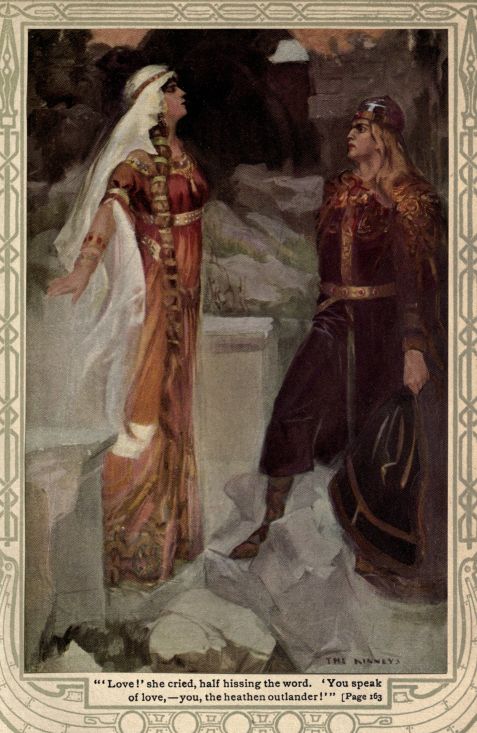
"'Love!' she cried, half hissing the word. 'You speak of love,--you, the heathen outlander!'" (Page 163)
Olvir wheeled his horse before the count, to shield him from the flights of Saracen darts and arrows which came whistling about them.
"Forward, men! forward, and wedge!" he cried; and the Franks, with a wild shout, came swarming over the wall.
"Wedge, men! wedge!" shouted Roland, as he sprang out in the lead. But the dismounted horsemen, unused to the movement, were slow in forming. Before their ranks could lock shields, the Saracens charged upon them. Line after line, the Moslem horse came leaping along the gorge in close order, three hundred swift coursers, three hundred turbaned riders shrieking their war-cries.
Before the fierce attack the half-formed line of Franks wavered, and more than one warrior glanced about at the wall. But Roland clashed Ironbiter against his shield and cried cheerily: "Stand fast, my Rhine wolves,--stand, and strike for Christ and king!"
"Christ aid! Christ and king! Heu! heu!" came back the deep roar of the Franks.
No longer did any look about at the barrier. All bent forward in their places, and as the flying mass of Saracens crashed upon their half-formed wedge, they met the enemy with mighty blows of axe and sword and war-hammer. Down went the foremost line of horses, and their riders fell slain with them; down went the second line, the third. Yet relentlessly the Moslems thrust forward, trampling over the bodies of their fallen leaders, to hurl themselves against the Frankish shieldwall.
Soon the Northern warriors began to give ground before the incessant shocks. Arrows and darts whirred into their midst from the Saracen rear, and many fell, pierced in throat or face. Others were crushed by the plunging horses, or thrust with lances through the joints of their rude armor; but most of all met their fate under the keen-edged scimetars.
The first impetus of the Saracen charge was quickly lost; but the dark riders gave the hated Afranj not a moment's time to gain breath. Their massed ranks closed up against the Franks, and overbore them with the sheer weight of the horses.
In vain Roland fought with a strength and skill such as no other Frank than Karl himself might have equalled; in vain Olvir, his face white to the lips and rigid with cold fury, spurred his courser forward into the mass of the Saracens, and struck down warriors to right and left with his lightning stabs.
Had there been room for retreat, the foremost Moslems would have shrunk away from the attack of the sword-brothers; but they had no choice. Penned between the cliffs, they were forced on by their fellows behind, without hope of escape other than in victory. In their rear rode Kasim Ibn Yusuf and a score of chosen men, threatening with instant death any who should turn. So, yelling with desperate rage, the Moslems continued to fling themselves upon the Afranj, each fiercely striving to cut down at least one unbeliever before he himself fell beneath the trampling hoofs.
At last the blows of the Franks began to lessen in force. Wearied by the furious struggle, and spent by wounds and blood-loss, increasing numbers sank beneath the steadily advancing hoofs. Only with the utmost effort could those who were left close the many gaps in their thinning ranks.
"The end draws near, brother!" cried Roland; and he drew back with his men, undaunted, but so wearied that he could hardly swing Ironbiter.
"Oh, for two score of my sea-wolves, with Floki at their head!" called back Olvir, bitterly. "We should soon rend our path through the midst of these swart hounds. Thor! Yonder rides the poisoner! I 'll cut my way to him, or die!"
But as the Northman sought to spur his horse farther into the dense jam of Saracens, Roland's voice rang out in a despairing cry: "Brother--brother! Farewell!"
Then berserk rage seized upon the Northman. He wrenched his horse about, and turned straight across the fore of the Saracens, his eyes glaring and the froth dripping from his lips. For the moment he was a madman, and had all the madman's strength. Al-hatif no longer thrust out, but glittered in wide strokes that slashed through the firmest mail. The viking's attack was so terrible that the bravest of the Moslems sought to avoid him; and though he fought utterly heedless of guard, fear so weakened their arms that their blows fell without harm on his helmet and mail-serk.
Striking down all in his path, Olvir cut his way without check to the spot where Roland, shieldless and utterly spent, reeled back under the blows of the enemy. Warned by the shrieks of their fellows, the count's assailants turned to meet the raving Northman. But already Olvir was upon them, and Al-hatif whistled in vengeful strokes.
Then the blood-mist cleared from the Northman's eyes, and he wheeled his horse around beside Roland.
"Close, men! close!" he cried. "One more rally, and we die together! Ho, brother; I come! stand back!"
But the dying Frank glared past his sword-brother. With a terrible cry he swung up Ironbiter and hurled the blade into the midst of the Saracens. It was the last deed of the hero. As the great sword whirled from his grasp, he reeled and would have fallen, had not Olvir bent to catch him.
Putting out all his strength, the Northman drew the great Frank up before him on the saddle. Then the black courser leaped with his double burden to the barrier, while behind him the bare score of Franks yet standing formed in shieldburg to guard their dying count.
Tenderly Olvir laid his friend on the crest of the wall, and drew the broken helmet from the tawny hair, already clotted with blood. The hero's eyes were fast dimming; but his cold hand closed on Olvir's fingers, and he murmured brokenly: "Ha, brother--Christ and king!--We 've fought--a good fight!"
"We have fought!" cried Olvir. "Now we die. Wait here for me, brother; I will soon join you!"
But Roland clutched at the turning Northman, and his voice rang out clear and strong above the Saracen yells and the clash of weapons: "Stay, Olvir! Not death to you, but life,--life and vengeance! To the king, brother! You alone may scale the cliff!"
"Go--go, lord count!" shouted the horsemen. "We die; but the king shall avenge! Go, tell him of the traitors!"
"While my brother breathes I will not leave him," replied Olvir, and he bent from the saddle to embrace the count. Then sudden grief fell upon him. The blue eyes were glazed, the noble face ghastly with the death-pallor. Olvir stared down upon the torn and bloody corpse, his heart wrung with bitter grief.
But it was no time for mourning. Thicker than ever, the arrows came whistling overhead and upon the barrier, and one struck the black courser through the neck. Roused by the beast's wild bound, Olvir sat up and gazed alertly about him. Already the Saracens were thrusting back the Frankish shieldwall.
"Ai, my fleet one!" cried Olvir. "Even you are stricken. But you have yet to save your rider. Bear me over the wall and back through the death-gorge."
Though quivering with pain, the black courser heeded instantly the voice and touch of his master. Lightly as a gazelle he bounded up and over the barrier, and fled along the bloody gorge at racing speed.
Though the way was heaped with rocks and logs and the bodies of men and horses, the black courser raced on unchecked until, swinging around a sharp bend, he all but ran upon a Frankish horse coming up the gorge.
"Anselm!" shouted Olvir--"you live? Thor! We shall both go free! Turn back! Yonder's a cranny in the cliff--turn back!"
"No, Olvir; I could not climb!" gasped the count, and he pointed to the splintered shaft of a javelin, fast in his side.
"You 're wounded, friend!"
"Where's Roland?"
"Slain,--slain by the swart dogs! His body lies on the wall crest. Before it fall the last of the horsemen. I alone have fled."
"And I alone come from the Vascon hail. I alone live; and now-- But you, hero; you 're yet unharmed; hasten up out of the bloody pit. To the king--to the king!"
"I have fled once. I stay here till you die."
"No, Holy Mother, no! Fly, hero! You alone may bear the evil word. The Vascons turn to loot the slain,--I hear yells behind you. Fly!"
"Let them come. Fenir tear me if I leave you, living!"
"Then shall your stay be brief!" cried Anselm.
With one hand he tore loose the clasps of his hauberk; with the other he grasped his dagger. Before Olvir could cry out or grasp his arm, he had struck himself to the heart.
A groan burst from Olvir's lips as he sprang off to catch the body of the count. Gently he drew it from the saddle and stooped to the ground. But as he bent, the horses snorted in terror. Loosening his hold of the Frank, Olvir rose up just as a boulder, hurtling from the cliff, shattered upon an outjutting ledge and flew about him in a hundred fragments. He heard his courser scream, and felt himself hurled back as though struck by the axe of Otkar Jotuntop.
In a moment he was up again, the blood spurting from a terrible wound just below the collar of his mail-serk. The sharp point of a whirling rock had torn through his threefold mail, snapped the bone beneath, and laid open his chest. But for the thick strand of Rothada's hair, he would never again have risen. Though severed by the sharp-edged stone, the strand had helped to break its blow. As he rose, the loosened plait came slipping down his breast, and, half dazed, he thrust it in through the rent in his mail.
Then his eye fell upon the black courser, standing in dumb anguish. Other fragments of the fatal rock had struck down Anselm's horse and broken the Arab's foreleg. Forgetful of his own wound, Olvir sprang to the faithful beast and kissed his white-starred forehead.
"Farewell, fleet one! You have served me true. May we meet again in Paradise!" he said, and then, swift and sure, the point of Al-hatif pierced the courser's heart.
A burst of triumphant yells re-echoed down the gorge. The last Frank had fallen. At the warning, Olvir thrust the scarlet blade back in its sheath and ran swiftly across the gorge.
"Now do all lie slain," he muttered; "and I--I go to bear the tidings, if so the Norns will. Here is a cleft,--I can yet climb; but if the feeblest of foes lies in wait on the crest, he may cast me down."
Thrusting the corner of his cloak in upon his wound, Olvir sprang up the cliff foot and began the ascent of its all but perpendicular face. Though every movement of his injured shoulder cost him terrible agony, he climbed with the utmost haste; for on the one side he could see advancing parties of the plunder-laden Vascons, while on the other, Moslem yells of victory rang near around the turn. So swiftly did he scale the cliff that he had gained a side ledge which sloped up to its crest before the Saracens raced into view.
Overcome by exertion and the anguish of his wound, he paused for a time at the top of the cranny, too faint and giddy to attempt the narrow ledge. But the pursuers, far below in the gorge bottom, never thought to look up for their quarry where all along was sheer precipice. For a little they circled about the bodies of the black courser and the Frank count, like hounds which have over-shot the scent; then they raced on through the gorge. Not until they came upon the advancing Vascons and learned that the fugitive had not passed that way, did they turn back to scan the cliffs. But they saw no warrior clinging to the dizzy ledges.
Urged on by the peril of discovery, Olvir had crept sideways up the ledge, even as the Saracens galloped away. The rock, as he slipped along its face, seemed to reel and thrust out against him, so that at each slow step he thought to hurl down into the chasm. It was well for him that in his boyhood he had climbed for the nests of sea-fowl on cliffs yet dizzier. The rock was swaying before his darkened gaze. Instinctively he drew himself upward. At last he was bending over the cliff's edge. Then darkness fell upon him, and he sank forward in a death-like swoon.
But life lay strong in the breast of the sea-king. In a little he sighed and half turned. His opening eyes gazed sideways along the cliff's edge. A hundred paces or so distant, over a projection of the rock, he saw the tops of a pair of turbans. Stung to instant action by the sight, he drew himself up from the brink of the cliff, and crept over the rocks toward a little fir wood on the slope above. Within a spear's length the heads and shoulders of the two Saracens came into view; but both men were leaning over the brink of the precipice, staring down at the wild scene in the gorge bottom.
"Odin blind the Asiamen!" he muttered, and he glided like a wounded weasel over the bare space which lay between him and safety.
At last he gained the first tree. He was safe from the swart watchers. But then something stirred in the midst of the young firs, a few feet before him. A groan rose to his lips. He sank down, only to grip his sword-hilt and rise again, the bared blade ready to strike. His lips pressed together in a smile of grim despair, and he crept forward again. Something showed through the fir twigs. He peered under the branches into a tiny glade. There, within half-a-dozen steps, stood Zora his red mare, tethered beside two other coursers, and no man was in sight.
CHAPTER XXVII
Then Brynhild laughed
Till the walls rang again:
"Good luck
To your hands and swords
That have felled
The goodly prince!"
LAY OF SIGURD.
Midway down the valley of the Little Nive the warriors of the Frankish host lay at ease about their fires, while across the camp fell the shadow of the early mountain twilight. All alike were merry; for now the rugged fells were passed; the sun-scorched Saracen Land lay behind. In the morning the great train of plunder-laden carts and wains would be allotted, and each folk-levy would journey home by its own way, to enjoy the war-loot.
Not the least merry in the host were the king's "men," gathered about the royal pavilion. Messengers had come from Casseneuil with confirmation of the queen's good health, and the welcome tidings that old Rudulf, the Grey Wolf, had come leaping out of the Sorb Mark in the nick of time, to save Fulda from the ravaging Saxons. With Teutoric, Count of the Frisian Mark, sweeping across Westphalia toward Paderborn, and Gerold and Worad making for the harried Rhinegau by forced marches through Austrasia, none might doubt that the wolves of Odin would soon be fleeing back to their forests with aching teeth.
In celebration of the fair tidings, Karl had relaxed his usual abstemiousness, and was drinking freely with his lords at the door of his tent. All about the royal seat the Franks stood laughing and jesting. The king himself sat smiling in careless amusement at one of the gay groups where Rothada and Liutrad played at tag with the pages about Abbot Fulrad.
But back in the dark recess of the pavilion was another group, whose members gulped their wine from shaking goblets, and peered out at the wassailers with little merriment in their looks. Crouched in the corner behind the others was Kosru, the Magian leech, muttering plaintive invocations to his sun-god.
"It cannot now be long. The word will soon come," growled Hardrat, who, though drinking even more immoderately than usual, was kept sober by the intense strain. The Magian edged a little nearer the thickset Thuringian.
"The word will soon come," he echoed in a trembling voice.
"And we crouch here like witless oafs," rejoined Fastrada. "Come; there's nothing to betray us but our own faces. Let us go out and make merry with the others."
"Well spoken, daughter of Rudulf! This time our great plot has failed; yet our enemy will soon have cause enough for grief. We will go out and rejoice at the tidings which shall soon blacken his merrymaking. Come. The good wine has put heart into me," answered Hardrat, and he stooped to grasp Kosru by the arm. But the Magian was palsied with terror; and while Fastrada lingered beside him, in a vain attempt to overcome his fear, Hardrat came springing back from behind the king's seat.
"Stay!" he cried. "Here comes a rider, fleeing down the valley."
"The word!" Seized with a second panic, the plotters drew back again into the depths of the tent.
A sudden hush had fallen upon the merrymakers about the king. All had turned, with paling cheeks, to gaze up the road. Down the valley a red Arab courser was racing as for life, and upon the flying beast sat a blood-stained figure which swayed and reeled in the saddle like a drunken man.
The king sprang up beside Fulrad.
"God's wounds!" he cried. "What mummery is this?"
But then from the viking camp in the rear burst out a terrible shout, and the lofty figure of Floki the Crane came rushing through the midst of the Franks.
"Olvir! Olvir!--my earl--my bright one!" he cried; and as Liutrad sprang in and halted the red mare at the edge of the gathering, Floki's long arm caught her rider from the saddle. But it was Rothada who took the king's flagon out of the cupbearer's hand and ran to place it at the lips of the Northman.
The fiery wine lent new strength to the fainting messenger. He drew away from Floki and faced the king.
"Vengeance!--vengeance, lord king!" he gasped. "Slain is the Hero--my brother--and all his host! I alone come forth alive--I alone--to call for vengeance!"
Karl's eyes blazed with terrible anger.
"Whose is the guilt?" he demanded.
But Olvir was reeling. Blood gushed from his mouth. He fell back into Floki's arms like one dead.
Quivering with rage and grief, the giant raised his earl as though a child, and turned upon the king.
"Thor!" he roared. "Do you still stand idle? Who rules the fell-folk?"
"Ha! Lupus,--that bastard fox!" cried Karl. "Where's Hardrat? Stay; 'tis a deed for his own men; they will not fail. You shall lead them yourself, Crane,--you and Liutrad. Those who have horses, let them ride; the rest follow as best they may. Five thousand of my Austrasians shall come after. Here is my seal-ring. Go swiftly to Bordeaux, and seize the Vascon Wolf!"
Without a word, Floki laid his earl upon the ground and ran to turn back the wild rush of vikings who came seething around the pavilion. Liutrad paused to lay his hand on Olvir's bloody breast and mutter a vow. Then, leading Zora by the bridle, he ran after Floki.
As the crowd parted before the Norse leaders, Karl knelt down beside their stricken earl.
"The leech,--where's the outland leech?" he demanded.
Back in the pavilion the plotters dragged Kosru to his feet.
"Hist, Magian!" cried Hardrat. "The king calls; I know that tone. Woe to you if you fail to heed!"
"Ai, God of Light! I cannot, noble lords. My limbs fail--"
"Here's the spur, dotard," said Hardrat, brutally, and he shook his dagger in the leech's face.
"Go, friend," urged Fastrada.
Reassured by her look, Kosru threw his cloak about his head, and ran, tottering, out beside the king.
But the fear-stricken Magian left behind him others little less overcome. As he passed through the entrance, Fastrada turned upon Hardrat.
"Oaf! sluggard!" she hissed. "You loiter here, and the chance is gone. Others ride first to Bordeaux. Lupus will be taken."
The Thuringian turned, snarling; but Fastrada was already calm again.
"Why wrangle, count?" she said. "What is done is done. Lupus is lost."
"And we with him! He will tell all to save his own skin. Who trusts a Merwing?"
"No, no," insisted Fastrada. "His is too crafty a nature. He could not speak straightforward if he wished. There may be danger if his trial is kept waiting; but if that happens my knowledge of the king is at fault."
"You are right, maiden," muttered Hardrat, and he drew a deep breath.
Fastrada laughed low and softly,--a laugh at sound of which her fellow-plotter drew away from her, shuddering.
"What do we care for Lupus?" she said. "We shall yet win success; and--and him whom I hated I have slain!"
Hardrat crossed himself hastily.
"Saints shield us from werwolves!" he mumbled.
But Fastrada flung herself face down upon the earth.
CHAPTER XXVIII
Of fourteen winters was I,
If thou listeth to wot,
When I swore to the young lord
Oaths of love.
HEL-RIDE OF BRYNHILD.
"Ho, there! Can this be Niflheim? Why is my voice so weak? I cannot lift my arm. If this is the under-world, I would look upon the blue and white face of Hel. Ho, there! Who hearkens to Olvir, son of Thorbiorn?"
"Peace, ring-breaker! You 're yet in Manheim," croaked a well-known voice. "When Olvir Elfkin goes hence, Odin, not Hel, shall claim his spirit. Now lie still, for a blood-fire has burned within your skull these twelve days gone."
"Faul! I 've dreamt dreams of ill omen. What tidings of the Wolf Duke?"
"He hangs in chains with his namesake. Before the Frank could strike, Asiamen and fell-folk had fled to safety with their bloody spoil. But Liutrad and I took the traitor earl even as he was flying from his burg. Short shrift did the Frank give him. Eight nights he has ridden on the tree."
Olvir uttered a hollow laugh: "Then this night he should be wise as Odin."
"Thor!" cried Floki; "that is a welcome laugh. Now shall you surely live."
"I laugh with a sore heart. What of my brother?"
"They build him a hero's mound in the dewy valley."
"Would that I might see it!"
"That you shall, ring-breaker, when your strength comes again. Yours is the right to ward the hero's mound and to seek vengeance upon his slayers. For listen, son of Thorbiorn: When the king fared north, though you yet lay as a dying man, he named you Earl of the Vascon Mark. From Toulouse to Bordeaux, from the Garonne to the Pyrenees, you are earl and hersir. The sons of Lupus are borne off to the king's hall. Where the Wolf Duke ruled, you rule."
"Earl--of the Vascon Mark!" muttered Olvir. "Now, by Thor, if the men stay by me--"
"All stay but Liutrad."
"Liutrad! I 'd have thought him the last after you--"
"The king's will, earl. The Frank is minded to do well by the lad. For his good and the pleasure of the king, you will not forbid. The king looks only to your welfare. While we raced away to take thrall the Wolf Duke, the king put you in the care of Kosru, that outland warlock. The man's own head was in pledge against your death. Between his wizardry and the care of the little vala, Hel's hand was thrust back from you. But now that you grasp firmly at life again, Liutrad should be faring away north, to return the old warlock to the king's household, and to bear back the little vala to the nun-women at Chelles, whence she came."
"To the cloister,--to the pale nun-women! By Loki! that shall not be; she shall not become one of that crew--I--"
"Settle that with the maiden," rejoined Floki, and he slipped softly from the room.
"He has gone--he has left me alone!" exclaimed Olvir, and, in his great weakness, he could have wept. But then a little maiden came darting across the room and knelt to clasp his wasted hands.
"Rothada--little may!" he cried. "What's this I hear? You go to the cloister?"
"Back to Gisela and the blessed sisters, Lord Olvir. My heart aches with this terrible world-life. I cannot bear the hatred and cruelties of it all. I seek peace where my mother died."
"You shall not stay,--you shall not stay for all time! Bend lower, king's daughter--little vala with eyes like dewy violets!--lower yet, till your lips press upon mine. So; bravely done, sweetheart! Now lay your arm about my neck, and promise me--by your tress which I wore, by my ring on your hand--you will not take the cloister vows, but will wait--let the time be long or brief--you will wait my coming!"
Obediently Rothada clasped her arms about the young sea-king's neck, and with her face hidden close against his tangled red-gold hair she answered him softly: "I promise, Olvir."
BOOK TWO
Surely know I
No love like your love
Among all men
On the mould abiding!
LAY OF GUDRUN.
CHAPTER I
He waxed under welkin in worth and honor
till the folk around him, far and near,
... hearkened to him.
BEOWULF.
Four long years had come and gone, and at last the dreaded loss had fallen upon the common folk of Vascon Land. The rule of the young Dane count, who from the first had dispensed a justice throughout his mark as keen and as bright as his Saracen sword, had come to an end. The king had at last given way to the request of Olvir, whose followers had become unutterably wearied of the small pleasure to be gained in hunting out thieves and lawless lords; and that he might do honor to his loyal liegemen, Karl had sent as special missi Abbot Fulrad and Count Gerold to take over the mark.
After the ceremony the missi had journeyed on to Toulouse to place the rulership in the hands of Count William, for he was the guardian of Louis, the survivor of the royal twins born at Casseneuil, whom Karl, a year since, had caused the Pope to anoint as King of Aquitania.
When they came sailing back down the Garonne from Toulouse, the missi found the five longships of the Norse fleet lying moored at Bordeaux, all newly refitted and scraped and painted, in readiness for the voyage north. So it chanced that the two Franks had clear proof of the nature of Olvir's rule; for the quays of the city swarmed with townfolk who had come to bewail the departure of their just count.
"Ah, Olvir," cried Abbot Fulrad, as they boarded the Raven, "our lord king did well to keep you here in the South all these years. I doubt if the missi will bring such satisfying reports of William's rule."
"There will be some who will not grieve at my going," answered Olvir, meaningly. But the smile left his firm lips as he turned to gaze at the sorrowful crowds on the quays. Gerold, who came and stood beside the Northman, had lost little of his old-time boyishness; but Olvir's dark face was marked by the lines of rulership and shadowed by habitual thought. Floki could have told the curious guests that during the past two years his earl had spent no small part of his time in poring over the runes of the White Christ and the strange book of the Asiamen which Count Roland had brought to his foster-brother with the gem-pouch, out of Saragossa.
As the Raven at last cast off from the moorings and glided away down the Gironde in stately lead of the fleet, Olvir waved his hand to the weeping townfolk, and turned quietly to Abbot Fulrad.
"Liutrad has written fully of your bitter Saxon war," he said. "The heroes have met on the stricken field. Again you have beaten Wittikind back into the North, and men say that the war has been fought to a glorious end. Yet I have lain here in the South with sheathed sword, and--do not grieve."
"You may well say that, my son!" exclaimed Fulrad. "Far nobler are the victories of peace than war-won fame. If you have lost the wild joy of battle, you have gained the love of the folk you ruled, and a happiness--"
"Love and happiness? Ay; but not the love and happiness for which I long," sighed Olvir, and his hand went to the double strand of chestnut hair clasped around his throat. "Listen, Father Fulrad. Liutrad once wrote that he had told you of my betrothal. It was a secret which promised me joy; but it has brought me sorrow instead. Through all these years I have sent message after message to my little may, ever faithful to my pledge, ever longing for a word of love in answer. But she is silent,--she has forgotten me in your cold cloisters."
"Forgotten!" cried Gerold, in protest. But Fulrad made a hasty sign to him to be silent, and answered Olvir gravely: "Be patient, my son. Much may chance in so long a time. The maiden was yet a child. None can say whether or not she has forgotten you. However that may be, bear in mind that you have won high favor in the king's eye. That alone should give you joy."
"Nor have you altogether lacked the joy of battle, Olvir," added Gerold. "Liutrad has told me how, at the very first, you searched out the mountain Vascons in their fastnesses, and avenged the death of Roland."
"Vengeance? I found little joy in that. There was more in the finding of Ironbiter, my brother's sword, which he flung among the swart Saracens, and which Floki took from a dying Vascon. I 'd had enough of blood."
"No need to tell us, my son, how you turned to the arts of peace. You have ruled with wisdom; you have tempered justice with mercy. Few counts give heed to the welfare of those they rule. You, not content with the administration of justice, have aided the landfolk out of your own treasure. The Lombards whom you brought in have shown the folk better methods of tillage, and I hear that our own men have sought to teach the rude shipwrights of Bordeaux your Norse art of shipbuilding. Our lord king will not soon forget such deeds."
"If he approve them, why, then, does he deal so harshly with the Saxons?" demanded Olvir, with sudden heat. "No Frank pays the tithe he has put upon the forest-folk. He has taken away their cherished freedom, and saddled them with stern laws that will goad them to revolt."
"No, no, lad; only to crush out their stubborn heathenism."
"A sight for the heathen fiend-gods!--a world-hero priest-ridden!"
"Saint Michael, no, Olvir!" cried Gerold, and he burst into a boyish laugh. "You 'd not say that had you been with us in Rome. Listen! It is now some five years since one of the learned deacons found a parchment, under seal by the Kaiser Constantine, whom men call the Great, giving to the Holy Father the title to Rome and all Italy. Yet our lord king set aside the claim, and, as you know, caused the Holy Father to crown little Carloman as King of Italy, under the name of Pepin."
"By Thor! those are good tidings. I had not heard that part of the tale, though I heard of the crowning of the bairns. William of Toulouse saw to that. The short-nosed count wrote to me, in the name of King Louis of Aquitania, demanding aid in his war against the Saracens. I sent back word that the Count of the Vascon Mark was not the man of any bairn or of any bairn's nurse."
"We heard of that sending, Olvir, even in the Saxon Mark," said Gerold. "William did not trouble you the second time."
"No; but the shrewd Neustrian waited his chance, as you know. And now, by Thor, I'm done with all that. Like my sea-wolves, I 've sickened of this mild Southland. Ho for the gritting snow and the icy breath of the frost-giant!" and the sea-king thrust over the Raven's tiller to steer out into the open sea.
The voyage Rhineward was very boisterous for the season, and Abbot Fulrad spent much of his time on a cot beneath the Raven's quarter-deck. But Gerold proved himself a better sailor, and after the second day was able to keep his place with Olvir beside the tiller. Standing thus, with the noble ship beneath him racing at the head of the fleet, Gerold could not only comprehend, but could share in the Northman's keen enjoyment of the whistling gale and the high-leaping waves. He felt, as few landsmen might, the wild fascination of the viking life.