FOR THE WHITE CHRIST (continued 2)
Reading edition
"I stand ready to pledge myself, lord king; but, man or not, I am a king's son, and will not bend knee to any one, living or dead."
"Be assured. I owe you too much to hold to the knee-kissing. You shall be to me as the son of a brother king, come to aid me for a season,--many seasons, I hope."
Fairly overcome by such an answer from the ruler of half Europe, Olvir at once clasped his hands together and placed them between the king's.
"Witness all," he called aloud; "now do I, Olvir, son of Thorbiorn, pledge myself loyal man to Karl, King of the Franks, so long as he wars upon the Saracen folk."
"It is well, my Dane hawk," replied the king, instantly releasing his clasp. "I now have a bird of mettle to fly at the swart pagans,--ay, and a wolf-pack to follow him. Saint Michael! those are stout heroes! With all your birth and spirit, lad, I wonder to see such warriors under the banner of a count so young and slight."
"There's no cause to wonder, lord king. In all my following stands no man to outmatch me in weapon-play, in running, or in swimming. Of runes I know all that Otkar knew, and that is not little. In his wander-years he gathered many writings,--Greek and Roman and Arabic. Each and all, I copied them on parchment of my own make when, a child, I dwelt outlaw with my kinsman in the mound of my father's father."
"In the mound! How came you to dwell in a tomb?"
Olvir half frowned, and looked at his questioner with a sombre light in his dark eyes. But then Rothada's upturned face met his gaze. At once his brow cleared, and he answered with no trace of the bitterness which had welled up from his heart,--
"It was thus, lord king. When tidings of Thorbiorn's death came north, my mother, the emir's daughter, died in her bed; and while they bound on her hel-shoes, I was laid, an unsprinkled babe, at the feet of Skuli, my father's brother. But he would not take me up. He bade them bear me out upon the fell-side. Then Otkar slew many of Skuli's men, and would have slain Skuli, had he not fled. When Otkar stood alone in Trondheim Hall, he took me up and bore me by sea, through darkness and storm, to the wife of Koll the Outlaw. But Otkar was himself outlawed for the slaying, and, when a winter was gone, he brought me to Starkad's grave-mound, where he had made himself a dwelling. Most daring of all his deeds was that breaking of his uncle's mound, for not even he might have matched the Hero of Bravallahede. Yet the fearless champion made his abode with the ashes of the king, on the wild cliffs; and there he reared me, his fosterling, training me in all games of skill and in runes of many tongues, until my fourteenth year. It was a hard training, for Otkar tried me in all things to the utmost of my strength."
"Even as Sigmund tried Sinfiotli."
"Truly so, lord king, and with like purpose. He intended that I should hurl Skuli from the high-seat of Lade, and then aid him to avenge my father."
"God alone could have stayed the crafty grey bear from his purpose! You were not with him when he came to the court of Carloman, my brother."
"The Norns--or your God--willed otherwise; for Skuli, my uncle, stepped into the shoe with me, and so, though lawful heir, I am not yet on the high-seat of Lade. Otkar was still in outlawry, and by our compact with Skuli I could not join him when he fared south to pay what we wrongly thought to be the greater of the blood-debts. But my training was not wasted. With Floki yonder, I swept the Dane shores for the traitor Hroar, and the bairn whose shield could ward a half-stroke of Otkar's axe proved the bane of many a champion. Though Otkar met his fate before vengeance was done, the sword which he whetted has at last sought out the murderer and paid the blood-debt of my father."
Karl gazed down into the sternly joyful face of the young sea-king.
"No more do I wonder that you lead men," he exclaimed. "It is a fair day which brings me such a liegeman!"
"Not the day should be praised, lord king, but this little maiden."
"She's very near my heart, Olvir, and I bear her to one who will greet her with a mother's love. The barge waits, and I am eager to place the child in Hildegarde's arms. Farewell until to-morrow. Eggihard, my steward, has gone to choose your camp. You have only to sail a few bowshots downstream. Eggihard will see to it that you receive food and drink as you may need."
"I give thanks, lord king," answered Olvir, and, stooping, he kissed Rothada on the forehead.
"Farewell, Earl Olvir!" cried the girl, in a merry voice; and, clasping the hand of her father, she turned away down the river-bank. Olvir's face softened as he watched them go,--the mighty King of the Franks and Lombards hand in hand with the little convent maiden. His eyes glistened as he saw how Karl bent to caress the child's tresses. Truly, here was a royal friend,--a hero whom even the Blood of Odin might serve with honor.
Fastrada sat among the war-counts chosen to accompany the king, with Roland between herself and Gerold. As Olvir looked from the king to his wounded foster-brother, his glance chanced to fall upon the queen's maiden. He turned quickly away, then looked again. After all, so long as he did not give way to desire, was there any reason why he should not enjoy the maiden's beauty? For what purpose was sight given but to see?
Silent and motionless as a statue, he stood gazing after the barge, until the bony hand of Floki the Crane fell upon his shoulder.
"You look over-closely at the dark maiden, earl," he said bluntly.
Olvir frowned, but answered coldly, "Be assured. My sword-brother loves the maiden."
"The more cause to heed me. Listen, son of Thorbiorn. The gerfalcon should fly high. Were Otkar here with his grey wit, I know what quarry he would name for your love quest,--no common bride--"
"What! that child? You 're mad--"
"Not I. If you but use shrewdly your nimble wit, your wedding-seat shall be on the bench of a world-king. As to the maiden, she is an opening bud, whose blossom will prove far fairer than that slant-eyed werwolf."
"Werwolf!"
"Ay," went on Floki, unchecked by the hissing menace in his earl's voice; "I am not blind. That maiden's lips are red as blood; and if ever I saw wolf's eyes in human being--"
Olvir burst into hearty laughter.
"Ho, Floki, you 're dogwise!" he cried. "Not even our little vala owns milder eyes or purer look than my sword-brother's may. Go now; take the ships downstream to the camp where the king's steward waits our coming. I go afoot."
Floki glowered down upon his earl, a wry look on his long, sharp face.
"Good mead in a hoopless cask,--wise words in a loath ear," he croaked; and turning on his heel, he stalked back to the viking wedge.
A word sent the crews leaping aboard their ships, and quickly all five craft were headed downstream.
CHAPTER VII
As he sat on the high-seat,
That man of the Southland.
SONG OF ATLI.
Left alone on the knoll, Olvir turned his gaze back to the now distant barge, and watched it musingly until it disappeared beyond a clump of woods. Floki's warning had moved him more than he had cared to acknowledge. Though far from being as profound as had been Otkar, the man was possessed of exceptional shrewdness, and the knowledge of this now compelled the young sea-king to pause and ponder his words. Could they be true? He smiled at the absurdity of the question. But then he remembered the noble Frank whom he had chosen for foster-brother, and the smile left his face. However pure and innocent, what was this maiden to him?
"It is I who am dogwise, not Floki," he muttered, and he turned his back on Casseneuil.
Within a bow-shot of the king's pavilion he came upon Count Hardrat, and his quick eye noted that the man's first impulse was to avoid him. But as the Northman approached, the Thuringian advanced to meet him.
"I would make my peace," he said with a gruff show of cordiality. "Heroes should not bear malice,--and more, you had the best of it."
"Say no more of the wrangle," replied Olvir, quickly. "I heard your name, but it slips my memory."
"Hardrat, a count of Thuringia,--count of a little shire, when I should hold the Sorb Mark, if right were done me," grumbled the Thuringian. "But old Rudulf has a pretty daughter in the king's hall; and when was Karl ever known--"
Olvir turned upon the speaker, his eyes ablaze.
"How!" he demanded; "do you say anything against the maiden?"
The Thuringian recoiled as though struck.
"I--I--no!" he stammered.
"Then ward your tongue."
The count sought to meet his gaze, but failed.
"My lord Dane," he protested half sullenly, "are you not over-hasty? Surely, to speak without offence of a maiden whom you have met but once--"
"To me she is as a sister. She is all but betrothed to my foster-brother. But no more. I mistook your tone. And now I should hold it a favor to be told whose are yonder tents. They differ from all others I see about."
"Well they may. It is the camp of the Saracen envoys,--Al Arabi and--"
"Al Arabi--Al Arabi! How else is he called?"
"He is named after the wise King of the Hebrews, though his people give it a strange sound,--Sul--Suleyman."
"Thor smite me!" cried Olvir, his eyes glittering. "My thanks for the word. Farewell, earl."
Before the astonished count could answer, the Northman was walking swiftly toward the Saracen camp. Very soon he came to an open-fronted pavilion, in whose recess a venerable figure reclined on a low divan, droning out a passage of the Koran. Olvir halted a moment to stare at the patriarch, then stepped quietly within the entrance.
"Peace be with you, O emir," he said in Arabic.
"And with you peace," answered the Saracen, as he lifted his eyes. Their hawk-like glance rested wonderingly upon the bright figure of the Northman; but then it was drawn by the glow of the great ruby on the pommel of Al-hatif, and in an instant the Arab's wonder had given place to fury.
"Dog of a kaffir!" he cried, and he leaped to his feet. A taboret, set with dishes, stood before him. Spurning it aside, he advanced with a rush, till his claw-like hands threatened the smooth cheek of the Northman.
"Al-hatif! Al-hatif! The sword of the Prophet!" he shrieked. "What kaffir dog bears the khalif's gift? Eblis take the thief! May his arm wither--"
"Stay!" commanded Olvir. "Would you curse your own blood?"
The Arab paused, transfixed, and Olvir gazed unwavering into his glaring eyes. A dozen or more Moslems, weapons in hand, came flocking about the pavilion, drawn by the outcry of their sheik. But Olvir, heedless of their bared scimetars, continued gravely: "Many winters, O sheik, have whitened the mountains of Armenia since my father and Otkar, whom you called El Jinni, gave oath to you and left you lying bound on the river's bank. Both Thorbiorn and his bride, who was my mother, long since passed over the bridge of the dead, and El Jinni has now followed; but the oath has ever been kept. None other than your blood has borne the khalif's gift."
The sheik made no reply. He was gazing searchingly into Olvir's dark face, his own stern features softened by a look of deepest yearning. His doubts were soon ended. With joy as impetuous and unmeasured as had been his anger, he sprang forward and seized the young man in his arms.
"Son of Gulnare! Seed of my House!" he cried. "Allah is good! You come to cheer my age with your youth and beauty."
Olvir reverently returned the embrace of his mother's father, but answered quickly and with decision: "Deny not the justice of Allah, O sheik! Into the North He sent my mother,--and I am a son of the North. While this war lasts we shall together fight the Omyyad beneath your black banners. Afterwards I must return here among the Afranj, if not to my father's people."
"Allah's will be done! We shall see when the time is at hand. Now, at least, you will eat my salt and abide with me this night."
"Be it as you desire. Yet, first, I would see to my men."
"Go; but return quickly. My eyes yearn to feast upon the son of my daughter."
Reluctantly the sheik's arms released their clasp, and Olvir darted away along the river-bank. Al Arabi, with a curt command to his swarthy followers to withdraw, stood gazing after his grandson until he vanished behind a group of booths.
"Allah be praised this day!" he murmured fervently as he returned to his cushioned seat. "Kasim, my son-in-law, is a thorn in the flesh; but this bright child of Gulnare renews my youth. His eye is as the soaring falcon's; his step as the fleet gazelle's."
Nor was the sheik's praise unmerited. No runner in the Frankish camp could have covered the mile downstream and back with near the swiftness of the young Northman; yet when he stood again at the door of the pavilion and stepped in upon the costly Persian rugs, he betrayed no other signs of the race than a slight flush in his dark cheeks and an added depth of breathing.
"By the Beard!" exclaimed Al Arabi; "as Zora among coursers, so is the son of Gulnare among runners."
"I have run down the grey wolf in fair chase," replied Olvir, simply, and at the beckoning gesture of the sheik, he seated himself beside the old man in the same Oriental posture. Al Arabi smiled and clapped his hands. Almost immediately an Arab attendant, in loose shirt and baggy trousers, appeared at the entrance and salaamed to the ground.
"Bring food," said Al Arabi.
The man salaamed again and sprang away. As he disappeared, Olvir turned gravely to the sheik.
"What says the Prophet, O kinsman?--'Better is it to do justice than to sit at meat.' Before I taste your salt, it is well that right should be done between us. It seems to me just that I should now return to my mother's father the sword which my father took by force. Here, then, is Al-hatif. I restore it willingly, though I cannot say that the deed is a joyful one."
Olvir was not long kept waiting to see how Al Arabi would meet this act of generous pride. With a quick movement the old Moslem seized the sword and sprang to his feet. The beautiful blade whipped from its sheath and flashed around the sheik's head in bright circles.
"Allah acbar!" he cried. "The sword of the Prophet returns! Once again my hand grasps the khalif's gift!"
Olvir turned his head away, unable longer to hide his anguish at the loss of the sword. He thought of the day in Starkad's mound, when Otkar first put the coveted plaything in his childish hands. Since then it had never lain beyond his reach, night or day, and now--!
In the midst of his rejoicing, Al Arabi paused and turned his head to glance at his grandson. A moment later sword and scabbard were lying across Olvir's feet.
"Look, my son!" cried the old man. "The khalif's gift is my gift. For a little the light of the blade blinded me. But how could I take from my daughter's son the only inheritance she left him? Once the sword was forced from my grasp; now my heart rejoices to part with it to the son of Gulnare."
Olvir sought to answer, but the words choked in his throat. An eye far less keen than the sheik's, however, could have seen the gratitude which lighted the young viking's face. His eyes were shining through a mist of tears. Al Arabi gravely seated himself beside his grandson, and, sheathing the sword, clasped it once more to Olvir's belt.
The first attendant and another now entered the tent, bearing between them a taboret set with food. The second attendant withdrew at once; but his fellow waited for further orders.
"Where is Vali Kasim?" asked Al Arabi.
"He goes with the herd to the river, O sheik."
"When they return, bid him come this way."
The man bowed and slipped noiselessly away, while the host, having first tasted each dish on the table, urged his guest to eat. He had no need to repeat the bidding. Olvir's youth and health would have given relish to the plainest fare, and the mutton stew was very savory. When the last drop of gravy had been sopped up, Olvir turned with good-will to the dates and candied fruit, which the sheik was attacking with the zest of an Oriental. Hearty, however, as was the younger man's appetite, his palate, unaccustomed to such confections, soon cloyed with their spicy sweetness. Al Arabi gravely shook his head at this sign of foreign taste, and then he smiled in recollection of the past.
"It is clear that you were not raised in the land of the faithful, son of my daughter," he observed. "You lack the sweet tooth."
"I will not turn from honey in the comb; but these sweets--"
"The spices of the Far East. You will in time become used to their flavor," explained the sheik, and he held up a slice of candied pomegranate between thumb and finger. But the sweetmeat did not reach his mouth. Struck by a sudden thought, he dropped the titbit to clutch Olvir's shoulder. His eyes were ablaze with intense feeling.
"Hei, by the Prophet's Beard, you shall in truth learn the taste of Moslem sweets! Who is Kasim, that he should stand first with the Beni Al Abbas? My word is yet weightiest in the council of the sheiks. When this lion of the Afranj has broken the might of that dog Abd-er-Rahman, my daughter's son--my daughter's son shall be Emir of Andalus!"
Olvir's cheeks flushed and his eyes sparkled at the alluring prospect; but his clear intellect was quick to perceive the wildness of the scheme.
"Hearken a little, father of my mother," He said. "I give thanks for the good thought; but how can such be? Did Allah uprear me a kaffir, that I might rule over the faithful?"
"The mission of Islam is to bring unbelievers into the faith."
"I hold to no faith but my own. No priest or prophet shall set the bounds of my thought. I see much good in the words of the Son of Mary; but little has Mohammed added to them. I believe that God is in all men alike, and that each man is good, not according as he is Moslem or Jew, Christian or heathen, but as he does in his deeds the will of the Spirit within him. But enough! I give you pain."
"Hei! you speak in a strange tongue, son of Gulnare. Yet the tongue can be bridled. You believe in the One God. For the rest, there need be--"
"Stay, father. What is the creed of Islam, which the proselyte must cry aloud? No; it cannot be. Even my hair would betray me."
"Bismillah! The All-powerful One will disclose his decrees in due time. If yours is the Afranj hair, is not Abd-er-Rahman's the Afranj eye? 'Blue of eye, and foul of face,' the saying is against the Omyyad; but there is nothing in men's mouths against hair of golden flame. We shall see what Allah has decreed. Now tell me how you come here to the host of the Sultan Karolah; tell me of my Gulnare, and of your life in the frozen North."
Olvir bowed; but he had hardly made a beginning of the tale of how Thorbiorn Viking brought home his elf bride from the Land of the Asiamen, when he was interrupted by the sound of quick hoof-beats, and a score of beautiful horses, wine-red in color, came crowding around the front of the tent. As Olvir stopped short with a cry of delight, Al Arabi smiled and lifted his hand. A mare at once pushed from among her companions and advanced quietly into the tent, the tip of her flowing tail brushing the costly rugs, upon which she planted her small hoofs with the daintiness of a woman. Al Arabi held out for her a stoned date, and as she nibbled at it he stroked her bony cheek.
"So, Zora," he said, "you must have your sweetmeats, like all women. But I do not begrudge them to my swift one. You look at the guest, daughter of Rustem. It is well. He is not such a one as these Afranj jinn, who must get them to battle or the chase on ox-like steeds. No, Wind-racer; this is one with whom you could course the gazelle from dawn even to sunset. Look closely at the young man, for he is of the Household,--he is the Heir."
Zora stretched out her graceful neck to nuzzle the Heir's strange attire with the tip of her projecting lip. The attention was appreciated at its full value. Never before had Olvir seen the like of this beautiful mare, and her friendliness greatly pleased him. He was stroking the broad forehead between her soft black eyes when the younger Saracen envoy entered the tent.
Kasim did not wait to examine the guest, but perceiving at the first glance that the stranger's dress was not of Saracen fashion, he exclaimed petulantly: "How now, father of my bride; has your dowar become a lounging-place for kaffirs? I did not look to find you breaking bread with an Afranj dog."
Great was the vali's surprise when the despised kaffir answered him in his own tongue: "Friend, what says the wise king, the emir's namesake?--'Even a fool, when he holdeth his peace, is accounted wise; and he that shutteth his lips is esteemed a man of understanding.'"
Though not a little humiliated by the apt rebuke, Kasim advanced closer to examine the guest with his blinking gaze. If his thought was to strike fear into the heart of the stranger by the fierceness of his look, he was never so mistaken. Olvir met him with a gaze so steady and so full of calm indifference that the Saracen, to cover the sudden confusion which fell upon him, shifted his glance to the stranger's dress.
The body armor of the guest was familiar to his sight; for only in its rich finish and in the threefold thickness of its mesh did it differ from his own. Yet it had an odd appearance, worn with the cross-thonged stockings, close breeches, and fur-trimmed cloak of the Norse dress. And, notwithstanding the ruddy yellow hair of the son of Gulnare, never had Kasim Ibn Yusuf seen a warrior who in figure, face, and bearing so nearly approached the Arab ideal of princeliness and beauty.
"May it please the father of my sultana to make known the guest who sits at meat with him," he said.
Al Arabi rose, and Olvir imitated the movement. When both were standing, the sheik laid his hand on Olvir's shoulder, and answered the vali: "You have heard of El Jinni, Ibn Yusuf,--that Samson of the Far North--"
"I have heard of El Jinni," retorted Kasim. "So this is his son. Had another than yourself told me that you would hold friendship with any kin of the robber who despoiled your city and bore off your daughter, I should name the teller a liar."
"Do not marvel, Ibn Yusuf. This is not the son of El Jinni, but the son of that daughter,--my Gulnare. Rejoice with me, Kasim! The lost is found! Come forward and greet your kinsman."
At the appeal, which was half a command, Kasim advanced and embraced Olvir, muttering formal words of pleasure. His protestations of friendship did not, however, deceive the young Northman. He read the hostility in the Arab's eyes, and met the feigned warmth of his greeting with cold disdain.
"You bear a sword of price, kinsman," remarked the vali, as the glow of the great ruby on Al-hatif's hilt caught his eye.
"It is a sword beyond price," answered Olvir. "The Prophet himself once bore it. When your wife's father aided Khalif Abdullah to overthrow the House of Omar, the khalif did more than make him Emir of Kars,--he gave to him Al-hatif."
"Al-hatif!" cried Kasim; "the Prophet's sword in the hand of an unbeliever!"
"I believe in the One God," replied Olvir. "There is good in all faiths. I accept the Truth wherever I find it; the error I reject."
The vali threw out his hands in pious horror.
"La I'laha ilia Allah; Mohammed resoul Allah!" he cried. "Within Islam alone is salvation."
"So say the Jews; so say the Christians; and so say the Magians,--each for his own creed," retorted Olvir.
Kasim frowned and shook his fist at the unbeliever, in sudden heat.
"What saying's this?" he exclaimed. "Who dares name the creeds of kaffir dogs in the same breath with the true faith? Who--"
"Enough, vali!" commanded Al Arabi. "There shall be no railing and contention in my House. The son of Gulnare does not come to bring strife, but to strengthen our hands in the struggle against Abd-er-Rahman. You saw his warriors in the strange ships which rowed past before our dowar. When Karolah comes south, with him will march your kinsman and his steel-clad warriors, to fight beneath our banners. And now, that the son of Gulnare may not find the way toilsome, I give him the choicest of my desert-fliers. The daughter of Rustem is fitting gift to the son of Gulnare."
"Zora!" stammered Kasim,--"Zora!"
"I have spoken. Lead the herd away, and make ready full equipment, that the fleet one may come to her master with adornment worthy of her lineage."
With his hand clutched convulsively in Zora's flowing mane, Kasim led her from the tent without a word.
Al Arabi watched his departure with a frown of displeasure, his lean hand tugging at his beard.
"He goes in anger," he muttered.
"I fear I bring you sorrow, father," said Olvir. "A house divided against itself cannot stand."
"The Son of Mary spoke truth. Yet be at peace. It is not you who bring contention to my House. Kasim Ibn Yusuf is a man of unruly spirit. He has long been a thorn in my flesh. Your coming has rejoiced my soul."
"Allah grant it may never be otherwise!" responded Olvir.
"Amin--amin!" said Al Arabi; and motioning Olvir to resume his seat, he added: "Now, my son, tell me fully of your mother and of your fearful uprearing by El Jinni in the tomb."
CHAPTER VIII
Unwound from arm winding-rings
Of Kaiser gold wrought--
LAY OF HILDEBRAND.
The seed of gold
Sowed the swan-bright woman,
Rings of red-gold.
SONG OF ATLI.
Morning put an end to Sheik Suleyman's hospitality. Shortly after sunrise his retainers began striking the tents of the dowar, in preparation for the journey back across the Pyrenees. To ferry the envoys over the Garonne, Olvir manned one of his longships, and made ready to embark with his new-found kinsmen. His purpose was to accompany the sheik half a day on the march, as a mark of the respect and affection due his mother's father. He also had in view the return to the Garonne, when, unhampered by companions, he could test the speed of the beautiful red mare.
At the last moment, however, as Zora was being led aboard ship, young Gerold of Busson came galloping down the bank, and hailed the Norse chief loudly: "Hold, Lord Olvir! The king bids you to his presence."
Olvir turned, frowning, to the sheik, who stood with Kasim in the vessel's stern.
"Eblis!" he exclaimed in Arabic. "Am I a hound, to leap to another's bidding? Karolah sends command for my presence. Let him command; I go with you."
"Allah forbid!" rejoined Al Arabi. "Have you not chosen the service of the Afranj sultan? Why, then, should he not command? Bend to his wish. It may be that he sends to honor you."
"Yours are words of wisdom, father of my mother. My freedom is in the hands of my lord. Farewell, therefore,--and peace be with you till we meet in Andalus," replied Olvir, and he beckoned the groom who held Zora to bring the mare to him.
Al Arabi leaned over the ship's side and extended his arms in a yearning gesture.
"My peace with you, son of Gulnare! I shall suffer many nights of longing before I see your face on the Ebro's bank."
"The days of our meeting will blot out the memory of the parting," answered Olvir; and a smile drove the lingering frown from his brow. Still smiling, he glanced aside at Kasim, with a pleasant word of parting on his lips; but neither look nor word won a responsive smile from the impassive face of the younger Saracen.
A moment later, as the ship's bows swung clear of the bank, Count Gerold rode down beside Olvir and cried out eagerly: "Tell me, hero, is not that your rune-friend Liutrad at the helm?"
"Ay."
"Then may he not come with us? Our lord king will be glad to see him also."
Olvir made a sign to the young giant, who calmly gave the tiller into Floki's hand, and turned to pick up his ponderous axe.
"The hero should move more briskly if he would come ashore dry shod," remarked Gerold, and he pointed to the quickly widening space between the bank and the longship's stern.
"The stag leaps high. I alone can out spring the son of Erling. Watch!"
As Olvir spoke, Liutrad bounded up on the high stern-piece of the ship. For an instant he stood poised on the gilded dragon-tail, gathering force for the wide leap; then he came flying above the water, clear to the side of his earl.
"Well done, Dane!" exclaimed Gerold; and he sprang from his horse.
Liutrad caught the extended hand of the queen's brother in his powerful grip, and met his smile with a look no less friendly. Though the Northman overtopped the Swabian by a head, the two were so well matched in years and nature that their hearts warmed in friendship on the spot.
For a while, as the boyish warriors exchanged pledges of friendship, Olvir watched the white-bearded figure in the stern of the receding ship. At last, with a gesture of farewell, he turned and looked at the new-made friends. His face lighted at sight of their smiles, and with a quick movement he unwound one of the double spirals of gold coiled about his arm. Another twist in his sinewy fingers broke the spiral into two equal parts. Handing one to each of the young men, he explained to the Swabian: "In the North a leader who is not close-fisted is called the 'ring-breaker,' because he gives the red gold of his rings to his true friends and followers. Here, then, I give you each a ring to wear, as a token of the bond between you."
Both sought to thank him; but he cut short their words with a gesture. His face had darkened as though a shadow had fallen across it.
"May the Norns weave you good luck!" he muttered. "Not all friends lack gall in their mead."
"Surely there shall be none in the sweet mead that I 'll drink with Liutrad the loreful!" replied Gerold. "But come now. Our lord king is eager to talk with such wise heroes. It is wonderful that warriors should be so learned. Few even among monks and priests can mark fair letters. Were you and Lord Olvir baptized, his Majesty would make bishops of you both."
"As it is," rejoined Olvir, ironically, "we are benighted heathen,--sons of the fiend-god Thor. And now, as you well say, we had best be moving if we would not keep the great king waiting."
"I will walk to the villa beside my Frank friend," remarked Liutrad, as Olvir placed a hand on Zora's withers and vaulted lightly into the saddle. But Gerold would not agree.
"Yonder is the camp of one who owes me favor," he said. "I will soon have a horse for you."
With Liutrad mounted, the three quickly covered the ride to Casseneuil. Grooms of the king's stables took charge of the horses in the courtyard of the villa, and Gerold, waving aside the Grand Doorward, himself ushered his companions to the royal apartments.
Olvir and Liutrad, staring wonderingly about them at the Roman architecture and Gallo-Roman decorations of the villa, followed Gerold in half-awed silence through the flower-perfumed courts and the marble-tessellated passages. At each turn they looked to find themselves on the threshold of some grand rush-strewn hall, crowded with war-counts and the Frank king's councillors. When, however, Gerold at last led them through a curtained archway, a glance at the tapestried chamber within showed them their mistake.
"The queen's bower!" muttered Olvir, and his black eyes flashed their glance along the line of busily sewing maidens on the right to Rothada, playing with her sister and brothers at the edge of the dais that extended across the farther end of the chamber. Upon the dais sat Hildegarde herself, side by side with her royal spouse.
With all his haughty pride, Olvir was quick to realize the honor paid him, stranger and outlander as he was, by such an introduction into the bosom of the Frank king's family. When he perceived the queen's extended hand beckoning him to approach, he advanced at once down the chamber, without pausing to look about. In his eagerness he failed to see Count Roland and Fastrada, who had drawn apart into one of the recessed windows of the bower. Liutrad, however, chancing to glance that way, turned aside to inquire the health of the wounded count; and Fastrada took instant advantage of the interruption to glide out beside Gerold. If her intention was to overtake Olvir, she was too late. He was already kneeling at the edge of the dais, to kiss the queen's hand.
As the Northman's knee touched the dais step, the great Frank in the oaken seat struck his thigh, and cried loudly: "By my sweet dame's spindle! hereafter I swear by that token! The Dane bows neither to sword nor crown, yet stoops low to a woman's hand."
Olvir stood erect and looked straight into the gracious face of the queen. Hair of golden floss, a skin of dazzling fairness,--neither was new to him; but the mild blue eyes beamed with spiritual light such as was seldom seen even in the lands of Christendom. The daughter of Childebrand, despite her seven years of wedlock, was a dame very lovely to the eye, no less in expression than in feature.
Olvir smiled at her as he would have smiled at Rothada, and, without turning, he answered the king steadily: "I come of high blood, lord king; also, I am a free Northman,--I bow to no man. But the greatest of all may well bow to holiness. We have a saying in the North, 'A good woman is near the gods.'"
"That is a wise saw, however heathenish. But give heed to our queen; she has something to say to you."
"I would give thanks for the safe bringing of this little maiden," remarked Hildegarde. "Only a warrior of noblest heart could have done such a deed."
Olvir shook his head smilingly.
"I freed the Dane's thralls for my own pleasure, which you now double," he said.
"But you shall also accept this ring, as mark of our gratitude," rejoined the queen, and she drew a bracelet of twisted gold wires from her white wrist. When she held out the ornament, Olvir, instead of grasping it, thrust his left hand through the opening.
"How! is the ring on?" exclaimed Karl, in surprise. "The lad has no need to talk of high birth,--a warrior with hands womanly slender!"
"Yet fit to grasp spear or sword," added Hildegarde, gazing curiously at the young sea-king's hard palms and sinewy wrists.
"Before I could walk I played with weapons," replied Olvir, and he glanced aside at the royal children. The king looked also, and at once beckoned to the little group. The sturdy boy Karl sprang forward at the signal, followed by his imperious little sister Rotrude and the toddling Carloman. After the children of Hildegarde came their unfortunate half-brother, the crook-backed Pepin. All were soon perched upon the massive knees of majesty.
There was space left for Rothada at her father's side; but she had lingered to greet Olvir. She came to him, her face beaming with delight and gay welcome, which yet could not altogether hide the shyness of budding maidenhood. Olvir did not wait for her faltering speech. He caught her hands in his and bent to kiss her white forehead.
"Health to you, maiden!" he said. "My sea-wolves send greeting to their little seeress. Already they howl for a glimpse of her bright face."
"I pray they may not howl so loud as when Liutrad, yonder, and the lofty Floki upraised us on the shield. My heart turned to water for fear of their roaring," replied Rothada; and even the awe of her father's presence could not restrain a burst of merry laughter at the memory.
Olvir smiled down into the girl's sparkling eyes.
"Ay, king's daughter," he said; "but you soon lost your dread of the grim hailers. Did you not cry back greeting to them? Small wonder they hailed the little valkyrie who stood so boldly on the shield with their earl; small wonder they choose for vala the wise little leech-maid who went among the stricken warriors with soft words and healing balm."
Karl stared at his daughter in wonder.
"Do you jest, Count Olvir?" he demanded. "This is a part of the tale I had not yet heard. Surely, for a nun-child--"
"She was no nun-child, then, but the child of the great Frank king. Already she had turned away Floki from the burning of the thralls. Then she stood with me on the swaying shield. But not until we crossed the river bar and held war-council oh the Garonne bank did the crews choose her for their vala,--their little seeress-maiden. The stricken Danes whom she had nursed aboard my Raven set her in the midst of the gathering, and the king's daughter won all alike by her sweet wisdom and lore. She holds the fierce hearts of my sea-wolves by a bond subtle and strong as the fetter of the Fenris-wolf. We have sworn to carve the blood-eagle on the back of whoever does her harm."
"The Holy Mother bless you!" cried Hildegarde; and the king, flushing with pleasure, added heartily, "Amen to the good wish! You have well earned it, my bright Dane,--you and all your followers, though you be twice over heathen. Before sunset the grim warriors shall see the maiden in their midst. Now come to my side, child, and let a seat be brought for our guests."
CHAPTER IX
As fair as thou seest
Brides on the bench abiding.
Let not love's silver
Rule over thy dreams;
Draw no woman to kind kisses.
LAY OF SIGRDRIFA.
As Rothada sprang up the step of the dais to nestle close to her father, Gerold drew out a bench from the nearest wall. On this Olvir seated himself, and the king beckoned to Liutrad and Roland.
"Come forward, heroes," he said; "and you, Gerold."
The quick advance of her companions left Fastrada alone in the midst of the bower. She hesitated and looked appealingly to the king. Karl had bent over the children clasped in his great arms; but Hildegarde saw the girl's look, and signed to her to take the place on the bench beside Roland.
Crimson with shamefaced delight, the girl glided forward. Near the bench, however, she began to falter, seemingly overcome by diffidence. A very audible tittering from the other bower-maidens sent her edging around the end of the bench farthest from Roland. Then the king, drawn by the note of merriment, looked up and fixed his gaze upon her. Was it to be wondered that, between her diffidence and the awe of the royal presence, the girl shrank back to the bench in such confusion as to thrust herself between Liutrad Erlingson and his lord?
Karl burst into a hearty laugh.
"Holy Mother!" he exclaimed, "it is our herald maiden. She plays her own part more ill than another's. Did you not tell me, sweetheart, that Roland--ay, it was Roland! We will mend matters if this young Dane bear will barter seats on the bench with a stricken hero."
Liutrad sprang up at the word. But Count Roland sat firmly in his place.
"The maiden has good eyesight, and there is space beside me," he said.
A second and louder titter ran down the row of bower-maidens, and even Hildegarde could not suppress a smile. Fastrada only blushed the more, and sat with downcast eyes, not even venturing a glance at the young sea-king beside her. Her drooping shoulder pressed lightly against the gold spirals on the Norse hero's mailed arm. She sat very quiet.
Again Karl laughed, this time at the frowning face of his nephew.
"Ha, kinsman," he admonished in a jesting tone, "the maiden seems coy. Your wooing has been over-hearty."
"That could not be, dear lord, if the maiden loves him," observed Hildegarde, softly.
"Which is to say--"
"Nothing, sire, nothing!" broke in Roland. "We were merely talking of my sword-brother."
"A choice subject," rejoined Karl; "yet had I worn the buskins of Count Roland, I should have talked more of the maiden herself, and of Count Roland's thoughts of her."
Roland's frown deepened, and Fastrada's blushing face bent still farther forward. Olvir sat rigidly erect, striving to resist his desire to gaze down on the drooping maiden. He had caught one glimpse of her face as she stood between him and the king,--a glimpse that of itself was enough to set his pulses wildly throbbing; and now there was added to it the warmth and perfume of her person close against his side. The temptation was almost greater than he could bear. Only by the strongest effort could he hold in mind his duty to his foster-brother. Of all present, he perhaps felt most keenly the constraint of the silence which followed the king's well-meant raillery.
The pause was broken by Hildegarde, with the kindly thought of diverting attention from the lovers.
"Dear lord, you told me that Count Olvir was the foster-son of Otkar the Dane. Have I not also heard you say that Lord Otkar was the craftiest as well as the strongest of warriors?"
"He was a foe worthy a king," answered Karl. "Would that the hero were now beside my throne, with his grey wit and mighty axe! Yet I should not complain. Here is one whom he has reared in all his lore and wisdom."
"The lore, but not the wisdom, lord king," replied Olvir. "He could give me the one; the other no man may impart."
"True; and the saying tells me you have found wisdom for yourself. Beware, for now I shall put your wit to the test. I would ask your counsel on this Saracen war. All my other borders are pacified. Even the Saxon Mark--"
"Count nothing on the Saxons, lord king," interrupted Olvir.
"How! already a difference from my councillors? Not one in my hall but will tell you those wolves are at last tamed. I have planted their wild land with fortresses and chapels."
"Your church tithes and the preaching of your priests will soon stir the sons of Odin to renewed anger. I speak words from Otkar's lips. There will be blood on priestly robes. Your burgs and your chapels will see the torch. Look for no sure peace in Saxon Land so long as Wittikind the Westphalian bears his head upon his shoulders."
"He dwells with Sigfrid the Dane, as you yourself bring word."
"Scant cheer! When he comes again, it will be with a following of Dane warriors. If he is content to dwell always with the Nordmannian king, why should he send the murderer Hroar to bear off this little maiden by your knee?"
The king laid his hand on Rothada's head, and his face grew stern with a look of majesty and power before which even Olvir sat half awed.
"Dane and Saxon,--sea-wolf and forest-wolf,--let the wild hordes come! They shall find other than lambs to greet them!"
"Yet now you 'd lay open the Mark to them, lord king," persisted Olvir. "You plan to lead your host still farther from the Rhineland."
"By Thor, Olvir," broke in Liutrad, with Norse freedom, "why seek to mar such fair chance of sword-play? The more of war, the merrier for heroes. And would you turn aid from your Saracen kin?"
"Saracen kin; how's that, my Norse hawk? Is the boy mad?"
"No, lord king," replied Olvir; "my face should tell otherwise. Because of it, men in the North call me Elfkin; but this is the truth,--in my mother's veins Greek and Arab blood were mingled. Her father, Sheik Suleyman, is known to you as Al Arabi,--leader of the Saracen envoys."
"Al Arabi!"
"One-time Emir of Armenia. The wife who bore him my mother was of kin to the Emperor Leo, whom men call the Isaurian."
"By my crown! no longer do I wonder at your unbending knee! I have done well to honor you. What is your knowledge of the Saracen folk?"
"As to those in the Eastland, I learned much from Otkar and from Arabic writings; but of these in Andalus, I know only what came to me last night from the lips of my mother's father."
"And what did he say of Abd-er-Rahman? The Saracen king has the name of a great warrior."
"True, lord king; yet the Beni Al Abbas cherish undying hatred against the Omyyad."
"These Saracen pagans are loath to take oath; but the envoys swore to the fealty of their faction. I count no less on aid from the Christian folk in that land."
"And Duke Lupus, your Majesty," added Roland, with a sudden show of interest. "He brings us safe passage of the Pyrenees."
"I have heard Otkar speak of the Vascons," rejoined Olvir, dryly. "It is said they do not love outlanders. As to this duke, is he not of Merwing blood?"
"True,--and therefore lacks boldness to break his allegiance," answered Karl.
Olvir's lip curled in a slow smile.
"A fox will snap in his own den, and, at the best, the mountain-cats are hard to hold. You may look for aid to the Beni Al Abbas; but count neither on Christian Vascon nor Christian Goth."
"What! do you hold that the Christian folk would choose their pagan oppressors before a ruler of their own faith? Our Holy Father Hadrian numbers them among the truest of Christians."
"And yet, lord king, the Moslem yoke is lighter on their necks than is your own upon the folk of Aquitania."
At the bold assertion, Karl's heavy brows met in a frown, and an angry light shone from his grey eyes.
"My yoke,--my yoke!" he repeated slowly. "By my sword, young Dane, you are no court-man. Otkar himself would scarce have ventured so bitter a jeer."
"Jeer! The king asked my counsel, and I gave it. I believe what I spoke; it came to me from Otkar. Why, then, should I not speak it?"
"Why not?" rejoined Karl; and he burst into hearty laughter. Then, falling grave again, he nodded, and called out approvingly, "Here, in truth, is a king's son! Hearken, my Dane hawk; though I have bold counts as well as sleek flatterers, my ears are not used to such biting truths. It shall be otherwise hereafter. I will not willingly part with so straight-tongued a counsellor."
The great Frank paused to pat the heads of the three boys astride his knees.
"May these bairns prove as bold," he added. "And now, enough of such matters. I had intended, Olvir, to test your learning, and that of your ruddy-cheeked follower; but that must now wait. After the feast of Lupus, we will have you both come of an evening to feast us on your book-lore."
"The feast of Lupus!" sighed Hildegarde, pausing in her needlework. "I wish that I might attend it with you, dear lord."
"And why, sweetheart?"
"Fastrada, tell his Majesty of the feast."
Thus called upon by her royal mistress, Fastrada raised her eyes with a timid glance, which, as she spoke, faltered and turned appealingly aside toward Olvir.
"Your Majesty," she murmured, "it is said that the Vascon duke has planned his feast after the manner of the old-time Romans. Instead of seats, he will place couches for the guests to recline upon while they dine."
"What!--to lie and sup together? The Vascon proves his Merwing blood. None other would think of mating bed and board. Yet he is host; we must make the best of it."
"Surely no harm will follow, sire," said Gerold. "Abbot Fulrad and other churchmen will be there, and thus to act out an ancient custom will give play for much merriment."
"Joy works no harm," replied Karl, nodding. "At the least, we shall give the duke's hospitality fair trial. Meantime, there is much else to demand our care. Farewell for the present, my Dane hawk, and you, young Samson."
All on the bench rose at the word of dismissal. Olvir, with a bow to the queen and a kindly glance for Rothada, turned quickly away after Gerold and Liutrad, resolutely refraining from a single glance at the lovely bench-mate whom he thus suddenly deserted.
In vain Fastrada gazed longingly after the Northman; while, no less vainly, Roland lingered for a parting look from the girl. Both were alike disappointed.
As the bower-maiden glided silently back among her companions, the wounded count followed Olvir from the chamber with a heavy tread.
CHAPTER X
Bids she not to be wary?
For a wolf's hair I found.
Wolf-beset shall be the way
If we fare on this errand.
SONG OF ATLI.
Evening of the following day found Olvir and Gerold returning to the viking camp from a successful hunt. Zora had fully justified the praises of her giver, and bore her rider into camp without a sign of fatigue. But the heavier Frankish horse was so spent by the chase that he could hardly carry his rider to Olvir's tent.
At the sound of their approach the tent was opened from within, and Count Roland came out to greet the hunters.
"Ho, brother!" called Olvir, as he leaped to the ground. "It is well; you keep tryst."
"Better than some," replied Roland. "Already we should be on our way to the Vascon's hall; yet Gerold is as good as horseless."
"We shall go more quickly by boat. Ho, there, Floki! man the Raven's barki. While we wait, brother, Gerold and I will change chase-gear for hall-dress."
"Stay; first see to this. A palace slave handed it to me for you. He claimed to know nothing of the giver, but said that the matter was urgent."
"A maiden's gift," ventured Gerold, at sight of the little ivory vial which Roland held out to the Northman.
Olvir took the gift and examined it keenly. There was yet ample light for him to discern a faint "F" traced on the cover of the vial. At the discovery every nerve of his body thrilled with sudden uncontrollable delight. But he shook his head at Gerold's suggestion, and said almost harshly, "I know of no maiden who should so honor me."
"Look within, brother; let us see what is sent," said Roland.
Olvir at once opened the little vessel and held it up to view. The sight brought out a merry shout from Gerold.
"Saint Petronella!" he cried; "the maiden loves you, hero. She has sent a lock of hair."
"But a sparse tress, as suits a grey spinster," added Roland, who had looked closer.
"Grey spinster!" muttered Olvir, and he held out to his smiling companions the one grey bristle which had lain coiled in the vial. "Here is hair, but no woman's," he added significantly.
"A wolf's hair!" exclaimed Roland. "But why--"
"A warning!" broke in Gerold. "I 've heard of the like in Saxon Land; and did not Gudrun, in the old lay, send such to her kinsmen? Am I not right, hero?"
"Ay; come within, Roland. Hroar's scale hauberk will hang well on your shoulders. You, Gerold, shall go borrow a mail-serk from a man your size. Bid Floki see to it that the boatmen also arm themselves. None shall go to the feast naked."
"You fear an attack?" questioned Roland as Gerold darted away.
"There are lonely copses on the way to Casseneuil," answered Olvir.
"If men lie in wait, they will not look for us in the boat. We will pass them by."
"And if not? Besides, it may be that the danger waits us at the villa--even in the feast hall. A dagger from behind--"
"True; Lupus is a Merwing. God forbid he put poison in our flagons!"
"That we must chance. But the good mail beneath our jerkins will do no harm."
Roland's response was to unbuckle the belt from which swung the heavy blade of Ironbiter. Olvir then unrolled Hroar's scale hauberk from its fur wrappings, and, having adjusted the bandages on the Frank's half-healed wounds, he buckled the armor about the massive body of his friend. The count's silk-embroidered tunic followed, entirely covering the gilded steel. Last of all, Olvir replaced Ironbiter with a lighter sword. Roland yet lacked strength to wield that great Norse blade.
Olvir's own mail was on in a trice, followed as quickly by his gala jerkin. Unlike Roland's tunic, however, the jerkin failed to hide his armor. Its gold collar might have passed as an ornament; but the long sleeves of ring-mail glinting beneath the cloth at the wearer's wrists could be mistaken by none.
"Thor! what care I for the Merwing?" exclaimed Olvir; and stripping off the jerkin, he belted Al-hatif on the shimmering mail. As he flung his gay cloak about his shoulders, he added grimly, "If the Vascon question my feast-dress, I have my answer. More than one tale did Otkar tell as he lay dying."
"Bear in mind, brother, the duke will be our host; so ward your tongue," cautioned Roland.
"Let him look to his own, then, and mine will wag little," replied Olvir. "Ah, here comes Gerold, with a good mail-serk on his back. On with your hall-dress, lad. We wait for you."
"The boat also. I was seeking Liutrad, to care for my horse," explained Gerold, as he drew on the garments tossed him by Olvir.
A little later the three friends were seated in the stern of the Raven's boat, and six mail-clad vikings were rowing them upstream, through the twilight, with long, steady strokes. Floki himself pulled bow-oar.
For a while Olvir skirted the shore; then he steered out into midstream.
"Ho, earl! swing in again," called Floki, sharply. "The stream might well run slower."
"Also your tongue, Crane!" retorted Olvir. "In this dusk watchers might doubt our looks; but Thor smite me if they could doubt your croak."
"What of that?" growled Floki.
"Have you so soon forgot?" demanded Gerold. "In this wood is the camp of Count Hardrat, whom two days since your ring-breaker flung on the turf."
"Liutrad's red pig!" said Floki, contemptuously.
"But even the meanest foe--"
Roland stopped short. An arrow had whistled past, not a span before his face.
"Saint Michael! an attack!" cried Gerold. "Put about, hero. We 'll land, and slay the murderers!"
"They shall hang! Put about, brother!" shouted Roland, as a second arrow flew out of the gloom, to shiver on his shoulder, and another fell blunted from Olvir's side.
The sea-king's nostrils quivered, and his black eyes flashed eagerly, as, thrusting over the steer-oar, he stooped for the arrow at his feet. For a moment he stood peering at the missile in the dim light, and a fourth arrow struck quivering in the boat's upcurved stern. Then, with a stifled cry, he thrust back the steer-oar so forcefully that the turning boat surged round again and headed for the opposite shore.
"Ho, look to your tiller!" protested Roland. "You sheer off."
"Give way, men," commanded Olvir. "Who hungers for venomed shafts?"
"Venomed?" cried Gerold.'
"Look for yourselves," answered Olvir, as he handed the arrow to Roland. "Beware the point, brother."
"This is no Frank shaft," said Roland, the instant he felt the arrow.
"No," replied Olvir, bitterly; "nor is the steel glazed for rust guard. Otkar brought the like from Saracen Land. They are more deadly than the adder."
"But who--"
"My Saracen kinsman, the younger envoy. Have I not won the old sheik's love and taken Zora from him?"
"The foul pagan!" muttered Roland. "But we have passed him. No more arrows whistle."
"And the snake crawls away unscathed!" spluttered Gerold, boiling with righteous anger.
But Olvir stood silent. Not until the boat swung in beside the villa landing did he speak a word, and then only a curt command: "Moor offshore, Floki, and wait."
"A dreary watch," remarked Gerold. "I could send wine--"
"Thanks, lad; but we have mead aboard," replied Floki. "A merry feast to you!"
"That is a notable henchman, brother," observed Roland.
Olvir made no reply. Silent as before, he followed his companions to the Vascon's hall. In the light of passing torches they saw his face livid with grief and anger.
In the Roman portico Roland paused and laid a hand on the Northman's shoulder.
"Guests--even armed guests--should come to the feast smiling," he said.
"True; yet my mouth tastes of gall,--my own kinsman!"
"There is that within will sweeten the taste, hero," replied Gerold. "Do not shame us with your frown."
"Lead in, then," said Olvir, and he smothered down the rage and grief which distorted his face. Before the three had passed the threshold of the banquet-chamber, the Northman's look, though stern, no longer showed a trace of passion.
CHAPTER XI
A fair may know I,
Fair of all the fairest,
Girt about with gold,
Good for thy getting.
LAY OF REGIN.
The feast was already begun when the doorward came forward to show the belated guests to their places. They followed him, gazing about with keenest curiosity. The apartment was one of ordinary size, hung with tapestries of a fashion familiar even to the Northman,--purple and blue silks, embroidered in gold and brilliant colors with peacocks and lions, griffins and unicorns. But, notwithstanding what they had heard from Fastrada in the queen's bower, all three, as they went forward, stared half bewildered at the sight of the guests on the pillowed couches.
The table, shaped like a horseshoe greatly elongated, gave room for thirty guests. It was a gay company,--stately dames and merry-faced bower-maidens, high court officials, war-counts, and pompous bishops, all alike gorgeous with silks and jewels.
The king himself reclined on a raised couch at the head of the board, with Duke Lupus at his right. On his left was the genial white-haired Abbot Fulrad; next to whom a high court-dame sat in a chair, severely erect, her eyes fixed watchfully upon the bower-maidens. Two places below the old dame Roland's eager gaze instantly singled out Fastrada.
One couch above and two below the maiden were vacant; and when the doorward waved Gerold and Roland to the latter, the Count of the Breton Mark flung himself down beside Fastrada, without a thought as to why the Vascon should have arranged such an opportunity for his most earnest rival. Gerold, little less hasty, took the second place and fell into gay chatter with the laughing bower-maiden on his left.
Olvir, however, was not to be diverted from his sombre mood either by love or by merriment. He advanced to his place above Fastrada with no sign of surprise at the high honor rendered him by its nearness to the head of the board. Heedless of the maiden, heedless even of the king, he flung back his cloak and stood with the light shimmering on his bared mail, his piercing gaze fixed upon Duke Lupus.
Almost instantly the laughter of the guests died away, and they stared at the Northman in wondering silence. But the king half rose on his couch.
"What does this mean, Dane?" he demanded. "Do guests in the North dine in full war-gear?"
"Not so, lord king; in the North there is no need."
"Saint Michael! what need here?"
"This is good answer," replied Olvir; and plucking the poisoned arrow from beneath his cloak, he darted it into the table directly before Duke Lupus. The Vascon's startled cry and deathly pallor, as he flung himself back, fully justified the test.
"The viper!" muttered Olvir. "Others than my kinsman shared in the murderous deed. Only for a blind were the high places at the feast kept for us."
The king had bent forward, and was reaching to draw the arrow from the wood. As he grasped the black shaft, Gerold cried warningly: "Beware, sire; the dart is venomed!"
Karl sat upright, the arrow raised before his eyes.
"I see," he said sternly, "this is no clean point; but it is blunted."
"On my mail," replied Olvir.
"Thank God the mail was proof! A foul deed! Name the wretches, Count Olvir. They shall meet death in the slime."
"That I may not do, lord king. Would such foul ones as they stand in the open?"
"This is no Frankish arrow."
"Nor Vascon!" stammered Lupus.
Olvir smiled darkly. "Lay it to some chance band of outland thieves, lord king. No others would be so base. And now, enough of treachery and bitterness! May all turn again to the merrymaking. I would not be a mar-joy."
Karl nodded gravely and rolled the poisoned arrow in his kerchief. Then he sank back again upon his couch, and gave command: "The count says well. Let the feast go on."
But Olvir stood waiting beside his place.
"What more?" demanded Karl.
"Does the host question my feast-dress?"
"I? No! What does my lord count mean?" exclaimed Lupus. "I welcome you gladly, in steel or in silk. Feast and be merry!"
"As you bid, lord duke," replied Olvir, smiling; but as he stretched out on the couch his eyes sparkled with another look than friendship.
"So; the wily snake! Not my cup alone shall taste of gall."
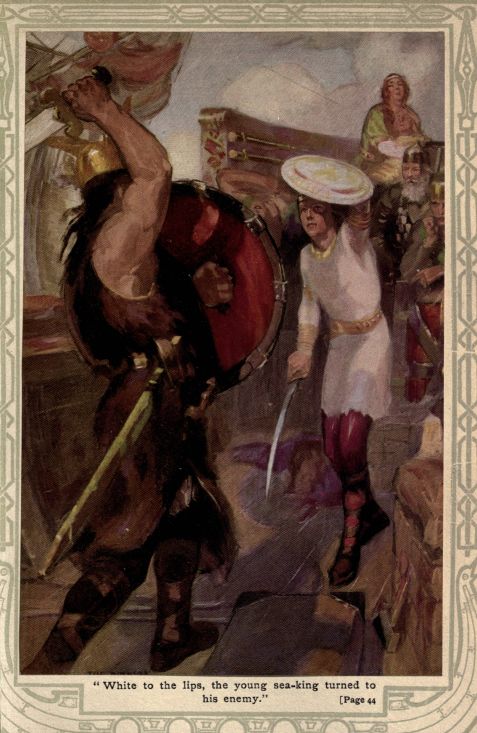
"White to the lips, the young sea-king turned to his enemy." (Page 44)
The comforting thought was diverted by a soft whisper at his ear,--"Do not be deceived, lord count. The Merwing lies."
In the tense strain of his test with the arrow, Olvir had lost all consciousness of Fastrada's presence. Now, however, he turned about, and his gaze rested upon the maiden's exquisite figure. At the sight, all his bitter thoughts of treachery and revenge were forgotten. He had no time to recall his sword-brother to mind before the girl raised her head, and, smiling and blushing with undisguised pleasure, turned upon him a look that set his heart to throbbing with mad delight.
"So my lord count is at last pleased to greet me," she half whispered.
"I had first to greet the host, maiden," rejoined Olvir, with a flash of grim humor.
"Ai! it was grandly done! But I shudder to think of your peril!" and the girl's bosom heaved with emotion.
Olvir gazed straight into her eyes, blue as sapphires and melting with love. Again his heart leaped wildly and sent the hot blood surging through his veins. All the Oriental in his nature was aroused. But it held control only for a moment. Over the graceful head of the maiden he caught sight of his foster-brother's face, clouded with doubt and bewilderment. One glance was enough to sober the viking. Not even youth and Eastern blood could withstand the Northern loyalty. Olvir tore his gaze from the spell of the sapphire eyes and stared out across the silver-laden table, his face stern almost to fierceness.
Fastrada, her blushes fast paling, watched him from beneath lowered lashes with a startled look. Roland also watched him, his blue eyes still troubled. Presently a change lit up the Northman's face. He turned about, with a frank smile for Roland, and met Fastrada's glance with a look of calm resolve.
"Drink with me, maiden," he said. "I pledge one who is the truest friend, the boldest hero in all Frank Land."
"I drink to that hero," replied Fastrada; and over the brim of her crystal goblet her eyes again beamed upon Olvir.
Great as was his self-control, the young man looked hastily away. But then his lip curled in scorn of his weakness, and he exclaimed, "We drink to my sword-brother. May he find favor in the eyes of the queen's fairest maiden!"
"The fair to the fair," rejoined Fastrada, with adroit play on the word. "The fair count will win a flaxen bride. But among the dark maidens I know one who has made choice of a dark-faced hero."
At the open confession Olvir panted, and his eyes glistened with the love which he could no longer restrain. Yet he held firm to his purpose.
"The dark maiden is a foolish maiden," he answered. "She should choose the blue-eyed hero,--a warrior of kingly blood. His great heart overflows with love for the maiden,--he, the king's kin, who need but speak, and honors will be heaped upon him. But the dark warrior, who is he?--a heathen outlander; a stranger in the land; a wanderer!"
"No, Olvir!" interrupted Roland, hoarsely; "you are no stranger, but my true brother. Listen, Fastrada! For no short day you have known that I loved you, and you have never frowned upon my wooing. Yet now I see that you turn to my brother. May the Holy Mother grant that you do not scorn his love the same! Give him the happiness which I thought should be mine."
"And which I 'll not take from you," rejoined Olvir. "Shall I cut the heart from the breast of my brother?"
"That the maiden already has done. I blame neither her nor my loyal brother. You have wooed for me, and failed; now you can woo for yourself without blame."
"He may win the same answer, lord count," said Fastrada, proudly.
The retort passed unheeded. The foster-brothers were gazing into each other's eyes. Soon, however, Roland turned away, that his friend might not perceive the grief which he could no longer hide. Olvir divined the cause of the movement, and he also sank back on his couch, to stare moodily before him.
For a while Fastrada held to her pretence of coldness, waiting for Olvir to begin his wooing. But he maintained his moody stare, and gave no sign. His silence and the sternness of his look puzzled and alarmed the girl. Clearly, this was a very different kind of lover from the sighing swains who trembled if she but withheld her smiles. Not even Roland would have so fought against his love when freed from the bond of foster-duty. One who could put honor before desire was indeed rare among suitors. Woman-like, Fastrada grew all the more eager at the seeming indifference. Unable longer to simulate coyness, she leaned toward her chosen hero and whispered softly: "Olvir,--Olvir, I wait to hear you speak."
Without turning or lifting his head, the Northman answered coldly: "Why should you wait, daughter of Rudulf? I have stamped my heel on the heart of my brother; I have stolen from him what he cherished more than life. The thief's loot is the thief's curse."
"Yet what have you stolen, Olvir? Surely, nothing that Lord Roland possessed, or any other Frank. Until you came, I had never loved any man--and now--and now--"
The pleading whisper died away in silence; but Olvir had turned, flushed and bright-eyed, no longer able to resist the love which filled his whole being. He saw how the girl leaned toward him, her bosom heaving, her scarlet lips half parted. Her cheeks were again crimson with blushes, and her eyes met his gaze with the open confession of her love.
"Thou art Freya!" he exclaimed adoringly, and the girl quivered with joy to see how his face softened and his eyes shone with rapture. Half unconsciously they drew nearer together and murmured their love over and over again.
They exchanged rings and whispered the betrothal vows, regardless alike of the unheeding revellers and of the far from friendly glances of their host. If Hardrat the Thuringian felt displeased at the success of the Dane intruder, no trace of the feeling was perceptible on his wine-flushed features. Lupus, however, took no pains to repress his jealous scowl.
For a time the Vascon was required to devote his attention to the royal guest at his side; but when Karl fell to jesting with Abbot Fulrad, Lupus could watch the lovers, undiverted. As he looked, a fit of jealous rage seized upon him. Though they hardly touched hands, the sight was more than he could bear. His first thought was to sign to his steward to put poison in the Northman's wine. A seemingly careless gesture and nod, and the crafty slave would know the chosen victim. But the sign was not given. At the last moment the duke perceived that Olvir's silver tankard stood brimming beside his trencher. What little wine the young man drank was sipped from Fastrada's cup.
Barred of his simplest and most certain means of removing his rival, the Vascon sat gnawing his lip, his face distorted with the look of a baffled fiend. Count Hardrat, failing to attract the duke's attention by his warning glances, spoke to the steward. But the mischief was already past mending. Drawn by the intensity of the duke's look, Olvir and Fastrada raised their heads, and for an instant both saw the malignant stare of the Vascon. Quickly as he looked away, neither failed to divine his jealous rage. Fastrada clasped her lover's hand in sudden dread.
"Ai! how he hates you!" she whispered.
"No new tidings," rejoined Olvir. Then he put his hand to his breast and turned smilingly to the maiden. "Dear one, here is hidden a bit of hollowed ivory of which you may have knowledge."
"The hollow was not empty," replied the girl. "I feared for you--I fear more now."
"You feared?"
Fastrada hesitated and glanced across the table at Hardrat. The war-count was intent on his trencher. She drew a deep breath, and, with eyes downcast, murmured her answer to Olvir's question: "My lord should know that others than Roland wooed me before his coming, and so there are those--"
"--Who do not wish me well," said Olvir, as the girl faltered. "Still, that is not cause enough for your wolf's hair."
"True, Olvir; and yet the token was sent at a venture. I know nothing certain. I chanced to see Lupus talking with my drunken countryman Hardrat. As I came upon them, Hardrat growled out your name, and repeated it with a curse. Then they saw me, and the drunkard hurried away like a guilty man. But Lupus stayed to greet me. I could not rid myself of him until I was bidden to the queen's bower."
"He saw that you thought to send a warning."
"No serpent is more subtle. But if he thinks to come between us, let him beware!"
Surprised by the hissing note in the softly murmured threat, Olvir glanced up from the hand he was fondling. He was too late to catch the cruel expression which for a moment had marred the girl's beauty; but he wondered to see how the color of her eyes had altered to a greenish grey. As he looked, her gaze met his, and the greenish tints quickly gave place again to the blue.
"By Freya, sweetheart," he said, "your eyes change their hue."
"My heart will never change."
"Nor mine, by my sword! But what hushes the merrymaking? Ah! the host rises to speak."
Standing on his couch, Lupus smiled down condescendingly upon his guests, and, to draw attention, waved a hand whose every finger was burdened with gem-rings.
"Brave counts and holy priests, chaste dames and beautiful maidens," he began, "fill your goblets to the brim, and drink with me to the health of the great ruler who honors us with his presence."
A chorus of shouts greeted the toast, and every man sprang to his feet, Olvir first of all.
"Long live the king!" cried Hardrat, his bloodshot eyes fixed upon Lupus.
"The king! the king!--long live the king!" shouted the guests in chorus, and the war-counts brandished their bared swords overhead while all present drained their wine-cups to the bottom.
As Olvir sheathed Al-hatif, he looked down, eager to rejoin Fastrada. In this, however, he was to be disappointed. The duenna dame had risen from her chair and was leaving the table. Immediately all the women present, dames and maidens alike, rose to follow their leader. None longed more to stay than did Fastrada, and she lingered beside Olvir to the very last. Already the women had drawn aside. Olvir looked at the girl ruefully.
"So we must part, sweetheart," he sighed.
Fastrada gazed into his dark face, and half whispered her answer: "Ah, my hero, would that the time had come when we need never part!"
"That, I trust, may soon be," replied Olvir, and he drew aside for the girl to pass. She would still have lingered beside him, but the old dame beckoned to her, and she glided away to join the other bower-maidens.
As the women swept after their leader through a private passage, Duke Lupus reached out to refill the king's gold flagon. He was met by a quick gesture of refusal, and Karl turned his empty cup brim down upon the table.
"Enough of wine," he said. "I am not over-fond of wassail, and the feast is dull without our fair ones to grace the board."
Lupus opened his lips to protest, but caught a glance from Hardrat, and changed at once to bowing compliance: "Your Majesty, dancing and juggling were to have followed. Yet whatever may be your pleasure--"
"You are a kind host, and we give thanks for the feast. Another time we may enjoy the mountebanks. Farewell, lord duke. God keep you! Anselm, a word in private; and you, Fulrad. Farewell, my bright Dane."
Olvir wheeled about to salute the king. As his hand fell, his eye met Karl's smiling gaze, and he glanced down at the royal couch. The king looked, and saw the arrow wrapped in his kerchief. He nodded gravely to Olvir, and, arrow in hand, left the chamber, between Anselm and Fulrad.
Released from restraint by the departure of the king, the remaining guests gathered about the head of the table, and many accepted the duke's invitation to join in a wassail bout. Most of the priests, however, and a few of the counts at once withdrew from the banquet-chamber. In their midst went Olvir, so intent on the vision of Fastrada's loveliness that he had no thought for his foster-brother.
Still musing, he passed the door, and found himself standing in the torchlight, face to face with Gerold and Roland. His eyes fell, and he would have passed by the two with flushed cheeks, had not Roland laid a hand on his shoulder and turned to walk beside him.
"Our horses are at your camp, gossip," calmly remarked the Frank. "We shall return with you for the night."
"The murderers may yet linger," added Gerold, from the rear.
Olvir halted and stepped back from Roland.
"Thor!" he muttered. "This--after what has happened!"
"Are you not my brother?" demanded Roland. "Heu! I know now she did not love me. If she had, I should hate you. But you have robbed me of nothing. How, then, can I grudge you your good fortune?"
"Brother!" cried Olvir.
CHAPTER XII
Look on thy loved one,
Lay lips to his lips.
LAY OF GUDRUN.
On the morning after the feast, the first to greet Roland as he stepped from Olvir's tent was a stocky, bow-legged warrior, whose unkempt red beard and travel-stained dress of coarse wool and leather spoke far more strongly of the camp than of kings' halls. But Roland answered the new-comer's hearty shout with a greeting no less cordial.
"Ho, Amalwin!" he cried; "I did not look to see your Saxon face this far south. What of your fellows in the Sorb Mark,--Count Rudulf?"
"Worad and I came with our levies, the few that Rudulf would spare us. The little birds twitter on the green boughs; but the crafty Grey Wolf scents war in the spring breezes. He will not venture Rhineward from his mark a step beyond Fulda."
"How is that, friend?" called Olvir, from the entrance of the tent. "Will not Count Rudulf attend the Mayfields?"
The Saxon stared at the Norse earl in mingled surprise and admiration until Roland repeated the question, "Then Rudulf will not come to the assembly?"
"Not he! I half wish I were myself back over Rhine Stream, in the deep forest. But who is this young hero?"
"Greet him as my sword-brother. He is a Northman from beyond the Danes,--a fosterling of Otkar."
"Of Otkar!" shouted Amalwin; and he ran to grasp Olvir's hand. "The Dane himself took me thrall at the fall of the Irminsul; yet he gave me freedom, and won for me the good-will of Carloman."
Olvir nodded: "Be sure the hero spoke no ill to me of Amalwin the Saxon. But Count Rudulf--I must speak with him."
"Then you must fare over Rhine Stream, hero," rejoined Amalwin.
"I know the Grey Wolf," added Roland, nodding in assent. "If he scents forest-war, he will not stir out of his mark for all the Saracens in the old Goth realm."
"It is well I have Zora, brother. I shall start without delay. The time of your Folk-meet is not over-long."
"That is true, Northman," remarked Amalwin. "Two fortnights will see the close of the Mayfields. Though you ride the fleetest of horses, your return will find Karl the King across the Pyrenees, and the Saracens already broken."
Olvir shook his head; but Roland broke in quickly: "Come, brother; let us bear Amalwin company to our lord king. He should know at once of your wish."
"I had forgotten. I am now only a henchman," said Olvir, and he frowned.
For a little while, as they walked along the river's bank to the royal pavilion, his anger kept him moody and silent. But then he began to question Amalwin on the course and condition of the roads along the main route to the Rhine.
Though Karl was deep in the affairs of his immense realm, he was none too busy to turn immediately at sight of the Saxon.
"Ho, my forest-bear!--greeting to you! Where is Rudulf?"
"Lying in lair, lord king. He scents blood near by," answered Amalwin, and he bent awkwardly to kiss the royal knee.
"How? Stand up, man. Are the Sorbs harrying?"
"Neither Sorb nor Saxon; yet the old wolf will not fare far from his mark. His wife, the Wend woman, has been at her witchery. She forebodes evil from the west. So he lies in his mark, sniffing the Saxon breezes."
"Witchcraft--witchcraft!" muttered Karl, frowning. "We must again warn Rudulf to keep his outland dame within our law. But as to the boding,--the fiends may read the future! Rudulf has a grey head, and you, my bright Dane, brought added warning. Rudulf shall have our arrow-bode, to levy at will all the land-host of Thuringia and Austrasia."
"Give me leave to bear the message, lord king," said Olvir.
"You, my Dane hawk? I counted on you to lead the host into Spain."
"My kinsman Al Arabi gave me an Arab mare. I will go and come before the ending of the Mayfields."
"Then your mare must be winged! Why should you go?"
Olvir glanced at Roland, flushing darkly.
The Frank met the look with a grave smile, and answered for his sword-brother: "It is a simple matter, sire. Olvir would ask Count Rudulf for the hand of his daughter. The Thuringian will not come south; so the suitor must go north."
"Still, is a long journey."
"I will return before you march, lord king," repeated Olvir.
Karl gazed steadily into the haughty face of the Northman. What he saw there soon satisfied his doubts. He nodded, and said briefly: "Fulrad will have the writings drawn up within an hour. Make ready--Stay! here is my ring. It may speed your faring."
Olvir's eyes glistened as he took the royal signet.
"Thor!" he cried. "Here is a king whom a king's son may serve without shame!"
"Then fly, king's son. We 'll be looking for your return."
Olvir saluted, and hastened out through the crowds of envious lords. He was springing away from the pavilion, when Roland's voice brought him to a stand: "Hold, brother! a word. I go first to the villa, to make ready for your farewell."
"Brother--ay, brother!" muttered Olvir; and he stood hesitating, overcome by the insistent generosity of the Frank. But time pressed. He waved his hand to Roland and darted away again.
The hour had hardly passed when Olvir sprang down from Zora's back, beside Gerold and Roland, at the main gateway of the villa. The older count promptly took the bridle-rein, while Gerold turned and led Olvir to the queen's apartments.
There was little change within the bower since Olvir's first visit. As before, Hildegarde sat on the dais, with the children grouped about her feet, and the row of busy maidens on her left. Only the king was absent.
At Olvir's entrance, the maidens dropped their needlework, to glance at him from beneath their lashes and exchange softly murmured comments on his appearance. But Olvir's gaze was already fixed upon the graceful form of Fastrada, among the children on the dais edge. Heedless of the chattering maidens, he hastened forward, his ardor so keen that he could hardly conceal his impatience when Rothada came running to meet him.
"You leave us, Lord Olvir!" she exclaimed.
"Ay, little maid; the time is short. Farewell," he answered, and, with a hasty kiss on her forehead, he passed by. For a moment he knelt to kiss the queen's hand, and then he was beside Fastrada, drinking in the loveliness of her blushing face. The look in her eyes as she gazed at his lithe figure and resplendent war-gear filled him with such an intoxicating delight that for a little he failed to comprehend Hildegarde's remark: "I know nothing of your Norse customs, Lord Olvir. Here we are somewhat strict with unbetrothed maidens. You must say your farewells in our presence."
Fastrada drooped her head to hide a look of resentment, and her dainty foot tapped the floor ominously. Olvir, however, the moment he sensed the queen's meaning, smiled up at her and answered gaily, "Why speak of strictness, dear dame? True love has nothing to hide."
As he spoke, he took Fastrada's hands, and bent to kiss her, thrilling with all the love and reverence of the Northern heart for a pure woman. But as their lips met, the girl, unable to restrain the impulse of her wild Wendish blood, threw herself upon his breast, and flung her arms about his neck. He could feel the throbbing of her heart through his mail.
"Farewell, my lord--my hero!" she whispered brokenly. "Hasten back again. If you linger, I shall die!"
"Never has man gone that journey swifter than I shall go, dear one. If you have need of service, ask for Liutrad Erlingson. All my sea-wolves are at your command. Now, farewell, for a little time!"
Tearing himself from the girl's embrace, Olvir turned and walked quickly away. Rothada and her brothers joined the queen in a chorus of God-speeds; but Olvir waved his hand and leaped out through the doorway, without a single glance even for Fastrada.
He found Roland with one hand on Zora's neck and the other caressing the mare's bony cheek. The Frank turned at once at the sound of Olvir's light step, and caught his outstretched hands. For a moment the two gazed at each other with eyes aglow. Then Olvir leaped into the saddle and called to the mare in Arabic. Wheeling at the word, she leaped through the gateway and shot away down the road like an arrow.
CHAPTER XIII
Riding swift on his errands
On the bit-gripping steed.
SONG OF ATLI.
Though reared on the iron coast of Northern Norway, Olvir Thorbiornson had coursed more than one good horse over the flat shores of Jutland and Frisia. What was no less to his present advantage, he held clearly in mind all that Otkar Jotuntop had told him, in his childhood, of the emir's red racers of the desert. Yet, confident as he felt of Zora's endurance, throughout the first day's ride he restrained his desire to course at full speed, and held the willing mare in check. Even a Frankish horse, if spurred, might have kept the road with them to the first night's rest,--at a Gothic farmstede just beyond Périgueux.
On the second day, however, Olvir held a looser rein, and Zora's long stride swept him forward through the fertile country of mid-Aquitania at a pace to astonish the dark-featured Gallo-Roman serfs toiling in the fields beside the road. Even the occasional Frankish noble and pompous bishop faring along the ancient highway could not but halt to stare, with gaping mouth, as the bright Northman shot past them on the red mare.
It might be that they would first catch sight of the rider in the distance, attracted by the sun-rays glittering on his mail and helmet. Then he would be rushing upon them, and they would draw aside to see him pass. Scarcely a glance would they have as horse and rider dashed by; but it was a glance not soon to be forgotten,--the rider, with the sun glinting on his war-gear and jewelled sword, staring eagerly ahead along the road; the red mare, with outstretched head and trumpet nostrils, sweeping over the ground with long, easy strides.
But not all saw the king's messenger so. Now and then Olvir leaped from the small Arab saddle and ran beside Zora, lightly as a deer, his hand upon her withers. The change rested both mare and rider, and slackened the pace but little. A hunter who could boast of having run down the grey wolf afoot in fair chase was not apt to lag in the pace with a hand on his horse. Another aid to Zora was the fair condition of the main route across the rich province. Before the king had marched south, the counts of Aquitania, spurred to unwonted activity by the prospect of his coming, had put both highroad and bridges in moderately good repair.
So it chanced that, shortly before sunset, Olvir halted for the night at a monastery a round ninety miles from where he had mounted at dawn. The sight of the warlike rider as he rode through their gates brought the black-robed Benedictines flocking about him with hospitable greetings; and when Olvir showed the king's signet, the abbot himself sought the privilege of kissing the royal ring.
But Olvir declined the wassail-feast with which the silk-clad priest would have honored him. Instead, he groomed Zora with his own hands, and, having eaten as plain and scanty a meal as he had doled out for the mare, he withdrew at once to a common bed in the hospice.
Dawn found Zora munching the last of her measure of barley from the stone manger, while her master, his hunger already satisfied by a share of the porter's breakfast, paced up and down the monastery court to rid himself of the stiffness yet lingering in his joints. At the first ray of sunrise, master and mare were passing out through the gates, leaving the porter to mumble his blessing over the handful of silver pennies which had fallen from the rider's hand.
The morning was yet early when, without stopping, Olvir rode past beneath the turreted walls of Poitiers, and noon found the red mare racing over the plains of Touraine. From both Otkar and Roland, Olvir had heard the tale of the fateful battle in which the Hammer of the Franks had shattered the victorious hordes of Saracen invaders. Only forty-six years had passed since that terrible slaughter of the Moslemah, and as Zora coursed along the smooth highway which stretched across the wide scene of the struggle, her rider's glance rested on luxuriant fields where the serfs yet ploughed up fragments of outland war-gear from the blood-drenched soil.
The young Northman was, however, less impressed by the thought of the great battle than by the grand monuments of the ancient Roman occupancy,--the lofty towers and walls, massive arched bridges and aqueducts which, where uninjured by man, still stood about the land, huge and uncrumbling after centuries of use. Often as Otkar had described to him the buildings of the old Romans, Olvir found himself staring at them in no little astonishment and wonder. His learning, however, spared him the awe which would have been felt by his simpler countrymen or the forest-dwelling Saxons, among whom the mighty stone burgs and aqueducts were commonly regarded as the works of giants.
The interest of the king's messenger was at last drawn from these Roman structures to the rapidly increasing numbers of wayfarers, journeying like himself to the north. Every class of society was represented, from counts and mitred bishops, travelling with princely retinues, to wretched poor folk, forced into a life of wandering and beggary by the ever-increasing oppression of brutal lords.
In the well-tilled fields which bordered the highway, Olvir could see numbers of toiling husbandmen, part of the fifteen thousand and odd serfs owned by the Abbey of Saint Martin. Here was Christianity exemplified,--the priests of the rueful White Christ sitting in purple and cloth of gold, while their fellowmen sweated and slaved to bring them wealth! The thought filled Olvir with such loathing that when he crossed the Cher and approached Tours, in the thick of the crowd, it was all he could do to bring himself to accept the hospitality of the famous abbey. Nor was his aversion to his monkish hosts lessened when the almoner, overflowing with pride for his monastery, insisted upon showing the king's messenger all the treasures of the church and shrine.
The gold-wrought hangings and the screens of brass and precious metals, the silver candelabra and the gemmed images, at first half dazzled the unaccustomed eyes of the Northman. But while those black eyes glistened with wonder and admiration of so many precious and beautiful things, the lip beneath curled in scorn of the manner in which the hoard had been gathered, and of the images, to which devout worshippers were offering praise and adoration, alike sanctioned and commended by the Bishop of Rome.
"By the Beard!" muttered Olvir, in Arabic; "and these folk call the Saracens pagans!"
The outlying buildings of the monastery, where monks in short-skirted working frocks plied various trades and handicrafts, tended somewhat to lessen the Northman's scorn of the woman-clad priests. But in the morning he gave to the almoner the exact amount which he thought his lodging was worth, and rode on his way, glad to leave behind him the shuffling black figures, the tinkling bells, and the melancholy chants.
Once on the road again, all bitterness soon passed from Olvir's mind. The day was fair, the road smooth, and already Zora's steel limbs had borne him far on his journey. He cried aloud in sheer gladness of heart, and from the pouch which the king's own hand had fastened to his saddle he flung a fistful of pennies to the rabble of pilgrims by the wayside. Then Zora lengthened her stride; and the wind whistled in his ears a song of hope and love.
And so Aquitania was left to the south, and the king's messenger rode up the Loire's right bank into Neustria, where were to be seen more Franks and no Goths, but still a vast body of subject Gallo-Romans. Swiftly as he passed, Olvir saw much of the beautiful land, whose tilled fields were interspersed with woodlands and meadows. Yet pleasant as was the land to the eye, Olvir observed that the few Frankish husbandmen whom he passed differed little in dress and bearing from the dark-haired serfs. What hope for the future could the free Franks hold, when even the iron rule of their mightiest king could not shield them from the greed and rapacity of their lords?
But Olvir had little commiseration to waste on Christian freemen. Why did they not stand to their ancient rights, like the Norse commonfolk, and cut off the heads of all lawbreakers, whether thralls or kings? With a scornful smile he put the weaklings from his thoughts, and sped on across Neustria as he had sped across Aquitania.
As he approached Paris, Olvir began to fear that Zora's hoofs would soon crack from the continual beating on the hard roads. So he sought out the most noted ironsmith in the city, and he and Zora lodged that night in the hovel of the low-born sledge-wielder.
Never had Zora been groomed as she was groomed by the smith that night and in the morning; and when it came to the shoeing, one would have thought the mare a queen, with such care and delicacy did the man fit on the light iron running shoes. While he then spent the forenoon in yet more grooming, Olvir took a stroll into the city. He found gardens and convents, hovels and palaces, spread over all the Island of Notre Dame and along both banks of the Seine opposite. Undeterred by the narrowness and filth of the streets, he crossed the ancient Roman bridge to the island, and visited the palaces of Clovis and Julian the Apostate, and the great domchurches of Saint Genevieve and Saint Merdicus.
Noon, however, saw the king's messenger not only back at the hut, but ready for the road. He had found Zora sleek as silk and bright-eyed, eager to start. When he mounted he said nothing of pay; but the smith bowed and smiled, and wished the princely king's rider a hearty God-speed. Smiling in turn, Olvir put his hand to one of the gold spirals on his left arm; and when the smith, who had not heeded the quick movement, grasped the Northman's hand, he felt an angular piece of heavy metal pressed into his palm. The giver's hand was withdrawn, and the smith stood gaping at the lump of yellow gold that was worth more than his forge and his home and all else he possessed, though he threw in the very shirt upon his back.