THOMASINE BONAVENTURE[95]
Reading edition
THOMASINE BONAVENTURE[95]
The aspect of rural England during the fifteenth and sixteenth centuries must have presented a strange and striking contrast, in the eye of a traveller, to the agricultural scenery of our own time. Thinly peopled—for the three millions of our chief city nowadays are in excess of the total population of the whole land of the Edwards and the Henrys—the inhabitants occupied hamlets few and far between, and a farm or grange signified usually a moated house amid a cluster of cultivated fields, gathered within fences from the surrounding forest or wold, and gleaming in the distance with rich or green enclosures, rescued from the wilderness, to give “fodder to the cattle, and bread to strengthen the heart of man.” But the great domains of the land for the most part expanded into woodland and marsh and moor, with glades or grassy avenues here and there for access to the lair of the red deer or the wild boar, or other native game, which afforded in that day a principal supply of human food. Yonder in the distance appeared ever and anon a beacon-tower, which marked the place and ward for the warning of hostile advances by night, and for the gathering rest of the hobbelars or horsemen, whose office it was to scour the country and to keep in awe the enemies of God and the king. Wheel-roads, except in the neighbourhood of cities or on the line of a royal progress, there were none; and among the bridle-paths men urged their difficult path in companies, for it was seldom safe for an honest or well-to-do man to travel alone. Rivers glided in silence to the sea without a sail or an oar to ruffle their waters; and there were whole regions, that now are loud with populous life, that might then have been called void places of the uninhabited earth. But more especially did this character of uncultured desolation pervade the extreme borders of the west of England, the country between the Tamar and the sea. There dwelt in scattered villages, or town-places as they are called to this day, the bold and hardy Keltic people, few in number, but, like the race of the Eastern wild man, never taught to bear the yoke. Long after other parts of England had settled into an improved agriculture, and submitted to the discipline of more civilised life, the Cornish were wont to hew their resources out of the bowels of their mother earth, or to haul into their nets the native harvest of the sea. Thus the merchandise of fish, tin, and copper became the vaunted staple of their land. These, the rich productions of their native county, were, even in remote periods of our history, in perpetual request, and formed, together with the wool of their moorland flocks, the great trade of the Cornish people. From all parts, and especially from that storied city whose merchants were then, as now, princes of the land, men were wont to encounter the perilous journey from the Thames to the Tamar, to pursue their traffic with the “underground folk,” as they termed the inhabitants of Cornwall, that rocky land of strangers, as, when literally interpreted, is the exact meaning of its name.
It was in the year 1463, when Edward IV. occupied the English throne, that a tall and portly merchant, in the distinctive apparel of the times, rode along the wilds of a Cornish moor. He sat high and firm upon his horse, a bony gelding, with demipique saddle. A broad beaver, or, as it was then called, a Flanders hat, shaded a grave and thoughtful countenance, wherein shrewdness and good-humour struggled for the mastery and the latter prevailed, and his full brown beard was forked—a happy omen, as it was always held, of prosperous life. His riding garb displayed that contrast of colours which was then so valued by native taste, insomuch that the phrase “motley” had in its origin a complimentary and not an invidious sound. Behind him and near rode his servant, a stout and active-looking knave, armed to the teeth.
The traveller had crossed the ford of a moorland stream, when he halted and reined up at a scene that greeted him on the bank. There, on a green and rushy knoll and underneath a gnarled and wind-swept tree, a damsel in the blossom of youth stood leaning on her shepherd-staff: her companion, a peasant boy, drew back, half shaded by a rock. Sheep of the native breed, the long-forgotten Cornish Knott, gathered around. As he drew nigh, the stranger discovered that the maiden was tall and well formed, and that her rounded limbs had the mould and movement of a natural grace that only health and exercise could develop or bestow. The sure evidence of her Keltic origin was testified by her eyes of violet-blue and abundant hair of rich and radiant brown—the hue that Italian poets delight to describe as the colour of the ripe chestnut,[96] or the stalks and fibres of the maidenhair fern. She had also the bashful nose that appears to retreat from the lip with the unmistakable curve of the Kelt. She was clad in a grey kirtle of native wool, and her bodice also was knitted at the hearth by homely hands. The merchant was first to speak.
“Be not scared,” said he, “fair damsel, by a stranger’s voice. My name is John Bunsby, of the city of London, and I am bound for the hostel of Wike St. Marie, which must be somewhere nigh this moor. What did thy gossips call thee, maiden, at the font?”
“My name, kind sir,” she answered, modestly, “is Thomasine Bonaventure, and my father’s house is hard by at Wike. These are my master’s sheep.”
“The evening falls fast,” said the traveller; “I would fain hire safe guidance to yonder inn.”
She beckoned to the youth and whispered a word in his ear, to which, however, he seemed to listen with reluctance or dislike, and then, with her crook still in her hand, she herself went on to guide the stranger on his way. They arrived in due course at the hostel-door, at the sign of the Rose: but it was the Rose, mere, and without an epithet; for mine host had wisely omitted, in those dangerous days, to designate the hue of that symbolic flower. The traveller dismounted at the door, thanked and requited his gentle guide, and signified that as soon as his leisure allowed he would find his way to her father’s house. After a strict command to his own servant and the varlet of the stable that his horses should receive due vigilance and abundant food, Master Bunsby at last entered the inn. A hecatomb of wood blazed on the earth, shedding light as well as heat around the panelled room—for in those times of old simplicity a single apartment was allotted for household purposes and for the entertainment of guests. The traveller took an offered seat on the carved oak settle, in the place of honour by the fire, and looked on with interest at the homely but original scene. At his right hand a vast oven, with an entrance not unlike a church-door, was about to disgorge its manifold contents. Rye-loaves led the way, sweet and tasty to the final crust (wheat was in those days a luxury unknown in Cornwall); barley-bread and oaten cakes came forth in due procession from the steaming cave; and, last of all, the merchant’s sight and nostrils were greeted by the arrival of a huge and mysterious pie from its depths. The achievements of the dame, who was both cook and hostess in her own person, were duly and triumphantly arrayed upon the board, and the stranger-guest took the accustomed seat at the right hand of “mine host.” His eyes were fixed with curiosity and interest on the hillock of brown dough which stood before him, and reeked like a small volcano with steaming puffs of savoury vapour. At last, when the massive crust which lay like a tombstone over the mighty dish had been broken up, the pie revealed its strange contents. Conger-eels, pilchards, and oysters were mingled piecemeal in the mass beneath, their intervals slushed with melted butter and clotted cream, and the whole well seasoned, not without a savour of garlic, with spices, pepper, and salt. The stranger’s astonishment was manifest in gesture and look, although he by no means repulsed the trencher which came towards him loaded with his bountiful share.
“Sir guest,” said the host, “you doubtless know the byword—‘The Cornish cooks make everything into a pie.’ Our grandames say that the devil never dared cross the Tamar, or he would have been verily put under a crust.”
Satisfied with his fare, the merchant now inquired for the dwelling-place of his guide. It was not far off. The parents of the shepherdess inhabited a thatched hut in the village, with the usual walls of beaten cob, moulded of native clay: all within and without bespoke extreme poverty and want, but there Master John Bunsby soon found himself an honoured visitor seated by the hearth, with a blazing fire of dry gorse gathered from the moor to greet his arrival. There, while the mother stood by her turn or wheel, and span, and the maiden’s nimble fingers flashed her knitting-needles to and fro by the fitful light of the fire, the old man her father and the merchant conversed in a low voice far into the night, on a theme of deep interest to both. The talk was of Thomasine, the child of the house. The merchant related his own prosperous affairs, and spoke of his goodly house in London, governed by a thrifty and diligent wife: the household was one of grave and decent demeanour, with good repute in the vast city wherein dwelt the king. He had taken an immediate interest, he declared, in the old man’s daughter, and desired to rescue her from the life she led on the bleak, unsheltered moor. He pledged himself, if they should consent, to convey her in safety to London, and to place her in especial attendance on his wife; and there, if her conduct were in unison with her looks, he doubted not she would win many friends, and secure a happy livelihood for the rest of her days. He would await their decision at the inn, where he should be detained by business two or three days. Earnest and anxious were their thoughts and their language in the cottage that night and the next day. The aspect and speech of the rich patron were such as invited confidence and trust; but there were the love and fear of two aged hearts to satisfy and subdue. There was the fierce and stubborn repugnance also of the youth, the companion of the maid, who stood with her under the tree upon the moor. He was her cousin, John Dineham,[97] of Swannacote, and they had grown up together from childhood, till, unconsciously to themselves, the tenderness of kindred had strengthened into love. The damsel herself could not conceal a natural longing to visit the great city, where, they said, but it might be untrue, “that the houses were stuck as close together as Wike St. Marie church and tower;” but she would at all events behold for once in her life the dwelling-place of the king. “She would store up every coin, and come back with money enow to buy a flock of sheep of her own, which she and John would tend together, as aforetime, on the moor.” All this shook the scale.
When the merchant arrived to seek their decision, it was made, and in favour of his wish. A pillion or padded seat was obtained from some neighbouring farm, and belted behind the saddle of the merchant’s man. Thereon, with a small fardel in her hand, which held all her worldly goods and gear, mounted Thomasine Bonaventure, while all the villagers came around to bid her farewell—all but one, and it was her cousin John. He had gone, as he had told her, to the moor, and there among the branches of the tree which marked the greeting-place of Master Bunsby the youth waited to watch her out of sight. He lifted up his hand and waved it as she passed on with a gesture of warning, but which she interpreted and returned as a silent caress.
The travellers arrived at their journey’s end after being only a fortnight on the road—a speed so satisfactory and unusual, that it was Dame Bunsby’s emphatic remark that she verily thought they must have flown.
Her mistress received Thomasine with a kind and hearty welcome, and ratified, by her everyday approval, her husband’s choice of the Cornish maid. When she was first told that her name was Bonaventure, and her husband explained that it signified good luck, she said, “Well, sweetheart, when I was a girl they used to say that the name was a fore-sign of the life, and God grant that thine may turn out [so] to be.”
Time passed on, and in a year or two the wild Cornish lass had grown into a frame of thorough symmetry, firmness, and health. Her strong thews, of country origin, rendered her capable of long and active labour, and she had acquired with gradual ease the habits and appliances of city life. She was very soon the favoured and the favourite manager of the household. Her mistress, born and reared in a town, had been long a frail and delicate woman; and life in London in those days, as now, was fraught with the manifold perils of pestilent disease. To one of those ancient scourges of the population, the sweating-sickness, Dame Bunsby succumbed. Her death drew nigh, and, with the touching simplicity of the times, she told her true and tender husband, with smiling tears, that she thought he could not do better than, if they so agreed, to put Thomasine in her place when she was gone. “Tell her it was my last wish.”
This gentle desire so uttered—her strong and grateful feelings towards the master who had taken her, as she expressed it in her rural speech, lean from the moor, and fed her, so that her very bones belonged to him—her happy home, and the power she would acquire to make the latter days in the cottage at Wike St. Marie prosperous and calm,—all these impulses flocked into Thomasine’s heart, and controlled for the time even the remembrance of Cousin John. That poor young man, when the tidings came that she was about to become her master’s wedded wife, suddenly disappeared, and for a while the place of his retreat was unknown; but it afterwards transpired that he had crossed the moor to a “house of religious men,” called the White Monks of St. Cleer, and pleaded for reception there as a needy novice of the gate. His earnest entreaties had prevailed; and six months after his first love, and his last, had put on her silks as a city dame, and begun her rule as the mistress of a goodly house in London, her cousin had taken the vows of his novitiate, and received the first tonsure of St. John.
Her married life did not, however, long endure. Three years after the master became the husband, he took the “plague sore,” and died. They were childless; but he bequeathed “all his goods and chattel property, and his well-furnished mansion, to his dear wife Thomasine Bonaventure, now Bunsby;” and the maid of the moor became one of the wealthy widows of London city. Among the MSS. which still survive, there is a letter which announces the event of her husband’s death and bequest, and then proceeds to notify her solemn donation, as a year’s-mind of Master Bunsby, of ten marks to the Reeve of Wike St. Marie, “to the intent that he shall cause skeelful masons to build a bridge at the Ford of Green-a-Moor: yea, and with stout stonework well laid; and see,” she wrote, “that they do no harm to that tree which standeth fast by the brook, neither dispoyle they the rushes and plants that grow thereby; for there did I passe many goodly hours when I was a simple mayde, and there did I first see the kind face of a fathful frend.” But in another missive to her mother, about the same date, there is a touch of tenderness which shows that her woman’s nature survived all changes, and was strong within her still. She writes: “I know that Cousin John is engaged to the monks of St. Cleer. Hath he been shorn, as they do call it, for the second time? Inquire, I beseech, if he seeketh to dispart from that cell? And will red gold help him away? I am prospered in pouch and coffer, and he need not shame to be indebted unto me, that owe so much to him.” But this frank and kindly effort—“the late remorse of love”—did not avail. John had broken the last link that bound him to the world, and was lost to love and her. Reckless thenceforward, therefore, if not fancy-free, and it may be somewhat schooled by the habits and associations of city life, she did not wear the widow’s wimple long. After an interval of years, we find her the honoured wife “of that worshipful merchant-adventurer, Master John Gall of St. Lawrence, Milk Street.”
Gall was very rich, and he appears to have emptied his money-bags into his wife’s lap, as the gossip of the city ran, for it is on record that soon after her second marriage she manifested her prosperity like a true-hearted Cornish woman by ample “gifts” and largess to the borough of St. Marie, “my native place.” Twenty acres of woodland copse in the neighbourhood were bought and conveyed by that kind and gracious lady, Dame Thomasine Gall, to feoffees and trust-men for the perpetual use of the poor of the paroche, “for fewel to be hewn in parcels once a-year, and justly and equally divided for evermore on the vigil of St. Thomas the twin.” To her mother she sends by “a waggon which has gone on an enterprise into Cornwall for woollen merchandise, a chest with array of clothing, fair weather and foul, head-gear and body raiment to boot, all the choice and costly gifts to my loving parents of my goodman Gall, and in remembrance, as he chargeth me to say, that ye have reared for him a kindly and loving wife.” But the graphic and touching passage in this letter is the message which succeeds: “Lo! I do send you also herewithal in the coffer a litel boke: it is for a gift to my Cousin John. Tell him it is not written as the whilom usage was, and he was wont to teach me my Christ Cross Rhime;[98] but it is what they do call emprinted with a strange device of an iron engin brought from forrin parts. Bid him not despise it, for although it is so small that it will lie on the palm of your hand, yet it did cost me full five marks in exchange.” But her marriage life was doomed to bring her only brief and transitory intervals of wedded happiness. Five years after the date of her letter above quoted, she was again alone in the house. Master Gall died, but not until he had endowed his “tender wife with all and singular his moneys and plate, bills, bonds, and ventures now at sea,” etc., with a long inventory of the “precious things beneath the moon,” too long to rehearse, but each and all to the sole use, enjoyment, and behoof of Dame Thomasine, whose maiden name of Bonaventure was literally interpreted and fulfilled in every successive change of station.
We greet her then once more as a rich and buxom widow of city fame. Her wealth, added to her comeliness—for she was still in the prime of life—brought many “a potent, grave, and reverend seignor” to her feet, and to sue for her hand. Nor did she long linger in her choice. The favoured suitor now was Sir John Perceval, goldsmith and usurer—that is to say, banker, in the phrase of that day; very wealthy, of high repute, alderman of his ward, and in such a position of civic advancement that he would have been described in modern language as next the chair. He wooed and won the “Golden Widow”—for so, because of her double inheritance of the wealth of two rich husbands, she was merrily named. Their wedding was a kind of public festival, and the bride, in acknowledgment of her own large possessions, was invested with a stately dower at the church-door. One year after their marriage her husband, Sir John, was elected to that honourable office which is still supposed by foreign nations to be only second in rank to that of the monarch on the throne, Lord Mayor of the city of London.
Thus, by a strange succession of singular events, the barefooted shepherdess of a Cornish moorland became the Lady Mayoress of metropolitan fame; and the legend of Thomasine Bonaventure—for it was now well known—was the popular theme of royal and noble interest among the lords and ladies of the Court. She demeaned herself bravely and decorously in her ascent among the great and lofty ones of the land. Like all noble natures, her spirit rose with her personal elevation, and took equal place with her compeers of each superior rank. Nor did her true and simple woman’s nature undergo any depreciation or change. It breathes and survives in every sentence of her family letters, transcripts of which have been perpetuated and preserved to our own times. One part of her personal history is illustrative of a scene of life and manners when Henry VII. was king.
“Sweet mother,” she wrote, “thy daughter hath seen the face of the king. We were bidden to a banket at the royal palace, and Sir John and I dared not choose but go. There was such a blaze of lords and ladies in silks and samite, and jewels and gold, that it was like the city of New Jerusalem in the Scriptures; and I, thy maid Thomasine, was arrayed so fine, that they brought up the saying that I was dressed like an altar. When we were led into the chamber of dais, where his highness stood, the king did kiss me on the cheek, as the manner is, and he seemed gentle and kind. But then did he turn to my good lord and husband, and say, with a look stark and stern enow, ‘Ha, Sir John! see to it that thy fair dame be liege and true, for she comes of the burly Cornish kind, and they be ever rebels in blood and bone. Even now they be one and all for that knave Warbeck,[99] who is among them in the West.’ You will gesse, dear mother, how my heart did beat. But withal the king did drink to me at the banket, and did merrily call, ‘Health to our Lady Mayoress, Dame Thomasine Perceval, which now feedeth her flock in the rich pastures of our city of London.’ And thereat they did laugh, and fleer, and shout, and there was flashing of tankards and jingling of cups all down the hall.”
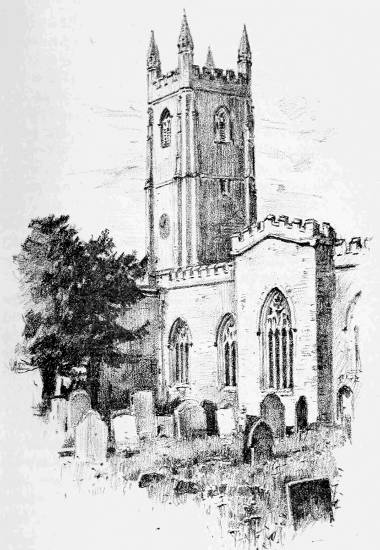
The Tower of St. Stephen’s Church, Dunheved, to which Dame Thomasine Perceval contributed 40 marks.
With increase of wealth came also many a renewed token of affectionate regard and sterling bounty to her old and well-beloved dwelling-place of Wike St. Marie. As her wedding-gift of remembrance she directed that “a firm and steadfast road should be laid down with stones,” at her whole cost, along the midst of Green-a-Moor, and fit for man and beast to travel on, with their lawful occasions, from Lanstaphadon to the sea. At another time, and for a New Year’s gift, she gave the sum of forty marks towards the building of a tower for St. Stephen’s church, above the causeway of Dunheved; and it was her desire that they should carry their pinnacles so tall that “they might be seen from Swannacote Cross, by the moor, to the intent that they who do behold it from the Burgage Mound may remember the poor maid which is now a wedded dame of London citie.”
During her three marriages she had no children, and it was her singular lot to survive her third husband, Sir John: it was in long widowhood after him that she lived and died. Her will, bearing date the vigil of the Feast of Christmas, A.D. 1510, is a singular document, for therein the memory and the impulses of her early life are recalled and condensed. She bequeaths large sums of money to be laid out and invested in land for the welfare of the village borough, whereto, amid all the strange vicissitudes of her existence, her heart had always clung with fond and lingering regret. She directs that a chantry[100] with cloisters was to be built near the church of Wike St. Marie, at the discretion and under the control of her executor and cousin, John Dineham, the unforgotten priest. She endows it with thirty marks by the year, and provides that there shall be established therein “a schole for young children born in the paroche of Wike St. Marie; and such to be always preferred as are friendless and poor.” They are to be “taught to read with their fescue from a boke of horn, and also to write, and both as the manner was in that country when I was young.” The well-remembered days of her girlhood appear to tinge every line of her last will. Her very codicil is softened with a touch of her first and fondest love. In it she gives to the priest of the church, where she well knew that her cousin John would serve and sing,[101] “the silver chalice gilt, which good Master Maskelyne the goldsmith had devised for her behoof, with a leetle blue flower which they do call a forget-me-not wrought in Turkess at the bottom of the bowl, to the intent that whensoever it is used the minister may remember her who was once a simple shepherd-maid by the wayside of Wike St. Marie, and who was so wonderfully brought by many great changes to be the Mayoress of London citie before she died.”
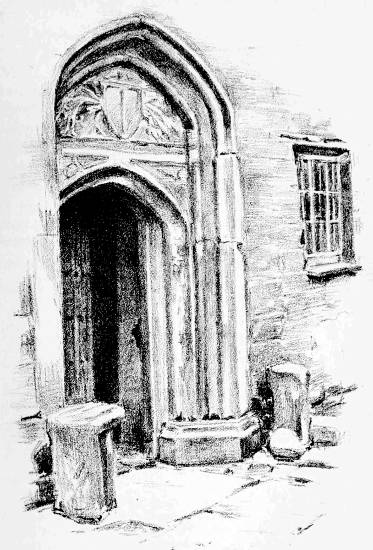
Doorway of old College, Week St. Mary.