ANTONY PAYNE, A CORNISH GIANT[77]
Reading edition
ANTONY PAYNE, A CORNISH GIANT[77]
On the brow of a lofty hill, crested with stag-horned trees, commanding a deep and woodland gorge wherein “the Crooks of Combe”[78] (the curves of a winding river) urge onward to the “Severn Sea,” still survive the remains of famous old Stowe,—that historic abode of the loyal and glorious Sir Beville,[79] the Bayard of old Cornwall, “sans peur et sans reproche,” in the thrilling Stuart wars. No mansion on the Tamar-side ever accumulated so rich and varied a store of association and event. Thither the sons of the Cornish gentry were accustomed to resort, to be nurtured and brought up with the children of Sir Beville Granville and Lady Grace; for the noble knight was literally the “glass wherein” the youth of those ancient times “did dress themselves.” There their graver studies were relieved by manly pastime and athletic exercise. Like the children of the Persians, they were taught “to ride, to bend the bow, and to speak the truth.” At hearth and hall every time-honoured usage and festive celebration was carefully and reverently preserved. Around the walls branched the massive antlers of the red deer of the moors, the trophies of many a bold achievement with horse and hound. At the buttery-hatch hung a tankard marked with the guests’ and the travellers’ peg, and a manchet, flanked with native cheese, stood ready on a trencher for any sudden visitant who might choose to lift the latch; for the Granville motto was, “An open door and a greeting hand.” A troop of retainers, servants, grooms, and varlets of the yard, stood each in his place, and under orders to receive with a welcome the unknown stranger, as well as their master’s kinsman and friend.
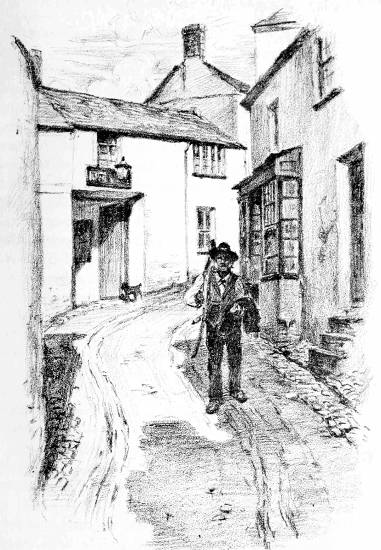
Antony Payne’s House, Stratton, now the Tree Inn.
Among these, at the beginning of the seventeenth century, appeared a remarkable personage. He was the son of an old tenant on the estate, who occupied the manor-house of Stratton, a neighbouring town. His parents were of the yeoman rank in life, and possessed no singularity of personal aspect or frame, although both were comely. But Antony, their son, was from his earliest years a wonderful boy. He shot up into preternatural stature and strength. His proportions were so vast that, when he was a mere lad, his schoolmates were accustomed to “borrow his back,” and, for sport, to work out their geography lessons or arithmetic on that broad disc in chalk; so that, to his mother’s amazement and dismay, he more than once brought home, like Atlas, the world on his shoulders, for her to rub out. His strength and skill in every boyish game were marvellous, and, unlike many other large men, his mental and intellectual faculties increased with his amazing growth.
It was Antony Payne’s delight to select two of his stoutest companions, whom he termed “his kittens,” and, with one under each arm, to climb some perilous crag or cliff in the neighbourhood of the sea, “to show them the world,” as he said. He was called in the school “Uncle Tony,” for the Cornish to this day employ the names “uncle and aunt” as titles of endearment and respect. Another relic of his boyhood is extant still: the country lads, when they describe anything of excessive dimensions, call it, “As long as Tony Payne’s foot.”
He grew on gradually, and in accurate proportion of sinews and thews, until, at the age of twenty-one, he was taken into the establishment at Stowe. He then measured seven feet two inches without his shoes,[80] and he afterwards added a couple of inches more to his stately growth. Wide-chested, full-armed, and pillared like a rock on lower limbs of ample and exact symmetry, he would have gladdened the critical eyes of Queen Elizabeth, whose Tudor taste led her to exult in “looking on a man.” If his lot had fallen in later days, he might have been hired by some wonder-monger to astonish the provincial mind, or the intellect of cities, as the Cornish Chang. But in good, old, honest, simple-hearted England, they utilised their giants, and deemed that when a cubit was added to the stature of a man, it was for some wise good end, and they looked upon their loftier brother with added honour and respect.
So for many years Payne continued to fulfil his various duties as Sir Beville’s chief retainer at Stowe. He it was who was the leader and the authority in every masculine sport. He embowelled and flayed the hunted deer, and carried the carcass on his own shoulders to the Hall, where he received as his guerdon the horns and the hide. The antlers, cleansed and polished, were hoisted as a trophy on the panelled wall; and the skins, dressed and prepared, were shaped into a jerkin for his goodly chest. It took the spoils of three full-grown red deer to make the garment complete. His master’s sons and their companions, the very pride of the West, who were housed and instructed at Stowe, when released from their graver studies, were under his especial charge. He taught them to shoot, and fish, and to handle arms. Tilt-yard and bowling-green, and the hurler’s ground, can still be identified at Stowe. In the latter, the poising-place and the mark survive, and a rough block of graywacke is called to this day “Payne’s cast;” it lies full ten paces beyond the reach whereat the ordinary players could “put the stone.”
It is said that one Christmas-eve the fire languished in the Hall. A boy with an ass had been sent to the woodland for logs, and the driver loitered on his homeward way. Lady Grace lost patience, and was displeased. All at once a sudden outcry was heard at the gate, and Sir Beville’s Giant appeared with the loaded animal on his mighty back. He threw down his burden in triumph at the hearth-side, shouting merrily, “Ass and fardel! ass and fardel for my lady’s Yule!” Another time he strode along the path from Kilkhampton village to Stowe with a bacon-hog of three hundredweight thrown across his shoulders, and merely because a taunting butcher had doubted his strength for the feat. Among the excellences of Sir Beville’s Giant, it is told of him that he was by no means clumsy or uncouth, as men of unusual size sometimes are, but as nimble and elastic, and as capable of swift and dexterous movement, as a light and muscular man. Added to this, his was a strong and acute intellect; so happy also in his language, and of such a ready wit, that he was called by a writer[81] of the last century, from his resemblance, in these points only, to Shakespeare’s knight, “the Falstaff of the West.”
But a great and sudden change was about to come over the happy halls of Stowe. The king and his Parliament were at fatal strife; and there could be but one place in the land for the true-hearted and chivalrous Sir Beville, and that was at his royal master’s side.[82] The well-known rallying cry went through the hills and valleys of Cornwall, “Granville’s up!” and the hearts and hands of many a noble knight and man-at-arms turned towards old Stowe. Mounted messengers rode to and fro. Strange and stalwart forms arrived to claim a place in the ranks. Retainers were enrolled day and night; and the smooth sward of the bowling-green and the Fawn’s Paddock were dinted by the hoofs of horses and the tread of serried men. Foremost among these scenes we find, as body-guard of his master, the bulky form of Antony Payne. He marshalled and manœuvred the rude levies from the western mines, “the underground men.” He served out arms and rations, and established order, by the mere terror of his presence and strength, among the wild and mixed multitude that gathered “for the king and land.”
Instead of the glad and hospitable scenery of former times, Stowe became in those days like a garrison surrounded by a camp. At last, one day tidings arrived that the battalions of the Parliament, led by Lord Stamford, were on their way northwards, and not many miles off. A picked and goodly company marched forth from the avenue of Stowe, and among them Payne, on his Cornish cob Samson, of pure Guinhilly breed. The next day, eight miles towards the south, the battle of Stratton Hill was fought and won by the royal troops. The Earl of Stamford was repulsed, and fled, bequeathing, by a strange mischance, his own name, though the defeated commander, to the field of battle. It is called to this day Stamford Hill.[83] Sir Beville returned that night to Stowe, but his Giant remained with some other soldiers to bury the dead. He had caused certain large trenches to be laid open, each to hold ten bodies side by side. There he and his followers carried in the slain. On one occasion they had laid down nine corpses, and Payne was bringing in another, tucked under his arm, like one of “the kittens” of his schoolboy days, when all at once the supposed dead man was heard pleading earnestly with him, and expostulating, “Surely you wouldn’t bury me, Mr. Payne, before I am dead?” “I tell thee, man,” was the grim reply, “our trench was dug for ten, and there’s nine in already; you must take your place.” “But I bean’t dead, I say; I haven’t done living yet; be massyful, Mr. Payne—don’t ye hurry a poor fellow into the earth before his time.” “I won’t hurry thee: I mean to put thee down quietly and cover thee up, and then thee canst die at thy leisure.” Payne’s purpose, however, was kinder than his speech. He carried his suppliant carefully to his own cottage not far off, and charged his wife to stanch, if possible, her husband’s rebellious blood. The man lived, and his descendants are among the principal inhabitants of the town of Stratton to this day.[84]
That same year the battle of Lansdown, near Bath, was fought. The forces of the Parliament prevailed, and Sir Beville nobly died. Payne was still at his side, and, when his master fell, he mounted young John Granville, a youth of sixteen, whom he had always in charge, on his father’s horse, and he led the Granville troop into the fight. A letter[85] which the faithful retainer wrote to his lady at Stowe still survives. It breathes in the quaint language of the day a noble strain of sympathy and homage. Thus it ran:—
“Honoured Madam,—Ill news flieth apace. The heavy tidings no doubt hath already travelled to Stowe that we have lost our blessed master by the enemy’s advantage. You must not, dear lady, grieve too much for your noble spouse. You know, as we all believe, that his soul was in heaven before his bones were cold. He fell, as he did often tell us he wished to die, in the great Stuart cause, for his country and his king. He delivered to me his last commands, and with such tender words for you and for his children as are not to be set down with my poor pen, but must come to your ears upon my best heart’s breath. Master John, when I mounted him on his father’s horse, rode him into the war like a young prince, as he is, and our men followed him with their swords drawn and with tears in their eyes. They did say they would kill a rebel for every hair of Sir Beville’s beard. But I bade them remember their good master’s word, when he wiped his sword after Stamford fight; how he said, when their cry was, ‘Stab and slay!’ ‘Halt, men! God will avenge.’ I am coming down with the mournfullest load that ever a poor servant did bear, to bring the great heart that is cold to Kilkhampton vault. Oh, my lady, how shall I ever brook your weeping face? But I will be trothful to the living and to the dead.
“These, honoured madam, from thy saddest, truest servant,
“Antony Payne.”
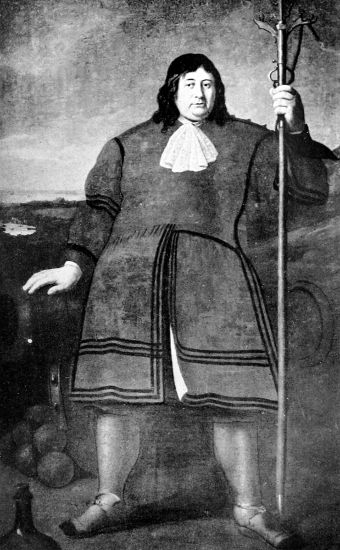
ANTONY PAYNE (p. 118)
From the picture by Sir Godfrey Kneller
At the Restoration the Stowe Giant reappears upon the scene in attendance on his young master, John Granville. Sir Beville’s son had been instrumental in the return of the king, and had received from Charles II. largess of money, great offices, and the earldom of Bath. Among other places of trust, he was appointed Governor of the Garrison at Plymouth. There Payne received the appointment of Halberdier of the Guns, and the king, who held him in singular favour, commanded his portrait to be painted by the Court artist, Sir Godfrey Kneller.[86] The fate of this picture was one of great vicissitude. It hung in state for some years in the great gallery at Stowe; thence, when that mansion was dismantled at the death of the Earl of Bath, it was removed to Penheale, another manor-house of the Granvilles, in Cornwall; but it ceased to be highly esteemed, from ignorance of the people and the oblivion of years, insomuch so that when Gilbert, the Cornish historian, travelled through the county to collect materials for his work, he discovered the portrait rolled up in an empty room, and described by the farmer’s wife as “a carpet with the effigy of a large man upon it.” It was a gift to her husband, she said, from the landlord’s steward, and she was glad to sell it as she did for £8! When Gilbert died his collection of antique curiosities was sold by auction at Devonport, where he lived, and this portrait of Payne, which had been engraved as the frontispiece to the second volume of his “History of Cornwall,” was bought by a stranger who was passing through the town, and who had strolled in to look at the sale, at the price of forty guineas. The value had been apparently enhanced by oil, and varnish, and frame. This stranger proved to be a connoisseur in paintings: he conveyed it to London, and there it was ascertained to be one of the masterpieces of Kneller; it was resold for the enormous sum of £800. This picture, or even the engraving in Gilbert’s work, reveals still to the eye the Giant of Old Stowe, “in his natural presentment” as he lived. There he stands before the eye, a stalwart soldier of the guard. One hand is placed upon a cannon, and the other wields the tall halberd of his rank and office as yeoman of the guns. By a strange accident this very weapon[87] and a large flask or flagon,[88] sheathed in wicker-work, which is said to have held “Antony’s allowance,” a gallon of wine, and which is placed in the picture on the ground at his feet—both these relics of the time and the man are now in the possession of the writer of this article, in the Vicarage House, near Stowe. It was in Plymouth garrison, and in his later days, that an event is recorded of Payne which testifies that even after long years “his eye had not grown dim, neither was his natural force abated.” The Revolution had come and gone, and William and Mary had been enthroned. At the mess-table of the regiment in garrison, on the anniversary of the day when Charles I. had been beheaded, a sub-officer of Payne’s own rank had ordered a calf’s head to be served up in a “William-and-Mary dish.” This, in those days of new devotion to the house of Hanover, was a coarse and common annual mockery of the beheaded king; and delf, with the faces of these two sovereigns for ornament, was a valued ware (the writer has one large dish). When Payne entered the room, his comrades pointed out to him the insulting and practical jest—to him, too, most offensive, for he was a Stuart man. With a ready and indignant gesture he threw out of the window the symbolic platter and its contents.
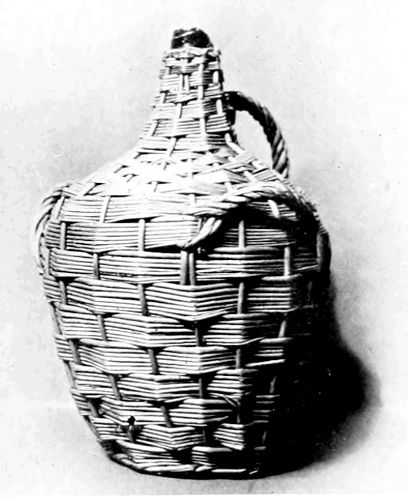
FIG. 3
ANTONY PAYNE’S FLAGON (P. 120)
A fierce quarrel ensued and a challenge, and at break of day Payne and his antagonist fought with swords on the ramparts. After a strong contest—for the offender was a master of his weapon—Payne ran his adversary through the sword-arm and disabled him. He is said to have accompanied the successful thrust with the taunting shout, “There’s sauce for thy calf’s head!” When the strong man at last began to bow himself down at the approach of one stronger than he, the Giant of Stowe obtained leave to retire. He returned to Stratton, his native place, and found shelter and repose in the very house and chamber wherein he was born.
After his death, neither the door nor the stairs would afford egress for the large and coffined corpse. The joists had to be sawn through, and the floor lowered with rope and pulley, to enable the Giant to pass out towards his mighty grave. Relays of strong bier-men carried him to his rest, and the bells of the tower, by his own express desire, “chimed him home.” He was buried outside the southern wall of Stratton church.[89] When the writer was a boy, the sexton one day broke, by accident, through the side wall of a vast but empty sepulchre. Many went to see the sight, and there, marked by a stone in the wall, was a vault, like the tomb of the Anakim, large enough in these days for the interment of three or four of our degenerate dead. But it was empty, desolate, and bare. No mammoth bones nor mysterious relics of the unknown dead. A massive heap of silent dust!