CRUEL COPPINGER[90]
Reading edition
CRUEL COPPINGER[90]
A record of the wild, strange, lawless characters that roamed along the north coast of Cornwall during the middle and latter years of the last century would be a volume full of interest for the student of local history and semi-barbarous life. Therein would be found depicted the rough sea-captain, half smuggler, half pirate, who ran his lugger by beacon-light into some rugged cove among the massive headlands of the shore, and was relieved of his freight by the active and diligent “country-side.” This was the name allotted to that chosen troop of native sympathisers who were always ready to rescue and conceal the stores that had escaped the degradation of the gauger’s brand. Men yet alive relate with glee how they used to rush at some well-known signal to the strand, their small active horses shaved from forelock to tail, smoother than any modern clip, well soaped or greased from head to foot, so as to slip easily out of any hostile grasp; and then, with a double keg or pack slung on to every nag by a single girth, away went the whole herd, led by some swift well-trained mare, to the inland cave or rocky hold, the shelter of their spoil. There was a famous dun mare—she lived to the age of thirty-seven, and died within legal memory—almost human in her craft and fidelity, who is said to have led a bevy of loaded pack-horses, unassisted by driver or guide, from Bossinney Haun to Roughtor Point. But beside these travellers by sea, there would be found ever and anon, in some solitary farmhouse inaccessible by wheels, and only to be approached by some treacherous foot-path along bog and mire, a strange and nameless guest—often a foreigner in language and apparel—who had sought refuge with the native family, and who paid in strange but golden coins for his shelter and food; some political or private adventurer, perchance, to whom secrecy and concealment were safety and life, and who more than once lived and died in his solitary hiding-place on the moor.
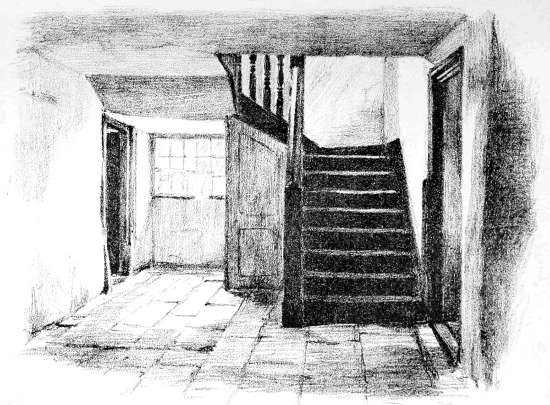
Interior of Galsham, once the home of Cruel Coppinger.
There is a bedstead of carved oak still in existence at Trevotter—a farm among the midland hills—whereon for long years an unknown stranger slept. None ever knew his nation or name. He occupied a solitary room, and only emerged now and then for a walk in the evening air. An oaken chest of small size contained his personal possessions and gold of foreign coinage, which he paid into the hands of his host with the solemn charge to conceal it until he was gone thence or dead—a request which the simple-hearted people faithfully fulfilled. His linen was beautifully fine, and his garments richly embroidered. After some time he sickened and died, refusing firmly the visits of the local clergyman, and bequeathing to the farmer the contents of his chest. He wrote some words, they said, for his own tombstone, which, however, were not allowed to be engraved, but they were simply these—“H. De R. Equees & Ecsul.” The same sentence was found, after his death, carved on the ledge of his bed, and the letters are, or lately were, still traceable on the mouldering wood.
But among the legends of local renown a prominent place has always been allotted to a personage whose name has descended to our times linked to a weird and graphic epithet—“Cruel Coppinger.” There was a ballad in existence within human memory which was founded on the history of this singular man, but of which the first verse[91] only can now be recovered. It runs—
“Will you hear of the Cruel Coppinger? He came from a foreign kind; He was brought to us by the salt-water, He was carried away by the wind.”
His arrival on the north coast of Cornwall was signalised by a terrific hurricane. The storm came up Channel from the south-west. The shore and the heights were dotted with watchers for wreck—those daring gleaners of the harvest of the sea. It was just such a scene as is sought for in the proverb of the West—
“A savage sea and a shattering wind, The cliffs before, and the gale behind.”
As suddenly as if a phantom ship had loomed in the distance, a strange vessel of foreign rig was discovered in fierce struggle with the waves of Harty Race. She was deeply laden or waterlogged, and rolled heavily in the trough of the sea, nearing the shore as she felt the tide. Gradually the pale and dismayed faces of the crew became visible, and among them one man of herculean height and mould, who stood near the wheel with a speaking-trumpet in his hand. The sails were blown to rags, and the rudder was apparently lashed for running ashore. But the suck of the current and the set of the wind were too strong for the vessel, and she appeared to have lost her chance of reaching Harty Pool. It was seen that the tall seaman, who was manifestly the skipper of the boat, had cast off his garments, and stood prepared upon the deck to encounter a battle with the surges for life and rescue. He plunged over the bulwarks, and arose to sight buffeting the seas. With stalwart arm and powerful chest he made his way through the surf, rode manfully from billow to billow, until with a bound he stood at last upright upon the sand, a fine stately semblance of one of the old Vikings of the northern seas. A crowd of people had gathered from the land, on horseback and on foot, women as well as men, drawn together by the tidings of a probable wreck. Into their midst, and to their astonished dismay, rushed the dripping stranger: he snatched from a terrified old dame her red Welsh cloak, cast it loosely around him, and bounded suddenly upon the crupper of a young damsel, who had ridden her father’s horse down to the beach to see the sight. He grasped her bridle, and, shouting aloud in some foreign language, urged on the double-laden animal into full speed, and the horse naturally took his homeward way. Strange and wild were the outcries that greeted the rider, Miss Dinah Hamlyn, when, thus escorted, she reached her father’s door in the very embrace of a wild, rough, tall man, who announced himself by a name—never afterwards forgotten in those parts—as Coppinger, a Dane. He arrayed himself without the smallest scruple in the Sunday suit of his host. The long-skirted coat of purple velveteen with large buttons, the embroidered vest, and nether garments to match, became him well. So thought the lady of his sudden choice. She, no doubt, forgave his onslaught on her and on her horse for the compliment it conveyed. He took his immediate place at the family board, and on the settle by the hearth, as though he had been the most welcome and long-invited guest in the land. Strange to say, the vessel disappeared immediately he had left her deck, nor was she ever after traced by land or sea. At first the stranger subdued all the fierce phases of his savage character, and appeared deeply grateful for all the kindness he received at the hands of his simple-hearted host. Certain letters which he addressed to persons of high name in Denmark were, or were alleged to be, duly answered, and remittances from his friends were supposed to be received. He announced himself as of a wealthy family and superior rank in his native country, and gave out that it was to avoid a marriage with a titled lady that he had left his father’s house and gone to sea. All this recommended him to the unsuspecting Dinah, whose affections he completely won. Her father’s sudden illness postponed their marriage. The good old man died to be spared much evil to come.
The Dane succeeded almost naturally to the management and control of the house, and the widow held only an apparent influence in domestic affairs. He soon persuaded the daughter to become his wife, and immediately afterwards his evil nature, so long smouldering, broke out like a wild beast uncaged. All at once the house became the den and refuge of every lawless character on the coast. All kinds of wild uproar and reckless revelry appalled the neighbourhood day and night. It was discovered that an organised band of desperadoes, smugglers, wreckers, and poachers were embarked in a system of bold adventure, and that “Cruel Coppinger” was their captain. In those days, and in that unknown and far-away region, the peaceable inhabitants were totally unprotected. There was not a single resident gentleman of property or weight in the entire district; and the clergyman, quite insulated from associates of his own standing, was cowed into silence and submission. No revenue officer durst exercise vigilance west of the Tamar; and to put an end to all such surveillance at once, it was well known that one of the “Cruel” gang had chopped off a gauger’s head on the gunwale of a boat, and carried the body off to sea.[92]
Amid such scenes Coppinger pursued his unlawful impulses without check or restraint. Strange vessels began to appear at regular intervals on the coast, and signals were duly flashed from the headlands to lead them into the safest creek or cove. If the ground-sea were too strong to allow them to run in, they anchored outside the surf, and boats prepared for that service were rowed or hauled to and fro, freighted with illegal spoil. Amongst these vessels, one, a full-rigged schooner, soon became ominously conspicuous. She bore the name of the Black Prince, and was the private property of the Dane, built to his own order in a dockyard of Denmark. She was for a long time the chief terror of the Cornish Channel. Once with Coppinger on board, when under chase, she led a revenue cutter into an intricate channel near the Gull Rock, where, from knowledge of the bearings, the Black Prince escaped scathless, while the king’s vessel perished with all on board. In those times, if any landsman became obnoxious to Coppinger’s men, he was either seized by violence or by craft, and borne away handcuffed to the deck of the Black Prince; where, to save his life, he had to enrol himself, under fearful oaths, as one of the crew. In 1835, an old man of the age of ninety-seven related to the writer that, when a youth, he had been so abducted, and after two years’ service had been ransomed by his friends with a large sum. “And all,” said the old man, very simply, “because I happened to see one man kill another, and they thought I should mention it.”
Amid such practices ill-gotten gold began to flow and ebb in the hands of Coppinger. At one time he chanced to hold enough money to purchase a freehold farm bordering on the sea. When the day of transfer arrived, he and one of his followers appeared before the astonished lawyer with bags filled with various kinds of foreign coin. Dollars and ducats, doubloons and pistoles, guineas—the coinage of every foreign country with a seaboard—were displayed on the table. The man of law at first demurred to such purchase-money; but after some controversy, and an ominous oath or two of “that or none,” the lawyer agreed to take it by weight. The document bearing Coppinger’s name is still extant. His signature is traced in stern, bold, fierce characters, as if every letter had been stabbed upon the parchment with the point of a dirk. Underneath his autograph, also in his own writing, is the word “Thuro.”[93]
Long impunity increased Coppinger’s daring. There were certain byways and bridle-roads along the fields over which he exercised exclusive control. Although every one had a perfect right by law to use these ways, he issued orders that no man was to pass over them by night, and accordingly from that hour none ever did. They were called “Coppinger’s Tracks.” They all converged at a headland which had the name of Steeple Brink. Here the cliff sheered off, and stood three hundred feet of perpendicular height, a precipice of smooth rock toward the beach, with an overhanging face one hundred feet down from the brow. There was a hollow entrance into the cliff, like a huge cathedral door, crowned and surrounded with natural Saxon arches, curved by the strata of native stone. Within was an arched and vaulted cave, vast and gloomy; it ran a long way into the heart of the land, and was as large and tall—so the country-people said—as Kilkhampton church. This stronghold was inaccessible by natural means, and could only be approached by a cable-ladder lowered from above and made fast below on a projecting crag. It received the name of “Coppinger’s Cave,” and was long the scene of fierce and secret revelry that would be utterly inconceivable to the educated mind of the nineteenth century. Here sheep were tethered to the rock, and fed on stolen hay and corn till their flesh was required for a feast: kegs of brandy and hollands were piled around; chests of tea; and iron-bound sea-chests contained the chattels and the revenues of the Coppinger royalty of the sea. No man ever essayed the perilous descent into the cavern except the captain’s own troop, and their loyalty was secured, not only by their participation in his crimes, but by a terrible oath.
The terror linked with Coppinger’s name throughout the coast was so extreme that the people themselves, wild and lawless as they were, submitted to his sway as though he had been the lord of the soil and they his vassals. Such a household as Coppinger’s was of course far from happy or calm. Although when his wife’s father died he had insensibly acquired possession of the stock and farm, there remained in the hands of the widow a considerable amount of money as her dower. This he obtained from the poor helpless woman by instalments; and when pretext and entreaty alike failed, he resorted to a novel mode of levy. He fastened his wife to the pillar of her oak bedstead, and called her mother into the room. He then explained that it was his purpose to flog Dinah with the sea-cat, which he flourished in his hand, until her mother had transferred to him such an amount as he required of her reserved property. This deed of atrocity he repeated until he had utterly exhausted the widow’s store. He had a favourite mare, so fierce and indomitable that none but Coppinger himself could venture on her back, and so fleet and strong that he owed his escape from more than one menacing peril by her speed and endurance. The clergyman had spoken above his breath of the evil doings in the cave, and had thus aroused his wrath and vengeance.[94] On a certain day he was jogging homeward on his parish cob, and had reached the middle of a wide and desolate heath. All at once he heard behind him the clattering of horse-hoofs and a yell such as might have burst from the throat of the visible demon when he hurled the battle on the ancient saint. It was Cruel Coppinger with his double-thonged whip, mounted on his terrible mare. Down came the fearful scourge on his victim’s shuddering shoulders. Escape was impossible. The poor parson knew too well the difference between his own ambling galloway, that never essayed any swifter pace than a jog-trot, and that awful steed behind him with footsteps like the storm. Circling, doubling like a hare, twisting aside, crying aloud for mercy,—all was vain. He arrived at last at his own house, striped like a zebra, and as he rushed in at the gate he heard the parting scoff of his assailant, “There, parson, I have paid my tithe in full; never mind the receipt!”
It was on the self-same animal that Coppinger performed another freak. He had passed a festive evening at a farmhouse, and was about to take his departure, when he spied at the corner of the hearth a little old tailor of the country-side, who went from house to house to exercise his calling. He was a half-witted, harmless old fellow, and answered to the name of Uncle Tom Tape.
“Ha, Uncle Tom!” cried Coppinger; “we both travel the same road, and I don’t mind giving thee a hoist behind me on the mare.”
The old man cowered in the settle. He would not encumber the gentleman,—was unaccustomed to ride such a spirited horse. But all his excuses were overborne. The other guests, entering into the joke, assisted the trembling old man to mount the crupper of the capering mare. Off she bounded, and Uncle Tom, with his arms cast with the strong gripe of terror around his bulky companion, held on like grim death. Unbuckling his belt, Coppinger passed it around Uncle Tom’s thin haggard body, and buckled it on his own front. When he had firmly secured his victim, he loosened his reins, and urged the mare with thong and spur into a furious gallop. Onward they rushed till they fled past the tailor’s own door at the roadside, where his startled wife, who was on the watch, afterwards declared “she caught sight of her husband clinging on to a rainbow.” Loud and piteous were the outcries of Tailor Tom, and earnest his shrieks of entreaty that he might be told where he was to be carried that night, and for what doom he had been buckled on. At last, in a relaxation of their pace going up a steep hill, Coppinger made him a confidential communication.
“I have been,” he said, “under a long promise to the devil that I would bring him a tailor to make and mend for him, poor man; and as sure as I breathe, Uncle Tom, I mean to keep my word to-night!”
The agony of terror produced by this revelation produced such convulsive spasms, that at last the belt gave way, and the tailor fell off like a log among the gorse at the roadside. There he was found next morning in a semi-delirious state, muttering at intervals, “No, no; I never will. Let him mend his breeches with his own drag-chain, as the saying is. I will never so much as thread a needle for Coppinger nor his friend.”
One boy was the only fruit of poor Dinah’s marriage with the Dane. But his birth brought neither gladness nor solace to his mother’s miserable hearth. He was fair and golden-haired, and had his father’s fierce, flashing eyes. But though perfectly well formed and healthful, he was born deaf and dumb. He was mischievous and ungovernable from his birth. His cruelty to animals, birds, and to other children was intense. Any living thing that he could torture appeared to yield him delight. With savage gestures and jabbering moans he haunted the rocks along the shore, and seemed like some uncouth creature cast up by the sea. When he was only six years old he was found one day upon the brink of a tall cliff, bounding with joy, and pointing downward towards the beach with convulsions of delight. There, mangled by the fall and dead, they found the body of a neighbour’s child of his own age, who was his frequent companion, and whom, as it was inferred, he had drawn towards the steep precipice, and urged over by stratagem or force. The spot where this occurred was ever afterwards his favourite haunt. He would draw the notice of any passer-by to the place, and then point downward where the murdered child was found with fierce exultant mockery. It was a saying evermore in the district, that, as a judgment on his father’s cruelty, his child had been born without a human soul. He lived to be the pestilent scourge of the neighbourhood.
But the end arrived. Money had become scarce, and the resources of the cave began to fail. More than one armed king’s cutter were seen day and night hovering off the land. Foreigners visited the house with tidings of peril. So he “who came with the water went with the wind.” His disappearance, like his arrival, was commemorated by a turbulent storm. A wrecker, who had gone to watch the shore, saw, as the sun went down, a full-rigged vessel standing off and on. By-and-by a rocket hissed up from the Gull Rock, a small islet with a creek on the landward side which had been the scene of many a run of smuggled cargo. A gun from the ship answered it, and again both signals were exchanged. At last a well-known and burly form stood on the topmost crag of the island rock. He waved his sword, and the light flashed back from the steel. A boat put off from the vessel with two hands at every oar—for the tide runs with double violence through Harty Race. They neared the rocks, rowed daringly through the surf, and were steered by some practised coxswain into the Gull Greek. There they found their man. Coppinger leaped on board the boat, and assumed the command. They made with strong efforts for their ship. It was a path of peril through that boiling surf. Still, bending at the oar like chained giants, the man watched them till they forced their way through the battling waters. Once, as they drew off the shore, one of the rowers, either from ebbing strength or loss of courage, drooped at his oar. In a moment a cutlass gleamed over his head, and a fierce stern stroke cut him down. It was the last blow of Cruel Coppinger. He and his boat’s crew boarded the vessel, and she was out of sight in a moment, like a spectre or a ghost. Thunder, lightning, and hail ensued. Trees were rent up by the roots around the pirate’s abode. Poor Dinah watched, and held in her shuddering arms her idiot-boy, and, strange to say, a meteoric stone, called in that country a storm-bolt, fell through the roof into the room at the very feet of Cruel Coppinger’s vacant chair.