FLOWER GUIDE
Reading edition
WILD FLOWERS EAST OF THE ROCKIES
Grouped in their Natural Order as in the Latest Edition of Gray’s Botany
[17]
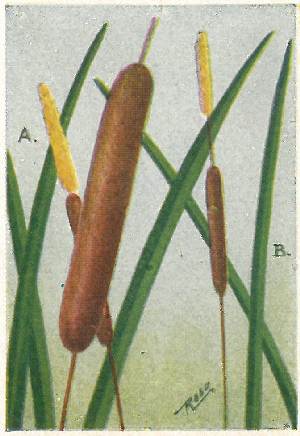
CAT-TAIL FAMILY (Typhaceæ)
The members of this family are very abundant aquatic herbs with perennial roots. We have two species with differences as noted below. Both have staminate yellow flowers in a spike above pistillate brown ones; the former soon fall or blow away, while the latter develop into the large, familiar, brown cat-tail that is often used for decorative purposes.
(A) Common Cat-tail (Typha latifolia) has yellowish staminate flowers encircling the upper end of the flower stalk, and immediately below a long cylindrical mass of brownish pistillate ones. The pollen grains are arranged in fours. Leaves three to eight feet long, sheathing at the base. Found in marshes throughout the United States and southern Canada, flowering in June and July.
(B) Narrow-leaved Cat-tail (Typha angustifolia) has narrower leaves, averaging less than ¾ in. broad. The two kinds of flowers are separated by a bare space of stalk and the pollen grains are simple.
[18]
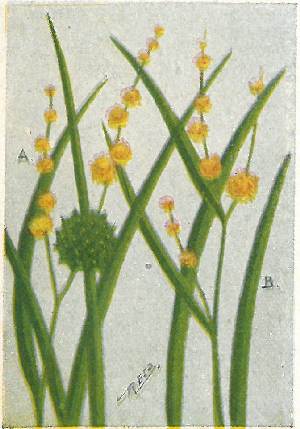
BUR REED FAMILY (Sparganiaceæ)
The Bur Reeds are marsh-inhabitating plants, some growing along the muddy shores of ponds or streams, while other species are strictly aquatic, growing in the water with floating leaves. Like the Cat-tails they are not in the least dependent upon insects for fertilization. The two kinds of flowers, staminate and pistillate, are always in separate spherical clusters usually alternately arranged along the stem.
(A) Great Bur Reed (Sparganium eurycarpum) is stout and erect, two to three feet in height. The mature heads, or fruit, about one inch across; composed of wedge-shaped nutlets arranged in the form of a sphere. The basal leaves are similar to those of the Cat-tail and clasp the stems. These plants are found in the whole of the U.S. and southern Canada, flowering from June to August.
(B) Branching Bur Reed (S. androcladum) throws off several weak flower-bearing branches from the angles of the upper leaves.
[19]
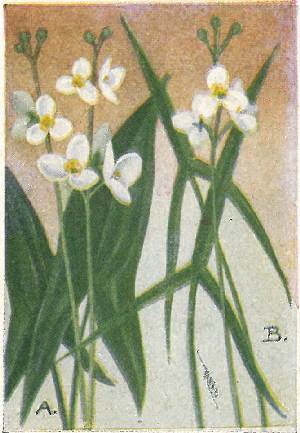
WATER PLANTAIN FAMILY (Alismaceæ)
Genus Arrow-head (Sagittaria). Arrow-heads or Sagittarias are among our most beautiful water plants. The leaves vary greatly in shape but are always graceful in appearance. All species have three pure white petals with a golden centre formed by the large anthers. They usually grow in the water but sometimes on the muddy shores, and flower in June.
(A) Broad-leaved Arrow-head (Sagittaria latifolia) has broad, arrow-shaped leaves on long petioles from the root. The 3-petalled white flowers grow in whorls of three, the upper ones being staminate and the lower pistillate. Seed, winged on both edges and with a twisted horizontal beak. This species is smooth, but a variety (pubescens) has the stem quite wooly. Common in the whole of our range.
(B) Narrow-leaved Arrow-head (S. Engelmanniana) has very narrow leaves with linear sagittate bases. The seeds are winged but the beak points upward instead of being bent at an angle as in the last.
[20]
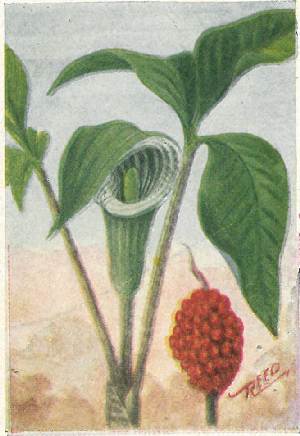
ARUM FAMILY (Araceæ)
This is quite a large family of plants containing six genera. All have acrid or pungent juices; flowers closely crowded on a spadix, usually surrounded by a spathe; leaves either simple or compound and of various shapes.
Genus (Arisæma)
Jack-in-the-Pulpit or Indian Turnip (Arisæma triphyllum) is the most abundant and the best-known representative of this genus. In moist woods you will find Jack, represented by the spadix, looking out at you from his pulpit, represented by the spathe of the flower. The spathe is light green, more or less striped with brown, especially on the inside; the spadix is also green and has the tiny flowers clustered about its base. The large solid roots are very acrid and fiery to the taste, but are said to have been relished by the Indians. Usually two, thrice-compounded leaves spread shelteringly on long stems over the flower spathe. Large clusters of bright berries remain after the leaves have withered. Flowers throughout U. S. from April to July.
[21]
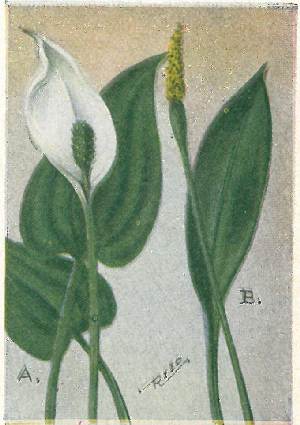
(A) Water Arum (Calla palustris) is our only representative of its genus. It is quite a common plant in cool bogs, where it grows from six inches to a foot in height. The beautiful dark green heart-shaped leaves stand above the water on long petioles. A beautiful, waxy-white, spreading spathe is often mistaken for the flower. The true flowers are small and perfect, clustered at the end of a yellow spadix. The flowering season is in June. You may find this plant commonly in cool bogs from N. J. and Mo. northward.
(B) Golden Club (Orontium aquaticum) is also our only member of its genus. As you will see by the opposite picture, there is no protective spathe for the golden floral club.
The florets are complete, having six sepals and stamens; they are set closely on the swollen spadix and attract many flies and even water snails that cross-fertilize them simply by crawling over the clubs.
The leaves of the Golden Club are pointed oblong in shape, floating on the surface of the water by means of long stems from the perennial rootstalk. Flowers in May from Mass. to Fla. and westward.
[22]
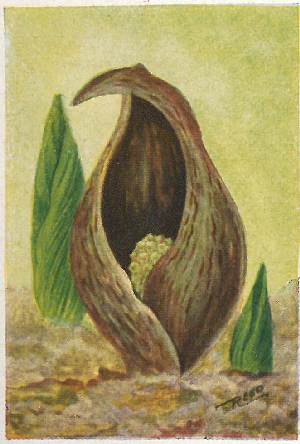
Genus (Symplocarpus)
The common Skunk Cabbage (Symplocarpus fœtidus) although regarded by many only with disgust, has one claim that cannot be disputed, that of being our first flower to bloom each year. It is not uncommon to find them with the shell-like spathe above ground and the pollen fully ripened even in January, although from the latter part of February to the first of May is the usual flowering season.
The flower spathes show a great diversity of coloring according to their age, ranging from a pale green sparingly streaked with brown to an almost solid purple tone.
The flowers are small, perfect, and closely crowded on the thick fleshy spadix, concealed or partially so by the large, thick purple and green stained hood. The leaves appear after the flower has withered or commenced to do so; they are bright green, large, cabbage-like and strongly veined; quite handsome, in fact. These plants range from N. S. to Minn., and southward, chiefly in boggy ground.
[23]
SPIDERWORT FAMILY (Commelinaceæ)
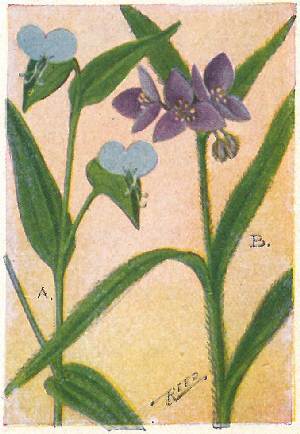
(A) Day-flower (Commelina communis) is one of a very few of our native plants having pure blue flowers. Each blossom lasts but a single day.
The stem is rather weak, much jointed, and attains heights of one to two feet. Two petals are large, rounded and blue, while the third is tiny and colorless; the whole flower peeps out from a clasping, cordate, heart-shaped leaf or spathe. Found from southern Mass. to Mich. and southward, blooming in rich woods or dooryards from June to Sept.
(B) Spiderwort; Job’s Tears (Tradescantia virginiana), like the Day Flower, remains open for but part of a day, after which the petals contract into glutinous drops.
The stem is hairy and sticky; from one to two feet high. Three purple petals, three brown, hairy sepals and six orange-tipped stamens compose the flowers. They may be found in rich soil from Me. to Mich. and southward, flowering from June to August.
[24]
PICKEREL-WEED FAMILY (Pontederiaceæ)
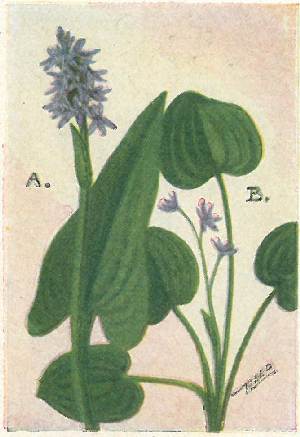
(A) Pickerel-weed (Pontederia cordata) is an exceedingly abundant water plant, growing profusely in shallow ponds or along the edges of fresh-water streams, and flowering from June to August.
The flowers grow on a spike that proceeds from a small, green, leaf-like spathe; the 3 upper divisions of the 6-parted perianth are partially united, but the 3 lower ones are spreading; they are a light violet-blue with two yellow spots at the base of the upper united parts. A single heart-shaped, cordate leaf clasps the stem about midway, while others on long petioles grow from the rootstalk. Commonly found from N. S. to Manitoba and southward.
(B) Mud Plantain (Heteranthera reniformis) has a slender, few-flowered spike proceeding from a small sheath-like spathe. The perianth is blue and regularly 6-parted. The leaves are round-lobed, kidney-shaped, floating on long stalks from the root. Found from Ct. to Neb. and southward.
[25]
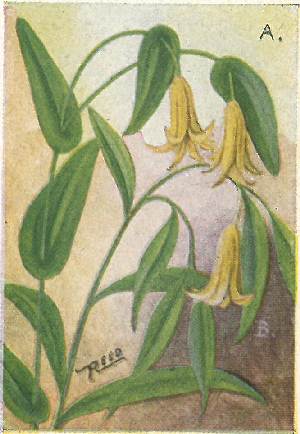
LILY FAMILY (Liliaceæ)
This is an exceedingly large family containing more than 80 species in our range, divided into 33 genera.
(A) Bellwort (Uvularia perfoliata) is common in rich woods. The stem, reaching a length of 6 to 18 in., rises from a short rootstalk. A single, straw-colored flower is pendent from the end of each drooping branch; it is long, bell-shaped, and has six narrow divisions. The leaves are light green, lance-shaped, and pierced by the stem. The slightly fragrant flowers are so concealed by their drooping position as to be invisible from above. They blossom in May and June throughout the U. S.
(B) Oakesia; Wild Oats (Oakesia sessifolia) has an angular stem from 6 to 14 in. long. The ovate-lanceolate leaves are seated on the stem and not pierced by it. The one or two flowers are similar in size and coloring to those of Bellwort but the interior is smooth while the latter has rough ridges. This species is common from Me. to Minn. and southward.
[26]
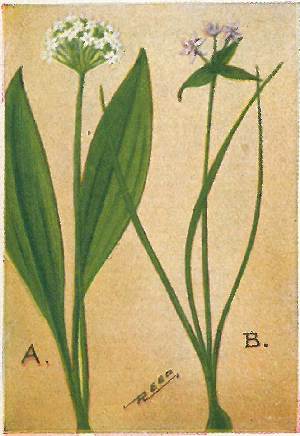
ONION; GARLIC Genus (Allium)
The various species belonging to this genus are very strongly scented, pungent herbs growing from a coated bulb.
(A) Wild Leek; Wild Onion (Allium tricoccum) is a woodland plant blooming in May and June. The flowers are in an umbel at the top of a scape 6 to 20 in. high. The flower perianth is divided into six greenish-white sepals. The leaves are oblong-lance-shaped, pointed at both ends, on long petioles from the bulbous root, but usually withering before the flowers appear. Found from N. B. to Minn. and southward.
(B) Wild Garlic (Allium canadense) has few purplish 6-parted flowers on slender pedicels from a cluster of bulblets at the top of a scape 10 to 24 in. high. The leaves are grass-like, sheathing the stem above the fibrous bulb. Flowers in May and June in moist meadows, from N. B. to Mich. and southward.
[27]
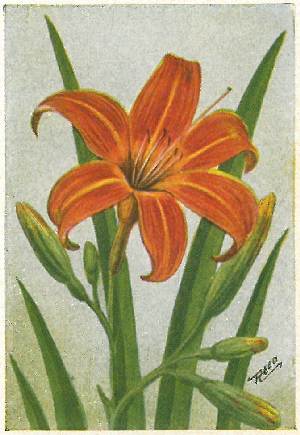
Day Lily (Hemerocallis fulva) (European) will, we think, prove a welcome addition to our flora. It is now locally abundant in R. I., Conn., and N. Y. It flourishes best near salt water and spreads rapidly by means of its running roots as well as by seed. The flower stalk is tall, 2 to 5 feet, and at its summit bears eight or nine buds which open one or two a day into large showy flowers.
The perianth is funnel-form, with six spreading orange limbs and six long stamens with large brown anthers. The blossoms appear in July and August, each remaining open for but a single day; this habit makes them very popular for vase flowers as the number of buds on each stalk insures fresh flowers every day for a week or more. The leaves are long and linear, similar to those of the Cat-tail, appearing from a fleshy perennial rootstalk at the base of the tall flower scape.
In the absence of any odor, the beautiful flower cup serves to attract the bees that are necessary for the setting of its seed.
[28]
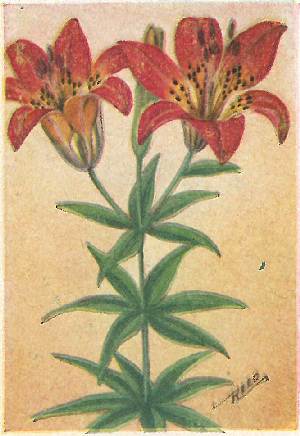
LILIES Genus (Lilium)
All the members of this genus are among our most beautiful flowers. In our range it includes eight species, of which seven are natives. The two species of Red Lily can readily be recognized because their perianth, or flower funnel, always opens upward.
Wood Lily; Wild Orange-red Lily (Lilium philadelphicum) has a leafy stem 1 to 3 feet high, at its summit bearing one to four erect (not pendulous) flowers; the divisions of the perianth are deep orange-red, lightening in color at the stem-like bases and profusely spotted with dark brown; the outside of the perianth is dull whitish green. The leaves are lanceolate, sharply pointed at each end and whorled about the stem in groups of from three to seven. Its name is rather misleading for, while it is sometimes found in woods, it will be found blooming most profusely in sandy or brush-covered land. Blooms in July and August in sandy soil from N. E. to Mich. and southward.
[29]
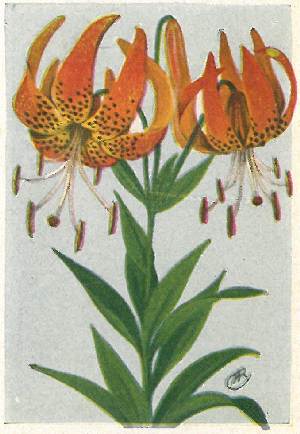
Turk’s-cap Lily (Lilium superbum) is a most beautiful plant, prolific in bloom almost beyond belief, sometimes containing from thirty to forty brilliant orange flowers. The bright sepals are always reflexed, sometimes so much so that they remind one of a coiled spring. One has but to touch the large pendent anthers to get a practical demonstration of how the pollen is attached to the body of a bee and carried to another flower, there to be deposited on the sticky stigma of the mature style. Naturally a species so prolific of flower and so capable of being cross-fertilized by foreign agency is in little danger of having its numbers lessened.
The flowers, nodding at the top of a stem ranging from 2 to 7 feet in height, have a six-parted perianth, orange-red, thickly spotted with purplish brown. The lanceolate leaves are crowded along the upper stem and whorled about its lower portion. Blooms abundantly in rich soil, during July and August, from N. B. to Minn. and southward.
[30]
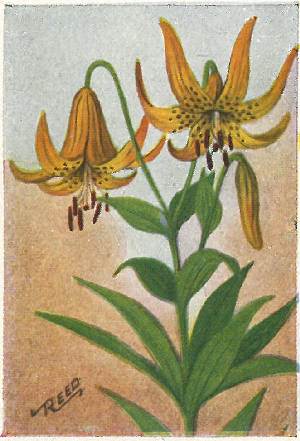
Field, Wild, Meadow, Yellow or Canada Lily (Lilium canadense) is one of the most abundant of the genus. Imagine a rich meadow, surrounded by deep green woods and covered with thousands of these lilies, their heads hanging and nodding invitingly and seeming fairly to tinkle in the bright sunlight. On the whole, this flower may be regarded as more graceful in form than is the Turk’s-cap, but it cannot compare with the latter flower for beauty of coloring. The regular whorled leaves and graceful bending peduncles supporting the hanging “bells” make a conventional design that often appeals to the artistic eye.
The flowers are in terminal clusters of one to twelve blossoms, nodding on long peduncles from the summit of tall leafy stems. The leaves are lanceolate, arranged about the stem at intervals in whorls of three to eight. Flowers during June and July in moist meadows from Quebec to Minn. and southward to Ga. and Mo.
[31]
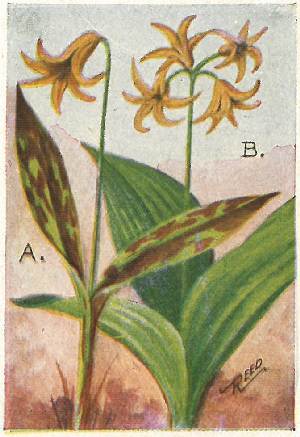
(A) Dog-tooth Violet; Yellow Adder’s Tongue (Erythronium americanum). These flowers are familiar and welcome ones to all who wander beside woodland brooks in the spring. The name “Violet” is of course a misnomer. It is often locally known as the “Trout Lily” or the “Fawn Lily,” both of which names are far more appropriate than those given it generally.
The single 6-parted flower grows at the top of a scape from 5 to 10 in. high. Two elliptical-lanceolate leaves clasp the scape at its base, near the scaly bulb; they are pale green, mottled with purple and white. This species blooms in April and May in moist woods or swamps, from N. B. to Minn. and southward.
(B) Clintonia (Clintonia borealis) is a beautiful species, its leaves resembling those of the Lily-of-the-Valley. The three to six pendulous, bell-shaped flowers are cream-colored within and greenish outside. Three large, oblong, pointed leaves clasp the flower scape at its base. The plant is about 6 to 16 in. high; it flowers during June in damp woods from Labrador to Man. and southward.
[32]
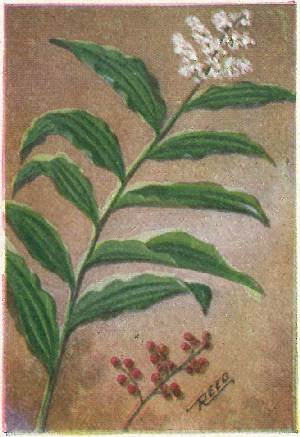
Wild Spikenard (Smilacina racemosa) is quite an imposing plant, with its long, curving, zigzag stem, its many light-green, deeply ribbed leaves and its feathery terminal flower clusters.
The white flowers are tiny but perfect, with a 6-parted perianth, six slender stamens, and a short, thick style. The stem is rather angular and attains a length of from 1 to 3 feet; alternating along it are the large, oval, sharply pointed leaves, with parallel ribs and wavy edge. The perennial rootstalk is thick and fleshy. Spikenard is quite abundant in moist rich, uncleared ground, flowering in May and June, from Me. to Minn. southward.
False Solomon’s Seal (Smilacina stellata) bears some resemblance to the last species, but the flowers are much larger and few in number, usually only six or eight terminating the zigzag stem. The leaves are broader at the bases and slightly clasp the stem, whereas those of the last species have very short stems. It grows commonly, but not as much so as the last, on moist banks and in meadows, from Me. to Minn. and southward.
[33]
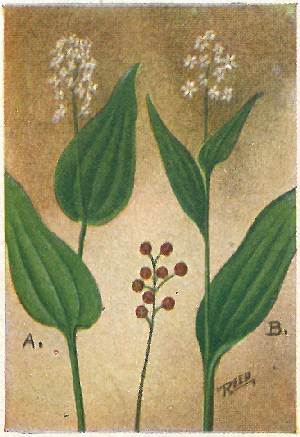
(A) Canada Mayflower; False Lily-of-the-Valley (Maianthemum canadense) is a very abundant woodland plant, growing in colonies, thousands of them sometimes carpeting pine woods with their dark-green glossy leaves. The two, or three broad, ovate-lanceolate, shiny green leaves are rather heart-shaped at the base, seated on the stem or very nearly so. The flower perianth has four divisions. After the flowering season both of these plants have berries; at first a creamy white, spotted with brown, and later turning to a dull ruby-red.
(B) Three-leaved False Solomon’s Seal (Smilacina trifolia), the smallest member of the genus Smilacina is found rather commonly in bogs and wet woods. The stem, straight and slender, from 2 to 6 in. high, usually has three leaves, shining green, oblong-pointed, and sheathing at the base, arranged at regular intervals along it. The flowers are white, few in number, on short peduncles in an open raceme and have six petals. It is found from Labrador to Manitoba and southward to N. J. and Mo., flowering during May and June.
[34]
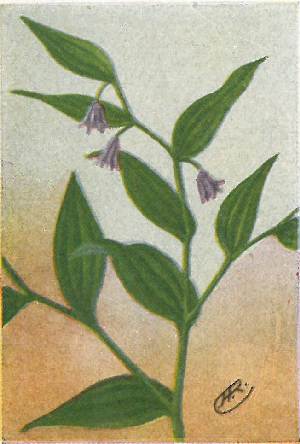
Purple Twisted-stalk (Streptopus roseus) has, as would be judged from its name, a very angular or twisted stem. At each angle or joint appears an ovate-lanceolate, cordately ribbed, shining green leaf, seated on the stem. From the axils of the terminal leaves appear small flowers on slender, thread-like peduncles; these flowers are sometimes single or, again, in pairs; they have a bell-shaped base and the perianth is divided into six lanceolate, spreading dull purple sepals. The stem, which is rather sparingly bristly hairy, reaches heights of 1 to 2½ feet. This rosy species blooms in May and June in cold moist woods from Newfoundland to Manitoba and southward to the Gulf of Mexico.
Common Twisted-stalk (Streptopus amplexifolius) is similar but has greenish-white flowers, the six sepals of which are very strongly reflexed. The plant is somewhat larger, the smooth stem being from 2 to 3 feet in length. It is found throughout northern United States and the southern half of Canada.
[35]
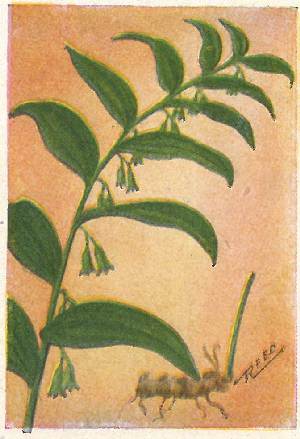
Solomon’s Seal (Polygonatum biflorum) has small greenish, bell-shaped flowers about one half inch in length, hanging in pairs on slender peduncles from the axils of the leaves. The stem is 1 to 2 feet in height. The oblong-lanceolate leaves alternate along, and are partly seated on, the stem; deep green above and glaucous or whitish below. Very common in woods from N. B. to Ont. and southward, flowering from April to June.
These plants receive their name from the thick, fleshy, and knotted rootstalks. They are perennials, each year throwing up new stalks; after flowering these wither away and leave pronounced scars on the roots. These scars suggested the name of Solomon’s Seal and the number of them probably accurately denotes the ages of the plants. Both the large and the small species grow in the same localities. They can readily be distinguished by comparison, for commutatum is always larger in all its parts; while it may be but a foot and a half tall it will be stouter and have comparatively larger flowers than its relative. Often it assumes truly gigantic size and may tower above a tall man’s head.
[36]
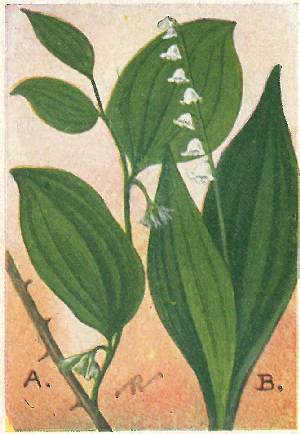
(A) Common Green Brier (Smilax rotundifolia) is a woody climbing vine with scattered sharp prickles; it climbs by means of pairs of tendrils from the axils of the leaves. Leaves alternating along the stem; round-ovate, sharply pointed at the tip and somewhat heart-shaped at the base. Flowers, few on slender peduncles from the angles of the leaves; perianth bell-shaped, with six short, spreading lobes, pale greenish in color. Common in moist thickets from N. S. to Minn. and southward, flowering in May and June.
(B) Lily-of-the-Valley (Convallaria majalis). As a garden flower, this species is probably familiar to nearly everyone. While, as a native, it is only found in some of the southeastern mountain ranges, it is sometimes found in the North as an escape from cultivation. It is a delicately beautiful species, very rich in fragrance and very hardy. The bell-shaped, white flowers grow in a one-sided raceme at the top of a scape, the base of which is sheathed by the two large, broad, oblong-pointed, parallel-veined leaves. It flowers in May and June in the mountains from Va. to S. C.
[37]
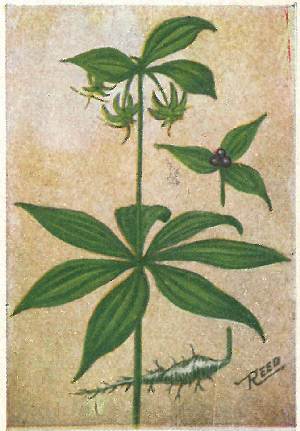
Indian Cucumber-root (Medeola virginiana) is a common woodland plant, but the flowers are so inconspicuous that they are often overlooked; in fact they are often nodding below the upper leaves so as to be invisible. The stem is tall and slender, ranging from 1 to 3 feet in height; it rises from a thick horizontal rootstalk, having a taste similar to that of the cucumber. A whorl of from five to nine ovate-lanceolate, pointed leaves is located midway on the stem; at the top, three smaller but similarly shaped leaves radiate. Above these, or it may be below, because of the curving pedicels, are three flowers. They are pale greenish-yellow; the three sepals and three petals composing the perianth are very much reflexed or curled; they have six stamens each, and one style dividing into three purplish-brown, recurved stigmas.
It is said that the Indians formerly used the roots for food; at the present time they are used for various medicinal preparations. Cucumber-root is found from N. B. to Manitoba and southward to the Gulf, flowering in rich woods during May and June.
[38]
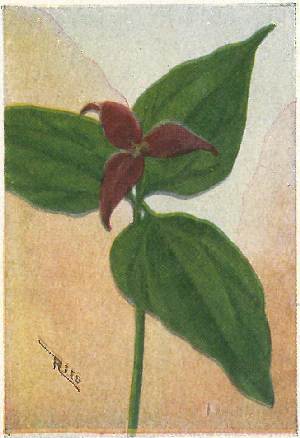
Genus (Trillium)
Trilliums derive their generic name from the fact that all their parts are arranged in threes; three leaves, three petals, three sepals, and a three-parted stigma. The common name of Wake Robin was probably early given because these flowers appear at an early date. As a matter of fact they do not bloom until weeks after the robins have returned to the Northern States. All the purple trilliums have an unpleasant odor resembling that of putrid meat; as they are largely dependent for fertilization upon certain carrion flies, it is very probable that their peculiar color is for the purpose of an added lure for these insects.
Purple Trillium; Birthroot; Ill-scented Wake Robin (Trillium erectum) has three purplish-brown petals and three sepals; six stamens exceeding in length the stout spreading stigma. Flower solitary, rising on a short pedicel above the whorl of broad, ovate, pointed, and short petioled leaves. This trillium ranges in height from 6 to 15 inches. It flowers in April and May, in rich woods from Quebec to Ont. and southward.
[39]
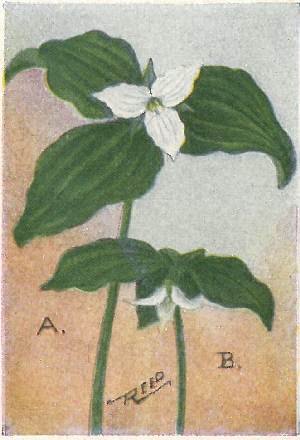
(A) Large-flowered Trillium (Trillium grandiflorum) is the largest of the genus in all respects and is one of the best known and most common species. It can be looked for in any damp, rich woods during May or June. Usually they grow in colonies and it is an exception when one finds a single plant without others being in sight. The stem of this species is from 10 to 18 inches in height; the waxy-white petals are from 1½ to 2 in. in length; as they grow older the color changes to a delicate pink and they curve gracefully backward.
The flower is on a short pedicel above the whorl of broad, ovate-pointed, and short petioled leaves. Found from Vt. to Minn. and southward to N. C. and Mo.
(B) Nodding Trillium (T. Cernuum) is quite similar to, but smaller than, the last species. Its blossom is either white or pink and is on a curved pedicel that often bends so as to place the flower beneath the whorl of leaves; the edges of the petals are quite wavy. This demure, bashful little trillium is found from Newfoundland and Man. south to Pa. and Mich.
[40]
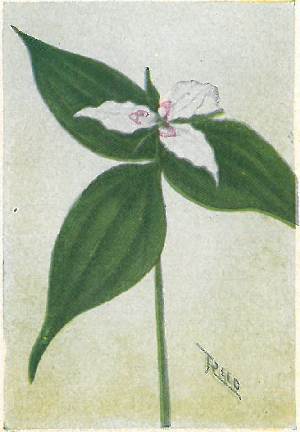
Painted Trillium (Trillium undulatum) has sharply pointed, wavy-edged, waxy-white petals with crimson V-shaped marks at the bases. The ovate leaves are sharply pointed and petioled. It is a common species from Quebec to Ontario and southward.
The Painted Trillium is usually regarded as the most beautiful of the genus. Certainly it is the most abundant. It is more gregarious than others, and we often find large beds of them with their dainty, waxy-white, wavy-edged flowers swaying above the deep green background formed by their broad, whorled leaves. They grow most profusely along the banks of woodland brooks and in cool, moist glens. You will find them most abundant during the latter part of May soon after the wood thrush, that frequents the same locality, makes his appearance from the South. They are always associated in my mind with these birds and with water thrushes that I have often watched as they daintily threaded their way among the numerous plant stalks, entirely concealed above by the numerous leaves, and visible only by placing the head close to the ground.
[41]
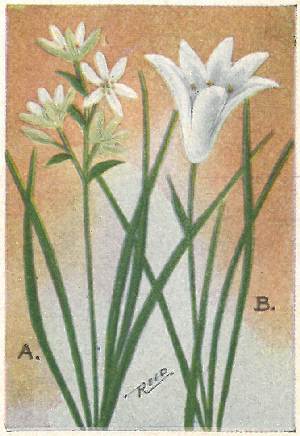
(A) Star-of-Bethlehem (Ornithogalum umbellatum) (European).
The scape, rising from a coated bulb, is from 6 to 12 in. high; at the top is a loose, terminal cluster of from four to eight blossoms. The perianth is divided into six waxy-white sepals, rather greenish on the outside, and with three to seven green nerves; six stamens and a three-sided stigma. The leaves are long, linear, and channeled. Found as an escape, from Me. to Va.
AMARYLLIS FAMILY (Amaryllidaceæ)
A family of bulbous and scape-bearing herbs with flat, grass-like leaves and regular six-parted flowers.
(B) Atamasco Lily (Zephyranthes atamasco) is an exceedingly beautiful species with pure, waxy-white flowers, only one to a plant, erect at the summit of a scape from 6 to 12 in. high. Perianth funnel-form, with six spreading lobes, a short pistil, and six stamens with large yellow anthers. Leaves long, linear, and channeled. Quite common in moist places or swamps, from Del. to Fla., flowering from April to July.
[42]
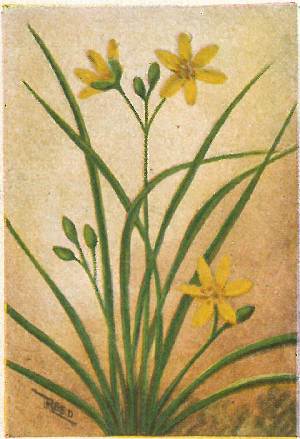
Yellow Star Grass (Hypoxis hirsuta) is the most widely distributed of any of the members of the Amaryllis family. It is very appropriately named. From April until July and more sparingly until September we may see these bright shining golden stars peering at us from a background of green grass. So closely do the leaves of this little plant correspond to the grass leaves, among which they grow, that sharp scrutiny is required to distinguish them. The blossoms are visited by several of the smaller bees for pollen; some of this is often unwittingly carried to the sticky stigma of the next flower visited and cross-fertilization effected.
The flowers are in a loose umbel at the top of a scape from 3 to 8 in. in height; perianth widespread and divided into six shining, golden-yellow sepals, paler and slightly greenish on the outside; the six stamens tipped with large, golden-orange anthers. The slender, narrow, grass-like leaves come from a small bulb together with the flower scape. This species is common from Me. to Manitoba and southward to the Gulf of Mexico.
[43]
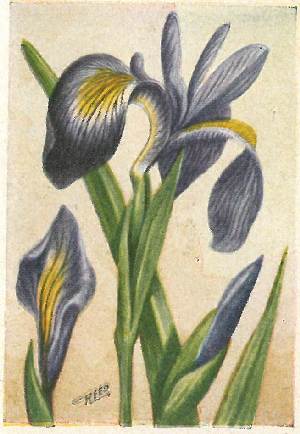
IRIS FAMILY (Iridaceæ)
This family is composed of perennial herbs growing in moist places and having long linear or sword-shaped leaves and large showy flowers. Iris is named from the Greek meaning, rainbow, and it certainly is no misnomer as applied to the Blue Flag or Iris which is the most common of the genus. The perpetuation of this species in healthy condition is insured by the formation of the flower, which is such that self-pollenization is practically impossible. The stamens are directly under the strap-like divisions of the style and the stigma is on the upper surface at the rolled-up tip. Bees are the most frequent visitors.
Larger Blue Flag; Blue Iris; Fleur-de-Lis (Iris versicolor). Flower solitary, from a green spathe at the end of a long peduncle; sepals, neither bearded nor crested, but broad, violet, and handsomely veined; petals erect, flat, and spatulate. Leaves sword-shaped, glaucous-green, folded into flat clusters at the base. Very common from Newfoundland to Manitoba and southward, flowering from May to July.
[44]
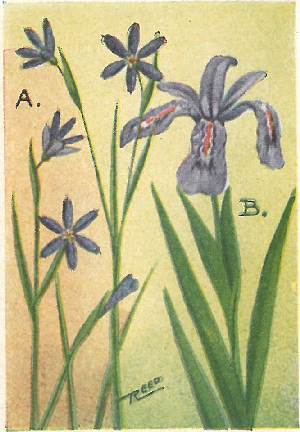
(A) Blue-eyed Grass (Sisyrinchium angustifolium), as one would suspect from the name, has grass-like leaves and flowers that make one think of bright little blue eyes as they peep out of the meadow grass in which you will find them.
The Blue-eyed Grasses have recently been separated into thirteen species, differing chiefly in the comparative lengths of the flower spathes, or the lengths of the leaves as compared to the flower stem. The six divisions of the flower are regular, violet, with a yellow or white star-shaped centre; each sepal is blunt, with a thorn-like tip. Common from N. B. to B. C. and southward.
(B) Crested Dwarf Iris (Iris cristata). Flowers usually solitary, very delicate in form, and of a light violet color; the sepals have a central crested rib of a bright orange color; the smaller petals are also crested. The tube is long and thread-like. Leaves lanceolate, about 5 to 7 in. long; those forming the spathe are ovate-lanceolate. This attractive little Iris is found on rich wooded hillsides and along streams, from Md. and Ind. southward, flowering in April and May.
[45]
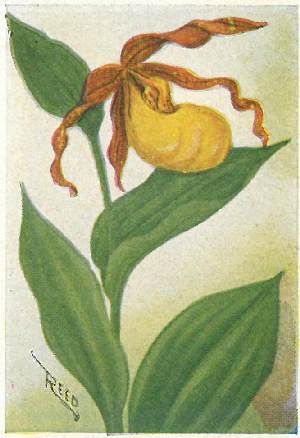
ORCHIS FAMILY (Orchidaceæ)
This is a large family composed of herbaceous perennials with tuberoid roots or corms. The perianth is composed of six divisions, the three outer being sepals (two of which are often united) and the three inner ones petals, the lower one of which, termed the lip, differs in form from the others.
Yellow Lady’s Slipper (Cypripedium parviflorum) has usually one, but sometimes three, flowers at the summit of a leafy stem 7 to 20 in. high. The inflated lip is bright yellow, slipper-shaped, and with a rounded orifice open near the base. The two lateral petals are brownish; exceedingly twisted. The broad, bright-green leaves are very prominently ribbed lengthwise, pointed and alternately sheathing the stem. This is one of the northerly species, being found along the northern border of the United States and southern Canada. It grows in colonies and flowers from May to July, in rich woods or bogs.
[46]
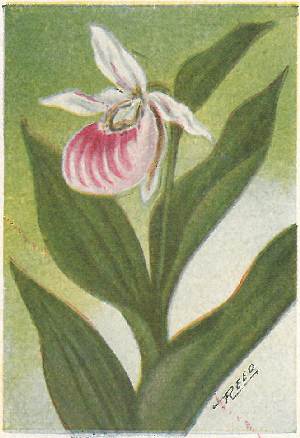
Showy Lady’s Slipper (Cypripedium hirsutum) is a magnificent orchid, usually regarded as the most beautiful of the genus. It is of imposing dimensions and has large, fragrant flowers.
The inflated lip is large and balloon-like, about 2 in. in length; white, with crimson-magenta blotches and streaks on the front edge; the sepals are round-ovate and the petals oblong, both pointed and both greenish-white in color. The leafy stem, that bears at its summit the solitary blossom, is from 1 to 2 feet in height. Found locally from Newfoundland to Minn. and southward to Ga. and Mo., flowering in rich woods during June and July.
Small White Lady’s Slipper (Cypripedium candidum). The flower of this species is of the same size and shape as that of the yellow variety, but the lip is pure white outside and striped with purple inside at the base; the two lateral sepals and the two petals are ovate-lanceolate, greenish, spotted with brown. It is a single-flowered species with numerous leaves. It is found in swamps from N. Y. to Minn. southward.
[47]
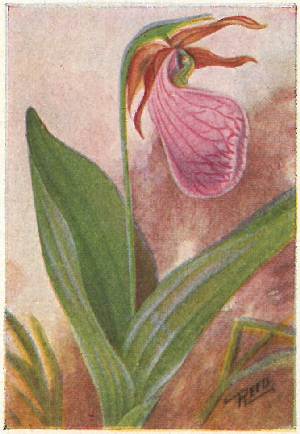
Pink Lady’s Slipper; Moccasin Flower (Cypripedium acaule) has solitary flowers surmounting a scape from 8 to 12 in. high; lip large, drooping pink, with a slit in front, instead of a circular opening as in the others. It frequents dry woods and may be found from southern Canada southward.
Although this is the most common of the Lady’s Slippers, it is no less beautiful than the others. The flower of the present species is a very ingenious contrivance; it is fertilized by the common bumblebee. The only entrance is through the fissure in the front; it requires considerable pressure to force his burly frame through, but at length he succeeds and the aperture closes behind him. After eating his fill he takes the easiest way out, toward the base where he can see two spots of light. As he forces his way through the narrow passage he comes in contact with a sticky stigma, armed with incurving hairs which remove any pollen he may have on his back; as he continues his struggle out he reaches an anther blocking the passage and waiting to clap its load of pollen on his back.
[48]
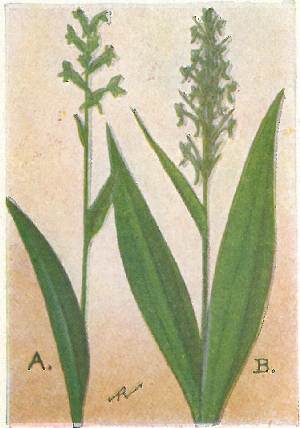
(A) Green Wood Orchis (Habenaria clavellata) has from three to sixteen inconspicuous greenish flowers in a loose spike at the top of a stem from 6 to 18 in. high; lip oblong and with three teeth; spur long, slender, and curved upward and to one side. One or two oblong-lanceolate leaves with obtuse tips clasp the stem near the base while several small bracts alternate along it. Grows in bogs from Newfoundland to Minn. and southward.
(B) Green-fringed Orchis (Habenaria flava) is a common green orchis (formerly virescens). The lower leaves are oblong-lanceolate, while the upper ones are linear, diminishing in size and passing into the flower bracts. The flower lip is square-ended and toothed; spur slender and about the length of the flower. In the whole U. S. and southern Canada we may find this species growing in bogs.
Habenaria bracteata is similar to flava, but the flower bracts are large, being from two to four times the length of the flowers. N. S. to Alaska and south through the U. S.
[49]
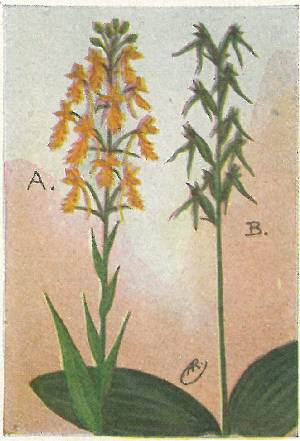
(A) Yellow-fringed Orchis (Habenaria ciliaris) is an attractive and rather common orchis with a tall leafy stem from 12 to 24 in. high. The spike is very closely set with flowers having rounded petals, fringed lips, and slender spurs about an inch in length. The leaves are lanceolate, gradually diminishing in size as they approach the spike and passing into the flower bracts. Found from Me. to Mich. and southward.
(B) Hooker’s Orchis (H. Hookeri) has a leafless scape from 6 to 12 in. high, at the base of which are two broad, oval, shining, deep-green leaves. The ten to twenty flowers are yellowish-green; lip lanceolate and sharply pointed, less than half an inch long; slender spur about one inch long. Flowers during June and July in woods from Me. to Minn. and south to N.C.
Round-leaved Orchis (H. orbiculata) is similar to Hookeri; the lip is oblong, obtuse, and about the same length as the spur. The two basal leaves are almost round. It is common in rich woods from Labrador to Alaska and southward.
[50]
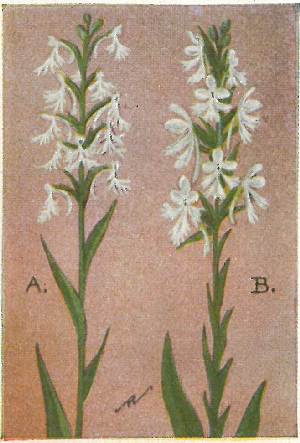
(A) Ragged-fringed Orchis (Habenaria lacera) does not attract our attention because of its beauty, for its flowers are rather inconspicuous in color. They are, however, remarkable for the peculiarly cut and slashed lip, it being divided apparently with no regard for method or symmetry. The greenish-white flowers are in a dense many-flowered raceme at the summit of a leafy stem from 10 to 20 inches high. The leaves are oblong-lanceolate, diminishing in size to the flower bracts as they reach the raceme. This species is not uncommon in swamps from Newfoundland to Minn. and southward.
(B) White-fringed Orchis (H. blephariglottis) has a densely flowered raceme or spike similar to that of the yellow-fringed species, but the flowers are pure white; the lip is not divided but is copiously fringed; lateral sepals rounded, upper ones elliptical and concave; spur nearly an inch long. Leaves lanceolate and gradually diminishing in size as they alternate to the top of the stem. In July and August you may find this species flowering throughout the United States.
[51]
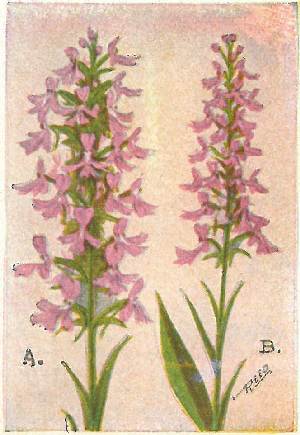
(A) Large Purple-fringed Orchis (Habenaria fimbriata) is the largest and perhaps the most beautiful of the genus. The pale purple flowers are nearly twice as large as those of the last species; the lip is more deeply fringed. The densely flowered spike is about two inches in diameter and often is twelve inches long. The leafy stem attains heights of from 1 to 5 feet. It is a magnificent plant, the sight of which is well worth the inconveniences necessary to visit its haunts. It grows in swamps throughout the U. S. and southern Canada.
(B) Small Purple-fringed Orchis (H. psycodes) has pale purplish flowers in a dense cylindrical spike terminating in a leafy stem, about 1 or 1½ feet tall. The spreading flower-tip is 3-parted and fringed; sepals rounded, petals spatulate and slightly toothed. The leaves are lanceolate and, like those of the fringed orchids, grow smaller as they approach the top of the stem. Flowers in July and August in wet meadows or swamps, from Newfoundland to Manitoba and southward.
[52]
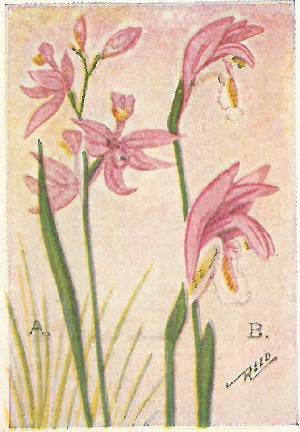
(A) Calopogon; Grass Pink (Calopogon pulchellus) is an exquisite orchid with a loose raceme of four to twelve delicate pink flowers at the top of a scrape ranging from 6 to 15 in. long. The flowers are apparently upside down as the lip is at the top; it is narrow at the base but broadens into a broad hooked tip, crested on the underside. A single grass-like leaf sheathes the flower scape near its base, as it rises from the solid bulb. It grows in deep swamps and bogs, from Newfoundland to Minn. and south to the Gulf, flowering in June and July.
(B) Arethusa; Indian Pink (Arethusa bulbosa) has a solitary magenta-pink blossom topping its slender scape that rises from 5 to 10 in. in height. The petals and sepals are similar in shape and in their proper positions at the top of the flower; the lip rises, then abruptly turns downward, broadens and is adorned with three to five yellow and white crests; margin of lip wavy and sometimes spotted with crimson. From Newfoundland to Minn. and south to Pa. and Mo., Arethusa has been found blooming in swamps during May and June.
[53]
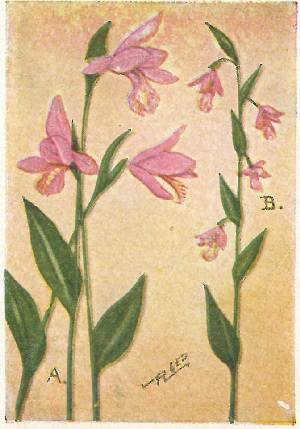
(A) Pogonia; Snake-mouth (Pogonia ophioglossoides). Snake-mouth is delicate, pure pink in color, and slightly fragrant. Its pollen is not in stemmed masses but is showered on the back of a visiting insect as he backs out of the flower. The stem is from 8 to 13 inches high, bearing at its top a single flower; sepals and petals are similar in shape; the lip is spatulate, prominently crested with yellow and white, and toothed and lacerated. About midway of the flower stem is a single oval leaf and just below the flower is a smaller bract-like one. Pogonia grows in swamps from Newfoundland to Minn. and southward to the Gulf of Mexico, flowering during June and July.
(B) Nodding Pogonia (P. trianthophora) has a leafy stem from 2 to 8 inches high. From two to eight small oval leaves alternately clasp the stem; the flowers, which number from one to six, appear singly from the axils of the upper leaves, nodding on slender peduncles; they are small, magenta-pink, and with ovate, three-lobed lips. It is locally distributed from Me. to Wisc. and southward.
[54]
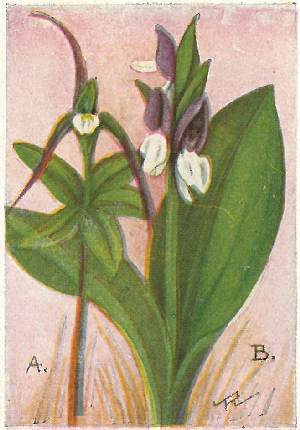
(A) Whorled Pogonia (Pogonia verticillata) has a single flower on a long stem, 8 to 12 in. high; the sepals are greenish-yellow, long, linear, with the edges rolled or folded together; the petals are oblong-lanceolate and purple; the lip is also purple, wedge-shaped, three-lobed and with a hairy crest, down the middle. Five lanceolate and stemless leaves are in a whorl about the stem just below the flower. It is a peculiar, inconspicuous plant found locally in moist woods from Me. to Wisc. and southward.
(B) Showy Orchis (Orchis spectabilis) is a charming early-blooming orchid found in flower from April to June in moist woods, often under hemlock trees. Two broad, ovate, deeply ribbed, beautiful leaves sheath the flower scape at its base. The four to twelve flowers are loosely racemed at the top of the scape which is from 5 to 10 in. high. The magenta-pink petals and sepals are united to form a hood; the lip, curving abruptly downward, is broadly ovate and white; each flower has a short spur and is bracted. This species is found throughout the U.S.
[55]
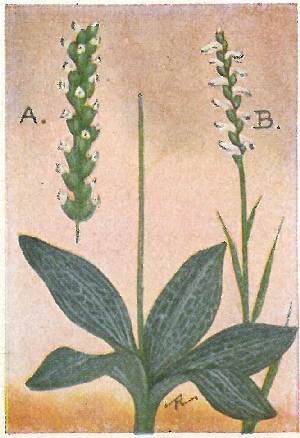
(A) Rattlesnake Plantain (Epipactis pubescens) is a common orchid having beautiful leaves, radiating from the fleshy, creeping rootstalk. The scape is 6 to 15 in. high and carries at its top densely flowered sepals and petals united to form a hood. It is found in the whole of the U. S., flowering in July and August.
(B) Ladies Tresses (Spiranthes cernua) is so named because of the braided arrangement of its flowers. The leaves are few, grass-like, sheathing the scape near its base. The scape is 6 to 15 in. high, has several small bracts, and ends in a 2- or 3-ranked spiral raceme of white or creamy flowers; petals and upper sepal joined, lateral sepals lanceolate; lip ovate-oblong with a rough tip. Common in moist fields or woods from Me. to Minn. and southward.
Slender Ladies Tresses (S. gracilis) is slender, has its flowers in a single-ranked 1-sided or slightly twisted raceme; lip green, with a white wrinkled margin. Leaves small, ovate basal. Found in dry ground from N. S. to Manitoba and southward.
[56]
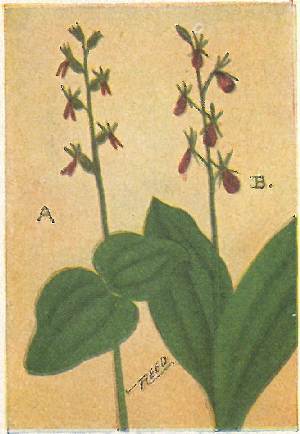
(A) Heart-leaved Twayblade (Listera cordata) belongs to a genus containing five species.
Like most of the orchids, they are largely or wholly dependent upon insect aid for fertilization. The weight or shock of an alighting insect on the broad lip causes a small gland within the flower to rupture and cover the pollen, just below, with a sticky fluid that causes it to adhere to the head or body of the insect and thus be transferred to the next flower.
The stem of this species is from 3 to 10 in. high. At the top is a few-flowered raceme; the sepals and petals are similar and spreading; the lip is drooping, longer, two-cleft and madder-purple in color. This species flowers during June and July in swampy woods from N. J. to Colo. and northward to the Arctic coast.
(B) Twayblade (Liparis lilifolia) although having the same common name, is of a different genus. It is a more attractive plant, having two broad basal leaves and larger flowers with a broad ovate lip. It grows in woodland from Me. to Minn. and southward.
[57]
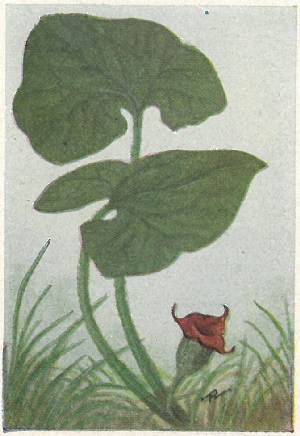
BIRTHWORT FAMILY (Aristolochiaceæ)
A small family of low herbs or twining vines, with but two genera and few species.
Wild Ginger (Asarum canadense) may be found flowering in rich woods during April and May, from Me. to Mich. and southward. It has two large, heart-shaped leaves on long petioles from the base; deep green above and lighter below, soft, wooly, and handsomely veined.
The leaves are very beautiful, but it is the solitary flower that makes this plant so interesting. Small, dully colored, on a weak, short stem that barely raises it above ground and often leaves it concealed by the dead leaves that carpet the woods in early spring.
The flower is bell-shaped, with three short, sharply-pointed spreading lobes; six stamens with short anthers and a thick style with six radiating stigmas. Another species (grandiflorum), found in Va. and N. C., has but one leaf and flowers twice as large, or two inches in length.
[58]
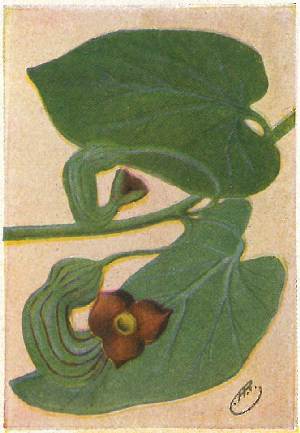
Pipe Vine; Dutchman’s Pipe (Aristolochia macrophylla). The Dutchman’s Pipe is chiefly a southern plant or vine, being found from Pa. and Minn. southward. It has a woody, climbing stem that may attain lengths of from 10 to 40 feet. The very large, deep-green, veiny leaves that alternate along the stem are very beautiful. In the dull, greenish-yellow flowers, however, lies the chief interest of the botanist. Its stigma matures and withers away before the ripening of the pollen, thus making the plant dependent upon insects for its perpetuation.
The throat is filled with tiny hairs, all pointing inward, so ingress is easy but egress impossible. Entering insects are held prisoners, living upon the nectar, until the stigma withers and pollen ripens; after this the hairs in the throat lose their rigidity and the pollen-dusted and well-fed prisoners are allowed to escape. Their memories are poor or the pollen feast is well worth the imprisonment, for they usually immediately hie to another blossom and force their way in, of course pollenizing the flower in so doing.
[59]
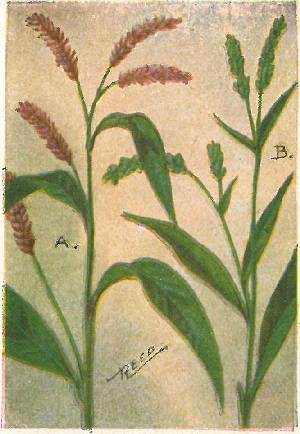
BUCKWHEAT FAMILY (Polygonaceæ)
This family is divided into seven genera and many of these are further divided. They are all inconspicuous in flower. The genus Rumex, to which our common Sorrels belong, contain seventeen species: that of Polygonum, which contains the Knot-weeds, has 32 species included in its six sub-genera.
(A) Lady’s Thumb; Persicaria; Knotgrass (Polygonum persicaria) (European). This is a very common weed everywhere in damp places, especially about farmhouses. The small, crimson-pink flowers are in dense spikes terminating the branching stems that are from 1 to 3 feet high. The lanceolate pointed leaves, that alternate along the angled and sheathed stem, are rather rough and usually have a dark triangular spot in the middle.
(B) Common Smartweed; Water Pepper (P. hydropiper) has similar shaped flowers of a greenish color. The leaves are lanceolate and very acrid. It is very abundant in wet places throughout our range.
[60]
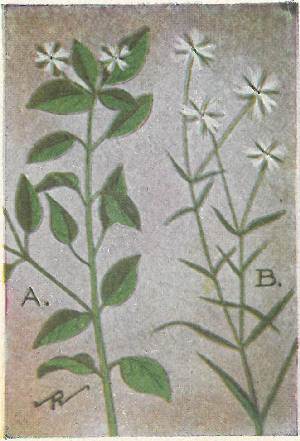
PINK FAMILY (Caryophyllaceæ)
(A) Common Chickweed (Stellaria media) (European). Although this is an introduced weed, so hardy and prolific is it that probably it now exceeds in numbers any of our indigenous plants. It grows profusely about dooryards and along roadsides everywhere. The corolla consists of five white, very deeply cleft petals, and the calyx of the same number of larger and longer green sepals. The leaves are ovate, small, opposite, on small stems about the length of the leaves. The plant stem is either simple or branched and ranges from 2 to 10 in. in height.
(B) Long-leaved Stitchwort (S. longifolia) has larger flowers than the last, but the petals are very narrow and so deeply cleft as to appear to be ten in number instead of five. The sepals are nearly but not quite as long as the petals. The stem is weak and usually supported by surrounding grasses or vegetation. The leaves are small, linear, and pointed at both ends. Common everywhere in wet places.
[61]
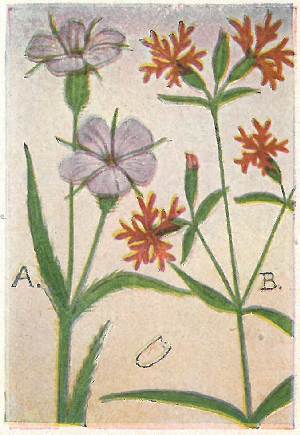
(A) Corn Cockle (Agrostemma githago) (European). The Corn Cockle is very closely related to the Campions (genus Lychnis). It is an annual with an erect and rather downy stem; it branches but slightly, each branch being terminated by one or two large handsome magenta flowers with an expanse of one to two inches. The calyx is densely hairy, as are also the lanceolate leaves that grow oppositely on the stem. We find it as an escape from gardens or in waste places near grain fields.
(B) Ragged Robin (Lychnis Flos-cuculi) (European). This species, which is also known as Meadow Lychnis, is noteworthy because of the slashed appearance of its five crimson petals. The flower calyx is deeply ribbed and is of a brownish-purple color, as is also the upper part of the flower stem; both are sticky and hairy. It is sometimes found in waste land or moist places where it has escaped from cultivation.
[62]
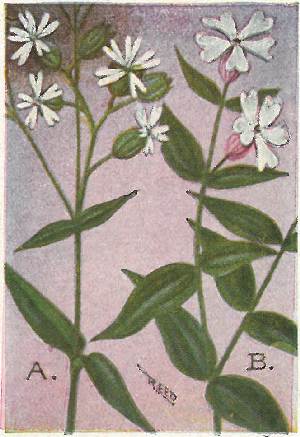
(A) Bladder Campion (Silene latifolia) (European). We have several Campions, some natives and some introduced. The present species was brought to us from Europe. It has very unusual blossoms, in that the calyx is very inflated, almost globular and handsomely marked with darker green, so as to often give it a very similar appearance to that of the citron melon. The five white petals are cleft in twain for nearly their whole length.
It is a common escape from gardens and may be found blooming from June to August along roads or in dry waste places from Quebec to Minn. and south to Va. and Mo.
(B) Evening Lychnis; White Campion (Lychnis alba) (European). This is another attractive species introduced from Europe. The petals are white, deeply cleft, and crowned at the base with little petal-like divisions; the calyx is inflated and often deep pink on the ribs. The leaves are smooth edged and oppositely on the stem that grows from one to two feet high. Escaped from gardens, from Me. to N. J. and west to Ohio.
[63]
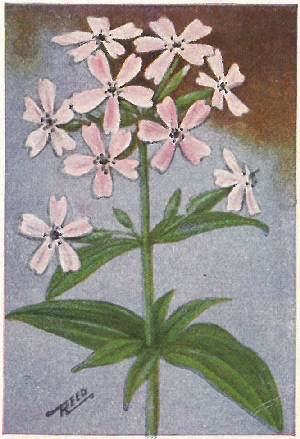
Bouncing Bet (Saponaria officinalis) (European). This is probably the most hardy and the most widely distributed of our adventive members of the Pink family. It increases very rapidly by means of underground runners as well as by seed. It is very commonly known as “Soapwort,” because of the fact that the mucilaginous juice from the crushed leaves will form a lather if they are shaken in water; it is said that it was, in olden days, used for washing purposes.
The plant stem is quite stout, smooth, erect, and sparingly or not at all branched. At the top is a corymbed or flat-topped cluster containing many flowers; petals, notched or sometimes quite deeply cleft, and with an appendage at the top of the long claws that, bent at right angles, enter the long, tubular, veined, greenish, 5-notched calyx.
From July until September Soapwort blooms profusely in waste places along railroad beds and beside dusty roads where few other flowers are able to flourish. It was one of the first of foreign flowers to be introduced into this country.
[64]
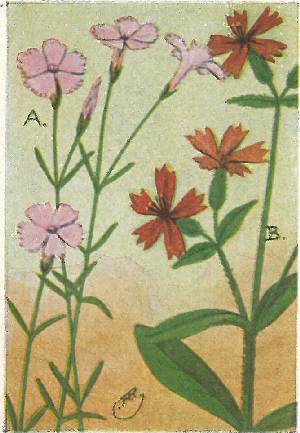
(A) Maiden Pink (Dianthus deltoides) (European). A handsome rose-colored Pink that has become naturalized along the Atlantic Coast and is quite abundant in some localities, in fields and waste places. The flowers grow singly, or in pairs, at the ends of the branching stem; the petals are broad, wedge-shaped, and finely toothed.
(B) Fire Pink; Catchfly (Silene virginica) is one of our most brilliantly colored wild flowers, the petals being either deep crimson or scarlet; the five petals are oblong, 2-cleft, long-limbed, and five in number. The lower leaves are thin and spatulate, the upper ones oblong-lanceolate. Both stem, leaves, and calyx are rather hairy. This species is found in open woods from southern N. J., western N. Y., and Mich. southward.
Wild Pink (Silene pennsylvanica) is another beautiful native species, with bright pink flowers and a low, sticky stem; the upper leaves are small, and the numerous basal ones lance-shaped. It is rather common from Me. to N. Y. and southward.
[65]
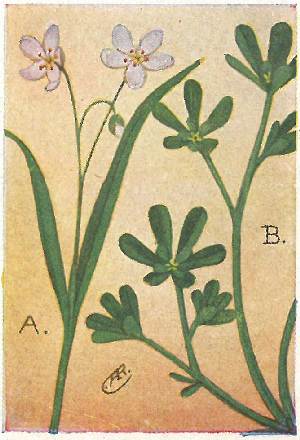
PURSLANE FAMILY (Portulacaceæ)
(A) Spring Beauty (Claytonia virginica), although very delicate in appearance, is among our earliest flowering plants.
The weak stem is usually very crooked and is often prostrate on the ground; two linear-lanceolate leaves clasp it oppositely about halfway up. The opened flowers, somewhat less than an inch across, have five petals, two sepals, and five golden stamens that mature before the stigma. It is found in moist woods from Me. to Mich. and south to the Gulf.
(B) Purslane (Portulaca oleracea) (European) has a prostrate, juicy stem and thick, fleshy leaves; the latter are wedge-shaped with rounded ends. The stem is very branching and spreads or radiates from the root. The flowers are tiny, solitary, and yellowish, seated in the whorls of leaves that terminate the branches. Found in waste places anywhere and possibly indigenous in the Southwest.
[66]
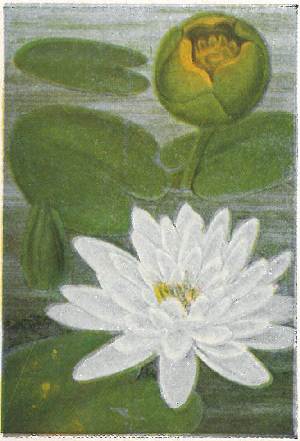
WATER LILY FAMILY (Nymphæceæ)
(A) Cow Lily; Yellow Pond Lily (Nymphæa advena) is not unattractive and is interesting in its makeup. The leaves are thick, rough, ovate, slit or lobed to the stem, which is long and hollow. The flower is raised above the surface of the water on a long, hollow stem. What appear to be six large green and yellow petals are in reality sepals; the real petals are numerous, stamen-like, inserted with the very numerous stamens under the golden-yellow rayed disk that forms the stigma. Very common in still or stagnant water.
(B) Water Lily; Water Nymph (Castalia odorata) needs no introduction to our readers. To my mind, it leads all other flowers in beauty, grace, purity, and fragrance. It is composed of four sepals, greenish on the outside and whitish within, and numerous pure, waxy-white petals. They sometimes are gigantic in size, often spreading five or six inches across. It flowers from June to Sept. in ponds or slow-moving water.
[67]
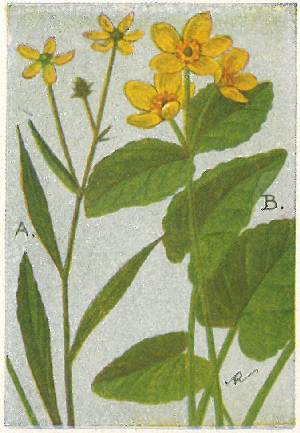
RANUNCULUS FAMILY (Ranunculaceæ)
(A) Water Plantain (Ranunculus laxicaulis) is a rather common marsh-inhabiting Buttercup, with five to seven narrow yellow petals. The stem is stout but rather weak and angled, at each joint sending out a clasping lanceolate, almost toothless leaf. The flowers, which are about ¾ in. broad, are on long peduncles terminating the branching stem that rises from 1 to 2½ feet. It is found in bogs, ditches, and muddy places from Me. to Minn. and south to the Gulf.
(B) Marsh Marigold (Caltha palustris) is the very common marsh herb usually, but erroneously, called “Cowslip.” Its leaves are very commonly used and marketed for food. The flowers are perfect, have no petals but from five to nine (usually the former) golden-yellow, shining sepals, and numerous brighter stamens. The stems are hollow and furrowed. The leaves are round, kidney-shaped, usually with scalloped edges. Marsh Marigold is abundant in swamps or wet meadows from Newfoundland to Alaska and southward through the United States, flowering in April and May.
[68]
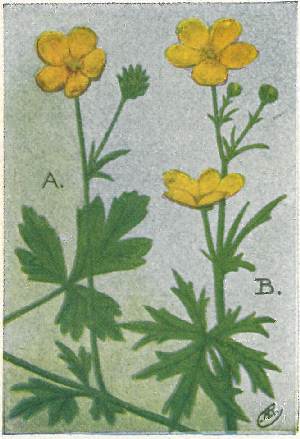
(A) Creeping Buttercup (Ranunculus repens) is, as per its name, a creeping plant. The stem is prostrate, creeping along the ground and striking new roots from the junctions of the leaf and flower stems with the main one. The flowers are large and broad-petalled, both the petals and stamens being a deep shining golden yellow. This species is indigenous in the West, but probably introduced from Europe in the East, where it is found chiefly near the coast, in ditches or along the edges of marshes.
(B) Common Buttercup; Crowfoot (R. acris) (European). Even though we have quantities of native Buttercups, it is this handsome foreigner that is the most abundant; this is the species that is found in fields everywhere, the one that delights the little folks and figures in many of their childish games.
The leaves and stem of the Crowfoots are very acrid, but not poisonous; on this account they are shunned by cattle and horses. This accounts in part for their abundance in most fields and pastures.
[69]
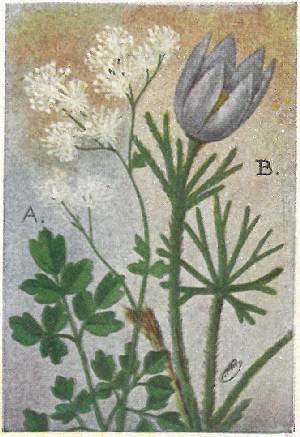
(A) Tall Meadow Rue (Thalictrum polygamum) is one of the characteristic plants of swamps and edges of streams. Should its neighboring plants be three or four feet high, we find the plume-like flowers of this species triumphantly waving above them on stems of five, six, or even seven feet tall.
The stalk is rather stout and grooved, pale-green, stained with maroon. The long-stemmed leaves are many times compounded into small, lobed leaflets of a pale, dull, blue-green color. The flowers are in feathery clusters; each individual flower having numerous white filaments, no petals, but usually four or five early-falling sepals.
From June to September we may find the mist-like flowers of Meadow Rue in swamps, from Labrador to Manitoba and south through the United States.
(B) Pasque Flower (Anemone patens) has a solitary erect flower with five to seven purplish sepals. Leaves divided and cut into narrow, acute lobes. Both stem and leaves covered with silky hairs. This species is found on prairies from Wis. and Montana southward.
[70]
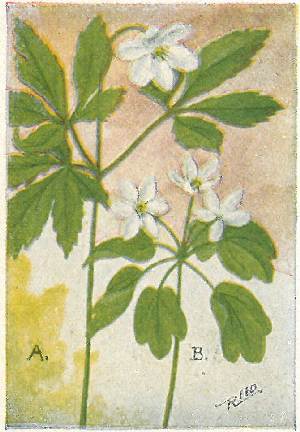
(A) Wood Anemone; Wind Flower (Anemone quinquefolia). The stem is slender and from 4 to 8 in. high. Three leaves radiate from a point about two thirds up; each on a long stem and divided into three to five, toothed, ovate leaflets, The solitary flower rises on a slender peduncle from the junction of these three leaves with the stem proper. It has four to seven sepals, most often five; white inside and purplish white on their outer surface. The flower has an expanse of slightly less than one inch, but is rarely seen fully expanded. The Wind Flower is common in woods or thickets from Nova Scotia to the Rockies and southward.
(B) Rue Anemone (Anemonella thalictroides) has four to nine sepals (usually six), numerous orange-tipped stamens and a broad stigma. There are several flowers on exceedingly slender peduncles, rising from the whorl of leaves. The latter are on slender stems, have heart-shaped bases and three-lobed ends; rather small, pale-green above and with a whitish bloom below. It is found in the same localities and the same range as the last species, with which it associates.
[71]
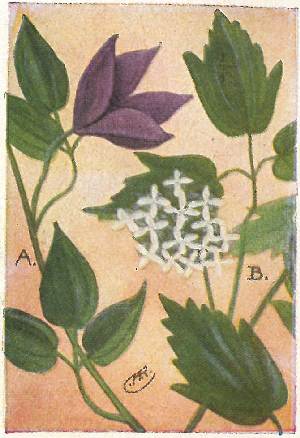
(A) Purple Virgin’s Bower (Clematis verticillaris) is probably the most rare species of Clematis. It grows in rocky, hilly, or mountainous woods, most abundantly in northern portions of its range, which is from Quebec to Hudson Bay and south locally to Del. and Pa. It is a climbing woody vine, supporting itself by the bending or clasping of the leaf stalks. The flowers grow singly, on long stems from the axils of the leaves or from the end of the vine. They are large and handsome, the four thin, purple, pointed, translucent sepals spreading from two to four inches when fully expanded. The leaves are divided into three leaflets, ovate, pointed, with a heart-shaped base.
(B) Virgin’s Bower (Clematis virginiana) is a beautiful, graceful, climbing, twining vine found throughout our range. The small greenish-white flowers, with four or five petals, grow in clusters from the leaf axils; staminate and pistillate ones are on separate plants. In fall, the beautiful silky plumes of the seed pods gives this species the name of “Old Man’s Beard.”
[72]
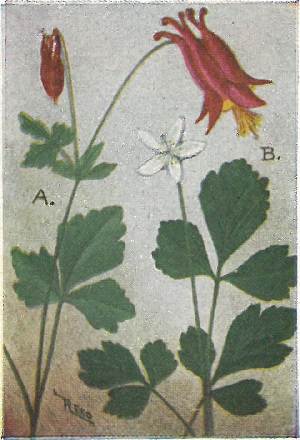
(A) Wild Columbine (Aquilegia canadensis) is one of our typical, early woodland plants, graceful in form and beautiful in flower. It grows in rocky woodland throughout our range, flowering from April to June.
The stem is very slender, wiry, and graceful, quite branching, and attaining heights of one to two feet. The flowers are heavy, which causes them to nod from their slender, thread-like peduncles. A quantity of nectar is secreted in the base of each red spur, serving to attract butterflies, moths, and often the Ruby-throated Hummingbirds, for those birds are very partial to red colors.
(B) Goldthread (Coptis trifolia) is a small woodland plant receiving its name from the slender, thread-like, golden-yellow roots. These roots are characteristic and readily identify the species. The leaves are evergreen, deeply shining green in color, 3-parted and notched, on long petioles from the root. The white flower has five or six early-falling sepals; it is usually solitary on a scape from 3 to 6 in. high. Common in rich woods throughout U. S. and Canada.
[73]
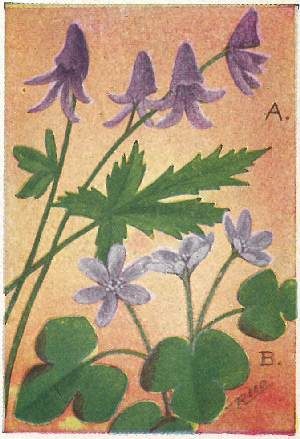
(A) Monkshood; Aconite (Aconitum uncinatum) is an attractive wild flower with a slender, rather weak stem often supporting itself against other species. The flowers are quite large and handsome. The five sepals are very unequal in size and shape; the upper one large and hood-like, concealing two small petals within it. The leaves are firm, three- to five-lobed and notched, on slender petioles. In rich, moist woods from Pa. southward, flowering from June to September.
(B) Hepatica; Liverwort (Hepatica triloba). If we except the Skunk Cabbage, the beautiful Hepatica is the first of our flowers to appear. Its stems are thickly covered with fuzzy hairs; the three-lobed, smooth-edged leaves are rather thick and coarse, lasting through the winter but turning a ruddy color, while the new ones, that appear with the buds, are light-green and radiate above the older prostrate ones. A single blossom appears at the end of each long fuzzy scape; it is about one inch broad, and has five to ten pale-purple or lilac sepals.
Hepaticas bloom from March to May in open woods from N. S. to Manitoba and southward.
[74]
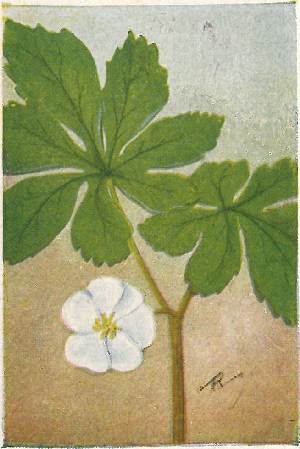
Mandrake; May Apple (Podophyllum peltatum) belongs to the Barberry Family (Berberidaceæ), a small family of shrubs or herbs, divided into five genera of but one or two species each. The present species is quite common in rich woods, or in shady moist ground, from western N. E. to Minn. and southward flowering in May. The bare stalk rises to heights of 10 to 12 inches, then branches into two long-stemmed, light-green, large, spreading leaves; the latter are five- to nine-parted, lobed, notched, and unevenly balanced. From the forked joint of the leaves hangs a solitary white flower on a short, slender, curving peduncle, this is very delicate, nearly two inches across, and of six petals and twice as many stamens.
The fruit is large and lemon-shaped, yellow in color, ripening in July. It is the fruit that gives it the name of May Apple. While the leaves and stem are poisonous, the fruit is not, but has a peculiar, acid, sickish flavor.
[75]
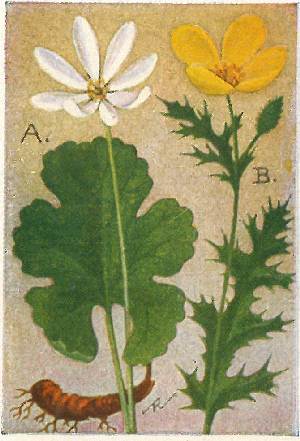
(A) Bloodroot (Sanguinaria canadensis). Closely following on the heels of our handsome Hepatica we find the delicate flowered Bloodroot unfurling its leaves and expanding its flowers in rich, rocky, open woodland. The flowers are very delicate; the petals stay but two or three days anyway, and a breath of wind may blow them off sooner.
After the flower is gone, the leaf develops rapidly and becomes very large and imposing, with many divisions and lobes. The root is reddish and is filled with a bloodlike juice, as is also the stem. Bloodroot is common from N. S. to Minn. and southward. It flowers in April and May.
(B) Prickly Poppy (Argemone mexicana) is a handsome Mexican plant found in the southwestern portions of the United States. It has a prickly stem from one to two feet high. The stemless leaves have sharp lobes, also armed with prickles. The flower is bright yellow, has four petals, and numerous orange-tipped stamens. The flowers give no nectar but plenty of pollen to the bees that visit them.
[76]
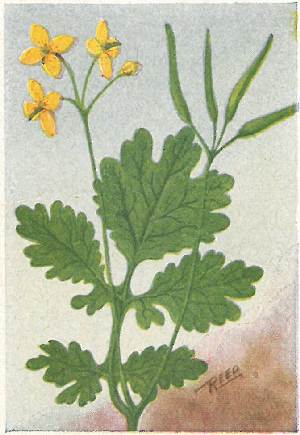
Celandine (Chelidonium majus) (European) is abundant almost everywhere in the eastern half of our country.
The stem is quite stout and very branching; at the end of each branch is a loose cluster of buds on slender pedicels. These open one or two at a time, so that the plant keeps in bloom for a long time; in fact, the flowering season extends from early in May to the end of September. The flowers are half an inch or more broad, with four golden-yellow petals, a slender, pointed green pistil, and numerous yellow stamens. The seed-pod is long and slender.
The thin, soft leaves are very handsomely divided into three-to seven-lobed leaflets. Both stem and leaves have a bright yellow, very acrid juice, that stains everything it comes in contact with. Celandine is often known in Europe as “Swallow-wort” as it is supposed to commence flowering with the coming of the swallows and to cease with their departure. Its generic name also originated in this belief.
[77]
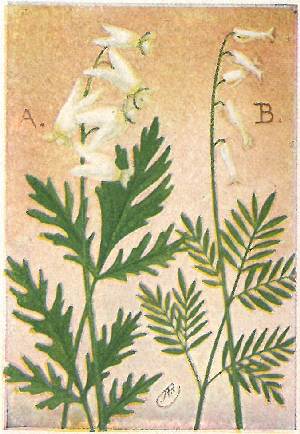
(A) Dutchman’s Breeches (Dicentra Cucullaria). This peculiarly flowered herb belongs to the Fumitory family, a family of delicate, smooth plants with watery juices and compound, dissected leaves.
The flower stalk, proceeding from the root, attains heights of from 5 to 9 inches and bears a loose raceme of four to eight white, inverted flowers; the four petals are united in pairs, two of them forming a large double-spurred sac, and the other two very small petals forming a protection for the stigma. The double sac is white, stained with yellow. The leaves are on long petioles from the rootstalk; they are pale sage-green in color, 3-parted and finely slashed. Dutchman’s Breeches may be found blooming in April and May in rich, hilly woods from N.S. to Minn. and south to N.C. and Mo.
(B) Squirrel Corn (D. canadensis) is similar, but the white, sac-like petals are stained with purple, the spurs are shorter and rounder, and the flower is slightly fragrant. The roots have little tuberous appendages resembling grains of corn. This species is found in the same range as the last.
[78]
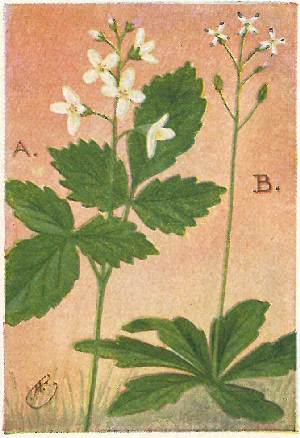
MUSTARD FAMILY (Cruciferæ)
(A) Toothwort; Crinkleroot (Dentaria diphylla). During the latter part of April or in May we will find white, crosslike flowers of Toothwort often growing side by side with Anemones. Its stem is stout and smooth, and rises to heights of 8 to 12 inches. Two 3-parted, notched-edged leaves with short stems are set oppositely on the flowering stalk, above the middle; other larger, similar ones are on long petioles from the rootstalk. Its root is crinkled and with toothlike appendages. It is found in rich woods from N. S. to Minn. and southward.
(B) Whitlow Grass (Draba verna) (European) is a weed that we find along roadsides, waste places, or barren fields. The flowers are small, and the four white petals are deeply notched. The scape is from 1 to 5 in. high. The leaves are all basal, lance-shaped, and lobed or toothed.
[79]
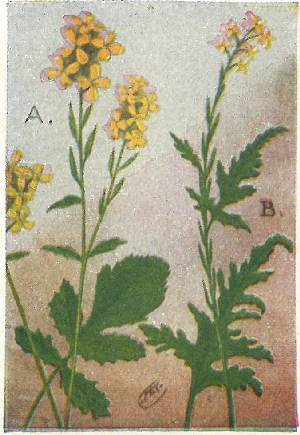
(A) Common Mustard (Brassica nigra) (European) is extensively cultivated in Europe for the small dark-brown seeds that form a valuable article of commerce, being used for the table condiment and for various medicinal purposes.
In our country Mustard is regarded as a pest; it is a very strong, hardy plant, soon overrunning sections where it gets a foothold. The stem is very branching and grows to heights of from 2 to 7 feet. The four-petalled, light-yellow flowers are in small dense clusters at the ends of the branches; a trail of small, erect seedpods is left in the wake of the flowers as they continue to bloom along the lengthening stem. The leaves have a large, terminal notched lobe and smaller lateral ones.
(B) Hedge Mustard (Sisymbrium officinale) (European). This common weed has tiny, four-petalled yellow flowers that bloom all summer, along the lengthening stem, and leave numerous tiny pods closely set against the stem. The leaves are more angular and more finely divided than those of the Common Mustard.
[80]
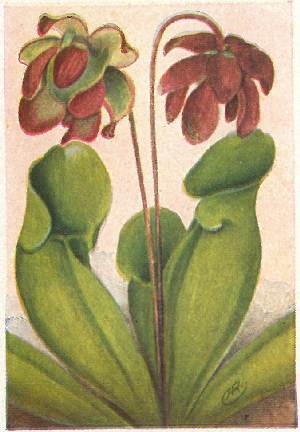
PITCHER PLANT FAMILY (Sarraceniaceæ)
A small family of bog-inhabiting plants having hollow pitcher-formed or trumpet-shaped leaves.
Pitcher Plant; Huntsman’s Cup (Sarracenia purpurea). Few plants are as little known generally as this species. It is one of the most interesting ones that we have. The shapes of both the leaves and blossoms are clearly shown in the opposite picture. The pitchers, or basal leaves, may number from three to a dozen, all radiating from the root and all with the orifice up. An examination shows that each pitcher is partially filled with water. Just below the rim of the leaf, on the inside, is a sticky substance to attract insects; as these enter, they pass downward over countless little hairs, all pointing downward. These make it very difficult for insects to crawl out of the pitcher, and many of them become exhausted and are drowned in the water. As these insects decompose, they are absorbed by the plant.
The Pitcher Plant is local in bogs from Labrador to Manitoba and southward.
[81]
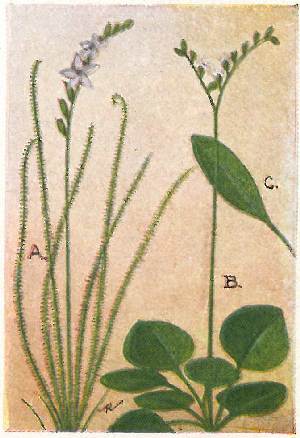
SUNDEW FAMILY (Droseraceæ)
(A) Thread-leaved Sundew (Drosera filiformis) has long, linear film-like, erect, very hairy leaves. The flowers are numerous and loosely racemed at the top of a slender smooth scape; they have five small purple petals, five stamens, and several 2-parted stigmas. This species is found in wet sandy soil from New England to Delaware.
(B) Round-leaved Sundew (Drosera rotundifolia) is one of the most common of the Sundews, it is found in moist, sandy, or peaty soil from Labrador to Alaska and south to Pa. and Cal. The leaves are numerous, quite round, and on long stems from the root. The leaves are thickly covered with hairy glands that exude drops of a clear glutinous fluid. These dew-like drops deceive insects into alighting on the leaves. Having caught a victim, the leaf slowly folds about it and digests it.
The flower stalk of this species grows from 5 to 9 in. high, is reddish colored, and often has one or two branches at the top. The one to twenty-five flowers that it has during the flowering season are white.
[82]
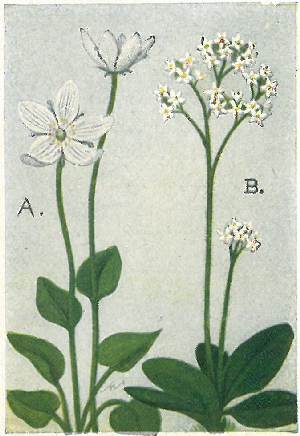
SAXIFRAGE FAMILY (Saxifragaceæ)
(A) Grass of Parnassus (Parnassia caroliniana) is a pretty little swamp or meadow plant growing from 8 to 24 inches high. The flowers are a delicate creamy white, finely veined with greenish, and borne singly on long scapes; a single heart-shaped leaf clasps each flower scape a short distance above its base. The basal leaves are long-stemmed, rather thick and coarse in texture, smooth-edged and bluntly pointed.
We find this species in bloom from the latter part of June until the end of September, most abundantly in the latter month. It ranges from Newfoundland to Manitoba, south to Va. and Mo.
(B) Early Saxifrage (Saxifraga virginiensis) is a tiny-flowered plant that loves dry, sunny, rocky hillsides. It flowers during March and April. The leaves are all basal; spatulate in shape, blunt ended, either rough-edged or toothed, rather coarse in texture, narrowing toward their base into clasping stems. Saxifrage is common from N. B. to Minn., south to Ga. and Tenn.
[83]
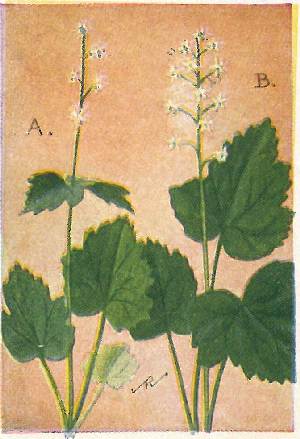
Mitrewort (Mitella nuda) has a few flowers, very short-stemmed, in a loose raceme at the top of a leafless, slightly hairy scape 4 to 7 in. high. The flowers have five petals, each with the edge beautifully fringed so as to give the flower a crystalline appearance almost like a snowflake. We find this species from Labrador to Saskatchewan, south to Ct. and Mich.
(A) Two-leaved Mitrewort (Mitella diphylla) is a larger and sturdier species with similar flowers, but with two very short-stemmed, heart-shaped leaves clasping the flower stem oppositely about halfway up its length. Found in rich woods from N. E. to Minn., south to N. C. and Mo.
(B) Foam Flower; False Mitrewort (Tiarella cordifolia) has the general appearance of the last species. The slender, hairy flower scape, rising 6 to 12 in. from the rootstalk, has at the top a loose panicle of many small flowers, each on a long, slender stem, thus differing from the short-stemmed flowers of Mitella. Foam Flower is common from N. S. to Minn. southward, flowering in May and June.
[84]
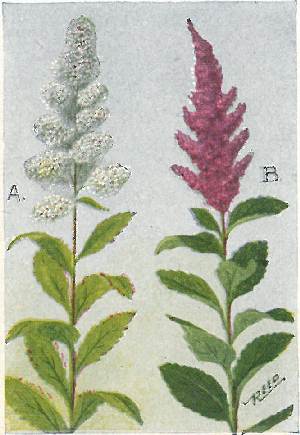
ROSE FAMILY (Rosaceæ)
(A) Meadowsweet (Spiræa salicifolia) is a common and beautiful shrub that grows along the edges of woods, swamps, or even roadsides. Its handsome pyramidal clusters of flowers are in evidence during July and August. The stem is straight, slender, woody, and yellowish buff; along it, at close intervals, alternate the lanceolate, toothed, short-stemmed leaves. At the top is a spire-like panicle of fleecy flower clusters. Each flower has five round, white petals and numerous long, pink stamens that give the flowers a feathery appearance and a rosy tint. It ranges from N. Y. to Mo. and southward.
(B) Hardhack; Steeplebush (Spiræa tomentosa) is one of our most beautiful flowering shrubs. The flower spike is more slender and steeple-like than that of Meadowsweet, and the flowers are a beautiful shade of pink. The leaves are more closely alternated and are dark green above and lighter below. Steeplebush grows in low ground from N. B. to Minn. and southward.
[85]
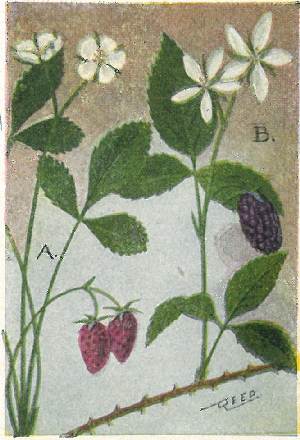
(A) Wild Strawberry (Fragraria virginiana). The hairy stems of both leaves and flowers rise directly from the running rootstalk. The flowers, several of which grow on each stem, are wheel-shaped, have five rounded white petals, and narrow lanceolate greenish sepals. After the flowering season, the green center expands, becomes pulpy, and finally turns red on the outer surface; the numerous seeds are in little pits provided for them on the surface of the berry.
The Wild Strawberry is common in fields and pastures throughout our range.
(B) High Bush Blackberry (Rubus allegheniensis) is a tall branching shrub with slender brown stems, from three to ten feet long, armed with stout, slightly recurved prickles. It is from this species that the well-known variety was developed. The leaves are divided into three to five ovate, pointed, toothed leaflets, with a ribbed and hairy surface. The flowers have five green sepals alternating with the narrow white petals. This species is very common everywhere.
[86]
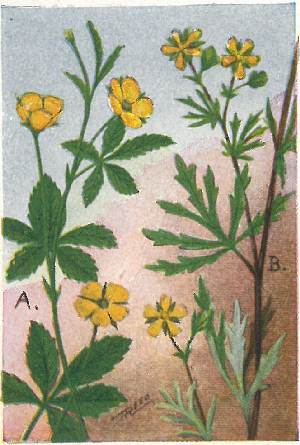
(A) Common Cinquefoil; Five-finger (Potentilla canadensis). This species is the most common of the Five-fingers. It is often mistaken for the Wild Strawberry, because of a similarity between the leaves of the two species, although those of this species have five divisions while those of the Strawberry have but three. The flowers are shaped like those of the Strawberry, but have bright-yellow petals. It is very common in the United States and southern Canada.
(B) Silvery Cinquefoil (Potentilla argentea) is a common and very handsome species found in dry, barren ground throughout our range, but most abundantly near the coast. It is smaller than the preceding, being from 5 to 12 in. high. The little yellow flowers are clustered at the ends of the branches. The stems and the undersides of the divided and deeply cut leaves are covered with fine, white, silvery wool, contrasting sharply with the dark green of the upper surfaces. This species bloom from May until September.
[87]
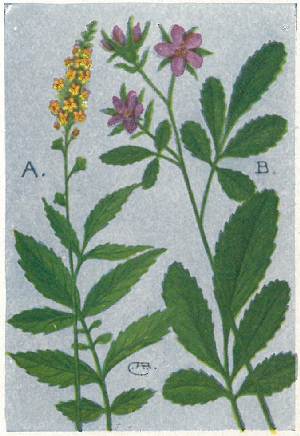
(A) Agrimony (Agrimonia gryposepala) is a common weed found on the borders of swamps or thickets. It has a tall, hairy, simple stem from two to four feet high.
The flowers are in a long, many-flowered spike at the top of the stalk. Each flower is tiny, has five yellow petals, and numerous orange stamens, giving the spike a bright, golden-yellow appearance. It is a common plant from N. B. to N. C. and westward to Cal.
(B) Marsh Five-finger; Purple Cinquefoil (Potentilla palustris) is in character quite like the foregoing species. It is the only one, however, having purple flowers, and is easily recognized on that account. The flowers are nearly an inch broad, larger than those of the other Cinquefoils.
The stem grows from 6 to 20 inches long and is rather woody at the base. Purple Cinquefoil grows in swamps or cool bogs, from Labrador to Alaska and south to N. J., Pa., Ia., and Cal., flowering during July and August.
[88]
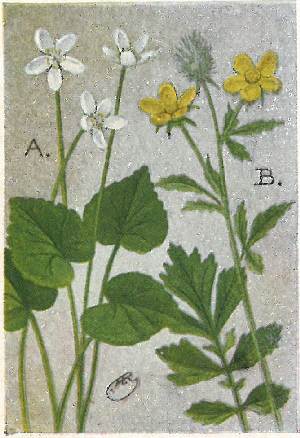
(A) Creeping Dalibarda (Dalibarda repens) is a delicate woodland plant, found from N. B. to Manitoba and south to N. J., Ohio, and Mich. It has creeping, densely tufted rootstalks, from which spring numerous heart-shaped leaves on long petioles; these leaves, their stems, and the flower stalks are downy, the former being scallop-edged or toothed.
Dalibarda has two kinds of flowers: The first on long, upright scapes spread about half an inch, have five oval white petals and many stamens. The second are cleistogamous ones (fertilized in the bud) on short curving peduncles from the root. These last flowers are fertile, while many of those with petals are not. Dalibarda blooms from June to September in rich woods.
(B) Yellow Avens (Geum strictum) grows in moist locations in swamps or thickets. The texture of the whole plant, leaves and stems, is rough and coarse. The root leaves are interruptedly pinnate, the segments being wedge-shaped and toothed. The flowers have quite large golden-yellow petals and a downy receptacle. This species is common from Newfoundland to Manitoba and south to N. C. and Mo.
[89]
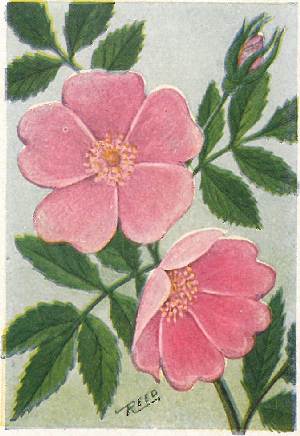
Swamp Rose (Rosa carolina). Wild Roses are very common throughout our range and, of course, are familiar to every one. The Swamp Rose is a very bushy species, growing from one to nine feet high. It is very common on the edges of swamps or streams, and in low ground, throughout our range.
The flowers are two or three inches broad and have numerous yellow stamens radiating from the greenish-white centre. The stem of the Swamp Rose is sparingly armed with stout, wide-based, curved thorns.
Pasture Rose (Rosa humulis) is the most abundant of all our Wild Roses and grows in profusion in all dry, rocky places. It does not grow as high as the Swamp Rose, rarely exceeding three feet in height, but the slender stems are more branching and often grow in large, tangled masses. The flowers are about the same size as those of the Swamp Rose, but are usually solitary at the ends of the branches.
The stem is armed with straight, slender, light brown thorns or prickles, two of which are set oppositely on the stem at its junctions with the leaf stems.
[90]
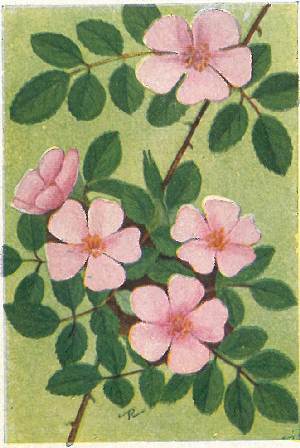
Sweetbrier; Eglantine (Rosa rubiginosa) is a very beautiful species of Wild Rose introduced from Europe. We may find it blooming quite commonly in dry, rocky pastures and waste places during June and July. It is remarkable for and easily identified by the sweet-scented aromatic fragrance of its leaves. The stems are long and arching, growing from 2 to 6 feet in height; they are brown and are armed at frequent intervals with short, decidedly recurved thorns or prickles.
At regular intervals along the stem are close-set, compact clusters of flowers and leaves. The leaves are made up of five or seven very small leaflets, rounded-ovate in form and with the edge finely double-toothed, and covered beneath with fine, sticky, glandular hairs. The flowers are also quite small, especially when compared to the very common Pasture and Swamp Roses, being only from 1 to 2 inches in diameter. Eglantine is found from Nova Scotia to Michigan and southward to Virginia and Tenn.
[91]
PULSE FAMILY (Leguminosæ)
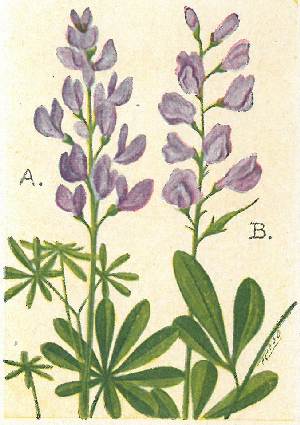
(A) Wild or Blue Lupine (Lupinus perennis) receives its generic name from the Latin of wolf, because it was thought that the species preyed upon the soil and made it infertile for other kinds of plants. It is a very common species in sandy places and we often see it on the banks along railroads. The stem is quite stout, erect, hairy, and branching. The leaves have long, slender stems; the leaf, proper, is palmately divided into seven to eleven narrow, smooth-edged leaflets.
The flowers are in long, showy, terminal spikes of pea-like blossoms. Lupine is very common through the United States, east of the Rocky Mountains.
(B) Blue False Indigo (Baptisia australis) is a tall branching species with a stem from 3 to 6 feet in height. The leaves are divided into three spatulate-shaped leaflets. The violet-blue flowers grow in long loose spikes; they are about one inch long, have a four- or five-toothed calyx, straight keel and wings, and short standard. The seed-pod has a spur at its tip. This species is common from Pa. to Ga. and west to Mo.
[92]
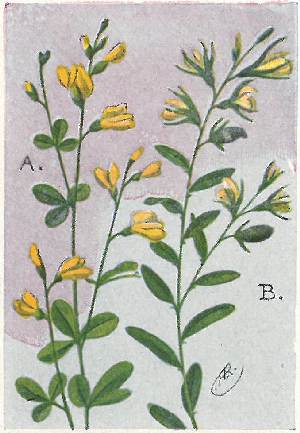
(A) Wild Indigo (Baptisia tinctoria) is a very branchy and very bushy herb. The stem divides soon after it leaves the ground, the slender branchlets extending equally in all directions. The leaves are three-parted, wedge-shaped, dull green with a white bloom that gives them a bluish-green appearance. The yellow, butterfly-shaped flowers are in loose clusters at the ends of all the branches.
The roots of Wild Indigo are used by drug concerns for the compounding of a number of medicines. An indigo dye, of a poor quality, can also be made from the plant. Wild Indigo grows in dry, sandy soil from Maine to Minnesota, flowering from June to September.
(B) Rattlebox (Crotolaria sagittalis) receives its name because the seeds rattle about in the large, inflated, blackish seed-pod. It is an annual herb, with a hairy-bending stem and stemless, toothless, pointed-oval leaves alternating along it. The yellow, pea-like flowers are in small clusters at the ends of the branches. It is found in sandy soil, chiefly along the coast, from Mass. to Fla. and Texas and, in the Mississippi basin, to Indiana and South Dakota.
[93]
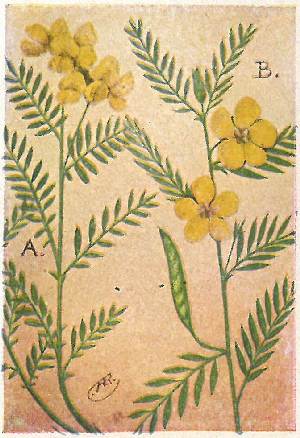
(A) Goats Rue; Cat Gut (Tephrosia virginiana). We find this herb in most all dry, sandy, waste places from N. H. to Minn. and southward.
It is a pea-like plant with a simple, silky-haired, erect stem, leafy to the top where it terminates in a dense raceme or panicle of yellowish-white flowers marked with purple. The flowers are large and numerous; they have a rounded standard but little longer than the wings and keel. Its roots are long, very slender, and very tough.
(B) Partridge Pea (Cassia Chamæcrista) is a handsome species with large, showy yellow flowers measuring about 1¼ inches across; often the five, large, rounded petals have purplish spots at their bases; after flowering long, erect seed-pods are left in the place of each of the blossoms.
The leaves of the Partridge Pea are long and compounded of 20-30 small, blunt, lance-shaped leaflets, each with a tiny awl-like point. The stem is erect, rather smooth, and grows one or two feet tall. We find this plant in dry or sandy fields throughout the United States.
[94]
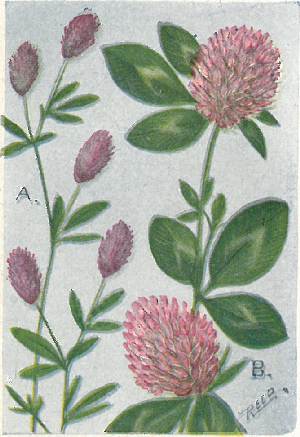
(A) Rabbit-foot Clover; Stone Clover (Trifolium arvense) (European). The stalk of this species is soft, silky, and from 4 to 10 inches high. The light-green leaves have three leaflets with blunt tips. The flower-heads are composed of numerous florets; it is the long, pink, feathery tips of the five-parted calyx that gives the blossom its silky fuzziness; it is quite fragrant and is visited by the smallest butterflies. You may find this species everywhere within our range.
(B) Red Clover (Trifolium pratense) is the most common and the most valuable species of clover. One would hardly believe, knowing how abundant it is in all parts of our range, that this Clover could have been introduced and have become so widely distributed, yet such is the case. One reason that it does so well in this country is that we have a very large number of bumblebees, and it has been found that clover is so dependent upon these insects for fertilization, that, without them, it will soon die out.
The little florets, composing the globular flower-head, are bright crimson-pink. The three leaflets that make up each leaf have whitish-green triangles in the middle.
[95]
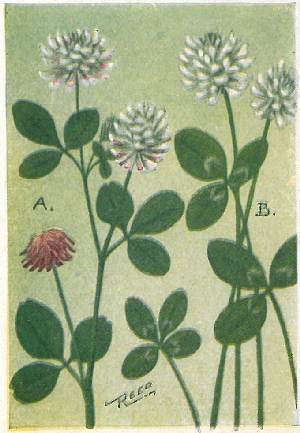
(A) Alsike or Alsatian Clover (Trifolium hybridum) (European) is quite similar to our native White Clover, but the stem is stout, branching, and juicy. The trifoliate leaves of this species are unmarked and have a simple, rounded end, not notched, but the edge of the leaf is very finely toothed. The florets composing the round flower-heads are cream-colored, tinged with pink; they are very fragrant and laden with nectar.
(B) White Clover (Trifolium repens) is the most common of the White Clovers. It is supposed to be indigenous in the northern parts of our range. It is highly prized as forage for cattle and is often cultivated in fields for that purpose. It is also a favorite with keepers of bees.
Its stems are smooth, reclining, and 4 to 10 inches long. The leaves are composed of three leaflets, heart-shaped or notched at the ends, and usually with a more or less distinct triangular mark in the middle. The flowers are creamy white, slightly pinkish, and very fragrant.
[96]
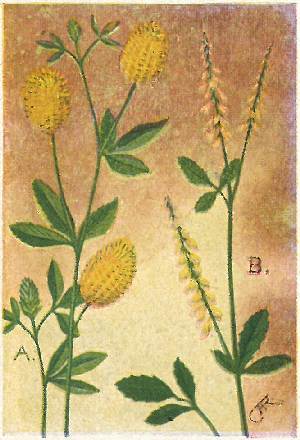
(A) Yellow Clover; Hop Clover (Trifolium agrarium) (European). This Clover is very common in the eastern half of the United States and southern Canada; we find it growing most abundantly along roadsides and in dry or sandy fields.
The stem is quite smooth, slender, erect, and slightly branching and grows from 6 to 15 inches high.
The flower-head is oblong, densely crowded with small, golden-yellow florets, having an alternate scaly arrangement. They bloom from the bottom of the head upward, and, as they mature, turn yellowish-brown and are reflexed, resembling dried hops. Its flowering season is from June until September.
(B) Yellow Melilot; Yellow Sweet Clover (Melilotus officinalis) (European) is a common, weed-like plant, found everywhere in waste places. The stem is tall and branching, growing from 2 to 4 feet high. The leaves are trifoliate, each leaflet being finely toothed and the middle one having a short stem with a double bend. The yellow, clover-like florets are in long, loose racemes, terminating the branches; they have a sweet fragrance.
[97]
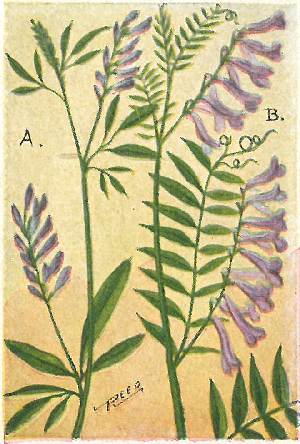
(A) Alfalfa; Lucerne (Medicago sativa) (European) is found growing wild in waste places or fields most anywhere in our range. It makes an excellent fodder for cattle and will grow in waste, sandy places where it is impossible to raise crops of hay.
The stalk is smooth, slender, branching, and erect; it grows from 1 to 2 feet high. The leaves are three-parted, on long, slender stems with narrow stipules at their base. The purple flowers grow in short, loose racemes at the ends of the slender branches; the seed-pod is curiously twisted or coiled.
(B) Cow Vetch; Blue Vetch (Vicia Cracca) is a trailing herb with a weak, angled stem; it is common on the borders of thickets or the edges of cultivated fields. The stem grows from 2 to 3 feet long and climbs over grasses or low brush by means of small, slender tendrils at the ends of the leaves.
The compound leaves are made up of twenty to thirty small, oval leaflets, each tipped with a tiny sharp-pointed bristle. The light violet-colored, bean-like flowers grow in one-sided racemes.
[98]
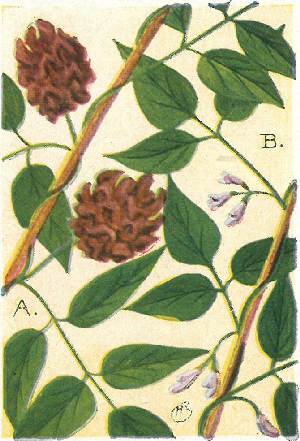
(A) Ground Nut; Wild Bean (Apios tuberosa) is an exceedingly beautiful climbing vine, attaining lengths of 4 or 5 feet, crawling over walls or fences, or twisting itself about shrubs or other plants. Its pear-shaped, tuberous root is edible, as every country boy knows.
The leaves of the Ground Nut are compounded of five, or sometimes seven, ovate-pointed leaflets; they are toothless, smooth, and light green. The flowers grow in dense, rounded clusters on slender stalks from between the angles of the leaves and the plant stem, and are maroon or lilac-brown. We find Ground Nut in bloom during August and September in damp ground, usually on the borders of swamps or wet meadows, from N. B. to Minn. and southward to the Gulf.
(B) Wild or Hog Peanut (Amphicarpa monoica)is a dainty, trailing vine 2 to 7 feet long. The delicate, light-green leaves are thrice compounded, on slender stems from the angles of which are small, drooping clusters of magenta-lilac blossoms. Other fruitful blossoms at the base of the plant develop into pear-shaped pods with single large seeds.
[99]
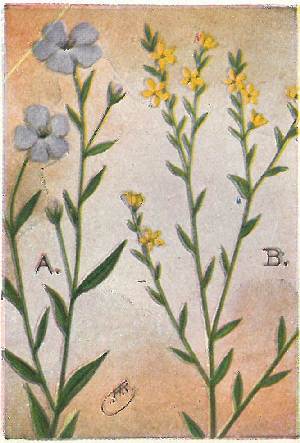
FLAX FAMILY (Linaceæ)
(A) Common Flax (Linum usutatissimum) (European) This slender species is more attractive than the last because of its larger flowers. The stem is very slender, from one to two feet in height, and each of its few branches is terminated with one or two delicate, violet-blue flowers; these measure about three quarters of an inch broad, or slightly more.
This is the species that is cultivated very extensively in Europe, and less so in this country, for its linen fibre and its seed oil, both of which have a very extensive commercial use.
(B) Wild Yellow Flax (Linum virginianum) is a slender perennial species with a smooth stem from 1 to 2 feet in height. The flowers have a calyx divided into five sepals, a corolla of five petals, five stamens, and pistils, perfect and symmetrical flowers fertilized by small bees and bee-like flies. The small leaves are thin and have but one rib. This species may be found in dry woodland from Me. to Minn. and southward.
[100]
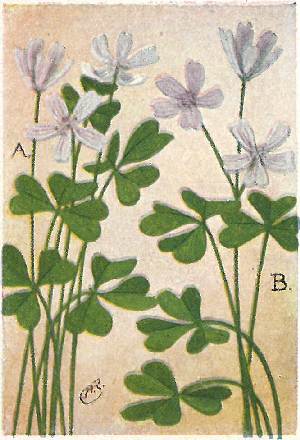
WOOD SORREL FAMILY (Oxalidaceæ)
(A) White Wood Sorrel (Oxalis Acetosella) is one of the most delicate and dainty of our woodland flowers. It is commonly found in cool, damp situations and is very partial to mountainous regions. The flowers are very frail looking, about an inch broad, borne on long, slender peduncles from the root. The leaves are also on long, slender petioles from the root; they are trifoliate or clover-like, each of the three leaflets being inversely heart-shaped—that is, with the end notched and with two rounded lobes. White Wood Sorrel is found from N. S. to Saskatchewan and south to N. E., N. Y., and in mountains to N. C.
(B) Violet Wood Sorrel (Oxalis violacea). The long, slender flower stalks bear at their summits three or more pale magenta flowers, similar, except in color, but a trifle smaller than those of the white species.
The leaves of both these Sorrels are very sensitive and fold up if handled; they also close at dusk and open in the morning.
[101]
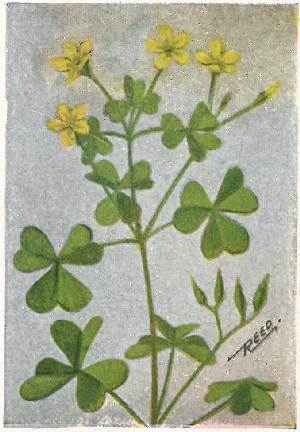
Yellow Wood Sorrel; Lady’s Sorrel (Oxalis corniculata) is not a woodland plant but is very common along roadsides, in gardens, dooryards, and fields. The pale-green, slender stem is quite erect, branches but little, if at all, and grows from three to twelve inches tall. The leaves are long-stemmed and trifoliate, the three leaflets being broadly heart-shaped. They are very sensitive and close if roughly handled.
The leaves have very acid and sour juices, similar in taste to those of the common Red Sorrel that, by the way, belong to an entirely different family (Buckwheat). Country school children often chew the leaves of both of these, as the sour taste has an agreeable twang.
The bright golden-yellow flowers are quite fragrant; they open only in the sunshine and close tightly at night. They grow in few-flowered umbels at the end of the stem on slender peduncles from the axils of some of the leaves. After their flowering season little erect, pointed pods take the place of the flowers. This species is a very common herb or weed throughout our range.
[102]
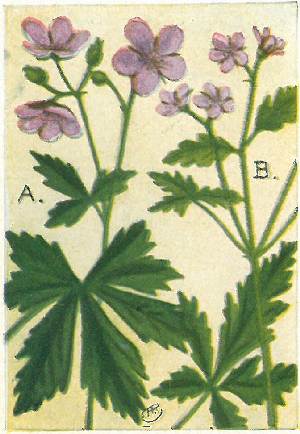
(A) Wild Geranium; Cranesbill (Geranium masculatum) is one of our most common woodland plants, flowering from May to July. The stem, the leaves, and the flower calyx are rough-hairy, the former being quite stout and branching and attaining heights of 1 to 2 feet. The large magenta or pale-purple flowers are in loose, few-flowered clusters at the ends of the branches; the petals are large and rounded and slightly overlap.
The leaves of the Geranium are very coarse and fuzzy, and the surface is often spotted with white or brown; they are palmately divided into five lobes, each of which is sharply toothed and pointed. It is very common from Me. to Manitoba and southward.
(B) Herb Robert (Geranium Robertianum) is a smaller edition of the last. Its flowers are similar, but smaller and coarser in texture. Its leaves are smaller and usually more deeply cleft. The stem is usually stained with red; both this and the leaves emit a strong odor when bruised.
Herb Robert is common from Me. to Minn. and southward.
[103]
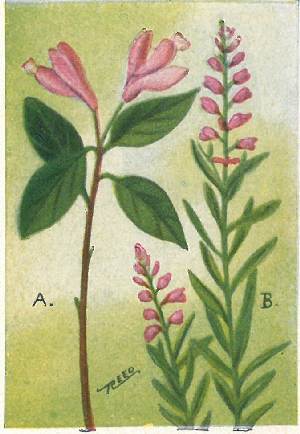
MILKWORT FAMILY (Polygalaceæ)
(A) Fringed Polygala (Polygala paucifolia) is a dainty and low perennial, usually rising but four or five inches from the ground; the stem bends sharply as it enters the soil and continues into a long, slender rootstalk often a foot in length. Either one or two flowers are at the summit of the stem; they are quite large, being nearly an inch in length; the two lateral sepals are large and wing-shaped; the three petals are joined together to form a tube, through which the yellow stamens and pistil protrude. Polygala is common in damp, rich woods from N. S. to Manitoba and southward to the Gulf, flowering during May and June.
(B) Milkwort (Polygala polygama) is a slender-stemmed species from 5 to 15 inches high; the stem is closely crowded, alternately, with narrow, oval, pointed, stemless leaves. The dull crimson flowers are borne in long, slender racemes at the top of the stem. It is quite common everywhere in dry, sandy soil.
[104]
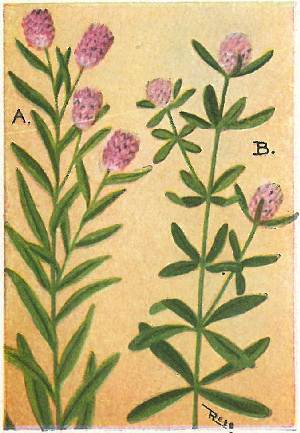
(A) Field or Purple Milkwort (Polygala sanguinea) is a sturdy little pink-headed plant that grows in fields or meadows or along roadsides.
The flowers, proper, are concealed beneath the large, broad, scale-like, crimson-pink sepals that tightly overlap each other and form the head; these scale-like sepals correspond to the wings on the Fringed Polygala, the true petals and minutely crested keel being shorter and not visible from the outside. The small, stiff, acutely pointed leaves are densely alternated on the stem up to the flower-head. The plant grows from 6 to 12 inches high, and abounds throughout the U. S.
(B) Cross-leaved Milkwort (Polygala cruciata) has spatulate-shaped leaves arranged in fours around the stem—cross-like. The stem is quite branchy, and grows from 4 to 14 inches high. At the end of each branch, seated within the four terminating leaves, is a dainty little globular pink flower-head.
We find this species around the edges of swamps or in rather moist fields, from Me. to Minn. and southward to the Gulf of Mexico, flowering from June until September.
[105]
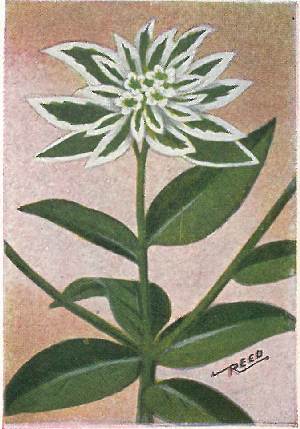
SPURGE FAMILY (Euphorbiaceæ)
Snow-on-the-Mountain; White-edged Spurge (Euphorbia marginata) is a large, bushy herb often cultivated because of its beautiful, white-margined foliage. The stem is very stout and branchy, and grows from 2 to 3 feet high. The leaves are dark green, large, ovate-pointed, and seated on the stem; the lower ones are quite similar in shape to those of the common Milkweed and are alternated on the stem; those near the end of the branches are crowded, opposite, or whorled about the stem; the terminal ones have the edges of the leaves more or less widely margined with white.
The flowers are rather small, grouped in clusters in the centre of the terminal cluster of margined leaves. The staminate and pistillate flowers are on different plants. The involucre is five-parted and has five white petals.
When broken both the leaves and stems exude quantities of a milky juice. This species of Spurge grows in dry soil from Minn. and Ohio west to Colorado, and is sometimes found in parts of the East.
[106]
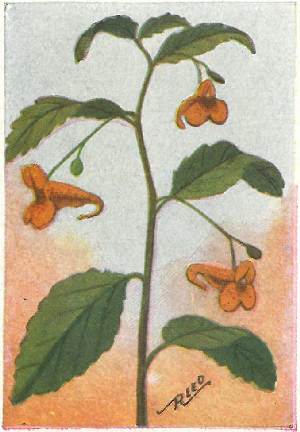
JEWEL-WEED FAMILY (Balsaminaceæ)
Jewel-weed; Spotted Touch-me-not (Impatiens biflora) is a common rank-growing herb with a stout but fragile branching stem. The large, inflated flower-sac, which is really one of the three sepals, is orange-yellow, spotted with brown. Two of these singular flowers droop from the ends of each thread-like peduncle, but only one flowers at a time.
The slim seed-pod is the cause of two very commonly applied names—Touch-me-not and Snapweed. When nearly ripe these pods can scarcely be touched but what they will suddenly, almost explosively, burst and scatter their seeds in all directions. One not acquainted with their ways is always startled when he accidentally brushes against the mature Touch-me-not.
The leaves are very delicate in appearance, and their light, slender stems are almost translucent; they are ovate, round-toothed, dull-green above, and whitish-green below. Common in shady places throughout the United States.
[107]
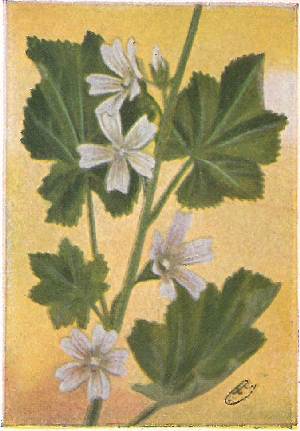
MALLOW FAMILY (Malvaceæ)
Common Mallow; Cheeses (Malva rotundifolia) (European) is a very common weed about dooryards, especially in the country, and along the edges of cultivated fields. The long stalks spring from biennial roots and creep over the ground, the branches being 6 to 24 inches in length. The dark-green, round leaves are very handsome; they have a shallow-lobed and very firmly toothed edge and are deeply, palmately ribbed. The leaves, their stems and the plant stems are rather rough.
The small, widespread, bell-shaped flowers are clustered close to the stalk on short stems from the axils of the leaves. The five petals have notched tips, are white, delicately tinted with pink or pale magenta, and have veinings of a deeper shade. The seed is hard, flat, and rounded, composed of a dozen or more carpels; it is eaten by children with great relish, these being the “cheeses” that give the species one of its common names.
[108]
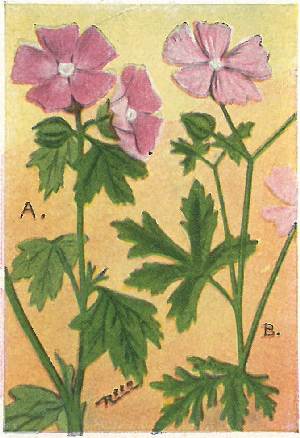
(A) High Mallow (Malva sylvestris) (European) is a tall biennial with a coarse branching stem, often attaining a height of 3 feet, or even more on waste land. Both the stems and the leaves have a thick covering of hair. The flowers grow in clusters of perhaps a half-dozen from the axils of the leaves; they have five heart-shaped petals of a purplish color, with two or three conspicuous veins of a darker shade.
The Mallows get their generic name of Malva, in allusion to the soothing effect of the mucilaginous juices of the root and stem.
(B) Musk Mallow (Malva moschata) (European) is a similar species with the leaves deeply and palmately slashed and toothed. Several hairy branching stems proceed from the perennial root to heights of 1 or 2 feet. The flowers are peculiar in that the ends of each of the five rose-colored petals are roughly notched, looking as though they had been bitten off.
This species received its name from the fact that when the leaves are crushed they give forth a slight odor of musk. It is quite abundant in northern New England and southern Canada.
[109]
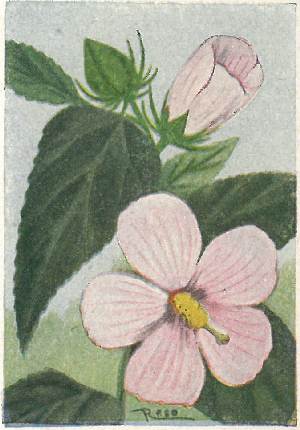
Rose Mallow (Hibiscus Moscheutos) is a tall, leafy perennial, bearing flowers that easily rank as being among the largest and most beautiful of any of our wild flowers. The stem is quite stout and inclined to be hairy. The large leaves are ovate-pointed and toothed; they are stemmed, and alternate along the main plant stalk. The lower ones are often three-lobed.
The flowers grow on short stems at the end of the upright stalk. But one usually blooms at a time and there are not a great many buds; what they lack in profusion of bloom this species fully makes up in size, for its blossoms measure 4 to 6 inches across. The five large petals are a delicate rose color, conspicuously veined, and often with crimson bases. The long, slender pistil divides at the tip into five flat-headed stigmas; for more than half its length it is encased in the long stamen column, the sides of which are covered with yellow anthers.