FLOWER GUIDE (continued 3)
Reading edition
The present species adopts the policy of the Beggar-ticks, but instead of single seeds, it attaches the whole bur-like head by means of its numerous little hooks. They cling tenaciously to everything they touch; doubtless most of my readers recall massing these burs together to make castles, funny men, animals, etc.
[202]
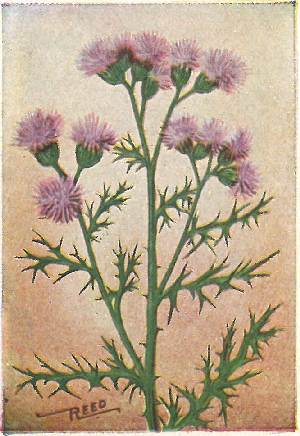
Canada Thistle (Cirsium arvense) (European) is a small-flowered, perennial species that has strayed across the ocean and become a pernicious weed.
The stem is rather slender, branching, and grows from 1 to 3 feet in height. It grows from a perennial, creeping rootstalk, that is, as farmers have discovered, very difficult to eradicate from the soil. It grows in extensive colonies and, unless strenuous efforts are made to destroy them, they very soon take possession of a field to the exclusion of almost everything else.
The leaves, that grow alternately and closely together on the stem, are long, lance-shaped, deeply cut into sharply prickled lobes. Numerous flower-heads, about one inch across, terminate the branches. When in full bloom, the florets vary in color from rose-purple to white; the involucre is almost globular and covered with over-lapping bracts, each with a tiny, sharp, out-turned point.
All the thistles yield an abundance of nectar and are frequented by bees and butterflies.
[203]
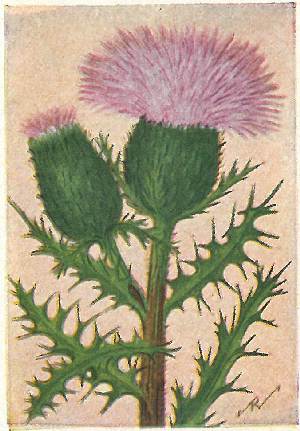
Bull Thistle (Cirsium lanceolatum) is the thistle that we most often see in fields and pastures. It is one of the largest of the genus, its heads often measuring 3 inches across. The stem is stout and simple, and grows from 1 to 3 feet high; it is hairy and angular in section and grows from a biennial rootstalk.
The flower-heads are very large, 2 to 3½ inches across and usually solitary, although frequently two heads grow on the same stalk. The leaves are lance-shaped, green, clasping, rather hairy, pinnatifid and armed with short, stout prickles. Just below the flowers are several small bract-like leaves, also armed with sharp prickles. All this armor tends to discourage pilfering insects from crawling up the stem; should they persist and reach the large involucre, which is also armed, they will find that, in addition, it is slightly sticky, and presents an impenetrable barrier to their upward progress. This species is common from Me. to Del. and Pa. It blooms from July until September.
[204]
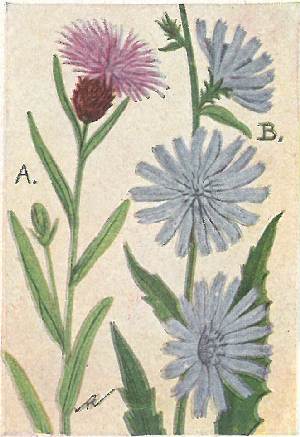
(A) Star Thistle (Centaurea nigra, var. radiata). The slender stein branches slightly and rises to heights of 1 to 2 feet, each branch bearing a solitary flower-head at the end. The flower-head has a round involucre of tawny, or dark brown, dry bracts; the florets are all tubular and rose-purple.
This species, which is introduced from Europe, grows in waste places and along roadsides from N. S. to Ontario and south to N. J. and Pa. It may be found in bloom from July until September.
(B) Chicory; Succory (Cichorium intybus) (European) has become thoroughly naturalized and is common in the eastern half of the United States, especially so near the coast.
The stem is stiff, tough, and angular in cross-section; it attains heights of from 1 to 3 feet. The leaves are long-lanceolate, dark gray-green and coarsely toothed. The flowers are very beautiful—a violet-blue, approaching a pure blue in color. There are at least two ranks of strap-shaped rays, the inner ones much shorter, all toothed at the ends. Succory blooms in dry situations from July until October.
[205]
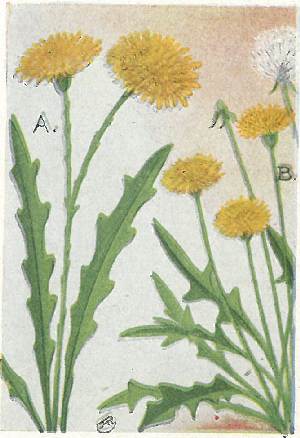
(A) Fall Dandelion (Leontodon autumnalis) (European) is a small dandelion, naturalized from Europe and common in the Eastern States during fall, or from the latter part of July. The leaves, tufted at the base of the flower scape, are long and narrow and have blunt teeth. The flower scape is long and slender and usually forks near the summit, bearing two or three flower-heads, rarely only one; the scape attains heights of 7 to 18 inches. The flower stalk is not hollow like that of the common dandelion, but is solid. It grows in fields and along roadsides and is quite common from Newfoundland to Mich. and south to Pa.
(B) Dwarf Dandelion; Cynthia (Krigia virginica) is a tiny little plant as compared to the common dandelion. The leaves are all basal on rather long petioles; they are coarsely and sharply, or laciniately, toothed. Numerous unbranching, slender flower scapes rise from these tufts of basal leaves, each bearing at the summit a little golden-rayed flower resembling a dandelion.
Cynthia is a very common native species and is found blooming from April until July in dry fields, open wilds, or sandy soil, from southern Canada to the Gulf.
[206]
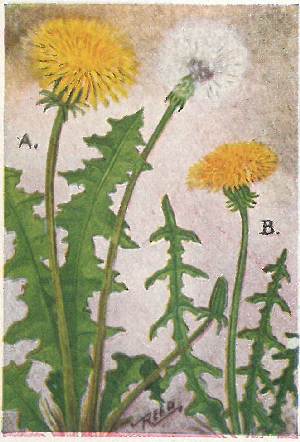
(A) Common Dandelion (Taraxacum officinale) although an immigrant to our land, has extended its range from the Atlantic to the Pacific, and is as well, or better known, as any other wild flower that we have. As every one knows its green, jagged leaves form a staple article of food and can be purchased in markets in spring at so much per peck. This species, with its large, flat, rosette of leaves and bright sunny flowers needs no description; it is well shown on the accompanying plate. All parts contain a bitter milky juice that exudes freely whenever the plant is broken.
The dandelion blooms most abundantly during the spring months but may be also found during every other month, even in winter. The name dandelion, of course, refers to the jagged edge of the leaves.
(B) Red-seeded Dandelion (Taraxacum erythrospermum) is a smaller species, also European, with more deeply cut leaves (pinnatifid) and with reddish-brown seeds, whereas those of the preceding species are usually olive-green. Common in dry fields from Me. to Pa. and westward to the Mississippi.
[207]
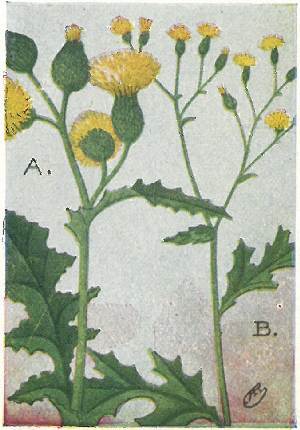
(A) Sow Thistle (Sonchus oleraceus) (European). This species is not a real thistle at all and the name “Sow” is applied rather as a term of derision, signifying spurious or worthless.
The stem is stout, smooth, grooved, hollow, and succulent; it attains heights of 1 to 6 feet. The leaves are shaped more like those of the dandelion than a thistle, but are armed with soft spikes. The small, thistle-like flower-heads are light yellow; they grow in loose clusters, terminating the branches.
(B) Wild Lettuce (Lactuca canadensis) is one of the rankest-growing of our native plants. The milky-juiced, branching, smooth stem ranges in heights from 3 to 10 feet. The leaves are all very angular, cut, toothed, and gouged in all manner of forms. Those near the base of the stem are very large, often attaining lengths of more than a foot. They become smaller and less deeply lobed as they mount the stem, the upper, small ones being almost entire edged. The small, yellow-rayed flowers are numerous but uninteresting. At maturity they are succeeded by silky beards of down, proceeding from the deep vase-like involucres.
[208]
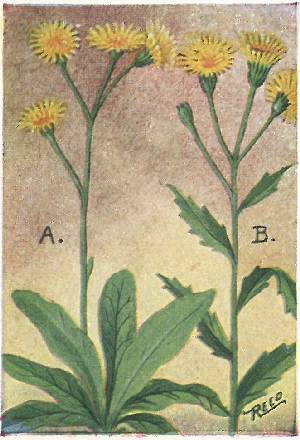
(A) Rattlesnake-weed (Hieracium venosum) is commonly found in dry sandy places and in open woods. It can readily be recognized by the tuft of spatulate leaves spreading from the root, each leaf having strong veinings of purple.
A solitary stem, branching slightly at the top, grows from the centre of the tuft of leaves. The flower-heads are composed of bright, golden-yellow rays seated in a rather deep involucre; they resemble little dandelions but the rays are fewer in number. Rattlesnake-weed blooms from June until September and ranges from Me. to Minn. and southward to Ga.
(B) Canada Hawkweed (Hieracium canadense) is a smooth, slender, leafy-stemmed species. Besides the large, spreading, basal ones, the stem is alternately set with stemless, lance-shaped, sharply toothed, light green leaves. The flowers are practically like those of the last species. In October, they are replaced by little brownish globes of down. Canada Hawkweed is common on the borders of woods from Newfoundland to British Columbia south to N. J., Mich., and Oregon. It blooms from July until September.
[209]