Front matter (continued 7)
Reading edition
While the illustrations to the Voyages formed their chief occupation, the De Brys found time to engrave many smaller plates for less important books. Thus in 1593 Theodor de Bry issued an emblem book Emblemata nobilitati et vulgo scitu digna (text in Latin and German), in which each emblem is enclosed in an engraved border, mostly quite meaningless and bad as regards composition, but of a brilliancy in the “goldsmiths’ style” which to lovers of bookplates will suggest the best work of Sherborn or French. The plates marked B and D, illustrating the lines “Musica mortales divosque oblectat et ornat” and “Cum Cerere et Baccho Veneri solemnia fiunt,” are especially fine and the “emblems” themselves more pleasing than usual.
In 1595 there was printed, again with Latin and German text, a Noua Alphabeti effictio, historiis ad singulas literas correspondentibus. The motif is throughout scriptural. Thus for A Adam and Eve sit on the crossbar on each side of the letter, the serpent rests on its peak amid the foliage of the Tree of Knowledge. In B Abel, in C Cain is perched on a convenient part of the letter, and so on, while from one letter after another, fish, birds, fruit, flowers, and anything else which came into the designer’s head hang dangling on cords from every possible point. Nothing could be more meaningless or lower in the scale of design, yet the brilliancy of the execution carries it off.
The year after this had appeared Theodor de Bry engraved a series of emblems conceived by Denis Le Bey de Batilly and drawn by J. J. Boissard. The designs themselves are poor enough, but the book has a pretty architectural titlepage, and this is followed by a portrait of Le Bey set in an ornamental border of bees, flowers, horses, and other incongruities, portrait and border alike engraved with the most brilliant delicacy (see Plate XXXVII). In the following year, again, 1597, the two younger De Brys illustrated with line engravings the Acta Mechmeti Saracenorum principis, and (at the end of these) the Vaticinia Severi et Leonis as to the fate of the Turks, also the David of Arias Montanus. The plates are fairly interesting, but in technical execution fall far below those of their father.
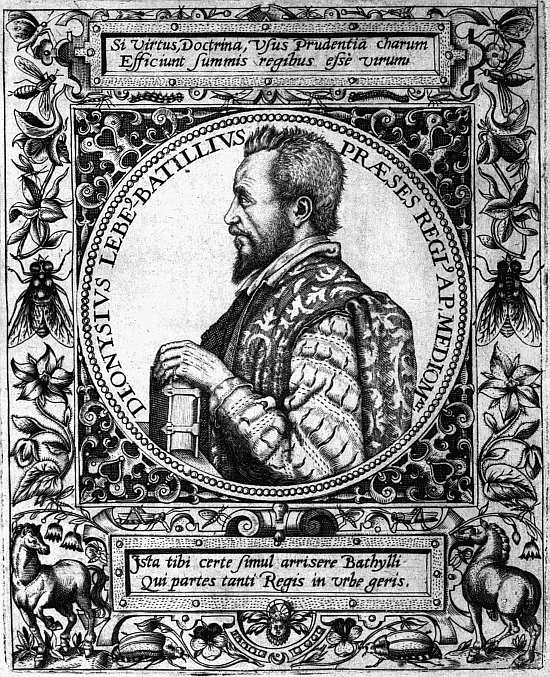
XXXVII. FRANKFORT, DE BRY, 1596 LE BEY. EMBLEMATA. PORTRAIT OF AUTHOR BY T. DE BRY, AFTER J. J. BOISSARD
Turning now to England, we find engraving in use surprisingly early in some figures of unborn babies in The Birth of Mankind, translated from the Latin of Roesslin by Richard Jonas and printed in 1540 by Thomas Raynold, a physician, who five years later issued a new edition revised by himself, again with engravings. In 1545 there appeared a much more important medical work, a Compendiosa totius anatomie delineatio professedly by Thomas Geminus, a Flemish surgeon and engraver attached to the English Court. In reality this was a rather shameless adaptation of the De Fabrica Humani Corporis of Vesalius (Basel, 1543), with engravings copied by Geminus from the woodcuts of his original. For us its chief interest lies in an elaborate engraved titlepage showing the royal arms surrounded by a wealth of architectural and strapwork ornament in the style, if not actually the work, of Peter Cock of Alost, as has been shown by Sir Sidney Colvin in the invaluable introduction to his Early Engravings and Engravers in England (1905). In 1553 an English translation of the anatomy was published by Nicholas Hyll, and in a second edition of this, printed in 1559, a rather heavy and stiff portrait of Elizabeth replaces the royal arms, which were burnished out to make room for it. Geminus subsequently produced a much larger portrait of the Queen, set in an architectural frame studded with emblematical figures, and a royal proclamation forbidding unauthorized “Paynters, Printers, and Gravers” to meddle with so great a subject seems to have been provoked by his handiwork.
In 1563 John Shute for his work on The First and Chief Groundes of Architecture produced four amateurish engravings to illustrate four of the five “orders,” a woodcut being considered good enough for the fifth. In 1568 we find the first edition of the “Bishops’” Bible adorned with an engraved titlepage in the centre of which, in an oval, is a not unpleasing portrait of the Queen, holding sceptre and orb, set in a mass of strapwork, amid which are seated Charity and Faith with the royal arms between them, while below the portrait a lion and dragon support a cartouche enclosing a text. Besides this titlepage, attributed by Sir Sidney Colvin to Franciscus Hogenberg, before the book of Joshua there is an engraved portrait of Leicester, while the “Blessed is the man” of the first Psalm is heralded by another engraved portrait which shows Lord Burghley holding in front of him a great B. In 1573 Remigius Hogenberg, brother of Franciscus, engraved after a picture by John Lyne a stiff but rather impressive portrait of Archbishop Parker, prefixed to some copies of his De Antiquitate Ecclesiae Britanniae. The year before this the second edition of the “Bishops’” Bible had been enriched with a decorative engraved map of the Holy Land, and in 1574 Archbishop Parker employed John Lyne to engrave for the De Antiquitate Academiae Cantabrigiensis of Dr. Caius (printed by Day) a plate of the arms of the colleges, a plan of the University schools, and a large map of the town. In 1579 there appeared a work which had occupied the intermediate five years, a series of maps of England from the drawings of Christopher Saxton, engraved by Augustine Ryther (like Saxton a native of Leeds), Remigius Hogenberg and others, and with a fine frontispiece showing the Queen seated in state beneath an architectural canopy, which Sir Sidney Colvin thinks may perhaps be the work of Ryther. Ryther was subsequently concerned with other maps, including the series illustrating the defeat of the Armada (Expeditionis Hispanorum in Angliam vera descriptio), and other cartographers got to work who hardly concern us here. Two long engraved rolls, the first by Marcus Gheraerts, representing a procession of the Knights of the Garter (1576), the second by Theodor de Bry, from the designs of Thomas Lant, the funeral of Sir Philip Sidney (1587), although most safely preserved when bound in book form, can hardly be reckoned as books. Yet over the latter I must stop to confess a dreadful sin of my youth, when I jumped to the conclusion that the portrait on the first page stood for Sidney himself, whereas it really represents the too self-advertising Lant. That it appears in the sky, above the Black Pinnace which bore home Sidney’s body, and itself bears the suggestive motto “God createth, Man imitateth, Virtue flourisheth, Death finisheth,” may palliate but cannot excuse the crime which enriched an edition of Astrophel and Stella with a portrait, not of Sidney, but of the illustrator of his funeral.
Not until 1590, when Hugh Broughton’s Concent of Scripture was accompanied by some apocalyptic plates engraved by Jodocus Hondius (subsequently copied by W. Rogers), do we come across what can really be called engraved illustrations in an English book, and these, which are of little interest, were speedily eclipsed the next year by Sir John Harington’s Orlando Furioso in English Heroical verse with its engraved titlepage and forty-six plates. Of these the translator writes in his introduction:
As for the pictures, they are all cut in brasse, and most of them by the best workemen in that kinde, that haue bene in this land this manie yeares: yet I will not praise them too much, because I gaue direction for their making, and in regard thereof I may be thought partiall, but this I may truely say, that (for mine owne part) I have not seene anie made in England better, nor (in deede) anie of this kinde in any booke, except it were in a treatise, set foorth by that profound man, maister Broughton, the last yeare, upon the Reuelation, in which there are some 3. or 4. pretie figures (in octauo) cut in brasse verie workemanly. As for other books that I haue seene in this realme, either in Latin or English, with pictures, as Liuy, Gesner, Alciats emblemes, a booke de spectris in Latin, & (in our tong) the Chronicles, the booke of Martyrs, the book of hauking and hunting, and M. Whitney’s excellent Emblems, yet all their figures are cut on wood, & none in metall, and in that respect inferior to these, at least (by the old proverbe) the more cost, the more worship.
The passage is of considerable interest, but hardly suggests, what is yet the fact, that, save for the addition on the titlepage of an oval portrait of the translator and a representation of his dog, all the plates in the book are closely copied from the engravings by Girolamo Porro in the Venice edition of 1584. The English titlepage was signed by Thomas Cockson. We are left to conjecture to whom Harington was indebted for the rest of the plates.
Although, as we shall see, from this time forward a great number of English books contain engraved work, those which can be said to be illustrated during the next sixty years are few enough, a study of Mr. A. M. Hind’s very useful List of the Works of Native and Foreign Line-Engravers in England from Henry VIII to the Commonwealth,68 tempting me to place the number at about a score. The year after the Orlando Furioso came another curious treatise by Hugh Broughton, not printed with type, but “graven in brasse by J. H.,” whom Sir Sidney Colvin identifies with Jodocus Hondius, a Fleming who lived in England from about 1580 to 1594, and may have done the plates in the Concent of Scripture and some at least of those in the Orlando. Six years later (1598) we find Lomazzo’s Tracte containing the artes of curious Paintinge with an emblematical titlepage and thirteen plates by Richard Haydock, the translator, four of the plates being adapted from Dürer’s book on Proportion, and all of them showing very slight skill in engraving. In 1602 came Sir William Segar’s Honour, Military and Civil, with eight plates showing various distinguished persons, English and foreign, wearing the robes and insignia of the Garter, the Golden Fleece, S. Michael, etc. Three of the plates are signed by William Rogers, the most distinguished of the English Elizabethan engravers, and the others are probably his also. Most of them are very dignified and effective in the brilliantly printed “first states” in which they are sometimes found, but ordinary copies with only the “second states” are as a rule disappointing.
The beginning of the reign of James I was directly responsible for one ambitious engraved publication, Stephen Harrison’s The Archs of Triumph erected in honor of the High and mighty prince James, the first of that name king of England and the sixt of Scotland, at his Maiesties Entrance and passage through his Honorable City & Chamber of London vpon the 15th day of march 1603 [1604] Invented and published by Stephen Harrison Joyner and Architect and graven by William Kip. Here an engraved titlepage, with dangling ornaments in the style of the De Bry alphabet, is followed by seven plates of the seven arches, the most notable of which (a pity it was not preserved) was crowned with a most interesting model of Jacobean London, to which the engraver has done admirable justice.
In 1608 came Robert Glover’s Nobilitas politica et civilis, re-edited two years later by T. Milles as the Catalogue of Honour, with engraved illustrations (in the text) of the robes of the various degrees of nobility, attributed by Sir Sidney Colvin to Renold Elstracke, the son of a Flemish refugee, and also two plates representing the King in a chair of state and in Parliament. After this we come to two works illustrated by an English engraver of some note, William Hole, Tom Coryat’s Crudities (1611), with a titlepage recalling various incidents of his travels (including his being sick at sea) and five plates (or in some copies, six), and Drayton’s Polyolbion (1612, reissued in 1613 with the portrait-plate in a different state), with a poor emblematic title, a portrait of Prince Henry wielding a lance, and eighteen decorative maps of England. In 1615 we come to a really well-illustrated book, the Relation of a Journey, by George Sandys, whose narrative of travel in Turkey, Egypt, and the Holy Land, and parts of Italy, is accompanied with little delicately engraved landscapes and bits of architecture, etc., by Francis Delaram. The work of the decade is brought to a close with two print-selling ventures, the Basiliωlogia of 1618 and Herωologia of 1620. The former of these works describes itself as being “the true and lively effigies of all our English Kings from the Conquest untill this present: with their severall Coats of Armes, Impreses and Devises. And a briefe Chronologie of their lives and deaths. Elegantly graven in copper. Printed for H. Holland and are to be sold by Comp.[ton] Holland over against the Exchange.” The full set of plates numbers thirty-two, including eight additions to the scheme of the book, representing the Black Prince, John of Gaunt, Anne Boleyn, a second version of Elizabeth, Mary Queen of Scots, Anne of Denmark, Prince Henry, and Prince Charles. Fourteen of the plates, mostly the earlier ones, are signed by Elstracke, and Simon Passe and Francis Delaram each contributed four. It need hardly be said that they are of very varying degrees of authenticity as well as merit. Several of the later plates are found in more than one state.
With the second of the two ventures Henry Holland was also concerned, but the expenses of the book were shared by Crispin Passe and an Arnhem bookseller named Jansen. Its title reads: “Herωologia Anglica: hoc est clarissimorum et doctissimorum aliquot Anglorum qui floruerunt ab anno Cristi MD. usque ad presentem annum MDCXX.” It is in two volumes, the first containing thirty-seven plates, the second thirty. Two of these represent respectively Queen Elizabeth’s tomb and the hearse of Henry Prince of Wales. All the rest are portraits of the notable personages of the reigns of Henry VIII and his successors, some of them based on drawings by Holbein, the majority on earlier prints, and all engraved by William Passe (younger brother of Simon) and his sister Magdalena.
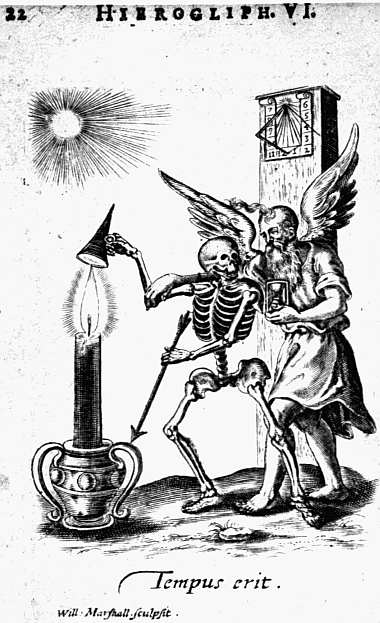
XXXVIII. LONDON. J. MARRIOT, 1638 QUARLES. HIEROGLYPHIKES OF THE LIFE OF MAN. PAGE 22 ENGRAVED BY W. MARSHALL
The next decade was far from productive of works illustrated with more than an engraved titlepage and a portrait, but in 1630 appeared Captain John Smith’s True Travels with several illustrations, one of them by Martin Droeshout; in 1634-5 came Wither’s Emblems, with plates by William Marshall, and in 1635 Thomas Heywood’s Hierarchie of the Blessed Angels, with an engraved title by Thomas Cecill and plates representing the several orders, Seraphim, Cherubim, and Thrones being entrusted to John Payne, Dominations to Marshall, Powers and Principalities to Glover, Virtues to Droeshout, etc. Some of the plates record the name of the patron who paid for them, another suggestion that it was money which stood most in the way of book-illustrating. In 1638 Marshall illustrated Quarles’s Hieroglyphikes of the Life of Man, with engravings, most of which seem chiefly made up of a candle, but in one the candle is being extinguished by Death egged on by Time, and to this not very promising subject (Plate XXXVIII) Marshall, the most unequal engraver of his day, has brought some of his too rare touches of delicacy and charm. In 1640 Wenceslaus Hollar, whom Thomas Earl of Arundel had discovered at Cologne (he was born at Prague) and brought to England, published his charming costume book Ornatus Muliebris Anglicanus, and his larger work, Theatrum Mulierum, must have been almost ready when Charles I hoisted his standard at Nottingham, since it was published in 1643. After this the Civil War interfered for some time with the book trade.
While fully illustrated books were thus far from numerous in the half century which followed the Orlando Furioso of 1591, the output of engraved titlepages and portraits to be prefixed to books was sufficient to find work for most of the minor engravers. The earlier titlepages were mostly architectural and symbolical, their purport being sometimes explained in verses printed opposite to them, headed “The Mind of the Front.” William Rogers engraved a titlepage to Gerard’s Herbal (1597), which is never found properly printed, and others to Linschoten’s Discourse of Voyages into ye East and West Indies (1598), Camden’s Britannia (1600—a poor piece of work), and Moffett’s Theatrum Insectorum, this last having only survived in a copy pasted at the head of the author’s manuscript at the British Museum. William Hole did an enlarged title for Camden’s Britannia (1607), titles for the different sections of Chapman’s Homer, a portrait of John Florio for the Italian-English dictionary which he was pleased to call Queen Anna’s New World of Words, a charming titlepage to a collection of virginal music known as Parthenia (1611-12), another to Browne’s Britannia’s Pastorals, and much less happy ones to Drayton’s Polyolbion (1612), and the Works of Ben Jonson (1616).
The best-known titlepages engraved by Renold Elstracke are those to Raleigh’s History of the World (1614) and the Workes of the Most High and Mightie Prince James (1616), the latter a good piece of work which when faced, as it should be, by the portrait of the king by Simon van de Passe, makes the most decorative opening to any English book of this period. Passe himself was responsible for the very imaginative engraved title to Bacon’s Novum Organum (1620), a sea on which ships are sailing and rising out of it two pillars with the inscription: “Multi pertransibunt et augebitur scientia” (Many shall run to and fro, and knowledge shall be increased). His son William, besides his work on the Herωologia, already mentioned, engraved a complicated title for Chapman’s version of The Batrachomyomachia or Battle of the Frogs and Mice, humorously called The Crowne of all Homer’s Worckes.
After 1620 the old architectural and symbolical titlepages began to be replaced by titles in compartments, in which a central cartouche is surrounded by little squares, each representing some incident of the book. Portraits of the author remained much in request, and nearly a hundred of these were done by William Marshall, who was employed also on about as many engraved titlepages. As has been noted, his work was strangely uneven, and he fully deserved the scorn poured on him by Milton for the wretched caricature of the poet prefixed to the Poems of 1645. Yet Marshall could at times do a good plate, as, for instance, that in Quarles’s Hieroglyphikes already mentioned, a portrait of Bacon prefixed to the 1640 Oxford edition of his Advancement of Learning and the charming frontispiece to Brathwait’s Arcadian Princess. Marshall at his worst fell only a little below the work of Thomas Cross; at his best he rivalled or excelled the good work of Thomas Cecill and George Glover.
After Cromwell’s strong hand had given England some kind of settled government the book market revived, and some ambitiously illustrated books were soon being published. The too versatile John Ogilby, dancing-master, poet, and publisher, appeared early in the field, his version of the Fables of Aesop, “adorned with sculpture,” being printed by T. Warren for A. Crook in 1651. The next year came Benlowe’s Theophila, or Love’s Sacrifice, a mystical poem, some copies of which have as many as thirty-six plates by various hands, with much more etching than engraving in them. In 1654 Ogilby produced his translation of Virgil, a great folio with plates dedicated to noble patrons by Pierre Lambart. Ogilby’s other important ventures were the large Odyssey of 1665, and the Aesop’s Fables of the same year, with plates by Hollar, D. Stoop, and F. Barlow, and two portraits of the translator engraved respectively by Pierre Lambert and W. Faithorne. Faithorne embellished other books of this period, e.g. the Poems of the “Matchless Orinda” (1667), with portraits, and publishers who could not afford to pay Faithorne employed R. White. The presence of a portrait by White in a copy of the first edition of Bunyan’s Pilgrim’s Progress, to which it was very far indeed from certain that it really belonged,69 has once made the book sell for over £1400, but save for the sake of completeness his handiwork is not greatly prized by collectors, nor is there any English illustrated book of this period after the Restoration which is much sought after for the sake of its plates, although those of Ogilby’s Virgil were sufficiently well thought of to be used again for Dryden’s version in 1697.
Meanwhile, books with illustrations en taille douce were being issued in some numbers both at Paris and at Amsterdam. In the former city François Chauveau (1613-76), in the latter Jan and Casper Luyken are credited by Mr. Hind (A Short History of Engraving and Etching, 1908) with having produced “hosts of small and undistinguished plates,” and these damning epithets explain how it is that even patriotic French collectors like Eugène Paillet and Henri Béraldi thought it wise to leave the illustrated books of the seventeenth century severely alone.
We meet the first advance guard of the brilliant French eighteenth century school of book-illustration in 1718, when a pretty little edition of Les Amours de Daphnis et Chloé (as translated by Bishop Amyot from the Greek of Longus) made its appearance with twenty-eight plates by Benoît Audran, after the designs of no less a person than the Regent of France, and duly labelled and dated “Philippus in. et pinx. 1714.” The plates vary very much in charm, but that with the underline Chloé sauve Daphnis par le son de sa flûte certainly possesses it, and one of the double-plates in the book, Daphnis prend ses oyseaux pendant l’Hyver pour voir Chloé, is really pretty. We find no other book to vie with this until we come to a much larger and more pretentious one, the works of Molière in six volumes, royal quarto, published in 1734. This was illustrated with thirty-three plates, in the mixture of etching and engraving characteristic of the French school of the day, by Laurent Cars, after pencil drawings by François Boucher, and by nearly two hundred vignettes and tailpieces (not all different) after Boucher and others by Cars and François Joullain. Another edition of this in four volumes with Boucher’s designs reproduced on a smaller scale was published in 1741 and reprinted three times within the decade.
After the Molière, books and editions which collectors take count of come much more quickly. There was an edition of Montesquieu’s Le Temple de Gnide in 1742 (imprint: Londres), a Virgil in 1743 with plates by Cochin, engraved by Cochin père, the Contes of La Fontaine (Amsterdam, 1743-5) also illustrated by Cochin, Guer’s Moeurs et usages des Turcs, with plates after Boucher (1746), an edition of the works of Boileau in five volumes, with vignettes by Eisen and tailpieces by Cochin (1743-5), and in 1753 a Manon Lescaut (imprint: Amsterdam) with some plates by J. J. Pasquier, which are stiff, and others by H. Gravelot, which are feeble.
In the four-volume edition of the Fables of La Fontaine (1755-9) with illustrations after J. B. Oudry, we come to a very ambitious piece of work, handsomely carried out, which a book-lover may yet find it hard to admire. Oudry’s designs are always adequate, and have more virility in them than is often found in the work of this school, and they are competently interpreted by a number of etchers and engravers, some of whom, it may be noted, worked together in pairs on the same plate, so that we find such signatures as “C. Cochin aqua forti, R. Gaillard cælo sculpsit,” and “Gravé à l’eau forte par C. Cochin, terminé au burin par P. Chenu”—a very explicit statement of the method of work. But adequate as the plates may seem, if they are judged not as book-illustrations but as engravings, no one could rate them high, and as a book what is to be said of an edition of La Fontaine’s Fables, which fills four volumes, each measuring nearly nineteen inches by thirteen? The bookman can only regard such a work as a portfolio of plates with accompanying text, and if the plates as plates are only second rate, enthusiasm has nothing to build on.
We return to book-form in 1757, when Boccaccio’s Decamerone was published in Italian (imprint: Londra) in five octavo volumes, with charming vignettes and illustrations mostly by Gravelot, although a few are by Boucher and Eisen. Gravelot, who was more industrious than successful as an illustrator, is seen here to advantage, and deserves some credit for having made his designs not less but more reticent than the stories he had to illustrate. This praise can certainly not be given to the famous 1762 edition of the Contes of La Fontaine, the cost of which was borne by the Fermiers-Généraux (imprint: Amsterdam). The fleurons by Choffard are throughout delightful and the plates are brilliantly engraved, but the lubricity of Eisen’s designs is wearisome in the first volume and disgusting in the second, and possessors of the book are not to be envied. It is to be regretted that the next book we have to notice, the Contes Moraux of Marmontel (3 vols., 1765), has very little charm to support its morality, the plates after Gravelot being poor, while the head- and tailpieces, or rather the substitutes for them, are wretched. A much better book than either of these last is the edition in French and Latin of Ovid’s Metamorphoses in four quarto volumes (1767-71); with plates after Boucher, Eisen, Gravelot, and Moreau, and headpieces by Choffard at the beginning of each book. The imprint, “A Paris, chez Leclerc, Quai des Augustins, avec approbation et privilège du Roi,” prepares us to find that the designers have kept their licence within bounds, and many of the plates have a combined humour and charm which are very attractive. If I had to choose a single plate to show Gravelot at his best, I doubt if prolonged search would find any success more complete than that of the illustration to Book I, xi., Deucalion et Pyrrha repeuplant la Terre, suivant l’Oracle de Themis (see the frontispiece to this volume, Plate I), and though Eisen was a much better artist than Gravelot, his Apollon gardant les troupeaux d’Admet, dans les campagnes de Messene (II, x.) is certainly one of his prettiest pieces.
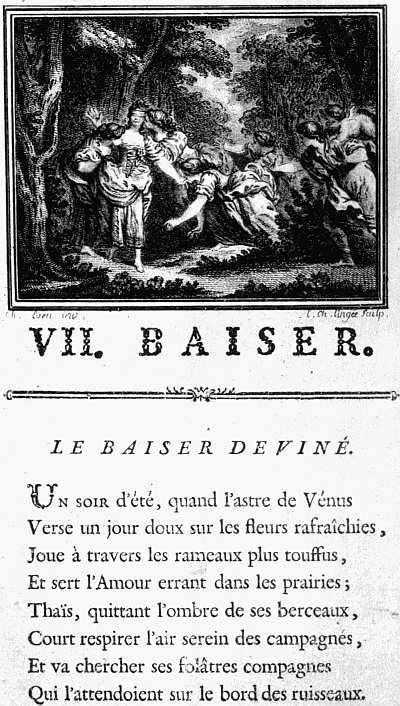
XXXIX. PARIS, LAMBERT, 1770. DORAT. LES BAISERS. PAGE WITH ENGRAVED HEADPIECE AFTER EISEN
During the next few years illustrated books became the fashion, so that in 1772 Cazotte wrote Le diable amoureux, nouvelle d’Espagne, with the false imprint Naples (Paris, Lejay) and six unsigned plates, said to be by Moreau after Marillier, on purpose to ridicule the craze for putting illustrations into every book. In 1768 the indefatigable Gravelot had illustrated an edition of the works of Voltaire, published at Geneva, with forty-four designs. In 1769 Les Saisons, a poem by Saint Lambert, was published at Amsterdam, with designs by Gravelot and Le Prince and fleurons by Choffard. In the same year there was published at Paris Meunier de Queslon’s Les Graces, with an engraved title by Moreau, a frontispiece after Boucher, and five plates after Moreau. In 1770 came Voltaire’s Henriade with ten plates and ten vignettes after Eisen, and more highly esteemed even than this, Dorat’s Les Baisers (La Haye et Paris), with a frontispiece and plate and forty-four head- and tailpieces, all (save two) after Eisen, not easily surpassed in their own luxurious style (see Plate XXXIX). In 1771 Gravelot, more indefatigable than ever, supplied designs for twenty plates and numerous head- and tailpieces for an edition of Tasso’s Gerusalemme Liberata, and was honoured, as Eisen had been in the Fermiers-Généraux edition of La Fontaine’s Contes, by his portrait being prefixed to the second volume. In 1772 a new edition of Montesquieu’s Le Temple de Gnide, in which the text was engraved throughout, was illustrated with designs by Eisen, brilliantly interpreted by Le Mire, and Imbert’s Le Jugement de Paris was illustrated by Moreau, With, fleurons by Choffard. In 1773 Le Temple de Gnide was versified by Colardeau, and illustrated by Monnet, and selections from Anacreon, Sappho, Bion, and Moschus by Eisen, while Moreau and others illustrated the Chansons of Laborde in four volumes and the works of Molière in six. After this the pace slackened, and we need no longer cling to the methods of the annalist. Moreau illustrated Saint Lambert’s Les Saisons and Fromageot’s Annales du règne de Marie Therèse (both in 1775), Marmontel’s Les Incas (1777), the seventy-volume Voltaire (1784-9), Paul et Virginie (1789), and many other works, living on to illustrate Goethe’s Werther in 1809; other books were adorned by Marillier, Cochin, Duplessis, Bertaux, Desrais, Saint Quentin, Fragonard, Gérard, and Le Barbier, and the fashion survived the Revolution and lingered on till about 1820.
We must go back now to England, where at the end of the seventeenth century the requirements of book-illustration were neglected, partly because of the growing taste for a neat simplicity in books, partly because the chief English engravers all devoted themselves to mezzotint. A few foreigners came over to supply their place, and Michael Burghers, of Amsterdam, illustrated the fourth edition of Paradise Lost, a stately folio, in 1688, with plates which enjoyed a long life and were also imitated for smaller editions. Burghers also illustrated the Oxford almanacs, and supplied frontispieces to the Bibles and other large books issued by the University Press up to about 1720. Another Dutchman who came to England not much later (in about 1690) was Michael Van der Gucht, who worked for the booksellers, as his children did after him. How low book-illustration had fallen in England at the beginning of the eighteenth century may be seen by a glance at the wretched plates which disfigure Rowe’s Shakespeare in 1709, the first edition on which an editor and an illustrator were allowed to work their wills. The year after this Louis Du Guernier came to England, and was soon engaged in the not too patriotic task of helping Claude Du Bosc to illustrate the victories of Marlborough. In 1714 he and Du Bosc were less painfully, though not very successfully, employed in making plates for Pope’s Rape of the Lock. Du Bosc subsequently worked on the Religious Ceremonies of all Nations (1733), an English edition of a book of Bernard Picart’s, and on plates for Rapin’s History of England (1743), but he was far from being a great engraver. It is a satisfaction that the plates to the first edition of Robinson Crusoe (1719) were engraved by two Englishmen, and not very badly. Their names are given as “Clark and Pine,” the Clark being presumably John Clark (1688-1736), who engraved some writing-books, and the Pine, John Pine (1690-1756), who imitated some designs by Bernard Picart to the book of Jonah in 1720, and may have been a pupil of his at Amsterdam.
It should, perhaps, have been mentioned that two years before Crusoe an English engraver, John Sturt (1658-1730), produced a Book of Common Prayer, of which the text as well as the pictures was engraved. This is rather a curiosity than a work of art, the frontispiece being a portrait of George I made up of the Creed, Lord’s Prayer, Ten Commandments, Prayer for the Royal Family, and Psalm XXI. written in minute characters, instead of lines. Sturt produced another engraved book, The Orthodox Communicant, in 1721.
In 1723 William Hogarth began what might have proved a notable career as a book-illustrator had not he soon found more profitable work. He illustrated the Travels of Aubry de la Mottraye in 1723, Briscoe’s Apuleius (1724), Cotterel’s translation of Cassandra (1725), Blackwell’s Compendium of Military Discipline (1726), and (also in 1726) Butler’s Hudibras, his plates to which, though grotesque enough, show plenty of character. For some years after this he worked on frontispieces, e.g. to Leveridge’s Songs (1727), Cooke’s Hesiod (1728), J. Miller’s comedy, The Humours of Oxford (1729), Theobald’s Perseus and Andromeda (1730), and in 1731 to a Molière, Fielding’s Tragedy of Tragedies, and Mitchell’s Highland Fair. But the success of his set of prints on “The Harlot’s Progress” diverted him from bookwork, although many years after he contributed frontispieces to Vols. II and IV of Tristram Shandy, and in 1761 a head-and tailpiece (engraved by Grignion) to a Catalogue of the Society of Arts.
In 1733 Hubert Gravelot was invited from France by Du Bosc to help in illustrating Picart’s Religious Ceremonies. He illustrated Gay’s Fables in 1738, Richardson’s Pamela in 1742, Theobald’s Shakespeare in 1740, and, mainly after Hayman, Hanmer’s in 1744-6. Neither of the sets of Shakespeare plates deserves any higher praise than that of being neat and pretty, but at least they were a whole plane above those in Rowe’s edition.
The year after Gravelot came to England, in 1733, Pine produced the first volume of his Horace, engraved throughout, and with head- and tailpieces in admirable taste. The second volume followed in 1737, and in 1753 the first of an illustrated Virgil which Pine did not live to complete.
Besides his work on Hanmer’s Shakespeare, Francis Hayman designed illustrations to Moore’s Fables of the Female Sex (1744), which were well engraved, some of them by Charles Grignion, a pupil of Gravelot’s, born in England (1717), but of foreign parentage. Hayman also illustrated the Spectator (1747), Newton’s Milton (1749-52), and later on, with the aid of Grignion, Smollett’s Don Quixote (1755), and Baskerville’s edition of Congreve’s Poems (1761). The plates to the earlier edition of Don Quixote, that of 1738, had been chiefly engraved by Gerard van der Gucht after Vanderbank, but two are by Hogarth.
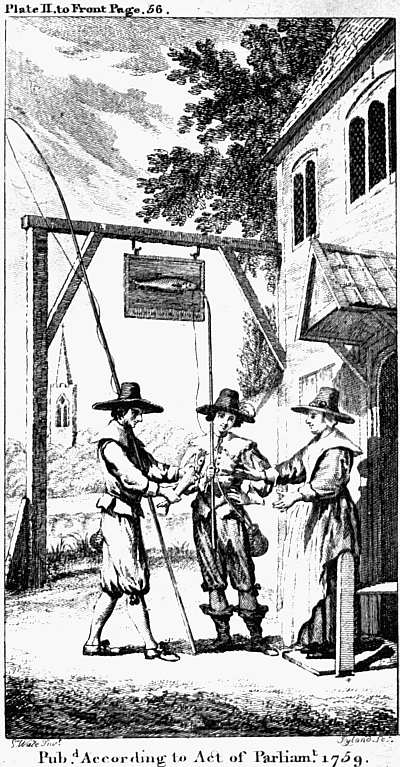
XL. LONDON, T. HOPE, 1760 WALTON, COMPLEAT ANGLER W. W. RYLANDS AFTER S. WALE
Samuel Wale (died 1786), a pupil of Hayman, was also an illustrator, and in 1760 supplied Sir John Hawkins with fourteen drawings for his edition of Walton’s Angler. These were engraved by the luckless W. W. Rylands, who was hanged for forgery in 1783, and the Walton thus produced is one of the prettiest and least affected of the illustrated books of its day (see Plate XL). Wale also drew designs for Wilkie’s Fables (1768) and Goldsmith’s Traveller (1774). He also worked for the magazines which about the middle of the century made rather a feature of engravings, often as headpieces to music. A few of the isolated books may be named, thus Paltock’s Peter Wilkins (1750) was illustrated very well by Louis Peter Boitard, who had previously contributed numerous plates to Spence’s Polymetis, and in 1751 supplied a frontispiece to each of the six books of the Scribleriad by R. O. Cambridge. Another book which, like Peter Wilkins, was concerned with flight, Lunardi’s Account of the first aerial voyage in England (1784), has a portrait of the author by Bartolozzi and two plates. For Baskerville’s edition of the Orlando Furioso (Birmingham, 1773) recourse was had to plates by De Launay, after Moreau and Eisen.
65 “In quo precipue tractat: An amico sepe ad scribendum prouocato ut scribat, non respondenti sit amplius scribendum.”
66 It was probably from his Horae plates that Plantin illustrated the rerum Sacrarum Liber of Laur. Gambara in 1577. They are printed with the text and are of average merit.
67 They were bought to accompany the fine set of De Bry collected by Mr. Grenville, but have since been transferred to the Department of Prints and Drawings.
68 Contributed to the work by Sir Sidney Colvin, Early Engravers and Engraving in England, already quoted.
69 This was an early proof of the portrait which is found in a slightly different state in copies of the third edition, and seemed to be an insertion in the first edition rather than an integral part of it.
CHAPTER XVI
MODERN FINE PRINTING
After the Restoration, printing and the book trade generally in England became definitely modern in their character, and the printer practically disappears from view, his work, with here and there an exception, as in the case of Robert Foulis or John Baskerville, being altogether hidden behind that of the publisher, so that it is of Herringman and Bernard Lintott and Dodsley that we hear, not of Newcomb and Roycroft.
Notwithstanding this decline in the printer’s importance, there was a steady improvement in English printing. As an art it had ceased at this time to exist. If a publisher wished to make a book beautiful he put in plates. If he wanted to make it more beautiful he put in more or larger plates. If he wanted to make it a real triumph of beauty he engraved the whole book, letterpress and all, as in the case of Sturt’s Prayer Books and Pine’s Horace. That a printer by the selection and arrangement of type, by good presswork and the use of pretty capitals and tailpieces, could make a book charming to eye and hand, without any help from an illustrator—such an idea as this had nearly perished. There was little loss in this, since if any artistic work had been attempted it would assuredly have been bad, whereas the craftsmen, when set to do quite plain work, gradually learnt to do it in a more workmanlike way. In this they were helped by certain improvements in printing which rendered the task of the pressman less laborious. In the middle of the seventeenth century William Blaew, of Amsterdam, invented an improved press, “fabricated nine of these new fashioned presses, set them all on a row in his Printing House and called each Press by the name of one of the Muses.” Clearly Blaew was an enthusiast. His chronicler, Joseph Moxon, was a fairly good English printer, and his description of the equipment of a printing house in the second part of his Mechanick Exercises (1683) contains much information still interesting. We gather from Moxon that Blaew’s improvements were slowly copied in England, and we know that the English printers still continued to buy their best founts from Holland. Thus when Bishop Fell, about 1670, was equipping the University Press at Oxford with better type, he employed an agent in Holland to purchase founts for him. English founts of which we have any reason to be proud date from the appearance about 1716 of William Caslon, who established a firm of type founders which has enjoyed a long and deservedly prosperous career.
The next move came from the north. Robert Foulis (the name was originally spelt Faulls), born in 1707, the son of a Glasgow maltster, had been originally apprenticed to a barber. He was, however, a man of bookish tastes, and, when already over thirty years of age, was advised to set up in business as a printer and bookseller. With his brother Andrew, five years younger than himself and educated for the ministry, he went on a book-buying tour on the Continent, and on his return started book-selling in 1741, and printed in that year Dr. William Leechman’s Temper, Character, and Duty of a Minister of the Gospel, and four other books, including a Phaedrus and a volume of Cicero. In March, 1743, he was appointed Printer to the University of Glasgow, and his edition of Demetrius Phalerus de Elocutione in Greek and Latin was the first example of Greek printing produced at Glasgow. A Horace which was hung up in proof in the University, with the offer of a reward for every misprint detected (in spite of which six remained), followed in 1744, an Iliad in 1747, an edition of Hardyknute in 1748, and a Cicero in 1749. In 1750 as many as thirty works were printed at the Foulis press. The next two years were mainly spent in touring on the Continent, and on his return Robert Foulis unhappily started an Academy of Art at Glasgow, which he had neither the knowledge nor the taste to direct successfully, and which sapped his energies without producing any valuable results. An edition of the Greek text of Callimachus in 1755 was rewarded by an Edinburgh society with a gold medal, and other Greek and Latin texts followed, including the Iliad in 1756, Anacreon in 1757, Virgil and the Odyssey in 1758, and Herodotus in 1761. Among the more notable later books of the firm were an edition of Gray’s Poems in 1768, and a Paradise Lost in 1770. The younger brother died in 1775, and Robert, after a mortifying experience in London, where he sold the “old masters” he had bought as models for his Academy for less than a pound over the expenses incurred in the sale, followed him the next year. The two brothers had raised printing at Glasgow from insignificance to an excellence which equalled, and perhaps surpassed, the standard attained at London, Oxford or Cambridge, or, indeed, for the moment, anywhere in Europe. This was no small achievement, and their compatriots and fellow citizens may well show them honour. But they were content to work according to the best standards set by other men without making any positive advance upon them or showing any originality. They avoided the snare of bad ornaments by using none; their Greek types were modelled on the French royal types associated with the name of the Étiennes; their roman types exhibit no special excellence. Historically, their chief importance is that they proved that care and enthusiasm for fine printing was re-awakening, and that printers with high ideals would not lack support.
Meanwhile, in the English Midlands an interesting and creditable, though wrong-headed, attempt to improve on existing founts had been made by John Baskerville, a Worcestershire man, born in 1706, who worked at Birmingham, and in 1757 printed there in his own types a quarto edition of Virgil which attracted considerable notice. The merit of Baskerville’s type is its distinctness; its fault is the reappearance in a slightly different form of the old heresy of Aldus, that what is good, or is thought to be good, in penmanship must necessarily be good in type. In imitation of the Writing-Masters Baskerville delighted in making his upstrokes very thin and his downstrokes thick, and his serifs—that is, all the little finishing strokes of the letters—sharp and fine. It is probable that his ideals were influenced in this direction by books like Pine’s Horace (1733-7), in which, as already noted, the letterpress as well as the illustrations and ornament is engraved throughout. These contrasts of light and heavy lines would naturally please an engraver; but they have no advantage when transferred to type, only making the page appear restless and spotty. Contemporary opinion in England was no more than lukewarm in their favour. The Virgil procured Baskerville a commission from the University of Oxford to cut a Greek fount, but this was generally condemned, though it had the merit of being free from contractions. Editions of Milton’s Paradise Lost and Paradise Regained (1758), and other classics, were more successful, and Baskerville was appointed printer to the University of Cambridge for ten years; but his profits were small, and when he died in 1775, in default of an adequate English offer, his types were sold to a French society for £3700, and used in printing a famous edition of the works of Voltaire (1785-9).
The most conspicuous exponent of Baskerville’s methods was an Italian, Giovanni Battista Bodoni, born in Piedmont in 1740. Bodoni settled at Parma, and it was at Parma that he did most of his printing. Even more notably than Baskerville, he tried to give to the pages which he printed the brilliancy of a fine engraving. He used good black ink (which is to his credit), exaggerated the differences between his thick strokes and his thin, and left wide spaces between his lines so as to let the elegance of his type stand out as brilliantly as possible against the white paper. The judgment of the best modern printers is against these vivid contrasts and in favour of a more closely set page, the two pages which face each other being regarded as an artistic whole which should not be cut into strips by a series of broad white spaces. Bodoni’s books, which used to be highly esteemed, are now perhaps unduly neglected, for his work in its own way, whether he used roman type, italics, or Greek, is very good, and his editions of Virgil, Homer, and the Imitatio Christi are very striking books, though built on wrong lines. Bodoni died at Padua in 1813.
While the names of Caslon, the brothers Foulis, and Baskerville in Great Britain, and of Bodoni in Italy, stand out from amid their contemporaries, the premier place in French book-production was occupied by members of the Didot family. The first of these was François Didot (1689-1757); his eldest son, François Ambroise (1730-1804), was a fine printer; his younger son, Pierre (1732-95), was also a typefounder and papermaker. In the third generation Pierre’s son Henri (1765-1852) was famous for his microscopic type, while Pierre II (1760-1853), the eldest son of François Ambroise and nephew of Pierre I, printed some fine editions of Latin and French classics at the press at the Louvre; and his brother Firmin Didot (1764-1836) won renown both as a typefounder and engraver, and also as a printer and improver of the art of stereotyping, besides being a deputy and writer of tragedies. In the fourth generation, the two sons of Firmin Didot, Ambroise (1790-1876) and Hyacinthe, carried on the family traditions. Incidentally, Ambroise wrote some valuable treatises on wood-engraving and amassed an enormous library, which, when sold at auction in 1882-4, realized nearly £120,000.
With the names of Bodoni and the Didots we may link that of the German publisher and printer Georg Joachim Goeschen, grandfather of the late Viscount Goschen. He was born in 1752, died in 1828, and worked the greater part of his life at Leipzig. He brought out pretty illustrated editions, made experiments with Greek types, much on the same lines as Bodoni, and devoted his life to the improvement of printing and bookmaking and the spread of good literature, enjoying the friendship of Schiller and other eminent German writers.
Coming back to England, we may note the beginning of the Chiswick Press in 1789, the year of the French Revolution. Charles Whittingham was then only twenty-two (he had been born at Coventry in 1767), and for his first years as his own master he was content to print hand-bills and do any other jobbing work that he could get. He began issuing illustrated books in 1797, and after a time the care he took in making ready wood-blocks (the use of which had been revived by Bewick) for printing gained him a special reputation. From about 1811 to his death in 1840 he left one branch of his business in the city under the charge of a partner, while he himself lived and worked at Chiswick, whence the name the Chiswick Press by which the firm is still best known.
His nephew, Charles Whittingham the younger, was born in 1795, was apprenticed to his uncle in 1810 and worked with him until 1828. Then he set up for himself at Tooks Court off Chancery Lane, and came rapidly to the front, largely from the work which he did for William Pickering, a well-known publisher of those days.
On his uncle’s death in 1840 the younger Whittingham inherited the Chiswick business also. Four years after this, in 1844, he led the way in the revival of old-faced types. The examples of Baskerville at home and of Bodoni and other printers abroad had not been without effect on English printing. Brilliancy had been sought at all costs, and in the attempt to combine economy with it the height of letters had been increased and their breadth diminished so that, while they looked larger, more of them could be crowded into a line. The younger Whittingham had the good taste to see that the rounder, more evenly tinted type, which Caslon had made before these influences had come into play, was much pleasanter to look at and less trying to the eyes. He was already thinking of reviving it when he was commissioned by Longmans to print a work of fiction, So much of the Diary of Lady Willoughby as relates to her Domestic History and to the Eventful Period of the Reign of Charles the First, and it occurred to him that the use of old-faced type would be especially in keeping with such a book. A handsome small quarto was the result, and the revival of old-faced type proved a great success.
Not content with reviving old type, the younger Whittingham revived also the use of ornamental initials, causing numerous copies to be cut for him from the initials used in French books of the sixteenth century. Some of these are good, some almost bad, or while good in themselves, suitable only for use with black-letter founts and too heavy for use with roman letter. Still the attempt was in the right direction, and the books of this period with the imprint of the Chiswick Press are worth the attention of collectors interested in the modern developments of printing. During the succeeding forty years there is little by which they are likely to be attracted save the issues of the private press kept and worked by the Rev. C. H. O. Daniel of Worcester College, Oxford, of which he is now Provost. While he was yet a lad Mr. Daniel had amused himself with printing, and a thin duodecimo is still extant entitled Sir Richard’s Daughter, A Christmas Tale of Olden Times, bearing the imprint “Excudebat H. Daniel: Trinity Parsonage, Frome, 1852.” In 1874 Mr. Daniel resumed his old hobby at Oxford, printing Notes from a catalogue of pamphlets in Worcester College Library, and in 1876 A new Sermon of the newest Fashion by Ananias Snip, of which the original is preserved in the library of Worcester College. It was, however, in 1881, by an edition of thirty-six copies of The Garland of Rachel “by divers kindly hands,” that the Daniel Press won its renown. Rachel was Mr. Daniel’s little daughter, and the eighteen contributors to her “Garland” included Frederick Locker, Robert Bridges, Austin Dobson, Andrew Lang, Edmund Gosse, John Addington Symonds, Lewis Carrol, W. Henley, and Margaret Woods. Each poet was rewarded by a copy in which his name was printed on the titlepage, and the “Garland” soon came to be regarded as a very desirable possession. Mr. Daniel subsequently printed numerous little books by interesting writers (Robert Bridges, Walter Pater, Canon Dixon, and others), and while neither his types nor his presswork were exceptionally good, succeeded in investing them all with a charming appropriateness which gives them a special place of their own in the affections of book-lovers.
Another venture in which a high literary standard was combined with much care for typography was The Hobby-Horse, a quarterly magazine edited by Herbert P. Horne and Selwyn Image between 1886 and 1892, after which it appeared fitfully and flickered out. The change in the type, the setting it close instead of spaced, and the new initials and tailpieces which may be noted at the beginning of Vol. III (1888), constituted a landmark in the history of modern printing of an importance similar to that of the return to old-faced type in Lady Willoughby’s Diary. The progress of the movement can be followed (i) in the catalogue of the Exhibition of Arts and Crafts Exhibition Society, held at the New Gallery in the autumn of 1888, with an article on printing by Mr. Emery Walker; (ii) in three books by William Morris, viz. The House of the Wolfings, The Roots of the Mountains, and the Gunnlaug Saga, printed under the superintendence of the author and Mr. Walker at the Chiswick Press in 1889 and 1890. In 1891 William Morris gave an immense impetus to the revival of fine printing by setting up a press at No. 16 Upper Mall, Hammersmith, close to his own residence, Kelmscott House. “It was the essence of my undertaking,” he wrote subsequently, “to produce books which it would be a pleasure to look upon as pieces of printing and arrangement of type,” and no one will be inclined to deny that the Kelmscott Press books fulfil this aim. The gothic type, whether in its larger or smaller size (the Troy type designed for the reprint of Caxton’s Recuyell of the Histories of Troy, and the Chaucer type designed for the great Chaucer), will hold its own against any gothic type of the fifteenth century. The Golden type (designed for the reprint of Caxton’s Golden Legend) cannot be praised as highly as this. “By instinct rather than by conscious thinking it over,” Morris confessed, “I began by getting myself a fount of Roman type,” and it is no unfair criticism of it to say that it betrays the hand of a man whose natural expression was in gothic letter forcing roman into yielding some of the characteristic gothic charm. The Golden Legend would have been a far finer book if it had been printed in the Chaucer type, and the Shelley, Keats, Herrick and other books which Morris printed in it to please F. S. Ellis or other friends cannot stand the test of comparison with The Wood Beyond the World and the other romances which he printed entirely to please himself. But whether he used his roman or his gothic type the exquisite craftsmanship which he put into all his books enabled Morris to attain his aim, and his wonderful borders and capitals crown them with the delight which this king of designers took in his work. No other printer since printing began has ever produced such a series of books as the fifty-three which poured from the Kelmscott Press during those wonderful seven years, and no book that has ever been printed can be compared for richness of effect with the Chaucer which was the crowning achievement of the Press.
Morris’s example brought into the field a host of competitors and plagiarists and a few workers in the same spirit. By his side throughout his venture had stood Mr. Emery Walker, who had no small part in starting the whole movement, whose help and advice for more than twenty years have been freely at the service of any one who has shown any inclination to do good work, and who, whenever good work has been achieved, will almost always be found to have lent a hand in it. After Morris’s death Mr. Walker joined with Mr. Cobden Sanderson in producing the Doves Press books, printed, all of them, in a single type, but that type a fine adaptation of Jenson’s and handled with a skill to which Jenson not only never attained but never aspired. The first book printed in it was the Agricola of Tacitus, and this and Mr. Mackail’s lecture on Morris and other early books are entirely without decoration. Woodcut capitals and borders, it was thought, had reached their highest possible excellence under the hand of William Morris, and since not progress but retrogression would be the certain result of any fresh experiments, decoration of this sort must be abandoned. The reasoning was perhaps not entirely cogent, since the decoration appropriate to the Doves type would hardly enter into any direct competition with Morris’s gothic designs. Later on, however, it was more than justified by the use in the Paradise Lost, the Bible, and most subsequent books (these later ones issued by Mr. Sanderson alone) of very simple red capitals, which light up the pages on which they occur with charming effect.
Similar capitals on a less bold scale, some in gold, others in red, others in blue, are a conspicuous feature in the masterpieces of the Ashendene Press belonging to Mr. St. John Hornby. This was started by Mr. Hornby at his house in Ashendene, Herts, in 1894, and was for some time worked by Mr. Hornby himself and his sisters, with, as at least one colophon gratefully acknowledges, “some little help of Cicely Barclay,” who subsequently, under a different surname, appears as a joint proprietor. The early books—the Journals of Joseph Hornby, Meditations of Marcus Aurelius, Prologue to the Canterbury Tales, etc.—are not conspicuously good, but in 1902, in a type founded on that used by Sweynheym and Pannartz at Subiaco, Mr. and Mrs. Hornby produced the first volume of an illustrated Divina Commedia which cannot be too highly praised. Its story is told in the red-printed colophon, the wording of which is very prettily turned:
Fine della prima Cantica appellata Inferno della Commedia di Dante poeta eccellentissimo. Impressa nella Stamperia Privata di Ashendene a Shelley House, Chelsea, per opera e spesa di St. John & Cicely Hornby coll’ aiuto del loro cugino Meysey Turton. Le lettere iniziali sono l’opera di Graily Hewitt, le incisioni in legno di C. Keates secondo disegni fatti da R. Catterson Smith sopra gli originali dell’ edizione di 1491. Finita nel mese di Dicembre dell’ anno del Signore MCMII, nel quale dopo dieci secoli di bellezza cadde il gran Campanile di San Marco dei Veneziani.
The third type happily inspired by the example of Morris was the Greek type designed by Robert Proctor on the model of that used for the New Testament of the Complutensian Polyglott in 1514, with the addition of majuscules and accents, both of them lacking in the original. An edition of the Oresteia of Aeschylus in this type was being printed for Mr. Proctor at the Chiswick Press at the time of his death, and appeared in 1904. In 1908 it was followed by an edition of the Odyssey printed at the Clarendon Press. Like Morris’s gothic founts, this Greek type may or may not be admired, but that it attains the effects at which it aims can hardly be denied. No page of such richness had ever before been set up by any printer of Greek.
To write of books printed in types which for one reason or another seem less successful than those already named is a less grateful task, but there are several designers and printers whose work approaches excellence, and who worked independently of Morris, though with less sure touch. Foremost among these must be placed Mr. Charles Ricketts,70 whose Vale type, despite a few blemishes, is not very far behind the Golden type of the Kelmscott Press, and whose ornament at its best is graceful, and that with a lighter and gayer grace than Morris’s, though it cannot compare with his for dignity or richness of effect. In a later type, called the Kinge’s Fount from its use in an edition of The Kinges Quair (1903), Mr. Ricketts’s good genius deserted him, for the mixture of majuscule and minuscule forms is most unpleasing.
The Eragny books printed by Esther and Lucien Pissarro on their press at Epping, Bedford Park, and the Brook, Chiswick, were at first (1894-1903, Nos. 1-16) printed by Mr. Ricketts’s permission in the Vale type. In June, 1903, a “Brook” fount designed by Mr. Pissarro was completed, and A Brief Account of the Origin of the Eragny Press printed in it. Mr. Pissarro’s books are chiefly notable for their woodcuts, which are of very varying merit.
In the United States, in addition to some merely impudent plagiarisms, several excellent efforts after improved printing were inspired by the English movement of which Morris was the most prominent figure. Mr. Clarke Conwell at the Elston Press, Pelham Road, New Rochelle, New York, printed very well, both in roman and black letter, his edition of the Tale of Gamelyn (1901) in the latter type being a charming little book. Mr. Berkeley Updike of the Merrymount Press, Boston, and Mr. Bruce Rogers during his connection with the Riverside Press, Boston, have also both done excellent work, which is too little known in this country. The artistic printing which Mr. Rogers did while working for the Riverside Press is especially notable because of the rich variety of types and styles in which excellence was attained.
70 Like Proctor, Mr. Ricketts had no press of his own. His books were printed for him by Messrs. Ballantyne.
SELECT BIBLIOGRAPHY
GENERAL WORKS
Ferguson, J. Some Aspects of Bibliography. Edinburgh, 1900.
Peddie, R. A. A List of Bibliographical Books published since the foundation of the Bibliographical Society in 1893 (Bib. Soc. Transactions, vol. x., pp. 235-311). London, 1910.
Bigmore and Wyman. A Bibliography of Printing. With notes and illustrations, 2 vols. London, 1880.
Reed, T. B. A List of Books and Papers on Printers and Printing under the Countries and Towns to which they refer. (Bibliographical Society.) London, 1895.
Bibliographical Society. Transactions. London, 1893, etc.
Edinburgh Bibliographical Society. Transactions. Edinburgh, 1896, etc.
Le Bibliographe Moderne. Paris, 1897, etc.
Bibliographica. 3 vols. London, 1895-7.
Centrallblatt für Bibliothekswesen. Leipzig, 1888, etc.
The Library. London, 1889, etc.
Zeitschrift für Bücherfreunde. Bielefeld, 1897, etc.
Brunet, J. C. Dictionnaire de Géographie ancienne et moderne à l’usage du libraire et de l’amateur de livre. Par un Bibliophile. Paris, 1870.
With notes on the introduction of printing into the places named.
Crane, W. Of the Decorative Illustration of Books Old and New. Second edition. London, 1901.
Duff, E. G. Early Printed Books. (Books about Books.) London, 1893. 8vo.
Humphreys, H. N. Masterpieces of the Early Printers and Engravers: Series of facsimiles from rare and curious books, remarkable for illustrative devices, beautiful borders, decorative initials, printers’ marks, and elaborate titlepages. Fol. London, 1870.
Kristeller, P. Kupferstich und Holzschnitt in vier Jahrhunderten. 4to. Berlin, 1905.
Lang, A. The Library. With a chapter on modern English illustrated books by Austin Dobson, London, 1881.
—— Second edition. London, 1892.
Lippmann, F. Druckschriften des xv. bis xviii. Jahrhunderts in getreuen Nachbildungen herausgegeben von der Direction der Reichsdruckerei unter Mitwirkung von Dr. F. Lippmann and Dr. R. Dohme. Fol. Berlin, 1884-7.
Morgan, J. P. Catalogue of Early Printed Books from the libraries of William Morris, Richard Bennett, etc., now forming portion of the library of J. P. Morgan. [By S. Aldrich, E. G. Duff, A. W. Pollard, R. Proctor.] 3 vols. Large 4to. London, 1907.
With many facsimiles.
Rouveyre, E. Connaissances nécessaires à un bibliophile. 10 vols. Paris, 1899.
I.—COLLECTORS AND COLLECTING
Elton, C. I. and M. A. The Great Book Collectors. London, 1893.
Fletcher, W. Y. English Book-Collectors. London, 1902.
Quaritch, B. Contributions towards a Dictionary of English Book Collectors. London, 1892-9.
Davenport, C. English Heraldic Book-Stamps. London, 1909.
With biographical notes.
Guigard, J. Nouvel Armorial du Bibliophile. Guide de l’amateur des livres armoriés. 2 tom. Paris, 1890.
With biographical notices of many French collectors.
Book Prices Current. London, 1893, etc.
American Book Prices Current. New York, 1895, etc.
Livingston, L. S. Auction Prices of Books. 1886-1904. 4 vols. New York, 1905.
Lawler, J. Book Auctions in England in the Seventeenth Century. London, 1898.
Roberts, W. Catalogues of English Book Sales. London, 1900.
—— Rare Books and their Prices. London, 1896.
Wheatley, H. B. Prices of Books: An inquiry into the changes in the price of books which have occurred in England at different periods. London, 1898.
Brunet, J. C. Manuel du libraire et de l’amateur de livres, contenant 1o un nouveau dictionnaire bibliographique, etc. Cinquième Édition. 6 vols. Paris, 1860-5.
Graesse, J. G. T. Trésor de livres rares et précieux: ou Nouveau Dictionnaire bibliographique. 7 vols. Dresde, 1859-69.
These two books mark the close of the fashion of General Collecting.
II.—BLOCK-BOOKS
Sotheby, S. L. Principia typographica. The block-books issued in Holland, Flanders, and Germany during the fifteenth century, etc. 3 vols. Fol. London, 1858.
Schreiber, W. L. Livres xylographiques et xylo-chirographiques. Fac-similés des livres xylographiques. (Manuel de l’amateur de la gravure sur bois et sur métal au xve siècle, tomes 4, 7, 8.) 8vo and fol. Leipzig, 1895, 1900, 1902.
Pilinski, A. Monuments de la xylographie ... reproduits en fac-similé sur les exemplaires de la Bibliothèque Nationale, précédés des notices par Gustave Pawlowski. Fol. Paris, 1882-3.
1. Apocalypse. 4. Ars Moriendi.
2. Bible des Pauvres. 5. Oraison Dominicale.
3. Ars Memorandi. 6. Cantica Canticorum.
Biblia Pauperum. Biblia pauperum. Nach dem Einzigen in 50 Darstellungen herausgegeben von P. Heitz, W. L. Schreiber. 4to. Strassburg, 1903.
Cust, L. H. The Master E. S. and the Ars Moriendi. 4to. Oxford, 1898.
III. and IV.—THE INTRODUCTION OF PRINTING—HOLLAND AND MAINZ
Grolier Club. A description of the Early Printed Books owned by the Grolier Club, with a brief account of their printers and the history of typography in the fifteenth century. Fol. New York, 1895.
Quotes numerous early references to the invention of printing, and gives some facsimiles.
Enschedé, C. Laurens Jansz. Coster de uitvinder van de boekdrukkunst. Haarlem, 1904.
—— Technisch onderzoek naar de uitvinding van de boekdrukkunst. Haarlem, 1901.
Hessels, J. H. Gutenberg: Was He the Inventor of Printing? London, 1882.
—— Haarlem the Birthplace of Printing, not Mentz. London, 1887.
—— Article “Typography” in the Encyclopædia Britannica.
Gutenberg Gesellschaft. Veröffentlichungen. Mainz, 1902, etc. 4to.
I. Zedler, G. Die älteste Gutenbergtype. 1902.
II. Schwenke, P. Die Donat- und Kalendertype. 1903.
III. Das Mainzer Fragment vom Weltgericht. Der Canon Missae vom Jahre. 1458.
IV. Zedler. Das Mainzer Catholicon.
V-VI. Das Mainzer Fragment vom Weltgericht. Die Type B42 im Missale von 1493. Die Missaldrucke P. und Joh. Schöffers. Die Bucheranzeigen P. Schöffers.
VIII-IX. Seymour de Ricci. Catalogue raisonné des premières impressions de Mayence (1445-67).
Dziatzko, C. Was wissen wir von dem Leben und der Person Joh. Gutenbergs? [1895.]
—— Gutenberg’s früheste Druckerpraxis auf Grund einer ... Vergleichung des 42-zeiligen und 36-zeilgen Bibel. (Sammlung, No. 4.) 1890.
Hessels, J. H. Gutenberg: Was He the Inventor of Printing? London, 1882.
—— The So-called Gutenberg Documents. (Reprinted from The Library.) London, 1912.
V.—OTHER INCUNABULA
Panzer, G. W. Annales Typographici ab artis inventæ origine ad annum MD. (ad annum MDXXXVI). 11 vols. 4to. Norimbergæ, 1793-1803.
Hain, L. Repertorium Bibliographicum, in quo libri omnes ab arte typographica inventa usque ad annum MD. typis expressi ordine alphabetico vel simpliciter enumerantur vel adcuratius recensentur. Stuttgartiæ et Tubingæ, 1826.
—— Indices uberrimi operâ C. Burger. Lipsiæ, 1891.
Copinger, W. A. Supplement to Hain’s Repertorium Bibliographicum. (Index by Konrad Burger.) 3 vols. London, 1895-1902.
Reichling, D. Appendices ad Hainii Copingeri Repertorium Bibliographicum. Additiones et emendationes. 7 pt. Monachii, 1905-11.
Pellechet, M. L. C. Catalogue général des Incunables des bibliothèques publiques de France. [Continued by M. L. Polain.] Vols. i.-iii. Paris, 1897, etc.
Proctor, R. An Index to the Early Printed Books in the British Museum, with notes of those in the Bodleian Library, Oxford. 2 vols. London, 1898.
British Museum. Catalogue of Books Printed in the Fifteenth Century, now in the British Museum. Vols. i-ii. [Block-books and Germany, Mainz-Trier.] 4to. London, 1908, etc.
Providence, R.I. Annmary Brown Memorial. Catalogue of Books mostly from the Presses of the First Printers, showing the progress of printing with movable metal types through the second half of the Fifteenth Century. Collected by Rush C. Hawkins. Catalogued by A. W. Pollard. 4to. Oxford, 1910.
Burger, K. Monumenta Germaniae et Italiae typographica. Deutsche und italienische Inkunabeln in getreuen Nachbildungen. Parts 1-8. Fol. Berlin, 1892, etc.
Gesellschaft für Typenkunde des 15. Jahrhunderts. Veröffentlichungen. Fol. Uppsala, 1907, etc.
Type Facsimile Society. Publications. (1900-4 edited by R. Proctor; 1904-8 by G. Dunn.) 4to. Oxford, 1900, etc.
Woolley Photographs. Woolley Photographs. Photographs of fifteenth century types of the exact size of the originals, designed to supplement published examples, with references to Robert Proctor’s Index of Books in the British Museum and Bodleian Library. [Edited by George Dunn, with a list of the 500 photographs.] Fol. Woolley, 1899-1905.
Haebler, K. Typenrepertorium der Wiegendrucke. 3 vols. Leipzig, 1905, etc. 8vo.
This supplies the measurement and some guide to the characteristics of every recorded fifteenth century type, with helps to the identification of the printers of unsigned books by means of the different forms of M, Qu, etc.
Bernard, A. J. De l’Origine et des Débuts de l’Imprimerie en Europe. 2 vols. Paris, 1853.
Valuable for its numerous references to notes and dates in individual copies.
Hawkins, Rush C. Titles of the First Books from the Earliest Presses established in different Cities, Towns, and Monasteries in Europe, before the end of the Fifteenth Century. With brief notes upon their printers. 4to. New York, 1884.
Claudin, A. Histoire de l’imprimerie en France. Vols. i.-iii. 4to. Paris, 1900, etc.
Thierry-Poux, O. Premiers monuments de l’imprimerie en France au xve siècle. [40 sheets of facsimiles.] Fol. Paris, 1890.
Holtrop, J. W. Monuments typographiques des Pays-Bas au quinzième siècle. [130 plates of facsimiles.] Fol. La Haye, 1868.
Campbell, M. F. A. G. Annales de la Typographie Néerlandaise au xve siècle. (With four supplements.) La Haye, 1874 (1878-90).
Fumagalli, G. Lexicon typographicum Italiae. Dictionnaire géographique d’Italie pour servir à l’histoire de l’imprimerie dans ce pays. Florence, 1905.
Haebler, K. Bibliografia iberica del siglo 15. La Haya, 1904.
—— The Early Printers of Spain and Portugal. [Bibliog. Soc. Illust. Monographs, 4.] 4to. London, 1897.
—— Typographie ibérique du xve siècle. Reproduction en fac-similé de tous les caractères typographiques employés en Espagne et en Portugal jusqu’à 1500. Fol. La Haye, 1902.
VI.—THE DEVELOPMENT OF THE PRINTED BOOK
Pollard, A. W. An Essay on Colophons. With specimens and translations, by A. W. Pollard, and an introduction by R. Garnett (Caxton Club). Chicago, 1905.
—— Last Words on the History of the Titlepage. 4to. London, 1890.
Roberts, W. Printers’ Marks: A Chapter in the History of Typography. London, 1893.
Büchermarken. Die Büchermarken oder Buchdrucker und Verlegerzeichen. 4to. Strassburg, 1892, etc.
1. Elsässische Büchermarken bis Anfang des 18. Jahrhunderts. Herausgeg. von P. Heitz, 1892.
2. Die Italienischen Buchdrucker- und Verlegerzeichen bis 1525. Herausgeg. von P. Kristeller, 1893.
3. Die Basler Büchermarken bis Anfang des 17. Jahrhunderts. Herausgeg. von P. Heitz, 1895.
4. Die Frankfurter Drucker und Verlegerzeichen bis Anfang des 17. Jahrhunderts. Herausgeg. von P. Heitz, 1896.
5. Spanische und Portugiesische Bücherzeichen des xv. und xvi. Jahrhunderts. Herausgeg. von. K. K. Haebler, 1898.
6. Kölner Büchermarken bis zum Anfang des xvii. Jahrhunderts. Herausgeg. von Dr. Zaretzky, 1898.
7. Genfer Buchdrucker, und Verlegerzeichen von xv. xvi. und xvii. Jahrhundert. Von P. Heitz, 1908.
Silvestre, L. C. Marques typographiques, ou recueil des monogrammes ... des libraires et imprimeurs en France, depuis l’introduction de l’imprimerie jusqu’à la fin du xve siècle. Paris, 1853-67.
Jennings, O. Early Woodcut Initials. London, 1908.
VII.—EARLY GERMAN AND DUTCH ILLUSTRATED BOOKS
Dodgson, C. Catalogue of early German and Flemish woodcuts preserved in the Department of Prints and Drawings in the British Museum. Vols. i.-ii. London, 1903, 1911.
Muther, R. Die deutsche Bücherillustration der Gothik und Frührenaissance (1460-1530). 2 Bde. 4to. München, 1884.
Schreiber, W. L. Catalogue des incunables à figures imprimés en Allemagne, en Suisse en Autriche-Hongrie et en Scandinavie, avec des notes critiques et bibliographiques. (Manuel de l’amateur de la gravure sur bois et sur métal au xve siècle, tom. 5 & 6.) Leipzig, 1910.
Cockerell, S. C. Some German Woodcuts of the Fifteenth Century. 4to. Hammersmith, 1897.
Conway, Sir W. M. The Woodcutters of the Netherlands in the Fifteenth Century. Cambridge, 1884.
VIII.—EARLY ITALIAN ILLUSTRATED BOOKS
Lippmann, F. The Art of Wood-Engraving in Italy in the Fifteenth Century. London, 1888.
Pollard, A. W. Italian Book-Illustrations, chiefly of the Fifteenth Century. (Portfolio monographs, 12.) London, 1894.
Kristeller, P. Early Florentine Woodcuts. With an annotated list of Florentine illustrated books. London, 1897.
Essling, Prince d’. Les Missels imprimés à Venise de 1481 à 1600. Description, illustration, bibliographie. Ouvrage orné de planches sur cuivre et de 250 gravures. Fol. Paris, 1894.
—— Études sur l’art de la gravure sur bois à Venise. Les livres à figures vénitiens de la fin du 15e siècle et du commencement du 16e. Fol. Paris, 1907, etc.
IX.—EARLY FRENCH AND SPANISH ILLUSTRATED BOOKS
Murray, C. F. Catalogue of a collection of early French Books in the library of C. Fairfax Murray. Compiled by H. W. Davies. 4to. London, 1910.
Vindel, P. Bibliografia grafica: Reproduccion en facsimil de portadas, retratos, colofones y otras curiosidades útiles á los bibliófilos, que se hallan en obras únicas y libros preciosos ó raros. 2 tom. Madrid, 1910.
1224 facsimiles of titlepages, illustrations, etc., of Spanish books, unfortunately neither well selected, nor well arranged, but still useful.
X.—LATER FOREIGN BOOKS
Proctor, R. An index to the Early Printed Books in the British Museum. Part II. 1501-20. Germany. London, 1903.
Nijhoff, W. Bibliographie de la typographie néerlandaise des années 1500 à 1540. La Haye, 1901, etc.
—— L’art typographique dans les Pays-Bas, 1500-1540: Reproduction en fac-similé des caractères, typographiques, des marques d’imprimeurs, etc. Fol. La Haye, 1902, etc.
Renouard, A. A. Annales de l’imprimerie des Aldes, ou histoire des trois Manuces, et de leurs éditions. Troisième édition, avec notes de la famille des Juntes, etc. 3 vols. Paris, 1834.
—— Annales de l’imprimerie des Estiennes ou histoire de la famille des Estiennes et de ses éditions. 2e édition. Paris, 1843.
Rooses, Max. Christopher Plantin, imprimeur anversois. Biographie et documents. 2e édition. Fol. Anvers, 1896.
Willems, A. Les Elzevier. Histoire et annales typographiques. Bruxelles, etc., 1880.
Goldsmid, E. M. Bibliotheca curiosa. A complete catalogue of all the publications of the Elzevir presses. Edinburgh, 1888.
XI.—SIXTEENTH CENTURY ILLUSTRATIONS
Many of the books entered under VII, VIII, and IX relate also to this period.

Butsch, A. F. Die Bücherornamentik der Renaissance, eine Auswahl stylvoller Titeleinfassungen, Initialen, Leisten, Vignetten und Druckerzeichen hervoragender italienischer, deutscher, und französischer Officinen aus der Zeit der Frührenaissance. 4to. Leipzig, 1878.
XII.—ENGLISH PRINTING, 1476-1580
Hazlitt, W. C. Handbook to the Popular, Poetical and Dramatic Literature of Great Britain, from the Invention of Printing to the Restoration. London, 1867.
Hazlitt, W. C. Collections and Notes. Three series with supplements. London, 1876-89.
—— A General Index to Hazlitt’s Handbook and his Bibliographical Collections, 1867-1889. By G. T. Gray. London, 1893.
British Museum. Catalogue of Books in the Library of the British Museum printed in England, Scotland, and Ireland, and of Books in English printed abroad, to the year 1640. [Mainly by G. W. Eccles.] 3 vols. London, 1884.
Duff, E. G. Catalogue of Books in the John Rylands Library, Manchester, printed in England, Scotland, and Ireland, and of Books in English printed abroad to the end of the year 1640. 4to. Manchester, 1895.
Sayle, C. E. Early English Printed Books in the University Library, Cambridge, 1475-1640. Cambridge, 1900-7.
The books are arranged under the printers.
Ames, J. Typographical Antiquities: Being an historical account of printing in England; with some memoirs of our antient printers, and a register of the books printed by them, 1471-1600. With an appendix concerning printing in Scotland and Ireland to the same time. 4to. London, 1749.
—— Considerably augmented.... By W. Herbert. 3 vols. 4to. London, 1785-90.
—— Greatly enlarged, with copious Notes and Engravings by T. F. Dibdin. Vols. i.-iv. 4to. London, 1810-19.
Duff, E. G. English Printing on Vellum to the end of 1600. (Bibliographical Society of Lancashire.) 4to. Aberdeen, 1902.
—— A Century of the English Book Trade: Short notices of all Printers, Stationers, Bookbinders, and others connected with it, 1457-1557. 4to. Bibliographical Society, London, 1905.
—— The Printers, Stationers, and Bookbinders of Westminster and London, 1476-1535. (Sandars Lectures.) Cambridge, 1896.
—— Early English Printing: A series of facsimiles of all the types used in England during the fifteenth century. Fol. London, 1896.
—— (and others.) Handlists of English Printers, 1501-1557. Parts 1-3. 4to. Bibliographical Society, London, 1896, etc.
Arber, E. A Transcript of the Registers of the Company of Stationers of London, 1554-1640. 5 vols. 4to. London, 1875-94.
Blades, W. The Life and Typography of William Caxton. 2 vols. 4to. London, 1861-3.
—— Biography and Typography of Caxton. London, 1882.
Duff, E. G. William Caxton. (Caxton Club of Chicago.) 4to. Chicago, 1905.
Ricci, Seymour de. A Census of Caxtons. (Bibliographical Society, Illust. Monographs, 15.) London, 1909.
Plomer, H. R. A Short History of English Printing, 1476-1898. (English Bookman’s Library.) London, 1900.
Reed, T. B. History of the Old English Letter Foundries. 4to. London, 1887.
XIII.—EARLY PRINTING IN ENGLISH OUTSIDE LONDON
Allnutt, W. H. English Provincial Presses. (Bibliographica, Parts 5-7.) London, 1895.
Duff, E. G. The English Provincial Printers, Stationers, and Bookbinders to 1557. (Sandars Lectures.) Cambridge, 1912.
Bowes, R. A Catalogue of Books Printed at or relating to the University, Town and County of Cambridge, 1521-1893. Cambridge, 1894.
Madan, F. L. Oxford Books. Vol. 1. The Early Oxford Press: A Bibliography of Printing and Publishing at Oxford “1468-1640.”
—— —— Vol. 2. Oxford Literature, 1450-1640, and 1641-1650. Oxford, 1895, 1912.
—— A Chart of Oxford Printing, “1468”-1900. With notes and illustrations. 4to. Oxford, 1903.
—— A Brief Account of the University Press at Oxford. With illustrations, together with a chart of Oxford printing. 4to. Oxford, 1908.
Davies, R. A Memoir of the York Press. With notices of Authors, Printers, and Stationers in the 16th, 17th, and 18th centuries. Westminster, 1868.
Dobson, A. Horace Walpole: A Memoir. With an Appendix of Books Printed at the Strawberry Hill Press. New York, 1893.
Aldis, H. G. A List of Books Printed in Scotland before 1700, including those Printed furth of the realm for Scottish Booksellers. With brief notes on the Printers and Stationers. 4to. Edinburgh Bibliographical Society, Edinburgh, 1904.
Dickson, R., and Edmond, T. P. Annals of Scottish Printing: from the Introduction of the Art in 1507 to the beginning of the 17th Century. 4to. Cambridge, 1890.
Dix, E. R. McC. A List of Irish Towns and Dates of Earliest Printing in each. Second edition. Dublin, 1909.
—— The Earliest Dublin Printing. With list of books, etc., printed in Dublin prior to 1601. Dublin, 1901.
Gilbert, Sir J. T. Irish Bibliography. Two papers. With an introduction, notes, and appendices by E. R. McC. Dix. Dublin, 1904.
Watkins, G. T. Bibliography of Printing in America: Books, etc., relating to the history of printing in the New World. Boston, 1906.
Evans, C. American Bibliography.... A Chronological Dictionary of all books, pamphlets, and periodical publications printed in the United States from 1639 to 1820. 4to. Chicago, 1903, etc.
Thomas, J. The History of Printing in America. With a Biography of Printers, etc. Second edition. 2 vols. Albany, 1874.
Roden, R. F. The Cambridge Press, 1638-1692: A history of the first printing press in English America, together with a bibliographical list of the issues. New York, 1905.
XIV.—ENGLISH WOODCUT ILLUSTRATIONS
Chatto and Jackson. A Treatise on Wood Engravings: Historical and Practical. Second edition. London 1861.
Linton, W. J. The Masters of Wood-Engraving. Folio. London, 1889.
XV.—ENGRAVED BOOKS—ILLUSTRATIONS
Hind, A. M. A Short History of Engraving and Etching for the use of Collectors and Students. With full bibliography, classified list, and index of engravers. Second edition, revised. London, 1911.
Colvin, Sir S. Early Engraving and Engravers in England, 1545-1695. Fol. British Museum. London, 1905.
Hind, A. M. List of the Works of Native and Foreign Line-Engravers in England from Henry VIII to the Commonwealth. British Museum. London, 1905.
Reprinted from Sir S. Colvin’s work.
Cohen, H. Guide de l’amateur de livres à gravure du 18e siècle, 6e édition, augmentée par Seymour de Ricci. Paris, 1912.
Levine, J. Bibliography of the 18th Century Art and Illustrated Books. London, 1898.
Béraldi, J. H. Estampes et livres, 1872-1892. 4to. Paris, 1892.
A catalogue of the compiler’s own collection of French illustrated books.
XVI.—MODERN FINE PRINTING
Straus, R., and Dent, R. K. John Baskerville: A Memoir. 4to. Cambridge, 1907.
Goschen, Viscount. The Life and Times of Georg Joachim Goeschen, Publisher and Printer of Leipzig, 1752-1828. 2 vols. London, 1903.
Werelet, E. Études bibliographiques sur la famille des Didot, imprimeurs, etc., 1713-1864. (Extrait de l’Histoire du Livre en France.) Paris, 1864.
Warren, A. The Charles Whittinghams, Printers. (Grolier Club.) New York, 1896.
Morris, W. A Note by William Morris on his Aims in Founding the Kelmscott Press. With a short description of the Press by S. C. Cockerell, and an annotated list of the books printed thereat. Hammersmith, 1898.
Ricketts. A Bibliography of the Books issued by Hacon and Ricketts. (The Vale Press.) London, 1904.
Steele, R. The Revival of Printing. London, 1912.
INDEX
Abbeville, illustrated books, 145 sq.
Aberdeen Breviary, printed at Edinburgh, 239 sq.
Abingdon, printing at, 226
Acqui, colophon, 80
Ad te levavi woodcut, 144
Aesop, illustrated editions, 106, 111, 120, 124, 125, 139, 141, 162, 251, 256, 289
Alcalà, Cardinal Ximenes’ Polyglott printed at, 176; Greek Testament type imitated by Proctor, 307
Aldus Manutius. See Manutius.
Alexander Gallus, early edition of his Doctrinale “jeté en moule,” 42; colophon of Acqui ed. quoted, 80 sq.; Venice ed. of, 126; Pynson’s, 213
Alexander of Villedieu. See Alexander Gallus
Allan, George, private press, 238
Allnutt, W., on English provincial printing, 233, 238
Alphabeti noua effictio. De Bry’s, 280, 285
Altdorfer, Albrecht, illustrator, 188 sq.
— Erhard, Bible illustrated by, 190
Alunno di Domenico. See Bartolommeo di Giovanni
American colonies, early printing in, 243-9
Ammann, Jost, book-illustrations, 193, 278
Amsterdam, English books printed at, 232; engravings, 289, 292; presses improved at, 297
Anabat, Guil., his Horae, 156
Andrea, Hieronymus, wood-cutter, 188
Antichristus, block-book, 27
Antwerp, printing, 72, 175 sq.; woodcuts, 202 sq.; English books printed, 229 sqq.; engraved illustration, 274 sqq.
Apocalypsis S. Johannis, block-book, 26
Aquila, good roman type, 89; illustrated Aesop, 141
Arbuthnot, Alexander, Edinburgh printer, 242
Ariosto, Lodovico, Orlando Furioso, illustrated editions, 277, 283, 296
Ars Moriendi, block-book, 25
Art de bien vivre et de bien mourir, Vérard’s edition, 149, De Worde’s, 254
Arundel, Earl of, Caxton’s cut of his device, 251
Ascensius. See Badius Ascensius
Ashendene Press, 306
Audran, Benoît, engraver, 290
Augsburg printing, 62, 169; book-illustration, 102 sqq., 184 sqq.
Augustine, S., Abbeville edition of his De Ciuitate Dei, 146
.b., woodcuts signed, 128 sq.
Bacon, Francis, engraved title to Novum Organum, 288
Badius Ascensius, Jodocus, printer at Lyon and Paris, 170
Bagford, John, his copies from block-books, 19
Bämler, Johann, illustrated books, 104
Bankes, Robert, London printer, 216
Banks, Sir Joseph, his natural history books, 5
Barbier, Jean, partner of Julyan Notary, 214
Barcelona, early printing, 75; illustration, 162
Barclay, Alexander, translator of Sallust, 217; of Gringore’s Chasteau de Labeur, 230, 254, 256
Barker, Robert, Royal Printer, 216 sq.
Barnes, Dam Julyan, “her boke of huntyng,” 208
— Joseph, Oxford printer, 235
Bartholomaeus Anglicus, editions of his De Proprietatibus Rerum, 121, 159; printed by Caxton, 204; by De Worde, 212, 253; edited by S. Bateman, 263
Bartolommeo di Giovanni, Mr. Berenson’s attribution of Florentine woodcuts to, 136
Bartolozzi, F., portrait of Lunardi, 296
Basel printing, 60, 170, book-illustration, 109, 191 sq.
Basiliologia engravings, 285
Baskerville, John, Birmingham printer, 299 sq.
Bassandyne, Thomas, Edinburgh printer, 242
Bateman, Stephen, illustrated books by, 263
Bay Psalter, first book printed in North America, 244 sq.
Beck, Leonhard, illustrator, 186, 188 sq.
Beham, Hans Sebald, illustrator, 183
Belgium, early printing, 73
Belial siue Consolatio peccatorum. See Theramo, Jac. de
Bellaert, Jacob, illustrated books, 120 sq.
Bellini, Gentile, woodcut after, 130
Benlowes, E., Theophila, 289
Berenson, Bernhard, attributes all early Florentine cuts to “Alunno di Domenico,” 135
Berghen, Adriaen von, English books printed by, 230
Bergomensis, Jac. Phil., his Supplementum Cronicarum, 126; De claris mulieribus, 140
Berkeley, Sir William, on free schools and printing, 249
Berrutus, Amadeus, engraving in his Dialogus, 273
Berthelet, Thomas, connection with Pynson, 213, 258; Royal Printer, 216, 259
Bettini, Ant., illustrated editions of his Monte Santo di Dio, 124, 268 sq.
Bible, English, early editions, 217, 231 sq., 260, 281; French Bible historiée, 150; German, illustrated editions of, 108, 112, 113, 114; Indian (Narraganset), 246 sq.; Italian, illustrated editions of, 125, 128; Latin, the 42-line, 47 sqq., 96; the 36-line, 51 sq., 83; of 1462, 57; of 1472, 57; Polyglott, 175, 176, 275; Scottish, 242
Biblia Pauperum, block-book, 25, 118; its plan imitated in Horae borders, 152, 155
Biel, Fried., illustrated books, 162
Binneman. See Bynneman
Birmingham, Baskerville’s press at, 299
Birth of Mankind, first English book with engravings, 280
Bladen, William, Dublin printer, 243
Bladi, printers at Rome, 169
Blaew, William, improves printing-press, 297
Block-books, 19-31, 118
Blomefield, Francis, private press, 238
Boccaccio, Giov., De Casibus Illustrium virorum, 144, 159, 186, 213, 256, 258 note, 270; De claris mulieribus, 106, 122, 162, 186; Decamerone, 291
Bodleian Library, effect of its foundation on private book-collecting, 3
Bodoni, Giovanni Battista, printer at Parma, 300
Boec von der Houte. See Cross, the Holy
Boitard, Peter, illustrator, 296
Bonaventura, S., illustrations to his Devote Meditatione, 123, 125, 138
Bonhomme, Jean, his illustrated books, 144, 158
Book-illustration, natural method of, 100; in Germany and Holland, 102-22, 181-94; in Italy, 123-42, 194-6; in France and Spain, 143-64, 197-202; in England, 250-66; engraved, 267-96
Borderpieces, stamped by illuminators, 125; Venetian, 125, 133; Florentine, 133; other Italian, 140, 142; Spanish, 162; Basel, 191; London, 252, 256, 258 sq., 266
Boston, Mass., early printing, 247; modern, 308
Boucher, François, illustrator, 290
Bradford, Andrew, printer at Philadelphia, 248
— William, first printer at Philadelphia, 247; and at New York, 248
Bradshaw, Henry, his claim for bibliography, 12; on the printer of the Speculum, 40
Brandis, Lucas, first Lübeck printer, 64, 114
Brant, Sebastian, connected with book-illustration, 110, 112, 161, 213, 254, 256
Brass, types made of, 212 note
Breidenbach, Bernhard von, his arms on a Mainz Agenda, 114; his Peregrinatio in Montem Syon, 115, 161, 162, 270
Brinckley, Stephen, Jesuit printer, 228
Bristol printing, 237 sq.
British Museum, bequests to, 4-6; block-books in, 31
Brosamer, Hans, Bibles illustrated by, 190
Broughton, Hugh, plates in his Concent of Scripture, 283
Bruges early printing, 73, 122, 205 sq.; engravings in books printed at, 270-3
Brussels early printing, 73
Brydges, Sir Egerton, private press, 239
Buckner, John, Virginia printer, 249
Bulkley, Stephen, printer at York, 237
Bulle, John, printer at Rome, Lettou’s relation with, 210
Bunyan, John, portrait in Pilgrim’s Progress, 289
Burghers, Michael, engraver, 294
Burgkmair, Hans, illustrator, 185 sq., 188 sq.
Burgundy, Margaret Duchess of. See Margaret
Bynneman, Henry, London printer, 220, 228
Cagli, good roman type, 89
Calendar of Shepherds, French editions, 145; English, 254, 256
Cambridge, printing at, 225, 234 sq., 300
Cambridge, Mass., printing at, 244 sq., 308
Canon Missae, Mainz edition of, 55; Crucifixion woodcut to, 109, 129
Canterbury, printing at, 227
Canterbury Tales. See Chaucer
Canticum Canticorum, block-book, 26, 118
Caoursin, Gulielmus, woodcuts in books by, 107
Capell, Edward, bequeaths his Shakespeare books to Trin. Coll., Camb., 5
Capitals, pictorial and heraldic, 69, 104, 197, 259 sqq.
Carmelianus, Petrus, pictures in his Carmen, 257
Cartwright, Thomas, his tracts printed at a secret press, 228
Caslon, William, typefounder, 298
Catholicon, possibly printed by Gutenberg, 52
Caxton, William, 204, 208; press at Bruges, 73, 205 sq.; at Westminster, 76, 207 sq.; method of printing in red, 86; illustrated books, 250-2; possible engraved portrait of, 272 sq.
Cazotte, J., his Le diable amoureux, 292
Cecill, Thomas, engraver, 286
Cennini, Bernardo, first printer at Florence, 67; colophon of his Virgil, 80
Cervicornus, Eucharius, printer at Cologne, 225
Chapman, Walter, printer at Edinburgh, 239
Charteris, Henry, printer at Edinburgh, 242
Chaucer, Geoffrey, early editions, 207, 251, 255, 258
Chauveau, François, engraver, 289
Chess, Game and Play of the, 205, 251
Chester, printing at, 237, etc.
Chiromantia, block-book, 28
Choffard, P. P., fleurons by, 291 sq.
Christian Prayers, Book of (Queen Elizabeth’s Prayer Book), 264
Christopher, S., early woodcut of, 119
Ciripagus, meaning of the word, 43
Civil War, its effects on Oxford printing, 236
Clark, John, engraver, 294
Classics, first editions of the, 6
Claudin, Anatole, his Histoire de l’Imprimerie en France, 143
Clement V, 1460 edition of his Constitutiones, 56
Clemente of Padua, self-taught printer at Venice, 67, 89
Cochin, C., Paris engraver, 290 sq.
Cock, Hieron, Antwerp engraver, 274
— Peter, Alost engraver, 281
Cockson, Thomas, London engraver, 283
Colines, Simon, his Horae, 157; relations with the Estiennes, 171; illustrated books, 199
Collectors and Collecting, 1-18, 83
Cologne, printing at, 61, 169, 205, 225, 231; book-illustration at, 113
Cologne Chronicle, its story of the invention of printing, 34
Colonna, Francesco. See Hypnerotomachia Poliphili
Colophons, 14; specimens quoted, 80 sq.; in manuscript, 91
Colour-printing in incunabula, 129 sq., 253
Columna, Aegidius, his Regimiento de los principes, 163
Colvin, Sir Sidney, his Early engravings quoted, 281, 300
Complutensian Polyglott. See Alcalà
Constance, Das Conciliumbuch, illustrated editions of, 106, 186
Conway, Sir M., his Woodcutters of the Netherlands
Conwell, Clarke, American printer, 308
Copland, Robert, London printer, 215, 258
— William, London printer, 215, 260
Cornelis, the bookbinder, of Haarlem, 37 sq., 41
Corrozet, Gilles, his verses to Holbein’s cuts, 192; other illustrated books by, 200 sq.
Coryat, Thomas, Crudities, 285
Coster, Lourens, legend of his inventing printing, 37 sqq.
“Costeriana,” group of books so called, 39-41, 72
Cotton, Sir Robert, his collections, 2
Cranach, Lucas, his bookwork at Wittenberg, 190
Cremer, Heinrich, copy of 42-line Bible rubricated by, 47 sq.
Creussner, F., Nuremberg printer, 63, 108
Cromwell, Thomas, Earl of, arms on title of Great Bible, 260
Croquet, Jean, of Geneva, first edition of Roman de la Rose attributed to, 160 note
Cross, the Holy, block-book history of, 118
Cunningham, William, his Cosmographicall Glasse, 218, 261
Dalles, Jean, Lyonnese wood-cutter, 159
Daniel, Rev. C. H. O., private press, 303
Danse Macabre, illustrations to, 145, 151
Dante Alighieri, illustrated editions of Divina Commedia, 129, 269, 306 sq.
Darmstadt Prognostication, printer of the, forged dates in his books, 58
Davidson, Thomas, Edinburgh printer, 240 sq.
Day, John, London printer, 218 sq., 234; illustrated books, 260 sq.
— Matthew, printer at Cambridge, Mass., 245
— Stephen, first printer in North America, 244
De Bry, family of engravers, 278-80, 282
Defensorium inviolatae castitatis Virginis Mariae, block-book, 127
Defoe, Daniel, plates to Robinson Crusoe, 294
Delaram, Francis, engraver, 285 sq.
Delft, early printing at, 72
Denham, Henry, London printer, 220
Derrick, John, Image of Ireland, 264
Deventer, early printing at, 72, 74
d’Ewes, Sir Simeon, fate of his manuscripts, 4
Dialogus Creaturum, woodcuts in, 119
Dictes or Sayengis of the Philosophers, Caxton’s, 207
Didot, family of printers at Paris, 301
Digby, Sir Kenelm Digby, benefactions to libraries, 5
Dinckmut, Conrad, illustrated books, 106 sq.
Doesborg, Jan van, English books printed by, 230
Dolet, Etienne, printer at Lyon, 174
Donatus, Aelius, early editions of his De octo partibus orationis, 35, 36, 46, 51, 65
Douay, English Catholic books printed at, 232
Dorat, C. J., Les Baisers, 293
Doves Press, 306
Downes, Thomas, English bookseller, patentee for Irish printing, 243
Drach, Peter, Speier printer, 63
Drayton, Michael, Polyolbion, 285
Dublin, early printing at, 242 sq.
Du Bosc, Claude, engraver, 294
Dudley, Earl of Leicester, encourages Oxford printing, 235
Duff, E. G., on woodcuts in 1471 Bible, 125 note; on Berthelet and Pynson, 213; on free trade in books, 223; on a book printed at St. Albans, 225
Du Guernier, Louis, engraver, 294
Du Guesclin, Bertrand, woodcut of, 146
Du Moulin, Conrad, buys a De Salute Corporis, 39
Dupré, Jean, fine printer at Paris, 71; his illustrated books, 143 sqq., 160; his Horae, 151 sq.
Dürer, Albrecht, book-illustrations by, 181 sq., 188
Dutch printing and book-illustration. See Holland
Duranti, Gulielmus, Rationale diuinorum officiorum, 1459 edition, 56
Dyson, Humphrey, book-collector, 3
Edinburgh printing, 239-42
Editions, number of copies in early, 21
Edward VI, woodcut of, 260
Egenolph, Christian, illustrated books, 183, 187
Eichstätt service-books, engravings in, 270
Eisen, C., illustrator, 291 sqq.
Eliot, John, books by, printed at Cambridge, Mass., 246
Elizabeth, Queen, portraits of, 264, 265, 281 sq.; her “Prayer Book,” 264
Elston Press, 308
Elstracke, Renold, engraver, 285 sq., 288
Elzevir, family of printers, 177 sqq.
Emblem books, 275, 280
Emden, Puritan books printed at, 232
England, printing in, 76 sq., 204-28, 233-9, 302-8
English books printed abroad, 228-32
English engraved illustrations, 280-9, 293-6
English woodcut illustrations, 250-66
Engraved illustrations, 267-96
Epistole ed Evangelii, illustrated Florentine ed., 136, 139
Eragny Press, 308
Erasmus, Desiderius, his relations with Froben, 170, 191
Erven, G. van der, printer at Emden, 232
E. S., the Master, Ars moriendi engravings by, 25
Essling, Prince d’, his Livres à figures venitiens quoted, 125 note, 127, 130 sq.
Estienne, family of scholar-printers, 171 sqq.
Eton, printing at, 234
Eustace, Guil., his Horae, 156
Exeter, early printing at, 237
F, woodcuts signed, at Venice, 128; at Paris, 200
Fabyan’s Chronicle, Pynson’s ed., 257
Faithorne, W., engraver, 289
Faques or Fawkes, Richard, London printer, 215
Faques, William, Royal Printer, 214
Fell, Bishop, buys Dutch types for Oxford, 298
Ferrara, early printing at, 68, 70; book-illustrations, 140
Fichet, Guillaume, letter on invention of printing, 33, 44; invites printers to the Sorbonne, 70
Field, Richard, London printer, 221
Fifteen Oes, Caxton’s edition, 252
First books printed in different countries and towns, their interest, 78 sq.
Fisher, Bishop, woodcuts to his funeral sermons, 254
Florence, early printing, 67, 70, book-illustration at, 133-9, 267; Venetian imitation of Florentine style, 196
Florio, John, engraved portrait, 287
Foliation, or leaf-numbers, first used by ther Hoernen, 62
Foster, John, first printer at Boston, Mass., 247
Fouler, John, English printer at Antwerp and Louvain, 232
Foulis, Robert and Andrew, Glasgow printers, 298
Foxe, John, his Actes and Monuments, or Book of Martyrs, 219, 262
France, printing in, 70-2, 170-5, 224; book-illustration, 143-61, 197-202, 289-93
Franciscus, Magister, Schoeffer’s corrector, 51
Francke (or Franckton), John, Dublin printer, 243
Frankfort am Main, book-illustration at, 184, 193, 278 sqq.
Franklin, Benjamin, printer at Philadelphia, 248
Freez (or Wandsforth), Gerard, York printer, 225
Freiburger, Gering and Crantz, first Paris printers, 70 sq.
Frezzi, Bishop, Quatriregio, illustrated editions, 139
Froben, Johann, scholarly printer at Basel, 170; his book-decorations, 191
Front, the Mind of the, 287
Froschauer, Christopher, Zurich printer, his English books, 231 sq.
Fust, Johann, dealings with Gutenberg, 46 sqq.; books printed by, 53 sq., 86
Gafori, Francesco, illustrations to his music-books, 141, 196
Gaguin, Robert, illustrations to his chronicles, 198
Game and Pley of the Chesse, 206
Garamond, Claude, French Royal Greek types cut by, 172
Garland of Rachel, 303
Garrick, David, his collection of plays, 5
Geiler, Johann, of Kaisersberg, illustrations to his books, 185, 190
Geminus, Thomas, engraved work, 281
Geneva, English books printed at, 232
Gérard, Pierre, first printer at Abbeville, 145
Germany, printing in, 44-64, 169 sq., 224; book-illustration, 102-17, 181-94
Giunta, family of printers at Florence and Venice, 128, 168 sq., 195
Giustiniano, Lorenzo, portrait of, 130
Glasgow, fine printing at, 298
Glover, Rev. Joseph, benefactor of Harvard College, 244
Goes, Hugo, York printer, 225
Goeschen, Georg Joachim, printer at Leipzig, 301
Golden Legend, Caxton’s editions, 207, 251
Gothic type, 88, 90 sq.
Gouda, printing and illustration, 72, 119, 122
Graf, Urs, book-decorations by, 191
Grafton, Richard, Royal Printer, 217, 259; his Chronicle, 264
Gravelot, H., engraver at Paris, 291 sqq., and London, 295
Greek printing in Italy, 167, 301; in France, 171 sqq.; in Spain, 176; in England, 176, 218, 226, 234, 300, 307
Green, Bartholomew, printer at Boston, Mass., 247 sq.
— Samuel, printer at Cambridge, Mass., 245 sqq.
Gregorii, Giov. and Greg. dei, printers at Venice, 69, 195
Grenewych by Conrade Freeman, spurious imprint, 232
Grenville, Thomas, character of his collection, 6
Grien, Hans Baldung, illustrator, 190
Grignion, Charles, engraver, 296
Gringore, Pierre, Chasteau de Labeur, 150 sq.; English editions, 230 sq., 254
Grolier, Jean, example as a book-buyer, 2; supports Aldus, 168
Grüninger, Johann, of Strassburg, illustrated books, 111 sq.
Gryphius, Sebastian, Lyon printer, 173
Gutenberg, Johann, claims to the invention of printing, 33-6, 44 sqq.; books he may have printed, 51 sq.
Haarlem, its claims to be the birthplace of printing, 37 sqq., 72
Hakluyt, Richard, Voyages, 278
Hamman, Johann. See Herzog
Han, Ulrich, early printer at Rome, 65, 67 sq., types, 90; printed the first Italian illustrated book, 123
Hardouyn, Germain and Gilles, their Horae, 156
Harington, Sir John, on the plates in his Orlando Furioso, 283
Harrison, Stephen, Archs of Triumph, 284
Hartlieb, Johann, block-book of Die Kunst Chiromantia, 28
Harvard College, printing at, 244 sq.