Cosmopolitan Book Corporation
Reading edition
MCMXXI
Copyright, 1921, by Cosmopolitan Book Corporation.—All rights reserved, including that of translation into foreign languages, including the Scandinavian
To ETHEL PETTIT ROCHE
Let Philip win his Clancy, As heroes always do; To each his own sweet fancy— My fancy is for you.
Contents
CHAPTER I
CHAPTER II
CHAPTER III
CHAPTER IV
CHAPTER V
CHAPTER VI
CHAPTER VII
CHAPTER VIII
CHAPTER IX
CHAPTER X
CHAPTER XI
CHAPTER XII
CHAPTER XIII
CHAPTER XIV
CHAPTER XV
CHAPTER XVI
CHAPTER XVII
CHAPTER XVIII
CHAPTER XIX
CHAPTER XX
CHAPTER XXI
CHAPTER XXII
CHAPTER XXIII
CHAPTER XXIV
CHAPTER XXV
CHAPTER XXVI
CHAPTER XXVII
CHAPTER XXVIII
CHAPTER XXIX
CHAPTER XXX
CHAPTER XXXI
CHAPTER XXXII
CHAPTER XXXIII
The Illustrations by
DEAN CORNWELL
Clancy Deane, the Heroine of Find the Woman
Clancy Rose Slowly to Her Feet—"Unlock that Door and Let Me Out——"
Grannis Pointed to Clancy—"Arrest Her, Officer," He Cried
"Who's Going to Believe that Kind of Yarn?" Carey Demanded
I
As the taxi stopped, Clancy leaned forward. Yes; she'd read the sign aright! It was Fifth Avenue that she saw before her.
Fifth Avenue! And she, Clancy Deane, of Zenith, Maine, was looking at it with her own eyes! Dreams did come true, after all. She, forty-eight hours ago a resident of a sleepy Maine town, was in the city whence came those gorgeous women who, in the summer-time, thrilled her as they disembarked from their yachts in Zenith Harbor, to stroll around the town, amusement in their eyes.
She looked to the left. A limousine, driven by a liveried chauffeur, beside whom sat another liveried man, was also stopped by the policeman in the center of the avenue. Furtively, Clancy eyed the slim matron who sat, leaning back, in the rear of the car. From the jaunty toque of blue cloth trimmed with gold, down the chinchilla-collared seal coat, past the edge of brown duveteen skirt to the short-vamped shoes that, although Clancy could not know it, had just come from Paris, the woman was everything that Clancy was not.
As the policeman blew a whistle and the taxi moved forward and turned up the avenue, Clancy sat more stiffly. Oh, well, give her six months— She knew well enough that her tailor-made was not the real thing. But it was the best that Bangor, nearest city to Zenith, could provide. And it would do. So would her hat that, by the presence of the woman in the limousine, was made to seem coarse, bucolic. Even her shoes, which she had been assured were the very latest thing, were, she suddenly knew, altogether too long and narrow. But it didn't matter. In her pocketbook she held the "Open Sesame" to New York.
A few weeks, and Clancy Deane would be as well dressed as this woman to whom a moment ago she had been so close. Clothes! They were all that Clancy needed. She knew that. And it wasn't vanity that made her realize that her faintly angular figure held all the elements that, ripening, would give her shape that lissomness envied by women and admired by men. It wasn't conceit that told her that her black hair, not lusterless but with a satiny sheen, was rare in its soft luxuriousness. It wasn't egotism that assured her that her face, with its broad mouth, whose red lips could curve or pout exquisitely, its straight nose with the narrow nostrils, its wide-set gray eyes, and low, broad forehead, was beautiful.
Conceit, vanity, egotism—these were not in the Clancy Deane make-up. But she recognized her assets, and was prepared to realize from their sale the highest possible price. She could not forbear to peep into her pocketbook. Yes; it was still there—the card, oddly enough, quite simply engraved, of "Mlle. Fanchon DeLisle." And, scrawled with a muddy pen, were the mystic words: "Introducing my little friend, Florine Ladue, to Mr. Morris Beiner."
Carefully, as the taxi glided up the avenue, Clancy put the card back in the side compartment of the rather bulky pocketbook. At Forty-fifth Street, the driver turned to the left toward Times Square. She recognized the Times Building from a photograph she had seen. The taxi turned again at the north end of the square, and, a door away, stopped before what seemed to be a row of modiste's shops.
"This is the Napoli, ma'am," the driver said. "The office is up-stairs. Help you with your bag, ma'am?"
"Of course." It was with a quite careless air that she replied.
She climbed the short and narrow flight of stairs that led to the office of the Napoli with as much of an air as is possible for any human to assume mounting stairs.
A fat, jolly-seeming woman sat at a desk perched so that it commanded not merely the long, narrow dining-room but the stairs to the street. Although Clancy didn't know it, the Napoli, the best known theatrical hotel in America, had been made by throwing several old dwelling-houses together.
"A room?" suggested Clancy.
The stout woman nodded pleasantly. Whereupon Clancy paid and tipped her taxi-man. The landlady, Madame Napoli, as Clancy was soon to learn, shoved the register toward her. With a flourish Clancy signed "Florine Ladue." To append the town of Zenith as her residence was too much of an anticlimax after the "Florine Ladue." Portland was a bit more cosmopolitan, and Portland, therefore, appeared on the register.
"You have a trunk?" asked Madame Napoli.
Clancy shook her head.
"Then the terms, for a room by the week, will be fourteen dollars—in advance," said madame.
Clancy shrugged. Nonchalantly she opened her purse and drew forth a twenty-dollar bill. Madame beamed upon her.
"You may sign checks for one week, Miss"—she consulted the register—"Miss Ladue."
"'Sign checks?'" Clancy was puzzled.
Madame beamed. Also, a smaller edition of madame, with the same kindly smile, chuckled.
"You see," said madame, "my children—these are all my children." And she waved a fat hand toward the dining-room, where a few men and women were gayly chattering incomprehensible badinage to each other between mouthfuls. "But children are careless. And so—I let them sign checks for one week. If they do not pay at the end of one week——"
Clancy squared her shoulders haughtily.
"I think you need have no apprehension about me," she said stiltedly.
"Oh, I won't—not for one week," beamed madame. "Paul!" she called. A 'bus-boy emerged from the dining-room, wiping his hands upon a soiled apron.
"Take Miss—Ladue's bag to one hundred and eighteen," ordered madame. She beamed again upon Clancy. "If you like chocolate-cake, Miss Ladue, better come down early. My children gobble it up quickly."
"Thank you," said Clancy, and followed the 'bus-boy porter up two flights of stairs. Her room, fairly large, with a basin for running water and an ample closet, and, as Paul pointed out, only two doors from the bathroom, had two wide windows, and they looked out upon Times Square.
The afternoon was waning. Dots of light embellished the awesome Times Building. Back, lower down Broadway, an automobile leaped into being, poised high in the air, its wheels spinning realistically. A huge and playful kitten chased a ball of twine. A petticoat flapped back and forth in an electrically created gale.
There was a wide seat before one window, and Clancy stretched out upon it, elbows upon the sill and her cheeks pressed into her two palms. Zenith was ten million miles away. She wondered why people had hoped that she wouldn't be lonely. As if anyone could be lonely in New York!
Why, the city was crowded! There were scores of things to do, scores of places to go. While, back home in Zenith, two days ago, she had finished a day just like a hundred preceding, a thousand preceding days. She had washed her hands in the women's dressing-room at Miller & Company's. She had walked home, tired out after a hard day pounding a typewriter for Mr. Frank Miller. Her aunt Hetty—she wasn't really Clancy's aunt—Clancy was an orphan—but she'd lived at Mehitabel Baker's boarding-house since her mother died, four years ago—had met her at the door and said that there was apple pie for supper and she'd saved an extra piece for her. After supper, there'd been a movie, then bed. Oh, occasionally there was a dance, and sometimes a dramatic company, fourth-rate, played at the opera-house. She thought of "Mlle. Fanchon DeLisle," whose card she carried, whose card was the "Open Sesame."
Mademoiselle DeLisle had been in the "New York Blondes." Clancy remembered how, a year ago, when the "flu" first ravaged the country, Mademoiselle DeLisle had been stricken, on the night the Blondes played Zenith. She'd almost died, too. She said herself that, if it hadn't been for Clancy, when nurses were so scarce and hard to get, that she sure would have kicked in. She'd been mighty grateful to Clancy. And when she left, a fortnight after her company, she'd given Clancy this card.
"Morris Beiner ain't the biggest guy in the world, kid," she'd said, "but he's big enough. And he can land you a job. He got me mine," she stated. Then, as she caught a glint of pity in Clancy's eyes, she went on: "Don't judge the stage by the Blondes, and don't judge actresses by me. I'm an old-timer, kid. I never could act. But if the movies had been in existence twenty years ago, I'd 'a' cleaned up, kid; hear me tell it. It's a crime for a girl with your looks to be pounding the keys in a two-by-four canning factory in a jerk Maine town. Why, with your looks—a clean-up in the movies—you don't have to be an actress, you know. Just look pretty and collect the salary. And a husband with kale—that's what a girl like you really wants. And you can get it. Think it over, kid."
Clancy had thought it over. But it had been one of those absurdly hopeless dreams that could never be realized. And then, two months ago, had come from California an inquiry as to her possible relationship to the late Stephen Burgess. Aunt Hetty had visited the court-house, looked up marriage records, with the result that, two days ago, Clancy had received a draft for seven hundred and thirty-two dollars and forty-one cents, one-eighth of the estate of Stephen Burgess, cousin of Clancy's mother.
It wasn't a fortune, but Clancy, after a shriek, and showing the precious draft to aunt Hetty, had run up-stairs and found the card that Fanchon DeLisle had given her. She stood before the mirror. She pirouetted, turned, twisted. And made her decision. If she stayed in Zenith, she might, if lucky, marry a traveling man. One hundred dollars a week at the outside.
Better to sink in New York than float in Zenith! And Fanchon DeLisle had been so certain of Clancy's future, so roseate in her predictions, so positive that Morris Beiner would place her!
Not a regret could Clancy find in her heart for having, on the day after the receipt of the draft, left Zenith. Forever! She repeated the word to herself, gritting her teeth.
"What's the matter, kid? Did he insult you?"
Clancy looked up. In the doorway—she had left the door ajar—stood a tall young woman, a blonde. She entered without invitation and smiled cheerfully at Clancy. She whirled on one shapely foot.
"Hook me up, will you, kid? I can't fix the darned thing to save my life."
Clancy leaped to her feet and began fastening the opened dress of the woman. She worked silently, too overcome by embarrassment to speak. The blonde wriggled in her dress, making it fit more smoothly over her somewhat prominent hips. She faced Clancy.
"My name's Fay Marston. What's yours?"
"Cl—Florine Ladue," replied Clancy.
"Y-e-s, it is," grinned the other. "But it don't matter a darn, kid. It's what others call you, not what you call yourself. On the stage?"
"I expect to enter the movies," said Clancy.
"'Enter' them, eh? Wish I could crawl in! I'm too blamed big, they all tell me. Still, I should worry, while Mr. Ziegfeld runs the 'Follies.'"
"Are you in the 'Follies'?" asked Clancy. This was life!
Fay winked.
"Not when they're on the road, old thing. You got your job?"
"Oh, I will!" said Clancy.
Miss Marston eyed her.
"I'll say you will. With a skin like that, you'll get anywhere under God's blue canopy that you want to go. That's the secret, Flo—Florine—skin. I tell you so. Oh, well, much obliged, kid. Do as much for you sometime."
She walked to the door but hesitated on the threshold.
"Like wild parties, Florine?" she asked.
"I—I don't know," said Clancy.
"Nothing rough, you know. I never forget that I'm a lady and what's due me from gentlemen," said Fay. "But—Ike Weber 'phoned me that his little friend was laid up sick with somethin' or other, and if I could bring another girl along, he'd be obliged. Dinner and dance—at the Château de la Reine. Jazzy place, kid. You'd better come."
Clancy was thrilled. If a momentary doubt assailed her, she dismissed it at once. She could take care of herself.
"I—I'd love to. If I have anything to wear——" She hesitated.
"Well, unpack the old gripsack," grinned Fay, "and we'll soon find out."
A moment later, she was shaking out the folds of an extremely simple foulard. Another moment, and Clancy was in her knickers. Fay eyed her.
"Dance? Stage-dances, I mean. No? You oughta learn. Some pretty shape, kid. Here, lemme button this."
For a moment, Clancy hesitated. Fay patted her on the shoulder.
"Don't make any mistake about me, Florine. I'm the right kind of people for a little girl to know, all right."
"Why—why, of course you are!" said Clancy. Without further delay she permitted Fay to return her service of a while ago and hook up the pretty foulard.
II
Ike Weber was waiting for them in the foyer of the Château de la Reine. During the brief taxi-ride up Broadway to the cabaret, Clancy had time to suffer reaction from the momentary daring that had led her to acceptance of Fay's invitation. It was this very sort of thing against which young girls were warned by pulpit and press! She stole a searching glance at her companion's large-featured face and was reassured. Vulgar, Fay Marston might be—but vicious? "No," she decided.
And Weber's pleasant greeting served to allay any lingering fears. A good-natured, shrewd-eyed man, with uneven and slightly stained teeth, his expensive-seeming dinner jacket of dark-gray cloth, his dark, shining studs—Clancy could not tell of what jewels they were made—and his whole well-fed air seemed to reek of money. He waved a fat hand at Fay and immediately came toward them.
"You're late, Fay," he announced.
"But look what made me late!" laughed the blonde girl.
Weber bowed to Clancy with an exaggerated gallantry which he had picked up by much attendance at the theater.
"You're forgiven, Fay."
"Florine, meet Mr. Weber," pronounced Fay. "Miss—Miss—kid, I forget your name."
"'Florine' will do," said Weber. "It's a bear of a name. Call me 'Ike,' girlie."
He took Clancy's hand between his two fat palms and pressed it. He grinned at Fay.
"I'll let you do all my picking after this, Fay. Come on; check your things."
Up a heavily carpeted stairway he forced a path for them. Clancy would have lingered. Pushing against her were women dressed as she had never expected to see them dressed. There were necklaces of pearls and diamonds, coats of sable and chinchilla, gowns that even her inexperience knew cost in the hundreds, perhaps the thousands.
In the dressing-room, where she surrendered her plain cloth coat of a cheap dark-blue material to the maid, she voiced something of her amazement to Fay. The blond girl laughed.
"You'll have all they got, kid, if you take your time. At that, there isn't one of them wouldn't give all her rags for that skin of yours. Did you notice Ike's eyes? Like a cat lookin' at a plate of cream. You'll do, kid. If Ike Weber likes your looks—and he does—you should worry about fur coats."
"Who is he?" demanded Clancy.
"Broker," said Fay. "With a leanin' to the stage. They say he's got money in half a dozen shows. I dunno about that, but he's a regular feller. Nothin' fresh about Ike. Don't worry, Florine."
Clancy smiled tremulously. She wasn't worried about the possible "freshness" of a hundred Webers. She was worrying about her clothes. But as they entered the dining-room and were escorted by a deferential maitre d'hôtel to a long, flower-laden table at one side, next the dancing-space, worry left her. Her shoulders straightened and her head poised confidently. For Clancy had an artistic eye. She knew that a single daisy in a simple vase will sometimes attract great attention in a conservatory filled with exotic blooms. She felt that she was that daisy to-night.
In somewhat of a daze, she let herself be presented to a dozen men and women, without catching a single name, and then sank into a chair beside Weber. He was busy talking at the moment to a petite brown-haired beauty, and Clancy was free to look about her. It was a gorgeous room, with a queer Japanesque effect to the ceiling, obtained by draperies that were, as Clancy phrased it to herself, "accordion-plaited." At the far end of the dancing-space was a broad flight of stairs that led to a sort of curtained balcony, or stage.
But it was the people at her own table who interested Clancy. The complete absence of formality that had marked their entrance—Weber had permitted them, after his escort to the dressing-room, to find their own way to the table—continued now. One gathered from the conversation that was bandied back and forth that these were the most intimate of friends, separated for years and now come together again.
A woman from another table, with a squeal of delight, rose, and, crossing over, spoke to the brown-haired girl. They kissed each other ecstatically, exchanged half a dozen sentences, and then the visitor retired. Clancy heard Weber ask the visitor's name.
"Hanged if I know! I seem to remember her faintly," said the brown-haired one.
Weber turned to Clancy.
"Get that?" he chuckled. "It's a great lane—Broadway. It ain't a place where you are acquainted with people; you love 'em."
"Or hate 'em?" suggested Clancy.
Weber beamed upon her.
"Don't tell me that you're clever as well as a bear for looks, Florine! If you do, I'll be just bowled over completely."
Clancy shrugged.
"Was that clever?"
Weber chuckled.
"If you listen to the line of talk around this table—how I knocked 'em for a goal in Philly, and how Branwyn's been after me for seven months to get me to sign a contract, and how Bruce Fairchild got a company of his own because he was jealous of the way I was stealing the film from him—after a little of that, anything sounds clever. Dance, Florine?"
Back in Zenith, Ike Weber, even if he'd been the biggest business man in town, would have hesitated to ask Clancy Deane so casually to dance with him. The Deanes were real people in Zenith, even though they'd never had much money. But great-grandfather Deane had seen service in '47 in Mexico, had been wounded at the storming of Chapultepec; and grandfather Clancy had been Phil Sheridan's aide. That sort of thing mattered a whole lot in Zenith, even to-day.
But Clancy had come to New York, to Broadway, with no snobbery. All her glorious ancestry hadn't prevented her from feeling mighty lucky when Mr. Frank Miller made her his stenographer. She'd come to New York, to Broadway, to make a success, to lift herself forever beyond the Mr. Frank Millers and their factories. So it was not disinclination to letting Ike Weber's arm encircle her that made Clancy hesitate. She laughed, as he said,
"Maybe you think, because I'm a little fat, that I can't shake a nasty toe, Florine?"
"I—I'm awfully hungry," she confessed. "And—what are these things?"
She looked down at the plate before her, on which were placed almost a dozen varieties of edibles, most of them unfamiliar.
Weber laughed.
"Florine, I like you!" he declared. "Why, I don't believe you know what a four-flusher is. This your first Broadway party?"
"I never saw New York until this afternoon," she confessed.
Weber eyed her closely.
"How'd you meet Fay?"
Clancy told him, told him all about the little legacy from the West, the breaking of the home ties. She mentioned that she had a card of introduction to an agent.
"Well, that'll help—maybe," said Weber. "But it don't matter. You give me a ring to-morrow afternoon, and I'll make a date with you. I know about everybody in the picture game worth knowing, and I'll start you off right."
"You're awfully good," she told him.
Weber smiled; Clancy noted, for the first time, that the merry eyes deep set in flesh, could be very hard.
"Maybe I am, and maybe I ain't. Anyway, you ring me—those are hors d'œuvres, Florine. Anchovy, salami—try 'em."
Clancy did, and enjoyed them. Also, she liked the soup, which Weber informed her was turtle, and the fish, a filet of sole. After that, she danced with her mentor.
They returned to the table and Weber promptly began singing her praises. Thereafter, in quick succession, she danced with several men, among them Zenda, a mop-haired man with large, dreamy eyes, who informed her casually that he was giving the party. It was to celebrate, he said, the releasing of his twenty-fifth film.
"You a friend of the big blond girl that you came in with?" he asked.
"Why, she invited me!" cried Clancy. "Miss Marston—don't you know her?"
Zenda grinned.
"Oh, yes; I know her. But I didn't know she was coming to-night. My press-agent told me that I ought to give a party. He invited every one he could think of. Forty accepted, and about a dozen and a half are here. But that doesn't matter. I get the publicity just the same. Know 'em? I know every one. I ought to. I'm one of the biggest men in the films. Listen to me tell you about it," he chuckled. "Florine, you sure can dance." Like the rest, he called her by her first name.
She was blushing with pride as he took her back to the table. But, to her piqued surprise, Zenda promptly forgot all about her. However her pique didn't last long. At about the salad course, the huge curtain at the top of the wide staircase parted, and the cabaret began. For forty-five minutes it lasted, and Clancy was thrilled at its elaborateness.
At its end, the dinner had been eaten, and the party began to break up. Zenda came over to Weber.
"Feel like a game?" he asked.
"You know me," said Weber.
Ensued a whispered colloquy between five of the men. Then came many loud farewells and the making of many engagements. Clancy felt distinctly out of it. Weber, who wished her to telephone him to-morrow, seemed to forget her existence. So even did Fay, who moved toward the dressing-room. Feeling oddly neglected, Clancy followed her.
"What you doin' the rest of the evenin'?" asked Fay, as she was being helped into her coat.
"Why—I—nothing," said Clancy.
"Of course not!" Fay laughed. "I wasn't thinkin'. Want to come along with me?"
"Where are you going?" demanded Clancy cautiously. She'd heard a lot about the wickedness of New York, and to-night she had attended a dinner-party where actresses and picture-directors and backers of shows gathered. And it had been about as wicked as a church sociable in Zenith.
"Oh, Zenda and Ike and a few of the others are goin' up to Zenda's apartment. They play stud."
"'Stud?'" asked Clancy.
"Poker. They play the steepest game you ever saw, kid. Still, that'd be easy, you not havin' seen any game at all, wouldn't it? Want to come?"
"To Mr. Zenda's apartment?" Clancy was distinctly shocked.
"Well, why not?" Fay guffawed. "Why, you poor little simp, Mabel Larkin'll be there, won't she?" Clancy's expression indicated bewilderment. "Gosh! Didn't you meet her? She sat at Weber's left all evening. She's Zenda's wife."
Clancy demurred no longer. She was helped into her coat, that seemed to have grown shrinkingly forlorn, and descended to the foyer with Fay. There Weber met them, and expressed delight that Clancy was to continue with the party.
"You'll bring me luck, Florine," he declared.
He ushered them into his own limousine, and sat in the rear seat between the two girls. But he addressed no words to Clancy. In an undertone, he conversed with Fay. Clancy grew slightly nervous. But the nervousness vanished as they descended from the car before a garish apartment-house. A question to Fay brought the information that they were on Park Avenue.
They alighted from the elevator at the seventh floor. The Zendas and five other people—two of whom were girls—had arrived before them, and were already grouped about a table in a huge living-room. Zenda was in his shirt-sleeves, sorting out chips from a mahogany case. Cigar smoke made the air blue. A colored man, in livery—a most ornate livery, whose main color was lemon, lending a sickly shade to his ebony skin—was decanting liquor.
No one paid any attention to Clancy. The same casualness that had served to put her at her ease at the Château de la Reine had the same effect now. She strolled round the room. She knew nothing of art, had never seen an original masterpiece. But once, in the Zenith Public Library, she had spent a rainy afternoon poring over a huge volume that contained copies of the world's most famous paintings. One of them was on the Zenda living-room wall. Fay, lighting a cigarette, heard her exclamation of surprise. She joined her.
"What's wrong?" she asked.
Clancy pointed at the picture.
"A Landseer," she said, breathlessly. "Of course, though, it's a copy."
"Copy nothin'," said Fay indignantly. "Zenda bought it for the publicity. Paid sixty-seven thousand for it."
Clancy gasped. Fay smiled indulgently.
"Sure. He makes about six hundred thousand a year. And his wife makes three thousand a week whenever she needs a little pocket-money."
"Not really?"
"Oh, it's true, all right. Why, Penniman, there, the little gray-haired man—he was an electrician in a Broadway theater five years ago. Griffin used him for some lighting effects in one of his films. Now he does nothin' but plan lighting effects for his features, and he gets two thousand a week. Grannis, that man shufflin' the cards"—and she pointed to a tall, sallow-faced man—"was press-agent for another theater four years ago. He's half-owner of the Zenda films to-day. Makes a quarter of a million or so every year. Of course, Zenda gets most of it. Lallo, the man drinkin' the Scotch, was a bankrupt eighteen months ago. He got some Wall Street money behind him, and now he owns a big bit of the stock of the Lallo Exchange, a big releasing organization. Worth a couple of million, easy. Oh, yes; that Landseer is the real thing. 'Sh. Come over and watch 'em play, kid."
Weber reached out his fat hand as Clancy came near. He patted her arm.
"Stay near me, and bring me luck, Florine."
The game had begun. It was different from any game that Clancy had ever seen. She watched eagerly. Zenda dealt five cards, one to each player, face down. Then he dealt five more, face up.
"You're high," he said to Weber. Clancy noted that Weber's exposed card was a king.
"I'll bet one berry," said Weber. He tossed a white chip toward the center of the table.
"How much is that?" whispered Clancy.
Weber laughed.
"A berry, Florine, is a buck, a seed—a dollar."
"Oh!" said Clancy. Vaguely she felt admonished.
Grannis sat next to Weber. He gingerly lifted the edge of the first card dealt to him and peeked at it. Then he eyed the eight of diamonds that lay face up before him.
"We are here," he announced jovially, "for one purpose—to get the kale in the middle of the table. I see your miserable berry, Ike, and on top of it you will notice that I place four red chips, red being the color of my heart."
Penniman immediately turned over his exposed card.
"I wouldn't like to win the first pot," he said. "It's unlucky."
"How the lads do hate to admit the tingle of yellow!" Weber jeered.
Lallo studied the jack before him.
"Just to prove," he said, "that I am neither superstitious nor yellow, I'll see your two hundred, Grannis."
"I feel the way you do, Lallo," said Zenda. He put five chips, four red and one white, in the middle of the table.
Weber squeezed Florine's hand.
"Breathe luck in my ear, kid," he whispered. Then, louder, he said: "Fooled you with that little berry bet, eh? Well, suckers, we're here for one purpose." He patted the king that lay face up before him with his fat hand. "Did your royal highness think I didn't show the proper respect to your high rank? Well, I was just teasing the boys along. Make it an even five hundred," he said briskly. He pushed four red and three blue chips toward the little pile.
Clancy did some quick figuring. The blue chips must be worth one hundred dollars apiece. It was incredible, ghastly, but—fascinating. Grannis stared at Weber.
"I think you mean it, Ike," he said gently. "But—so do I—I'm with you."
Lallo turned over his exposed card. With mock reproach, he said:
"Why, I thought you fellows were playing. Now that I see you're in earnest——" He winked merrily at Clancy.
Zenda chuckled.
"Didn't know we were playing for keeps, eh, Lal? Well, nobody deceived me. I'm with you, Ike."
He put in his chips and dealt again. When, finally, five cards had been given each remaining player, Grannis had two eights, an ace and a king showing. Weber dropped out on the last card but Zenda called Grannis' bet of seven hundred and fifty dollars. Grannis turned over his "buried" card. He had another king, and his two pair beat Zenda's pair of aces. And Grannis drew in the chips.
Clancy had kept count of the money. Forty-five hundred dollars in red and blue chips, and four dollars in whites. It—it was criminal!
The game now became more silent. Sitting in a big armchair, dreamily wondering what the morrow and her card to Morris Beiner would bring forth, Clancy was suddenly conscious of a harsh voice. She turned and saw pretty Mabel Larkin, Zenda's wife, staring at Weber. Her eyes were glaring.
"I tell you, Zenda," she was saying, "he cheats. I've been telling you so for weeks. Now I can prove it."
Clancy stared at Weber. His fat face seemed suddenly to have grown thin.
"Your wife had better prove it, Zenda," he snarled.
"She'll prove it if she says she will!" cried Zenda. "We've been laying for you, Weber. Mabel, what did he do?"
His wife answered, never taking her eyes from Weber.
"He 'made' the cards for Penniman's next deal. He put two aces so that he'd get them. Deal them, Mr. Penniman, and deal the first card face up. Weber will get the ace of diamonds on the first round and the ace of clubs on the second."
Penniman picked up the deck of cards. For a moment, he hesitated. Then Weber's fat hand shot across the table and tore the cards from Penniman's grasp. There was a momentary silence. Then Zenda's voice, sharp, icy, cut the air.
"Weber, that's confession. You're a crook! You've made over a hundred thousand in this game in the last six months. By God, you'll settle——"
Weber's fat fist crashed into Zenda's face, and the dreamy-eyed director fell to the floor. Clancy leaped to her feet. She saw Grannis swing a chair above her head, and then, incontinently, as Zenda's wife screamed, Clancy fled from the room. She found her coat and put it on. With trembling fingers she opened the door into the corridor and reached the elevator. She rang the bell.
It seemed hours before the lift arrived. She had no physical fear; it was the fear of scandal. If the folks back home in Zenith should read her name in the papers as one of the participants, or spectators, even, in a filthy brawl like this, she could never hold her head up again. For three hours she had been of Broadway; now, suddenly, she was of Zenith.
"Taxi, miss?" asked the polite door-man down-stairs.
She shook her head. At any moment they might miss her up-stairs. She had no idea what might or might not happen.
A block down the street, she discovered that not wearing a hat rendered her conspicuous. A small closed car passed her. Clancy did not yet know that two-passenger cars are never taxis. She hailed the driver. He drew in to the curb.
"Please take me to the Napoli," she begged. "Near Times Square."
The driver stared at her. Then he touched his hat.
"Certainly," he said courteously.
Then Clancy drew back.
"Oh, I thought you were a taxi-man!"
"Well, I can at least take you home," smiled the driver.
She looked at him. They were near an arc-light, and he looked honest, clean. He was big, too.
"Will you?" she asked.
She entered the car. Not a word did either of them speak until he stopped before the Napoli. Then, hesitantly, diffidently, he said,
"I suppose you'd think me pretty fresh if—if I asked your name."
She eyed him.
"No," she said slowly. "But I wouldn't tell it to you."
He accepted the rebuke smilingly.
"All right. But I'll see you again, sometime. And so you'll know who it is—my name's Randall, David Randall. Good-night." She flushed at his smiling confidence. She forgot to thank him as she ran up the stairs into the Napoli.
Safe in her room, the door locked, she sat down on the window-seat and began to search out her plan of action. Little by little, she began to see that she had no plan of action to find. Accidentally she had been present when a scandalous charge was made. She knew nothing of it, was acquainted with none of the participants. Still, she was glad that she had run away. Heaven alone knew what had happened. Suddenly she began to weep. The conquering of Broadway, that had seemed so simple an achievement a few hours ago, now, oddly, seemed a remote, an impossible happening.
Some one knocked on her door. Startled, afraid, she made no answer. The door shook as some one tried the knob. Then Fay's voice sounded through the thin partition.
"Hey, Florine! You home?"
Clancy opened the door reluctantly. Fay burst into the room. Her blond hair had become string-seeming. Her make-up was streaked with perspiration.
"Kid, you're a wise one," she said. "You blew. Gosh, what a jam!"
She sank down in a chair and mopped her large face.
"What happened?" demanded Clancy.
"'Happened?' Hell broke loose."
"The police?" asked Clancy, shivering.
"Lord, no! But they beat Weber up, and he smashed Zenda's nose. I told Ike that he was a sucker to keep tryin' it forever. I knew they'd get him. Now——" She stopped abruptly. "Forget anything you hear me beef about, Florine," she advised harshly. "Say, none of them got your name, did they? Your address?"
"Why?"
"Because Zenda swears he's goin' to have Ike arrested. Fine chance, though. Ike and I are leavin' town——"
"You?"
The blond girl laughed harshly.
"Sure. We been married for six months. That's why I said you weren't in no danger comin' along with me. I'm a married woman, though nobody knows it. But for that Larkin dame, we'd been gettin' away with it for years to come. Cat! She's clever. Well, kid, I tried to get you off to a good start, but my luck went blooey at the wrong moment. Night-night, Florine! Ike and I are goin' to grab the midnight to Boston. Well, you didn't bring Ike much luck, but that don't matter. New York is through with us for a while. But we should worry. Be good, kid!"
She left the room without another word. Through the thin wall, Clancy could hear her dragging a trunk around, opening bureau drawers. This most amazing town—where scandal broke suddenly, like a tornado, uprooting lives, careers! And how cynically Fay Marston took it!
Suddenly she began to see her own position. She'd been introduced as a friend of Weber's. She couldn't discover a six-months-old husband and leave town casually. She must stay here, meet the Zendas, perhaps work for them—— On this, her first night in New York, Clancy cried herself to sleep.
And, like most of the tears that are shed in this sometimes futile-seeming world, Clancy's were unnecessary. Only one of her vast inexperience would have fled from Zenda's apartment. A sophisticated person would have known that a simple explanation of her brief acquaintance with Fay would have cleared her. But youth lacks perspective. The tragedy of the moment looms fearsomely large. For all its rashness, youth is ostrichlike. It thinks that refusal to see danger eliminates danger. It thinks that departure has the same meaning as end. It does not know that nothing is ever finished, that each apparently isolated event is part of another apparently isolated event, and that no human action can separate the twain. But it is youth's privilege to think itself godlike. Clancy had fled. Reaction had brought tears, appreciation of her position.
III
Clancy woke with a shiver. Consciousness was not, with her, an achievement arrived at after yawning effort. She woke, always, clear-eyed and clear-brained. It was with no effort that she remembered every incident of yesterday, of last night. She trembled as, with her shabby bathrobe round her, she pattered, in her slippered feet, the few steps down the hall to the bathroom.
The cold water did little to allay her nervous trembling. Zenda, last night, had referred to having lost a hundred thousand dollars. That was too much money to be lost cheerfully. Cheerfully? She'd seen the beginning of a brawl, and from what Fay Marston had said to her, it had progressed brutally. And the mere departure of Ike Weber with his unsuspected wife would not tend to hush the matter up.
Back in her room, dressing, Clancy wondered why Weber's marriage had been kept quiet. Fay had said, last evening, that "Weber's little friend" could not go to the party. Clancy had been asked to fill in. Why had Fay Marston not merely kept her marriage secret but searched for girls to entertain her own husband? For Fay, even though she was apparently quite callously and frankly dishonest, was not immoral, Clancy judged, in the ordinary sense with which that adjective is applied to women.
The whole thing was strange, incomprehensible. Clancy was too new to Broadway to know many things. She did not guess that a girl only casually acquainted, apparently, with Ike Weber could help in a card game as his own publicly accepted wife could not. Miss Fay Marston could glimpse a card and nothing would be thought of it. Mrs. Ike Weber could not get away with the same thing. But Clancy had all of these matters yet to learn.
Down in the dining-room, presided over by Madame Napoli and her buxom daughter, two shabby waiters stood idle. They looked surprised at Clancy's entrance. Madame ushered Clancy to a table.
"It's easy seen you ain't been in the business long, Miss Ladue," chuckled madame. "Gettin' down to breakfast is beginners' stuff, all right. At that, it would help a lot of 'em if they did it. You stick to it, Miss Ladue. The griddle-cakes is fine this morning."
Clancy had a rural appetite. The suggestion of buckwheat cakes appealed to her. She ordered them, and had them flanked with little sausages, and she prepared for their reception with some sliced oranges, and she also drank a cup of coffee.
Her nervousness had vanished by the time she finished. What had she to be concerned about? After all, she might as well look at last night's happenings in a common-sense way. She could prove that she arrived in New York only yesterday, that her acquaintance with Fay Marston—or Weber—had begun only last night. How could she be blamed? Still—and she twitched her shoulders—it was nasty and unpleasant, and she hoped that she wouldn't be dragged into it.
The waiter brought her check to her. Clancy drew a fifty-dollar bill from her pocketbook. The waiter scurried off with it, and madame, in a moment, came to the table with Clancy's change.
"Carryin' much money?" she asked.
"Quite a lot—for me," said Clancy.
"Better bank it," suggested madame.
Clancy looked blank. She hadn't thought of that. She'd never had a bank-account in her life. But seven hundred dollars or so was a lot of money. She took the name and address of a bank in the neighborhood, and thanked madame for her offer of herself as a reference.
It was barely nine o'clock when she entered Times Square. The crowd differed greatly from the throng that she had observed last night. Times Square was a work-place now. Fascinated, Clancy watched the workers diving into subway entrances, emerging from them, only to plunge, like busy ants, into the office-buildings, hotels, and shops that bordered the square. The shops fascinated her, too. She was too new to the city, too unlearned in fashion's whimsicalities to know that the hats and gowns and men's clothing shown in these windows were the last thing in the bizarre.
It was quite exciting being ushered into a private office in the Thespian National Bank. But when it came to writing down the name: "Florine Ladue," she hesitated for a moment. It seemed immoral, wrong. But the hesitation was momentary. Firmly she wrote the nom de théâtre. It was the name that she intended to make famous, to see emblazoned in electric lights. It was the name of a person who had nothing in common with one Clancy Deane, of Zenith, Maine.
She deposited six hundred and fifty dollars, received a bank-book and a leather-bound folding check-book, and strolled out upon Broadway with a feeling of importance that had not been hers when she had had cash in her pocketbook. The fact that she possessed the right to order the great Thespian Bank to pay her bills seemed to confer upon her a financial standing. She wished that she could pay a bill right now.
She entered a drug store a block from the bank and looked in the telephone-book. Mademoiselle DeLisle had neglected to write upon the card of introduction Morris Beiner's address. For a moment, Clancy felt a sick sensation in the pit of her stomach. A doubt that, up to now, had never entered her head assailed her. Suppose that Mr. Beiner had gone into some other business in some other city! Suppose he'd died!
She sighed with relief when she found his name. There it was: "Beiner, Morris, Theatrical Agt., Heberworth B'ld'g. Bryant, 99087."
The condescending young gentleman at the soda-fountain affably told her that the Heberworth Building was just round the corner, on Forty-fifth Street. To it, Clancy made her way.
The elevator took her to the fifth floor, where, the street bulletin had informed her, Morris Beiner's office was located. There was his name, on the door of room 506. For a moment, Clancy stood still, staring at the name. It was a name, Fanchon DeLisle had assured her, with a certainty that had dispelled all doubt, owned by a man who would unlock for Clancy the doors to fame and fortune.
Yet Clancy trembled. It had been all very well, tied to a typewriting machine in Zenith, to visualize fame and fortune in far-off New York. It took no great imagination. But to be in New York, about to take the first step—that was different.
She half turned back toward the elevator. Then across her mind flashed a picture, a composite picture, of aunt Hetty, of Mr. Frank Miller, of a score of other Zenith people who had known her since infancy. And the composite face was grinning, and its brazen voice was saying, "I told you so."
She shook her head. She'd never go back to Zenith. That was the one outstanding sure thing in a world of uncertainties. She tossed her head now. What a silly little thing she was! Why, hadn't even Fay Marston last night told her that her skin alone would make her a film success? And didn't she herself know that she had talent to back up her good looks? This was a fine time to be nervous! She crossed the hall and knocked upon the door.
A harsh voice bade her enter. She opened the door and stepped inside. It was a small office to which she had come. It contained a roll-top desk, of an old-fashioned type, two chairs, a shabby leather couch, half hidden beneath somewhat dusty theatrical magazines, and two filing-cases, one at either end of the couch. The couch itself was placed against the further wall, before a rather wide window that opened upon a fire-escape.
A man was seated in a swivel chair before the roll-top desk. He was tilted back, and his feet were resting comfortably upon an open drawer. He was almost entirely bald, and his scalp was red and shiny. His nose was stubby and his lips, thick, gross-looking, were clamped over a moist cigar. He was in his shirt-sleeves, and Clancy noticed that the noisily striped shirt he wore, although there was an ornate monogram upon the left sleeve, was of a flimsy and cheap grade of silk.
"Welcome to our city, chicken!" was his greeting. "Sit down and take a load off your feet."
His huge chest, padded with fat, shook with merriment at his own witticism.
"Is this Mr. Beiner?" asked Clancy. From her face and voice she kept disgust.
"Not to you, dearie," said the man. "I'm 'Morris' to my friends, and that's what you and I are goin' to be, eh?"
She colored, hating herself for that too easy flow of blood to cheek and throat.
"Why—why—that's very kind of you," she stammered.
Beiner waved his cigar grandiloquently.
"Bein' kind to pretty fillies is the best thing I do. What can I do for you?"
"Mademoiselle"—Clancy painfully articulated each syllable of the French word according to the best pronunciation taught in the Zenith High School—"Fanchon DeLisle gave me a card to you."
Beiner nodded.
"Oh, yes. How is Fanchon? How'd you happen to meet her?"
"In my home town in Maine," answered Clancy. "She was ill with the 'flu,' and we got right well acquainted. She told me that you'd get me into the movies."
Beiner eyed her appraisingly.
"Well, I've done stranger things than that," he chuckled. "What's your name, dearie?"
Clancy had read quite a bit of New York, of Broadway. Also, she had had an experience in the free-and-easy familiarity of Broadway's folk last night. Although she colored again at the "dearie," she did not resent it in speech.
"Florine Ladue," she replied.
Beiner laughed.
"What's that? Spanish for Maggie Smith? It's all right, kid. Don't get mad. I'm a great joker, I am. Florine Ladue you say it is, and Florine Ladue it'll be. Well, Florine, what makes you want to go into the movies?"
Clancy looked bewildered.
"Why—why does any one want to do anything?"
"God knows!" said Beiner. "Especially if the 'any one' is a young, pretty girl. But still, people do want to do something, and I'm one guy that helps some of 'em do it. Ever been in the movies at all?" Clancy shook her head. "Done any acting?"
"I played in 'The Rivals' at the high-school graduation," she confessed.
"Well, we'll keep that a dark secret," said Beiner. "You're an amachoor, eh? And Fanchon DeLisle gave you a card to me."
"Here it is," said Clancy. She produced the card from her pocketbook and handed it to the agent. Her fingers shook.
Beiner took the card, glanced at it carelessly, and dropped it upon his desk.
"From the country, eh? Ingénue, eh?" He pronounced it "anjenoo." He tapped his stubby, broken-nailed fingers upon the edge of his desk. "Well, I shouldn't wonder if I could place you," he said. "I know a couple companies that are hot after a real anjenoo. That's nice skin you have. Turn round."
Clancy stifled an impulse to laugh hysterically. Tears were very close. To be appraised by this gross man—— Nevertheless, she turned slowly round, feeling the man's coarse eyes roving up and down the lines of her figure.
"You got the looks, and you got the shape," said Beiner. "You ain't too big, and you ain't too small. 'Course, I can't tell how you'll photograph. Only a test will show. Still——" He picked up the desk telephone and asked for a number.
"Hildebloom there? This is Beiner talking. Say, Frank, you wanted an anjenoo, didn't you? I got a girl here in the office now that might do.... Yes; she's a peach. Fresh stuff, too. Just in from the country, with the bloom all on.... Bring her around? At six? You made a date, feller."
He hung up the receiver and turned to the furiously blushing Clancy.
"You're lucky, kid. Frank Hildebloom, studio manager for Rosebush Pictures, asked me to keep my eyes open for some new girls. He's a queer bug, Frank. He don't want professionals. He wants amateurs. Claims most of the professionals have learned so many tricks that it's impossible to unlearn them. I'll take you over to him. Come back here at five."
Somehow or other, Clancy found herself outside the office, found herself in the elevator, in the street down-stairs. She'd expected much; she had come to New York with every confidence of achieving a great success. But doubts linger unbidden in the hearts of the most hopeful, the most ambitious, the most confident. To have those recreant doubts scattered on the very first day! Of course she'd photograph well. Hadn't she always taken good pictures? Of course, moving pictures were different; still—— She wished that there were some one whom she knew intimately—to whom she could go and pour out the excitement that was welling within her. What an angel Fanchon DeLisle had been! Poor Fanchon—a soubrette in a cheap burlesque company! But she, Clancy Deane—she was forgetting. She, Florine Ladue, would "do something" for Fanchon DeLisle, who had set her feet upon the path to fortune.
She didn't know what she'd do, but she'd do something. She beheld a vision, in which Fanchon DeLisle embraced her with tears, thanked her. She endowed a school for film-acting in Zenith, Maine.
She walked through Forty-second Street to Fifth Avenue. She boarded a passing 'bus and rode up-town. She did not know the names of the hotels she passed, the great mansions, but—famous actresses were received everywhere, had social position equal to the best. In a year or so, she would ride up the avenue in her own limousine. At Grant's Tomb, she left the 'bus. She walked along Riverside Drive, marveling at the Palisades.
Hunger attacked her, and she lunched at Claremont, thrilling with excitement, and careless of prices upon the menu. She was going into the movies! What did a couple of dollars more or less matter to her?
Still moving in a glowing haze, out of which her name in brilliant electric lights thrust itself, she returned in mid-afternoon to the Napoli. Carefully she bathed herself. As meticulously as though she were going to her wedding, she dressed herself in fresh linen, in her best pair of silk stockings. She buttoned herself into her prettiest waist, brushed the last speck of lint from her blue suit, adjusted her hat to the most fascinatingly coquettish angle, and set forth for the Heberworth Building.
At its doorway, she stepped aside just in time to avoid being knocked down by a man leaving the building in great haste. The man turned to apologize. He wore a bandage across one eye, and his hat was pulled down over his face. Nevertheless, that mop of dark hair rendered him recognizable anywhere. It was Zenda!
For a moment, she feared recognition. But the movie director was thinking of other things than pretty girls. Her hat shielded her face, too. With a muttered, "Beg pardon," Zenda moved on.
He had not seen her—this time. But another time? For years to come, she was to be in a business where, necessarily, she must come into contact with a person so eminent in that business as Zenda. Then, once again, common sense reasserted itself. She had done nothing wrong. She could prove her lack of knowledge of the character of Fay Marston and her husband. Her pretty face was defiant as she entered the Heberworth Building.
IV
It was an excited Beiner that threw open the door when she knocked at his office a moment later. The cigar stuck between his thick lips was unlighted; his silk shirt, although it was cold outside, with a hint of snow in the tangy atmosphere, and there was none too much heat in the Heberworth Building, clung to his chest, and perspiration stained it.
"Come in," he said hoarsely. He stood aside, holding the handle of the door. He closed it as Clancy entered, and she heard the click of the latch.
She wheeled like a flash.
"Unlock it!" she commanded.
Beiner waved a fat hand carelessly.
"We got to talk business, kid. We don't want any interruption. You ain't afraid of me, are you?"
Clancy's heaving breast slowed down. She was not afraid of Beiner; she had never seen any one, man or woman, in her brief life, of whom she was afraid. Further, to allay her alarm, Beiner sat down in his swivel chair. She sat down herself, in a chair nearer the locked door.
"Quite a kidder, ain't you, Florine?" asked Beiner.
"I don't understand you," she replied.
He grinned, a touch of nervousness in the parting of the thick lips. Then he closed them, rolling his wet cigar about in his mouth.
"Well, you will pretty soon," he said. "Anjenoo, eh? I gotta hand it to you, Florine. You had me fooled. Amachoor, eh? Played in 'The Rivals' once?" He took the cigar from his mouth and shook it at her. "Naughty, naughty, Florine, not to play fair with old papa Beiner!"
"I don't know what you're talking about," she said.
"Oh, no; of course not. Little Florine, fresh from Maine, doesn't know a soul on Broadway. Of course not! She gets a letter from Fanny DeLisle to old papa Beiner, and wants a job in the movies, bless her dear, sweet heart! Only"—and his voice lost its mocking tones and became reproachful—"was that the square way to treat her friend Morris?"
"I came here," said Clancy coldly, "to keep a business engagement, not to answer puzzles. I don't know what you're talking about."
"Now, be nice; be nice," said the agent. "I ain't mad, Florine. Didn't Fanny DeLisle tell you I was a good old scout?"
"She said that you were a very competent agent," said Clancy.
"Oh, did she, now?" Beiner sneered. "Well, wasn't that sweet of old Fanny? She didn't happen to say that anybody that tried to trim old Morris was liable to get their hair cut, did she?"
All fear had left Clancy now. She was exasperated.
"Why don't you talk plain English?" she demanded.
"Oh, you'd like it better that way, would you?" Beiner threw his cigar upon the floor and ground his heel upon it. "'Plain English,' eh? All right; you'll get it. Why did Ike Weber send you here?"
Clancy's breath sucked in audibly. Her face, that had been colored with nervous indignation, whitened.
"'Ike Weber?'" she murmured.
Beiner laughed harshly.
"Now, nix on the rube stuff, Florine. I got your number, kid. Paul Zenda just left my office. He wants to know where Weber is. He told me about the jam last night. And he mentioned that there was a little girl at his house that answered to the name of Florine. I got him to describe that little girl."
"Did you tell him," gasped Clancy, "that I was coming here this afternoon?"
"You understand me better, don't you?" sneered Beiner. "Oh, you and me'll get along together fine, Florine, if you got the good sense you look like you have. Did I tell Zenda that I knew you? Well, look me over, Florine. Do I look like a guy that was just cuttin' his first teeth? Of course I didn't tell him anything. I let him tell me. It's a grand rule, Florine—let the other guy spill what's on his chest. 'Course, there's exceptions to that rule, like just now. I'm spillin' what I know to you, and willin' to wait for you to tell me what I want to know. Suppose I put my cards right down where you can see 'em, Florine?"
She could only stare at him dumbly. Zenda was a big man in the picture industry. He'd been robbed and beaten. Last night, he'd seemed to her the sort of man who, for all his dreaminess, would not easily forget a friend or a foe. He was important enough to ruin Clancy's picture career before it began.
Beiner took her silence for acquiescence.
"Zenda gets trimmed last night in a stud game. He's been gettin' trimmed for a long time, but he ain't really wise to the scheme. But last night his wife watches close. She gets hep to what Ike Weber is doin'. There's a grand row, and Zenda gets slugged, and Weber takes a lickin', too. But they ain't got any real evidence on Weber. Not enough to have him pinched, anyway, even if Zenda decides to go that far. But Zenda wants his money back." Beiner chuckled. "I don't blame him. A hundred thousand is a wad of kale, even in these days. So he comes to me.
"Some time ago I had a little run-in with Ike Weber. I happen to know a lot about Ike. For instance, that his brokerage business is a stall. He ain't got any business that he couldn't close out in ten minutes. Well, Ike and I have a little row. It don't matter what it's all about. But I drop a hint to Paul Zenda that it wouldn't do any harm for him to be careful who he plays stud with. Paul is mighty curious; but I don't tell him any more than that. Why should I? There was nothing in it for me. But Paul remembers last night what I'd told him—he'd been suspicious for quite a while of Weber—and to-day he hot-foots it to me. So now, you see, Florine, how you and me can do a little business."
"How?" asked Clancy.
"Oh, drop it!" snapped Beiner. "Quit the milk-maid stuff! You're a wise little girl, or you wouldn't be trailin' round with Ike Weber. Now—where's Ike? And why did Ike send you to me?"
Clancy shook her head vehemently.
"I don't know him. I never met him until last night. I don't know anything at all about him."
Beiner stared at her. For many years, he had dealt with actresses. He knew feigned indignation when he heard it. He believed Clancy. Still, even though he believed, he wanted proof.
"How'd you meet him?" he asked.
Clancy told him about her arrival in New York, her meeting with Fay Marston, and what had followed, even to Fay's late visit and her statement that she was married to Weber and was leaving town.
"And that's every single thing I know about them," she said. Her voice shook. The tears stood in her eyes. "I ran away because I was frightened, and I'm going right to Mr. Zenda and explain to him."
For a moment, Beiner did not speak. He took a cigar from the open case on his desk and lighted it. He rolled it round in his mouth until one-half its stubby length was wet. Then, from the corner of his mouth, he spoke.
"Why do that, kid? Why tell Zenda that Fay Marston practically confessed to you?"
"So that Mr. Zenda won't think that—that I'm dishonest!" cried Clancy.
"Aw, fudge! Everybody's dishonest, more or less. And every one else suspects them, even though they don't know anything against them. What do you care what Zenda thinks?"
"What do I care?" Clancy was amazed.
"Sure. What do you care? Zenda can't do anything to you."
"He can keep me out of pictures, can't he?" cried Clancy.
Beiner shrugged.
"Oh, maybe for a week or two, a few people would be down on you, but—what did you come to New York for, Florine, to make friends or money?"
"What has that to do with it?" she asked.
Beiner leaned over toward her.
"A whole lot, Florine. I could 'a' told Zenda a whole lot about Ike Weber to-day. I could 'a' told him a couple things that would 'a' put Ike behind the bars. 'Smatter of fact, I could 'a' told him of a trick that Ike done in Joliet. But what's the good? The good to me, I mean. Ike knows that I put the flea in Zenda's ear that led to his wife spottin' Ike's little game. If he's got sense, he knows it, for I saw that my hint to Zenda reached Ike. Well, Ike will be reachin' round to get hold of me. Why, I thought, when Zenda described you and mentioned your first name, that Ike had sent you to me. Because Ike knows what I could tell Zenda would be enough to give Zenda a hold on Ike that'd get back that hundred thousand. But why be nasty? That's what I ask myself." His face took on an expression of shrewd good humor, of benevolence, almost. "You're just a chicken, Florine, a flapper from the mud roads and the middle-of-the-day dinner. And a hick chicken don't have it any too soft in New York at the best of it. I don't suppose that your bank-roll would make a mosquito strain its larynx, eh? Well, Florine, take a tip from old papa Beiner, that's been watchin' them come and watchin' them go for twenty-five years along Broadway.
"Why, Florine, I've seen them come to this town all hopped up with ambition and talent and everything, and where do they land? Look the list over, kid. Where are your stars of twenty years ago, of ten years ago, of five, when you come right down to it? Darned few of them here to-day, eh? You know why? Well, I'll tell you. Because they weren't wise, Florine.
"Lord, don't I know 'em! First or last, old papa Morris has got 'em jobs. And I've heard their little tales. I know what pulled 'em back to where they started from. It was because they didn't realize that friends grow cold and enemies die, and that the only friend or enemy that amounts to a darn is yourself.
"I've seen girls worry because somebody loved 'em; and I've seen 'em worry because somebody didn't love 'em. And those girls, most of them, are mindin' the baby to-day, with a husband clerkin' it down-town, too poor to afford a nurse-girl. But the girls that look out for the kale, that never asked, 'What?' but always, 'How much?'—those are the girls that amount to something.
"Here's you—crazy to run right off to Paul Zenda and tell him that you're a good little girl and don't know a darned thing about Ike Weber. Well, suppose you do that. What happens? Zenda hears your little story, decides you're tellin' the truth, and forgets all about you. Your bein' a nice, honest little fool don't buy you no silk stockings, kid, and I'm here to tell you so.
"Now, suppose you don't run to Zenda. Sooner or later, he runs into you. He bawls you out. Because you've kept away from him, he suspects that you stood in with Ike. Maybe he tries to get you blacklisted at a few studios. All right. Let's suppose he does. Six months from now, Zenda's makin' a picture out on the Coast, or in Europe, maybe. A director wants a girl of your type. I send him you. He remembers that Zenda's got it in for you, but—Zenda's away. And he hires you. Take it from me, Florine, he'll hire you. Get me?"
Her brows knitted, she had heard him through.
"I've heard you, but I don't understand. You talk about being sensible, but—why shouldn't I go to Mr. Zenda?"
"Because there's no money in it. And there's a bunch in not going to him," said Beiner.
"Who's going to give it to me?" demanded Clancy.
"Weber."
"He's left town."
Beiner guffawed.
"Maybe that fat blonde of his thought so last night. She had a scare in her all right. But Ike ain't a rube. He knows Zenda's got no proof. He'll lie low for a few days, but—that's all. He'll pay you well—to keep quiet."
"Pay me?" gasped Clancy.
"Surest thing! Same as he'll be round to see me in a day or so, to shut my mouth. I know too much. Listen: By this time, Ike has pumped Fay Marston. He knows that she, all excited, blew the game to you. My God, what a sucker a man is to get married! And if he must do it, why does he marry a Broadway doll that can't keep her face closed? Oh, well, it don't matter to us, does it, Florine? What matters is that Ike will be slippin' you a nice big roll of money, and you should worry whether you go to work to-day or to-morrow or next month. I'll be gettin' mine, all right, too. So now you see, don't you?"
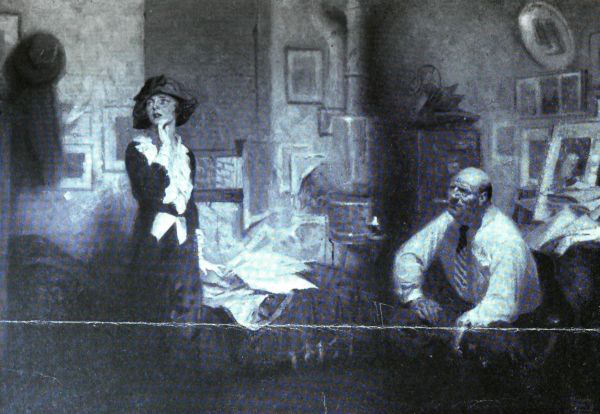
Clancy rose slowly to her feet.
"Yes," she said deliberately; "I see. I see that you—why, you're no better than a thief! Unlock that door and let me out!"
Beiner stared at her. His fat face reddened, and the veins stood out on his forehead.
"So that's the way you take it, eh? Now then, you little simp, you listen to me!"
He put his cigar down upon the edge of his desk, an edge scarred by countless cigars and cigarettes of the past. Heavily he rose. Clancy backed toward the door.
"If you touch me," she cried, "I'll——"
She had not dreamed that one so fat could move so quickly. Beiner's arms were round her before the scream that she was about to give could leave her lips. A fat palm, oily, greasy with perspiration, was clapped across her mouth.
"Now, don't be a little fool," he whispered harshly. "Why, Florine, I'm givin' you wise advice. I've done nothin' to you. You don't want to go to Zenda and tell him that Fay Marston admitted Ike was a crook, do you? Because then the game will be blown, and Ike won't see his way to slip me my share. You wouldn't be mean to old papa Beiner that wants to see all little girls get along, would you? How about it, Florine?"
He drew her closer to him as he spoke. Clancy, staring into his eyes, saw something new spring into being there. It was something that, mercifully, she had been spared seeing ever before. Fear overwhelmed her, made her limp in Beiner's clasp. The agent chuckled hoarsely.
"What a sweet kiddie you are, Florine! Say, I think you and me are goin' to be swell little pals, Florine. How about giving old papa Beiner a little kiss, just to show you didn't mean what you just said?"
Her limpness deceived him. His grasp loosened as he bent his thick neck to bring his gross mouth nearer hers. Clancy's strength came back to her. Her body tautened. Every ounce of strength that she possessed she put into a desperate effort for freedom. She broke clear, and whisked across the room.
"If you come near me, I'll scream," she said.
Beiner glared at her.
"All right," he said thickly. "Scream, you little devil! I'll give you something to scream about!"
He leaped for her, but she knew now how fast he could move. Swiftly she stepped to one side, and, as she did so, she seized a chair, the one on which she had been sitting, and thrust it toward the man. The chair-leg jammed between his knees and unbalanced him. His own momentum carried him forward and to one side. He grasped at the edge of the desk for support. But his hand slipped. Twisting, trying desperately to right himself, he pitched forward. His head struck upon the iron radiator beside his desk. He lay quite still.
For a moment, her mouth open, prepared to scream, Clancy stared down at the man. As the seconds passed and Beiner failed to move, she became alarmed. Then his huge chest lifted in a sigh. He was not killed, then. She came near to him, and saw that a bruise, already swollen, marked the top of his bald skull. She knew little of such injuries, but even her amateur knowledge was sufficient to convince her that the man was not seriously hurt. In a moment, he would revive. She knelt beside him. She knew that he had put the door-key in his trousers pocket. She had noticed the key-ring and chain. But her strength had deserted her. She was trembling, almost physically ill. She could not turn the gross body over.
She heard footsteps outside, heard some one knock on the door. Bent over, trying not to breathe, lest she be heard outside, she stared at the door. The person outside shook the knob, pounded on the door. Then she heard a muttered exclamation, and footsteps sounded, retreating, down the hall.
Beiner groaned; he moved. She straightened up, frightened. There had been something in his eyes that appalled her. He would not be more merciful when he recovered. She crossed the tiny office to the couch. Outside the wide window was the fire-escape. It was her only way of escape, and she took it.
She opened the window and stepped upon the couch. A sort of court, hemmed in by office-buildings, faced her. She stepped through the window upon the iron grating-like landing of the fire-escape. The sheer drop beneath her feet alarmed her. She hesitated. Why hadn't she called to whoever had knocked upon the door and got him to break it down? Why had she been afraid of the possible scandal? Last night, she had fled from Zenda's through fear of scandal, and her fear had brought her into unpleasant complications. Now she had done the same thing, practically, again.
But it was too late to worry. Beiner would revive any moment. She descended the fire-escape. Luck was with her. On the next landing was a window that opened, not into an office but into a hallway. And the latch was unfastened. In a moment, Clancy had climbed through the window and was ringing the elevator-bell. No one was in the hall. Her entrance through the window was not challenged.
V
Clancy woke clear-brained. She knew exactly what she was to do. Last night, after eating dinner in her room, she had tried to get Zenda on the telephone. Not finding his number in the book, she had endeavored to obtain it from "Information," only to learn that "it is a private wire, and we can't tell it to you." So, disappointed, she went to bed.
Her resolution had not changed over-night. She'd made a little idiot of herself in running away from the Zenda apartment night before last. But now that she found herself involved in a mass of nasty intrigue, she would do the sensible thing, tell the truth, and let the consequences be what they might.
Consequences? She mustn't be absurd. Innocently she had become entangled in something, but a few words would straighten the matter out. Of course, she would incur the enmity of Ike Weber, but what difference did that make? And Morris Beiner—she hoped, with a pardonable viciousness, that his head would ache for a week. The nasty beast!
In the tub, she scrubbed herself harshly, as though to remove from herself any possible lingering taint of contact with Beiner. A little later, she descended to the Napoli dining-room and ordered breakfast. It was as substantial as yesterday's. Exciting though yesterday had been, Clancy had not yet reached the age where we pay for yesterday's deviation from the normal with to-day's lack of appetite.
As at her previous breakfast, she had the dining-room to herself. Madame Napoli waddled beamingly over to her and offered her a morning paper. Clancy thanked her and put it aside until she should have finished her omelet. But, finally, the keen edge of her appetite blunted, she picked up the paper. It was a sheet devoted to matters theatrical, so that the article which struck her eye was accorded greater space in this newspaper than in any other in the city.
For a moment, Clancy's eyes were blurred as the import of the words of a head-line sunk into her understanding. It was impossible for her to hold the paper steadily enough to read. She gulped her second cup of coffee, put a bill on the table, and, without waiting for her change, left the room. Madame Napoli uttered some pleasant word, and Clancy managed to stammer something in reply.
Up in her room, she locked the door and lay down upon the bed. Five minutes, staring wide-eyed at the ceiling, she stayed there. Then she sat up and looked at the paper. She read:
THEATRICAL MAN FOUND SLAIN
MORRIS BEINER STABBED TO DEATH IN OWN OFFICE
Morris Beiner, an old-time manager, more recently a theatrical agent, was killed in his office some time yesterday afternoon under mysterious circumstances. He was stabbed with a paper-knife, one that has been identified as belonging to the dead man.
The discovery was made by Lemuel Burkan, the watchman of the Heberworth Building, in which Beiner had his office. According to Burkan's statement, he has been in the habit of answering telephone calls for many of the tenants during their temporary absences. Last evening, at six-thirty, while making his first night-round of the building, Burkan heard the telephone ringing in Beiner's office. Although the light was on, the telephone was unanswered. Burkan unlocked the door to answer the call and take the message. He found Beiner lying upon the floor, the paper-knife driven into his chest.
Burkan did not lose his head, but answered the call. Frank Hildebloom, of the Rosebush Film Company, was on the wire. On being informed of the tragedy by the watchman, Hildebloom immediately came over to the dead man's office. To the police, who were immediately summoned by Burkan, Hildebloom stated that Beiner had telephoned him in the morning, stating that he wished to make an engagement for a young actress to make a film-test. Hildebloom was telephoning because the engagement was overdue and he could wait no longer. An old friend of the murdered man, he was overcome by the tragedy.
The police, investigating the murder, learned from the janitor of the adjoining building, the Bellwood, that he had seen a young woman emerge from a window on the fifth floor of the Heberworth Building at shortly before six o'clock yesterday. She had descended by the fire-escape to the fourth floor and climbed through a window there. The janitor, who is named Fred Garbey, said that, while the incident was unusual, he'd thought little of it. He gave a description of the young woman to the police, who express confidence in their ability to find her, and believe that she must be the same woman for whom Beiner had made the engagement with Hildebloom.
None of the dead man's friends who could be reached last night could advance any reason for the killing. Beiner was apparently rather popular in the profession, having a wide acquaintance.
There followed a brief résumé of the dead man's career, but Clancy did not read it. She dropped the paper and again stared at the ceiling.
She was the woman who had fled by the fire-escape from Beiner's office, for whom the engagement had been made with Hildebloom! And the police were looking for her!
Beiner had been murdered! She had not killed him, but—who had? And would the police believe her story? She'd heard of third degrees. Would they believe her? Her whole story—if she admitted having been in Beiner's office, she must admit her method of egress. That descent by the fire-escape would have to be explained. She would have to tell the police that Beiner had seized her, had held her. Having admitted that much to the police, would they believe the rest of her story?
She shook her head. Of course they wouldn't! Beiner had been killed with his own paper-knife. The police would believe that she had picked it up and used it in self-defense.
She became unnaturally calm. Of course, she was a girl; her story might win her acquittal, even though a jury were convinced that she was a murderess. She knew of dozens of cases that had filled the newspapers wherein women had been set free by sentimental juries.
But the disgrace! The waiting in jail! Some one else had entered Beiner's office, had, perhaps, found him still unconscious, and killed him. But would that some one come forward and admit his or her guilt to free Clancy Deane?
She laughed harshly at the mere thought. Everything pointed to her, Clancy Deane, as the murderess. Why, even at this very moment, the police might be down-stairs, making inquiries of Madame Napoli about her!
She leaped from the bed. She stared out the window at the tall buildings in Times Square. How harsh and forbidding they were! Yesterday they had been different, had suggested romance, because in them were people who, like herself, had come to New York to conquer it.
But to-day these stone walls suggested the stone walls of jails. Jails! She turned from the window, overwhelmed by the desire for instant flight. She must get away! In a veritable frenzy of fear, she began to pack her valise.
Midway in the packing, she paused. The physical labor of opening drawers, of taking dresses from the closet, had helped to clear her brain. And it was a straight-thinking brain, most of the time. It became keener now. She sat down on the floor and began to marshal the facts.
Only one person in the world knew that Florine Ladue and Clancy Deane were the same girl. That person was Fanchon DeLisle, and probably by this time Fanchon DeLisle had forgotten the card of introduction.
Morris Beiner had not mentioned to Hildebloom the name of Florine Ladue. Hildebloom could not tell the police to search for the bearer of that name. Fay Marston knew who Florine Ladue was, but Fay Marston didn't know that Florine had been intending to call on Morris Beiner. Nor did Madame Napoli or her daughter. Zenda and the members of his party had never heard Florine's last name, and while the discovery of that card of introduction in Morris Beiner's office might lead the police to suspect that Florine Ladue had been the woman who descended the fire-escape, it couldn't be proved.
Then she shook her head. If the police found that card of introduction—and, of course, they would—they'd look up Florine Ladue. The elevator-boy in the Heberworth Building would probably identify her as a woman who had ridden in his car yesterday afternoon at five.
The first name would attract the attention of Zenda and his friends. Her acquaintance with Fay Marston and her card-sharp husband would come out. She wasn't thinking clearly. The affair at Zenda's was unimportant now. The only important thing in the world was the murder of Morris Beiner.
She got back to her first fact—only Fanchon DeLisle could know that Florine Ladue and Clancy Deane were the same person. If, then, Fanchon had forgotten that high-sounding name, had forgotten that she had given a card of introduction to Clancy— What difference would it make if Fanchon had forgotten the incident of the card? The police would remind her of it, wouldn't they?
She put her palms to her eyes and rocked back and forth. She couldn't think! For five minutes she sat thus, pressing against her eyes, slowly, out of the reek of fearsome thoughts that crowded upon her brain, she resolved the salient one. Until Fanchon DeLisle told the police that Florine Ladue and Clancy Deane were one and the same persons, she was safe.
It would take time to locate Fanchon. Meanwhile, Clancy was safe. That is, unless the police began to look up the hotels to find Florine Ladue right away, without waiting to communicate with Fanchon. She leaped to her feet. She'd decided, several minutes ago, that that was exactly what the police would do. Therefore, she must get out of the Napoli.
Now, with definite action decided upon, Clancy could think straightly. She tilted her hat forward, so that it shielded her features, and descended from her room to the street. Yesterday afternoon she had noticed a telegraph office on Forty-second Street. To it she went now.
She wrote out a telegram: "Florine Ladue, Hotel Napoli, Forty-seventh Street, New York. Come home at once. Mother is ill." She signed it, "Mary."
The receiving clerk stared at her.
"You could walk up there in five minutes and save money," he said.
Clancy stared at him. The clerk lowered his eyes, and she walked out, feeling a bit triumphant, not at her poor victory over the clerk but because she had demonstrated to herself that she was mistress of herself.
Back in the Napoli, she packed her valise. She had almost finished when Paul, the 'bus-boy porter, knocked at her door. He gave her the telegram which she had written a little while ago.
Clancy, holding the door partly shut, so that he could not see her preparations for departure, read the wire. She gasped.
"Bad news, miss?" asked Paul.
"Oh, terrible!" she cried. "My mother is ill—I must go home—get me a taxi—tell Madame Napoli to make up my bill——"
The boy murmured something meant to be sympathetic, and disappeared down the hall. Five minutes later, Madame Napoli came wheezing up the stairs. She refused to permit Clancy to pack. Clancy was a good girl to worry so about her mother. She must sit still and drink the coffee that Paul was fetching. Madame Napoli would pack her bag. And madame had sent for a taxi.
It was all very easy. Without arousing the slightest suspicion, Clancy left the Napoli.
She told the driver to take her to the Grand Central Station. There she checked her valise. For she was not running back to Zenith. No, indeed! She'd come to New York to succeed, and she would succeed. Truth must prevail, and, sooner or later, the murderer of Morris Beiner would be apprehended. Then—Clancy would be free to go about the making of her career. But now, safety was her only thought. But safety in Zenith was not what she sought.
In the waiting-room she purchased a newspaper. She found a list of lodging-houses advertised there. Inquiry at the information-desk helped her to orientate herself. She wished to be settled some distance from Times Square. She learned that Washington Square was a couple of miles from the Napoli. Two miles seemed a long distance to Clancy.
She reacquired her valise, got another taxi, and shortly had engaged a room in the lodging-house of Mrs. Simon Gerand, on Washington Square South. Mrs. Gerand was not at all like Madame Napoli, save in one respect—she demanded her rent in advance. Clancy paid her. She noted that she had only seven dollars left in her purse. So, in her room, she took out her check-book and wrote her first check, payable to "self," for twenty-five dollars. She'd take a 'bus, one of those that she could see from her tiny room on the square below, ride to Forty-second Street, cross to the Thespian Bank. No, she wouldn't; she might be seen. She'd ask Mrs. Gerand to cash her check.
She sat suddenly down upon a shabby chair. She couldn't cash her check, for Florine Ladue could be traced through her bank-account as well as through any other way!
She rose and walked to the window. It was a different view from that which she had had at the Napoli. She might be in another country. Across the park stood solid-looking mansions that even the untutored eyes of Clancy knew were inhabited by a different class of people than lived at Mrs. Gerand's. The well-keptness of the houses reminded her of a well-dressed woman drawing aside her skirts as the wheel of a carriage, spattering mud, approached too closely. She did not know that an old-time aristocracy still held its ground on the north side of Washington Square, against the encroachments of a colony of immigrants from Italy, against the wave of a bohemia that, in recent years, had become fashionable.
Despite the chill of the winter day, scores of children of all ages played in the park. Some were shabby, tattered, children of the slums that lurked, though she did not yet know it, south of the square. Others were carefully dressed, guarded by uniformed nurses. These came from the mansions opposite, from the fashionable apartments on lower Fifth Avenue.
Girls in tams, accompanied by youths, carelessly though not too inexpensively dressed, sauntered across the park. They were bound for little coffee-houses, for strange little restaurants. They were of that literary and artistic and musical set which had found the neighborhood congenial for work and play.
But, to Clancy, they were all just people. And people made laws, which created policemen, who hunted girls who hadn't done anything.
She had come to New York to achieve success. Here, within forty-eight hours after her arrival, she had not only roused the suspicions of one of the biggest men in the profession which she had hoped to adopt but was wanted by the police on the charge of murder, and had only seven dollars in the world. She stared at the greasy wall-paper of her ill-kept room. Without friends, or money—in danger of arrest! And still she did not think of going to the police, of confessing to circumstances that really were innocent. She had not learned over-night. She was still young. She still believed in the efficacy of flight. Queerly, she thought of the young man who had taken her home from the Zendas' apartment in the runabout. She remembered not merely his blue, kindly eyes, and the cleft in his chin, and his bigness, but things about him that she had not known, at the time, that she had noticed—his firm mouth, his thick brown hair. And he'd had the kindest-seeming face she'd ever seen. The only really kind face she'd seen in New York. All the rest—— Clancy wept.
VI
Youth suffers more than age. No blow that comes to age can be more severe than the happening to a child which, to its elders, seems most trivial. Each passing year adds toughness to the human's spiritual skin. But with toughness comes loss of resiliency.
Clancy was neither seven nor seventy; she was twenty. She had not yet acquired spiritual toughness, nor had she lost childhood's resiliency. The blows that she had received in the forty-eight hours since she had arrived in New York—the loss, as she believed, of her hoped-for career, the fear of arrest on the hideous charge of murder, and, last, though by no means least, the inability to draw upon the funds that she had so proudly deposited in the Thespian Bank—all these were enough to bend her. But not to break!
Her tears finally ceased. She had thrown herself upon the bed with an abandon that would have made an observer of the throwing think her one entirely surrendered to despair. Yet, before this apparently desperate, hysterical hurling of her slim body upon a not too soft couch, Clancy had carefully removed her jacket and skirt. She was not unique in this regard for her apparel; she was simply a woman.
So, when, in the natural course of the passing hours, hunger attacked Clancy, and she rose from the narrow bed that Mrs. Gerand provided for the tenant of her "third-floor front" room, she had only to remove the traces of tears, "fix" her hair, and don her waist and skirt to be prepared to meet the public eye.
She had been lying down for hours, alternating between impulses toward panic and toward brazen defiance. She compromised, of course, as people always compromise upon impulses, by a happy medium. She would neither flee as far from New York as seven dollars would take her nor surrender to the searching police. She would do as she had intended to do when she came down, earlier in the day, to Washington Square. She would look for a job to-morrow, and as soon as she found one, she'd go to work at anything that would keep her alive until the police captured the murderer of Morris Beiner and rendered her free to resume her career. And just now she would eat.
It was already dark. Somehow, although she was positive that she could not have been traced to Washington Square, she had been timid about venturing out in the daylight. But that very darkness which brings disquiet to the normal person brought calmness and a sense of security to Clancy. For she was now a different person from the girl who had arrived in New York from Zenith two days before. She was now that social abnormality—a person sought by the officers of justice. Her innocence of any wrong-doing in no way restored her to normality.
So, instead of a frank-eyed girl, fresh from the damp breezes of Zenith, it was an almost furtive-eyed girl that entered the Trevor, shortly after six o'clock, and, carrying an evening paper that she had acquired at the news-stand, sat down at a table in the almost vacant dining-room. Her step was faltering and her glance wary. It is fear that changes character, not sin.
She had entered the down-stairs dining-room of the Trevor, that hotel which once catered to the French residents of New York, but that now is the most prominent resort of the Greenwich Village bohemian or near-bohemian. It held few guests now. It was the hour between tea and dinner.
Clancy looked hastily over the menu that the smiling, courteous captain of waiters handed her. With dismay, she saw that the Trevor charged prices that were staggering to a person with only seven dollars in the world. Nevertheless, the streak of stubbornness in Clancy made her fight down the impulse to leave the place. She would not confess, by implication, to any waiter that she had not money enough to eat in his restaurant.
So she ordered the cheapest things on the menu. A veal cutlet, breaded, cost ninety-five cents; a glass of milk, twenty; a baked potato, twenty-five; bread and butter, ten. One dollar and a half for a meal that could have been bought in Bangor for half the money.
The evening paper had a column, surmounted by a scare-head half a page wide, about the Beiner murder. Clancy shivered apprehensively. But there was nothing in the feverish, highly adjectived account to indicate that Florine Ladue had been identified as the woman for whom Beiner had made the engagement with Hildebloom, of the Rosebush studios. Clancy threw care from her shoulders. She would be cautious, yes; but fearful—no! This, after she had eaten a few mouthfuls of the veal cutlet and drunk half of her glass of milk. A full stomach brings courage.
She turned the pages of the newspaper and found the "Help Wanted" page. It was encouraging to note that scores of business firms needed stenographers. She folded the paper carefully for later study and resumed her dinner. Finished, finally, she reached for the paper. And, for the first time, she became conscious that a couple across the room was observing her closely.
Courage fled from her. A glimmering of what her position would continue to be until her relation to the Beiner murder was definitely and for all time settled flashed through her brain. She would be always afraid.
She had not paid her check. Otherwise, she would have fled the room. Then she stiffened, while, mechanically, she returned David Randall's bow.
What ill fate had sent her to this place? Then, as Randall, having flashed her a smile that showed a row of extremely white although rather large teeth, turned to the woman with whom he was dining, Clancy's courage raced back to her.
What on earth was there to be nervous about? Why should this young man, whose knowledge of her was confined to the fact that, two nights ago, he had conveyed her in his runabout from somewhere on Park Avenue to the Napoli, cause her alarm? She forced herself to glance again in Randall's direction.
But the woman interested Clancy more than the young man who had introduced himself two nights ago as David Randall. A blonde, with reddish brown hair, most carefully combed, with a slightly tilted nose and a mouth that turned up at the corners, she was, Clancy conceded, far above the average in good looks. She was dressed for the evening. Two days ago, Clancy would have thought that only a woman of loose morals would expose so much back. But an evening spent at the Château de la Reine had taught her that New York women exposed their backs, if the exposure were worth while. This one was. And the severe lines of her black gown set off the milky whiteness of her back.
Her eyes were envious as the woman, with a word to Randall, rose. She lowered them as the woman approached her table. Then she started and paled. For the woman had stopped before her.
"This is Sophie Carey," she said.
Clancy looked up at her blankly. Behind her blank expression, fear rioted. The other woman smiled down upon her.
"I have been dining," she said, "with a most impetuous young man. He has told me of a somewhat unconventional meeting with you, and he wishes me to expurgate from that meeting everything that is socially sinful. In other words, he pays me the doubtful compliment of thinking me aged enough to throw a halo of respectability about any action of his—or mine—or yours. Will you let me present him to you?"
Back in Zenith, no one had ever spoken to Clancy like this. She was suddenly a little girl. New York was big and menacing. This woman seemed friendly, gracious, charming. She had about her something that Clancy could not define, and which was cosmopolitanism, worldliness.
"Why—why—it's awfully kind of you——"
The woman turned. One hand rested on the table—her left hand. A wedding-ring was on it, and Clancy somehow felt relieved. With her right hand, Mrs. Carey beckoned Randall. He was on his feet and at Clancy's table in a moment.