Cosmopolitan Book Corporation (continued 4)
Reading edition
Yours faithfully, Zenda.
All her illusions were shattered. She didn't wish to see the test. She believed Zenda.
Slowly her sobs ceased. She had no lack of courage. Also, she was young, and youth turns from defeat to future victory in a moment's time.
Carefully, as she bathed, she removed the traces of tears. Dressed, she breakfasted at the Trevor. Then, feeling more lonely than she had ever felt in her life, she went out upon Fifth Avenue. Groups of people were entering a church a block away. She was not a particularly devout young person, but she had been a regular churchgoer at Zenith. She walked up the avenue and into the church. She expected no consolation there; a girl or boy of twenty who can acquire consolation from religion is not exactly normal. Age turns to religion; youth away from it. But she did manage to forget herself in the solemn service, the mellow music.
Emerging, she envied the groups that paused to chat with each other. In Zenith, she knew everybody, would have also stopped to exchange comment and gossip. But here—she had failed in her great ambition. The rest was makeshift, a stop-gap until—until what? She didn't know. Vaguely she wondered where Randall was. Probably hundreds of miles beyond Chicago now.
And then, as she crossed the square, her heart leaped. For she saw him reluctantly descending the steps of her lodging house. She quickened her pace. He saw her. His reluctant tread also quickened. Unmindful of the drifts, Randall plowed across the street and joined her. She wondered why he had not started on his Western trip.
And then Clancy's heart, which had been beating joyously with a gladness that she did not quite understand, seemed to drop to some region inches below where it belonged. For, coming round the corner of Thompson Street—no, not coming, but stopping as he perceived her—was Spofford, the dyed-mustached detective of Vandervent's office. And with him was a shorter slighter person. Fear aided recognition. He was the elevator-man of the Heberworth Building, who had taken her up to Beiner's office last Tuesday afternoon.
XXII
Randall released Clancy's hand. He laughed embarrassedly.
"You looked glad," he said.
Clancy's hand fell limply to her side. A moment ago, her hand-clasp would have been firm, vital, a thing to thrill the young man. But now, although that protection he might give was most desirable, she could not respond to its presence.
For she was caught. Spofford, across the street, staring menacingly over at her, had been too swift for her. Yet, trapped though she was, she managed to look away from the attaché of the district attorney's office. She met Randall's eyes.
"I am glad," she said. As though to prove her words, she raised her hand and offered it again to Randall.
He took it. Holding it, he turned and stared over his shoulder. Spofford was still standing across the street; his companion was nodding his head. It seemed as though, sensing some threat in Randall's stare, they stood a little closer together. Something of that surly defiance that is the city detective's most outstanding trait seeped across the street. Clancy felt it. She wondered whether or not Randall did.
But he said nothing. With an air of proprietorship that was comforting, he drew her hand through his bended arm and started guiding her through the drifts.
Dully, Clancy permitted herself to be led. She wondered, almost apathetically, if Spofford would halt them. Well, what difference would it make? For a moment, she was vaguely interested in Randall's possible attitude. Would he knock the man down?
Then, as they reached the two men, Randall stopped. His big right arm moved backward; Clancy almost swung with it, back out of a possible fracas.
"I thought summer-time was your hunting-season," said Randall.
Spofford eyed him sullenly.
"Who you talkin' to?" he demanded.
"Why, to you," said Randall. "I thought that all you old gentlemen with dyed whiskers and toupées did your work in the pleasant months." He half-wheeled and pointed west. "Know what's over that way? I'll tell you—Jefferson Market. And the least that they give a masher is ten days on the Island. That is, after he gets out of the hospital." He paused, stared at Spofford a moment, then added "It's your move."
Spofford's red face bore a deeper color. But he met Randall's stare calmly. Slowly he turned back the lapel of his jacket, affording a glimpse of a nickel badge.
"Take a slant at that, friend," he advised. "I ain't mashin'; I'm 'tendin' to my business. Suppose," he finished truculently, "you 'tend to yours."
Clancy, hanging on Randall's arm, felt his biceps tighten. But her precarious position would not be improved by an attack upon Spofford. She made her gripping fingers dig deeper. She felt the biceps soften.
Then, as she waited for Spofford to announce that she was under arrest, the blue-coated man with the outthrust lower lip moved aside. She gave Randall no time for digestion of the queer situation. Her fingers now impelled him forward, and in a moment they were in the hall of Mrs. Gerand's lodging-house.
She left him there while she went up-stairs. Clancy would have stopped the procession to the death-house to powder her nose. And why not? Men light a cigarette; women arrange their hair. Either act, calling for a certain concentration, settles the nerves.
But Clancy's nerves were not to be settled this morning. Even though Spofford had not arrested her, his presence with the elevator-man from the Heberworth Building meant only one thing. He had not believed her explanation of her visit to Philip Vandervent's office, and, acting upon that disbelief, had produced, for purposes of identification, a man who had seen Beiner's mysterious woman visitor last Tuesday afternoon. Arrest was a mere matter of time, Clancy supposed.
Panicky, she peeped through the window, flattening her nose against the pane. Outside, across the street now, was Spofford. She was quite certain that his roving eyes sought her out, found her, and that his mean mouth opened in an exultant laugh.
She shrugged—the hopeless shrug of the condemned. She could only wait. Flight was useless. If Spofford suspected flight, he would not hesitate, she felt, to arrest her. She could visualize what had happened since she had entered the house. Spofford had told his witness to telephone for instructions. She knew vaguely that warrants were necessary, that certain informations and beliefs must be sworn to. How soon before a uniformed man— She almost ran down-stairs to Randall.
He was not in the hall, but she found him in the parlor. He was sitting down, his wide shoulders hunched together, his forehead frowning. She knew that he was thinking of the man outside, the man with the truculent lower lip, who wore a detective's shield pinned inside his coat lapel. Somehow, although, he had been willing to strike a blow for her a few minutes ago, it seemed to her that he had lost his combativeness, that the eyes which he lifted to her were uneasy.
Yet the smile that came to his lips was cheering. He moved over slightly on the old-fashioned sofa on which he was sitting. Clancy took the hint; she sat down beside him.
"Suppose you were surprised to see me so soon again?" he asked. The banal question told Clancy that he intended to ignore the incident of Spofford. She was surprised—and vaguely indignant. Yet the indignation was not noticeable as she returned his smile.
"'Surprised?' I was thinking of you when I met you," she told him. "Of course I was surprised, but——"
"You were thinking of me?" He seemed to forget Spofford.
"Why not? Does one forget in twenty-four hours a man who has proposed?"
"There are degrees of forgetfulness," he said.
Clancy held her right hand before her. She spread its fingers wide. With the index-finger of her left hand, she began counting off, beginning with the right thumb.
"Absolute zero of forgetfulness. M-m-m—no; not that." She touched her right forefinger. "Freezing-point—no; not that." She completely forgot, in the always delightful tactics of flirtation, the man lurking outside. She paused.
"Please continue," pleaded Randall.
"Oh, I wouldn't want to," she told him. "You see, one finally reaches the boiling-point, which isn't forgetfulness at all, and—why are you in New York?" she suddenly demanded.
"Train reached Albany hours late—account of the snow. I had time to think it over, and—what's business when a lady beckons."
"Did I beckon?" she asked demurely. "I thought that I pointed."
"You did," he agreed. "But pointing is vulgar, and I knew that you couldn't be that."
She grinned—the irrepressible Clancy grin that told of the merry heart within her.
"Did you return to New York to apologize for thinking me vulgar," she inquired. Randall had never been so near to winning her admiration. She liked him, of course, thought him trustworthy, dependable, and safe, the possessor of all those qualities which women respect in sons, fathers, brothers, and husbands, but not in suitors. But, for the first time since she had met him—not so long ago, as age reckons, but long enough as youth knows time—he was showing a lightness of touch. He wasn't witty, but, to Clancy, he seemed so, and the soul of wit is not so much its brevity as it is its audience. He seemed witty, for the moment, to Clancy. And so, admirable.
But the lightness left him as quickly as it had come. He shook his head gravely.
"I had time to think it over," he said again. "And—Miss Deane, if I could fall in love with you in a week, so could other men."
"Are you proposing again?" she demanded.
His shoulders were broad; they could carry for two. He was kindly; she forgot that, a moment ago, he hadn't seemed combative. She liked him better than she had. And then, even as she was admiring and liking him, she became conscious that he was restless, uneasy. Instinctively, she knew that it was not because of his love for her; it was because of the man outside.
That she could let Randall leave this house without some sort of explanation of Spofford's queer manner had never been in her thoughts. She knew that Randall would demand an explanation. She knew that he had been conscious of her fright at sight of Spofford.
"'Proposing again,'" echoed Randall. "Why—you know——"
She cut into his speech. She wasted no time.
"That man outside! Do you know why he's watching me?"
"Is he watching you?" Randall's surprise was palpably assumed. It annoyed Clancy.
"You know that he is!" she cried. "Aren't you curious?"
Randall breathed heavily. He sat bolt upright.
"I want you to know, Miss Deane, that it doesn't matter a bit to me. Whatever you may have done, I am sure that you can explain."
At any other time, Clancy would have flamed fire at his tone. Into his speech had entered a certain stiltedness, a priggishness, almost, that would have roused all the rage of which she was capable. And as she would be able to love greatly, so would she be able—temporarily—to hate. But now she was intent on self; she had no thought to spare for Randall—save in so far as he might aid her.
"'Explain?'" Her voice almost broke. "It's—it's pretty hard to explain murder, isn't it?"
Randall's lower jaw hung down.
"'Murder!' You—you're joking, Miss Deane!" Yet, somehow, Clancy knew that he knew that she was not joking.
"I'm not joking. He—he thinks that I killed Morris Beiner."
"Murder! Morris Beiner!" he gasped.
"You've read about it. I'm the woman! The one that ran down the fire-escape, that the police want!"
Slowly Randall digested it. Once again he gasped the word:
"Murder!"
"Goodness me!" Clancy became New England in her expression. "What else did you think it was?"
"Why—I supposed—something—I didn't know—murder! That's absurd!"
"You seem relieved," she said. He puzzled her.
"Well, of course," he said.
"I don't see why."
"Well, you couldn't have committed murder," he replied, with an air of having uttered explanation of his relief.
"I wish the police could think so!" she cried.
"'Think so?' I'll make them think so. I'll tell that chap out there——"
"But it won't do any good!" cried Clancy. Her cry was almost a wail. Once before she had practically confessed, then withdrawn her confession. Now she could not withdraw. Words rushed from her as from a broken water-main. But, because she was Clancy Deane, they were not words of exculpation, or of apology. They were the facts. Silently Randall heard them through. Then he spoke slowly.
"Any jury in the world would believe you," he said.
"But I don't want to tell it to any jury!" screamed Clancy. "Why—why—the disgrace—I—I——"
Confession is always dramatic, and the dramatic is emotional. The tears welled in her eyes. Through the blur of tears, Randall seemed bigger, sturdier than ever. She reached out her arms toward him.
"You asked me to marry you!" she cried. "I—I—would you want to marry me now?"
Randall smiled.
"You know it," he said. "Just as soon as this affair is fixed up, we'll be married, and——" He rose and took her hands in his. Quite unaccountably, Clancy released her hands.
"Fix it up? It can't be fixed up," she said.
"Well, we can try," said Randall. "I'll call in this man outside——" He hesitated. "Judge Walbrough has been mighty nice to you, hasn't he? Suppose I get him on the telephone?"
He didn't wait for Clancy to reply. He walked briskly from the room and she heard him at the telephone. She didn't listen to what he said. She walked to the window. Spofford was still outside. What right had he to act upon his own responsibility? Why hadn't the word of Philip Vandervent been enough for him?
She turned as Randall entered the room.
"The telephone is out of order," he said. "I think I'd better run up to the Walbroughs' house and get him."
"And leave me here!" cried Clancy.
Randall shrugged.
"I'm afraid that man wouldn't let you go with me."
"He may come in here and arrest me," she said.
He shook his head.
"I don't think so. And, if he does, Walbrough and I'll be right down after you. You'd better let me go."
She made no further protest. Suddenly, unaccountably, she wanted him to go.
XXIII
Up in her room, alternating between moments of almost hysterical defiance when she would stare through the window-panes at Spofford, and moments when she would hurl herself upon the narrow bed, she waited for Randall's return.
Somewhere she had read, or heard, that murder was not a bailable offense. That meant that she would be detained in prison, awaiting trial. With a curious detachment, she studied herself. As though she were some formless spirit, remote, yet infinitely near, she looked at Clancy Deane. How silly it all was—how futile! Billions of humans had conspired together, had laid down for themselves millions of queer rules, transgression of which was so simple a matter that she wondered that any one avoided it.
For a moment she had that odd clairvoyance that comes to persons who, by some quirk of fate, are compelled to think for themselves. She might escape from the present net, but what nets would the demon set for her in the years to come? Would she avoid them all? A horror of the future, a future in which she saw herself eternally attempting extrication from the inextricable, loomed before her.
And then that queer, blurry clairvoyance left her. She came back to the present. Mrs. Gerand, knocking at her door, announced that two gentlemen wished to see her. She ran to the window. Spofford was still there.
Down-stairs she ran. Mrs. Gerand had not told her that three persons were calling. And it was the third to whom Clancy ran, upon whose capacious bosom she let loose a flood of tears.
Mrs. Walbrough patted her head, drew her close to her, kissed her; with her own handkerchief wiped Clancy's eyes, from her own little vanity case offered Clancy those replenishments of the toilet without which the modern woman is more helpless than a man lost in the jungle without food or arms.
The judge noisily cleared his throat. Though he ever afterward disputed Mrs. Walbrough's testimony, it is nevertheless the fact that he used his own handkerchief upon his eyes. As for Randall, Clancy, lifting her head from Mrs. Walbrough's breast, was subtly aware that his reddened face bore an expression that was not merely embarrassment. He appeared once again uneasy. It almost seemed to her that he avoided her eyes.
Judge Walbrough cleared his throat a second time.
"Mr. Randall has told us a lot, Miss Deane. Suppose you tell us the whole story."
It was easy to talk to Walbrough. He possessed the art of asking the question that illuminated the speaker's mind, made him, or her, see clearly things that had seemed of little relevance. Not until she had finished did Clancy wonder if she had dropped in the Walbrough regard, if she had lost a patronage, a friendship that, in so brief a time, had come to mean so much.
"What must you think of me?" she cried, as Walbrough tapped his cheek with his fingers.
The judge smiled.
"I think that you've been a sensible young woman."
Clancy gasped. Her eyes widened with amazement.
"Why, I was sure that you'd blame me——"
"What for?" demanded the judge.
"For running away—hiding—everything," said Clancy.
The judge's voice was grim.
"If you'd voluntarily surrendered yourself to the indignities of arrest, I'd have thought you an idiot."
"But won't the fact that she remained in hiding go against her, Judge Walbrough?" asked Randall.
Walbrough surveyed the younger man frowningly.
"'Go against her?' Where? You certainly don't imagine that any jury would convict Miss Deane?"
"Of course not," stammered Randall.
"And public opinion will certainly not condemn an innocent girl for trying to avoid scandal, will it?" insisted the judge.
"No," admitted Randall.
"Then Miss Deane did the proper thing. Of course, the police will try to make it seem that flight was the admission of guilt, but we won't worry about them."
Clancy seized his hand.
"Do you mean that I won't be arrested?" she cried.
"Exactly what I mean," said the judge. Yet, had Clancy been in a calmer frame of mind, she would have observed that the judge's kindly smile was of the lips, not of the eyes. She was not old enough in the world's experiences to realize that a good lawyer is like a good doctor—he cheers up his client. But, for that matter, it took not merely an older person to know always what lay behind Judge Walbrough's smile; it took an extremely keen analyst of human nature. Even his wife, who knew him quite as well as any wife knows a husband, was deceived by his confidence. Her hug was more reassuring to Clancy than even the judge's words.
"Bring that man in," the judge said to Randall, who went out to the street to tell Spofford that Judge Walbrough wished to see him.
The judge walked up and down the room while Randall was gone. Clancy, watching him, was content to ask no questions, to beg for no more reassurances. She felt as might a little child toward a parent. Nor did her faith in him lessen as Randall, accompanied by Spofford, returned. The judge ceased his pacing up and down the floor. He held the detective with an eye from which all kindliness had vanished.
"You know who I am?" he demanded.
Spofford jerked a thumb at Randall.
"This man told me that Judge Walbrough wanted to see me."
"I'm Walbrough," said the judge. "I want to know why you're annoying this young lady?"
"Me?" Spofford's mean eyes widened. His surprise was overdone. "Annoyin' her?"
"We want to know why you are watching her."
Spofford's eyes were cunning.
"Ask her," he said.
Judge Walbrough drew closer to the man.
"Spofford, you know, of course, that I am no longer on the bench. You also, I presume, know how long you will remain on the force if I want you put off."
Spofford thrust out his lower lip.
"And I guess you know, too, that there's somethin' comin' to the man who interferes with an officer in the performance of his duty. I don't care who you are. Threaten me, and see what you get."
The judge laughed.
"A fine spirit, Spofford! Thoroughly admirable! Only, my man, I'll not stop at putting you off the force. I'll run you out of town." His voice suddenly rose. "Answer me, or I'll knock you down."
The truculence of Spofford was always assumed. He knew, as did every New Yorker, that, ex-judge though he might be, the power of Walbrough was no inconsiderable thing.
"Aw, there's no need gettin' huffy about it. I'll tell you, if the young lady won't. She murdered Morris Beiner."
The judge's laugh was exquisitely rendered. He didn't guffaw; he merely chuckled. It was a marvelous bit of acting. Clancy, her heart beating and throat choky with fear, was nevertheless sufficient mistress of herself to be able to appreciate it. For the chuckle held mirth; it also held appreciation of the seriousness of the charge. Before it, the assumption of truculence on Spofford's features faded. He looked abashed, frightened. To have offended Judge Walbrough without any evidence was to have invited trouble. Spofford was not the sort that issues such invitations. He suddenly grew desperate.
"That's all right with me. Laugh if you want to. But I tell you we been lookin' for a dame that was in Beiner's office just before he was killed. And the elevator-boy at the Heberworth Building just took a slant at this dame and identified her as a woman he let off on the fourth floor round five o'clock on last Tuesday afternoon. And this woman was in Mr. Vandervent's office yesterday, and she sent in the name of Florine Ladue—the woman we been lookin' for, and——"
"Miss Deane has explained that. Wasn't Mr. Vandervent satisfied with her explanation?" demanded the judge.
"He was; but he ain't me!" cried Spofford. "I don't fall for them easy explanations. And, say—how did Miss Deane happen to guess what I was hangin' around for? If you know that she explained things to Mr. Vandervent, why'd you ask me why I was watchin'?"
Judge Walbrough chuckled again.
"Stupid people always think in grooves, don't they, Spofford? Don't you suppose that Miss Deane might have told me an amusing practical joke that she had played upon Mr. Vandervent?"
"Yes; she might have," sneered Spofford. "It was funny, at that. So funny that she fainted when she played it. Perhaps that was part of the joke, though."
Judge Walbrough now became the alert lawyer.
"Spofford, does Mr. Vandervent know of this—er—independent investigation of yours?" he asked.
The detective shook his head.
"He'll know in the mornin', though. And if he won't listen, there's others that will."
"Certainly," said the judge. "If you have something to say. But, before you say it, you'd like to be quite certain of your facts, wouldn't you?"
Spofford nodded; his forehead wrinkled. Himself cunning, he was the sort that always is trying to figure out what lies behind another's statement. And that sort always thinks that it will do something cunning. He wasn't so far wrong in this particular instance.
"And, as I understand it, you make the charge of murder against Miss Deane because she played a joke upon Mr. Vandervent, and because an elevator-man claims to recognize her. His recognition doesn't justify an accusation of murder, you know."
"No; but it'll entitle her to a chance to do some more explainin'."
"Perhaps," said the judge. "Where is this elevator-man now?"
"He's where I can get hold of him," said Spofford.
"Excellent!" said the judge. "Because the police will want him to-morrow. And not for the reason that you imagine, Spofford. They'll want him for criminal slander and, possibly, if he sticks to the absurd story that he told, you, for perjury, also. At the time when this elevator-man claims to have seen Miss Deane in the Heberworth Building, she was having tea with me and my wife at our home."
It was a magnificent lie. But even as it was uttered, Clancy wondered at the judge. Why? He surely wouldn't, for a mere acquaintance, commit perjury. And if he would, surely his wife could not be expected to join him in the crime.
But its effect upon Spofford was remarkable. His lower lip lost its artificially pugnacious expression. It sunk in as though his lower teeth had been suddenly removed. It never occurred to him—not then, at any rate—to doubt the judge's statement. And if it had, his doubts would have been dissipated by Mrs. Walbrough's immediate corroboration.
"Tuesday afternoon, yes. I think, Tom, that Miss Deane didn't leave until a quarter after six."
Clancy's eyes dropped to the floor. Terrific had been the accusation, menacing had been the threat; and now both seemed to vanish, as though they had never been. For Spofford tried a grin. It was feeble, but it had the correct intention behind it.
"'Scuse me, lady—Miss Deane. I been locked out, and all the time thinkin' I had the key in my pocket. Well, I guess I'll be moseyin' along, ladies and gents. No hard feelin's, I hope. A guy sees his dooty, and he likes to do it, y' know. I'll sure wear out a knuckle or two on this elevator-man." He waited a moment. He had made grave charges. Walbrough was a power; he wanted to read his fate if he could. He felt assured, for Walbrough smiled and inclined his head. Sheepishly he shuffled from the room.
There was silence until the outer door had crashed behind him. Then the judge leaped into activity.
"The Heberworth Building. Part of the Vandervent estate, isn't it, Randall?"
Randall shook his head. He was a clever business man, doubtless, thought Clancy, but his mind seemed not nearly so quick as the judge's.
"I don't know," he answered.
"Well, I do," said the judge. "It's a shame; it's tough on Phil to make him suborn perjury, but I don't see any other way out of it. Where's the telephone, Miss Deane?"
"It's out of order," Clancy gasped.
The judge frowned.
"Well, it doesn't matter. Half an hour from now will do as well as earlier, I guess. Run up-stairs and pack your things." He turned to his wife. "Better help her," he suggested.
"'Pack?'" gasped Clancy.
"Of course. You're coming home with us. That chap Spofford is not an absolute fool, even if he is a plain-clothes man. By the time he's thought over two or three little things, he'll be back again. And he might get somebody to swear out a warrant. Might even take a chance and arrest without it. But if you're in my house, there'll be lots of hesitation about warrants and things like that until there's been more evidence brought forward. And there won't be. Hurry along, young lady."
Clancy stared at him.
"Do you know," she said slowly, "I want to cry."
"Certainly you do. Perfectly correct. Cry away, my dear!"
Clancy suddenly grinned.
"I want to laugh even more," she said. "Judge Walbrough, you're the dearest, kindest— I can't let you do it."
"Do what?" demanded the judge.
"Why, tell lies for me. They'll jail you, and——"
Judge Walbrough winked broadly at Randall.
"I guess that wouldn't bother you, would it, Mr. Randall? Jail for a girl like Miss Deane? Then I think an old-timer like myself has a right to do something that a young man would be wild to do—even if he has a jealous wife who hates every woman who looks at him."
It was heavy, as most of Walbrough's humor was apt to be, Clancy couldn't be sure that it was even in good taste. But it cleared the atmosphere of tears. Her laugh that followed the threat of weeping had been a bit hysterical. Now, as she went up-stairs with Mrs. Walbrough, it was normal. She could climb up as quickly as she could descend.
XXIV
Vandervent entered the Walbrough living-room with a jerky stride that testified to his excitement. A dozen questions were crowded against his teeth. But, though the swift motor-ride down-town had not been too brief for him to marshal them in the order of their importance, he forgot them as he met Clancy's eyes.
They should have been penitent eyes; and they were not. They should have been frightened eyes; and they were not. They should have been pleading eyes; and they were not. Instead, they were mischievous, mocking, almost. Also, they were deep, fathomless. Looking into them, the reproach died out in Vandervent's own. The pleading that should have been in Clancy's appeared in Vandervent's, although he undoubtedly was unconscious of the fact.
On the way there, he had been aware of himself as a trained lawyer confronted with a desperate, a possibly tragic situation. Now he was aware of himself only as a man confronting a woman.
He acknowledged the presence of the Walbroughs and of Randall with a carelessness that seemed quite natural to the older people but which made Randall eye the newcomer curiously. In love himself, Randall was quick to suspect its existence in the heart of another man.
"So," said Vandervent, "you weren't joking with me Friday, eh, Miss Deane?"
She shook her head slowly. There was something in her manner that seemed to say to him that she had transferred her difficulties to him, and that, if he were half the man she believed him to be, he'd accept them ungrudgingly.
"Suppose I hear the whole story," suggested Vandervent.
Intently, he listened as, prompted by the judge when she slid over matters that seemed unimportant to her, she retold the tale of the past week. The judge took up the burden of speech as soon as she relinquished it.
"So you see, Vandervent, your job is to get hold of this elevator-man and persuade him that his identification is all wrong."
Vandervent pursed his lips; he whistled softly.
"I haven't as good a memory as I ought to have, Judge. I can't recall the exact penalty for interference with the course of justice."
Clancy's eyes blazed.
"Judge, please don't ask Mr. Vandervent to do anything wrong. I wouldn't have him take any risk. I——"
Vandervent colored.
"Please, Miss Deane! You should know that I intend—that I will do anything—I was intending to be a little humorous."
"No time for humor," grunted the judge.
Vandervent looked at Mrs. Walbrough. Her glance was uncompromisingly hostile. Only in Randall's eyes did he read anything approximating sympathy. And he resented finding it there.
"The—er—difficulties——" he began.
"Not much difficulty in shutting an elevator-boy's mouth, is there?" demanded the judge. "It isn't as though we were asking you really to interfere with the course of justice, Vandervent. You realize that Miss Deane is innocent, don't you?"
"Certainly," said Vandervent. "But—I'm an officer of the law, Judge."
"Does that mean that you won't help Miss Deane? Good God! You aren't going to let a young woman's name be dragged through a filthy mess like this, are you?"
"Not if I can help it," said Vandervent.
"That's better," grunted the judge. "But how do you expect to help it, though?"
"By finding the real murderer."
"When?" roared Walbrough. "To-day?"
Vandervent colored again.
"As soon as possible. I don't know when. But to shut up the boy—think it over, Judge. He works for the Vandervent estate, it's true. But I don't own his soul, you know. Think of the opportunities for blackmail we give him. It's impossible, Judge—and unnecessary. If Spofford goes to him again, it's the elevator-boy's word against yours. Worthless!"
"And you, of course, knowing that I lied, would feel compelled, as an officer of the law——"
"I'd feel compelled to do nothing!" snapped Vandervent. "Your word would be taken unreservedly by the district attorney's office. The matter ends right there."
"Unless," said the judge softly, "the boy goes to a newspaper. In which case, his charge and my alibi would be printed. And five directors of the Metals and Textiles Bank would immediately recollect that I had been present at a meeting on Tuesday afternoon between the hours of one and six. Likewise, thirty-odd ladies, all present at Mrs. Rayburn's bridge, would remember that my wife had been at Mrs. Rayburn's house all of Tuesday afternoon." He groaned. "I had to think of something, Vandervent. I told the first lie that popped into my head. Our alibi for Miss Deane will go crashing into bits once it's examined, once there's the least publicity. Publicity! That's all that Miss Deane fears, all that we fear for her. Scandal! We've got to stop that."
"Exactly; we will stop it," said Vandervent. "There's a way." Oddly, he blushed vividly as he spoke. "I know of one way—but we won't dwell on that just now. I—I have a right—to suppress information that—that I don't think is essential to the enforcing of justice. I—I—if the suppressing of the elevator-man would work good for Miss Deane, I would see to his suppression. Because I know her to be innocent."
"Well, what are you going to do?" demanded the judge.
Vandervent shrugged.
"It's not an offhand matter, Judge. We must think."
They thought. But Clancy's thoughts traveled far afield from the tremendous issue that confronted her. Mentally, she was comparing Randall and Vandervent, trying to find out what it was in Randall that, during the past few hours, had depressed her, aroused her resentment.
"You see," said Vandervent finally, "the relations between the Police Department and the district attorney's office are rather strained at the moment. If the police should happen to learn, in any way, that we've been conducting an independent investigation into the Beiner murder and that we'd dropped it——"
"Where would they learn it?" asked the judge. His brusqueness had left him. With a little thrill that might have been amazement, Clancy noted that the few minutes' silence had somehow caused Judge Walbrough to drop into a secondary place; Vandervent now seemed to have taken command of the situation.
"Spofford," answered Vandervent.
"Would he dare?" asked the judge.
Vandervent laughed.
"Even the lowly plain-clothes man plays politics. There'll be glory of a sort for the man who solves the Beiner mystery. If Spofford finally decides that he is by way of being close to the solution, I don't believe that he can be stopped from telling it to the police or the newspapers."
"And you don't see any way of stopping Spofford?" asked the judge.
"He may have been convinced by your story," Vandervent suggested.
The judge shook his head.
"His conviction won't last."
Vandervent shrugged.
"In that case— Well, we can wait."
Clancy interjected herself into the conversation.
"You won't really just simply wait? You'll be trying to find out who really killed Mr. Beiner?"
"You may be sure of that," said Vandervent. "You see"—and he shrugged again—"we become one-idea'd a bit too easily in the district attorney's office. It's a police habit, too. We know that a young woman had been in Beiner's office, that Beiner had had an engagement to take a young woman over to a film-studio. We discovered a card introducing a Miss Ladue to Beiner. From its position on Beiner's desk, we dared assume that the young woman of the studio appointment was this Miss Ladue. Our assumptions were correct, it seems. But we didn't stop at that assumption; we assumed that she was the murderess. We were wrong there."
Clancy's bosom lifted at his matter-of-fact statement. With so much evidence against her, and with this evidence apparently corroborated by her flight, it was wonderful to realize that not a single person to whom she had told her story doubted it.
"And, because we believed that we had hit upon the correct theory, we dropped all other ends of the case," continued Vandervent. "Now, with the case almost a week old—oh, we'll get him—or her—all right," he added hastily. "Only—the notoriety that may occur first——" He broke off abruptly.
Clancy's bosom fell; her hopes also. The palms of her hands became moist. In the presence of Vandervent, she realized more fully than ever what notoriety might mean. Vandervent sensed her horror.
"But I assure you, Miss Deane, that we'll avoid that notoriety. I know a way——"
"What?" demanded the judge.
"Well, we'll wait a bit," said Vandervent. "Meanwhile, I'm going to the office."
"On Sunday?" asked Mrs. Walbrough. Vandervent smiled faintly.
"I think I'll be forgiven—considering the cause for which I labor," he finished. He was rewarded by a smile from Clancy that brought the color to his cheeks.
And then, the blush still lingering, he left them. Walbrough escorted him to the door. He returned, a puzzled look upon his face.
"Well, I wonder what he means by saying that he knows a way to keep the thing out of the papers."
"You're an idiot!" snapped his wife "Why—any one ought to know what he means."
The judge ran his fingers across the top of his head.
"'Any one ought to know,' eh? Well, I'm one person that doesn't."
"You'll find out soon enough," retorted Mrs. Walbrough. She turned to Clancy. "Come along, dear; you must lie down."
Randall, whose silence during the past half-hour had been conspicuous, opened his mouth.
"Why—er——," he began.
But Mrs. Walbrough cut him off.
"You'll forgive Miss Deane, won't you?" she pleaded. "She's exhausted, poor thing, though she doesn't know it."
Indeed, Clancy didn't know it, hadn't even suspected it. But she could offer no protest. Mrs. Walbrough was dominating the situation as Vandervent had been doing a few moments ago. She found herself shaking hands with Randall, thanking him, telling him that her plans necessarily were uncertain, but adding, with the irrepressible Clancy grin, that, if she weren't here, she'd certainly be in jail where any one could find her, and bidding him good-by. All this without knowing exactly why. Randall deserved better treatment. Yet, queerly enough, she didn't want to accord it to him.
A little later, she was uncorseted and lying down in a Walbrough guest bedroom, a charming room in soft grays that soothed her and made her yearn for night and sleep. Just now she wasn't the least bit sleepy, but she yielded to Mrs. Walbrough's insistence that she should rest.
Mrs. Walbrough, leaving her guest, found her husband in his study; he was gravely mixing himself a cocktail. She surveyed him with contempt. Mildly he looked at her.
"What have I done now?" he demanded.
"Almost rushed that poor girl into a marriage," she replied.
"'Marriage?' God bless me—what do you mean?"
"Asking again and again what Phil Vandervent meant when he said that he knew a way to avoid publicity. And then you didn't have sense enough to edge young Randall out of the house. You let me be almost rude to him."
"Well, why should I have been the one to be rude? Why be rude, anyway? He's been darned nice to the girl."
"That's just it! Do you want her to keep thinking how nice he is?"
"Well, in the name of heaven, why not?" demanded her exasperated husband.
"Because he's not good enough for her."
"Why isn't he?"
"Because she can do better."
The judge drained his cocktail.
"Mrs. Walbrough, do you know I haven't the faintest idea what you're talking about?"
"Of course you haven't! You'd have let her stay here and listen, maybe, to a proposal from that young man, and perhaps accept it, and possibly——"
"Peace!" thundered the judge. "No more supposes,' please. I'll not be henpecked in my own house."
She came close to him and put her arm about him.
"Where shall I henpeck you then, Tommy boy?" she asked.
"'Tommy boy! Tommy boy?' O my good Lord, what talk!" sputtered the judge. But he kissed her as she lifted her mouth to his.
XXV
Familiarity breeds endurance as well as contempt. Clancy ate as hearty a breakfast on Monday morning as any criminal that ever lived, and, according to what one reads, condemned criminals on the morning of execution have most rapacious appetites. Which is not so odd as people think; how can they know when they're going to eat again?
She had been in New York one week, lacking a few hours, and in that week she had run the scale of sensation. She did not believe that she could ever be excited again. No matter what came, she believed that she would have fortitude to endure it.
The judge and his wife seemed to have banished alarm. Indeed, they had seemed to do that last night, for when Mrs. Walbrough had permitted Clancy to rise for dinner, she had conducted her to a meal at which no talk of Clancy's plight had been permitted to take place. Later, the three had played draw-pitch, a card game at which Clancy had shown what the judge was pleased to term a "genuine talent."
Then had come bed. And now, having disposed of a breakfast that would have met the approval of any resident of Zenith, she announced that she was going out.
"Better stay indoors," said the judge. "Just as well, you know, if people don't see you too much."
Clancy laughed.
"I've been outdoors right along," she said. "It's rather a late date to hide indoors. Besides, I mustn't lose my job."
"Job!" The judge snorted disgustedly.
"Why, you mustn't think of work until this matter is all settled!" cried Mrs. Walbrough.
Clancy smiled.
"I must live, you know."
"'Live! Live!'" The judge lifted an empty coffee-cup to his mouth, then set it down with a crash that should have broken it. "Don't be absurd, my dear girl. Mrs. Walbrough and I——"
"Please!" begged Clancy. She fought against tears of gratitude—of affection. "You've been so dear, so—so—'angelic' is the only word that fits it. Both of you. I'll adore you—always. But you mustn't—I didn't come to New York to let other people, no matter how sweet and generous they might be, do for me."
The judge cleared his throat.
"Quite right, my dear; quite right."
"Of course she is," said Mrs. Walbrough.
Clancy hid her mirth. It is a wonderful thing to realize that in the eyes of certain people we may do no wrong, that, whatever we do, even though these certain people have advised against it, becomes suddenly the only correct, the only possible course. And to think that she had known the Walbroughs only a few days!
Fate had been brutal to her these past seven days; but Fate had also been kindly.
"But you'll continue to make this your home—for the present, at least," said the judge. "Until this affair is closed."
To have refused would have been an unkindness. They wanted her. Clancy was one of those persons who would always be wanted.
The judge, as she was leaving, wrote on a card his private-office telephone-number.
"If you got the listed one, you might have difficulty in speaking with me. But this wire ends on my desk. I answer it myself."
Clancy thanked him. Mrs. Walbrough kissed her, and the judge assumed a forlorn, abused expression. So Clancy kissed him also.
A servant stopped her in the hall.
"Just arrived, Miss Deane," she said, putting in Clancy's hand a long box, from one end of which protruded flower-stems. Clancy had never been presented with "store" flowers before. In Zenith, people patronize a florist only on sorrowful occasions.
And now, gazing at the glorious red roses that filled the box, Clancy knew that she would never go back to Zenith. She had known it several times during the past week, but to-day she knew it definitely, finally. With scandal hovering in a black cloud over her, she still knew it. These roses were emblematic of the things for which she had come to New York. They stood for the little luxuries, the refinements of living that one couldn't have in a country town. Had the greatest sage in the world come to Clancy now and told her of what little worth these things were in comparison with the simpler, truer things of the country, Clancy would have laughed at him. How could a man be expected to understand? Further, she wouldn't have believed him. She had seen meannesses in Zenith that its gorgeous sunsets and its tonic air could not eradicate from memory.
She turned back, and up-stairs found Mrs. Walbrough.
"I'll fix them for you," said the judge's wife.
But Clancy hugged the opened box to her bosom.
"These are the first flowers from a florist's that I ever received," she said.
"Bless your heart!" said Mrs. Walbrough. "I'll even let you fill the vases." Mrs. Walbrough could remember the first flowers sent her by her first beau. "But you haven't read the card!" she cried.
Clancy colored. She hadn't thought of that. She picked up the envelope.
"Oh!" she gasped, when she had torn the envelope open and read the sender's name. And there were scribbled words below the engraved script: "To a brave young lady."
Mutely she handed the card to her hostess. Mrs. Walbrough smiled.
"He isn't as brave as you, my dear. Or else," she explained, "he'd have written, 'To a beautiful young lady.' Why," she cried, "that's what he started to write! Look! There's a blot, and it's scratched——"
Clancy's color was fiery.
"He wouldn't have!" she protested.
"Well, he didn't; but he wanted to," retorted Mrs. Walbrough.
Clancy gathered the roses in her arms. She could say nothing. Of course, it was absurd. Mrs. Walbrough had acquired a sudden and great fondness for her, and therefore was colored in her views. Still, there was the evidence. There is no letter "t" in brave, and undeniably there had been a "t" in the word that had preceded "young." She saw visions; she saw herself—she dismissed them. Mr. Philip Vandervent was a kindly, chivalrous young man and had done a thoughtful thing. That's all there was to it. She would be an idiot to read more into the incident. And yet, there had been a "t" in "brave" until he had scratched it out!
Her heart was singing as she left the Walbrough house. A score of Spoffords might have been lurking near and she would never have seen them.
Suddenly she thought of Randall. Why hadn't he thought of sending her roses? He had come back from Albany, cut short his trip to California to see her, to plead once more his cause. Her eyes hardened. He hadn't pleaded it very strongly. Suddenly she knew why she had been resentful yesterday—because she had sensed his refusal of her. Refusal! She offered to marry him, and—he'd said, "Wait."
But she could not keep her mind on him long enough to realize that she was unjust. The glamour of Vandervent overwhelmed her.
She walked slowly, and it was after nine when she arrived at Sally Henderson's office.
Her employer greeted her cordially.
"Easy job—though tiresome—for you to-day, Miss Deane," she said. "Sophie Carey has made another lightning change. Wants to rent her house furnished as quick as we can get a client. You've got to check her inventory. Hurry along, will you? Here!" She thrust into Clancy's hands printed slips of paper and almost pushed her employee toward the door.
Clancy caught a 'bus and rode as far as Eighth Street. On the way, she glanced at the printed slips. They were lists of about everything, she imagined, that could possibly be crowded into a house. The task had frightened her at first, but now it seemed simple.
Mrs. Carey's maid had evidently recovered from the indisposition of the other day, or else she had engaged a new one. Anyway, a young woman in apron and cap opened the door.
Yes; Mrs. Carey was in. In a moment, Clancy had verbal evidence of the fact, for she heard Sophie's voice calling to her. She entered the dining-room. Mrs. Carey was at breakfast. Her husband was with her, but that his breakfast was the ordinary sort Clancy was inclined to doubt. For by his apparently untouched plate stood a tall glass.
He rose, not too easily, as Clancy entered.
"Welcome to our city, little stranger!" he cried.
Clancy shot a glance at Sophie Carey. She was sorry for her. Mrs. Carey's face was white; she looked old.
"Going to find me a tenant?" she asked. Her attempt at joviality was rather pathetic.
"Take the house herself. Why not?" demanded Carey. "Nice person to leave it with. Take good care ev'rything. Make it pleasant for me when I run into town for a day or so. Nice, friendly li'l brunette to talk to. 'Scuse me," he suddenly added. "Sorry! Did I say anything I shouldn't, Sophie darling? I ask you, Miss Deane, did I say a single thing shouldn't've said. Tell me."
"No, indeed," said Clancy.
Her heart ached for Sophie Carey. A brilliant, charming, beautiful woman tied to a thing like this! Not that she judged Don Carey because of his intoxication. She was not too rigorous in her judgment of other people's weaknesses. She knew that men can become intoxicated and still be men of genius and strength. But Carey's weak mouth, too small for virility, his mean eyes, disgusted her. What a woman Mrs. Carey would make if the right man—— And yet she was drawn to her husband in some way or another. Possibly, Clancy decided, sheer loneliness made her endure him on those occasions when he returned from his wanderings.
Mrs. Carey rose.
"You'll excuse us, Don? Miss Deane must go over the house, you know."
"Surest thing! Go right 'long. 'F I can help, don't hes'tate t' call on me. Love help li'l brunette."
How they got out of the room, Clancy didn't know. She thought that Sophie Carey would faint, but she didn't. As for herself, the feeling that Don Carey's drunken eyes were appraising her figure nauseated her. She was so pitifully inclined toward Sophie that her eyes were blurry.
Up-stairs in her bedroom, Mrs. Carey met Clancy's eyes. She had been calm, self-controlled up to now. But the sympathy that she read in Clancy weakened her resolution. She sat heavily down upon the edge of the bed and hid her face in her hands.
"O my God, what shall I do?" she moaned.
Awkwardly, Clancy advanced to her. She put an arm about the older woman's shoulders.
"Please," she said, "you mustn't!"
Mrs. Carey's hands dropped to her side. Her eyes seemed to grow dry, as though she were controlling her tears by an effort of her will.
"I won't. The beast!" she cried. She rose, flinging off, though not rudely, Clancy's sympathetic embrace. "Miss Deane, don't you ever marry. Beasts—all of them!"
Clancy, with the memory of Vandervent's roses in her mind, shook her head.
"He—he just isn't himself, Mrs. Carey."
The other woman shrugged.
"'Not himself?' He is himself. When he's sober, he's worse, because then one can make no excuses for him. To insult a guest in my house——"
"I don't mind," stammered Clancy. "I—I make allowances——"
"So have I. So have all my friends. But now—I'm through with him. I——" Suddenly she sat down again, before a dressing-table. "That isn't true. I've promised him his chance, Miss Deane. He shall have it. We're going to the country. He has a little place up in the Dutchess County. We're going there to-day. The good Lord only knows how we'll reach it over the roads, but—it's his only chance. It's his last. And I'm a fool to give it to him. He'll be sober, but—worse then. And still— Hear him," she sneered.
Clancy listened. At first, she thought that it was mere maudlin speech, but as Don Carey's voice died away, she heard another voice—a mean, snarling voice.
"You think so, hey? Lemme tell you different. All I gotta do is to 'phone a cop, and——"
"Go ahead—'phone 'em," she heard Carey's voice interrupt.
The other's changed to a whine.
"Aw, be sensible, Carey! You're soused now, or you wouldn't be such a fool. Why not slip me a li'l jack and let it go at that? You don't want the bulls comin' in on this."
Clancy stared at Sophie. The wife walked to the door.
"Don!" she called. "Who's down-stairs?"
"You 'tend to your own affairs," came her husband's answer. "Shut your door, and your mouth, too."
Mrs. Carey seemed to stagger under the retort. She sat down again. She turned to Clancy, licking her lips with her tongue.
"Please—please——" she gasped, "see—who it is—with Don."
Down-stairs Clancy tiptoed. Voices were raised again in altercation.
"Why the deuce should I give you money?" demanded Carey. "Suppose I did run a fake agency for the pictures? Suppose I did promise a few girls jobs that they never got? What about it? You can't dig any of those girls up. Run tell the police."
"Yes; that's all right," said the other voice. "But suppose that I tell 'em that you had a key to Morris Beiner's office, hey? Suppose I tell 'em that, hey?"
Something seemed to rise from Clancy's chest right up through her throat and into her mouth. Once again on tiptoe, wanting to scream, yet determined to keep silent, she edged her way to the dining-room door. Don Carey had made no answer to this last speech of his visitor. Peering through the door, Clancy knew why. He was lying back in a chair, his mouth wide open, his eyes equally wide with fright. And the man at whom he stared was the man who had been with Spofford yesterday, the elevator-man from the Heberworth Building!
XXVI
Hand pressed against her bosom, Clancy stared into the dining-room. She could not breathe as she waited for Carey's reply to his visitor's charge. So Don Carey had possessed a key to the office of Morris Beiner! The theatrical man had been locked in his office when Clancy had made her escape from the room by way of the window. The door had not been forced. And Don Carey had possessed a key!
For a moment, she thought, with pity, of the woman up-stairs, the woman who had befriended her, whose life had been shadowed by her husband. But only for a moment. She herself was wanted for this murder; her eyes were hard as she stared into the room.
Carey's fingers reached out aimlessly. They fastened finally upon a half-drained glass.
"Who's going to believe that kind of yarn?" Carey demanded
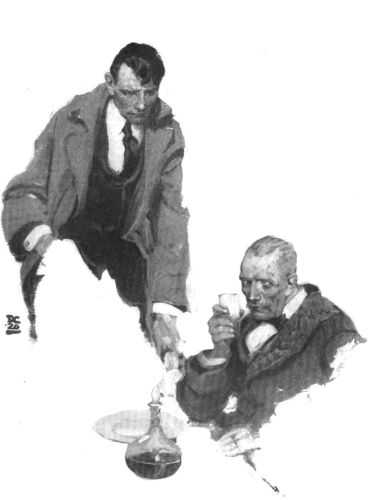
"Who's going to believe that kind of yarn?" he demanded.
"I can prove it all right," said the other.
"Well, even if you can prove it, what then?"
His visitor shrugged.
"You seemed worried about it a minute ago," he said. "Oh, there ain't no use tryin' to kid me, I know what I know. It all depends on you who I tell it to. I ain't a mean guy." His voice became whining. "I ain't a trouble-maker. I can keep my trap closed as well as any one. When," he added significantly, "there's enough in it for me."
"And you think you can blackmail me?" demanded Carey. His attempt at righteous indignation sounded rather flat. The elevator-man lost his whine; his voice became sulkily hard.
"Sticks and stones won't break no bones," he said. "Call it what you please. I don't care—so long as I get mine."
Carey dropped his pretense of indignation.
"Well, there's no need of you shouting," he said. He rose to his feet, assisting himself with a hand on the edge of the table.
"My wife's up-stairs," he said. "No need of screaming so she'll be butting in again. Shut that door."
Clancy leaped back. She gained the stairs in a bound. She crouched down upon them, hoping that the banisters would shield her. But no prying eyes sought her out. One of the two men in the room closed the dining-room door.
For a minute after it was shut, Clancy remained crouching. She had to think. A dozen impulses raced through her mind. To telephone Vandervent, the judge? To run out upon the street and call for a policeman? As swiftly as they came to her, she discarded them. She had begun to glean in recent days something of what was meant by the word "evidence." And she had none against Carey. Not yet!
But she could get it! She must get it! Sitting on the stairs, trembling—with excitement now, not fear—Clancy fought for clarity of thought. What to do? There must be some one correct thing, some action demanded by the situation that later on would cause her to marvel because it had been overlooked. But what was it?
She could not think of the correct thing to do. The elevator-man knew something. He was the same man who had identified her to Spofford, the plain-clothes man. The man assuredly knew the motive that lay behind the request for identification. And now, having told a detective things that made Clancy Deane an object of grave suspicion, the man was blandly—he was mentally bland, if not orally so—blackmailing Don Carey.
Yet Clancy did not disbelieve her ears merely because what she heard sounded incredible. Nor did she, because she believed that the elevator-man had proof of another's guilt, delude herself with the idea that her own innocence was thereby indisputably shown. Her first impulse—to telephone Vandervent—returned to her now. But she dismissed it at once, this time finally.
For a man who brazenly pointed out one person to the police while endeavoring to blackmail another was not the sort of person tamely to blurt out confession when accused of his double-dealing. She had nothing on which to base her accusation of Carey save an overheard threat. The man who had uttered it had only to deny the utterance. Up-stairs was Sophie Carey, torn with anguish, beaten by life and its injustices. The hardness left her eyes again. If she could only be sure that she herself would escape, she would be willing, for Sophie's sake, to forget what she had overheard.
She heard Sophie's voice whispering hoarsely to her from the landing above.
"Miss Deane, Miss Deane!" Then she saw Clancy. Her voice rose, in alarm, above a whisper. "Has he—did he—dare——"
Clancy rose; she ran up the stairs.
"No, no; of course not!" she answered. "I—I twisted my ankle." It was a kindly lie.
It was, Clancy thought, characteristic of Sophie Carey that she forgot her own unhappiness in sympathy for Clancy. The older woman threw an arm about the girl.
"Oh, my dear! You poor thing——"
"It's all right," said Clancy. She withdrew, almost hastily, from the embrace. Postpone it though she might, she was going to bring disgrace upon the name of Carey. She had to—to save herself. She could not endure the other's caress now.
"Who was it?" asked Mrs. Carey.
Clancy averted her eyes.
"I don't know," she said. "I—— The door was closed."
"It doesn't matter," said the older woman. "I—I—I'm nervous. Don is so——" Her speech trailed away into a long sigh. The deep respiration seemed to give her strength. She straightened up. "I'm getting old, I'm afraid. I can't bear my troubles as easily as I used to. I want to force some one to share them with me. You are very kind, Miss Deane. Now——"
She had preceded Clancy into her bedroom. From a desk, she took a slip of paper and a ring from which dangled several keys.
"We're all ready to go," she said. "It only remains to check up my inventory. But I'm quite sure that we can trust you and Sally Henderson"—her smile was apparently quite unforced—"not to cheat us. If there are any errors in my list, Sally can notify me."
She handed Clancy the paper and key-ring. As she did so, the door-bell rang.
Almost simultaneously the door to the dining-room could be heard opening. A moment later, Carey called.
"Ragan's here," he shouted. His voice was surly, like that of a petulant child forced to do something undesirable. Clancy thought that there was more than that in it, that there was the quaver that indicates panic. But Mrs. Carey, who should have been sensitive to any vocal discords in her husband's voice, showed no signs of such sensitiveness.
"Ready in a moment. Send him up," she called.
Ragan was a burly, good-natured Irishman. He grinned at Mrs. Carey's greeting. Here was a servant who adored his mistress, Clancy felt.
"Ready to go to the country, Ragan?" asked Mrs. Carey.
The big man's grin was sufficient answer.
"Ragan," said Mrs. Carey to Clancy, "is the most remarkable man in the world. He can drive a car along Riverside Drive at forty-five miles an hour without being arrested, and he can wait on table like no one else in the world. How's Maria?" she asked him.
"Sure, she's fine," said Ragan. "She's at the station now."
"Where we'll be in ten minutes," said his mistress. She indicated several bags, already packed. Ragan shouldered them. He started down-stairs. Mrs. Carey turned to Clancy. "Hope an empty house doesn't make you nervous," she smiled.
Clancy shook her head. "I'll not be here long, anyway. And isn't your maid here?"
"I think she's gone by now," said Mrs. Carey. "But she'll sleep each night here—until you've found me a tenant. For that matter, she'll be back early this afternoon—to wash dishes and such matters." She was not a person to linger over departures. Her husband had sulkily donned hat and coat and was standing in the hall down-stairs, waiting for her.
So Mrs. Carey held out her hand to Clancy.
"Wish I could ask you to week-end with us sometime, but I don't suppose that the country, in winter-time, means anything in your young life." She seemed to put the statement as a question, almost pleadingly. Impulsively, Clancy answered her.
"Ask me sometime, and find out if it does."
"I'll do that," said Mrs. Carey. "Coming, Don," she called. Her hand clasped Clancy's a moment, and then she trotted down the stairs. The door banged behind them.
A thought came to Clancy. She raised her voice and called. But the door was thick. The Careys could not hear. Frightened, she raced down-stairs. As she passed the dining-room door, she glanced through the opening. Then fear died from her. She had been afraid that the elevator-man from the Heberworth Building still remained in the house. But, when she had seen him talking to Don Carey, his hat and coat were lying on a chair. They were gone now.
Still—— Sudden anger swept over her. This lying, blackmailing thing to frighten Clancy Deane? Anger made her brave to rashness. From the fireplace in the dining-room she picked up a short heavy poker. If he were lurking anywhere in this house, if Don Carey, fearful lest his wife note the sort of person who paid him morning visits, had hidden the man away, she, Clancy Deane, would rout him out. She'd make him tell the truth!
Through the dining-room, into the butler's pantry beyond, through the kitchen, to the head of the cellar stairs she marched, holding the poker before her. Her fingers found a switch: the cellar was flooded with light. Without the least timidity, Clancy descended.
But the elevator-man was not there. And as in this tiny house there was but one flight of stairs leading to the upper stories, Clancy knew that the man was not in the house. She suffered reaction. What might have been her fate had she found the man hiding here?
Like all women, Clancy feared the past more than the future. She feared it more than the present. She sank down upon the stairs outside the dining-room. Why, the man might have shot her! What good would her poker have been, pitted against a revolver? And, with the Careys up in the country somewhere, she might have lain here, weltering in her gore—she'd read that somewhere, and grinned as she mentally said it.
Well, she might as well begin the inventory of Mrs. Carey's household effects. But she was not to begin it yet. Some one rang the door-bell.
No weakness assailed Clancy's knees now. Indeed, it never occurred to her that the caller might be any other than the post-man. And so she opened the front door and met the lowering gaze of Spofford, Vandervent's plain-clothes man.
XXVII
Clancy felt no impulse to slam the door in Spofford's face. Instead, she opened it wider.
"Come in," she said.
He stepped across the threshold. Just beyond, he paused uncertainly. And now his lips, which had been sullen, Clancy thought, shaped themselves into a smile that was deprecatory, apologetic.
"I hope I ain't disturbin' you, Miss Deane," he said.
Clancy stared at him. She had never felt so completely in command of a situation.
"That depends," she said curtly. "If you are to annoy me further——"
Spofford's grin was extremely conciliating.
"Aw, don't hit a man when he's down, Miss Deane. Every one has to be a sucker once in a while. It ain't every guy that's willin' to admit it, apologize, and ask for a new deal. Now, if I go that far, don't you think you ought to come a little way and meet me?"
Clancy's eyes widened.
"Suppose," she said, "we sit down."
"Thank you, Miss Deane." Spofford's tone was as properly humble as Clancy could possibly have wished. "A nice little friendly talk, me tryin' to show you I'm a regular guy, and you, maybe, bein, a little helpful. That's it—helpful."
He followed her as she led the way into the drawing-room and he seated himself carefully upon the edge of a chair whose slim legs justified his caution.
Clancy sat down opposite him. She leaned the poker against the wall. Spofford laughed.
"I'll just bet you'd 'a' beaned me one with that as soon as not, eh, Miss Deane?"
Clancy suddenly grew cautious. Perhaps this was an attempt to make her admit that she would not shrink from violence. Detectives were uncanny creatures.
"I should hate to do anything like that," she said.
Spofford guffawed heartily.
"I'd sure hate to have you, Miss Deane. But you don't need to be afraid of me."
"I'm not," said Clancy.
Spofford's nod was the acme of appreciation of a remark that held no particular humor, so far as Clancy could see. He slipped a trifle further back in the chair. He crossed his legs, assisting one fat knee with his hands. He leaned back. From his upper waistcoat pocket he took a cigar.
"You wouldn't mind, would you, Miss Deane? I can talk easier."
The downward and inward jerk of Clancy's chin gave him consent. From his lower waistcoat pocket, attached to the same heavy chain that Clancy assumed secured his watch, Spofford produced a cigar-clipper. Deliberately he clipped the end from the cigar, lighted it, tilted it upward from one corner of his mouth, and leaned toward Clancy.
"Miss Deane, you gotta right to point the door to me; I know it. But—you'd like to know who killed this Beiner guy, wouldn't you? Bein' sort of mixed up in it—bein' involved, so to speak——" His voice died away questioningly.
Despite herself, Clancy sighed with relief. Spofford was really the only man she had to fear. And if he believed in her innocence——
"How do you know I didn't do it?" she demanded.
"Well, it's this way, Miss Deane: When you come into Mr. Vandervent's office and fainted away after announcin' yourself as Florine Ladue, I couldn't quite swallow what you said about playin' a joke. You don't look like the sort of lady that would play that kind of a joke. Anyway, I have a hunch, and I play it. I get this elevator-man from the Heberworth Building to come down to your living-place——"
"How did you know where I lived?" demanded Clancy.
Spofford grinned.
"Same way I found out that you were down here to-day, Miss Deane. I had a guy follow you. You can't blame me, now, can you?" he asked apologetically.
Clancy hid a grin at her own magnanimous wave of her hand.
"Well, this elevator-man tells me that he took you up to the fourth floor of the Heberworth Building on Tuesday afternoon. I think I have something. But, then, Judge Walbrough butts in. Well, I begin to figure that I'm goin' a trifle fast. Judge Walbrough ain't the sort of man to monkey with the law. And nobody ain't goin' to fool him, either. So, if Walbrough strings along with you, maybe I'm a sucker to think you got anything to do with this Beiner affair.
"And when the guy I have watching the house tells me that you've gone up to Walbrough's, and when I learn that Mr. Vandervent is down at Walbrough's house—well, I do some more figurin'. There's lots of influence in this town; but a pull that will make a man like Walbrough and a man like Vandervent hide a murderess—there ain't that pull here. 'Course, I figure that Walbrough is sendin' for Vandervent to help you out, not to pinch you.
"Anyway, what I'm guessin' is that maybe I'd better examine my take-off before I do too much leapin'. And my take-off is that the elevator-man says he saw you in the Heberworth Building. That ain't a hangin' matter, exactly, I tells myself. Suppose I get a little more.
"What sort of a lady is this Florine Ladue, I asks myself. An actress, or somebody that wants to be an actress; well, where would she be livin'? Somewhere in the Tenderloin, most likely. So, last evenin', I get busy. And I find at the Napoli that Miss Florine Ladue registered there last Monday and beat it away after breakfast Wednesday mornin'. And that's proof to me that Florine Ladue didn't do the killing.
"Now, I'm pretty sure that you're Florine Ladue all right. Madame Napoli described you pretty thoroughly. Even told me that you was readin' a paper, at breakfast, what paper it was, how you got a telegram supposed to be from your mother that called you away. Now, I figure it out to myself: If Miss Ladue's mother wired her, and the wire made Miss Ladue pack her stuff and beat it, why didn't she go home? Because the wire's a fake, most likely. Then why, the next question is, did Miss Ladue put over that fake? The answer's easy. Because she'd just read in the mornin' paper about Beiner's murder. She's read about a young woman climbin' down the fire-escape, thinks she'll be pinched as that young woman, and—beats it. Pretty good?"
Clancy nodded. She looked at the man with narrowed eyes.
"Still," she said, "I don't understand why you're sure that Miss Ladue didn't kill him."
Spofford's smile was complacent.
"I'll tell you why, Miss Deane. This Ladue lady is no fool. The way she beat it from the Napoli proves that she was clever. But a clever woman, if she'd murdered Beiner, would have beat it Tuesday afternoon! Miss Deane, if you'd left the Napoli on Tuesday, I'd stake my life that you killed Beiner. No woman, leastwise a young girl like you, would have had the nerve to sit tight like you did on Tuesday night. I may be all wrong, but you gotta show me if I am," he went on emphatically. "Suppose you had killed Beiner, but didn't know that any one had seen you on the fire-escape! Even then, you'd have moved away from the Napoli. I tell you I been twenty-seven years on the force. I know what regular criminals do, and amachures, too. And even if you'd killed Beiner, I'd put you in the amachure class, Miss Deane."
"Let's go a little farther," suggested Clancy. "Why did I announce myself to Mr. Vandervent as Florine Ladue and then deny it?"
"You was scared," said Spofford. "Then, after you'd sent in that name, you read a paper sayin' Fanchon DeLisle was dead. You knew no one could identify you as Florine. You see, I picked up the paper on the bench where you'd been sittin'."
"Mr. Spofford," said Clancy slowly, "I think that you are a very able detective."
"'Able?'" Spofford grinned ingenuously. "I'm a great detective, Miss Deane. I got ideas, I have. Now, listen: I've put my cards on the table, I'm goin' to tell the chief that I've been barkin' up the wrong tree. Now, you be helpful."
"Just how?" Clancy inquired.
"Tell me all that happened that afternoon in Beiner's office," said Spofford. "You see, I got to land the guy that killed Beiner. It'll make me. Miss Deane, I want an agency of my own. I want some jack. If I land this guy, I can get clients enough to make my fortune in ten years. Will you come through?"
Clancy "came through." Calmly, conscious of the flattering attention of Spofford, she told of her adventures in Beiner's office; and when he put it in a pertinent question, she hesitated only momentarily before telling him of the part that Ike Weber and Fay Marston had played in her brief career in New York.
Spofford stared at her a full minute after she had finished. She brought her story down to her presence in the Carey house and the reason thereof. Then he puffed at his cigar.
"Be helpful, Miss Deane, be helpful y' know; somebody else is liable to tumble onto what I tumbled to; he's liable to have his own suspicions. 'S long as you live, you'll have a queer feelin' every time you spot a bull unless the guy that killed Beiner is caught. Finish your spiel, eh?" He raised his pudgy hand quickly. "Now, wait a minute. I wouldn't for the world have you say anything that you'd have to take back a minute later. What's the use of stallin'? Tell me, what did Garland say to you?"
"'Garland?'" Clancy echoed the name.
"Sure, the elevator-man from Beiner's building. Listen, Miss Deane: I get the tip from one of the boys that you've left this Miss Henderson's place and come down here. I beat it down to have a little talk with you, same as we been havin'. And whiles I'm hangin' around, out comes Garland. Why'd you send for him?"
"I didn't," said Clancy.
Spofford shot a glance at her.
"You didn't?" His lips pursed over the end of his cigar. "Then who did send for him? Say, isn't this the Carey house? Mrs. Sophie Carey, the artist? Wife of Don Carey? Wasn't it them that just left the house?"
"Yes," said Clancy.
"Well, I'm a boob. Don Carey, eh? And him bein' the gossip of Times Square because of the agency he run. Hm; that might be it."
"What might be it?" asked Clancy.
"A li'l bit of jack to Garland for keepin' his face closed about what went on in Carey's fake office," explained Spofford. "Still—— I dunno. Say, look here, Miss Deane: Loosen up, won'tcha? I been a square guy with you. I come right down and put my cards on the table. I admit I got my reasons; I don't want a bad stand-in with Mr. Vandervent. But still I could 'a' been nasty, and I ain't tried to. Are you tellin' me all you know? Y' know, coppin' off the murderer would put—put a lot of pennies in my pocket."
For a moment, Clancy hesitated. Then she seemed to see Sophie Carey's pleading face. Her smile was apparently genuinely bewildered as she replied,
"Why, I'd like to help you, Mr. Spofford, but I really don't know any more than I've told you."
It was another falsehood. It was the sort of falsehood that might interfere with the execution of justice, and so be frowned upon by good citizens. But it is hard to believe that the recording angel frowned.
XXVIII
Clancy was prepared to hear Spofford plead, argue, even threaten. Such action would have been quite consistent with his character as she understood it. But to her relief he accepted the situation. He rose stiffly from the chair.
"Well, I'll be moseyin' along. I'm gonna look into a coupla leads that may not mean anything. But y' never can tell in this business. Much obliged to you, Miss Deane. No hard feelings?"
"None at all," said Clancy. "I think—why I think it's wonderful of you, Mr. Spofford, to be so—so friendly!"
Spofford blushed. It was probably the first time that a woman had brought the color to his cheeks—in anything save anger—for many years.
"Aw, now—why, Miss Deane—you know I—glad to meetcha," stammered Spofford. He made a stumbling, confused, and extremely light-hearted departure from the house. Somehow, he felt deeply obligated to Clancy Deane.
The door closed behind him, and Clancy sat down once again upon the stairs. She felt safe at last. Now that the danger was past, she did not know whether to laugh or cry. Was it past? Before yielding to either emotional impulse, why not analyze the situation? What had Spofford said? That until the murderer was captured, she would always be apprehensive. Until the murderer was caught——
She tapped her foot upon the lower stair. There was no questioning Spofford's sincerity. He did not believe her guilty. But—— The telephone-bell rang. It was Sally Henderson.
"Miss Deane?... Oh, is this you? This is Miss Henderson. Man named Randall telephoned a few minutes ago. Very urgent, he said. I don't like giving out telephone-numbers. Thought I'd call you. Want to talk with him?"
Like a flash Clancy replied,
"No."
No pique inspired her reply. Randall had not measured up. That the standard of measurement she applied was tremendously high made no difference to Clancy, abated no whit her judgment.
A week ago, she had met Randall. She had thought him kind. She had liked him. She had even debated within herself the advisability, the possibility of yielding to his evident regard. More than that, she had practically offered to marry him. And he had been cautious, had not leaped at the opportunity that, for one golden moment, had been his. Clancy did not phrase it exactly this way, but her failure to do so was not due to modesty. For never a woman walked to the altar but believed, in her heart of hearts, that she was giving infinitely more than she received.
"Probably," said Clancy, half aloud, "he's found out that the Walbroughs are still with me, and that Philip Vandervent isn't afraid of me——"
She thought of Vandervent's flowers, and the card that had accompanied them.
"What did you say?" demanded Sally Henderson. Clancy blushed furiously. She realized that she'd been holding on to the receiver. "I thought that you said something about Judge Walbrough."
"Lines must have been crossed," suggested Clancy.
"Rotten telephone service," said Miss Henderson. "Oh, and another man!"
Clancy felt pleasurably excited. Philip Vandervent——
"I didn't see him. Guernsey told him where you were. Guernsey is an ass! As if you'd have a brother almost fifty."
"What? I haven't any brother," cried Clancy.
"Lucky girl. When they weren't borrowing your money, they'd be getting you to help them out of scrapes or mind your sister-in-law's babies. Sorry. If you're frightened——"
"'Frightened?' Why?" demanded Clancy.
"Well, Guernsey told him where you were, and the man left here apparently headed for you."
Clancy's forehead wrinkled.
"What did he look like?" she asked.
"Oh, Guernsey couldn't describe him very well. Said he wore a mustache that looked dyed, and was short and stocky. That's all."
"Some mistake," said Clancy.
"Perhaps," said Miss Henderson dryly. "Anyway, you needn't let him in. Might be somebody from Zenith who wanted to borrow money."
"Probably," said Clancy.
"Getting ahead with the work?"
"Checking up the inventory now," said Clancy.
"All right; take your time."
And Miss Henderson hung up.
Once again, Clancy sat upon the stairs. Spofford had distinctly said that one of his men had followed Clancy down to this house. The description that Guernsey had given fitted Spofford exactly.
Spofford, then, not one of his men, had trailed Clancy down here. Why did he lie? Also, he must have known quite clearly who were the occupants of this house. Why had he expressed a certain surprise when Clancy had told him? He had said that, while he had been waiting outside, Garland had come out. But why had Spofford been waiting outside? Why hadn't he come right up and rung the door-bell? Could this delay have been because he knew that Garland was inside the house, and because he did not wish to encounter him? But how could he have known that Garland was inside with Carey? Well, that was easily answered. He might have arrived just as Garland was entering the house.
But there were other puzzling matters. Why had Spofford been so long in recollecting that Don Carey had roused the suspicions of the police because of the office he had maintained in the Heberworth Building? Apparently, it had only occurred to him at the end of his rather long conversation with Clancy.
Hadn't Spofford been a little too ingenuous? Could it be that he had some slight suspicion of Don Carey? As a matter of fact, looking at the matter as dispassionately as she could, hadn't Spofford dropped a strong circumstantial case against Clancy Deane on rather slight cause? Against the evidence of her presence in Beiner's office and her flight from the Napoli, Spofford had pitted his own alleged knowledge of human nature. Because Clancy had delayed flight until Wednesday, Spofford had decided that she was innocent. She didn't believe it.
It had all been convincing when Spofford had said it. But now, in view of the fact that she had detected in his apparent sincerity one untruth, she wondered how many others there might be.
Would fear of the Vandervent and Walbrough influence cause him to drop the trail of a woman whom he believed to be a murderess? No, she decided; it would not. Then why had he dropped the belief in her guilt that had animated his actions yesterday?
The answer came clearly to her. Because he felt that he had evidence against some one else. Against Carey? She wondered. If against Carey, why had he gone in search of Clancy at Sally Henderson's office?
But she could answer that. He wanted to hear her story. Finding that she was at the very moment in Don Carey's house had been chance, coincidence. He had known that Garland had not come here to see her; he had known that Garland had come to see Carey. How much did he know? What was there to know?
Her brain became dizzy. Spofford had certainly not ceased to question the Heberworth Building elevator-man when the man had identified Clancy. Spofford had cunning, at the very lowest estimate of his mental ability. He would have cross-examined Garland. The man might have dropped some hint tying up Carey to the murder. She began to feel that Spofford was not entirely through with her.
There was a way, an almost certain way, now, though, to end her connection with the affair. If she told Philip Vandervent or Judge Walbrough the threat that she had heard Garland utter, the elevator-man would be under examination within a few hours.
Did she want that? Certainly not, just yet. She knew what scandal meant. She doubted if even Sophie Carey, with her apparently unchallenged artistic and social position, could live down the scandal of being the wife of a man accused of murder. She must be fair to Sophie. Indeed, if she were to live up to her own code—it was a code that demanded much but gave more—she must be more than fair to her. Sophie had gotten her work, had dressed her up. She did not like being under obligation to Mrs. Carey. But, having accepted so much, repayment must be made. It would be a shoddy requital of Sophie's generosity for Clancy Deane to run to the police and repeat the threats of a blackmailer.
How did she know that those threats were founded upon any truth? She had heard Garland say that Carey had possessed a key to Beiner's office; she had seen the expression of fright upon Carey's face as Garland made the charge. But fear didn't necessarily imply guilt. Clancy Deane had been a pretty scared young lady several times during the past week, and she was innocent. Don Carey might be just as guiltless.
Of course, Judge Walbrough and his wife had been unbelievably friendly, Vandervent had shown a chivalry that—Clancy sighed slightly—might mask something more personal. Noblesse oblige. But her first obligation was to Sophie Carey. Until her debts were settled to Sophie she need not consider the payment of others. Especially if the payment of those others meant betrayal of Sophie. And an accusation against her husband was, according to Clancy's lights, no less than that.
And so she couldn't make it. There was nothing to prevent her, though, from endeavoring to discover whether or not Don Carey were guilty. If he were—Clancy would pass that bridge when she came to it.
Meantime, she was supposed to be earning a salary of fifty dollars a week. A few minutes ago, she had told Sally Henderson that she had begun checking up the Carey household effects. She had not meant to deceive her employer. She'd work very hard to make up for the delay that her own affairs had caused.
The Careys' house was not "cluttered up," despite the artistic nature of its mistress. Clancy, who knew what good housekeeping meant—in Zenith, a dusty room means a soiled soul—pursed her lips with admiration as she passed from room to room. Two hours she spent, checking Sophie Carey's list. Then she let herself out of the house, locked the front door carefully behind her, and walked over to Sixth Avenue, into the restaurant where she had met Sophie Carey last Thursday morning.
Only that long ago! It was incredible. Whimsically ordering chicken salad, rolls, tea, and pastry, Clancy considered the past few days. It was the first time that she had been able to dwell upon them with any feeling of humor. Now, her analysis of Spofford's words, more than the words themselves, having given her confidence, she looked backward.
She wondered, had always wondered, exactly what was meant by the statement that certain people had "lived." She knew that many summer visitors from the great cities looked down upon the natives of Zenith and were not chary of their opinions to the effect that people merely existed in Zenith.
Yet she wondered if any of these supercilious ones had "lived" as much as had Clancy Deane in the last week. She doubted it. Life, in the argot of the cosmopolitan, meant more than breathing, eating, drinking, and sleeping. It meant experiencing sensation. Well, she had experienced a-plenty, as a Zenither would have said.
From what had meant wealth to her she had dropped to real poverty, to a bewilderment as to the source of to-morrow's dinner. From the quiet of a country town she had been tossed into a moving maze of metropolitan mystery. She, who had envied boys who dared to raid orchards, jealous of their fearlessness of pursuing farmers, had defied a police force, the press——
And she'd liked it! This was the amazing thing that she discovered about herself. Not once could she remember having regretted her ambitions that had brought her to New York; not a single time had she wished herself back in Zenith. With scandal, jail, even worse, perhaps, waiting her, she'd not weakened.
Once only had she been tempted to flee the city, and then she'd not even thought of going back to Zenith. And she knew perfectly well that had Spofford failed to visit her this morning, and had some super-person guaranteed her against all molestation if she would but return to her Maine home, she would have refused scornfully.
Perhaps, she argued with herself, it was too much to say that she'd enjoyed these experiences, but—she was glad she'd had them. Life hereafter might become a monotonous round of renting furnished apartments and houses; she'd have this week of thrills to look back upon.
She ate her salad hungrily. Paying her check, she walked to Eighth Street and took the street car to Sally Henderson's office. She learned that Judge Walbrough had telephoned once during the forenoon and left a message—which must have been cryptic to Sally Henderson—to the effect that he had met the enemy and they were his.
Clancy assumed that Philip Vandervent had seen Spofford and that the man had told of his visit to Clancy. She wished that Vandervent hadn't told the judge; she'd have liked to surprise him with the news that Spofford, the one person of all the police whom she dreaded, had called off the chase. Oddly, she assumed that the judge and his wife would be as thrilled over anything happening to her as if it had happened to themselves. This very assumption that people were interested in her, loved her, might have been one of the reasons that they were and did. But it is futile to attempt analysis of charm.
She spent the afternoon with Miss Conover, the dressmaker. Business was temporarily slack with Sally Henderson. Until the effects of the blizzard had worn off, not so many persons would go house-hunting. And the kindly interior decorator insisted that Clancy yield herself to Miss Conover's ministrations.
Clancy had an eye for clothes. Although nothing had been completed, of course, she could tell, even in their unfinished state, that she was going to be dressed as she had never, in Zenith, dreamed. Heaven alone knew what it would all cost, but what woman cares what clothing cost? Clancy would have starved to obtain these garments. It is fashionable to jibe at the girl who lunches on a chocolate soda in order that she may dine in a silk dress. "She puts everything on her back," her plain sisters say. But understanding persons respect the girl. While marriage, for the mass, remains a market-place, she does well who best displays the thing she has for sale.
It was a delightful afternoon, even though Miss Conover lost her good nature as her back began to ache from so much bending and kneeling. Clancy went down Fifth Avenue toward the Walbroughs' home walking, not on snow, but on air.
Philip Vandervent had been attracted to her when he saw her in a borrowed frock. When he beheld her in one that fitted her perfectly, without the adventitious aid of pins—— Her smile was most adorable as she looked up at the judge, waiting for her at the head of the stairs. Quite naturally she held up her mouth to be kissed. Clancy unconsciously knew how to win and retain love. It is not done by kisses alone, but kisses play their delightful part. She had never granted them to young men; she had rarely withheld them from dear old men.
XXIX
Behind the judge stood his wife. Clancy immediately sensed a tenseness in the atmosphere. As she gently released herself from the judge's embrace and slipped into the arms of Mrs. Walbrough, what she sensed became absolute knowledge. For the lips that touched her cheek trembled, and in the eyes of Mrs. Walbrough stood tears.
Clancy drew away from her hostess. She looked at the judge, then back again at Mrs. Walbrough, and then once again at the judge.
"Well?" she demanded.
"It isn't well," said the judge.
"But I thought you knew," said Clancy. "Miss Henderson gave me your message. And that Spofford man saw me to-day, and told me that he didn't believe I had anything to do——" She paused, eyeing the judge keenly. She refused to be frightened. She wasn't going to be frightened again.
"Of course he doesn't! Spofford went to Vandervent this forenoon. But—the newspapers," said the judge.
Clancy's lips rounded with an unuttered "Oh." She sank down upon a chair; her hands dropped limply in her lap.
"What do they know?" she demanded.
The judge's reply was bitter.
"'Know?' Nothing! But a newspaper doesn't have to know anything to make trouble! If it merely suspects, that's enough. Look!"
He unfolded an evening newspaper and handed it to Clancy. There, black as ink could make it, spreading the full length of the page, stood the damnable statement,
WOMAN SOUGHT IN BEINER MYSTERY
Her eyes closed. She leaned back in her chair. The full meaning of the head-line, its terrific import, seeped slowly into her consciousness. She knew that any scandal involving a woman is, from a newspaper standpoint, worth treble one without her. One needs to be no analyst to discover this—the fact presents itself too patently in every page of every newspaper. She knew, too, that newspapers relinquish spicy stories regretfully.
Her eyes opened slowly. It was with a physical effort that she lifted the paper in order that she might read. The story was brief. It merely stated that the Courier had learned, through authentic sources, that the district attorney's office suspected that a woman had killed Beiner, and that it was running down the clues that had aroused its suspicions.
But it was a bold-face paragraph, set to the left of the main article, that drove the color from her cheeks. It was an editorial, transplanted, for greater effect, to the first page. Clancy read it through.
FIND THE WOMAN
Another murder engages the attention of police, the press, and the public. The Courier, as set forth in another column, has learned that the authorities possess evidence justifying the arrest of a woman as the Beiner murderess. How long must the people of the greatest city in the world feel that their Police Department is incompetent? It has been New York's proudest boast that its police are the most efficient in the world. That boast is flat and stale now. Too many crimes of violence have been unsolved during the past six months. Too many criminals wander at large. How long must this continue?
It was, quite obviously, a partisan political appeal to the prejudices of the Courier's readers. But Clancy did not care about that. The fact of publication, not its reason, interested her. She looked dully up at the judge.
"How did they find out?" she asked.
The judge shrugged.
"That's what Vandervent is trying to find out now. He's quizzing his staff this minute. He meant to be up here this evening. He was to dine with us. He just telephoned. Some one will be 'broken' for giving the paper the tip. But—that doesn't help us, does it?"
Clancy's lips tightened. Her eyes grew thoughtful.
"Still, if that's all the paper knows——"
"We can't be sure of that," interrupted Walbrough. "Suppose that whoever told the Courier reporter what he's printed had happened to tell him a little more. The Courier may want a 'beat.' It might withhold the fact that it knew the name of the woman in order that other newspapers might not find her first."
Slowly the color flowed back into Clancy's cheeks. She would not be frightened.