Cosmopolitan Book Corporation (continued 3)
Reading edition
"You are worried," he charged.
He did not make the iteration stubbornly. He made it as one who was certain of what he said. Also, there was a patience in his tone, as though he were prepared for denial, and had discounted it in advance and had no intention of changing his belief.
For a moment, Clancy wavered. He was big and strong and competent-seeming. He looked the sort of man who would understand. There are some men who one knows will always be faithful to any trust imposed in them, who can be counted upon always. Randall had the fortunate gift of rousing this impression. He was, perhaps, not overbrilliant—not, at least, in the social way; but he was the sort that always inspires, from men and women both, not merely confidence but confidences. Had he not been making love to her, Clancy would perhaps have confided in him. But a lover is different from a friend. One hides from a lover the things that one entrusts to a friend. It is not until people have been married long enough to inspire faith that confidences result. Whoever heard of a bride telling important secrets to her husband?
Clancy's wavering stopped. Possible husbands could not be entrusted with knowledge prejudicial to her chances as a possible wife.
"If you're going to continue absurd, we'll go up-stairs again," she announced.
Her chin came slightly forward. Randall looked at her doubtfully, but he was too full of himself, as all lovers are, to press the subject of Clancy's worriment. He was tactful enough, after all. And he told her of his boyhood in Ohio, of his decision to come to New York, of the accident that had caused him to leave the bank which, on the strength of his father's Congressional career, had offered him an opening. It had to do with the discontinuance of the account of an apparently valuable customer. Randall, acting temporarily as cashier, had, on his own responsibility, refused further credit to the customer. He had done so because a study of the man's market operations had convinced him that a corner, which would send the customer into involuntary bankruptcy, had been effected. There had ensued a week of disgrace; his job had hung in the balance. Then the customer's firm suspended; the receiver stepped in, and Randall had been offered a raise in salary because of the money—from the refusal of worthless paper offered as security by the bankrupt—that the bank had been saved.
He had refused the increase in salary and left the bank, convinced—and having convinced certain financiers—that his judgment of the stock-market was worth something. His success had been achieved only in the past two years, but he was worth some hundreds of thousands of dollars, with every prospect, Clancy gathered, of entering the millionaire class before he was much over thirty.
He went farther back. Despite his apparently glowing health, he'd suffered a bad knee at football. The army had rejected him in 1917. Later on, when the need for men had forced the examiners to be less stringent, he had been accepted, and had been detailed to a training-camp. But he had won no glory, achieving a sergeancy shortly before the armistice. He had not gone abroad. He was a graduate of the University of Illinois, knew enough about farming to maintain a sort of "ranch" in Connecticut, and was enthusiastic about motor-cars.
This was about as far as he got when he insisted that Clancy supplement his slight knowledge of her. She told him of the Zenith normal school, which she had attended for two years, of the summer residents of Zenith, of the fishing-weirs, of the stage that brought the mail from Bucksport, of the baseball games played within the fort of Revolutionary times on the top of the hill on which the town of Zenith was built. And this was as far as she had reached when Vandervent found them.
He was extremely polite, but extremely insistent in a way that admitted of no refusal.
"I say, Randall, you mustn't monopolize Miss Deane. It's not generous, you know. You've been lucky enough. This is my dance."
Clancy didn't remember the fact, but while she and Randall had rambled on, she had been doing some close thinking. She couldn't confess to Vandervent that she was Florine Ladue, but she could utilize the heaven-sent opportunity to fascinate the man who might, within twenty-four hours, hold her life in his hand—although it couldn't be as serious as that, she insisted to herself. But, in the next breath, she decided that it could easily be as serious as that, and even more serious. Yet, with all her worry, she could repress a smile at Randall's stiff courtesy to his rival. Clancy was young, and life was thrilling.
But she had no chance to "vamp" Vandervent. A Paul Jones was in full swing as they reached the studio, and Judge Walbrough took her from Vandervent after a half-dozen bars had been played. From him she went to Mortimer, the illustrator, and from him to Darnleigh, the poet, and from him to Cavanagh, the millionaire oil-man, the richest bachelor in the world, Judge Walbrough informed her, in a hoarse whisper meant to reach the ears of Cavanagh.
And then Mrs. Carey announced that the storm was increasing so savagely that she feared to detain her guests any longer lest they be unable to reach their homes. There was much excitement, and several offers to take Clancy home. But Mrs. Carey came to her.
"I want you to stay with me, Miss Deane. Please!" she added, in a whisper. Clancy thought there was appeal in her voice. She said that she would. Whereas Randall looked savage, and Vandervent downcast. Which looks made Clancy's heart sing. In this laughing crowd, under these lights, with the jazz band only a moment stilled, it was absurd to suppose that she was really in danger from Vandervent or any one else. Wasn't she innocent of any wrong-doing?
Up and down, down and up! The Clancys of this world are always so. Which is why they are the best beloved and the happiest, all things considered.
She was properly remote and cool to both her suitors, as she called them to herself. Modesty was not her failing.
XV
The room into which Sophie Carey showed Clancy was smaller than her hostess' bedroom, but, in its way, just as exquisite. It made Clancy think—with its marvelous dressing-table, divided into two parts, the mirror between them, its soft rugs, its lacy covers on the bed—of pictures in magazines devoted to the home. It brought, somehow, to a focus, certain uneasy thoughts of the past day. So that her face was troubled when, having donned a wonderful nightgown that Mrs. Carey had lent her, and having put over this a fleecy dressing-gown, she turned to receive her hostess, who was similarly attired. Mrs. Carey pulled up a chair and sank into it.
"You're nervous," she announced.
Clancy shrugged faintly. If Sophie Carey knew just what Clancy had to be nervous about!
"No; I've been wondering," she replied.
"Wondering what?" asked Mrs. Carey.
Clancy's forehead puckered.
"About all this," she replied.
She waved a hand vaguely about the little room. Sophie Carey laughed.
"Like it?" she asked languidly. "Care to live here?"
Clancy stared at her.
"'Live here?'" she demanded incredulously.
"Why not?"
"Why should I?" countered Clancy.
"I like you," Mrs. Carey said. "I think we'd get on well together."
Clancy frowned.
"Why, I couldn't begin to pay——"
"No one said anything about paying," interrupted Mrs. Carey.
"But I couldn't—I never accepted——" Clancy was prim.
Mrs. Carey laughed.
"You'll get over that, I fear. Now, as for the expense—if you feel that way, we'll arrange what's fair."
"You really want me?" said Clancy.
"I told you earlier this evening that I liked success. Well, I like to protégé success. You'll be a success. You're practically one already. With Phil Vandervent interested and the Walbroughs enthusiastically enlisted on your side—It was rather hard on David to-night, wasn't it?"
Clancy blushed.
"'Hard?'"
Mrs. Carey smiled.
"He had an open face, poor David! It tells what is in his heart quite plainly. Oh, well, David is a remarkable youth in lots of ways, but Phil Vandervent—he's a Vandervent."
"You don't really think, can't imagine—" Clancy paused, dazed at the possibilities.
"Why not? Three Vandervents have married chorus-girls. You're a lady, my dear. Phil could do a lot worse. And you could hardly hope to do better."
Clancy shook her head.
"That isn't the career I came to New York to find."
Mrs. Carey chuckled.
"None of us find the career we were looking for. Half the bankers in the world planned to be authors. Half the authors planned to be bankers. And there you are! You'll live here?"
The offer opened up opportunities undreamed of by Clancy. To be chaperoned, guided, protégé'd by a woman like Sophie Carey! She had come to New York intent on making financial and, secondarily, of course—Clancy was young—artistic success. To have a vista of social achievement placed before her enraptured eyes——
"It would be pretty hard," she said naïvely, "to give up a thing like this, wouldn't it? I mean—pretty clothes, a place to live in that was beautiful. I stayed to-night because you wanted me to. But I was wondering. I can see why girls—slide down. And I don't think it's because they want what they haven't got; it's more because they can't give up what they have. Isn't it?"
"It sounds convincing," admitted Mrs. Carey. She sighed. "Well, we're going to be friends, anyway, my dear. It was good of you to spend the night here. I—Donald didn't drop in as he'd threatened, and I'm lonesome, and—blue." She rose suddenly. "I'm keeping you up. It isn't fair." She walked toward the door and turned. "Do you know why I really asked you to stay? Because I saw that something was on your mind, my dear. And I didn't want you to do anything foolish."
"'Foolish?'" Clancy stared at her.
"David Randall would have insisted on taking you home. And—if he'd proposed sudden marriage, what would you have done?"
"'Marriage?'"
"That's what I said," said Mrs. Carey. "You're nervous, a stranger, and—I like you, little girl. I want you to have a fair chance to make up your mind."
"But I wouldn't have—why, it's absurd!" said Clancy.
Her hostess shrugged.
"My third night in New York, I went to a dance. I was terribly depressed. And a boy had conceived the same sudden sort of attachment for me that David has conceived for you. Only one thing saved me from making a little idiot of myself—not a minister would marry us without a license. I'm confessing a lot, my dear. Good-night," she ended abruptly.
Alone, Clancy slipped out of the pretty dressing-gown and got into bed. She could not doubt Sophie Carey's sincerity. Yet how absurd the woman was in thinking that she and David— She wondered. Suppose that Randall had proposed—in one of her reactions from bravado to fear. To have a man to help her fight her battle, to extricate her from the predicament into which her own frightened folly had hurried her! Sleepily, she decided that Sophie Carey was a wonderful friend. Also, she decided that Clancy Deane wasn't much of an actress. If every one guessed that she was worried——
Once, during the night, she half wakened. She thought that she'd heard the door-bell ringing. But she slipped into unconsciousness again almost at once. But in the morning she knew that she had not been mistaken. For Sophie Carey woke her up, and Clancy saw a face that was like a blush-rose.
"Miss Deane, you must wake up and meet him before he goes."
"Before who goes?" demanded Clancy.
Sophie Carey's face was like fire.
"Don. He came last night after all—late, and he isn't going to get a divorce, because I won't let him." There was fiery pride and touchingly soft self-abasement in her voice. "We've made it up. It was all my fault, anyway."
Clancy, as she bathed and dressed, shook her head wonderingly. Mrs. Carey's life was almost as kaleidoscopic as her own.
She put on the gray foulard and descended, shortly, to the dining-room. There she met Donald Carey. Weak-mouthed, its selfishness was partly hidden by a short mustache, blond. If Clancy hadn't heard something of him, she'd not have known, at first, the essential meanness of his nature. Undoubtedly he had helped himself from one of the decanters on the sideboard, for his nerves were well under control, and Clancy gathered, from his own somewhat boastful remarks, that he'd been intoxicated for the better—or worse—part of the week.
Last night, Sophie Carey had been so attracted by Clancy that not only did she wish to protégé her but wished to support her. Her offer, last night, had meant practically that. But events had transpired, Mrs. Carey was no longer, in effect, a widow. She was a married woman again—pridefully so. Her air of dependence half sickened Clancy. A woman of prestige, ability, and charm, she was a plaything of the momentary whim of the man whose name she bore. Last night independent, mistress of her own destiny, this morning she was an appanage. And how could Sophie Carey respect this weak sot?
But she had more to think about than the affairs of Sophie Carey, no matter how those affairs might affect herself. Few persons, no matter how temperamentally constituted, are nervous on first waking in the morning. They may be cranky and irritable, but not nervous. So Clancy, who had no irritation in her system, was calm until after breakfast. Then she began to fret. This was the day! Assistant District Attorney Philip Vandervent would receive an answer to his telegram to Fanchon DeLisle. He would learn that the real name of the woman who had borne Fanchon's card of introduction to the office of Morris Beiner was Clancy Deane. Her arrest was a matter of—hours, at the outside.
She felt like one condemned, with the electric chair round a turn in the corridor. Of course, she assured herself, the police must believe her story. But even if they did, gone was her opportunity for success. She would be the distasteful figure in a great scandal. Her breakfast was an unsubstantial meal. But her hostess did not notice. She was too intent on seeing that her husband's coy appetite was tempted.
Suddenly, Clancy felt a distaste for herself—a distaste for being protégé'd, for having a patroness. Sophie Carey had taken a liking to her. Sophie Carey had wished to do this and that and the other thing for her. Now Sophie Carey was by the way of forgetting her existence. She accepted the offer of her hostess' car to take her home, but gave vague replies to Sophie's almost equally vague remarks about when they must see each other again. It had been kind of Mrs. Carey to invite her to spend the evening, but it had been a little too much like playing Destiny. Suppose that Randall had proposed and that Clancy had, in a moment of fright, accepted him. It would have been her own business, wouldn't it?
She was almost sullen when she reached Washington Square. Up-stairs in her dingy room, she fought against tears. She had voiced a great truth, without being aware of it, last night, when she had said that what made girls slide down-hill was the having to give up what they had, not the desire for possession of those things which they'd never had.
She almost wished that Sophie Carey had not weakly surrendered to her husband's first advances. Clancy might have been installed in the studio home on Waverly Place, half-mistress of its comforts, its charms—a parasite! That's what she had been by way of becoming within a week of her arrival in the city where she had hoped, by the hardest sort of work, to make a place for herself. Well, that was ended. Why the fact that Sophie Carey had taken back her errant husband should have affected Clancy's attitude toward life and the part she must play in it is one of the incomprehensible things of that strange thing which we call "character."
Yet it had done so. Perhaps, after all, because it had shown Clancy how little dependence must be placed on other people. Not that she felt that Sophie Carey would not be friendly to her, but that Sophie Carey's interest would now be, for a while, at any rate, in the husband to whom she surrendered so easily. And by the time that Sophie had rid herself again of Donald Carey, Clancy would have been forgotten.
Forgotten! As, clad in the storm-overshoes that were necessities in Zenith, she braved the drifts of Washington Square on her way to the 'bus, she laughed wryly. Forgotten! Possibly, but not until her name had been blazoned in the press as a murderess——
Sally Henderson was not at the office when Clancy arrived there. She telephoned later on that the storm was too much for her, and that she would remain at home all day. She told young Guernsey to instruct Clancy in the routine matters of the office.
By one o'clock, Clancy had begun to understand the office machinery. Also, she was hungry, and when Guernsey announced that he was going out to luncheon, Clancy welcomed the cessation of their activities. She had been too apathetic to wonder why she had not heard from Zenda, and was amazed when, just as she had buttoned her coat, the girl clerk summoned her to the telephone.
"Miss Deane? This is Zenda talking. I got your letter. Can I see you right away?"
Clancy vaguely wondered where Zenda had procured her working-address. She had mentioned it this morning, after changing her dress, to Mrs. Gerand, but Mrs. Gerand had been a bit frigid. Mrs. Gerand did not approve of young lodgers of the female sex who spent the nights out. Clancy didn't believe that Mrs. Gerand had heard her. However, inasmuch as Zenda telephoned, the landlady must have heard her lodger's business address.
"Yes," she answered.
It was the beginning of the end. Zenda would believe probably about her connection with Fay Marston and Weber, but he'd perhaps know that Florine Ladue had been in Beiner's office. She shook her head savagely. As on Wednesday, when she'd read of Beiner's murder, she'd been unable to think clearly, her brain now wandered off into absurdities.
For it didn't matter about Zenda. Philip Vandervent had wired Fanchon DeLisle. What did Zenda matter? What did anything matter?
"Can you come over to my office, Miss Deane?"
"Yes," she replied.
"I'll be waiting for you," said Zenda.
She hung up the receiver. She shrugged her shoulders, and, telling the telephone clerk that she was going out to luncheon, left the office.
XVI
Zenda Films, Incorporated, occupied the tenth, eleventh, and twelfth floors of the newly named—though Clancy didn't know it—Zenda Building. In the lobby was a list of the building's tenants, and it stated that the executive offices of Zenda Films were on the tenth floor.
An office-boy heard her name, asked if she had an appointment, and reluctantly, upon her stating that she had, turned toward an inner room, casting over his shoulder the statement that he didn't think Mr. Zenda was in.
But from the room toward which he was making his sullen way—that sullen way peculiar to office-boys—emerged a tall young man, garbed in the height of Broadway fashion. He advanced beamingly to Clancy.
"Miss Deane? Please come right in."
Clancy followed him through the door, across an inner room, and into a further chamber beyond. And the instant she was inside that second room, Clancy knew that she had been a gullible fool, for instead of Zenda, she beheld Grannis.
But what was somehow more terrifying still, she saw beside Grannis, his thick features not good-humored to-day, the face of Weber. She didn't scream—Clancy was not the sort who would use valued and needed energy in vocalities—she turned. But the tall youth had deftly locked the door behind her. He faced her with a triumphant grin, then stepped quickly to one side; the key which he had been holding in his hand he transferred to the hand of Grannis, who put it, with an air of grim finality, into his trousers pocket.
Clancy knew when she was beaten, knew, at least, when the first round had gone against her. She did the one thing that rendered uncertain the mental attitudes of her captors. She walked coolly to a chair and sat.
Grannis, expecting to see a girl reduced by fright to hysteria, eyed her bewilderedly. He had intended to be calm, intending, by calm, to convince Clancy that her danger was the greater. Now he lapsed, at the start, into nervous irritation, the most certain sign of indecision.
"Pretty cool about it, Miss Deane, aren't you?"
Clancy knew, somehow, that her cool desperation had given her, in some inexplicable fashion, an equally inexplicable advantage.
"Why not?" she asked.
Grannis' sallow face reddened.
"Will you feel that way when you see a policeman?" he demanded.
"You talked about policemen yesterday," said Clancy. "Don't talk about them to-day. I want to see Mr. Zenda," she added.
Weber interjected himself into the scene.
"I suppose you do. But you see, Florine, my little dear, we're seeing you first. And you're seeing us first."
"Pretty clever of you, writing to Zenda," said Grannis. "Never occurred to you that, getting a letter from you, I might run through Zenda's mail, looking for a note in the same handwriting, eh?"
"No-o, it didn't," said Clancy slowly. "Yet, I suppose I should have known that one kind of crook is another kind, too."
Grannis nodded his head. His underlip came forward a trifle.
"I'll give you credit; you're game enough. If being a fool can be called gameness. And any one that parts with a thousand dollars in this town is certainly a fool. But that's all right. You probably don't need money. 'Little Miss Millions' is your name, I suppose."
Clancy yawned.
"I don't want to hurt your feelings, Mr. Grannis, but if you're being funny, I somehow can't get it."
"You will!" snapped Grannis. "Look here, Miss Deane! You're breaking into matters that don't concern you."
"I suppose I am," said Clancy.
She turned to Weber.
"I understood that New York's climate was bad for you," she said.
"Not half as unhealthy as it's going to be for you, Florine," he retorted. "You can make up your mind this minute. Either out of town for yours or the Tombs. Take your pick."
He had advanced threateningly until he stood over Clancy. Grannis pushed him aside.
"Let me handle her," he said. "Now, let's get down to cases, Miss Deane. Ike never done anything to you, did he?" Clancy shrugged. "'Course he didn't," said Grannis. "Then why not be a regular feller and keep out of things that don't concern you? Zenda never paid the rent for you, did he? No. We're willing to pay the rent and the eats, too, for a long while to come. That thousand is only a part. Listen: Ike got me on the long-distance last night. I told him it's O. K. to come back to town, that Zenda, with you keeping your face closed, couldn't do a thing to him. And then I get your letter this morning, and grab your note to Zenda. I find out that you're giving me the double cross. Well, we won't quarrel about it. Maybe you think Zenda is a heavier payer than I'd be. But you'd have to gamble on that, wouldn't you? You don't have to gamble on me. You take ten thousand dollars and leave town for just six months. That's all I ask. How about it?"
"I thought that you were Zenda's partner," said Clancy. Her pretty lips curled in the faintest contemptuous sneer.
"Never mind about that," snapped Grannis. "You're not talking to any one's partner, now. You're just talking to me."
"And me," put in Weber.
"And both of you want me to help you in swindling Mr. Zenda?" said Clancy.
Weber took a step toward her, his big fist clenched. Once again, Grannis intervened.
"Never mind the rough stuff, Ike!" he cried. "Let me handle her. Now, Miss Deane, are you going to listen to sense? Ike is back in town. He don't feel like skipping out every time you get a change of heart. And listen to this: Ike is a good-hearted guy, at that. All you can tell Zenda won't prove anything. It'll just cause a lot of trouble—that's all. It'll make a bunch of scandal, you claiming that Fay Marston told you that Ike was gyping Zenda, but it won't prove much."
"I don't suppose that your offering me money to leave town will prove anything, either," said Clancy.
"I'll just say you lie," said Grannis.
"I wonder which one of us Mr. Zenda will believe," retorted Clancy.
"I've never been in jail. I've got no criminal record," said Grannis.
"Neither have I!" cried Clancy.
Grannis smiled. It was a nasty smile, a smile that chilled Clancy. The advantage that she had felt was somehow hers seemed to have left her. She became suddenly just what she always was, a young girl, unwise in the ways of the metropolis. Courage, desperation made her forget this, but when courage ebbed, though ever so slightly, she became fearful, conscious of a mighty aloneness. She felt this way now.
For Grannis turned and walked to a farther door, opposite the one which the tall youth had locked. He opened it and cried out dramatically,
"Come in, Mrs. Weber!"
Clancy's fingers stopped drumming on the table. She eyed, wonderingly and fearfully, the tall figure of Fay Marston, who was cloaked in a short squirrel-skin jacket. Below that appeared the skirt of a dark-blue dress. Her shoes, despite the inclement weather, were merely slippers. Her blond hair was almost entirely hidden by a jaunty hat, also of a squirrel-skin. Altogether, she was an amazingly prosperous-seeming individual. And she was the sort of person to whom prosperity would always bring insolence of manner. Her expression now was languidly insulting as she looked at Clancy.
"This the woman?" asked Grannis.
Fay nodded.
"She's the one."
"No question about it, is there?" demanded Weber.
"Why, you know there isn't," said Fay, in apparent surprise. "I took her to Zenda's party at the Château de la Reine, and, later, up to his apartment. You was with us all the time."
"Yes," said Weber; "but two identifications are better than one, you know." He turned to Grannis. "You might as well call him in," he said.
Grannis had been standing by the door. He swung it wide, and called,
"Come in, officer."
Clancy's fingers clenched. It seemed to her like a scene in a play or a moving picture—Fay's identification of her, Grannis' dramatic manner at the door, and now the entrance of a policeman.
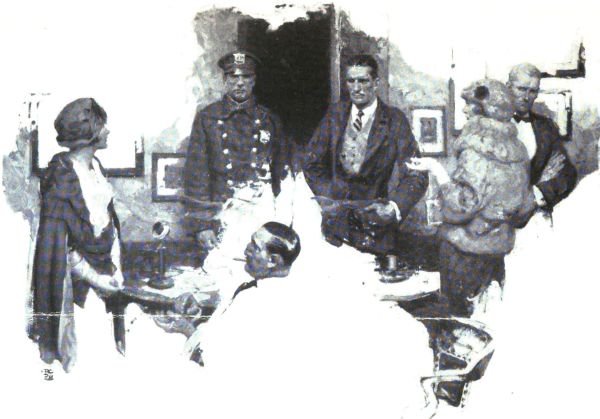
Grannis pointed to Clancy.
"Arrest her, officer!" he cried.
The uniformed man moved toward Clancy. She shrunk away from him.
"What for?" she cried.
"You'll find out soon enough," said the policeman, with a grin.
Fay Marston laughed shrilly.
"Ain't that like a thief, though? Trust her kind to have nerve!"
"'Thief!'" Clancy stared at her.
"Thief's what I said, and it's what I mean, too."
It was too absurd! Had the charge been that of murder, Clancy would not have laughed. That charge would soon be made against her. But, until it was——
"What am I supposed to have stolen?" Clancy asked.
"You ain't supposed to have stolen anything," said Weber. "You're known to have stolen a pearl necklace from my wife."
"A pearl necklace," said Fay glibly. "She came into my room at the Napoli. I was packin', officer, gettin' ready to take a little trip with my husband. I asked her to pack the necklace and some other things for me. She said she'd put them in a bag. The necklace was missin' when I opened the bag next day."
Clancy laughed. It was ridiculous.
"You can't arrest me on a story like that!" she cried.
"Not if we produce the pawnbroker where you pawned the pearls?" sneered Weber.
"You can't," said Clancy.
Yet, as she looked from his sneering face to the threatening eyes of Grannis, she wondered whether or not they could. She had read of "frame-ups." Was it possible that she was to be the victim of one?
"Like to talk it over a bit?" asked Grannis. She made no verbal answer, but her expression was reply enough. "Wait in the next room, officer," said Grannis.
The policeman looked undecided.
"It ain't regular," he muttered.
"I know it isn't," said Grannis, "but—under the circumstances——"
"All right," said the officer.
He walked through the door, which Grannis closed after him. Then Zenda's sallow-faced partner came close to Clancy.
"I'm going to talk turkey," he declared. "You've butted in on a game that's a whole lot bigger than you are, little girl. We don't want to ride you, but we ain't going to let you ride us, neither. It's up to you. Fay will swear that you took her necklace. We've got a pawnbroker all lined up. He'll not only identify you but he'll produce his books and the necklace that you stole. We're in earnest. Now—will you take ten thousand and—get?"
Clancy was beaten; she knew it; at least, she had lost the second round. That it was the final round she could not believe. And yet, if she refused their money, they'd not believe her. They would take her to jail. By this time, Vandervent's men were doubtless searching for her. With the ten thousand dollars she might flee. She wouldn't use a penny of it. But she'd take it, merely in order that they'd believe her. She let Grannis press the money into her hand.
Head down, she heard Grannis call in the policeman and state that she had promised to make restitution. The policeman, with some grumbling, left. Clancy supposed that it was an ordinary sort of thing; the officer was venal, would be unfaithful to his duty for the sake of a few dollars.
She listened apathetically to Grannis' threats. They didn't interest her. New York had whipped her.
Yet, when she left the building, she stopped before a hotel across the street. There she tried to engage a taxi-cab to take her up to Park Avenue. But the taximen were emulating their millionaire brethren. They were profiteering. Inasmuch as the travel was difficult because of the snow, the man wanted triple fare. Clancy couldn't afford it.
She tramped across Forty-second Street to Fifth Avenue, fought her way, buffeted by the wind, up to Forty-eighth, and then crossed over to Park avenue. She didn't know exactly where Zenda lived, but she did know that it was a corner apartment-building on the east side of the avenue. Her fourth inquiry was rewarded with the information that Zenda lived there. But when her name was telephoned up-stairs, word came back that Mr. Zenda had been taken ill last night with influenza, and was unconscious at the moment.
She turned away. The Fates were against Clancy and with her enemies.
Still—she had ten thousand dollars in her pocketbook. One could do a great deal with ten thousand dollars. But she dismissed the temptation as quickly as it had come to her. She'd go home and wait the certain arrival of Vandervent's men.
She shrugged, her lips curling in a self-amused smile. She'd been frightened at arrest on a trumped-up charge, while imminent arrest on a charge that would be supported by strong circumstantial evidence was just round the corner. She was a funny person, this Clancy. Little things scared her; big things— But big things scared her, too. For when Mrs. Gerand met her at the door of the lodging-house, after Clancy had survived the perilous journey down Fifth Avenue on the 'bus, the landlady's first words were that a gentleman awaited her. Not until Randall had held her hand a full minute could Clancy realize that it wasn't a detective from the district attorney's office.
XVII
Clancy had, on the other occasions on which she had met David Randall, been cool, aloof, mildly flirtatious, fun-making. Even when fear had swayed her and he had guessed at some worry eating at her heart, she had managed to preserve a verbal self-command.
But it was a Clancy whom he had never met before who faced him now. It was an incoherent Clancy, who said brokenly, while his big hand still held hers:
"What a surprise! I expected—I'm glad— What a terrible storm—so much snow—in a few hours— Wasn't it fun—last night?"
Then the incoherence that, from a person who had heretofore been always in complete possession of herself, was all the more charming, vanished. She looked down at her hand, then demurely up at him. With Vandervent's detectives ready to knock upon the front door—it is a peculiar thing that one always thinks of detectives as knocking, never ringing—with ten thousand dollars of venal money in her purse; with flight from the city as her only escape—and that, her common sense told her, a temporary one—from her amazing difficulties; with her career, not merely the moving-picture ambitions but the new one of achieving success with Miss Henderson, vanishing as the snow upon the streets would vanish before the rain and sun; with more trouble than she could cope with, Clancy became demure. She was thoroughly feminine. And a woman regards a man as something to be swayed by her. So Clancy forgot her own troubles for the moment in the pleasing task of making Randall's face redder than it was.
"You like it?" she asked. He didn't understand her. "My hand," she explained.
Randall dropped it at once. Her own incoherence communicated itself to him.
"I didn't mean— I didn't realize——"
"Oh, it's perfectly all right," said Clancy soothingly. "If I were you, I'd probably like to hold my hand, too."
She laughed. Randall discovered from the laugh that he had not offended irreparably. Emboldened, he snatched at the hand again. But they were in the hall, and Mrs. Gerand, disapproving of eye as she looked at this young couple violating the austerity of her house by open and bold flirtation, was only twenty feet away.
"Let's go in the parlor," said Clancy.
There was a sort of sofa near the old-fashioned marble mantel in the parlor, and in the exact center of this Clancy sat. Randall was forced to deposit himself upon a chair, a rickety affair which he drew as near to Clancy as he dared. He coughed nervously. Then he smiled—a broad smile, the smile, he thought, of large friendliness, of kindly impersonality. Clancy was not deceived by it.
"How'd you find me here?" she demanded. "Didn't I refuse to tell you my address?"
"Mrs. Carey told me this morning."
"Oh, she did! Why did she do that?"
"It wasn't a crime, was it?" asked Randall aggrievedly. "I guess that she thought she owed it to me—after last night."
"What do you mean?"
Randall's eyes lowered. He fidgeted uneasily in his chair. Then he lifted his eyes until they met hers.
"Well, she wouldn't give me a chance last night."
"'A chance?' What do you mean?" Clancy sat bolt upright on the sofa.
"She was afraid that you might listen to me." The explanation didn't quite explain.
"I'm listening to you now," she said.
"Yes; yes"—and Randall smiled rather wanly—"Mrs. Carey is a mind-reader, I think. She knew that I intended—she knew what I intended to say," he corrected his phrasing, "and she didn't want me to say it."
Into Clancy's eyes came glints of merriment.
"Oh, yes; she was afraid that you would propose to me."
Somehow or other, without Clancy putting it into words, her manner indicated an amused scorn. Randall was in love—in love in that terrific and overwhelmingly passionate fashion that only love at first sight can attain. But he was a grown man, who had proved, by his business success, his right to walk among men. He was good-natured, would always be good-natured. But he had self-respect. And now he hit back.
"Oh, no," he said; "she was afraid that you would accept me."
Not afraid to hit back, nevertheless, for a moment, he feared that he had struck too hard. He misread, at first, the light in Clancy's eyes. He thought it was anger.
But, to his relieved amazement, she began to laugh.
"Some one has a flattering conception of you, Mr. Randall," she told him.
He grinned cheerfully.
"Not flattering, Miss Deane—correct."
"Hm." Clancy pursed her lips. "You think well of Mr. David Randall, don't you?"
"I couldn't offer you goods of whose value I had any doubt, Miss Deane," he retorted.
Clancy's respect for him reached an amazing altitude. He could, after all, then, be quick of speech. And Clancy liked a man who could find ready verbal expression for his thoughts.
"I take it, then, that you are definitely offering me your hand and fifty per cent of all your worldly goods, Mr. Randall."
"Do you accept them?" he asked.
Clancy shook her head, smiling.
"Not to-day, thank you."
Randall frowned.
"Mrs. Carey is altogether too ambitious," he said. "She couldn't play Fate."
Clancy made a moue.
"Oh, then, last night—you think it might have been different?"
"I have no thoughts, Miss Deane—merely hopes. But Mrs. Carey said that you were worried— I could see that, too—and she thought that it wasn't fair——"
Clancy felt a sudden resentment at Sophie Carey. After all, even though Mrs. Carey had been ever so kind, it had all been voluntary. Clancy hadn't dreamed of asking anything of her. And even involuntary kindness, grudging kindness, doesn't bestow upon the donor the right to direct the affairs of the donee. Once again, she was rather certain that she and Sophie Carey would never be real friends. She would always owe the older woman gratitude, but——
"Not fair, eh? You didn't mind that, though."
The humor left Randall's eyes. He was deadly serious as he answered,
"Miss Deane, any way that I could get you would be fair enough for me."
"But why hurry matters?" smiled Clancy.
"'Hurry?'" His smile was a little bit uneasy. "You—you're destined to a great success, Miss Deane, and pretty soon I'm afraid that you'll be way beyond my reach."
"I suppose that I should courtesy," said Clancy. "But I won't. I'll simply tell you that——"
"Don't tell me anything unless it's something I want to hear," he interposed.
"You'll like this, I'm sure," she said naïvely. "Because I was going to tell you that I like you immensely, and—well, I like you."
"And you won't marry me?"
"Well, not now, at any rate," she replied.
He rose abruptly.
"I'm sorry—awfully sorry. You see—last night—it's altogether ridiculous, I suppose, my expecting, daring to hope, even, that a girl like you would fall in love with me so soon. But—you're so lovely! Vandervent—last night—please don't be offended—and I'm leaving town to-day."
"'Leaving town?'" Clancy was shocked.
"That's why. I'll be gone a month. And I've never met a girl like you. Never will again; I know that. I—didn't want to tell you last night. It wasn't absolutely decided. If I'd taken you home—well, I'd have told you. Because I'd have proposed then. But not at Mrs. Carey's. I hoped to—sort of surprise you in the taxi. But that chance went. You spent the night at her house. And I'm leaving to-day."
"Where for?" she asked. She didn't know how dull her voice had suddenly become. She wasn't in love with Randall. Clancy Deane was not the kind to surrender her heart at the first request. Her head would not rule her heart, yet it would guide it. Under normal conditions, even had she fallen in love with Randall, she would not have married him offhand, as he suggested. She would demand time in which to think the matter over.
But these were abnormal conditions. She was in danger. In the rare moments, when she could force her mind to analyze the situation, she believed that her danger was not great, that the police must believe her story. But she was a young and somewhat headstrong girl; fear triumphed over reason most of the time.
If she loved Randall, she might have accepted him. Of course, she would have told him her predicament. She was enough of a character-reader to know that Randall would believe her and marry her. But she didn't love him.
"California," he said. "A moving-picture combination. They've asked me to handle the flotation of stock and the placing of the bonds. It's a big thing, and I want to look the proposition over." He leaned suddenly near to her. "Oh, don't you think that you can come with me? If you knew how much I cared!"
She shook her head.
"I don't love you," she said.
He managed a smile. The nicest thing about him, Clancy decided, was his sportsmanship.
"Well, I have rushed matters, Miss Deane. But—don't forget me, please."
"I won't," she promised. "And I hope you have a fine trip and make a great success."
"Thank you," he said. "Good-by."
They touched hands for a moment, and then he was gone. Thus banal, almost always, are the moments that follow upon the ones that have reached for the height of emotion.
Clancy was left alone almost before she realized it. Up-stairs, in her shabby bedroom, she wondered if any other girl had ever crowded so much of differing experience into a few days. Truth was stranger than fiction—save in this: in fiction, all difficulties were finally surmounted, all problems solved.
But her own case— One who flees always prejudices his case. Fanchon DeLisle's reply to Vandervent's telegram would arrive by the morrow, anyway. The only reason that Clancy had not been called upon by Vandervent's men that she could conceive was that the storm had delayed the transmission of telegrams. A thin reed on which to lean! She suddenly wished with all her heart that she loved Randall. If she did love him, she could demand his protection. That protection suddenly loomed large before her frightened eyes.
Well, there was only one thing to do. Accepting defeat bravely is better than running away from it eternally. Also, in her mind lived the idea that Vandervent might possibly— Absurd! He'd only met her last night. And he was an officer of the law, sworn to do his duty.
She had no preconceived idea of what she'd do. She felt dull, bewildered, dazed.
Surrender! It was the only thing to do. Better by far that than being rudely taken to the Tombs. She'd read of the Tombs prison. What a horrible name! How it suggested the gruesome things! Lesser characters than Clancy for much less reason have had recourse to poison, to other things— It never even entered her head.
Mrs. Gerand, amazed at the question, told her where to find the district attorney's office. Clancy fought her way to the Astor Place subway station. She got off at Brooklyn Bridge. From there, a policeman directed her to the Criminal Courts Building. In the lobby, an attendant told her that Mr. Vandervent's office was on the third floor. She took an elevator, and, after entering two offices, was correctly directed. To a clerk who asked her business, she merely replied:
"Tell Mr. Vandervent that Florine Ladue wishes to see him."
The clerk showed no surprise. That was natural. Vandervent's underlings, of course, knew nothing of the clue which Vandervent possessed to the identity of the Beiner murderer. He departed toward an inner office.
Clancy sank down upon a wooden bench. Well, this was the end. She supposed that she'd be handcuffed, locked in a cell. She picked up a newspaper, a paper largely devoted to theatrical doings. Idly she read the dramatic gossip. She turned a page, and glanced a second time at a portrait displayed there.
It was a picture of Fanchon DeLisle. Her bosom rose; in her excitement she did not breathe. For beneath the picture was a head-line reading:
FAMOUS SOUBRETTE DIES OF INFLUENZA
She read the brief paragraph that followed. Fanchon DeLisle, leading woman of the New York Blondes Company, had died of the "flu" in Belknap, Ohio, on Wednesday afternoon. It was her second attack of the disease. Clancy's eyes blurred. She read no more. She looked about her. She must escape. Fanchon DeLisle was the only person who could tell Vandervent that Florine Ladue was Clancy Deane. Of course, Fay Marston knew, but Fay Marston's knowledge was not known to the police. Only Fanchon DeLisle could, just now, at any rate, tell that Clancy— She had sent in the name, Florine Ladue!
She must escape before Vandervent— But even as she rose tremblingly to her feet, Vandervent entered the outer reception-room. He stopped short at sight of Clancy. His mouth opened. But Clancy didn't hear what he said, because she fainted.
XVIII
Clancy came out of her faint mentally alert, although physically weak. It took her but the smallest fraction of time after she recovered consciousness to remember all that had led up to her collapse. And she kept her eyes closed long enough to marshal to her aid all those defensive instincts inherent in the human species. So, when she did open her eyes, that consummate courage which is mistaken for histrionism made her wreathe her lips in a smile. She was lying on a leather-covered couch in what she learned, in a moment, was Vandervent's private office. Her eyes rested on the tenant of that office. His broad shoulders were slightly stooped as he bent toward her. In his hand, he held a glass of water. She noted immediately that his hand shook, that water slopped over the edge of the glass.
"You—feel better?" he asked breathlessly.
Clancy sat upright, her hand straying to her hair. She looked beyond Vandervent to where stood a man in a badly cut blue suit. His black mustache was gray at the roots, and the vanity that this use of dye indicated was proved by the outthrust of his lower lip. A shrewder observer than Clancy—one versed in the study of physiognomy—would have known that the jutting lip had been trained to come forward, that the aggressiveness it denoted was the aggressiveness of the bully, not of a man of character. His round chin was belligerent enough, as were his little round blue eyes, but there was that lack of coordination in his features that is found in all weak souls.
But, to Clancy, he was terrifying. His small eyes were filled with suspicion, filled with more than that—with a menace that was personal.
Clancy reached for the glass of water; she drank it thirstily, yet in a leisurely manner. She watched the blue-suited man closely. She put back the glass into Vandervent's outstretched hand.
"Thank you—so much," she said. "It's a wonder that you didn't let me lie where I fell, after my playing such a silly joke."
She saw Vandervent cast a glance over his shoulder at the blue-suited man. His head nodded slightly. Had he phrased it in words, he could not more clearly have said, "I told you so."
And if the blue-suited man had replied verbally, he could not have said more clearly than he did by the expression of his eyes, "She's lying."
Vandervent's shoulders shrugged slightly; his keen gray eyes gleamed. Once again it was as though he spoke and said, "I'll show you that she isn't."
It was a swift byplay, but need sharpens one's wits. Not that Clancy's ever were dull, for, indeed, a lesser character, even in such danger as hers, might have been too concerned with her physical well-being, her appearance, to notice anything else. But she caught the byplay, and it brought a silent sigh of relief up from her chest. She was on her own ground now, the ground of sex. Had Vandervent been a woman, such a woman as Sophie Carey or Sally Henderson, Clancy would have surrendered immediately, would have known that she had not a chance in the world of persuading any woman that she had played a joke when she announced herself as Florine Ladue. But with a man—with Philip Vandervent, whose hand shook as he held a glass of water for her, whose eyes expressed a flattering anxiety—Clancy's smile would have been scornful had not scorn been a bit out of place at the moment. Instead, it was shyly confident.
"A—er—a joke, of course, Miss Deane," said Vandervent.
"Not so very funny, though, after all," said Clancy, with just enough timidity in her manner to flatter Vandervent.
The blue-coated man snorted.
"'Joke!' 'Funny!' Excuse me, lady; but where do you get your humor?"
Vandervent wheeled and glared at the man.
"That'll be about all, Spofford!" he snapped.
Spofford shrugged.
"You're the boss," he said. "Only—how does she happen to know the name Florine Ladue? Answer me that, will you?"
"I told her," said Vandervent shortly.
Spofford caressed his mustache.
"Oh, I getcha. Oh-h!" His grin was complimentary neither to Clancy nor Vandervent. Then it died away; his eyes became shrewd, although his voice was drawling. "And the faintin'—that was part of the joke, eh, lady?"
Clancy felt a little chill of nervous apprehension run between her shoulder-blades. Confidence left her. This man Spofford, she seemed to foresee, might be dangerous. She was not out of the woods yet. But Vandervent's words reassured her.
"Miss Deane doesn't need to explain anything to you, Spofford."
There was a touch of petulance in the assistant district attorney's voice. Spofford recognized it.
"Sure not, Mr. Vandervent. Certainly she don't. Only—" He paused; he turned, and started for the door.
Vandervent recalled him sharply.
"What do you mean by 'only,' Spofford?"
"Well, she come in here and said she was Florine Ladue—and then she faints when you come out to see her. I meant that, if there was any of the newspaper boys hangin' around——"
"There weren't," said Vandervent. "And if the papers should mention Miss Deane's joke—" The threat was quite patent.
"They won't," said Spofford.
He cast a glance at Clancy. It was a peculiar glance, a glance that told her that in his eyes she was a suspicious character—no better than she should be, to put it mildly.
And Vandervent's expression, as he turned toward her, drove away what fears Spofford's expression had aroused. For, despite his effort to seem casual, the young man was excited. And not excited because of the name that she had sent in, or because she had fainted, but excited simply because Clancy Deane was alone in the room with him. He moved toward her. Quite calmly she assumed control of the situation, and did it by so simple a method as extending her hand for the glass which he still held and uttering the single word: "Please."
She held the glass to her lips for a full minute, sipping slowly. Falsehood was repugnant to her. Yet she must think of how best to deceive Vandervent.
"I suppose I've made you very angry," she said, putting the glass down upon the couch beside her.
"'Angry?' How could you make me angry—by coming to see me?"
Vandervent, with an acquaintance that comprised the flower of American and European society, was no different from any other young and normal male. His attitude now was that of the young man from Zenith or any other town in America. He was embarrassed and flattered. And he was so because a pretty girl was showing a certain interest in him.
"But to—fool you! I—you'll forgive me?" She was conscious that she was pleading prettily.
"Forgive you? Why—" Vandervent had difficulty in finding words. He was not a particularly impressionable young man. Had he been so, he could not, with his name and fortune, have remained a bachelor until his thirtieth birthday.
Clancy took up the not easily rolling ball of conversation.
"Because it was a terrible impertinence. I—you see——"
She paused in her turn.
"Jolly good joke!" said Vandervent, finally finding, apparently to oblige his guest, humor in the situation. "You can't imagine my excitement. Just had a wire from the chief of police in Belknap, Ohio, that Fanchon DeLisle was dead. Didn't see how we could locate this Ladue woman, when in comes a clerk saying that she's outside. I tell you, I never was so excited. Then I saw you, and you—tell me: why did you faint?" He put the question suddenly.
"Why did I faint?" She tried to laugh, and succeeded admirably. "I'm used to cold weather and blizzards. In Zenith, sometimes, it is thirty below, and the snow is piled ten feet high in the big drifts. But one dresses for it, or doesn't go outdoors. And, to-day, I wanted to see New York so much. I've only been here since Monday. The cars aren't running very regularly, so I walked down-town. And I guess I grew cold and tired. I feel ever so much better now," she ended chirpily.
"I'm glad of that," he smiled.
"And some one told me that this was the Criminal Courts Building, and I thought—I thought of—" She paused at exactly the right moment.
"Of me?" asked Vandervent. He colored faintly.
"I'm here," said Clancy. "And I thought that perhaps you wouldn't remember my name; so I—thought I'd play a joke. You will forgive me, won't you?"
He laughed.
"I'm afraid that Spofford won't, but I will."
"'Spofford?' The man who was here?" asked Clancy.
"One of the detectives attached to the staff. Hasn't much sense of humor, I'm afraid. But it doesn't matter."
He sat down, pulling up a chair opposite her.
"I think it's mighty nice of you to call down here, Miss Deane."
"You don't think it's bold of me?" she asked.
"Hardly. Would you like to go over the Tombs?"
Clancy shuddered.
"Indeed I wouldn't!"
"No morbid curiosity? I'm glad of that."
"'Glad?' Why?"
"Oh, well, just because," he blurted.
Clancy looked demurely downward, fixing a button on her glove. For a moment, there was silence. Then Clancy rose to her feet. She held out her hand to Vandervent.
"You've been so kind," she said. "If you'd arrested me for my silly joke, you'd have done to me what I deserved to have happen."
"Not at all," he said. "I feel that—that maybe I scared you when I came in——"
"Not a bit. I was—tired."
"You must let me take you home," he said.
She shook her head.
"I've troubled you enough. Please!"—as he seemed about to insist. "I'm really all right."
He eyed her doubtfully.
"You're sure?"
"Positive."
"All right, then; but—I'd like to."
She became mockingly stern.
"I've interrupted the course of justice enough for one day. Some other time, perhaps."
"There'll be another time?" he asked eagerly.
"Well"—she was doubtful—"I can't promise."
"But we might have luncheon together. Or tea? Or dinner?" He was flatteringly eager.
"I'll see," said Clancy.
Down-stairs, in the great lobby of the building, she marveled that she had escaped so easily. To have announced herself as Florine Ladue, the woman wanted for Beiner's murder, to have fainted when Vandervent came out, and still to have avoided, by a puerile explanation, all penalties was a piece of good luck that was incredible. She blessed the person unknown who had left the newspaper on the bench. The luckiest of chances had saved her from betrayal. Had she not read of Fanchon's death— She shuddered.
Then her eyes clouded. She had been fighting, with all the wit she owned, for liberty. She had not yet had opportunity to pay to Fanchon's death the tribute of sorrow that it demanded. She had known Fanchon but slightly; the woman was of a class to which Clancy could never belong—a coarse but good-hearted vulgarian. And she had tried to help Clancy in return for little kindnesses that Clancy had shown her when she lay ill with the "flu" in Zenith.
And now this same disease had finally killed the kindly soubrette. Her death had saved Clancy from disgrace—from worse, perhaps, if there is anything worse than disgrace— She suddenly realized how lucky she had been.
She stopped outside to adjust her veil. And she noticed that Spofford, the dyed-mustached gentleman of Vandervent's office, also emerged from the building. She shuddered. If her wit had not been quick, if she had not remembered, on, coming out of her faint, that the item in the paper had removed all danger, his hand might now be clasped about her wrist. Instead of walking toward the subway, she might now be on her way to the Tombs.
Spofford turned south toward the Brooklyn Bridge. She would never, thank God, see him again. For nothing would ever tempt her to the Criminal Courts Building another time. Its shadow would hang over her soul as long as she lived. She had had the narrowest escape that was possible, and she would not tempt fate again.
She would never learn. As her mind ceased to dwell upon the problem of her connection with Beiner's mysterious fate and moved on to consider what she should do with Grannis's ten thousand dollars, it was as though the Beiner incident were forever closed. Clancy had too much Irish in her for trouble to bear down upon her very long. She would never learn that issues are never avoided but must always be met. She was in a congratulatory mood toward herself because Vandervent had not suspected the grim truth behind what she called a jest. She had conquered this difficulty by the aid of fate; fate would help her again to handle the Grannis-Zenda-Weber matter. So she reasoned. It would straighten itself out, she assured herself.
XIX
There was a lunch-room on Broadway, just below Eighth Street. Clancy, walking westward from Astor Place, the station at which she emerged from the subway, saw its window-display of not too appetizing appeal, and paused. To-day was Friday; it was quite possible that Sally Henderson would to-morrow give her new employee an advance upon salary. But Clancy had learned something. That something was that New York is not a place in which to reveal one's pecuniary embarrassment. It was not that New York was hard-hearted, Clancy decided. It was that it was a busy place, and had no time to listen to whines. To ask an advance on salary was, in a way, to whine. Clancy was not going to begin her relationship with Sally Henderson on anything but a basis of independence.
So her pause before the lunch-room was only momentary. She entered it immediately. The Trevor was only two hundred yards away, but Clancy had only a pitiful amount of money in her pocket. That is, money that belonged to her. Grannis's ten thousand was not hers. To whom she would give it, she did not yet know, but she did know that she would starve before she used any of it. It might be that Sally Henderson would pay her a half-week's salary to-morrow. She must hope for that. But she must not rely on it. Hence she must live leanly.
This was only her fifth day in New York. It had been her fortune to eat at restaurants of the better class, at a private home. Now, for the first time since her arrival from Zenith, she had opportunity to find out what might have been, what might still be, her lot. Not that the food in the lunch-room was particularly bad. Of its kind, it was rather good. But there was the stain of egg upon the table-cloth; the waiter who served her was unshaven. The dishes in which the food was served were of the heaviest of china. And Clancy was of the sort that prefers indifferent food well served to good food execrably presented.
She paid her check—considering that she had had only corned-beef hash and tea and bread, she thought that sixty cents was an exorbitant charge—tipped the waiter a dime, and trudged out into the storm again.
The snow had ceased falling, but only one so weather-wise as the Maine-bred Clancy would have known that. For the flurries blown by the gale had all the appearance of a continuing blizzard. Bending forward, she made her way to Fifth Avenue, and thence south across Washington Square. Twice, feeling very much alone in the gloom, she made detours to avoid coming too near men whom she observed moving her way. She was yet to learn that, considering its enormous heterogeneous population, New York holds few dangers for the unescorted girl. And so she ran the last few yards, and breathed with relief when the latch-key that Mrs. Gerand had given her admitted her to the lodging-house on the south side of the square.
In her room, her outer clothing removed, she pulled a shabby rocking-chair to the window and looked out upon the dimly descried trees, ghostly in their snowy habiliments. Chin on elbow, she pondered.
The wraith of Florine Ladue was laid. So she believed. And she could find no reason to fear a resurrection. Beiner, who knew her, could recognize her as Florine Ladue, was dead. So was Fanchon DeLisle. Zenda, Grannis, Weber, and the others of the poker-party at Zenda's knew that she called herself "Florine." But it was quite a distance from knowing that a young woman had named herself Florine to proof that the same young woman's last name was Ladue, and that she had visited Morris Beiner's office. Of course—and Clancy's brows knitted at the thought—if there were any legal trouble over the Weber-Zenda-Grannis matter and she testified in court, and Vandervent or Spofford or some other of the district attorney's office heard or saw testimony which involved the fact that she'd used the name "Florine," that person would do some thinking, would wonder how much jesting had been behind her announcement of herself under the name of the woman wanted for the Beiner murder. In that case——
What about that case? Oddly enough—yet not so oddly, after all, when one considers that Clancy was only twenty years of age—up to now she had given a great deal of thought to her predicament and practically none to the real way out of it. She marveled at herself.
Why in that case, she'd be in desperate danger, as great danger as she had been in just before she picked up the paper in Vandervent's anteroom, and the only way out of that danger, without lasting disgrace at the least, would be the production of the real murderer of Morris Beiner.
The real murderer! She drew in her breath with a whistle.
Beiner had been killed; she was suspected. These were facts, and the only facts that she had reckoned with. But the greater fact, though up to now ignored by her, was that somebody had killed Beiner. Some one had entered the man's office and slain him, probably as he lay unconscious on the floor. That somebody was foot-loose now, perhaps in New York, free from suspicion.
She straightened up, alert, nervous. Suddenly, horror—a horror which fear had managed to keep from her till now—assailed her. A murderer! And free! Free to commit other murders! She started as a knock sounded upon the door. And, queerly, she didn't think of the police; she thought of the murderer of Beiner. It was with difficulty that she mastered herself sufficiently to answer the knock.
It was Mrs. Gerand. Miss Deane was wanted on the telephone. It was not a moment when Clancy wished to talk to any one. She wished to be alone, to study upon this new problem—the problem that should have been in her mind these past three days but that had only popped into it now. But the telephone issued commands that just now she dared not disobey. It might be Grannis or Vandervent. She ran down-stairs ahead of Mrs. Gerand. A booming voice, recognition of which came to her at once, greeted her.
"Hello!"
"Miss Deane? This is Judge Walbrough speaking."
"Oh, how do you do?" said Clancy. In her relief, she was extremely enthusiastic.
The deep voice at the other end of the wire chuckled.
"You know the meaning of the word 'palaver,' don't you, young woman? The happy way you speak, any one'd think I was a gay young blade like David Randall or Vandervent instead of an old fogy."
"'Old fogy!' Why, Judge Walbrough!"
Clancy's tone was rebuking, politely incredulous, amused—everything, in short, that a young girl's voice should be when a man just passing middle age terms himself "old." Walbrough chuckled again.
"Oh, it's a great gift. Miss Deane; never lose it. The young men don't matter. Any girl can catch one of them. But to catch the oldsters like myself—oldsters who know that they can't catch you—that takes genius, Miss Deane."
Clancy laughed.
"Please don't flatter me, Judge. Because, you know, I believe you, and——"
"Sh," said Walbrough. As he uttered the warning, his voice became almost a roar. "The jealous woman might overhear us; she is listening in the next room now——"
There was the sound of a scuffle; then came to Clancy's ears the softer voice of Mrs. Walbrough.
"Miss Deane, the senile person who just spoke to you is absurd enough to think that if an old couple—I mean an old man and his young wife—asked you, you'd probably break an engagement with some dashing bachelor and sit with us at the opera."
"I don't know the senile person to whom you refer," retorted Clancy, "but if you and the judge would like me to go, I'd love to, even though I have no engagement to break."
"We won't insist on the breaking, then. Will you run over and dine with us?"
Clancy was astonished. Then she remembered that she had dined rather early at the Broadway lunch-room. It really wasn't more than six-thirty now. People like the Walbroughs, of course, didn't dine until after seven, possibly until eight.
"I won't do that," she answered. "I'd intended to go to bed—it's such a terrible night. And I ate before I came home—but I'd love to come and sit with you," she finished impulsively.
There was something warm, motherly in the older woman's reply.
"And we'd love to have you, Miss Deane. I'll send the car around right away."
Clancy shrugged as she surveyed again her meager wardrobe. But the Walbroughs must know that she lived in a lodging-house—she supposed that they'd obtained her telephone-number and address from Sophie Carey—and the fact that she didn't possess a gorgeous evening gown wouldn't mean much to them, she hoped. And believed, too. For they were most human persons, even if they did, according to Sophie Carey, matter a lot in New York.
Mrs. Gerand was quite breathless when she announced to Clancy, half an hour after the telephone-call, that a big limousine was calling for the newest Gerand lodger. Clancy was already dressed in the pretty foulard that was her only evening frock. Mrs. Gerand solicitously helped her on with her shabby blue coat. Her voice was lowered in awe as she asked:
"It ain't the Walbroughs, is it? The chauffeur said, 'Judge Walbrough's car;' but not the judge, is it?"
"Are there two of them?" laughed Clancy.
Mrs. Gerand shook her head.
"Not that I ever heard of, Miss Deane. But—gee, you got swell friends, ain't you?"
Clancy laughed again.
"Have I?"
"I'll say you have," said Mrs. Gerand.
The Walbrough home was on Murray Hill, though Clancy didn't know at the time that the section of the city directly south of the Grand Central Station was so named. It was not a new house, and it looked as though it was lived in—something that cannot always be said of New York homes, whether in apartment-buildings or in single houses. It was homey in the sense that the houses in Zenith were homey. And, even though a colored man in evening clothes opened the front door, and though a colored maid relieved Clancy of her coat, Clancy felt, from the moment that she passed the threshold, that she was in a home.
Her host met her at the top of a flight of stairs. His great hands enveloped hers. They drew her toward him. Before she knew it, he had kissed her. And Clancy did the thing that made two admiring acquaintances adoring friends for life. She kissed the judge warmly in return. For Mrs. Walbrough was standing a trifle behind the judge, although Clancy hadn't seen her. She came forward now, wringing her hands with a would-be pathetic expression on her face.
"I can't trust the man a moment, Miss Deane. And, to make it worse, I find that I can't trust you." She drew Clancy close to her. She, too, kissed the girl, and found the kiss returned.
"Why shouldn't I kiss him?" demanded Clancy. "He brags so much, I wanted to find out if he knew how."
"Does he?" asked Mrs. Walbrough.
Clancy's eyes twinkled.
"Well, you see," she answered, "I'm not really a judge myself."
The judge exploded in a huge guffaw.
"With eyes like hers, Irish gray eyes, why shouldn't she have wit? Tell me, Miss Deane: You have Irish blood in you?"
"My first name is Clancy," replied the girl.
"Enough," said the judge. He heaved a great mock sigh. "Now, if only Martha would catch a convenient cold or headache——"
Mrs. Walbrough tapped him with an ostrich-plume fan.
"Tom, Miss Deane is our guest. Please stop annoying her. The suggestion that she should spend an hour alone with you must be horrifying to any young lady. Come."
The judge gave an arm to each of the ladies, and they walked, with much stateliness on the part of the judge, to a dining-room that opened off the landing at the head of the stairs.
Clancy felt happier than she had deemed it possible for her to be. Perhaps the judge's humor was a little crude; perhaps it was even stupid. But to be with two people who so evidently liked her, and who so patently adored each other, was to partake of their happiness, no matter how desperate her own fears.
Dinner passed quickly enough, and Clancy found out that she had an appetite, after all. The judge and his wife showed no undue interest in her. Clancy would have sworn that they knew nothing about her when dinner ended and they started for the opera. She did not know that, before he went upon the bench, Judge Walbrough had been the cleverest cross-examiner at the bar, and that all through dinner he had been verifying his first estimate of her character. For the Walbroughs, as she was later to learn, did not "pick up" every lovely young female whom they chanced to meet and admire. A happy couple, they still were lonely at times—lonely for the sound of younger voices.
And the significant glance that the judge cast at his wife at the end of the dinner went unnoticed by Clancy. She did not know that they had passed upon her and found her worth while.
And with this friendly couple she heard her first opera. It was "Manon," and Farrar sang. From the beginning to the tragic dénouement, Clancy was held enthralled. She was different from the average country girl who attends the opera. She was not at all interested in the persons, though they were personages, who were in the boxes. She was interested in the singers, and in them only. She had never heard great music before, save from a phonograph. She made a mental vow that she would hear more again—soon.
XX
The judge and his wife were true music-lovers and didn't attend the opera for social reasons. Nevertheless, they knew, seemingly, every one of importance in the artistic, financial, professional, and social world. During the entr'actes, the judge pointed out to Clancy persons with whom he was acquainted. Ordinarily, Clancy would have been thrilled at the mere sight of the demi-gods and goddesses. To-night, they left her cold. Yet, out of courtesy, she professed interest.
"And there's my little friend Darcy," she heard the judge say.
She roused herself from abstraction, an abstraction in which she was mentally reviewing the acting and singing of the superb Farrar.
"Who is he?" she asked.
The judge smiled.
"Munitions. Used to live in Pennsylvania. Now he dwelleth in the Land of Easy Come."
For a second, her thoughts far away, Clancy did not get the implication. Then she replied.
"But I thought that the munitions millionaires made so much that they found it hard to get rid of it."
"This is a wonderful town, Miss Deane. It affords opportunity for everyone and everything. No man ever made money so fast that New York couldn't take it away from him. If the ordinary methods are not sufficient, some brilliant New Yorker will invent something new. And they're inventing them for Darcy—and ten thousand other Darcys, too."
Clancy stared at the squat little millionaire a few seats away.
"He doesn't look very brilliant," she announced.
"He isn't," said the judge.
"But he's worth millions," protested Clancy.
"That doesn't prove brilliance. It proves knack and tenacity, that's all," said her host. "Some of the most brilliant men I know are paupers; some of the most stupid are millionaires."
"And vice versa?" suggested Clancy.
The judge shrugged.
"The brilliant millionaires are wealthy despite their brilliance. My child, money was never so easy to make—or so easy to spend. And those who make it are spending it."
"But isn't every one spending, not only the millionaires?" demanded Clancy.
"It's the fashion," said the judge. "But fashions change. I'm not worried about America."
The curtain rose, cutting short Walbrough's disquisition. But, for a moment, Clancy pondered on what he had said. "The Land of Easy Come." The people that she had met, the moving-picture millionaires—theirs had come easily— Would it go as easily? Even David Randall, worth approximately half a million before his thirtieth birthday—she'd read enough to know that brokers went bankrupt over-night. The hotels that she knew were crowded almost beyond capacity with people who were willing to pay any price for any sort of accommodation. The outrageous prices charged—and paid—in the restaurants. The gorgeous motor-cars. The marvelous costly clothing that the women wore. Some one must produce these luxuries. Who were paying for them? Surely not persons who had toiled and sweated to amass a few dollars. Easy come! Her own little nest-egg, bequeathed to her by a distant relative—it had come easily; it had gone as easily. Of course, she hadn't spent it, but—it was gone. But she was too young to philosophize; she forgot herself in the performance.
She was throbbing with gratitude to the Walbroughs as, the opera over, they slowly made their way through the chattering thousands toward the lobby. They had given her the most wonderful evening of her life.
She was about to say something to this effect when some one accosted the judge. For the moment, he was separated from the two women, and verbal expression of Clancy's feelings was postponed. For when the judge joined them, he was accompanied by a man whose mop of hair would have rendered him noticeable without the fading bruise upon his face. It was Zenda!
His recognition was as quick as Clancy's. His dreamy brown eyes—one of them still discolored—lighted keenly. But he had been an actor before he had become one of the most famous directors in Screendom. He held out his hand quite casually.
"Hello, Florine!" he said.
Walbrough stared from one to the other.
"You know each other? 'Florine?'"
"A name," said Clancy quickly, "that I called myself when—when I hoped to get work upon the screen."
She breathed deeply. Of course, Judge Walbrough and Zenda didn't know that a woman named Florine Ladue was wanted for Beiner's murder; but still——
"'On the screen?' That's funny," said the judge. "Sophie Carey told us that you were thinking of stenography until she put you in touch with Sally Henderson. Huh! No fool like an old fool! I was thinking I would put a new idea in your head, and you have it already. Darcy stopped me and introduced his friend Mr. Zenda, and I immediately thought that a girl like you with your beauty—" He interrupted himself a moment while he presented Zenda to his wife. Then he turned to Clancy. "Couldn't you get work?" he asked, abruptly.
They were on the sidewalk now, and the starter was signaling, by electrically lighted numbers, for the judge's car. It was a clear, crisp, wonderful night, and the stars vied with the lights of Broadway.
Clancy looked up and down the street. She had no intention of running away. She'd tried to reach Zenda to-day, and had been told that he was too ill to receive visitors. Nevertheless, the impulse to flee was roused in her again. Then, listening to reason, she conquered it.
She answered the judge.
"'Get work?' I didn't try very long."
"And she didn't come to me," said Zenda. He put into his words a meaning that the Walbroughs could not suspect. Clancy got it.
"Oh, but I did!" she said. "I've tried to get you on the telephone. Central wouldn't give me your number. I wrote you a letter in care of Zenda Films. Your partner, Mr. Grannis, opened it. And to-day I called at your apartment and was told that you were ill."
Zenda's face, which had been stern, softened.
"Is that so?" he asked.
The judge, a trifle mystified, broke into the conversation.
"Well, she seems to have proved that she didn't neglect you, Mr. Zenda. Don't see why she should go to such pains, unless"—and he laughed—"Miss Deane wants to prove that she played fair;—didn't give any one else a prior opportunity to make a million dollars out of her pretty face."
"Miss Deane can easily prove that she is playing fair," said Zenda.
"I want to," said Clancy quickly.
Walbrough was a clever man. It was pardonable in him not to have suspected earlier that there was some byplay of talk to whose meaning he was not privy. But now he knew that there was some meaning not understood by him in this talk.
"Here's the car," he said. "Suppose you ride home with us, Zenda?"
"I have some friends. If you'll wait a moment—" And Zenda was off.
In silence, Clancy entered the judge's limousine. Then Mrs. Walbrough, settling herself comfortably, suddenly patted the girl upon the hand. She was a keen woman, was Mrs. Walbrough; she sensed that something was troubling Clancy. And the judge cleared his throat portentously.
"Miss Deane," he said, "I don't know your relation to Mr. Zenda. But, if you'd care to consider yourself my client——"
"Thank you," said Clancy.
Then Zenda reappeared. He crowded himself into the car.
"I just telephoned my apartment, Miss Deane. The door-man went on at noon and stays until midnight. He says that a young lady answering your description called on me to-day."
"Did you need verification, Zenda?" asked the judge angrily.
Zenda shrugged.
"In a matter involving a hundred thousand and more, corroboration does no harm, and my obtaining it should not be offensive to Miss Deane."
"Oh, it isn't, it isn't!" said Clancy tremulously.
The judge's eyes narrowed.
"I must inform you, Zenda, that Miss Deane is my client," he said.
Zenda bowed.
"I couldn't wish a better adviser for Miss Deane. Farrar was in excellent voice to-night, didn't you think?"
No one challenged the change of subject, and until they were settled in the Walbrough library, the opera was the only subject of discussion. But, once there, Zenda came to business with celerity.
"Judge Walbrough, I have been swindled in a poker game, in a series of poker games, out of thousands of dollars. Last Monday night, we caught the man who did the cheating. There was trouble. Miss Deane was present at the game, in my apartment. She came as the guest of one Ike Weber. She disappeared during the quarrel. It has been my assumption that she was present as the aide of Weber. At the Star Club, on Tuesday, I stated, to associates of Weber, that the man was a swindler. Yesterday, I was told that he intended bringing suit against me. So I have denied myself to all possible process-servers on the plea of illness."
"Why? If the man is a swindler——"
But Zenda cut the judge short.
"I can't prove it. I don't want scandal. Suit would precipitate it. If I could get proof against Weber, I'd confront him with it, and the suit would be dropped. Also, I would recover my money. Not that that matters much. Miss Deane, why did you come to see me?"
Clancy drew a long breath; then she began to talk. Carefully avoiding all reference to Morris Beiner, she told everything else that had to do with Zenda, Weber, and Grannis. The judge spoke first after she ceased.
"I don't get Grannis's connection."
"I do!" snapped Zenda. "He's been trying to get control of the company— I'm not nearly so rich as people think I am. The company has a contract with me for a term of years at no very huge salary. I expected to make my money out of the profits. But now we've quarreled over business methods. If he could get me entirely out, use my name—the company has the right to—increase the capitalization, and sell stock to the public on the strength of my reputation, Grannis would become rich more quickly that way than by making pictures. And the quicker Grannis broke me, so that I'd have to sell my stock—every little bit helps. If Weber won a million from me——"
"'A million!'" gasped Walbrough.
Zenda's voice was self-contemptuous.
"Easy come, Judge," he said. "I'm an easy mark. Weber had a good start toward the million, would have had a better if it hadn't been for Mrs. Zenda."
"It's an incredible story!" cried the judge.
"What's incredible? That I should gamble, and that some one should swindle me? What's strange about that in this town, Judge? In any town, for that matter?"
Clancy, eyes half closed, hardly heard what they were saying. How easy it would be to confess! For, what had she to confess? Nothing whatever of wrong-doing. Then why had it not been easy to call on Zenda the first thing on Tuesday morning and tell him of Fay Marston's involuntary confession? Because she had been afraid of scandal? Her lips curled in contempt for herself. To avoid doing right because of possible scandal? She was overly harsh with herself. Yet, to balance too much harshness, she became too lenient in her self-judgment when it occurred to her that only fear of scandal kept her from confessing to Vandervent that she was Florine Ladue. That was a different sort of scandal; also, there was danger in it. No; she could not blame herself because she kept that matter quiet.
"And you'd advise me to keep it out of the courts, Judge?" she heard Zenda asking.
"If possible," replied the judge. "It will do you no good. The mere threat of it will be enough. Offer Grannis a fair price for his stock, deducting, of course, from that price whatever have been your poker losses to Weber. For the two are partners, unquestionably. Tell Grannis that, if he doesn't accept your offer, you will prosecute both Weber and himself for swindling. That's much the better way."
"I agree," said Zenda. "But I haven't the cash to swing Grannis's stock."
"Plenty of people have," said the judge. "In fact, I have a client who will take that stock."
"It's a bet," said Zenda. He rose briskly. "Can't thank you enough, Miss Deane. Will you be at the offices of Zenda Films to-morrow morning with Judge Walbrough?"
He turned to the judge and arranged the hour, then turned back to Clancy.
"And as soon as that's settled, we'll make a test of you, Miss Deane."
He was gone in another moment. The judge stared at Clancy.
"Little girl," he said, "if it weren't so late, I'd give you a long, long lecture."
"You'll lecture her no lectures, Tom Walbrough," said his wife firmly. "Hasn't she put you in the way of an investment for a client? You'll thank her, instead of scolding her."
The judge laughed.
"Right enough! But I will give her advice."
"And I'll follow it," said Clancy earnestly.
And she did. But not to the extent of doing as age, or proven experience, or ability advised her. She would always act upon the impulse, would follow her own way—a way which, because she was the lovely Clancy Deane, might honestly be termed her own sweet way.
XXI
When she and Judge Walbrough—the Walbroughs sent their car for her at nine-thirty—arrived in the offices of Zenda Films, they were ushered into an inner office by the same overdressed youth who had shown Clancy in there yesterday.
The meeting that loomed ahead of her was fraught, she believed, with tremendous dramatic possibilities. Of course, none of the people who would take part in it knew that she had visited the office of Morris Beiner, yet she might be called again by the name "Florine" in the presence of some one who knew.
Zenda was already there, seated at the large table. At the far end of it were Weber and Grannis. There were no introductions. Zenda greeted the new arrivals, and merely stated:
"Judge Walbrough will act as my attorney. If you want a lawyer, Grannis, you, of course, are entitled to one."
Grannis grunted unintelligibly. Zenda drummed a moment on the table with his slender fingers. Then he spoke.
"I won't go over everything again, Grannis. I've the goods on you. I've plenty on Weber, too. Judge Walbrough is prepared to offer you, on behalf of a client, seventy-five for your stock."
Here the judge nodded acquiescently. He opened an important-seeming wallet and withdrew a check.
"I went to the bank first thing this morning, Zenda," he said. "It's certified. Three hundred and seventy-five thousand dollars for half the stock—five thousand shares."
"That's correct," said Zenda. "It doesn't take account of my poker losses, but"—he leaned toward Weber—"I'm not going to slug you, Ike. I'm not going to sue you. I'm not going to do anything. Not now. But, so surely as you stay in this town, so surely as you mix into the film business anywhere, I'm going to land you in jail." He turned to his erstwhile partner. "I haven't much to say to you, Grannis. The judge is offering you a price that's fair, considering that he's deducted about what you and Ike trimmed me of from his offer. That's O.K. I'm willing to let his client in, sort of at my expense, in order to get rid of you. Now, do you accept?"
Clancy held her breath. But Zenda and Grannis must have held some earlier conversation this morning or last night. For Grannis produced a sheaf of engraved documents. He put them on the table. Zenda reached for them and handed them to the judge. The latter examined them carefully, then nodded in acceptance.
"The certificates are properly endorsed in blank, Zenda. It's all right." He pushed across the table his certified check. Grannis took it. He rose and looked uncertainly at Zenda.
The film-director met his glance fairly.
"You're a pretty wise bird, Grannis," he said slowly. "But it isn't really wise to double-cross your friend and partner."
That was all that was said. Grannis and Weber had left the room when Clancy suddenly remembered something.
"The ten thousand dollars they gave me!" she cried. "Have you returned it?"
She had given it, for safe-keeping, into Walbrough's hands last night.
Zenda laughed.
"My dear Miss Deane," he said, "I've lost scores of thousands at stud to Grannis and Weber. That ten thousand dollars is my money. That is, it was my money."
Clancy stared at him. The judge chuckled.
"Considering that your evidence saved Zenda from a nasty lawsuit, that it ridded him of a crooked partner, that it gave him a chance to continue his business with a partner who will not interfere with him, both he and myself agree that you are entitled to that ten thousand dollars."
Clancy had been pale as wax. But now the color surged into her cheeks.
"For simply doing what I ought to do? No, indeed!" she cried.
Nor could their united protests move her. Zenda finally ceased. An idea struck him. He beamed upon her.
"You said, last night, that you had film ambitions. Well, Miss Deane, here's my chance to repay you."
Her eyes lighted.
"Oh, I don't want you to feel that——"
Zenda scribbled upon a card.
"Take this to the studio. Johansen will make a test of you. He'll do it right away. On Monday, you telephone——"
"And then begins the big career!" cried the judge. "Well, well, Miss Deane; I shall expect to see Zenda Films advertising the newest star all over the city. Eh, Zenda?"
Zenda smiled.
"I can always use a pretty girl with intelligence," he said. "Miss Deane is certainly pretty and just as certainly intelligent. If she screens as well as I hope——"
His unuttered promise seemed to open the gates of Fortune to Clancy. She hardly knew afterward what she said by way of thanks. She only knew that Judge Walbrough insisted that she use his limousine—stating that he himself was going to take the subway down-town—and that Zenda wrung her hand warmly, and that, a moment later, she had descended in the elevator and was in the big motor, on her way to the East-Side studio of Zenda Films, Incorporated.
In the car, she managed to collect herself. Once again she saw herself the peer of the famous women of the screen; she saw herself famous, rich. Oddly enough, she thought of David Randall. She wondered how he would feel if he knew that she was on the threshold of international fame. For she never doubted it. She knew that all she needed was opportunity.
Johansen, a thin, bald, worried-seeming Swede, eyed her keenly with deep-set blue eyes. He was in his shirt-sleeves, superintending the erection of a "set." But he ceased that work and summoned a camera-man. The Zenda command caused all to put themselves at her service. Johansen even superintended her making-up process, of which she was abysmally ignorant. Also, he rearranged her hair. Then he conducted her to the "set" which he was erecting.
There was a table in the middle of the scene. Johansen instructed her. He put a letter on the table.
"Now, Miss Deane, you enter from the left there, you're kinda blue, downhearted—see? Then you spy this letter. You pick it up. It's for you, and you recognize the handwriting. It's from your sweetie—get me? You smile. You open the letter. Then your smile fades away and you weep. Get me? Try it. Now, mind, it don't really matter if you can act or not. Zenda wouldn't care about that. He could teach a wooden image to act. It's just your registering—that's all. Ready? Camera!"
In Zenith, when she had played in the high-school shows, Clancy had been self-conscious, she knew. And here, with only a bored assistant director and an equally bored camera-man to observe her, she was even more self-conscious. So she was agreeably surprised when Johansen complimented her after the scene had been taken.
"You done fine!" he said. "Now let's try another. This time, you come in from the right, happy-like. You see the letter and get blue. You read it and get happy. Got it? Shoot!"
She went through the little scene, this time with less self-consciousness. Johansen smiled kindly upon her.
"I think you got something," he told her. "Can't tell, of course, yet. The screen is funny. Prettiest girl in the world may be a lemon on the screen. Same goes both ways. But we'll hope."
But he couldn't dash her sense of success. She rode on air to Sally Henderson's office. Her employer was not there, Clancy had telephoned before meeting Walbrough, asking permission to be late, and also apologizing for not having returned to the office the afternoon before.
"Miss Henderson's gone out of town for the week-end," young Guernsey, the too foppishly-dressed office-manager, told her. "She left this for you."
"This" was an envelope which Clancy quickly opened. It contained, not her discharge, which she had vaguely expected—why should her employer write to her otherwise?—but twenty-five dollars, half a week's salary. And Clancy was down to her last dollar!
"We close at one on Saturdays," Guernsey informed her. He himself was beating the closing-time by three-quarters of an hour, but Clancy waited until one o'clock. Then she left. She called upon Miss Conover, but the plump, merry little dressmaker had nothing ready to try on her newest customer.
It didn't matter. Nothing mattered. Zenda had caused a test to be made of her—and Clancy Deane would be upon the screen.
She wondered just what sort of parts Zenda would give her. Of course, she'd have to begin with little "bits," as Fanchon had called them. But soon—oh, very soon!—she'd work up to great rôles. She wanted emotional parts; she felt that she could bring to the screen something new in the way of interpretation. All the Clancys of the world, whether it is acting or writing or singing that they wish to do, feel the same.
She took in a matinée in the afternoon. She supped, in lonely splendor, at the Trevor. And, equipped with a novel, she went to bed early. But she could not concentrate. Her mind wandered; and it didn't wander to the mystery of Morris Beiner's death, or to the possibility that some one in Vandervent's office would definitely decide that she was Florine Ladue, nearly so often as it wandered to the Zenda studios.
She had fooled Philip Vandervent yesterday. Grannis and Weber had passed, so she believed, out of her life. Why should she worry? She had done no wrong. Resolutely, she refused to fret. Instead, she went off to sleep, prepared for roseate dreams. She had them, but the awakening was not so roseate.
Mrs. Gerand, who, by request, roused all her lodgers on week-days, permitted them to slumber as late as they chose on Sundays. The lodging-house, usually from seven o'clock until nine a noisy place, filled with the bustle of departing men and women, was silent as the tomb on Sunday morning. And Clancy slept until eleven o'clock, to be awakened by the landlady.
"I hate to do it, Miss Deane," she apologized, "but when letters come by special messenger, they're important as telegrams, I think. So I brought this up."
Clancy, sitting up in bed, took the note from Mrs. Gerand's hand. After the landlady had gone, she opened it. And then she put her head upon the pillow and wept. For Zenda had written:
Dear Miss Deane:
I am at the studio, where I had them run off your test of yesterday morning. You see, I didn't waste any time. And I'm sorry to tell you that you won't do for the screen. One cannot explain it. Your skin, your features, your hair—everything about you is beautiful. And you have brains. But the camera is a tricky and unreasonable thing. All of that beauty and charm which is yours fails to register upon the screen. I cannot tell you how sorry I am, and I shall be only too glad to let you see the test yourself, so that you will not possibly doubt my good faith. If, in any other way, I can be of service to you, please command.