TREE SURGERY.
Reading edition
INDIVIDUAL TREE EXAMINATIONS.
The tree surgery work was continued in charge of Mr. Roy G. Pierce. A brief statement of the work here follows:—
Numerous requests for examinations of individual trees have been received continuously up to the time of closing our work. These requests have come from owners of individual lawn trees, owners of cultivated orchard trees, and owners of wood lots or small forest properties. When desired the owners or the gardeners were instructed how to take care of the trees. This is the most satisfactory way of handling this kind of work, since frequent examinations during the growing season are necessary to keep the chestnut blight under control. The owner, if well informed, may notice a diseased twig or branch at any time and remove it before the infection has spread any further. On request, the names of reputable tree surgeons have been given the owners.
ADVICE IN FOREST MANAGEMENT.
Frequently where there have been a large number of infected chestnut trees in the forest, as on Mount Penn and on the Neversink Mountain at Reading, or at Galen Hall, Wernersville, Berks County, the owners have not been so desirous of prolonging the life of the chestnut trees as of maintaining a grove or woodlot of trees of different kinds. In such cases the first principles of forestry have been recommended, namely, requiring the removal of trees that were becoming badly diseased, thus giving place to other tree species coming up beneath, such as hickories and oaks, instead of advising any tree surgery.
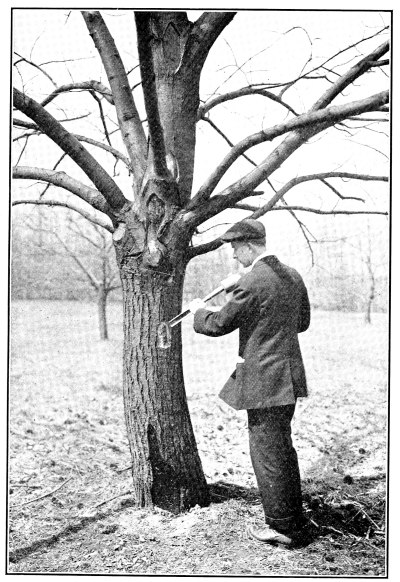
Tree surgery. Operator has gouged outer rim of canker, leaving mycelium of chestnut blight in center. Other cuts shown on tree were made at an earlier period.
CONTACT WITH THE PEOPLE.
In thus meeting the people themselves, it has been possible to inform them much more thoroughly on the real cause of the blight than can be done through the medium of bulletins or newspaper articles. Many still think that the chestnut blight is caused by an insect or a mysterious something that kills the trees by descending on them as a vapor. To these people, however, “seeing is believing.”
EXPERIMENTS.
Experiments have been started at different points:—(1) On methods of cutting out cankers; (2) With substances used as sterilizing agents and as water-proofing; (3) On the charring of cankers for various periods of one to five minutes; and (4) On the uses of various fungicides and water-proofings for painting over the cankers.
EXPERIMENTS WITH LIME-SULPHUR.
The use of the lime-sulphur spray to prevent infection has been experimentally tried at several places on orchard chestnut trees. One of the most important of these experiments is one that was started in Chester County in an orchard of 200 chestnut trees, 41 trees being used for the experiment, the trees ranging in height from 15 to 35 feet, and about twenty-five years of age. At the time of closing the work of the Commission, these experiments have not yet been continued for one year, therefore no definite results have been obtained, nor can any definite conclusion be drawn.
ALLEGED CURES FOR THE BLIGHT.
Besides the trials of different treatments at Emilie, Bucks county, mentioned elsewhere, three residents of Pennsylvania, who claim they have cures for the chestnut blight, have been permitted to demonstrate the efficacy of their cures at other points. Two of these “cures” are already failing at the present time.
LOCATION OF CANKERS.
An observation which may be of importance is that blight cankers are very seldom found to have started on the underside of branches.
VALUE OF TREE SURGERY WORK.
The work of tree surgery thus far has shown that it is possible to save chestnut trees that are diseased with the chestnut blight. This can only be done, however, by the most careful tree surgery, followed by frequent examinations for new infections and the spread of the old ones. Young, smooth bark trees are more easily saved than old thick bark trees, because it is much easier to discover the blight on the former than on the latter.
OTHER TREE SURGERY WORK.
In addition to the tree surgery work under the immediate direction of Mr. Pierce, other competent employees of the Commission have done similar work at Emilie, Charter Oak, and in a large orchard at Paxinos, the results of which up to this date are considered as largely successful.
The accompanying figures, No. I and No. II, will illustrate certain phases of the tree surgery work.