PROCEDURE IN ERADICATING SPOT INFECTIONS.
Reading edition
SCOUTING.
The principal obstacle met in applying sanitation methods for the control of the chestnut blight is the high cost of locating spot infections. The cause of this lies in the great extent of territory which must be covered, and difficulty in securing competent and reliable scouts at reasonable salaries. Experience has proved, however, that thorough scouting can be done at a moderate cost under efficient supervision. Rapidity and efficiency in scouting vary with the size and density of the stand, the proportion of chestnut, the topography and location of the tract, and the prevalence of blight. The records of the Chestnut Tree Blight Commission show that between October 3 and June 30, 1913, it required 11,651 days of labor to scout 738,881 acres of timber, notify timber owners of infections found, and supervise the work of removal. This is at the rate of 63.41 acres per man per day, with the average of 2.07 infections found, and 1.49 infections removed per man per day. The average day, (not including time consumed in going to and returning from work), consisted of 8.2 hours spent in the field, .4 hour lost on account of rain, and .4 hour lost on account of sickness and leave. With thoroughly experienced and practical men under competent crew leaders, an average of 100 acres or more per day can be covered, unless the spot infections are very large and numerous. In thick infection, one man can make thorough tree to tree examinations of from 2 to 5 acres, depending on the character of the timber. However, on the basis of past experience, it appears to be more practical and economical to locate the boundaries of the spot infection, and eliminate all of the chestnut trees within and immediately adjoining the spot infection, instead of eradicating only the diseased trees. This plan reduces the amount of tree to tree inspection required, and one man should be able to scout at least 50 acres per day, even when spot infections are numerous. It has been found that a crew of two or more men can accomplish more and obtain better results than in the case of men scouting alone, except in a country where the woodlots are very small and scattered.
In scouting, rapid and thorough work depends upon the experience and capability of the crew leader. The size of the crew depends on the character of the timber to be scouted and the ability of the crew leader to handle men. Except in a very heavily timbered area, three men constituting a crew will usually accomplish more than a larger crew. There is an added advantage in a small crew in that two or three men can find accommodations near to their work where a larger number of men cannot, and must consequently spend more time on the road to and from work. In large tracts of woodland, the best plan is to establish a camp as headquarters for several crews. A camp is too expensive for a small crew, but for a number of men it is economical, and has the advantage of keeping the men close to their work.
The tracts must be scouted systematically. The best plan is to go back and forth parallel to the backbone of the ridges, each man inspecting a strip 50 to 100 feet wide. In large bodies of timber four or five men can work together advantageously, each man being separated by the distance best adapted to viewing all the trees in the strip between himself and the men on either side of him. The man on the outside marks the edge of the strip either by breaking branches on the underbrush of species other than chestnut, or by marking tree trunks with yellow lumber crayon. Unless eradicated as found, diseased trees are located by pacing to the strip boundary at right angles and marking a tree on the line with crayon to indicate the location of the diseased tree. If a cutting-out crew closely follows the scouting crew, there is less waste of time and effort than where the scouting crew attempts to eradicate the infections as found, unless infections are very few and limited to single trees. With the cutting-out crew following the scouting crew, there is the additional advantage that they may locate diseased trees missed by the first crew.
The greatest aid to efficient scouting is a pair of good field glasses. They often make it unnecessary to climb doubtful trees, and are of further usefulness in the hands of an experienced scout, because they enable him to locate many diseased trees from a high point of land or from tree tops. In such cases compass sights are taken on the diseased trees, and an assistant is dispatched to locate them. Such scouting, however, cannot entirely take the place of more detailed examination.
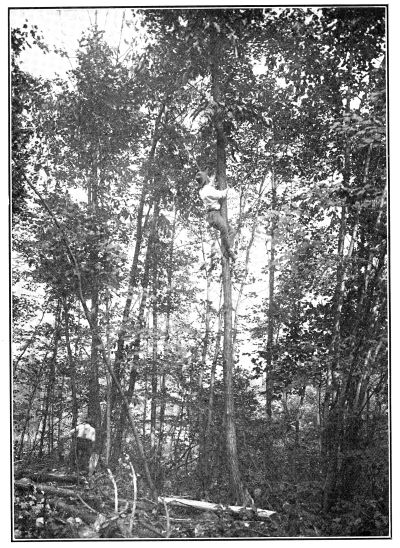
Thorough scouting for the blight is necessary.
It has also been demonstrated that more and better work in scouting can be done in the fall and winter, after the leaves have fallen. In August and September the majority of new infections become plainly visible on isolated trees, but in dense woods the foliage makes it difficult to locate small infections. After the leaves have fallen, however, more light is admitted, and a scout can see for comparatively long distances through the bare tops, even in dense woods. The dead leaves on girdled branches are conspicuous throughout the winter and early spring, and where cankers have not yet girdled the parts, the increased light makes them much more prominent than in summer. Winter scouting has the disadvantage of fewer hours of daylight and occasional loss of a day or two on account of snow storms that tend to hide the cankers on the trunk and branches. If the snow becomes very deep it is not easy to examine the bases of the trees sufficiently, and the snow also greatly interferes with the proper treatment of the blighted trees.
In the work done by the Commission, the law required that the owner of diseased trees be notified to remove them within 20 days. A map or written description giving the location of the diseased trees on the tract, was also required by law. On private land the scouts kept field notes on the location of all diseased trees, blazed each tree to the wood and marked a serial number on it with black lumber crayon; on the side opposite from the blaze, a yellow manila tag was attached to the tree. These tags bore a printed notification that the tree to which one was attached must be cut in 20 days, with directions for treatment and a warning against starting forest fires; they also bore the serial number of the tree, the name of the scout, and the date when attached. In this way the trees were easily identified later when approached from any direction, and by means of the “location sheet” giving the direction and distance of each diseased tree from some fixed point, it was not difficult to find the trees. The “location sheet” was made out in duplicate, one copy being handed to the owner of the tract, with a written request to remove the trees within the 20 days granted by law. The duplicate copy was sent to the field office, the scout retaining his note book. Some system of this sort is necessary when the cutting out is not done by the scouting force, but it is cumbersome and very expensive. Frequently, it required more time to fulfill the requirement of the law than would have been necessary to treat properly the diseased trees on a tract. Much time was consumed also in very detailed inspection of the trees around a blight center, so that apparently healthy trees would not be cut, since the law provided that healthy trees ordered to be cut, must be paid for. Not only was this very detailed scouting a waste of time in the light of recent investigations, but it resulted in decreased efficiency of control because so many of the trees permitted to remain, in reality were infected. Although no disease could be found on them at the time, the disease developed fully after the spot was treated, necessitating several re-examinations before all infections could be removed.
METHOD OF ERADICATING A SPOT INFECTION.
There are many points to be observed in removing diseased trees in spot infections, if the disease is to be permanently wiped out. The main point to keep in mind is the fact that the fungus propagates itself more readily as a saprophyte than as a parasite, so that unpeeled logs, strips of healthy bark and chips from diseased trees or nearby healthy ones, if left in the woods, are almost certain to become infected. The principal object is to do the work in a thoroughly sanitary manner at a reasonable cost. An experienced man acquired “tricks of the trade” that enabled him to do the work much more thoroughly and in less time than an inexperienced hand can do even a poor job. Great care was necessary in supervising the work of removal carried on by the individual owners, since each spot infection practically meant training a new man to do the work, and unless an experienced man was constantly on the spot, the work would seldom be done properly. On State forest reserves and in cases of forced removals, the work was done by employees of the Commission, and it was found that it was done at less cost and much more effectively than was usually the case elsewhere.
The removal of an infected tree is best done as follows: First: Where the ground beneath the tree is covered with a dense growth of brush, this growth should be cleared away so that the chips and branches may be easily picked up. Small chestnut or chinquapin trees or sprouts should be cut flush with the surface of the ground and the tops burned.
The stump should be made as low as possible. The bark should be first removed from the lower 3 or 4 feet of the trunk to an inch or more below the surface of the soil. If felled by sawing, peeling may be done after the tree has been cut down. During the fall and winter the bark is difficult to remove, and if the stumps are cut low, it is easier and cheaper to split off the sap wood and attached bark with an axe. In any case the stump and all exposed roots must be cleared of every particle of bark, and all bark removed must be carefully collected and burned.
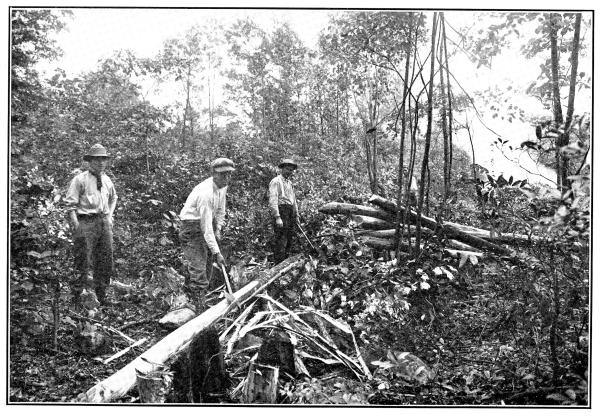
Peeling blight infected trees in a spot infection.
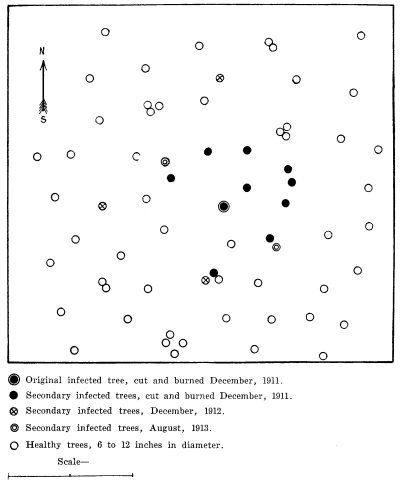
Figure 4.
Typical small spot infection, near Dry Run, Franklin County, Pa., showing original center and secondary infected trees. If all chestnut trees within 35 feet of the nearest diseased tree cut in 1911 had been removed at the time of the first cutting, and all stumps properly sterilized, it would have prevented the appearance of the new infections of 1912 and 1913.
After the tree is felled, all portions above the stump which show mycelium or pustules of the blight must be peeled of bark or the entire piece cut out. This diseased material, the brush from the tops, the bark, and portions of the felled chestnut trees which are not peeled and which it is not intended to utilize must be burned.
After the stump is peeled, if fire can be made over it without injuring the surrounding trees, and without danger of forest fires, the brush and refuse is best piled over the stump and burned. The fire must entirely consume or deeply char all of the material; no uncharred ends of branches and small twigs can be allowed to remain without grave chances of reinfection. If it is impossible to make the fire over the stump without injuring the surrounding trees, the sides and top of the stump and exposed roots should be thoroughly coated with creosote.
Portions of infected trees which show no evidence of the blight should not be permitted to lie unpeeled in the woods over twenty days, but may be safely handled and shipped with the bark on, if shipped as soon as cut. If the logs from the diseased trees are not removed from the woods within twenty days from the time the trees are felled, they should be peeled and the bark burned, or else the entire trees burned. Wood from diseased trees to be used where exposed to the weather must be peeled, or the fruiting bodies are almost sure to appear on the dead bark and become a source of infection. Fire wood, if kept under dry cover, need not be peeled.
One of the most important time saving items is to peel the lower portion of the tree before felling, and it is still more important to cut the stumps as low as possible. Bark remaining between buttresses and deep crevices of stumps can be removed very readily by chipping down from a position directly over the low stump, which is not possible in the case of high stumps. A rake and a large coal-burner’s basket included among the tools used in burning, are very useful in cleaning the chips from the ground. Before starting the fire, all the leaves and debris for a considerable distance around the place where the material is to be burned should be raked into a pile on which the fire is started. The bark and small particles of wood are raked together as soon as the brush is piled, instead of waiting until all the tops are burned. In this way, no large quantity of leaves and fine rakings are left until the end to smoulder for a great length of time before burning, and thus increase the danger of forest fire.
All possible care should be taken to prevent injury to surrounding chestnut trees and sprouts in felling the infected trees. Observation has shown that nearby trees are too frequently injured through carelessness, and the wounds are very apt to be a point of reinfection. Experience has also shown that unbarked stumps of blighted trees and green tops which are permitted to lie for a month or two on the ground are almost certain to become infected. The spores germinate on the sappy surface of the stump, and the mycelium grows downward through the cambium, and in the course of a year or two reaches the sprouts which come up around the base of the stump. In the case of the tops and particles of bark and wood, the decaying bark appears to be a very favorable seed-bed for the development of the spores that reach any portion of this material. It must be impressed on the workmen that the stumps must be peeled clean, and every particle of the diseased tree must be either burned or utilized in such manner that no opportunity is given for the saprophytic growth of the fungus.
It has been found that painting the thoroughly peeled stumps with creosote is effective in keeping the stumps free from the pycnidia of the blight fungus, but is not so desirable as hard burning over the stumps. In an experimental cutting at Wildwood Park, Harrisburg, 55 per cent. of burned stumps later showed blight, while only 23 per cent. of the creosoted stumps showed any signs of it. However, it is possible that in the future, many of the creosoted stumps will become diseased.
The results of an extensive experiment at Anderson Station, Mifflin County, are given below. This experiment deals with the efficiency of burning over stumps as compared with creosoting stumps. The stumps in Table II were peeled at various times during January, February, and March, 1913, and cold creosote applied with a brush. The cost of creosote and labor of application was approximately one-fifth of a cent for each six-inch stump, cut low. The data given below are the result of an inspection of these stumps made December 12, 1913.
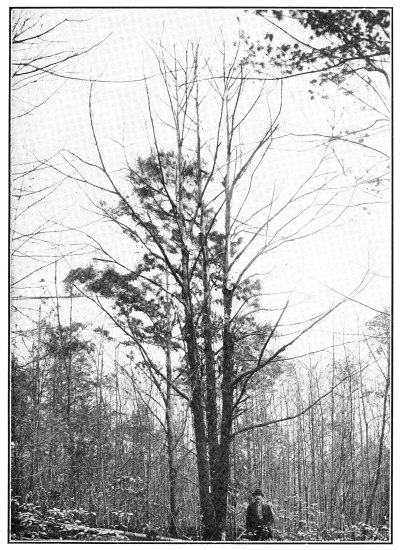
Center of spot infection at St. Mary’s, Elk County, Pa. This tree was infected at least four years prior to the time the picture was taken.
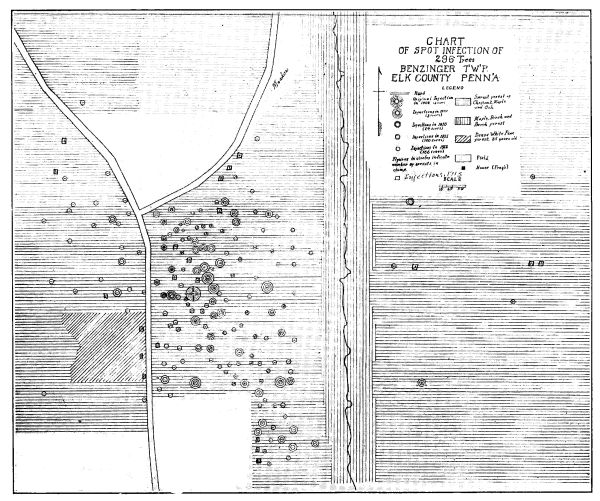
A Spot Infection in Elk County, Pa.
TABLE II.
RESULTS OF CREOSOTING PEELED STUMPS.
Number. Number of vigorous sprouts. Average height of vigorous sprouts. (feet). Number of diseased sprouts. Point of disease on sprouts. Diseased bark on stump. Pycnidia on wood of stump (creosoted portion).
1, 14 5 Yes
2, 8 5 1 Base Yes
3, 8 5
4, 6 6
5, 4 4
6, 4 5
7, 5 6
8, 3 3
9, 12 5 1 Base Yes
10, 7 7
11, 4 6
12, 3 5
13, 1 3
14, 6 6
15, 2 5
16, 5 3
17, 2 4
18, 6 5 Yes
19, 2 4
20, 4 3
21, 4 6
22, 6 7
23, 10 7 Yes Yes
24, 3 5 2 Base Yes
25, 1 4
26, 3 4 1 Base Yes
27, 8 5
Average, 5.2 5.2 0.035
of sprouts
0.148
of stumps
No pycnidia were found on wood of peeled stumps after creosoting, except in one case, where a large area of inner bark adhered to the stump at time of creosoting, and later raised up, exposing an untreated wood surface. The inner side of this bark and the uncreosoted area of wood were covered with pycnidia. Creosote painted on thick bark at the base of stumps or on an exposed root does not appear to hinder the growth of the fungus. Hence, since stumps can be peeled but a very short distance below the soil, especially in winter, it is believed that creosoted stumps are more apt to have infected sprouts after a few years than burned stumps. The danger point is at the ground line, and exposed roots and the crotches at the collar between roots are especially liable to have areas of bark that are missed in peeling. If this bark becomes affected, it brings the disease very close to the young sprouts that spring up around the stumps, and sooner or later causes infection.
The stumps in Table III were burned in December, 1912. The data given below are the result of an inspection made December 12, 1913.
TABLE III.
RESULTS OF BURNING OVER PEELED STUMPS.
Number. Number of vigorous sprouts. Average height of vigorous sprouts. (feet). Number of diseased sprouts. Point of disease on sprouts. Diseased bark on stump. Pycnidia on wood of stump
1, 4 3 0
2, 8 6 3 Base Yes
3, 2 2 0 Yes
4, 4 4 0
5, 6 6 1 Base Yes Yes
6, 7 4 0 Yes
7, 3 3 0
8, 2 4 0
9, 5 4 0
10, 0 0 0
11, 3 4 0
12, 4 3 0
13, 1 1 0
14, 4 3 0
15, 4 7 0
16, 3 6 0
17, 4 4 1 Base Yes Yes
18, 4 4 0
19, 4 5 0
20, 1 6 0
21, 3 5 0
22, 2 3 0
23, 4 4 0
24, 2 2 0
25, 3 5 0
26, 0 0 0
27, 2 4 1 Base Yes
28, 6 4 0
29, 6 6 2 Base Yes Yes
Average, 3.5 3.9 [10]0.078
[11]0.17
One very heavily burned stump, cut close to ground, had an area of diseased bark at crotch between roots, and a diseased sprout (No. 27). The least charring was always in crotches between roots at or near the soil line. Heavily burned stumps have weak sprouts or none, as a rule, about one stump out of twenty having no sprouts. Creosoted stumps usually have more and stronger sprouts than burned stumps.
Creosoting is cheaper than burning over the stump, on account of the labor saved. While it is apparently effective where the peeling and creosoting are well done, burning is safer, although more expensive. A gallon of creosote costs about 15 cents and will treat from 50 to 100 medium sized (10”-15”) stumps, varying with the height of the stump and the temperature of the air and creosote. The creosote may be profitably used where other trees will be injured by fire or where there is great danger of starting forest fires. Other methods of treating the stump have been tried, such as spraying the stumps with crude oil or kerosene and then burning them, after peeling. The stumps have also been buried under a mound of soil through which the sprouts had to penetrate. These treatments are less efficient and more expensive than creosote and cannot be recommended.
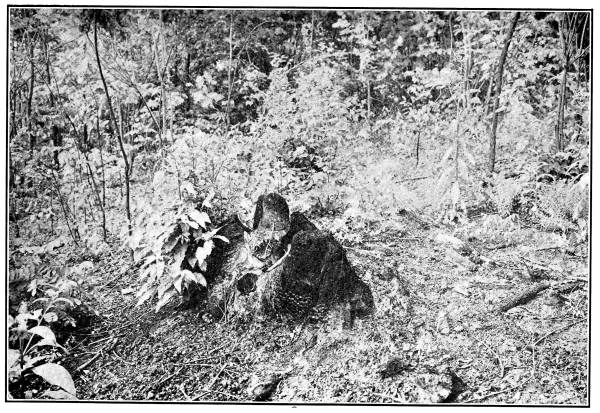
Heavily burned stump showing very few sprouts; also shows remnants of improperly burned tops, bearing growth of blight fungus, (on right).
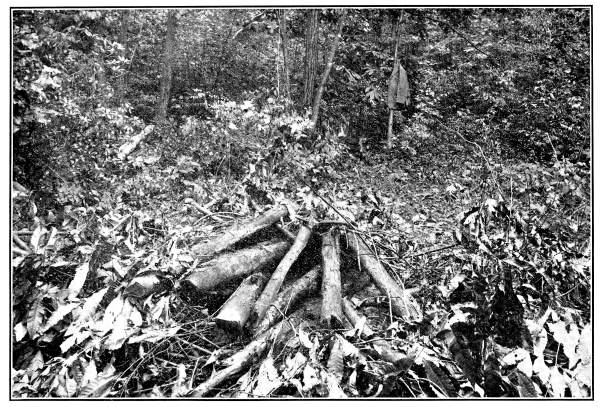
Improper piling and burning of parts of an infected tree. The brush from the tops must be piled, and the edges of the pile pushed on the fire from time to time.
COST OF ERADICATION.
The cost of eradication will vary greatly according to the conditions. If an average of 50 acres is scouted per day per man, at a labor charge of $2.50 per day to include the cost of supervision, the cost of scouting an acre is 5 cents. In a region of much blight, the cost of efficient scouting will run four or five times this amount unless the plan is adopted of determining only the edges of a spot infection, and then cutting out all of the chestnut trees inside of the area regardless of whether or not they show visible signs of the blight. This seems to be the most sensible plan, since the results of reinspection show that it is the trees inside of the edges of the spot infection which in almost every case show reinfection. It will save money not only in scouting, but in future control. On the Pennypacker forest reserve in Perry County where the infections were thickly scattered, the cost of scouting and removal in 1911 and 1912 on 1,620 acres was 73 cents per acre, or 52 cents per diseased tree, and this is probably the lowest figure for which the work can be done. The most expensive part of the work is the peeling of the stumps, and here a great deal can be saved by following the proper methods. In a large spot infection, the cost can be reduced considerably because of the concentration of the work. A spot infection of 822 trees, ranging up to 18 inches in diameter on the stump (average 6 inches) was cut out at a cost of $70.50 or 8.58 cents per tree. This included peeling not only the stumps; but all merchantable portions of the trees, burning the brush, sterilizing the stumps, and cleaning up thoroughly. This cost, however, does not include scouting, which in this case can be figured at 2 cents per tree. The total area of this spot was about three acres, so that the total cost of scouting and eradication was approximately $29. 00 per acre. In all but very small spot infections, enough material is produced to pay for doing the work.
In Mifflin County, three men treated 2,341 clumps of six-year-old chestnut sprouts at an average cost of 20.3 cents per clump. Each man averaged 15 clumps per day; cutting, peeling, cleaning up and burning were very carefully done at a cost of 16.3 cents per clump. Scouting, creosoting, and loss of time from bad weather cost an additional 4 cents per clump. The average acre contained 205 clumps of chestnut sprouts, with an average of 5 five-inch sprouts per clump; 29 clumps per acre or 14 per cent. were diseased. The cost of thorough sanitation thus amounted to $5.89 per acre. The average daily wage was $2.40, including the cost of board and supervision.
EFFICIENCY OF THE CUTTING-OUT METHOD OF CONTROL.
To determine the efficiency of sanitation in controlling the disease, a careful reinspection of 67 spot infections which had been treated a year or more previous to the examination, was made in the fall of 1913. The results of these investigations are shown in the following tabulation:
TABLE IV.
RESULTS OBTAINED, IN ONE YEAR, IN CUTTING OUT 20 ADVANCE SPOT INFECTIONS OF CHESTNUT BLIGHT.
(A) = Number of infected trees removed.
(B) = Number of infected trees.
(C) = Number of treated stumps with infected sprouts.
(D) = Probable age of oldest infection.
(E) = Distance of furthest infection from center (yards).
Tract no. County. First Inspection. (A) Second Inspection. (B) (C) (D) (E)
1 Blair, April, 1913,[12] 1 Feb., 1914, 1 0 1913 10
2 Clearfield, Nov., 1912,[12] 1 Jan., 1914, 0 0
3 Tioga, Dec., 1912,[12] 1 Jan., 1914, 0 0
4 Tioga, Sept., 1912,[12] 1 Jan., 1914, 0 0
5 Tioga, Nov., 1912,[12] 1 Jan., 1914, 0 0
6 Tioga, Sept., 1912,[12] 1 Jan., 1914, 0 0
7 Bradford, Jan., 1913,[12] 1 Jan., 1914, 0 0
8 Bradford, Jan., 1913,[12] 1 Jan., 1914, 0 0
9 Bradford, Jan., 1913,[13] 1 Jan., 1914, 0 0
10 Bradford, Jan., 1913,[12] 1 Jan, 1914, 0 0
11 Blair, Dec., 1912,[12] 2 Aug., 1913, 0 0
12 Cambria, Jan., 1913,[12] 3 Jan., 1914, 0 0
13 Tioga, Jan., 1913,[12] 3 Aug., 1913, 0 0
14 Tioga, Dec., 1912,[12] 4 Jan., 1914, 4 0 1913 30
15 Huntingdon, Jan., 1913,[12] 6 Jan., 1914, 5 0 1912 70
16 Blair, Feb., 1913,[14] 7 Aug., 1913, 10 0 1912 50
17 Blair, Jan., 1913,[12] 8 Aug., 1913, 1 0 1913
18 Blair, Jan., 1913,[13] 22 Aug., 1913, 4 0 1912 50
19 Blair, Jan., 1913,[12] 26 Aug., 1913, 3 0 1912
20 Huntingdon, March, 1913,[12] 30 Jan., 1914, 7 0 1912 5
Averages, 6.05 1.75 0 35.8
TABLE V.
Results Obtained, in Two Years, in Cutting Out 35 Advanced Spot Infections of Chestnut Blight.
Tract number. County. First Inspection. Number of infected trees removed.
1 Blair, August, 1912,[15] 1
2 Blair, August, 1912,[15] 1
3 Blair, June, 1912,[15] 1
4 Blair, July, 1912,[15] 1
5 Huntingdon, April, 1912,[15] 1
6 Huntingdon, November, 1912,[15] 1
7 Warren, October, 1912,[15] 1
8 Huntingdon, January, 1912,[17] 2
9 Elk, July, 1912,[15] 2
10 Elk, June, 1912,[15] 3
11 Clearfield, June, 1912,[17] 3
12 Blair, August, 1912,[15] 3
13 Blair, July, 1912,[15] 3
14 Blair, April, 1912,[16] 4
15 Blair, May, 1912,[15] 4
16 Blair, June, 1912,[15] 4
17 Warren, July, 1912,[15] 4
18 Blair, July, 1912,[15] 5
19 Blair, June, 1912,[16] 6
20 Blair, July, 1912,[15] 6
21 Blair, July, 1912,[16] 6
22 Huntingdon, April, 1912,[17] 6
23 Blair, July, 1912,[15] 7
24 Blair, April, 1912,[16] 7
25 Blair, August, 1912,[15] 7
26 Clearfield, July, 1912,[15] 7
27 Clearfield, September, 1912,[15] 7
28 Clearfield, June, 1912,[16] 9
29 Warren, October, 1912,[15] 11
30 Blair, July, 1912,[15] 11
31 Blair, June, 1912,[16] 15
32 Blair, July, 1912,[15] 17
33 Clearfield, September, 1912,[16] 19
34 Blair, August, 1912,[15] 25
35 Blair, August, 1912,[17] 27
Averages, 6.8
Tract number. Second Inspection. Number of infected trees removed. Number of treated stumps with infected sprouts.
1 December, 1912, 0 0
2 December, 1912, 0 0
3 December, 1912, 0 0
4 December, 1912, 0 0
5 December, 1912, 0 0
6 March, 1913, 0 0
7 April, 1913, 0 0
8 November, 1912,[15] 0 0
9 May, 1913,[15] 2 0
10 April, 1913,[15] 3 0
11 December, 1912,[17] 1 0
12 December, 1912, 0 0
13 April, 1913,[16] 3 0
14 December, 1912, 0 0
15 March, 1913,[15] 4 0
16 March, 1913,[15] 7 0
17 April, 1913, 0 0
18 December, 1912, 0 0
19 March, 1913,[16] 1 0
20 December, 1912, 0 0
21 December, 1912, 0 0
22 May, 1913,[16] 5 0
23 April, 1913,[16] 1 0
24 March, 1913,[17] 2 0
25 March, 1913,[17] 3 0
26 December, 1912,[15] 2 0
27 December, 1912, 0 0
28 December, 1912,[17] 8 0
29 April, 1913, 0 0
30 March, 1913,[17] 5 0
31 April, 1913,[17] 10 1
32 April, 1913,[17] 9 0
33 December, 1912,[17] 11 1
34 March, 1913,[15] 3 0
35 March, 1913,[17] 9 0
Averages, 2.5 .06
Tract number. Third Inspection. Number of infected trees. Number of treated stumps with infected sprouts. Probable age of oldest infection. Distance of furthest infection from center (yards.)
1 February, 1914, 0 0
2 February, 1914, 0 0
3 February, 1914, 1 0 1913 12
4 February, 1914, 0 0
5 January, 1914, 0 0
6 August, 1913, 0 0
7 December, 1913, 0 0
8 August, 1913, 7 0 1912 20
9 January, 1914, 0 0
10 January, 1914, 3 0 1912 13
11 December, 1913, 4 2 1912 37
12 February, 1914, 0 0
13 February, 1914, 1 0 1913 6
14 February, 1914, 1 0 1913 4
15 February, 1914, 2 1 1913 3
16 February, 1914, 3 0 1913 10
17 December, 1913, 0 0
18 February, 1914, 3 0 1913 20
19 February, 1914, 0 0
20 February, 1914, 1 0 1911 300
21 February, 1914, 1 0 1913 10
22 January, 1914, 1 1 1912 0
23 February, 1914, 0 0
24 February, 1914, 1 0 1913 0
25 February, 1914, 1 3 1913 5
26 December, 1913, 10 0 1912 15
27 December, 1913, 0 0
28 December, 1913, 5 2 1912 7
29 December, 1913, 0 0
30 February, 1914, 7 5 1913
31 February, 1914, 6 2 1913 35
32 February, 1914, 9 9 1912 200
33 December, 1913, 8 1 1913 50
34 February, 1914, 3 0 1913 5
35 February, 1914, 4 9 1913 35
Averages, 2.3 1.0 37.5
TABLE VI.
RESULTS OBTAINED IN CUTTING OUT 8 LARGE SPOT INFECTIONS OF CHESTNUT BLIGHT.
Tract number. County. First Inspection. Number of infected trees removed.
1 Elk, August, 1912,[19] 34
2 Clearfield, September, 1912,[20] 36
3 Blair, November, 1912,[20] 93
4 Huntingdon, March, 1913,[20] 100
5 Huntingdon, March, 1912,[20] 271
6 Elk, November, 1912,[18] 296
7 Cambria, November, 1912,[18] 480
8 Huntingdon, October, 1912,[19] 822
Averages, 266.5
Tract number. Second Inspection. Number of infected trees removed. Number of infected stumps with infected sprouts.
1 May, 1913,[19] 4 0
2 December, 1912,[20] 12 0
3 August, 1913, 14 0
4 January, 1914, 46 0
5 November, 1912,[19] 82 0
6 April, 1913,[18] 23 0
7 June, 1913,[18] 5 0
8 June, 1913,[20] 24 0
Averages, 26.2 0
Tract number. Third Inspection. Number of infected trees. Number of infected stumps with infected sprouts. Age of oldest infection.
1 January, 1914, 2 2 1912
2 January, 1914, 36 0 1912
3 1912
4 1912
5 August, 1913, 88 6 1910
6 December, 1913, 51 0 1911
7 August, 1913, 9 0 1913
8 August, 1913, 91 0 1912
Averages, 46.2 1.3
NOTES OF RE-INSPECTION.
Over 60 spot infections located on the western advance line were examined between August, 1913, and February, 1914. The spots were located in 7 counties on the extreme western advance line of the disease, and also some distance back of this line. The cutting out had been done by practically as many owners as there were spots, under supervision of various field men, so that the conditions were averaged in every way. The point which was brought out most prominently by the re-examination was the fact that where the stumps were well peeled and thoroughly charred and where the tops and refuse were well cleaned up and burned, and the merchantable material promptly removed from the vicinity of the spot infection, there was no reinfection of the stumps or sprouts of the treated trees. Where the work was carelessly done, there was more or less reinfection. However, there were exceptions in both cases. In some cases where the work was done only fairly well or even poorly, there was less infection than might naturally be expected. In some other cases where the work was done as well as it can be expected under field conditions, there was a considerable reinfection. This variation is probably explained by other factors which undoubtedly enter into the effectiveness of sanitation cutting. Probably the age of the original infection center is one factor governing the number of new infections which appear after the first cutting out. If the original infection is still so young that there is a comparatively small canker, or if the condition of the growth has been unfavorable for the production of ascospores, a small amount of new infection may be expected, since the wind apparently distributes most of the infection to the surrounding trees. On the other hand, if the diseased area of bark at the center of an infection is large and has produced a great number of perithecia, and the climatic conditions have been favorable for the ejection of ascospores, a large number of incipient infections are very apt to be left in the surrounding trees at the time of the first removal cutting.
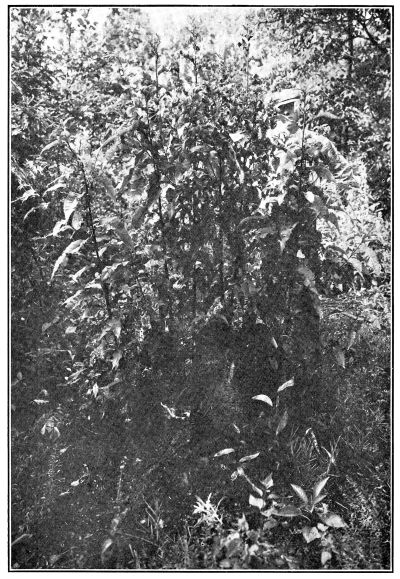
Healthy sprouts growing around a burned stump.
Just how long after cutting it takes these incipient infections to develop so that they can be detected in scouting depends on a number of conditions, such as the location of the diseased area on the tree and the height above ground where infection occurs, size of the tree, season of the year and climatic conditions following the occurrence of infection, location of the spot infection relative to topography, etc. Probably the most important factor governing the number of new infections after a removal cutting is the character and quality of the man who scouted the area. Certain men have much better scouting ability than others, and in some of the spots examined, at least, this factor alone is sufficient to account largely for the conditions found on reinspection. However, even the best scout cannot detect small twig infections in the tops of tall trees before they have girdled the twigs, and it is frequently very easy to miss well developed cankers either at the base of large trees when no fruiting bodies have been produced, or on the upper trunks of tall trees before the tops have been girdled.
It was very noticeable that new infections appearing in a spot where the original infection had been properly removed were almost always within a short distance of the original infection. Probably half of the new infections found, even after the second inspection, were on trees that grew on the same stump or in the same tree group as an original infected tree, and 90 per cent. of the newly infected trees were so close that their tops interlocked or were directly exposed to the tops of the previously infected trees. The accompanying diagram illustrates the characteristic manner in which new infection appears. In several cases the farthest infection as noted in the tabulated data was an old infection which was missed at the time of the first inspection, and which really constituted a separated spot infection.
Blight spots in northern Pennsylvania seem to be smaller, more widely scattered, and to spread less rapidly from the center than spots in the southern part of the State. One reason for this may be that there is, as a rule, a much lower percentage of chestnut in the forest and the chestnut appears to be sounder and in better health than much of the chestnut in the southern part of the State. Further south along the advance line, greater injury is noticed on young trees from the bast miner; damage from ice storms and hail storms also appears to be greater. Another possible factor is that the climate is warmer, and favorable to the copious formation and ejection of ascospores over a longer period than in the northern part of the State. Another possible factor is differences in topography which favor the carrying of spores long distances along regular “air lanes.” This may be the explanation for long chains of spot infections which occur along the lower edges of timber of the long, forested ridges, and on benches half way up mountain sides. This is put forth merely as a suggestion and not as a fact, although there is some evidence to warrant a hypothesis of this kind.
The results of the investigation show clearly that the chestnut trees immediately within and adjoining a spot infection (say 25 feet beyond the outermost infected trees), should be cut out and the stumps sterilized whether the trees appear to be infected at the time the cutting is done, or not (Fig. 4). The investigation proves that these trees in the majority of cases will become infected later on, and it means extra expense and less effective control to wait until the infection appears. In very small spot infections or even those of considerable size, it is believed that such treatment will avoid a recurrence of the blight in the majority of cases. However, to cut out these apparently healthy trees is not sufficient; the sanitation work must be done as thoroughly as if the trees were diseased. Even though the merchantable portions are taken out of the woods and the tops burned, the unpeeled stumps are very apt to become infected, especially if nearby diseased trees have been ejecting ascospores. Four treated spot infections were examined which proved this very conclusively. The following facts relative to these spots are interesting:—
Spot 1. Five infected trees in Huntingdon County were treated in April, 1912, by digging up the trees, stumps and all, and burning them in an open field. In March, 1913, the spot was re-examined and three infected trees found. The stumps were peeled and the tops burned, but not over the stumps. At the same time all of the chestnut trees on a half acre surrounding the spot that were large enough for fence posts were cut out, the tops burned and the rest of the trees removed. The stumps were left unpeeled and in January, 1914, 6 new infections were found on small saplings that remained after the cutting, and all but 4 out of 75 stumps from which the bark was not peeled showed pycnidia on the cut surface of the wood or bark, pustules in the dead bark on the side of the stump, and usually, mycelium growing downward toward the base of the stump through the live bark.
Spot No. 2. Seven infected trees cut March, 1913; stumps well peeled but not burned over. In January, 1914, 9 new infections were found on adjoining trees and 50 new infections were found on the stumps of healthy trees cut in close proximity to the spot in March, 1913. These stumps were not peeled and the pustules appeared in the bark on the side of the stump, and in many cases showed mycelium running through the live bark of the lower part of the stump.
Spot No. 3. Seven trees cut June, 1912; stumps peeled and well burned. March, 1913, 7 infections were cut out, the stumps poorly peeled and not burned. At this time 17 healthy trees were cut within a radius of 30 yards and the bark was not peeled from the stumps. In January, 1914, no new infections had appeared on any of the surrounding trees, but 8 of the stumps were infected.
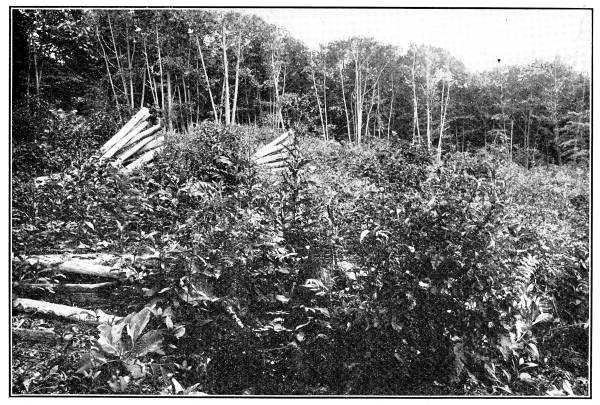
Healthy sprouts in spot infection where blight was cut out by sanitary methods.
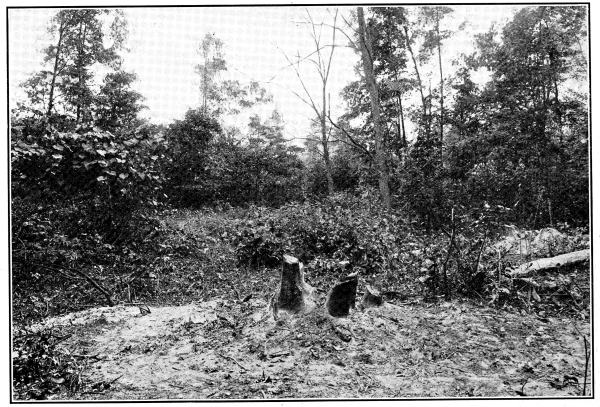
Properly burned stump; stump on the left cut too high.
Spot No. 4. One infection cut July, 1912. Stumps peeled and burned. In April, 1913, 16 new infections were found on stumps cut at the time the original infection was removed and immediately surrounding the infected trees. These stumps were located as follows: One stump 3 yards west of center; 3 stumps northwest of center (farthest 35 yards); 3 stumps north of center (farthest 20 yards); 5 stumps northeast of center (farthest 12 yards); 2 stumps east of center (farthest 3 yards); 2 stumps southeast of center (farthest 8 yards); these stumps were peeled and not burned over. In February, 1914, 4 additional infected stumps were found, the farthest being 12 yards from the center.
East of the advance line sanitation has proved effective in hindering the progress of the disease, but not in eradicating it. Inspections made of a tract of blighted chestnut at Haverford, Pa., cut in 1910 and the stumps peeled, but not burned, showed both in 1912 and 1913, that only about 20 per cent. of the stumps and sprouts were reinfected. On a nearby tract where the trees were cut at the same time and stumps left unpeeled, the reinfection was approximately 80 per cent. At Hummelstown, Pa., on several acres of diseased chestnut, cut in the winter in 1911-12, a portion of the stumps were peeled and lightly burned. In the spring of 1913, 80 per cent. of the peeled stumps and 90 per cent. of the unpeeled stumps were reinfected. The reasons for the high per cent. of reinfection was the fact that the peeled stumps were not well burned, and the nearness of disease on trees in the adjoining woods and on the adjoining unpeeled stumps. This is shown by the location of the infection on the sprouts as follows:
TABLE VII.
INFECTION ON SPROUTS AROUND STUMPS OF BLIGHTED TREES CUT AT HUMMELSTOWN, PA.
PEELED STUMPS.
Stump Number. Number of sprouts. Infected Sprouts.
Infected on crotches. Infected in insect galls. Basal infection.
1, 42 5 11 0
2, 28 0 0 0
3, 35 4 7 0
4, 20 4 1 0
5, 11 0 3 0
6, 12 2 0 0
7, 50 0 2 0
8, 10 0 2 0
9, 15 1 3 1
10, 28 0 0 0
Average, 25.1 1.6 2.9 0.1
UNPEELED STUMPS.
1, 15 4 3 0
2, 24 0 4 1
3, 30 1 0 1
4, 10 0 2 1
5, 2 0 0 0
6, 46 0 4 0
7, 54 1 3 0
8, 55 1 1 0
9, 23 0 1 0
10, 40 1 3 0
Average, 29.9 .8 2.1 .3
The investigation at Hummelstown shows that there is little or no difference in the number and vigor of the sprouts produced by peeled and unpeeled stumps. In many cases, the sprouts reached a height of six feet or more in a single year’s growth. The sprouts from peeled stumps frequently spring from the roots, 2 to 4 inches from the stump, and push through three inches or more of soil. This will undoubtedly aid in keeping them free from disease, and the new growth will be better rooted than ordinary stump sprouts.
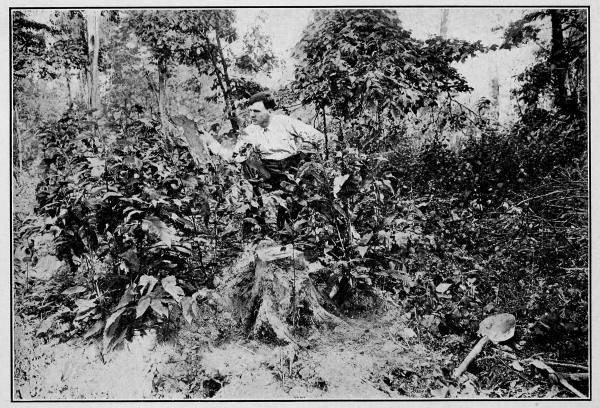
Peeled stump uncovered after burial. Showing piece of diseased bark buried with stump. On this bark the fungus was still alive.
RECOMMENDATIONS.
It has been shown that with the less effective methods of cutting out spot infections used in the beginning of its work by the Pennsylvania Chestnut Tree Blight Commission, the amount of blight has been substantially reduced. It is reasonable to suppose that much more efficient results will be obtained by using the methods which have been developed by experience, and which are recommended in this report:
(1) Cutting out all chestnut trees inside the limits of a spot infection, also immediately beyond, regardless of whether or not they all show visible signs of the blight.
(2) Great care in peeling the stumps and in burning or removing from the woods all felled portions of the treated trees.
(3) Thorough disinfection of the peeled stumps, preferably by burning.
(4) A force of well-trained and experienced men to do both the scouting and sanitation cutting.
REGULATING SHIPMENTS OF CHESTNUT NURSERY STOCK.
The Commission issued the appended official regulations for the better protection of buyers of chestnut nursery stock, and to aid in the effort to prevent the spread of the chestnut tree bark disease. So far as could be learned, the railway and other transportation companies generally complied with these instructions, recognizing their meaning and importance, knowing that diseased nursery stock was a serious menace.
REGULATIONS RESPECTING CHESTNUT NURSERY STOCK; ADOPTED BY THE CHESTNUT TREE BLIGHT COMMISSION, MARCH 4, 1913.
Whereas, It is found necessary to make certain regulations in order to provide efficient and practical means for the prevention, control, and eradication of the chestnut tree blight; therefore, in pursuance of the powers conferred by Act of Assembly, it is resolved by this Commission that the following regulations be adopted, and as occasion may arise, such other and further regulations, and the altering or amending of the same, as it may seem necessary.
Regulation No. 1. Railroad companies, express companies, and other common carriers must not accept for shipment, until further notice, any chestnut nursery stock which does not bear the official inspection tags of this Commission. Chestnut nursery stock shipped from without the State and intended for delivery within the State not being accompanied by an official inspection tag issued by the proper authorities of the State or Country wherein such shipment originated, certifying apparent freedom from chestnut blight, must be held at a convenient place within the State, and this Commission immediately notified. Every such shipment must be retained in its original package, unopened, and must not be delivered to the consignee until after an examination shall have been made by an inspector representing this Commission, and then not until the inspector shall have attached thereto the official inspector’s tag of this Commission.
The official inspection tag of the Commission bears the official seal of the Pennsylvania Chestnut Tree Blight Commission, and reads as follows:
COMMONWEALTH OF PENNSYLVANIA
The Commission for the Investigation and Control of the Chestnut Tree Blight Disease in Pennsylvania.
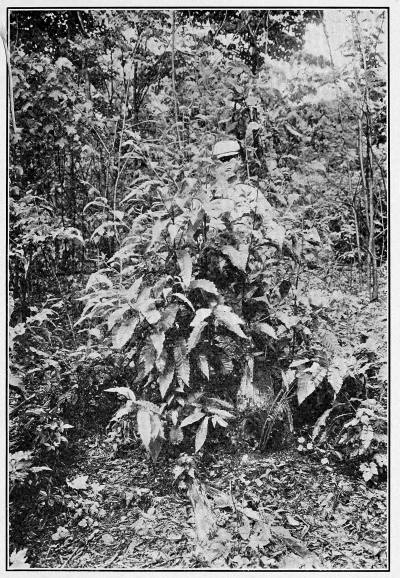
Large sprouts growing around creosoted chestnut stumps.
CERTIFICATE OF INSPECTION
This is to Certify that the chestnut nursery stock to which this certificate is attached, under my supervision, was carefully examined, and at the time of shipment was found to be apparently free from any infection by blight caused by the fungus Diaporthe parasitica.
Dated ...................... 191 ...... at ................................. Pa.
.................................... Inspector. For the Chestnut Tree Blight Commission.
Each bundle, bale, or package of chestnut nursery stock shall bear the above tag, and in addition each tree shall have attached thereto a numbered and signed tag of which the following is a copy:
COMMONWEALTH OF PENNSYLVANIA
The Commission For the Investigation and Control of the Chestnut Tree Blight Disease in Pennsylvania.
Certificate of Single Tree Inspection.
Tree Number ....
This is to Certify that the chestnut tree to which this tag is attached, under my supervision, was carefully examined, and at the time of shipment was found to be apparently free from any infection by blight caused by the fungus Diaporthe parasitica.
Dated ...................... 191 ...... at ................................. Pa.
.................................... Inspector.
Regulation No. 2. No chestnut tree nursery stock shall be removed from any nursery or other place where the same may be growing, for the purpose of sale or shipment until said trees shall first have been inspected by this Commission and the official inspection tag attached thereto. “Removed” is here construed to mean the final tying up into an original package, transporting from the premises where grown, or offering same to a common carrier for shipment.
Regulation No. 3. All chestnut tree nursery stock intended for sale or shipment must first be dipped into an approved fungicide prior to delivery or shipment. The official inspection tag will not be attached to stock unless first so treated.
Regulation No. 4. All chestnut tree nursery stock found to be infected with the chestnut bark fungus must be immediately destroyed. This regulation applies to diseased stock found at the time of inspection for shipment, and also to inspections in the nursery before stock is marketed.
Regulation No. 5. Nurserymen and common carriers, who, after receiving notice of the above regulations, negligently or willfully fail to refuse to be governed thereby, will, without further notice, subject their chestnut stock and shipments to quarantine, which will be maintained by this Commission.
All correspondence relative to nursery inspection should be addressed to Dr. F. D. Heald, Pathologist, Zoology Building, University of Pennsylvania, Philadelphia, Pa.
THE AMENDED CHESTNUT TREE BARK DISEASE ACT.
The work of the Chestnut Blight Commission was suspended not because of the lack of a desire to proceed, or lack of opportunity to render most valuable services, but for reasons stated in the letter at the beginning of this report. While the legislation recognized the need of continuing active work of this character by providing for a continuation of the Commission, it did not see its way clear to have the work advance with that vigor which the Commission believed necessary in order to achieve the most marked success.
The original Act of Assembly approved June 14, 1911, provided that the Commission should continue operations for a period of three years from the date of the approval of the Act. This period would have expired by limitation, June 14, 1914. To continue the Act in force, and to provide for a Commission to take up the work at any time, should it be thought in the future desirable to do so, the original Act of Assembly was amended by extending the term of the original Commission to a period of five years from the date of their appointment, and to continue thereafter for so long, as in the judgment of the Governor, it might be necessary to have work done in accordance with the terms of the law. This makes the Commission a continuing one to be revived at the pleasure of the Governor. Section one, of foregoing Act, as amended[21] by the 1913 Legislature, reads as follows:
“Section 1. Be it enacted, etc., That a commission, to consist of five members, to be appointed and commissioned by the Governor for a period of five years from the date of their appointment, and to continue thereafter for such period as, in the judgment of the Governor, may be necessary to enable them to complete the work to be done under this Act, and to be called The Commission for the Investigation and Control of the Chestnut Tree Blight Disease in Pennsylvania, is hereby created; with power to ascertain, determine upon and adopt the most efficient and practical means for the prevention, control, and eradication of a disease of the chestnut tree, commonly known as the chestnut tree blight disease; and for this purpose, in collaboration with the Department of Forestry, or otherwise, to conduct scientific investigations into the nature and causes of such disease and the means of preventing its introduction, continuance, and spread; to establish, regulate, maintain, and enforce quarantine against the introduction and spread of such disease; and, from time to time, to adopt and prescribe such regulations and methods of procedure as to it may seem necessary and proper for carrying into effect the purpose of this Act, and exercising the powers and authority hereby conferred: Provided, That in the work of collaboration by the Commission with the Department of Forestry, said Department may employ such means, and make detail of such men, and do such other things, as may seem to be necessary or expedient to accomplish the purpose of this Act. Provided further, That if the fungus causing the aforesaid disease be found to attack other species of trees, such trees shall be deemed to come within the purview of this act.”
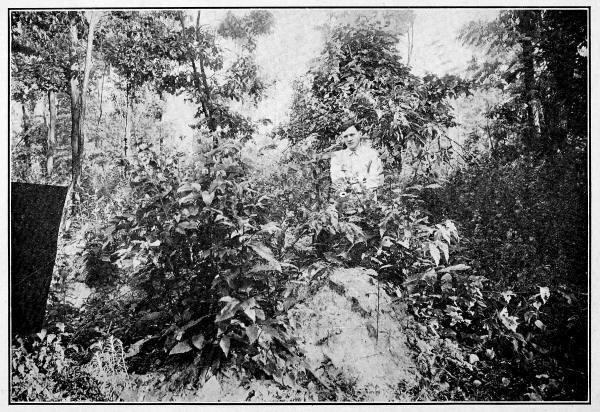
Peeled chestnut stump buried, showing sprouts.
Bibliography of the Chestnut Bark Disease
By R. KENT BEATTIE,
FOREST PATHOLOGIST, U. S. Department of Agriculture.
