OBSERVATIONS ON SANITATION CUTTING IN CONTROLLING THE CHESTNUT BLIGHT IN PENNSYLVANIA.
Reading edition
By SAMUEL B. DETWILER, GENERAL SUPERINTENDENT OF THE PENNSYLVANIA CHESTNUT TREE BLIGHT COMMISSION.
INTRODUCTION.
In view of the continued rapid spread of the chestnut blight, and the great damage sustained through this relentless parasite, it is important at the present time to have more complete information on the possibility of controlling its spread. It is now an established fact that the disease exists in China, and that it was probably introduced into America from the Orient. This disposes of the theory that the blight is caused by a native fungus, originally a saprophyte or weak parasite, which gained vigor, or appeared to gain vigor because of the decadence of the native chestnut trees from the effects of drouth and winter injury. It is evident that it would be difficult, if not impossible, to control a native fungus of wide dissemination, with predisposing factors in its favor. But even the most severe critics have acknowledged that foreign origin of the parasite affords “at least some basis for the fight for control.”[9]
HOW THE BLIGHT SPREADS.
The pathological investigations of the Commission have shown that wind, water (rain), and birds are the principal agencies in disseminating the blight. A single spore thread may produce from 100,000,000 to 200,000,000 pycnospores, and even a small canker produces dozens of spore threads in a season. A single perithecium has been observed to eject ascospores almost continuously for a period of 26 days, at the rate of 4.7 spores per second. Insects assist by making wounds through which the spores of the fungus enter the bark, and also, to some extent, by distributing the spores locally. The ejection of ascospores into the air following rain, and the washing of pycnospores down the trunks and into the soil during rain, appear to be the principal agencies in spreading the disease. Birds have been proved to carry spores in great numbers, and undoubtedly are responsible for a certain proportion of infections, at least, of advance infections.
The planting of diseased nursery stock in regions free from the blight appears to be one of the principal agencies in spreading the disease to great distances. The disease was probably introduced into this country on nursery stock, and in the early years, nursery stock apparently played the most important role in getting the disease quickly and firmly established. This point is well illustrated by a shipment of three chestnut trees sent from a New Jersey nursery into Western Pennsylvania in 1912. Through a misunderstanding, these trees were not held at the State line for inspection, but were carried direct to their destination. When the inspection was made, the disease was found at two places on one of the trees, although the nurserymen claimed to have carefully examined the trees before shipment. At Warren, Warren county, Pennsylvania, 11 out of a shipment of 12 nursery trees purchased in 1910 were found affected with the blight in 1912. In Elk County, 34 diseased nursery trees were found in a young chestnut orchard, and the disease had already reached adjoining native chestnut trees. In Somerset County, there is evidence to support the belief that an infected area covering about one-third of the county spread originally from diseased scions grafted on native trees. There are many similar occurrences outside of Pennsylvania.
All observers have noted that the blight advances by attacking widely separated trees far ahead of the generally infected territory. In Pennsylvania, the main spread of the blight has been from the southeastern corner of the State. During rains and immediately following, when the spores are being ejected, the wind is usually from the south or east, thus tending to carry the spores north and west. At least, it is a matter of common observation that the southern and eastern edges of woodlots very frequently show the first infections.
In order to learn more about the spread of the blight, two areas in the region of general infection, one in the Mahoning Valley in Carbon County, and the other in the vicinity of Topton Mountain, in Berks county, were studied in the spring of 1913 by Mr. J. Wesley Sitler, a field agent of the Chestnut Tree Blight Commission.
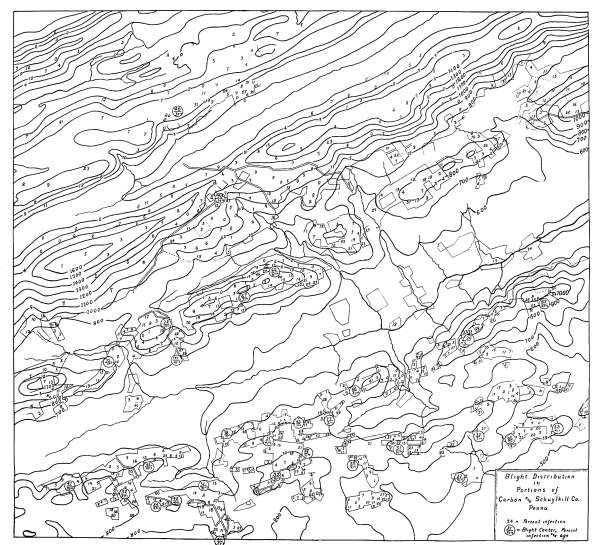
Sketch map showing blight centers and percentage of infection in a portion of the Mahoning Valley, Carbon and Schuylkill Counties, Pennsylvania
By J. Wesley Sitler, June, 1913.
STUDY OF BLIGHT CONDITIONS IN THE MAHONING VALLEY.
In the Mahoning Valley, all timber tracts on an area about 7 miles square were mapped on a large scale topographic sheet, (Fig. 1). In round numbers this investigation covered about 50 square miles of land which varied widely as to elevation and geological formation. Spot infections of blight were accurately located on the map, and each spot was studied in detail as to the percentage of surrounding infection, slope, exposure, soil, character of the stand of timber, and surface features. Originally chestnut oak and yellow pine occupied the steeper upper slopes, while the more gentle and fertile lower slopes were covered with a stand consisting of 50 to 70 per cent. chestnut, with a mixture of red oak, maple, and white pine. Very little chestnut grew in the valleys where the forest consisted of heavy stands of white oak, white pine, red oak, and maple. All of the flat bottom land and much of that along the lower slopes has been cleared for farming, so that part of the area studied consisted of woodlots with trees varying in size from small coppice to 20 inches in diameter. The area is traversed by several ridges extending northeast and southwest, and the poor rocky soil of these ridges, particularly north of the Mahoning Valley, is covered with young coppice of oak and chestnut, or with scrub oak brush. Forest fires frequently burn over the ridges and the young growth is therefore in poor condition.
At present no tract can be found on the area studied that is entirely free from blight, but the chestnut trees south of Mahoning Valley are diseased more than the stand north of the valley. The southern slopes of the ridges, also the south and east portions of exposed woodlots, are more seriously infected than the northern exposures. There are thousands of cicada wounds in twigs of all species growing in these woods. These wounds were made during the invasion of 1911. It is very common on chestnut to find such wounds infected, and the cicada has thus undoubtedly aided in the general distribution of the blight throughout this region.
Every tract of chestnut timber showing the presence of blight, when carefully examined, shows that the disease appears in spots. By careful observation, the source of infection for the entire spot can be traced to one or more badly infected trees which evidently bore the original infection of that particular area. Such a tree or group of trees is commonly referred to as an infection center, because from such centers the disease advances in all directions. The age of these centers can be determined quite accurately from the appearance of the original infection, by the concentric rings of cankers and by the age of water sprouts and shoots at base of cankers. Generally, the older the infection, the further it has spread from the center.
Many of these infection centers have been carefully worked over, but nothing definite can be said as to characteristic elevation, soil conditions, exposure, or character of woods. Probably 90 per cent. of these centers are found in the shallow depressions at the heads of gullies; or, where a ridge slope forms a terrace-like flat. However, it is evident from a large number of observations, that such centers develop under any surface conditions favorable to the growth of chestnut. They are found on well drained gravel slopes, dry knolls, steep rock slopes, and in low fertile flats.
The spread of the blight seems more rapid in young coppice growth of nearly pure chestnut, than in a chestnut stand of large trees. In old stands the percentage of infected trees decreases abruptly from the infection center outward. Often, a distance of twenty rods will take one from an area of 40-50 per cent. infection to a zone of one-fourth per cent. and beyond that no infection may be found. In coppice growth the decrease is more gradual and a zone showing less than 8-10 per cent. infection can seldom be found on a tract with an infection center. The abundance of bast miner galleries in the bark of young smooth-barked chestnuts probably explains the wide and even distribution of the blight in such stands.
The importance of wind as an agent in disseminating blight cannot be positively stated, but from observations made in this locality there seems more evidence favoring wind distribution than any other factor. The result of a large number of comparative observations show that:—
1. A large number of infections are in wounds made by cicadas and are usually uniformly distributed around a blight center.
2. New infections are generally scattered through areas of young shoots growing up after fire.
3. Freshly cut stumps with their new sprouts show a high per cent. of infection even where the surrounding woodland is little affected.
4. Trees standing in exposed places, such as isolated trees in fields, and trees along southern edges of timber tracts, show a high per cent. of infection.
Very little can be said about birds as carriers of blight. Numerous scattered spots of infection show signs of having been started by bird distribution. However, the observations gave little reliable evidence on this point. Many spots have a large, dead-topped tree standing near the center. Often these trees have been infected on the lower branches, longer than any of the surrounding trees. The dead, snaggy tops show no evidence of death from blight. There is reason to believe that birds were attracted by the open snag and carried the spores which later started the infections in the lower branches.
This locality furnishes numerous opportunities for comparing the percentage of infected trees on the north and south slopes. The stand of chestnut is similar on the two slopes. The results of detailed examinations show that there is more blight on the south slopes. Also, many of the woodlots show a higher per cent. of infection on the southern borders. To strengthen these observations several miles of the Blue Ridge, (lying north of the Mahoning Valley, and not included in the area studied), were also worked over, (Fig. 2.) This ridge is higher than any other within the limits of area studied, and shows the typical high percentage of blight on the south slopes, up to the summit. Immediately across the summit, northward, the number of blighted trees decreases. However, at the base of the north slope in almost pure chestnut, it increases but does not average more than 60 per cent. of the amount of infection at the base along the south side. There is a general decrease in the amount of infection on each successive ridge to the north.
There are distinct differences in the moisture conditions in this region. The stream valleys often have a clay loam soil too heavy and moist to support chestnut. We find all variations in soil and moisture from these valleys to the dry, rugged ridges where chestnut oak and scrub oak form most of the stand. The amount of infection apparently does not depend on soil moisture, as is shown by the percentages on the infection map. Tracts lying in the valleys show similar percentages of infection to those on higher ground. The theory that chestnut trees growing on or near limestone soils are resistant to blight is not supported by these observations. A belt of limestone borders Lizard Creek Valley on the south, and the per cent. of infection is as high in that region as elsewhere. Infection centers have been found near limestone quarries, where the roots of the chestnut penetrated to bed rock.
INFECTION POINTERS.
1. Each successive ridge shows a decrease in the number of old infections, from the Blue Ridge northward.
2. There is more blight along the south slopes than on the adjacent north slopes.
3. Recently cut stumps with their sprouts show a high per cent. of infection even where adjacent tracts are clear of blight.
4. Centers of infection are found under all conditions. Slope, exposure, drainage, rock formation, and fertility of the soil seem to have no relation to origin of infections.
5. A large number of infections one and two years old began in wounds made by cicadas in 1911.
6. Wind appears to be the most important factor in the dissemination of the blight. Birds may be factors as carriers of the original infecting spores, but cannot be blamed for the local distribution of the blight around an infection center. This distribution is very uniform, which presumably would not be the case had birds been the principal carriers of the disease. In young coppice growth much wounded by cicadas, the wounds on the twigs are the chief points of entrance for the disease. Results of accurate counting show that on certain tracts 80 to 90 per cent. of new infections began in such wounds made by the 17-year cicadas during their invasion of 1911. Many new infections are at and near the bases of young sprouts, and there is little cause to believe that these were due to birds, since they are usually about the same age and at points that birds are not likely to frequent. Also, this condition exists on exposed north slopes little visited by birds. The most plausible explanation seems to lie in the hypothesis of wind dissemination. This explains the numerous infections starting in cicada stings; also the rapid spread over a tract of young sprouts; the common occurrence of new infections on trees standing alone, in exposed places. The greater quantity of infection on south slopes appears to be due to the fact that the prevailing winds are southerly and easterly during the periods when ascospores are extruded in greatest numbers.
STUDY OF BLIGHT CONDITIONS ON TOPTON MOUNTAIN, BERKS COUNTY.
The highest point of this mountain rises about 600 feet above the base, the summit being 1,230 feet above sea level. The long axis of the ridge runs about 15 degrees north of east, the east end of the ridge terminating abruptly. The area studied comprises about 2,000 acres, about 600 of which are cleared, and the balance bears a dense stand of timber which is mainly coppice growth between 10 and 25 years old. On the summit, and the upper and middle slopes, chestnut is the predominating species, forming 80 to 90 per cent. of the stand. Below this is a zone in which chestnut and chestnut oak constitute the stand in about equal proportions. At the base of the mountain there is a narrow, irregular belt of tulip, butternut, red oak, and ash, with a very low per cent. of chestnut.
Strips four rods wide were run north and south across the mountain, and also in an east and west direction over the top and along the sides. Observations were made of all the chestnut trees on each strip acre. In this way the tract was gridironed, and a fairly comprehensive idea obtained of the relative amount of blight in the various portions of it. (Fig. 3).
By J. Wesley Sitler, July, 1913.
Scale 2.75 inches—1 mile.
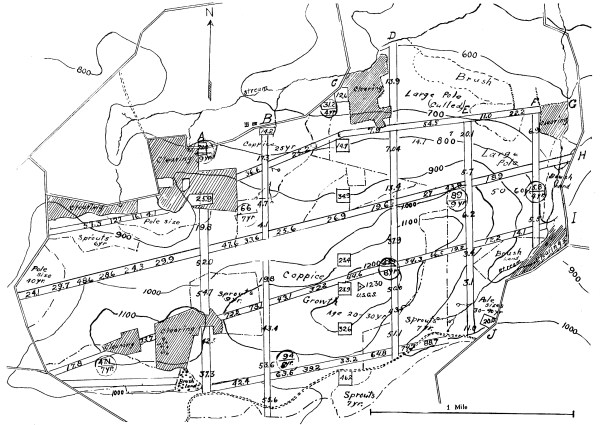
6/6-yr blight center, upper figure is per cent. of infection on an area within 50 feet radius or more of the center.
Lower figure is the approximate age of the original infection.
The infection nowhere runs less than 3 per cent., and it was impossible to find an acre with less than this amount of blight on it. On most of the ridge the percentage of diseased chestnut runs from 17 to 30 per cent., although there are spots where it is much higher. The centers of infection are not confined to any characteristic slope or environment. Generally, the blight has spread over larger areas on the summit and south slope than on the north slope. The centers along the south slope and summit show more trees killed by the blight than those of any other part of the mountain. This is doubtless due to a more rapid spread of the blight in these situations. Scattered dead trees are less common along the north slope than elsewhere; however, several centers containing a dozen or more large trees entirely killed are found on the north slope.
The blight is so uniformly distributed between the centers that it was difficult to determine the facts relative to the dissemination of the disease by wind. However, most of the infected areas show a wider zone of distribution east and north of the infection center, giving the areas of thick infection an egg-shaped outline, with the oldest infections nearest to the western boundary. No definite information was obtained on this tract concerning the part played by birds as disseminators of the disease.
The south slope of the ridge is more dry and barren than the north slope. The only springs found there are near the eastern end of the ridge, and a few small springs are scattered along the lower portions of the south slope, but these are below the zone of chestnut growth. The north slope is a more gradual incline, and there are numerous shallow dips resembling miniature gullies. Some of these are moist enough to support alder bushes and several species of moisture loving ferns; also trees of the lowland types, such as tulip and maple, are quite common in these depressions. Most of these dips contain springs, but not all of them; however, there are numerous small springs scattered all along the north slope of the ridge. Most of these are well down toward the base, but several are well up toward the summit. So far as could be ascertained, no relation exists between the thickly infected areas and moisture conditions.
The data collected lead to the belief that the infection is distributed without any regard to elevation. For instance, along the base of the north slope high percentages of infection are found. Similarly, an increase in the percentage of blight is found half-way toward the summit. While the summit seems to support more infection than any other portion of the mountain, there is no reason to suppose that this is due to elevation. The stand here is almost pure young chestnut coppice, and the conditions appear to be more favorable to the rapid spread of the disease in such stands. The base of the south slope supports coppice growth similar to that found at the summit, and here the per cent. of infection compares very closely with that along the summit.
RESULT OF OBSERVATIONS.
No definite cause for the areas of high and low per cent. of infection was determined. The highest percentages of infection are found on the summit and on the south slope of the ridge. Also this portion of the area supports more old infection than any other part of the mountain. In part, this may be due to the higher percentage of chestnut on the summit and south slope, and to the fact that most of it is young coppice. Such stands appear very susceptible to the disease. The theory that varying chemical elements, derived from the rock strata, affect the amount of infection is not supported by any evidence gathered in this work, for on the three general rock formations of this tract, as well as along the edge of the adjacent limestone, high and low per cents. of infection seem equally common. No evidence sheds any light upon the belief that the distribution of disease is along any definite compass direction. If there is any proof at all toward this end, it lies in the fact that infections on the south are more uniformly distributed than on the north. It is probably true that the advance infections came from the south and crossed the mountain northward, but areas of thick infection are not confined to any character of topography, slope, or elevation.
The accompanying maps give in detail the percentages of blight found in the Mahoning Valley and Topton Mountain areas.
RATE OF INCREASE OF BLIGHT IN EASTERN PENNSYLVANIA.
The southeastern corner of the State has a higher percentage of infection than any other portion of the State. The rapid increase of the blight is well shown in this section by the record of 1,637 trees on tracts in the vicinity of Philadelphia, which were examined for blight in October and November, 1910, December, 1912, and August, 1913. In 1910, 31 per cent. of these trees were infected with the blight, and 29 per cent. were doubtful. In 1912, 79 per cent. were infected, and in 1913, 88 per cent. If we include the 29 per cent. doubtful trees with the 31 per cent. certainly infected in 1910, the total becomes 60 per cent. This makes the annual increase in infection approximate 10 per cent. per annum. In this connection it is interesting to note that on the du Pont estate at Kennett Square, Pa., where tree surgery methods, supplemented by spraying with Bordeaux mixture, have been in use for the past two years, the progress of the blight has been materially delayed. Mr. R. E. Wheeler, forester for the estate, believes that these methods will save the trees under treatment for at least five years more, and probably for a much longer time.
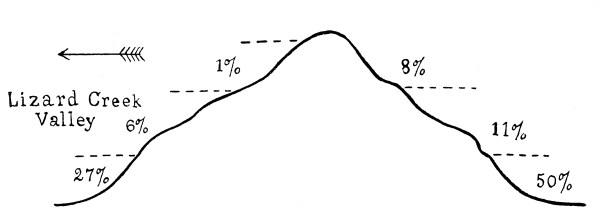
Figure 2.
Cross section of the Blue Ridge Mountain, showing altitudinal distribution of the chestnut blight on north and south slopes
Tree surgery without spraying has had little effect in delaying the progress of the blight after it attacks a tree. In a large orchard of Paragon chestnuts, in Northumberland County, in a block of 9,612 trees, 4 to 15 years old, thoroughly examined in the winter of 1911-12, 194 infected trees were found, (2 per cent. infection), 103 of which were so badly diseased that they were cut out and burned, and 91 trees were treated by surgical methods. In the winter of 1912-1913, this same block was again carefully gone over, and 1,064 infected trees were found, (11.2 per cent. infection), 325 of which were marked for removal, and the balance for surgical treatment. The rate of increase in this case was over 500 per cent.
INFECTION CENTERS ON THE ADVANCE LINE.
In applying sanitation measures for the control of the blight, it is not practicable to use tree surgery methods and spraying, (except possibly in orchards), but only to cut out bodily every infected tree and to sterilize the stumps. When the blight is generally distributed through a region, as is the case in southeastern Pennsylvania, it is manifestly impossible to eradicate the disease by sanitation methods without also practically eradicating the host. A detailed study of spot infections as they occur on the western advance line of the disease is therefore of more interest than the conditions which exist in the generally infected territory.
On the advance line, as in the eastern part of the State, there is no rule for the location of an infection center, nor is there any rule as to the part of the tree which is attacked first by the disease. It is true, however, that on the western advance line more infections occur on isolated trees and on the edges of timber tracts than elsewhere, and that the majority of infections first appear in the tops of trees. Likewise, in its spread from tree to tree around a center, the blight shows no general rule, except that the trees immediately adjoining a primary infected tree are most apt to show the first secondary infection. The following tabulation gives the details of 175 infected trees in a spot infection of 271 trees, located at Orbisonia, Huntingdon County, Pennsylvania, studied in 1911 by Mr. R. C. Walton.
TABLE I.
DETAILS OF INFECTION AT ORBISONIA, PA.
Number.
Origin of tree, Coppice, 136
Seedling, 89
Slope, Gentle to medium steep, 5
Gentle to steep, 24
Gentle, 6
Steep, 79
Very steep, 0
Medium steep, 61
Aspect, North, 108
Northeast, 16
Northwest, 41
North to northwest, 7
North to northeast, 3
Location, Lower slope, 23
Middle slope, 152
Along road, 76
Near road, 28
Away from road, 71
Moisture, Dry, 28
Damp, 37
Dry to damp, 69
Medium dry, 13
Medium damp, 20
Windy, dry, 8
Density of forest, Dense, 72
Medium dense, 97
Rather open, 6
Infection on benches, 36
Orientation of lesions, North, 34
East, 29
South, 14
West, 21
Northeast, 29
Southeast, 10
Northwest, 9
Southwest, 5
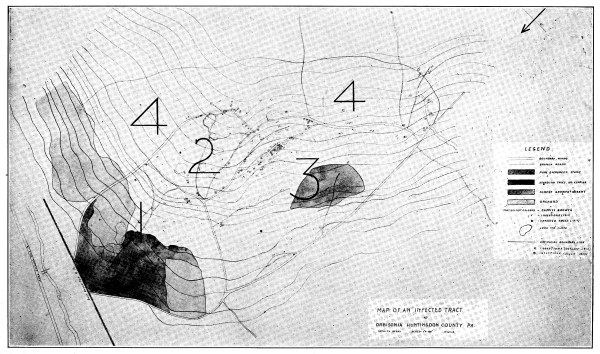
Blight Infected District at Orbisonia, Huntingdon County, Pa.
The most important practical point in the study of spot infections, however, is the location of the secondary diseased trees with reference to the original center of infection. Where a careful study has been made, it has always been apparent that the disease spreads from an original center of one or two trees to trees in the immediate vicinity, as illustrated in the accompanying diagram, which is an example of a typical small spot infection, (Fig. 4).