Volume 12 — PREFACE
Reading edition
Ever since the period of our war with North America, which ended in the independence of the United States, the attention of Europe has been intensely drawn to that portion of the globe; and many Philanthropists have entertained sanguine hopes that the declaration of Independence was the commencement of a new era of radical improvement to mankind—that the old Governments of the world, full of abuses, and unable to stand before the light of the new Republic, must soon fall before it; and that from America would triumphantly arise the Genius of true liberty, to glad and improve the condition of the nations of the earth. So ably were the whole negotiations conducted on the adverse side, both before [viii] and after the war, by a few shrewd and determined minds; and so effectually was the war concluded by a Washington, that the people of the old continent fancied the new one must be covered by Statesmen and Warriors, and hailed the approaching amelioration of mankind from the bright examples these were to send forth.
'Tis true the subsequent conduct of the Republicans, both to their leaders and towards ourselves, did not tend to keep up the admiration which had been raised; yet, other causes—the late events in Europe, having brought governments there into great difficulties, and multitudes of the people, from the intoxication of a short-lived prosperity, eventually to drain the cups of privation and poverty, many of these naturally turned their attention to other countries; and leaving their own, sought on foreign shores those comforts they had lost at home. American liberty again became the theme of a class of politicians among us; travellers of inquiry again went out to make observations; published their accounts, mostly of flattering import, and in consequence, [ix] ship-loads of emigrants from all the countries of Europe were constantly arriving in the ports of the new Republic.
One of the latest among the crowd of travellers who thus have set the fashion of emigration (Mr. Morris Birkbeck) has published his account, and has met with the greatest success in influencing the minds of his countrymen;—his "Letters from the Illinois," and previous "Journal," are written in a plain concise style, and yet dictated at the same time by an unperceived romantic sanguine temperament which always gives so beautiful a colouring to nature, and produces a work most fascinating to the mind.
These favourable accounts, aided by a period of real privation and discontent in Europe, caused emigration to increase tenfold; and though various reports of unfavourable nature soon circulated, and many who had emigrated actually returned to their native land in disgust, yet still the trading vessels were filled with passengers of all ages and descriptions, full of hope, looking forward to the West as to a land of liberty and [x] delight—a land flowing with milk and honey—a second land of Canaan.
To inquire into the truth of so inviting a prospect as that held up by Mr. Birkbeck and some others, and in part to relieve the mind from evils of a domestic nature, the Author was induced in the year 1819 to embark for North America: he took in his hand the flattering accounts in print in order to compare them with his own actual observations; with the intent either to add his confirmation to the favourable side, or otherwise to exert his utmost to undeceive the many of his countrymen misled by specious reports.
With these views the journey was undertaken, and the annexed pages are the result; in perusing which the reader is requested to observe, that he will not find, strictly speaking, an emigrant's guide through the country, (although there are hints which it is hoped may be found useful,) but chiefly facts and reflections for consideration previous to going thither under the inducements held out by Mr. Birkbeck and others:—These hints, the Author is conscious, have not been conveyed [xi] in the most pleasing form, but he trusts, that if the matter be found important the manner will not be looked upon with the severity of a critic's eye.
To the Americans the Author wishes to address a few words, in order to assure them that, in the following observations, he has fully intended to guide his pen by the spirit of his motto: nor does he think them at all to blame in not coming up to the perfect model of a Republican which may be mentally pourtrayed; but rather ourselves are wrong in forgetting that they are not only men, but men placed in a new country, with all its difficulties, natural and moral, to overcome. If I picture to myself a giant and find a man of but ordinary proportions, is he to blame for this? Certainly not. The North Americans possess a fertile beautiful country and a fine climate: no one can wish for the improvement and the true enjoyment of these advantages more than the Author; he the more laments the apparent presence among them of a huge portion of blind conceit in their own superiority, and also the absence of the very essential Christian principle of good-will and benevolence; [xii] under the influence of which the truly great hold out the hand of good fellowship to the rest of mankind, regard them as brothers, and wish for "peace on earth, good-will toward men."
VISIT TO NORTH AMERICA
THE VOYAGE1
May 5th. Off Margate on board the Venus, bound for New York. This ship, which was to have sailed on 29th April, did not drop down the river until the 1st instant; and then, owing to an accident which befel the Steam Tug, did not reach Gravesend until Sunday the 2d. We had meanwhile repaired thither, and remained smarting under the extortionate charges of a Gravesend tavern. At length, on the Monday evening, the signal was displayed for sailing, and trunks, &c. having been previously sent on board, we took a [2] long leave of English ground, and proceeded with other passengers to the ship; expecting, like unfledged Voyagers, to find everything in trim to receive us.
When agreeing with the Captain for the passage, I had inquired if there were many other passengers, and was then told there were "a few;" previous to going on board the "few" had increased to "as many as convenient;" notwithstanding this hint, so inexperienced were we, that we were not in the slightest manner prepared for the scene presented to our appalled senses on rising the ship's side! Trunks, portmanteaus, packages of all kinds and descriptions, piled in all directions and in every way—a crowd of dirty squalid steerage passengers, which appeared to our magnifying eyes at least five times the real number, (about 80)—altogether formed a mass through which we could not, without much difficulty, push our way to the cabin; and that accomplished, still more horrors presented themselves to view: instead of the carpet and good order which reigned there when I had examined the vessel while in dock, the dirty floor was covered now with nothing but trunks, bedding, and other baggage; giving an effect the most forlorn and petrifying to us all: so that we sat down upon broken chair, box, trunk, or anything we could, and glared upon each other [3] desponding as the fallen angels at their first drop!
Our fate, however, not merited like their's,—no; but we regarded our Captain as the arch-fiend and tormentor, and we gave him looks of reproach which pretty plainly said, "you have entrapped us into your abominable pit this time, but if we ever get out you will not do so again:"—However, I will not suppose he enjoyed our horror, but rather partook a little of the general feeling; for he sat, his eyes glaring as wildly as any of the party until at length, as nothing was offered to relieve the spirits, I proposed a biscuit and some porter, which were brought, and nearly in silence consumed; after which we each turned in for the night, and sought repose.
While engaged this morning writing the above in the cabin, the ship floating easily along under a pleasant little breeze, we suddenly felt a shock, followed by a rubbing along the bottom; the Captain started up, and was upon deck in a moment; the passengers ran in all directions, and the appalling cry "we are aground" sounded on all sides! Happily, though such a mixed multitude, even the females betrayed but little fear, and most of the men lent every aid in their power; the [4] weather was favorable, and though the ship beat much, the bottom being sand and the tide rising, great hopes were entertained that she would get off. Had it happened in the night and the wind had come on to blow hard, we should in all probability have been lost; being day, we were descried from the shore, distant about ten miles, and boats of fishermen soon arrived to render assistance; but now a long previous altercation ensued between them and the Captain, before a bargain was struck: for a service which they acknowledged would not occupy more than half an hour, they first asked one hundred, and then sixty guineas.—Such is man when the consideration is the property of his fellow! Our lives they did not contemplate to be in danger, otherwise to save them these same men would have risked their own without thought of reward: so let us be in charity with human nature yet. At length, after an anxious interval to the passengers, it was agreed that fifty guineas should be the price for getting the ship afloat; the word was given, and in twenty minutes of alacrity the bower anchor was carried out; the men exerted themselves at the capstern; the ship's head swung round; and after three or four violent bumps of the stern upon the sand she heeled off and swam again. Those who have experienced such accidents may know how people [5] feel at such a moment; mutual congratulations went round accompanied with internal thankfulness to that Providence, whose care is over all.2
6th. Off Deal. A lovely morning, well calculated to remove from the mind the impressions of the preceding day; a clear view of the town; and the French coast also is very visible from the deck.
In order to attain the important objects of health and security among so promiscuous an assemblage, the cabin passengers met at the instance of the Captain, and a set of resolutions was drawn up for the general observance; and a copy being handed to those of the steerage, was acceded to by them and this morning put in force:—by these rules, one captain of the day from the cabin, and another from the steerage were on duty by rotation,—candles were put out at a fixed hour,—the parts of the deck for the use of the cabin and steerage passengers were prescribed; and sundry rules for cleanliness, which were afterwards but ill obeyed: no forfeitures were necessary, as the captains of trading vessels have by law the power [6] of punishment; as far at least as putting in irons for misconduct, and indeed this was inflicted in the course of the voyage, upon a riotous tailor.
Sunday, 9th. Light airs with mist hitherto; wind this morning rather more favorable. Prayers read upon deck by one of the passengers.
We are now clear of the Channel, and drifting upon the vast wilderness of waters, a plank our dependence until we may reach a new continent. To sailors of course, a circumstance so common brings little reflection, but those to whom the situation is new, must confess a sensation most awful and uneasy: certain it is we are equally in the hands of a beneficent Providence, whether we tread the seemingly firm-set earth, or commit ourselves as now upon this immense ocean; but it is in vain for philosophy to disguise—she cannot subdue feeling.
10th. We are now first experiencing a calm attended by a heavy swell of the sea;—the sailors call this "Paddy's Hurricane," and Paddy was right, for the rolling of the Ship, racking of masts, flapping of sails, &c. render it anything but a calm on board.
Of our cabin party it is not necessary to record the views; suffice it, that it consists of three ladies and six gentlemen, besides six children; some for pleasure and health, others for business bound.
[7] The passengers in the steerage are far too numerous either for their own comfort or ours; many of them seem very respectable people, farmers, farm-servants, hop-planters, masons, carpenters, and tailors, with their wives and children. I cannot perceive the tenable policy of throwing obstacles in the way of emigration of such people; as England is overstocked with artisans, and other countries are in want of them, it is surely a mutual benefit; and to prevent individuals seeking the best market for their craft is the highest injustice.
12th. Being fine and calm in the mid-day, the Hold was opened and various packages got up for examination and re-stowage; while this was doing, and loose straw laying about on deck, there was a cry "the Caboose is on fire!" This only occasioned a momentary panic, as luckily no harm arose from it; the chimney was foul, and some fat taking fire had communicated to the soot, and from thence nearly to the main-sheet.
This day we took up a cask which upon tapping proved full of excellent brandy; it was covered with barnacles, and had probably been floating four or five months.
15th. A Hawk of a small kind, resembling the Sparrow Hawk of England, was this morning caught in the rigging; the nearest land being supposed above three hundred miles renders this an [8] extraordinary circumstance: we also saw yesterday a large brown bird pursuing a Gull, and understood its name to be Rump-poke. An appropriate appellation, as it pursues other birds for their droppings, which it catches as they fall and feeds upon.
18th. We have experienced so many head winds and calms that the spirits of all, not excepting the Captain, are cast down,—two thousand five hundred miles yet to run. Yesterday a lady a cabin passenger, was safely delivered of a boy her first child.
22d. Favorable breezes. A quarrel between the cook and a sailor, in which the former knocked out three of the latter's teeth with a billet of wood; and for which he underwent a severe cobbing.3
24th. Two Whales of the Grampus kind rose near the vessel. At 7 A. M. a large fish was seen to pass the ship tormented by a shoal of small ones; the Captain ordered the boat down, went out, struck it, and it was got on board; it proved to be a Sun-fish that weighed one hundred weight and a half: it was quickly cut to pieces, dressed, [9] and eaten by the ship's company and some of the passengers; the flesh very white and firm.
SHIP COOKERY
Anything but clean,—anything but simple,—anything but what one is used to.
SITUATION OF A PASSENGER ON BOARD SHIP
Some risk,—little comfort,—a total inversion of all accustomed habits,—a feeling of insecurity,—irritability,—a longing to be ashore; in short, a total be-blue-devilment at times, with a few hours of pleasanter colour just to keep hope alive.
The ignorance and simplicity of some of the passengers are greater than might be supposed; one said the other day he supposed we had five hundred miles yet to go, and another asked me if America was mountainous.
26th. A tremendous wave broke over us, giving the ship such a shock as laid her down on her side. Great was the confusion; trunks thrown upon trunks, tables, chairs, all forced from their [10] mooring, in spite of bolts and ropes; we were glad to find however that, excepting the fracture of glasses and crockery, no material accident had happened to any one.
About this time an account of each steerage passenger's stock of provisions was taken, and though but three weeks out, several were found nearly exhausted; so improvident had they been.
The following list of sea stores is recommended as sufficient for a steerage passenger.
42 lb. Beef or Pork.
56 lb. Cabin bread (biscuit).
14 lb. Flour.
7 lb. Cheese.
4 lb. Butter.
1 lb. Coffee (ground).
½ lb. Tea.
10 lb. Sugar.
¼ lb. Pepper.
1 lb. Salt.
7 lb. Split Peas.
Bottle of Mustard, about 1s. 6d.
100 Eggs.
2 Bushels of Potatoes.
A few red Herrings.
2 Quarts of Vinegar.
[11]4 Dozens of Porter.
1 Gallon of Spirits.
Some Carrots, Turnips, and Cabbages.
2 lb. Soap.
Some pieces of Tobacco-pipe Clay, which will be found to rub well with sea water in cleansing the skin.
A Tin-pot with cover, in shape like a coffee boiler, with a hook at the side to hang upon the bars of the Caboose grate.
Crockery, Spoons, &c.
A passenger provided as above will not experience want in any common passage, and indeed there are some articles with which he may dispense; as, for example, the Porter; and others he may lessen, as the Potatoes perhaps. With respect to medicine, it may be as well to provide some Epsom salts and magnesia, and a few lemons will be found highly grateful; otherwise the ship always carries a chest containing the common remedies.
31st. The wind blew what the sailors call a strong breeze, which is in fact a gale, from the west; the ship laboured much, and such was the impression upon the minds of many of the steerage passengers, that at night they took leave of each other, thinking it not likely the vessel should live through the night.
[12] June 1st. With the prospect of a protracted passage, an inspection was also judged necessary of the ship's cabin stores; and such waste and extravagance was proved against the Steward, that it was resolved to take into our own hands the ordering of each day's provisions: a meeting was consequently held, an account of stock taken; and ordered, that one of the party by rotation should superintend each day's consumption of food; and also of water, which had likewise been used very extravagantly. Let those going a voyage not only ascertain their sort of Captain but their sort of Steward, upon whom I can assure them a very material share of their comfort will depend.
The general subject of conversation now is, calculating the probable duration of the passage; yet it is essential to comfort during a voyage to abstract the mind as much as possible from such reflections, and to engage it as much as in us lies in some useful studies and occupations—'tis one of the worst to watch the winds and the waves; 'tis one of the most useless, for we cannot command them.
We are, it is supposed, approaching the great bank of Newfoundland: as much doubt exists as to the accuracy of the dead reckoning of longitude, (and we have no other,) our anxiety is great [13] to ascertain the passage over the bank, by which a new departure may be taken.
8th. It is now the general opinion, in which the Captain coincides, that we have passed, without knowing when, the great Bank; the weather is warmly tempered by a fine S. W. breeze, and the ship is wafting us delightfully over summer seas: hope again "tells a flattering tale" and conversation runs chiefly on what will be done, and what will be had, on our arrival at the much-desired Port.
Last night the full moon exhibited, through a heavy mist, an appearance of several rings of the prismatic colours,—a beautiful effect, which I remember once before to have witnessed in England.
11th. Spoke the brig Spring, of Blyth, homeward bound; and had the no small satisfaction to find that her calculation of longitude nearly agreed with our own late suppositions.
This morning the extraordinary conflict between the fish called the Thresher and a Whale was seen near the vessel; the Thresher repeatedly raised itself on the Whale's back, so that its tail was nearly upright, and struck the Whale violently with it on the head; it is said that the Pilot-fish is at the same time wounding him underneath with his sword-snout: they did not however succeed this time, but relinquished their pursuit at the noise [14] which the people made at the extraordinary spectacle. The Thresher appeared to be about six or seven feet long.
16th. A Shark seen in early morning: and a large Sword-fish swam majestically round the ship's bow, probably taking it for a Whale; but finding his mistake he dropt astern, and soon after a shoal of small fish, perhaps endeavouring to avoid him, rose completely out of the water;—his length was about nine feet as we judged, and his form and colours beautiful. Several kinds of birds have lately been seen; among which we viewed with pleasure the "Hagdown" as the sailors say it is always seen on or near soundings; it is about the size of, and somewhat resembles, a Duck.—Many Porpoises too have lately passed us; one of these the men struck, and succeeded in getting it on board, when it was soon cut up and eaten; we were prevailed upon to taste it, and must acknowledge that it could not have been distinguished from a fine beef steak; the gravy was indeed richer.
18th. The events of the voyage have lately been harassing and pregnant with danger; three officers have kept reckonings of longitude, and all have proved erroneous; the ship has headed them considerably, and, when we little thought of our danger, has been near wrecked upon one of the dangerous shoals off Nantucket; the grave of [15] many a good vessel. Our escape was providential: during breakfast, the Captain, with seeming presentiment, suddenly went upon deck while the lead was throwing; he made the next cast himself, which he had no sooner done than he let it go—gave the word "'Bout ship"—ran himself to assist, and notwithstanding the great confusion, it was quickly effected;—the steersman called out "What point?"—answer, "Out as you came in," and in twenty minutes we had deepened again as many fathoms! Had this happened during the night, or had the sea been rough, we should, in all human probability, never have been heard of again. It was conjectured, that we had been upon the edge of what is called "Fisher's Rip," and the water when the ship was put about had suddenly shoaled to less than three fathoms.
We stood a southerly course until midnight, in order to avoid the breakers which lie out forty miles south from Nantucket; and then tacked again.
19th. More alarms,—yester-evening the Boatswain suddenly called out "shoal-water!" the line was immediately thrown, but the depth proved twenty-five fathoms: at half past nine P. M. one of those storms which are I suppose frequent in this new world, passed over us, and most awfully grand was its transit. At eight P. M. the ship was just put about under a [16] clear serene starlight,—not five minutes had elapsed when we heard great noise and confusion upon deck, and running up saw the sky covered with the tremendous cloud-storm; throwing its black mantle across from E. to W. and dipping its points like wings into the opposite sides of the horizon. The sails were flying in all directions, and the men clueing them up as fast as they could, while the ship was turning round at the mercy of the whirlwind; providentially, the extreme violence of the storm passed above us, and even while we beheld it, the dense vapour seemed to vanish from the sight instantaneously; leaving upon our minds the effect of enchantment.
Six o'clock P. M. not yet quit of terrors; another storm, the extreme force of which we have again been spared, has just past over, but its effects continue; it rains violently, and lightens incessantly.
Sunday, 20th, four A. M. Land at length seen on starboard quarter, which proved to be Long Island: the sun arose and brought with it a day and breezes the most favorable, under which we ranged along the coast of the Island, at about seven miles' distance, having a view of it which imagination made delightful. Various schooners, brigs, and other shipping are in view, working [17] different ways, and our recent alarms are forgotten in the beauty and grandeur of the scene.
Before night we passed Sandy Hook, were boarded by a pilot, who took us up the Bay about six miles and then cast anchor for the night: once more then surrounded by land, the outline of which was indistinctly seen by the aid of an azure sky thickly studded with stars, we at length retired to rest, and undisturbed by noise slept profoundly.
21st. The ship dropped anchor again opposite the Quarantine ground, where it was necessary to undergo an examination of the births previous to obtaining permission to gain the much desired Port. A party of us took this opportunity to go on shore, and after seven weeks' confinement to enjoy again a walk on land. We procured clams, oysters, milk, new bread, &c. loaded with which we returned well pleased on board. The houses here are chiefly frames covered with boards, having lean-to sheds roofed like the houses with shingles, the best being made of cedar; under these sheds the inhabitants sit and enjoy the cool breezes, unannoyed by the scorching rays of the sun: cherry and peach are the principal trees around these dwellings, except the weeping-willow and formal Lombardy poplar; these last one would suppose the least likely [18] to be cultivated in a country where shade is more a necessary comfort than to be called a luxury.
This morning in working up to the Quarantine ground, we passed a schooner, or rather the remains of one (for it was a mere wreck,) which had suffered in one of those black squalls that had passed over us; she had only a stump of a mast left, to which her remaining sail was tied.
22d. After some difficulty in obtaining the permit for our departure from the Quarantine hospital, (which the filthy state of several of the steerage births amply justified,) we at length weighed anchor for the last time, with a favourable and light breeze, affording leisure to admire the beautiful surrounding scenery of the Bay, and soon brought-to off the city of New York;—an officer of the customs came on board; he appeared a very respectable man, and behaved very politely to the passengers; at the same time was strict in his duty and superior to a bribe.4 Our fees at the custom-house on clearing were altogether half a dollar and twenty [19] cents: on leaving England we had paid the Captain for doing the same for us three pounds. This was probably good pay for the trouble, and indeed I should recommend every passenger not to be above managing this affair for himself, if he values money.
23d. The heat of the weather in the city is so oppressive to English constitutions, that we have established ourselves across the river, on the Jersey shore, at a very pleasant place called Hoboken;—here we pay 7$ per week each, for board and lodging, and have a quick and pleasant communication with New York by steam ferry-boats every hour during the day to and from it.
On entering our present boarding-house to inquire their terms, &c. we encountered the first striking specimen of the effects of freedom without refinement; upon asking for the Landlord, a young woman who was sweeping the floor slip-shod, desired us to walk into a room she pointed to; where, she said, we might wait for further orders!! We did as we were ordered, reflecting on this contrast to a good English inn where, upon the traveller's arrival, from the Landlord down to "Boots,"5 all are immediately [20] upon the alert ready and willing to attend to your wishes.
One reason for this want of attention in the American servants is, that they are paid wholly by their employers, and expect no compensation from their guests; though, I have since seen enough to convince me that this praiseworthy custom is gradually wearing away, and that in general the servants will not refuse a fee when offered.
Called at a working cutler's near the post-office, to purchase a pocket knife; he asked two dollars for one which in London would be sold for about four shillings; said he paid rent for his shop alone 400$, and that fuel cost him during the winter seven shillings sterling per week.
The Americans at New York have not made a favourable impression upon me: almost every face expresses the game of desperate speculation. I am told that this is owing to the general distress of mercantile affairs consequent to the late war with England; and also the effects of the French revolution, felt upon both continents, but in a much higher degree in America, as that country was less able to bear up against it;—the people here like those of England were beyond measure extravagant under the deceitful prosperity, and they now doubly feel the dreadful re-action. Besides, like ancient Rome, here is the asylum of [21] the desperate and discontented of all nations:—Will the period arrive when, like the former, this modern Rome shall rule mistress of the globe? It is, if I may venture to judge, at all events very distant; they must first gain the necessary qualities for the attainment of such an elevation; at present, of these they are nearly destitute. But to return to my journal.
Business here, with the exception of a few respectable houses, is conducted on an apparently slovenly plan; clerks at their banks look like our tavern waiters in deshabille, and the bankers themselves not in appearance so respectable as our clerks.
The town is handsomely built, and several things constantly remind one that here the people rule, and their convenience and comfort are studied: the footways for example are in general twice as broad as ours, in some instances taking up at least as much of the street as that set apart for the carriages; and the hackney coaches are not only neat but elegant in our sense of the word, and both drivers and horses equally superior. In a late publication,6 it is observed that the goods in the stores are set out in a slovenly manner; [22] my own observation is that their shops or stores are apparently as good, and the stock as well shewn as in many good houses in London: their coffee-houses and dinner-rooms in the best lodging-houses are even superbly fitted up, very much in the French style: the Tontine, the City, and the Bank-coffeehouses are three of the first; and a person may now dine at any one of them, I believe, for three dollars and a half per week, and fare sumptuously upon turtle, &c. every day;—wine is but little drank, or any other liquor indeed, either at or immediately after dinner by Americans; the reason for this, as given to me by an American, seems good—"We consider dinner as a sufficient stimulus" says he "without adding wine or spirits to it."
The business of the courts of justice during the summer is done in the evenings and nights; the great heat of the weather in the day time absolutely preventing any number of people from collecting together without danger of fevers, particularly such persons as compose the witnesses, auditors, and attendants in a law court.
Mr. Fearon states, that forgery of bank notes is unknown here, for, that the execution of them is so excellent (I write the sense of his words from memory) it renders it too difficult to attempt.—I can affirm that there was scarcely a store I [23] went into at New York, but they could shew me several; and so well executed, it was impossible for me to see any difference between the valid and the forged note.
A DRIVE TO THE FALLS OF THE PASSAIC RIVER, JERSEY STATE
Leaving Hoboken on the Delaware, we proceed along a good road with some romantic scenery of rock, wood, and water, through the town of Hackensac to the village of Paterson; where we found a good tavern and an attentive Landlord, a very remarkable character in the United States: after dining at the table d'hote, which was very well provided, we set out to walk to the falls, a mile distant, under a burning sun, which made it appear at least two. The beautiful clear stream of the gentle Passaic here suddenly rushes down two perpendicular fissures in the granite rock; making a grand fall at each, of about one hundred feet, into a capacious basin beneath; from thence recovering, it murmurs along a stony bed a mile or two, when resuming [24] a placid course it winds through a country thickly settled, the inhabitants chiefly Dutch and Germans; and gliding by the towns of Belville and Newark finally mingles its waters with the Delaware. The views near Belville, and on the road to it on the banks of the Passaic, are very fine: but the whole way the black population were so numerous as to be quite oppressive to the eye unaccustomed to it; every house we passed presented a group of black heads huddled together glaring at us:—But the beautiful Passaic has floated us away from its falls too soon; we must just return thither to say that we ascended by steps made for the purpose to the top of the rocks, from whence the river is precipitated. Here are some wide yawning clefts of great depth, and one of them occasioned a dreadful catastrophe not long before our coming: a new-married couple accompanied a party to the falls, and after admiring the tremendous broken and precipitous rocks and chasms, were returning in order to descend; when the bride ran back, as she said, to take a last view, and heedlessly going too near to the edge of the yawning cleft fell into it in sight of her husband, who in vain rushed to save her—she was seen no more!
On returning to the tavern at Paterson, I asked the little shabby bare-footed boy, our guide, [25] whether he worked at a wool manufactory we were passing, "No," said he, rather bluntly; "I go to school; my father's a 'squire:" thinking I did not hear correctly, I repeated the question and received the same answer. "And pray what is a 'squire, what does he do?" "Oh, he attends sessions, trials, and hears causes." "And what may your father do at other times?" "He assists Mr. ******* at the tavern there, in the bar!"
We returned to Hoboken by the town of Belville; day departed long before we got back, and night came on, its darkness beautifully relieved by the novel effect of the fire-fly, myriads of which were darting in perpetual motion; and in all directions filling the air and the surface of the low grounds with brilliant illumination.
We met on the road many small light waggons drawn by two horses harnessed to a pole, which are here by the country people used generally: in these the farmer and his family travel at a brisk pace and very commodiously;—at a distance I at first fancied a handsome Phaeton approaching, as they drove towards us; indeed, away from the city every one seems comfortable and independent; we see no misery, no disgusting army of paupers, not even a beggar to be seen:7 we have, however, [26] already discovered that this country is not entitled to a character for cheap living; for many articles, particularly those of luxury, you pay at least as much as in England, the difference consisting in this, (a very material one to the seller,) that here, the whole price of the commodity goes into the pocket; there, a heavy tax is paid in some shape or other out of every article sold: for example, the hire of a gig and horse for the day is here thirteen shillings and sixpence sterling; the owner puts the whole of this into his pocket, for there is no duty to government; whereas in England we all know too well that there is an enormous one, besides an assessed tax for both carriage and horse. Wine here, though of course to be bought much cheaper by the private consumer, is charged at least a dollar and a half per bottle at a public boarding-house, though the duty on importation is trifling; in England the price is the same, notwithstanding the high duties. As another instance, washing is done here from three shillings and sixpence to four shillings and sixpence sterling per dozen, of everything indiscriminately; though soap is not half the price it is in England, where the same quantity may be washed for two shillings.
From the above examples, and many more I could mention, it would appear that the man who should emigrate to this country to spend an income, [27] might not gain by the change; it is equally evident that the individual who goes to make money may be benefited.
4th. Sunday here presents a most pleasing contemplation; the people before united in trade and political government, are now seen shedding out quietly and in utmost harmony, repairing to the places of worship of their several persuasions: the English protestant establishment seems to be well attended; the service with a few alterations, and the (perhaps) well-judged omission of our frequent repetitions, was very impressively read to an attentive congregation. The places for worship are generally strongly and, though plainly, handsomely constructed; yet not perhaps, strictly according with the best rules of architecture.
We cannot but observe a very striking flatness or insipidity of character pervading the population, which is not perhaps to be attributed to bad times, but to various other causes: I am apt to believe that a large portion bear expatriation with a sort of melancholy feeling—America is not yet their home,—they talk little of it, but much of Europe.
The United States is a theatre on which are met all nations of Europe, each at present attached to the customs they have left there, and agreeing [28] only in the support of religious and political liberty: time alone can wear down their heterogeneous habits into a national character, which many other causes, besides those now enumerated, may at present unite to oppose: the effect is an evident want of energy, of heart and soul in every thing animating to other nations. I am just returned from witnessing the celebration of the anniversary of their Liberty,—such a festival might well be expected to call forth every spark of enthusiasm; but, even then, not an eye either of spectators or actors glistened with joy or animation, the latter seemed walking to a funeral; the others contemplating the melancholy ceremony! Nothing could dispel the illusion but the gay clothes of the female spectators, to which their countenances in general bore a strong contrast.
Notwithstanding these unfavourable impressions however, one could not but at intervals feel gratified;—it was the assembly of a people to commemorate the epoch of their liberty, and we wished to discover an elevation of character deserving of the blessing, and to hail them as brothers.
July 6th. Took leave of New York, of which city, perhaps I may have said more than necessary, so much having been published before. By steam boat and land carriage we were conveyed [29] to Bordentown, a beautiful elevated situation, commanding most extensive views, where Joseph Buonaparte at present resides.8 He lives quietly and hospitably, and, by accommodating himself to the people, exists amongst them undisturbed:—on his arrival he received a mark of attention as uncommon as it was unexpected; a mob at Philadelphia collected to see and welcome him; a compliment he mistook, for not aware of their intention, and supposing it might be to seize and deliver him up, he was with difficulty at length prevailed upon to shew himself and receive their friendly greetings. He is fond of shooting and finds plenty of sport: in the widely spread low grounds covered with brush wood, the Wood-cock and Snipe abound; and the Partridge or Quail is plentiful in the high country. At a little distance from Bordentown, on the edge of a precipitous cliff, and surrounded by wood, forming a pleasing retreat, stands his house.9
7th. Much pleased with the scenery during the passage down the Delaware; on its beautiful Pensilvania side many of the houses appeared to be placed in delightful situations: as we floated [30] along the Sturgeon was seen frequently darting upwards at the insects on the surface; he is a fish but little valued here, either because his flavour is not so good as it is with us, or perhaps a royal fish suits not republican palates. The spot where Penn first landed in search of a site for his intended city was pointed out as we passed; and soon after came in view Philadelphia, presenting by no means so favourable a coup d'œil as New York had done.
PHILADELPHIA
Of this city I shall say little at present, but hasten the western journey. Having both read and been told of streets with clear water running along the channels, and of trees planted on each side, affording a pleasing shade during the heat of summer, I confess a great disappointment at finding but very few trees, and no water but green stinking puddles! Indeed, for the credit of New York, I must say that their Board of Health is more active, or the people themselves are more cleanly; for, there no stinks assaulted our noses equal to those we met with here: walking in these streets under the influence of a hot burning sun I have [31] met with the putrifying carcass of a dead dog; from the stench of which I have ran off, while the natives were passing it without notice! We need not then be at a loss to account for their fevers.
Away from the wharfs the streets are in general good, well paved, and laid with fine broad causeways of brick: the handsome flights of marble steps to the doors would look still better if well polished; the marble is white with blue veins, of a good kind, and comes by water about sixty miles, at a cheap rate.
During the hot season, mineral waters, (chiefly soda,) sometimes mixed with syrups, are drank in great abundance;—the first thing every American who can afford five cents (about threepence) takes, on rising in the morning, is a glass of soda water: many houses are open for the sale of it, and some of them are fitted up with Parisian elegance.
Being so attached to water potations it is not surprising that these people should stand in more than usual dread of canine madness; they are dog-mad without being bit: such is the rage against the canine species that carts are sent round the town both here and at New York every two or three days, attended by fellows armed with bludgeons and spears, with which they kill every dog they meet, and receive I am informed a dollar for each. I had a fine Bull-dog put an [32] end to in this manner, for which fifty dollars had been offered since my arrival; the cold blooded wretches first enticed him, as I heard, towards them, and when he, not knowing fear, came up to be caressed, they despatched him with spears and bludgeons. For this I obtained no redress.
Accompanied Mr. ******* to the handsome public library presented to Philadelphia by Dr. Franklin;10 and of which his ungrateful countrymen make use, while they are as silent as his statue over the entrance if the worthy donor is mentioned, or if they do speak of him, it is generally slightly;—the fact is, he was too good and too shrewd for them to understand. I inquired respecting his philanthropic bequest of money laid out at compound interest in aid of young tradesmen, and heard it was properly attended to; though my informer added that several who had been assisted from the fund had not subsequently been fortunate in trade: that is probably according to the old adage "lightly come lightly go," they had spent it instead of attending to business: the original sum was four thousand dollars, and it has now increased to sixteen thousand.11
Little Brandywine, Pennsylvania
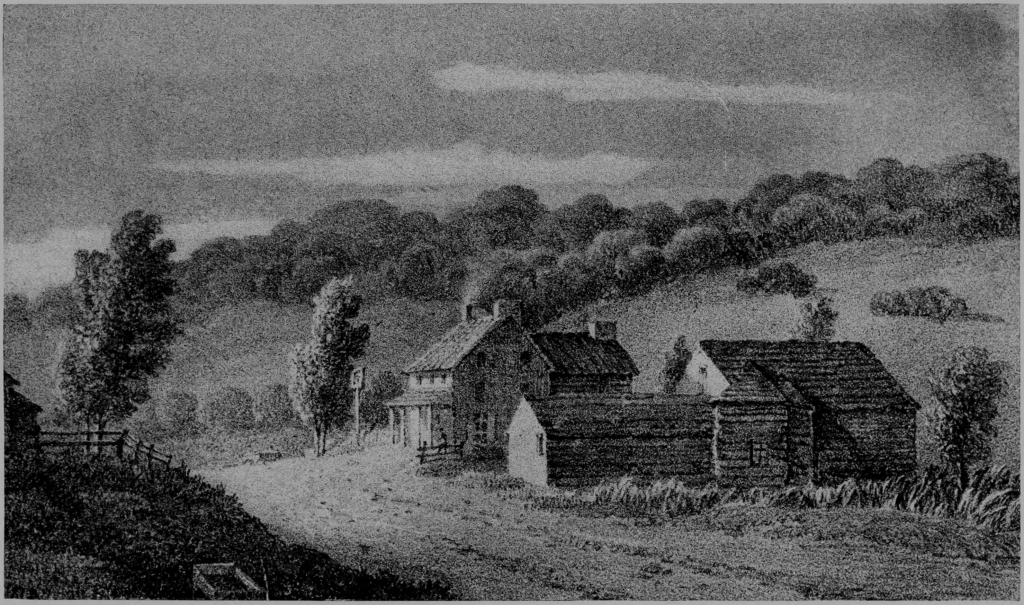
14th. Visited the Penitentiary: this institution has been so fully described by others that it is not necessary to give more than an additional testimony to the truth of its admirable [33] plan; unfortunately, the prison is at this time so full, (five hundred are in confinement,) that it is impossible to lock up, separately at night, those whose crimes are trifling from culprits of greater magnitude; but a new prison is building which will enable them, when finished, to correct this evil: the utmost cleanliness prevails, with order and industry; indeed, the whole had the appearance of a well-regulated manufactory, in which a regular debtor and creditor account is kept with each individual, who receives, at the termination of his confinement, the balance of his earnings, with which he may be enabled to maintain himself while he seeks honest employment: an excellent regulation. We afterwards viewed the Hospital for Lunatics, where the same, or more attention to cleanliness and every thing conducive to the health and recovery of the patients pervade every part; no appearance of gloom in the building, but all calculated to inspire the mind with ease and comfort. There is a good garden which, besides providing fruits and vegetables to the house, affords a pleasant walk to the convalescent; and in front of the building, encircled by a beautiful collection of trees, lemon, orange, pomegranate, &c., stands the statue of William Penn, holding in his hand the Charter of Liberties.
This is not a cheap country for the stranger: [34] either boarding-houses or taverns he must be in, (private lodgings being unknown;) and in such establishments the charges are high: but the inhabitant must, it would seem, live at a very reasonable rate, as the following prices will shew, and the lowest are not stated:—Meat, good at six cents12 a lb., excellent Tea for one dollar a lb., Sugar (loaf) for eleven cents a lb., Soap at ten or eleven cents a lb., and other groceries cheap in proportion. Of Wines, Port we buy for two dollars the gallon, Claret one and a half the gallon, Sherry two and a half. Spirits,—good Brandy for two dollars, Rum and Hollands the same.
But we will take leave of Philadelphia for the present—a future opportunity may occur for further observations; and to that chance we will leave it for the more important view of the Western country.
21st. With a strong but light carriage, called here a Dearborn waggon, for myself and party, and a light covered baggage waggon driven by my servant, I left the City about noon of such a day of heat as we had never until lately experienced: in consequence of which my dog, the fine animal above alluded to, ran off in a high fever, and I [35] never saw him again; but he recovered, and came back to the house I had left in search of me, and was taken care of for a few days, when the dog butchers destroyed him. Not to mention the breaking of a three gallon Demijon bottle of good liquor in rattling over the pavement, another cross adventure happened, which made the commencement of so long a journey ominous;—having sent the baggage waggon forward the first stage, and there happening to be two roads and two inns with the same sign at about the same distance, my man unluckily took the wrong way—we slept the first night therefore ignorant of what had happened to him; however he crossed over, and to our mutual satisfaction joined us the following day. On requesting the ostler to call me early next morning, the drunken old beast told me I might "call myself and be damned." Oh, the blessings of independence!—But I will say this for the Americans, that if during my stay one other oath was uttered it is the most I heard.
24th. At Lancaster, Pensilvania.13 We left Philadelphia on the 21st, and have travelled through a country well cultivated and still improving as we advanced, until, near this town, it breaks into hill and dale, woodland and pasture, forming the most beautiful scenery, and wanting nothing to the eye but water; actually [36] it is, we are told, exceedingly well-watered. We admired the state of cultivation, observing good crops of red clover-seed, and the wheat stubbles clearly showing that heavy crops had been carried;—the beautiful Indian corn just shooting into ear, green and luxuriant, greatly relieved the eye; the oats alone (not yet harvested) looked short in the straw and bad, owing we were told to their quick ripening and want of rain. The clumsy zig-zag rail fence of the first settlers is giving way to strong post and rail, and in a few spots to the live hedge, which looked beautiful.
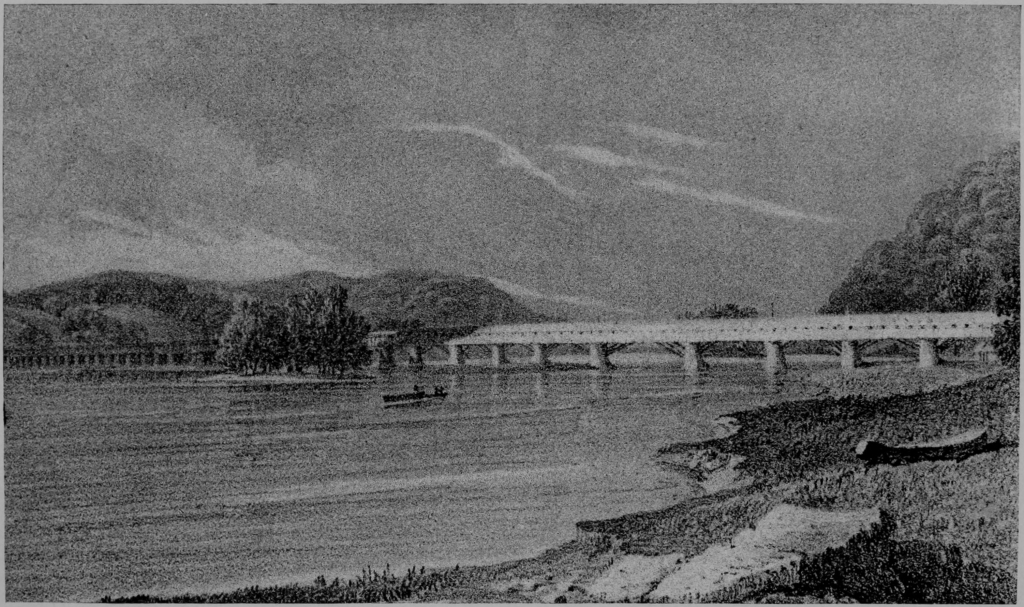
Bridge at Columbia, Pennsylvania
Thus we have passed along the centre of a fine valley of cultivated land, grandly skirted by the primeval forest the whole way; the houses and other buildings in general are excellent, bespeaking the inhabitants to be at least rich in comforts; which are after all true riches. The horses of Pensilvania have been frequently praised: they are indeed excellent; uniting strength of frame with activity, and coming nearest in form to the old English charger as seen in paintings; they are by no means generally castrated as in England. The roads as yet we do not feel inclined to praise, for they are abominably stony and jolting; yet they seem to have been formed at some cost, in some parts, I am told, at least twenty dollars [37] per rod; but no carriage except of the strongest kind (and their construction here is admirable for the purpose,) could last long against the perpetual concussions they receive. It is much to be regretted that in laying out the roads of this new country, the space allotted for them had not been thrice their present width, which would have left an ample summer road on each side of the principal one, rendering it better both for convenience and ornament; but in this and too many more instances the Americans, instead of adopting better plans, and improving by our errors, have servilely copied those of the old country.
To the same lounging idleness remarked by Mr. Birkbeck we too must bear testimony: added to which may be observed a most unconciliating manner of studiously avoiding common civility, arising we suppose from a vulgar idea of shewing their independence. The black population of all shades, from the deepest to nearly white, still appears considerable as we proceed.
Lancaster is a very respectable town, with a handsome court-house, &c. Slaymaker's inn or tavern excellent. A large manufactory of rifle barrels is carried on here, much cheaper than they can be produced in Europe; a very good rifle may be had complete for twelve or [38] fourteen dollars, clumsy in appearance, but throwing a ball with astonishing exactness. It was market day, and horses, carriages, &c., were among other things put up to auction; the auctioneer, riding or driving up and down the streets, with stentorian lungs proclaiming the qualities of the horse or carriage on sale, and receiving the biddings as he went on: a ranting preacher's exertions are nothing compared with this man's.
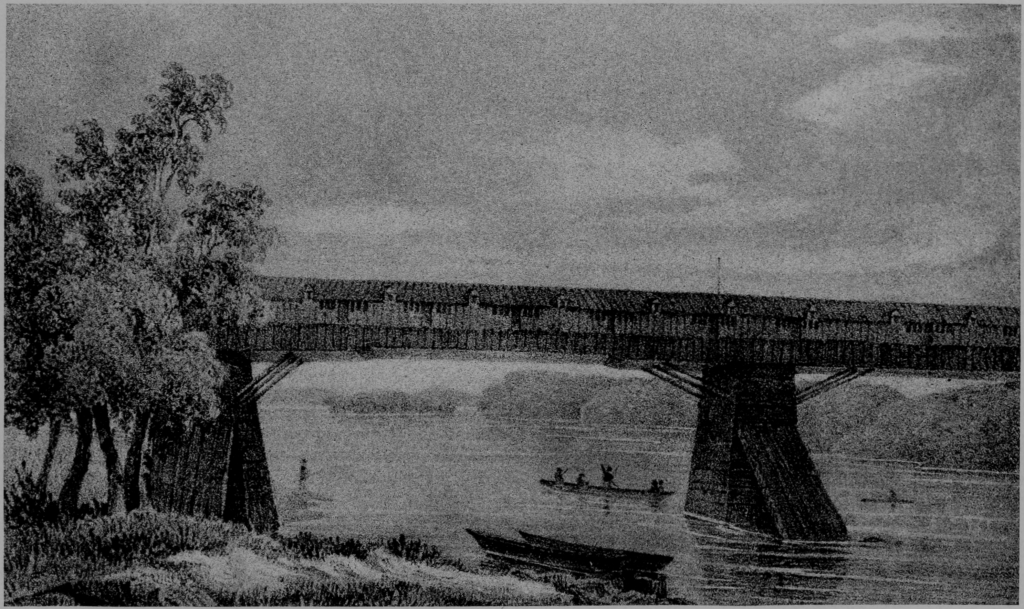
Susquehannah River at Columbia
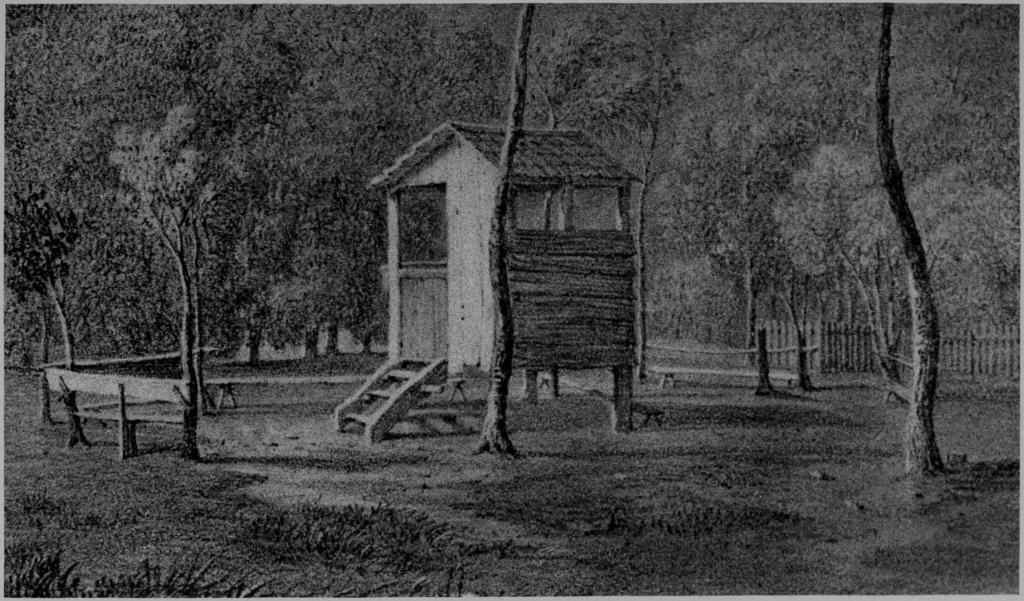
Place of Worship and Burial Ground at Ligonier Town, Pennsylvania
29th. At Chambersburgh. From Lancaster, by Columbia passing over the beautiful Susquehannah by a close bridge of one mile and a quarter long, to this town the roads are at present wretched, even dangerous; and the settlers, German and Dutch boors, as abominable. Having broke a buckle of one of the traces, we applied to a blacksmith to mend it, which he refused to do. Night with a thunder-storm approaching, we tied up the harness as well as we could, wasting plenty of hearty bad wishes upon the cursed smith which some poor Irishmen working on the road joined us in, though they could not assist us; and proceeded some distance, the storm still lowering, to a tavern kept by one of the above wretches where we were absolutely refused admittance: obliged to drive on we just got to the door of another, when the thunder in tremendeous peals burst over us [39] accompanied with torrents of rain; here we bolted in determined to be received, and found ourselves in the midst of parties of ill-looking people drinking whiskey and smoking. It was the bar or tap-room, and as no offer was made of a better or safer place for ourselves and luggage, and a little disapprobation being consequently shewn by some of my party, the brute landlord, notwithstanding the storm, told us we had better drive on to the next town, if we disliked his accommodations.—Not chusing to be drenched in rain for his ill humour we were obliged to remain during pleasure; until at length I got mine host into better humour, and he gave us a tolerable good supper and beds, though with the usual company of bugs and fleas, and without water for washing, which they positively refused to let us have; observing, we might wash out of doors. This man boasted of being possessed of thirty-five thousand dollars in property, and said, that land now worth one hundred dollars per acre was bought by his father for four dollars.
Tired of such abominable inns and the keepers of them, we have now twice boiled the kettle in the woods and breakfasted upon the contents [40] of our canteen, a plan we have much enjoyed, and recommend to all travellers in this country whose convenience it may suit. The scenery is beautiful, the land pretty well cultivated and finely interspersed with woodland; the harvest, except Indian corn or maize, is nearly got in, and seems to have been abundant. Man alone here stands an object of disgust. How strangely to our circumscribed views does Providence work its purposes! To a rough untutored set of naked savages, another race of little less than savages (clothed savages) has succeeded; who, in all probability, will in their turn give place to a third of some intellect and refinement; themselves driven from their paternal hearths by the insolence of an aristocracy, the intolerance of a state religion, or the craving demands of an extravagant government: these, seeking for themselves and their posterity relief from such evils, will bring into this fine portion of the earth, the letters and refined manners, which alone it wants to make it perhaps one of the most desirable countries of the globe.
We are now ascending the first range of mountains separating the eastern from the western part of the continent. The grand and ancient monarchs of the forest have only been removed where the road is opened for the passage of the [41] traveller. The Oak, the Chestnut, the Locust and various other trees tower aloft in their prime, while some lie fallen with age, and others, inclining from their aged roots, ready to follow,—emblems these of the lot of humanity!
The heat of the sun, though great, is here tempered by a cool air from the mountains. A man, his wife, and children travelling in their light waggon with one horse, have joined us; they are on their way to Virginia, in which State he lives; he seems to be a good-natured civil being and by no means wanting in humanity in general; yet custom could make him smile at my expression of abhorrence, when he said there was no law practically for slaves in that State, and that he has frequently seen them flogged to death!
Widow McMurran's Tavern, Scrub Ridge
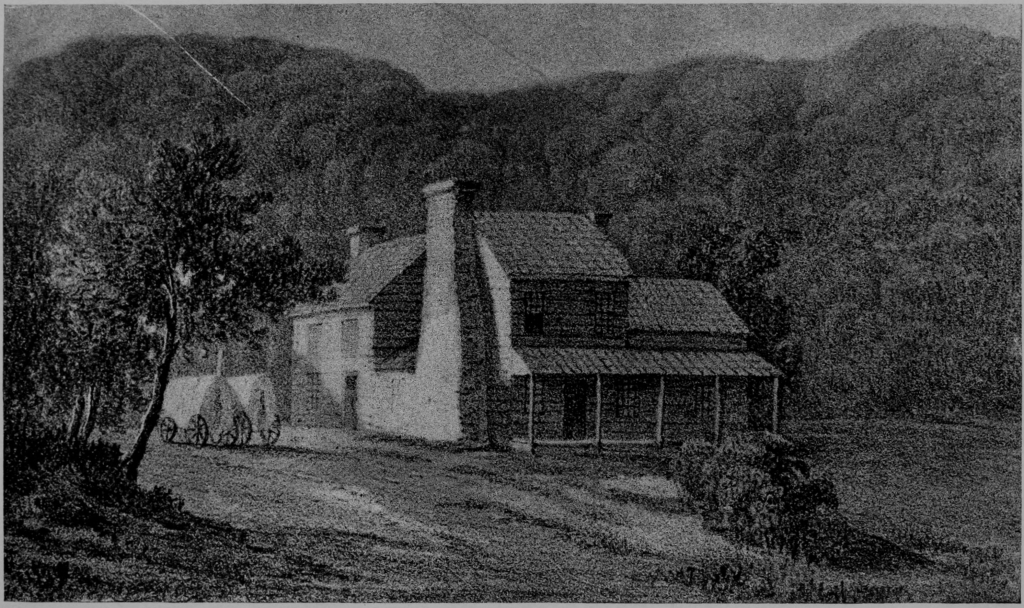
A PENSILVANIAN INNKEEPER
When we drove up to the door, a black or two came to the horses, no master or his representative appeared. We got out and walked into the common entry, and at length I accosted a stranger to know if there was a master of the house, who very civilly said he was in the back part and would perhaps soon come; I then went and called the Independent, who came forward, [42] I told him we wanted breakfast, he just inquired for how many, and then, without shewing a place to sit down, went to order it. This man I afterwards could perceive knew what he was about,—the above is one of the modes of shewing to an Englishman their boasted liberty and independence; their vulgar minds cannot perceive the difference between servility and civility. Having a tent in the baggage waggon and every thing for the purpose, we last night escaped these sort of fellows, and their bugs and fleas, by driving into the wood, where, finding a pleasant spot and good water, we lighted a fire, took tea very comfortably, and slept well upon the camp-bedsteads: this, during the hot weather, is by far the most pleasant plan where it can be adopted; but there are some objections to it which cannot easily be got over; it is not always in one's power to pitch the tent in the neighbourhood of good water; the apprehension of the horses breaking their halters and straying is not pleasant; (otherwise, they are quite as well off as ourselves away from American buildings;) and the greater attendance necessarily required from our own servants, both to ourselves and horses is harassing,—another assistant or two would have rendered the plan feasible with comfort and less expence. By the way, it is strange that [43] tavern-keeping should increase in these times, so dead as they say to trade, and consequently one would suppose also dead for travelling; but so it is, taverns are every where building or adding to: what a joyous prospect for the bugs and fleas! Expressing myself at a loss the other day to account for the number of public-houses building, a black man within hearing said he guessed they were preparing for better times—they could just now do it cheaper as hands, in consequence of want of money, were more plentiful: his observation appears just.
August 3d. The weather is extremely hot, and we have encountered several most tremendous storms of thunder and lightning. The thermometer is now at 88° in the shade with a draught of air at one o'clock; in the sun it is at least 108°. Many parties from various nations and of different modes of travelling are on the road for the West, and we hear of great numbers having passed during the spring and summer, all making towards the great point of attraction the western country.
We have now passed over Cove mountain and Scrubridge;14 the road over both has been lately formed, is judiciously laid, and would be excellent were the stones covered with gravel, or rather were they broken small; as it is, one is shaken to pieces without the possibility of avoiding it. [44] Under this evil we are solaced by the views of grand forest scenery,—the Oak of several kinds, the sweet Chestnut, the black Walnut and Hickory, with here and there tracts of pine, cover these mountains; affording shelter to herds of deer, foxes, rakoons, and also, as we had occular proof, to snakes of various kinds. Throughout the mountains and their neighbourhood you almost universally meet with most excellent water, affording a delicious beverage during the hot weather; the trunk of a tree hollowed out is set up like a pump, with a spout near the top, from which the water, constantly rising towards its level, runs in a clear and cool stream.
View on Scrub Ridge
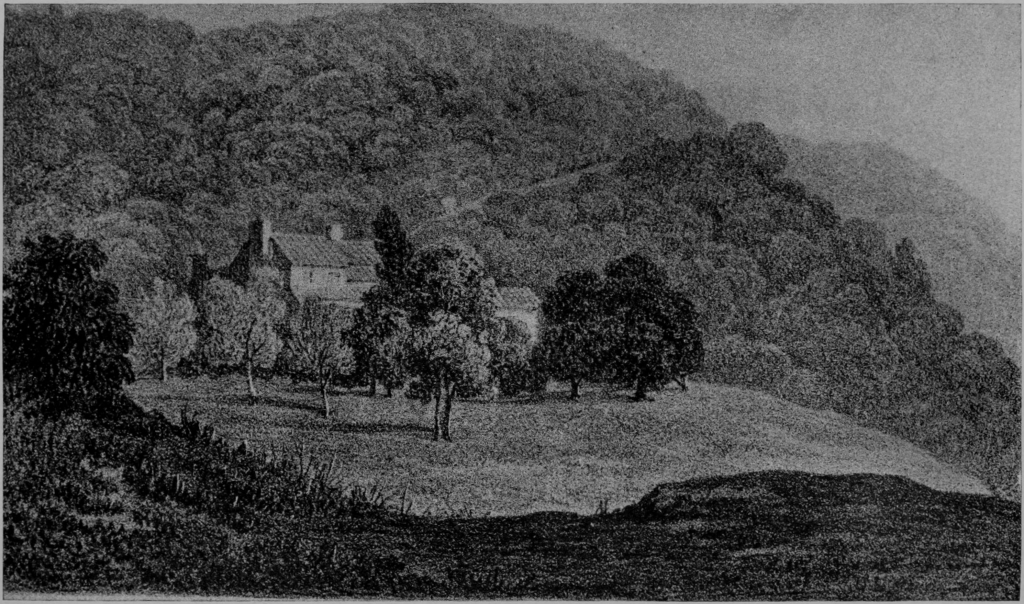
5th. At Bloody Run, called so from a battle fought with the natives;15 here stands a little town pleasantly situate on the Juniatta river, and containing several useful trades, such as blacksmith, wheelwright, harness-maker, tailor, and draper, &c. We approached it for the last nine miles by a new and excellent road just finishing, which is laid a considerable way along the Juniatta, the banks of which are beautifully edged with woodland. Some alterations and repairs done to the dearborn and the waggon here were charged at the following rate:—
Cents.
[45] Wheelwright, for two new poles, one great swing tree, and two single ditto$4 : 50
Blacksmith, for ironing the above (except one of the poles.) 6 : 50
Price of a horse-shoe and putting on 0 : 31½
Ditto, a remove 0 : 12½
We here enjoyed ourselves under the comforts of a good inn and attentive landlady.
10th. At Johnson's tavern, foot of Chestnut Ridge. We have now passed the Allegany mountains, and can affirm that at this time of the year there is little except the stony road very formidable to encounter: the line of it is laid with judgment, and with steady horses and a stout carriage may well be passed over by those who fear not a shaking; that, indeed, they may rely upon. The settlers on the eastern side of the mountains take great pains to deter the traveller from attempting the pass, and even after having surmounted the Cove mountain, Scrubridge, &c., I was told of the great difficulties of Laurel Hill; the fact is, it proved the easiest of the whole; nothing annoyed us but the sun, it being about mid-day when we began the ascent.
Much has been said of the expense of travelling in this country, I give therefore a night's bill at one of the better houses, viz.
Cents.
[46] 5 Suppers$1 : 87½
Lodging 0 : 37½
Hay for 4 horses 1 : 0
8 Gallons (1 Bushel) of Oats 1 : 0£. s. d.
———
4 : 250 : 19 : 1½
A night's bill at a good English inn for the same would be double the amount.
AMERICAN WAITERS
A tavern-keeper brought in some wine glasses stinking of whiskey, to which a cloth seemed never to have been applied; out of a pitcher of water he poured some into a glass, just shook it, and then throwing the water into the waiter upon which the wine stood, walked away satisfied with this proof of his cleanliness: and a female the other evening, in order to brush away the flies while we were at supper, flourished over our heads her dirty pocket handkerchief, in the absence of the brush of feathers fixed upon a long stick, which is generally waved over the dishes during the repast. The practice of going barefoot is here very general among working people, particularly the females; it is by no means an uncommon sight [47] in New York and Philadelphia, during the summer season, even in good houses; a custom this, probably, at least as cleanly as that of wearing close shoes and stockings.
12th. At Greensburgh, thirty miles east from Pittsburgh. The country we have lately passed is beautifully undulated, land of good quality interspersed with woodland, worth near from twenty to twenty-five dollars per acre; water plentiful and good.
Our landlord has just returned from a journey to the western country as far as St. Louis, on the borders of the Missourie territory; his report of the country is not favourable: he says it is very unhealthy, which he ascribes to the woodland, contrary to the general situation of such land, being lower than the open prairie; consequently retaining much stagnant water, the fruitful cause of diseases.
18th. At Hayes' tavern, three miles west of Pittsburgh, in which "Birmingham of America" I had intended to make some stay; but the heat, dirt, filth, and charges made me hasten out of it in search of rest and fresh air to this place.
The town of Pittsburgh16 stands beautifully, at the junction of the two rivers, and the land around it is of good quality; but its trade is upon the wane, not alone owing I apprehend to the times, [48] but to the town of Wheeling's being better situated for ready communication with the western country, and consequently thriving upon its decay. Pittsburgh has, too, suffered greatly from the extensive failures of the country banks. I met everywhere grave, eager, hungry looking faces; and could perceive, as well as hear complaints of, a general want of employment.
It being near the hour of dinner when we arrived, we joined the company at table, consisting chiefly of constant boarders, who, after a quick and silent repast, vanished; leaving at table two pleasant and travelled men, one a man of law from Boston, (Massachusetts,) the other a gentleman resident in Virginia. We talked of slavery, which the latter defended ingeniously, though not convincingly, by quotations from the sacred writings, St. Paul, &c.;—he owned a numerous establishment of slaves, and such was his reliance upon their attachment and content, that he had not the slightest apprehension of danger to his family during his absence: he had come to Pittsburgh to attend a trial, and entertained us with an account of the conduct in court of his Counsel, who, he gave us to understand, was a man high in the profession; neither Counsel nor Judge as is well known, put on here any gown but the heat of the day had induced this gentleman's [49] Counsel first to put off his coat, and not finding himself yet cool enough he got rid of waistcoat also; and then, further to cool his constitution and assist thought, he put a cigar into his mouth, and in this trim paraded up and down the court. The old gentleman, who had been in most parts of Europe, then asked what could strangers, just coming from England, think of such conduct in a court of trial? The glass circulated and in such conversation the time passed agreeably, until, at some general observation I made, the Bostonian fired up and we were as near a quarrel as any prudent people need to be; when the Virginian interposed and succeeded in making peace: however, harmony had been broken and we soon after separated. In the evening, expecting a pleasant drive of three miles, we left Pittsburgh; and, crossing the river by a respectable new-covered-bridge, for which I paid a toll of one dollar each carriage, took a wrong turn on the other side; and after encountering most dreadful roads, and making a tour of above six or eight miles instead of three, arrived by moonlight at the long-looked-for tavern.
At this obscure inn exists yet hearty at the age of eighty-eight years, one of fortune's fools, Captain Fowler, an Englishman late of the 38th regiment of foot; a man who in early life was [50] advanced, solely by merit and strict attention to the duties of a soldier, through every gradation, until he not only bore a captain's commission, but at the same time received the pay of adjutant and paymaster to three regiments.—Having attained to this rank, the favourite of Lord Percy, General Crosby and other officers of his day, and being in the high road to further honour and promotion, he was induced on the insidious misrepresentations of a sordid brother, to quit all these favours of fortune and come to America: here, at the instance of this relative embarking in one plausible speculation or another, he wasted his fortune; and now wears out the remainder of his days unknown at this tavern, kept by a good-hearted rough Irishman who has become his son-in-law. It is pleasing to see the attention that he receives from the family, which uniting with age and religion seem effectually to reconcile the old man to his fate.
SERVANTS
At this small house are maintained four female and two male servants, yet the house is not half cleaned, and the garden is little else but weeds; litter and dirt pervade the premises, while these Independents will play for hours at ball, or loll [51] over a rail to rest themselves. Behold a true picture-general! How pleasing to the lover of freedom to contemplate its blessed effects! Leisure, instead of inducing habits of mental improvement, and cleanliness, leaves them, in utter negligence of both, only to pass half their time in mere idleness and dirt: but why do I speak of the lower order while those, who should set these a better example, pass their days at taverns and other boarding-houses in idle games of shuffleboard and ninepins; or, seated for hours motionless under the shed which is universally attached to the houses, seem to exist solely to inhale the fumes of tobacco. Truly these people understand not liberty,—civilly, it is idleness and licentiousness; religiously, a leaving them to their wildest fancies.
BLACK POPULATION IN FREE PENSILVANIA
A black girl with youthful spirits was playing with a lad in the town street, when the wheelwright, with whom I was talking while he mended the carriage, said, "if it were not for fear of the [52] law one would be inclined to put an end to that black——; they ought to be taught the difference between a black and a white, and to pay more respect than to think of associating with them!"—The man spoke really in earnest, and would have thought little of putting the girl to death.
Immediately afterwards I met a white little boy who followed a tall mulatto woman, and with all his little strength was beating her with a stick; at length the woman could bear it no longer, and told him, if she should be whipped the next moment for it, she would pull his ears if he continued to do so. The same day, in my hearing a mulatto woman was threatened by her master with the application of the "cowhide" for not bringing the Independent his umbrella quick enough!
NIGHT
From the slight chirping of a few grasshoppers or crickets in England, no one can have a conception of the noise of a summer night here; all the insect tribe seem to open at once and to join in one perpetual chorus, very unpleasant to ears unaccustomed to it.
[53] AMERICANS AND SCOTS
The Pensilvanians resemble in many points the Scots: they go barefoot, they have both some dirty habits, neither have yet very generally erected temples to Cloacina beyond the immediate neighbourhood of great towns. A medical man lately told me that the itch, a disorder which proves uncleanliness where it prevails, was as rife as in Scotland; of drams of whisky and bitters they are equally fond. In cookery the comparison turns in favour of our northern neighbours, who understand it far better than they do here, where it is the most abominable messing and spoiling of provision imaginable: nothing but frying in butter till the stomach turns even at the smell; of vegetables they have but small variety, and of these the sickly tasting beet is a favourite, which they dress in the same disgusting way as the flesh-meat, neither good for palate or stomach.
22d. At Washington, Pensilvania, eight miles west of Canonsburgh: this latter little town stands in a healthy beautiful situation. It has a college in an unfinished state; there are three professorships, viz. Mathematics and Natural Philosophy, Languages, and Humanity Class, the whole supported [54] by voluntary contributions to which the government have made a handsome addition: at this time there are ninety students.17 The land about Canonsburgh to this place, is generally of very good quality, and just now may be bought at a reasonable rate; its nominal value, I was informed by one of the students, is from under twenty, to the best about thirty dollars per acre; it abounds in coal, lime, and iron; the first only two cents per bushel at the pit, and laid down at the door for two more. There are many English settlers hereabout, and the shew of improved management was very perceptible. There are some objections however to this part of the country, which perhaps the improvement of roads and canals will in time obviate; it is a distant point from both the great markets for commodities, the Eastern and Western; consequently what they sell is low, and that which they buy is very high.
Washington (Pensilvania,) is a very pleasant, fast-increasing, and of course thriving town, through which the great national western road and six others are laid. The College here too is in an unfinished state; it has now only [55] forty-five students, owing to the dismissal of a favourite president, and the appointment of one not liked.18
VIRGINIA
On leaving Washington a few miles, the traveller enters the state of Virginia, which he crosses to Wheeling, a town on the eastern bank of the Ohio. The whole way is in general a fine drive, and in two or three years will be better from the improved roads forming every where as we pass with great judgment and spirit. The National road is a work truly worthy of a great nation, both in its idea and construction; upon it, the traveller will be enabled to pass with comfort, from the eastern coast, westward the whole way to New Orleans; and perhaps by another branch to St. Louis, without being stopt to pay a single toll.19 This is as it should be; for roads are one of those important works which are scarcely ever executed well by individuals, and which therefore should be done by their representatives, and paid for by the treasury; one is not then stopt every five or ten miles to pay a toll frequently exorbitant; nor would the public be speculated upon [56] by individual proprietors20 or small companies, who seldom execute these works upon a scale sufficiently liberal.
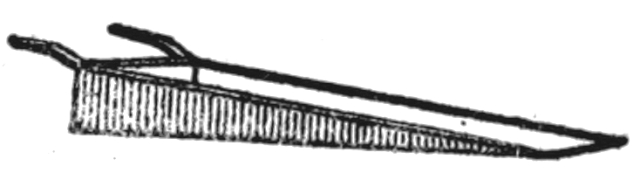
Almost all the labourers employed here upon the roads are either Irish or English, and it is not certain that these republicans have not a secret pride in beholding the natives of the old world toiling for their benefit; however, the earnings of the men are I believe sufficient to render them in time independent, and I must say they look in general well fed, well clothed and comfortable. We passed one party employed in ploughing down part of the uneven road with a strong machine drawn by eight oxen, while two others drew a large wooden scoop to shovel up and lead away the ploughed up soil: it appeared to save much labour. The Irish here have not lost in our esteem; two or three times we have been beholden to individuals of that nation for good-natured little services: one of them lately aided me successfully to get along part of the new road where we had met with some opposition; another actually accompanied us about nine miles on a like occasion, not with a view to remuneration, for I could not persuade him to [57] take any thing for his services but some refreshment at the tavern. I heartily return them the good wishes they so frequently expressed as we passed them. One of the above men had acquired some property; he told me that seven years ago he bought land at six dollars per acre, and that he had just sold a part of it at fifty, and some even so high as seventy dollars per acre. The proximity of the new road had increased thus the value of his land.
The beautiful Sassafras shrub is now plentiful, also several others which I in vain endeavoured to obtain the name of; for the people seem almost totally ignorant of the trees and shrubs in their woods.
WHEELING
Is very pleasantly situated on the Ohio, and, standing upon high ground, appears to be healthy; it is also a very thriving town, as a number of excellent buildings and others rapidly carrying up sufficiently testify; among these is a public seminary endowed by a professional man in the law, who, dying without heirs, left amply sufficient to endow it:21 near to this stands a neat chapel erected by methodists. Two good vineyards [58] are planted here, which looked thriving and, we were told, produce excellent wine.
Without meaning to speak in favour of slavery, I will yet state the fact that, during the drive across this small arm of the slave state of Virginia, the white people seemed far more respectable and civilized than in the free state we had just left; almost all we met accosted us pleasantly, as if to welcome a stranger without that rude stare to which we had become accustomed; the blacks, too, appeared to be well clothed, civilized, and comfortable; very superior to the free black population elsewhere seen. We had scarcely crossed the Ohio into the free state of that name, when we found a rogue and rudeness; freedom must at least take honesty for her companion or she is not worth a rush.
STATE OF OHIO
On entering the state of Ohio by this route we find little to interest; a wild uncleared hilly country,22 which with little alteration continues [59] till you approach St. Clairsville: the soil then is clay; the town well placed and its buildings good and neat; land hereabouts, a good grazing soil, is worth about twenty dollars per acre. We bought here, out of a waggon load, half a peck of peaches for six cents, (3d.) the peach and apple orchards are literally breaking down with fruit; every morning we stop at the first orchard to take in as many apples as we want for the day.
My man experienced an accident, in coming down one of these steep hills, which might have proved worse in its consequence than it did; not seeing him behind as usual I waited sometime for his coming up, and began to feel uneasy about him, when we heard his waggon wheels approaching: one of the horses had broke the hame-strap, which, throwing the pole on one side, had precipitated the waggon and driver into some brush-wood on the road side;—while in this situation, unable to extricate himself, a country waggon luckily came past, and he applied to the fellows with it for aid, which the human brutes refused without first being paid for their trouble.—From such contemplations let us turn for relief to the variety of foliage so highly pleasing in this part of the wilderness; we now see the Tulip tree for the first time; the Sassafras grows thickly, and a great variety of other plants and shrubs of which, [60] for want of botanical knowledge, I know not the names.
Several people clothed something like Jews with long beards have passed us at different times on horseback; these, I was told, are a Christian sect of charitable pilgrims styling themselves Dunkards.23
30th. The weather has been for some days past cooler owing to the falling of some rain, but is again becoming warm. The sudden and violent changes of temperature are at least as frequent on this side of the mountains as on the eastern shores, whatever may have been asserted to the contrary, and rain is almost always succeeded by cold. On the 24th of August in the early morning the thermometer of Fahrenheit was at 46°, it has since been above 80º, but again this morning has sunk to 56°.
31st. The road is covered with dust arising from the great number of horses, waggons, &c. conveying people from a methodist camp-meeting just held in the neighbourhood, at which it was calculated that nearly four thousand attended; the convocation had continued for several days, during which these people had slept upon the ground in the intervals between praying and preaching.
September 2d. At Chillicothe,24 Ohio. Watson's [61] hotel; the wit's mode of spelling it (Hothell) is more significant, for the beds swarm with bugs, and the thermometer is at 86° in the shade. I called at the land office and was shewn the map of the district; most of the sections, except those south-east of the town, (a poor mountainous tract,) are entered, and to my surprize, in general paid for; so this considerable part of the state is in the hands of land speculators, under whose baneful influence a chief part of the country remains a wilderness, which otherwise would have been under cultivation, if open to real settlers at the government price per acre. The British government have in Canada acted more wisely, in offering the lands only to those who will build, clear, and settle upon them.
5th. At Col. Woods' Log tavern, nine miles east of the town of West Union, Ohio. The road has lately led us through a fine fertile tract of vale, beautifully skirted by the high rocky woodland, from whence is quarried a good hard granite for building and other purposes. The town in this tract called Bainbridge is a new settlement,25 but already possesses some neat and good houses; the value of land of the district may be estimated by the price of town lots, containing sufficient space for a house and garden, which are as high in best situations as two hundred dollars (forty-five [62] pounds;)—the out-field lots are from twenty to twenty-five dollars per acre. This tract throughout appears well watered; the only objection I heard of to it, and that perhaps no small one to a settler, is, there being many disputed titles.
Among the growth in the wood we have lately noticed the Papaw, a bushy elegant shrub with large leaves; its fruit not yet ripe. The Tulip tree becomes more common, also more Elm and Beech, Sycamore and Buttonwood; all these are found here of immense size, towering high in air with stems perfectly straight. Near to Chillicothe, which is in north latitude about 39° 15´, we saw the first tobacco cultivation; it looked well notwithstanding the drought which now begins to be felt every where.
Upon admiring a large strong dog the other day, his owner told me he was very necessary on account of the wolves which are yet numerous: the dogs here are as mixed a breed as the people, and a thorough-bred is not to be seen. Deer are plentiful, also rackoons and squirrels; the wild Turkey we saw yesterday, which seemed to resemble exactly our dark tame breed.
Ferry at Maysville, on the Ohio
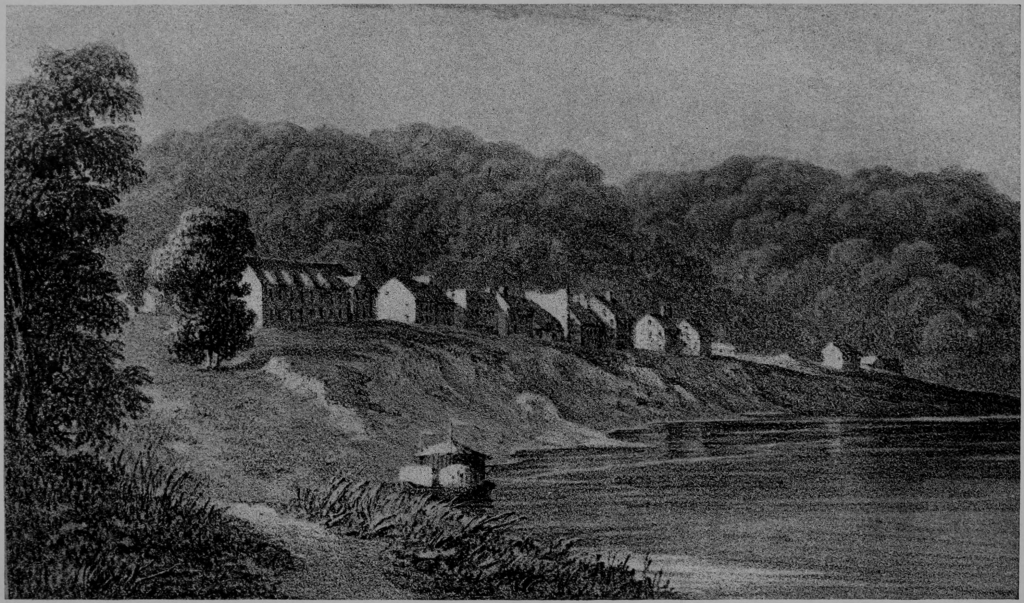
5th. Several parties on horseback have passed us on the road, making inquiries of the way to a methodist preachment, and to judge from the [63] immense numbers that collect on these occasions fanaticism seems to have taken deep root here.
6th. Started with my host on an expedition through the woods to visit a farm belonging to him. We took our guns uselessly for we saw no game of any kind, but, on arriving at the farm, got some good peaches and drank the pure water of a fine spring; being warm, he directed me to let the water run upon my wrists for some time before drinking, to prevent the effects of suddenly taking cold water while heated; these sort of cautions have probably been handed down from the native hunters. We passed a kind of vine which has a poisonous quality,26 the leaves being rubbed on the skin will raise irritating blisters. The Poplar tree, my host observed, made better shingles for covering roofs, if painted, than the Cedar, which is commonly used unpainted; perhaps any of the poplar tribe may do, and where a light covering is required might be advantageously employed in England.
A large party of settlers from the state of Illinois came by, they are returning to that of New York, to the same spot they quitted a year and a half ago. The account they give is that a fine fertile tract of land about forty miles from the river Illinois, and not far from its confluence with the Mississipi, was purchased by them, and they [64] settled upon it last summer; since which period they had lost eight of their party by dysentery, fever and ague, and that the remainder had determined to quit the purchase, and return with the loss of all their time and nearly all their money. These are facts much lessening our sanguine expectations as to the western paradise; however, I am resolved to proceed and endeavour to ascertain the truth on all the points for which I undertook the journey. One of the above party told me, that when ill he had paid a fee of twenty-five dollars for one visit of a Physician, the distance being about twenty miles; if this be true the medical science at least must meet with sufficient encouragement.27
The state of Ohio took a rough leave of us down a rocky precipitous hill, at the foot of which we found ourselves safe on the bank of the river; and driving down to the water's edge into a team-boat lately established, were, about dark landed on the other side, and comfortably received at a good family inn at Maysville kept by Mr. Chambers, a sensible clever man, who came to it from Jersey State about seventeen years ago, and [65] who has, by judgment in the purchase of land &c., made a good fortune for himself and family: some lots about the town, which he bought for four hundred dollars six years since, are now worth some thousands; such is the rapid increase in the value of property in this country when a man makes a good hit.
On quitting this State, through which we have travelled from Wheeling in a south-west direction to Maysville or Limestone, (Kentucky,) the impression it has made is not so favourable as I had been led to expect; though our course comprehended but a small part of it, yet we passed through the most populous districts, if we except that around Cincinnati. Instead of a garden, I found a wilderness; land speculators have got a considerable part in their baleful clutches to make their market on the wants of the poor settler; but I am apt to think have been themselves outwitted, owing to the superior attraction of the more distant western country: yet is Ohio a desirable one, as it contains within itself most articles of the first necessity and perhaps more; coals in abundance, lime, stone for building, iron and other metals, with fine rivers for transporting commodities of all kinds. The face of [66] that part which I saw, is exceedingly hilly, in some places approaching to mountains; but the soil in general well adapted to grazing, and the whole strongly resembling our county of Derby upon a gigantic scale. The northwest part of the State, an immense tract of country, has been lately ceded by the natives to the United States,28 and I believe has been surveyed, allotted, and is now offering to the public at one and a quarter dollar per acre ready money: of its fertility much is reported, and its communication with Lake Erie, and by it with the other lakes and the eastern markets, will render it perhaps more desirable than the part we have travelled over.
The roads at present are altogether in a state of nature, the trees only just chopped off about a foot from the ground, and rocks, and stones, and gullies left to be got over as we can; no wonder then, that you see a blacksmith's shop every two or three miles, and tavern by the side of it to put up and spend your money while the repairs are doing; for which, however trifling, Vulcan cannot form his mouth to any word less than a dollar, and his friend the tavern-keeper charges an "elevenpenny bit" if you have but two cents worth of whisky.
As to the general want of cleanliness in the [67] taverns, of which so much has been said and so justly, though the keepers of them have no doubt a large share of the blame, yet much may be said in their defence; the fact is, their customers are of so filthy habits that to have a house clean is almost impossible; and though bugs swarm it is true in the bed-rooms, beyond an English imagination, it is extremely difficult in this warm climate to keep free from them, particularly at inns, as they are constantly carried in the cloaths, luggage, &c., from one house to another until many a bug, it may happen, has been as great a traveller as Mr. Birkbeck himself. Yet do the people deserve reprehension, for while "such things are," and sundry other unseemly appearances are constantly, in their bed-rooms and other parts, existing in full force; while their gardens (ill deserving the name) are over-run with weeds, and cropped in the most slovenly manner; while a thousand disagreeables are around them, these—what shall I call them?—slaves to sloth, and worshippers of an idle deity of independence, will sit lounging against the wall with arms across smoking cigars; or you shall see the female part, lolling out of their windows gazing at nothingness.
Maysville, on the Ohio, Kentucky
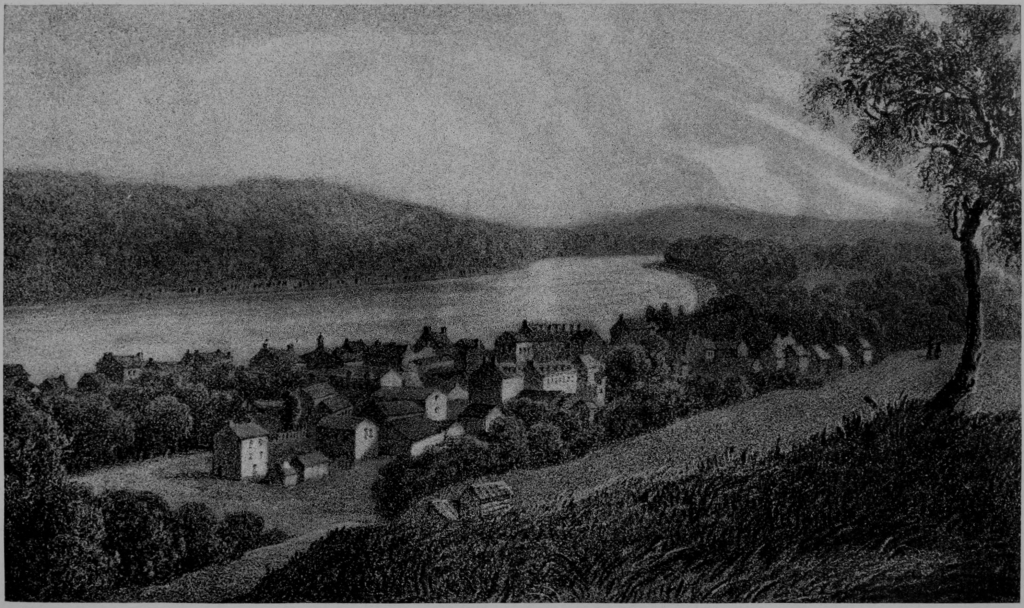
[68] KENTUCKY MAYSVILLE, OR LIMESTONE
Here at Mr. Chamber's, we staid two days, received more like guests than as travellers at an inn; his conversation was amusing and his anecdotes conveying much information: in his garden which is spacious and well-managed, we ate the first ripe grapes we had met with. The town, which seems to be fast increasing in size and importance, stands high from the level of the river, and is screened by towering hills, affording in the immediate neighbourhood and also up the river situations for building that few places can surpass: the view from above the town looking down the river is beautiful and extensive; a considerable part of the buildings are of brick; glass works are established, and other manufactories requiring machinery. All these advantages however will hardly compensate with most people for its being within the territories of a slave state. Of the determined obstinacy and turpitude of a black boy we were here witnesses; a silver fruit-knife had been left upon the table, and he had secreted it, the knife was soon missed, and search made for it in vain; at length, suspicion falling upon him, he was sent for and [69] questioned, but denied all knowledge of the knife with an air of the greatest innocency; he was offered half a dollar and to be screened from punishment if he would give it up, but continued to deny that he had taken it, wishing, "his flesh might rot if he had"—his pockets were at length examined; and the knife and an apple dropt together from one of them, upon which the young rogue declared that the person who searched him had put it there, and a terrible beating which I fear he got, did not in the least make him prevaricate.
We took leave of our host and hostess not without some regret, and, as we slowly paced up the long hill which rises immediately from the town, looked back frequently to view the beautiful river scenery from the different points it offered: a turn at the top suddenly presented on all sides a cleared, well cultivated, and inclosed country; the road was good, the day beautiful, and we bowled along through plentiful crops of Indian corn, rejoicing that we had escaped the wilderness, and thinking we had really entered upon the garden of the United States. After a few miles of good road however these pleasant ideas were shaken out by an absolute rock, upon which with but little intermission we rattled for near twenty miles, passing through a place called Blue Licks.29 At its salt springs [70] the deer and buffaloe used formerly to be found in immense herds; it is now a watering place, the resort of invalids: yet let not the English reader here picture to himself either Bath, Cheltenham, or Tunbridge Wells, but a few dispersed log huts and two taverns of the same description. Many of the men here wear, instead of a coat, a short cloak, a little resembling that part of the old English dress, which if they knew how to carry with any grace would look well.
The drought is now exceedingly great, and we have reports of much stock dying to the south of this state for want of water; we therefore see the country at as unfavourable a time as possible; yet, under these disadvantages, the grass is really green, a circumstance which proves the strong natural fertility of the soil, also shewn by the spontaneous growth of the white clover among the trees of the uncleared forest land where it has been grazed. Of this grazed forest the farmers assert that it will not, when cleared, broke up and sown, produce so much corn by one third per acre as that which has not been grazed, and many of them consequently shut up their forest land from all cattle and even from pigs.
[71] AN ODD MISTAKE
A little black boy was playing upon the ground, at the tavern-door with a dog; I pointed to them and said to the landlord, (a very civilized man,) "Do you make christians of these?" "Oh no."—"You name them without the clergyman?" "Oh yes; we sometimes give them one name and then alter it for another:"—"And does not your church find fault with you sometimes for such neglect?"
"No, they never think of such things."
"And when they die you throw them into the ground without further ceremony?"
Answer,—Always let them lie just where it happens—I suppose, you do not do so in your country; do you?
Self,—Certainly not; we think very differently upon the subject; that child would there be free, the moment it set foot upon our shores.
Landlord,—"Oh, you mean the negre; I thought you were speaking of the dog all the time. Yes; we christen them; but we do not let them eat with us, only the Quakers let them eat with them!"
This man's kitchen presented a picture which is general with some exceptions throughout the [72] slave country, a description of it will therefore serve for all the rest. Behold, a dark log building with a floor of mud, upon which a number of little black children are at all times to be seen crawling, while others are perhaps lying without the door sunning themselves; all mostly without any covering whatever: these are the progeny of the cook and other slaves, and are destined for sale or to supply the places of others. A quick lively little black girl, of about nine years of age, waited here with such spirit and so cleverly upon the guests that she attracted our notice; and upon praising her dexterity to her master he told us, that he had more than once refused three hundred dollars which had been offered for her.—The kitchen, besides being made the daily black-nursery, is also their general dormitory: at night, they creep round the warm embers and huddled together sleep in the contaminated atmosphere of this Augean stable, in the midst of the dirt and abominations of which the traveller's meat is prepared, and served more decently than might be expected; after escaping (perhaps) the fingers of the poor little creatures, who, watching their opportunity, rise from under the dressers, pilfer the meat and dip their fingers in gravies.