Volume 12 — PREFACE (continued 3)
Reading edition
At West Union, a small town with a good court-house, we had intended to sleep; but on arriving found the whole place full of people and to obtain beds impossible; at which the owners of the tavern very civilly expressed their regret, and though in the midst of hurry and bustle thought to speak for beds to the owner of a good private house, three or four miles further who happened to be in the inn. While the horses were feeding however, we went into a room, the table of which was covered with a profusion of fowls, ham, veal, beef, and many other symptoms of plenty; to partake of which the hostess very hospitably pressed us, and, that we might not be backward in accepting her proffered good cheer, assured us that it would be no loss to them, as every thing on the table would be swept away not to appear again; for especially upon these occasions nothing was ever brought on a second time.—"Have you no poor people to accept of the remains?" said I. She knew but of one family, she replied, to whom it could possibly be acceptable, and she did not think even these would receive it. An additional instance this, proving that food is abundant in [146] this country. Paid here for a new horse-shoe about eighteenpence sterling.
In passing through Ohio, the Derbyshire of the United States, we found in the sitting-rooms coal fires used almost generally in preference to wood; but from an extraordinary prejudice, which even exists at Philadelphia and other places, wood is still used for the purpose of cookery, and they will not believe that a dinner can be dressed properly at a coal fire.
Bridge at Zanesville, Ohio
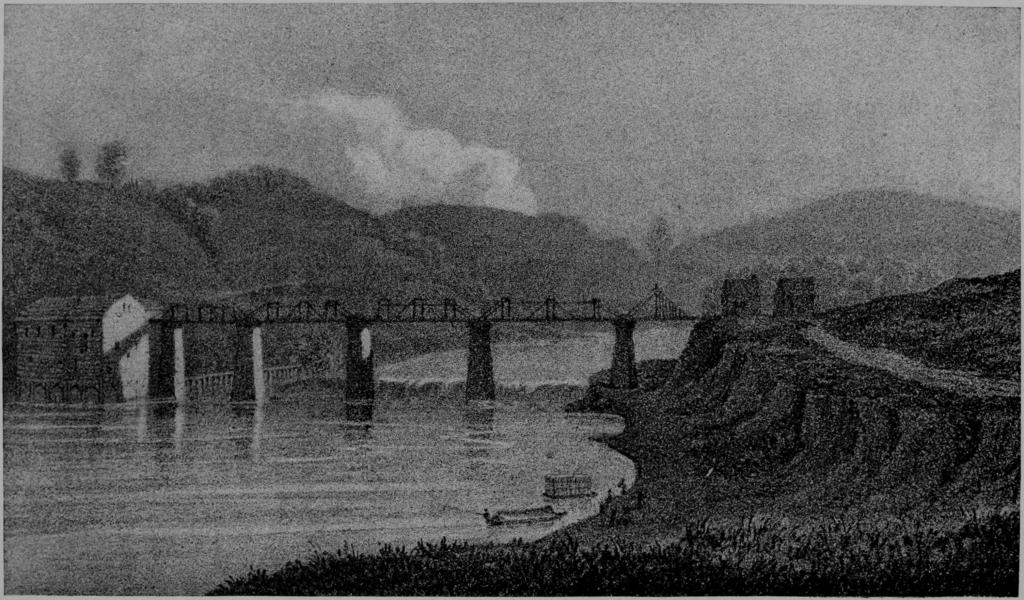
We again slept at Wheeling, and again were much pleased with the situation. Old Major Sprigs48 did us the honour to entertain us at his very good house, though it was very perceptible that he, in common with so many more, is not in charity with English blood: as a proof of the feeling, he was complaining of the rats about his premises, none of which vermin, he said, "were to be found in the country before the English brought them!"
This is the beginning of the season for Venison. A man came to the door with a horse-load which the Major bought for threepence sterling per lb., the price asked. Let not the reader long for American venison and fancy it to resemble a fine haunch fed in an English park; it is lean and more like horse-flesh, with very few exceptions.
Many families and other parties were still waiting [147] here, and at other places where we had crossed the Ohio, until the rising of its waters should enable them to pass down to the west: this did not happen, I was told, in the past year until the month of December; and to all appearance it may be as late this season; during the interval these poor people are exhausting their resources, losing their time, and at last will pass down the river at a most unpleasant and dangerous season of the year, if the ice should permit, a circumstance not probable: those travellers therefore, who intend such mode of conveyance, (a very pleasant one in summer,) should not start later than May; as the waters rapidly subside after June, when it frequently happens that none but light and nearly flat-bottomed boats can get down.49—[148] The rivers of North America it must be acknowledged are grand, but this annual loss of water will perhaps ever be a drawback to their utility which no art can remedy. I am more than half inclined, however, to withdraw this opinion, for American enterprise is alive to the object; and two works which I saw in progress, and which by this time may be finished, give promise that much may be accomplished;—one of these is at Louisville, where a canal cut at great expense will enable vessels to avoid the Falls of the Ohio, dangerous at all times, and often impassable;50—another on the Schuylkil, where the aim is to deepen the water sufficiently to render it at all times navigable.51 Weirs are carried at certain distances nearly across the river, leaving a space for a short canal with two locks to pass vessels.
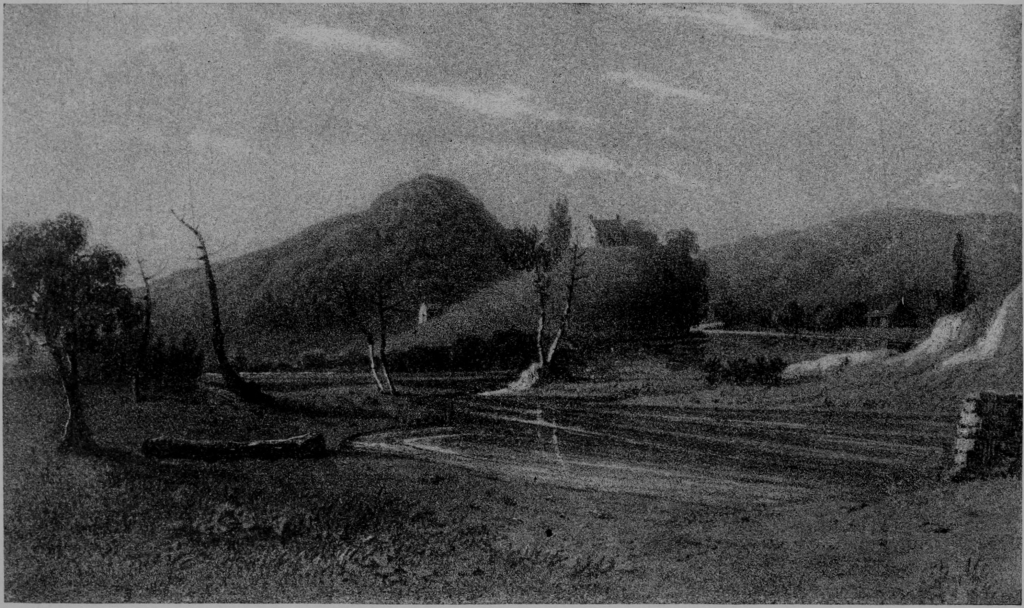
View at Fort Cumberland, Maryland
Should this plan become generally adopted on those rivers where the navigation fails annually from the loss of water, it will, among other good results, conduce essentially to the health of the climate; by preventing the stagnant pools left in hollows, and the exposure of slime and mud to the sun, now the pregnant source of disorders.
Where, or when an American uses water for the purpose of washing more than his face and fingers, [149] does not appear, for no water ever goes up stairs at a tavern unless your own servants take it. Under the shed of the house, water and tin basons are placed in the morning, and each one on coming down rubs his face and hands over;—they may bathe perhaps in the rivers occasionally; if not, they are decidedly dirty people.—An English youth at our inn at Wheeling in order to wash himself a little more effectually, let his shirt down to his waistband; an attempt at cleanliness so unusual, caused a general surprise and laugh among the yahoos.
At a small place called Claysville, a stage from Washington (Pensilvania), a man came to offer to the tavern-keeper for sale a fat pig; the price he demanded was about two shillings and sixpence sterling per stone of fourteen pounds, and I was told that he would have taken a quarter less.—Another proof this, if one were wanting, of the cheapness and plenty of food.52
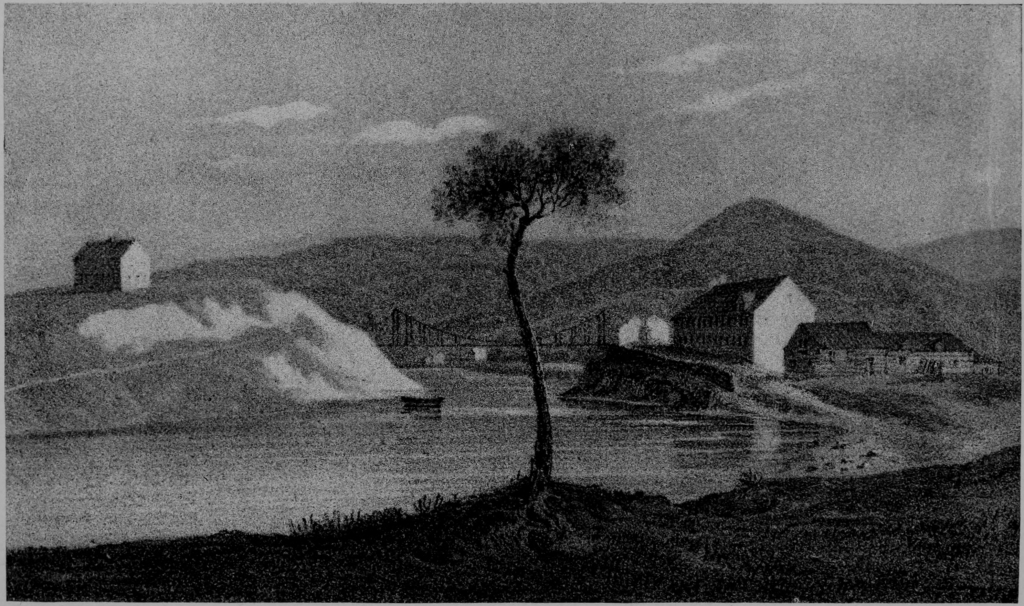
We stayed a day at Washington, Pensilvania, comfortably received at Mr. Morris's good tavern, and then took a new route by the south-west corner of this State: crossing the Monongahela river we baited at Brownsville,53 at an excellent house kept by Mr. Evans, an emigrant; from [150] thence, by a fine new road through Union Town,54 we soon entered the picturesque State of Maryland, and arrived at a small town called Fort Cumberland. The traveller by this route will pass the mountains scarcely knowing it, except from the fine views of the subjacent country which are frequently presented to view; that from the top of the hill about eleven or twelve miles west of Cumberland is truly magnificent. Along this well-formed road we pass without once being stopped to pay toll, and I understood it to be the intention of the United States government to finish and support this western road, from Washington the seat of the government down to New Orleans, by a fund to be raised solely for that purpose; a liberal plan and worthy of imitation. Of the few picturesque stations it has been our lot to see, Fort Cumberland stands first; it is not in itself a town of any importance or containing many good buildings, but surrounded as it is by mountains covered with beautiful foliage, and its stream winding through the vale, it forms a whole worthy the pencil of a master: at the distance of about six miles are some natural curiosities of rock, cave, and waterfall, which, owing to the lateness of the season, I did not chuse to lose a day in viewing though invited to it by the respectable old Patriarch of [151] the settlement, who in his ninetieth year yet offered to walk and accompany us to the scene.
View at Fort Cumberland, Maryland
The reader will be mistaken if, from what has been said of good roads and fine weather, he supposes we meet with nothing else; from a few miles off Wheeling until this day or two, the air has been filled with what in England would be thought a thick fog,—here they say it is smoke arising from burning barrens and prairies which are yearly at this time set on fire; indeed we have lately passed near enough to woodland on fire to see the flames and to hear the crackling of the timber; to our eyes a melancholy sight, accustomed as they have been to value and admire the forest growth. This brings to remembrance what has been told me of the great danger, and of lives lost in the Prairie country, from the custom of setting fire to the long grass in order to obtain a fine beautiful herbage, which, in a few weeks after succeeds it: the devouring element assisted by the wind advances so quickly that the speed of a horse has sometimes proved unavailing. The effect upon the long rushy grass as the fire reaches it, is frightfully grand; the heat first elevates and then throws it forward like waves, thus crossing the country at a rate inconceivably rapid;—instances have occurred of houses, cattle, and people suddenly falling a sacrifice to this rash [152] method of clearing the ground: the way to avoid such a catastrophe, the neglect of which occasioned to Mr. Flower the loss of some stacks, is to mow the herbage to a sufficient distance round the premises.
Nor is this danger to be apprehended only in the Prairie country. An emigrant, crossing the mountains some few years ago, wrote thus back to his alarmed friends, "the fire is before and behind me, I dare neither go forward nor return, and what will become of me I know not:" as his letter came safe we will hope he escaped.
Within this week a considerable number of waggons laden with goods and people have passed on their way to the Western country: as this Indian summer cannot last much longer, these parties would seem to be some of the improvident of the earth not to have moved earlier to their destination.
November 13th. The journey to-day, though over high hills and tremendous rocky ways, has been one of the pleasantest drives we have experienced: the clouds were just sufficiently broken to throw as they flew, endless and varied light and shade over the most beautiful and extensive views; rocks of various forms presented their rugged surfaces amongst the thick growing Pines and Oaks which, though small and stunted compared [153] to those in the Western country, are not on that account the less picturesque; and though the land is also equally inferior, yet such scenery, healthy air, and good water, must I conceive render Maryland a desirable residence to the man of refinement and property, in preference to any part that I have seen.
14th. A day more beautiful never opened or continued throughout. The national road not being finished we had twelve miles of the old track yet to pass, over rocks and gullies.
Maryland is a country of high narrow ridges, much rock, and but little land of prime quality; the timber, chiefly pine and oak, is small,—the rock which on this route everywhere abounds, is much of it strongly impregnated with iron; there is also much of it limestone and granite. Ridge after ridge we passed, rewarded by many an extensive and beautiful view, until at length after an hour's toil up Sidling Hill we entered upon the new road and bowled along down to the small town of Hancock near the Potomac, skirting that beautiful river to Fredericktown.
18th. Fredericktown55 stands in a good situation, having a fine view of the ridges of hills immediately west of it. The place is about half the size of Lexington (Kentucky): the inhabitants seem to be rich, having erected many good [154] buildings both public and private, the latter very tastefully and expensively furnished. The Court-house, a handsome building, stands in a square which is yet to be gravelled; on one side we remarked a lofty shed under which were hung an enormous pair of scales, seemingly typical of the purposes to which the central building is devoted. Churches are plentiful, nine in number and some of them well built. Talbot's tavern excellent and good attendance, but charges, as they are every where on this road, very high.
This is a Slave State; an institution hateful to English ears; yet I will observe again that after travelling through three slave States, I am obliged to go back to theory to raise any abhorence of it: not once during the journey did I witness an instance of cruel treatment, nor could I discover anything to excite commiseration in the faces or gait of the people of colour—they walk, talk, and appear at least as independent as their masters; in animal spirits they have greatly the advantage: doubtless there may be instances of cruelty, but I am inclined to think that such are of rare occurrence, and this for other reasons, as before remarked, besides those of humanity. Upon the question "What is the proper place of the Black in the order of creation?" (a subject which, after so much has been said on both sides, yet remains [155] in dispute,) the tendency of the above observations may seem to place him subordinate to the white—the next link in that chain of gradation, almost imperceptible to us, which nature exhibits throughout all her works: yet is the man of colour in general orderly in his conduct under the every-day duties of life, and also instances are not wanting of superior abilities among them, though they have not had perhaps fair-play shewn them in this respect. I may have occasion to observe more hereafter on this subject, meanwhile let it console the philanthropist, that if the black is not in his proper place, yet he possesses comforts, and appears very contented.
19th. At Baltimore. The view is fine from an eminence about half a mile from the town, nor are you disappointed on entering the city; though not so large, it is yet the most pleasing by far of the three eastern ports we have visited: whether the beauty and taste, the variety and neatness of the buildings, both public and private be considered, or the plan and situation—the whole is indeed strikingly interesting. A beautiful marble column is in part finished, a national monument to the memory of those who fell in the battle at North Point;56 not far from this is in progress a superb Catholic cathedral, and close to it stands a Unitarian church, an edifice not surpassed [156] in beauty by any in the city. Besides these there are a variety of churches and other public buildings: one of the most prominent the College of Physicians, a very heavy combination, and not rendered the more pleasant by, we will hope, the inappropriate neighbourhood of a burial ground. On the whole the traveller cannot but be pleased with a view of Baltimore and the State of which it is the chief town.
On leaving Baltimore about half a mile, a large burial ground presents itself on the road side: the Americans inclose these places with little or no fence, and very frequently bury their dead with little or no ceremony;—as we passed this ground a man within it was carrying a child's coffin under his arm, which he was going to inter apparently by himself.—Mr. Birkbeck mentions the summary method in the western country of felling a tree across the spot where they inhume a body: but the tree had sometimes been removed, and we frequently drove over hillocks in the wilderness under which lay the bones of the departed.
The road now led along the western edge of the grand bay of Chesapeak, of which we caught frequent and delightful views—here indeed may America justly pride herself; her bays and rivers stretching to a great distance from the coast—[157] surely nothing in nature can exceed for grandeur or utility. Havre de Grace at the mouth of the Susquehannah is a small place, but beautifully and healthfully situated: it was burned by us during the last war, they say upon very small provocation, which has given a blow to the little prosperity it enjoyed; and a bridge now building at a short distance up the river, by rendering the ferry useless and turning the present road, will further hurt it. One of the greatest dainties, the canvas-back duck, is here obtained in great numbers and sent to Philadelphia and Baltimore markets; though this was the season for them, we were not so fortunate as to feast upon the delicacy. The Susquehannah is navigable for large vessels to the bridge, and for small craft, I was informed, for near five hundred miles up the country.
The tavern at Havre de Grace is far better than that on the opposite shore; we had good beds and attendance. The ferry, about a mile wide, is well managed; on landing, we drove on through Elkton, Christiana, and Newport to Wilmington, a large town near the Delaware, and a place of some trade: the State Bank is a good building. At night reached Chester; the first inn was quite full and the next nearly so, which appeared very unaccountable; but on enquiry learned that it is [158] the chief retiring place for Debtors, where in about five weeks residence they get cleared of the Dun disease and come out themselves again.
23d. A beautiful day: breakfasted near the small town of Darby, and shortly after once again entered Philadelphia, after an absence of four months, and a journey of above two thousand five hundred miles performed in good health and with much interest throughout.
I now take leave of the Western country of the United States; and although the reader may perhaps be enabled to gather from the foregoing observations sufficient whereon to judge for himself, yet it may be proper to sum up that which I have to say upon it; and it may be done in a few words:—First addressing all those who are possessed of capital, I will state, that if they are content to undergo for their own lives many difficulties, and to make a certain sacrifice of many of the little comforts they can possess and have been used to enjoy at a moderate cost in England, they may then for a trifling sum establish their posterity upon a good estate in America, which hereafter may place them in affluence; and this may be accomplished at a distance far short of the Prairies of Illinois;—but let them be again reminded [159] that it must be done at some risk, much trouble, and a certain sacrifice of many of their own comforts: so much for those who look forward. As to immediate prospects, taking the different ranks, professions, and businesses in turn, I must first assure the gentleman and the idle man that they have no business in any part of the territory. The farmer who has been accustomed to the regular markets, the constant labourers, and the comforts of an English hearth, will here find the reverse of all these and more; not so bad perhaps in the country nearest to the eastern cities as in the west, where labour to manage more than a small portion of his land is not to be had; and if it could, there is either no market, or it is so distant that the small price he can obtain for his grain renders it little worth growing; whilst this very distance from market which thus acts against him, also renders the price of all groceries at least double that which it is in the Eastern States.57 For professional men I saw no opening, unless it may be for dissenting teachers in religion.—There are many young physicians spread about the country who keep taverns for their support; as to lawyers, there are enough for the population. [160] For manufacturers there may perhaps be found some employ: but it is principally the young poor man who can turn his hand to anything—the stout agricultural labourer, for whom this country is at present calculated; here such men may, with reasonable labour and activity, in a short time realise a little property, and after living in comparative plenty and comfort, leave their families to enjoy the same with independence. It is emphatically the country for the poor man; but he must not go thither, as many have done, expecting no difficulties to be encountered, no privations to be endured; nor must he be disheartened at finding a cool reception, and work not immediately offered on his arrival at the Eastern ports;—he must push forward westward without idly stopping to spend his money and waste his time; work his way if money runs short (he may at all places get food at least for his services,) until he arrives at a place where hands are wanted and good wages are offered for them; he has then a fair and near prospect of comfort, taking care only to be industrious, frugal, and especially to avoid habits of drinking, a vice the most difficult to withstand where the spirits of the country are to be obtained for half a crown the gallon.
There are people with us in England who object [161] to giving the poor man any facility of emigration, and who are disposed to condemn prospects held out to him of improving his present condition by a change of country; I shall not stop to argue with such narrow policy and truly anti-christian reasoners more than to say, that I will leave them to point out, for I cannot, even in a political point of view, any loss to a country arising from the emigration of a redundant population.
A WINTER AT PHILADELPHIA
Though a winter passage across the Atlantic may be quick it is almost always unpleasant; this thought, aided by a wish to see a little more of the climate and people ere I should bid to both farewell, determined me to stay till spring. The following notes and reflections are the fruit of the protracted residence, and they are presented to the reader nearly as they stand in my journal: in their nature they must be desultory, and by essaying to render them more connected, the little interest they may possess might be made yet less.
December 6th. A beautiful day, even warm, as indeed the mid-day has hitherto been, yet the [162] thermometer in an east room window opened at early morning stood at 33°.
Rode with D***** to the view on the Schuylkil called the "Flat Rock." On the way called at Mr. Fletcher's screw factory,—Mr. F. took pains to explain to us the machinery, though after all we best understood the result; one of the machines cut the iron rod into proper lengths and turned out seven screws complete per minute; with only the attendance of a boy, it forms thirty-five gross per day. Two miles more partly along the bank of the river, and amongst its beautiful scenery, brought us to the Flat Rock, and we crossed by an inclosed wood bridge. One of the dams which have been already mentioned is here formed, and there is a canal on one side with locks for the passage of vessels;—the broad cascade of the silvery waters sparkling in the sun over the dam, and the high, broken, and wooded banks of the river, presented a scene, even without the aid of foliage, enchanting. We returned by the old Lancaster road, making a pleasant ride of about twenty miles. In the evening called with D**** on Mr. H. This gentleman's life affords an instance of successful industry, by no means uncommon in this country of enterprise and speculation; it is also interwoven with some extraordinary incidents. At setting out in life's [163] career he and a brother laid out their several portions in goods such as they judged best for the market, and with them sailed for this country: the venture proved fortunate; the goods were quickly sold to great profit, and his brother again set sail for England to purchase more with the produce. But here a cruel disappointment awaited Mr. H., for his relative instead of pursuing the intentions of his voyage, engaged on his arrival in Europe in other speculations, lost the whole of the money, and his anxious partner in America, when riches seemed already to be within his grasp, received notice of his brother's misconduct, and found himself suddenly reduced to his last shilling, in a foreign land, and without a friend! Young and active, however, his mind bore up against poverty, and, though at the age now of three and twenty, he took the resolution to bind himself apprentice to a trade of which he already knew a little; at this he served his time; by steadiness and application perfected himself in the business; then set up for himself in prosperous times, and rapidly made a handsome income, which he now comfortably enjoys. Let us here venture reverentially to trace the moral justice of Providence in the life of the brother, who, though enterprising and at one period apparently prosperous, was reduced by successive losses;—[164] was taken by the French and imprisoned for several years;—being at length set at liberty he got together sufficient money to freight a vessel at one of the southern ports of that country, but which in coming round from thence for England was lost; and himself also soon after perished at sea.
9th. Just returned from a shooting excursion in Jersey. We saw pheasants, partridges, and rabbits, but few of any of these were shot: the American pheasant seems half grouse, the partridge half quail, and the rabbit half hare.58 Buffon and the Abbè Raynal59 have both remarked that the animals of this continent are larger than those of Europe, but the fox, pheasant, partridge and woodcock are all certainly much smaller.—The Jersey horses are excellent hacknies, for a pair of them drew us in a lumbering vehicle eight miles with ease in about an hour along a heavy sandy road.
We have been told there are no taxes in America, or that they are few and light; I insert therefore a copy of a tax paper handed to me by a gentleman of Philadelphia.
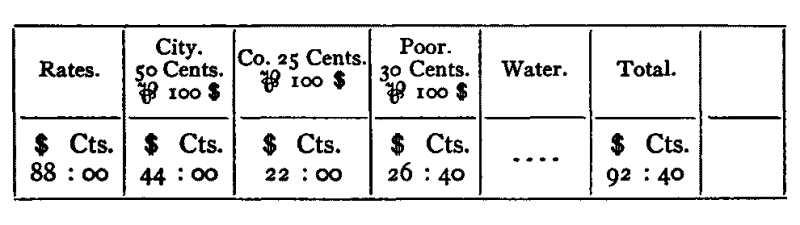
[165] Besides these there are still levied a poll-tax of one dollar; a dog-tax of one dollar, and I believe some others. During the last war, a tax was laid upon top-boots, watch-chains, part of household furniture, and various other articles.—Horses and carriages are also virtually taxed, for the assessor calling to put his queries in order to make out the assessment asks, among other questions, "Does Mr. ***** keep a horse or mare, a gig or other carriage?" and upon being answered in the affirmative he increases the poll-tax in proportion: this district or parish officer has, or I am misinformed, in great measure discretionary powers, and as he is elected by all the inhabitants of the district, whether they do possess property or not, the consequence may be easily foreseen.—Thus are the Americans pretty well taxed according to their means of paying: in the country indeed taxes are very little if at all paid, for the reason that the government either cannot or dare not levy them; hardly indeed, in some places dare the owners claim the land itself from the Squatters. An instance of this lately occurred in a distant part of Pensilvania: a proprietor having heard of several settlers upon his land without purchase or permission, mounted his horse and journeying to his allotment soon came up to a good log house; a Squatter was at his door, [166] and the owner, by way of entering into conversation with him, observed that he had erected a comfortable dwelling there; to which the other assented.—"But, my friend, I am told that you and several more have built here without any title to the land, and the owner is coming to remove you." The man, who had his rifle in his hand, immediately pointing to a pig at a distance took aim and shot it dead; then turning to the alarmed proprietor told him, that if the owner should ever come to disturb him he would serve him as he had served that pig.
Sunday 12th. In the morning attended the episcopal church, a building handsomely decorated withinside: near the pulpit, which was placed within the altar, sat a Bishop in his lawn sleeves, &c. supported in a chair of state of carved wood, the mitre surmounting the back;—he took no part in the service, but I understood he would officiate in the ceremony of admission to a young minister. In the middle of the service, otherwise conducted with decency, a man with a money box came into every pew to levy contributions for the support of the church. In the evening went to the Presbyterian church, where we heard much singing. Here a purse at the end of a long stick was thrust into every pew for contributions: this mode of raising funds for whatever purpose is an abomination.
[167] Marriage is here a civil contract, though some parties have the ceremony read by a minister; in general they may and do go before the Mayor, a Justice, or as they are called here a 'Squire, and declaring their resolution to take each other for man and wife, the contract is binding. As to registers I understand they are very inaccurately kept, if at all in many places, of either marriages, christenings, or burials, which must occasion most profitable confusion for the lawyers.
Went with ***** to one of the many billiard tables in this city; the game usually played is the four balls, two red and two white. This seemed to me a very childish play and well suiting the table-keeper, as from the facility of cannoning the game is soon finished. Returning home my companion proposed to dive into one of the Oyster Cellars, to which agreeing we vanished in a trice, and entering the infernal abode, the heat of which was at least that of a hot-house, we found a room well lighted and boxes arranged like our coffee-houses, except that the partitions were carried to the ceiling and the addition of curtains in front.—We supped well upon stewed oysters brought upon a chaffing dish, and a sallad of finely shredded raw cabbage and celery, which I found very palatable; for these with beer we paid half a dollar, and again rose to encounter the keen air of a [168] frosty night. It is I apprehend these constant sudden changes of temperature, and not severity of climate, which destroy the constitutions of many here, and render the use of flannel next the skin indispensable.
No one will again say that this country is free from paupers when he learns that there are subscriptions for the support of public soup establishments, which find plenty of employment throughout the winter. 'Tis true the poor here seem to be more fastidious than with us, for a pauper in my hearing the other day objected to some good cold meat offered to her, because it was too cold for her stomach, and said she would prefer some money if the giver pleased.
Sunday 26th. Went with ***** to a Roman Catholic church: the altar very handsome, but the architecture and decorations more calculated for a temple dedicated to Venus, than for the sanctity of a christian church. Between the pillars of corinthian order which supported the altar was a view of the Holy City and the Temple, well painted in distemper, and before this full as large as life the Crucifixion, the first view of which sight of horror, must make a sickening impression; but its constant presence deadens the feelings, and renders devotion grounded upon it a mere ceremony, as the "nods and becks and wreathed [169] smiles" between acquaintances coming in during the prayers plainly proved. The priest on his entrance, being finely enrobed in a scarlet velvet and worked muslin petticoat, commenced his operations by a very hearty and plentiful use of his pocket handkerchief, which "I thought to myself" might as well have been done before his entrée; he then with a voice like a bull-frog began prayers, but after some progress turned short round from the altar to the congregation and in very familiar language said he was too hoarse to preach, but would, as I understood, give them more prayers instead. He again during prayers took sudden occasion to remind them of some particular day in the ensuing week, and then finished the orisons;—the priest's voice was very pleasingly relieved by the singing from the organ-loft, it was fine and impressive. The ceremony of the purse was here too gone through and then we departed, the organ playing very well but not very àpropos "Adeste fideles."
An affair occurred last week at New York which caused a considerable sensation,—a young man in a fit of angry malice stabbed another in the open street with a concealed cane dirk. He fled, but was pursued and taken: when brought before the magistrates twenty thousand dollars were offered as bail for his appearance, which [170] has not been in this case accepted; though I am told it is not at all uncommon here to take bail in cases of murder, or rather manslaughter to speak technically. No wonder then that duels of that assassin character are of so frequent occurrence. It is common to practise beforehand on giving or receiving a challenge, and I believe rifle-barrelled pistols have been used; if after this a man is admitted to bail, let the assassin go free.
31st. After a long continuance of fine mild weather, in the mid-day sometimes even hot, winter comes clothed in his thickest fleecy covering, ushered in by as fine and gentle a rain as ever fell in autumn; the snow is already a foot deep, and sleds, or as they are called here sleighs, are moving in all directions. These carriages are not only applied to the useful purposes of life at this season, but they also afford an amusement much indulged in by all who can afford it;—there are sleighs of various sizes drawn by from one to four horses, and some of these carriages are of a form elegant enough, and handsomely covered within by the rich furry skins of the Bear and Buffalo; the horses wear belts of bells round their necks and bodies, and also some at their ears; this, which is a legal regulation intended to give notice of their approach, and thus to prevent accidents, [171] is rendered an affair of ornament to delight the eye and the ear, the bells being nicely assorted to harmonize, and affixed to handsome leather belts. The fun and frolic consists in large parties forming a cavalcade of these sleighs to some place of public resort at a distance, where when arrived, the dance is struck up, hot wines are drunk as a refreshment, and in the night, after a good supper, wrapped in furs and huddled together, they drive helter skelter home not "alone by the light of the moon."
Americans make amends for the want of originality of invention by a quick perception and adoption of whatever is useful in other nations; without owning that they do so, they servilely copy us in every thing; for examples among so many, Savings Banks are adopted to great extent. Lotteries are of as frequent occurrence as with us; schemes are for ever publishing, and without any other difference than the substitution of dollars for pounds; head prize, 20,000 dollars, second 10,000, and so on down to 10 and 5. The state of pauperism has even obliged them to adopt the before-mentioned soup institutions, which are now in daily action at each quarter of the city, besides other places where bread, and at some, clothing, is given away to proper objects of the charity; many of whom they say are Emigrants [172] out of employ.60 The newspapers indeed are full of advertisements for employ, and societies are established by Englishmen to relieve and forward poor emigrants to where their services may be wanted; but I am informed by a subscriber that the applications to them for working hands are just now but few: work would be plentiful, but money is wanting, meanwhile Penitentiaries and prisons and poor-houses are full! This does not form an inviting picture to the emigrant.
Writers on the United States have too much said the thing which is not, and too little the thing which is; consequently I entered the country with impressions which have almost all been totally changed by actual observation. We have been told that suits at law are here quickly heard and as quickly determined: walking the other day in Philadelphia with a gentleman, he pointed to some buildings we were passing, and surprised me by observing that he had for many years been disputing at law the possession of them. My landlady too is engaged in a lawsuit of many years standing, and of which she knows not the probable termination. Whether these evils are some for which they may thank our administration is [173] not here worth enquiring, as a wise nation should have remedied them when it formed for itself a Constitution; but in this and many other instances they still suffer under many of the evils of which we complain.
In a statement of grievances drawn up by a Grand Jury at a late county Assize in Pensilvania, it is complained that improper persons are put into the commission of the peace, and of the improper conduct of such in their magistracy: it also contains a strong remonstrance against the practice in prisons of putting the tried and untried culprits together: the bringing before the Grand Jury causes of a petty nature, and which therefore should have been tried in inferior courts, is also objected to.
The militia laws here bear hard upon the Foreigner, towards whom they are a vexatious tax. A residence in the country of, I believe, only six months renders him liable to be called out, and enrolled, or to pay a fine for absence; yet were a war to take place with the government to which an enrolled stranger is subject, he is sent up the country, instead of accepting of his military services; as it happened to the English who were resident here during the last war, to the great detriment of their affairs. The foreigner of course generally submits to pay the fine rather than be [174] subject to the demand of a military duty so unjust towards him; but that the practice of procuring substitutes, should be gaining ground among the citizens themselves, proves pretty clearly a falling off from the republican spirit. I have somewhere met with the remark that the Athenians were so wholly devoted to public life that they neglected the private virtues: the moderns on the contrary, and the remark may be applicable equally elsewhere as here, may be said to neglect their public interests in a constant attention to their private affairs; when this is the case, parties may hold intemperate language, journalists may snarl at each other, but all will not preserve the liberties of a people who have ceased to be true to themselves, when, from whatever cause, they shall hold back from their public duties, more especially those which are military; they then soon sink into effeminacy, lose that manliness of character which such exercises would give them, and becoming indifferent to all else but sordid gain, let their liberties sooner or later become the sacrifice to despotism. A militia may not go through its evolutions so quick and exact as a standing army—the latter is also a fine spectacle on a field-day, when the sun shines—it is likewise, it must be confessed, very enticing to indolence to be able to sit at home and nurse "its dainty [175] sympathies" while the army is abroad fighting its battles; but the Republic that would long preserve its freedom, that would truly enjoy the shade of its own vine and fig-tree, must keep the sword belted to its own side; must know how to use it, and submit with chearfulness and energy to its military duties. A standing army and disarmed population is the awful lever wherewith despotism and crooked policy have everywhere overturned the temple of liberty.
But whither is fancy leading me to wander? forgetful that I am where true liberty is unknown, or where the Goddess has only deigned to shed the rays of her intelligence on the favoured head of a Washington, a Franklin and a few others; while a spirit totally irreconcileable with the noble, disinterested, high minded, true republican pervades each bosom—money—gain—sordid gain is the predominant, almost the sole passion; scarcely leaving room for vanity; which shews itself not only in a firm belief and modest assertion that they alone among the nations of the earth hold the palm in Arts, Arms, and Science, but also in the important object of decorating the person. Reader—know, that the tailor, hatter, bootmaker, here give to our modern Republican his rank; and by the cut of his habiliments is known the circle in which he moves, and in which he [176] must continue to move. As unbending an order of aristocracy exists here as in any old court of Europe; and if an unfortunate individual is known ever to have appeared in an inferior circle, the ostracism banishes him for ever from the double refined society of this upper order of store keepers.
January 31st, 1820. Went last evening to attend service at the African Church: a charity sermon was preached and the whole very decently conducted. Contemplating however the sable countenances around us, the observation that the black forms a grade just below the white again occurred; 'tis true the former seems capable of all the common mental exertions, so nearly equal with the white man that it must be confessed he treads close upon his heels, yet notwithstanding, perhaps the result of a close examination and comparison of their mental faculties might shew as much difference between them as may be observed in the features of the countenance. On whichever side the truth of the question may lie, the general opinion in those States which have formally and publicly called the men of colour "Men and Brothers" is pretty clearly shewn in various ways—separate churches—civil disabilities, besides such common advertisements in the daily papers as the following; which I copy from the Aurora61 of Friday, 25th March, 1820:—
[177] BAKER'S EXCHANGE AND INTELLIGENCE-OFFICE
For SALE:—A black girl 20 years old, and 8 to serve.
Ditto 17 and 11 ditto.
Ditto 13 and 15 ditto, from the country.
Ditto 18 and 10 ditto.
Ditto 13 and 15 ditto.
A black boy 16 and 15 ditto, &c. &c.
To BIND:—White boys 11, 12, 13, &c. years of age.
White girls 8, 11, 12, &c.
Thus in free Pensilvania are blacks positively sold for a limited period, and though the law does not allow the purchaser the power of life and death over this sort of slave, yet to all other intents and purposes he is in as complete subjection as any slave in Virginia or Kentucky.
We have lately attended service at the churches of the Anabaptists, the Swedenborgians, &c.—Contemplating the various sects of religion in the United States, men will be pleased or otherwise, according to their private sentiments, to see the people on a Sunday quietly moving to the places of worship belonging to their several persuasions, without the least symptom of disrespect or rancorous spirit towards each other; thus forming an exception to the rest of the globe.—Whether such a state of religion will long continue, or whether, professing the same end (happiness hereafter,) [178] they may at length unite in the same means, one form of religion, time only will demonstrate: there are indeed people who seem to be of opinion that it will end in no religion at all; and I must confess thus much, that though theoretically it is certainly pleasing to contemplate religion free from state trammels, and each man walking before his God as his unbiassed conscience shall dictate, yet, as religion ought to influence men's conduct in the world, and "a tree is known by its fruit," it would be satisfactory to perceive, as the result of such religious liberty, more probity in the every day dealings between man and man than I have witnessed in the United States. While they talk of the moral and religious principle; of true liberty, honesty, &c. their actions belie their words, and make them appear a nation of unprincipled atheists; by the bye, a description of people perhaps more general over the world than we might be inclined to allow; people, who outwardly profess belief in a Creator and future Judge of our actions, yet whose daily acts contradict their professions. But to return to America, where integrity is at so low an ebb at present, that the nearest relative or friend can scarcely be safely trusted. One instance of baseness and ingratitude, among the many, I will relate. A man some time ago became insolvent—retired for the [179] usual period of five or six weeks, during which time he obtained signatures of release from his creditors, and came out whitewashed: one would naturally suppose that at least towards these men he would feel a debt of gratitude as well as of money due, and he had soon an opportunity of shewing it; for one of them, to whom he had been most indebted, in his turn got into difficulties,—and what followed—the scoundrel seized the occasion by the help of chicanery to turn his former creditor into the street and sold up his goods! Can either a religious or moral principle prevail where such things are commonly perpetrated?—Can the laws be good?—Can the government be efficient? Can a country last where such things pass as clever strokes of practice, and the most successful swindler is praised as the smartest fellow?
"Such things are;" and while they are, they furnish ground for such philippics as the following; which I will insert, not because any calm unprejudiced person or one not writing for preferment can agree with the pen of gall, but in the hope that America aroused at such anathemas, may exert her better self, give vigour to her laws, and blot out these foul deeds from the page of her history. Speaking of the principle of honour, the writer expresses himself thus:—"Honour alone [180] will indeed never make a great nation, but it will always preserve it from dwindling down into thorough contempt. It has done much more for France than ever virtue did. Without this semi-heroic principle she would have been detestable indeed. I say not that she was ever anything very desirable to boast of with it. America in this respect stands insulated from all the world. She has neither a spark of true magnanimity about her, nor any grace or colouring of it. She is equally destitute of honesty and honour, of substance and semblance. She set off without an established religion, and has now pretty well prepared herself for needing none."
In another place he writes thus, "there is no saying what this same America may turn out in the lapse of ages, or how far that unprincipled Oligarchy may extend her growing plagues into futurity, which, at present, exhibits the young serpents crawling out of their beds of venom in every direction where the heavens may smile, or the air freshly blow upon them, &c."62
Such sentiments as these, from a man professing himself a minister of "the meek and lowly Jesus," are little calculated to fascinate and render [181] any people the more inclined to a church establishment.
February 3d. What transitions of temperature!—the frost yesterday was severe; the Schuylkill and even the Delaware frozen over, and skating the order of the day; the thermometer at ten degrees below freezing:—last night a heavy mild rain has fallen, and at mid-day now the thermometer is at 40°.
HORRIBLE EXECUTION!
I shall copy the account without comment; it needs none. Perpetrated among a people who call themselves christians, and who boast of being "the most free, the most enlightened, the most humane people on earth."
"Augusta, (Georgia,) Feb. 1, A. D. 1820.
"On Friday last, two negro men, named Ephraim and Sam, were executed in conformity to their sentence, for the murder of their master, Mr. Thomas Handcock, of Edgefield district, S. C.—Sam was burnt and Ephraim hung, and his head severed from his body, and publicly exposed. The circumstances attending the crime for which these miserable beings have suffered, were of a nature so aggravated, as imperiously demanded the terrible punishment which has been inflicted upon them. [They had shot their owner while he slept.]
[182] "The burning of malefactors is a punishment only resorted to when absolute necessity demands a signal example. It must be a horrid and appaling sight to see a human being consigned to the flames—let even fancy picture the scene—the pile—the stake—the victim, and the mind sickens and sinks under the oppression of its own feelings,—what then must be the dreadful reality! From some of the spectators we learn, that it was a scene which transfixed in breathless horror almost every one who witnessed it. As the flames approached him, the piercing shriek of the unfortunate victim struck upon the heart with a fearful, painful vibration,—but when the devouring element seized upon his body all was hushed: yet the cry of agony still thrilled in the ear, and an involuntary and sympathetic shudder ran through the crowd."
In consequence of the above, the following letter was addressed to the editor of the newspaper.
"To Z. Poulson,
"A Philadelphian in thy paper says, the burning of malefactors is a punishment never before resorted to in this country,—I wish the fact were so, but in the year 1800, the following was published, viz.
"'Charlston, December 4, 1800.
"'Yesterday was brought to trial, before Justices Johnson and Glover, Ben and Smart, two negro slaves, the property of Mr. Gregmiles, for the murder of Wm. Maxwell, ship carpenter.—The Magistrates and Freeholders were unanimous in bringing them in guilty: and further, from the circumstances of aggravation, that the punishment should be severe. They were accordingly sentenced—Ben to be carried between the hours of ten [183] and twelve this day, outside the tobacco inspection, and there to suffer death by being burned alive; the other, Smart, to be carried to the place where the murder was committed, between the hours of ten and four, and there to suffer the like punishment on Friday the 5th instant.'"63
That such scenes have at some period disgraced the annals of most nations it must be acknowledged; for which even a faint shadow of excuse may be found in the madness of fanaticism: that they are now sanctioned by cold blooded sentences from a misnamed bench of justice, proves this new continent to be some centuries behind in civilization; a fact corroborated by several others, amongst the most glaring of which are the perpetuation of the institution of slavery, and the frequency and mode of conducting duel combat.
The first of these condemning facts has just been decided, after much and violent debate in both houses of Congress; and only by the small majority of four, a majority which in England would not carry a question, the New State of Missourie is admitted into union with the free republic without any restriction as to slaves! In the course of the discussion, the State of Virginia has gone so far as to throw out hints hostile, should the question be decided otherwise than it has: and in this it is understood she would have [184] been supported by the other Slave States all deeply interested in the event; as, had the abolition party prevailed, the next measure would have been an attempt at general emancipation, which, if carried, would have been a death blow to the paramount influence which Virginia now possesses in the general government, owing to her extent of territory and population, and to the law which gives to each slave-holder, besides his own vote, one for every five negroes he has. These causes have hitherto enabled Virginia successively to influence the choice of a President of the United States. Another reason given by the politicians here why the last mentioned State with Kentucky, and some others, may be careless of maintaining the union is, that a debt of some magnitude is due from them to the general Government for lands unpaid for, taxes, &c., and which, being unable or rather unwilling to pay, they would cancel by a war. The political and civil interests of the Slave States also frequently clash with, or are in direct opposition to those which are called Free.
Another division of this immense country contemplated as probable, is into eastern and western Governments, the Alleghany chain of mountains to form the mutual grand barrier; and indeed I found the subject pretty generally discussed in [185] the western country, the inhabitants of which seemed well disposed to the measure.
On the subject of Duel combat mentioned above I would add a few words, partly of general application, to the sentiments of so many already delivered. Though the angry passions of some, and the foolish conduct of others will perhaps continue to give cause for and never entirely banish the necessity of appeal to arms; yet will all sensible men concur in the opinion that it ought to be the last resort of injured honour, the ultimate remedy to repel insult. As real christians, we should refuse it altogether; but taking the world as it is (and that is very far indeed from true christianity), the combat ought to be regarded as a serious appeal to heaven, alone justifiable when human laws have failed to do us right—when, however we may as a christian forgive the offender, we yet cannot keep our honour and overlook the offence:—in such situations, and fortunately such are very rare, a man has no alternative—he must trust his cause to mortal arbitrement: but to rush to the combat for any cause short of this is not true courage, for this is alone consistent with right conduct;—it is irreligious, for religion forbids it—it is immoral, for it tends to banish virtue and disorganize society;—it is barbarous, for it belongs to the wild beast of the forest; and the [186] people who have recourse to the combat on frivolous occasions cannot therefore be placed lower upon the scale of humanity. If then these sentiments be correct, what are we to think of those who can invite each other to the field upon a dispute about their tailor's bill, or the best mode of peeling a sausage, with other equally important occasions of meeting among these mockeries of humanity. From the contemplation of such, let us turn to behold the more serious mockery of all that is right, in the chief Magistrate of a nation, and a considerable part of a nation's council, publicly parading the funeral of a favourite naval officer, who fell—not nobly fighting his country's battles, but pointing at a murderous distance, with vindictive malice, the weapon at the breast of his brother officer; on account of an affair too, with which he had no concern, and for which even his own friends condemned his interference! He fell; and his antagonist, who appears to have attempted all which an honourable man could do to avoid the meeting, remains.64
After what has been said, it will not surprise the reader that a store-keeper should put out a board to advertise the passenger that he has "ten cases of Duelling Pistols on sale;" though it might to a reflecting mind be little less hurtful to society than if he had offered ten cases of [187] picklock keys, or some neat sets of combustibles for firing houses or blowing up the inhabitants.
Went to visit the Dock-yard and to view a 74 upon the stocks; within the hull of which it is said one of our 100 gun ships might be placed; and in effect she is framed to carry as many guns at least, and those of a large size. The plan of having all the guns of the same size appears to be good in more respects than one; it prevents mistakes in loading during action, as the same quantity of powder will be required for each gun:—32 pounders are cast here I understood for the service generally. The Americans seem alive to naval enterprise, and no doubt can be entertained of their becoming very powerful, if they avoid internal divisions and cordially join in effecting it. It will not be denied that they have on several occasions at sea behaved gallantly; but the mere trick of rating ships of war below their real force, by which they have gained some few advantages, will no longer succeed, and was unworthy of the adoption of a brave nation.
[188] LECTURES ON ANATOMY
The mansion which the Government caused to be erected and presented to George Washington for his residence, and which he, always like himself, only accepted to give it up for the public benefit, is now devoted to the medical and anatomical sciences, and is named the University of Pensilvania.65 By favour of Dr. Physic I was presented with a general ticket of admission to the anatomical course. On entering the Lecture room, which is spacious, it was pleasing to see in attendance about three hundred students; it was not so pleasing however, to hear the impatient noise kept up by their heels and sticks in the manner of our play-house galleries, because the Dr. did not make his appearance quite so soon as expected. This is both highly indecorous and shewing a want of proper respect for a man of years and science. Dr. P. ranks high in reputation, and I believe deservedly: his salary for the college duties, which occupy his time for four months of each year, is about six thousand dollars. There are several other courses of lectures delivered here, all of which are numerously attended: at the concluding lecture of a course on medicine given by Dr. Coxe, the very indecorous conduct of the students in [189] hawking, spitting, and coughing, while some few lay across the benches asleep, led me fully to expect a severe reprimand, as they richly deserved, at the end of the lecture; I was then much astonished to hear a short, diffident address from the Dr. concluding with thanking them for their attention! This they applauded with as much sense and propriety as they had before coughed, hawked, and spat; by the way, these beastly habits I am told carry off numbers of young men in early consumptions.
The Dr. took occasion in speaking on the subject of fermented liquors, to reprobate, and it may be too justly, the wine merchants and brewers of England for the custom of mixing deleterious ingredients in their liquors.
The practice of medicine in Philadelphia, New York, and other large towns appears to be on a very respectable footing. Fees are high; on which account perhaps it is that the operations of bleeding with the lancet, cupping, &c. are still performed by barbers, and by other ignorant people as formerly in England; in almost every street is a sign put out66 denoting that these [190] operations are performed within; it may be supposed therefore that disorders of repletion are very general. Dentists are well paid: at New York I had occasion for their services, and a little Frenchman, who, though now in fashion as a dentist, had, I afterwards heard, previously figured in the world as marker at a billiard-table and in several other characters, was recommended to me, and I sought his house: after extracting the tooth, which he performed very well, he told me among other rhodomontade that he only now practised "pour son amusement." I therefore doubtingly requested to know if he took a fee upon such pleasant occasions, and putting a note into his hand, he retained only two dollars of it which he pocketed also "pour son amusement." A lady paid to ****** twenty-five dollars for plugging three teeth, and another was charged thirty-six dollars for having her teeth cleaned. A midwife's common fee is twenty-five dollars and frequently much more is given.
Empirics too here find a field whereon to gather in a harvest: imitations of the bottles and labels of the most successful of our quack medicines are made and openly advertised for sale to the imitators. Holcroft67 it is, I think, who, in his account of Paris mentions that boards are to be seen fixed over doors with the inscription "ici on [191] fait les avortemens." At Philadelphia one of the same infamous race placards in large letters the corners of the principal streets with "Obstructions removed at No. — in —— street."
February 22d. Anniversary of the birth of George Washington. I suppose it was that the people might be awakened early to pleasing thoughts on this day, that a double drum accompanied by fifes went thumping through the city at four o'clock in the morning. Soon after daylight all was bustle and preparation. At ten A. M. we repaired to Washington Hall, where an oration was to be delivered, in honour of the departed hero and friend of his country, by a young student in the law, one of which profession is annually chosen for the task; this being an opportunity of becoming known, and a trial of ability, may be of much advantage to a young man. A handsome spacious room surrounded with galleries was appropriated for the ceremony; the ladies above, the male auditors below. At the upper end was a raised platform for the Orator, the city magistrates, a few military officers, &c.
During the arrival of the company, a band of about half a dozen wind instruments stationed in the gallery above the platform, played some airs, chiefly English, and pertinaciously continued their exertions while the city militia with [192] drums, and fifes blowing a different tune entered the room, and marching up, squatted down upon benches and ordered their arms between their legs. The din was horrid, and the idea of seating the military novel.
The Orator now entered and, accompanied by the public characters, ascended the platform; seats being taken, the six wind instruments in the gallery struck up the national air of "Yankee doodle," which immediately set all the ladies nodding, jumping, and beating time, while some heavy heels below tried to accord with them.—This air is surely of all national airs the most unfortunate; to those of other nations we may listen with delight;—the Swiss Ranz des Vaches—the Dutch "Orange Boven"—the Marseillois' hymn of the French and our own coronation anthem, and Rule Britannia, have all their several characteristics of grand, plaintive, or inspiring; but Yankee doodle! What concatenation can render it agreeable? What mental images can it conjure up worthy to rejoice the hearts of a great nation!68
Yankee doodle over, the Orator, a fine young man but of very inadequate strength of voice, [193] advanced and commenced his address, in which I was surprised to hear but little of the great character we were met to recal to respectful memory. It was a rapid panoramic sketch of the political situation of the several principal powers of Europe, with all of whom he found fault; then weaving in an uncalled-for condemnation of Napoleon (a great character, let history hereafter say what it may of his errors,) he concluded with an unqualified approbation of the men and measures at home; not excepting the late decision of Congress on the Missouri question, which perpetuates slavery in the United States: in short, he boldly affirmed that their nation was alone the favoured one under heaven where true liberty was understood and enjoyed, &c.
At the philippic against Napoleon, General H. L'A****d who sat near me, though he does not converse in English, shewed well that he understood it, by the indignant colour which rose to his face: the General was one of Buonaparte's most attached officers, and being consequently proscribed by the present French government, sought an asylum with Marshal Grouché and many more on the shores of America. Here he now resides truly a practical philosopher after the pomp and bustle of war is over; after having borne a part in many campaigns; among [194] others that of Moscow, and enduring the horrors of the retreat, eating horse-flesh as a luxury, and subsisting for some time on sugar; and lastly having been engaged at the final battle of Waterloo. He now lives a quiet domestic man with his lady and infant, and employs himself in writing upon subjects connected with his profession; upon which, as well as upon general topics, he speaks with great ability and feeling, as one who has thought much and deeply. It is with pleasure that I seize this opportunity of inserting a few words of remembrance of this worthy man: it is time that party proscriptions should cease in France, and I heartily wish he may be reinstated in rank and fortune.
The address was of course received at its conclusion with thundering applause; the drums, fifes, and wind instruments again joined in a Dutch concert, and the audience dispersed. As we returned home I observed that all the stores were kept open; no great proof of respect on such a day.
To instance further symptoms of slavery, and perhaps a little injustice, in this free State of Pensilvania, where all men are declared equal by the constitution, the people of colour are neither called upon to pay the poll-tax as men, nor are they allowed a vote for representatives or otherwise; [195] yet all taxes, the payment of which give no such privileges, are exacted of them.
As this subject may not be again alluded to here, I insert the following curious advertisement: it may give some insight respecting the public mind upon more subjects than one.
"MISSOURI "To Southern and Western Planters
"For SALE; one hundred prime Virginia-born Slaves, the property of a Planter who is contracting the scale of his business, and does not chuse that all the produce of his land and labour should go into the pockets of manufacturers or fundholders. These Slaves will be sold all together or in families, to suit purchasers. Conditions, Cash, and Removal not South of the State of Georgia. The condition of their removal is for their own accommodation.
"N.B. No proposals from any Slave Trader will be attended to.
"The Proprietor of this property would prefer selling them all together, and would give a credit to any Planter, on receiving satisfactory [i.e. landed] security. No bank notes, bank stock, six per Cent, three per Cent, or other evidence of debt, public or private, domestic or foreign, will be received in payment; but coin or bullion will be taken at their lawful value or market price respectively.
"——British or Portuguese gold or Spanish milled dollars would be preferred.
[196] "If the above-mentioned Slaves are not disposed of at private sale before the first Monday of November next, they will be sold at public auction on that day, at Lynchburg in Virginia.69
"These Slaves were bred on the estate where they are now working, and are perfectly acquainted with the cultivation and curing of the best Virginia Tobacco.
"Their ancestors were purchased by the ancestor of the present proprietor out of Guineamen, and they have been in the same family for several generations.
"The best character can be given of them: among them are the best Blacksmiths perhaps in Virginia and several other Tradesmen, Carpenters, &c."
28th. Visited the Playhouse—the piece represented was "The Battle of Hexham;" very humbly got up but the parts respectably filled. It was a full house, being a benefit night; we sat next to the stage-box in the second row: the party who had obtained the front seats were a lady and three gentlemen, two of whom kept on their horsemen's great coats and one his hat the whole night; this custom is common here. As to the state of the stage, it is not a subject worth entering upon; there is in fact no American stage, the players being almost wholly English.
March 3d. The meat market here is plentifully supplied with excellent well-fed beef, good veal and mutton, though the Americans little [197] esteem the latter. The poultry too is well-fed and fine. In order to shew to what point of perfection feeding and grazing have reached, I present the reader with some account of the annual Cattle shew, prefacing it with the advertisement extracted from the Aurora Journal of March 3d, 1820.
"SPLENDID AND EXTRAORDINARY EXHIBITION!
"The public are respectfully informed that twenty-three head of Fat Cattle, eleven Fat Sheep, and two Fat Goats, advertised to be exhibited at the Merchants' Coffee-House, by Messrs. White, Shuster, Fryburg, Drum and Miller, may be seen at B. Graves's Drove-Yard and Cattle-Market; where the public generally are respectfully invited to view this magnificent and splendid shew of fine cattle of American production: such we believe as has never been exhibited for sale, in one day, in any city in the world, at all events never surpassed!!!"
These animals, such as were "never before exhibited in any city in the world," I saw; and can vouch at least for their being very fat;—the cattle were of middling size, and frame pretty good, yet judging from their appearance, I should not have guessed that they possessed (to use a grazier's phrase,) "an aptitude for laying on fat." Any particular information of the length of time they had been feeding, or of the quantity and kinds of food, was not obtained; but I suspect that though their heads were large they had pretty [198] well eaten them off, (as prize cattle are sometimes known to do in other parts of the world,) and that the grand principle of grazing, laying on flesh with the least expense of food, has not here been sufficiently attended to.
When slaughtered, another exhibition was made of the carcases, and they all proved well, not excepting those of the goats which were very fat;70—the tallow in some of the beasts weighed considerably more than two hundred lb. and the carcases from eighty to one hundred and thirty stone of fourteen lb. The whole sold for a quarter dollar (13½d.) per lb.; but previous to the sale, it was paraded about the city in one-horse carts, attended by butchers in neat handsome white frocks with insignia, and a military band of music in a cart,—a large model of a ship upon wheels, having a lad dressed as a sailor in it throwing the line, bringing up the rear. I have before had occasion to remark a want of spirit, a flatness—I know not what to call it, among the Americans upon public parades and holidays, when other nations are all life and noise: not a hat was thrown up upon this occasion among the crowd, not one hurrah, not even a smile was to be seen; but all passed by with the quiet and order of [199] business: they all seemed to be calculating how much the meat would sell for, or taking in large draughts of conceit upon having the honour to attend the best beef in the whole world!
Of the state of Agriculture, the little I saw is not worth a comment to the English farmer. The price of all machinery is so high that it precludes the general use of complex implements of husbandry, and the unexhausted fertility of much of the soil, perhaps, renders the use of them less obvious. Clovers are grown in this State in course of cropping, and we may suppose by the following advertisement that they begin to know the value of manure.
"TO BE SOLD, "This day a quantity of Street Dirt, in Lots to suit Purchasers."
Of the present low price of land an instance may be given in the late purchase of two hundred acres, six miles from Philadelphia, part good grazing ground, and the rest of good quality, including a good and newly-erected brick house upon it; for the whole of which the price was five thousand dollars (about £5. 7s. 6d. sterling per acre.) I believe that bargains as good, or nearly so, may now be made.
9th. For two days past it has rained and froze as it fell; the trees, the ships, buildings, [200] &c. are all incrusted with icicles: the strongest branches of the trees are every minute giving way and falling under their loads. A ship at one of the wharfs, being neglected came down, broke her masts against the wharf and the hull was sunk. In the country the scene is brilliant and beautiful beyond description: a letter from the neighbourhood says, "the spruce, the pine, and the cedar, are coated with transparency, their limbs bending in every fantastic shape, whilst the rich dark green of their leaves shows to double advantage through the brilliant covering; the twigs of the yellow willow may be compared to amber set in crystal; the red maple, and the large berries of the sweet-briar, seem covered with pendant diamonds; the trees at a distance appear to be loaden with blossoms, white, glittering, and brilliant; but no description can convey an adequate idea of the 'fairy frost-work.'"
April 2d. As memoranda relative to the climate must be particularly interesting to those who may think of emigrating, I notice, that this day a heavy snow is falling, wind N. N. E.,—the Thermometer at eight o'clock A. M., exposed in shade, 37° of Fahrenheit; yesterday it was above temperate, but the two days before at the above hour of the morning, as low as 31° and 32°: the apricots and other trees which have already put [201] forth blossoms, must have been injured and many of the trees will probably be killed. In consequence of these sudden extremes of temperature, garden cultivation is difficult and uncertain, and the market produce much higher than in England; a dollar is frequently given for a cauliflower, and a quarter dollar (13½d.) is considered a low price; for a common cabbage I was asked nine cents (about 5d.,) and most other vegetables bear a proportionate price.
Called yesterday upon Mr. H*****: the conversation turned upon the right of primogeniture, a right which (scarcely deserving to be so called) is not recognised here. It is true that a man is permitted to exercise it in his testamentary dispositions, but it is scarcely ever acted upon. I observed, that though the descent of estates to the eldest son was strictly agreeable to the spirit of our government, yet many with us wished its abolition were practicable, and were of opinion that this would be a great point gained to the cause of rational liberty; regarding it as strictly an act of justice, that a father should divide his property evenly among children who all claimed an equal share in his affection. In answer, he acknowledged, that his mind too was so strongly impressed with the equal claim of children to a parent's support, that he believed he might in his [202] own case act upon it: yet, he added, that should he do so it would be entirely unaccordant with his actual observation of its effects; for, out of very many instances which had come under his observation, he had hardly known any which had succeeded; the children had received their equal portions, but not the experience necessary to proper management and economy, and consequently nine times in ten they bought experience with every dollar, and in the end became either idle, dissipated, good-for-nothing characters, or had at least to begin the world again with nothing.—I asked how the children, in the instances which he called to mind, had been brought up, and if they had been placed out properly at first; for if so, it seems to be a manifest advantage that a young man should possess a sum of money for immediate support and with which to start in life. He said, that in many cases the parents had given excellent educations, but he acknowledged that they had died before the children had been well introduced into life. "Were it otherwise," he observed, "were the parent to live long enough to induce habits of industry and economy, and to see his children well settled in their respective professions or trades, there can be no objection to their being equally portioned; else, an elder brother, especially if he conducts himself worthily, [203] forms a sort of support to the rest of the family, a point d'appui, which preserves a share of respectability to them that in America they experience the want of; he keeps together that property which would otherwise probably be squandered, that respectability which would otherwise be lost."
3d. Mr. K*** having some business to transact at Washington, the metropolis of the United States, I took the opportunity and agreed to accompany him. We left Philadelphia at mid-day, in the steam boat bound for the small town of Newcastle, on the Delaware, distant about forty miles; price of passage one dollar and a half: there were twenty-four passengers on board; a fine day over head, but snow lay upon the ground and the air piercingly cold. Arrived at Newcastle a little before five P. M., where stages numbered 1, 2, 3, &c. were waiting to take passengers eighteen miles over the neck of land which here divides the Delaware from the Chesapeake Bay: previous to landing we had each a ticket, numbered, given to us, which each one took to the stage of corresponding number by which he was to go, and this plan prevented all disputes and confusion.
Having all taken our seats in these vehicles, which are a sort of covered waggon having [204] benches placed in rows across, and the luggage being adjusted, they started in cavalcade, and in little more than two hours and a half arrived upon the shore of Chesapeake Bay. It was now dark, but everything was quickly removed into another steam boat, much larger than the first, and without any loss of time its wheels were set in motion and we proceeded for Baltimore at the rate of about ten miles an hour, bringing-to at the wharf there about three o'clock next morning. The steam boats here have been already frequently described, I shall only observe therefore that they are of great length, capacious, and as comfortable as carpets, stoves, good beds, and good meals can make them: this had three cabins, two aft and one before, containing altogether fifty-eight births. There are a set of regulations hung up which are strictly observed; one is that no smoking is allowed except upon deck; another, that no portmanteau or trunk be admitted into the cabin: travellers will do well therefore to take a sacde-nuit with them for the few things they may want at night; let them not forget too, to bring some book to their taste in case of a want of conversation, for Americans are in general rather reserved. The conversation here was chiefly upon the recent fatal duel between Commodores Decatur and Barron; it seemed to be [205] the general opinion that the latter could not with honour have avoided the meeting: one gentleman observed that the right man had fallen, both on account of his conduct towards Barron, and also for his quarrelsome disposition and general seeking such combats; he had, he said, previously killed three antagonists, of whom two were English.
These American stages or caravans carry all the passengers withinside, an arrangement which renders travelling with servants expensive: we were eleven young and old, closely packed, and jumbled away at the rate of seven or eight miles an hour, without interest; for we could only catch a glimpse of the country now and then by lifting up the side leather. Soon after noon we came in sight of the Capitol, and were set down at a large Tavern near to it.
The dirt, ill-arrangement and absence of common comforts in an American tavern or hotel have already been expatiated upon amply; but to meet with such things under the walls of the Capitol, at the very seat of government, I was not prepared. On entering the Hotel, a poor lad, whose dishabille of dirt and rags defies description, came with a brush, which he was making less fit for use by rubbing its bristles upon his dirtier hand, to ask if he should brush our coats. We enquired [206] for a room up stairs to shave, &c., and though past one o'clock not a bed had been made, or a breath of acceptable fresh air permitted to blow into these chambers of contamination!-Having finished the toilette as well as we were able, our first visit was to the Capitol.
It stands finely upon the edge of a high commanding ridge, from whence with one sweeping glance one views the subjacent ground down to the Potomac river, and the elevated country beyond; to the right is seen George Town and the most populous part of Washington, the President's House, the Post-Office, &c. but alas! excepting these and a few other mostly dispersed buildings, the horse, the cow, and the swine, still graze quietly around the Capitol of Washington. Viewing however the beautiful site of this city with the eye of its venerable founder, and with him letting imagination cover it with houses and "the busy hum of men," if we then look round for the attractions of support for this multitude, the illusion vanishes. Commerce cannot but with difficulty flourish upon the shallow bed of the river, and agriculture may long strive for success in vain, with the surrounding sterility. Wherein then must the motive of the statesman be sought for founding a city in a place favourable alone to the eye? Could he make a mistake? [207] That is not probable. Could it be to favour his native State, or to gratify a whim? This is not consonant to the character of his great mind. A despot of Russia might build a city upon piles vainly to shew posterity his power: Frederick of Prussia might have his Potsdam; but Washington ever kept utility in view, and never aimed to gratify a vain wish at the expense of his fellow creatures. It is then suggested, that, impressed with the importance of quiet deliberation, he fixed the seat of government upon a spot so unattractive to the multitude that their representatives might be unbiassed by faction.
Of the Capitol the centre is yet to rear its head, the wings alone are finished; these contain the Hall of Representatives and that of the Senate—a Library71—a Post-Office for the Members—Committee Rooms, &c.
The Hall of Representatives is of semicircular form; a beautiful colonnade of native with capitals of Italian marble, ranges along within the semicircle and its base, with rich crimson and fringed curtain drapery between the columns. The President's throne is placed on the centre of the base and fronting the semicircle, the seats and desks [208] for the Members ranged so as to radiate from it; the whole area is covered with a rich and rather gaudy carpet.
The Hall of the Senate is as studiously plain as that of the Representatives is gaudy; in the same form, but upon a much smaller scale, and the gallery is only upon the base of the semicircle, so that a spectator here fronts the Members;—the style of decoration throughout is far preferable to the other.
Of the debates on the tapis I can say but little, not having had time sufficient to give them much attention,—they were apparently carried on however with more decorum than from report I had reason to expect, except that the exercise of spitting upon the beautiful carpet was continued as everywhere else; the walls of the stairs and the stairs themselves also were covered with the saliva of tobacco chewers.
It being an expected compliment from strangers coming to the Seat of Government to pay their respects to its head, we drove down to the President's house, at the hour appointed; it is a handsome stone building, which has now been restored and repaired since the shock given to it by the English; but the gardens and pleasure grounds, reaching down to the banks of the Potomac, and extending again up to the Capitol, are as yet only [209] to be seen upon paper; rude nature still rules absolute over the tract. Remains of the late snow yet lay in the shade, and negligence, studied or accidental, had left it upon the flight of steps to the President's house, an old plank being laid upon the landing that visitors might get dry to the door. A servant, not a man of show, admitted us into a plain hall, and ushered us up stairs to the private apartment in which we found Mr. Munroe seated alone at his bureau with various papers before him; he arose at our entrance, and himself placed chairs for us, which his independent servant had left the room without doing. Mr. Munroe appeared a plain quiet man in dress and manners, the English country gentleman with a physiognomy which bore marks of deep reflection: a conversation of ten minutes on indifferent subjects terminated our visit, when, instead of formal etiquette he gave me a friendly shake of the hand with a "God bless you," spoken in a pleasing tone, which left upon me a very favourable impression.
The other objects of our curiosity were, the Naval Dock-yard, George Town, the Patent Office; at this last, we were much amused by the various models, amongst which, though I shall not attempt minutely to describe them, may be enumerated a car propelled with the hands by a [210] easy and very simple contrivance, a model of machinery applicable to propelling boats instead of the steam engine, several models of bridges, a cotton-carder, a plough having its beam turn upon a centre to save the trouble of swinging it round at the land ends; these were among the inventions most attracting our attention, and I now mention them as a remembrancer to good machinists who may have an opportunity of viewing them. George Town is an extensive place and pretty thickly settled; and it much resembles our more populous villages adjoining to London; the road is excellent between it and the Capitol, and to the foot of the hill is lined with houses many of which are good, substantial, handsome buildings.
In the Naval Dock there was little to review worth mention to an English reader; we saw a clumsy monument, erected we were told to commemorate the burning of a frigate at Tripoli by Commodore Decatur. On the stocks was a frigate as they denominated it, but which appeared to be of a size equal to our second rate; and at the forge an anchor was forming of 10,000lb. weight. These were the chief objects which attracted attention. On account of the recent loss of Decatur it was the fashion to be very dull, and no drawing-room has been held since his death: we passed the evening with Mr. ****, a Member [211] of Congress, who had obligingly shewn us whatever was thought worth viewing, and some amusement was afforded at a lecture upon the laughing gas, in seeing its ludicrous effects upon several individuals of the company who inhaled it.
The following morning, my compagnon-de-voyage having finished his business, we quitted Virginia, and in twenty-eight hours were landed again at the Fish-market wharf in Philadelphia.
Fish is well supplied here in quantity but not in variety: it has hitherto chiefly consisted of a coarse kind called Sea Bass, but now the Shad fishery is just commencing; these fish come up the large rivers in shoals, and are caught in hundreds at each haul with the seine; they are a very oily fish and weigh from two or three to ten pounds and perhaps more; being a plentiful season they are just now bought of the fishermen at the price of five dollars a hundred, and have been lately as low as three dollars. In the season of 1818, they sold at sixteen and seventeen dollars a hundred. Many parties are formed during the season to see them caught and to partake of them fresh from the water; one of these being made we took a boat, which carried us under a pleasant breeze down the river to a place called Gloucester Point, here the shore suiting we saw several seines hauling, and upon the beach caravans [212] waiting to convey the fish, as quick as caught up the country, where they are cut open, cleaned, salted down, and many of them smoked, contributing very largely to the winter food of the Americans. The Herring season comes on here immediately after that of the Shad, but it is not near so much reckoned upon.
Out of the produce of one of the hauls two fish, of about seven or eight pounds each, were taken, and quickly brought to table in excellent order;—the mode of dressing is to open the fish, nail it to a board and place it before a fire; it is thus toasted, and being brought in upon the board quite hot proves very good eating. In the room where we dined were hung up a printed set of rules of a fox-hunting club; but how the chase can be followed on horseback through a country so uncleared and undrained, it is to me a mystery—must too often prove like that of Caliban and his companions following the music of the invisible Ariel, "through toothed briars, sharp furzes, pricking gorse and thorns," and ending "i' the filthy mantled pool;" dry clothes and a cigar the best enjoyment of the day. By the way we had a specimen here of the early initiation into the habit of smoking; a fine child of only about three years old was very coolly walking about and puffing a cigar, while he looked on at our pastime [213] at shuffleboard, an obsolete English game, it is said, though new to our party. The day had been delightfully fine; but, tempted by the game, we lingered too long at the amusement, and on the return encountered one of those violent squalls of wind and rain which are so common here in spring; it suddenly blew tremendously, and our little sail was with difficulty taken in—the party luckily all sat steady, or we might not have escaped with the inconvenience alone of a thorough wetting and spoiled finery.
9th. Incendiaries have lately been dreadfully alert—the whole city is under nightly apprehension of fire, and hardly a day passes without alarm, the roll of fire engines with the dismal horns of the attendants are constantly sounding in our ears: threatening letters have been received, and many buildings actually burnt down. The Theatre was consumed late on Sunday evening in a short space of time, fire having been laid in several places; snow, which lay in the streets, by adding to the reflection of light increased the tremendous effect. The cause of these crimes is sought for by some people in religious bigotry; others look with suspicion on the black population; and some, not without grounds, have attributed these diabolical deeds to some unprincipled white people of even respectable connections. To save themselves [214] from these unknown desperadoes the inhabitants of each district or parish, have formed themselves into patroles, relieving each other nightly; the watch is doubled and every precaution taken.
18th. The cry of "fire," which begun here, spreads;—Baltimore and New York are suffering from incendiaries, who are now supposed to be mechanics, many of whom are out of work and most working for low wages.
This general state of alarm and real insecurity naturally increases the anxious wish once again to breathe English air. The sails are unfurling for departure, and I should quit a country without regret where hope supported by theory has met with disappointment, were it not that, during my residence, I have found a few individuals whose worth entitles them to a lingering, painful farewell. Such characters support a state amidst the vice and folly of the million. They fill with respectability any station, for their hearts are good; and of such were America composed there would be little to say against her sons. As, however, this is not the unalloyed lot of any the most perfect assemblage of mankind, the United States may be supposed to stand upon at least equally fair ground with others; that she may do so in time I cannot deny,—that she does so at present is not my opinion: and truth compels the avowal, that [215] actual observation of the effects of republican Government, as mankind are at present constituted, are not favourable to the improvement of their nature, or the cultivation of those high qualities which we may all admire but cannot all possess. Nor is it necessary that we should: they can alone be brought to perfection by attentive education; which subsequent reading, observation, leisure, and deep reflection may refine into the legislator, the philosopher, the statesman and all of that rank in society so essential to good government, united with general polish of manners. Now this portion of a community needs evidently to consist of but few, which are sufficient for the important parts they take; while the rest are immersed in the equally necessary affairs of trade, traffic, handicraft, &c., falling into the ranks suitable to their capacities; but that this latter class, even if they could conveniently forego their daily speculations and cares, can be expected to act with proper dignity, penetration, propriety and tact in the character of legislators and other high offices of common weal, is an expectation too absurd to need an argument. Do I then prefer the Government of my own country? I do prefer it; even with all its many faults to the present mob influence of the United States: and America must so far get rid of it as to let talents rise into respect, [216] and form a rank in society which she now abhors,—she must too, gain more efficiency to the executive part of her Government or.... I should expect as soon that the good citizens of London, who are certainly a very worthy body of men in their proper stations, should become superior to the court in high knowledge and refinement of manners, as that America can ever be well-conducted under a Government composed of men who are otherwise engaged in mercenary speculations of trade and commerce; these may sharpen the wits but will never elevate the understanding.
May 10th. At sea. The farewell is over; the tear has fallen; and the hearty gripe of the hand between those who "may ne'er meet again" may not be forgotten. The anchor weighed, no longer impeding the ship's course; the last friendly wave of the handkerchief (meaning more then than is afterwards remembered) has been answered; and we now pledge a health "to those far away" with feelings of regret, not unmixed with those of anticipated pleasure at the prospect of again beholding our native shore.
The progress down Delaware Bay was rough and tedious; easterly winds (an uncommon occurrence,) blowing steadily against us, and the tides alone favouring; we have been from the 2d [217] of the month working out. Off Lewistown we lay two days at anchor; pilot boats came off to the ship, and weather being fine, and some few additional stores being wanting, a party was made to go on shore; an excursion which had nearly ended disastrously. Those who have been at sea are well enough acquainted with the difficulties of getting down and up a ship's side, into one boat, and then from that into another, landing upon a surfy beach, &c. After experiencing all this we got on shore pretty well, and proceeding for the town were agreeably surprised to find a neat village, though apparently it has seen better days: the soil a dry sandy gravel, and the country around a good black loam and clay. Almost for the first time we saw in America pretty neat gardens well stocked with flowers, in which, and in the neatness of their houses, the owners seemed to enjoy much satisfaction. It might partly be the effect of land after five days tossing upon the water that we fancied this place so pleasant, and that we thought, if retirement were the object, a man might well seek it here: several of the inhabitants very civilly invited the party into their houses and gardens, and a rich bouquet of flowers was presented to us by a very handsome interesting girl the daughter of one of the proprietors;—may her beauty last long, and herself meet not [218] the fate of the flowers she gave;—they were lost and scattered to the winds on our passage to the ship, during which we had sufficient employment to take care of ourselves alone.