Volume 12 — JOURNAL (PART II) (continued 3)
Reading edition
13th.—During a conversation this day with Dr. Thornton, of the post-office,156 he observed that this city, like that of ancient Rome, was first peopled with thieves and assassins, and that, during his residence in it, he had found more villains than he had seen in any other part of the world. When he was a magistrate, such instances of unblushing villainy and want of principle amongst the people [468] had come to his view, as he could not suppose existed any where. "There are, however," said the doctor, "many good men now in it." There is a disposition generally amongst the citizens to live above their income. Persons who live as independent gentlemen, often run into debt with their butchers, &c., to the amount of several hundred dollars, and delay a year and a half before they attempt to pay, suffering themselves to be dunned continually, always promising payment, but never being punctual in performance, and ultimately paying by instalments of five, ten, or fifteen dollars; a mode of payment from which the meanest man in England would shrink.
15th.—I received a farewell visit from Mr. Thompson, late of Boston, who states that he finds the inducements to emigrate much fewer and smaller than he expected. Society, as it at present exists, shews great want of organization, great want of religion, honour, and virtue, and the country generally seems destitute of English comforts and advantages. Yet he is now about to make a commercial attempt, by way of experiment, which, if not successful, he will return into his former sphere, well content to remain in it, without again wandering five miles from it. He believes that none of the tables in America afford the comforts of an English table. He thinks that the government in its neglect of seminaries entails imperfection on the people. A bitter sectarian [469] spirit prevails, and is more vicious than in England, and there is a miserable, petty feeling of aristocracy. It seems to him that republicanism is suited only for an infant people.
This evening I took my farewell of the claret club, the focus of liberal principles and of friendly feelings.
Sunday, 16th.—Accompanied by Mr. Elliot and the Rev. J. Wright, I drove to Mount Eagle, the hired seat of Ferdinand Fairfax, Esq., on our way to Mount Vernon. This gentleman, an English lord, gave us an introductory letter, penned on the top of a post, to the supreme Judge, Washington, who received us coldly and reluctantly before he read the letter, and said, "I do not like to see people on this day, but you may walk round." He then turned away while Mr. Elliot muttered, "We consider it no act of impiety to visit the tomb of General Washington, and thus to come on pilgrimage to the shrine of your illustrious ancestor." On reading the letter his severity relaxed, and he sent two of his servants to conduct us to the tomb, through the house and gardens, and to point out whatever was curious. The road, through the estate, leading to the mansion, is rough and worn into gullies. Every thing bespeaks the neglect and apathy of the present owner. The land is poor; the estate is separated on all sides by a rail fence, that is, rails split and mortised into posts; and the gardens are surrounded [470] with evergreen cedar fences, all of which are the work of the late General, for whom every thing here seems to mourn. The house contains nothing curious save the huge old iron key of the French Bastile, kept in a glass case, and the recollection of its being once the abode of General Washington. Instead of carpets, you see Indian matting on the floors. The furniture is mean and common, and was brought here by Judge Washington.
The exterior of the house is of wood, sanded over, in imitation of stone. It suffers for want of paint, while bricks seem falling from the chimneys without being replaced. Here are no pictures of any value. The only likeness of the late General is cut from a Chinese pitcher! The grass upon the lawn and garden, in front and rear of the house, is rotting and seeding down; it is never mown.
The tomb containing the General, and his lady, and brother, and others of this renowned family, might be mistaken for a dog-kennel, or a mound, much resembling a potatoe grave in England. It is situated at the extremity of the garden, and on the brow of a hill. No monument marks it. Evergreen cedars of Lebanon grow thick upon it, a branch of which is often stolen as a sacred relique. I bore away one for the king of England. In like manner did the Russian minister carry one to his Imperial master, Alexander. No pilgrim is forbidden [471] thus to pilfer. The tomb is formed by excavating the earth, and then arching it over with bricks; three feet of earth is then cast on to the arch, which completely hides every thing but the entrance at one end, through a door, formed of half inch fir board, now rotting away. Such a door would disgrace an English pig-stye. Were pigs to range here, they would soon enter the tomb, which was built by the brother of the late General, the latter of whom is to sleep here until a national grave is made by lottery. Graves and cathedrals are raised, in this country, by means of lotteries!
While seated on this monumental hill, I exclaimed with Gray. "The paths of glory lead but to the grave." Mr. Elliot replied. "Why, Sir, I look on my grave, already made, with pleasure, and in the same manner as a weary traveller does to a down bed at the end of a long journey. I anticipate, with joy, the rest which there awaits me." "Such a feeling," said I, "is desirable, but how few the number of those who so feel!"
We were next taken to the green-houses, which in winter, are filled with all species of choice exotics, from all quarters of the earth, gifts to the late General. They now stand out in front of the green-house, with myrtles, oranges, and lemons, ripe, and in great abundance. There are aloes too of enormous size; plantains, mace, and coffee trees. [472] I gathered ripe coffee, which is contained in a kind of rich fruit or berry, of delicious flavor. The pine-apple also bears in the green-house, but it seemed in a withering state.
The approach to the house is marked by negro huts, and negroes of all ages, male and female. In the General's time, all was well managed, particularly the farm and gardens. He, the Cincinnatus of his time, was up early, and always vigilant. Now all is ruin, and ruin personified mourns for him.
The Judge is cold and reserved in his manners, and more than commonly plain in his dress. He seems to be between fifty and sixty years of age, of small stature, and lean habit of body. His features possess but little expression, and he is, indeed, as unlike the late General, as any man in the United States.
After having seen all we wished, we re-entered the house to thank the Judge, but he appeared no more, simply sending a message that we were "welcome, and he hoped pleased." He is, we were informed, an amiable, good man, but of limited knowledge. We appeared, in his esteem, as sabbath-breakers. On this account he excused his inhospitality to us; and, besides, the saying of the late General, "I would not trust any man an inch beyond my nose, who would set an open example of sabbath-breaking," might rise in his recollection much to our prejudice. I felt the [473] Judge's answer to us as a reproof, because I hold it essential to the good of society that Christian sabbaths should be respected.
The scenery in the neighbourhood of the house and estate is very interesting. The umbrageous mount, on which the house stands, is a mile high from the shores of the great Potowmac, which is here two or three miles broad.
The British, and all the foreign diplomatic personages, visited this spot by water, and with the marine band saluted it with solemn dirges. Our guide told us that none but great gentlemen were permitted to see the house and gardens on Sunday. I asked if the Judge preached or kept a parson? He himself reads prayers, morning and evening, and therefore keeps no parson.
From an attentive perusal of the American history, and a close examination of the character of Washington, says Mr. ——, it appears to me that the principal faculty of his mind was judgment, which always led him to avoid the dangers of precipitancy, and the errors which sometimes result from a more vivid and brilliant imagination. The dictates of that judgment constituted the line of his conduct, which was of course marked with the most consummate prudence. This virtue seems never to have deserted him, either as a statesman or a warrior, in a public or private capacity. His prudence and caution were particularly observable in his military career, and, like Pericles, he never [474] willingly came to an engagement, when the danger was considerable, and the success very uncertain; nor did he envy the glory of those Generals, who are admired and applauded, because their rash enterprizes have been attended with success. He had many difficulties to encounter, but these difficulties were readily surmounted. Patriotism animated him, and prudence conducted him to triumph. With a limited education and little patronage, he paved his way to greatness, and by his virtues, cast a blaze of glory around his character, which time can only increase, and which posterity must contemplate with enthusiasm and rapture. There is no parallel for such a man in the annals of the world; so singular a combination of virtues with so few vices. Such disinterested patriotism and such unimpeachable integrity, with so many temptations to swerve and so many inducements to betray, were never before united. Immoveable in the hour of danger, no difficulties could shake, no terrors appal him. He was always the same, in the glare of prosperity, and in the gloom of adversity. Like Fabricius, he could not be moved from the paths of virtue and honor, and like Epaminondas, he made every thing bend to the interests of his country. His country was his idol, and patriotism the predominant feeling of his mind. Personal aggrandizement and individual resentment and interest, were alike sacrificed to this overwhelming passion, which no difficulty could [475] weaken and no neglect destroy. Washington was reserved, without being haughty; religious, without being bigotted; great in all stations, and sublime in all his actions, whether he moved in the sphere of domestic obscurity, or employed his energies in wielding the destinies of his country. Antiquity would have made him a god. Posterity will make him more. Every nation can boast of its heroes, its statesmen, and its bards, but there are few that have produced their Washingtons. He stands alone in the history of the world, and will be venerated while virtue and patriotism have an influence on human action.
"You will, (says the same eulogist,) no doubt, be astonished to understand, that the remains of this great and excellent man still repose in a humble sepulchre on the estate at which he resided, and from which, like Cincinnatus, he was several times called by his country. The Americans are certainly not ungrateful, but they seem to have an aversion to perpetuate a man's name by "monumental brass," or to express their gratitude by splendid tombs, or ponderous and magnificent mausolea. Your long acquaintance with Westminster Abbey, where the high and the low, the great and the obscure, the good man and the villain, are alike honoured by their country or their friends, may, perhaps, draw from you a burst of indignation, at the imaginary apathy and indifference of this great republic, to the memory [476] and past services of its illustrious dead, but I question whether it be not correct policy. To begin would be to have no end, and the erection of a monument to Washington might terminate, as in Russia, with a monument to a dog. Since the invention of writing, and the present extent of knowledge, the "storied urn and animated bust," have become almost useless. History will record with fidelity the illustrious actions of him who has deserved well of his country, and his name will be as perpetual as if Pelion had been piled on Ossa, to preserve his memory. It was doubtless owing to the want of this art, that the humble tumuli of the Celts, and the massy pyramids of the Egyptians, were formed; they had no other mode of expressing their gratitude, or of perpetuating the memory of their dead. After all, perhaps, the best monument is "to read their history in a nation's eyes.
"It is but justice, however, to state, that though the American government have refused to erect a monument to the memory of their illustrious hero, his countrymen have not been quite so fastidious; and the citizens of Baltimore, with that enthusiasm and public spirit which have done them so much credit, are now engaged in building a monument that will, at once, evince their gratitude, their patriotism, and their taste. It may be safely asserted, that the Americans pay less attention to the depositories of their dead, than almost any other nation. [477] They seem to be no sooner laid in the earth, than they are forgotten; and the tear of sorrow, and the hand of affection, neither bedews nor decorates the sward, under which the friend, the parent, or the relative reposes. Among the ancients, you will recollect, this was a part of their religion, and we owe to the tenderness and affection of a Corinthian nurse for her deceased charge, the rich and splendid capital which beautifies the Corinthian shaft. It is in vain to look into the burial grounds of this country, for the pensive cypress, or the melancholy willow, the virgin weeping over the urn of her departed lover, or the mother hanging over the grave of her darling child. No flower blooms, bedewed with the tear of affection. All is waste and dreary, and dead as the sunken grave over which you pass; and a few stones, on which are engraved the name and age of the deceased, are all that remain to manifest the affection of the living, to those who have passed away and are no more.
"Bushrod Washington, the present proprietor of Mount Vernon, is the nephew of the General. He seems to be about 60 years of age, is below the middle size, and apparently nervous and feeble; his complexion is pale and cadaverous, but his countenance has the lineaments of benevolence and good nature. He has long been one of the judges of the supreme court of the United States, and has, during that period, discovered no deficiency [478] in his acquaintance with the law. His decisions are, I believe, generally correct, though not very remarkable. I know not whether he ever was distinguished for his eloquence at the bar; but little seems to be known of his powers as an advocate or a lawyer, and that little does not tend to place him much beyond the grade of mediocrity. Satisfied with the reputation which the fame of his uncle, the situation he holds, and the wealth he possesses, cast around him, he feels no motive to exertion, and no desire to render himself illustrious by his own efforts. He appears to be one of those men to whom the pleasures of the domestic circle are more seducing than the fitful, though captivating splendour which surrounds the temples of the statesman or the warrior, and he prefers what the world would term the inglorious repose of domestic felicity, to the feverish agitation and sickly turmoil of public life.
"Mount Vernon has become, like Jerusalem and Mecca, the resort of travellers of all nations, who come within its vicinity. Veneration and respect for the memory of the great and illustrious chief, whose body it contains, lead all who have heard his name, to make a pilgrimage to the shrine of patriotism and public worth, and to stroll over the ground which has been consecrated by the repose, and hallowed by the ashes, of heroism and virtue. A twig, a flower, or even a stone, becomes interesting, when taken from the spot [479] where Washington lived and died, and no man quits it without bearing with him some memento to exhibit to his family and friends."
17th.—I was revisited yesterday and to-day by Mr. Law, who, in speaking of my new acquaintance Mr. Fairfax, says, "he is an amiable, good, and learned man, but like Charles II. 'he never said a foolish thing, nor ever did a wise one.' He is ever unprepared to protect himself from cheats. This gentleman is the great great grandson of the famous Sir Thomas Fairfax, Cromwell's favourite general; he was once the richest man in America, but exchanged 100,000 acres of Virginia land for the same quantity in the west country, which he was told abounded in iron, silver, and other mines; he thus parted with a substance for a shadow."157 "He still," says Mr. Elliott, "possesses 100,000 acres, and one of the warmest and truest hearts in the world. He was brought up at Mount Vernon, a favourite of General Washington's, who predicted great things of him." But, says Mr. Law, he has long been living in prison bounds. His lady lamented to us on Sunday her want of a carriage, and the hot walks she had to make to town. This gentleman's brother, Thomas Fairfax, Esq., commonly known as Lord Fairfax, who, in his own right is a British peer, possesses large unproductive estates, and lives frequently in disgrace, but both, though lords in England, would feel themselves [480] highly insulted were they so to be addressed here. Both are staunch republicans.
I yesterday added to my acquaintance a lord-chancellor, a lord, and two princes of the Ossage nation of Indians, who with two other chiefs, last week, went in state (naked) to the Secretary of war, and stamped, and said, in great anger, they came not here to be cheated out of their lands. They are fine dignified fellows, speaking only their own wild language.
Mr. Law, during conversation this day, observed that if this government would, and he believed they would, adopt his financial system, the people here would soon flourish again, and every wild spot become a garden. "Mr. Crawford, the Chancellor of the Exchequer, although he has recommended a contrary measure, is exactly of my opinion. We are both as much alike on this subject as pea to pea."
I said, "Mr. Law, would not a visit to England be agreeable? Would it not tend to lengthen your life?" "O, Sir, it would, but I could not now live in England; I must be active, and doing that which I deem for the good of mankind. My opinions would run counter to the powers which be." "But, Sir," rejoined I, "is it not our duty to be prudent and to seek the peace of the land we live in? Because in its peace we shall have peace."
"Certainly! such is the duty of every good man. [481] Why should he sacrifice himself and family? Mr. A——, your envoy here, seems suspicious of you on account of your acquaintance with Mr. ——. I am sorry Mr. —— should have given such toasts at the dinner on the 4th of July, in favour of the radicals. What have the radicals to do with America? These toasts will be sent home by A——. Envoys have nothing to do but to watch the conduct of British subjects and give reports. I am sorry that Mr. ——, who is a good, kind-hearted, polite man, should thus expose himself, and you, and other friends, to suspicion and misrepresentation."
19th.—I received the following letter from Mr. Law, addressed to me at Mr. ——'s.
Washington, 18th July, 1820.
Dear Sir,
I enclose you a list of garden seeds; if you will make a statement of the probable amount, I will pay now, or answer your draft after the purchase. A pound or two of Swedish turnips and of Norfolk turnips may be added. I shall be happy to pay every attention to any of my countrymen coming here, and to give them any information in my power. I regret that I formed your acquaintance so late. My hay turns out better than I expected, and I hope to have four or five acres of turnips, as I am sowing between my rows of corn. Any farming information I shall be very thankful [482] for. I remain, with wishes for a safe and speedy voyage,
Your most obedient servant, T. Law.
Pray write to me by what vessel you send the seeds.
The following letter from Edward Meacher, gardener to Mr. Law, is a specimen of the easy freedom and familiarity of Yankee labourers. It is addressed
To Thomas Law, Esq.
July, 1820.
Sir,
Considering my ill behaviour towards you the other day, I consider myself culpable; therefore to prevent such like trouble in future to you, I shall declare upon oath against spirituous liquors, such as brandy, rum, gin, and whiskey, except three drams in the course of each day, as long as I live with you. Three drams a day will not injure my health or temper. Upon these conditions I expect not to displease you in future, which will be a cause, I hope, for you to encourage me in your employment.
Sir, From your faithful servant, Edward Meacher.
[483] 20th.—This day I bade farewell to Washington city and America, and to all the bright and vivid spirits I found in it.
21st.—In company with Mr. E. Dumbleton, and my wicked, beautiful, silver grey squirrel, a native of Maryland, whose brushy tail is his nightcap, and who eats razors, buttons, bibles, &c., and is therefore sentenced to transportation for life, I embarked on board the good ship Minerva of Boston, to Amsterdam bound, and from Alexandria sailed gently down the great river Potowmac.
After a passage of about 30 days, we arrived at the Isle of Wight. Here I had the honour to present my most gracious Sovereign with a precious relic—a cedar-cane cut from the grave of General Washington; together with six gallons of "elegant, mighty fine claret," purposely sent on a Yankee voyage of 10,000 miles, to ripen for the use of British royalty.
[484] CONCLUSION
Having reached home, partially recovered what seemed irrecoverably gone, my long lost health, and told my story, there seems little or nothing to add, except a few retrospective observations, summarily bearing on the preceding descriptions, opinions, and decisions, which throughout are frankly and fearlessly rendered, chiefly aiming to enlighten the ignorant, and to abash the wicked. "But," says the reader, "to emigrate or not to emigrate? That is the question!" It is easier to propound than to answer this inquiry. To seek a refuge from danger, and to fly from the coming storm, is on the one hand in accordance with one of the first laws of nature; and on the other hand, it may be said, that to abandon our hearths, homes, and altars, because our country mourns and is in trouble, is cowardly. That numbers have gone, are now going, and will continue to go, is certain; for when there is a surplus population, and the hive swarms, what shall set bounds to the free-born? To those, then, who are inevitably destined to roam, friendless, homeless, really lone strangers in a strange land, and to see their old, much-loved homes, and the tombs of their fathers no more, I would say: Study the preceding well-meant pages. I know your wants and feelings. Study, then, I [485] would say, by every attainable qualification, principle, and sentiment, to fortify your minds, and make yourselves all which you ought to be. Plague not yourselves nor the land of your adoption, by importing and giving perpetuity to homebred prejudices. A nest you will find; but every where, like that of the nightingale, a thorn within it. Learn, therefore, yourselves to forget, and as far as in you lies, teach your posterity also to forget, and to remember only what they ought to remember. A British origin will be ever honourable in their heraldry. This is well worth remembrance, and may they never stain, never dishonour it; but into whatsoever lands they wander, may they seek the good and peace of that land, for in its good and peace they shall have peace themselves!
To those whose disgusts and moral and physical disabilities point them homewards, as prodigals to the house of their fathers, the broad Atlantic, in the words of the Hon. J. Q. Adams, offers a highway for their return; having undergone a process by which they shall, perhaps, learn the vast sum and value of English homes and comforts.
The old family quarrel has evidently made the natives of both countries somewhat incommiscible; else how is it that the French, Dutch, Germans, Irish, and strangers of any other land, are more acceptable to America than the children of the common parent, Great Britain. For to the latter the most distinguished Americans have heretofore [486] proudly traced their pedigree, unless some rank and cancerous blemish was in the root and core of it. Hence all grades blush not to own and call her mother, though she is denounced by many, and it must be owned with some justice, as an unnatural parent. But those events have long since become matter of historical record, and it is not good policy to visit the sins of the fathers upon the children, from generation to generation. Let both countries wisely learn to think correctly of their several governments, and kindly of each other. Peace and goodwill, in all their fruitful ramifications, will ever bring more silver dollars to the one, and more golden guineas to the other, than fire-ships, torpedos, battles, blazing cities, and heroes covered with glory!
"Well! I guess, after all," exclaimed a Yankee friend, "it is a good land with small faults; necessary evils; seeming evils; good in disguise." "Yes, it is a good land," rejoined another, in love with it at first sight, "mine eyes have seen it for myself, and not another. I am fascinated with it. My return from it would be impossible, but for the adamantine chain which binds me to my country. My heart tempts me, but my duty forbids me to break it." Hasty conclusions like hasty matches, are rarely happy, and so it was with our enthusiast; for in less than two years of patient trial and perpetual travel, he very gladly returned to his native country, joyfully repeating,
[487] ——"Whoe'er thou art, Cling to thy home. If there the meanest shed Yield thee a hearth and shelter for thy head, And some poor plot with vegetables stor'd, Be all that heav'n allots thee for thy board, Unsavoury bread, and herbs that scatter'd grow Wild on the river bank, or mountain brow, Yet ev'n this cheerless mansion shall provide More heart's repose than all the world beside."
Finally; were, however, America, of which I now perhaps take my leave for ever, every thing that the purest patriotism could make it, yet the climate is an evil, a perpetual evil, a mighty drawback, an almost insurmountable obstacle to the health, wealth, and well-being of all, except the native red and black man, the genuine aboriginal, and the unstained African, for whom alone this land of promise, this vast section of the earth, this new and better world, seems by nature to have been intended. Otherwise, it is argued, would noisome pestilence annually desolate its cities and districts, and every where unsparingly and prematurely people the grave? In spite, however, of climes, tropical or changeful, torrid or frigid, and of constitutional predisposition to sickness, health, physical and moral, is much more at the command of mankind than she is generally supposed to be. Temperance, abstinence, and exertion, approximating to labour, in free air, are the essential handmaids to health, and enable a man to laugh at doctors, and to withstand the effects of climate. Hence, then, [488] in whatsoever climes, stations, or circumstances, my reader may be found, let him learn to think health worth a sacrifice. To persons, whose fortune it may be to encounter the risks of this dangerous and debilitating climate, I would especially say: Let ablutions and affusions of pure, cold spring water, become habitual with you, and as a beverage, let water be substituted for wine, whiskey, and alcohol in all its forms. Let milk supply the place of tea, coffee, and other stimulants; and let tobacco, snuff, and all the family of narcotics, be abandoned. Surely health is ever, what a late venerable friend of his species was often wont to call her, the Sugar of Life. He who thinks and acts otherwise rarely finds health, and never deserves her.
FINIS
FOOTNOTES:
Welby's Visit to North America, May 5, 1819— May 10, 1820
Reprint of the original edition: London, 1821
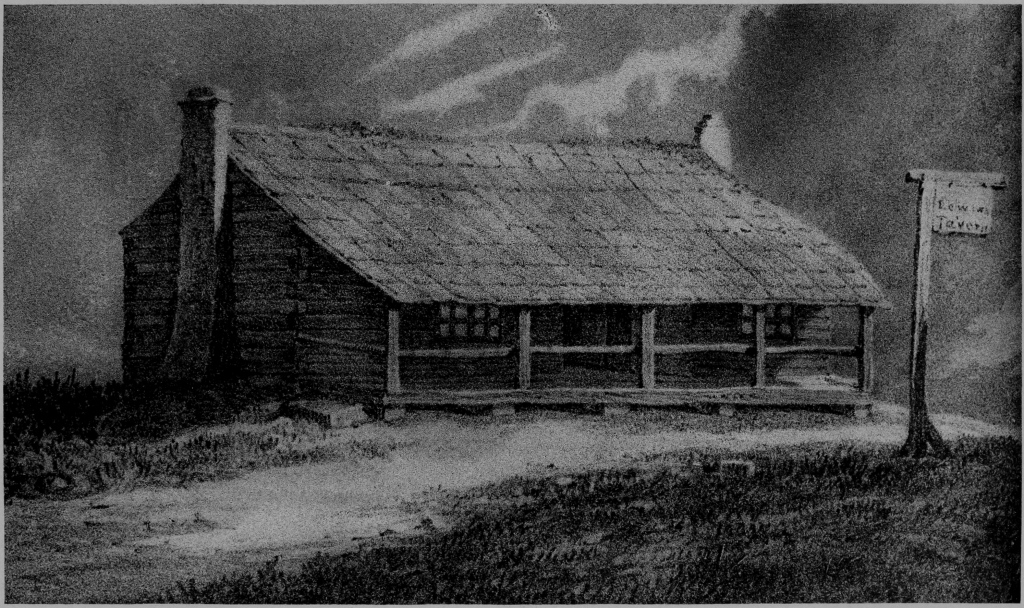
Log Tavern, Indiana