Front matter
Reading edition
EDNA MAY As Violet Grey in "The Belle of New York."
Famous Prima Donnas
By
Lewis C. Strang
Author of "Famous Actors of the Day," "Famous Actresses of the Day," "Famous Stars of Light Opera," "Players and Plays of the Last Quarter Century," etc.
Illustrated
L·C·PAGE·&·COMPANY BOSTON PUBLISHERS
Copyright 1900 By L. C. Page & Company (INCORPORATED) All rights reserved Third Impression, February, 1906 COLONIAL PRESS Electrotyped and Printed by C. H. Simonds & Co. Boston, U. S. A.
CONTENTS
CHAPTER PAGE
Introductionix
I.Alice Nielsen1
II. Virginia Earle21
III. Lillian Russell30
IV. Josephine Hall46
V. Mabelle Gilman56
VI. Fay Templeton67
VII. Madge Lessing81
VIII. Jessie Bartlett Davis88
IX. Edna Wallace Hopper104
X. Paula Edwardes113
XI. Lulu Glaser120
XII. Minnie Ashley134
XIII. Edna May147
XIV. Marie Celeste156
XV. Christie MacDonald 172
XVI. Marie Dressler181
XVII. Della Fox192
XVIII. Camille D'Arville208
XIX. Marie Tempest222
XX. Maud Raymond233
XXI. Pauline Hall239
XXII. Hilda Clark253
LIST OF ILLUSTRATIONS
PAGE
Edna May as Violet Grey in "The Belle of New York"Frontispiece
Alice Nielsen in "The Fortune Teller"7
Virginia Earle as Winnifred Grey in "A Runaway Girl"21
Lillian Russell as "The Queen of Brilliants"42
Mabelle Gilman in "The Casino Girl"56
Fay Templeton singing the "coon" song, "My Tiger Lily"67
Madge Lessing81
Edna Wallace-Hopper 104
Paula Edwardes 113
Lulu Glaser 120
Minnie Ashley134
Christie MacDonald 172
Marie Dressler181
Della Fox192
Marie Tempest222
Introduction
The musical stage in the United States may be said to be a birthright rather than a profession. A critical examination of the conditions quickly shows one that the number of women at present prominent in light opera and kindred forms of entertainment, who have earned their positions by continued endeavor and logical development in their art, is comparatively small. The majority are, in fact, the happy victims of personality, who have been rushed into fame chiefly by chance and a fortunate combination of circumstances. They are without the requisite training, either in the art of singing or in the art of impersonation, that would entitle them to be seriously considered as great vocalists or as great actors. They are, however, past mistresses in the one essential for their profession,—the art of entertaining.
The readiest proof of this peculiar state of affairs is the almost universal brevity of the careers of the women just now in the ascendancy in the musical drama. Ten years of professional life is more than many of them can claim. Arising suddenly into conspicuous popularity as they have, their reputations are founded, not on the sure basis of careful preparation and long and diversified experience, but on the uncertain qualities of personal magnetism and physical beauty. They shine with a glory that is perhaps deceptive in its brilliancy; they are the sought for by many managers, the beloved of a faddish public, and the much exploited of the newspaper press.
The difficulties that encumbered the path of the compiler of this book, dealing with the women of the musical stage in this country, were numerous. First among them was the choice of subjects. The selection could not be made with deference to any classification by merit, for the triumphs of personality were not amenable to such a classification. The compiler was compelled by the conditions to bring his own personality into the case, and to choose entirely by preference. He could not be governed by an arbitrary standard of comparison; for how can personality, which is a quality, an impression, hardly a fact, and certainly not a method, be compared? In the present instance, the writer found it expedient to limit himself to those entertainers who have given at least some evidence of continued prominence. It may be, therefore, that a few names have been omitted which are rightly entitled to a place in a work of this kind. Nevertheless, the list is surely representative, even if it be not complete.
After the subjects had been chosen, the question, how to treat them, at once became paramount. Again the bothersome limitations of personality asserted themselves; and one perceived immediately that criticism, meaning by that the consistent application of any comprehensive canon of dramatic art, was out of the question. The vocal art of the average light opera singer is imperfect, and the histrionic methods in vogue show little evidence of careful training: they are neither subtle nor complex. Indeed, the average woman in light opera is not an actress at all in the full meaning of the word. She does not fit herself into the parts that she is called upon to play, and she does not attempt expositions of character that will stand even the most superficial analysis. She acts herself under every circumstance. Describe in detail her work in a single rôle, and she is written down for all time.
Yet, should one limit his critical vision to a single part, he not only fails to touch the main point at issue, but he runs the risk, as well, of self-deception and misunderstanding. The artistic worth of a player of personality is invariably overestimated after the first hearing; and the sure tendency of even the experienced observer, particularly if he be of sympathetic and sanguine temperament, and constantly on the watch for the slightest indication of unusual talent, is to mistake personality for art. The result is that, after indulging himself to the full in eloquent rhapsody, he encounters, upon a more intimate acquaintance, mortifying disillusionment.
What is of genuine value in the player of personality is the elusive force that makes her a possibility on the stage, and the problem is to get that peculiar magnetism on paper. It is a problem unsolved so far as the writer is concerned. One can dodge above, below, and aroundabout a personality, but he cannot pierce directly into it. When it comes to the final word, one is left face to face with his stock of adjectives. Most unsatisfactory they are, too. None of them seems exactly to fit the case. They serve well enough, perhaps, to convey one individual's notions regarding the personality under discussion, but they are indeed lame and limping when it comes to presenting any definite idea of the personality itself.
As for the biographical data in the book, they are as complete and as accurate as diligence and care can make them. The woman in music is conscientiously reticent regarding the details of her early struggles for position and reputation. Nothing would seem to be so satisfactory to her as a past dim and mystifying, a present of brilliancy unrivalled, and a future of rich and unshadowed promise.
Famous Prima Donnas
CHAPTER I
ALICE NIELSEN
Five years ago Alice Nielsen was an obscure church singer in Kansas City; to-day she is the leading woman star in light opera on the American stage. One feels an instinctive hesitation in putting her in the first place, however sure he may be that she is justly entitled to it. He anxiously seeks the country over for a possible rival. He feels that Alice Nielsen has hardly been tested as yet, for she has been only two seasons at the head of her own company, and she has not appeared in an opera which is of itself artistically worthy of serious consideration. Moreover, she is such a little thing,—a child, it would seem,—and is it safe to take seriously a child, even a child of so many and so potent fascinations?
This feeling of doubt, caused by Miss Nielsen's stage youthfulness, is, it appears to me, the pith of the whole difficulty, and therein lurks a curious paradox. Alice Nielsen's great charms are her youth, her spontaneity, and her ingenuousness; but these very qualities are the ones that make one pause and consider before giving her the artistic rank that she has honestly earned. Alice Nielsen seems almost too human to be really great. She is too natural, too democratic, too free from conceit. She is never disdainful of her public, and she is never bored by her work.
One cannot help being charmed by this little woman, who sings as if singing were the best fun in the world; who is so frankly happy when her audience likes her work and applauds her; and who goes soaring up and away on the high notes, sounding clear and pure above chorus and orchestra, without the slightest apparent effort and without a trace of affectation or of artificial striving for effect. Everybody who has ever written anything about Alice Nielsen has declared that she sings like a bird, freely, naturally, and easily, and this metaphor describes exactly the impression that she creates.
Her voice one appreciates at once,—its volume and its colorful brilliancy, its great range, and its rich, sympathetic, and musical qualities; what he misses in her are the conventionalities of the prima donna,—the awe-inspiring stage presence, the impressive posings and contortious vocalizations. The world is very apt to take one at his own estimate until it gets very well acquainted with him. Alice Nielsen has never proclaimed herself a wonder, and the world has not yet fully made up its mind regarding her as an artist. It acknowledges her great personal charm, her delightful music, but it is not just sure whether she can act.
I regard Miss Nielsen as a thoroughly competent actress in a limited field. She is fitted neither physically nor temperamentally for heroics, but she is fully equal to the requirements of operatic light comedy. She acts as she sings, simply and naturally, and her appeal to her audience is sure and straightforward. As an instance of this, take her striking first entrance in "The Singing Girl." She appears on a little bridge, which extends across the back of the stage. She runs quickly to the centre, then stops, stoops over with her hands on her knees in Gretchen fashion, and smiles with all her might. The action is quaint and attractive, and she wins the house at once. Alice Nielsen's smile is really a wonderful thing, and it is one proof that she knows something about acting. It never seems forced. Yet, when one stops to think, he must see that a girl cannot smile at the same time, night after night, without bringing to her aid a little art. To appear perfectly natural on the stage is the best possible acting, and that is just what Alice Nielsen does with her smile.
However, "The Singing Girl," for which Victor Herbert wrote the music, Harry Smith the lyrics, and Stanislaus Stange the libretto, like "The Fortune Teller," in which Miss Nielsen made her début as a star during the season of 1898-99, was from any standpoint except the purely spectacular a pretty poor sort of an opera. There was a great deal to attract the eye. The costuming was sumptuous, the groupings and color effects novel and entrancing, and the action throughout mechanically spirited. Mr. Herbert's music, which was plainly written to catch the public fancy, fulfilled its purpose, though that was about all that could be said in its favor. It waltzed and it marched, and it broke continually into crashing and commonplace refrains. It was strictly theatrical music, with more color than melody, showy and pretentious, but without backbone.
There was really only one song in the whole score that stuck to the memory, and that was Miss Nielsen's solo, "So I Bid You Beware." Possibly, even in this case I am giving Mr. Herbert more credit than belongs to him, for Miss Nielsen's interpretation of the ditty was nothing short of exquisite. She found a world of meaning in the simple words, coquetted and flirted with a fascinating girlishness that was entrancing, and flashed her merry blue eyes with an invitation so purely personal that for a moment the footlights disappeared.
Mr. Stange's libretto was wofully weak. It seemed to be full of holes, and into these a trio of comedians were thrust with a recklessness born of desperation. What Mr. Stange did faithfully was to keep Miss Nielsen on the stage practically all the time that she was not occupied in taking off petticoats and putting on trousers—or else reversing the process. To be sure, he succeeded in bringing about these many changes with less bewilderment than did Harry Smith in the case of "The Fortune Teller," the plot of which no one ever confessed to follow after the first five minutes of the opening act. Alan Dale once described this peculiar state of affairs in the following characteristic fashion:—
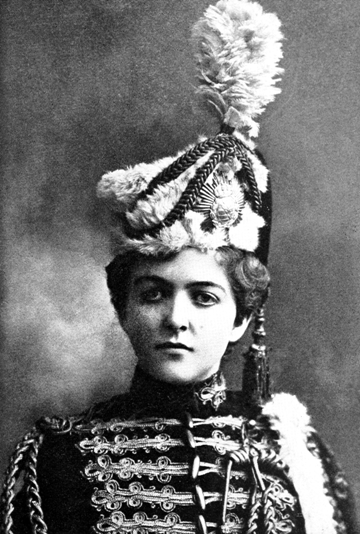
ALICE NIELSEN In "The Fortune Teller."
"In 'The Fortune Teller' the astonishing Harry B. Smith, who must have gone about all summer perspiring librettos and dripping them into the laps of all the stars, has woven a rôle for Miss Nielsen that is stellar but difficult to comprehend. Miss Nielsen appeared as three people who are always changing their clothes. Just as the poor little woman has got through all her vocal exercises as Irma, Mr. Smith insists that she shall be Musette in other garbs. And no sooner has she appeared as Musette and sang something else than Mr. Smith rushes her off and claps her into another garb as Fedor. You don't know who she intends to be from one minute to another, and I am quite sure that she herself doesn't. The variety of dresses, tights, wraps, jackets, and hats sported by this ambitious and earnest little girl is simply astonishing. It must be very difficult to accomplish these chameleon-like changes without getting rattled. Miss Nielsen seemed to enjoy herself, however; and as for getting rattled, she coquetted with her audience as archly after the twelfth change as she did after the first."
Alice Nielsen was born in Nashville, Tennessee. Her father, from whom she probably inherited her musical talent, was a Dane. He was an excellent violinist, but he was never able to turn his gifts to financial advantage. During the Civil War he fought on the Union side and received a severe wound that is believed to have been the indirect cause of his death, which occurred when Alice was about seven years old. Alice Nielsen's mother was of Irish parentage,—a woman of sturdy and sterling qualities.
After the war the family settled in Warrensburg, Missouri, and remained there until after Mr. Nielsen's death. There were four children in the family, three girls and a boy, and Alice was next to the oldest. After the death of Mr. Nielsen, Mrs. Nielsen removed with her children to Kansas City and opened a boarding-house at the corner of Thirteenth and Cherry streets. Alice was at that time about eight years old. For some years she attended school at St. Teresa's Academy, and later she studied music and voice culture under a Kansas City music-teacher, Max Desci. Many years afterward this tutor claimed the whole credit for developing her voice and for "bringing her out," even going so far as to sue her for $8,000, which he alleged to be due him for music lessons. He lost the suit, however.
Kansas City first began to talk of Alice Nielsen's voice after she became a member of the choir of St. Patrick's Church, with which she was connected for five years. She married the organist, Benjamin Neutwig, from whom she was divorced in 1898. After her marriage she continued to live in her mother's apartments at Thirteenth and Cherry streets, where, in fact, she made her home until she left Kansas City. Appreciating his wife's unusual gifts, Mr. Neutwig did much to develop them, and it was perhaps due to him as much as to any one else that she became something more than a church singer.
The Kansas City friends of Alice Nielsen relate many interesting incidents of her early life, nearly all of which show indications of the spirit and strength of character that have done so much toward pushing her forward. The following anecdotes, told by a member of St. Patrick's Church choir, were published in the "Kansas City World":—
"I was in a grocery store near Twelfth and Locust streets with Alice one day, when she was about fifteen years old, I should judge. A couple of boys of her age were plaguing her. She took it good-naturedly for awhile, but finally warned them to let her alone. They persisted. Then becoming exasperated, she picked up an egg and threw it, hitting one of her tormentors squarely in the face. Of course the egg broke, and the boy's countenance was a sight for the gods. I understand she apologized afterward. This may be recorded as her first hit.
"She joined the choir of St. Patrick's Church, Eight and Cherry streets, eleven years ago, and sang in it about five years, or until she left Kansas City to begin her operatic career. It was there she met Benjamin Neutwig, the organist. A great many persons were jealous of her vocal talents, nor were certain members of the church itself entirely exempt from twinges of envy. Indeed, a no less personage than she who was at that time choir leader manifested symptoms of this kind to a pronounced degree.
"I remember one Easter service, Alice, then a girl of probably eighteen, was down to sing a solo in Millard's Mass. The leader was angry: she thought the solo should have been assigned to her. Alice knew of the hostility, and it worried her, but she rose bravely and started in. Scarcely had she sung the first line when the choir leader turned and gave Alice a hateful look.
"It had the desired effect. The singer's voice trembled, broke, and was mute. She struggled bravely to regain her composure, but it was useless,—she could not prevail against that malevolent gaze from the choir leader. This, I believe, was the first and only time Alice Nielsen ever failed in public.
"It is a wonder, in the face of petty jealousies of this kind, coupled with the poverty of her mother, which seemed an insurmountable barrier to a musical education, that Alice's talents were not lost to the world. For every influence tending to push her forward, there seemed a dozen counter influences tending to pull her back. As a child, I have seen her many a time on the street, barefooted, clothing poor and scant, running errands for her mother. Later in life, when she was almost a young lady, I have known her to sing in public, gowned in the cheapest material, and she would appear time after time in the same dress. On such occasions she was often wan and haggard, as if from anxiety or overwork. But once in a while she received the praise which she so richly merited.
"One day Father Lillis received a letter from a travelling man who was stopping at the Midland, in which he asked the name of the young woman who sang soprano in the choir. He had attended church the day before, he said, and had heard her sing. 'It is the most wonderful voice I ever heard,' he wrote. 'That girl is the coming Florence Nightingale.' I don't know whether the letter was ever answered or not, but Alice came to know of the incident, and it pleased her.
"Both before and after she joined the choir, Alice appeared in amateur theatricals and in church concerts. She was always applauded and appreciated, but it was in the character of a soubrette in 'Chantaclara,' a light opera put on at the Coates Opera House by Professors Maderia and Merrihew, that she created the most decided sensation. This was but a few weeks before she left Kansas City."
Miss Nielsen bade farewell to Kansas City in 1892, going away with an organization that styled itself the Chicago Concert Company, and which planned to tour the small towns of Kansas and Missouri. This, her earliest professional experience, ended in disaster, and Miss Nielsen was stranded in St. Joseph, Missouri, before she had been out a week. It was an eventful week, however, and Miss Nielsen vividly recalls it.
"We got out somewhere in far Missouri," said Miss Nielsen, "with the thermometer out of sight and hotels heated with gas jets and red flannel. Nobody had ever heard of us. I don't think that in some of the towns we struck they'd ever heard anything newer than the 'Maiden's Prayer,' and that was as much as they wanted. They called me 'the Swedish Nightingale,' and you can imagine how I felt,—a nightingale in such a climate, and Swedish at that. But I just sang for all I was worth and I tried to educate them, too. I sang the 'Angel's Serenade,' and they didn't like it, because when they tried to whistle it in the audience, they couldn't. We didn't carry any scenery; we just had a lot of sheets with us, and used to drape the stage ourselves.
"One 'hall' we came to, there was no dressing-room, so we strung a sheet in one corner, and some one put a table behind with a lamp on it. The 'ladies of the company' (myself and the contralto) occupied this improvised dressing-room. Suddenly we discovered that we were unconsciously treating the audience to a shadow pantomime performance. There was only one way out of the difficulty,—we women must shield each other. So I held my skirts out while the contralto dressed, and she did the same for me.
"I remember in one place we had managed to excite the hayseeds into coming to hear us, and the hall was quite full. We were giving a little operetta. Somehow or other it didn't seem to please the public, and they were in a mood to be disagreeable,—yes, restless. They wanted their money's worth; they were mean enough to say so.
"We held a consultation behind our sheetings, and the tenor suddenly remembered that once upon a time, when he was a school-boy, he used to amuse his comrades with tricks. 'Could he do them now?' we asked. He would do his best, he said. So he got a wooden table, hammered a nail into it, bent it a little, and slipped a curtain ring on his finger.
"The trick was to lift the table with the palm of the hand, the ring and nail being invisible. Just in the middle of the trick the nail broke. Well, I believe that audience was ready to mob us. The bass, seeing the situation, made a dive for the money in the front of the house, and we escaped. It was a packed house, too. There must have been as much as eight dollars."
"Did you ever have to walk?"
"Yes, indeed. We walked eight miles once to a town,—snowballed each other all the way. It was lots of fun. When we got there the local paper had an advance notice something like this: 'We are informed that "the Swedish Nightingale" and others intend to give a show in the schoolhouse to-night. Any one who pays money to go to their show will be sorry for it.'
"The local manager, an Irishman, asked us to sing a little piece for him when we arrived. After we had done so, he said he had never heard anything so bad in all his life. As to the nightingale, he would give her three dollars to sing ballads, but the rest of the troupe were beneath contempt. His language was a dialect blue that was awful. I tell you it was hard luck singing in Missouri."
In St. Joseph Miss Nielsen was fortunate enough to secure an engagement to sing in a condensed version of the opera "Penelope" at the Eden Musée. She received seventy-five dollars for her services, and this money paid the railroad fares of herself and some of the members of the defunct concert company to Denver, Colorado. There her singing attracted the attention of the manager of the Pike Opera Company, which she joined and accompanied to Oakland, California.
Her first part with a professional opera company was that of Yum Yum in "The Mikado." The Pike Opera Company later played in San Francisco, and in that city she was heard in "La Perichole" by George E. Lask, the stage manager of the Tivoli Theatre, which was, and is still, I believe, given over to opera after the style of Henry W. Savage's various Castle Square Theatre enterprises in the East. Miss Nielsen was engaged for the Tivoli Company. She sang any small parts at first, but gradually arose until she became the prima donna of the organization. In all, she is said to have sung one hundred and fifty parts at the Tivoli, where she remained for two years.
While she was singing Lucia, H. C. Barnabee of The Bostonians, which organization was then playing in San Francisco, read of her in the newspapers and went to hear her. The result was the offer of an engagement, which she accepted. Her first part with The Bostonians was Anita in "The War Time Wedding." Then she was given the small part of Annabelle in "Robin Hood." She also sang in "The Bohemian Girl" and was Ninette in "Prince Ananias." The next season she created Yvonne in "The Serenade," and was the hit of the opera,—so much of a hit, indeed, that nothing remained for her but to go starring in "The Fortune Teller."
CHAPTER II
VIRGINIA EARLE
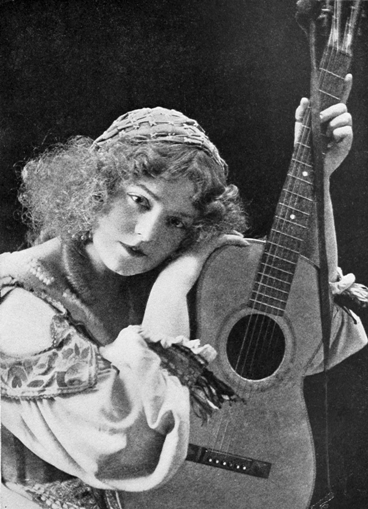
VIRGINIA EARLE As Winnifred Grey in "A Runaway Girl."
An accomplished and versatile artist is Virginia Earle, who, because of the variety of her attainments and the grace and finish of her art, is entitled to rank with the foremost soubrettes on the American stage. Miss Earle's ability has been tested in many forms of the drama. She has appeared in light opera, in extravaganza, in musical comedy, and in the Shakespearian drama. I question if there is another in her line now before the public who can claim any such extensive experience.
It would be strange if this diversified endeavor had not had its effect on her art. In her we find united with a personality of curiously subtle charm an authority in action that is restful and refreshing. In her presentation of a part there is neither hesitancy nor misplaced endeavor. She always has command of herself and of the rôle that she is portraying. One never for a moment feels that she is to the slightest degree uncertain as regards the effect that she will produce on her audience. She knows what to do and how to do it.
Yet, when one stops to think of it, her power over her audience is far in excess of what one would naturally expect. Miss Earle is by no means impressive in her stage presence. She cannot be called beautiful. Her singing voice is a modest instrument, though a wonderfully expressive one, it must be acknowledged. Her acting is quiet, even unassuming, but it is also plain, easily comprehended, and always appropriate. She apparently never does anything to attract attention, yet attention rarely fails to be centred on her. This, of course, is due to the finish of her art and a fine technique that makes its presence felt by its seeming absence.
If Miss Earle cannot justly claim any exceptional advantages in the matter of physical beauty, she certainly has the greater advantage of an intensely magnetic personality. Her individuality, too, is thoroughly distinct. It is one of the paradoxes of acting that the more distinct the artist's individuality, the greater is his ability to set apart one from another the characters which he assumes. Miss Earle has this talent for making each one of her rôles a separate and distinct personage to a greater degree than any of her associates in the musical field. She does this, too, in a strictly legitimate way, by impersonation pure and simple without the aid of make-up.
I remember especially what entirely different persons were her Mollie Seamore in "The Geisha" and her Winnifred Grey in "A Runaway Girl," so different, in fact, that one who knew her only in the first part found it hard to believe for some time that it really was she in the second part. Those who saw her in "The Geisha" cannot fail to recall the fascinating, quizzical squint that was continually getting into the mischievous Mollie's eyes. I know that I liked it so much that when I saw Miss Earle the next season as Winnifred Grey, the first thing I looked for was the squint. I was astonished to find that it was not there, and disappointed, too, for I had always associated the actress in my own mind with that squint. No sign of it could I perceive until the last act, when it came suddenly into view while she was singing the song about the boy with the various kinds of guesses. It gathered around the corners of her eyes, and it twinkled as merrily as ever. It made me quite happy again, for I felt that I should not be compelled to revise my imagination and repicture Miss Earle without the tantalizing squint.
Miss Earle is a noteworthy example of the long time, the constant endeavor, and the faithful service that are sometimes required to win recognition in the important theatrical centres of the country. She had been many years on the stage before George Lederer finally gave her an engagement at the New York Casino. That was really the first chance that she ever had to prove herself something more than a one night stand favorite, and since that time she has only rarely played outside of New York.
This long-delayed recognition was one of the freaks of fortune for which no one can account. She was apparently one of those unlucky persons who through no fault of their own start wrong. She was born in the West, in Cincinnati, Ohio, on August 6, 1873, and it was in the West that she remained for a number of seasons. Her theatrical career began when she was very young, and the Home Juvenile Opera Company was the means of introducing her to the stage. This was in 1887, and her first part was Nanki Poo in "The Mikado." Miss Earle also played leading rôles in the other Gilbert and Sullivan operas then so popular,—"Patience," "Pinafore," and "The Pirates of Penzance."
Then she joined the Pike Opera Company and toured the West in a repertory of the best-known light operas. In San Francisco she was engaged by Hallen and Hart, the farce comedy team, and remained with them for two seasons, appearing in "Later On." Her next engagement was with Edward E. Rice, and under his management she went to Australia. Three years were spent there, during which time she acted Taggs in "The County Fair," Gabriel in "Evangeline," Madora in "The Corsair," Dan Deny in "Cinderella," and Columbia in Rice's "World's Fair."
On her return to America she was engaged for Charles Hoyt's farce comedy, "A Hole in the Ground," acting the lunch counter girl; and after a short but successful season with this mess of nonsense she joined a company under the management of D. W. Truss & Company, playing "Wang" in the places too small for DeWolf Hopper to visit. For two seasons with this organization Miss Earle acted Della Fox's famous part of Mataya. Canary and Lederer of the New York Casino then secured her services, and under their management she assumed leading parts in "The Passing Show," "The Merry World," in which she doubled the rôles of Vaseline and Little Billee, in "Gay New York," and "The Lady Slavey."
As soon as her contract with the Casino expired, Augustin Daly engaged her for his musical comedy company, where she succeeded Violet Lloyd as Mollie Seamore in "The Geisha." Not only did she present this part with ready skill, but she made a second hit as Flora in "Meg Merrilies." Nor did old comedy daunt her, for as still another Flora, maid to Ada Rehan in "The Wonder," her work was much praised. She crowned her success by appearing in Shakespeare, winning new laurels with her Ariel in "The Tempest." In all these impersonations her readiness in song was of service, but her vivacity counted for much; and, more than that, her magnetic influence over her audience, which it is impossible to analyze. A number of years before, Sarah Bernhardt had taken a fancy to Miss Earle's Taggs in "The County Fair," and had predicted a future for her. Notwithstanding this, however, it is not unlikely that Miss Earle herself would have been incredulous had any one told her a few months before, while she was playing Prince Rouge et Noir in "Gay New York," that within a year she would be a principal in Shakespeare at Daly's.
Dora in "The Circus Girl" and Winnifred Grey in "A Runaway Girl" followed, and Miss Earle's conquest of New York was complete. She had won recognition at last as a soubrette who was an artist as well as a personality. After Mr. Daly's death Miss Earle returned to the New York Casino, appearing first as Percy Ethelbert Frederick Algernon Cholmondely in "The Casino Girl." This part by no means showed her at her best, although she did fully as well as could be expected with the material with which she had to work.
CHAPTER III
LILLIAN RUSSELL
For many years Lillian Russell held without challenge and without serious rivalry the first place among light opera prima donnas in this country. Her triumphs followed one after the other in rapid succession, and her popularity in all the leading cities in the country—and she would visit none except leading cities—was remarkable. "Queen of Comic Opera" she was called; and what a vision of loveliness, she was, to be sure! the most perfect doll's face on the American stage, as some one described it. A golden-haired goddess, with big blue eyes that seemed a bit of June sky, and perfectly rounded cheeks, soft and dimpled like a baby's.
There are two classes of women in the world,—pretty women, whom we see everywhere, and beautiful women, about whom we often read, but whom we seldom see in real life. Lillian Russell was emphatically a beautiful woman. She was almost an ideal. I remember her in all her perfection as Florella in "The Brigands," by W. S. Gilbert and Jacques Offenbach, during the season of 1888-89. Later she learned to act better than she did in those days,—but then she did not need to act. When one saw her, he forgot all about acting. He thought of nothing except Lillian Russell, her extraordinary loveliness of person, and her voice of golden sweetness. She compelled admiration that was almost personal homage. And she could sing, too! Her voice, a brilliant soprano, was rich, full, and complete, liquid in tone, pure and musical.
From 1888 to 1896 were the days of her greatest successes, and the list of operas in which she appeared during that time is a remarkable one. Besides "The Brigands," there were "The Queen's Mate," "The Grand Duchess," "Poor Jonathan," "Apollo," "La Cigale," "Giroflé-Girofla," "The Mountebanks," "Princess Nicotine," "Erminie," "The Tzigane," "La Perichole," "The Little Duke," and "An American Beauty." Naturally enough, the Lillian Russell of to-day is not the Lillian Russell of ten years ago. Her great beauty has lost some of its freshness, and her voice, though by no means wholly past its usefulness, is worn by the years of constant use in the theatre. She still retains to a remarkable extent, however, her great personal hold on the public. Although the Lillian Russell of to-day fails to maintain the standard of the Lillian Russell of yesterday, there are but few light opera sopranos on the American stage who can fairly rival her even now, and there is no one who is at present what Lillian Russell was ten years ago.
Lillian Russell was christened Helen Louise Leonard. Tony Pastor gave her the name of Lillian Russell, for the very practical reason, I believe, that it had so many "l's" in it, and consequently would look well on a bill-board. Little Miss Leonard was born in Clinton, Iowa. Her father was the proprietor and editor of the "Clinton Weekly Herald," and Lillian Russell's first press notice read as follows: "Born to Mr. and Mrs. Charles E. Leonard, at their home on Fourth Avenue, December 4, 1861, a bright baby girl, weighing nine and one-half pounds." In spite of the fact that this birth notice speaks of a high-sounding Fourth Avenue, Lillian Russell was born in an alley. The house in Clinton, in which the interesting event occurred, was situated in the rear of the office building of H. B. Horton, located on Fourth Avenue, between First and Second streets, and faced east on the alley running north and south between Third and Fourth avenues. At that time the house was situated almost in the centre of the business section across the street from the Iowa Central Hotel, then the largest hotel in the state and one of the finest west of Chicago. Shortly after the baby's birth the Leonard family removed from their abode on the alley to 408 Seventh Avenue, immediately in the rear of the Baptist Church, and at that time one of the finest residences in the town. Here the remainder of their days in Clinton was spent.
During the first few years of her life there was nothing to distinguish Helen Louise Leonard from any other baby; but by the time she was two years old, she showed the marks of great beauty, having large blue eyes and golden hair. She was not reared among all the comforts of life. Her country editor father was not possessed of wealth, but was compelled to work hard on his prosperous, though none too well-paying newspaper, every day of his life. During the period of Lillian's babyhood, too, the war forced the prices of luxuries entirely beyond the reach of all but the rich.
Lillian inherited her good looks from her father. Charles E. Leonard was a man of fine appearance, and always dressed in a faultless manner. When he went to Clinton in 1856 he was probably thirty years of age and showed plainly the marks of early culture and training. He, too, was a blond. That he was a man of marked ability is evidenced by the success he achieved in his profession in what was then a scattering Western settlement of not half a hundred houses all told, in the midst of a country unreclaimed and almost wholly unsettled.
On December 18, 1856, he issued the first number of the "Clinton Herald," a weekly publication having as competitors two other well-established newspapers at Lyons, only one mile north in the same county. There was really no field at Clinton at that time for a newspaper, but Leonard thought otherwise. The panic of 1857 caught the enterprise in the weakness of infancy; but the paper survived the financial storm and eventually came forth on the top wave of success, all of which was undoubtedly due to the excellent business management of Leonard and the strong personality he threw into his work. When the general offices of the Chicago and Northwestern Railroad were removed to Chicago in 1865, Mr. Leonard moved the fine job office connected with the "Herald" to that city, as the nucleus for the extensive printing establishment he later acquired.
After the family moved to Chicago, Lillian Russell spent several years in the Convent of the Sacred Heart in that city. Her first music lessons were on the violin, and were given by Professor Nathan Dyer. Then she took vocal lessons from Professor Gill in Chicago. When the time came for him to show off his pupils, he gave a musicale in Chickering Hall. The fair-haired Lillian sang at this concert "Let Me Dream again" by Sullivan and "Connais-tu le Pays?" from "Mignon." The papers, of course, gave her complimentary notices, one declaring that she sang "like an old professional." Possibly it was this notice that first turned her mind toward the stage. For some time after that, however, she sang in St. John's Episcopal Church on the West Side, and studied with Madame Jennivally, who encouraged her in her ambition to become a grand opera singer. With the idea of studying for the grand opera stage, she went to New York to have her voice tried, and she had taken but a few lessons of the late Dr. Damrosch when Mrs. William E. Sinn persuaded her to join the chorus of Edward E. Rice's "Pinafore" company for the sake of the experience on the stage. This connection lasted about two months and was terminated by her first matrimonial experience, her marriage to Harry Braham, the musical director of the company. She retired from the stage for a time, but her domestic happiness did not last long. It then became a matter of necessity for her to get an engagement, and she applied in vain to such managers as McCaull and D'Oley Carte, who could find nothing in her voice to warrant them in giving her a chance.
She finally succeeded in getting a position in a curious way. She was living in a theatrical boarding-house, and among her fellow-boarders was a girl who was engaged by Tony Pastor for a specialty act in his theatre, which at that time was situated on Broadway opposite Niblo's Garden. While calling at the house one day to complete some business transactions with this young woman, the variety manager heard Miss Russell singing in a neighboring room. He asked who she was and said he wanted to meet her. He did meet her, and at once offered her fifty dollars a week to sing ballads at his theatre. Fifty dollars a week was a good salary in those days, and the following Monday saw the name of Lillian Russell, "the English ballad singer," described as one of the leading attractions on the programme.
"I was very cool and collected up to the time that I heard the first note of the orchestra," wrote Miss Russell, in describing her first experience at Pastor's. "From that moment until I had finished my third song, however, I was practically in a trance. I was told afterward that I did splendidly, but to this day I cannot tell what occurred after I went on the stage until I reached my dressing-room and donned my street clothes."
She sung with considerable success such well-known songs as "The Kerry Dance" and "Twickenham Ferry." "The Kerry Dance," in fact, created a bit of a sensation. It was a style of vocal music quite new at that time in the variety theatres. When Mr. Pastor introduced his stage burlesques on "Olivette," "The Pirates of Penzance," and other popular operettas, Miss Russell took part in them, and she also appeared in Pastor's condensed version of "Patience."
Then Colonel John A. McCaull enticed Miss Russell away from Mr. Pastor's by means of a larger salary, and she sang under his management in "The Snake Charmer" at the Bijou Opera House. Her next engagement was with a company under the management of Frank Sanger. It was a strong organization, and some of its members were Willie Edouin, Alice Atherton, Jacob Kruger, Lena Merville, and Marion Elmore. Its tour extended straight through the country to California; and the experience that Miss Russell gained with the distinguished artists of the company was invaluable to her.
A season of concert work was followed by her engagement at the New York Casino, and her appearance in the "The Sorcerer" and "The Princess of Trebizonde." At this period in her career another man interfered, and the fair Lillian disappeared from the Casino, as did also Edward—they called him Teddy—Solomon, the leader of the orchestra. The couple went to England, where they remained two years, Miss Russell appearing in two operas which Solomon wrote for her,—"Virginia" at the Gaiety Theatre and "Polly" at the London Novelty Theatre.
Miss Russell left Solomon when she learned that another woman claimed to be his wife and returned to the United States. She joined the Duff Opera Company, with which she remained until May, 1888, when she again resumed her place at the head of the New York Casino forces, singing first the Princess in "Nadjy," the part originated by Isabelle Urquhart, when the opera was first produced in New York. The revival ran for something like two hundred nights; and the popular "Nadjy" was succeeded by "The Brigands," which was also very successful.
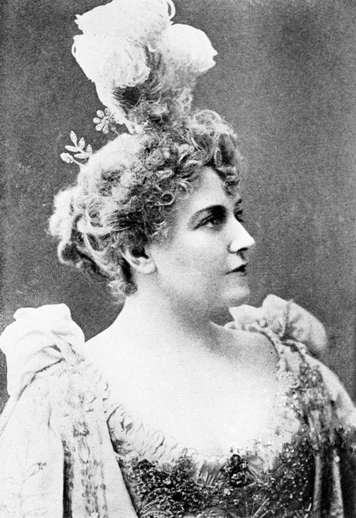
LILLIAN RUSSELL As "The Queen of Brilliants."
The years of her greatest success already referred to then followed. During the season of 1897-98 Miss Russell appeared with Della Fox and Jefferson DeAngelis in "The Wedding Day;" and her last appearances in opera were in April, 1899, in "La Belle Hélène" with Edna Wallace Hopper. During the season of 1899-1900, Miss Russell was with the Weber and Fields Company, whose clever burlesques make life in New York so merry.
Miss Russell was recently asked which one of the many operas in which she had appeared was her favorite.
"'The Grand Duchess,'" she replied emphatically. "That, to my mind, was one of the best comic operas ever written. Then I had a beautiful part in 'Giroflé-Girofla' and 'La Perichole,' but 'The Grand Duchess' was my favorite."
Miss Russell also described interestingly her methods of working up a part:—
"How do I study my parts? Well, every one has his or her own peculiar idea of study and rehearsal, but the true artist always arrives at the same result, with the aid of a clever stage manager and musical conductor. When a part is handed to me, generally six weeks before the opening night, I read it through carefully, picture myself in different positions in the several scenes, and then I separate the music from the dialogue and study the music first. The majority of the operas in which I have recently appeared are of the French or Viennese school, and in the translation there will sometimes appear a word or a sentence that does not harmoniously fit the music. Of course this must be altered before it is finally committed to memory. Then, again, we are all inclined to think ourselves wise enough to improve upon the composer's work, and where a chance is found to introduce a phrase to show one's voice to better advantage, as a rule, the opportunity is not neglected.
"After I become thoroughly conversant with the music, I take up the study of the dialogue. This, to a comic opera singer, is the hardest task of all; for it is written in the blue book that an interpreter of comic opera cannot act. The desire to overcome this prejudice often has a disastrous result; and instead of doing justice to the rôle and one's self, the fear of adverse criticism will be so overpowering that the delivery of the dialogue, and the attempt to convey the author's idea to the audience, become extremely painful alike to the auditor and the artist. A great many times I have formed my own conception of a part only to find myself entirely in the wrong at the first rehearsal; and then to undo what I had done and to grasp the new idea would confuse me for several days."
To complete the Russell marriage record, it should be added that in January, 1894, during the run of "The Princess Nicotine," she became the wife of the tenor of the company, Signor Giovanni Perugini, known in private life as John Chatterton. This marriage also resulted unhappily, and was followed by a separation and a divorce.
CHAPTER IV
JOSEPHINE HALL
Josephine Hall soared into a prominence that she had not before enjoyed, on the screechy strains of "Mary Jane's Top Note" in "The Girl from Paris" during the season of 1897-98. Previous to that, however, she had passed through a varied theatrical experience. She was born in Greenwich, Rhode Island, and came of a very well-known family. Like many others, she acquired her first taste for the stage by appearing in amateur theatricals. The story is that she ran away from home to become an actress, and journeyed to Providence, where she made it known at the stage door of one of the theatres that she was going to win fame by treading the boards, or die in the attempt. She was plain "Jo" Hall when she made her professional début as Eulalie in "Evangeline" at the Fourteenth Street Theatre, New York, under the management of Edward E. Rice.
After this initial appearance in extravaganza, she forsook the musical stage entirely until she succeeded Paula Edwardes in the title rôle of "Mam'selle 'Awkins," although in the farces with which she was identified for a number of seasons, she usually was given a chance to introduce one or more comic songs. After she left Mr. Rice, she became a member of Eben Plympton's "Jack" company. Then she came under Charles Frohman's management, and was consistently successful in such parts as Evangeline in "All the Comforts of Home," Jennie Buckthorne in "Shenandoah," and Katherine Ten Broeck Lawrence in "Aristocracy." The last two plays, it will be remembered, were by Bronson Howard, and he once took occasion to remark that Miss Hall came nearer meeting his ideal of the two characters she impersonated than any other actress on the stage.
Then came her big hit in "The Girl from Paris," in which she played the character part of Ruth, the slavey, and sang the ludicrous "Mary Jane's Top Note." How she happened to hit upon this fantastic conception, she once related as follows:—
"I felt that the song would not be a success unless I did something out of the ordinary. The context of the song indicated a high note, which was not given in London, so I conceived the notion of giving a high screech at the climax, which proved to be just what it needed. It was a difficult song to render effectively, as it had to be spoken almost entirely; and as I have a very good ear for music, I found it difficult to keep from singing. The high note had to be off key to make it more ridiculous. I couldn't have sung the song for any length of time, as the strain would have injured my speaking voice."
During the first half of the season of 1899-1900, Miss Hall was the Praline in "The Girl from Maxim's,"—a French farce, undeniably dirty, but funny to those not saturated to the point of boredom with the foreign variety of low comedy, which has all the marks of being manufactured to order. It is farce which drives the spectator breathlessly along the road of hilarity by means of a rapidly moving series of mechanically conceived situations. "The Girl from Maxim's" was bluntly suggestive and crudely salacious, as are all these off-color French farces which are turned into English, but it was also bright and ingenious in its machine-like way, and it was in addition very well acted.
Whatever patronage "The Girl from Maxim's" gained outside of New York—and it made money, so I have understood, both in Boston and Philadelphia—was given it, not because it was audacious, but solely on its merits as an entertainment. It has been shown time and time again that a farce, which is only salacious and nothing more, cannot live on the road. "The Turtle," which was boomed as the smuttiest thing that ever was, but which was also stupid and inane, never earned a dollar outside of New York. "Mlle. Fifi," which was both dirty and boresome, had a similar experience. "The Cuckoo," whose suggestiveness was much exploited, but whose only merits were an exceedingly smart last act and a very fine cast, was only mildly patronized. On the other hand, "Because She Loved Him So," a delightful farce and innocent enough for Sunday-school presentation, enjoyed two seasons of prosperity and kept two different companies of players employed. "At the White Horse Tavern," another fresh and unsmirched farce, also had a prosperous run.
No, whatever success attended "The Girl from Maxim's" was rather in spite of, instead of traceable to, its filth. It had merit as a mirth-maker. Its spirit was unflagging, its ingenuity amazing, and its character studies capable. There was not a suspicion of a drag until a few minutes before the final curtain, when the indefatigable author, George Feydeau, seemed suddenly to lose his breath.
Josephine Hall's Praline, with all her doubtful morals and her questionable freedom of speech and action, was an exceedingly attractive young woman. She bubbled with merriment, and never for a moment was she to the slightest extent worried even in the midst of the most bewildering complications. Her unfailing good humor was really the backbone of the play.
Indeed, the faculty of making black appear white seems to be something of a specialty with Miss Hall, who has exuberance of spirits without vulgarity or coarseness, and whose unconventionality has coupled with it refinement and inherent delicacy. Her jollity is whole-souled without harshness. Hers is the witchery of personality joined to an art that is authoritative and complete in its own sphere.
"Mam'selle 'Awkins" was an indifferent conglomeration of old stage jokes and tinkling music. That it should have succeeded at all was an odd chance, but that it should have entertained Philadelphia for so many weeks was indeed a mystery. Honorah 'Awkins was a Cockney, who, with a fortune acquired in the soap trade, was on the hunt for a titled husband. This was the plot. The part of Honorah was created by Paula Edwardes, who took her work rather seriously and went in for a touch of artistic character drawing. Miss Hall did not trouble herself much about imitating nature. She relied wholly on her ability to give her audience a good time. She played Mam'selle 'Awkins in a dazzling red wig and a complexion that suggested an hour or two over the kitchen stove, or better still, considering the antecedents of the fair Honorah, over the scrubbing board. Neither did Miss Hall go very heavily into the Cockney; she suggested rather than reproduced, and then fell back on her powers as a fun-maker to win out with her audiences.
For her, this method filled the bill perfectly. Of course, we knew from previous experience that Miss Hall was a capable actress in the hurricane variety of farce, but she did not draw heavily on that side of her artistic equipment in "Mam'selle 'Awkins." She went in head over heels to be as entertaining as possible with the materials at hand,—which, it must be confessed, were not over abundant—and with whatever else she herself could devise. She walked the tight-rope of vulgarity with marvellous expertness, and because she was Josie Hall, one laughed instead of turning up his nose.
In spite of the fact that she has been continually called upon to play all sorts of impossible foreigners, Miss Hall's humor is essentially the humor of the average American. It is fun straight out from the shoulder with the laugh just enough hidden to make it all the more enjoyable when it is discovered. It is not the heavy punning variety so mysteriously popular with the Englishman, nor the double entendre of the Frenchman.
Though she may act Cockneys and French grisettes to the end of the chapter, Miss Hall will always be what she was born,—a jolly American girl. And this suggests a brilliant idea,—one that may be novel to those who up to date have had her artistic fate in their hands. Why not give Miss Hall a chance to play the girl next door? Why scour Europe for a human specimen which only warps a personality that belongs right here at home? Try her once in a character—farcical naturally—that has some native stuff in it. Let her show us a girl whom we know first-hand as the genuine article. I think that the result would be a surprise for somebody.
CHAPTER V
MABELLE GILMAN
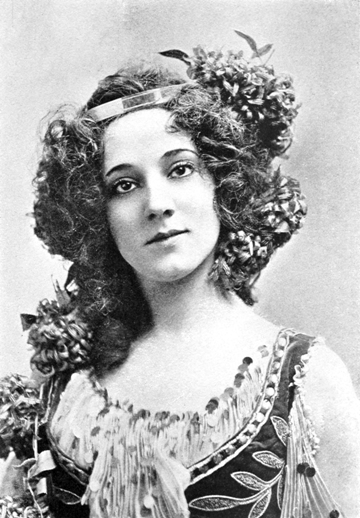
MABELLE GILMAN In "The Casino Girl."
Very much in evidence in the unusually strong and brilliant cast, even for the New York Casino, that lent its assistance to such good purpose in bringing into popular favor during the season of 1899-1900 that really amusing as well as highly colored vaudeville, "The Rounders," was Mabelle Gilman,—a young woman whose stage experience has been short, but whose histrionic and musical talent, remarkable beauty, winsome personality, and artistic temperament would seem to make comparatively safe the prophecy of an especially rosy future. Miss Gilman has two most valuable qualities that are many times lacking in girls who enter the musical field,—strength of character and will power. One has only to see her on the stage to be convinced that she is not one that will be content to drift willy-nilly with the tide on the calm sea of self-satisfaction and unambitious gratification.
Equipped, as I am sure she is, with a serious art purpose, and richly endowed, as I know that she is, with so much that brings success in the theatre, her reputation will not long be confined, as is at present the case, to the comparatively narrow limits of two or three of the most important theatrical centres.
Indeed, when one considers her youth—she is not yet twenty years old—and the few seasons that she has been before the public, Miss Gilman's advancement has been little short of phenomenal. Although she was born and educated in San Francisco, the professional labors that have won for her her present position in musical comedy have been entirely confined to New York, with the exception of a single short engagement in Boston and another in London. This has been, on the whole, a fortunate circumstance, for it has undoubtedly kept her keyed up to her best endeavor, and it has also saved her from the energy-dissipating fatigue of constant travel, and the artistic inertia resulting from long association with a single part. On the other hand, it has unquestionably limited her reputation, and also deprived her of the lessons to be learned from acting before all sorts and conditions of humanity. The New York public is oddly provincial in its narrow self-sufficiency, but, worse than that, it has in a highly developed form the sheep instinct of follow-my-leader. It is both faddish and freakish, and on that account its judgments are not always to be trusted and its influence is sometimes to be deplored.
New York is a wonderfully amusing city—to the outsider who watches its antics from a safe distance. It has the atmosphere of an excessively nervous woman, watching apprehensively a mouse-hole; it is constantly on the verge, occasionally in the very midst of, hysteria. It enjoys no intellectual calm, no quiet repose, no philosophical serenity. It is always gaping widely for a sensation, real or manufactured, eager as the child who is all eyes for the toy-balloon man in the Fourth of July crowd. Many times has this hysterical tendency moulded the affairs of the theatres in New York, and for that reason New York's judgment can be by no means the all in all to the country at large. A New York reputation, which means so much to the average man and woman connected with the stage in this country, may result in a temporarily inflated salary, but it does not necessarily promise long-continued success. Far from it! New York, after all, is merely a centre, not the centre, as the dwellers within its walls are firmly convinced is the case. It is not London monopolizing the whole of Great Britain, and it is not Paris, by common consent the privileged representative of France.
In the case of Miss Gilman, however, the judgment of New York is fully justifiable. Rarely lovely as she is,—a perfect brunette type, black hair, black eyes, and expressive face,—she does not rely on her beauty, nor on the attractiveness of her personality for success; she is an actress as well. It should be understood that the spoken drama and the musical drama are two different things. The ideal of the first is to create an impression of naturalness and fidelity to nature. It has its conventions, but they are every one of them evils, which are continually being uprooted by the combined intelligence of the dramatist, the actor, and the theatre-goer. Conventions, on the other hand, are the very life of the musical drama, which is in its whole scheme a travesty on nature and a violation of dramatic art. The musical drama is art purposely artificial. Consequently, while the actor in the spoken drama strives to the best of his ability for sincerity and conviction, and feels that he has attained the highest when he causes the spectator of his mock frenzy to forget absolutely that the emotion engendered is only a wilful simulation of the genuine article, the actor in the musical comedy is purposely and frankly artificial. He is limited to presenting the symbol without in the least striving for deception.
It is the quality of inherent insincerity that makes anything approaching sentiment dangerous in the musical drama. The highly dramatic and the essentially farcical can be utilized in this form of stage representation with equal facility; but when the musical drama approaches the comedy field of the spoken drama, it begins at once to tread on dangerous ground. For this reason Miss Gilman's greatest achievement in "The Rounders" was the remarkable success with which she accomplished the formidable task of mixing sentiment into a musical comedy. Her rôle of the little Quakeress married out of hand to a sportive Frenchman really had an element of pathos in it,—a hint of pathos, as it were, not enough to be ridiculous, but just enough to add a touch of human interest and character contrast to the picture, and thus to make Priscilla something more than a lay figure in a popular vaudeville.
There was art in the characterization, the art of the sensitive and essentially feminine woman, and this art appealed strongly to the chivalrous side of man's nature; he felt at once the instinctive desire to protect this woman so remarkably impressive in her feminine way. So modest, so demure, so innocent, and so altogether appropriate was the quiet gray of the Quakeress gown worn by Miss Gilman, that the sight of her later on in the bathing suit that would not, perhaps, have caused much comment at Newport, was a distinct shock, while the dance that went with the bathing costume song—a dance of many boneless bendings and gymnastic kicks and contortionist feats—was only believed as a fact because it was seen. Theoretically, one would be justified in claiming that Miss Gilman never danced it.
Moreover, according to all precedents, this astonishing exhibition should have destroyed at once and forever all the sentiment in Miss Gilman's Quakeress, but, as a matter of fact, it did nothing of the kind. When she resumed her quiet gray, she was again the same winsome, pathetic, in-need-of-protection little thing as before. A paradox such as this is only explainable in one way: the perpetrator of it knows how to act and is something more than a prettily decorated bit of personality.
Another surprise, which Miss Gilman has in store for those who pass judgment regarding her complete artistic equipment at first sight of her face, is her singing voice. I know that I expected to hear the plaintive, faint, and indefinite piping that goes with so many girlishly innocent soubrettes. It proved, however, a full and satisfying soprano, rich and mellow, a soprano which did not make holes in the atmosphere on the top notes. She has had the advantage of instruction in singing from Mr. George Sweet of New York, who is justly proud of his pupil.
While Miss Gilman was a student at Mills College in San Francisco, Augustin Daly heard her recite, and was sufficiently impressed with her ability to offer her a place in his New York company. She lost no time in coming East and at once signed with Mr. Daly for a term of five years. His death occurred before this contract had expired, and it was thus that it happened that Miss Gilman was free to join George W. Lederer's forces at the Casino in New York.
While under the management of Mr. Daly, Miss Gilman played in "The Tempest" and "The Merchant of Venice." Her Jessica in the latter drama was an exquisitely charming bit, and received the especial commendation of Mr. Daly. Of the Daly musical comedy productions she appeared in "The Geisha," "The Circus Girl," "La Poupée," and "A Runaway Girl." Priscilla, in "The Rounders," was her first part at the Casino, and during the spring of 1900 she was one of the prominent features in "The Casino Girl," a Harry B. Smith product. The fineness of Miss Gilman's art as shown in this work was thus commented on:—
"The production brings distinctly to the front Miss Mabelle Gilman, one of the most conscientious young actresses on the stage. Miss Gilman's work shows that she is a careful student of her art. Everything is done by method, and yet with such ease and naturalness that one might imagine it was play and no work. Miss Gilman has a sweet, well-cultivated voice, and uses it apparently without effort, but to the greatest advantage."
Miss Gilman's experience at the Casino has developed in her an appreciation of comedy and a quiet vein of humor that she had not previously shown.
CHAPTER VI
FAY TEMPLETON
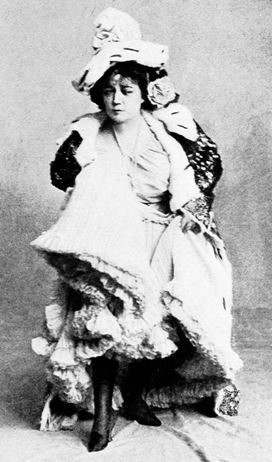
FAY TEMPLETON Singing the "Coon" Song, "My Tiger Lily."
Born almost literally in the theatre, and cradled as a baby in a champagne wardrobe basket, a full-fledged "professional" at the tender age of three years, it would have been marvellous, indeed, if Fay Templeton had become anything else except an actress. When I heard these tales of Fay Templeton's life in the nursery period of her existence,—stories of how she had often slept in the dressing-room while her mother, Alice Vane, died nightly in the leading rôle of some old-time tragedy, of the nights and the days of travel, of all the nerve-racking hardships that made up the weary, weary life of the actor "on the road,"—I was strongly reminded of the early life of Minnie Maddern Fiske. Both were children of the theatre; and forthwith we who are not children of the theatre exclaim, how pathetic that is! So they seem to me, I must confess, these children without homes and without companions of their own age, knowing nothing of the pleasure of quarrelling and making up again, children whom one never thinks of as young, and yet who cannot really be old, brought up as they are in the indescribable and contradictory atmosphere that is characteristic of the stage, an atmosphere of hypocrisy and simple-mindedness, of contemptible smallness of spirit and self-sacrificing generosity, of petty spitefulness and frank good fellowship, of foolish jealousies and whole-souled democracy. With all their artificiality, superficiality, and self-sufficiency, I think that there is, on the whole, more frankness, sincerity, and honest selfishness among stage folks than among any other class of society. In certain respects, actors are in their relations with one another far less the actor than are many persons who are not supposed to act at all.
A strange thing must life seem to the child of the theatre, when he gets old enough to think about it. He looks upon the world topsy-turvy, as it were. The serious things of his life are the frivolities of the work-a-day world, and the viewpoint of these work-a-days must be a constant source of perplexity to him. He must wonder, for instance, why they go to the theatre at all, why they are so foolish as to spend money, which is such a rare and precious thing, to behold the commonplace and dreary business of play-acting. How he, the pitied one of the world of homes and domesticated firesides, in his turn must pity those easily beguiled individuals who practise theatre-going! How he must smile ironically at their sophisticated innocence and be even shocked at their unaccountable ignorance! Thus it happens that he pities us because we have illusions about things that he knows are the crudest delusions, and we pity him because he lives a life so far apart from ours that we can see nothing in it but hardship and unhappiness. We of the homes waste our tears on him who feels no need of a home, who, contented with his lot and glorying in his freedom, scorns publicly the narrow monotony of a seven A.M. to six P.M. with an hour off for luncheon at noon existence. Which is right? Both—and neither.
But to return to Fay Templeton and Mrs. Fiske. Miss Templeton made her first appearance on the stage when she was three years old, dressed as a Cupid and singing fairy songs. Mrs. Fiske began even younger, and she, too, was a singer. Arrayed in a Scotch costume of her mother's making, she piped in a shrill treble between the tragedy and the farce a ballad about "Jamie Coming over the Meadow." After this infantile experiment, however, Mrs. Fiske forsook the lyric stage practically for good and all, although she did at one time play Ralph Rackstraw in Hooley's Juvenile Pinafore Company. Miss Templeton, on the other hand, clung faithfully to opera and the allied forms of theatrical entertainment, particularly that branch known as burlesque, in which she was and still is an adept without a compare. The nearest that she ever came to being identified with what player-folk delight to call the "legitimate" was when at the age of seven years she played Puck in Augustin Daly's production of Shakespeare's "A Midsummer Night's Dream" at the Grand Opera House in New York. This was considered a remarkable impersonation, especially for a child of seven, and it received the special commendation of Mr. Daly himself. Miss Templeton's success at so youthful an age was, to be sure, most unusual, but it was by no means inexplicable, if one only knew that she had had, even at that time, four years' experience on the stage, and that she had starred, principally throughout the West and South, at the head of a company managed by her father, John Templeton.
The generalization that infant stage prodigies never amount to anything has fully as great a percentage of truth in its favor as any other generalization, but there are occasional exceptions. Mrs. Fiske, already referred to, was one; Della Fox was another; and Fay Templeton was a third, and possibly the most remarkable case of all. Mrs. Fiske at least had the advantage of the intellectual training of the classic drama, and Della Fox, after her precocious success as a child, was kept faithfully at school for a number of years by stern parental authority; but Fay Templeton during her childhood was continually associated—with the possible exception of Puck—with the lightest and frothiest in the theatrical business. More than that she was at the head of the company, the star, the praised and petted. Whoever saved her from herself and the disastrous results of childish self-conceit is entitled to the greatest credit.
After her hit in New York in "A Midsummer's Night's Dream," Miss Templeton travelled to San Francisco with her father and James A. Herne. There she became a prima donna in miniature, and charmed the Californians, especially by her imitations of the prominent grand opera and comic opera artists of the day. Her San Francisco experience was followed by her appearance at Niblo's Garden, New York, as Parepa Rosa, Aimée, and Lucca. The next half-a-dozen years were spent principally in the South, where she starred in a repertory of which her Puck in "A Midsummer's Night's Dream" was the chief feature.
Fay Templeton was fifteen years old when she became a recognized light opera star of national reputation. She was the original in this country and the best-known Bettina in "The Mascotte," and she also appeared in "Giroflé-Girofla." For two years she played Gabriel, which was created by Eliza Weatherby, one of the most beautiful of the Lydia Thompson burlesquers, in "Evangeline," and she was also in the revival of "The Corsair."
At the Fourteenth Street Theatre, New York, in August, 1890, after a period of absence from the stage, Miss Templeton brought out the burlesque called "Hendrick Hudson; or, The Discovery of Columbus," by Robert Frazer and William Gill. This told an imaginary story of the meeting, at the El Dorado Spring in Florida, of Columbus lost on his third expedition to America, and Hudson. It was not an unfruitful theme for burlesque treatment, but the work itself was poorly put together, disconnected, and prone to drag. Neither was Miss Templeton herself all that could be desired. She was apparently in a state of transition. She had lost the roguish girlishness that made her Gabriel so charming, and she had not yet learned to give free rein to the rich individuality and the unctuous humor that are so characteristic of her work at the present time. No dramatic critic would say to-day, as was said at that time, of the production of "Hendrik Hudson," that "it must be written, in reluctant sorrow, that Miss Templeton was not sufficient in talent nor in charm to lead a burlesque company to great success." Miss Templeton was not seen again, after the short and inglorious career of "Hendrik Hudson," until she brought out "Mme. Favart" during the season of 1893-94.
The piece that re-established her in public favor, however, was "Excelsior, Jr.;" New York, in particular, finding her impersonation of the up-to-date young man about town very much to its liking. After she joined the Weber and Fields organization in New York and unexpectedly shone forth as a marvellously entrancing interpreter of "coon" songs, she clinched her hold on the public with which she is now an established favorite.
During the season of 1899-1900 Fay Templeton was identified with those two gorgeous productions, "The Man in the Moon" and "Broadway to Tokio," besides taking a flyer into vaudeville, where she first brought out her wonderful imitation of Fougère, the French chanteuse. In shows like "The Man in the Moon" and "Broadway to Tokio" one is expected to have nothing with him except the two senses of sight and hearing. It is the spectator's part to take what comes—and it is supposed to come constantly and rapidly—simply for the sake of the moment's fun that there may be in it. His cue is to laugh at the stage jokes of the hard-worked comedians, and to be dazzled into a semi-hypnotic state by the dancing women posturing amid marvellous effects of light and color. They are eminently entertainments to be felt and not thought about. One is constantly receiving new impressions, and just as constantly forgetting all about them. The result is that after the shows are all over, one is surprised to find that from the mass of material he has retained no one impression distinctly. He remembers only flashes here and there.
One figure, however, was revealed by each and every one of these memory flashes,—that of Fay Templeton, whose wonderful versatility as an entertainer, and whose pure virtuosity as an artist, both of them given free rein in these spectacles, raised her head and shoulders above her associates in the two casts.
In "The Man in the Moon" there was nothing else that evidenced half the art shown in her singing of the ditty "I Want a Filipino Man." It was, it is true, a fearfully suggestive study of elemental human passion, a song of hot blood and crude, unblushing animalism. But it was wonderfully well done, and the swing of its rhythmic sensuality was not to be resisted.
Two things that Fay Templeton did in "Broadway to Tokio" I recall with especial vividness. One was her treatment of the cake-walk, commonly a prosaic, athletic exhibition of increasing boredom. She evolved from the conventional prancing of the gay soubrette a dance whose appeal to the imagination was intense, a dance into which might be read many meanings. Her cake-walk was the embodiment of languorous grace and the acme of sensuous charm. It breathed an atmosphere of tropical indolence. It suggested the lazy enjoyment of the cool of the evening after a long day of hot, fierce summer sunshine, the time when one dreams idly of fleshly delights. It was a dance teeming with passion, passion quiescent, which a breath would fan into a blaze.
Miss Templeton's second remarkable achievement was her imitation of Fougère, or, better still, her impersonation of Fougère. It is difficult to describe intelligently just the effect of Miss Templeton's art in this specialty. It was not a photographic copy of the external Fougère; it was rather a reproduction of the Fougère personality. Indeed, she pictured only with indifferent fidelity the Fougère mannerisms, but she placed before one, with almost uncanny accuracy, the Fougère individuality and the Fougère stage appeal.
It was, in fact, acting as distinguished from mimicking. Fay Templeton literally represented Fougère as she might a dramatist's imaginary personage. Temperamentally, Miss Templeton does not in the remotest way suggest Fougère. The French woman, indeed, is just what Fay Templeton is not. She is thin, she is nervous with a champagne sparkle, and she is perpetually and restlessly vivacious in her artificial French way. Fay Templeton is not thin, and her personality is far away from nervousness. Where Fougère would worry herself half to death, Fay Templeton would insist on solid comfort and plenty of time to think, even a chance to sleep, over the vexing problem. One pictures Fay Templeton as passing her leisure moments in the luxurious embrace of a thickly wadded couch piled high with the softest of pillows. Nor is hers the champagne temperament,—rather that of rich and mellow old Madeira, a wine of substance, of delicate aroma and of fruity flavor, which does not immediately bubble itself into a state of insipidness.
CHAPTER VII
MADGE LESSING
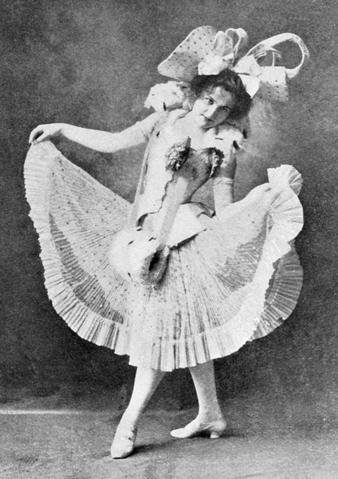
MADGE LESSING.
Madge Lessing had been on the stage a number of years before she suddenly sprang full into the illuminating power of the limelight of publicity as the principal part of the astonishing success of that alluring beauty show, "Jack and the Beanstalk." At that time everybody made the discovery that no one knew exactly who she was, and Miss Lessing has succeeded even to this day in shrouding her early life in mystery. This much is known,—that she ran away from home to go on the stage. She came to the United States from London about 1890 and became a chorus girl at Koster and Bial's in New York. She remained in that humble position only a week, being promoted at one step to the title rôle in the burlesque, "Belle Hélène." Her next engagement was with the Solomon Opera Company, and this was followed by her appearance in "The Passing Show" and "The Whirl of the Town."
As far as the casual theatre-goer was concerned, however, she did not exist until the Klaw and Erlanger production of "Jack and the Beanstalk." This extravaganza, like "1492," also the work of R. A. Barnet, was first brought out by the First Corps of Cadets of Boston, and it is still counted the greatest success that this brilliant troupe of amateurs ever had. In the Cadet performances the principals and chorus were all men, and naturally this order of things was changed when the extravaganza passed over into the professional hands. Otherwise it was given practically in its original form.
Mr. Barnet struck a veritable gold mine when he hit upon the idea of dramatizing Mother Goose. "Jack" was his first ploughing of this field, and although he has worked it often since, he has not yet succeeded in getting from the old ground another crop so exactly suited to the popular taste. Mr. Barnet undoubtedly got his general scheme from the annual London pantomimes. His work was loosely constructed, and his lines were not all of them of the kind that readily cross the footlights. His wit, while wholly conventional, was also a trifle involved. It did not sparkle. His situations, on the other hand, were effective, and especially were they adaptable to expansion under the gentle administration of a stage manager with an eye for light and color and pleasing groupings. In the process of development the spectacular qualities of "Jack and the Beanstalk" came prominently into the foreground, while the literary qualities—a purely descriptive phrase, which in this connection gracefully designates a condition without stating a fact—were lost in the midst of the substitutions by players with specialties. The stage wit of actors has one advantage over that of writers of dialogue; it may not be analyzed, it may be utterly inane on examination, but it does crackle for the moment. In fact, it exists only because it crackles.
Thus "Jack and the Beanstalk" became in the course of its evolution the conventional spectacular extravaganza of theatrical commerce, of which Mr. Barnet was the sponsor rather than the creator. It was also, at the time of its production, a marvellous exploitation of feminine loveliness, and the especial gem of the great array was the bewildering vision of physical perfection, Madge Lessing, in the principal boy's part of Jack. No great amount of histrionic talent was demanded of her, for her success depended, not so much on what she did as how she looked.
Madge Lessing then and there established herself as the exception that proved the rule. I confess that I usually find the woman in tights a decided disillusionment. Instead of making a subtle and seductive appeal to the imagination, she is a prosaic fact; interesting, possibly, as an anatomical study, she loses in a peculiar way the fascinations of the feminine gender. When tights enter into the problem, there is a vast difference between the womanly woman and the womanish woman. The first is a rare and, I may also add, a pure delight. The second is merely an embarrassment.
Miss Lessing belonged, in "Jack and the Beanstalk," to the class of womanly women. She was as femininely alluring amid the bald disclosures of unblushing fleshings as amid the tantalizing exasperations of swishing draperies. Her beauty was exuberant, voluptuous, pulse-stirring,—a laughing, happy face, crowned and encircled with tangled masses of dark brown hair, which made her head almost too large, to be sure, though size counted for little amid the ravishments of sparkling eyes and kissable dimples that danced in and out on either cheek.
Miss Lessing walked through this part of Jack—walking through was all that was demanded of her—with a pretty unaffectedness that met all requirements, and she sang with a voice of considerable sweetness, but of no great power. Still, she has in a mild, inoffensive way some small ability as an actress. This was shown in "A Dangerous Maid" and in "The Rounders," which followed her engagement in that failure imported from London, "Little Red Riding Hood," which was brought out in Boston just before Christmas, 1899.
In "The Rounders" Miss Lessing succeeded Mabelle Gilman as Priscilla during the run of that brisk vaudeville at the Columbia Theatre, Boston. It is a thankless task, that of successorship which results inevitably in direct comparisons, but Miss Lessing met the test surprisingly well. Without Miss Gilman's strength of personality and less apparent art, Miss Lessing indicated with unmistakable correctness the sentimental atmosphere of prudish modesty, which represents Priscilla as a dramatic character. With memories of "Jack and the Beanstalk"—they seem inevitable where Miss Lessing is concerned—one was a little bewildered at Priscilla's embarrassment in her ballet costume during the scene in Thea's dressing-room. This bewilderment was due to Miss Lessing's inability to impersonate. She is always Madge Lessing acting,—never Madge Lessing identified with another and wholly different personality; and at the sight of Madge Lessing embarrassed because she wore tights, one had a right to be bewildered.
During the Spring of 1900 Miss Lessing also appeared in the title rôle of "The Lady Slavey" when that musical farce was revived in Boston.
CHAPTER VIII
JESSIE BARTLETT DAVIS
The name and fame of Jessie Bartlett Davis are linked inseparably with the history of that prominent light opera organization, The Bostonians, with which she was connected for ten years, and from which she resigned during the summer of 1899. If the proprietors of The Bostonians had ever acknowledged that it were possible for any one to be a star in their troupe, that star would have been Mrs. Davis. To be sure, tradition would have been violated by such a procedure, for Mrs. Davis is a contralto, and tradition decrees that a soprano shall be the only woman star in opera. The composer naturally conceives his heroine as a soprano. In fact, his heroine must be a soprano in order that he may invent brilliants for her to sing. You cannot do that sort of thing for the mellow-toned contralto, and consequently she is never the centre of feminine interest. When a composer needs a contralto for a quartette or something of that kind, he usually puts her in tights and calls her a man, gets her as little involved in the plot as possible, gives her some heart-throbbing songs and uses her voice effectively for padding in the choruses, where the high notes of his heroine soprano shine like diamonds.
There is, however, one seriously practical reason for the neglect of the contralto, Sopranos, good, bad, and indifferent, are almost as common as piano-players, but contraltos—even bad and indifferent contraltos—are rare enough to be noted when found; while contraltos that vocally are entitled to rank with the best light opera sopranos are so uncommon it is not strange that no one thought it worth while to write operas especially for them.
When one does find such a contralto, he hears a quality of tone that is charged with sympathetic appeal. Where the soprano is sparkling, the contralto is thrilling. Where the soprano is vivacious, happy, delighting in the sunshine, the contralto is fervid, passionate, and throbbing with sentiment. In Mrs. Davis's case, with the voice is also united an attractive personality and comely face and figure, as well as no mean gifts as an actress. Mrs. Davis's natural voice is a magnificent instrument, but whether she made as much of it as she might, especially in later years, is a question. A large voice carries with it its responsibilities. The singer, with vast resources at his command, finds it so easy to make an impression on the unmusicianly auditor merely by letting the big voice go, to win applause by making a tremendous volume of sound, that one need not be surprised to discover in such a singer a growing tendency toward broad and somewhat coarse effects and a lessening appreciation of delicacy, of light and shade, of phrasing, and of the finer variations of expression.
However, if Mrs. Davis has made such a criticism not altogether undeserved, it is equally true that she has never permitted herself—even after her performances of Alan-a-Dale in "Robin Hood" passed the two-thousandth mark—to become wholly a victim of musical charlatanism, which in the "Robin Hood" instance just cited would not only have been excusable but was wellnigh unavoidable. She has never been forgetful of the art of interpretation and of expression, and by means of her beautiful voice she has kept herself well in the lead among the light opera contraltos.
Sympathy in a contralto is a prime essential. She must appeal to the heart with her rich, pulsating tones. It is not her province to electrify by vocal gymnastics; she is the conveyer of emotion. If this emotion be true and honest and sincere, then the singer brings a message that enriches, ennobles, and broadens; if, on the other hand, the emotion be false and artificial, the singer, however admirable her art in other respects, fails lamentably in a most important particular. The highest praise that can be given Mrs. Davis is that she has rarely failed to impress her audiences with the truth and sincerity of the emotion inspired by her music.
Jessie Bartlett Davis was born in Morris, Illinois, a little town not far from Chicago, in 1866. She came from good New England stock, her parents having moved to Illinois from Keene, New Hampshire, where her father was the school-teacher, the leader of the church choir, and the instructor in music to the few persons in the town who cared to employ him in that capacity. One day he fell in love with a seventeen-year-old miss, who applied to him for a position as school-teacher, and shortly after married her. The Bartlett family was a large one,—four girls and four boys, besides Jessie, who might be called the pivot of the family, three of the boys being older and three of the girls younger than she. It is interesting to know, too, that during the Civil War Mrs. Davis's father enlisted and served his time as a soldier.
There was no spare money in this household to spend on a musical education for Jessie Bartlett, who began to sing almost before she could talk. When she could scarcely toddle, she would climb on the stool before the old-fashioned melodeon, strike away at the notes of the instrument with her tiny fists, and sing at the top of her voice. Her father taught her all that he knew about music, and by the time that she was twelve years old, she was the leading spirit in every musical event in the town. Her voice was something tremendous,—"loud enough to drive every one out of the schoolhouse when I opened my mouth," according to her own statement. In fact, she was at that time chiefly concerned about the amount of noise that she could make, and she used her big voice at the fullest extent, habitually and wilfully drowning out anybody who dared to join in the singing when she was present. She sang in the church choir, and wherever else there was any one to listen to her.
Finally, when she was fifteen years old, she became a member of Mrs. Caroline Richings Bernard's "Old Folks'" Concert Company at a salary of seven dollars a week, and her voice, even then, uncultivated as it was, attracted considerable attention. When the troupe disbanded in 1876, she returned to her home in Morris. Next she was given an engagement to sing in the Church of the Messiah in Chicago, and the whole family moved to that city with her. While singing in church, she also studied with Fred Root, son of George F. Root, the composer of many popular ballads.
The "Pinafore" craze was directly responsible for Jessie Bartlett's entrance into opera. John Haverly heard her sing while he was making the rounds of the church choirs looking up members for the Chicago Church Choir "Pinafore" Company, and engaged her for the part of Little Buttercup at a salary of fifty dollars a week. It was therefore in this rôle that she made her début on the operatic stage. At the end of the season she married the manager, William J. Davis, who is at present prominently connected with theatrical affairs in Chicago.
Mr. Davis firmly believed in his wife's future, and after her "Pinafore" engagement was over he advised her to decline all further offers until she had learned better how to use her voice. He took her to New York, where she became a pupil of Signor Albites. Then Colonel Mapleson, who was at that time managing Adelina Patti, heard her sing and advised her to study for grand opera. It happened, not long after, that the contralto who was to appear as Siebel in "Faust" with Patti was taken ill. There was no substitute in the company, and Colonel Mapleson came to Mrs. Davis in a great state of mind. It was then Saturday, and the performance of "Faust" was to be on the following Monday. Her teacher coached her in the part all that day, and Saturday night was spent in memorizing the words and music. Sunday was given over to a thorough drill in the customary stage business of Siebel's part, and the memorable Monday night found the aspirant ready, but fearful and trembling.
"What frightened me more than anything else," said Mrs. Davis, "was the romanza that Siebel sings to Marguerita. I was so afraid of Patti, whom I considered a vocal divinity, that I finished the romanza without having dared to look her in the face. You can imagine my surprise, therefore, when she took my face in her hands and kissed me on both cheeks. Afterward in the wings she threw her arms around my neck, exclaiming: 'You're going to sing in grand opera, and I'm going to help you.' Adelina Patti's favor and influence did more for me than two years of hard study. There were only two weeks left of the opera season. During that time I appeared twice as Siebel in 'Faust,' and once as the shepherd boy in 'Dinorah.'"
Colonel Mapleson evidently thought that he had made a find, for he offered to send Mrs. Davis to Italy, to give her three years of study with the greatest teachers in the world, every advantage and every opportunity, in short, to become a world-famous singer. In return for these favors Mrs. Davis was to sing under Colonel Mapleson's direction for three years. Personal reasons made it impossible for her to accept this offer, however, though she did not give up the idea of singing in grand opera. After the birth of her son, Mrs. Davis studied a year with Madame LaGrange in Paris. On her return she sang for a season in W. T. Carleton's company. Her principal parts were the drummer boy in "The Drum Major" and the German girl in "The Merry War." The next season found her in the American Opera Company, which included Fursch-Nadi, Emma Juch, and Pauline L'Allemand, with Theodore Thomas as musical conductor, and the season following that she was with the reorganized National Opera Company.
"That was hard work," remarked Mrs. Davis, "all for no money, and so I got home to Chicago, tired, sick, and discouraged, and vowing that I would never sing in public as long as I lived."
"But you changed your mind?"
"Not immediately. While I was resting in Chicago the manager of The Bostonians came to see me to talk about an engagement. Agnes Huntington was their contralto, but they wanted to replace her. At first I said 'No!' point blank. I thought nothing would induce me to leave the comfort and seclusion of my home. Then the manager came to see me again, and—well, woman-like I changed my mind."
During her first seasons with The Bostonians, Mrs. Davis's repertory was an extensive one and comprised the Marchioness in "Suzette," Dorothea in "Don Quixote," Cynisca in "Pygmalion and Galatea," Vladimir Samoiloff in "Fatinitza," Siebel in "Faust," Nancy in "Martha," Azucena in "The Troubadour," Carmen in "Carmen," and the Queen of the Gipsies in "The Bohemian Girl." Her great success as Alan-a-Dale in "Robin Hood," brought out at the Grand Opera House in Chicago on June 9, 1890, followed, and this part kept her busy for several seasons. While The Bostonians were on their long hunt—not yet finished, I believe—for a successor to "Robin Hood," Mrs. Davis appeared in "The Maid of Plymouth," "In Mexico," or, "A War-time Wedding," "The Knickerbockers," "Prince Ananias," and "The Serenade," with its beautiful "Song of the Angelus."