Front matter (continued 3)
Reading edition
Camille D'Arville has temperament, and she has style. It is these two qualities particularly that have brought her success so often in dashing cavalier parts, parts which require that a woman shall act either a man or a woman masquerading as a man. The modern comic opera librettist often has but one main purpose in mind, that is, to get his prima donna in tights as soon after the show begins as possible and keep her in them as long as practical. Indeed, if one were looking for a practical way to distinguish modern comic opera from extravaganza, he might find it in this matter of tights. If the leading woman represent a woman disguised as a man, she is an operatic prima donna; if, on the contrary, she be represented as a man from start to finish, she is merely principal "boy" in extravaganza.
I suppose this tendency toward tights, which is so common as to be almost a light-opera conventionality, is an outgrowth or heritage from the old-fashioned burlesque. In fact, the difference between the modern comic opera and the burlesque of thirty years ago is purely one of degree. The relation between the two is similar to that between the variety show of eight years ago and the so-called "fashionable vaudeville" of to-day. Variety has been put through what managers of the large circuits call a refining process. There is no denying that the old-style variety show in most of its components was crude, noisy, and vulgar, and that its surroundings were scarcely favorable to the development of high art. But one was always sure of finding vigor and life—plenty of both—in the old-time varieties, and there were oftentimes spontaneity and humor—rude and bucolic, perhaps, but real, just the same—which one is not sure of meeting in the latter-day entertainments so carefully prepared for the mentally delicate and sensitive.
Modern comic opera has adopted in a modified and refined form the chief characteristics—one of them the woman in tights and another of them the clown with his perfunctory low comedy—of the old-fashioned burlesque. Of course, the opera makes more pretensions than did the burlesque, and musically it is superficially superior, not necessarily more tuneful but orchestrated with more scholarly skill. Stage pageantry to-day is also much further developed, and spectacular effects are far more elaborate. The costuming is richer and more tasteful, and the women on the stage—if not actually younger and prettier—are certainly daintier and more feminine. The girlishness and natural beauty of many modern light-opera choruses are simply amazing.
If we look beneath these externals, however, we find that the comic opera of to-day is hardly an advance over the burlesque of yesterday. There was good stuff in most of the old burlesques. They had original ideas, plenty of simple dramatic action, and some genuine comedy, but it is seldom that one finds any of these three essentials in the book of the modern comic opera. Not for ten years, I am tempted to declare, has there been written a light-opera libretto with sufficient intrinsic merit to attract the public attention without the assistance of the most magnetic personalities surrounded and set forth by the most gorgeous of stage accessories.
Camille D'Arville's cavaliers—and in recent years she has not played a part that did not require male attire—are a direct heritage from the burlesque stage. When Camille D'Arville becomes a man, she makes the change from petticoats without the slightest show of self-consciousness. I heard her once termed the most modest woman in tights on the stage. That was simply an acknowledgment of her complete effacement of the personal equation. Yet her individuality was not at all diminished, her presence was inspiring, and her acting both vivacious and forceful.
Camille D'Arville was born in 1863 in the village of Oldmarck, Province of Overyseel, Holland, and came of a family that had never shown any theatrical or especial musical talent. When she was twelve years old, her voice gave promise of developing into something more than the ordinary, and she was sent to the Conservatory at Amsterdam for instruction. Here she made her first appearance in concert in 1877. Later she went to Vienna, where she received further instruction, and also made a successful appearance in a one-act operetta.
"I was a big girl fourteen or fifteen years old before I saw other lands than my own Holland," remarked Miss D'Arville, "and after I left Amsterdam I was on the Continent and in England for a long time before I returned home. I still claim Holland as my birthright, however, and I do not want to be called anything but Dutch. If I have a trace of French accent in speaking English, as some claim, it is not my fault.
"But, do you know," she continued, "if it were purely a matter of inclination, I think I should much rather be an actress than to be a singer. Of course, I love music, but what can be more gratifying than to portray the heroines of Shakespeare and other great dramatists? But my natural endowment as a singer led me toward the operatic career. In opera I prefer a strong dramatic rôle, a part which has only one grand song if it afford plenty of opportunity for acting.
"When did I first sing in public? Oh, I can't remember that. I appeared in concerts in Amsterdam when I was a girl, and by the time I entered my teens I took part in operatic performances given by the Conservatory pupils. Do you mean when did I make my real début in opera? I suppose that might be said to have occurred in March, 1883, at the Strand Theatre, London, in an operetta entitled 'Cymbria, or the Magic Thimble.'"
Before this, however, Miss D'Arville had anything but a pleasant experience in London. She went there under the supposition that she had been engaged to sing in opera. The managerial promise she found to be worthless, and she had to be satisfied with a chance to earn a little money in a music hall. It was after several months of the most uncongenial toil that she finally gained recognition in "Cymbria."
"Harry Paulton was responsible for that appearance," continued Miss D'Arville. "He heard me sing, and under his tuition I learned the words of the opera and sung them before I understood their meaning. It was not long, however, before I could speak English fairly well. The Dutch, you know, are famous linguists.
"In October of the same year I created the part of Gabrielle Chevrette in 'La Vie,' an adaptation by H. B. Farnie of Offenbach's 'La Vie Parisienne.' The critics spoke very kindly of me then, but were much more generous in their praises when during the following spring I appeared as Fredegonda in a revival of M. Hervé's 'Chilperic' given at the Empire Theatre. Perhaps chief among my early successes was in 'Rip Van Winkle.' I succeeded Miss Sadie Martinot in the leading soprano part, and sang it until the end of the opera's long run. Fred Leslie was the Rip Van Winkle, and very fine he was, too. It was a pity he afterward became so thoroughly identified with burlesque."
It was at the time of her first appearance in opera in England that the singer adopted the name of Camille D'Arville. It was chosen for euphony only, and had no significance whatever.
After her success in "Rip Van Winkle" Miss D'Arville toured the English province with "Falka," and in 1887 returned to London to play in "Mynheer Jan." This was followed by an engagement at the Gaiety Theatre, and her position in London seemed established, when a quarrel with the management caused her to break her contract and she appeared at another theatre in the title rôle of "Babette."
Miss D'Arville first came to this country in the spring of 1888, being under engagement to J. C. Duff; and her first appearance here was made in New York in April in "The Queen's Mate" in the cast with Lillian Russell. In the fall Miss D'Arville returned to London, where she appeared in "Carina," in which piece her charming archness was a feature. The Carl Rosa Company then engaged her to take the part of Yvonne in "Paul Jones," in which Agnes Huntington as the hero had taken the city by storm. With the same company she also created the title rôle in "Marjorie," which also enjoyed a long run. During the summer of 1889 Miss D'Arville became connected with the New York Casino, appearing in "La Fille de Madame Angot," "The Grand Duchess," and "Poor Jonathan." Back to London she hied herself once more, and for a time was heard at the Trocadero and Pavillon. Then she returned to the United States, and joined the Bostonians, with whom she sang Arline in "The Bohemian Girl," Maid Marion in "Robin Hood," and Katherine in a revival of "The Mascotte." She was probably the most satisfactory Maid Marion, all things considered, that ever sang the part. Certainly she was better as an actress than Marie Stone, who had previously taken the rôle, and she was physically better fitted to the character than Alice Nielsen. Critics, who up to that time had not been entirely satisfied with Miss D'Arville, claiming that her vocal method was bad and her acting oftentimes crude and meaningless, found her work in "Robin Hood" very much to their taste.
"As a singer she has improved during the past year," said one. "Her tones are purer; she uses her voice with more discretion; and she has discovered that a scream is not synonymous with forte. She is vivacious; she lends a dramatic interest that has been sadly lacking in former performances of this company, when the members were too apt to mistake the audience for a congregation and the stage for a choir loft. She is fair to look upon, and yet she does not strive to monopolize attention."
After quitting the Bostonians Miss D'Arville starred in Edward E. Rice's spectacular production of the extravaganza "Venus," which was first acted in Boston in September, 1893. Her dashing Prince Kam, that imaginary Thibetian potentate, who, finding no earthly beauty that satisfied his ideal, journeyed to Mars, where he succeeded in winning the love of Venus herself, was a thoroughly delightful characterization.
"A Daughter of the Revolution," with which Miss D'Arville was next identified, was made over by J. Cheever Goodwin and Ludwig Engländer from a comic opera called "1776," produced some ten years before by a German company playing at the Thalia Theatre in New York. It achieved but limited popularity at that time, but in its revised form it was an agreeable, if not exactly exciting, entertainment. It was not an ideal comic opera, by any means. Too much of the machinery of construction was left visible for that. There were two characters, the dealer in military supplies and the laundress, so obviously dragged in simply because the low-comedy man needed a foil and a soubrette to play opposite to him, that one looked to see the marks of violence on their ears. But librettos are hard things to write—they must be or we should certainly find one now and then that is above reproach—so one would fain overlook jarring circumstances for the sake of the tuneful melodies of the score and the brisk action. Miss D'Arville sang well, and made an attractive picture in her series of becoming costumes.
A starring tour in "Madeleine; or the Magic Kiss," a comic opera of considerable merit although it never won more than a fair degree of popularity, was her next venture, and then she was engaged to create the prima donna rôle of Lady Constance in "The Highwayman," a Reginald DeKoven and Harry B. Smith composition. A quarrel with the management while rehearsals were in progress caused her to retire from the company, however, and her place was taken by Hilda Clark.
CHAPTER XIX
MARIE TEMPEST
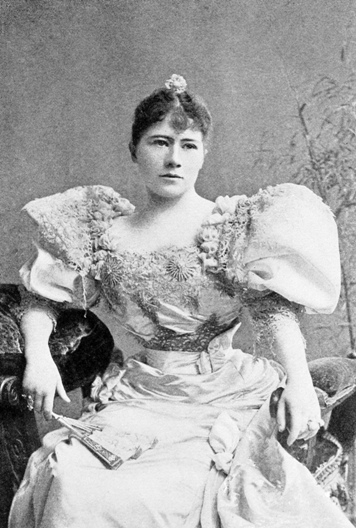
MARIE TEMPEST.
No better characterization of Marie Tempest, that wonderfully fascinating personality which last appeared in this country during the season of 1893-94 in "The Algerian," have I ever seen than that written by Charles Frederick Nirdlinger and published several years ago in the "Illustrated American."
"Nell Gwynne lives again in the person of Marie Tempest," declared Mr. Nirdlinger. "From out of a past tinkling with tuneful poesy, sparkling with the glory of palettes that limned only beauty and grace, bubbling with the merriment and gallantry of gay King Charlie's court, there trips down to moderns a most convincing counterfeit of that piquant creature. If one may trust imagination's ear, little Tempest sings as pretty Nell did: in the same tenuous, uncertain voice, with the same captivating tricks of tone, the same significant nuances, and the same amorous timbre. Tempest talks just as Nell did, and walks with the same sturdy stride,—there was nothing mincing about Nell,—and, if one may trust to fancy's eye, she looks just as Nell looked. I have seen Nell a hundred times, and so have you, dear reader. The mere sight of that curt, pert, and jadish name—Nell Gwynne—calls up that strangely alluring combination of features: the tip-tilted nose, the pouting lips, the eyes of a drowsy Cupid, the confident, impudent poise of the head. None of them fashioned to the taste of the painter or sculptor, but forming in their unity a face of pleasing witchery.
"There is no record of Nell's artistic methods, of the school of her mimetic performance, or the style of her singing. All we know of that sort of thing we must gather from the rhymes and rhapsodies of the poets. Some of them wrote in prose, to be sure; but they were poets for all that, and poets are such an unreliable lot when it comes to judging such a girl as Nell. If she had any art, though, I'll be bound it was like Tempest's. There is but one way to be infinitely charming in the craft of the theatre,—the eternal verities of art prevent that it should be otherwise,—and whatever devices of mimic mechanism Nell employed must have been those of her modern congener. But she never studied in Paris, some sceptic will say, and Tempest did: how could Nell Gwynne have mastered the lightness of touch, the exquisite refinement of gesture, the infinity of significant byplay that constitute the distinctly Parisian method of Tempest? To that I would answer that Tempest's method is not distinctly Parisian, that it is not at all Parisian. She is a delightful artist, not because of her brief period of Gallic training, but in spite of it.
"Elsewhere I have ventured an opinion on the subject of what we have been taught to regard as the French school of comic opera. That school, if we may judge of its academic principles and practices by the performances of some of its most proficient graduates, has nothing in common with the methods of Tempest. Wanton wiles and indecent suggestion,—these are the essential features of that ridiculously lauded French school; kicks and winks and ogling glances, postures of affected languor, and convincing feats of vicious sophistication. Where, in all that, is to be found the simple graciousness, the dainty, delicate, unobtrusive art of Marie Tempest? To liken her to the garish product of that French school—as well liken Carot's sensuous nymph of the wood to Bougereau's sensual nymph of the bath! For my own part, I don't believe Tempest belongs to any school, or if she does, it is a school of which she is at once mistress and sole pupil. Indeed, it may be doubted whether instruction and training have any considerable part in the charm of such a player. There are women of infinitely better method—not manner—of singing and acting; women with whom nature has dealt far more carefully and generously in beauty of face and figure; women even in no degree inferior to Tempest in innate allurement. But this little Englishwoman, with her svelte form and her bewitching face of ugly features, her tricky voice that makes one think of a thrush that has caught a cold, her impertinences and patronizing ways with her audience, has about her a vague, illusive something that makes of her the most fetching personality of the comic-opera stage."
Marie Tempest, whose real name is Marie Etherington, was born in London in 1867. Her father died while she was a child, and she was educated abroad by her mother. Five or six years of her life were spent in a convent near Brussels. From there she was sent to Paris to finish her education, afterward going to London, where she became a student at the Royal Academy of Music.
At that time she had no idea of going upon the stage. Her exceptional musical talent at once became apparent to the professors at the academy, notably Emanuel Garcia, who, although then upward of eighty years of age, took the liveliest interest in his young pupil. Miss Tempest worked so successfully with Garcia that within eighteen months of her entrance at the academy she had carried off from all other competitors the bronze, silver, and gold medals representing the highest rewards the academy could offer. She also studied for a time with Signor Randeggor, in London, and in 1886 made her first appearance on any stage at the London Comedy in "Boccaccio." It was a small part that she played in the London company managed by Arthur Henderson, and the salary which she received was four pounds a week.
After that she created the soprano part in an opera called "The Fay o' Fire" at the Opera Comique, from thence returning for a few months to the Comedy Theatre to take Florence St. John's place in "Erminie." Miss Tempest then took an engagement with Augustus Harris at the Drury Lane in Hervise's comic opera, "Frivoli." In 1887 she joined Henry J. Leslie's company, then playing at the Prince of Wales's Theatre, London, in Alfred Cellier's opera, "Dorothy," in which she assumed the title rôle. In this part Miss Tempest made a very great success. She played in "Dorothy" for nearly nine hundred performances at the Prince of Wales and Lyric theatres. Subsequently she appeared at the Lyric in Cellier's opera of "Doris" and after that in "The Red Hussar." Although Miss Tempest was engaged chiefly in light opera, during these years she at various times undertook more serious work, frequently singing in oratorio and in the high-class London concerts.
She came to this country for the first time in the spring of 1890, appearing in New York and after on tour as Kitty Carroll in "The Red Hussar." Her success was remarkable, and she at once became an established favorite. Although the prima donna of to-day might consider Kitty Carroll, with only its three changes of costume, from soldier to beggar girl and then to heiress, a veritable sinecure, Marie Tempest's skill in passing quickly from one character to another was ten years ago quite as much commented on as was her unquestionably artistic presentation of the triple rôles. She also repeated in this country her London success in "Dorothy," and sang in "Carmen" as well.
Miss Tempest was next seen at the New York Casino as the successor to Lillian Russell and Pauline Hall. In the operetta, "The Tyrolean," she had a part scarcely equal to her abilities, although the nightingale song, which came in the last act, was a charming melody and was so delightfully sung by Miss Tempest as really to be the feature of the performance. In her peasant's dress Miss Tempest was the choicest of dainty morsels, a dream of fairylike loveliness.
Her greatest success in this country, however, was "The Fencing Master" in which the prima donna rôle was peculiarly suited to her personality. This opera was built around the conceit of a master of fencing, who, not being blessed with a son to succeed him in his profession, brought up his daughter as a boy, and by severe training made her a most expert user of foil and sword. In this character Miss Tempest united remarkably well boyish freedom and masculine swagger with feminine charm and ingenuousness, and the picture that she made was one never to be forgotten. It was true, however, in spite of her great attractiveness in the part, that tights and tunic did take away a little of that subtle bewitchery, which was the root of her wonderful winsomeness in "Dorothy." It was a Boston critic, I believe, who said of her in this opera, that she suggested a Dresden china image that had hopped down from the mantel and committed an indiscretion. Still another, evidently a bit of a china connoisseur himself, applied the fancy porcelain simile with far more searching analysis. "She reminds one of a bit of Sèvres china," he declared, "although a pretty piece of Dresden would not be an inappropriate simile, especially when she is dressed in that picturesquely ragged costume in the first act. Sèvres china, however, is to an art connoisseur what truffles and pâte-de-foie gras are to an accomplished epicure." Whether she were Dresden china or Sèvres china, it mattered not; the main fact remained that a thoroughly feminine woman like Miss Tempest needed the fuss and feathers of feminine attire to bring out her attractions in the most effective way. That the public unconsciously felt this was proven even in "The Fencing Master," where her appearance in the last act in all the glory of court gown and flashing jewels was always the signal for the heartiest applause.
In "The Algerian," by Reginald DeKoven and Glen MacDonough, which followed "The Fencing Master," being brought out in Philadelphia in September, 1893, Miss Tempest not only returned to the garb of her own sex, but appeared as well in her own auburn hair with that tiny irresistible curl hanging down the middle of her forehead, just like that of the little girl in the old ballad.
At the close of the run of this opera in 1894, Miss Tempest returned to London. Her greatest hits of recent years in that city have been made as the heroine in "The Artist's Model" and as O Mimosa San in George Edwardes's original production of "The Geisha" at Daly's Theatre in London.
CHAPTER XX
MAUD RAYMOND
High in the ranks of women low comedians who have been graduated from the variety theatre into musical comedy and extravaganza, is Maud Raymond, who fairly shares the honors with the Rogers Brothers in their popular vaudevilles. It would be unfair to call Miss Raymond an actress, for she does not aspire to be anything more than a delightful entertainer, whose unusual mimetic gifts and whose real or assumed sense of humor led her to adopt as the most natural thing imaginable the serious calling of making the world laugh.
With her marked individuality, Miss Raymond drifted as a matter of course into character impersonation. In the days when she entered the varieties three distinct types of low-comedy characterizations were recognized—the Irish, the Dutch, and the negro. The first two were genuine burlesques, while the last named was the familiar minstrel type,—a great deal of burnt cork and an insignificant amount of genuine negro. Miss Raymond selected the Dutch type. Whether she was the first woman to attempt a Dutch character sketch, I do not know, but I am willing to risk the statement that she was the best one.
An amazingly grotesque figure she presented, with her figure built on the lines of a meal sack with a string tied around the middle, and her huge sabots that clattered noisily every step she took. Her face was a study in ponderous stupidity, and her movements were slow and unwieldy. Yet, with all its grotesqueness, its mammoth exaggerations, there was human nature in the sketch and rich, full-blooded humor, the brutal, coarse humor of the soil, humor that had not been refined into flavorless delicacy nor polished into insipidness for the moral salvation of too easily shocked tenderlings.
When the "coon" craze struck the stage, Miss Raymond was among the first to take that up, and she has clung faithfully to it ever since. Like all her work, her interpretation of the modern "coon" song is all her own. She does not reproduce so fantastically as some others the antics of the swell cake-walker, but she infuses into her work a rich humor that is infectious. In this one particular she resembles closely Miss May Irwin. May Irwin's "coon," however, is the Southern "mammy" type, while Maud Raymond's is of Northern city birth and training. In this aspect of her "coon" art, Miss Raymond seems nearer the progenitor of the up-to-date stage negro, who was, of course, the "nigger" minstrel of a number of decades ago.
Miss Raymond's method was capitally illustrated in the song "I thought that he had Money in the Bank," which was introduced in "The Rogers Brothers in Wall Street" during the season of 1899-1900. Her dialect was by no means extraordinary. It had not the darky softness and twang, which one finds for instance so faithfully reproduced by Artie Hall. Miss Raymond, however, got a curious comic effect by twisting her words out of the corner of her mouth in a manner indescribable, by hunching up her shoulders, one a little higher than the other, thrusting her head forward, crooking her elbows, and letting her hands hang loose and lifeless as if they had been broken at the wrists.
After seeing Miss Raymond's inimitable Dutch woman, I carried away the impression that she herself inclined toward embonpoint,—that she was grossly notoriously fat, in fact. Later observations, however, have caused me to revise that impression. Miss Raymond is not fat, merely comfortably plump. She is a decided brunette with rather irregular features, but features none the less attractive for that, snapping black eyes that seem always to sparkle with irrepressible merriment, and an inexhaustible amount of vivacity. Vivacity may, indeed, be said to be her specialty. It is always in evidence, and yet it never runs riot and it never becomes wearisome.
Miss Raymond has been a vaudeville feature for the past twelve years. She made her first appearance with Rice and Barton's company, and afterward played two years with Harry Williams's Own Company. Her next appearance was in the soubrette part in "Bill's Boot," in which Joe J. Sullivan starred. She then joined Irwin Brothers' Company, in which she sang with great success. She spent several weeks in the Howard Athenæum Company when it was under James J. Armstrong's management, and finished the season with Fields and Hanson.
Miss Raymond was specially engaged to play the soubrette rôle in Bolivar in Donnelly and Girard's "The Rainmakers." Those popular stars declared that the part had never been so well done as it was by Miss Raymond, but she was obliged to retire at the end of the season on account of illness. During the summer she appeared on the roof gardens and in the continuous houses. She joined Tony Pastor's company in the early fall, and played a season of fifteen weeks with that organization, meeting with great success.
When the Rogers Brothers began starring with "The Reign of Error" in the fall of 1898, she was made a prominent feature of their company, and she continued with them as their leading support the following season in "The Rogers Brothers in Wall Street."
She is also the wife of one of the brothers, though whether of Max or Gus I never can remember.
CHAPTER XXI
PAULINE HALL
A very remarkable woman is Pauline Hall, whose stage career of twenty-five years encompasses every experience possible in light opera in this country. Miss Hall began as a dancer. She spent her apprenticeship in the chorus. She sang inconsequential rôles in opera, and she acted small parts in drama. She had her season in burlesque. She was for years the foremost figure in the best light-opera organization this country has ever known. She has starred, and she is to-day a better singer than the majority of her youthful contemporaries, a better actress than all except a very few of them, and a more satisfactory all-around artist—if the expression be permissible—than any of them.
When I heard her sing with Francis Wilson in "Cyrano de Bergerac"—about the stupidest opera, by the way, ever produced—and in "Erminie" in the spring of 1900, I was amazed; her voice was in splendid condition, certainly better than it had been five years before, true in tone, clear, and without huskiness. It showed its wear only in the loss of the richness and sweetness—the music, one might say—of the old Casino days. In figure Miss Hall was trim and youthful. Her face was plump and rounded like a girl's. Her hair, cut short for boys' parts and coquettishly curled, retained its dark, almost black, hue, while her eyes—wonderfully handsome they always were—snapped and sparkled like a débutante's.
Pauline Hall's fame reached its height during the long run of "Erminie" at the New York Casino. She was the originator of the rôle of the Erminie, and she sang in the opera in all the principal cities of the country. She was—and is still, for that matter—one of the finest formed women on the American stage, and her stately manner and graceful demeanor gained for her the sobriquet so commonly associated with her name—statuesque. During her subsequent starring career Miss Hall continued a popular favorite, although she was not consistently successful in obtaining operas of notable merit. "Puritania" met with excellent success, but "The Honeymooners" and "Dorcas" were neither of them strong enough to make any lasting impression. They were both of the familiar "prima donna in tights" type, and their librettos were without striking originality, and their scores showed only commonplace tunefulness.
In spite of this handicap Miss Hall succeeded in maintaining—largely through the force of her personality and art—her place among the foremost in light opera in this country. During the season of 1899-1900 she most happily again became associated with Francis Wilson, who is also an "Erminie" product. Miss Hall, with her renewed youth and her years of experience, at once took a position in Wilson's company, second only to the star. In "Cyrano" she made Christian—a barren and sterile character—vigorous, picturesque, and attractive, while her Princess in "Erminie," barring the loss of vocal mellowness already referred to, was stronger than it was a dozen years ago.
Pauline Hall's active life on the stage began when she was about fifteen years old. She was born in Cincinnati about 1860 in rather humble quarters in the rear of her father's apothecary shop on Seventh Street. She bore the somewhat formidable and decidedly German name of Pauline Fredericka Schmidgall, until she adopted the simple and harmonious stage name of Pauline Hall.
It was in 1875, at Robinson's Opera House in Cincinnati, under the management of Colonel R. E. J. Miles, that Miss Hall made her first appearance on the stage. She began at the very bottom of the ladder, an "extra girl" in the chorus and a dancer in the ballet. Next she journeyed to the Grand Opera House in the same city, a theatre which was also under Colonel Miles's management, where she remained until the versatile Mr. Miles organized and put on the road his "America's Racing Association and Hippodrome," a circus-like enterprise. She was made a feature in the street parade tableaux of Mazeppa used to advertise the attraction, and a very effective figure she must have been, too, for she was a handsome girl and a picture of physical perfection. Besides luring the public to the show, Miss Hall entertained it after it got there by driving a Roman chariot in the races.
After a summer of this exciting work Miss Hall returned to the theatre as a member of the chorus of the Alice Oates Opera Company, which was at that time making a Western tour under the management of the same Colonel Miles. Alice Oates was then in her prime, and the most popular operatic star in the country. She was born in Nashville, Tennessee, and educated in Louisville. When she was nineteen years old she made her début in Chicago in the Darnley burlesque, "The Field of the Cloth of Gold." She sang in "The Little Duke," "The Mascotte," "The Pretty Perfumer," "The Princess of Trebizonde," "The Grand Duchess," and "Olivette," and was one of the first of the many Ralph Rackstraws in "Pinafore" in this country. She died in Philadelphia on January 11, 1887, at the early age of thirty-seven years. She was small of figure and pretty of face, unusually so off the stage and dazzlingly so on the stage. Her voice was of rare compass and sympathetic in tone, and her acting was vivacious, dashing, and hearty.
After leaving the Alice Oates Company, small parts in Samuel Colville Folly company gave Miss Hall a slight advance in the theatrical world, and then she made her first and only appearance in the "legitimate." She joined Mary Anderson's company, and for three or four months acted minor characters in the plays of Miss Anderson's repertory, which at that time was somewhat limited. Among Miss Hall's parts were Lady Capulet in "Romeo and Juliet" and the Widow Melnotte in Lord Bulwer Lytton's stilted melodrama, "The Lady of Lyons."
In 1880, Miss Hall first began to be noticed by professional discoverers of stage talent. She was then a member of Edward E. Rice's "Surprise Party," with which she appeared in "Horrors" and "Revels." Next, in Rice's greatest success, "Evangeline," Miss Hall played Gabrielle and even Hans Wagner, being the first woman to try the droll character. In the fall of 1882 she went on a tour with J. H. Haverly's "Merry War" company, and sang the part of Elsa. With Haverly she also appeared in "Patience." Following this engagement she rejoined Mr. Rice's forces, and on December 1, 1883, opened with his company at the Bijou Opera House, New York, where she created the part of Venus in "Orpheus and Eurydice." She was a success from the start, and continued with Mr. Rice until the close of the run of the burlesque on March 15 of the following year, when she went with the company, under the management of Miles and Barton, on the road.
On her return to New York, Miss Hall again appeared at the Bijou, on May 6, 1884, as Hasson in a revival of "Blue Beard," following this with another road experience that lasted until July. In August she began an engagement at Niblo's Garden, New York, as Loresoul in Poole and Gilmour's spectacular production of "The Seven Ravens." The part was a singing one, and Miss Hall added considerably to her popularity among the frequenters of the burlesque shows that were so largely patronized in those days. In February, 1885, Miss Hall was in the title rôle of "Ixion" at the Comedy Theatre, New York, though only for a short time, and on April 4 she made her first appearance in a German speaking part, singing Prince Orloffsky in "Die Fiedermaus" at the Thalia Theatre.
On May 25 Miss Hall opened with Nat C. Goodwin at the Park Theatre, Boston, and created the character of Oberon in the travesty "Bottom's Dream." This was a failure, and in a few weeks Miss Hall returned to New York, where she signed with Rudolph Aronson of the Casino, making her first appearance as Ninon de l'Enclos in the English presentation of "Nanon." She did well with the part, and further increased the favorable impression that she had made by her Angelo in "Amorita" and her Saffi in "The Gipsy Baron." Next came "Erminie," which achieved a success as yet unequalled by any light opera in this country unless it be "Robin Hood." The successor to "Erminie" was "Nadjy," also a famous hit, in which, however, Miss Hall's part of the Princess Etelka was overshadowed by the character of Nadjy, the dancer, so captivatingly played by Marie Jansen in the original production. After "Nadjy" came "The Drum Major," which failed, however, to make any lasting impression.
After leaving the Casino Miss Hall began her career as a star, appearing in "Puritania." This was followed the next year by "Amorita" and "Madame Favart," while "Puritania" was retained in her repertory. The season succeeding she brought out "The Honeymooners." During 1894-95 her operas were "La Belle Hélène," a revival of "The Chimes of Normandy," and "Dorcas." She then retired from the stage for a while, and afterward appeared in vaudeville until she joined Francis Wilson.
"Puritania, or the Earl and the Maid of Salem," the best known and most successful of all her operas, was produced in Boston in the summer of 1892. The opera was written by C. M. S. McLellan, and Edgar Stillman Kelley was responsible for the music. The story of the opera was decidedly attractive. The action began in Salem. Elizabeth, a fair young miss of the town, had been accused of being a witch by Abigail, a confirmed woman-hater. Elizabeth was tried by the local tribunal and was condemned, chiefly because she had refused to wed Jonathan Blaze, the chief justice of the court. Just as the sentence was pronounced an English ship arrived in the harbor, and Vivian, Earl of Barrenlands, came ashore. He rescued Elizabeth from the mob, and captivated by her beauty proceeded to make love to her. Nothing would do but he must take her back to England with him. Smith, the Witch-finder-general to his Majesty Charles II., was indignant because Vivian had won the girl, and threatened to expose her as a witch to the king.
The second act took place in a subterranean chamber under the king's palace, where Killsin Burgess, a conspirator, was plotting after the Guy Fawkes fashion to blow up everything. So deeply did he meditate on divers plots and treasons, that he fell asleep, lighted pipe in mouth and seated on a keg of gunpowder. The next scene showed the palace where King Charles had just bestowed his favor on Vivian and the future Countess of Barrenlands. Smith entered with Blaze and Abigail, and the trio denounced Elizabeth as a witch. Elizabeth, driven half mad by their false accusations, mockingly declared that she was a witch, and proceeded to "weave a spell." She summoned Asmodeus, the Prince of Eternal Darkness, to appear. A loud report was heard, and the form of Burgess was hurled through the air. The sparks from his pipe had ignited the keg of powder which exploded just as Elizabeth was pretending to display her powers. Of course, Elizabeth was condemned by the king on this prima facie evidence; but Burgess, recognizing her as his daughter, confessed his conspiracy against the king, and all ended happily.
Miss Hall gave the opera a first-class production, a fine cast, and handsome scenery. Louise Beaudet acted Elizabeth, and graceful and charming she was, too. Miss Hall herself played Vivian. Frederic Solomon was the original Witch-finder-general, and his conception of the character was thoroughly original. Jacques Kruger as the Judge, Eva Davenport as Abigail, John Brand as the King, and Alf Wheelan as the Conspirator were all happily chosen. The opera ran in Boston from June until September. Then Miss Hall took the opera on the road for a season. "Puritania" was tuneful and bright in action. The dialogue was often sparkling, the fun was spontaneous, and the three comedians had parts which had the added value of being characters. Vivian was admirably suited to Miss Hall's talents. Her songs were given with spirit, her acting had that freedom so characteristic of her "boys," while her costumes were pictorially gorgeous.
Miss Hall's first husband was Edward White, whom she met in San Francisco in 1878, where he was engaged in mining enterprises. They were married in St. Louis in February, 1881. Eight years later Miss Hall secured a divorce from Mr. White, and in 1891 she was married to George B. McLellan, the manager of her company.
CHAPTER XXII
HILDA CLARK
The divine gift of song has placed Hilda Clark, whose ability as an actress is by no means great, in a position of prominence in the theatrical world. She went on the stage because she could sing, and did not learn to sing because she was on the stage; and, owing to the fact that there is, always has been, and always will be a demand for attractive young women with pleasing singing voices, she has had her fair measure of success. Miss Clark has also the added charm of more than ordinary physical attractiveness. She is a blonde of prettily irregular features. Her personality is winning rather than compelling, and her stage presence is good, though there are times when this would have been improved by more bodily grace and freedom. Byron, who hated a "dumpy woman," would have found Miss Clark "divinely tall and most divinely fair," but very likely he would have advised her to take a mild course in calisthenics in order to acquire conscious control of a somewhat unruly physique.
Hilda Clark comes of an old Southern family, several of whose members won military distinction. An ancestor of hers, Colonel Winston, was awarded a sword by Congress for his services in the Revolutionary War. Her great-grandfather, General Winston, was distinguished in the war of 1812, while several of her relatives were noted for gallantry during the Civil War. Miss Clark was born in Leavenworth, Kansas, in the early seventies. When her father, who was a banker, died, the family removed to Boston, where Miss Clark was educated. As she grew into womanhood, her voice attracted the attention of her friends, and by their advice she went to Europe, where she studied music for two years. On her return to this country she became the soprano of St. Mark's Church in New York City, and it was there that Willard Spenser, the composer of "The Princess Bonnie," first heard her sing.
Miss Clark's voice is what is technically known as a soprano legere, and while she excels in floria music, her voice has considerable of that rare sympathetic quality possessed by coloratura singers. Her work in the theatre may be summed up in a few words. She made her début in the title rôle of "The Princess Bonnie" in September, 1895. After that she accepted the offer of The Bostonians, with whom she appeared for a season. In "The Serenade" she alternated in the rôle of Yvonne, the ballet dancer, with Alice Nielsen, and she also sung Maid Marian in "Robin Hood" and Arline in "The Bohemian Girl." Next she was engaged by Klaw and Erlanger. She created the part of Lady Constance in "The Highwayman" after Camille D'Arville, who was expected to take the character, had quarrelled with the stage manager over some detail in the action, and refused to have anything more to do with the opera. Miss Clark was quite successful in this character, and it may be said to have established her firmly in the ranks of the light opera prima donnas. Next came her appearance in the prima donna rôle of John Philip Sousa's opera "The Bride Elect," in which she is best known by the general public.
Sousa is the most eminent composer for the bass drum and the cymbals that we have, and he can make music with more accents than any other man in the business. His powerful first and third beats set the feet to tapping and the head to nodding, and the American public thinks that it is great stuff. So it is, the finest music for a military parade that ever came out of a brass band. Sousa writes his music with a metronome at his elbow clacking out the marching cadence of 120 to the minute. Every time the machine clacks he puts in a bang on the big drum and a clash with the cymbals. Then he weaves a stately moving melody around the bangs and the clashes, marks the whole business "fortissimo," and lets it go. He does not bother much about originality. His strong point is marches, and he knows it. In "The Bride Elect," he gave us marches—shall we say "galore"? The score was undoubtedly catchy, and the tunes pleased for the moment. As for the book, which was also by Sousa, it was nothing to boast of. It served admirably as a ringer-in for the marches.
Miss Clark's work in "The Bride Elect" was thoroughly satisfactory. She sang the music with splendid effect and with much brilliancy. Her acting, to be sure, was hardly all that could be desired, but, fortunately for her success, the book did not call for any great dramatic force. Miss Clark's career has been somewhat unusual in that she took at once a position of importance on the stage and has continued in positions of importance ever since. All this has happened because she could sing; and so busy has she been with her singing that she really has had no time to learn to act. In other words, in spite of her five years behind the footlights, she still lacks experience. The woman who starts in a humble capacity in the chorus and who climbs slowly to the heights of calciumdom may have at first very crude notions regarding action, but she learns as time goes on to be non-committal in gesture at least. She may not develop into a histrionic genius, but she does acquire facility in the conventions of light opera that so often stand for acting. It is of just this facility that Hilda Clark is most in need.
Index
"Algerian," Tempest, Marie, 222, 232. "All the Comforts of Home," Hall, Josephine, 47. "American Beauty," May, Edna, 152. Russell, Lillian, 32. American Opera Company, 98. "Amorita," Hall, Pauline, 247, 248. Anderson, Mary, 245. "Apollo," Russell, Lillian, 32. "Aristocracy," Hall, Josephine, 47. Aronson, Rudolph, 247. "Artist's Model," Tempest, Marie, 232. Ashley, Minnie, 134. Atherton, Alice, 40. "Babette," D'Arville, Camille, 217. Barnabee, H. C., 19. Barnet, R. A., 82, 83, 140, 141. Barrymore, Maurice, 190. Beaudet, Louise, 251. "Belle Hélène," Hall, Pauline, 248. Hopper, Edna Wallace, 112. Lessing, Madge, 82. Russell, Lillian, 42. "Belle of New York," Edwardes, Paula, 113, 118. May, Edna, 148, 149, 150, 151, 153. Bennett & Moulton Opera Company, 189, 190, 192, 193, 194, 199. Bernard, Caroline Richings, 94. Bernhardt, Sarah, 28. "Billie Taylor," Fox, Della, 199. "Bill's Boot," Raymond, Maud, 137. "Black Sheep," Edwardes, Paula, 117. "Blue Beard," Hall, Pauline, 246. "Boccaccio," Tempest, Marie, 227. "Bohemian Girl," Clark, Hilda, 256. D'Arville, Camille, 218. Davis, Jessie Bartlett, 99. Fox, Della, 199. Nielsen, Alice, 20. Bostonians, Clark, Hilda, 255, 256. D'Arville, Camille, 218, 219. Davis, Jessie Bartlett, 88, 98, 99. Nielsen, Alice, 19, 20. "Bottom's Dream," Hall, Pauline, 247. Braham, Harry, 38. Brand, John, 251. "Bride Elect," Celeste, Marie, 169. Clark, Hilda, 256, 257, 258. MacDonald, Christie, 180. "Brigands," Russell, Lillian, 31, 32, 42. "Broadway to Tokio," Templeton, Fay, 76, 78. "Brownies," Celeste, Marie, 169. Burnett, Mrs. Frances Hodgson, 197. Burt, Laura, 118. "Carina," D'Arville, Camille, 217. Carl Rosa Opera Company, 217, 218. Carleton Opera Company, 98. "Carmen," Davis, Jessie Bartlett, 99. Tempest, Marie, 229. Casino, New York, 25, 27, 29, 40, 65, 66, 200, 201, 206, 218, 229, 240, 247, 248. "Casino Girl," Earle, Virginia, 29. Gilman, Mabelle, 65. Castle Square Opera Company, 19, 169. "Castles in the Air," Fox, Della, 194, 195, 200, 201. "Cavalleria Rusticana," Celeste, Marie, 169, 170. "Celebrated Case," Fox, Della, 196. Celeste, Marie, 156. Cellier, Alfred, 228. "Chantaclara," Nielsen, Alice, 14. "Chieftain," Glaser, Lulu, 128, 129, 130, 131. MacDonald, Christie, 180. "Chilperic," D'Arville, Camille, 216. "Chimes of Normandy," Fox, Della, 199. Hall, Pauline, 248. "Chorus Girl," Ashley, Minnie, 141. "Chris and the Wonderful Lamp," Hopper, Edna Wallace, 112. "Chums," Hopper, Edna Wallace, 110. "Cigale," Russell, Lillian, 32. "Cinderella," Earle, Virginia, 26. "Circus Girl," Ashley, Minnie, 135, 141. Earle, Virginia, 28. Gilman, Mabelle, 65. Clark, Hilda, 221, 253. "Club Friend," Hopper, Edna Wallace, 109. Collier, Willie, 164. "Combustion," Fox, Della, 197, 198, 199. Conried, Heinrich, 199, 200. "Contented Woman," May, Edna, 148. "Corsair," Earle, Virginia, 26. Templeton, Fay, 74. "County Fair," Earle, Virginia, 26. Crox, Elvia, 117. "Cymbria, or the Magic Thimble," D'Arville, Camille, 215, 216. "Cyrano de Bergerac," Glaser, Lulu, 124, 133. Hall, Pauline, 240, 242. Dale, Alan, 7, 8. Daly, Augustin, 27, 29, 64, 71, 118. "Dangerous Maid," Edwardes, Paula, 118. Lessing, Madge, 86. D'Arville, Camille, 190, 208, 256. "Daughter of the Revolution," D'Arville, Camille, 220, 221. Davenport, Eva, 251. Davis, Jessie Bartlett, 88, 208. Davis, William J., 95. Dazey, C. T., 103. DeAngelis, Jefferson, 42, 206. DeKoven, Reginald, 221, 232. Desci, Max, 9. "Devil's Deputy," Glaser, Lulu, 128. MacDonald, Christie, 179, 180. Dickson Sketch Club, 196, 197, 198, 199. Dickson, W. F., 196, 197, 198, 199. "Dinorah," Davis, Jessie Bartlett, 97. "Don Quixote," Davis, Jessie Bartlett, 99. "Dorcas," Hall, Pauline, 241, 248. "Doris," Tempest, Marie, 228. "Dorothy," Tempest, Marie, 228, 229, 232. Dressler, Marie, 181. "Dr. Syntax," Hopper, Edna Wallace, 111. "Drum Major," Davis, Jessie Bartlett, 98. Hall, Pauline, 248. Duff, J. C., 141, 217. Duff Opera Company, 41. Duse, Eleanora, 187. Earle, Virginia, 21. "Editha's Burglar," Fox, Della, 197, 198, 199. Edouin, Willie, 40. Edwardes, George, 232. Edwardes, Paula, 47, 113. Edwards, Julian, 172, 178. "El Capitan," Ashley, Minnie, 140. Hopper, Edna Wallace, 107, 111. Engländer, Ludwig, 220. "Erminie," Glaser, Lulu, 128, 133. Hall, Pauline, 240, 242, 248. MacDonald, Christie, 179. Russell, Lillian, 32. Tempest, Marie, 227. "Evangeline," Earle, Virginia, 26. Hall, Josephine, 47. Hall, Pauline, 245. Templeton, Fay, 74. "Excelsior, Jr.," Templeton, Fay, 75. "Falka," D'Arville, Camille, 217. Farnie, H. B., 216. Farrington, Adele, 187. "Fatinitza," Davis, Jessie Bartlett, 99. "Faust," Davis, Jessie Bartlett, 96, 97, 99. "Fay o' Fire," Tempest, Marie, 228. "Fencing Master," Tempest, Marie, 230, 231, 232. "Fiedermaus," Hall, Pauline, 247. "Fille de Madame Angot," D'Arville, Camille, 218. First Corps of Cadets, 82, 117. Fiske, Minnie Maddern, 67, 70, 71, 72. "Fleur-de-lis," Fox, Della, 202. "Fortune Teller," Nielsen, Alice, 5, 7, 20. Fougère, 76, 78, 79, 80. "1492," 82. Ashley, Minnie, 140. Dressler, Marie, 190. Fox, Della, 27, 42, 72, 104, 110, 111, 168, 190, 192. "Fra Diavolo," Fox, Della, 193, 194, 199. Frazer, Robert, 74. "Frivoli," Tempest, Marie, 228. Frohman, Charles, 47, 109, 111. Fursch-Nadi, 98. Furst, William, 201, 202. Garcia, Emanuel, 227. "Geisha," Ashley, Minnie, 135, 141. Earle, Virginia, 23, 24, 27. Gilman, Mabelle, 65. Tempest, Marie, 232. Gerard, Bettina, 117. Gilbert, W. S., 19, 26, 31. Gill, William, 74. Gillette, William, 199. Gilman, Mabelle, 56, 86. "Gipsy Baron," Hall, Pauline, 247, 248. "Girl from Maxim's," Hall, Josephine, 49, 50, 51. "Girl from Paris," Hall, Josephine, 46, 48. "Girl I Left Behind Me," Hopper, Edna Wallace, 110. "Giroflé-Girofla," Celeste, Marie, 168. Russell, Lillian, 32, 42. Templeton, Fay, 74. Glaser, Lulu, 120, 179. Goodwin, J. Cheever, 201, 202, 204, 220. Goodwin, N. C., 164, 247. "Grand Duchess," Celeste, Marie, 168. D'Arville, Camille, 218. Russell, Lillian, 32, 42. Grau, Jules, 188, 189. "Great Metropolis," Celeste, Marie, 163. "Great Ruby," Edwardes, Paula, 118. "Greek Slave," Ashley, Minnie, 135, 142, 143, 144, 145, 146. Hale, Philip, 202, 203, 204, 205. "Half-a-King," Glaser, Lulu, 131. MacDonald, Christie, 180. Hall, Artie, 236. Hall, Josephine, 46, 116. Hall, Pauline, 179, 208, 229, 239. Hallen, Fred, 26. Hammerstein, Oscar, 148. Harlow, Richard, 191. Harris, Augustus, 228. Hart, Joseph, 26. Haverly, J. H., 85, 246. Henderson, Arthur, 227. Henderson, William J., 159. "Hendrik Hudson," Templeton, Fay, 74, 75. Herbert, Victor, 5, 6. Herne, James A., 73. "Highwayman," Clark, Hilda, 256. "Hole in the Ground," Earle, Virginia, 26. "Honeymooners," Hall, Pauline, 241, 248. Hopper, DeWolf, 27, 104, 110, 111, 140, 146, 170, 200, 201. Hopper, Edna Wallace, 42, 104, 140. "Horrors," Hall, Pauline, 245. "Hoss and Hoss," Celeste, Marie, 164, 165, 166, 167. "Hotel Topsy Turvy," Dressler, Marie, 191. Howard, Bronson, 47. Hoyt, Charles H., 26, 148, 164. Huntington, Agnes, 99, 218. "In Gay New York," Earle, Virginia, 27, 28. "In Mexico" (see "War Time Wedding"). Irwin, May, 235. "Ixion," Hall, Pauline, 247. "Jack," Hall, Josephine, 47. "Jack and the Beanstalk," Celeste, Marie, 169. Lessing, Madge, 81, 82, 84, 85, 86, 87. "Jane," Hopper, Edna Wallace, 110. Jansen, Marie, 120, 127, 128, 248. Jones, Walter, 146. Juch, Emma, 98, 200. Kelley, Edgar Stillman, 249. "King's Fool," Fox, Della, 200. Klaw and Erlanger, 82, 169, 180, 256. "Knickerbockers," Davis, Jessie Bartlett, 100. Koster and Bial's, 81. Kruger, Jacques, 251. "Lady of Lyons," Hall, Pauline, 245. "Lady Slavey," Dressler, Marie, 183, 184, 188, 191. Earle, Virginia, 27. Lessing, Madge, 87. L'Allemand, Pauline, 98. LaShelle, Kirk, 172, 173, 174, 175. Lask, George E., 19. "Later On," Earle, Virginia, 26. Lederer, George W., 25, 27, 148, 149, 150, 151, 152, 200. "Lend Me Your Wife," Hopper, Edna Wallace, 109. Lenox, Fred, 142. Leonard, Charles E., 33, 35. Leslie, Elsie, 197. Leslie, Fred, 216. Leslie, Henry J., 228. Lessing, Madge, 81, 118. "Lion Tamer," Glaser, Lulu, 127, 128. MacDonald, Christie, 179. "Little Corporal," Glaser, Lulu, 124, 131, 132. "Little Duke," Celeste, Marie, 108. Russell, Lillian, 32. "Little Host," Fox, Della, 207. "Little Red Riding Hood," Lessing, Madge, 86. "Little Trooper," Celeste, Marie, 168. Fox, Della, 168, 201, 202. Lloyd, Violet, 27. Lucia, Alice Nielsen as, 19. MacDonald, Christie, 169, 172. MacDonough, Glen, 232. "Madame Favart," Hall, Pauline, 248. Templeton, Fay, 75. "Madeleine, or, the Magic Kiss," D'Arville, Camille, 221. Dressler, Marie, 190. "Maid of Plymouth," Davis, Jessie Bartlett, 100. "Mam'selle 'Awkins," Edwardes, Paula, 113, 116, 119. Hall, Josephine, 47, 52, 53. "Man in the Moon," Dressler, Marie, 191. Templeton, Fay, 76, 77. Mapleson, Colonel, 95, 96, 97. "Marjorie," D'Arville, Camille, 218. "Martha," Davis, Jessie Bartlett, 99. Martinot, Sadie, 216. "Mascotte," D'Arville, Camille, 218. Templeton, Fay, 74. May, Edna, 147. McCaull, John A., 40. McLellan, C. M. S., 249. McLellan, George B., 252. "Meg Merrilies," Earle, Virginia, 27. "Men and Women," Hopper, Edna Wallace, 110. "Merchant of Venice," Gilman, Mabelle, 65. "Merry Monarch," Glaser, Lulu, 128. MacDonald, Christie, 179. "Merry War," Hall, Pauline, 246. "Merry World," Davis, Jessie Bartlett, 98. Earle, Virginia, 27. "Midsummer Night's Dream," Templeton, Fay, 71, 73. "Mikado," Dressler, Marie, 188. Earle, Virginia, 26. Nielsen, Alice, 19. Miles, R. E. J., 243, 244. "Mountebanks," Russell, Lillian, 32. "Muldoon's Picnic," Fox, Della, 195. "Mynheer Jan," D'Arville, Camille, 217. "Nadjy," Hall, Pauline, 248. Russell, Lillian, 41. "Nanon," Hall, Pauline, 247. National Opera Company, 98. Neutwig, Benjamin, 10, 11. Nielsen, Alice, 1, 219, 255. Nirdlinger, Charles Frederick, 222, 223, 224, 225, 226. Oates, Alice, 243, 244. Offenbach, Jacques, 31, 216. "One Round of Pleasure," Celeste, Marie, 169. O'Neill, James, 196. "Orpheus and Eurydice," Hall, Pauline, 246. Palmer, A. M., 191. Palmer, Frank, 166, 167. "Panjandrum," Fox, Della, 194, 201. Hopper, Edna Wallace, 106, 110, 111. "Passing Show," Earle, Virginia, 27. Lessing, Madge, 82. Pastor, Tony, 33, 38, 39, 238. "Patience," Earle, Virginia, 26. Hall, Pauline, 246. Russell, Lillian, 40. Patti, Adelina, 96, 97. "Paul Jones," D'Arville, Camille, 218. "Penelope," Nielsen, Alice, 18. "Perichole," Celeste, Marie, 168. Nielsen, Alice, 19. Russell, Lillian, 32, 42. Perugini, Giovanni, 45. Pike Opera Company, 18, 26. "Pinafore," Davis, Jessie Bartlett, 95. Earle, Virginia, 26. Fox, Della, 195, 196. Russell, Lillian, 37. "Pirates of Penzance," Earle, Virginia, 26. Fox, Della, 199. Plympton, Eben, 47. "Polly," Russell, Lillian, 41. "Poor Jonathan," D'Arville, Camille, 218. Russell, Lillian, 32. "Poupée," Gilman, Mabelle, 65. "Prince Ananias," Davis, Jessie Bartlett, 100. Nielsen, Alice, 20. "Prince Pro Tem," Ashley, Minnie, 137, 141, 142. "Princess Bonnie," Clark, Hilda, 255. "Princess Chic," MacDonald, Christie, 172, 176, 177, 178, 180. "Princess Nicotine," Celeste, Marie, 168. Dressler, Marie, 191. Russell, Lillian, 32, 45. "Princess of Trebizonde," Russell, Lillian, 41, 42. Puerner, Charles, 190. "Puritania," Hall, Pauline, 241, 248, 249, 250, 251, 252. "Queen's Mate," D'Arville, Camille, 217. Russell, Lillian, 32. "Rainmakers," Raymond, Maud, 238. Raymond, Maud, 233. "Red Hussar," Tempest, Marie, 228, 229. Reed, Charles, 164. Reed, Roland, 109. Rehan, Ada, 28. "Reign of Error," Raymond, Maud, 238. "Revels," Hall, Pauline, 245. Rice, Edward E., 26, 37, 47, 140, 219, 245, 246. "Rip Van Winkle," D'Arville, Camille, 216, 217. "Robber of the Rhine," Dressler, Marie, 190. "Robin Hood," Clark, Hilda, 255. D'Arville, Camille, 218, 219. Davis, Jessie Bartlett, 91, 99, 100, 101. Nielsen, Alice, 20. Rogers Brothers, 233, 238. "Rogers Brothers in Wall Street," Raymond, Maud, 235, 236, 238. "Romeo and Juliet," Hall, Pauline, 245. Root, Fred, 94. Root, George F., 95. "Rounders," Gilman, Mabelle, 56, 61, 62, 63, 65, 86. Lessing, Madge, 86, 87. "Runaway Girl," Celeste, Marie, 160, 161, 169. Earle, Virginia, 23, 24, 28. Edwardes, Paula, 113, 115, 116, 117, 119. Gilman, Mabelle, 65. Russell, Lillian, 30, 168, 191, 206, 208, 217, 229. Sadler, Josie, 142. "Santa Maria," May, Edna, 148. Savage, Henry W., 19, 169. Seabrooke, Thomas Q., 117. "Serenade," Clark, Hilda, 255. Davis, Jessie Bartlett, 100. Nielsen, Alice, 20. "Seven Ravens," Hall, Pauline, 246, 247. Sheldon, William, 146. "Shenandoah," Hall, Josephine, 47. "Singing Girl," Nielsen, Alice, 4, 5. Smith, Edgar, 97. Smith, Harry B., 5, 7, 65, 159, 221. Smythe, W. G., 196. "Snake Charmer," Russell, Lillian, 40. Solomon, Edward, 41. Solomon, Frederic, 251. Solomon Opera Company, 82. "Sorcerer," Russell, Lillian, 40. Sothern, E. H., 197. Sousa, John Philip, 256, 257. Spenser, Willard, 255. "Sphinx," MacDonald, Christie, 180. Stange, Stanislaus, 5, 6. St. John, Florence, 228. Stone, Marie, 218. Sullivan, Arthur, 19, 26. Sullivan, Joe J., 237. "Suzette," Davis, Jessie Bartlett, 99. Sykes, Jerome, 112. Teal, Ben, 163. "Tempest," Earle, Virginia, 28. Gilman, Mabelle, 65. Tempest, Marie, 222. Templeton, Fay, 67. Templeton, John, 72. Thomas, Augustus, 196, 197, 198, 199. Thomas, Theodore, 98. Thompson, L. S., 141. Titus, Fred, 147. Tivoli Opera Company, 19. "Tobasco," Edwardes, Paula, 117. "Troubadour," Davis, Jessie Bartlett, 99. "Twenty Minutes in Shirt Waists," Dressler, Marie, 186, 187, 188. "Tyrolean," Tempest, Marie, 229, 230. "Tzigane," Celeste, Marie, 168. Russell, Lillian, 32. Urquhart, Isabelle, 41. Vane, Alice, 67. "Venus," D'Arville, Camille, 219, 220. "Vie," D'Arville, Camille, 216. "Virginia," Russell, Lillian, 41. "Walking Delegate," MacDonald, Christie, 180. "Wang," Celeste, Marie, 170. Earle, Virginia, 27. Fox, Della, 194, 201. Hopper, Edna Wallace, 111. "War Time Wedding," Davis, Jessie Bartlett, 100, 102, 103. Nielsen, Alice, 20. Weathersby, Eliza, 74. Weber and Fields, 42, 75, 197. "Wedding Day," Fox, Della, 206. Russell, Lillian, 42. Weil, Oscar, 103. Wheelan, Alf. C., 251. "Whirl of the Town," Lessing, Madge, 82. White, Edward, 252. Wilson, Francis, 120, 121, 125, 126, 127, 128, 129, 130, 131, 132, 179, 240, 242, 249. "Wonder," Earle, Virginia, 28. "World's Fair," Earle, Virginia, 26. "Yankee Doodle Dandy," Hopper, Edna Wallace, 112.
TRANSCRIBER'S NOTES:
Inconsistencies in spelling and hyphenation have been retained from the original.
Obvious typographical errors have been corrected as follows:
Pages 176 and 212: d'Arville changed to D'Arville Page 198: debut changed to début
Punctuation has been corrected without note.