Front matter (continued 2)
Reading edition
I think it was in 1896 that Mrs. Davis estimated that she had sung "Oh, Promise Me," that popular interpolated song in "Robin Hood," something like five thousand times. "Robin Hood" had received at that time 2041 performances, and she had appeared in it all but twenty-five or thirty of them. "Oh, Promise Me" always got an encore, and often a double encore, which brought the number up to Mrs. Davis's estimate.
"I don't tire so much of the acting of a rôle as I do singing the same words and music night after night," she continued. "I sang 'Oh, Promise Me' until I thought they ought to blow paper wads at me. One day in Denver I said to our conductor, Sam Studley, 'Sam, I'm so sick of "Oh, Promise Me" that I've made up mind to sing something else.' 'Jessie,' he said, 'I don't blame you!' So it was agreed that on the following night I would substitute another of DeKoven's sentimental songs. But they wouldn't have it. I had no sooner commenced singing it than there were shouts from all over the house of 'Oh, Promise Me!' 'We want "Oh, Promise Me!"' I managed to struggle through one verse, and then ran off the stage laughing. Then Mr. Studley struck up the introductory to 'Oh, Promise Me,' and I went back and satisfied the audience by singing their favorite ballad. It's an awful fate to become identified with a single song.
"Being a singer is not like being an actress. If you are a singer, your voice must be your first care. An actress, if she gets over-tired, can go on and spare herself. A singer cannot. An actress can use less voice at one time than at another. A singer cannot. Now, over-fatigue, excitement, anxiety, all affect the voice by which the singer lives.
"I had my grand opera experience. I wasn't very happy in it, although I had good rôles to sing—once in a while. I did not know how to protect myself. I was young then and too good-natured. I confess that while the work in grand opera was more to my taste, I was happier in light opera, and, after all, that is a great thing in the world. Sometimes I used to sigh for more serious work, for a heavier rôle, and in that way 'In Mexico' came to pass. I used to say sometimes 'Oh, I wish I could have a hard part; I am tired of rigging up to show my legs. I want something to do that is hard to do.' So when 'In Mexico' was read they said, 'Well, here's Mrs. Davis's serious part.'"
That opera was, indeed, very serious, so serious, in fact, that the public would have nothing to do with it. It was brought out in San Francisco on October 28, 1895. The music was by Oscar Weil and the book by C. T. Dazey, the author of the popular melodrama "In Old Kentucky."
CHAPTER IX
EDNA WALLACE HOPPER
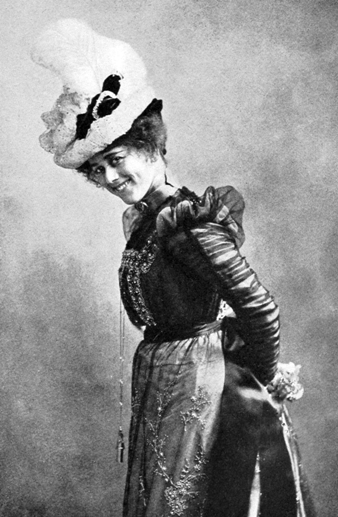
Copyright, 1898, by B. J. Falk, Waldorf-Astoria, N. Y.
EDNA WALLACE-HOPPER.
A captivating atom of femininity was Edna Wallace when she succeeded Della Fox as the soubrette foil to the DeWolf Hopper's long-leggedness. What a happy girlish smile she had,—her eyes sparkled and danced so merrily, the little dimples in her cheeks were so altogether alluring! Edna Wallace Hopper never was much of a singer, but she was so pretty and so delicate that one never troubled himself about her voice; he was chiefly concerned lest she might thoughtlessly break into bits. She was vivacity itself, vivacity that never seemed noisy nor forced, just the spontaneous expression of natural blithesomeness; and her magnetism could not be escaped. Although she could not sing, she could act in her soubrettish way, for her little experience on the stage had been spent with plays and not with operas.
The art of the soubrette is about the hardest thing in the world to pin down for examination. In fact, in many cases, the word "art," in connection with the soubrette, is purely conventional; instinct would more correctly describe the means employed by her to gain her stage effects. Dramatic instinct is, of course, the corner-stone of the actor's mental equipment. Indeed, we all have to a degree that involuntary notion what to do under certain circumstances—wholly unexpected circumstances possibly—to create the impression we wish to make. Preachers have it abundantly, or else their words from the pulpit would be ineffective; lawyers are also exceptionally endowed with it, or else their addresses to the jury would be worse than useless; teachers, family physicians, the man who makes politics a profession, all must have the dramatic instinct to win any great success.
In the case of the soubrette, dramatic instinct is limited in its field. She does not, as a general thing, attempt impersonation, and she never is called upon to do anything more than slightly ruffle the surface of emotional possibilities by a faint appeal to the sentiments. Her dramatic instinct is chiefly concerned in presenting to the best advantage an attractive personality and sparkling temperament backed up by a pretty face and a pleasing figure. Herein lies the difficulty of writing about soubrettes. Having called them happy, gay, graceful, altogether charming, one finds that he has nothing more to say. He cannot talk about their art, for their art is merely themselves, indefinable and impossible of description. He cannot talk about the characters they have played, for they have never played but one, and that themselves. Edna Wallace Hopper's Paquita in "Panjandrum," for example, was none other than her Estrelda in "El Capitan." The environment was different and the raiment was different, but the character was the same.
Now a personality cannot be put on paper; it cannot be talked over except in the most superficial and unsatisfactory way. It can only be felt. When one has declared that a certain actor's personality is unusually attractive, he has spoken the last word. Edna Wallace Hopper, in common with all other light opera soubrettes, is a personality. She is there to be liked or disliked just as the notion happens to strike one; but whether one likes or dislikes her, there is no possible ground for an argument about the matter. This person here, who is unmoved by her presence, may claim that she cannot sing and that she is wholly artificial. That person there, who finds her altogether delightful, will declare that he does not care whether she sings or not, and such a dainty creature is she that her frank artificiality is a positive delight.
Personally I have always found Edna Wallace Hopper exceptionally entertaining. I first bowed the knee before her smile and her coaxing dimples—a great deal of Mrs. Hopper's fascination is smiles and dimples—when she was very new to the stage, and I have never wholly escaped from their thraldom since that time. I acknowledge freely all her shortcomings,—her lack of versatility and resourcefulness, her narrowness of range,—but as long as she keeps her smile and her dimples, I am certain that I shall never be absolutely insensible to her allurements. She is wholly and fixedly a soubrette, a pretty, dancing, laughing creature without a suggestion of seriousness or the slightest trace of emotion. She is not to be studied, and she does not pretend to any depth of illusion. She is an impression, to be admired or scorned always in the present tense.
Edna Wallace was born in San Francisco and was educated at the Vanness Seminary there. It was due entirely to Roland Reed, the light comedian, that the idea of going on the stage ever entered her head. Mr. Reed met Miss Wallace at a reception while he was playing in San Francisco in 1891. She was then not far from seventeen years old. Impressed with her vivacity, he laughingly offered her a position in his company, and, behold! the mischief was done. She accepted quickly; and although her parents did not approve of the plan in the least, she journeyed east during the summer, and in August made her appearance at the Boston Museum with Mr. Reed as Mabel Douglass in "The Club Friend."
Two weeks later she acted in the same play at the Star Theatre in New York, where six weeks later she was given the leading ingénue rôle in "Lend Me Your Wife." She attracted the attention of Charles Frohman, and was engaged by him, appearing successively as Lucy Mortan in "Jane," Mrs. Patterby in "Chums," Margery in "Men and Women" and as Wilbur's Ann, the boisterous frontier maiden, in "The Girl I Left Behind Me."
It was while she was acting in this play in June, 1893, that she was married to DeWolf Hopper. A few weeks after this, Della Fox, the Paquita in "Panjandrum," was taken suddenly ill and journeyed off to Europe. Mrs. Hopper jumped into the part and played it successfully until the end of the New York season. The following comment on Mrs. Hopper shortly after her first appearance in light opera is interesting:—
"A winsome little woman recently bounded into the affectionate regard of New York audiences at the Broadway Theatre. The severely critical may take occasion to compare her with her predecessor as Paquita in 'Panjandrum,'—possibly to her disadvantage in some instances,—but the fact still remains that the audiences like her immensely, because she is young, pretty, modest, and because she can act. Edna Wallace Hopper, if not able to sing quite as well as some comic opera performers, is a capable actress, and in this respect her advancement has been somewhat remarkable."
In the fall Mrs. Hopper returned to Charles Frohman's management, but she was not long after released from her contract so that she could assume the part of Merope Mallow in DeWolf Hopper's production of "Dr. Syntax." This was a decidedly attractive bit of work natural and artistic. On the road she also assumed Della Fox's old character of Mataya in "Wang." When "El Capitan" was produced in Boston in April, 1896, she created the part of Estrelda, the hero-worshipping coquette, her first original rôle, by the way, in opera, for her character in "Dr. Syntax" was taken directly from a similar conception in "Cinderella at School." This was her last rôle with the Hopper organization, for while it was still a popular attraction, domestic difficulties separated her from Mr. Hopper, and she retired from the company at the expiration of her contract with Ben Stevens, the manager.
Mrs. Hopper next appeared in "Yankee Doodle Dandy," an extravaganza of doubtful merit, and with Lillian Russell in a revival of "La Belle Hélène." During the season of 1899-1900, she shared the honors with Jerome Sykes in the extravaganza, "Chris and the Wonderful Lamp," acting the part of the sophisticated youth Chris.
CHAPTER X
PAULA EDWARDES
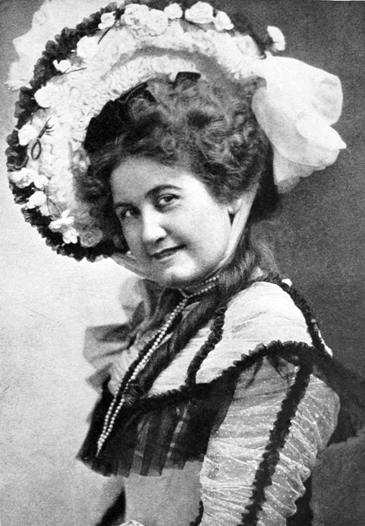
PAULA EDWARDES.
One of the few young and pretty women making a specialty of eccentric comedy parts is Paula Edwardes, a Boston girl, who, starting at the foot of the ladder only a few seasons ago, has quickly claimed a position of prominence in the musical comedy world. Miss Edwardes's most recent characterizations have been two different varieties of the Cockney type in "A Runaway Girl" and "Mam'selle 'Awkins," but previous to that she gave a taste of her ability in this line of impersonation by creating in "The Belle of New York" the rôle of Mamie Clancy, the Bowery girl, a type of character which is nothing more nor less than an Americanized Cockney. I have no idea where Miss Edwardes picked up her weird and wonderful Cockney dialect, unless she got it during her short visit in London with "The Belle," for she was born and brought up in Boston, where, as every one knows, nothing is spoken except the purest of Emersonian English. Neither will I vouch for the accuracy of Miss Edwardes's importation. However, it sounds English enough, and it is certainly hard enough to understand to be the real thing.
There are two ways of presenting a character study of the uncultivated types of civilized humanity. One is faithfully to imitate the original, sparing not in the least vulgarity, uncouthness, and coarseness. The comedy in this method is the crude product of incongruity and contrast. The second method is merely to retain a recognizable likeness to the original, to tone down the vulgarity, to reduce the uncouthness to a suggestion, and to rely for effect on an heightened sense of humor. There is also introduced in this second method of treatment a subtle, but nevertheless distinct, self-appreciation of one's own unfitness for polite society and social conventions,—a cynical atmosphere, as it were, that gives the study a touch of satire.
The first method is usually adopted by the unpolished and unthinking actor of variety sketch training, and often, too, by the acrobatic and strictly mechanical comedian of light opera surroundings. It is comedy acting which proves vastly amusing to such as desire their theatrical entertainment as devoid as possible of any intellectual flavor, who do not care to hunt for a fine point, and who are bored by anything that suggests an intelligent appreciation of humor. The comedy of the second method is on a decidedly higher plane. It suggests more than it actually represents. It is more delicate in every way, and it requires a modicum of intelligence on the part of the spectator to be estimated at its full value.
Miss Edwardes's Carmenita in "A Runaway Girl" was a genuine characterization. She did more than to array herself in garments of curious pattern, stain her face a gypsy tan and talk a Blackfriars-ish, or alleged Blackfriars-ish dialect, that was wellnigh incomprehensible; she also imparted an individuality to the rôle, and one got from her acting a distinct impression of Carmenita, the woman. Such was the case, too, with her Honorah in "Mam'selle 'Awkins." She evolved, from the precious little material that was given her, a personality. Josephine Hall, on the other hand, let the character go completely by the board, and relied entirely for success on her ability as an entertainer. I will not say which achieved the better results in this particular instance, for the entertainment in which they appeared was too absurd to be considered seriously even as an absurdity. Miss Edwardes, however, adopted the more artistic treatment of the two.
Paula Edwardes went into the theatrical business on the strength of a voice, a face, and a figure, which is simply another way of saying that she began in the chorus. It happened in Boston, and the occasion was the professional production by Thomas Q. Seabrooke of the First Corps of Cadets' extravaganza, "Tobasco." Miss Edwardes was understudy for Elvia Crox, the leading soubrette, and a little luck came the chorus girl's way at the first matinée. Miss Crox declared that she was too ill to play, and Miss Edwardes took her part for the afternoon, succeeding so well that Miss Crox rapidly recovered her health and was able to appear at the evening performance.
Nevertheless, the next season still found Miss Edwardes in the chorus, this time with Hoyt's "A Black Sheep." Again Boston was good to her, for when the company reached that city, Bettina Gerard, who was playing the Queen of Burlesque, was affected by the climate or something of that kind, threw up her part, and Miss Edwardes was pressed into service in the emergency. Her success was sufficient to put an end for good and all to her chorus experience. The following season Miss Edwardes was in "A Dangerous Maid" with Laura Burt and Madge Lessing, and then she created the part of Mamie Clancy in "The Belle of New York." She went to London with the original company, but after a few months she became tired of the fog and homesick for New York and the familiar surroundings of Broadway and the Rialto. So she resigned from "The Belle" cast and took the next steamer for the United States. Augustin Daly engaged her for Carmenita in "A Runaway Girl," and at the conclusion of the run of that piece in New York she was transferred to "The Great Ruby" in which she made quite a hit as Louise Jupp, the romantically inclined hotel cashier.
In February, 1900, she appeared in "Mam'selle 'Awkins," creating the title rôle, and after that she acted in Boston and New York her old part of Carmenita in "A Runaway Girl."
CHAPTER XI
LULU GLASER
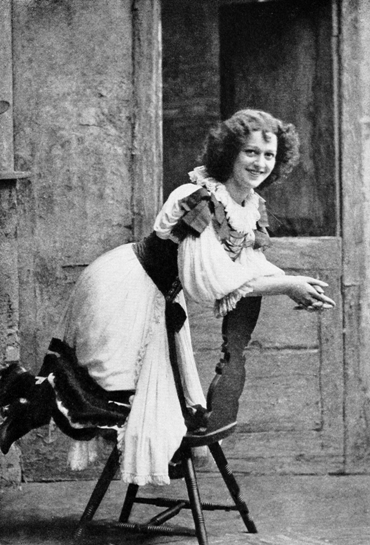
LULU GLASER.
A very few years ago Lulu Glaser was known only as "Francis Wilson's new soubrette." That continued for several seasons after she succeeded the fascinating Marie Jansen,—she of the rippling laugh and the form of inscrutable perfection. Lulu Glaser was a bright, sparkling girl in those days of her earlier successes, winsome in personality and as pretty as a picture with her light fluffy hair and her eyes that still retained their girlishness. Her vivacity was remarkable, and her spirits were unflagging. She worked with all her might to please, and she was successful to an unusual degree.
Too bad that those excellent qualities—vivacity, freshness, and unsophisticated youthfulness—should have so nearly proved her undoing! Too much kindness on the part of those who wished her only the utmost good, indiscriminate praise and the conventional applausive audience, together with association with Francis Wilson, an excellent comedian in his own line, but not a player who will bear imitation, have brought Miss Glaser to a most critical period in her career. Her personal popularity, it is true, has not suffered as yet,—at least, not to any appreciable extent,—but her reputation as an artist is already on the wane among discriminating judges. She should rank with the very best of our light opera soubrettes, but it would not be true to say that she does.
Miss Glaser's utter lack of any notion of the inherent fitness of things and of her own position as a paid entertainer is shown most conspicuously and most persistently in her exasperating habit of "guying" every performance in which she participates. Here is a young woman of unquestioned talent both as an actress and a singer, bound down hill simply and solely for the want of restraining good sense and proper discipline. She is much in need of the fatherly advice of a hard-headed stage manager, who would curb that vivacity which has run riot and squelch effectively a condition of cocksureness that is amazing in its effrontery. The trick of "guying" may seem to those on the stage very pretty and highly amusing, but to an audience it is at first surprising, then bewildering, and finally utterly wearisome and disgusting.
The actor, who systematically makes sport on the stage for the benefit of his fellow-players instead of attending to his own business of amusing those who have paid their money for entertainment, commits a breach of artistic etiquette that is wholly inexcusable. The stage is a dangerous place for one to give free rein to personal adoration. I have known actors who were free from conceit and complete self-satisfaction, but they are comparatively few. Fortunately, however, this generous estimate of one's own attainments does not often, as in Miss Glaser's case, intrude itself into the actor's art. Still, is her condition of mind to be wondered at? She was only a girl when she began to be the subject of kindly notoriety. She was praised, praised, praised, and, worst of all, she was without the restraining influence of a strict disciplinarian.
From desiring above all else to please her audience, and with that end in view, giving lavishly on every occasion the very best that was in her, she developed a frame of mind that conceived her position to be directly opposite to what it really was. She began to feel that the favor was on her side,—that her audience should be grateful to her for taking part in the show. She acquired an atmosphere of condescension and patronage which would have been ridiculous if it had not been so provoking. This curious attitude was noticeable to a considerable extent in "The Little Corporal;" but it could be endured there, for "The Little Corporal" was, in comparison with the average, an opera not altogether without merit. In "Cyrano de Bergerac," however, that wretched misconception, Miss Glaser's egotism bloomed forth in an astonishing fashion. She was almost below the sphere of serious attention.
It is painful to speak so harshly of a woman naturally so charming as Miss Glaser, whom I would be only too glad to eulogize in rainbow-hued words. I confess that I like her, but that is my weakness. Indeed, if I did not like her, and if I were not convinced of her genuine ability, I should not distress myself to the extent of being honest with her. Sometimes I have even thought that she had a sense of humor until her persistent "guying" knocked the notion out of my head. "Guying" does not signify a sense of humor. A sense of humor includes, besides the ability to comprehend a joke in a minstrel show, a saving appreciation of the ridiculous in one's self as well as in humanity at large. This quality of looking at one's self from the viewpoint of some one else is rare in man, but it is still rarer in woman. Woman, however, is more expert than man at "faking" a sense of humor.
When Miss Glaser really gets down to business and makes fun wholly for her audience, she is a most entertaining little woman. Her talent for burlesque is unmistakable, although her characters do not always have the atmosphere of spontaneity. Her whole experience having been with Francis Wilson, it is not strange, perhaps, that she should have adopted some of his methods. A comic opera comedian, whose humor is so much a matter of individuality, is the last person in the world to be imitated. In many cases he is an acquired taste, and almost always he is only conventional, trading on a trick of personality.
Lulu Glaser was born in Allegheny City, Pennsylvania, on June 2, 1874, and continued to live there until she joined Francis Wilson's company in 1892.
"I surely inherited no longing for the stage," once remarked Miss Glaser, "for none of my family ever had any professional connection with the theatre. I just had a passionate longing to sing. I talked of it incessantly, and finally father said to mother: 'Let her try it; she will never be satisfied until she does. You go with her to New York, and we shall see what comes of it.' So to New York my mother and I went, and through a friend who knew somebody else who knew Francis Wilson's leader of the orchestra, I got an introduction to this all-important personage.
"Well, I think it was all of a month we had to wait before the interview could be arranged, and then one eventful day I sang for Mr. de Novellis on the stage of the Broadway Theatre. No, strangely enough, I wasn't nervous in the least. The song, I remember, was 'My Lady's Bower;' and when I had finished it, Mr. de Novellis said that he would suggest that I should see Mr. Wilson,—'the great Wilson,' as I described him in a letter to my father after the first interview. The company was to produce 'The Lion Tamer,' and Mr. Wilson made me understudy to Miss Marie Jansen, meantime giving me a place in the chorus.
"My chance to sing alone came sooner than I anticipated, before I was ready for it, evidently, because on the night when Miss Jansen fell ill, and I was to take her place, I fainted before the curtain went up. But I was not discouraged. 'She is sure to do splendidly now,' said Mr. Wilson, when he heard of that faint. A few months later, Miss Jansen resigned to become a star, and Mr. Wilson informed me, while I was still in the chorus, that I was to have her place. And he regarded it as the greatest achievement of my life, that for the remaining weeks of the season I never told a soul of what was in store for me."
During her first season Miss Glaser played, besides Angelina in "The Lion Tamer," Lazuli in "The Merry Monarch." Then she tried Javotte in "Erminie," which performance added greatly to her reputation. It is perhaps, the best thing that she has ever done, and certainly bears comparison with the work of other soubrettes in the part. Her next rôle was that of Elverine in "The Devil's Deputy," and from this came still more praise. The rather sedate—for a soubrette—character of Rita in "The Chieftain" was her next exploit. This was what might be termed a "straight" part, and was only given to Miss Glaser after two other rôles had been assigned to her. "The Chieftain" was produced in the fall of 1895. When Mr. Wilson secured the opera the previous spring, he told Miss Glaser that she was to play Dolly.
"Very well," said she, not in the least surprised, for the rôle was precisely in her line. But she had scarcely begun to plan her conception of the character when somebody discovered that Dolly appeared only in the second and last acts.
"That will never do, you know," said Mr. Wilson. "I tell you what we will do, you must be Juanita, the dancing girl. That is the soubrette part, after all."
"Very well," said Miss Glaser again, with perfect confidence that she would be cast to the best advantage, whatever happened.
The season ended, Miss Glaser went with her mother to their summer home at Sewickley, just out of Pittsburg, and Mr. Wilson sailed for Europe. He saw "The Chieftain" in London, and at once sent a cablegram to Sewickley: "You are to play Rita." This was indeed a surprise to Miss Glaser,—to be the dignified prima donna of the house bill! It almost took her breath away.
"Do you think I can do it?" she asked Mr. Wilson, when he returned.
"I will stake my reputation on it," was the prompt reply.
So when Sullivan's opera was produced at Abbey's Theatre in New York in September, the public and the critics declared that Mr. Wilson's leading woman was as strong in the "straight" parts as she had proved herself to be in the lighter lines in which she had first won her reputation.
"But, oh, wasn't I nervous that first night!" confessed Miss Glaser. "And didn't I pick up the papers the next morning with fear and trembling!"
Miss Glaser, before the run of the opera was over, however, found her part in "The Chieftain" somewhat hampering, and she was pleased enough when Pierrette in "Half a King" placed her back in the ranks of the joyous and captivating soubrettes. Light-hearted, too, was her part in "The Little Corporal," a rôle which travelled all the way from the long skirts of a court lady to the not too tight trousers of a drummer boy in the French army.
In "The Little Corporal" one could not help but notice how great an influence Mr. Wilson's clowning methods had exercised on Miss Glaser. Mr. Wilson, however, was artistic in his fooling, and was not given to overdoing the thing, which was not strange, for he had been at it a good many years.
Miss Glaser especially worked to the limit the old "gag" popular with variety "artists," of laughing at the jokes on the stage as if they were impromptu affairs gotten up for her especial benefit. She did it rather well, although she did it too much. Perhaps because the jokes were funny and one laughed at them himself, one liked to think that Miss Glaser—some time before, of course—did see something funny in Mr. Wilson's remarks, and that she laughed at them now because she remembered how she had laughed at them at first. Marie Jansen used to laugh, too, when she was with Mr. Wilson, and her laugh was a wonderful achievement,—a thing of ripples, quavers, and gurgles. And this coincidence suggests a horrible thought. Possibly Mr. Wilson himself was to blame for these laughs. Possibly he stipulated in the bond that his soubrettes should laugh early and often at his jokes as a cue to the audience. In the early scenes of "The Little Corporal," regardless of laughs and all else, Miss Glaser was captivating, and her first song—it was something about a coquette, as I recall it—was a fetching bit of descriptive singing.
During the season of 1899-1900, Miss Glaser played Roxane in "Cyrano de Bergerac," and Javotte in "Erminie."
CHAPTER XII
MINNIE ASHLEY
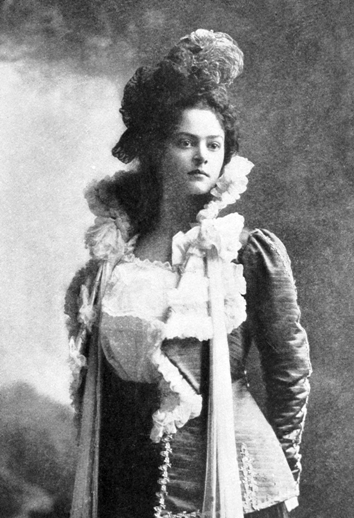
MINNIE ASHLEY.
Artless girlishness, remarkable personal charm, and skill as an imaginative dancer scarcely equalled on the American stage, account for Minnie Ashley's sudden success in musical comedy. Aside from her dancing, which is artistic in every sense, she is by no means an exceptionally talented young woman. Nature was indeed good to her when it endowed her with a most fascinating personality, a pretty, piquant face, and a slim, graceful figure, but it was by no means lavish with other gifts most desirable. Miss Ashley's range as an actress is decidedly limited; she is not to the slightest degree versatile, and she has no notion at all of the art of impersonation. Her singing voice is more of an imagination than a reality, although one is sometimes deceived into believing that she can sing in a modest way by the admirable skill with which she uses the little voice that is hers. She has a due regard for its limitations, and she delights one by the clearness of her enunciation and the expressive daintiness of her interpretation of the simple ballads that show her at her best.
Nothing could be more exquisitely charming than her art in such songs as "The Monkey on the Stick" and "The Parrot and the Canary" in "The Geisha," "A Little Bit of String" in "The Circus Girl," and "I'm a Dear Little Iris" and "This Naughty Little Maid" in "A Greek Slave." These songs are all of the same class,—little humorous narratives, or, better yet, funny stories set to music. Miss Ashley seems almost to recite them, so perfectly understandable is every word, yet she keeps to the tune at the same time. Not a point in the story is overlooked, and every phase of meaning is captivatingly illustrated in pantomime. Miss Ashley's pantomime, like her acting, is limited in quantity; so limited, in fact, that it suggests, after one becomes familiar with it, the fear that it is all mannerism. Even at that, I doubt if any one can escape its persuasive appeal, can remain absolutely cold and unresponsive before those eyes so full of roguish innocence, those lips smiling a challenge, and that pretty bobbing head shaking a negative that means yes.
However, if he be unmoved by Miss Ashley's singing, he surely cannot resist her dancing. It is as an illustrative dancer that Miss Ashley is supreme. She is the one woman who comprehends dancing as something more than violent physical exercise, who appreciates the art of dancing in its classic sense as a means of symbolic and poetic expression. Minnie Ashley dances with her whole body moving in perfect unity and in perfect rhythm. She is the personification of grace from head to foot, and there is vivacity and joy and fulness of life in the saucy noddings of her head, the languorous sway of her form, the sinuous wavings of her arms and hands, and the bewildering mingling of billowy draperies and flashy, twinkling feet. When Minnie Ashley kicks, she does so delicately and deliberately,—kicks that end with a shiver and quiver of the toe-tips.
It has been Miss Ashley's good fortune in most of her parts to be permitted to dance in long skirts. As Gwendolyn in "Prince Pro Tem," however, she wore the conventional soubrette skirt of knee length. It was surprising what a handicap it was to the full effectiveness of her dancing. Miss Ashley is not a whirlwind dancer; she does not sacrifice grace for speed, nor dignity for astounding contortions of the body. Knowing full well the value of the artistic repose and the crowning fascination of suggestion, she handles her draperies with that rare skill which makes them seem a part of herself. Their sweeping softness destroys all crude outlines, and they are at the same time tantalizing provokers of curiosity. The short skirt—blunt, plain-spoken, and tactless—compelled the substitution of abandon for sensuousness, and consequently a sacrifice of coquetry and suggestiveness.
Minnie Ashley was born in Fall River, Massachusetts, in 1875. Her family name was Whitehead. When she was very young her father and mother separated, her mother going to Boston and taking Minnie with her. The mother afterward was married to a man by the name of Ashley, and it was as Minnie Ashley that the dainty actress was always known during her girlhood in Boston. She lived and went to school both in Roxbury and the South End; and she learned her first dancing steps, as thousands of city children do, by tripping away on the sidewalk to the grinding music of the hand-organ.
Her first appearances in public were made at the children's festivals on Washington's birthday in the old Music Hall, Boston. The first year she was the Queen of the Fairies with a number of other school-children as subjects; and the next year, after demonstrating that she could dance, she was promoted to the position of solo dancer, and a feature of the entertainment was her exposition of the intricacies of "The Sailor's Horn-pipe." Her native talent, so prettily shown at these children's festivals, attracted the attention of a teacher of dancing, who took Miss Minnie under her charge and gave the child the instruction that was necessary to develop her gifts to the best advantage.
During the summer the teacher took her promising pupil to the summer resorts in the White Mountains. There the guests were charmed, and the boys and girls of ambitious parents were instructed in the art Terpsichorean. This lasted until Miss Minnie came to the conclusion that she was doing all the work while her companion was reaping most of the profits. So they quarrelled about it and separated, Miss Ashley returning to Boston firmly resolved to go upon the stage as a professional dancer.
At that time Edward E. Rice was organizing a company to produce the R. A. Barnet spectacle, "1492," and to him Miss Ashley applied. She succeeded in getting a place in the chorus. When DeWolf Hopper brought out "El Capitan" in Boston in 1896, she was still in the chorus, although she was permitted to understudy Edna Wallace Hopper. Miss Ashley, however, had developed since the days of "1492," and although she was in the chorus, she was by no means of the chorus. Her individuality was so pronounced, her magnetism so potent, that the largest chorus could not conceal her. She literally stood forth from the group, a graceful and beautiful figure, animated, interesting, and pertly captivating. She had something of the spirit of France about her, or at least what we think is the spirit of France; and it was not altogether strange, therefore, that her first engagement outside the chorus should have been to act a French girl. This occurred in a musical comedy called "The Chorus Girl," which was brought out at the Boston Museum after the close of the regular season in 1898. "The Chorus Girl" was pretty poor stuff, but Miss Ashley's personal success was considerable.
The following season J. C. Duff put "The Geisha" and "The Circus Girl" on the road, and Miss Ashley played Mollie Seamore in "The Geisha" and Dolly Wemyss in "The Circus Girl." In May, 1899, when "Prince Pro Tem," a musical comedy by R. A. Barnet and L. S. Thompson, which has never played a successful engagement outside of Boston, was revived, Miss Ashley appeared as Gwendolyn. Those who heard Josie Sadler sing "If I could only get a Decent Sleep" in "Broadway to Tokio," may be interested to know that this touching ballad was originally one of the chief hits of "Prince Pro Tem." "Prince Pro Tem," with its numerous deficiencies, had one thoroughly artistic character, Tommy Tompkins, the showman. Fred Lenox acted the part; and a capital bit of comedy it was, too, deliciously humorous in its depreciating self-sufficiency, wonderfully clever as a loving and sympathetic caricature, and thoroughly convincing as a sincere study of human nature, a Thackeray-like creation, which was worthy of a more pretentious setting than it received in Mr. Barnet's show.
When "A Greek Slave" was produced in New York in November, 1899, that city discovered Minnie Ashley and forthwith shouted her name from the housetops. "A Greek Slave" was not a success, but Miss Ashley's Iris was. As the "New York Telegram" said:—
"And there is Minnie Ashley. A slim, graceful, attractive young woman, with scarcely the suggestion of her wonderful magnetic power in her slender outlines. Two minutes after she had made her entrance, the house was hers and all that therein was. She couldn't sing in the same country with Dorothy Morton. She couldn't act in a manner to warrant attention on that score—and she knew it, and didn't make any harrowing attempts to reach what was beyond her. She knew herself. There was part of the secret. She didn't endeavor to gather in impossibilities. She simply came out and played with that audience as a little child would play with a roomful of kittens. 'You may purr over me and lick my hand and look at me with your great, appreciative eyes,' she told her kittens, 'and in return, I will stroke you and soothe you, and charm you.'
"And she certainly did charm that house. She has a pleasing little voice which she uses with utmost judiciousness. She has an innate grace and refinement that are most telling accomplishments. As she informed us in her opening song, 'I'm a Dear Little Iris,' a slave girl, who knows how to drape herself and how to execute the steps of the airiest, fairiest dances. There have been many times at the Metropolitan Opera House when great singers have been overwhelmed by the fierce applause of an emotional audience. Then the bravos have been shouted and the enthusiasm has reached a fever pitch. But before last night these scenes have formed no part of the programme at the Herald Square. Miss Ashley changed that old order, and changed it with the lightness and lack of perceptible effort which characterized her whole performance. The house simply went wild over this practically unknown girl. Her name was called again and again, and the encores of her pretty little songs stretched the opera out far beyond its legitimate length. The house admired the daintiness, the womanliness, and the suggestion of the thorough-bred in this young girl. The poise of her head, the poetical motion of her body, the total lack of self-consciousness, these were constant delights."
"To Minnie Ashley," declared the "Boston Transcript," a few weeks later, when "A Greek Slave" was played in Boston, "fell nine-tenths of the honors of the performance, and she gave another impersonation fully as charming as those with which she has been associated in 'The Geisha,' 'The Circus Girl,' and 'Prince Pro Tem.' She was a dainty little slave, demure as was befitting the character, but with a way that was certainly irresistible. She is a real comédienne, and each of the points in the few funny lines that fell to her lot was capitally brought out. Especially clever was the song about 'The Naughty Little Girl' in the second act, where she made the hit of the evening. Nature never intended her to be a prima donna, but it gave her the power to sing a song like that in a way that leaves nothing to be desired, and when she dances—well, it doesn't matter in what language she dances; Latin, Japanese or Yankee, the result is just the same."
While she was with DeWolf Hopper, Miss Ashley was married to William Sheldon, a half-brother of Walter Jones, from whom she was afterward separated.
CHAPTER XIII
EDNA MAY
A pretty face and a gentle, winning personality brought Edna May into prominence in the most dramatic fashion. Edna May Petty, the daughter of E. C. Petty, a letter-carrier in Syracuse, New York, lovely to look upon and demure in manner, had some talent for singing, but more for dancing, when her parents yielded to her entreaties and said that she might go to New York to study for the stage. She was only sixteen years old. Hardly had she settled down to her singing and dancing lessons, however, when along came Fred Titus, at that time the holder of the hour bicycle record and one of the most prominent racing men in the country. They were married, but Edna May remained just as determined as ever to go on the stage. Her ambitions were forced for a time to be satisfied with occasional opportunities to substitute in church choirs. Her name first appeared on a playbill when "Santa Maria" was produced at Hammerstein's in New York, but the part was so small as to be practically non-existent. Then she was engaged for White's Farcical Comedy Company and appeared in Charles H. Hoyt's "A Contented Woman."
At this point there is a dispute as regards Miss May's next move, or at least there was a dispute until manager and star patched up their difficulties. George W. Lederer was wont to claim that Edna May joined the chorus of his prospective "The Belle of New York" company. At the last moment, the woman whom he had engaged for leading part disappointed him. He had to do something quickly, and he cast about in his own chorus for a girl who might fill the part for a night or two until he could find someone to take it permanently. His discerning eye fell on the plaintive prettiness of Edna May. "She'll look the part, anyhow," he declared. So in this haphazard fashion, Violet Grey, the Salvation Army lassie, was passed over to her, and, presto! her fortune was made.
"But it was not that way at all," pouted the gentle Miss May, after she had signed a contract to leave Mr. Lederer and return to London under some one else's care. "I never was in Mr. Lederer's chorus. I went to Mr. Lederer after I had been playing a small part in the 'Contented Woman' company. I begged him to put my name down for something even if it were ever and ever so little, and he gave me the part of Violet Grey in 'The Belle.'"
At this time, also,—this period devoted by Miss May to the signing of the contracts, which never amounted to anything, after all,—a second dispute arose regarding Miss May's indebtedness to Mr. Lederer for her success in "The Belle." Mr. Lederer announced to a deeply impressed public that he had trained Miss May with the most extraordinary attention to detail. He had made her walk chalk-lines on the stage, and had written on the music-score minute directions regarding gestures, even indicating the exact point where she was captivatingly to cast down her eyes.
"No, no, no," declared Miss May. "All that is very unkind and very untrue. He did not teach me all or nearly all I know about my art, and he did not have to write out gestures and full directions for my conduct on the stage. Not one word of this sort of thing was written in the score. Mr. Lederer rehearsed me, it is true, but not as if he were rehearsing a performing seal. He gave me an opportunity, and for that I am very grateful. But that is all he did. I am not such a fool as Mr. Lederer is always pretending to think me."
However, regarding Miss May's extraordinary popular success in "The Belle of New York" in this country, and more especially in London, there can be no dispute. That is a fact discernible without opera glasses. It was, however, almost wholly a triumph of personality. Violet Grey is what actors call a "fat" part. The Salvation Army lassie, a quaint, subdued, almost pathetic figure, thrown in the midst of the contrasting hurly-burly and theatrical exaggerations of a typical musical farce, appeals irresistibly to the spectator's sympathy. She touches deftly the sentiments, for in her modest way she is a bit of real life, a touch of human nature, in surroundings where the men and women of every-day life are complete strangers.
But Violet Grey is not a rôle to be acted. It is not, in the strictest sense, a dramatic character at all, merely a picture from life, set forth without comment and without exposition. One sees all that there is to see, the instant Violet Grey appears on the scene; he recognizes at once her reality and her fidelity to nature, and he falls a victim to her charm without further ado. The actress cast for this part must in a sense live it. She must, as Mr. Lederer said, "look the part;" she must suggest at a glance, modesty, demureness, quaintness, spirituality, and idealism. Coquetry, any notion of archness or frivolity, must be rigorously banished. There her responsibility practically ends, for folded hands, cast-down eyes, and the ability to sing a little do the rest.
Success in such a part as Violet Grey affords not the slightest test of artistic ability, and Edna May's artistic future is still a matter of doubt. She has appeared in only one operetta aside from "The Belle,"—"An American Beauty," brought out in London by an American company in April, 1900.
The remarkable feature of Miss May's career was the furore that she created in London, where, due as much to her personal popularity as to any other one thing, "The Belle of New York" ran for eighty-five weeks. It was wonderful, when one thinks of it, that sweet simplicity could do so much. Of course, when Miss May returned to this country in January, 1900, she had many pleasant remarks to make about the Londoners. Speaking of the opening night, she said:
"I played the part during the long run in the United States, so I was very used to it, and there was nothing out of the ordinary about the first night in London, until the sensation caused by their tremendous applause came to me. There is nothing like it, nothing that approaches it. It is quite the most delicious sensation on earth. I don't expect ever to feel it again quite as I did that night. It's like the first kiss, you know, or the first anything. After that it's only repetition.
"Success was particularly sweet to me at that time, but it was something of a shock. I wasn't looking for such a reception. They not only applauded, they shouted and deluged me with flowers. The next day I found myself talked about everywhere. I had done nothing but be natural, and do my best, yet they praised my talent. They kept my rooms flower-laden; they sent me rich gifts, and what was more,—oh, a great deal more,—they held out to me the hand of friendship, men and women alike, and made me one of them.
"There is one of the most marked differences between London and New York. Here a girl who enters the profession is ostracized; there it is considered an added charm. Here if a girl of any social position chooses a stage career, it must be at a great personal sacrifice. There, whatever social prestige she may have will be an aid to her in her professional ambitions. One of the greatest helps to me in London was the way the genuine people of the aristocracy opened their doors to me, and made me welcome in their lives and homes. For my own part, I did not know that it was possible for so much happiness to come to a single life as I have realized during the past two years abroad."
CHAPTER XIV
MARIE CELESTE
Almost as necessary as a singing voice to the young woman who would venture into light opera and musical comedy, are physical attractiveness and personal magnetism. An unusually good voice, daintiness of face and figure, and a winsome personality. Marie Celeste has, and she has one other quality which to me makes her work on the stage especially enjoyable. That is her total lack of affectation. When one sees her he is not conscious of that irritating screen of artificiality that so often darkens and sometimes hides completely the personality on the stage. An actor, to be effective, must show a personality of some sort. It may not be his own, but it should appear to be his own. The ability, under the conditions represented in the theatre, to convince an audience that the personality represented is a real personality constitutes that branch of acting known as impersonation.
Actors try to accomplish this deception by various means. They bring to their aid wonderful skill in make-up and astonishing ingenuity in pantomime; but these external devices fail, every one of them, to produce the impression desired, unless the final effect on the mind of the person to be convinced is one of simplicity and sincerity. To create this impression of simplicity and sincerity, the actor must project his character mentally as well as reproduce it physically; he must appeal to the mind as well as to the eye; he must know human nature; he must study and experiment, and he must have the dramatic temperament.
Simplicity and sincerity of this kind are none too common on the stage, and especially is one not apt to find them among the men and women who interpret any form of opera. There are two simple reasons for this. One is that the operatic singer who has a chance to study naturally enough seeks first of all to improve the voice on which he is so dependent. Acting he regards as something that can be quickly acquired from the ubiquitous stage manager. The second reason is that, even in the case of singers who can act, the artificiality of the operatic scheme—drama united with music—is bound to affect the player's art. The player in opera acts, not as men and women act, but as operatic tenors or sopranos or bassos have acted ever since opera came into being. In fact, we have become so accustomed to strutting tenors and mincing sopranos that we accept what they have to offer as a matter of course. If only they sing well and their inherent artificiality be not too ridiculous, we are satisfied.
Yet when spontaneity and conviction are present, what a change in conditions they cause! They make opera—even the frivolous opera of the hardworking Harry B. Smith, who has what William J. Henderson calls the "operetta libretto habit"—seem real. One does not have to adopt the intended illusion by a sort of free-will process; it is forced on him.
Marie Celeste is one of the few actresses in opera. She has spontaneity and conviction, simplicity and sincerity, and in particular refreshing and unconscious naïveté. Her personality is attractive, winsome, and thoroughly feminine, and her style is vivacious, sparkling, and refined. Her voice is a high soprano of considerable power, and might easily of itself have won her a place on the operatic stage. As a matter of fact, however, her greatest successes have been in parts where singing was something of a secondary consideration. Both physically and temperamentally, Miss Celeste is best fitted for soubrette rôles, parts that require appreciative humor, girlish charm, and artistic finish, ability to dance, and some pretensions as a ballad singer. Miss Celeste's dancing is dainty and graceful, without physical violence, and with a hint of the poetry of motion that makes dancing something more than an athletic feat.
As Winnifred Grey in "A Runaway Girl"—a part in which personal charm counted for a great deal—Miss Celeste made a splendid impression largely through her ability as an actress. The music of the part was too low to show her voice to the best advantage, yet she sang the fetching "The Boy Guessed Right the Very First Time" song more effectively than any one I have ever heard. It is, of course, a simple enough ditty, which, however, demands considerable finesse, suggestive action, and a strain of humor to make it go as it should. The sentiment that she put into the second verse of the catchy little duet, "I Think 'twould Break my Heart," was exquisitely delicate and true. Except for a pretty moment at the end of the first act, there is little else than these two bits in the part, aside from an attractive monotony of brightness and happiness; and brightness and happiness, of course, are directly in the line of every musical comedy girl.
Marie Celeste—her full name is Marie Celeste Martin—was born and brought up in New York City. So far as she knows, she was the first one of her family to go upon the stage. In fact, from her mother she inherited a strain of Quaker blood, which certainly would never have countenanced a theatrical career. Her mother's grandfather, however, was a Frenchman, and from him probably came her artistic temperament. He was a bit of an inventor in his way, though apparently not a very practical one, a man who dreamed of great things, but like Cotta in "The Schönberg-Cotta Family" failed to bring them to an issue in time to reap any material benefit. Of an original turn of mind and a sanguine temperament, he experimented with many inventions from which he expected to derive fortune and fame. None of them amounted to anything, however.
Marie's father died when she was a girl studying music in the New York Conservatory, and she was obliged to look about for a means whereby to earn her livelihood. For some time she had thought of the stage,—say rather idly speculated regarding it as a possibility without ever really believing that she would sometime adopt it as her life-work. Naturally, therefore, it was to the stage that she turned at this time of adversity. Her ambition was opera. She knew that she had a voice, but she also knew that she could not act. With rare foresight in one so young, she made up her mind that the first thing for her to do was to learn to act, and she pluckily took an engagement in a stock company at Halifax, Nova Scotia. That was in 1890, and her first part was Fantile, the maid in Ben Teal's melodrama, "The Great Metropolis."
"Mr. Teal, whom afterward I came to know very well, and I have often laughed over that," said Miss Celeste. "But it was hard work in that stock company. We changed the bill twice a week, and sometimes now I think how often I have sat with a dress-maker on one side of me and my part in a chair near my elbow on the other side, memorizing my lines while I sewed away for dear life on my costumes."
Miss Celeste steadily gained in skill as an actress, and was given characters of increasing importance. She went with the company to Portland; and when she announced that she was going to leave the organization and look for an opening in opera, she was offered the position of leading woman as an inducement to stay.
After Miss Celeste returned to New York, she studied singing for a time, and then was engaged for the farce comedy, "Hoss and Hoss," which exploited Charles Reed, now dead, and Willie Collier, who is at present emulating the example of Nat Goodwin and trying to make himself over into a legitimate comedian. The company opened at the Hollis Street Theatre in Boston, on January 12, 1892, and Miss Celeste's character was Polly Hoss. It was not really a character though, only a name, and she was engaged not to act, but to sing. Everybody in the company thought that she was a beginner, and she did not tell her associates how she had barely escaped being leading lady of a two-bills-a-week stock-company.
"Hoss and Hoss" was a typical farce comedy of the Charles H. Hoyt school,—a plotless, formless thing, which was no play, but a vehicle. The chief object of the person that conceived it was to get every person in the company on the stage at the same time, toward the end of the third act. When this remarkable artistic feat was accomplished, a leading personage in the cast would remark with elaborate casualness:—
"Seeing we're all here and looking so well, suppose we have a little music."
Forthwith every one on the stage fell into the nearest chair in a helpless sort of a way, as if life were a veritable snare and delusion, and the master of ceremonies continued:—
"Miss Jones, will you kindly favor us with that beautiful ballad entitled 'Way Down upon the Swanee River?'"
And so they began, and thus they continued, until every one on the stage had his chance to air his talent before a highly entertained assemblage. It was not exactly a minstrel show, but it approached the minstrel territory. On the bill it was called the "olio."
Miss Celeste's part in the "olio" was to sing a ballad; and as no one knew anything about her, she was placed almost at the end of the list of entertainers. When she came to talk with Frank Palmer, the musical director of the company, he asked her what song she had chosen. She told him, and then he wanted to know what she was going to give as an encore.
"You know," said Miss Celeste, in telling me the story, "I wasn't very old, and I wasn't very big, and I was terribly nervous, and just a little frightened. I knew what I intended to sing, but it took all the courage I had to murmur gently, 'I'd like to sing, "Coming Thro' the Rye."'
"Never shall I forget the expression of disgust on Mr. Palmer's face.
"'I'll rehearse you, anyway,' was all he said.
"But I didn't tell him that I had taken a little advantage of him. As a matter of fact, I had sung 'Coming Thro' the Rye' in Halifax, in a part which required a song, and in which the old melody seemed appropriate. I knew I could make a success of it.
"We went on with the rehearsals,—Mr. Palmer and I,—and he was very kind and considerate after he heard me sing, transposed the music to a higher register, so as to show my voice to better advantage, and gave me any number of little points. When it was all arranged, he said:—
"'Now promise me one thing. Promise that you won't tell any one in the company what you are going to sing.'
"I promised. I suppose he was afraid that some one of them would make fun of me.
"'And you won't flunk, will you?' he added.
"'No,' I said, 'I won't flunk.'
"On the first night," continued Miss Celeste, "'Coming Thro' the Rye' brought me four or five recalls, and consequently after that the stage manager gave me a much better place in the 'olio.' That is the reason I call 'Coming Thro' the Rye' my mascot."
After her farce comedy experience, Miss Celeste became a member of Lillian Russell's opera company, appearing as Paquita in "Giroflé-Girofla," Petita in "The Princess Nicotine," and Wanda in "The Grand Duchess." During the season of 1894-95 she was with Della Fox in "The Little Trooper," singing the part of Octavie most charmingly, and acting as understudy to Miss Fox, whose rôle she played many times. The next season she returned to Miss Russell's company, making so effective as to attract considerable attention the trifling part of Ninetta in "The Tzigane." She also sang Gaudalena in "La Perichole," and the Duchess de Paite in "The Little Duke."
Miss Celeste was taken seriously ill in March, 1896, and her work during the following season was necessarily not very heavy. Under the management of Klaw and Erlanger she appeared as the Queen in "The Brownies," in which, by the way, she again sang "Coming Thro' the Rye;" and the following summer she made a decided hit as Peone Burn in the lively spectacle, "One Round of Pleasure." Mistress Mary in "Jack and the Beanstalk" followed, and then she succeeded Christie MacDonald as Minutezza in "The Bride Elect." Her last part was Winnifred Grey in "A Runaway Girl."
Miss Celeste has also sung leading parts with the Castle Square Opera Company, under Henry W. Savage's management, in New York, and for a brief season in Boston. Her principal part with this organization was Santuzza in "Cavalleria Rusticana."
"I suppose Mr. Savage thought I looked the part," said Miss Celeste, "and so he asked me to study it. I was really frightened at the idea. I told him that I had never tried anything heavy like Santuzza, and that tragedy was not in my line. He insisted that I attempt it, however, and so I did the best I could. I got into the part far better than I believed were possible, and the result surprised me. I don't think I could do anything with a rôle that runs the gamut of emotions, as they say. But Santuzza is all in one key, a perfect whirlwind, and after you once strike the pace she fairly carries you along with her own impetuosity.
"What is the most enjoyable part I ever had?" said Miss Celeste, repeating my question. "That's easily answered: Mataya in 'Wang,' which I played during a summer engagement, just before DeWolf Hopper went to England. He's such a dear boy,—Mataya, I mean,—thinks he is so very sporty when he isn't at all, and then he's so very much in love. I was very fond of that boy.
"I think there is a fascination about boys' parts, anyway. It is something of a study to do them just right, to be feminine and still not to be effeminate. An old stage manager once said to me, 'Be sure you please the women. That will bring them to the theatre, and they will bring the men.' The difficulty in playing boys is to please the women, and at the same time to keep your boy from being a poor, weak, colorless creature. One must never overstep the line of womanliness in seeking masculinity, and she must still make the character a real boy and not a girl disguised as a boy."
CHAPTER XV
CHRISTIE MACDONALD
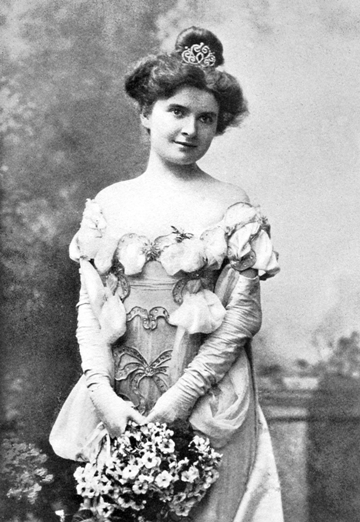
Copyright, 1896, by Aimé Dupont, N. Y.
CHRISTIE MACDONALD.
After eight years of soubrette experience Christie MacDonald unexpectedly came into prima donnaship in February, 1900. A light opera called "The Princess Chic," book by Kirke LaShelle and music by Julian Edwards, had been living a quiet life at the Columbia Theatre, Boston, for several weeks. For some reason or other it did not seem to go just as it should. It was a good opera at that—much better than the average. Mr. LaShelle's book told a story with a genuine dramatic climax, and Mr. Edwards's music was charming,—simple but melodious. There was action enough apparently, but the performance dragged. It lacked snap and vigor.
The prima donna rôle in this opera was one of great difficulty. It demanded an actress as well as a singer,—a woman who could be swaggering, audacious, and masculinely incisive as the Princess, masquerading as her own envoy, timid, modest, and shrinkingly feminine as the make-believe peasant girl, and finally queenly and royal as the Princess in her proper person. The plot of "The Princess Chic," by the way, paralleled history in a curious manner, and the story of how it was written was told me by Mr. LaShelle:—
"To begin with," said he, "'The Princess Chic' was not taken from the French, though there was a French vaudeville with the same title. I got the idea of the opera fixed in my mind after seeing Henry Irving play 'Louis XI.' during one of his visits to this country. You remember in that drama where the envoy from the Duke of Burgundy and his clanking guard march into Louis's presence. The envoy throws his mailed gauntlet at Louis's feet and exclaims, 'That is the answer of Charles the Bold!' or words to that effect, at any rate.
"That kindled my admiration for Charles the Bold, and I have been admiring him ever since. Consequently when I wanted a comic opera and couldn't get any one to write it for me, I said to myself, 'Here's a chance for Charles the Bold.' I forthwith started in on what is now the second act of 'The Princess Chic,' and wrote backward and forward.
"Now comes the odd part of the whole business. I had to have a woman for my opera, so I invented the Princess Chic. I had to have a plot,—I'm a bit old-fashioned, I know,—so I invented the intrigue of Louis XI. plotting to cause a revolt among the subjects of the Duke of Burgundy. I seemed to be getting along first-rate when it occurred to me that it wouldn't do any harm to delve a bit into history. So I delved.
"You can imagine my astonishment when I found that I had unwittingly been duplicating to a startling extent historical fact. I discovered that there actually had been a Princess Chic. I learned that Louis XI. had thought to cause trouble in Charles's domain, and by this means to open a way for the seizure of that province for France. The Duke's bold move in arresting the King and holding him captive until the King agreed to a treaty that suited Charles was new to me, however, and I grabbed it quick.
"Now you have the whole story of 'The Princess Chic.' Somebody has accused me of coquetting with history. I deny all coquetry. 'The Princess Chic' is to all intents and purposes genuine history, much nearer fact than many a historical drama that makes more pretences of sticking closely to the truth."
However, history or no history, the opera did not act as it should, and Mr. LaShelle decided to try what the effect of a new prima donna would be. He wanted Camille D'Arville, but she was not available; and by some marvellous stroke of good fortune he hit upon Christie MacDonald. How he happened to do it is a mystery. Christie MacDonald was, of course, well known as a very amiable little lady with a decided fancy for short skirts and for frisky and vivacious characters, that sang prettily and danced nimbly. Never for a moment had she been associated with the dignified prima donna. Nor had she ever been guilty of seriousness. Moreover, if the whole truth were to be told, her voice—though sweet, delicate, musical, and skilfully controlled—was by no means strong. Decidedly Christie MacDonald had other things besides a voice to make her attractive. There was her personality, magnetically feminine, her temperament, so sunshiny and happy, and her face, not exactly pretty, but immensely attractive when fun lighted it up with smiles.
Therefore Christie MacDonald's Princess Chic came as a great surprise. At first, she was apparently feeling her way in the rôle. She was, in fact, a model of discretion, but save in one particular her acting lacked force and conviction. As the peasant girl, in this three-sided impersonation, she was from the first exquisite. Never was the subtle attack of a modest maiden upon a susceptible man's heart more daintily or more fascinatingly exhibited. Under every circumstance Miss MacDonald was simple and straightforward in her methods, and absolutely free from affectation and self-consciousness. How thoroughly delightful that is! Singers, in particular, are the victims of conventional mannerisms, smiles that are meaningless and as a result expressionless, curious contortions with the eyes, and strange movements of the hands. How much they would gain by mastering the difficult art of artistically doing nothing!
With so much that was good in evidence during her earliest presentations of the Princess Chic, with her faults those of omission rather than commission, it was only natural that Miss MacDonald should improve greatly as she became thoroughly familiar with the requirements of the part, and as she gained experience in acting it. Especially did she seem to catch the spirit of the Princess Chic masquerading as the handsome young envoy. She developed a most entrancing swagger and the most captivating nonchalance. Her voice, too, which at first seemed almost too light for Mr. Edwards's trying music, was heard to a much better advantage later; and in spite of its want of volume, it had a strange insistency, a peculiar penetrating quality, which enabled it to balance admirably the full chorus in the ensemble climaxes.
Before she adopted the stage professionally, Christie MacDonald gained a little experience by taking small parts in several summer "snap" companies in her home city of Boston. Her parents were not altogether pleased at her theatrical aspirations, and even after she had been enrolled in 1892 as a member of Pauline Hall's company, she was persuaded to give up the engagement in deference to their wishes. Just at this critical point in her career, however, she chanced to meet Francis Wilson, who had "The Lion Tamer" in rehearsal. He heard her sing and liked her voice so well that he offered her a place in his company. The temptation was too strong to be resisted, and Miss MacDonald established herself under the Wilson banner. At first she was given only a small part in "The Lion Tamer," and at the same time understudied Lulu Glaser in both "The Lion Tamer" and "The Merry Monarch." The next season she played Marie, the peasant girl, in "Erminie," and during Miss Glaser's illness, Javotte. When "The Devil's Deputy" was brought out for the season of 1894-95, she created the rôle of Bob, the valet. She was a capital Mrs. Griggs in the pretty Sullivan opera, "The Chieftain," her singing of the topical song, "I Think there is Something in That," being especially popular. During the summer of 1896 she appeared in Boston in "The Sphinx," making a pleasing impression as Shafra. The following fall found her again with the Francis Wilson forces, playing Lucinde in "Half a King." That summer she filled another engagement in Boston as the Japanese maiden Woo Me, in the not-too-successful opera, "The Walking Delegate." It was a dainty part and charmingly done.
The next season Miss MacDonald was engaged by Klaw and Erlanger for the Sousa opera, "The Bride Elect," with which she remained two seasons, and this was followed by her appearance in "The Princess Chic."
CHAPTER XVI
MARIE DRESSLER
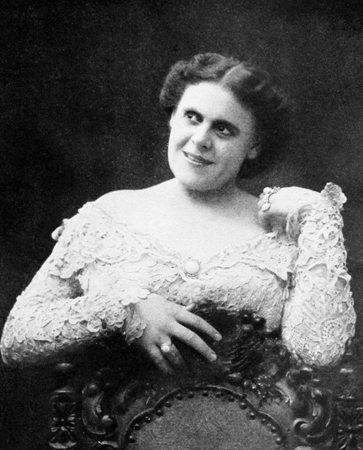
MARIE DRESSLER.
One cannot see Marie Dressler on the stage without being convinced that she is acting no one in the world but herself. Such, I believe, is the actual condition of affairs, although there are sometimes strange paradoxes in theatrical life. It would not be altogether extraordinary for the rollicking tomboy of the stage to be in private life the most retired and the most dignified person imaginable, a woman with spinster written all over her face and reeking in domesticity, with a decided fondness for tea, toast, and tidies.
However, that is not the case with Marie Dressler. She has a mental quirk that keeps the incongruous side of life in her view practically all the time. She cannot help pricking constantly the bubble of mirth any more than she can help breathing. Her humor is just the kind that one would naturally expect to find as a companion to her overflowing physique,—ponderous, weighty, and a bit crude, perhaps, but spontaneous, real, and thoroughly good-natured. She never stabs with the keen shaft of cynical wit, and she does no business in the epigram market. Her specialty is incongruity, for Marie Dressler is a burlesquer in thought, word, and deed, and being a burlesquer she is of necessity absolutely without illusions. When one is so susceptible to the oddities, the inconsistencies, and the tragic pettiness of human affairs as she is, it is a toss-up whether or not his settled condition of mind, after a fair experience with the world, be one of gloomy pessimism or irresponsible optimism. Had Miss Dressler been by nature cold, suspicious, and inherently selfish, had she been unsympathetic and without the milk of human kindness, her instinct for incongruity would surely have turned her toward misanthropy. Her disposition, however, was rollicking, jovial, and fun-loving. She was naturally impulsive, generous, and warm-hearted. Consequently, life, even in its smallnesses and its meannesses, made her laugh. With the humorist's whimsical temperament she united also the happy faculty of being able to communicate to others by means of the theatre her comical view of things. Choosing to do this through the force of her own personality rather than by infusing her personality into a dramatist's conception, she became a droll, a professional jester.
Miss Dressler's best-known and most characteristic work on the stage was done in the rôle of the boisterous music-hall singer, Flo Honeydew, in "The Lady Slavey." It was hardly a case of acting,—better call it a case of letting herself go. Marie Dressler without subterfuge presented herself in the guise of the unconventional Miss Honeydew. She seemed a big, overgrown girl and a thoroughly mischievous romp with the agility of a circus performer and the physical elasticity of a professional contortionist.
To call her graceful would be an unpardonable accusation. Possibly she might have been graceful had she chosen to be; but what she was after principally was energy, and she got it,—whole car-loads of it. Her comic resource was inexhaustible, her animal spirits were irrepressible, and her audacity approached the sublime.
Yet, amid all her amazing unconventionality and her astonishing athletic feats, one found, if he met her on her own plane of impersonal jollity, neither vulgarity nor suggestiveness. Her mental attitude toward her audience was absolutely clean and straightforward. She was not a woman cutting up antics and indulging in unseemly pranks, but a royal good fellow with an infinite variety of jest.
With nothing especially tangible to offer as evidence, I have a suspicion that Marie Dressler, if she could escape from her reputation as a burlesquer, might act a "straight" part not at all badly. It is only a fine line between burlesque and legitimate acting, only a triflingly different mental attitude, which results in travesty instead of seriousness. Of course, the burlesque must be set forth with the proper amount of exaggeration to give point to the take-off, but that is only a matter of technique. Artificiality in actors and insincerity in dramatists very often result in unconscious burlesque. The melodramatic school is particularly prone to this most inartistic of blunders, and many a good laugh has followed lines that were supposed to be charged with the most highly colored sentiments and situations that were intended to be dramatically strong and impressive. One at all familiar with Miss Dressler's methods cannot have failed to notice her trick of beginning a speech with profound and even convincing seriousness and ending it in ridiculous contrast with a sudden drop from the dramatic to the commonplace. In spite of the fact that one knows for a certainty that she is fooling him, she succeeds invariably in making the first part of her sentence seem honest and sincere.
Now, I do not believe that she could hit just the right key every time in these startling and laughter-provoking contrasts, if she did not have to an unusual extent the instinct for dramatic effect, which is so large a part of the equipment of the legitimate actor. However, I hope that she will never make the experiment. There are already enough serious actors of ordinary calibre, while the genuine burlesquer of Marie Dressler quality is rare indeed.
Miss Dressler's versatility as a single entertainer was splendidly illustrated in a curious variety act, which was called "Twenty Minutes in Shirt Waists." It was devised for the sole purpose of showing off to the best advantage Miss Dressler's native talent for fun-making and travesty. It was mere hodge-podge, of course, with neither rhyme nor reason, but it did afford Miss Dressler every chance that she could desire to display her marvellous resource as a comic entertainer. The title of the sketch, "Twenty Minutes in Shirt Waists," suggested some sort of a disrobing act, but in that it was deceptive. Indeed, the title—and possibly it was all the better for that—had no connection at all with the act beyond the fact that Miss Dressler and her assistant, Adele Farrington, both wore shirt waists of spotless white. It was a very intimate and unstagy affair. The two entertainers called each other Marie and Adele, and they kept up the illusion of spontaneous comradeship by appearing, or seeming to appear, in the Eleanora Duse fashion, without facial make-up. The turn itself was a continuous "jolly," and Miss Dressler introduced before it was over about everything funny that she ever did in the theatre, including the amusing revolving hat of "The Lady Slavey" fame.
Miss Dressler was born in Canada, and went on the stage when she was sixteen years old; and in spite of the fact that she was without experience,—in fact, before she had ever seen a comic opera,—she rather inverted the ordinary method of procedure, and started at once to play old women. Her first character was Katisha in "The Mikado" in a company managed by Jules Grau. The reason, so she claims, that she made a try at "old women" was because she was too big and healthy ever to meet with success as a soubrette. Her Katisha was sufficiently liked to convince her that light opera was just the place for her, and thus her theatrical career began.
"I might state," remarked Miss Dressler, naïvely, in speaking of her early experiences, "that we members of the Grau Company were promised and were supposed to receive very good salaries. All we got, however, was the promises, and they came early and often. No, that is not altogether true: we got besides the promises twenty-five cents which was handed to each member of the company every night. It was supposed to be squandered in the purchase of beer. I forgot this little circumstance, for I did not drink beer, and consequently in my case the aforesaid quarter of a dollar was not forthcoming. This omission hurt me so much that I resigned from this enterprising organization, and wandered to Philadelphia. The exchequer was about as low as it well could be, and I was glad enough to take a place in the chorus of a summer company at eight dollars a week,—not a great deal, to be sure, but I got it, such as it was."
Miss Dressler's next engagement was with the Bennett and Moulton Opera Company, from which Della Fox was also graduated. This organization played week stands in small cities and large towns, giving two performances a day and changing the bill every day. This may be said to have been Miss Dressler's school, for while under the Bennett and Moulton management she appeared in thirty-eight different operas and played every variety of part, from prima donna rôles to old women.
Following this arduous experience on the road came her first appearance in New York at the Fifth Avenue Theatre as Cunigonde in "The Robber of the Rhine," an opera of which Maurice Barrymore, who wrote the book, and Charles Puerner, who composed the music, never had reason to feel proud. Her first New York success of any consequence, therefore, was not made until she appeared with Camille D'Arville in "Madeleine, or the Magic Kiss." Her next venture was as the Queen in "1492," the part which brought fame to that most accomplished woman impersonator, Richard Harlow. After the termination of this engagement she appeared for a time at the Garden Theatre, New York, under the management of A. M. Palmer, and then joined Lillian Russell in "Princess Nicotine." Her remarkable success in "The Lady Slavey" came next, and since then she has been seen in "Hotel Topsy Turvy," "The Man in the Moon," and vaudeville.
CHAPTER XVII
DELLA FOX
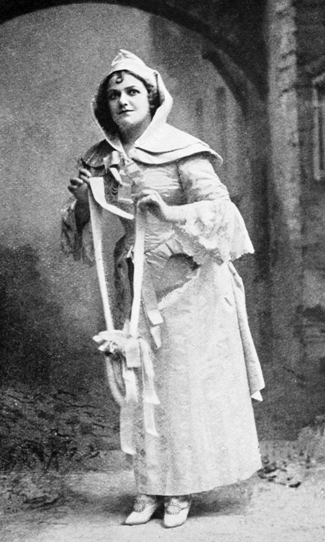
Copyright, 1894, by J. B. Falk, Waldorf-Astoria, N. Y.
DELLA FOX.
It was a dozen or fifteen years ago that the hard-working organization known as the Bennett and Moulton Opera Company was a frequent visitor to the small cities and large towns of New England. It played week stands with daily matinees, and it was, more than likely, the pioneer to flaunt in the theatrical field the conquering banner of "ten, twenty, thirty." I have every feeling of gratitude toward the Bennett and Moulton Opera Company, for it introduced me, at the modest rate of ten cents per introduction, which small sum purchased the right to sit aloft in the gallery, to all the famous old-time operettas,—"Olivette," "The Mascotte," "The Chimes of Normandy," and others.
As I recall the annual performances of this obscure troupe, they were surprisingly good. At least, so they seemed to me, and I can laugh even now at the excruciatingly funny fellow who sang the topical song, "Bob up Serenely" in "Olivette." There was also a curious dance, I remember, that went with the song,—a spreading out simultaneously of arms and legs in jumping-jack fashion,—and we boys thought it vastly amusing. We clapped and stamped and whistled, and kept the poor comedian at work as long as our breath held out and long after his had gone.
The last time that I saw the Bennett and Moulton Opera Company was in "Fra Diavolo," and the prima donna—the term seems ridiculous and absurd as I think of the person to whom it is applied—was a golden-haired little creature, wonderfully ample, tremendously in earnest, and strangely fascinating, a dainty slip of a girl, who seemed, in truth, only a child. I can see her now as she sat on the edge of the bed in the chamber scene, unfastening her shoes, singing very sweetly and very expressively her good-night song, all unconscious of the bold brigands who were watching the proceedings from their places of concealment. She charmed me as no singer in light opera ever had before, and the impression that she made upon me has never been lost. The child was Della Fox, of whom at that time no one had ever heard—Della Fox in the humblest of surroundings, but to me more fascinating than in any of the brilliant settings that have since been hers.
I did not see Della Fox again until 1890, when she was playing Blanche in "Castles in the Air" with DeWolf Hopper. She had changed greatly in the few years, though far less than she has since the days of "Castles in the Air," "Wang," and "Panjandrum." Her appealing, unsophisticated girlishness had gone, and in its place was self-possession and authority. She was charming in her daintiness, provoking in her coquetry, a tantalizing atom of femininity. Her archness was not bold nor unwomanly, and her vivacity was well within the bounds of refinement and good taste. Her singing voice, too, was musical, though not over strong.
Della Fox was born in St. Louis on October 13, 1872. Her father, A. J. Fox, was a photographer, who made something of a specialty of theatrical pictures; and thus Della's babyhood was passed, not exactly in the playhouse atmosphere, perhaps, but certainly in an atmosphere next door to that of the greasepaint and footlights. Her experience on the stage began when she was only seven years old as the midshipmate in a children's "Pinafore" company, which travelled in Missouri and Illinois for a season. She was an astonishingly precocious child, and many persons who watched her shook their heads and predicted that her talent had ripened too early, and that, as is the case with many promising stage children, she would never amount to anything.
Apparently this midshipmate experience firmly established in Miss Della's childish mind the intention to become an actress. Her parents, however, succeeded in keeping her in school for a few years longer, though she appeared in several local performances where a child was needed. When she was nine years old, for instance, she acted for a week in St. Louis the child's part in the production of "A Celebrated Case" of which James O'Neill was the star, and she was also at one time with a "Muldoon's Picnic" company. Her first real professional experience, however, was obtained with an organization known as the Dickson Sketch Club.
This was gotten up by four St. Louis young men, W. F. Dickson and W. G. Smythe, both of whom became prominent theatrical managers, Augustus Thomas, the playwright, and Edgar Smith, the author of several Casino pieces, and at present writer-in-ordinary to Weber and Fields. Mr. Thomas made a one-act play of Mrs. Frances Hodgson Burnett's story, "Editha's Burglar," and the company also appeared in a musical farce called "Combustion." Della Fox was the Editha in the play and the soubrette in the musical piece, while Mr. Thomas acted Bill Lewis, the burglar, and Mr. Smith was Paul Benton. Miss Fox's impersonation of Editha was, according to report, very good indeed. At any rate, the success of the play was sufficient to encourage the author to expand it to three-acts. The result was "The Burglar," one of the first plays in which Mr. E. H. Sothern appeared as a star. In the three-act version Sothern acted Bill Lewis, the burglar, and Elsie Leslie was Editha.
Mr. Dickson, who is now connected with the business staff of the Alhambra in Chicago, referred not long ago to this early experience as a manager.
"Yes," he said, "that was 'Gus' Thomas's début as a dramatic author. 'Gus' was in the box office with me at the Olympic in St. Louis, and he managed to find time during the leisure moments when he was not selling tickets to scribble ideas in dramatic form. He read me this little sketch, 'Editha's Burglar,' and asked me to give it a trial. Right across the street from the theatre lived Della Fox, daughter of a photographer, a precocious little miss, whose talents were always in requisition whenever there were any child's parts to be filled at the theatre. I used to send over for Della whenever there was a little part for her, and she was delighted to get away from school and skip and trip before the footlights. After 'Gus' had read the play to me, he suggested that Della should play little Editha, and as a result I was induced to put the piece on with the budding author in the principal rôle. It had a certain sort of success, and we went on a tour, using 'The Burglar' as a curtain raiser to another play called 'Combustion,' also from 'Gus' Thomas's pen. Later 'The Burglar' was produced in New York as a curtain-raiser to William Gillette's comedy, 'The Great Pink Pearl.' Gillette himself played the burglar, and Mr. Thomas was encouraged to expand his sketch into a pretentious three-act play, and it went on the road, making money for the managers and familiarizing the public with Augustus Thomas's name."
Next came Miss Fox's connection with the Bennett and Moulton Company, with which she appeared in the leading soprano rôles of all the light operas,—"Fra Diavolo," "The Bohemian Girl," "The Pirates of Penzance," "Billie Taylor," "The Mikado," and "The Chimes of Normandy." Her success with this minor organization brought her to the notice of Heinrich Conried, who was getting together an opera company to appear in "The King's Fool." She was given the soubrette part, and created something of a stir wherever the opera was given by her singing of "Fair Columbia," one of the most popular songs of the piece. From Mr. Conried also she received about all the real instruction in dramatic art that she had ever had. When Davis and Locke, who had managed the Emma Juch Opera Company, decided to launch DeWolf Hopper as a star, they began to look about for a small-sized soubrette to act as a foil for Mr. Hopper's great height. George W. Lederer, of the New York Casino, suggested Della Fox, and accordingly she was engaged and opened with Hopper in "Castles in the Air" at the Broadway Theatre, New York, in May, 1890.
Her success in this larger field was remarkable, and before the summer was over she was sharing the honors with Hopper and was just as strong a popular favorite as he. Her Blanche was a delightful creation throughout, but best remembered is the "athletic duet" in which she and Hopper gave amusing pantomimic representations of games of billiards, baseball, and other familiar sports. Her Mataya in "Wang," which was brought out in New York in the summer of 1891, was another triumph. This was, perhaps, the most artistic of all her rôles. She was cute, impish, and jaunty in turn as the Crown Prince, and, in addition, was a picture never to be forgotten in her perfect fitting white flannel suit, worn in the second act. It was in this act, too, that she sang the famous summer-night's song, which was whistled and hand-organed throughout the land.
Next Miss Fox created the principal soubrette rôle in Mr. Hopper's opera "Panjandrum," in which she continued to appear until she made her début as a star in August, 1894, at the Casino, New York, in Goodwin and Furst's opera, "The Little Trooper." Her first season was extremely successful. The next year she was seen in "Fleur-de-lis," another Goodwin-Furst product. Writing of Miss Fox in this opera, Philip Hale said:—
"Disagreeable qualities in the customary performance of Miss Fox were not nearly so much in evidence as in some of her other characters. She was not so deliberately affected, she was not so brazen in her assurance. Even her vocal mannerisms were not so conspicuous. She almost played with discretion, and often she was delightful. Her self-introduction to her father was one long to be remembered. No wonder that the audience insisted on seeing it again and again. All in all, Miss Fox appeared greatly to her advantage."
His criticism of the opera is also interesting:
"It was March 31, 1885, that 'Pervenche,' an operetta, text by Duru and Chivot, music by Audran, was first produced at the Bouffes-Parisiens. Mrs. Thuillier-Leloir was the Pervenche, Maugé the Count des Escarbilles, and Mesnacker the Marquis de Rosolio. The honors of the evening, however, were borne away by Mr. and Mrs. Piccaluga, who were respectively Frederick and Charlotte. The opera did not please, and it ran only twenty-nine nights. Nor has it been revived.
"In the time of Henry the Second, or Henry the Third, two nephews disputed the right to possess a castle in Touraine that had belonged to their late uncle, who died without will. Rosolio held the castle, and Escarbilles tried to dislodge him. By the will, found eventually, the castle belonged to Rosolio if Frederick, the son of Escarbilles, should marry Pervenche, the natural daughter of Rosolio.
"The performance was in the main poor, and the music of Audran was not distinguished, they say. A romance of Frederick, a pastorale Tyrolienne sung by Charlotte at the end of the second act, and a duet of menders of faience in the third act, said to be the best of the three, alone seemed worthy of remark.
"So much for 'Pervenche,' the libretto of which furnished the foundation for Mr. Goodwin's story and songs. Just how far Mr. Goodwin departed from the situations furnished by Messrs. Durn and Chivot, I am unable to say, for I never saw 'Pervenche' nor its libretto. However much he may be indebted, this can be truly said: he has written an entertaining book; the plot is coherent, and the situations laughable. The second act is admirable throughout. The colossal effrontery of the starved Rosolio in the castle manned by women disguised as soldiers, the reconciliation of the nephews, the exchange of reminiscences of gay student days in Paris, the discovery of the imposition, and the renewed hostilities,—these are amusing and well connected. Furthermore, the audience at the end of this act realizes at once the need of a third act, to clear up matters. Now this is rare in operetta of to-day. Even in the third act the interest never flags, although there was one dreadful moment, when it looked as though the old 'Mascotte' third-act business was to be introduced. Fortunately the suspicion was groundless, and the audience breathed freer and forgot its fears in the enjoyment of the delightful scenes between Des Escarbilles and the miller, and then the ghost.
"Not so much can be said in praise of the music. It is the same old thing that has served in many operettas. There is a jingle, there are the inevitable waltz tunes that always sound alike. But the music gives the comedians an excuse for singing and dancing. It thus serves its turn and is promptly forgotten until another operetta comes, and the hearer has a vague impression that he has heard the tunes before."
"The Wedding Day," with Della Fox, Lillian Russell, and Jefferson De Angelis in the cast, was brought out in the fall of 1897, and it revived to a degree old-time memories of players at the Casino. The opera itself proved to be of an order of merit recalling "Falka," "The Merry War," and "Nanon," the like of which had not appeared for many, many seasons. The music was ambitious without being dull, and some of the concerted numbers had genuine musicianly value. The story held its interest fairly well, though in spots it was too complicated, and at one point in the third act quite absurd. Still it was an excellent vehicle to display the talents of the so-called "triple alliance" of comic opera stars. Miss Fox, who had shown a decided tendency toward stoutness, had trained down to within hailing distance of her former slender lithesomeness, and she made a pretty and attractive bride.
The following season found Miss Fox again an individual star, this time in "The Little Host." Her last appearances in opera were made in this piece, for after her season had begun in the fall of 1899, she was taken seriously ill, and for a long time her death was expected. She recovered partially, however, after months of illness, and in the spring of 1900 she appeared for a few months in vaudeville. Even this labor proved too much for her strength, and her friends were compelled to remove her to a place where she might have perfect rest.
CHAPTER XVIII
CAMILLE D'ARVILLE
Camille D'Arville, like Lillian Russell, Pauline Hall, and Jessie Bartlett Davis, is one of the old guard, in American light opera. She has not appeared in opera for some time, for during the season of 1899-1900 she followed the general inclination and went into vaudeville. From these appearances it was apparent that her voice was not what it had been once—and little wonder that it had failed, when one recalls how continuously that voice has been in use since the owner left her Dutch home, forswore her own name of Neeltye Dykstra, and first learned to talk a prettily accentuated English. She still had in full the power to win an audience instantly and completely. Nor had she lost to any perceptible degree her rare good looks. A little fuller in the figure, perhaps, than she was five years ago, she carried herself with the same fine grace and perfect poise which were of themselves an art.