Part 2 — THE STORY OF THE REAPER
Reading edition
"What if Cyrus McCormick should be able to make his reaper really work and we could cut all that wheat by machinery! No more dreadful backaches then in harvest time!" said Ezra Harding, as he stood looking out of the back door of a Virginia farmhouse one bright morning in June in the year 1832.
He saw nothing of the beauty all around him; all he saw was acre upon acre of yellow wheat ready to be harvested. How he dreaded the harvesting! It meant the hardest work his father ever asked him to do. Help was so scarce that even Ezra, the youngest of the five Harding boys, though he was only fifteen, had to do a man's work. It made Ezra feel almost eighty to think about the back-breaking work that was to begin the next morning.
At that time all the wheat in the world was cut by hand, and on that account there was not enough raised so that everybody could have white bread. In the old world the peasants used chiefly the sickle to cut the wheat; in the new world the farmers preferred the scythe and cradle. To harvest wheat means both to cut it and to tie the long stalks into bundles, or sheaves, for the drying which is necessary before the wheat kernels are threshed out. Hay can be pitched about hit-or-miss, but not so the wheat. It must be tied up in an orderly fashion so that as it dries it can be gathered into the barns without shaking out and losing too many of the wheat kernels.
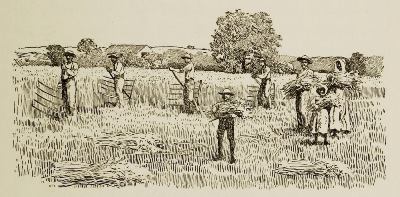
The Old Way of Reaping
Ezra knew his part would be to swing a cradle scythe. This was a rather broad scythe with a wooden frame attached which was called a cradle. This cradle was nothing more than a set of wooden fingers parallel with the scythe, which helped to lay the cut grain straight in the rows because they collected the grain and carried it to the end of the stroke. The straighter it fell, the easier it was to bundle it. The contrivance was clumsy and Ezra disliked it very much. However, he was thankful he did not have to follow the men who mowed the grain and do the bundling and tying. That work he knew was the most back-breaking of all.
Ezra was feeling anything but cheerful when he saw his father come out of the barn with a smile on his face.
"What do you think I heard last night at Lexington Court House?" his father asked, coming up the path. "Cyrus McCormick is going to try his new reaping machine here in Lexington in Farmer Ruff's wheat field to-day. I want to see the trial. We'll all go over, if you boys like."
Like to go? Indeed they would, and they thought of nothing but the possibility of a successful reaping machine all through breakfast time.
Late in the season the preceding year Cyrus McCormick had created a sensation by cutting six acres of oats in an afternoon at Steele's Tavern near his home eighteen miles north of the Hardings' farm. None of the Hardings had seen that event, but they had been deeply interested not only because they would welcome a successful reaping machine, but also because the young man's father, Robert McCormick, was a friend of Mr. Harding, and they knew of the repeated trials and failures of the father's reaping machine. In fact, Robert McCormick had worked for fifteen years on a reaper which he had tried for the last time in that same season of 1831 and then had reluctantly put away forever as a failure.
"I still believe a successful reaping machine is possible, but somebody else will have to make it," he had said sadly.
The Hardings knew that the son Cyrus, who had worked for years with his father, had not given up even then, and, begging his father to leave one small patch of grain for him to use for trial, had started a new machine on a different principle, and late in the season had tried it at home with only his own family to watch its working.
"It is a success!" they had said one to another, but they dared say very little outside because it was still far from satisfactory.
Mr. Harding had learned from the older McCormick that it had not run smoothly, but that it had cut the grain without tangling it and had left it on a platform from which the raker could take it off in good order for the bundling. To the McCormicks, however, it had been a proof that the machine could be made a success, and a few days later, after making some changes, Cyrus McCormick had cut the six acres of oats at Steele's Tavern in one afternoon. It was then too late in the season for other demonstrations, and the Hardings had heard nothing more about the invention until the day before the trial at Lexington in Farmer Ruff's field.
An hour before the time set for the trial of the reaper Ezra Harding and his brothers were at the appointed place. They watched the crowd gather. There were Negroes, and farm laborers, and some owners of farms. Most of the people around Ezra, to his surprise, not only seemed to expect the machine to fail, but actually hoped it would. He could not understand why until he heard two rough, ignorant fellows talk about losing their chance to earn their bread if machines could be made to do the work of men.
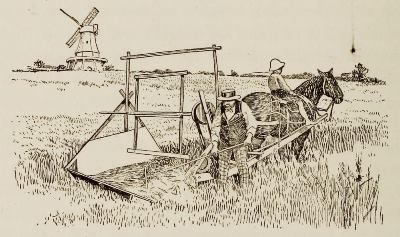
The First Type of McCormick Reaper
"We'll smash the things," they said, "before we'll have the bread taken out of our mouths by any such contraptions."
Ezra thought it strange they should oppose the invention for he knew how anxious his father was that it should be a success. His father said machinery meant the possibility of larger crops, and therefore not less work, but more work and more wealth for all. Ezra was puzzling over the strange stupidity of these men who could not see what larger crops would mean, and who seemed to want to go on in their old back-breaking toil, at the same pitifully small wages,—for the pay of these days was actually less than a nickel an hour,—when the machine came in view drawn by two horses. Two Negroes were leading the horses because the machine made such a clattering noise that it frightened them. About a hundred spectators had gathered by that time. The crowd jeered at the sight of the strange machine.
"It's drunk," they said, and laughed uproariously at their own wit.
On it came, turned into the field, and began in a short time to cut the wheat. It did not work well. The field was rough and hilly, and the heavy, cumbersome machine careened like a ship in a gale. The crowd ran up and down the field alongside the machine, hooting at the top of their voices and calling the reaper all kinds of names. The Negroes were doubled up with laughter at the slewing of the unwieldy machine. One man said to another with decision, "Give me the old cradle yet."
Another said scornfully, "It's a humbug!"
Farmer Ruff, rough by nature as well as by name, ran, too, shouting, "Stop! Stop! your machine is rattling the heads off my wheat!"
It did look as if the trial would end in complete failure. Much as Ezra wished the machine to succeed he had no confidence that it was going to, and he turned to see if he could read his father's thoughts. Just as he turned he saw a fine-looking man on horseback ride up to the jeering crowd. It was Hon. William Taylor. Taking in the situation at a glance he changed everything instantly.
"Pull down the fence," he ordered, pointing to the division fence between his field and that of Farmer Ruff, "and cross over into my wheat field. I'll give you a fair chance to try your machine!"
This opportunity was eagerly seized by the young inventor, and soon he was ready to begin again the trial of his precious machine. Mr. Taylor's field was smoother and less hilly than that of Farmer Ruff. The machine began to cut the grain successfully. Once around! Ezra could scarcely credit his eyes. Round and round the machine went—cutting, cutting, cutting. The heavy clack-clack of the machine was sweet music to the little group of those who were eager for its success.
The crowd became quieter as the grain continued to fall, and many after an hour or two lost all interest in watching and went home. For nearly five hours the reaper was driven around Mr. Taylor's field, and the six acres of wheat were cut in that time—the first wheat in the United States to be cut by machinery. No wonder the young inventor was proud of the accomplishment. His machine had done in less than half a day what he knew would have required, according to the method generally used in Europe, twenty-four peasants with sickles.
After the trial was over, Mr. Harding and Ezra joined the excited little group around the inventor.
"Your reaper is a success," Ezra heard Robert McCormick say to his son, "and it makes me proud to have a son do what I could not do!" Ezra felt like throwing his cap and cheering. What a joy to have a machine which could do that back-breaking work he had had to do in harvesting the grain!
That night the machine was hauled to the court house square in Lexington. There it was examined by a crowd of curious people who had heard of the successful trial in the afternoon. One of the men who was specially interested in the machine was Professor Bradshaw of the Female Academy of Lexington, a thoughtful man whose judgment was greatly respected in the community. In his usual impressive manner he fairly astounded the bystanders by the wholly improbable statement, "That machine is worth—a—hundred—thousand—dollars!"
"A hundred thousand dollars!" repeated Mr. Harding when the remark was told him the next day. "I think this time Professor Bradshaw is wrong. Cyrus McCormick will be disappointed, surely, if he expects any such large returns from his invention. The great inventors have not become very rich men even when the invention, like the cotton gin, has caused a revolution in a whole industry."
This was when Cyrus McCormick was twenty-three years old. Before he was an old man the reaper had proved itself worth more millions than the predicted thousands, and Ezra and his father had many a laugh over Mr. Harding's criticism of Professor Bradshaw. However, at the time the astounding remark was made, not even the inventor himself dreamed of the complete change in methods of farming which the reaper would make all over the country. Nobody, indeed, could realize that within the life time of the inventor it would be possible for the farmers of the United States to raise enough wheat to feed the whole world. Most people, naturally enough, perhaps, felt as did Miss Polly Carson when she saw the reaper dragged along the road on the way to Farmer Ruff's field. Years later when she told the story of that day she said:
"I thought it a right smart curious sort of thing, but that it wouldn't amount to much."
The successful trial of the reaper was in 1832, when the United States was about fifty years old. For the next ten years Cyrus McCormick was preaching reapers but he did not succeed in selling them. They seemed very costly to the farmer; and, moreover, they were not the perfect machines we know to-day, machines which work as if they had brains of their own. Not until 1840 was Cyrus McCormick successful in selling the reapers, which he made himself at his home. Then he sold two machines for fifty dollars each. Two years later he sold seven for one hundred dollars each. Soon he could sell hundreds.
The West Virginia home was not a good location for making the reapers as it was both difficult and expensive, with the poor railroad facilities of the day, to ship the machines to the great West where it was already plain that the largest number would be used. Accordingly Cyrus McCormick moved nearer his best market, establishing himself first in Cincinnati, but two years later, in 1847, choosing the very new, very muddy, very unattractive little town which has since become the immense city of Chicago. History has shown the wisdom of his choice. Chicago soon became the greatest distributing center of the West, and as the reaper was necessary to work successfully the big wheat fields, it was no uncommon sight as early as the sixties to see, moving out from Chicago, a whole train loaded with nothing but showy bright-red reapers.
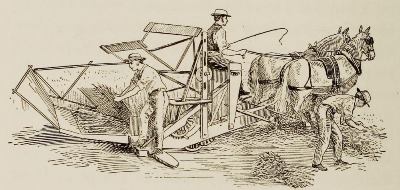
McCormick's Reaping Machine As advertised in The Working Farmer, 1852. Notice that a man rides on the machine to rake off the grain.
During the ten years while Cyrus McCormick was struggling to introduce his reaper, Ezra Harding grew to admire more and more the tall, handsome, powerful man who never lost his courage. Ezra believed in reapers almost as fully as did Mr. McCormick himself; and when Mr. McCormick moved to Chicago, Ezra followed him to help make the wonderful machines.
In the years between the first successful trial and the time when Ezra went to Chicago so many changes had been made in the reaper that Miss Polly Carson would hardly have recognized it, had she seen it coming down the road. When the machine was tried in Farmer Ruff's field the grain was cut by a cutting bar similar to that on a mowing machine, then it was caught by a reel and carried to a platform from which it was raked to be tied in bundles. Two men were needed with each machine; one walked beside the horses to drive them, the other walked beside the platform to rake off the wheat for the bundling. Not very long afterward Mr. McCormick added seats for both driver and raker. One of the next big changes was to take off the raker and his seat and put in their place an "iron man." This was really a long iron finger moved by the turning wheels, which did the work of the raker, and automatically pushed off the cut grain in untied bundles.
Tying, or binding, the bundles remained for years the hardest part of the harvesting. It was the custom to tie the sheaves with a crude rope made of the grain. This hard, back-breaking work required both strength and skill and could be endured only by the strongest men. Even Ezra Harding said:
"No genius will ever live who can make a machine throw a cord around a bundle of wheat and knot that cord securely."
In this, however, Ezra was wrong, for within twenty-five years from the time when the first reapers were sold Ezra saw added to the machine two steel arms which, driven by the revolution of the wheels, caught each bundle of grain before it left the platform on which it was collected, whirled a wire tight around it, fastened the two ends together with a twist, cut it loose, and tossed it on the ground.
There was then only one complaint made by the farmers. When the grain was fed to cattle they were often injured by pieces of wire. This trouble was remedied later by substituting twine for wire, adding a very ingenious contrivance for knotting the twine, and then the McCormick Reaper and Self-Binder might be said to be perfected.
One man alone, to drive the reaper, could then do what, only twenty years before, had required twenty men. Moreover, the harvesting of a bushel of wheat which required under the slow snip, snip of a sickle three hours could be done in ten minutes! Long before Ezra Harding was an old man he saw moving out of the Chicago freight yards a train loaded with nothing but reapers, carrying these machines not only over the United States but even to Russia and China. He saw the wheat crop of this country doubled and trebled and quadrupled; he saw the time when even a poor man could have white bread to eat, because the cost of a loaf had been cut in two; he saw the reaper bring millions and millions of dollars to its inventor; and he saw not only this great wealth come to the man he himself had long admired, but also, while Cyrus McCormick was still in the prime of life, the honor and fame which have been denied many of the great inventors until after death.