Part 2 — ANNA HOLMAN'S DAGUERREOTYPE
Reading edition
When Anna Holman was twelve years old she had to sit perfectly still for one hundred twenty seconds—think of it! two whole minutes!—to have her picture taken. Now she could have it taken in one hundredth of the time at one hundredth of the cost.
The only likenesses of people which Anna knew about before she was twelve were the pictures in the parlor of her home. Two of these were pictures of her Grandfather and Grandmother Holman, whom she had never seen. These pictures always interested her, though for a certain reason she did not like them.
Anna had been told that her grandmother was a great beauty in her day, and she often tried to see if she could tell how her grandmother had looked. This she never felt sure she knew, as the picture was only a silhouette. Of all the different kinds of pictures that people have had made, the silhouette, surely, is the most unsatisfactory.
These were not uncommon in the days before photography was known. They were made by using a strong light to obtain a clear, black shadow of the profile of the sitter, and then cutting from plain black paper as perfect a copy as possible of the shadow head. Of course, the sitter was always posed for a direct side view in order to get an outline of the features; and, of course, in such a picture the expression of the face was wholly lacking.
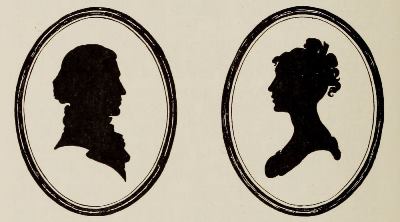
Silhouettes of Grandfather and Grandmother
When Grandmother Holman sat for her silhouette and the picture maker had cut out the little black shadow which her beautiful head had made, Grandfather Holman said, "It is perfect, Rebecca"; and then when Grandfather Holman, in turn, had sat for his picture and the picture maker had cut a silhouette which showed very little but his straight nose and strong chin, Grandmother Holman said: "It is just like you, James."
They knew each other well enough to supply the expression which the pictures lacked. In fact they were so well pleased with the little black paper heads that they had them mounted on white cards and framed for the parlor, never dreaming how these same silhouettes would some day disappoint a little granddaughter who wanted to know how her grandparents had really looked.
In the same room was a life-size oil portrait of Anna's great grandfather. This she liked, and she felt that she knew just how he had looked.
"Why didn't Grandmother Holman have some artist paint a picture of her?" Anna asked her mother one day.
"It cost too much," her mother answered. "She wanted a portrait of your grandfather and he wanted a portrait of her; and I think there never was money enough to have a good artist paint them both. I wish we were rich enough to have a miniature of you painted, Anna. Perhaps we shall be sometime. Your Aunt Anna in her last letter says she wishes we would send her a daguerreotype of you for her Christmas present.
"I know very little about these new pictures, but they are a wonderful kind which the sun makes. I have heard that they are not very expensive, and I think that if there were only a chance here in town to have the daguerreotype taken we might do what she suggests. These pictures, as I understand it, are entirely different from anything you and I have ever seen: they show the face, the eyes, the smile—everything, like a portrait—but there are no colors; the pictures are all in black and white."
Anna had really been wondering, ever since she heard of her aunt's wish, why anybody should care to have a picture of a girl who had freckles and straight yellow hair and blue eyes, instead of curly black hair and black eyes. When she heard her mother's last words she laughed merrily.
"Would my hair be black in the picture? And my eyes, too?" she exclaimed.
"Yes, I think so," answered her mother with a smile.
"How lovely! How I hope I can have my picture taken!"
Later that very day when Anna went down town on an errand she saw this notice:
COMING AUGUST 20 Prof. Aaron B. Coleman, Artist, will open a daguerreotype gallery and furnish perfect likenesses of his patrons for $2.00 a picture.
Abigail Silsbee joined Anna while she was still studying the notice.
"I'm going to have my picture taken!" exclaimed Abigail joyfully. "Mrs. Follen saw some daguerreotypes in Boston when she was there, and she says they are splendid. She told mother about them yesterday, and mother says I may have one taken. Why don't you have your picture taken?"
"Perhaps I shall," answered Anna. "I'll tell my father and mother about the notice."
At supper time when Anna brought up the matter of having her picture taken, her father did not approve.
"I do not believe there are any satisfactory pictures except oil portraits," he said. "I think it would be just a waste of money."
By that time, however, Anna had become quite enthusiastic over daguerreotypes. She had learned during the afternoon of three of her friends who were going to have their pictures taken.
"May I have mine taken if I earn the money myself?" she asked.
"Oh, yes, indeed," her father replied, and then dismissed the matter, feeling that when she had seen a daguerreotype she would have no further interest in them.
It was then two weeks before the artist, as he called himself, would come to town. Anna went to work at once picking blueberries. The berries were plentiful, and Anna's purse held enough money for the picture before the two weeks had passed. Anna, however, did not go to the picture gallery the first day it was opened. She waited to see Abigail's picture. When Abigail fairly danced into the house the second afternoon after the artist's arrival, Anna was much disappointed at first, because she thought Abigail had left the picture at home.
"See!" cried Abigail, holding up something that looked like a little black wooden book. It was about four inches by three and a half and not more than half an inch thick.
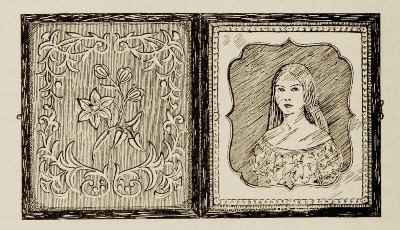
Abigail's Daguerreotype
Abigail unfastened the two tiny brass hooks which held the two covers together, and displayed the picture inside. Fitted into one of the covers and framed by a mat of red velvet was a likeness of Abigail which made Anna gasp with surprise. There was Abigail's face, Abigail's smile, even the sprigs of roses on Abigail's new delaine dress. It was not a colored picture, to be sure, but otherwise it was just as good a picture as an oil painting, so Anna thought.
Such daguerreotypes as that of Abigail, and the ambrotypes and the ferrotypes which were advertised at almost the same time—so quickly were new kinds of pictures invented when once the process of photography was discovered—were the first portraits made by the camera. Compared with the beautiful photographs of to-day, these pictures taken during the ten years preceding the Civil War seem very poor and unsatisfactory; but to those who had never seen any likenesses except either the oil portraits or the silhouettes, these likenesses made by the camera were very wonderful.
It is rather surprising that the pictures taken when Anna was a child were as good as those still in existence show them to have been. It had been little more than ten years since Monsieur Daguerre had announced to the French Academy his invention of photography. Unlike most other inventors he actually wished all his discoveries to be made public, and as a result, the further discoveries of other men greatly hastened the development of the art.
In 1839, when Daguerre announced his discovery, he exposed his picture one hour and twelve minutes. This, of course, meant that it could not be used for portraits until the exposure could be reduced to a reasonable length. The use of different chemicals from those Daguerre used soon brought the time of exposure to thirty minutes; but one of the newspapers of the day says that the portraits taken then were "terrific likenesses of the human visage."
By 1850 such improvements had been made that one writer says that in the large cities cameras were as common as hand organs, and that the pictures were no longer "terrific." The credit for all this surely belongs to the far-seeing inventor who asked that he might give to the public all that he had found out, in order that other men might build on his discoveries.
After seeing three of these new pictures, it was no wonder that Anna could hardly wait until the next day to go to the photographer's herself. That night at bedtime she said to her mother, "I suppose, if my hair is going to look black in the picture, I could have black curls if you were willing to do up my hair on rags."
"Do you really want me to?" asked her mother, hoping Anna would decide against the curls.
"Of course I don't. I was just joking. I want Aunt Anna to have a real picture of me," replied Anna.
The first thing the next morning Anna wanted to know when they should go to the photographer's.
"Right away after dinner I think will be the best time," her mother answered.
Accordingly, as early in the afternoon as possible, Anna dressed to have her picture taken. As this was back in 1853, Anna wore, although she was only twelve years old, a full, ruffled skirt which came almost to the tops of her brown gaiter boots. The boots were her special pride, and as they were the very first she had ever owned with kid vamps and cloth tops, she did hope they would show in the picture. She wore her best white guimpe, which was cut in what was called a half-low neck; her sprigged muslin, which had very large, flowing sleeves; and her new white muslin undersleeves, which had been a present from Aunt Anna. Her hair was parted in the middle and held in place on the sides by a round comb.
"Do I look all right?" Anna asked, turning slowly for her mother to inspect her.
"Yes, I think so, and to me you look very nice," her mother answered. "Don't you think you'll need your galoshes? The showers last night have left the streets very muddy."
"I'll wear them, for I'm sure I don't want anything to happen to my beautiful boots," said Anna, and so she buckled on a pair of the clumsy rubber overshoes which they wore in those days.
Anna wanted a full length picture; her mother said little, but preferred the head and shoulders only, as the face then would be so much larger and plainer. Finally it was decided to have the little girl seated in a quaintly carved high-backed chair. In those early days of photography Anna must keep still two minutes—one hundred and twenty seconds—instead of one second, and so it was really better to sit than to stand.
When Anna was seated, she folded her hands, and held her head very high. The photographer said her position seemed a little stiff, and so he turned her head slightly to one side and gave her the choice of a stuffed bird or a paper rose to hold in her hands. Anna chose the rose because it was pink and matched the roses in her new sprigged muslin dress. She forgot that the picture would be all black and white anyway. She felt more at ease when she had something to hold and was sure she could sit as still as a stone for one hundred twenty seconds or even twice that.
The photographer went behind the great, awkward machine which he called a camera and covered up his head and part of the camera, with what looked to Anna like a tablecloth. She almost laughed, and the photographer, who was looking through the camera, told her almost sharply not to smile so much because it made her open her mouth.
"Say 'Flip' to make your mouth small and get it into shape again," he directed.
Anna said "Flip," anxious at the same time to try "Flop" to see if it would make a large mouth. It was just as well she did not delay matters just then by trying, for only a very little later she actually read in the Boston Transcript: "For a small mouth 'Flip,' for a large mouth 'Cabbage.'"
"All ready," said the man at last, after he had taken his head from under the shawl several times to arrange the folds of Anna's skirt, to turn her head a little more, or to straighten her shoulders. Then he slipped the plate for the picture into place in the camera and said, "Now look pleasant."
Anna did her best to do so, but her mouth felt stiff, and she wanted both to wink and to swallow, and, worst of all, her nose itched. It seemed one hundred twenty minutes instead of one hundred twenty seconds to the little girl, but at last the photographer said, "All done."
In those early days of photography the completed picture was the very plate which had been placed in the camera. They did not know then how to print from the plate as photographers do now, and so the plate on which the image was made was developed and "fixed" and then mounted under glass in such little cases as Abigail's. Only one picture could be made at a time, and pictures were consequently expensive.
It did not take long, however, to develop a daguerreotype and mount it. Soon Anna was looking at her own picture. She thought it very good indeed and secretly felt it more elegant than Abigail's, because she was seated and showed the whole figure, and Abigail's was only of head and shoulders.
"Good!" said Anna's father when he saw it. "I didn't believe there was much in this new process of photography, but there is. Monsieur Daguerre and all those who have made improvements on his discovery certainly deserve great honor. This is really a picture of my little girl. If this is Aunt Anna's, then I must have another to keep myself."
"It really is a good picture of Anna, isn't it?" said Mrs. Holman as her husband passed it back to her. Then, as she looked again at the picture, she laughed merrily. "It is a very good picture of the galoshes, too."
"The galoshes!" exclaimed Anna.
"The galoshes!" said her father.
"Didn't I take them off?" asked Anna.
"It must be that you didn't," replied her mother. "Never mind; it must be a very fine picture of you yourself or we should have seen the galoshes sooner."
Anna wondered if her Aunt Anna would notice the overshoes. The present reached her aunt in her far-off western home on Christmas day.
"I am delighted with the picture," she wrote. "It is like having a visit from my dear little niece. It seems as if she could speak to me if she wished. What a lovely dress, and what a lovely guimpe! Really, I am so pleased with the picture that I even admire the galoshes."
Anna had many other pictures taken before she was grown up, but she said she always felt the marvel of sitting before a camera for the sun to reflect and imprint her features on a plate which she could not see. Indeed, the faithfulness and the certainty of the result always made her declare that she could never have her picture taken without recalling the lines which Lucy Larcom wrote after her first daguerreotype was made:
"Oh, what if thus our evil deeds Are mirrored on the sky, And every line of our wild lives Daguerreotyped on high."