Part 2 — PART II
Reading edition
The day before his uncle's next visit Jimmie set his type to say, "Much interest is felt in the new Hoe press which will be installed in the Record office early next month. It is the first of the kind to be used by any newspaper in the city and will mark a revolution in newspaper printing. This new 'perfecting press' will make it possible to print 24,000 eight-page papers an hour—a thing not dreamed of a few years ago. People are anxious to see this fast press printing, cutting, folding, and delivering the papers all ready for the newsboys."
"You really know of somebody who is anxious to see the press, do you?" asked his uncle with a twinkle in his eye when he read the item in Jimmie's paper.
"Guess I do," said Jimmie. "Honestly, I won't be any bother; I won't be any bother; I won't ask any questions except about the press—cross my heart and hope to die."
Uncle Francis laughed. He knew Jimmie too well to think he would not be any bother, but he said, "All right; as soon as you have two good legs again I'll invite you to see the new machinery."
Jimmie's leg mended as fast as the leg of any boy should, and he was able in March to take the trip to the city. Jimmie's mother went with him.
"I want to see the big press, too," she explained to her brother.
"I'm glad you came," said Uncle Francis as he greeted her. "I should think every man and woman in the United States would be interested in this new kind of printing press. Do you know, it will bring down the price of a paper from a nickel to three cents! They have just begun to print the afternoon edition. Shall we go now to see the new Hoe rotary perfecting press? It is the most wonderful thing in printing that has ever been invented since Gutenberg invented movable type more than four hundred years ago. It seems as though it must mark the limit in fast printing, but who knows? Surely Gutenberg and Faust would have thought our old press with the pages of type on a stationary flat bed over which rollers and paper passed, the limit of wonders. Come and see this new press eat up the paper!"
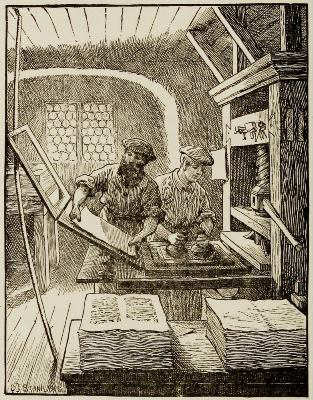
The Earliest Printers at Work
They soon stood before a great throbbing monster, a mystery of wheels within wheels and of gleaming steel. At one end was a huge roll of white paper; at the other was an unceasing stream of newspapers. Jimmie watched in wide-eyed wonder. He heard his uncle say that the huge roll, or web, of white paper was being fed into one end of the press, was being printed on both sides, the newspaper sheets were being cut apart, folded, and finally delivered, counted, at the other end of the press. How could it be done!
"Well, what do you think of it all?" asked Uncle Francis, turning to Jimmie.
Jimmie hardly took his fascinated gaze from the great whirring monster.
"It's great! It's a hundred times more wonderful than I thought it would be! Now that I've seen what this press can do I think I shall run one of these instead of being an editor."
His uncle laughed. "All right," he said; "you see how this runs, do you?"
"Not all of it," admitted Jimmie.
"Probably the type part bothers you," said his uncle, "because you are accustomed to seeing the type in a flat steel frame, or chase, as we call it. Here it is on the outside of one of those huge rollers, or cylinders, as we call them. Do you see it?"
"Yes," said Jimmie, "but there isn't any type on the cylinder just under it."
"No," answered his uncle, "the other is the impression cylinder. Those two big cylinders work together like the rollers of a clothes wringer. That broad ribbon of paper, just as wide as our newspaper, goes between the two cylinders as clothes pass between the rollers of the wringer. The impression cylinder rolls the paper hard against the inked type cylinder and prints one side of the paper. If one of the rollers of a clothes wringer had ink marks on it they would be printed on the clothes as they went between the rollers, wouldn't they? That is the way this press works. Can you see the paper as it goes on?"
"Yes, and there are two more cylinders like the other pair!" cried Jimmie.
"That's right," answered his uncle. "I think you can see that when the paper passes between the second pair the other side of the paper is printed. Just get your eye on the paper as it is unwound from that enormous spool, or web, and watch as far as you can. The white paper in that web is a strip four miles long and as wide as two pages of the Record. The type cylinders turn so fast you can't see what is on them, but there is enough type to print four pages of the newspaper on each cylinder."
"Why do they need such a quantity of small black rollers?" asked Jimmie's mother.
"Those small rollers you are watching are inking cylinders," answered her brother. "They are very important in the printing. See them keep inking the type cylinder, rolling against the part which has just done some printing as it turns around to print again. I don't believe you can see the ink fountain which covers them with ink so that they in turn can cover the type, but it is there, working all the time."
"It is easy enough to see why it is called a rotary press," said Mrs. Granger. "Cylinders and cylinders and cylinders rolling round and round and round."
"Do you see why it is called a perfecting press, Jimmie?" asked Uncle Francis.
"No, I don't believe I do. Do you, mother?" he asked.
"Why, yes, I think so. Look at the other end of the press and see those newspapers fairly pouring out all cut from the web, folded, and even counted. If they are completed in every respect so that there is nothing for anybody to do but sell them, I should think the press might be called a perfecting press."
"Of course," assented Jimmie, "that's the reason. Why didn't I see it?"
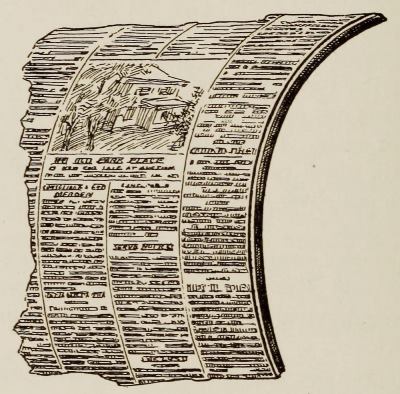
Curved Stereotype Plate
"Shall we go back to the office now where there is less noise and see what to-day's paper says?" asked Uncle Francis after giving Jimmie a good long time to watch the press. "There is one thing more I should like to have you see, but it is too late for you to do so to-day. Give one look at the type cylinder before you leave. Can you see that the type is not in little pieces of one letter each, but is in solid pieces of metal curved to fit the cylinder?" On the way back to the office Uncle Francis showed Jimmie a stereotype plate which he could study at close range.
"These plates are what you saw on the type cylinder," explained Uncle Francis. "You shall see one made sometime. In these days in the big offices after the real type is set letter by letter it isn't used for the printing at all. It wears it out too fast to print 50,000 newspapers from it each day, and besides it takes too much type. Instead of using the movable type for the printing, we cover the type with a soft substance like soaked up pasteboard, press it hard on the type, dry it, and have a perfect copy of the type except that the letters are little hollows instead of raised pieces.
"This copy, or model, is used for a mold into which we pour liquid metal. When this cools we have, you see, another copy of the type and in this the letters are all raised. The mold is curved to fit the cylinders before the molten metal is poured in, so that the stereotype plate, as the page of fixed type is called, can be clamped tight on the big cylinder. It is these big plates that you have seen used for type on the press cylinders."
"Jingles! but it is some work to print a newspaper!" exclaimed Jimmie.
"Yes, it is, and it is a very wonderful process, too, more wonderful every year. You and your mother will be interested in this paragraph in to-day's paper," said his uncle, passing Mrs. Granger one of the freshly printed papers. "In that article about the new press are some striking comparisons you will enjoy."
"What a change in printing!" said Mrs. Granger. "Just listen, Jimmie! 'The old flat screw press of the colonial period could print fifty small papers on one side in an hour; the Washington compound lever hand press in 1829—the best hand press ever made—brought the number up to 250; the revolving cylinder press made it possible to print about 1000 an hour; then in 1847 the Hoe lightning press printed 30,000; and now the Hoe rotary perfecting press prints on both sides,—not a little four-page paper, but a large-sized eight-page paper—at the rate of 24,000 an hour!'"
"Jingles!" said Jimmie again, for what can a boy say to such figures as those.
When Jimmie reached home that night he announced to his father that he was going to be a newspaper man.
"I'm willing," replied his father. "The printing press has done more for the progress of civilization than anything else, and the modern newspaper is one of the greatest factors in the world's advancement. Go ahead. You'll live to see the printing press reach even more people than it does now."
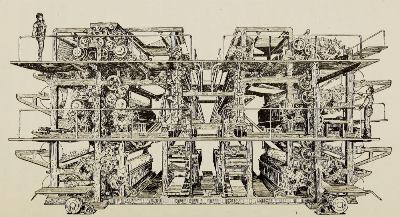
Sextuple Perfecting Press
Mr. Granger was right. When Jimmie was no older than his uncle had been on the day that Jimmie first saw a big press, Jimmie did indeed see another wonder. It was a Hoe Double Octuple Press—the biggest press in the world in 1912—which, with others built on the same principle even if they were smaller, made newspaper printing cheap enough so that a sixteen-page paper could be sold for one cent.
The grown-up Jimmie felt as he stood by the new press very much as he felt years before. Could there be a more wonderful machine? Eight rolls of paper were feeding the monster; eighteen plate cylinders were revolving, each carrying type enough for eight pages of a large newspaper; the cylinders, turning at a speed of three hundred revolutions a minute, were consuming paper at the rate of 108 miles of paper six feet wide in an hour. Jimmie, then an experienced newspaper man, watched the four sets of folders pouring out thirty-two-page papers at the rate of 75,000 an hour, until he turned away, saying, "Can it be possible that printing will ever be easier? How I wish Benjamin Franklin could see this press! How he would glory in its possibilities! It is perfectly true that the printing press is to literature what the steam engine is to the industries, and what the locomotive is to traffic."