LECTURE V. NATURE AS A MANIFESTATION OF MIND.
Reading edition
The subjects already discussed should have prepared us to regard nature as not a merely fortuitous congeries of matter and forces, but as embodying plan, design, and contrivance; and we may now inquire as to the character of these, considered as possible manifestations of mind in nature. The idea that nature is a manifestation of mind, is ancient, and probably universal. It proceeds naturally from the analogy between the operations of nature and those which originate in our own will and contrivance. When men begin to think more accurately, this idea acquires a deeper foundation in the conclusion that nature, in all its varied manifestations, is one vast machine too great and complex for us to comprehend, and implying a primary energy infinitely beyond that of man; and thus the unity of nature points to one Creative Mind.
Even to savage peoples, in whose minds the idea of unity has not germinated, or from whose traditions it has been lost, a spiritual essence appears to underlie all natural phenomena, though they may regard this as consisting of a separate spirit or manitou for every material thing. In all the more cultivated races the ideas of natural religion have taken more definite forms in their theology and philosophy. Dugald Stewart has well expressed the more scientific form of this idea in two short statements:
"1. Every effect implies a cause.
"2. Every combination of means to an end implies intelligence."
The theistic aspect of the doctrine had, as we have seen in a previous lecture, been already admirably expressed by Paul in his Epistle to the Romans. Writing of what every heathen must know of mind in nature, he says: "The invisible things of him since the creation of the world are clearly seen, being perceived through the things that are made, even his eternal power and divinity." The two things which, according to him, every intelligent man must perceive in nature are, first, power above and beyond that of man, and, secondly, superhuman intelligence. Even Agnostic Evolution cannot wholly divest itself of the idea of mind in nature. Its advocates continually use terms implying contrivance and plan when speaking of nature; and Spencer appears explicitly to admit that we cannot divest ourselves of the notion of a First Cause. Even those writers who seek to shelter themselves under such vague and unmeaning statements as that human intelligence must be potentially present in atoms or in the solar energy, are merely attributing superhuman power and divinity to atoms and forces.
Nor can they escape by the magisterial denunciation of such ideas as "anthropomorphic" fancies. All science must in this sense be anthropomorphic, for it consists of what nature appears to us to be when viewed through the medium of our senses, and of what we think of nature as so presented to us. The only difference is this—that if Agnostic Evolution is true, Science itself only represents a certain stage of the development, and can have no actual or permanent truth; while, if the theistic view is correct, then the fact that man himself belongs to the unity of nature and is in harmony with its other parts gives us some guarantee for the absolute truth of scientific facts and principles.
We may now consider more in detail some of the aspects under which mind presents itself in nature.
1. It may be maintained that nature is an exhibition of regulated and determined power. The first impression of nature presented to a mind uninitiated in its mysteries is that it is a mere conflict of opposing forces; but so soon as we study any natural phenomena in detail, we see that this is an error, and that everything is balanced in the nicest way by the most subtle interactions of matter and force. We find also that, while forces are mutually convertible and atoms susceptible of vast varieties of arrangement, all this is determined by fixed law and carried out with invariable regularity and constancy.
The vapor of water, for example, diffused in the atmosphere, is condensed by extreme cold and falls to the ground in snowflakes. In these, particles of water previously kept asunder by heat are united by cohesive force; and the heat has gone on other missions. But these particles do not merely unite: they geometrize. Like well-drilled soldiers arranging themselves in ranks, they form themselves, according to regular axes of attraction, in lines diverging at an angle of sixty degrees; and thus the snowflakes are hexagonal plates and six-rayed stars, the latter often growing into very complex shapes, but all based on the law of attraction under angles of sixty degrees (see Fig. 12). The frost on the window-panes observes the same law, and so does every crystallization of water where it has scope to arrange itself in accordance with its own geometry. But this law of crystallization gives to snow and ice their mechanical properties, and is connected with a multitude of adjustments of water in the solid state to its place in nature. The same law, varied in a vast number of ways in every distinct substance, builds up crystals of all kinds and crystalline rocks, and is connected with countless adaptations of different kinds of matter to mechanical and chemical uses in the arts. It is easy to see that all this might have been otherwise—nay, that it must have been otherwise—but for the institution of many and complex laws.
Fig. 12.
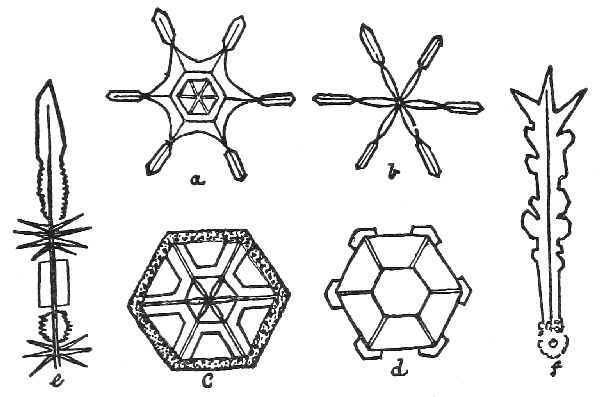
Snowflakes copied from nature under the microscope, and serving to illustrate the geometrical arrangement of molecules of water in crystallizing. a, b, simple stars; c, d, hexagonal plates; e, f, rays of large and complex star-shaped flakes. The law of arrangement of the molecules is that of attraction in the lines of three axes at angles of sixty degrees, and the varieties are produced by differences in temperature and rate of supply of material.
A lump of coal at first suggests little to excite interest or imagination; but the student of its composition and microscopic structure finds that it is an accumulation of vegetable matter representing the action of the solar light on the leaves of trees of the Palæozoic Age. It thus calls up images of these perished forests and of the causes concerned in their production and growth, and in the accumulation and preservation of their buried remains. It further suggests the many ways in which this solar energy, so long sealed up, can be recalled to activity in heat, gaslight, steam, and electric light, and how remarkably these things have been related to the wealth and the civilization of modern nations. An able writer of the agnostic school, in a popular lecture on coal, has his imagination so stimulated by these thoughts that he apostrophizes "Nature" as the cunning contriver who stored up this buried sunlight by her strange and mysterious alchemy, kept it quietly to herself through all the long geological periods when reptiles and brute mammals were lords of creation, and through those centuries of barbarism when savage men roamed over the productive coal-districts in ignorance of their treasures, and then revealed her long-hidden stores of wealth and comfort to the admiring study of science and civilization, and for the benefit of the millions belonging to densely-peopled and progressive nations; It is plain that "Nature" in such a connection represents either a poetical fiction, a superstitious fancy, or an intelligent Creative Mind. It is further evident that such Creative Mind must be in harmony with that of man, though vastly greater in its scope and grasp in time and space.
Even the numerical relations observed in nature teach the same lesson. The leaves of plants are not arranged at random, but in a series of curiously-related spirals, differing in different plants, but always the same in the same species and regulated by definite laws. Similar definiteness regulates the ramification of plants, which depends primarily on the arrangement of the leaves. The angle of ramification of the veins of the leaf is settled for each species of plant; so are the numbers of parts in the flower and the angular arrangement of these parts. It is the same in the animal kingdom, such numbers as 5, 6, 8, 10 being selected to determine the parts in particular animals and portions of animals. Once settled, these numbers are wonderfully permanent in geological time. The first known land reptiles appear in the Carboniferous period, and they have normally five toes; these appear in the earliest known species in the lowest beds of the Carboniferous. Their predecessors, the fishes, had numerous fin-rays; but when limbs for locomotion on land were contrived, the number five was adopted as the typical one. It still persists in the five toes and fingers of man himself. From these, as is well known, our decimal notation is derived. It did not originate in any special fitness of the number ten, but in the fact that men began to reckon by counting their ten fingers. Thus the decimal system of arithmetic, with all that follows from it, was settled millions of years ago, in the Carboniferous period, either by certain low-browed and unintelligent batrachians or by their Maker.
2. Nature presents to us very remarkable revelations of dissimilar and widely-separated matters and forces. I have referred to the numerical arrangement of the leaves of plants; but the leaf itself, in its structure and functions, is one of the most remarkable things in nature. Composed of layers of loosely-placed living cells with air-spaces between them; enclosed above and below with a transparent epidermis, the spaces between the cells communicating with the atmosphere without by means of microscopic pores guarded by cunningly-contrived valves opening or closing according to the hygrometric state of the air; connected with the stem of the plant by a system of tubes strengthened with spiral fibres within,—the structure of the leaf is, mechanically considered, of extreme beauty and complexity. But its living functions are still more wonderful. Receiving the water from the soil with such materials as it brings thence in solution, and absorbing carbonic dioxide and ammonia from the air, the living protoplasm of the leaf-cells has the power of chemically changing all these substances, and of producing from them those complicated and otherwise inimitable organic compounds of which the tissues of the plant are built up. The force by which this is done is that of the solar heat and light, both admitted freely into the interior of the leaf through the transparent epidermis, and therein imprisoned, so as to constitute a powerful storehouse of evaporation and chemical energy. In this way all the materials available for the maintenance of life, whether vegetable or animal, are produced, and no other structure than the living vegetable cell, as it exists in the leaf, has the power to effect these miracles of transmutation. Here, let it be observed, we have the vegetable cell placed in relation with the system of the plant, with the soil, with the atmosphere and its waters, with the distant sun itself and the properties of its emitted energies. Let it further be observed that, on the one hand, the chemistry involved in this is of a character altogether different from that which applies to inorganic matter, and, on the other, the products derived from a very few elements embrace all that vast variety of compounds which we observe in plants and animals, and which constitute the material of one of the most complex of sciences—that of organic chemistry. Finally, these complicated structures were produced and all their relations set up at a very early geological period. In so far as we can judge from their remains and the results effected, the leaves of the Palæozoic period were functionally as perfect as their modern successors (see Figs. 13, 14). Of course, the agnostic evolutionist may, if he pleases, attribute all this to fortuitous interactions of the sun, the atmosphere, and the earth, and may provide for what these fail to explain by the assumption of potentialities equivalent to the things produced. But the probability of such an hypothesis becomes infinitely small when we consider the variety and the diversity of things and forces which must have conspired to produce the results observed, and to maintain them so constantly, and yet with so much difference in circumstances and details. It is a relief to turn from such bewildering and gratuitous suppositions to the theory which supposes a designing Creative Mind.
Fig. 13.
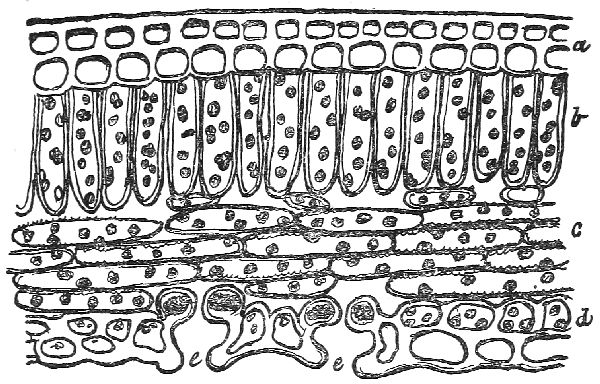
Section of the leaf of a Cycad, being one of the most ancient styles of leaf of which the structure is known. a, upper epidermis; b, upper layer of cells, with grains of chlorophyll; c, lower layer of cells, with chlorophyll; d, lower epidermis; e, stomata, or breathing-pores, with contractile cells for opening and closing.
Fig. 14.
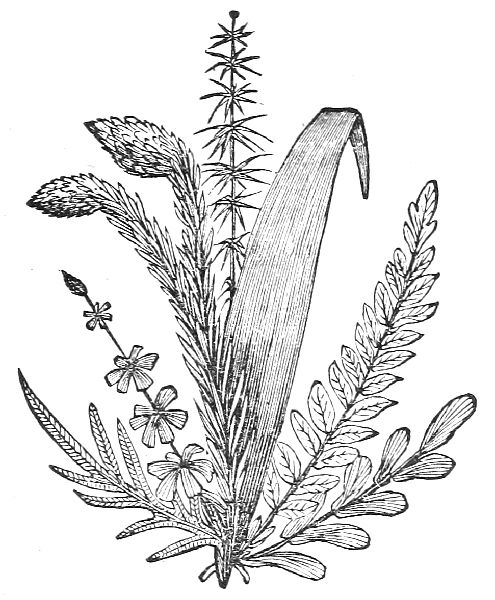
Foliage from the coal-formation, showing some of the forms of leaves instrumental in accumulating the carbon of our coal-beds, by their action on the atmosphere under the influence of sunlight.
From the boundless variety of illustrations which the animal kingdom presents I may select one—the contrivances by means of which marine animals are enabled to float or balance themselves in the waters. The Pearly Nautilus (see Fig. 15) is one of the most familiar, and also one of the most curious. Its coiled shell is divided by partitions into air-chambers so proportioned that the buoyancy of the air is sufficient to counterpoise in sea-water the weight of the animal. There are also contrivances by which the density of the contained air and of the body of the animal can be so modified as slightly to disturb this equilibrium, and to enable the creature to rise or sink in the waters. It would be tedious to describe, without adequate illustrations, all the machinery connected with these adjustments. It is sufficient for our purpose to know that they are provided in such a manner that the animal is practically exempted from the operation of the force of gravity. In the modern seas these provisions are enjoyed by only a few species of the genera Nautilus and Spirula; but in former geological ages, more numerous, as well as larger and more complex, forms existed. Further, this contrivance is very old. We find in the Orthoceratites and their allies of the earliest Silurian formations these arrangements in their full perfection, and in some forms[12] even more complex than in later types.
Fig. 15.
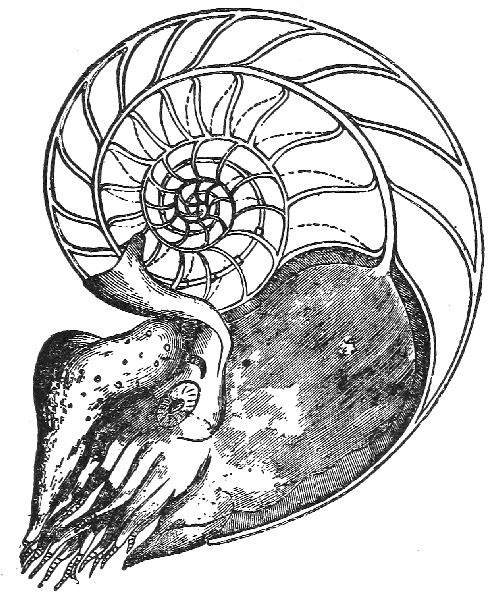
Section of the Pearly Nautilus and its shell, showing that the animal occupies only the outer chamber, the others being filled with air and acting as a float whose buoyancy can be modified by the action of the tube, or siphuncle, passing through the chambers.
The peculiar contrivances observed in the nautilus and its allies are possessed by no other mollusks, but there is another group of somewhat lower grade, that of the Ianthinæ, or violet snails, in which flotation is provided for in another way (see Fig. 16). In these animals the shell is perfectly simple, though light, and the floating apparatus consists in a series of horny air-vesicles attached to what is termed the "foot" of the animal, and which are increased in number to suit its increasing weight as it grows in size. There are some reasons to believe that this entirely different contrivance is as old in geological time as the chambered shell of the nautiloid animals. It was, indeed, in all probability, more common and adapted to larger animals in the Silurian period than at present.
Fig. 16.
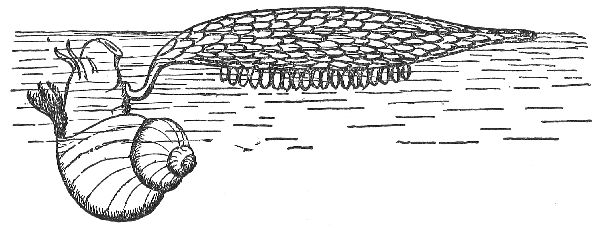
Ianthina, or Violet Snail, attached to a float composed of horny hollow vesicles, to the under side of which its eggs are attached. When hatched, each young animal develops a small float similar to that of the parent.
Another curious instance—not, so far as yet known, existing at all in the modern world—is that of the remarkable stalked star-fish described by Professor Hall under the name Camerocrinus, and whose remains are found in the Upper Silurian rocks. The Crinoids, or feather-stars, are well-known inhabitants of the seas, in both ancient and modern times; but previous to Professor Hall's discovery they were known only as animals attached by flexible stems to the sea-bottom or creeping slowly by means of their radiating arms. It was not suspected that any of them had committed themselves to the mercy of the currents, suspended from floats. It appears, however, that this was actually realized in the Upper Silurian period, when certain animals of this group developed a hollow calcareous vesicle forming a balloon-shaped float, from which they could hang suspended in the water and float freely (see Fig. 17). So far as known, this remarkable contrivance was temporary, and probably adapted to some peculiarities of the habits and food of these animals occurring only in the geological period in which they existed.
Fig. 17.
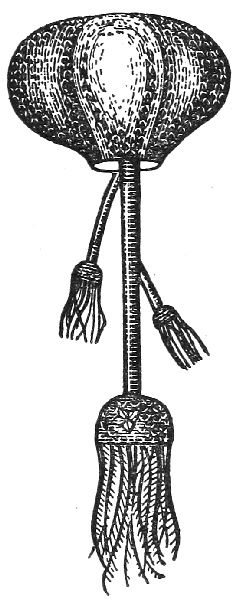
Camerocrinus, reduced in size (as restored by Hall). This is a crinoid, or feather-star, of the Upper Silurian period, floating by means of a hollow balloon-shaped structure divided into chambers and formed of calcareous plates.
Examples of this sort of adjustment are found in other types of animal life. In the beautiful Portuguese man-of-war (Physalia) and its allies flotation is provided for by membranous or cartilaginous sacs or vesicles filled with air, and which are the common support of numerous individuals which hang from them (see Fig. 18). In some allied creatures the buoyancy required is secured by little vesicles filled with oil secreted by the animals themselves.
In each of these cases we have a skilful adaptation of means to ends. The float is so constructed as to avail itself of the properties of gases and liquids, and the apparatus is framed on the most scientific principles and in the most artistic manner. That this apparatus grows and is not mechanically put together, and that in each case the instincts and the habits of the animal have been correlated with it, can scarcely be held by the most obtuse intellect to invalidate the evidence of intelligent design.
Fig. 18.
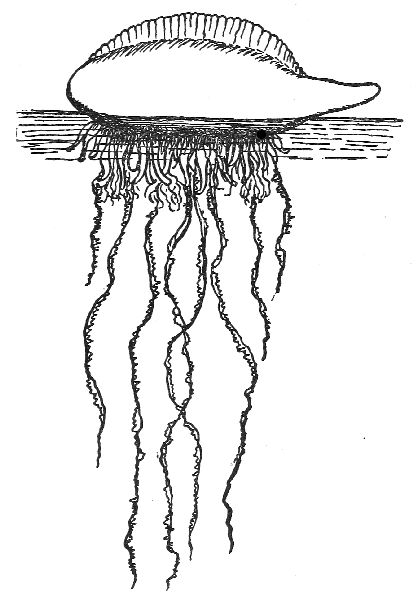
The Physalia, or "Portuguese man-of-war" of the Atlantic, being a colony of animals provided with long tentacles used as fishing-lines, and hanging from a membranous float with a crest, or "sail," on the top, and a pointed end which, being turned from side to side, serves as a rudder.
3. Structures apparently the most simple, and often heedlessly spoken of as if they involved no complexity, prove, on examination, to be intricate and complex almost beyond conception. In nothing, perhaps, is this better seen than in that much-abused protoplasm which has been made to do duty for God in the origination of life, but which is itself a most laboriously manufactured material. Albumen, or white of egg—which is otherwise named "protoplasm"—is a very complicated substance both chemically and in its molecular arrangements, and when endowed with life it presents properties altogether inscrutable. It is easy to say that the protoplasm of an egg or of some humble animalcule or microscopic embryo is little more than a mass of structureless jelly; yet, in the case of the embryo, a microscopic dot of this apparently structureless jelly must contain all the parts of the future animal, however complex; but how we may never know, and certainly cannot yet comprehend.
There are minute animalcules belonging to the group of flagellate Infusoria, some of which, under ordinary microscopic powers, appear merely as moving specks, and show their actual structures only under powers of two thousand diameters, or more; yet these animals can be seen to have an outer skin and an inner mass, to have pulsating sacs and reproductive organs, and threadlike flagella wherewith to swim. Their eggs are, of course, much smaller than themselves—so much so that some of them are probably invisible under the highest powers yet employed. Each of them, however, is potentially an animal, with all its parts represented structurally in some way. Nor need we wonder at this. It has been calculated that a speck scarcely visible under the most powerful microscope may contain two million four hundred thousand molecules of protoplasm.[13] If each of these molecules were a brick, there would be enough of them to build a terrace of twenty-five good dwelling-houses. But this is supposing them to be all alike; whereas we know that the molecules of albumen are capable of being of very various kinds. Each of these molecules really contains eight hundred and eighty-two ultimate atoms—namely, four hundred of carbon, three hundred and ten of hydrogen, one hundred and twenty of oxygen, fifty of nitrogen, and two of sulphur and phosphorus. Now, we know that these atoms may be differently arranged in different molecules, producing considerable difference of properties. Let us try, then, to calculate of how many differences of arrangement the atoms of one molecule of protoplasm are susceptible, and then to calculate of how many changes these different assemblages are capable in a microscopic dot composed of two million four hundred thousand of them. It is scarcely necessary to say that such a calculation, in the multitudes of possibilities involved, transcends human powers of imagination; yet it answers questions of mechanical and chemical grouping merely, without any reference to the additional mystery of life. Let it be observed that this vastly complex material is assumed as if there were nothing remarkable in it, by many of those theorists who plausibly explain to us the spontaneous origin of living things. But nature, in arranging all the parts of a complicated animal beforehand in an apparently structureless microscopic ovum, has all these vast numbers to deal with in working out the exact result; and this not in one case merely, but in multitudes of cases involving the most varied combinations. We can scarcely suppose the atoms themselves to have the power of thus unerringly marshalling themselves to work out the structures of organisms infinitely varied, yet all alike after their kinds. If not, then "Nature" must be a goddess gifted with superhuman powers of calculation and marvellous deftness in arranging invisible atoms.
4. The beauty of form, proportion, and coloring that abounds in nature affords evidence of mind. Herculean efforts have been made by modern evolutionists to eliminate altogether the idea of beauty from nature, by theories of sexual selection and the like, and to persuade us that beauty is merely utility in disguise, and even then only an accidental coincidence between our perceptions and certain external things. But in no part of their argument have they more signally failed in accounting for the observed facts, and in no part have they more seriously outraged the common sense and natural taste of men. In point of fact, we have here one of those great correlations belonging to the unity of nature—that indissoluble connection which has been established between the senses and the æsthetic sentiments of man and certain things in the external world. But there is more in beauty than this merely anthropological relation. Certain forms, for example, adopted in the skeletons of the lower animals are necessarily beautiful because of their geometrical proportions. Certain styles of coloring are necessarily beautiful because of harmonies and contrasts which depend on the essential properties of the waves of light. Beauty is thus in a great measure independent of the taste of the spectator. It is also independent of mere utility, since, even if we admit that all these combinations of forms, motions, and colors which we call beautiful are also useful, it is easy to perceive that the end could often be attained without the beauty.
It is a curious fact that some of the simplest animals—as, for example, sponges and Foraminifera,—are furnished with the most beautiful skeletons. Nothing can exceed the beauty of form and proportions in the shells of some Foraminifera and Polycistina, or in the skeletons of some silicious sponges (see Fig. 19), while it is obvious that these humble creatures, without brains and external senses, can neither contrive nor appreciate the beauty with which they are clothed. Further, some of these structures are very old geologically. The sponge whose skeleton his known as "Venus's flower-basket" produces a structure of interwoven silicious threads exquisite in its beauty and perfect in its mechanical arrangements for strength (Figure 20). Even in the old Cambrian rocks there are remains of sponges which seem already to have practically solved the geometrical problems involved in the production of these wonderful skeletons; and with a Chinese-like persistency, having attained to perfection, they have adhered to it throughout geological time. Nor is there anything of mere inorganic crystallization in this. The silica of which the skeletons are made is colloidal, not crystalline, and the forms themselves have no relations to the crystalline axes of silica. Such illustrations might be multiplied to any extent, and apply to all the beauties of form, structure, and coloring which abound around us and far excel our artificial imitations of them.
Fig. 19.
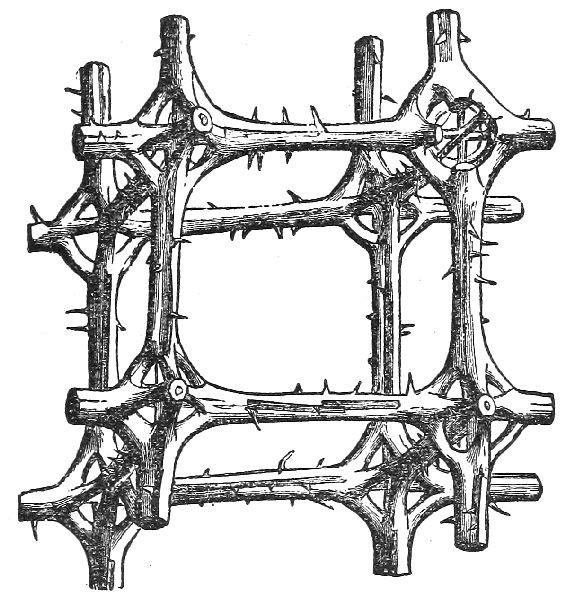
Magnified portion of a silicious sponge, showing the principle of construction of the hexactinellid sponges, with six-rayed spicules joined together and strengthened with diagonal braces. (After Zittel.)
Fig. 20.
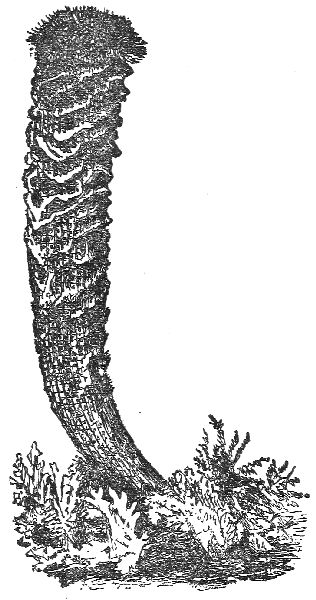
Euplectella, or "Venus's flower-basket," a silicious sponge, showing its general form. (Reduced, from Am. Naturalist, vol. iv.)
5. The instincts of the lower animals imply a Higher Intelligence. Instinct, in the theistic view of nature, can be nothing less than a divine inspiration placing the animal in relation with other things and processes, often of the most complex character, and which it could by no means have devised for itself. Further, instinct is in its very essence a thing unimprovable. Like the laws of nature, it operates invariably; and if diminished or changed, it would prove useless for its purpose. It is not, like human inventions, slowly perfected under the influence of thought and imagination, and laboriously taught by each generation to its successors: it is inherited by each generation in all its perfection, and from the first goes directly to its end as if it were a merely physical cause.
The favorite explanation of instinct from the side of Agnostic Evolution is that it originated in the struggle for existence of some previous generation, and was then perpetuated as an inheritance. But, like most of the other explanations of this school, this quietly takes for granted what should be proved. That instinct is hereditary is evident; but the question is, How did it begin? and to say simply that it did begin at some former period is to tell us nothing. From a scientific point of view, the invariable operation of any natural law affords no evidence of any gradual or sudden origination of it at any point of past time; and when such law is connected with a complicated organism and various other laws and processes of the external world, the supposition of its slowly arising from nothing through many generations of animals becomes too intricate to be credible. Instinct must have originated in a perfect condition, and with the organism and its environment already established. I may borrow here an apposite illustration from recent papers on the unity of nature by the Duke of Argyll, which deserve careful study by any one who values common-sense views of this subject. The example which I select is that of the action of a young merganser in its effort to elude pursuit:
"On a secluded lake in one of the Hebrides, I observed a dun-diver, or female of the red-breasted merganser (Mergus serrator), with her brood of young ducklings. On giving chase in the boat we soon found that the young, although not above a fortnight old, had such extraordinary powers of swimming and diving that it was almost impossible to capture them. The distance they went under water, and the unexpected places in which they emerged, baffled all our efforts for a considerable time. At last one of the brood made for the shore, with the object of hiding among the grass and heather which fringed the margin of the lake. We pursued it as closely as we could; but when the little bird gained the shore, our boat was still about twenty yards off. Long drought had left a broad margin of small flat stones and mud between the water and the usual bank. I saw the little bird run up about a couple of yards from the water, and then suddenly disappear. Knowing what was likely to be enacted, I kept my eye fixed on the spot; and when the boat was run upon the beach, I proceeded to find and pick up the chick. But, on reaching the place of disappearance, no sign of the young merganser was to be seen. The closest scrutiny, with the certain knowledge that it was there, failed to enable me to detect it. Proceeding cautiously forward, I soon became convinced that I had already overshot the mark; and, on turning round, it was only to see the bird rise like an apparition from the stones and, dashing past the stranded boat, regain the lake, where, having now recovered its wind, it instantly dived and disappeared. The tactical skill of the whole of this manœuvre, and the success with which it was executed, were greeted with loud cheers from the whole party; and our admiration was not diminished when we remembered that, some two weeks before that time, the little performer had been coiled up inside the shell of an egg, and that about a month before it was apparently nothing but a mass of albumen and of fatty oils."
On this the duke very properly remarks that any idea of training and experience is absolutely excluded, because it "assumes the pre-existence of the very powers for which it professes to account." He then turns to the idea that animals are merely automata or "machines." Here it is to be observed that the essential idea of a machine is twofold. First, it is a merely mechanical structure put together to do certain things; secondly, it must be related to a contriver and constructor. If we think proper to call the young merganser a machine, we must admit both of these characters, more especially as the bird is in every way a more marvellous machine than any of human construction. He concludes his notice of this case with the following suggestive words:
"This is a method of escape which cannot be resorted to successfully except by birds whose coloring is adapted to the purpose by a close assimilation with the coloring of surrounding objects. The old bird would not have been concealed on the same ground, and would never itself resort to the same method of escape. The young, therefore, cannot have been instructed in it by the method of example. But the small size of the chick, together with its obscure and curiously-mottled coloring, are specially adapted to this mode of concealment. The young of all birds which breed upon the ground are provided with a garment in such perfect harmony with surrounding effects of light as to render this manœuvre easy. It depends, however, wholly for its success upon absolute stillness. The slightest motion at once attracts the eye of any enemy which is searching for the young. And this absolute stillness must be preserved amidst all the emotions of fear and terror which the close approach of the object of alarm must, and obviously does, inspire. Whence comes this splendid, even if it be unconscious, faith in the sufficiency of a defence which it must require such nerve and strength of will to practise? No movement, not even the slightest, though the enemy should seem about to trample on it,—such is the terrible requirement of nature, and by the child of nature implicitly obeyed. Here, again, beyond all question, we have an instinct as much born with the creature as the harmonious tinting of its plumage, the external furnishing being inseparably united with the internal furnishing of mind which enables the little creature in very truth to 'walk by faith, and not by sight.' Is this automatism? Is this machinery? Yes, undoubtedly, in the sense explained before—that the instinct has been given to the bird in precisely the same sense in which its structure has been given to it; so that anterior to all experience, and without the aid of instruction or of example, it is inspired to act in this manner on the appropriate occasion arising."
Lastly, the reason of man himself is an actual illustration of mind in nature. Here we raise a question which should perhaps have been considered earlier: Is man himself actually a part of what we call nature? We are so accustomed to the distinction between things natural and things artificial that we are liable to overlook this essential question. Is nature the universe outside of us, containing the things that we study and which constitute our environment? Are we elevated on a pedestal, so to speak, above nature? or, on the other hand, does nature include man himself? In that haze or fog of ideas which environs modern evolutionism, it is not wonderful that this question escapes notice, and that the most contradictory utterances are given forth. Tyndall—by no means the most foggy of the agnostics—may afford an instance. He remarks respecting the philosophers of antiquity:[14] "The experiences which formed the weft and woof of their theories were drawn, not from the study of nature, but from that which lay much closer to them-the observation of man.... Their theories accordingly took an anthropomorphic form." Here we see that in the view of the writer man is distinct from and outside of nature, and so much out of harmony with it that the observation of him leads to false conclusions, stigmatized, accordingly, as "anthropomorphic." In this case man must be supernatural, and preternatural as well. But it is Tyndall's precise object to show us that there is nothing supernatural either in man or elsewhere. The contradiction is an instructive example of the delusions which sometimes pass for science.
If, with Tyndall, we are to place man outside of nature, then the human mind at once becomes to us a supernatural intelligence. But truth forbids such a conclusion. The reason of man, however beyond the intelligence of lower animals, so harmonizes with natural laws that it is evidently a part of the great unity of nature, and we can no more dissociate the mind of man from nature than from his own animal body. If we could do so, we might have ground to distrust the validity of all our conclusions as to nature, and thus to cut away the foundations of science; and what remained of philosophy and religion would be preternatural, in the bad sense of destroying the unity of nature and imperilling our confidence in the unity of the Creator himself.
In connection with this we have cause to consider the true meaning and use of two terms often hurled at theists as weapons of attack.
The word "anthropomorphic" is a term of reproach for our interpreting nature in harmony with our own thoughts or our own constitution. But if man is a part of nature, he must be a competent interpreter of it. If he is not a part of nature, then, whether we make him godlike or a demon, we have, in him, to deal with something supernatural. It is true that in a certain sense he is above nature, but not in any sense which so dissociates him from it as to prevent him from rationally thinking of it in his own thoughts and speaking of it in his own form of words. So true is this that no writers are more anthropomorphic in their modes of speaking of nature than those who most strongly denounce anthropomorphism. Even the celebrated definition of life by Herbert Spencer cannot escape this tincture. "Life," he says, "is the continuous adjustment of internal to external conditions." Now, the essence of this definition lies in the word "adjustment." But to adjust is to arrange, adapt, or fit—all purely human and intelligent actions. Nothing, therefore, could be more anthropomorphic than such a statement. As theists we need not complain of this, but surely as agnostics we should decidedly object to it.
The other word whose meaning it is necessary to consider is "supernatural," which it might be well, perhaps, to follow the example of the New Testament in avoiding altogether as a misleading term. If by supernatural we mean something outside of and above nature and natural law, there is really no such thing in the universe. There may be that which is "spiritual," as distinguished from that which is natural in the material sense; but the spiritual has its own laws, which are not in conflict with those of the natural. Even God cannot in this sense be said to be supernatural, since his will is necessarily in conformity with natural law. Yet this absurd sense of the term "supernatural" is constantly forced upon us by so-called advanced thinkers, and employed as an argument against theism. The only true sense in which any being or any thing can be said to be supernatural is that in which we use it with reference to the original creation of matter and force and the institution of natural law. The power which can do these things is above nature, but not outside of it; for matter, energy, and law must be included in, and in harmony with, the Creative Will.
To return from this digression. If man is a part of nature, we can see how it is that he conforms to natural law, not merely in his bodily organization and capabilities, but in his mind and habits of thought, so that he can comprehend nature and employ it for his purposes. Even his moral and his religious ideas must in this case be conformed to his conditions of existence as a part of nature. We have here also the surest guarantee of the correctness of our conclusions respecting the laws of nature. In like manner, there is here a sense in which man is above nature, because he is placed at the head of it. In another sense he is inferior to the aggregate of nature, because, as Agassiz well puts it, there is in the universe a "wealth of endowment of the most comprehensive mental manifestations which man can never fully comprehend."
Still further, if the universe has been created, then, just as its laws must be in harmony with the will of the Creator, so must our mental constitution; and man, as a reasoning and conscious being, must be made in the image of his Maker. If we discard the idea of an intelligent Creator, then mind and all its powers must be potentially in the atoms of matter or in the forces which move them; but this is a mere form of words signifying nothing, or, if it has any significance, this is contrary to science, since it bestows on matter properties which experiment does not show it to possess. Thus the existence of man is not only a positive proof of the presence of mind in nature, but affords the strongest possible proof of a higher Creative Mind, from which that of man emanates. The power which originated and sustains the universe must be at least as much greater and more intelligent than man as the universe is greater than man in the power and the contrivance which it indicates. Thus we return to the Pauline idea—that the power and the divinity of the Creator are shown by the things he has made. Legitimate science can say nothing more, and can say nothing less.