LECTURE III. EVOLUTION AS TESTED BY THE RECORDS OF THE ROCKS.
Reading edition
Having discussed those vague analogies and fanciful pedigrees by which it has been attempted to drag the science of Biology into the service of Agnostic Evolution, we may now turn to another science—that of the earth—and inquire how far it justifies us in affirming the spontaneous evolution of plants and animals in the progress of geological time. This subject is one which would require a lengthy treatise for its full development, and it cannot be pursued in the most satisfactory way without much previous knowledge of geological facts and principles, and of the classification of animals and plants. On the present occasion it must therefore be treated in the most general possible manner, and with reference merely to the results which have been reached. There is the more excuse for this mode of treatment that, in works already published and widely circulated,[7] I have endeavored to present its details in a popular form to general readers.
Geological investigation has disclosed a great series of stratified rocks composing the crust of the earth, and formed at successive times, chiefly by the agency of water. These can be arranged in chronological order; and, so arranged, they constitute the physical monuments of the earth's history. We must here take for granted, on the testimony of geology, that the accumulation of this series of deposits has extended over a vast lapse of time, and that the successive formations contain remains of animals and plants from which we can learn much as to the succession of life on the earth. Without entering into geological details, it may be sufficient to present in tabular form (see p. 107) the grand series of formations, with the general history of life as ascertained from them.
Tabular View of Geological Periods and of Life-Epochs.
Geological Periods. Animal Life. Vegetable Life.
Cainozoic or Neozoic.
Post-Tertiary or Modern {Recent. {Post-Glacial. Age of Man and Modern Mammals. Age of Angiosperms and Palms.
Tertiary {Pleistocene, or Glacial. {Pliocene. {Miocene. {Eocene. Age of Extinct Mammals. (Earliest Placental Mammals.)
Mesozoic.
Cretaceous {Upper, {Lower, or Neocomian. Age of Reptiles and Birds. (Earliest Modern Trees.)
Jurassic {Oolite. {Lias. Age of Cycads and Pines.
Triassic {Upper, {Middle, or Muschelkalk. {Lower. (Earliest Marsupial Mammals.)
Palæozoic.
Permian {Upper, {Middle, or Magnesian Limestone. {Lower. (Earliest True Reptiles.)
Carboniferous {Upper Coal-Formation. {Coal-Formation. {Carboniferous Limestone. {Lower Coal-Formation. Age of Amphibians and Fishes. Age of Acrogens and Gymnosperms.
Erian or Devonian {Upper. {Middle. {Lower.
Silurian {Upper, {Lower, or Siluro-Cambrian. Age of Mollusks, Corals and Crustaceans. (Earliest Land Plants.) Age of Algæ.
Cambrian {Upper. {Middle. {Lower.
Eozoic.
Huronian {Upper. {Lower. Age of Protozoa. (First AnimalRemains.) Indications of Plants not determinable.
Laurentian {Upper, or Norian. {Middle, {Lower, or Bojian.
In the oldest rocks known to geologists—those of the Eozoic time—some indications of the presence of life are found. Great beds of limestone are contained in these formations, vast quantities of carbon in the form of graphite, and thick beds of iron-ore. All these are known, from their mode of occurrence in later deposits, to be results, direct or indirect, of the agency of life; and if they afforded no traces of organic forms, still their chemical character would convey a presumption of their organic origin. But additional evidence has been obtained in the presence of certain remarkable laminated forms penetrated by microscopic tubes and canals, and which are supposed to be the remains of the calcareous skeletons of humbly-organized animals akin to the simplest of those now living in the sea. Such animals—little more than masses of living animal jelly—now abound in the waters, and protect themselves by secreting calcareous skeletons, often complex and beautiful, and penetrated by pores, through which the soft animal within can send forth minute thread-like extensions of its body, which serve instead of limbs. The Laurentian fossil known as Eozoon Canadense (see Fig. 3) may have been the skeleton of such a lowly-organized animal; and if so, it is the oldest living thing that we know. But if really the skeleton or covering of such an animal, Eozoon is larger than any of its successors, and quite as complex as any of them. There is nothing to show that it could have originated from dead matter by any spontaneous action, any more than its modern representatives could do so. There is no evidence of its progress by evolution into any higher form, and the group of animals to which it belongs has continued to inhabit the ocean throughout geological time without any perceptible advance in rank or complexity of structure. If, then, we admit the animal nature of this earliest fossil, we can derive from it no evidence of monistic evolution; and if we deny its animal nature, we are confronted with a still graver difficulty in the next succeeding formations.
Fig. 3.
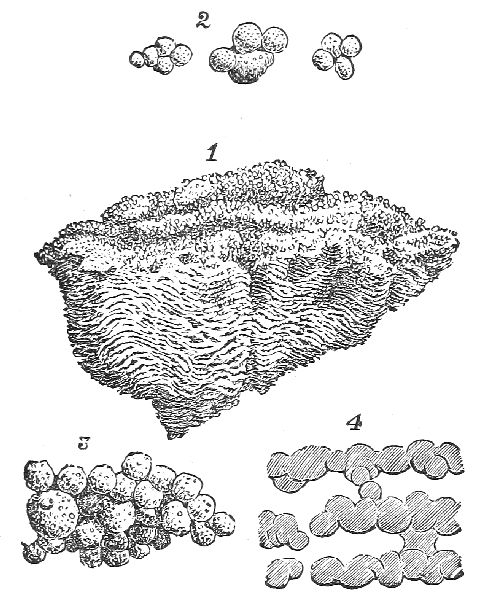
1. Small specimen of Eozoon Canadense, weathered out from the containing rock, and showing its laminated structure.
2. Casts of irregular or acervaline chambers of upper part (magnified).
3. Surface of a cast of a flat chamber, showing its constituent chamberlets (magnified).
4. Section of casts of flat chambers (magnified). From the Laurentian of Canada.
Between the rocks which contain Eozoon and the next in which we find any abundant remains of life, there is a gap in geological history, either destitute of evidence of life or showing nothing materially in advance of Eozoon. In the Cambrian Age, however, we obtain a vast and varied accession of life. Here we find evidence that the sea swarmed with living creatures near akin to those which still inhabit it, and nearly as varied. Referring merely to leading groups, we have here the soft shellfishes and the worms, the ordinary shellfishes, the sea-stars, and the corals, with the sponges. In short, had we been able to drop our dredge into the Cambrian or Lower Silurian ocean, we should have brought up representatives of all the leading types of invertebrate life that exist in the modern seas—different, it is true, in details of structure from those now existing, but constructed on the same principles and filling the same places in nature.
If we inquire as to the history of this swarming marine life of the early Palæozoic, we find that its several species, after enduring for a longer or a shorter time, one by one became extinct and were replaced by others belonging to the same groups. Thus there is in each great group a succession of new forms, distinct as species, but not perceptibly elevated in the scale of being. In many cases, indeed, the reverse seems to be the case; for it is not unusual to find the successive dynasties of life in any one family manifesting degradation rather than elevation. New, and sometimes higher, forms, it is true, appear in the progress of time, but it is impossible, except by violent suppositions, to connect them genetically with any predecessors. The succession throughout the Palæozoic presents the appearance rather of the unchanged persistence of each group under a succession of specific forms, and the introduction from time to time of new groups, as if to replace others which were in process of decay and disappearance.
In the later half of the Palæozoic we find a number of higher forms breaking upon us with the same apparent suddenness as in the case of the early Cambrian animals. Fishes appear, and soon abound in a great variety of species, representing types of no mean rank, but, singularly enough, belonging, in many cases, to groups now very rare; while the commoner tribes of modern fish do not appear. On the land, batrachian reptiles now abound, some of them very high in the sub-class to which they belong. Scorpions, spiders, insects, and millipedes appear, as well as land-snails, and this not in one locality only, but over the whole northern hemisphere. At the same time, the land appears clothed with an exuberant vegetation—not of the lowest types nor of the highest, but of intermediate forms, such as those of the pines, the club-mosses, and the ferns, all of which attained in those days to magnitudes and numbers of species unsurpassed, and in some cases unequalled, in the modern world. Nor do they show any signs of an unformed or imperfect state. Their seeds and spores, their fruits and spore-cases, are as elaborately constructed, the tissues and forms of their stems and leaves as delicate and beautiful, as in any modern plants. So with the compound eyes and filmy wings of insects, the teeth, bones, and scales of batrachians and fishes; all are as perfectly finished, and many quite as complex and elegant, as in the animals of the present day (Figure 4).
Fig. 4.
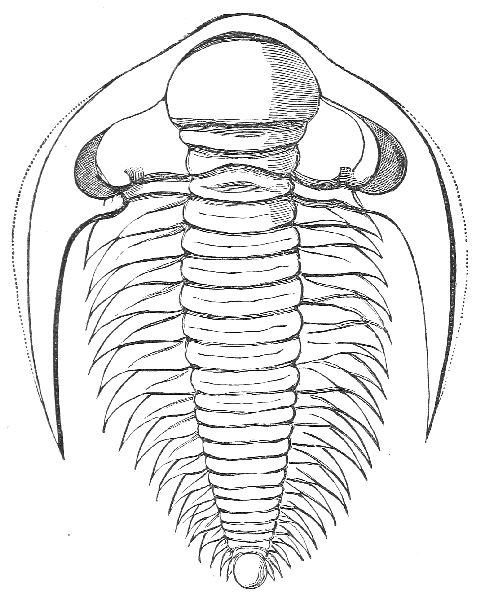
Restoration (by G. F. Matthew) of a Trilobite (Paradoxides) from the Lower Cambrian, as an evidence of the existence of crustacean animals of high type and great complexity in this early age. If such animals were evolved from Protozoa by slow and gradual changes, the time required would be greater than that which intervened between the Cambrian period and the present time.
This wonderful Palæozoic Age was, however, but a temporary state of the earth. It passed away, and was replaced by the Mesozoic, emphatically the reign of reptiles, when animals of that type attained to colossal magnitude, to variety of function and structure, to diversity of habitat in sea and on land, altogether unexampled in their degraded descendants of modern times. Sea-lizards of gigantic size swarmed everywhere in the waters. On land, huge quadrupeds, like Atlantosaurus and Iguanodon and Megalosaurus, greatly exceeded the elephants of later times; while winged reptiles—some of them of small size, others with wings twenty feet in expanse—flitted in the air. Strangely enough, with these reptilian lords appeared a few small and lowly mammals, forerunners of the coming age. Birds also make their appearance, and at the close of the period forests of broad-leaved trees altogether different from those of the Palæozoic Age, and resembling those of our modern woods, appear for the first time over great portions of the northern hemisphere.
The Cainozoic, or Tertiary, is the age of mammals and of man. In it the great reptilian tyrants of the Mesozoic disappear, and are replaced on land and sea by mammals or beasts of the same orders with those now living, though differing as to genera and species (see Fig. 5). So greatly, indeed, did mammalian life abound in this period that in the middle part of the Tertiary most of the leading groups were represented by more numerous species than at present; while many groups then existing have now no representatives. At the close of this great and wonderful procession of living beings comes man himself—the last and crowning triumph of creation; the head, thus far, of life on the earth.
I have merely glanced at the leading events of this wonderful history, because its details may be found in so many manuals and popular works on geology. But if we imagine this great chain of life extending over periods of enormous duration in comparison with the short span of human history, presenting to the naturalist hosts of strange forms which he could scarcely have imagined in his dreams, we may understand how exciting have been these discoveries crowded within the lives of two generations of geologists. Further, when we consider that the general course of this great development of life, beginning with Protozoa and ending with man, is from below upward—from the more simple to the more complex—and that there is of necessity, in this grand growth of life through the ages, a likeness or parallelism to the growth of the individual animal from its more simple to its more complex state, we can understand how naturalists should fancy that here they have been introduced to the workshop of Nature, and that they can discover how one creature may have been developed from another by spontaneous evolution.
Fig. 5.
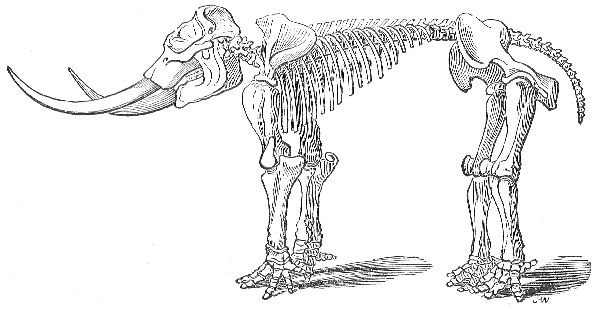
Skeleton of the American Mastodon, illustrating the number and wide distribution of elephantine animals of the three genera Dinotherium, Mastodon, and Elephas in the later Tertiary Age. Gaudry, the most eminent modern authority on these animals, remarks that the facts at present known do not "permit us to indicate any relation of descent between the elephantine animals and those of other orders known to us at present."
Many naturalists like Darwin and Haeckel, as well as philosophers like Herbert Spencer, are quite carried away by this analogy, and appear unable to perceive that it is merely a general resemblance between processes altogether different in their nature, and therefore in their causes. The greater part, however, of the more experienced palæontologists, or students of fossils, have long ago seen that in the larger field of the earth's history there is very much that cannot be found in the narrower field of the development of the individual animal; and they have endeavored to reduce the succession of life to such general expressions as shall render it more comprehensible and may at length enable us to arrive at explanations of its complex phenomena. Of these general expressions or conclusions I may state a few here, as apposite to our present subject, and as showing how little of real support the facts of the earth's history give to the pseudo-gnosis of monistic evolution.
1. The chain of life in geological time presents a wonderful testimony to the reality of a beginning. Just as we know that any individual animal must have had its birth, its infancy, its maturity, and will reach an end of life, so we trace species and groups of species to their beginning, watch their culmination, and perhaps follow them to their extinction. It is true that there is a sense in which geology shows "no sign of a beginning, no prospect of an end;" but this is manifestly because it has reached only a little way back toward the beginning of the earth as a whole, and can see in its present state no indication of the time or manner of the end. But its revelation of the fact that nearly all the animals and plants of the present day had a very recent beginning in geological time, and its disclosure of the disappearance of one form of life after another as we go back in time, till we reach the comparatively few forms of life of the Lower Cambrian, and finally have to rest over the solitary grandeur of Eozoon, oblige it to say that nothing known to it is self-existent and eternal.
2. The geological record informs us that the general laws of nature have continued unchanged from the earliest periods to which it relates until the present day. This is the true "uniformitarianism" of geology which holds to the dominion of existing causes from the first. But it does not refuse to admit variations in the intensity of these causes from time to time, and cycles of activity and repose, like those that we see on a small scale in the seasons, the occurrence of storms, or the paroxysms of volcanoes. When we find that the eyes of the old trilobites have had lenses and tubes similar to those in the eyes of modern crustaceans, we have evidence of the persistence of the laws of light. When we see the structures of Palæozoic leaves identical with those of our modern forests, we know that the arrangements of the soil, the atmosphere, and the rain were the same at that ancient time as at present. Yet, with all this, we also find evidence that long-continued periods of physical quiescence were followed by great crumplings and foldings of the earth's crust, and we know that this also is consistent with the operation of law; for it often happens that causes long and quietly operating prepare for changes which may be regarded as sudden and cataclysmic.
3. Throughout the geological history there is progress toward greater complexity and higher grade, along with degradation and extinction. Though experience shows that it may be quite possible that new discoveries may enable us to trace some of the higher forms of life farther back than we now find them, yet there can be no question that in the progress of geological time lower types have given place to higher, less specialized to more specialized. Curiously enough, no evidence proves this more clearly than that which relates to the degradation of old forms. When, for example, the reptiles of the Mesozoic Age were the lords of creation, there was apparently no place for the larger Mammalia which appear at the close of the reptile dynasty. So in the Palæozoic, when trees of the cryptogamous type predominated, there seems to have been no room in nature for the forests of modern type which succeeded them. Thus the earth at every period was fully peopled with living beings—at first with low and generalized structures which attained their maxima at early stages and then declined, and afterward with higher forms which took the places of those that were passing away. These latter, again, though their dominion was taken from them, were continued in lower positions under the new dynasties. Thus none of the lower types of life introduced was finally abandoned, but, after culminating in the highest forms of which it was capable, each was still continued, though with fewer species and a lower place. Examples of this abound in the history of all the leading groups of animals and plants.
4. There is thus a continued plan and order in the history of life which cannot be fortuitous. The chance interaction of organisms and their environment, even if we assume the organisms and environment as given to us, could never produce an orderly continuous progress of the utmost complexity in its detail, and extending through an enormous lapse of time. It has been well said that if a pair of dice were to turn up aces a hundred times in succession, any reasonable spectator would conclude that they were loaded dice; so if countless millions of atoms and thousands of species, each including within itself most complex arrangement of parts, turn up in geological time in perfectly regular order and a continued gradation of progress, something more than chance must be implied. It is to be observed here that every species of animal or plant, of however low grade, consists of many co-ordinated parts in a condition of the nicest equilibrium. Any change occurring which produces unequal or disproportionate development, as the experience of breeders of abnormal varieties of animals and plants abundantly proves, imperils the continued existence of the species. Changes must, therefore, in order to be profitable, affect the parts of the organism simultaneously and symmetrically. The chances of this may well be compared to the casting of aces a hundred times in succession, and are so infinitely small as to be incredible under any other supposition than that of intelligent design.
Fig. 6.
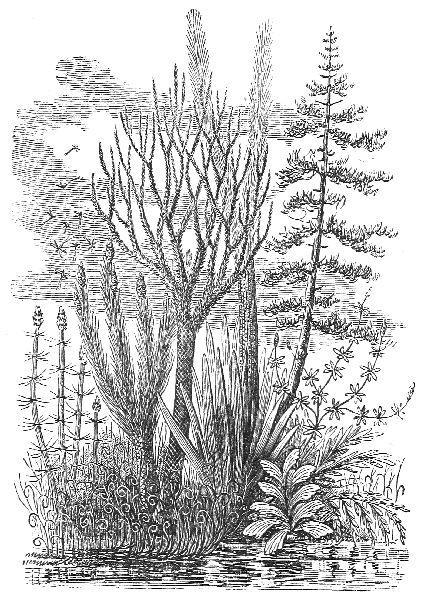
Group of Plants (restored) from the Devonian period, illustrating the complexity and beauty of the earliest known land vegetation, though many of the leading forms of modern plants are unknown in this very ancient period.
5. The progress of life in geological time. Just as the growth of trees is promoted or arrested by the vicissitudes of summer and winter, so in the course of the geological history there have been periods of pause and acceleration in the work of advancement. This is in accordance with the general analogy of the operations of nature, and is in no way at variance with the doctrine of uniformity already referred to. Nor has it anything in common with the unfounded idea, at one time entertained, of successive periods of entire destruction and restoration of life. Prolific periods of this kind appear in the marine invertebrates of the early Cambrian, the plants (Figure 6) and fishes of the Devonian, the batrachians of the Carboniferous, the reptiles of the Trias, the broad-leaved trees of the Cretaceous, and the mammals of the early Tertiary. A remarkable contrast is afforded by the later Tertiary and modern time, in which, with the exception of man himself, and perhaps a very few other species, no new forms of life have been introduced, while many old forms have perished. This is somewhat unfortunate, since, in such a period of stagnation as that in which we live, we can scarcely hope to witness either the creation or the evolution of a new species. Evolutionists themselves—those, at least, who are willing to allow their theory to be at all modified by facts—now perceive this; and hence we have the doctrine, advanced by Mivart, Le Conte, and others, of "critical periods," or periods of rapid evolution alternating with others of greater quiescence. It is further to be observed here that in a limited way and with reference to certain forms of life we can see a reason for these intermittent creations. The greater part of the marine fossils known to us are from rocks now raised up in our continents, and they lived at periods when the continents were submerged. Now, in geological time these periods of submergence alternated with others of elevation; and it is manifest that each period of continental submergence gave scope for the introduction of numbers of new marine species, while each continental elevation, on the other hand, gave opportunity for the increase of land-life. Further, periods when a warm climate prevailed in the arctic regions—periods when plants such as now live in temperate regions could enjoy six months of continuous sunshine—were eminently favorable to the development of such plants, and were utilized for the introduction of new floras, which subsequently spread to the southward. Thus we see physical changes occurring in an orderly succession and made subservient to the progress of life.
6. There is no direct evidence that in the course of geological time one species has been gradually or suddenly changed into another. Of the latter we could scarcely expect to find any evidence in fossils; but of the former, if it had occurred, we might expect to find indications in the history of some of the numerous species which have been traced through successive geological formations. Species which thus continue for a great length of time usually present numerous varietal forms which have sometimes been described as new species; but when carefully scrutinized they are found to be merely local and temporary, and to pass into each other. On the other hand, we constantly find species replaced by others entirely new, and this without any transition. The two classes of facts are essentially different; and though it is possible to point out in the newer geological formations some genera and species allied to others which have preceded them, and to suppose that the later forms proceeded from the earlier, still, when the connecting-links cannot be found, this is mere supposition, not scientific certainty. Further, it proceeds on the principle of arbitrary choice of certain forms out of many without any evidence of genetic connection. The worthlessness of such derivation is well shown in a case which has often been paraded as an illustration of evolution—the supposed genealogy of the horse. In America a series of horse-like animals has been selected, beginning with the Orohippus of the Eocene, and these have been marshalled as the ancestors of the fossil horses of America; for there are no native horses in America in the modern period. Yet this is purely arbitrary, and dependent merely on a succession of genera more and more closely resembling the modern horse being procurable from successive Tertiary deposits, often widely separated in time and place. In Europe, on the other hand, the ancestry of the horse has been traced back to Palæotherium—an entirely different form—by just as likely indications. Both genealogies can scarcely be true, and there is no actual proof of either. The existing American horses, which are of European parentage, are, according to the theory, descendants of Palæotherium, not of Orohippus; but if we had not known this on historical evidence, there would have been nothing to prevent us from tracing them to the latter animal. This simple consideration alone is sufficient to show that such genealogies are not of the nature of scientific evidence.
It is further to be observed that some of the ablest palæontologists, and those who have enjoyed the largest opportunities of observation and comparison, attach no value whatever to theories of evolution as accounting for the origin of species. One of these is Joachim Barrande, the palæontologist of Bohemia, and the first authority in Europe on the fossils of the older formations. Barrande, like some other eminent palæontologists, has the misfortune to be an unbeliever in the modern gospel of evolution, but he has certainly labored to overcome his doubts with greater assiduity than even many of the apostles of the new doctrine; and if he is not convinced, the stubbornness of the facts he has had to deal with must bear the blame. In connection with his great and classical work on the Silurian fossils of Bohemia, it has been necessary for him to study the similar remains of every other country; and he has used this immense mass of material in preparing statistics of the population of the Palæozoic world more perfect than any other naturalist has been able to produce. In successive memoirs he has applied these statistical results to the elucidation of the history of the oldest group of crustaceans—the trilobites—and the highest group of the mollusks—the cephalopods. In his latest memoir of this kind he takes up the brachiopods, or lamp-shells, a group of bivalve shellfishes very ancient and very abundantly represented in all the older formations of every part of the world, and which thus affords the most ample material for tracing its evolution, with the least possible difficulty in the nature of "imperfection of the record."
Barrande, in the publication before us, discusses the brachiopods with reference, first, to the variations observed within the limits of the species, eliminating in this way mere synonyms and varieties mistaken for species. He also arrives at various important conclusions with reference to the origin of species and varietal forms, which apply to the cephalopods and trilobites as well as to the brachiopods, and some of which, as the writer has elsewhere shown, apply very generally to fossil animals and plants. One of these is that different contemporaneous species, living under the same conditions, exhibit very different degrees of vitality and variability. Another is the sudden appearance at certain horizons of a great number of species, each manifesting its complete specific characters. With very rare exceptions, also, varietal forms are contemporaneous with the normal form of their specific type, and occur in the same localities. Only in a very few cases do they survive it. This and the previous results, as well as the fact that parallel changes go on in groups having no direct reaction on each other, prove that variation is not a progressive influence, and that specific distinctions are not dependent on it, but on the "sovereign action of one and the same creative cause," as Barrande expresses it. These conclusions, it may be observed, are not arrived at by that "slap-dash" method of mere assertion so often followed on the other side of these questions, but by the most severe and painstaking induction, and with careful elaboration of a few apparent exceptions and doubtful cases.
His second heading relates to the distribution in time of the genera and species of brachiopods. This he illustrates with a series of elaborate tables, accompanied by explanation. He then proceeds to consider the animal population of each formation, in so far as brachiopods, cephalopods, and trilobites are concerned, with reference to the following questions: (1) How many species are continued from the previous formation unchanged? (2) How many may be regarded as modifications of previous species? (3) How many are migrants from other regions where they have been known to exist previously? (4) How many are absolutely new species? These questions are applied to each of fourteen successive formations included in the Silurian of Bohemia. The total number of species of brachiopods in these formations is six hundred and forty, giving an average of 45.71 to each, and the results of accurate study of each species in its characters, its varieties, its geographical and geological range, are expressed in the following short statement, which should somewhat astonish those gentlemen who are so fond of asserting that derivation is "demonstrated" by geological facts:
1. Species continued unchanged28per cent.
2. Species migrated from abroad7"
3. Species continued with modification0"
4. New species without known ancestors65"
100per cent.
He shows that the same or very similar proportions hold with respect to the cephalopods and trilobites, and, in fact, that the proportion of species in the successive Silurian faunæ which can be attributed to descent with modification is absolutely nil. He may well remark that in the face of such facts the origin of species is not explained by what he terms les élans poétiques de l'imagination.
The third part of Barrande's memoir, relating to the comparison of the Silurian brachiopods of Bohemia with those of other countries, though of great scientific interest, and important in extending the conclusions of his previous chapters, does not so nearly concern our present subject.
I have thought it well to direct attention to these memoirs of Barrande, because they form a specimen of conscientious work with the view of ascertaining if there is any basis in nature for the doctrine of spontaneous evolution of species, and, I am sorry to say, a striking contrast to the mixture of fact and fancy on this subject which too often passes current for science in England, America, and Germany. Barrande's studies are also well deserving the attention of our younger men of science, as they have before them, more especially in the widely-spread Palæozoic formations of America, an admirable field for similar work. In an appendix to his first chapter Barrande mentions that the three men who in their respective countries are the highest authorities on Palæozoic brachiopods, Hall, Davidson, and De Koninck, agree with him in the main in his conclusions, and he refers to an able memoir by D'Archiac in the same sense, on the cretaceous brachiopods.
It should be especially satisfactory to those naturalists who, like the writer, had failed to see in the palæontological record any good evidence for the production of species by those simple and ready methods in vogue with most evolutionists, to note the extension of actual facts with respect to the geological dates and precise conditions of the introduction of new forms, and to find that these are more and more tending to prove the existence of highly complex creative laws in connection with the great plan of the Creator as carried out in geological time. These new facts should also warn the ordinary reader of the danger of receiving without due caution those general and often boastful assertions respecting these great and intricate questions made by persons not acquainted with their actual difficulty, or by enthusiastic speculators disposed to overlook everything not in accordance with their preconceived ideas.
It may be asked, Is there, then, no place in the geological record even for theistic evolution? This it would be rash to affirm. We can only say that up to this time there is no proof of it. If nature has followed this method, she seems carefully to have concealed the process. If such changes have occurred as to evolve from a species, say of mollusk or coral, belonging to one geological period some form found in another period, and recognized as a distinct species, we have to suppose that the capacity for such change was in some way implanted in the species on its creation, and ready to be developed under favorable conditions or in the lapse of time. For example, we may suppose that a plant originating in the long arctic summers of a warm period might, on migrating southward into the alternations of day and night, undergo material changes. A marine animal long confined to a limited sea-basin might, on being permitted to expand over a wide submerged continent, be greatly modified in its structure and habits. Up to a certain point we know that such changes have occurred, and Barrande himself has largely illustrated them. As an example which I have myself studied, I may refer to the common shells known on our coasts as sand-clams (Mya truncata and Mya arenaria). The former species, in the cold waters of the Glacial Age, assumed a short form which it still retains in the arctic regions, and occasionally in the colder waters of the more temperate regions, though there a more elongated form prevails. Evidently the two forms are interchangeable according to the temperature of the water. Still, if we could imagine a permanent refrigeration over all the area occupied by the animal, the short form only might survive, and might be supposed to be a distinct species. This did not occur, however, even in the Glacial Age, and is not likely to occur. Further, the allied, though quite distinct, species Mya arenaria has lived with the other through all the long duration of the Post-Pliocene and modern periods, and, though having its own range of varietal forms, has preserved its distinctness. Cases of this kind are obviously of the nature of varietal, not specific, change.
In conclusion, the whole of the facts and laws above detailed point to a predetermined plan and to an intelligent Creator, of whose laws and modes of procedure we may learn much by patient and careful study. This surely gives a great additional interest to that marvellous story of the earth which in these last days has been revealed to us by the study of the rocks. We may also infer that not one method only but many have been employed in replenishing the earth at first with living beings, and in adding to these from time to time. To what extent we may be able to understand these, time and future discoveries will show. In the mean time, we can only suggest such general theories as those referred to in the first of these lectures, but can affirm that Agnostic Evolution is altogether abortive in its attempts to solve the problem of the chain of life in geological time.