LECTURE IV. THE ORIGIN AND ANTIQUITY OF MAN.
Reading edition
Man, when regarded merely as an organism, is closely related to the lower animals. His body is constructed on the same general plan with theirs. More especially, he is near akin to the other members of the class Mammalia. But we must not forget that even as an animal man is somewhat widely separated from his humbler relations (see Fig. 7). It is easy to say that every bone, every muscle, every convolution of his brain, has its counterpart in the corresponding parts of an orang or a gorilla. But, admitting this, it is also true that every one of these parts is different, and that the aggregate of all the differences mounts up to an enormous sum-total, more especially in relation to habits and to capacities for action. Those remarkable homologies or likenesses of plan which obtain in the animal kingdom are very wonderful, and the study of them greatly enlarges our conceptions of the unity of nature; but we must never forget that such general agreements in plan cover the most profound differences in detail and in adaptation to use, and that, while they indicate a common type, this may rather point to a unity of design than to a mere accidental unity of descent.
Fig. 7.
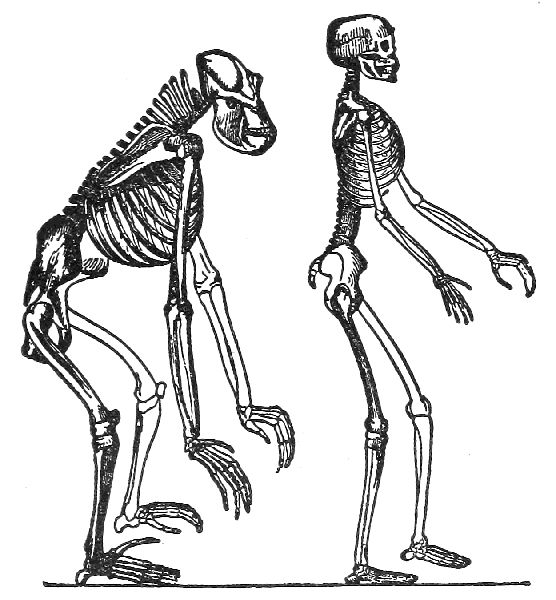
Man and his "poor relation," the gorilla. (After Huxley.) The head of the gorilla, with immense jaws and small brain-case, its huge spines on the neck, its long arms, its elongated pelvis, and its hand-like feet, with its incapacity to assume the erect position, indicate its ordinal difference from man, and the necessity of many intermediate forms, still unknown, to connect the two species.
There is a method, well known to natural science, for measuring and indicating the divergence of man from his nearest allies. This is the application of those principles of classification which, though of essential importance in science, are by some modern students of nature strangely overlooked or misunderstood. Perhaps in nothing has the progress of ideas of evolution made a more injurious impress on the advance of knowledge than in the manner in which it has caused many eminent and able naturalists to diverge from all logical propriety in their ideas of classification. Still, in so far as man is concerned, there are some facts of this kind which are indisputable. He certainly constitutes a distinct species, including many races, which all, however, have common specific characters. On the other hand, no one pretends that he is conspecific with any lower animal. All naturalists would now deride the stories, at one time current, that gorillas and chimpanzees are degraded races of men. On the other hand, even Haeckel admits that there is a wide gap, unfilled by any recent or any fossil creature, between man and the highest apes. Again, no generic relationship can be claimed as between man and the lower animals. He presents such structural differences as entitle him to rank by himself in the genus Homo. Still further, the ablest naturalists, before the rise of Darwinism, held that man was entitled to be placed in a separate family or order from the apes. Modern evolutionists prefer to fall back on the old arrangement of Linnæus, and to place man and apes together in the group of Primates, which, however, Linnæus would not have regarded as precisely of the same value with an order as now held. In this those of them who have sufficient ability to comprehend the facts of the case are undoubtedly warped in judgment by the tendency of their philosophy to magnify resemblances and to minimize differences; while the herd of feebler men have their ideas of classification thoroughly confused by the doctrine which they have received as a creed dictated by authority, and to which they adhere under the influence of fear. In point of fact, the differences between man and any other animal are so wide that they warrant a distinction, not merely specific and generic, but of a family and an ordinal character.
Perhaps the best way to appreciate this will be to suppose that man has become extinct, and that in some future geological period his fossil remains are studied by some new race of intelligent beings, and compared with those of the lower animals his contemporaries. Let us suppose that they have disinterred a human skull or the bones of a human foot. From the foot they would learn that man is not an arboreal animal, but intended to walk erect on the ground. They could infer from this certain structures and uses of the vertebral column and of the anterior limbs different from those found in apes, and which would certainly induce them to conclude that they had obtained remains indicating a new order of mammals. If they had found the foot alone, they might doubt whether the possessor of this strange and highly-specialized organ had been carnivorous or herbivorous, more nearly allied to the bears or to the monkeys. Should they now find the skull, these doubts would be solved, and they would know that the new animal was somewhat nearer to the apes than to the bears, but still at a very remote distance from them, and this indicated by peculiarities of brain-case, jaws, and teeth, proving divergences in function still wider than those apparent in the structures. They would also plainly perceive that to link man with his nearest mammalian allies would require the discovery of several missing links.
When we consider the psychological endowments of man, his divergence from lower animals becomes immensely greater. In his external senses and in the perceptions derived through them it is true he resembles the brutes. There is also much in common with them in his appetites and emotions, and in some of the lower manifestations of intelligence. But he adds to this a higher reason, which causes his actions to be differently determined from theirs; and this higher reason, or spiritual nature, leads him to abstract ideas, to consciousness, to notions of right and of wrong, to ideas of higher spiritual beings and of futurity altogether unknown to lower animals. This divine reason, in connection with special vocal contrivances, also bestows on him the gift of speech. Nor can speech be reduced to a mere imitation of natural sounds; for, granting that these sounds may be the raw material of speech, yet man is enabled to apply this to the expression of ideas in a manner altogether peculiar to himself. Scientific precision obliges us to recognize these differences, and to admit that they place man on an entirely different plane from the lower animals.
Perhaps the expression "a different plane" is scarcely correct, for man can exist on many different planes—a fact which has produced some confusion in the minds of naturalists not versed in psychological questions, though, when rightly considered, it marks very strongly the distinction between the man and the mere animal.
The lower animals are tied up by invariable instincts to certain lines of action which keep all the individuals of any species on nearly the same level, except where some little disturbance may be caused by man in his processes of domestication. But with man it is quite different. He is emancipated from the bond of instinct, and left free to follow the guidance of his own will, determined by his own reason. It follows that the habits and the actions of a man depend on what he knows and believes, and on the deductions of his reason from these premises. Without knowledge, culture, and training, man is more helpless than any brute. With the noblest and highest capacities, he may devise and follow habits of life more base than those of any mere animal. Thus there is an almost immeasurable difference between the Godlike height to which man can attain by the right use of his powers and the depth to which ignorance and depravity may degrade him. It follows that the degradation of the lower races of men is as strong a proof of the difference between man and the lower animals as is the elevation of the higher races. Both are characteristic of a being emancipated from the control of instinct, knowing good and evil, free to choose, and differing in these respects from every other creature on earth. Such is man as we find him; and we may well ask by what process animal instinct could ever spontaneously develop human freedom and human reason.
But we might have evidence of such a process, however strange and improbable it might at first sight appear. We might be able to trace man back in history or by prehistoric remains to greater and greater approximation to the lower animals, and might thus bridge over the great chasm now existing between man and beast. It may be instructive, therefore, to glance at what geology discloses as to the origin of man and his first appearance on the earth.
In the older geological formations no remains of man or of his works have been found. Nor do we expect to find them, for none of the animals more nearly related to man then existed, and the condition of the earth was probably not suited to them. Nor do we find human remains even in the earlier Tertiary. Here also we do not expect them, for the Mammalia of those times were all specifically distinct from those of the modern world. It is only in the Pliocene period that we begin to find modern species of mammals. Here, therefore, we may look for human remains; but we do not find them as yet, and it is only at the close of the Pliocene, or even after the succeeding Glacial period, that we find undoubted traces of man. Let us glance at the significance of this.
Mammalian life probably culminated or attained to its maximum in the Miocene and the early Pliocene periods. Then there were more numerous, larger, and better-developed quadrupeds on our continents than we now find. For example, the elephants, the noblest of the mammals, are at present represented by two species confined to India and parts of Africa.[8] In the Middle Tertiary there were, in addition to the ordinary elephants, two other genera, Mastodon and Dinotherium, and there were many species which were distributed over the whole northern hemisphere. The sub-Himalayan deposits of India alone have, I believe, afforded seven species, some of them of grander dimensions than either of those now existing. We have no trustworthy evidence as yet that man lived at this period. If he had, he either would have required the protection of a special Eden, or would have needed superhuman strength and sagacity.
But the grand mammalian life of the Middle Tertiary was destined to die out. At the close of the Pliocene came an age of refrigeration, when arctic cold crept down over our continents far to the south, and when most of the animals suited to temperate climates were either frozen out or driven southward. During, or closing, this period was also a great submergence of the continents, which must have been equally destructive to mammalian life, and which extended over both Eurasia and America till the summits of some of the highest hills were under water. Attempts have been made to show that man existed before or during the Glacial Age, but this is very unlikely, and, as I have elsewhere argued, the evidence adduced to prove so great antiquity of man, whether in America or Europe, has altogether broken down.[9]
At the close of the Glacial period the continents re-emerged and became more extensive than at present. Survivors of the Pliocene species, as well as other species not previously known, spread themselves over this new land. It would appear that it was in this "Post-Glacial" period that man made his appearance, and that he was then contemporary with many large animals now extinct, and was the possessor of wider continental areas than his descendants now enjoy. To this age belong those human bones and implements found in the older cave and gravel deposits of Europe, and which are referred to those palæolithic or palæocosmic ages which preceded the dawn of history in Europe and the arrival therein of the present European races. The occupation of Europe, and probably of Western Asia, by these oldest tribes of men was closed by a subsidence or submergence at the end of that "second continental period," as it has been called by Lyell,[10] in which they lived. When the land was restored to its present condition, they were replaced by the ancestors of the present European races.
It may be well here to tabulate that later portion of the earth's geological history in which man appeared, more especially as it is sometimes arranged in a manner not suited to convey a correct impression of the actual succession. It will be seen by the general table given in the last lecture that the latest of the Tertiary ages is that known as the Pleistocene or Post-Pliocene, and this, with the succeeding modern period, may be best arranged as follows:
I. Pleistocene, including—
(a) Early Pleistocene, or First Continental Period. Land very extensive, moderate climate.
(b) Later Pleistocene, or Glacial (including Dawkins' "Mid-Pleistocene"). In this there was a great prevalence of cold and glacial conditions, and a great submergence of the northern land.
II. Modern, or Period of Man and Modern Mammals, including—
(a) Post-Glacial, or Second Continental Period, in which the land was again very extensive, and palæocosmic man was contemporary with some great mammals—as the mammoth, now extinct—and the area of land in the northern hemisphere was greater than at present. (This represents the Late Pleistocene of Dawkins.) It was terminated by a great and very general subsidence, accompanied by the disappearance of palæocosmic man and some large Mammalia, and which may be identical with the historical deluge.[11]
(b) Recent, when the continents attained their present levels, existing races of men colonized Europe, and living species of mammals. This includes both the Prehistoric and the Historic Period.
The palæocosmic men of the above table are the oldest certainly known to us, and it has been truly said of them that they are so closely related to modern races that, on any hypothesis of gradual evolution, we must look for the transition from apes to men not merely in the Eocene Tertiary, but even in the Mesozoic—that is, in formations vastly older than any containing any remains so far as known either of man or of apes. That these most ancient men were in truth most truly human, and that they presented no transition to lower animals, will appear from the following notices, which I condense from a work of my own in which these subjects are more fully treated:
The beautiful work of Lartet and Christy has vividly portrayed to us the antiquities of the limestone plateau of the Dordogne—the ancient Aquitania—remains which recall to us a population of Horites, or cave-dwellers, of a time anterior to the dawn of history in France, living much like the modern hunter-tribes of America, and, as already stated, possibly contemporary—in their early history, at least—with the mammoth and its extinct companions of the later Post-Pliocene forests. We have already noticed the arts and implements of these people, but what manner of people were they in themselves? The answer is given to us by the skeletons found in the cave of Cro-magnon. This cavern is a shelter or hollow under an overhanging ledge of limestone, and excavated originally by the action of the weather on a softer bed. It fronts the south-west and the little river Vezère; and, having originally been about eight feet high and nearly twenty deep, must have formed a cosey shelter from rain or cold or summer sun, and with a pleasant outlook from its front. All rude races have much sagacity in making selections of this sort. Being nearly fifty feet wide, it was capacious enough to accommodate several families, and when in use it no doubt had trees or shrubs in front, and may have been further completed by stones, poles, or bark placed across the opening. It seems, however, in the first instance to have been used only at intervals, and to have been left vacant for considerable portions of time. Perhaps it was visited only by hunting- or war-parties. But subsequently it was permanently occupied, and this for so long a time that in some places ashes and carbonaceous matter a foot and a half deep, with bones, implements, etc., were accumulated. By this time the height of the cavern had been much diminished, and, instead of clearing it out for future use, it was made a place of burial, in which four or five individuals were interred. Of these, two were men, one of great age, the other probably in the prime of life. A third was a woman of about thirty or forty years of age. The other remains were too fragmentary to give very certain results.
These bones, with others to be mentioned in connection with them, unquestionably belong to the oldest human inhabitants known in Western Europe. They have been most carefully examined by several competent anatomists and archæologists, and the results have been published with excellent figures in the Reliquiæ Aquitanicæ. They are, therefore, of the utmost interest for our present purpose, and I shall try so to divest the descriptions of anatomical details as to give a clear notion of their character. The 'Old Man of Cro-magnon' was of great stature, being nearly six feet high. More than this, his bones show that he was of the strongest and most athletic muscular development—a Samson in strength; and the bones of the limbs have the peculiar form which is characteristic of athletic men habituated to rough walking, climbing, and running, for this is, I believe, the real meaning of the enormous strength of the thigh-bone and the flattened condition of the leg in this and other old skeletons. It occurs to some extent, though much less than in this old man, in American skeletons. His skull presents all the characters of advanced age, though the teeth had been worn down to the sockets without being lost; which, again, is the character of some, though not of all, aged Indian skulls. The skull proper, or brain-case, is very long—more so than in ordinary modern skulls—and this length is accompanied with a great breadth; so that the brain was of greater size than in average modern men, and the frontal region was largely and well developed. In this respect this most ancient skull fails utterly to vindicate the expectations of those who would regard prehistoric men as approaching to the apes. It is at the opposite extreme. The face, however, presented very peculiar characters. It was extremely broad, with projecting cheek-bones and heavy jaw, in this resembling the coarse types of the American face, and the eye-orbits were square and elongated laterally. The nose was large and prominent, and the jaws projected somewhat forward. This man, therefore, had, as to his features, some resemblance to the harsher type of American physiognomy, with overhanging brows, small and transverse eyes, high cheek-bones, and coarse mouth. He had not lived to so great an age without some rubs, for his thigh-bone showed a depression which must have resulted from a severe wound—perhaps from the horn of some wild animal or the spear of an enemy.
The woman presented similar characters of stature and cranial form modified by her sex, and must in form and visage have been a veritable squaw, who, if her hair and complexion were suitable, would have passed at once for an American Indian woman, of unusual size and development. Her head bears sad testimony to the violence of her age and people. She died from the effects of a blow from a stone-headed pogamogan or spear, which has penetrated the right side of the forehead with so clean a fracture as to indicate the extreme rapidity and force of its blow. It is inferred from the condition of the edges of this wound that she may have survived its infliction for two weeks or more. If, as is most likely, the wound was received in some sudden attack by a hostile tribe, they must have been driven off or have retired, leaving the wounded woman in the hands of her friends to be tended for a time, and then buried, either with other members of her family or with others who had perished in the same skirmish. Unless the wound was inflicted in sleep, during a night-attack, she must have fallen, not in flight, but with her face to the foe, perhaps aiding the resistance of her friends or shielding her little ones from destruction. With the people of Cro-magnon, as with the American Indians, the care of the wounded was probably a sacred duty, not to be neglected without incurring the greatest disgrace and the vengeance of the guardian spirits of the sufferers.
The skulls of these people have been compared to those of the modern Esthonians or Lithuanians; but on the authority of M. Quatrefages it is stated that, while this applies to the probably later race of small men found in some of the Belgian caves, it does not apply so well to the people of Cro-magnon. Are, then, these people the types of any ancient, or of the most ancient, European race? One answer is given by the remarkable skeleton of Mentone, in the South of France, found under circumstances equally suggestive of great antiquity (Figure 8). Dr. Rivière, in a memoir on this skeleton illustrated by two beautiful photographs, shows that the characters of the skull and of the bones of the limbs are precisely similar to those of the Cro-magnon skeleton, indicating a perfect identity of race, while the objects found with the skeleton are similar in character.
The ornaments of Cro-magnon were perforated shells from the Atlantic and pieces of ivory. Those at Mentone were perforated Neritinæ from the Mediterranean and canine-teeth of the deer. In both cases there was evidence that these ancient people painted themselves with red oxide of iron; and, as if to complete the similarity, the Mentone man had an old healed-up fracture of the radius of the left arm, the effect of a violent blow or of a fall. Skulls found at Clichy and Grenelle in 1868 and 1869 are described by Professor Broca and Mr. Fleurens as of the same general type, and the remains found at Gibraltar and in the cave of Paviland, in England, seem also to have belonged to the same race. The celebrated Engis skull, believed to have belonged to a contemporary of the mammoth, is also precisely of the same type, though less massive than that of Cro-magnon; and, lastly, even the somewhat degraded Neanderthal skull, found in a cave near Dusseldorf, though, like that of Clichy, inferior in frontal development, is referable to the same peculiar long-headed style of man, in so far as can be judged from the portion that remains.
Fig. 8.
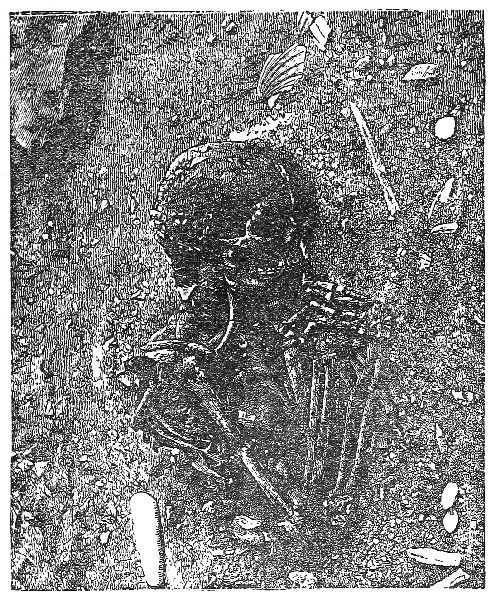
Portion of the skeleton of the fossil man of Mentone. This skeleton was discovered by Dr. Rivière under about twenty feet of accumulated débris. It belongs to the palæocosmic age, and illustrates the high type, physically, of the man of that period. The skeleton, like others of that age, indicates a man of great stature and muscular vigor, and with brain above the average size. (After Rivière.)
Let it be observed, then, that these skulls are probably the oldest known in the world, and they are all referable to one race of men; and let us ask what they tell as to the position and character of palæolithic man. The testimony is here fortunately wellnigh unanimous. Huxley, who well compares some of the peculiar features of these ancient skulls and skeletons to those of Australians and other rude tribes, and of the ancient Danes of Borroby—a people not improbably allied to the Esthonians and Fins—remarks that the manner in which the individual heads of the most homogeneous rude races differ from each other "in the same characters, though perhaps not to the same extent with the Engis and Neanderthal skulls, seems to prohibit any cautious reasoner from affirming the latter to have necessarily been of distinct races." My own experience in American skulls, and the still larger experience of Dr. Wilson, fully confirm the wisdom of this caution.... He adds: "Finally, the comparatively large cranial capacity of the Neanderthal skull, overlaid though it may be by pithecoid, bony walls, and the completely human proportions of the accompanying limb-bones, together with the very fair development of the Engis skull, clearly indicate that the first traces of the primordial stock whence man has been derived need no longer be sought by those who entertain any form of the doctrine of progressive development in the newest Tertiaries, but that they may be looked for in an epoch more distant from that of the Elephas primigenius than that is from us." If he had possessed the Cro-magnon and Mentone skulls at the time when this was written, he might well have said immeasurably distant from the time of the Elephas primigenius. Professor Broca, who seems by no means disinclined to favor a simian origin for men, has the following general conclusions, which refer to the Cro-magnon skulls: "The great volume of the brain, the development of the frontal region, the fine elliptical profile of the anterior portion of the skull, and the orthognathous form of the upper facial region, are incontestably evidence of superiority which are met with usually only in the civilized races. On the other hand, the great breadth of face, the alveolar prognathism, the enormous development of the ascending ramus of the lower jaw, the extent and roughness of the muscular insertions, especially of the masticatory muscles, give rise to the idea of a violent and brutal race."
Fig. 9.
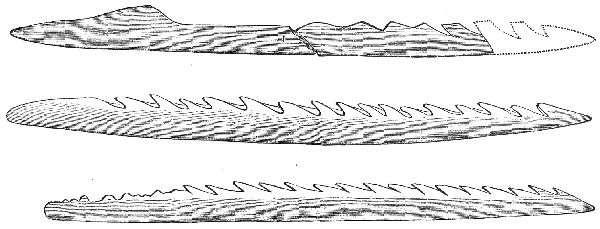
Three bone harpoons. The upper is from Kent's Cavern, Torquay, and perhaps the oldest known, being of the mammoth age. The second is from Denmark, and is neocosmic, though prehistoric. The third is modern, from Tierra del Fuego. They show the similarity of bone implements in all ages of the world. The earliest had already attained as much perfection as the material permitted with reference to the use intended.
He adds that this apparent antithesis, seen also in the limbs as well as in the skull, accords with the evidence furnished by the associated weapons and implements of a rude hunter-life, and at the same time of no mean degree of taste and skill in carving and other arts (see Fig. 9). He might have added that this is precisely the antithesis seen in the American tribes, among whom art and taste of various kinds, and much that is high and spiritual even in thought, coexisted with barbarous modes of life and intense ferocity and cruelty. The god and the devil were combined in these races, but there was nothing of the mere brute.
Rivière remarks, with expressions of surprise, the same contradictory points in the Mentone skeleton. Its grand development of brain-case and high facial angle—even higher, apparently, than in most of these ancient skulls—combined with other characters which indicate a low type and barbarous modes of life.
Another point which strikes us in reading the descriptions, and which deserves the attention of those who have access to the skeletons, is the indication which they seem to present of an extreme longevity. The massive proportions of the body, the great development of the muscular processes, the extreme wearing of the teeth among a people who predominantly lived on flesh and not on grain, the obliteration of the sutures of the skull, along with indications of slow ossification of the ends of the long bones, point in this direction, and seem to indicate a slow maturity and great length of life in this most primitive race.
The picture would be incomplete did we not add that in France and Belgium, in the immediately succeeding or reindeer age, these gigantic and magnificent men seem to have been superseded by a feebler race of smaller stature and with shorter heads; so that we have, even in these oldest days, the same contrasts so plainly perceptible in the races of the North of Europe and the North of America in historical times (Figure 10).
Fig. 10.
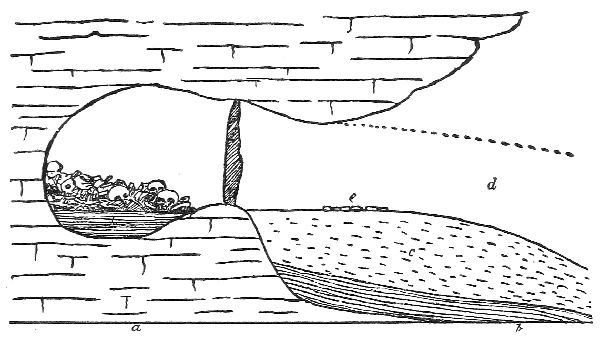
Section of the cave of Frontal, in Belgium. (After Dupont.) a, limestone; b, deposit of mud of the mammoth age, on which rests a bed of gravel, c, and above this there was, in modern times, a mass of fallen débris, d, up to the dotted line. On removing this, a hearth was found at e, on which were numerous bones of modern animals, the remains of funeral feasts. The cave was closed with a flat stone, and within were skeletons, stone implements, ornaments, and pottery of the "neolithic" age. Under these was undisturbed earth of the palæolithic, or mammoth age. The facts show the succession, in Belgium, of palæocosmic or antediluvian men and of neocosmic men allied to the Basques or to the Laps, and all this previous to the advent of the modern races.
It is further significant that there are some indications to show that the larger and nobler race was that which inhabited Europe at the time of its greatest elevation above the sea and greatest horizontal extent, and when its fauna included many large quadrupeds now extinct. This race of giants was thus in the possession of a greater continental area than that now existing, and had to contend with gigantic brute rivals for the possession of the world. It is also not improbable that this early race became extinct in Europe in consequence of the physical changes which occurred in connection with the subsidence which reduced the land to its present limits, and that the dwarfish race which succeeded came in as the appropriate accompaniment of a diminished land-surface and a less genial climate in the early modern period. Both of these races are properly palæolithic, and are supposed to antedate the period of polished stone; but this may, to a great extent, be a prejudice of collectors, who have arrived at a foregone conclusion as to the distinctness of these periods (Figure 11). Judging from the great cranial capacity of the older race and the small number of their skeletons found, it would be fair to suppose that they represent rude outlying tribes belonging to races which elsewhere had attained to greater culture.
Fig. 11.
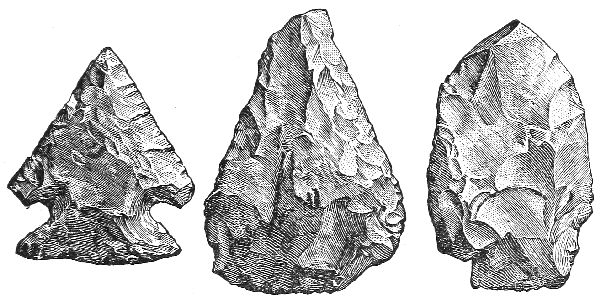
Flint arrow-heads found together in a modern Indian deposit in Canada, and showing the coincidence in time of rude and finished flint weapons, or that among all savages using chipped flint, the palæolithic and neolithic ages are contemporaneous.
Lastly, both of these old European races were Turanian, Mongolian, or American in their head-forms and features, as well as in their habits, implements, and arts. To illustrate this, in so far as the older of the two races is concerned, I have carefully compared collections of American Indian skulls with casts and figures representing the form and dimensions of some of the oldest European crania above referred to. Some of the American skulls may fairly be compared in their characters with the Mentone skull, and others with those of Cro-magnon, Engis, and Neanderthal; and so like are some of the Huron, Iroquois, and other northern American skulls to these ancient European relics and others of their type, that it would be difficult to affirm that they might not have belonged to near relatives. On the other hand, the smaller and shorter heads of the race of the reindeer age in Europe may be compared with the Laps, and with some of the more delicately formed Algonquin and Chippewayan skulls in America. If, therefore, the reader desires to realize the probable aspect of the men of Cro-magnon, of Mentone, or of Engis, I may refer him to modern American heads. So permanent is this great Turanian race, out of which all the other races now extant seem to have been developed, in the milder and more hospitable regions of the Old World, while in northern Asia and in America it has retained to this day its primitive characters.
The reader, reflecting on what he has learned from history, may be disposed here to ask, Must we suppose Adam to have been one of these Turanian men, like old men of Cro-magnon? In answer, I would say that there is no good reason to regard the first man as having resembled a Greek Apollo or an Adonis. He was probably of sterner and more muscular mould. But the gigantic palæolithic men of the European caves are more probably representatives of that fearful and powerful race who filled the antediluvian world with violence, and who reappear in postdiluvian times as the Anakim and traditional giants, who constitute a feature in the early history of so many countries. Perhaps nothing is more curious in the revelations as to the most ancient cave-men than that they confirm the old belief that there were 'giants in those days.'
And now let us pause for a moment to picture these so-called palæolithic men. What could the old man of Cro-magnon have told us had we been able to sit by his hearth and listen understandingly to his speech?—which, if we may judge from the form of his palate-bones, must have resembled more that of the Americans or Mongolians than of any modern European people. He had, no doubt, travelled far, for to his stalwart limbs a long journey through forests and over plains and mountains would be a mere pastime. He may have bestridden the wild horse, which seems to have abounded at the time in France, and he may have launched his canoe on the waters of the Atlantic. His experience and memory might extend back a century or more, and his traditional lore might go back to the times of the first mother of our race. Did he live in that wide Post-Pliocene continent which extended westward through Ireland? Did he know and had he visited the nations that lived in the valley of the great Gihon, that ran down the Mediterranean Valley, or on that nameless river which flowed through the Dover Straits? Had he visited or seen from afar the great island Atlantis, whose inhabitants could almost see in the sunset sky the islands of the blest? Or did he live at a later time, after the Post-Pliocene subsidence, and when the land had assumed its present form? In that case he could have told us of the great deluge, of the huge animals of the antediluvian World—known to him only by tradition—and of the diminished strength and longevity of men in his comparatively modern days. We can but conjecture all this. But, mute though they may be as to the details of their lives, the man of Cro-magnon and his contemporaries are eloquent of one great truth, in which they coincide with the Americans and with the primitive men of all the early ages. They tell us that primitive man had the same high cerebral organization which he possesses now, and, we may infer, the same high intellectual and moral nature, fitting him for communion with God and headship over the lower world. They indicate, also, like the Mound-builders, who preceded the North American Indian, that man's earlier state was the best—that he had been a high and noble creature before he became a savage. It is not conceivable that their high development of brain and mind could have spontaneously engrafted itself on a mere brutal and savage life. These gifts must be remnants of a noble organization degraded by moral evil. They thus justify the tradition of a Golden and Edenic Age, and mutely protest against the philosophy of progressive development as applied to man, while they bear witness to the identity in all important characters of the oldest prehistoric men with that variety of our species which is at the present day at once the most widely extended and the most primitive in its manners and usages.
Thus it would appear that these earliest known men are not specifically distinct from ourselves, but are a distinct race, most nearly allied to that great Turanian stock which is at the present day, and has apparently from the earliest historic times been, the most widely spread of all. Though rude and uncultured, they were not either physically or mentally inferior to the average men of to-day, and were indeed in several respects men of high type, whose great cranial capacity might lead us to suppose that their ancestors had recently been in a higher state of civilization than themselves. It is, however, possible that this characteristic was rather connected with great energy and physical development than with high mental activity.
To the hypothesis of evolution, as applied to man, these facts evidently oppose great difficulties. They show that such modern degraded races as the Fuegians or the Tasmanians cannot present to us the types of our earlier ancestors, since the latter were men of a different and higher style. Nor do these oldest known men present any approximation in physical characters to the lower animals. Further, we may infer from their works, and from what we know of their beliefs and habits, that they were not creatures of instinct, but of thought like ourselves, and that materialistic doctrines of automatism and brain-force without mind would be quite as absurd in their application to them as to their modern representatives.
It is not too much to say that, in presence of these facts, the spontaneous origin of man from inferior animals cannot be held as a scientific conclusion. It may be an article of faith in authority, or a superstition or an hypothesis, but is in no respect a result of scientific investigation into the fossil remains of man. But if man is not such a product of spontaneous evolution, he must have been created by a Being having a higher reason and a greater power than his own; and the ancestry of the agnostic, and the rational powers which he exercises, constitute the best refutation of his own doctrine.