Front matter (continued 6)
Reading edition
On January 28, 1887, Stanley started for Lake Albert, 330 miles distant in an air line, through an entirely unknown country. It proved to be a virgin forest, the greatest of the world, through which a path had to be cut almost the entire distance. For one hundred and sixty days they marched through an almost unbroken forest-bush, jungle, marsh, and creek. The scattered villages, filled with barbarous and hostile tribes, were abandoned at their approach; poisoned skewers, covered with green leaves, were planted in the paths, and twice the party was attacked.
On October 6th affairs came to a crisis, as provisions had failed, save scanty wild plants; many, stricken with disease, including Stairs, one of the officers, could go no farther. No less than one hundred and twenty-six men had been lost by death and desertion, about half from each cause, and all must perish unless the party divided. Stanley left Nelson and 52 men in camp on Ituri River, about 1° 5´ N., 28° 30´ E., and started ahead for relief. After terrible privation, and nearly perishing of starvation on the way, they reached Ipoto, October 17th, where food was purchased from the natives. As soon as possible Jephson, Stanley’s able and loyal assistant, returned to Nelson’s relief and brought him and three men to Ipoto, nine carriers having died and forty deserted. December 4th, Stanley with 175 men emerged from the forest and nine days later reached Lake Albert, whence Wadelai, Emin’s station, was distant four days’ journey by water, or twenty-five by land.
Finding no boats on Lake Albert, Stanley was obliged to retreat from its desolate shores westward to a fertile region, where he built Fort Bodo and planted crops, while a detachment brought up his steel boat, in which Jephson reached M’swa and was met, on April 26, 1888, by Emin, who had been notified by Stanley’s native courier. Two days later Emin and Stanley met at Lake Albert, when propositions and plans as to Emin’s movements were made and discussed with no definite results.
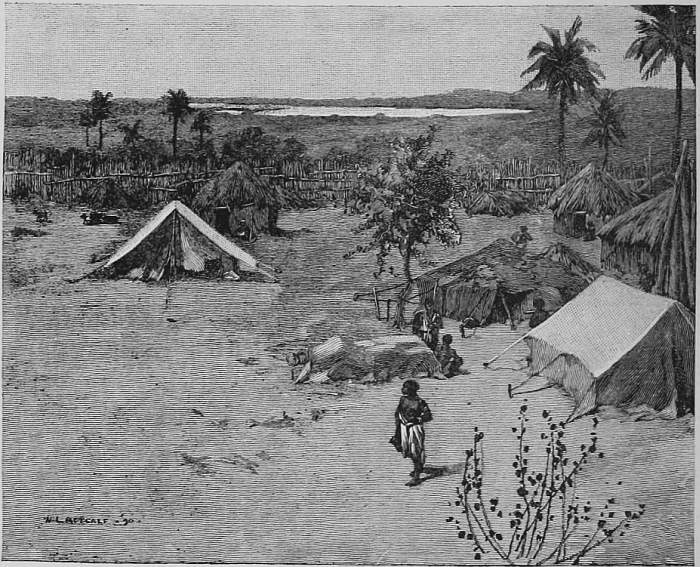
A Stockaded Camp. (From a photograph.)
The equation of Emin’s character seems to have been best stated by Vita Hassan, his friendly subordinate for twenty years, who considers Emin’s many virtues as those of a missionary rather than of a governor or commander, and attributes his infirmity of indecision to innate goodness of heart. It was nine months before Emin, his army mutinous, himself and Jephson imprisoned, with death as an alternative, decided to return with Stanley to Zanzibar.
In the meanwhile Stanley, anxious as to his rear guard, returned through the dreaded forest hoping from day to day to meet it, but saw no signs until he reached Banalya, on the Aruwimi, a few miles from where he had left it. Here he found it in a state of inactivity and disorganization, its chief, Major Barttelot, murdered by a native, Jameson and one hundred and two out of the original two hundred and seventy-six dead, and twenty-six deserted. Again the journey through the forest and its hostile tribes to Lake Albert, where Stanley with the hesitating Emin Pasha and his followers started for Zanzibar on April 1, 1889.
The return journey, made as far as Lake Victoria Nyanza over unknown ground, resulted in the discovery of Mount Ruwenzori, a snow-clad peak under the Equator, estimated to be seventeen thousand feet high. Moreover, of vastly more importance, Stanley ascertained that Lake Albert Nyanza through the Semliki River, drained a large lake, named Albert Edward, thus determining the secret of the long-sought and ever retreating source of the White Nile. Small streams feed Lake Albert Edward from the south, whose extreme limit is placed by Stanley in 1° 10´ S. latitude.
December 4, 1889, found the party arrived at Bagamoyo, the coast town opposite Zanzibar. The work which Stanley was sent to do, as all other tasks assumed by this great explorer, was ended, and Emin Pasha once more looked on the faces of his countrymen.
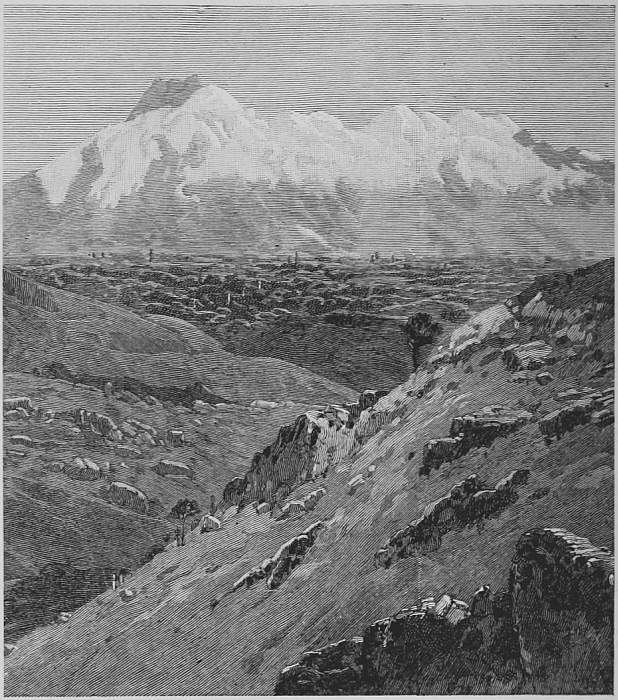
Ruwenzori (The Snowy Mountain) identified by Stanley with “the Mountains of the Moon.” Ascended 10,677 feet above sea-level by Lieutenant Stairs. Total height about 16,600 feet. (From a drawing by Mr. Stanley, made at the time of the discovery.)
Crowned with highest honors from all the powers of Europe, no tribute, as Stanley has said, gave such gratification as that from the United States, which, proud of the achievements of its great citizen, extended to him the unprecedented honors of its official, well-considered, and merited commendation, wherein, under date of February 7, 1878, it was “Resolved, by the Senate and House of Representatives in Congress assembled, That, regarding with just pride the achievements of their countryman, Henry M. Stanley, the distinguished explorer of Central Africa, the thanks of the people of the United States are eminently due and are hereby tendered him as a tribute to his extraordinary patience, prudence, fortitude, enterprise, courage, and capacity in solving by his researches many of the most important geographical problems of our age and globe, problems of a continental scope, involving the progress of our kind in commerce, science, and civilization.”
THE END.