PANORAMA. (continued 5)
Reading edition
Of the ancient castle not a vestige at present can be discerned, and its very site is completely covered with thriving plantations. The Bailey Hill, on which it stood, though at present difficult of ascent, was rendered still more arduous by the erection of strong ramparts and the formation of a deep moat: from the summit of this hill a fine view of the surrounding country is obtained. About a mile west of Mold is a noted spot of ground, called
Maes Garmon,
Or the Field of Germanus. Soon after the final establishment of Christianity in this part of the Principality, about 448, a severe conflict took place here, between the combined forces of the pagan Saxons and Picts, and the native converts, of whom thousands had been just previously baptized. The latter calmly awaited the approach of the enemy at this place, under the command of Bishops Germanus and Lupus, the former of whom, having given his troops orders to repeat after him the word “alleluiah,” led them on to battle.
This triumphant shout, uttered by the whole army, struck such terror into the hearts of the pagans, that they fled on all sides; numbers perished by the swords of their pursuers; and many, attempting to escape, were drowned in the adjacent river. This celebrated victory, which took place in Easter week, has been distinguished by historians with the appellation of “Victoria Alleluiatica;” and the memorial of it has been perpetuated by the erection of a pillar, in 1730, on the spot where St. Germanus is said to have stood. Modern researches of antiquarians have raised a doubt as to the locality of this remarkable event. One mile and a half on the Chester road runs
Offa’s Dyke,
The ancient and famous boundary between Wales and England, extending from Basingwerk, in Flintshire, to Monmouth. When the Romans made their inroads into this island, many of the Britons retreated into Wales, at which time the rivers Dee and Severn divided the two countries: all to the east was England, and to the west Wales. This division continued about 600 years, when the ambitious Offa, coveting the fertile lands of his neighbours, raised a quarrel and an army. He drove the conquered westward among the mountains, seized their property, formed this vast dyke, and ordained that neither Englishman nor Welshman should pass the new boundary.
The Tower.
On the right of the road leading towards Caergwrle, and about a mile from Mold, is an old structure, which presents a singular specimen of the style of domestic architecture during the ages of lawless violence in which it was erected: it consists of an ancient square tower of three stories, and appears to have been designed as a place of fortified habitation. During the wars between the houses of York and Lancaster, it was inhabited by Reinallt ab Gruffydd ab Bleddyn, who was constantly engaged in feuds with the citizens of Chester. In 1495, a considerable number of the latter came to Mold fair, and a fray arising between the hostile parties, great slaughter ensued on both sides; but Reinallt, who obtained the victory, took the mayor of Chester prisoner, and conveyed him to his mansion, where he hung him on the staple in his great hall. To avenge this affront, a party of two hundred men was dispatched from Chester to seize Reinallt, who, retiring from his house into the adjoining woods, permitted a few of them to enter the building, when, rushing from his concealment, he blocked up the door, and, setting fire to the house, destroyed them in the flames: he then attacked the remainder, whom he pursued with great slaughter: and such as escaped the sword, were drowned in attempting to regain their homes. The staple on which the mayor was hung still remains fixed on the ceiling of the lower apartment.
Moel Fammau.
On the right of the road to Ruthin, about five miles west of Mold, is this conspicuous eminence, rising 1845 feet above the level of the sea. Upon the summit of this mountain, the gentlemen of the country entered into a subscription, and erected in 1810, a jubilee column, to commemorate the fiftieth year of the reign of George III. The first stone was laid by Lord Kenyon, on the 25th October, in the presence of more than 3000 people. The monument was executed from designs by T. Harrison, Esq., of Chester, and consists of a rough stone building of pyramidal form, about 150 feet in height, and 60 feet diameter at the base. A square block of stone in the centse marks the division of the two counties, Denbighshire and Flintshire, and four parishes. From this elevated spot may be seen parts of Staffordshire and Derbyshire; the Wrekin, in Shropshire; Snowdon and Cader Idris, in Wales; and Black Comb, in Cumberland. The view is exceedingly grand and extensive, combining every variety of natural scenery; and as the mountain road has lately been repaired, and a room for visitors with a shed for horses erected on the summit, it forms a convenient and interesting spot from which to contemplate the beauties of Wales. The jubilee column has also been repaired by public subscription, to which Lord Kenyon was a liberal contributor.
Kilkain.
This village, which lies about four miles from Mold, on the bridle road to Denbigh, is remarkable for the finely-carved roof of its church, which at the dissolution of monasteries was brought from the abbey of Basingwerk.
MONA INN, (Anglesea.)
Beaumaris 14
Holyhead 12
Menai Bridge 10
Mona Inn, formerly called Caeau Môn, is an excellent hotel, situate midway between Bangor and Holyhead, on the new line of road between those places. Post chaises are kept here. About nine miles beyond the Mona Inn the mail road crosses the Stanley Sands, by means of an embankment 1300 yards in length, and upon an average of 16 feet in height. In the fields of the inn the geologist will find a curious red rock, containing jasper, which will cut glass like a diamond, and which also polishes beautifully.
MONTGOMERY, (Montgomeryshire.)
Bishop’s Castle 9
London 169
Newtown 9
Welshpool 8
This town, the capital of the county, is romantically situated, partly on the summit, and partly on the declivity of a hill, rising from the southern bank of the Severn, and under the shelter of a mountain of a mountain of loftier elevation.—The town-hall stands in the middle of the town, the area underneath being used for the market: the upper part is divided into two handsome rooms, erected at the expense of Lord Clive, the larger of which is used for assemblies; the smaller, for the business of the quarter sessions. On the left of the road leading to Shrewsbury is the new gaol, built by the county at an expense of £10,000. In 1841, the population returns gave to this town 1208 inhabitants. The Dragon has the reputation of being the principal inn.
The town was anciently built and fortified with a castle, by Baldwyn, lieutenant of the Welsh marshes to William the Conqueror, and then called Tre-Faldwyn, i.e. Baldwyn’s Town; but Roger de Montgomery, Earl of Shrewsbury, in 1092, entered Powys-land, and took his place, which he fortified anew, built the castle (according to Doomsday-book), and called it after his own name. The church is a handsome cruciform structure, and contains an ancient monument to the memory of Richard Herbert, Esq., father of the celebrated Lord Herbert of Chirbury.
The ruins of the castle crown an eminence to the north of the town, the approach to which is easy; but on the opposite side, the rock upon which it is built rises almost perpendicularly. A seat belonging to the Earl of Powys, called Leymore Lodge, stands about half a mile from the town, on the road to Bishop’s Castle.
Mynydd, or Cefn Dygoll,
Is celebrated for having been the spot where the national independence of the Welsh was finally prostrated. After the death of Llywelyn, the northern Welshmen set up Madoc, his cousin, who assembled a great army, and after several victories at Caernarvon, Denbigh, Knockin, and on the marshes, the hero of the Principality was here overthrown, in 1294, by the collected power of the Lords Marshers, after a fiercely contested battle.
NEVYN, (Caernarvonshire.)
Caernarvon 21
Cricaeth 15
London 270
Pwllheli 7
Nevyn is a small market town, situated on the western coast of the county, with a population of 1726 inhabitants. It is only remarkable as the place where Edward the First, in 1284, celebrated his conquest of Wales by tournaments and feasts. The coast in the neighbourhood is bold and rocky, and the surrounding scenery altogether of a mountainous character. The church is a neat building, erected in 1824.
On a narrow head-land, jutting into the sea, about a mile from the town, is Porth-yn-Llëyn, supposed, from remains of strong entrenchments, to have been a port frequented by the Romans. It forms a natural bay, in which there is safe anchorage in all winds, for vessels of the largest tonnage.
NEWBOROUGH, (Anglesea.)
Aberfraw 7
Menai Bridge 12
Newborough is on inconsiderable village, containing 895 inhabitants, deriving its name from having been constituted a free borough by Edward the First. It was originally a place of great importance, being the capital of the island, and was for many years the residence of the princes of North Wales, who had a palace here, where, or at Aberfraw, on the opposite side of the Malldraeth sands, they occasionally fixed their seat of government, as the exigences of that turbulent period might require. At the time of the first conquest of Wales by Edward the First, this place appears to have been the chief town in the island, as well as the seat of justice for the whole comot of Menai. In the reign of Henry the Seventh, upon a representation to that sovereign, the assizes and other county business were removed from Beaumaris to Newborough. Having, however, declined from its former importance, in the third year of Edward the Sixth, the assizes, sessions, and general county business were removed back to Beaumaris, where they have been continued ever since.
NEWMARKET, (Flintshire.)
Caerwys 5
Holywell 7
St. Asaph 6
Rhuddlan 4
This village is situated about three miles to the right hand of the great Chester and Holyhead road, and within three miles of the estuary of the Dee.
The church is a small structure of modern date, standing within a spacious cemetery, in which are some fine lofty trees. On the south of the church, and not far distant from the principal entrance, stands a tall and very beautiful stone cross, the upper part finely sculptured in high relief. Here is built one of the charity schools, founded and opened in 1726, by Dr. Daniel Williams, a dissenting minister, with an annual endowment of £8, a charity which he extended to every county in North Wales, distinguishing that of Wrexham, the place of his birth, by an annual salary of £15.
The conjecture of the learned antiquarian, Mr. Pennant, that from the numerous tumuli and other sepulchral memorials visible in the neighbourhood, it was the scene of the slaughter of the Ordovices, by the Romans under Agricola, seems to be well founded.
Near the village is a hill called Cop ’r ’leni, on the summit of which is a most enormous carnedd or tumulus, formed of lime-stones. It covers nearly an acre of ground, and is in height from 20 to 30 yards. The most probable conjecture is, that it was erected over the remains of some distinguished warrior or chieftain, slain in battle, and in later times served as an observatory to discern the approach of an enemy, for which purpose it is well calculated, as it commands an extensive view both of the neighbouring encampments, and the estuaries of the Dee and Mersey.
A short distance from this place, on the brow of another hill, is Bryn-y-Saethau, or the Hill of Arrows, probably from being the station of the archers in the engagement: close to this is Bryn-y-Lladdfa, or the Hill of Slaughter, a name peculiarly appropriate to the site of a battle; a little below again is Pant-y-Gwae, or the Hollow of Woe.
Between Newmarket and Mostyn, about one mile and a half distance from the former place, there is on an elevation a singular monument, denominated Maen Achwynfan, or the Stone of Lamentation and Weeping, on which are cut some very curious figures; the height of the stone is twelve feet, and two feet four inches wide at the base; the form is that of an ancient obelisk.
A short time since one of the tumuli or barrows was opened in the presence of Mr. Morgan, of Golden Grove, and the Rev. Henry Parry, vicar of Llanasa, and was found to contain a quantity of bones and boars’ tusks, the latter in good preservation. An urn, nearly two feet in height, was struck upon, but through the precipitancy of the workmen employed on the occasion, was unfortunately broken to pieces.
NEWTOWN, (Montgomeryshire.)
Bishop’s Castle 16
Llanidloes 14
Llanfyllyn 19
London 179
Machynlleth 30
Welshpool 14
Newtown, or as it is called by the Welsh Tre’-Newydd, is situated on the banks of the river Severn, on the road from Welshpool to Aberystwyth, and contains 3990 inhabitants.—The principal inns are the Boar and the Angel. Very little is known either of the origin or the early history of this place, which within the last fifty years, from the celebrity of its flannel manufacture, has risen into importance. A spacious hall has recently, been erected, from a design by Mr. Penson, in which the market for the staple commodity of the place is held, each alternate Thursday. Many factories have been established, which afford employment to more than two thousand persons.
A substantial bridge of stone over the Severn, called the Long Bridge, was completed in 1827, at a cost exceeding £4000: it consists of three arches of more than sixty feet span; the arches and the parapets being of grey free-stone, and the spears and spandrils of blue stone, found in the neighbourhood. A stone bridge of one arch was built in 1803, over the town brook, on the road to Welshpool, which, by way of distinction, is called the Short Bridge.
The church, dedicated to St. Mary, is an ancient structure. In the interior are some marble monuments, chiefly to the family of Price, of Newtown Hall. The environs abound with pleasing and romantic scenery, and a fine view of the town is obtained from the summits of the hills on the north and south sides. At the distance of about a mile and a half on the road to Built, there is a picturesque and beautiful spot, which is much resorted to by strangers; from the summit of a shelving mass of rock, eighty feet high, a stream of water rushes with impetuosity, forming in its descent a fine cascade, which winds at the base through a richly wooded glen.
Angling Stations.
Distances from Newtown. Miles.
Bettws 4
Llanmerewig 4
Llanwynog 6
NORTHOP, (Flintshire.)
Chester 11½
Flint 3
Hawarden 4½
Holywell 6
London 194
Mold 3
This is a large and pleasantly situated village, in a fertile part of the country, surrounded by numerous seats and elegant villas. The Welsh name is Llan-Eurgain, from the dedication of its first church to St. Eurgain, daughter of the Prince Maelgwyn Gwynedd, and niece of St. Asaph, the second bishop of the see, which from him derived its name.
The church, which has a noble tower, erected in 1571, stands on a small eminence, and is an irregular building, embattled in the front, and supported by clumsy buttresses. The interior length is 113 feet, and the breadth 38½ feet. There have been three dedications of Northop church; the first to St. Eurgain; the second to St. Mary; and the third to St. Peter. There are several remarkable monuments in this church.
The parish of Northop contains about 6000 acres of land, nearly the whole extent of which is in cultivation. The population of the parish in 1841 was 3566.
Coals are found in the lower parts of the parish, and some of the works have been extensively carried on for many years; large quantities are conveyed by iron rail-roads to Connah’s Quay, and there shipped for Chester, Liverpool, and Dublin. Lead ore is found, though not in great abundance, in the township of Caer Allwch.
OSWESTRY, (Shropshire.)
Chirk 5
Ellesmere 8
Llanfyllyn 14
Shrewsbury 18
Welshpool 16
Wrexham 14
This town, though not situated in Wales, is so contiguous, that it is frequently visited by travellers, either on commencing or terminating their tour, Oswestry lying on the great line of road from Llangollen to Shrewsbury. The town occupies the declivity of a range of hills, which skirt it on the western side, and command an extensive view over the fertile plains of Salop. The streets are well paved and lighted: the old buildings of timber and brick have been succeeded by respectable modern edifices; and the town, which has long been stretched beyond its ancient boundaries, is still progressively increasing in extent and importance. The population of the parish by the last census was 8843.
OVERTON, (Flintshire.)
Ellesmere 5
Wrexham 7
This is a neat little village, delightfully situated on the banks of the Dee, over which river is a handsome stone bridge of two lofty arches, connecting the counties of Denbigh and Flint, on the road from Chester to Shrewsbury. The surrounding scenery is beautifully picturesque. The village, with its venerable church, forms a pleasing and highly interesting feature in a charming landscape. In the churchyard are several fine yew trees. The site of the ancient castle occupies the brow of a lofty promontory overlooking the river Dee; and in the park of Gwernhaeled are the remains of a large circular camp, with an ancient tumulus. In this vicinity is the elegant seat of F. R. Price, Esq. Bryn-y-Pys.
Angling Station.—The Dee up to Llangollen.
PENMAEN MAWR, (Caernarvonshire.)
Aber 4
Bangor 9
Conway 6
Port Penrhyn 8
Penmaen Mawr is an immense hill, and so denominated from being the last of the long chain of mountains which cross the country. This gigantic rock, along which the road from Chester to Holyhead passes, exhibits a fine contrast with the adjacent fertility, by its sterile grandeur. This place was once the dread of the neighbourhood, the immense promontory affording only a narrow zig-zag path along the shelf of its frowning side for the terrified traveller to pass. Under his feet were loose masses of rugged stones, impeding his progress; beneath, a hundred fathoms down, the roaring ocean foaming against the perpendicular base of the mountain; and over his head, the impending precipice, threatening by its shivering aspect to overwhelm or hurry him headlong down the craggy steep. The danger, from the declivity of the mountain, with the crumbling nature of the strata, increased with his progress, and, in several difficult parts of the road, one false step must have inevitably proved fatal.
From the numerous accidents that occurred, it was long an object of melancholy consideration to the inhabitants in the vicinity: the winter evenings were often spent in relating the alarming tales of the perils and disasters attendant on passing Penmaen Mawr. Modern science, however, has made travelling in this fearful district both safe and attractive. By order of the Parliamentary Commissioners, a new road was opened in 1827, by the celebrated Mr. Telford. And a capacious tunnel has been constructed for the Chester and Holyhead Railway, through the adjoining mountain of Penmaen Bach, which seemed to defy every attempt to pierce its gloomy recesses.
On the summit of a lull called Braich-y-Ddinas, rising out of Penmaen, are the ruins of a castle, the fortifications of which were capable of containing 20,000 men; the remains of walls are still standing, and a well that supplied the garrison is constantly full of water, furnished principally by the condensed vapour of the mountain. This was considered the strongest post possessed by the Britons in the district of Snowdon. It was deemed impregnable; and here the reduced bands of the brave Welsh army were posted, pending the negociation betwixt Edward I. and Llywelyn.
PENMORFA, (Caernarvonshire.)
Beddgelert 7
Pwllheli 11
Pont Aberglaslyn 5½
Tremadoc 1
Penmorfa, or the Head of the Marsh, is a small wood-clad village, romantically situated on the western bank of Traeth Mawr, but is so much out of the way of tourists as to be seldom visited. The church is small, and dedicated to St. Beuno, having within a small monument to the memory of Sir John Owen, a general and supporter of Charles I., who, being taken prisoner at a battle near Bangor, was condemned to die by the Parliament; but through the intercession of Ireton, he was liberated after a few months’ imprisonment.
PENMYNYDD, (Anglesea.)
Beaumaris 6
Plas Newydd 5
Penmynydd is situated on the eastern side of Anglesea, near the great post road from Bangor to Holyhead, six miles from the Menai Bridge. It is celebrated as being the native place of Owen Tudor.
PENTRE VOELAS, (Denbighshire.)
Capel Curig 11
Corwen 15
Denbigh 18
Ffestiniog 14½
Llanrwst 11
Maen-Twrog 17
This is a small hamlet on the great London and Holyhead road, with a very comfortable inn. About four miles distant are the Conway waterfalls. A new road has lately been formed hence to Denbigh, and another to Ffestiniog.
PLAS NEWYDD, (Anglesea.)
Caernarvon 6
Llanidan 3
Plas Newydd (the New Mansion), anciently Llwyn Moel (the Grove on the Hill), one of the principal groves in Anglesea, sacred to druidic worship, once the magnificent seat of the Marquis of Anglesea, but now occupied by T. Assheton Smith, Esq. of Vaenol. Caernarvonshire. It is beautifully situated on the curve of the Menai, protected on three sides by venerable oak trees, and about one hundred yards of the strait, with a fine lawn in front, sloping to the edge of the water, and defended from the encroachment of the sea by a strong parapet embattled wall.
Here the noble proprietor had the distinguished honour of entertaining his late Majesty George the Fourth, on his visit to Ireland in 1821; and also, at the invitation of the Noble Marquis, who was then exercising his official duties as Lord Lieutenant of Ireland, her Royal Highness the Duchess of Kent and her illustrious daughter, the Princess (now Queen) Victoria, took up their residence for several weeks in the summer of 1822, during the time of holding the Eisteddfod at Beaumaris, where they visited and occasionally resided.
Opposite the stables, behind the house, stands the most complete cromlech in Anglesea, perhaps in Britain; and the domains abound with most interesting vestiges of antiquity.
A short distance from Plas Newydd, is Mr. Saunderson’s beautiful cottage, in the formation and embellishment of which that gentleman has displayed peculiar taste; and about half a mile to the west, within the park, is Plasgwyn, the seat of the lute Rev. Henry Rowlands, and also Llanidan Hall, the seat of Lord Boston.
On Craig-y-Dinas, a rock on the side of the London and Holyhead road, about midway between the Menai bridge and Plas Newydd, stands the Anglesea Column, erected to commemorate the exploits of the noble marquis. The first stone was laid June 18, 1816, being the anniversary of the battle of Waterloo; and the pillar was completed September 8 in the following year. Its height from the base is 100 feet, and the summit of the hill on which it is built rises 260 feet above the level of the sea. It forms an interesting and commanding object in the romantic scenery of the neighbourhood.
PONT-Y-GLYN, (Denbighshire.)
Bala 12
Corwen 6
Pont-y-Glyn (the Bridge of the Precipices) is situated on the great Holyhead and London road, between Corwen and Cerniogan Mawr. The woody glen, at the head of which stands Pont-y-Glyn, with its prominent rocks, nearly obscured by the surrounding foliage, forms a lovely picture. On a sudden turn of the road, stands the bridge thrown over a chasm. Beneath is the rugged and precipitous bed of the river, where, among immense masses and fragments of rocks, the stream foams with violent impetuosity. The cataract is not lofty, but from its being directly under the bridge, where it is seen dashing among the dark opposing rocks, with the addition of the pendant foliage from each side, the scene is finely picturesque and elegant. The bridge rests upon the two nearly perpendicular rocks, and appears to be 50 or 60 feet above the bed of the stream. The view thence down the hollow is truly sublime.
PWLLHELI (Caernarvonshire.)
Caernarvon 20
Chester 93
Cricaeth 8
London 250
Nevyn 7
Pwllheli, or the Salt Water Pit, is a pleasant market-town and sea-port, the population of which is about 1500. The market is held on Wednesday and Saturday. The Crown and Anchor, where post-chaises may be had, is accounted the principal inn; the Ship and Ivy Bush are respectable. The town, which is well built, has become a place of some resort for bathing. The parish church, which is situated about half a mile to the north of the town, is small and dilapidated. A new church, dedicated to St. Peter, was consecrated by the Bishop of Bangor September 16th, 1834. It is a neat and chaste edifice, capable of accommodating a large congregation. Two banks have branches here, the North and South Wales and the National Provincial.
The town-hall, erected in 1818, is a neat substantial edifice, the lower part of which is appropriated on market-days as shambles, and the upper part contains an excellent assembly room, and a room in which the petty sessions are held. The commerce consists entirely in the importation of coal and of shop goods from Liverpool, for the supply of which to the surrounding country Pwllheli forms a great depôt, and is esteemed the cheapest place for living in North Wales. This is one of the contributory boroughs which, with Caernarvon, returns a member to parliament.—The surrounding scenery comprehends many pictures of grandeur and of beauty; and a view from the town, embracing the whole extent of the Snowdon mountains, the Merionethshire hills, and Cardigan bay, is truly magnificent. Several improvements are in progress at Pwllheli.
RHUDDLAN, (Flintshire.)
Abergele 5
Flint 16
Holywell 11
London 220
Rhuddlan contains, with the chapelry of Rhyl, 2415 inhabitants. The town lies in a flat, on the eastern hank of the river Clwyd, about two miles from its influx into the sea. The river is here a little extended in width, so as, at high water, to admit vessels of 50 tons up to the bridge.
Rhuddlan was formerly a place of considerable magnitude, but no traces of its former importance are left, except in the ruins of its ancient castle. Edward the First annexed to it the privileges of a free borough, to facilitate an intercourse between the Welsh and English, for the purpose of allaying the rooted enmity and the unhappy jealousies that had for centuries rent the two countries. In all his proceedings, this monarch exhibited strong features of policy. He had been early taught that when stratagem would supply the place of men and treasure, it was at least wise, if not always just, to adopt it. Hence originated the statute of Rhuddlan, and hence was his infant son proclaimed Prince of Wales. This statute, which was passed in parliament assembled here in the year 1283, contains a set of regulations for the government of Wales; it also recites many curious particulars relative to the Welsh customs previous to Edward’s conquest, against which it was in a great measure directed.
Betwixt the town and the sea is a large marsh called Morva Rhuddlan (the Marsh of Rhuddlan), where, in the year 725, a dreadful battle was fought between the Saxons, under Offa, king of Mercia, and the Welsh, in which the latter, after an obstinate conflict, were defeated with great slaughter, Carodoc, king of North Wales, and many of his principal chieftains, being among the slain. Such of the Welsh as escaped the sword of the enemy, perished in the marsh, from the influx of the tides; and all who were taken prisoners were inhumanly massacred, without regard to age or sex. In commemoration of this disastrous event, was composed the well-known Welsh air of “Morva Rhuddlan,” which is much admired for the plaintive sweetness of its melody.
The bridge at Rhuddlan consists of two arches, built or rebuilt in 1595, with an impression of the arms of Hughes, Bishop of St. Asaph, upon one of the battlements.
At a private house is shewn part of the building where Edward the First held the parliament which passed the statute of Rhuddlan, in 1283; the observation of the tourist will be directed to it by the following inscription on the building:—“This fragment is the remains of the building where King Edward the First held his parliament, A.D. 1283, in which was passed the statute of Rhuddlan, securing the Principality its judicial rights and independence.”
Rhuddlan Castle
is built of red stone, nearly square, and has six towers. The principal entrance appears to have been at the north-west angle, betwixt two round towers; the two opposite to these are much shattered, but the others are in a better state of preservation. There is some difference of opinion as to the period at which this castle was erected. Two celebrated historians, Powel and Camden, attribute it to Llywelyn ap Sitsyllt, who reigned in Wales at the commencement of the eleventh century, and made it the place of his residence. In 1063, three years before William the Conqueror came to the throne, Rhuddlan castle was in the possession of Gruffydd ap Llywelyn, prince of North Wales. It was in that year attacked and burnt by Harold, the son of Godwin, Earl of Kent (afterwards King of England), in retaliation for some depredations committed by the Welsh on the English borders. It was subsequently the scene of many interesting historical events.
In 1399, the castle was seized by the Earl of Northumberland, previous to the deposition of Richard the Second, who dined here, in company with the Earl, in his way to Flint, where he was treacherously delivered into the power of his rival, Bolingbroke.
In the civil wars, Rhuddlan was garrisoned for the King, but was surrendered to General Mytton in July, 1646, and in the December following was ordered by the parliament to be dismantled.—It is at present the property of the Bodryddan family.
Angling Station.—Cwm, three miles from Rhuddlan.
RHYL, (Flintshire.)
Abergele 8
Chester 30
Holywell 13
St. Asaph 5
Rhyl is situated at the termination of the Vale of Clwyd, near the mouth of the river from which that beautiful valley takes its name, and is much frequented as a bathing place during the summer months, for which purpose, both from its immediate contiguity to the sea, and the extent and firmness of its sands, it is admirably adapted. There are excellent and commodious hotels, with smaller inns and lodging houses, intermingled with several neat cottages, occupied for the summer residences of some of the wealthy neighbours. There are machines for the accommodation of bathers, and hot and cold baths, supplied with sea water, to which are attached billiard and news rooms, and a spacious bowling green.
A church has been erected, capable of containing 500 persons, in which there is Divine service in the English language every Sunday. Steam-packets ply regularly from Rhyl to Liverpool three times a week, and occasionally from Rhyl to Beaumaris, affording its visitors an opportunity of seeing some of the magnificent scenery of the Welsh coast. Cars may be obtained at any time from the principal inns, and there is an omnibus on the Voryd side, which runs regularly from Abergele, to meet the packets. Extensive and important local improvements have lately been effected, to add to the attractions of Rhyl as a marine residence.
The shore presents no very striking scenery; still the antique castle of Rhuddlan, in its sober hues, and the dark range of Clwydian hills, stretching far into the distance, afford a scene of no ordinary beauty. To the south is seen the bold promontory of the Great Ormeshead, beyond which is Puffin Island; and when days are bright and skies are clear, the distant hills of Cumberland may be dimly seen, losing themselves beyond the waters of the Irish Sea.—Provisions of all kinds are cheap; and milk, vegetables, and poultry, are abundantly supplied by the neighbouring farmers. The lover of angling may find an opportunity of enjoying his favourite amusement, as the Clwyd and Elwy, both celebrated trout streams, are within one hour’s walk.
RUABON, (Denbighshire.)
Chirk 4½
Denbigh 28
Llangollen 7
Wrexham 5½
Ruabon, or Rhiw-abon, is a village containing about 1300 inhabitants, situated on the road from Oswestry to Wrexham and Chester. The church, dedicated to St. Mary, is an interesting and venerable structure, in which are several splendid marble monuments. There is one by Rhysbrac, to the memory of Sir Watkin Williams Wynn, who was killed by a fall from his horse, on the 26th of September, 1749, aged 41 years; the figure is in a graceful attitude, as in the act of addressing an assembly. An elegant Latin inscription, the composition of the late Dr. King, of St. Mary’s Hall, Oxford, enumerates in eloquent detail his mental abilities, social qualities, and public and private virtues.
There are likewise two monuments by Nollekens, one to the memory of the late Sir Watkin Williams Wynn, Bart., and the other to his wife, Lady Rennetta Williams Wynn. The latter represents that amiable lady in the character of Hope, standing and reclining on an urn. The countenance, attitude, and drapery, are exquisitely fine. The figure stands on a pedestal, on which, in high relievo, is a coiled serpent, hieroglyphical of eternity; and within is an inscription indicating that her ladyship was third daughter of Charles Noel, Duke of Beaufort, and died July 25, 1769, at the early age of 23. The church was thoroughly repaired in 1772, at the expense of the first Sir Watkin, who presented an organ and a small but elegant font of white marble, on the occasion of the baptism of his eldest son, the late baronet. Dr. David Powel, the Welsh historian, who was instituted to this vicarage in the year 1571, was interred here.
In the neighbourhood are numerous iron works and collieries. The British iron company has very extensive works at Acrevair, in which several hundred men are constantly employed. There are considerable coal works at Cefn-Mawr, a large and populous village on the northern bank of the Dee, near an elegant bridge thrown over the river, called New Bridge. The Eagles or Wynnstay Arms Inn is a respectable house. Ruabon is one of the principal stations of the Shrewsbury and Chester Railway.—A short distance from the inn is
Wynnstay.
This extensive park, which is twelve miles in circumference, is entered from the village by a plain but handsome gateway of modern erection, opening into a straight avenue, nearly a mile in length, composed of lofty trees of ancient growth, in which venerable oaks, stately elms, beeches, and chesnuts, are intermingled; and at the extremity of which is the mansion, the hospitable residence of Sir Watkin Williams Wynn, Bart., beautifully situated on a fine and extensive lawn, gently sloping to a noble and picturesque lake. The older portion of the building contains the domestic offices and general departments for the accommodation of the household. The modern part, erected by the first Sir Watkin, and enlarged by the late baronet, is spacious and substantial structure: the interior comprises several noble apartments, embellished with some excellent family portraits, by Sir Joshua Reynolds and some of the best masters, two full length paintings of Charles II. and his Queen, and several other pictures of merit.
The park is enriched with some of the noblest trees in the Principality, and comprehends much variety and beauty of scenery: there are handsome lodge entrances into it from various parts of the surrounding district.
At a short distance from the hall, situated in charming pleasure grounds, is a cold bath, near which stands a handsome fluted column, erected after a design by the late Mr. James Wyatt: it is one hundred feet high, ornamented on the faces with festooned wreaths of oak leaves, and at the angles with eagles, finely moulded in bronze; the capital is surmounted by an entablature supporting a circular platform, surrounded with an iron balustrade, to which there is an ascent from the interior by a flight of spiral steps, and having in the centre a circular pedestal, twelve feet high, on which is placed a massive vase of bronze, enriched with goats’ heads. Over the door leading to the ascent, is a tablet bearing the following inscription:—“To the memory of Sir Watkin Williams Wynn, Bart. who died on the 29th of July, MDCCLXXXIX. this column was erected by his affectionate mother, Frances Williams Wynn;” and on the north side, in letters of copper, is the inscription—“Filium optimus. Mater, eheu! superstes.” Near this column is a fine sheet of water, bounded by Watt’s Dyke, which here intersects the park, and from which the mansion originally derived the name of Wattstay, changed by Sir John Wynn, to its present appellation.
Near the southern extremity of the woods is a cenotaph, erected by the late Sir Watkin, from a design by Sir Jeffrey Wyatville, to the memory of his brother officers and soldiers who were slain during the rebellion in Ireland in 1798: it stands on an eminence overlooking a deep ravine, called Nant y Bele (the Dingle of the Marten), through which the river Dee urges it rapid course along a narrow channel, richly fringed with impending woods. From this spot there is a most magnificent prospect, embracing a vast extent of the counties of Caernarvon, Denbigh, Flint, Chester, and Salop, Chirk Castle and its noble park, the whole of the beautiful vale of Llangollen, including the stupendous aqueduct of Pont-y-Cysylltau, and the majestic ruins of Castell Dinas Brân, with the stately range of mountains in the distance.
A gay archery fête of the British Bowmen, attended by 300 of the aristocracy of the kingdom, was held at Wynnstay in 1846.
Angling Station.—The Dee.
RUTHIN, (Denbighshire.)
Bala 22
Chester 22
Corwen 12
Denbigh 8
Llangollen 15
London 210
Mold 10
St. Asaph 14
Wrexham 18
Ruthin (Rhudd-ddin or Rhuthyn) is beautifully situated on the aclivity of an eminence in the picturesque Vale of Clwyd, at the base of which and through the lower part of the town flows the river from which the vale takes its name, at this place an inconsiderable stream, serving only to work some mills in the neighbourhood. The parish contains 3333 inhabitants. The appearance of the town is pleasing, and the neighbourhood is embellished with numerous gentlemen’s seats, and commands much varied scenery. The principal inns are the White Lion and Cross Foxes.
The government of Ruthin is vested in a municipal corporation. It is one of the contributory boroughs, with Denbigh, Holt, and Wrexham, to return a member to parliament. Ruthin has been made a polling-place in the election of knights of the shire; and from its central situation, it has been selected, in preference to the town of Denbigh, for holding the assizes for the county: the quarter sessions are held alternately here and at Denbigh. The town-hall, situated in the market-place, was built in 1663, and is used for holding the courts leet and baron. Prior to the erection of the county-hall, the quarter sessions were held there. The county-hall is a modern structure, fronted with white stone, and, with the county gaol and house of correction, also situated here, is highly creditable to the skill of the architect, Mr. Turner.
The church is an interesting and ancient structure, with a fine roof of carved oak, panelled, richly sculptured, and apparently of the time of Henry the Seventh. The church was changed into a collegiate chapter A.D. 1310, by John de Grey, who formed an establishment of several regular canons, and endowed it with valuable lands and numerous privileges. The apartments of the canons were connected with the church by a cloister, of which a remaining portion has been converted into a residence for the warden.
The town contains an endowed free grammar school, a national school supported by voluntary subscriptions, and places of worship for various dissenting congregations.—The present rector is the Venerable Archdeacon Newcome, author of Memoirs of Dr. Goodman, Dean of Westminster, and Dr. Godfrey Goodman, Bishop of Gloucester, and also of some local histories.
The ancient castle occupied the declivity of a hill, fronting the Vale of Clwyd towards the west, and, from the extensive foundations and remaining portions of the walls, appears to have been a structure of great strength and magnificence: the remains consist chiefly of fragments of the towers, dungeons, and ruined walls. This fortress was built by Edward the First, who in 1281 gave it, with the hundred of Dyffryn Clwyd, to Reginald de Grey; from the family of Greys it devolved to Richard Earl of Kent, who sold it to Henry the Seventh. It was afterwards granted to Dudley Earl of Warwick, by Queen Elizabeth. After the restoration, the castle and its dependencies were purchased by Sir Richard Myddelton.
The elegant castellated mansion erected by the Hon. F. West, within the ruins of the old castle, forms a beautiful feature in the prospect of the town. The architect having blended the ancient and modern parts with harmonious effect, the structure displays great taste on the part of the projector. From various parts of the site are several rich and extensive prospects. No tourist should omit a visit to Ruthin Castle, which abounds with objects of interest to the student of British history.
Near the town-hall is a rude block of lime-stone, called Maen Huail, on which, it is said, the celebrated Prince Arthur beheaded his rival Huail, brother to Gildas the historian. Ruthin mill, a curious ancient edifice, having on the apex of the eastern gable a red stone cross, is supposed to have been originally the chapel of the cell of White Friars, mentioned by Leland as formerly existing here, but of which no records are preserved.
Dr. Goodman, Dean of Westminster, one of the translators of Archbishop Parker’s Bible, and principal promoter of Bishop Morgan’s Welsh translation; Edward Thelwall, tutor to Lord Herbert of Chirbury; Dr. Parry, Bishop of St. Asaph; Dr. Goodman, Bishop of Gloucester; Sir Eubule Thelwall, Knt., principal and second founder of Jesus College, Oxford; and Sir Thomas Exmewe, Lord Mayor of London in 1517, were natives of this place.
Vale of Clwyd.
This beautiful valley, called by the Welsh Dyffryn Clwyd (the Vale of the Flat), commences three or four miles south of Ruthin; enclosed by mountains, whose brown and barren summits form a fine contrast to the verdant meads and luxuriant fields beneath, which as far as the eye can reach present a most pleasing picture. Towns, villages, and mansions, thickly studded over the country, tend still more to enliven the cheering scene, which is exceedingly beautiful and attractive.
This vale is the most extensive of any in Wales, being about twenty-four miles in length, above Ruthin to Rhuddlan, and varying from five to seven miles in breadth; it contains the three considerable towns of Denbigh, Ruthin, and St. Asaph. There are several of the adjacent heights whence the vale may be seen to advantage; such are the Bwlch Pen-Barras, on the old road to Mold, about four miles from Ruthin, and that part of the new road by which the traveller descends into the vale, commencing about three miles from the latter town; but the best station for an extended view, is the eastern ridge of the mountain, between Dymeirchion and Bodfari, about three hundred yards from Bryn Bella. The view presents a most enchanting panorama of natural scenery.
Angling Station.—The Clwyd.
ST. ASAPH, (Flintshire.)
Abergele 7
Conway 18
Chester 28
Denbigh 6
Holywell 10
London 217
Rhuddlan 3
St. Asaph, commonly called Llan Elwy, derived its origin and name from the erection of a church on the bank of the river Elwy, about the middle of the sixth century. The city is beautifully situated on the gentle aclivity of an eminence, washed on the eastern side by the river Clwyd, and on the west by the Elwy, which unite at the distance of about a mile to the north. The parish contains 3338 inhabitants. Over the Elwy, at the extremity of the principal street, is a handsome stone bridge of five arches; and over the Clwyd is a fine bridge of more modern erection, within a quarter of a mile to the east of the cathedral church. The White Lion and the Mostyn Arms are the principal inns. St. Asaph has been added to the other boroughs of this county, now eight in number, which unitedly return one member to parliament.
The approach from Holywell to St. Asaph is commodious and picturesque. The view of the city is peculiarly striking; its elevated situation on an eminence near the termination of the rich and fertile Vale of Clwyd, crowned on the summit with the cathedral, and having the parish church at its base, makes it a conspicuous object from every point; and the luxuriant groves of trees in which it is deeply embosomed, give to it a romantic appearance. The surrounding scenery, which abounds with objects of interest and beauty, is seen to great advantage from the heights of the city and from the grounds in the immediate vicinity.
The cathedral consists chiefly of the structure raised by Bishop Anian, the second of that name, about the year 1284, and after its demolition by Owen Glyndwr, it was restored by Bishop Redman, towards the close of the fifteenth century, with the exception of the choir, which was rebuilt about the year 1770, by the Dean and Chapter, with funds which had been vested in their hands as trustees for that purpose. It is a cruciform structure, principally in the decorated style of English architecture, with a low square embattled tower, rising from the intersection of the nave and transepts, and having at the north-east angle a staircase turret: the exterior is of simple but good design; the buttresses are few and of very bold character, and the arch of the west door is plainly moulded: the east end is ornamented with a window, which is said to be a fac-simile of the east window in Tintern abbey, in Monmouthshire, and in 1810 was filled with beautifully stained glass, at the expense of the Dean and Chapter, aided by the contributions of the gentry in the neighbourhood. The “good Bishop Beveridge” was consecrated to this see in 1704.
The interior of the cathedral contains some interesting monuments; an altar-tomb, with a recumbent figure in episcopal robes, is said to commemorate the munificent prelate, Davydd ab Owen, who was interred here in 1512; and near the west door is a painted tomb, with an inscription to the memory of Bishop Isaac Barrow, who died in 1680. There is a monument of white marble, to the memory of Dean Shipley, by Ternouth, erected by subscription about the year 1829, at an expense of £600, consisting of a full-length figure of the Dean in his canonicals, in a sitting posture; and also a neat altar-tomb monument to the memory of Bishop Luxmore, who died in January, 1830, from a design by T. Jones, Esq. of Chester. Among other objects of interest to admirers of taste and genius, we may mention a mural tablet to the memory of that charming poetess, the gifted Mrs. Hemans. The choir is neatly fitted up, and the general appearance of the interior remarkably gratifying, from its appropriate solemnity and the excellent order in which it is kept. A new organ was erected a few years since.
The episcopal palace, situated at a short distance to the west of the cathedral, was rebuilt upon a more extensive scale and in an appropriate style, at the expense of the late Bishop. The deanery, about a quarter of a mile from the cathedral, and on the west bank of the river Elwy, was also rebuilt by the present Dean. Dr. T. V. Short is the present Bishop of St. Asaph. The parochial church, dedicated to St. Asaph and St. Kentegern, is situated at the base of the eminence, of which the cathedral occupies the summit; it is a small edifice without a tower, and is supposed to have been erected about the year 1524. There are places of worship for Independents, and Calvinistic and Wesleyan Methodists.
The views in the neighbourhood are delightfully picturesque and varied.
There are numerous elegant mansions within the parish; among the most conspicuous are—Kinmel, the seat of Lord Dinorben; Bodelwyddan, the seat of Sir John Williams, Bart., one of the handsomest residences of North Wales; Pengwern, that of Lord Mostyn, built about the beginning of the last century; Cefn, that of Edward Lloyd, Esq.; and Bronwylfa, the residence of Colonel Sir Henry Browne, erected in the year 1660, and enlarged in 1816. In this last mansion are some valuable trophies taken during the late war, amongst which are, Napoleon Buonaparte’s travelling map and book of roads of the French empire, in splendid morocco cases, emblazoned with the imperial arms, taken from his library at Fontainbleau, by Sir Henry, in 1815 and a French field-marshal’s baton, two feet three inches in length, covered with purple velvet, ornamented with golden bees, and surmounted with an imperial crown, taken in Silesia, in 1812, by a division of Blucher’s corps.
In the township of Cefn Meriadog are some magnificent natural caverns, extending for a considerable distance into the limestone rocks; in some parts of those the roof is more than forty feet in height, and near the river Elwy the base of the rock is perforated by a lofty natural arch, 21 yards in length, and 36 feet high, through which is a road capable of admitting a wagon loaded with hay. Various fossil remains have been found in these caverns, which have been considered by Professor Buckland as worthy of a personal scrutiny on the spot.
Angling Station.—Bodfari, four miles from St. Asaph.
SNOWDON, (Caernarvonshire.)
A chain of the highest mountains in Wales extends across Caernarvonshire, from Bardsey Island to Penmaen Bach, near Conway bay, gradually rising from each extremity towards the centre, which is occupied by Snowdon. The name of this mountain was first given to it by the Saxons, and signifies a hill covered with snow; but the Welsh call all this adjacent range Creigian-yr-Eyri (the Eagle’s Cliffs;) for it is not true, as has been asserted, that snow may be found upon it through the whole year. The temperature at the summit is generally very low, even in summer. In July, just after sunrise, the thermometer has been observed at 34 deg. and in August at 48 deg. early in the afternoon.
The perpendicular height of Snowdon is by late admeasurements 1190 yards above the level of the sea. This makes it, according to Pennant, 240 yards higher than Cader Idris. Some state Whernside, in Yorkshire, to be the highest mountain in South Britain, and more than 4000 feet. Helvelyn is 3324 feet, Benlomond 3262. Mont Blanc rises 15,680 feet; the American Chimboraco is 20,909 feet, the highest ground ever trodden by man; and the mountain of Thibet above 25,000 feet, the highest at present known.
The air on the top of Snowdon is sharp and bracing, and like that in all other mountain districts, is salubrious and congenial to health and longevity. It is seldom that persons who have taste and leisure visit this part of Caernarvonshire without ascending to the top of our British Alps; and those who make a tour from motives of curiosity would think the omission almost inexcusable. An important consideration for the tourist is the point whence he should commence the ascent for the towering summit of this majestic mountain. Dolbadarn, Llyn Cwellyn, Beddgelert, and Llanberis, all put in their claims for eligibility as a starting-place, and at each of these stations trusty guides may be engaged. We are inclined to the opinion that the Victoria Hotel at Llanberis is the spot from which the most easy and convenient ascent may be effected.
It may readily be imagined that every resting point in climbing this commanding eminence must reveal, amidst the magnificent scenery of so romantic a district, views of surpassing grandeur and beauty: and such indeed is the case to an extent which the most vivid imagination can scarcely conceive. The enthusiastic author of “The Beauties, Harmonies, and Sublimity of Nature,” gives the following glowing description of the prospects from the summit:—
“After climbing over masses of crags and rocks, we ascended the peak of Snowdon. Arrived at its summit, a scene presented itself magnificent beyond the powers of language! Indeed, language is indigent and impotent when it would presume to sketch scenes on which the Great Eternal has placed his matchless finger with delight. Faint are thy broad and deep delineations, immortal Salvator Rosa! Powerless and feeble are your inspirations, genius of Thomson, Virgil, and Lucretius! From this point are seen five-and-twenty lakes. Seated on one of its crags, it was long before the eye, unaccustomed to measure such elevations, could accommodate itself to scenes so admirable; the whole appearing as if there had been a war of the elements, and as if we were the only inhabitants of the globe permitted to contemplate the ruins of the world. Rocks and mountains, which, when observed from below, bear all the evidence of sublimity, when viewed from the summit of Snowdon, are blended with others as dark, as rugged, and as elevated as themselves; the whole resembling the swellings of an agitated ocean. The extent of this prospect appears almost unlimited. The four kingdoms are seen at once: Wales, England, Scotland, and Ireland! forming the finest panorama the empire can boast. The circle begins with the mountains of Cumberland and Westmoreland; those of Ingleborough and Penygent, in the county of York, and the hills of Lancashire forefollow; then are observed the counties of Chester, Flint, Denbigh, and a portion of Montgomeryshire. Nearly the whole of Merioneth succeeds; and drawing a line with the eye along the diameter of the circle, we take in the regions stretching from the triple crown of Cader Idris to the sterile crags of Carnedds David and Llywelyn. Snowdon, rising in the centre, appears as if he could touch the south with his right hand, and the north with his left. ‘Surely,’ thought Colonna, ‘Cesar sat upon these crags, when he formed the daring conception of governing the world!’ From Cader Idris, the eye, pursuing the orbit of the bold geographical line, glances over the bay of Cardigan, and reposes for a while on the summit of the Rivals. After observing the indented shores of Caernarvonshire, it travels along a line of ocean, till, in the extremity of the horizon, the blue mountains of Wicklow terminate the perspective. Those mountains gradually sink along the coast till they are lost to the eye; which, ranging along the expanse, at length, as weary of the journey, reposes on the Island of Man, and the distant mountains of Scotland. The intermediate space is occupied by the sides and summits of mountains, hollow crags, masses of rocks, the towers of Caernarvon, the fields of Anglesea, with woods, lakes, and glens, scattered in magnificent confusion. A scene like this commands our feelings to echo, as it were, in unison to its grandeur and sublimity: the thrill of astonishment, and the transport of imagination, seem to contend for the mastery, and nerves are touched that never thrilled before.”
But it is not always thus. Earthly pleasures are often greater in the anticipation than the enjoyment; and ardent hopes are subject to occasional disappointments. Bright as the day may be, mountain mists will sometimes intervene, and passing clouds suddenly draw a curtain over these glorious revelations of Almighty Power. Take, for instance, the narrative of the King of Saxony’s ascent up Snowdon in July, 1844, his Majesty’s excursion being made from Beddgelert:—
“Early this morning, according to our previous design, we made the ascent of Snowdon: the appearance of the weather was by no means encouraging, the sky was lowering, and the clouds hung deep around the mountain top. Still there was no rain, many signs of a favourable change, and we took our chance of the advantages in our favour and set out. We made early preparation for our journey, and, at seven o’clock, mounted a light carriage, accompanied by a skilful guide. We followed the road towards the foot of the mountain, as far up its flank as it was accessible to any description of carriage. We commenced the ascent. Our path lay for some distance over wet pasture and spongy meadows; after which, the path became steeper, and occasional masses of bold projecting rocks occurred. We were not the only travellers, whom the day tempted to try their good fortune on the summit of the highest mountain in England. Some ladies, mounted on ponies, rode sometimes before and sometimes behind us, and several parties followed them on foot. The summit of the mountain lay concealed in clouds; the rocks stood forth bold and black from the green of the Alpine meadows, on which the beautiful yellow anthericum ossifragum grows in great profusion, and a cold wind blew from the ravines which skirted our path. A young Alpine lark, only imperfectly fledged, fluttered along the ground before our feet; our guide easily caught it with his hands, but the old ones flew around, uttering such painful screams, that I induced him again to put the poor panting little creature upon the grass, behind a large block of stone. When we ascended a little further, the view to the westward became partially free, and we saw the sea, the isle of Anglesea, and Caernarvon Castle. As we ascended, however, the clouds again closed around us, and finally we found ourselves completely enveloped in the penetrating fog of these moist goddesses. The ascent also in many places now became difficult; the wind blew cold along the side of some rocky walls, or from the depths of some neighbouring ravine; the thick fogs continued to roll more densely along the mountain sides; but fortunately, so far, they did not thoroughly penetrate our clothes with their moisture.
“Still onward, from height to height! deep ravines lay at our side, the bottom of which, filled with thick fog, yawned horribly below. Vegetation now almost wholly disappeared, except merely a few rare Alpine plants, and on every side of us rose lofty crags of black chlorite slate. Having taken some repose after the efforts of the ascent, behind a projecting rock which sheltered us from the wind, we again set forth, and in about a quarter of an hour (two hours in all) we reached the pinnacle of the mountain—4348 feet above the level of the sea. View there was none! We found refuge in a small wooden shed, erected for the protection of travellers from the rain and wind, in which the host kept up a welcome fire. The man presently prepared a singular brown mixture, which he sold for coffee, and furnished some grayish oatmeal cake as an accompaniment. There were no spirituous liquors of any description to be had, because the occupier, with no small degree of self-satisfaction, gave us to understand that his wooden hut was to be regarded as a Temperance Inn. Not far from this mountain hotel, which I must state to be the first imperfect house of accommodation we had yet met in England, was a small stone hut, in which the rest of the travellers, together with their ponies, had found a harbour not much better than our own.
“Having spent some time upon the summit, dried ourselves, and ranged about among the craggy rocks and through the fog, we found our visit was in vain—no hopes of the weather clearing were longer entertained, and we prepared to proceed on our descent. Before we had descended far from the summit, the clouds presented occasional breaks, and we were able to snatch partial views into the beautiful deep valleys which lie between the converging ridges of the mountain; and on one occasion the clouds rose like a curtain, and revealed to us a splendid prospect of the sea. In these occasional glimpses, we perceived for a moment that the declivities of the mountain were enjoying the full beams of the sun, and immediately we were again closely enveloped in our foggy mantle of clouds. There was a continual play of currents of air and waves of fog with the earth. Such phenomena furnish highly interesting subjects of contemplation to those who have greater leisure for their contemplation than we ourselves had. Of such extraordinary atmospheric phenomena, however, it may be said, they show the life of the clouds, but cloud the image of life! If, however, the observation of such phenomena be made the chief object of a whole excursion, they will be found to have something in them unsatisfying. The unconscious life of nature always falls in value in the eyes of him who has thought upon and experienced the mighty movements and impulses of the mind and feelings. As I have already said, what signify earth, and suns, and planets, if there were no eye to see, no intelligence to give them life?
“Having proceeded somewhat further on the descent, our guide prepared to follow a different route in our return, through a deep precipitous valley, in which the king immediately acquiesced. The task, however, was by no means easy; it involved the necessity of going straight down a sharp declivity of the mountain, at least 1000 feet high, and very sparingly covered with moist earth and tufts of grass. We were obliged to aid ourselves as well as we could by the firmness of our tread, taking a zigzag course, and by the appliances of our hands and sticks, at length reached the bottom in safety. The path, however formidable to us, would, undoubtedly, not have presented many difficulties to a well-trained Alpine hunter; to those, however, who are not accustomed to such clambering, it must be regarded as making a severe demand upon the exercise of their muscular power, and as a species of training which, when successfully completed, must always result in good. Even on reaching the valley, there was no path, and we were obliged to make our way over stock and stone, through bog and brook, till we came to a lower and a smoother region. During our descent, we were obliged to endure the alternative of heat and cold, of sunshine and rain; at length we reached some mines, at which rude paths began to appear, and presently after found ourselves at our carriages, and drove by another road again back to Beddgelert. On this road, too, we enjoyed the sight of some splendid mountain scenery. The weather had now become clear and sunny, while the top of Snowdon still lay thickly enveloped in masses of dark clouds. A small lake lay stretched out before us in the vale, full of picturesque beauty, and noble mountains beside and beyond, rose and towered one above another. I heartily envied an artist who had established his studio on the edge of a mountain brook, and appeared to be diligently engaged in his work. What a pleasure it must be, to be engaged in an attempt to give a faithful delineation of such noble forms! About half-past two we reached the hotel at Beddgelert, and our mountain excursion was at an end.”
Let us be very earnest in impressing upon the minds of all tourists one important injunction,—never ascend Snowdon without a guide. It is unwise and perilous, even in the brightest weather, to make such an attempt. A melancholy instance of this venturous spirit occurred in the autumn of 1846, when the Rev. H. S. Starr, of Northampton, ascended the mountain without a guide; and doubtless perished in some of its bogs or precipitous defiles, as from that period till now, no trace of this unfortunate clergyman has been discovered.
For Angling Stations, see Llanberis.
TAL-Y-LLYN, (Merionethshire.)
Dolgelley 8
Dinas Mowddwy 11
Machynlleth 8
Towyn 10
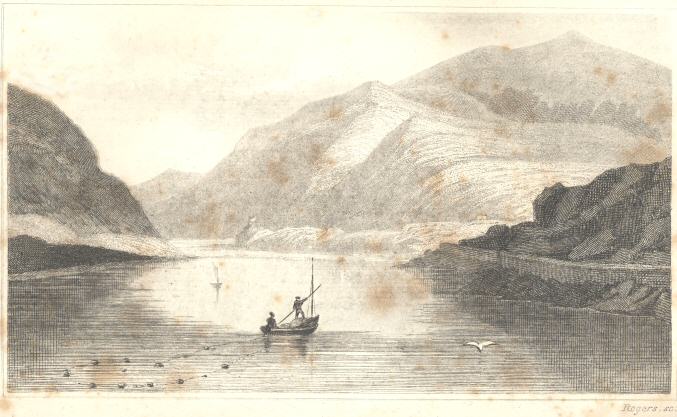
This is a very picturesque little village, about half way between Machynlleth and Dolgelley, deriving its name from the church, at the head of a beautiful lake, appropriately called Llyn Mwyngil, (The Lake of the Charming Retreat,) from the west end of which issues the river Dysyni, taking its course to the sea through Towyn Marsh. The scenery is remarkably romantic, and is rendered more so by the lakes which are within the limits of the parish. That of Tal-y-llyn is small but beautiful; its greatest breadth is not more than half a mile, and its length between one and two miles. Its northern boundaries consist of rich pasture land, while on the south a high green hill, covered only with short herbage, in fact a mere sheep walk, rears itself to the clouds, and extends the whole length. Its only piscatory productions are trout and eels; the latter attaining a good size, and finding a safe protection in the deep coat of moss which covers the bottom. Of the trout there are two species, the large lake trout and the common river trout, the latter finding their way into the lake by two or three streams which feed it from the mountain; these never attain any considerable size, but the others, being indigenous to the pool, grow to a large size. The finest, which are caught with a fly, vary from half a pound to between one and two pounds; one weighing more than 12lb. was found a few winters ago, frozen under the ice. The lake is the property of Colonel Vaughan, who purchased it for no other purpose than that of affording his friends the enjoyment of angling therein. The stranger, who is perfectly unknown to the generous-hearted Welshman, is equally welcome to participate in the sport, without the formality of begging a day’s fishing, or even intimating his intention to the proprietor. A new and commodious inn, near the village, was built last year by Colonel Vaughan: it affords good accommodations, and the charges are very moderate.
Beside the lake already mentioned, there is another under the summit of Cader Idris, called Llyn Cau, (the Pool of the Chasm,) from its being situated under vast cliffs; it is about a quarter of a mile long, and nearly of equal breadth, and has the appearance of the crater of a volcano, at the head of the chasm, through which a stream runs from the lake, and forms a fine cataract, close to the ancient house of Dolydd Cau, and then unites with another river, which meanders along the level vale below, to the upper end of Llyn Mwyngil. The vale in which it is situated is so contracted, as to leave, for a considerable part of its length, only a very narrow road on each side of the lake, from the clear surface of which are reflected its precipitous declivities. Towards the extremity of the vale, the lake contracts gradually into the form of a river, rushing with much force through a stone arch into a very narrow pass, having on one side the church, and on the other a small cluster of houses, which form the village, embosomed in trees, and assuming a romantically beautiful appearance.
At the distance of a mile or two from the church, the hills almost meet, and present a sterile and rugged aspect; they are broken into numberless crags, of which some are vertical and sharply pointed, but the greater number project horizontally, and impend with threatening gloom over the vale beneath. One of these precipices, from its resemblance in form to a harp, has been called Pen y Delyn; and another, from a tradition that it was formerly the practice to throw thieves from its summit, has been denominated Llan-y-Lladron (the Thieves’ Leap), a practice corresponding with that related of the Tarpeian rock at Rome.
Angling Station.—The Lake: good fishing. A boat.
TOWYN, (Merionethshire.)
Aberdovey 4
Barmouth 12
Dolgelley 16
London 226
Machynlleth 14
Towyn is a market-town beautifully situated at the distance of about a mile from the sea-coast, near the mouth of the river Dysyni, in a small but pleasant vale. The return of the population for the town and parish is 2694 inhabitants.
During summer, the place is much frequented for sea-bathing, by persons who prefer retirement to the bustle of a more fashionable watering place. Valetudinarians are also attracted hither by St. Cadvan’s Well, much celebrated for the cure of rheumatic, scrofulous, and cutaneous disorders. The ride over the sands to Aberdovey, a rising place about four miles distant, is very pleasant. A beautiful line of road to that interesting village has been constructed, and is continued from that place to Pennal, abounding with picturesque scenery, and commanding views of Snowdon, Arran Mowddwy, Cader Idris, and Plinlimmon.
Towyn is one of the places at which the poll is appointed to be taken in the election of the parliamentary representative of the county. The church, dedicated to St. Cadvan, is an ancient cruciform structure, in the Norman style of architecture, containing some curious old monuments, which the inquisitive stranger ought not to leave unnoticed.
On a steep hill near the town are some remains of an ancient castle of great strength; the fortifications comprehend the entire summit of the eminence: one of the apartments, thirty-six feet in diameter, was hewn out of the solid rock, Craig-y-Deryn (the Bird’s Bock), situated in the vale of Dysyni, about three or four miles from Towyn, is in the highest degree wild and romantic. A small but picturesque waterfall may be seen at Dôlgôch.
At a small distance from the town is Ynys-y-maengwyn, a noble mansion, pleasantly situated in grounds tastefully laid out, and embellished with flourishing plantations and timber of ancient growth, among which is an evergreen oak, considered to be the finest tree of its kind in the kingdom. The garden is very extensive, and contains many rare trees and plants.
The angler will find excellent amusement in the Dysyni, which, after rolling through a rude assemblage of rugged mountains, flows through the fertile vale of Towyn, passing first by Peniarth, a seat belonging to the Wynn family, and then by Ynys-y-maengwyn, and finally entering Cardigan bay, about a mile eastward of Towyn. This is an excellent river for salmon, and it contains some remarkably dark and deep pools, more especially near Peniarth, where the river winds close by the house; the angler will also find good sport farther up the mountains.
Angling Station.—The river, up to Tal-y-Llyn.
TRAWS-FYNYDD, (Merionethshire.)
Bala 18
Dolgelley 12
This village is situated on the road from Dolgelley to Tan-y-Bwlch, in an exposed and mountainous district. The church is an ancient structure of the old English style of architecture; the parish is of vast extent, being above ten miles in length, and eight in breadth, consisting chiefly of barren mountains, used only as sheep-walks. At this place a guide may be had to the waterfalls of Pistyll-y-Cain and Rhaiadr-y-Mawddach, distant about three or four miles.
On the road side towards Ffestiniog is Llyn Rathlyn, a small lake, noted for a singular variety of perch, having the lower extremity of the back-bone strangely distorted. The celebrated Humphrey Lloyd, who was consecrated Bishop of Bangor in 1673, was born at Bôd-y-Vuddai, in the parish of Traws-fynydd.
TREMADOC, (Caernarvonshire.)
Barmouth 20
Ditto, by Tan-y-Bwlch 30
Beddgelert 7
Caernarvon 20
Ffestiniog 13
Harlech 10
Ditto, by Tan-y-Bwlch 20
Pwllheli 14
Tan-y-Bwlch 10
Tremadoc is a market-town and sea-port of very recent origin, and is a signal instance of the triumph of perseverance over apparently insurmountable local difficulties. It derives its name from its enterprising founder, the late Wm. Alexander Madock, Esq. This gentleman, having projected a plan for regaining from the sea a portion of the land on the western side of the wide sandy estuary called the Traeth Mawr, purchased the estate of Tan-yr-Allt, in the immediate vicinity, in 1798, and in 1800 succeeded in recovering a tract of nearly two thousand acres of rich land, then forming Penmorfa Marsh, which now produces excellent crops of wheat, barley, and clover, to which he gave the appropriate name of Glandwr.
Encouraged by the success of his first attempt, Mr. Madock was induced to undertake the more arduous enterprise of reclaiming the whole of the Traeth Mawr; and for this purpose he obtained in 1808 an act of parliament, vesting in him and his heirs the whole extent of these sands, from Pont Aberglâslyn, at their head, to the point of Gêst, at their lower extremity. Notwithstanding the numerous unforeseen obstacles which threatened to frustrate the undertaking, Mr. Madock succeeded in constructing across the mouth of the Traeth Mawr, at the eastern extremity of Cardigan bay, an embankment of earth and stones, nearly one mile in length, from north to south, varying from 100 to 400 feet in breadth at the base, and diminishing gradually to the summit, which is 100 feet high from the foundation. By means of this embankment, a line of communication has been formed between the counties of Caernarvon and Merioneth, and a tract of more than 2700 acres of land was recovered from the sea, besides a vast extent of adjoining land, which was before overflowed by the tides, but which is now, by draining, rendered susceptible of cultivation. This arduous enterprise was completed in 1811, at an expense of more than £100,000; and, including the lands previously recovered, not less than 7,000 acres have been gained.
The town is situated by the side of a lofty mountain, on the western side of Traeth Mawr, on a portion of the tract first recovered from the sea, and is built in the form of a square quadrangular area, having in the centre a lofty column, round the pedestal of which there is a flight of twelve steps. On the eastern side a commodious market-house has been erected, above which is an assembly-room. Mr. Madock also built, at his own expense, a handsome church, in the late style of English architecture, with a lofty spire, which forms an interesting object as seen from the sea-coast.
Tan-yr-Allt, the seat of the late W. A. Madock, Esq., is a spacious modern mansion of elegant design, situated on a rock overlooking the town. Morfa Lodge, and Tuhwnt-i’r-Bwlch, erected also by that gentleman, are handsome villas in the immediate vicinity of the town. Captain Parry, R.N. of Llwyn-on, Denbighshire, has also a seat called Aberdunant, between this place and Beddgelert.
With a view to promote the commercial interests of the town which he had founded, Mr. Madock, in 1821, obtained an act of parliament for improving the navigation of this part of the bay on which it is situated, and thus rendered it accessible to vessels of three hundred tons burden: commodious quays and wharfs were also constructed.
The last improvement carried into effect was the erection of Port Madoc, about one mile from the town, where many good houses have been built. The principal exports are slates, from the Ffestiniog quarries, and copper ore, which is brought from the neighbouring mines. The chief imports are timber, coal, and lime. A rail-road also runs to this place from the quarries and mines in the neighbourhood. The road from Tremadoc to Beddgelert commands to great advantage the scenery of the Merionethshire side of the Traeth, and affords a delightful ride to Pont Aberglaslyn and its vicinity.
WELSHPOOL, (Montgomeryshire.)
Llanfair 8
London 171
Montgomery 8
Newtown 14
Oswestry 16
Shrewsbury 18
This town is called Welsh, to distinguish it from a town of the same name in Dorsetshire, and Pool, from its proximity to a piece of water called Llyn-du Pool, now within the inclosure of Powys park. The town, which Leland describes as being in the reign of Henry the Eighth, “the best market in Powys,” still retains that character, in addition to which it may justly be regarded as the modern capital of the county, and, with the parish, contains 4626 inhabitants. The town has a cheerful and prepossessing appearance. The flannel manufacture is carried on here, but upon a less scale than at Llanidloes or Newtown. A considerable trade is carried on in malt, and there are likewise several large tanneries. Welshpool is made contributory with Llanidloes, Llanfyllyn, Machynlleth, Montgomery, and Newtown, in returning a member to parliament. The assizes for the county are held here. The town-hall is a commodious building of brick, in the centre of the principal street.
The church, with the exception of the chancel and the tower, was rebuilt in 1774. It is in the early style of English architecture, with a lofty square embattled tower, and its interior accommodation was enlarged by the addition of galleries in 1824. Amongst the communion plate, there is a chalice of fine gold, holding one quart, and valued at £170; engraved on it is a Latin inscription, stating it to have been presented to the church of Pool, by Thomas Davies, Governor-general of the English colonies on the western coast of Africa, in gratitude for the preservation of his life during his residence in that unhealthy clime.
Powys Castle,
the seat of the Earl of Powys, is a stately but irregular pile of building, venerable for its antiquity: it is pleasantly situated in a well-wooded park, at the distance of a mile from the town, on the right of the road leading to Montgomery, and occupies a commanding site on a ridge of rocks overlooking a vast extent of richly diversified country, the greater part of which was formerly subject to its lord. The views from its extensive and richly wooded park are remarkably interesting and beautiful.
Angling Stations.
Distances from Welshpool. Miles.
Berriew, on the confluence of the Rhiw and Severn 5
Llandysylio, on the Vyrnwy 8
Llandrinio 9
Llanvyllin, the Abel, Cain, and Vyrnwy 12
WREXHAM, (Denbighshire.)
Chester 12
Llangollen 11½
Oswestry 6
Ruthin 16
Wrexham is a large and well-built town, whose population, including the parish, was returned in 1841 at 12,981 inhabitants. From its extent and importance, it has sometimes been denominated the metropolis of North Wales. The town is pleasantly situated at the junction of the Shrewsbury. Welshpool, Oswestry, and Chester roads, and in the centre of the mining and manufacturing districts of the eastern part of Denbighshire. Races are annually held early in October, on a course a little north-west of the town, on the right of the road to Mold. Wrexham is one of the principal stations on the Shrewsbury and Chester Railway.
No particular branch of trade or manufacture is carried on in the town; but the parish, which is about twelve miles in length, abounds with mineral wealth, and extensive works of various kinds are carried on in different parts of it. The principal inns are the Wynnstay Arms and the Lion. Markets are held on Thursday and Saturday, the former being the chief market day. There are several fairs held annually for cattle; but the principal one is that which commences on the 23d of March, and continues for fourteen days. For the accommodation of the various dealers attending it, five extensive areas are fitted up with shops and booths. A new and handsome market-hall has also been lately built, and cheese fairs established. Wrexham is contributory with Denbigh, Holt, and Ruthin, in the return of a parliamentary representative.
The church, dedicated to St. Giles, is a spacious and noble Gothic structure, deservedly regarded as one of the finest ecclesiastical edifices in the Principality. It was erected in the year 1472, the tower not being finished till 1506, as appears by a date on the building. The exterior is elaborately embellished with sculpture; and the tower, which is very lofty and highly enriched, consists of several successive stages, panelled throughout, and decorated with numerous statues of saints in canopied niches: from its elevation, and the light open-work turrets by which it is crowned at the angles, it forms a conspicuous and interesting object in the surrounding landscape. It has a remarkably fine carved roof: and a noble altar-piece, designed by Mr. Jones of Chester, and worked in stone by Mr. Blayney of that city; the east window being filled with beautifully stained glass by Mr. Evans, of Shrewsbury.
In the chancel is an altar-tomb, on which is a recumbent effigy of Dr. Bellot, successively Bishop of Bangor and Chester, who died in 1596, and was there interred. Nearly opposite to this tomb is an interesting monument, by Roubilliac, to the memory of Mrs. Mary Myddelton, of Chirk Castle, representing a female rising from the tomb in all the freshness of youth and beauty, at the sound of the last trumpet which is to summon the dead to judgment. At the corner of the aisle is also a monument by Roubilliac, to the Rev. Thomas Myddelton and Arabella his wife; and there are monuments to Wm. Lloyd, Esq. and his son, the Fitzhughs, the Pulestons, the Longuevilles, Sir Foster and Lady Cunliffe, and other families in the neighbourhood..
About a mile from Wrexham, on the right of the road leading to Chester, is Acton Park, the residence of Sir R. H. Cunliffe, Bart., a spacious mansion, delightfully situated in extensive grounds, richly diversified with picturesque and romantic scenery, and commanding pleasing views of the town and adjacent country. Acton was the birth-place of the notorious Judge Jeffreys, who obtained so bad an eminence in the reign of James the Second.