PANORAMA. (continued 4)
Reading edition
The triumphal arch, which was opened in August, 1824, is a chaste and elegant structure of Mona marble, brought from the Red-wharf Quarry, and consists of a central carriage way, separated on each side by two handsome pillars of the Doric order from a footway, enclosed by a wall ornamented at the extremities with antæ of correspondent character, the whole twenty feet high, and supporting a boldly projecting cornice, surmounted by three diminishing tiers of masonry, forming a platform. Over the carriage-way, on each side, is a large entablature, respectively bearing inscriptions in Welsh and Latin, commemorative of the event.
The lighthouse is built entirely of hewn stone, and without any other timber than what was necessary for the door cases and window frames. It consists of three stories, the ceilings of which are groined, and the gloves are of smooth stone: its base is six feet above high water mark, and is protected from the sea by a stone glacis. The tower, which is circular, is thirty-three feet in height to the gallery, and the lantern, which is ten feet higher, is lighted with twenty brilliant lights of oil gas, having reflectors plated with silver, and displaying a strong white light, which, being at an elevation of fifty feet above the level of the sea, affords a safe guide to vessels approaching the harbour. The whole of these works were completed at an expense of about £130,000, and a graving dock was constructed at an additional expense of £12,000.
The post-office establishment at this place consists of six steam packets of 230 tons burden, which sail regularly from this port and Kingstown, keeping up a constant intercourse between the two countries.
No manufactures are carried on at this place: several attempts have been made at considerable expense to explore the mineral treasures with which the parish was supposed to abound, but nothing of importance has yet been discovered, except veins of Mona marble, called “verd antique,” which have been worked to some extent. The trade consists chiefly in the building of coasting vessels, the repairing of all the post office steam packets belonging to the several ports of England and Wales, and the making of ropes and cables. The market is on Saturday. The North and South Wales bank has a branch here.
The church, dedicated to St. Cybi, is a spacious cruciform structure, principally in the decorated style of English architecture.
The promontory called the Head, by which the harbour is sheltered from the westerly winds, presents a singular aspect, its sides towards the sea forming in some parts immense perpendicular precipices, while in others they are worn, by the continued action of the waves, into caverns of magnificent and romantic appearance. Of these, one called the “parliament house,” is accessible only by boats at half ebb ride, and consists of a series of receding arches, supported by massive and lofty pillars of rock, displaying an interior of picturesque beauty and sublime grandeur. Some of these caverns afford shelter for gulls, razor-bills, herons, cormorants, and other birds; and the loftiest crags are frequented by the peregrine falcon. The eggs of these birds are in great request as a delicacy for the table; and some of the hardiest inhabitants are employed in the hazardous task of procuring them for sale.
There are several ancient military forts in the neighbourhood, whose appearance indicates them to be of Roman origin. At a small distance westerly is a large hill, having several natural and artificial curiosities. Within about 200 yards of the top are the remains of a strong wall, which seem to have belonged, as well as the churchyard walls, to a place of defence against the frequent incursions of the Irish. To the W. S. W. of the top, and nearly under it, in a situation awfully romantic, are the remains of a chapel. From the top of this mountain there is a most extensive view, comprehending the Isle of Man, the hill of Howth on the Irish coast, and parts of the Highlands of Scotland.
Many gold Roman coins of the time of later emperors were found a few years ago in Holyhead mountain; and in 1835, in removing some old walls at Ty Mawr (Great House), the property of Lord Stanley, of Alderley, were found several spear heads, axes, and rings, of bronze, with red amber blades, which from the form and the nature of the materials, appear to be of Phœnician origin. At Trefigreeth, another farm belonging to the Stanley family, situated within a quarter of a mile of the London and Holyhead road, about one mile from the town, is a small but perfect cromlech. A larger one, in great preservation, may be seen at Presadwaedd, about four miles from Holyhead. And at Tywyn-y-Capel, about two miles from Holyhead, on the old post road, and close to the sea, is a very singular mound, on the top of which, a few years ago, were the remains of a small chapel. The mound is artificial, being formed of sea sand. It is filled with graves. The coffins are formed of rude flat stones, and are placed in rows above each other. They contain the remains of persons of both sexes. The sea every year makes encroachments upon it, laying open the graves and strewing the shore with bones. Tradition is silent as to the origin of this singular place of burial. It is worth the investigation of the antiquary.
The South Stack Light-house is connected with the harbour, and materially contributes to facilitate its access. It is erected on the summit of an isolated rock, three or four miles westward from Holyhead, and separated from the main land by a chasm 90 feet in width. This splendid structure was raised in the year 1808. The elevation of the summit of the rock on which it is erected, is 140 feet above the level of the sea at high water mark; the height of the tower, from the base to the gallery, is 60 feet; and the lantern is 12 feet high from the gallery; making the total elevation of the light 212 feet above high water mark. The light is produced by twenty-one brilliant lamps, with powerful reflectors placed on a revolving triangular frame, displaying a full-faced light every two minutes, which, in clear weather, is distinctly visible at a distance of ten leagues. Latterly there has been an addition of three red lights placed at the rock, which are more distinctly visible in foggy weather than the light-house lights. The rough sea caused by the strong tides, about the head, rendered the communication by boat very precarious. In order to obviate the danger, a passage was contrived by means of two ropes thrown across the gulph, along which the individual was drawn in a box or cradle, by the assistance of pulleys affixed at each end. This plan was superseded by a bridge of ropes, which was used some years after, though always considered unsafe, on account of the constant wear of the ropes. In 1827, a modern suspension chain bridge was thrown over the sound, the span of which is 110 feet, the chains being firmly bolted in the rock on each side, and carried over two massive stone pillars erected for the purpose. The chain supports a platform of timber five feet wide, and 70 feet above high water mark. The bridge is attained by descending the Holyhead mountain in a zigzag direction, by a flight of 380 steps.
On the rocks south of the harbour of Holyhead, and commanding the town, an obelisk has been erected by public subscription to the memory of the late Captain Skinner, formerly master of one of the post-office packets on this station, who lost his life by being washed overboard in 1833. He was very generally respected, and had been a commander on this station for many years.
To the N. E. is the Isle of Skerries, on which there is also a light-house.
There are several good inns at Holyhead, the principal of which is the Eagle and Child Hotel.
For romantic wildness and stern grandeur of aspect, no place can surpass this portion of the iron-bound coast of Anglesea.
HOLYWELL, (Flintshire.)
Chester 18
Denbigh 14
Flint 5
London 201
Mold 10
Northop 6
Rhuddlan 11
St. Asaph 10
Holywell, called by the Welsh Trêffynnon, (or the Town of the Well,) is an improving and pleasantly-situated place, on the great road from Chester to Holyhead; the town and parish containing a population of 10,834, with a crowded market on the Friday.
But before going into any topographical particulars, we must introduce our readers to the legend of the miraculous well of the famous St. Winefred, as put into an agreeable narrative by Miss Costello:—
We stopped at a remarkably good inn, and lost no time in going down the steep hill at the bottom of which the pretty little chapel over the fine well is situated. Nothing can be more secluded and pleasing than its position by the side of the handsome church with its low churchyard, all placed in a deep hollow, so removed from the upper town, that the bells summoning to prayer cannot be heard above, and a ringer is accustomed to go about the town with the large bell slung round his shoulders, and a cushion on his knee, against which the bell beats as he walks, and proclaims his holy errand. This old custom, doubtless of considerable antiquity, is still kept up, and we are glad that, being there on a Sunday, we were able to see the perambulating belfry.
Margaret, the mother of Henry VII., erected the graceful chapel whose fretted roof is the boast of Holywell, but one had existed long before her time; for the miracle of St. Winefred happened, according to the monks of the Basingwerk, to whom the world is indebted for the legend, early in the seventh century, and is thus told:
Winefred, a beautiful and devout virgin, lived in the reign of an imaginary king, and was of noble birth, and the niece of a man whose sanctity had already made him conspicuous, and who was known as the good Beuno. A prince of the country, whose name was Caradoc, saw the fair damsel, and loved her; but his passion was not so pure as her goodness ought to have inspired. Even then there was a chapel at the foot of the hill, where, while Beuno was at the altar praying with certain of the inhabitants of the neighbouring town, amongst whom were the parents of Winefred, to the astonishment of all, a head rolled and bounded into the sacred inclosure, and stopped at the altar. Beuno stooped to raise up the head, and observed that where it had rested, instead of the pool of blood which was there but an instant before, a stream of crystal water had sprung up. His amazement was increased when he found that the beautiful features and golden hair of the head he gazed upon were those of his beloved niece. He hastened from the spot, and mounting the hill, discovered her mutilated body lying prostrate, and the cruel prince Caradoc flying with a drawn sword in his hand. The truth became clear to him at once. Winefred had fled from the importunities of the prince who, pursuing, had wreaked his vengeance on her by cutting off her head. The saint, for such Beuno afterwards became, immediately with devout prayers joined the severed head to the body, when, to the awe and delight of all beholders, the virgin arose, as if from sleep, uninjured and lovely as ever, nor was there a trace left of the accident but a slight white mark, like a thread, round her throat. Beuno cursed the caitif prince, “who melted away as wax melts before the fire.” Winefred lived fifteen years after this event; she founded a monastery at Gwytherin in Denbighshire, of which she became the abbess, and died there.
Before the event of her decapitation, it seems the valley was particularly dry, so much so as to bear the name of Sychnant, [130] from that circumstance; therefore it was most fortunate that the head of the pursued damsel should have rolled where it did. Not only did the spring attest the miracle, but the very moss and stones around have properties that enforce the belief. The moss emits an odoriferous smell in testimony of the saint’s purity, and the stones at the bottom are stained with her blood, and keep their tint to this day. It is true that some naturalists, who had not the same motive for keeping the world in ignorance as the monks of Basingwerk had, have proclaimed that the moss is only a sweet-scented plant called Jungermannia asplenoides, and that the crimson stains on the stones are produced by a vegetable named Byssus jolithus, by no means uncommon, thus characterised by Linnæus: “the Byssus easily betrays itself by giving the stones, to which it adheres, an appearance of being smeared with blood. If rubbed, the plant yields a smell like violets.”
Fortunately, all the botanical and other students of the days of St. Winefred were monks, who knew well how to keep their own counsel, and turn their knowledge to their own advantage.
Our fair tourist proceeds to narrate some of the “miracles and lying wonders,” which are said to have occurred during the removal of the devout virgin’s corpse from Gwytherin to Shrewsbury; and then comes a conclusion, which we suppose the devotees of the saint of the Holy Well will regard as nothing less than “flat blasphemy.” “After all this,” observes Miss Costello, “it is mortifying to find that the blessed St. Winefred never existed at all, nor was more than an Undine, a thought, a name, a fairy of a fountain! for Gwenvrewy, as she is called in Welsh, signifies the white hill water, or the white gushing stream, meaning the overflowing well which Nature formed without a miracle.”
As our province is rather to describe the well itself, than to bandy arguments about the lady whose name it bears, we may briefly state that it is one of the most remarkable springs of water in the kingdom.
The well is an oblong square, about twelve feet by seven. The water passes into a small square court through an arch, under which the Roman Catholics used to swim as an act of penance. The quantity of water thrown up is not less than eighty-four hogsheads every minute. This water has never been known to freeze, and scarcely ever varies in quantity, either in drought, or after the greatest rains. Though this stream has little more than a mile to run before it arrives at the sea, a great number of mills, forges, and other works are kept in motion by it, three of which are placed abreast.
The sacred well is the object of many pilgrimages, even in this day, and several modern miracles are related of the influence of its waters. Pope Martin the fifth especially enjoined such pilgrimages, and the monks of Basingwerk were furnished with pardons and indulgences to sell to the devotees. James the Second visited the well in 1686; and Leopold, king of the Belgians, in 1819.
Apart from all superstitious notions, its waters doubtless possess many sanative properties.
The authoress of the new romance of “Llywelyn’s Heir,” says with reference to this charmed place: “We would recommend any strangers to the spot to visit it, should an opportunity offer, and judge with their own eyes of the lightness and beauty of the tall pointed arches and the flying buttresses that adorn the exterior; and to decide whether the interior is not even more worthy of notice. The well, into which the miraculous stream pours forth its astounding body of water, is polygonal; the columns that rise above it are singularly beautiful, and after many serpentine wanderings, meet and form a canopy worthy of the water-king, who doubtless frequently holds there his court. The legend of the saint, and beautiful carvings in stone are scattered around; but they appear to have been placed there to do honour to the house of Stanley, and not to the saint—by no means an astonishing circumstance, for the saint had been long dead, and was probably tired of working miracles; and the Stanleys were living, and willing to bestow munificent gifts, of which this building and the chapel above it remain memorials to this day.”
The church, dedicated to St. Winefred, and rebuilt in 1769, is a rather spacious structure of Grecian architecture, 68 feet long by 56 wide; consisting of a nave with north and south aisles, with a chancel, in which is a window embellished with modern stained glass. It has also two large galleries over the aisles, and the whole is calculated to contain about 3,000 persons. Remains of the ancient edifice are still seen in the remarkably plain pillars on each side of the nave. It contains several monuments and tablets, and amongst them one by Westmacott, erected to the memory of Paul Panton, Esq.
Under the chancel are the vaults of the Mostyns of Talacre, the Pennants of Downing, and the Pantons of Bagillt; in the chancel is a neat cenotaph, in memory of Mary, mother of the late Edward Pennant, Esq. On the wall, at the end of the same aisle, is a flat stone with twelve quarterings, copied from those over the chimney-piece in the dining-room at Mostyn.
In rebuilding the church, the headless figure of a priest was found in his sacerdotal habit, and with a chalice in his hand. He is supposed to have been Thomas, second son of Thomas ap David, abbot of Basingwerk. This headless trunk is often exhibited to the wondering as the image of the blessed St. Winefred! The service is alternately English and Welsh, and at night there are English lectures. Holywell contains several meeting-houses for the various denominations of dissenters. A new Roman Catholic chapel has lately been erected.
The environs, which are studded with numerous handsome residences and gentlemen’s seats, abound with richly diversified scenery; and from the higher grounds are obtained extensive and varied prospects over the surrounding country, which is rich in picturesque beauty. The air is salubrious, and the opportunities of cold and sea-bathing, render it not only a pleasant place of permanent residence, but also of occasional resort for invalids, for whose comfort every accommodation is provided, with the benefit of good medical advice, and the advantage of numerous pleasant rides and walks in the immediate neighbourhood.—There are several good inns in the town, the principal of which are, the White Horse, King’s Arms, King’s Head, and the Red Lion.
For many ages, the copious stream of St. Winefred served only to turn a corn-mill belonging to Basingwerk abbey, and it was not till the year 1777 that Holywell began to emerge from obscurity, when Mr. Smalley introduced the cotton manufacture, and erected a mill on a principle similar to that of one built at Cromford, by Sir Richard Arkwright. Soon after this, Mr. Smalley was joined by an opulent company from Lancashire, and erected, in 1783, a larger mill, now called the upper mill, which worked 12,218 spindles; the same company, in 1787, built the lower mill, adapted to the working 7492 spindles, and in 1791, the crescent mill, in which 8286 spindles were kept in motion. These mills were applied to the spinning of cotton thread, of which 26,098lb was produced on an avenge weekly, furnishing employment to nearly one thousand persons. A great part of that trade has now left Holywell, and the buildings are applied to other branches of manufacture.
There are, upon the same stream, several extensive copper mills, for rolling sheet copper, the manufacture of every description of copper vessels, copper bolts used in ship-building, and copper cylinders: there is also a mill for drawing copper wire, &c. Besides these, there are a large iron foundry, a paper mill, and zinc works.
The district immediately around Holywell, is pre-eminently distinguished for the richness of its mineral treasures, and particularly for its mines of lead and calamine, which appear to have been worked from the earliest period, and continue still to form an almost inexhaustible source of wealth.
Basingwerk Abbey,
(Or Maes-glâs), called also Greenfield Monastery, is beautifully situated in a meadow, about a mile east of Holywell among rich meadows, commanding a fine view of the Cheshire shore, with a profusion of spreading sycamores, and groves of ancient trees on all sides. Its time-worn and crumbling ruins are, from some points of view, highly picturesque.
The little at present left of the abbey is scarcely sufficient to indicate its former extent. The church, which stood on the east side, is totally destroyed.
Near to the abbey, a castle formerly reared its towers, but of this scarcely a vestige remains visible. Close to this spot also runs the celebrated Watt’s Dyke, which terminates at the Dee below. It is clearly traced hence through Northop, Hope, Wrexham, and the grounds of Wynnstay, to Maesbury, near Oswestry, where it ends.—About three miles north-west of Holywell, is
Downing,
The seat of Viscount Fielding, who married, in June 1846, Miss Pennant, the heiress to the estate. The present house was built, probably on the site of an older mansion, in 1627, but has lately undergone great improvements. This hall was the birth-place and residence of the celebrated author, Mr. Thomas Pennant, whose antiquarian and topographical researches form an important contribution to the historical records of the country. The walks are agreeable and diversified, particularly in the immediate vicinity of the mansion, which is approached by a rural path, winding through a beautiful and well-wooded dingle. Much taste is displayed in the landscape gardening and horticultural arrangements of this little paradise.—About a mile and a half north-west of Downing, on the summit of a lofty hill, stands
Mynydd-y-Garreg,
An ancient circular building of great height, in form not much unlike a windmill. It is a pharos, or Roman light-house, erected by that people to conduct navigators to and from the Deva. It is tolerably entire, and built of lime-stone, bedded in hard mortar. The antiquary will not begrudge a walk to examine this ancient relique bequeathed to us by the conquerors of the world.—Two miles north-west of Downing, lies the ancient structure of
Mostyn Hall,
The property and residence of the Hon. Edward Mostyn Lloyd Mostyn, M.P., nephew of the late Sir Thomas Mostyn, and heir apparent of Lord Mostyn, of Pengwern. The house is approached by a magnificent gateway, called Porth Mawr, erected at the termination of a venerable avenue of forest trees, leading to one vestibule of the mansion, which stands in a small but beautiful and well-wooded park, about half a mile from the estuary of the Dee. The mansion is worth the attention of the tourist and antiquary. It is of the Elizabethan age, though built upon the site of a former house erected in the reign of Henry the Sixth. In the spacious hall are several specimens of armour and implements of warfare previous to the introduction of fire-arms. The rooms are literally crowded with family portraits, by the old masters, the principal of which are Sir Roger and Lady Mostyn. There are several fine portraits of Charles the First, including an original by Vandyke. In the dining-room, the sideboard is formed of one piece of plank, quite a curiosity; it is nearly six feet wide, and twelve feet long; and is hewn, not sawed. The tapestry parlour is beautiful. The mansion is noted for the maintenance of English hospitality after the manner of “the olden time.”
During the time that Henry, Earl of Richmond, was secretly conspiring the overthrow of the house of York, he passed concealed from place to place, in order to form an interest among the Welsh, who favoured his cause on account of their respect to his grandfather, Owen Tudor, their countryman. While he was at Mostyn, a party attached to Richard the Third arrived there to apprehend him. He was then about to dine, but had just time to leap out of a back window, and make his escape through a hole, which to this day is called the King’s Window. Richard ap Howel, then Lord of Mostyn, joined Henry at the battle of Bosworth: and after the victory, received from the King, in token of gratitude for his preservation, the belt and sword he wore on that day.
There are many curious objects of antiquity at Mostyn, including a golden torque found at Harlech; a silver harp, in the possession of the family since 1568; the Mostyn pedigree; and the largest private collection of Welsh manuscripts in the Principality. The Gloddaeth library and manuscripts, as well as similar literary stores from other mansions of this family, have been brought here; for the reception of which, the hon. proprietor has erected a library worthy of the collection.
To the treasures of Mostyn has also been added a splendid candelabrum valued at one thousand guineas, presented by the political friends of the Hon. Mr. Mostyn, who, on the day of the presentation, October 31, 1843, entertained the subscribers, amounting to several hundreds, in a manner worthy of the best days of the ancient, princely, loyal, and hospitable house of Mostyn.
LLANASA, (Flintshire.)
Holywell 6½
Rhuddlan 6
St. Asaph 10
The village of Llanasa is situated in a pleasant valley at the northern extremity of the county, on the south-western shore of the estuary of the Dee. The church has two east windows, in the more ancient of which is some fine stained glass, brought from Basingwerk abbey. The church-yard contains some curious tomb-stones.—In the neighbourhood are several genteel residences, and about two miles from the village is
Talacre,
the seat of Sir Pyers Mostyn, a branch of the family of the Mostyns of Mostyn. The old house was built in the time of James the First; but when the late baronet came into possession of the estate, it was razed to the ground for the purpose of building another mansion on its site. The first stone of the new house was laid by Sir Edward Mostyn, on the 31st day of July, 1824. When the shell was completed, part of it was burnt down by an accidental fire on the night of the 11th of September, 1827; but it was soon rebuilt, and finished in a magnificent style. The house is an old English mansion, of truly handsome appearance, erected after a design and under the superintendence of Mr. T. Jones, architect, of Chester.—Within a short distance of Llanasa, and situated on an eminence near the confluence of the Dee with the Irish Sea, is
Gyrn,
built by the late John Douglas, Esq. It is a building in the castellated style of English architecture, having several lofty and elegant towers, from the summit of which the view is very extensive, commanding the surrounding hills, and those of Yorkshire, Derbyshire, and Staffordshire; the Isle of Man, Beeston Castle, Chester, and Liverpool, are also discernible; and, in the opposite direction, a small part of the Snowdonian chain may be observed.—About a mile from Llanasa, is
Golden Grove,
the admired residence of Edward Morgan, Esq., erected in 1578; but it has been considerably improved and enlarged within the last forty years. The house occupies a sheltered situation among the hills, whence the prospect is extensive and pleasing.
LLANBERIS, (Caernarvonshire.)
Beddgelert 12
Caernarvon 10
Capel Curig 10
Dolbadarn 2
This village, situated on the road between Caernarvon and Capel Curig, derives its name from the dedication of its church to St. Peris, a British, or, as some affirm, a Roman saint, who had been a cardinal of Rome, and is said to have resided in this celebrated spot with Padarn, an anchorite about the sixth century, who had a cell or small chapel, in a meadow between Dolbadarn castle, and old Dolbadarn inn, now called the “Snowdonia.”
The church, situated in a deeply sequestered glen about half a mile above the upper lake, is a small, low structure, of the most primitive character.
Near the church is the well of St. Peris, formerly famed for its miraculous efficacy in the cure of diseases, and therefore a place of resort with pilgrims and devotees.
The parish of Llanberis is very large in extent, and is divided into two districts or townships, viz. Nant-ucha’, alias Nant-Peris, and Nant-isa’, alias Nant-Padarn, and comprises several of the loftiest mountains in the Principality, besides numerous natural objects worthy the research of the curious.
The village of Llanberis is romantic in the extreme. It lies in a narrow grassy glen, surrounded by immense rocks, whose cloud-capped summits are seldom visible to the inhabitants below. All the parts immediately surrounding the village were formerly covered with wood; but, except some saplings from the old roots, there are at present very few trees left. In the memory of persons lately living, there were great woods of oak in several parts of these mountains. In the tenth century the whole country must have been nearly covered with wood, for one of the laws of Howel Dda (Howel the Good) directs that “whoever cleared away timber from any land, even without the consent of the owner, he should, for five years, have a right to the land so cleared; and after that time it should again revert to the owner.”
The Pass of Llanberis presents a scene of wild grandeur and fearful sublimity, of the most impressive and majestic character.
Amidst the vast ranges of these British Alps, are two beautiful lakes. The upper one at Llanberis, called also Llyn Peris, is about a mile in length, and nearly half of one in breadth; the depth is said, in places, to be one hundred and forty yards. The other, called Llyn Padarn, is about a mile and a half long, but so narrow as to assume rather the appearance of a river than a lake. Between these, a communication is formed by a stream, and out of the lower issues the river Seiont, which, after flowing in an irregular diffused manner, discharges itself into the Menai at Caernarvon. At the foot of the lower lake is a rural and picturesque stone bridge, leading to a most perfect Roman station, called Dinas Dinorwic, partly natural and partly artificial. It is in fine preservation.
Dolbadarn,
(Or Padarn’s Meadow), so called from Padarn, a British saint of obscure note. Since the opening of the new line of road from Caernarvon to Capel Curig, Llanberis has become the principal resort of parties visiting Snowdon. In addition to the spacious and comfortable inn at Dolbadarn, a new and more commodious house, the Royal Victoria Hotel, has been erected at the expense of T. A. Smith, Esq., near Dolbadarn castle, for the accommodation of the increased number of visitors whom this truly interesting district draws together in the summer months. The hotel is in a most eligible situation, at the junction of the two lakes, and within a few hundred yards of Dolbadarn castle, about two miles from the village of Llanberis, on the road from Caernarvon. Every facility for ascending Snowdon is here provided.
The castle, standing near the junction of the two lakes of Llanberis, is the only one that remains in the narrow passes of North Wales. As it was impossible for an enemy to climb the chain of mountains, which are a guard to Caernarvonshire and Anglesea, and as there were five narrow passes, the British secured each with a castle: this was the central one. Owen Gôch was here confined upwards of twenty years, for having joined in a rebellion against his brother Llywelyn ap Gruffydd, the last prince of Wales. It seems to have been long in ruins, for in Leland’s time there was only part of a tower left. The key of the castle is kept at the Victoria Hotel, and may be had by tourists on application.
The view hence is remarkably splendid, embracing the lakes, which extend nearly three miles, the various interesting objects by which they are surrounded, and the immense chains of rugged mountains that bound the vale. The view from the lake is also finely picturesque.
About half a mile south of the castle, at the end of a deep glen, there is a tremendous cataract, called
Ceunant Mawr,
(The Waterfall of the Great Chasm.) It is upwards of sixty feet in height, and is formed by the mountain torrent from Cwm Brwynog, which rushes through a cleft in the rock above, and after coming in a direct line, suddenly takes a turn with the broad stratum of the rock, and thus descends aslant, with a thundering noise, into the deep black pool below.
On the declivity of the mountain, and nearly opposite Dolbadarn castle, on the eastern side of the lake, are extensive slate quarries, the property of Thomas Assheton Smith, Esq., situated high among the rocks. The mode of conveying the slates down the almost precipitous descent, to the margin of the lake, was formerly singularly awkward, and apparently very dangerous. The carts, each conveying about one ton of slates in winter, and two in summer, were drawn down a serpentine path by one horse in front, and one hooked on behind, to counteract the rapidity of motion which otherwise would endanger the whole. From the lake the slates were carted in great quantities to the Menai, whence they were shipped to Ireland, Liverpool, America, &c. To avoid this great labour and danger, a railroad has been made from the quarries down to the shipping place at Velin Heli, on the Menai, a distance of about nine miles. By this road, the slates are conveyed down, at an average, it is said, of about 100 tons daily throughout the year. At this place of activity, generally designated by the name of “Dinorwic Slate Quarry,” above a thousand men are usually employed.
On the opposite side of the lake, and nearer to Caernarvon, at a place called Glyn Rhonwy, is another quarry, the property of Lord Newborough, worked by from 150 to 200 men; and the slates are conveyed by carts to Caernarvon.
This little valley can also boast of its mineral treasures. A valuable copper mine is situated on the side of the upper lake, about half a mile from the village. A stream of water, for the use of the mine, is conveyed along the mountain on each side, and over the road, just at the head of a lake, by means of a wooden conduit, supported by piers. The ore obtained is, in general, what is termed rich, on an average worth from £20 to £25 per ton; but the value consequently varies with the price of copper.
About two miles above Llanberis church, on the Capel Curig road, there is an immense stone, that has once been precipitated from above, called
The Cromlech. [140]
This stone is of some thousand tons weight, and many times larger than the celebrated mass of rock in Barrowdale, called Bowdar Stone. It lies in a place called Ynys Hettws (Hetty’s Island); and two of its sides meeting at an angle with the ground, it was once used as the habitation of an old woman, who in summer resided in the vale to feed and milk her cows. The enclosures are yet nearly entire, and are sometimes used as a sheepfold.
Gorphwysfa,
(The Resting Place), the top of the ascent between Llanberis and Capel Curig, four miles from the former, overlooks the glorious prospects before noticed. It also commands a view into the mountain pass which joins Nant Hwynan and the vale of Capel Curig. The vale of Llanberis is narrow and almost straight, nearly filled with two lakes, connected by a canal called Bala ’r Ddeulyn (the Junction of the two Lakes), celebrated (previous to the opening of the copper mines) for the abundance of the red and golden char. These fish are still caught in the lakes, though not so plentifully as formerly; the char is taken about the middle of September.
Angling Stations.
The upper and lower lakes (Bad sport).
Llyn Cwm Dwythog 2 miles from Dolbadarn inn.
Llyn Llydan 5 — on Snowdon.
Glaslyn on the west of ditto.
LLANDEGAI, (Caernarvonshire.)
Aber 3½
Bangor 2
Conway 10
Port Penrhyn 2
Near to the grand entrance to Penrhyn Park, are the much admired church and little village of Llandegai, hidden from the immediate view by a high wall, extending some yards in the front. The parish is more than fifteen miles in length, from the shore of the Menai straits far into the mountainous regions of Snowdon, including a wide district, abounding with almost every species of mineral treasure. The scenery of the neighbourhood is beautifully picturesque and impressively grand, comprehending on one hand a vast amphitheatre of mountains, and on the other a fine view of the Menai Straits.
The church is one of the neatest in the Principality, in the form of a cross, having a tower in the centre. Its style is Gothic, and it is supposed to have been erected about the reign of Edward the Third. Within the church is a mural monument to the memory of John Williams, lord keeper of the great seal in the reign of James the First, who died at Gloddaeth, and was interred in this church in 1650. He is represented in his episcopal dress, kneeling at the altar. There is also an elegant marble monument erected to the memory of the late Lord and Lady Penrhyn, executed by Westmacott. On one side it is supported by a female peasant, deploring the loss of the deceased, and on the other by a quarry-man, holding an iron bar and a slate knife, earnestly reading the inscription which commemorates his benefactor. Beneath are smaller figures, the first representing a boy feeding his goats on the mountains, emblematical of the state of the country when his lordship commenced his improvements; the second, two boys working in a slate quarry, emblematical of industry; the third is, one boy teaching another to read the Bible, emblematical of religious education; and the fourth, three boys with sickles in a wheat field, denoting plenty. Lord Penrhyn died in 1806.
The following is a translation of the somewhat curious Latin inscription on the monumental record of the renowned Archbishop and Lord Chancellor Williams:—“Sojourner, read, and in these few words, particularly observe that which you would not expect to find in this obscure chapel. Here lies buried John Williams, the most renowned of prelates, descended by his father’s lineage from the Williams’s of Cochwillan, and by his mother’s from the Griffiths of Penrhyn, whose great parts and eminence in all kinds of learning raised him first to the deanery of Sarum, and afterwards advanced him to that of Westminster by the favour of King James. At one and the same time he was the most intimate favourite of and privy councillor to that great king, lord keeper of the great seal of England, and bishop of the see of Lincoln, whom Charles the First honoured with the archiepiscopal mitre of York. He was thoroughly versed in all sciences—a treasury of nine languages—the very soul of pure and undefiled theology—an oracle of political tact—the very acmé and ornament of wisdom, whether sacred, canonical, civil, or municipal. His conversation was engagingly sweet—his memory more tenacious than human—a repository of all species of history—expended in magnificent edifices the sum of £20,000,—an exemplary pattern of liberality, munificence, generosity, hospitality, and compassion for the poor. In those lamentable times which followed, being worn out with the things which he saw and heard, when, by reason of the fury of the rebels, he could no longer serve his king nor his country, having lived 68 years, on the 25th of March, which was his birthday, with strong faith in Christ, and steadfast allegiance to his king, he most devotedly resigned his soul to God, dying of a quinsy. It matters little that so small a monument, placed in this obscure spot, preserves the memory of so great a man, since years and ages shall never cease to celebrate his virtues. He died 25th March, A.D. 1650.
“Pass on, traveller, it is enough, your curiosity is gratified.”
The ancient family residence, Cochwillan, is within a short distance of the church, and remains in much the same condition as when, “broken by the storms of state,” the good prelate here sought his final resting-place on earth.
LLANDUDNO, (Caernarvonshire.)
Abergele 16
Conway 5
Llandudno old church is situated near the promontory of Ormeshead, which forms the eastern boundary of the entrance into Beaumaris Bar. It has the appearance from the sea of a dilapidated cow-house. A new church has been erected on the side of the promontory, where the inhabitants principally reside. There are here several very valuable and extensive copper mines. The cliffs towards the sea are lofty and abrupt; and the whole scene wild and romantic in the extreme.
On the centre of the mountain is a rocking stone, called Crŷd Tudno (or the Cradle of St. Tudno); and on an eminence are the ruins of a large square building, of which the walls, apparently constructed without mortar, lie scattered in various directions. On the highest part of the promontory, and near the Great Ormeshead, a signal staff has been erected, communicating with Llysfaen on the east, and Puffin Island on the west, forming thereby a post of communication between Liverpool and Holyhead. These hills and the neighbouring woods of Gloddaeth abound in rare and curious plants. The rock just above the village of Llandudno is the only habitation in Britain of the cotoneaster vulgaris, which grows here abundantly.
The parish of Llandudno contains six hundred and sixty-two inhabitants.
LLANEDWEN, (Anglesea.)
Llanidan 2
Moel-y-Don 3
Llanedwen is a small village where Henry Rowlands, the learned author of Mona Antiqua Restaurata, was interred. He was instituted to the vicarage of this place in October, 1696, and died 1723. He lies under a black slab of Anglesea marble, in the south part of the church.
LLANELIAN, (Anglesea.)
Amlwch 8
Beaumaris 20
This is a small village on the eastern coast of Anglesea. The church, dedicated to St. Elian, is supposed to have been founded by the patron saint about 540; and adjoining to it is a small chapel, of very ancient foundation, measuring in its interior twelve feet by fifteen, called Myfyr, the confessional. A curious closet of wood, of an hexagonal form, called St. Elian’s closet, is yet left in the east wall, and is supposed to have served both the office of a communion table, and as a chest to contain the vestments and other utensils belonging to the chapel. Near to the door is placed Cyff Elian (Elian’s Chest), or poor-box. Superstitions devotees out of health send their offerings to the saint, which are put through a hole into the box.
At Point Lynas, near this place, a light-house of considerable dimensions has been erected.
LLANERCH-Y-MEDD, (Anglesea.)
Amlwch 6
Beaumaris 17
Holyhead 16
London 263
Llanerch-y-medd is a considerable town, with a market on Wednesday, deriving its importance chiefly from its proximity to the Parys mountain, on the northern side of Anglesea. Here are the leading fairs for Anglesea oxen, and the south country dealers attend to make their purchases for the Kent and Sussex pastures. An establishment has been opened in this town for the manufacture of snuff, in imitation of the celebrated Lundy Foot, of Dublin. There is a small but comfortable inn here.
Within one mile of the town is Llwydiaeth, the hospitable mansion of W. P. Lloyd, Esq. At a small distance is a rocking stone, held in great sanctity by the bards as a druidical remain.
LLANERVUL, (Montgomeryshire.)
Dolgelley 24
Llanfair 5
Machynlleth 25
Mallwydd 13
Newtown 14
Welshpool 12
This interesting little village is pleasantly situated on the banks of the river Banwy, and at the lower extremity of a narrow vale of about seven miles in length. The Cross Foxes Inn affords good accommodation. The situation of the village, being on the turnpike-road from Shrewsbury to Machynlleth and Dolgelley, causes it to be much enlivened in the summer season, by coaches passing through, conveying travellers to the bathing places at Aberystwyth and Barmouth.
The parish, extending nearly eight miles in length, and about three in breadth, is divided into six townships, comprising a population of about 1000, chiefly employed in agriculture. The lands are but partially enclosed and cultivated, the hilly parts affording only pasturage for sheep, young cattle, and Welsh ponies, during the summer; but the soil of the lower grounds is tolerably fertile, and when properly cultivated, is capable of producing grain of every kind. Within this parish, on the mountains, are several lakes of considerable extent and depth, and some of them containing great abundance of fish, chiefly trout and eels.
The most ancient manor-house in these parts is Neuadd-wen (the White-hall). This was formerly the seat of Meredydd ab Cynan, brother of Gruffydd ab Cynan, Prince of North Wales, who served the Princes of Powys, and was termed Lord of Rhiw-hiriaeth, Coedtalog, and Neuadd-wen. Some genealogists say that he was Meredydd ab Cynvyn, and brother to Bleddyn ab Cynvyn, Prince of Powys. The estate of Neuadd-wen was divided and subdivided according to the custom of gavel kind, until the time of Evan ab Owen, the last of the line of Meredydd ab Cynan, whose two daughters were married, the one to the Llwydiarth family, the other to that of Newtown Hall. In a heap of rubbish, at the back of the present farm-house of Nauadd-wen, were found pieces of free stone, with mouldings, which appeared to be the ruins of an arched window. The building seemed to have been Gothic, according to the taste of the eleventh and twelfth century. It is probable that the name of Neuadd-wen was given to the new structure, for there is a tradition that its former appellation was Llŷs Wgan, which is corrobarated by the fact, that a rivulet near the house is still called Nant Wgan.
Adjoining Neuadd-wen lies the capital farm of Llysyn, formerly the estate of Ieuan ab Bedo Gwyn, descendant of a cadet branch of the family of Neuadd-wen. This estate was afterwards purchased by the Herberts, and made the residence of some branch of that family, ancestors to the present Earl of Powys. The name of Llysyn seems to be a contraction of Llŷs-dyddyn (the Court-farm). Probably, the Princes of Powys had here a court of judicature.
This parish contains the vestiges of several tumuli, forts, and ramparts, such as those at Moel-y-ddolwen, Gardden, Rhôs-y-gallt, &c.; but the most singular vestige of antiquity here is that of the Roman causeway, called Sarn-Sws, or Sarn-Swsen, which leads from the old Roman station of Caer-Sws, near Llanidloes, to Chester; or as some will have it, from Caerllëon-ar-Wysg, in Monmouthshire, to Caerllëon-ar-Ddyfr-dwy, or Chester on the Dee. This road enters the parish of Llanervul on the hills of the Drum, and thence descends through the farms of Cae’r-Bacha, Cynniwyll, &c., and crosses the river Banwy below Neuadd-wen, and then up Craig-y-gô, whence it proceeds through the parish of Llanvihangel; and Dr. Worthington says it might be traced through the parish of Llanrhaiadr-yn-Mochnant, at Street-Vawr, near Coed-y-Clawdd, over Rhôs-y-brithdir, to Pen-y-Street, and thence to Llamiwrch, &c. In some places the pavement may be found a little below the surface.
The church of Llanervul is dedicated to Urval Santes, a female saint, whose pedigree is not known: some suppose that the ancient tomb-stone in the church-yard was erected to her memory, but the inscription by no means corroborates that supposition.
Mrs. Priscilla Forster, a descendant of the family of the Herberts of Llysyn, bequeathed £300 for the instruction of the poor children of the parish: this sum was invested in the purchase of a farm near the village, now considered worth £35 per annum, which is appropriated agreeably to the intentions of the benevolent testatrix.
LLANFAIR, [146] (Anglesea.)
Llangefni 5
Pentraeth 2½
This village is celebrated as the birth-place of Goronwy Owen, of whom a Welsh author has said that “he was the greatest genius either of this age, or that ever appeared in our country; and perhaps few other countries can boast his equal for universal knowledge.” He was born in 1722, had the rudiments of his education at the grammar-school of Bangor, whence, in 1741, he went to Oxford. Four years afterwards he received holy orders at Bangor, and became curate to the Bishop at Llanfair. He successively held the curacy of Donnington, near Shrewsbury, and Walton, near Liverpool: but having only a slender income, and being disappointed in his hopes of preferment, he emigrated to America. The taste, manners, and morals of the Virginians were offensive and disgusting to this son of sorrow. He lost by death his wife and children, all but one boy; and he himself, while but comparatively a young man, sank to the grave under the pressure of accumulated misfortunes. To a perfect acquaintance with the Latin and Greek languages, he added a knowledge of the Hebrew, Chaldee, Arabic, and Syriac. His Latin odes have been universally admired for the purity of their language, and for the elegance of their expression. As a Welsh poet he ranks superior to all since the days of Dafydd ap Gwilym. Those parts of his works which have been printed are considered as perfect models of Welsh poetry. It has been lately stated that a grandson of the bard is now living in the United States, and is a member of the congress.
LLANFAIR, (Montgomeryshire.)
Can-Office 7
Dinas-Mowddwy 18
Mallwyd 16
Newtown 10
Oswestry 20
Welshpool 8
Llanfair, or Llanfair-Caer-Einion, a small market town pleasantly situated on the declivity of an eminence, rising from the south bank of the small river Banwy, which falls into the Vyrnwy, and on the turnpike road leading from Welshpool to Machynlleth and Dolgelley, containing 2687 inhabitants. It has a church dedicated to St. Mary, an ancient structure; and five places of worship for dissenters. The Vyrnwy abounds with such a quantity and variety of fish, as justly to entitle it to the name of amnis piscosus. The inhabitants of this place are said to excel in the practice of spearing fish.
Angling Stations.
Myfod (Meivod) 5 miles on the Vyrnwy.
Llangynyw 2½ „
Llanervul 5 „
LLANFYLLYN, (Montgomeryshire.)
London 178
Mallwyd 20
Oswestry 14
Shrewsbury 25
Welshpool 12
A market town of some note, situate in a fertile valley on the banks of the river Cain, surrounded by lofty hills. The market is held on Thursday. Population, 1955.
In the centre of the town stands the church, which was erected when the excellent Dr. Beveridge was bishop of the diocese; it is a neat brick building, dedicated to St. Myllyn. The peal of bells surpasses any in the county. Here are three endowed schools; and a good town hall was built in 1775.
Bôd Fach, near this town, the seat of Lord Mostyn, was once the residence of his paternal ancestors, the Kyffins. The markets and fairs of Llanfyllyn are well attended, particularly for the purchase of Welsh merlins, which are brought here for sale in great numbers.
LLANGEFNI, (Anglesea.)
Beaumaris 12
Llanerch-y-Medd 7
Menai Bridge 7
Mona Inn 3
This is a small but neat market town centrally situated in the island. The markets and fairs are of considerable importance. It is one of the contributory boroughs; the present M.P. being Col. Paget. There is a neat church under the hill, and the town is romantically situated. The principal inn is Pen-y-bont.
Tregarnedd, now only a farm-house, but once the residence of Ednyfed Vychan, an able chieftain to Llywelyn the Great, is in this parish.
About three miles distant on the Llanerch-y-medd road is Tregaian, the residence of Vice-Admiral Lloyd. Not far off is Maen Rhos Rhyfel, where Owen Gwynedd obtained a signal victory over an invading army of Erse, Manksmen, and Normans. The population of Llangefni is 1753.
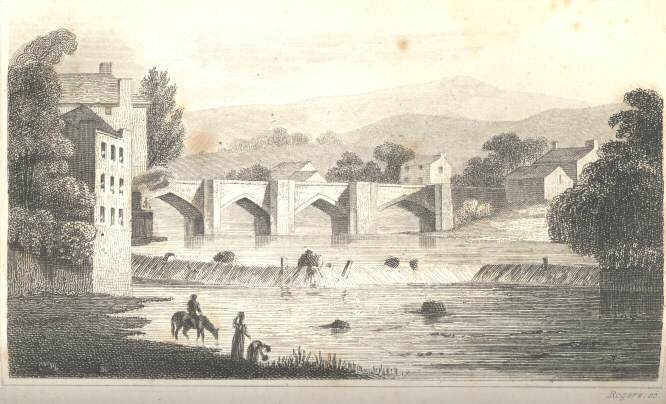
LLANGOLLEN, (Denbighshire.)
Chester 23
Chirk 7
Corwen 10
London 183
Oswestry 12
Ruabon 6
Ruthin 15
Wrexham 12
The name of this place is derived from the dedication of its church to an ancient British saint named Collen, whose lineage runs thus, in names almost unpronounceable by Saxon tongues—St. Collen ap Gwynnawg ap Clydawg ap Cowrda ap Caredog Freichfras ap Llyr Merim ap Einion Yrth ap Cunededd ap Wledig. The town, which is beautifully situated in a deep narrow valley, enclosed by lofty mountains, and watered by the noble stream of the Dee, appears anciently to have been protected by the neighbouring fortress of Castell Dinas Bran, situated on the summit of a vast conical hill in its neighbourhood. The houses are in general old or rather mean in appearance, though occasionally interspersed with some modern handsome dwellings; and there is excellent accommodation for the numerous visitors who frequent the neighbourhood during the summer season. The pure air and mild temperature cause a number of families to adopt this locality as a permanent retreat. The Hand, the King’s Head and Royal Hotel, are the two principal inns. Population, 1500.
Here is a stone bridge over the Dee, consisting of four pointed arches, erected in the year 1345, by John Trevor, Bishop of St. Asaph, and which was anciently regarded as one of the wonders of North Wales. The scenery of the neighbourhood is pre-eminent for its grandeur and sublimity, and for its picturesque and romantic beauty.
The church is an ancient structure, with small pretensions to architectural beauty, except some fine carvings on the roof and other parts of the interior. The view from the churchyard is remarkably pretty, embracing the bridge, the weir, and Crow Castle. The talented and self taught clerk, Mr. Jones, may be consulted by writers with profit, as a person of considerable attainments and general information. The church services are alternately in the Welsh and English language.
The market is held on Saturday, and is well supplied with butcher’s meat, but very little corn is sold. By the late act for amending the representation, Llangollen has been made a polling-place in the election of knights for the shire.
Llangollen Vale,
a district long celebrated in prose and verse for its varied beauties, is bounded on each side by lofty mountains of imposing grandeur. It is certainly a charming and romantic spot; and though not so grandly impressive, or so surpassingly beautiful as some of the other Welsh valleys, its lovely features become more attractive on a familiar acquaintance. A remarkable range of lime-stone hills, called the Eglwyseg Rocks, adds a singular variety to the landscape. It is almost needless to observe that “Llangollen, that sweetest of vales,” is the scene of the home of “Jenny Jones,” whose charms are sung in Charles Matthews’ popular ballad.—In this vale, and within a quarter of a mile from the town, stands
Plas Newydd,
the famed retreat of Lady Eleanor Butler and Miss Ponsonby, better known, probably, as the two recluses of Llangollen Vale. These two females, delighted with the scenery around Llangollen, when it was little known to the rest of the world, sought here, about the year 1778, a philosophical retirement from the frivolities of fashionable life, and selected and improved a dwelling that commands a fine mountain prospect, which obtained the name of Plâs Newydd. This elegant little cottage is situated on a small knoll, and surrounded by very tasteful grounds.
The peculiar style in which these ladies decorated their retreat has been much discussed. A palisade, ornamented with antique and grotesque figures carved in oak, enclosed the front; and the doors and windows were decorated with carving of the same material. The rooms were tastefully adorned with drawings. A carriage drive, open to strangers, crosses the lawn immediately in front of the cottage. Lady Eleanor Butler died June 2, 1829, at the advanced age of 90, and Miss Ponsonby, Dec. 9, 1831, aged 76: both were interred in the churchyard of Llangollen. To their memory is erected a monument of unique and elegant structure. It has three sides, on each of which there is an appropriate epitaph; one for Lady Eleanor Butler, another for Miss Ponsonby, and the other for their youthful servant, Mary Carrol, who had accompanied them from Ireland, the country of their birth, to this delightful retirement.
The whole property was consigned to the hammer in 1832, and was purchased by two other maiden ladies, viz. Miss Lolly and Miss Andrew, who seemed inclined to emulate the retirement of its former possessors.
There are many other genteel villas and country residences, within a convenient distance of the town, deserving of notice.
Castell Dinas Bran
is situated on a high and somewhat conical hill, about a mile from Llangollen. The building has been about a hundred yards long, and fifty in breadth; and it formerly occupied the whole crown of the mountain. From its extremely elevated situation (being about 910 feet above the surface of the Dee at Llangollen bridge), it must have been a place of vast strength. On the side which is most accessible, it was defended by trenches cut through the solid rock. The present remains consist of nothing more than a few shattered walls. There is a well of pure water on the top of the hill.
The views hence on every side are very grand. Towards the east stretches the whole vale of Llangollen, through which the Dee foams over its rocky bed; and beyond the vale is seen all the flat and highly cultivated country that extends for many miles. Just beneath lies the town of Llangollen, and towards the west is the vale of Crucis, with its back-ground of lofty mountains, whose dark sides are agreeably varied with wood and meadow. This fortress, from the style of its architecture, is evidently the work of the Britons; but by whom built, or when demolished, is a matter of mystery. Old Churchyard, who visited it in the sixteenth century, calls it “an old ruynous thing.”
Vale Crucis Abbey,
or, as it is called by the Welsh, Monachlog Llan Egwestl, about two miles from Llangollen, and one mile and a half from Castell Dinas Bran, on the right of the road towards Ruthin, is a grand and majestic ruin, affording some noble specimens of ancient Gothic architecture. There are still remaining of the church the east and west ends, and the south transept. Several pillars and arches also remain as interesting memorials of this exquisite relic of a past age.
The cloister on the south side, which a century ago, was only a shell, is now converted into a dwelling-house, the residence of the person who farms the adjacent lands. Three rows of groined arches, on single round pillars, support the dormitory, which is now a loft for containing corn, approached by steps from without. The area of the church is overgrown with tall ash trees, which hide from the sight some part of the ruin, but contribute greatly to its picturesque beauty.
Vale Crucis was a house of Cistercian monks, dedicated to the Virgin Mother. It was indebted for its foundation, about the year 1200, to Madoc ap Griffith Maelor, Lord of Bromfield and Dinas Brân, who, after various successes, and acquiring much booty by the reduction and ruin of English castles, dedicated a portion of his booty to the service of religion. He was interred here. At the dissolution the revenues appear to have amounted to about £200 per annum. A short time ago, the burial place of the monks was accidentally discovered, in the garden at the back of the farm-house, where many of their remains were found, which must have been there in an undisturbed state for six hundred years.
Pillar of Eliseg.
The Vale of Crucis is indebted for its name to this cross or pillar, which is to be found in a field near the abbey, and just opposite to the second mile-stone from Llangollen. This pillar is very ancient. The Rev. John Price, Bodleian librarian, (uncle of Dr. Price of Llangollen,) a great antiquary, wrote to Mr. Lloyd, of Trevor Hall, respecting this long neglected pillar, and at his suggestion it was placed in the position it now occupies. It appears to have been erected upwards of a thousand years ago, in memory of Eliseg (the father of Brochwel Yscythrog, Prince of Powys, who was slain at the battle of Chester in 607), by Concenn or Congen, his great grandson. The inscription is much defaced, so that it cannot be satisfactorily traced. The shaft was once above twelve feet long, but having been thrown down and broken, sometime during the civil wars, its upper part, only about eight feet in length, was left. After these commotions, it was suffered to lie neglected for more than a century.
Post Cysylltau, or Cysylltau Aqueduct.
From Llangollen, most tourists visit this stupendous work of art. It is a wonderful effort of ingenious contrivance, and affords a convincing proof of the incalculable capability of human energies when directed by science. This aqueduct was constructed for the purpose of conveying the Ellesmere canal over the river and vale of the Dee. It was commenced in 1795, from designs by Mr. Telford, and completed in ten years. Its direction is from north to south, crossing the Dee at right angles; and it forms, in connexion with the exquisite scenery surrounding it, a noble and magnificent picture. To view it to the best advantage, the stranger must descend on one side of it, into the valley beneath; he will then be impressed with its stupendous character. Though the aqueducts of the Romans were superior in length, in other respects they were inferior to this modern structure.
The tourist may proceed along the high road towards Chirk, four miles from the town, where a turning to the left will conduct him to Pont Cysylltau Aqueduct; or crossing the bridge at Llangollen, ascend the hill to the canal, and walk along its banks till he arrives at the aqueduct. The high road is preferable, as it commands some engaging prospects.
The aqueduct, in length 1007 feet, consists of nineteen arches, each 45 feet in the span, with the addition of 10 feet 6 inches of iron work in continuation at each end. The supporting piers are stone, of a pyramidal shape, measuring at the base 21 feet by 14 feet wide; but diminishing upwards to 12 feet by 7 at the top; and their height about 116 feet. Over this immense arcade is extended a trough, or large open caisson, made of cast iron, 11 feet 10 inches broad, by which the water of the canal is conveyed over the river 1009 feet to the opposite level. Two iron plates are screwed together from centre to centre of each arch; and along one side of the canal is a towing path, four feet in breadth, with a handsome iron balustrade, as a defence for man and horse. The elevation collectively will stand thus:—
Feet. Inches.
Height of piers 116 0
Depth of trough, or caisson 5 6
Height of balustrade 4 7
Total height from surface of the Dee 126 1
At the southern end is an embankment of earth, 1500 feet in length, and seventy-five feet in height nearest the abutment of the arches. The whole undertaking is said to have cost £47,069 : 6 : 7.
On the centre arch is the following inscription:—“The nobility and gentry of the adjacent counties, having united their efforts with the great commercial interest of this country, in creating an intercourse and union between England and North Wales, by a navigable communication of the three rivers, Severn, Dee, and Mersey, for the mutual benefit of agriculture and trade, caused the first stone of this aqueduct of Pont Cyssyllte to be laid on the 25th day of July, MDCCXCV, when Richard Myddelton, of Chirk, Esq., one of the original patrons of the Ellesmere canal, was Lord of the Manor, and in the reign of our Sovereign George the Third; when the equity of the laws and the security of property promoted the general welfare of the nation, while the arts and sciences flourished by his patronage, and the conduct of civil life was improved by his example.”
The antiquarian will find some interesting remains in this neighbourhood worthy of investigation. Amongst them is a square tower, very strongly built, in advance of and at the foot of the hill on which Crow Castle stands. For many years it has been appropriated as part of a farm-house, called ‘The Tower.’ The walls of the original building or tower are very thick; and in one corner of the quadrangle there is a winding stone staircase, now concealed by a bookcase. The probability is that this old tower was an advanced station belonging to the castle. There are also vestiges of a nunnery or monastery at a place called Pengwern.
About six miles from Llangollen, on the Ruthin road, is a curious old building, called Rhydidris, near Llandaglan. The site, the extensive stabling, and the antique curiosities in the house, raise the probability that it has been garrisoned, and also been a military station of great importance.
The Shrewsbury and Chester Railway Company intend to run a branch from their main line at Ruabon to Llangollen.
Angling Stations.
The Dee from Corwen to Llangollen.
“ “ from Llangollen to Overton.
LLANGYNOG, (Montgomeryshire.)
Bala 11
Llanfyllyn 7
Llanrhaiadr 6
Llangynog (the church of St. Cynog) is a small village, situated in a pleasing slip of fertile land, above which rises a stupendous rock of coarse slate. The river Tanat, which runs through this village, is celebrated for its delicious trout. The upper end of the vale is bounded by two vast precipices; between them juts out the rude promontory of Moel ddu Vawr. On the north side of this valley is the house of Llechwend-garth, the occasional residence of the late Thomas Thomas, Esq. of Downing, near Holywell, whose daughter married H. Davies Griffith, Esq. of Caer-Rhûn, Caernarvonshire, who, in consequence, became possessed of this estate, and was in 1835 high sheriff of the county of Montgomery. The new inn affords tolerable accommodations.
At Craig-y-Mwyn. somewhat more than two miles from the village, in 1692, a vein of lead ore was discovered, so valuable as to yield to the Powys family a clear revenue of at least £20,000 a year. It had been worked to the depth of about one hundred yards, when on a sudden the water broke in with such continuous power, that the proprietor was compelled to abandon the undertaking. About the commencement of the present century, however, the mine was leased by a company, who drove a level beneath it, in order to draw off the water, and continued the working of it for some time; they occasionally found masses of pure ore, weighing from 70 to 1001b. each. After some time the works were again discontinued, until a few years ago, when the old shaft was reopened, and the operations proceeded with considerable success.
At Craig-y-Gribin, in this parish, are some quarries of excellent blue slate, of strong and durable quality.
LLANHAIARN, (Caernarvonshire.)
Caernarvon 13
Pwllheli 7
This is a small village, situated near the west coast of the promontory of Lleyn. Its church, standing on an eminence, forms a good land-mark.—Between this place and the sea, the lofty range of the Rival (or Yr Eifl) Mountains, which form conspicuous objects from Caernarvon and other parts of the country. Upon the first of these eminences, about a mile from Llanhaiarn, is Tre ’r Caeri (or the Town of Fortresses), which Mr. Pennant describes as “the most perfect and magnificent, as well as the most artfully constructed British post he ever behold.” The only accessible side was defended by three walls, which appear to have been very lofty. The area is irregularly shaped, and near the centre is a square space surrounded by the fragments of habitations.
LLANIDAN, (Anglesea.)
Caernarvon 3
Llanedwen 2
Menai Bridge 6
Plas Newydd 3
Llanidan is a little village, near the shores of the Menai, not far from the spot where the Romans landed, headed by Suetonius Paulinus, who murdered the Britons by thousands. It is called, by Rowlands, Maes Mawr Gad (the Great Army’s Field). It lies three hundred yards from the Menai, and consists of about twenty acres. The Romans entered the water about two hundred yards south of Llanfair-is-caer church, where the shore is flat, the water shallow, and only three quarters of a mile wide. At low water, and at neap tide, most of the bed is dry.
After the death of Nero, in the year 67, the natives, after six years of thraldom, threw off the Roman yoke, the Druids returned and assumed their authority and property, which they held till the year 76; when Agricola crossed the Menai, nearly a mile farther north, landed at a field yet called Pont or Pant-yr-Yscraffiau (Bridge of Boats), where the same tragedy was re-acted in this and the two adjoining fields.
The locality abounds with an interesting variety of druidical remains. Lord Boston has a residence and a park here: the house is a clumsy building, but the situation is most pleasant.
LLANIDLOES, (Montgomeryshire.)
Aberystwyth 30
Devil’s Bridge 19
London 193
Machynlleth 20
Newtown 14
Plinlimmon 7
Llanidloes (the Church of St. Idloes) is pleasantly situated near the Severn. The population of the whole parish is 4261, including 2562 inhabitants of the town, who are principally employed in spinning and weaving of flannels, the manufacture of which has been established in this town from a very early period, and has continued materially to increase; the softest and most durable texture is made here. The principal inn is the New Inn, an excellent and well conducted establishment, where post-chaises and other vehicles may be had; the Queen’s Head, Red Lion, and the Crown, are also respectable houses, where travellers may be well accommodated. By the late Reform Act, this town was made one of the contributory boroughs of the county.
The church was originally founded towards the close of the fifth or at the beginning of the sixth century. Of the original building the towers only remain. The present structure was built about 200 years ago. In 1816, the chancel and south wall were rebuilt; at the same time the church was renewed; and a set of new bells was hung in the tower in 1824. As is usual in all the Welsh towns, there are places of worship for various dissenting congregations. The market-day is on Saturday.
A few years ago, a handsome stone bridge of three arches was erected over the Severn, at a considerable expense; and a new and excellent line of road was opened from hence to Rhaiadr, which makes a direct and regular communication between North and South Wales. Lord Mostyn is lord of the manor; a court leet is held once a year, at Michaelmas, when officers are appointed, in whom the government of the place is vested. In the vicinity of the town are several handsome residences, the property of opulent individuals.
Within eight miles of Llanidloes, in the parish of Llanbrynmair, are two fine waterfalls, near to each other, of which the principal, called Ffrwd Vawr, is very grand, especially after heavy rains; the water having a perpendicular descent of more than one hundred and thirty feet.
Plinlimmon.
Within the limits of Llanidloes parish is partly included the lofty mountain of Plinlimmon, (or, more properly, Plumlumon, the five-peaked mountain) which is the highest in the several chains, of which it forms the centre: and from this place the ascent to its summit is usually made, being only seven miles distant from the town, whence guides from the principal inns are provided. From the highest point is obtained a fine prospect of vast extent, comprehending on the south, the hills of Cardiganshire and Radnorshire; on the west, Cardigan bay and St. George’s channel; on the north, Cader Idris and part of the Snowdon range of mountains, separating the counties of Caernarvon and Merioneth; on the north-east, the Breiddyn hills, in Montgomeryshire; and on the east, part of the counties of Hereford and Salop. This mountain derives a considerable degree of interest from its giving rise to the rivers Severn, Wye, Rheidiol, and Llyvn-nant; of which the former is secondary only to the Thames in commercial importance; whilst the Wye and the Rheidiol surpass all other rivers in Britain for the picturesque beauty of their scenery.
The Severn, here called by its ancient British name of Havren, rises on the northern side of the mountain, in a stony chalybeate spring, and is speedily joined and increased by other springs rising near to its source, and by several mountain torrents, before it reaches Llanidloes.
The Wye rises from two powerful springs on the south-eastern side of the mountain, and after a long circuitous course, falls into the Severn near Chepstow.
The Rheidiol has its source in a pool called Llyn Llygad Rheidiol, and falls into the sea at Aberystwyth.
The Llyvn-nant issues from a pool called Glâs Llyn.
About twenty years ago, Llyn Llygad was entirely without fish. Two gentlemen, one of whom was the late Captain Jones, R.N., of Machynlleth, were grousing on Plinlimmon, when the conversation turned on the peculiarity of this lake being entirely destitute of the finny tribe, and the possibility of stocking it from a neighbouring rivulet. A staff net was procured, and some dozens of small trout caught in the river Rheidiol were thrown into the lake, which at that time swarmed with millions of horse leeches. Some of the trout, when placed in the pool, lay upon their sides faint and exhausted: and strange as it may appear, the rapacious leeches attached themselves to the sick fish, and actually devoured them. Others of the trout were vigorous; these and their progeny have enforced the lex talionis with a vengeance; and while the fish abound, not a leech is now to be seen.
At Melin Velindre, on the route to Plinlimmon, is a romantic cataract, and near a sheep farm, called Blaen Havren, the Severn rolls its waters over a lofty ledge of slate rocks, in which gullies have been found of picturesque shapes.
About two miles from the town, on the south-east, is a spacious pool, called Llyn-ebyr, extending over a surface of nearly one hundred acres; it abounds with pike, eels, and perch, and affords excellent fishing; it is frequented by wild fowl; and during the summer season it is the resort of parties of pleasure, for whose accommodation boats belonging to gentlemen in the vicinity are kept on the pool.
Angling Stations.
Distance from Llanidloes. Miles.
The Clywedog
Bodaioch, on the Tavannon 5
Glan Trevnant 5
Llandinam 6½
Llangurig 5
LLANRHAIADR, (Denbighshire.)
Denbigh 4
Ruthin 4
Llanrhaiadr (the Village of the Cataract), on the road between Ruthin and Denbigh, is situated on a small eminence in the fertile vale of Clwyd. It derives its name from a spring at a short distance, called Ffynnon Ddyfrog, where once was a bath and chapel, dedicated to St. Ddyfrog.
The church is a very interesting and handsome structure. On the east window is a painting of the genealogy of Christ from Jesse, executed about 1533. In the church-yard is a curious inscription to John ap Robert, whose pedigree is traced up to Cadell, king of Powys.
The scenery, both to Denbigh and Ruthin, is all the way extremely beautiful.
LLANRHAIADR-YN-MOCHNANT, (Denbighshire.)
Bala 18
Llanfyllyn 5
Llangynog 6
Oswestry 14
This is a small village situated at the extremity of the county, in a deep hollow, surrounded by mountains.
Dr. William Morgan, the first translator of the Bible into Welsh, was vicar of this place. He was promoted to the bishopric of Llandaff, and in 1601 to that of St. Asaph, where he died in 1604. This valley is called Mochnant, (the Vale of the Rapid Brook) at the extremity of which, distant from the village about four miles and a half, is
Pistyll Rhaiadr,
(The Spout of the Cataract) reputed to be the largest waterfall in Wales. The little river Rhaiadr here falls down an almost perpendicular black crag, of 240 feet in height. For about two-thirds of this space, the water slides down the flat face of a naked rock; it rages thence through a natural arch, and, passing between two prominent sides, falls into a basin. It then passes though a well-wooded dell, forming a boundary line which separates the counties of Denbigh and Montgomery, and after assisting to form some pretty scenes, falls into the Tanat. Near to the waterfall is a neat inn, built in the Gothic style, by Sir W. W. Wynn, where the stranger may meet with tolerable accommodation.
LLANRWST, (Denbighshire.)
Abergele 22
Bettws-y-Coed 4
Cerniogau 14
Capel Curig 10
Conway 12
Denbigh 22
Llanrhychwyn 2½
London 218
Maen-Twrog 20
This town is pleasantly situated on the western bank of the river Conway, which here forms the boundary between the counties of Denbigh and Caernarvon, in the spacious and beautiful vale of Llanrwst, environed by majestic and well-wooded hills, the land at the foot of which is plentifully watered and remarkably fertile. The town consists principally of small houses and shops, with a population of 3905 inhabitants. It has a market on Tuesday, and a branch of the North and South Wales bank. The Eagles is the principal inn; but a good house of public entertainment is sadly wanted here.
The bridge over the Conway, leading to Gwydir, is an elegant structure, built about the year 1636, from a plan by the celebrated Inigo Jones, at an expense of £1000, defrayed conjointly by the two counties which it connects. It is an extraordinary fact that a vibration of the bridge may be caused by any person standing above the middle arch and forcing himself rather smartly against the parapet.—Excellent roads have lately been made, communicating with the London, Holyhead, and Chester roads, and also with Denbigh and St. Asaph, the improved state of which has induced a considerable increase of visitors, during the summer months, to view the picturesque and much admired scenery of this neighbourhood.
Llanrwst was formerly noted for making harps; at present the spinning of woollen yarn, and the knitting of stockings, constitute the principal branches of trade. In the market-place stands the town-hall, a substantial structure, rebuilt in 1842.
The original church, dedicated to St. Grwst, was a small edifice, situated close to the margin of the river, and built about the year 1170; and was supposed, from its style of architecture, to have been erected in the fifteenth century: it contained a screen of beautifully carved oak, brought here from the abbey of Maenan, which was used as a gallery for the singers. A new church has, however, been built on its site; and adjoining it, on the other side, is Gwydir chapel, a handsome square castellated edifice, the interior of which is decorated with a profusion of carved work; it was built by Sir Richard Wynne, from a design by Inigo Jones, in 1633, as a burial place for his family, the deceased members of which had previously been interred in the chancel, and contains many elegantly engraved brasses, exhibiting portraits of several of this family. On the eastern wall is a slab of white marble, recording the pedigree of the founder, and tracing his ancestors to Owen Gwynedd, prince of North Wales. On the southern wall is a mutilated monument to the memory of Sir John Wynne, Bart., a learned antiquary, and an indefatigable gleaner of materials for the illustration of Welsh history. In the centre of the chapel, upon the floor, lies the stone coffin of Llywelyn the Great, who died in 1240, and was interred in the abbey which he had founded at Aberconway, thence removed to Maenan, and from that place, at the dissolution, the coffin was brought to the old parish church of Llanrwst, where it remained obscured by rubbish, until placed in its present more appropriate situation. The same attention has likewise been paid to another piece of antiquity placed near it, a recumbent armed effigy of Howel Coetmor, grandson of Davydd, brother to Llywelyn ap Gruffydd; he was the owner of the Gwydir estate, which was sold by one of his descendants to the family of Wynne. There are in the parish eleven places of worship for dissenters. A new church, called by the inhabitants the English church, has lately been erected about half a mile from Llanrwst. It is a neat and commodious edifice.
Gwydir.
This ancient mansion, about half a mile distant from the town, beautifully situated amidst extensive woods of oak, which clothe the rocks projecting between the rivers Conway and Llugwy, near the foot of a lofty precipice called Carreg y Gwalch, or the Rock of the Falcon, was erected by John Wynne ab Meredydd, in 1555, and comprised an extensive, but somewhat irregular pile of buildings, ranged in a quadrangular style, and consisting of an inner and outer court. A great part of this edifice was taken down in 1816, since which time the present structure, though on a much smaller scale, has been built. A small portion of the former mansion still remains, and is fitted up in an antique and elegant style. That part which was built by Meredydd still remains, and contains some magnificent rooms, in which are several articles of furniture made from the druidical oaks of ancient times, and the cradle which nurtured Sir John and Sir Richard Wynne is still to be seen. The pleasure grounds are laid out with great taste, and contain a good collection of plants. Mary Wynne, afterwards Duchess of Ancaster, the last of this great race, conveyed the property to that family, and Lord Willoughby d’Eresby now possesses it in right of his lady.
Vale of Llanrwst.
This delightful vale, which is neither so widely extended as the Vale of Clwyd, nor so contracted as that of Llangollen, is regarded by the admirers of picturesque scenery, as exhibiting the most varied assemblage of beautiful features which the pencil could delineate. Mr. Burke has pronounced it “the most charming spot in Wales.” The prospect of the dense woods and towering hills which enclose it on each side, is enlivened by the sparkling waters of the sportive Conway, which present an animated scene, either of small vessels arriving at the village of Trefriw, or of the diminutive boats, called coracles, used in fishing for salmon and smelts, considerable quantities of which are caught in their respective seasons. At Mayne, within a mile of Llanrwst, is a spring of high repute, and frequently used with great effect as a cold bath.
In the valley called Nant Bwlch yr Haiarn, near Gwydir, is a cataract which falls about 100 feet, called Rhaiadr-y-Parc Mawr. The quantity of water, however, is seldom large enough to produce much effect. About two miles and a half from Llanrwst, on the Conway road, is the small but beautiful village of
Trefriw,
situated on an eminence commanding a delightful and extensive view of the Vale of Llanrwst. Near and above this lovely spot is the celebrated lake of Geirionydd, on the banks of which lived the illustrious bard Taliesin, called by his countrymen, by way of distinction, “Taliesin ben Beirdd,” the chief of the bards. About a mile from Llyn Geirionydd is the mountain village of Llanrhychwyn. Lord Willoughby d’Eresby has erected a monument which his lordship intended should identify the spot where the poet resided. Here, in a sort of hollow, formed on the summit of a mound, are still to be seen some remains of an ancient habitation. The river Conway is navigable from its mouth to Trefriw, for vessels of 60 tons burden, which bring coal, lime, timber, and grocery, for the supply of the inhabitants of the town and neighbourhood, and carry back the produce of the slate quarries and mines of the adjoining parishes. Five miles S. E. of Llanrwst, is
Gwytherin,
a small village, very poor and primitive indeed, once celebrated as the burial place of St. Winefred, but the pilgrimages to it are now few and far between.—Three miles to the north stood the Abbey of Maenan; but a large old house built out of its ruins now occupies its place.
Angling Stations.
Distance from Llanrwst. Miles.
Bettws-y-Coed 5
Trefriw 2½
Dolgarrog 4
Llanbedr 5
Dolwyddelan 8
Various Lakes near Llanrhychwyn and Dôlgarrog, viz.
Llyn Geirionydd 4
Llyn Bogynmyd 3
Llyn Cowlyd 6
Llyn Afangc.
Llyn Tal-y-llyn, and Llyn Crafnant, near Llanrwst.
MACHYNLLETH, (Montgomeryshire.)
Aberdovey 10
Aberystwyth 18
Chester 70
Dolgelley 16
Llanidloes 20
London 208
Newtown 28
Towyn 14
Machynlleth is an ancient well-built town, superior to most in North Wales for cleanliness and respectability, the streets being remarkably spacious and regular in appearance. It is situated on the road leading to Aberystwyth from Shrewsbury and North Wales, about a quarter of a mile from the southern bank of the river Dyfi. The township contains a population of 2482. It is the centre of the woollen manufactory in this part of the country, where also some tanning business is carried on. The Eagles is accounted the principal inn, and the Unicorn Arms, in the middle of the town, has obtained a good repute for excellent accommodation. The name of this town signifies the place of the river Cynllaeth, which was the ancient name of the Dyfi or Dovey, in the valley of which it stands. It is the supposed Maglana of the Romans, where, in the reign of Honorius, a lieutenant was stationed to awe the mountaineers.
Here Owen Glyndwr summoned the nobility and gentry, of Wales in 1402. Amongst the number, Sir David Gam attended with the design of murdering Glyndwr, but the plot was discovered, and Sir David was seized. He would have suffered instantaneous death, had not some powerful friends interfered, through whose intercession his sentence was mitigated to confinement at Machynlleth, where he continued some time. But Sir David was scarcely set at liberty, ere he began to manifest a turbulent disposition; which so exasperated Glyndwr, that he burnt his house in resentment, uttering to Gam’s servant the following extemporaneous stanza:—
Os gweli di wr coch cam, Yn ’mofyn am Gyrnigwen; Dywed ei bod hi tan y lan, A nod y glo ar ei phen.
David, however, escaped this meditated vengeance by flying into England, where he continued in favour at the court of Henry the Fifth.
In the august assembly called Owen’s parliament, Glyndwr exerted his first acts of royalty, being then acknowledged as the Prince of Wales, and proclaimed and crowned.
Machynlleth has a neat and commodious church, which has recently been rebuilt. The town-hall or market-house was erected in 1783, by Sir W. W. Wynn, grandfather of the present owner of Wynnstay, who is lord of the manor, and holds courts leet twice in the year. The county court is held alternately here and at Montgomery, and the petty sessions for the hundred are held here occasionally. There are places of worship for Independents, Calvinists, and Wesleyan Methodists; and a national school liberally endowed.
The new line of road from Machynlleth to Towyn is exceedingly picturesque and beautiful, particularly that part of it lying between Penal and Aberdovey, which is cut out of the solid rock, and was opened in 1827; it passes along the northern bank of the Dovey, and affords most delightful views of the opposite coast of Cardiganshire, with the sea in the distance.
MAEN-TWROG (Merionethshire.)
Bala 22
Bedd-gelert 10
Capel Curig 22
Caernarvon 23
Dolgelley 18
Ffestiniog 3
Harlech 10
Slate Quarries 5
Tan-y-Bwlch 0¼
Tremadoc 10
The Cataracts 2
This is a small village, situated in the most romantic part of the highly picturesque vale of Ffestiniog, on the southern bank of the river Dwyryd. It derives its name from a large stone, still remaining in the church-yard, called Maen-Twrog, erected to the memory of a British saint, who died about the year 610. The church was rebuilt on the site of the ancient structure in 1814, and is a neat stone edifice with a square embattled tower. The Rev. Edmund Prys, Archdeacon of Merioneth, one of the most eminent poets of his time, was rector of this parish: he translated the metrical psalms used in the Welsh churches, and assisted Bishop Morgan in translating the Bible. He died in the year 1623, and was buried in Maen-Twrog church. Nothing can exceed the beauties of the little vale in which the village is built; the well-wooded hills are moderately high, and scattered with pleasing effect.
There is a comfortable inn here, where neat cars may be had. A Sunday school was lately erected, at the expense of Mrs. Oakley. Within sight of the village, and about a quarter of a mile distant, on the opposite side of the river, is
Tan-y-Bwlch,
that is, Below the Pass, which is one of the most beautiful and celebrated places connected with the range of Snowdonian mountains. It takes its name from being situated at the brow of a hill, where it overlooks the vale of Ffestiniog; and from Plâs Tan-y-Bwlch, the residence of the late W. G. Oakley, Esq., which is delightfully and romantically situated. The prospect from the terrace of this mansion is most splendid and interesting, embracing the glorious scenery of the vale of Ffestiniog, the river Dwyryd in all its meandering windings, the range of Merionethshire mountains in the distance, the majestic castle of Harlech, and the lake-like intervening views opening into Cardigan bay.
The Oakley Arms, an elegant hotel, is conveniently situated in the centre of the many attractive objects of this romantic district.
Several Roman antiquities have lately been found near this place, consisting of coins, urns, and inscribed stones, some of which are in the possession of Mrs. Oakley, and of J. Lloyd, Esq. of Pen-y-Glanau, who has also an extensive collection of antiquities, found in different parts of the Principality.
About two miles on the Harlech road, up a woody valley, are two most interesting waterfalls, on the Velin-Rhyd river, one called the Rhaiadr Dû, or the Black Cataract, and the other the Raven Fall. From the former the water rushes down a steep channel for about one hundred yards, and is thence thrown with great force over three rocks, each of which takes a different direction from the others: the depth of the fall is about forty feet. The latter is not more than a quarter of a mile distant, and in equal in beauty and grandeur. It consists of six different falls, each of which, about thirty feet in extent, is beautifully picturesque, and, as seen from the base of the rock over which the river descends, has a sublime and romantic appearance. There are also several other falls of minor interest on the streams that water the vale. At a cottage near the bridge, which the tourist will cross before he leaves the main road from Maen-Twrog, a guide to the falls may be obtained.
After the natural beauties of this lovely district, the object of the greatest attraction is the Ffestiniog railroad, for the conveyance of slates from the Ffestiniog quarries to Port Madoc, which is cut through rocks nearly the whole length of fourteen miles, and forms an inclined plane the whole distance, the fall of which is equal to one in one hundred and twenty, and the descent from its commencement to its termination is a most delightful ride, through an infinite variety of sublime and interesting scenery. For the accommodation of tourists and visitors, a carriage, connected with the Oakley Arms Hotel, has been placed on the line.
The quarries with which the railway is in connexion produce the best and most valuable kind of slate. They belong to Lords Newborough, Palmerston, and Powlett; Mrs. Oakley; S. Holland, J. Greaves, W. Turner, and Thomas Casson, Esquires.
MALLWYD. (Montgomeryshire.)
Bala 19
Can-Office 12
Dinas Mowddwy 1½
Machynlleth 12
This is a little village, placed between the salient angles of three abrupt mountains, Arran, Camlan, and Moel Dyfi, in a small valley surrounded by many delightful scenes, through which runs the river Dyfi, or Dovey.
The falls of the Dovey at Pont Fallwyd, about half a mile distant, are particularly romantic and beautiful.
The church is a very humble Gothic structure. The churchyard is remarkable for several large yew trees, one of which measures twenty-two feet in girth, and forty feet in height.—Mallwyd has a good inn, where post chaises may be procured.
MOLD, (Flintshire.)
Chester 12
Denbigh 16
Flint 6
Hawarden 6
Holywell 10
London 200
Northop 3
Ruthin 10
Wrexham 11
The ancient British name of this place, (Yr Wyddgrûg), signifying a Lofty and Conspicuous Hill, and also the Roman name of Mont Altus, of like import, were derived from a high mound on the north-western side of the present town, now called the Bailey Hill, a commanding eminence, partly natural, and partly artificial, upon which a fortification appears to have been erected at a very early period, but whether by the ancient Britons, or by the Romans, is not accurately known. It is seated in a pleasant valley, watered by the river Alyn; consists principally of one long spacious street; and in 1841, with that part of the township immediately adjoining, contained 10,653 inhabitants. By the late Act for amending the representation, Mold has been constituted a borough, contributory with Flint and the other boroughs in the county, in the return of a member to Parliament.
In the environs are numerous handsome seats and elegant mansions. The principal inns are the Black Lion and Leeswood Arms hotels. To the former a spacious assembly room has lately been added, and many agreeable balls are there given. The parish abounds with mineral wealth; the western district is rich in lead ore, which is generally found imbedded in limestone, or chirtz; but the operations are much impeded by the subterraneous stream of the Alyn, which here flows under ground for the space of upwards of half a mile. Numerous tumuli are found in various parts of the parish. In October 1833, some workmen, digging in a field near the town, discovered a human skeleton, having at its feet an earthern pot, which apparently contained ashes; and on the breast, with other metal, a large plate of gold, much ornamented, valued at the sum of £70: the trustees of the British Museum became the purchasers of these antique relics.
In the neighbourhood are various works for smelting lead, and an extensive cotton mill.
The county assizes are held in Mold. A new county hall has been erected in the old English style of architecture, from a design by Thomas Jones, Esq., architect, of Chester.
The church, dedicated to St. Mary, and said to have been erected in the early part of the sixteenth century, is a spacious and handsome structure, consisting of a nave, north and south aisles, and a chancel, with a lofty square embattled tower, enriched with sculpture and crowned with pinnacles, which though of more recent erection, precisely correspond with the general design. The interior of the church is embellished with architectural details and sculptured monuments. Among numerous monuments worthy of examination, is an elegant one to the memory of Richard Davies, Esq., of Llanerch; and against a pillar of the nave is this singular epitaph, composed by Dr. Wynne for himself, and placed there during his life:—“In conformity to ancient usage, from a proper regard to decency, and a concern for the health of his fellow-creatures, he was moved to give particular directions for being buried in the adjoining churchyard, and not in the church; and as he scorned flattering of others while living, he has taken care to prevent being flattered by others when dead, by causing this small memorial to be set up in his lifetime: God be merciful to me a sinner!” In the burial ground are deposited the remains of Wilson, the celebrated painter, styled “the English Claude.” There are places of worship for various denominations of dissenters. A branch railway from Mold, to form a junction with the Shrewsbury and Holyhead lines, at Saltney, near Chester, will soon be constructed.