RECONSTRUCTION AND INTERPRETATION
Reading edition
Culture Complex A
The authors believe culture Complex A is related to what has been termed the Fremont Culture of western Colorado and eastern Utah. Complex A appears to manifest itself between the surface (the erosional surface below a cow dung layer) and 44-48 inches below baseline. Complex A and the Fremont culture have a number of similarities. Foremost among these is pottery. All the plainware found is assignable to this complex. Although the total number of sherds is not large, one restorable vessel is represented. In shape, method of manufacture, temper, paste, color, and firing, this specimen approximated Wormington’s Turner Grey Variety II (Wormington, 1955). There are two points of difference between this and classic Fremont ceramics. First, it is a bowl, while most Fremont vessels are handled jugs. This is offset by the possibility that a second large sherd does come from a small pot or jug. Also Wormington (1955) and Taylor (1957) note the presence of bowl-forms at their sites. Second, much Fremont pottery is calcite tempered (Burgh and Scoggin, 1948; Wormington, 1955). However, Gunnerson (1956) has recently shown that choice of temper for the Fremont Culture is more a function of locality than of cultural preference.
A second correlation is found in the gaming pieces assignable to Complex A. The three decorated pieces illustrated are almost duplicated in some of Wormington’s illustrations and descriptions. Similar items have had a long history in the Southwest (Morris and Burgh, 1954).
Third, there is a similarity between class bb projectile points and certain Fremont points, particularly at Castle Park (Lister, 1951). Features include concavity of the edges, general narrowness, straight short bases, and frequent serrations. One of the points of Complex A is made on a curved flake, chipped only on one face. This is a rather distinctive type occurring also in Fremont sites. Wormington (1955), found some peculiar asymmetrical points like Fig. 27. She found no evidence of utilization as knives which their shape suggests.
The presence of dent corn, similar to that grown in Fremont localities is significant in indicating similarities in the ecologic orientation of the two groups.
Other artifacts included in the levels of Complex A are: Leaf-shaped and triangular knives, side, discoidal and serrated scrapers, expanding base drills, perforators, prismatic flakes?, 1 graver, small ovoid bifaces, utilized flakes, choppers/hammerstones, paint stones, splinter, sliver and headed awls, rib or scapulae knives, antler flakers, tubular beads, 1 tooth ornament, leather fragments, 1 wood arrow shaft, handstones and grinding slabs. End scrapers, perforators, prismatic flakes, small ovoid bifaces, sliver awls, perhaps antler flakers, and the tooth ornament are either extremely uncommon or absent at Fremont sites. These artifacts may be associated with culture Complex B. None are confined to the interval between the surface and 44-48 inches below baseline. Evidently they were present before the occupation of the site by people of Complex A.
A word of caution is in order. Relatively speaking there are few artifact types assignable to Complex A. Pottery is especially scarce. However, projectile points of the type believed to be associated with it make up at least 40 percent of the total in the 44″-surface levels. We have tentatively identified it with the Fremont Culture on the basis of the evidence above. However, since so many distinctive traits of this culture are in the realms of architecture and perishable goods, we are necessarily dealing with a partial inventory. Without such features we can suggest but cannot prove.
One item of interest is the evidence that the Fremont people did reach eastern Colorado or at least trade with people of that area. A rather spectacular headband found in Castle Park (Burgh and Scoggin, 1948), was made from the feathers of a yellow flicker (Colaptes anratus luteus) which occurs only east of the mountains.
Cultural Reconstruction
Since Complex A largely overlapped B, cultural reconstruction will have to be considered in the light of evidence from sites affiliated with it. This reconstruction will be based however, on evidence from LoDaisKa.
The economic life of the people probably revolved mainly about hunting and gathering. Animals hunted included birds, prairie dog, chipmunk, bighorn sheep, bison, and above all deer. The large number of projectile points attests to the importance of hunting. Gathering placed an emphasis on plum, acorn, and grass seeds such as Muhlenbergia. Corn also appears to have been grown. Characteristics of preservation have precluded the possibility of determining its importance in the diet of the people. One bone of the genus Canis was found. This may represent coyote or dog. Wormington (1955) found a bone of genus Canis which also could have been from a domestic dog. Since dogs were known in the Southwest from Basketmaker times, this is not an impossibility (Kidder and Guernsey, 1931). Pieces of leather suggest that this was used for clothing. There were also beads attesting to ornamentation. Necklaces and elaborate dress were characteristic of the Fremont people, as revealed by petroglyphs and various discoveries of clothing.
Amusement, or at least recreation, is indicated by the presence of gaming pieces. Considering the care used in making one of these objects they must have been fairly important in the cultural pattern. Great Basin people were often inveterate gamblers (Steward, 1940). Wormington (1955) has recorded a Cheyenne woman’s description of a game played with bone gaming pieces.
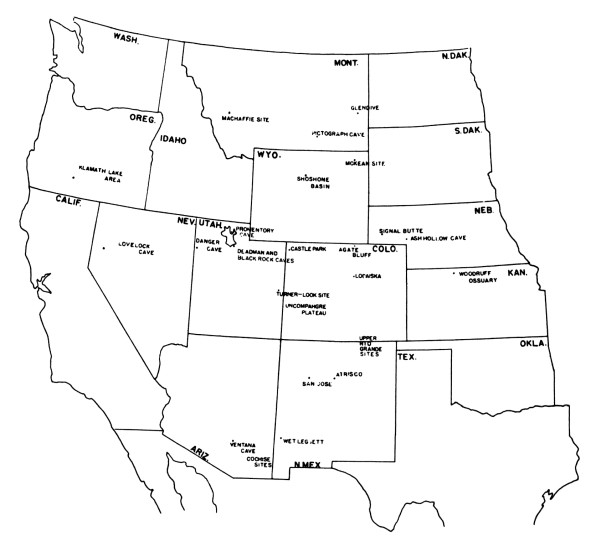
FIGURE 74— LOCATION OF PRINCIPAL SITES AND LOCALITIES REFERRED TO IN THE TEXT.
People of this complex appear to have been rather skilled in stone working. Chipped projectile points are usually executed with care, often achieving slender finely flaked forms. It is interesting to note that stone scrapers were apparently little used by Fremont people. Perhaps hides were prepared in other ways. Baskets were undoubtedly made and were probably important. The awls found can attest either to sewing or basket-making; the long slender awls would have been especially suited for the latter. Tubular beads were made by a process widespread in the West: incising and splitting. Pottery was roughly made and fairly thick, but not more so than some of Wormington’s (average thickness 5 mm.). Pottery of this rougher type is widespread in northern Fremont locales.
Concerning the possible socio-political situation some conjecture can be recorded. First, as Wormington (1955) pointed out, using data from Murdock (1949), “hunting is normally a male activity and it seems probable that agricultural pursuits were left to the women, and the corn plots may have belonged to them. The inheritance of corn plots by women may have served to unite nuclear families into extended families with matrilineal descent and matri-local residence. However, emphasis on hunting and possible warfare would tend to enhance the status of men and descent may have been bilateral or patrilineal.” For Complex A the latter would be especially important if the absence of quantities of pottery indicates less emphasis on agriculture and more on hunting. Certainly, however, the wild foods at both the LoDaisKa Site and in Castle Park show the continued importance of gathering activities usually associated with women.
Culture Complex B
The culture complex represented between roughly 24 and 53 inches below baseline appears to be a manifestation of the Woodland Culture, Orleans Aspect. The authors excavated several single component sites of this manifestation in the area (Irwin and Irwin, n.d.). The following artifacts, occurring in these sites and also in this depth range at LoDaisKa, appear characteristic of the culture: cordmarked pottery, corner-notched projectile points similar to those in Fig. 75, end scrapers, drills, small ovoid knives, spoke-shaves, awls (splinter or extremely small sliver types), large hafted “knives.” Large projectile types could have been used with a spear-thrower. There are also tubular beads, small stone triangles (possibly gaming pieces), 1 shaft-smoother, handstones and milling slabs. One decayed corn cob was found at 53-57 inches and may belong to the Woodland levels at LoDaisKa. This was a popcorn (see above). Dent corn has been found at other Woodland sites in the Morrison area (Irwin and Irwin, n.d.). Especially characteristic of this occupation was the pottery, small ovoid knives, and sliver awls.
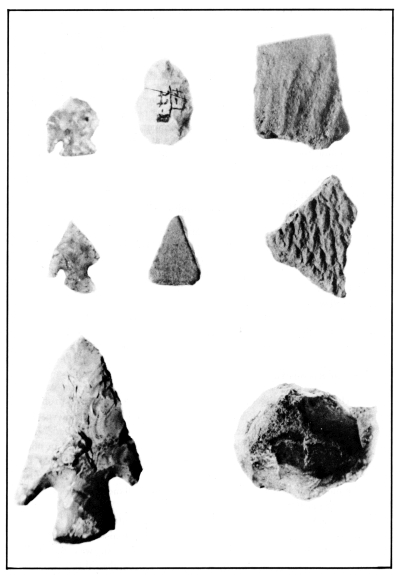
Figure 75— Artifacts from single component Woodland sites in the Morrison area. Actual size.
Establishing a closer affiliation is more difficult. In essence, much of the material resembles that of Ash Hollow focus established in Western Nebraska and Northern Colorado (Kivett, 1952a; Irwin and Irwin, 1957). Specifically, pottery of Class I is similar in composition, cord application, thickness, rim styles, and absence of decoration. However, Class II has several features reminiscent of the Keith focus pottery (Kivett, 1952b) being a thicker ware with a more granular structure. However, the Harlan cord-roughened pottery, assigned by Kivett to the Keith focus, is calcite tempered and has no diagonal cord-marking. Kivett has pointed out that clastics may have been used in areas where calcite does not occur, or more desirable temper is at hand. The absence of side-notched points in Woodland levels at LoDaisKa contrasts with Ash Hollow focus sites where 30% are usually of this variety. This constitutes another similarity to Keith focus sites, such as the Woodruff Ossuary, where such forms do not occur. Class III pottery is not present in Plains Woodland sites. It may be a local variation since it is similar to II in all but cord application.
In connection with this complex, there is a C 14 date for Keith materials of 611 ± 240 A.D. (Wedel and Kivett, 1956). For Ash Hollow Cave tree ring estimates (Champe, 1946) place occupation at 1000-1150 A.D. However, a carbon sample from Woodland materials in the Denver area yielded a date of 800 ± 150 A.D. (Hunt, 1954). Ash Hollow Focus materials appear to share traits with both Valley (Hill and Kivett, 1940, Kivett 1952a, 1952b and Keith Foci). The authors feel the manifestation at Morrison is basically similar to Ash Hollow but with a few more traits in common with the Keith Focus.
Cultural Reconstruction
The economic life of the people of culture Complex B probably revolved around hunting, limited agriculture, and gathering of specific foods, mainly plums and acorns. Foods were ground on milling slabs with handstones and perhaps, as with the Pawnee, were cooked in pots, or made into cakes fried on a hot slab. Agriculture is indicated by remains of corn at LoDaisKa and at nearby sites of the same culture. In the more classic manifestations of Plains Woodland Culture evidence is slim. Squash remains occurred at Sterns Creek (Strong, 1935) and popcorn at the Lawson Site (Kivett, 1952a). Wedel (1934) felt corn could not grow west of the 99th meridian in prehistoric times. For the Upper Republican Culture an example of corn was found in northern Colorado by the authors, (1957). In the Morrison area several occurrences were noted (see above) in connection with the Woodland Culture.
Animals hunted were mainly deer and bison, with smaller animals such as prairie dogs, gophers and birds also represented. Perhaps the importance of bison at the site is misrepresented because in dealing with such large animals it is possible that only the meat was brought into camp (for an example of this see Clark, 1952).
Clothing was probably of skin. Numerous scrapers attest to the importance of hide dressing. Tubular beads and a tooth pendant provide evidence of interest in self-ornamentation. Paint stones may have served for pigment. Mixed with grease this could have been used for bodily decoration, though ethnologic parallels suggest other objects were also painted (see above).
A considerable amount of skill in stone working must have been necessary to produce the small delicate projectile points, presumably used with arrows. Some much larger points suggest a continued dependence on the spear or spear-thrower. Drills may have been used to manufacture ornaments or perform more utilitarian functions. Pottery was durable and primarily utilitarian. Variation in pattern was practically non-existent, but the fineness of cord-marking shows some noticeable difference. Bone awls were mostly of the splinter type and rather poorly made. Perhaps baskets were made, but these may not have been too important. Awls could have been used in their manufacture or for sewing.
Concerning the socio-political organization, some inferences can be made. A possible sketch of the “way of life” can be found by examining Pawnee culture as outlined above. Cultivation may have been in small patches worked by women. Hoeing and weeding were probably spasmodic. In view of the absence of bell-shaped storage pits or other such facilities, we can probably infer that crop supplies were consumed in a few seasonal feasts in the characteristic Basin style rather than stored in the Plains manner to conserve for future needs. Despite this, corn plots must have anchored the population to some extent. The presence of pottery suggests a more or less settled way of life. Plains social structure tended to be patrilocal, though there were exceptions. A greater emphasis on hunting, such as was apparently present at LoDaisKa, would increase the chance of such a development.
Despite the fact that the site was fairly small, there is a good deal of evidence of Plains Woodland Culture in the area, and we can assume some kind of inter-component interaction.
Complex C
Cultural Complex C occurs primarily between the depths of 50 to 72 inches below baseline. The definition is based on the occurrence of a cluster of traits similar to those found in a previously defined unmixed culture. A certain amount of the apparent overlap is due to the telescoped nature of the stratigraphy, which aggravates the effects of trampling and other disturbances. It is not possible on the basis of the available evidence to determine the relationship of Complex C to those traits which are not consistent with the culture. They may represent traits adopted by the C people, or they could be remains of intermittent occupation by other groups, (see above).
The closest affiliation of Complex C is to the lower level of the McKean Site, (Mulloy, 1954a), Signal Butte I, and related sites. The most significant typological similarities occur in the projectile point categories. The most numerous type at the site is the shouldered, concave based point, (24 examples), designated “Duncan” by Wheeler (1952). “Duncan” points are very common at the McKean Site. Somewhat less well represented at the LoDaisKa are the McKean lanceolate types. Though the general similarity to the McKean type material is undeniable, certain differences occur uniformly. Most noticeable is the discrepancy in size, McKean specimens being consistently larger. The largest LoDaisKa examples approximate the smaller or medium-sized McKean points. The small LoDaisKa points are completely out of the range of McKean specimens, but certain of them do resemble types from Signal Butte I, (Strong, 1935). Such differences and similarities may reflect distance and local stylistic variation, functions of the points in different economies, or perhaps chronological difference.
A second trait which was found to be useful in defining Complex C is the end scraper. Though common at all depths above 72 inches, it is almost completely absent below and aids in segregation of the complexes, especially C and D. Many such scrapers were found at McKean and Signal Butte.
The third important trait of technological as well as typological significance is the striking of prismatic flakes, presumably from prepared cores. As in the case of projectile points, most of the examples are smaller than those which occur at McKean. On the other hand, they appear to be more regular with a greater percentage that have trapezoidal sections and roughly parallel sides. Some of these have been worked and utilized as gravers, cutting edges, and possibly scrapers. In this respect they approach, though do not equal, the classic northern prismatic flake assemblages. For example, they approximate the lower part of the size range and the slightly rougher section of the material from Anangula Island, (Laughlin and Marsh, 1954).
The vertical distribution of stone-filled hearths is not confined to the limits of Complex C. However, those features may be related to those at McKean where they are large and well-defined. Grinding stones were also important at both sites.
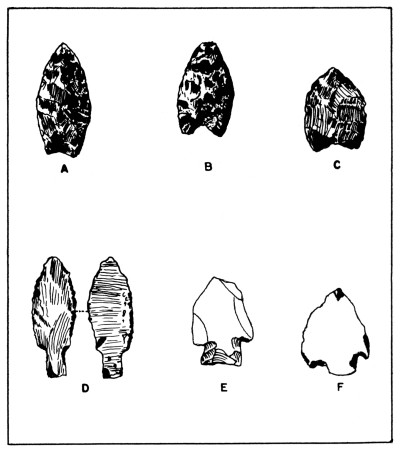
Figure 76— Projectile points from Signal Butte illustrated for comparison. A-C. Signal Butte I, presumably IA. D-F, flake points, presumably IC. A-D, drawn from photostats courtesy of R. Forbis, E-F by R. G. Forbis.
Relations with Signal Butte I are most evident in the projectile point category, especially in the size average. A communication received from R. G. Forbis, to whom we are deeply indebted, indicates that the modal weight of the Signal Butte McKean points is about .56 that of those at the McKean Site. Further, the collections from Signal Butte contain three flake points. One striking example of a flake point in the shape of a “Duncan” was found at LoDaisKa, (Fig. 15, type A). Other flake points of varying form (listed as xx) occur in Complex C levels. Some of these are not dissimilar to that of Signal Butte I, but Dr. Forbis feels that these may belong to a later phase than the McKean points. The main differences lie in the relative scarcity or perhaps absence of straight stemmed or “Duncan” types at Signal Butte I[9], and the occurrence of flared stemmed varieties or “Hanna” points. The former are numerous at LoDaisKa, the latter absent. There is a good possibility that Signal Butte I should be divided into two or three phases, with McKean points earliest, (Bliss, 1950b, and R. G. Forbis, personal communication).
Relations to other known sites may also be noted. Not only the stemmed and lanceolate points, but side-notched and certain corner-notched types are found in Deadman Cave, Stansbury Island, and Danger Cave (Smith, 1952; Jameson, 1958; Jennings, 1957). The total range, however, differs considerably. There is also some similarity to materials of the earlier levels of Birdshead Cave, (Bliss, 1950a).
The stemmed “Duncan” types have rather wide morphological similarities. As far away as Texas, middle levels of certain sites yield similar materials (Pearce, 1932, pp. 46-47). Pedernales points of the Edwards Plateau Aspect are roughly comparable (Suhm, Krieger, Jelks, 1954, p. 468; Kelley, 1947, 1959). At the other extreme, Thomas Kehoe (1955) reports finding “Duncan-like” points at the Billy Big Springs Site in Montana. Lister (1953) has suggested that a generalized form of indented-based, stemmed point is a horizon marker in the West and Southwest.
A large number of the artifacts that occur with the above are of little diagnostic value. However, some of them are probably associated culturally and formed part of the total artifact inventory. These include: leaf-shaped and triangular knives, end and side scrapers, and discoidal and serrated forms, one expanding base drill, perforators, a few small ovoid bifaces, utilized flakes, chopper/hammerstones, one bone ornament, paint stones, headed and splintered awls, used bone splinters, one bone knife, and one wood shaft.
Cultural Reconstruction
The economy of the people of Complex C was probably oriented toward a combination of hunting and gathering. The former is evidenced by the presence of animal bones and the frequency of projectile points. The mule deer, Odocoileus hemionus, which represented nearly 75% of the faunal remains, appears to have been the animal most hunted. The projectile points are considered to have been used in connection with atlatls. Stalking and snaring were probably prevalent methods, although a surround or drive might have been practical in certain seasons when the animals gathered into larger herds. The small number of bison bones indicate that bison were also occasionally hunted. There is a surprising lack of bones of small game, these being even less numerous than in Complex D. Other animals included an undetermined carnivore and some bird bones.
Numerous milling stones and hand stones as well as plant remains attest to the continued importance of vegetable products in the diet. The plants utilized include acorns, sedges, wild plums, chenopods and Umbellifereae. Wads of moss may have been used for padding etc.
There is no information on any structures. Probably none were used since the overhang provided rather good shelter. Large stone-filled hearths may have been used for large scale roasting, as Mulloy (1954a) hypothesized for the McKean Site.
Technologically the Complex C occupants possessed sufficient skill to adapt to the environment with little evidence of elaboration. Clothing was probably scant except for cold weather, and was possibly of skins. In stone work, projectile points were functional, and made rather roughly with little pressure retouch. A proliferation of scraping tools and utilized flakes was probably a by-product of the emphasis on hunting, and suggests that many skins were prepared. A certain amount of technological “know-how” was required to manufacture the relatively fine prismatic flakes. In bone work the commonest tools were awls made on a splinter of bone worked only on the functional end. One bone appears to have been used for flint flaking.
Despite the apparent emphasis on utility there is a certain amount of evidence on the aesthetic side. The people had beads for adornment, made of sections of bird bone. Fragments of hematite and limonite indicate that they also practiced painting of some sort, perhaps on their bodies and tools or hides.
The occurrence of pieces of worked mica may have some magico-religious significance. Similar specimens were found in Danger Cave (Jennings, 1957) and the pieces may indicate Great Basin affiliation. However, the greatest concentration of these is between 50 and 72 inches. These might have been used as charms, or have been part of shamanistic paraphernalia. Other inferences drawn from ethnology would suggest the importance of beliefs connected with hunting.
There is no direct evidence of a socio-political nature. The size of the site and the type economy represented indicate a small semi-nomadic group. The possible overlap in cultural groups suggests either intermittent occupations alternating between groups of different cultural complexes, or the close proximity and strong influence of such groups. In the field of social organization, many modern hunting-gathering groups exhibit bilateral kin organization. On the other hand the especial importance of large game would render the men’s position of greater consequence, and the affiliation of the material culture is oriented toward the Plains where patrilineal organization is rather common.
Complex D
The authors believe that the culture (Complex D) represented at LoDaisKa from 55 inches below baseline to the top of the late Wisconsin Alluvium (erosional surface), is a manifestation of the Desert Culture as described by Jennings (Jennings and Norbeck, 1955; Jennings, 1957). This exists in its purest form below 72 inches but there is a persistence of some forms during the beginning of Complex C. Certain types characteristic of the complex continue above 55 inches; they occur, however, in diminishing quantities. There are two possible reasons for this: 1) that the shelter continued to be occupied by people of this affiliation; 2) that the materials worked up by the process of re-use or trampling and mixing of the floor. There is ethnological evidence that different tribes recognized each other’s projectile points and often collected them (Brew, 1946). To avoid confusion we shall treat this culture as it is manifested in its purest form below 72 inches. Where specific shift or other phenomenon does occur between 72-55 inches, it will be noted.
Traits characteristic of this complex are the following: projectile points of various forms, (to be discussed below), triangular knives, especially the second type described above, a few flake knives, side, discoidal, serrated, and a very few end scrapers, Uncompahgre scrapers, drills, perforators, utilized flakes, chopper/hammerstones, paint stones, splinter awls, awls with heads (especially some very large forms), a notched rib, used bone splinters, antler flakers, gaming pieces (undecorated), tubular beads, a tooth pendant, worked mica, wood shafts (large), a limestone pendant, one quartz crystal and one clay ball. Other artifacts found in the level include a few prismatic flakes perhaps fortuitous or intrusive, and above 60 inches a few small projectile points that are, by any criterion (e.g. Fenenga 1953), arrowheads. Typologically these show the greatest resemblance to forms found in Level 3 in Hells Midden (Lister, 1951). However, since there appear to be no allied traits they are felt to be intrusive. At least they provide no proof of the presence of this culture.
We will discuss cultural affinities in terms of projectile points with an eye to establishing possible lines of cultural influence from various geographical areas. We do not suggest that in most cases more than an idea was transmitted.
The Desert Cultures represent, according to Jennings, a “life way”, a specific economic approach to living in a certain environment. Though the Morrison biome differs in some respects from that of the classic “Desert Cultures”, the nature of the problems faced and the kinds of cultural response invoked are remarkably similar. Typological similarities to Danger Cave materials include a high degree of correspondence between class D projectile points and Jennings’ category W31. This form is also found at Medicine Rock Cave, Oregon (Cressman, 1956, Fig. 41) and Kawumkan Springs Midden (type 7a, Ibid.). It was also present at Deadman Cave, (Smith, 1952) and at Wormington and Lister’s (1956) Uncompahgre sites (Fig. 42 ff). Hurst (1944, 1945) named points of this type Tabeguache points. Points of a rather similar form occur in Ventana Cave in the Chiricahua-Amagosa II level (Haury, 1950) as a minor type, and become more common in the San Pedro materials.
Below we shall compare the LoDaisKa materials of this complex to three archaeological manifestations, since cultural ties seem to be closest with these. These are: Ventana Cave, Danger Cave, and sites of the Uncompahgre Complex, especially the Taylor Site. Reference will be made to other areas for specific items.
The similarities between type D projectile points and class W31 at Danger Cave have already been noted. Other similar forms include Class E forms and W25, 26. Class J may or may not be identified with W18 and W19; since large corner-notched forms are widespread they may not have enough distinctive features to be of value in site correlation. They are also present at Deadman Cave. There are five points (Class G) very similar to W38 (distribution Levels DIII-V at Danger Cave). If W8 and W10 are connected with McKean lanceolate and Duncan forms this is a good correlation point with the overlapping Complex C at LoDaisKa. There is a similarity between W16 and Class C, and W22 resembles Class I forms.
The only important projectile point category of Danger Cave Levels DIII-IV which is lacking at LoDaisKa is the series W28, 29, 30, corner-notched forms with deep basal notches.
In other tool types there is an amazing similarity between the triangular knives of Type I rather characteristic of Complex D at LoDaisKa and Jennings’ W48 and especially W52. Since one of those at LoDaisKa is obsidian, it is conceivable that it was traded from Utah or the surrounding area. At both Danger Cave and LoDaisKa the relative scarcity of end scrapers is noticeable. Other shared traits include flake knives, straight drills, a few gravers, the possible foreshaft from LoDaisKa, splinter awls and “headed” awls (it is interesting to note that DIV types were less well made than LoDaisKa or DIII types). One-hand manos and slab milling stones are found at both localities. However, the peculiar four-plane type does not occur at Danger Cave. Abrading stones, present at Danger Cave, are not found in Complex D. It is of interest to note that both sites contained worked mica, ochre and paint pigments. Nothing is known concerning basketry at LoDaisKa.
There are numerous similarities between the projectile points of Ventana Cave and those of LoDaisKa. Type H resembles Haury’s expanding stemmed, round tanged, convex based form. These are distributed vertically throughout the levels of both Ventana and LoDaisKa, but are almost entirely absent at Danger Cave. Points of Class C very closely resemble Haury’s expanding stemmed sharp tanged convex based or straight based types. These are the second most numerous type as low as level VI at Ventana. There are some points with oblique tangs that may be related to Class I or J. However, the best marker is Class C2. The first point figured in the group is identical with points of the class loosely termed Pinto Basin. Both this and the second two can be duplicated in Ventana Cave, or at the San Jose Site (Bryan and Toulouse, 1943). Nearer to LoDaisKa, Renaud (1942, 1946) has found similar points in the Upper Rio Grande.
In both LoDaisKa Complex D and Ventana Levels II-III there are triangular, convex-edged blades, side and discoidal scrapers. End scrapers, especially snub-nosed forms are comparatively rare at both sites. There are drills and/or perforators, including what we have termed gravers, choppers, and utilized flakes. Hematite appears together with quartz crystals. Awls are found: both headed and splinter forms are represented. At both sites the former are the most numerous type during the interval under discussion. At LoDaisKa there was no category of “sawed” awls as at Ventana. Rib scrapers or knives are also an interesting feature. There are in addition, tubular beads of bird and mammal bone, and antler flakers. One additional and notable similarity is to be found in handstones. These are all of the one hand variety. Due to a peculiarity of usage, a median line developed creating four grinding planes. This was probably caused in rocking the mano when pushing it forward and then back. Occasionally a specimen is noted where the user had rotated it 90° when reversing it, creating median lines on opposite faces perpendicular to each other. As Haury (1950) pointed out, this phenomenon is a special feature of the Cochise Culture. It occurs at Ventana Cave and in the LoDaisKa Site. Both flat slab milling stones and those with slight basins are found.
A third comparison can be made with the nearby Uncompahgre Complex (Wormington and Lister, 1956). Similarities to Danger Cave, sites of the Middle Horizon of the Plains and to the Cochise Culture are reflected in the Uncompahgre Complex, as summarized by the authors. Certain forms of projectile points, especially the type called Tabeguache by Hurst, are found in the Taylor Site in levels 4, 8, and 10. Another similar form is the round based, round barbed type (Class II), also found in Ventana Cave. There are certain small points from these levels, possibly arrowheads, which bear resemblance to projectile points of levels 1-3 at the Taylor Site, and forms of Level 2 at Hells Midden.
Generally asymmetrical large ovoid bifaces or knives are common in the Uncompahgre Complex, as they are here. The stemmed drills, straight drills, gravers, and perforators of the general class that we have called awls, are common in both the Uncompahgre and Complex D. There are other similarities in serrated scrapers, and the rarity of end scrapers. A triangular notched pendant found at LoDaisKa is probably analogous to certain flat pieces of soft stone that were used as ornaments on the Plateau. The four-planed manos noted above are also found here. An interesting artifact, the Uncompahgre scraper, was first described by Wormington and Lister in their report. Such pieces also occur at LoDaisKa. Whether they occur elsewhere is not known, since it is possible they were present in other areas but have not been recognized. At the Taylor Site there were storage pits as at LoDaisKa. One notable discrepancy is the lack of awls with heads at sites of the Uncompahgre Complex.
Before closing this discussion, we should take note of a possible broader relationship of Complex D, that is within the continent-wide framework of an Archaic horizon. While we have limited specific correlation to Desert cultures, other similarities do exist in total tool assemblage and specific point types with a number of Eastern Archaic sites, such as Modoc Rock Shelter (Fowler, 1959). Jennings (1957) has admirably summarized the relations of manifestations of the Desert cultures with sites of the Eastern Archaic, and further inquiry should be made in this direction. Perhaps when Archaic sites between LoDaisKa and the Mississippi are discovered, a gradual blending of Eastern Archaic-Desert Culture will be noted. A recent publication for Oklahoma by R. Bell (1958) gives hope in this regard. Since corn was present at Bat Cave (Dick, 1952), a site with certain Chiricahua Cochise affinities, it is not unreasonable to assume corn diffused to LoDaisKa from New Mexico or Arizona.
Cultural Reconstruction
There can be little doubt that the people of Complex D led a life similar to that described by Jennings for the Desert Cultures. The term “Desert” is a little misleading, since the Morrison Biome is not in any sense of the word a desert. However, the vegetation is of the Sonoran type, a type with great variation characterized by fairly low rainfall, scrubby bushes and few trees. The proximity of the mountain forest biome supporting deer and other large animals, probably led the people to greater dependence on these at the expense of small game. This hypothesis is supported by the faunal charts. The multitude of grinding stones, and the presence of edible floral remains attest to the continued importance of gathering. Another factor is present, for floral remains and the pollen record indicate the presence of maize in early times at LoDaisKa. At another site in southwestern New Mexico, Bat Cave (Dick, n.d.) was recorded one of the earliest occurrences of maize in North America. At Bat Cave preservation was better than at LoDaisKa and a more complete record was found. There is a clear resemblance between certain projectile points of Bat Cave (e.g. Datil points) and Chiricahua and Ventana forms, and those of LoDaisKa mentioned above. Perhaps maize was grown by the people of Ventana Cave also. It remains to be seen, however, how much difference the cultivation of small amounts of corn made in social and economic life. We are inclined to agree with Willey and Phillips (1958), who suggest that it was indeed little. In their hunting and gathering activities these people must have lived a life very similar to that of the Ute, outlined above. For theoretical considerations, the light shed on prehistoric life by these primitive cultures of the historic period cannot be overemphasized. The characters are different, but all the evidence suggests that the play was much the same with only minor variations.
Cists from Complex D suggest that seeds and perhaps corn were stored. Fire areas are sometimes large and deep. Perhaps these were traditional cooking areas. The many rocks scattered in the pits suggest that stone boiling or baking was practiced, and flat slabs may have been used for cooking cakes. Food was ground on basin or flat metates with one-hand manos. Lowie (1924) cites ethnological evidence for the use of different kinds of grinding stones for different foods in the Great Basin cultures. Perhaps a similar custom gave rise to the peculiar four-plane and ordinary type manos in equal proportions at LoDaisKa. Hunting methods included the use of the atlatl, or spear-thrower, and possibly, though no evidence is at hand, snares. Perhaps the use of bolas is recorded by the clay ball described above. Long bone awls suggest that basketry was important.
In technology the people had rather well formed projectile points. The flaking technique employed was probably largely percussion supplemented by pressure. In general, tools were smaller than those from other sites that exhibit typological parallels. This could have been partly due to ecologic conditions or perhaps to a scarcity of stone. Wide use of rough quartz and metamorphic rock suggest that the latter factor was operative. Obsidian was obtained through trade or visits to other areas. For sources of obsidian, one must look either to the vulcanism of northern Wyoming, Southwestern Colorado, New Mexico or Utah. Peoples occupying other sites of this time period also appear to have engaged in trade (see Jennings, 1957; Haury, 1950).
Bone was widely used for scraping, cutting and piercing. The exact method of cutting bone is not known; but there are gravers and utilized flakes that could have been used.
Ornaments suggest that interest in self adornment was not lacking. Hematite and ochre indicate that there was some use of paints and pigments. A piece of chlorite was found that, if ground and mixed with grease, could have made a spectacular kind of paint. Worked mica again may have had ornamental or ceremonial uses.
In the magico-religious field, one can probably infer some of the religious practices of the Basin hunters and gatherers, from those of the recent Ute. An interesting feature is the occurrence of a rather large, well formed, smokey colored quartz crystal. Perhaps as Haury suggested (1950), such crystals were picked up for beauty, but another possibility is that they were a part of a shaman’s paraphernalia. Certain California and Louisiana Archaic sites contain many of these, and they are assumed to have had some sort of magico-religious function. It would be surprising not to find at least a part time shaman in such a culture, although regalia such as sucking tubes are lacking.
Conjectures concerning social organization can be briefly set forth. It is probable that the people had a more or less bilateral form of kinship. As Murdock (1949) and others have noted, where economic division of labor is nearly even, a more or less bilateral organization tends to develop, with at most only mild matri-or patrilineality. From ethnologic parallels for Basin peoples this seems plausible. But use of ethnological evidence for single traits at this chronological level is extra-hazardous. What effect the little agriculture practised had is a moot question. As we have pointed out concerning the people of Complex A, small plots of corn would have required at least semi-annual gatherings, and would have temporarily placed the society on a relatively stable footing. Possibly the proceeds of a harvest were used for a gala feast or ceremony. However, the presence of cache pits suggests that something at least was stored.
Two oblong pieces of bone which appear to have been gaming pieces suggest that gambling existed as a form of recreation. Certainly, as Steward (1940) has noted, gaming was a constant feature of Basin cultures.
Other Remains
Just within sands and gravels attributed by Hunt to Late or Post-Wisconsin outwash, one fragmentary point and a few flakes were found. Some charcoal, ash and burned bone occurred at the same level, extending in a lens about 2 inches lower. The point appears to the authors to be the basal section of what might be called morphologically a Plainview point (Krieger, in Sellards, Evans and Meade, 1947). Flaking was parallel. Another parallel-flaked point of a similar type was found higher up in the fill, and was undoubtedly a re-used piece (see Fig. 25). Both points are of quartzite, and both have ground edges. Five of the associated flakes were of a flinty material, 2 of grainy quartzite.
These artifacts probably represent a culture of the early Lithic Stage in the area, and are perhaps the earliest evidence of its occupation. The fill was so sparse, however, that no further evidence could be obtained.