Book 4 — CHAPTER II. WHAT MAY BE SEEN UPON THE EARTH.
Reading edition
"I care not, Fortune, what you me deny; You cannot rob me of free Nature's grace; You cannot shut the windows of the sky Through which Aurora shows her bright'ning face; You cannot bar my constant feet to trace The woods and lawns by living streams at eve."
Of all the strata composing our planetary mass, the most important, so far as man is concerned, is, at the same time, the most superficial; for it is here that all the phenomena of life transpire. Our vegetable earth is the great laboratory in which are prepared all the solid, liquid, and gaseous aliments necessary for the nourishment of animal life. It is on the surface of the globe that men play their various parts. And why? Can it be for no other purpose than to modify, in some degree, its aspect, that they occupy the terrestrial surface? One would be tempted to think so on consulting what these majestic bimanes pompously designate their "Universal History." Regions formerly blooming with fertility,—gay with gardens, and orchards, and meadows,—musical with brooks, and glorious with harvest,—are now uncultivated and barren. Monuments which seemed adapted to defy the winds and the rains, and the corroding touch of the years, lie shattered in ruins; and with them the once populous cities and the once mighty empires of which they were the pride. The jackal howls among the broken columns of Tadmor; the sand-drifts have accumulated above the splendour of Memphis and Thebes. With their stones other monuments are raised, other cities are embellished, and other empires, which, in their turn, undergo the same unalterable fate: a perpetual relation of human forms, in every respect comparable with that which transpires in the bosom of the prolific earth, our common mother and nurse.
But why do men wander so far from the straight way? Why do they their best to ensure each other's unhappiness? They seem, alas! ignorant of the tendency of their actions, while attaching themselves to things transitory, and despising things imperishable. These, indeed, they would utterly ignore; they would live, like the brutes, unconscious of their destiny, if, at the bottom of their indestructible conscience, there did not prevail a glimmer of light, though more or less eclipsed, if they did not all feel themselves attracted, if they did not all irresistibly gravitate, some more quickly, others more slowly, towards the sun of eternal truth and justice. Instead of moving with sidelong sinuous pace, instead of taking ninety-nine steps backward for every one hundred taken in advance, they would all march onward in the way of progress; were it not that they pass their time in clipping their own wings; were it not that, to bend their heads the better—Veluti pecora ventri obedientia—they check the aspiring flight of that thought which would soar beyond the present; in a word, were it not that they lay a sacrilegious hand—unfortunate wretches!—on that which God Himself has respected in His creature—Liberty! The doubt which perplexes us as to the great problem of our destiny,—the doubt which allows so much latitude to the workings of our conscience,—does it not indicate the path we ought to follow? Should not men regard their freedom with peculiar reverence, when the Divinity they invoke has mercifully refrained from fettering it? Creatures of a day, who live as if you would never die! the contradictions and the miseries of which you so incessantly complain, are your own work. Help, help yourselves, by the development of your faculties, by the cultivation of your heart and mind, for herein you shall see the law and the prophets. Barren lip-service is nothing better than blasphemy!
But let us return to the ground which we tread, and where our life-companions are the animals and the plants.
The uppermost stratum of our globe undergoes the direct action of the light and heat of the all-vivifying "orb of day." This action, very unequal in its effects, and most important to understand, has scarcely been touched as yet by scientific research. Our geologists, having been more busily engaged with the inside than the outside of the earth, have broached certain plausible theories—for the most part of a very dubious character—respecting the central fire, Plutonism and Neptunism, the stratification of the planets, the formation of mountains, valleys, and basins. Our mineralogists, thinking far less of the chemical molecular constitution of the different formations than of their crystalline constitution, have minutely studied the physical qualities and geometrical forms of the integral parts of the rocks; but neither have condescended to direct their inquiries to the layer of soil trodden underneath their feet. Yet this very layer of arable earth, to which all bodies must return after death what they have taken from it during life,—this much despised humus, furnishes all our agricultural products, the very foundation and support of our material existence.
To touch industrial occupations—to meddle with trade, commerce, or agriculture—is unworthy of Science! Such is the silly cry of the many distinguished savants who pride themselves on what they call their "freedom from selfish considerations."
Be it so; but then you ought surely to be consistent, and never regard science as a profession or a bread-winner.
On the Chemical Action of Light.
It is no easy study to investigate the modifications and chemical effects which the terrestrial surface is capable of receiving or undergoing, either from the direct rays of the sun, or from diffused light. It requires new methods of inquiry,—methods frequently of extreme delicacy, as the labours of Bunsen and Roscoe, of Kirchhofer and Tyndall, have abundantly demonstrated. Let us here confine ourselves to establishing the fact that the chemical action of light varies according to the geological constitution of the soil,—according to the diurnal and annual obliquity of the solar rays,—according to the hours of the day,—according to the latitudes and seasons. The maximum of effects is manifested about the times of the solstices.
For the better co-ordination of these phenomena, might we not, as has been done in regard to the distribution of heat over the terrestrial surface,[78] link together by lines the points of equality? We should thus create an aggregate of iso-photo-chemical lines,—diurnal, mensual, and annual,—of incontestible utility for the progress of general physics and meteorology, which are still in their infancy.
But to realise this magnificent programme, the union and agreement is necessary of scientific men in every region of the globe; an ideal, therefore, as yet, is very far from being attained.
The Action of Heat.
The earth is subject to the influence of two different sources of heat. One, like the arterial blood, strikes from the centre to the circumference: this internal heat it is which has been stored up since the unknown epoch when our globe was nothing more than an incandescent nucleus, surrounded by condensable vapours. The other, like the venous blood, flows from the circumference towards the centre: this is the solar heat which the earth continues to receive through its crust.
The first of these sources lies beyond the domain of experiment. It has been the object of numerous hypotheses and diverse speculations, with which we shall not here concern ourselves. The second source is alone accessible to our investigations, and yet the network of isothermal lines is scarcely defined.
Since the year 1817, when Alexander von Humboldt conceived the felicitous idea of representing by lines the same mean temperatures enjoyed, in a given space of time, by the different regions of the globe, researches of this nature have very considerably multiplied. But these researches—do not forget—refer rather to the temperature of the atmosphere than to the heating of the inferior stratum of that gaseous ocean whose bed or foundation is the terrestrial crust. And it is the penetration of the latter by the sun's calorific rays which we would especially desire to understand. Here, then, a sufficient margin is left for our curiosity.
"If the king, my father, does not rest from his conquests," cried Alexander of Macedon, while still a child, "he will leave me nothing to do when I shall have reached manhood." To such a complaint, be you sure, dear reader, that the conquests made by science will never give rise. Every step in advance is but a step into the infinite: what we have done only shows us the boundless extent of what we have to do.
It is this reflection which must always teach humility to the scientific student, even while he rejoices in the achievements of human patience and genius. He will not despair for he knows that great victories have been won: he will not grow arrogant, for he knows that he is still on the threshold of eternal truth. As Sir J. Herschel has justly said:—"He who has seen obscurities, which appeared impenetrable, in physical and mathematical science, suddenly dispelled, and the most barren and unpromising fields of inquiry converted, as if by inspiration, into rich and inexhaustible springs of knowledge and power, on a simple change of our point of view, or by merely bringing them to bear on some principle which it never occurred before to try, will surely be the very last to acquiesce in any dispiriting prospects of either the present or the future destinies of mankind; while, on the other hand, the boundless views of intellectual and moral, as well as material relations, which open to him on all hands in the course of these pursuits,—the knowledge of the trivial place he occupies in the scale of creation, and the sense continually pressed upon him of his own weakness and incapacity to suspend or modify the slightest movement of the vast machinery he sees in action around him, must effectually convince him that humility of pretension, no less than confidence of hope, is what best becomes his character."[79]
The temperature of the terrestrial surface perpetually varies under the influence of local as well as general causes. Had this fact been known to the philosophers of antiquity, they would have taken advantage of it to liken the earth to an animal whose skin is more or less sensible of heat, not only according to the difference of the seasons, but according to the different hours of the day.
The diurnal thermometrical variations are those which penetrate the least profoundly into the interior of the soil. At a depth of about five feet they cease to be perceptible. The maxima and minima of the year, however, can be detected at a sufficiently considerable depth. The limit descends as low as 80 to 100 feet. Below 100 feet, the terrestrial stratum is found invariable,—that is, inaccessible to the thermometrical changes of the atmosphere. It is remarkable that the temperature of this stratum differs but little from the mean annual temperature of the air, which, in the latitude of London, is 49°.
The maxima and minima of the yearly heat are propagated very slowly in the earth, and their difference gradually becomes less and less. Thermometers buried 26 feet deep in the ground, mark, in our latitudes, the maximum of temperature only on the 10th of December, and the minimum on the 15th of June. But there are certain elements which we must take into account. Thus, the depth of the invariable thermometrical curve depends both on the latitude of the place, on the conductibility of the strata, and the difference between the highest and lowest temperature of the year. The less this difference, the more nearly does the invariable stratum approach the surface. Here we have the reason why, in the intertropical torrid zone, where the temperature scarcely varies above two or three degrees in the whole year, the invariable curve is not found more than forty centimetres beneath the surface.
In the temperate zone, lying between the torrid and the frigid zones, the same phenomena assume, apparently, a more complex character; the isogeothermal lines inflect as diversely as the isothermal, and the former are far from running parallel with the latter. And this is easily understood, even without any experiment, for there is no relation between the ever-varied composition of the terrestrial strata, and the much more uniform composition of the atmosphere.
In the frigid zone, the soil remains constantly frozen for an insignificant depth, whatever may be the temperature of the encircling atmosphere. In some regions a stratum of ice and snow eternally reposes on the surface of the soil.
Unfortunately the observations, which require to be undertaken on an uniform plan and under well-weighed conditions, at various points over the whole globe, are as yet far too few to assist us in defining any general currents of heat or cold, whether variable or constant, as prevailing in the lower strata of the gaseous ocean of our planet.
Arable Land.
A more useful picture than that of the isogeothermal lines would be one of all the arable land covering the continents of the Old World and the New,—indicating the composition of this nutritive earth, the nature of the soil on which it reposes, as well as the various kinds of cultivation appropriate in different climates. Here is a work to be achieved,—a work which would benefit the whole human race,—a work differing vastly from the conquests and achievements of too many of those "heroes" the world delights to honour.
"Peace hath her victories More renowned than war."
In this immense task, of which, as yet, not even the outlines have been sketched, particular attention would require to be paid to the subsoil; for upon this the success of all cultivation literally depends.
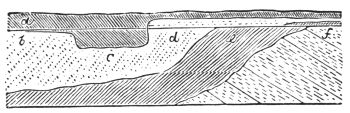
Fig. 69.—a, Humus, or stratum of arable earth,—the horizontal line shows the depth reached by the labourer; b, subsoil; c, subsoil; d, arable earth; e, humus in an inclined stratum; f, humus mixed with subsoil.
Arable land is the most superficial stratum of the cultivable terrestrial crust; it is this which the plough turns up and subdues; it is this which, properly manured, and enriched by the decomposition of organic matter, furnishes to vegetables their principal nourishment. As it varies in thickness, it necessarily presents one or other of the following circumstances:—1st, The labourer, penetrating the entire stratum of arable earth (Fig. 69, a), will strike down to the subsoil (Fig. 69, b); or, 2d, he will not traverse the entire stratum (Fig. 69, c); or, 3d, after having traversed the entire depth of the humus, he will reach a portion of the subsoil (Fig. 69, d); or, 4th, after having gone through both humus and subsoil, he will discover another layer of arable earth, which may be either pure humus, in a thick inclined stratum (Fig. 69, e), or humus mixed with the débris of the subsoil.
As for the subsoil, it may, by its composition, completely modify, stimulate, or delay the action of the vegetable mould, however rich this may be in assimilating principles. Thus, where the subsoil is argillaceous, the pluvial waters are arrested by it as by a bed of impervious cement, and render the ground too damp and cold to yield abundant harvests. In such a case subsoil-drainage is the best remedy. But if the earth be porous, the moisture gradually percolates through its various layers, fertilising and warming, communicating to the plants the needful humidity, and assisting in the production of that most glorious of all the scenes of cultivated nature—a corn-field thickly ripe with golden grain. In the poet's "Palace of Art" no finer picture can be seen than this:
"The reapers at their sultry toil. In front they bind the sheaves. Behind Are realms of upland, prodigal in oil, And hoary to the wind."
Oh! a sight to thank God for, and rejoice in, is the field all aglow with the splendour of the harvest!
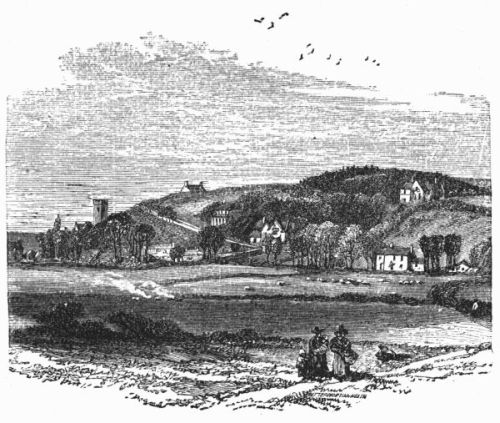
Fig. 70.—"Behind are realms of upland."
Without having recourse to chemical analysis, which is within the reach of a very limited number of persons, clayey soils may be distinguished by the vegetable species that most commonly flourish in them: as—
I. Plants belonging to clayey soils.—The Queen of the Meadows, Spiræa ulmaria (order Rosaceæ). Wild Angelica, Angelica sylvestris. Common Sorrel, Rumex acetosa (order Polygonaceæ), and various kinds of Ranunculaceæ, as Ranunculus lingua, Ranunculus flamma, and Ranunculus sceleratus.
II. Plants belonging to sandy soils.—Horny Lotus, Lotus corniculatus (order Rhamnaceæ). Little Harebell, Campanula rotundifolia (order Campanulaceæ). Eyebright, Euphrasia officinalis (order Scrophulariaceæ). Anthoxanthum odoratum.
III. Plants belonging to argilo-calcareous soils.—Coltsfoot, Tussilago farfara (order Compositæ). Wild Mustard, Sinapis arvensis (order Cruciferæ). Buckwheat, Polygonum aviculare (order Polygonaceæ).
IV. Plants belonging to a sandy and calcareous soil.—Broom, Genista scoparia (order Leguminosæ). Centaury, Centaurea nigra (order Gentianaceæ). Galium verum (order Rubiaceæ). The Jacobea, Seneecio Jacobæa.
V. Plants belonging to alluvial and marshy soils.—Reed, Arundo phragmites, Poa aquatica, Poa fluitans. Rush, Juncus conglomeratus (order Juncaceæ).
After these different soils have been brought under cultivation, the characteristic species, which we have just enumerated, disappear, and are replaced by other plants, which grow, to all appearance, spontaneously, under the name of weeds; but, in reality, spring from germs or seeds too frequently mixed up with the different manures, or spread abroad by the agency of birds or the wind.
In reference to this latter consideration, the diffusion of plants, we shall transcribe an interesting passage from Balfour's excellent "Manual of Botany."
"Some plants," he remarks, "are disseminated generally over the globe, while others are confined within narrow limits. Some of the common weeds in Britain, such as chickweed, shepherd's purse, and groundsel, are found at the southern extremity of South America. Laura minor and trisulca, Convolvulus sepium, Phragmites communis, Cedium Mariscus, Scirpus lacustris, Juncus effusus, and Solanum nigrum, are said to be common to Great Britain and New Holland. Nasturtium officinale, and Samolus Valerandi are very extensively diffused, and they may be reckoned true cosmopolites. They are both natives of Europe, and they occur, the former near Rio Janeiro, the latter at St Vincent. The lower the degree of development, the greater seems to be the range. Some cryptogamic plants, as Lecanora subfusca, are found all over the globe.
"Man has been instrumental in widely distributing culinary vegetables, such as the potato, and the cereal grains, as well as many other plants useful for food and manufacture. Corn plants, such as barley, oats, rye, wheat, spelt, rice, maize, and millet, are so generally cultivated over the globe, that almost all trace is lost of their native country. They can arrive at perfection in a great variety of circumstances, and they have thus probably a wider geographical range than any other kind of plants.
"As regards these plants, the globe may be divided into five grand regions—the region of rice, which may be said to support the greatest number of the human race; the region of maize; of wheat; of rye; and lastly, of barley and oats. The first three are the most extensive, and maize has the greatest range of temperature.
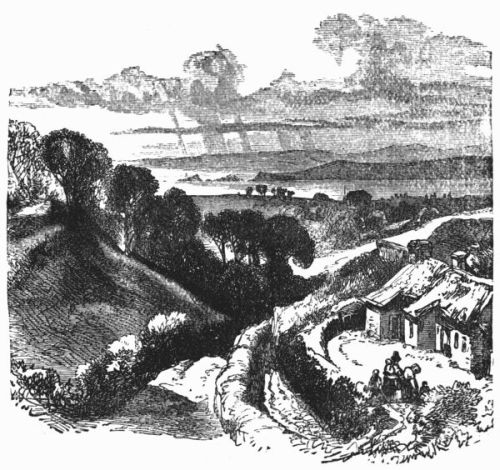
Fig. 71.—The Rye District.
"The grains extending farthest north in Europe are barley and oats. Rye is the next, and is the prevailing grain in Sweden and Norway, and all the lands bordering on the Baltic, the North of Germany, and part of Siberia. Wheat follows rye; it is cultivated in the middle and South of France, England, part of Scotland, part of Germany, Hungary, Crimea, and the Caucasus. We next come to a district where wheat still abounds, but no longer exclusively furnishes bread,—rice and maize becoming frequent. To this zone belong Portugal, Spain, part of France, Italy, and Greece, Persia, Northern India, Arabia, Egypt, the Canary Islands, &c. Wheat can be reared wherever the mean temperature of the whole year is not under 37° or 39° F., and the mean summer heat, for a period of at least three or four months, is above 55°. It succeeds best on the limits of the sub-tropical region. In the Scandinavian peninsula, the cultivation of barley extends to 70° N. latitude, rye to 67°, and oats to 65°. The cultivation of rice prevails in Eastern and Southern Asia, and it is a common article of subsistence in various countries bordering on the Mediterranean. Maize succeeds best in the hottest and dampest parts of tropical climates. It may be reared as far as 40° N. and S. latitude on the American continent, on the western side; while in Europe it can grow even to 50° or 52° of latitude. It is now cultivated in all regions in the tropical and temperate zones which are colonised by Europeans. Millet of different kinds is met with in the hottest parts of Africa, in the South of Europe, in Asia Minor, and in the East Indies."[80]
Professor Houston furnishes the following table in illustration of the distribution of wheat and barley. It also shows the mean temperature which they require:—
BARLEY.
Winter Summer Annual
Mean.Mean.Mean.
N. Lat. 62½° Faroe, 39°51°45°
70 Lapland, 224633
67·30' Russia,94632
57·30' Siberia,06032
WHEAT.
Winter Summer Annual
Mean.Mean.Mean.
Lat. 58° Scotland,36°57°64°
Norway,235939
Sweden,235939
Russia,156037
30° Cairo,578872
Macao,648273
Rio Janeiro, 687874
Havannah,718277
Bourbon,718077
"Winds, water, and animals, are also instrumental in disseminating plants. Many seeds, with winged and feathery appendages, are easily wafted about; others are carried by rivers and streams, and some can be transported by the ocean currents to a great distance, with their generating powers unimpaired."
Mushrooms or Agarics (Order Fungi).
Every year—principally in autumn—we are startled by hearing or reading of cases of poisoning by mushrooms. Erudite connoisseurs, however, who have profited by Dr Badham's book on "Esculent Fungi," do not suffer themselves to be intimidated by these sad narratives, though, unfortunately, they are frequently too well founded; because they know how to distinguish the good from the ill, the true from the false, the edible from the poisonous mushroom. But this security ought not to embolden the inexperienced amateur in risking his life for the sake of a delicacy. It is true, nevertheless, that we frequently see men's lives exposed for something less.
"Look, what a splendid mushroom I have discovered!" a lady said to me, the other day; a lady who knew something of flowers, but nothing of cryptogams. "Take care!" I replied, taking from her hand the supposed prize; "this is the false mushroom; and would suffice, if served up at your table, to poison yourself and all your guests."
I ought here to observe that my friend had narrowly escaped death two years before, through regaling herself with a dish of mushrooms of very dubious character. Among the symptoms which she experienced, and which she described with medical exactness, she particularly dwelt upon the cold sweats, accompanied by a sentiment of undefinable terror, which is nothing else than the dread of death: it was the special symptom of poisoning with an unwholesome fungus.
Let us endeavour to make ourselves better acquainted with this formidable enemy of epicures. You will have no difficulty in finding it in any warm, close season, but especially in spring and autumn. The toadstool thrives indifferently in the shade of all the forest trees, but seems to prefer the oak and birch to the pine and fir. A patch of soft greensward, at the foot of an old oak, and in the neighbourhood of a "brawling stream" or "tranquil pool," will generally be covered with fungi of this description. The numerous synonyms attaching to it show how greatly it has exercised the classifying spirit of our naturalists. Some call it Agaricus muscarius, as if we should say "kill-fly mushroom;" others, changing only the specific designation, designate it Agaricus pseudo-aurantiacus,—which signifies, literally, "false orange," in allusion to the beautiful yellow colour of the true aurantiacus. What is certain is, that our mushroom, which can kill men as well as flies, belongs to the genus Agaric, so numerous in species that it can be formed into a family, that of the Agariceæ. The Agarics, of which the esculent mushroom (Agaricus edulis) represents the type, are easily recognised by their more or less fleshy pileus, or cap, garnished underneath with lamellæ, or gills, which radiate from the centre to the circumference, when the pedicel is in the centre.
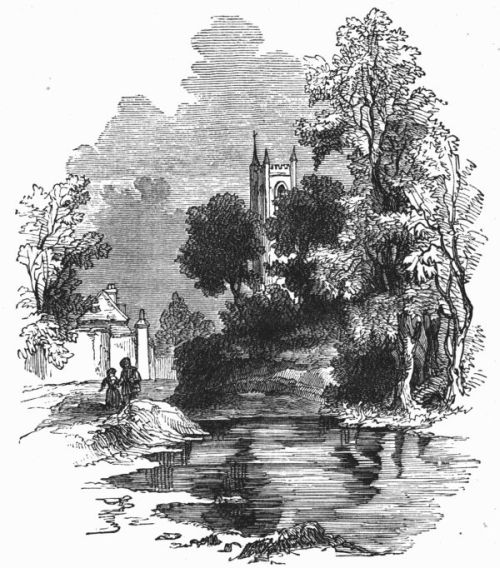
Fig. 72.—"At the foot of an old oak."
But some cryptogamists are unwilling to recognise the orange mushrooms (les oronges), whether true or false, as Agarics. They place them in a separate genus, the genus Amanita, though without informing us where they found the name. Meanwhile, they justify the formation of the new genus by the presence of the white swelling, the volva, or wrapper, of the mycelium, or spawn, which entirely covers both the true and the false mushroom on its emergence from the earth. Each, then, is an Amanita. But now remark their specific difference. The true mushroom, as it develops, ruptures its ovoid wrapper, or volva, leaving the remains entirely at the base of the pedicel; while, in the false mushroom, the débris of the volva are formed, not only at the base of the pedicel, as in the real Agaric, but even upon the red surface of the pileus itself: these are the white irregular warts characteristic of the Amanita, but wholly wanting in the Agaricus. Thus, there are two Amanitas: the Amanita muscaria, or "fly agaric," and the Amanita aurantiaca, or, as the English botanists call it, Agaricus Cæsareus, the imperial mushroom.
This fanciful "study" in nomenclature has the advantage of initiating us into the most essential distinctive characters of the two species in question. However, a few additional details are necessary to complete our history.
The Fly Agaric, or Amanita muscaria.
The species seems to have been expressly created to teach our gourmands the necessity of vigilance; that before enjoying a dainty they must first learn to distinguish, under penalty of death, the poisonous fungus from that which safely and pleasantly tickles the palate. The warning is useful, moreover, as showing that even sensualists are not wholly exempt from the law of work.
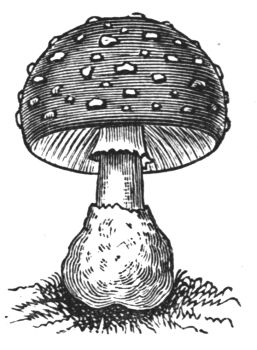
Fig. 73.—The Amanita Muscaria.
The Amanita, like most falsehoods, is pleasant to the sight. Its round pileus, of a beautiful orange-red colour, spotted with white warts, and lined with white gills, seems to invite your attention. (Fig. 73.) Strike it down with your stick; the lamellæ or gills underneath resemble the white leaves of a book. Its graceful stalk, ornamented on the upper part by a well-designed necklet, is bulbous in its lower portion; its flesh is dazzlingly white; in short, its entire appearance is attractive. Yet it is a traitor! You little know the depth of its wickedness. Mix a few shreds of its white flesh with a little milk; every fly which drinks of the mixture will, in a few seconds, fall dead, their swollen abdomen bearing testimony to the effect of the poison. And in many districts of Germany, particularly in Thuringia, the peasants make use of it to rid themselves of the swarms of flies which, towards the close of summer, infest their habitations. It is thus that man may frequently turn to his advantage those objects of nature which, at the first glance, appear injurious rather than useful.
Various experiments have been essayed to test the intoxicating influence of our Amanita. Bulliard, author of the "Histoire des Champignons de France," made two cats partake of it. Six hours afterwards, these animals, who are so tenacious of life, were dead.
Haller, in his "Histoire des Plantes Vénéneuses de la Suisse," says that "the Agaricus muscarius (Amanita muscaria) cannot be eaten with impunity, six Lithuanians having died of it; and in Kamtschatka it has been known to excite deadly attacks of delirium, accompanied by so deep a despondency, that those who have eaten of it would fain fling themselves into the fire, or fall upon their knives or daggers." This, however, we take to be an exaggeration. The truth is, that in Kamtschatka it is used to produce intoxication; and such is its strength, it imparts an intoxicating property to the urine of those who swallow it. When the fungus itself is not at hand, the would-be drunkard frequently resorts to this nauseous potion.
The flesh of the Amanita is not yellow. Yet Vicat speaks of poisonings produced by the Yellow Amanita. "I had much difficulty," says this physician, "in saving two families of Lausanne, poisoned through eating a very small quantity of mushrooms, which the father in the one case, and the mother in the other, had mistaken for Agarici Cæsarei, though they were both esteemed great connoisseurs, and especially in this species; nor had they been once deceived for upwards of thirty years, until they indulged themselves in this delicious but deceitful dish."
These poisonings could have been occasioned only by the Amanita. Some varieties exist, in which the under surface of the pileus is yellow, but the flesh is white. To one of these varieties Vicat's anecdote probably refers.
Thus, the Amanita formosa of Persoon has pedicel, pileus, and warts of the pileus, of a citron yellow. It is but a variety of the Amanita muscaria.
The Amanita umbrina of the same botanist (the Agaricus pantherinus of De Candolle) has an olive-coloured pileus; its surface, like that of Amanita muscaria, is covered with white scales.
The Amanita solitarius is distinguished by the size of its umbilical cap,—sometimes depressed in the centre,—which is furnished with a great number of white or pale brown scales; when fully developed, it measures from thirty to forty centimetres in diameter. The pedicel is bulbous, with a membranous ring, white as snow, clasped around it; at the base it is clothed in pellicles, the remains of its scaly volva. The flesh is firm, thick, and white. You rarely meet with more than two or three individuals in the same locality; hence its name of solitarius. Bulliard speaks of the flesh as good to eat, when cooked on a gridiron, and seasoned with fresh butter, salt, and pepper. It is possible. But as it is so easily confused with the poisonous species, the author of the "Histoire des Champignons" would have done better to prohibit its consumption, whether eatable or not.
We may now turn to the method adopted by Dr Vicat to save the lives of the two families at Lausanne, who, as we have seen, were poisoned by partaking of the Amanita:—
I dissolved, he says, six grains of tartar emetic in a litre of water, and from time to time administered a spoonful to my patients; moreover, I made them swallow floods of warm water, sweetened with a little honey,—that is, a large tea-spoonful of honey to a cupful of water.
I had much difficulty to get one of the sufferers, who was sixty years old, to swallow the first few spoonfuls. He was plunged into a lethargic insensibility differing in no respect from complete apoplexy; his teeth were closely set. Those whom I had ordered to administer the mixture had given it up, after several useless attempts; and in all probability the old man would have sunk, had I not had the patience to hold, for some hours, against his teeth the back of the blade of a small silver knife, so as to profit by the few moments when the teeth were a little less firmly clenched. I used some force to make the blade act as a wedge, and after a while opened up a passage to the handle, which, serving as a lever, forced the jaws sufficiently apart to admit the introduction of a spoonful of the emetic. It was not, however, until fully two hours had passed that the patient, having undoubtedly swallowed the necessary dose, began to vomit, with strenuous efforts and frightful cries. This was at midnight. Four in the morning arrived before, after numerous alternations of vomiting and profound lethargy, he began to speak, and then like a man in delirium. After the first vomit, which was inconsiderable, the convulsions of his whole body were so very violent as to require four men to hold him, while I continued to make use of my knife as at first. Nor did I desist until I was satisfied that his stomach had been sufficiently cleansed. After this, I applied two strong blisters to the back of his legs. As these acted, the purging subsided, and at the end of twenty-four hours it had passed away entirely, the invalid finding himself as well as could be expected after sustaining so severe a shock. The other patients, who were not in so much danger, experienced twitchings and tremblings in the face, which quite disfigured them; the brain seemed a blank; though awake, they felt as in a dream, and their visions were most frightful.
It is evident, from these particulars, that mushroom-poisoning specially affects the encephalic nervous system, and that the best remedies are emetics and antispasmodics. In our present ignorance of what are the poisonous principles in the Amanita, we can adopt no other method than a chemical neutralisation.
Agaricus Cæsareus, or Imperial Mushroom.
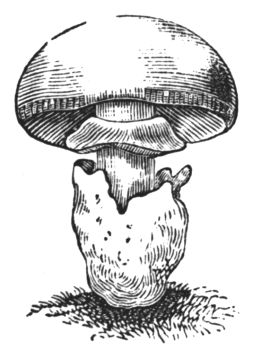
Fig. 74.—The Imperial Mushroom.
In this mushroom, for which, as we have seen, the Amanita is too frequently mistaken, the inside as well as the outside is yellow; the upper surface of the pileus, which is equally free from scales and warts, is, however, of a reddish yellow, like that of an orange (whence the popular French name, la vrai oronge); all the other parts are of a beautiful citron hue. This agaric exhales an agreeable odour, combined apparently of the scent of the vanilla and the truffle. It decomposes rapidly, and when in a state of advanced putridity, the fragrance I speak of is succeeded by—well, by a fearful stench! When young, and still completely covered with its wrapper or volva (this, in the Amanita, is imperfect), it is very like a hen's egg which has been partly buried in the ground so as to expose only the larger end. It seems partial to solitude; more than four or five are seldom found in the same locality. Moreover, in autumn it affects the same habitats as the Amanita,—which is unfortunate.
It would seem that our imperial mushroom was specially appreciated by the ancients, and it is said that Nero pronounced it a dish fit for the gods. In this circumstance originated the scientific name which has now become popular, and which was first applied to it by the cryptogamist Fries, Agaricus Cæsareus.
The Boletus of Pliny appears to have been our Agaricus, and not one of our Boleti, which are easily recognised by the numerous tubercular projections covering the under part of the pileus. In proof of this I would point out that the Roman naturalist, after speaking of the Boleti as genuine delicacies, immediately inveighs against them as dangerously poisonous. He relates that it was with one of these, or rather with one of the false mushrooms so easily mistaken for the true, that Agrippina poisoned the Emperor Claudius, to secure the imperial crown for her son Nero.[81]
The virtues of the mushrooms have been sung by Juvenal and Martial. The latter accurately distinguishes the true from the false, when reproaching Cæcilianus with his gluttony. "Ah, you are used to devour your Boleti alone, in the face of your invited guests; eat then, the Boletus which Claudius ate!"
"Dic mihi, quis furor est? Turba spectante vocata, Solus boletos, Cæciliane, voras. Quid dignum tanto tibi ventri, gulaque precabor? Boletum, qualem Claudius edit, edas."[82]
The best known and most valuable species of Agarici may be briefly enumerated:—
Agaricus campestris, or Common Mushroom, found in nearly all temperate regions: pileus convex, and white, with a tinge of brown; thick set on the under side with dark brown gills; stem firm and fleshy, and surrounded by a white membranous ring.
Agaricus Cæsareus, or Imperial Mushroom, the Kaiserling of the Germans, already described.
Agaricus deliciosus, or Orange-milked Agaric, found in coverts of fir and juniper; pileus viscid, orange, and upwards of four inches broad; gills and juice of a fine orange colour.
Agaricus procerus, or Parasol Mushroom, found in the shade of trees, on meadows with a sandy soil; stem from eight to twelve inches high, with a thick spongy ring; pileus bell-shaped, and covered with brown scales.
Agaricus Virgineus, or White Field Agaric, found in rich moist
pastures; pileus whitish, and convex; gills of a light chocolate shade; stem nearly two inches broad.
Agaricus eburneus, or Ivory Mushroom, found in beech woods; grayish-yellow pileus; broad gills; stem long and scaly.
Agaricus Georgii, St George's Agaric, or Whitecaps, found in moist pastures, and in the shelter of old barns, farmhouses, and churches; flesh yellow; gills yellowish-white; pileus twelve to eighteen inches broad; the least valuable of British species of agaric, but useful in ketchup-making.
Agaricus oreades, Fairy-ring Mushroom, or Scotch bonnets, found in meadows, where it grows in circles known as "fairy rings;" pileus seldom exceeds an inch in diameter; stem solid, tough, and fibrous, with a boss or umbo in the centre, of a light brown colour; the flesh white, and of a pleasant odour.
Agaricus odorus, Anise Mushroom, or Sweet-scented Agaric; pileus slightly convex, about three inches broad, and with pale gills; the scent like that of anise; stem strong, fleshy, but not very tall.
Agaricus formosus, or Smoky Mushroom; so called from the colour of the upper surface of the pileus; the stalk and gills of a pale yellow; grows in fir woods.
Agaricus primulus, or Mousseron, grows in woods and pastures, where the soil is sandy; pileus convex, yellow, about three or four inches in diameter; gills change from white to flesh colour.
How many Vegetable Species exist over the whole surface of the Globe?
I will not do my readers the injustice to suppose that they are unacquainted with the writings of our greatest English poetess, Elizabeth Barrett Browning. They will not fail to have been attracted by the prodigal genius, the superabundant power, the exquisite imagery, the profound spirit of tenderness, the high, pure thoughts, which render almost every page such delightful reading. Successful as she was, however, in giving expression to the most subtle emotions and the intensest feeling, I think she was even happier in her descriptions of scenery. These are invariably aglow with life and colour, and have all the fidelity of Creswick with the imaginative insight of Turner. Turning over her "Aurora Leigh," the other day, I lighted on the following beautiful picture:—
"I flattered all the beauteous country round, As poets use—the skies, the clouds, the fields, The happy violets, hiding from the roads The primroses run down to, carrying gold— The tangled hedgerows, where the rows push out Their tolerant horns and patient churning mouths 'Twixt dripping ash-boughs—hedgerows all alive With birds, and gnats, and large white butterflies, Which look as if the May-flower had caught life And palpitated forth upon the wind: Hills, vales, woods, netted in a silver mist; Farms, granges, doubled up among the hills, And cattle grazing in the watered vales, And cottage chimneys smoking from the woods, And cottage gardens smelling everywhere, Confused with smell of orchards."
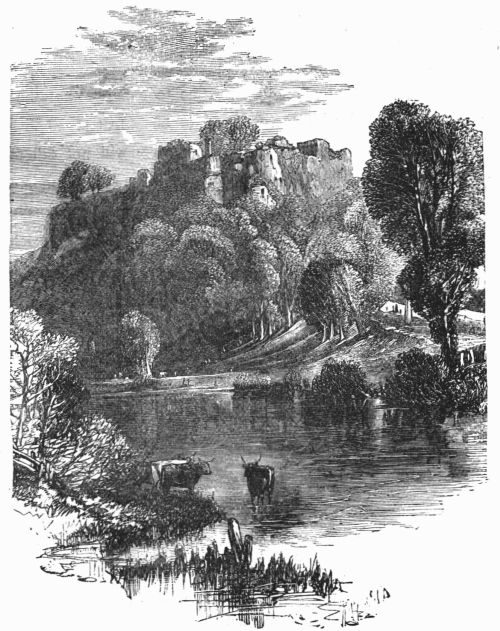
Fig. 75.—"And cattle grazing in the watered vales."
As I read this fine passage, the thought occurred to me, how many thousands there are who, in such a scene as it so vividly depicts, would see no beauty whatever, whose heart would not respond to it, whose sympathies would not be aroused by all its variety of outline and all its rich magnificence of colour! Yet not in so wide a landscape alone, but in the smallest nook,—in the little clump of elms by the side of the stream, in yonder grassy knoll rising straight up from the old churchyard, in the quiet angle of the green pasture-meadows,—there is a whole world of wonder and beauty for him who has eyes to see and a heart to feel! Look at the flowery bank which runs along the side of an English lane. Is it not crowded with objects of the rarest and purest interest? Count the many varieties of grasses which clothe it so abundantly, count the many species of flowers and herbs which adorn it with a grace beyond all human skill, and acknowledge that in itself it might supply the inquirer with matter for years of study and meditation.
Pursuing this train of thought, I was led to think of the number of genera and species into which the plant world is divided,—a remarkable proof, not only of the power and wisdom, but of the goodness of the Creator, of His desire to furnish man with inexhaustible sources of pleasure and entertainment; and finally, to put to myself the question, How many vegetable species exist over the whole surface of the globe? If this corner of a leafy English lane is so rich in variety, what must be the case with "the wide, wide world?"
I was now brought to see that a question so difficult could, like so many others, be usefully approached only by its inferior limit; in other words, that in the actual condition of botanical science, we can but affirm the number which certainly exceeds the sum of the vegetable species scattered over the surface of our earth. To determine this total with mathematical accuracy, we should need to have explored the terrestrial crust, liquid and solid, land and water, from the bed of ocean to the line of perpetual snow, and from the equator to the poles. And as yet we are very far from having obtained so complete a possession of the planet which has been assigned as a dwelling-place to our poor humanity,—alas, more presumptuous than powerful!
The number of plants mentioned by Theophrastus, Dioscorides, and Pliny, whom we take to be the representatives of ancient botany, does not exceed five hundred species. How very few, compared with the presumable total! The Middle Ages added scarcely anything to the botanical researches of antiquity. It is only since the discovery of America that we have seen the domain of Flora extending itself in unexpected proportions. But we must come down to the epoch of Linnæus (the middle of the eighteenth century) before we can obtain an accurate list of species, scientifically classified. Murray's edition of the "Specilegium" of Linnæus contains two thousand and forty-two species, including the Cryptogams. Wildmore, in another edition of the same great work, raised the total to twenty thousand. And this was the point at which our botanists had arrived when the nineteenth century opened.
But it was not long before they perceived that all these estimates, large as they seemed, fell immeasurably short of the reality. In attempting to distribute the different species among the then known regions of the globe, Alexander von Humboldt arrived at a total of forty-four thousand species, Phanerogams and Cryptogams included. De Candolle extended the estimate to upwards of fifty-six thousand.
Let us divide, in fancy, the earth into two parts,—one which has been visited by travellers, and one which still remains to be explored. Can you determine which would present the larger area? The latter.
Thus we possess but a very imperfect knowledge of the luxuriant, the glowing vegetation of the tropical and sub-tropical regions of the New World, in spite of the labours of Bates, Agassiz, Wallace, and others. To the north of the equator, we know very little of the flora of Yucatan, Guatemala, Nicaragua, the isthmus of Panama, the Chaco of Antioquius, the province of Los Pastos. We are not much better acquainted with the vegetation of the countries south of the equator. What do we know of the manifold species flourishing in Paraguay, in the province of the Missions, in the immense wooded region between the Ucayali, the Rio de la Madeira, and the Tocantin, three affluents of the mighty river Amazon? We know scarcely anything.
Our ignorance increases if from America we pass to Africa. Nearly the whole interior of this continent, from 15° N. latitude to 20° S. latitude, is, botanically speaking, a blank to us. The same is the case with the greater portion of Central Asia. The floras of the south and south-east of Arabia are still sealed letters,—treasuries to which we have not found the key. As much may be said of the floras of the countries situated between the Thian-Schan, the Kuenlung, and the Himalaya, as well as of the floras of western China, and most of the trans-Gangetic countries. We know still less of the vegetation of the interior of Madagascar, Borneo, New Guinea, and the greater part of Australia. To conclude: we are probably not acquainted with more than one-fifth of the vegetable species which cover the surface of our globe.
There are regions, moreover, which we imagine will always lie outside of our sphere of investigation; such, for instance, are the Polar regions, properly so called. Undoubtedly, it is open to us to conjecture that the Poles—those two extremities of our axis of planetary rotation—are not the home of any form of life. But this is only a conjecture; we are even without an analogy for it; since we have found, as shown in an earlier chapter of the present volume, living beings, plants, and animals, among the snows of our loftiest mountains. Moreover, might not the auroras, whose maximum of intensity occurs exactly at the poles, render life possible in regions where we at present suppose it to be impossible? Conjecture for conjecture,—acknowledge that we here touch in both cases upon an element completely beyond our human power.
These, then, are the reasons why, at present, we can only venture upon defining the lower limit, the restricted number, above which we are unable to fix the total of vegetable species living on the surface of our planet.
The method to be adopted has been indicated by Alexander von Humboldt in his "Ansichten der Natur" ("Pictures of Nature"). His method consists in the comparison of the vegetable families whose numerical relations are known, with the number of species contained in our herbariums, or cultivated in our botanical gardens.
But here, at the outset, a difficulty confronts us. Does any relation exist between the classification of plants by natural families and by their geographical distribution?
To group plants according to their analogies of structure, we study them from an abstract point of view, and without any regard to the medium in which they flourish. The question grows complicated if we also take into consideration their characteristic conditions and their distribution over the terrestrial surface. Families are then split asunder, and the importance of our scientific classifications disappears.
The gathering together of a small number of species, represented by innumerable individuals, confined within the same area, may suffice to communicate to a landscape its characteristic physiognomy: as, for example, is the case with the Asiatic steppes, the landes of Brittany, the moors of Scotland, the palm-groves and the clumps of Cactaceæ of tropical America. By the side of species which impress us by their mass—that is, by the frequent reproduction of the same individuals at an infinitesimal distance from one another—are placed those much more numerous species which are everywhere very thinly sown.
But do the plants themselves follow, from the equator to the poles, the same law of decrease as obtains from the base to the summit of the loftiest equatorial mountains?
Under identical isothermal lines, is the ratio of families known and identified to the probable aggregate of Phanerogams the same, in the temperate zone, on either side of the equator?
What are the vegetable families which preponderate at the two extremes, represented by the torrid and the frigid zones?
Under the same geographical latitude, or between the same isothermal lines, are the Synantheræ, the Gramineæ, the Leguminosæ, the Labiatæ, the Cruciferæ, the Umbelliferæ, more numerous in the Old than in the New World?
What families, either through their mass of individuals or their number of species, take precedence of the other Phanerogams?
How many species of one and the same family belong to any particular country?
What groups or families are characteristic of each zone?
Is the present classification of genera and species in all respects what could be desired?
These are questions that require to be considered, and to some of them we shall presently attempt replies.
Herbariums, though their classification is too frequently imperfect, may furnish us with data of great utility. The great herbarium of Benjamin Delessert was estimated, after his death, to contain 86,000 species,—a total not widely differing from that which Lindley, in 1835, estimated as the probable aggregate of the vegetable species of the world.
Great in importance are botanic gardens. Loudon, in his Hortus Britannicus (ed. 1832), places at 22,660 the number of Phanerogams cultivated in the gardens of the Bristol amateur botanists. With this number we must not confound the living species exhibited, in other counties, in gardens designed for the instruction of students, nor the grand total reared for a similar purpose at Kew. Kunth's enumeration, in 1861, of the plants at the Botanic Gardens at Berlin, one of the richest in Europe, amounted to upwards of 14,000 species, including 375 heaths. Among the Phanerogams were 1600 Synantheræ, 1150 Leguminosæ, 428 Labiatæ, 370 Umbelliferæ, 460 Orchidaceæ, 60 Palmaceæ, 600 Gramineæ and Cyperaceæ, &c. By comparing these data with the number of species described in the works of De Candolle, Walpers, Bentham, Lindley, Kunth, and others, we find that in the Berlin gardens are cultivated only one-seventh of the known species of the Synantheræ, one-eighth of the Leguminosæ, one-ninth of the Gramineæ, and about one-fiftieth of the smaller families, such as the Labiatæ and Umbelliferæ.
Now, if we admit that, on the one hand, the number of phanerogamous species cultivated in all the great gardens of Europe is about 30,000, and, on the other, that the cultivated Phanerogams form about one-eighth part of the species described in books and preserved in herbariums, we obtain a total of 24,000 species.
But the Cryptogams, or Agams, such as heaths, mosses, lichens, mushrooms, fungi, mould, and the like, of which our knowledge, as yet, is very imperfect, are probably much more numerous in species than the Phanerogams; for these vegetables, mostly microscopical, develop themselves wherever life can manifest itself—on the barren and denuded rocks, as well as in the air and in the depths of the ocean. If we suppose that they exceed only by 2000 the estimated number of Phanerogams, we shall obtain a total of just half-a-million!
Such, in our opinion, is the number which approximatively represents the lower limit of the aggregate of vegetable species (phanerogamous and cryptogamous) inhabiting our planet. The innumerable individuals of this half-million of species are born, and live, and reproduce their kind, and die, like the twelve hundred millions of individuals of our solitary human species. The former, it is true, remain fixed to the soil which has witnessed their birth, while the latter wander, more or less freely over the terrestrial surface. Do not animals enjoy the same privilege of locomotion? Undoubtedly. But men boast of the reason and the conscience with which they are endowed. Agreed. But with the exception of a small number—the infinite minority of progress—to what advantage have men employed the reason and the conscience of which they boast?
But this is a digression. We proceed to place before the reader a few final data in illustration of the subject we have been considering—the number of existing vegetable species.
The following is an estimate of the known species of plants on the globe at different dates:—
Phanerogams. Cryptogams. Total.
According toLinnæus, 1753,5,323 615 5,938
Pusoon, 1807,19,949 6,000 25,949
Stendel, 1824,39,684 10,765 50,649
Stendel, 1841,78,000 13,000 91,000
Stendel, 1844,80,000 15,000 95,000
The advance made of late years in the knowledge of existing species will be apparent from a consideration of Lindley's estimate in 1846:—
Genera. Species.
Thallogens, 939 8,394
Acrogens,310 4,086
Rhizogens,21 53
Endogens,1,420 13,684
Dictyogens,17 268
Gymnogens,37 210
Exogens,6,191 16,225
——————
Total,8,935 92,920
According to Hinds, the following families are almost entirely restricted to particular divisions of the globe:—
To Europe—Globulariaceæ, Ceratophyllaceæ.
To Asia—Dipterocarpaceæ, Aquilariaceæ, Camelliaceæ, Moringaceæ, Stilaginaceæ.
To Africa—Bruniaceæ, Brexiaceæ, Belvisiaceæ, Penæaceæ.
To North America—Sarraceniaceæ.
To South America—Rhizobolaceæ, Gillesiaceæ, Calyceraceæ, Vochysiaceæ, Simarubaceæ, Monimiaceæ, Humiriaceæ, Papayaceæ, Gesneraceæ, Lacistemaceæ.
To Australasia—Goodeniaceæ, Epacridaceæ, Stackhousiaceæ, Brunoniaceæ, Tremandraceæ.
[A group of plants occurring only in one of the six great divisions of the world is called monomic, (from μονος one, and νομὸς, a region).
A group common to two divisions is dinomic; to three, trinomic; to four, quatrinomic; to all the divisions, polynomic.]
Natural Families predominant in the Northern Hemisphere.
Aceraceæ,
Alismaceæ,
Amentaceæ,
Artocarpeæ
(fam. Articaceæ),
Aurantiaceæ,
Berberaceæ,
Boraginaceæ,
Campanulaceæ,
Caprifoliaceæ,
Caryophyllaceæ,
Cistaceæ,
Coniferæ,
Cruciferæ,
Dipsacaceæ,
Elæagnaceæ,
Fumariaceæ,
Grossulariaceæ,
Hamamelidaceæ,
Hippocastaneæ
(fam. Sapindaceæ),
Hypericaceæ,
Magnoliaceæ,
Onagraceæ,
Orobanchaceæ,
Papaveraceæ,
Ranunculaceæ,
Residaceæ,
Rosaceæ,
Rutaceæ,
Saxifragaceæ,
Umbelliferæ,
Vacciniaceæ.
Natural Families predominant in the Southern Hemisphere.
Amaryllidaceæ,
Atherospermaceæ,
Cactaceæ,
Capparidaceæ,
Crassulaceæ,
Dilleniaceæ,
Diosmeæ
(fam. Rutaceæ),
Geraniaceæ,
Hæmodoraceæ,
Heliotropeæ
(fam. Ehretiaceæ),
Iridaceæ,
Malpighiaceæ,
Melastomaceæ,
Mesembryaceæ,
Myoporineæ
(fam. Verbenaceæ),
Myrtaceæ,
Oxalidaceæ,
Pittosporaceæ,
Polygalaceæ,
Proteaceæ,
Restiaceæ,
Scævoleæ
(fam. Goodeniaceæ),
Spigeleæ
(fam. Loganiaceæ),
Stylidiaceæ.
The Harvest Bug.
"I very much wish," said my friend T. to me one day, "to buy a small estate in the vicinity of —— Forest. If there should be one to sell, pray let me know of it."
It was not long before an opportunity arose for my friend to satisfy his desire. But after I had made him acquainted with it, he declared himself no longer willing to purchase a property in a district where, as he had learned, one was devoured by red beasts all through the finest months of the year. What a frightful neighbourhood to live in, where you were forbidden to walk in your garden under pain of catching an itch in your legs!
Unquestionably, it is only too true that the cultivated ground, whether on the northern or the southern slope of the forest, is infested, from the beginning of summer to the beginning of winter, by Lilliputian horrors, like so many tiny red points, which cling obstinately to the skin, and there deposit, under the epidermis, their microscopic brood. Once planted there, the rougets, as the French call them, or harvest bugs, as we English call them, effect considerable mischief; and if, to relieve one's self, one indulges in "a scratch," the cutaneous surface is quickly covered by small blisters, which on a cursory examination might be taken for a skin affection not generally named in polite hearing.
But one does not perceive the galleries excavated by these annoying insects, positive tunnels or covered ways, through which they proceed to pour forth elsewhere the superfluity of their numerous progeny. Less prolific than the Acari, which create upon the skin immense patches of irritation, the harvest bugs confine themselves to a few circumscribed localities: their favourite choice being the legs, the arms, and the corners of the eyes, especially among young children. They are not above domestic animals; cats and dogs frequently suffer from them,—not, indeed, over the whole surface of the body, for they are not so wandering as the Acari,—but particularly inside the shell of the ear.
At the first glance you would scarcely believe that those red points, apparently immovable, could be living beings,—could be animals belonging to an order of some importance.
Let us attempt to isolate one of the animalcules with the point of a pin: it is not an easy thing to do, because they usually adhere to the epidermis in clusters of three or four individuals. There, now we have succeeded, and here is one before us: it is only the fifth of a millimètre in diameter, which is, for most people, the very last limit of the visual function (see the small white line in Fig. 76, a). And, in truth, it would be imperceptible to the eye but for its bright red colour. To study it carefully, of course, you must make use of a very strong lens, or, rather, of a microscope. (See Fig. 76, b.)
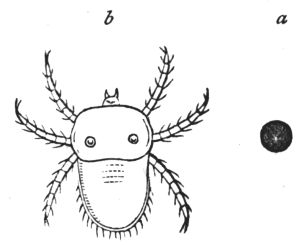
Fig. 76.—a Leptus Autumnalis (nat. size). b Ditto (mag.).
To this tiny animal has been given the name of Leptus autumnalis; the first, on account of its extreme delicacy; the second, because it is visible up to the end of autumn.
When examined through a microscope, it produces on the spectator the impression of a spider; but, like all other insects, it has only six legs.
Our naturalists, however, have found some difficulty in classifying it; and by way of cutting the Gordian knot of their embarrassments, some have placed it in a separate family of Microphthiræ (literally "little lice"), which is made to include all Arachnidæ with six legs. Others, who regard the wheat worm as an insect, rank it among the parasitical Apteræ.
In effect, it has all the characters of the parasitical insect—its protracted head, distinct from the rest of its body, is sometimes thrust forward in quest of its food, sometimes drawn back or concealed, to protect it from danger. Intended to suck rather than to knead or bruise, it has a sucker, but no mandibles. The head is without antennæ, and its palpi are very short, barely visible, and of a conical form. The body is ovular and very soft (whence the Grecian name leptus, λεπτός, signifying "soft"). The anterior part, corresponding to the thorax, is broader than it is long, and is marked underneath, on each side of the central line, by a black point: these two points, symmetrically placed, appear to represent the eyes.
The posterior portion, corresponding to the abdomen, is longer than it is broad, and covered with hairs. Each leg consists of six joints, easily distinguished by the hairs inserted at each articulation; and each terminates in a couple of strong crooked claws, which enable the animal to obtain a firm hold on the skin.
Thus, then, to judge from the aggregate of its characters, the harvest bug, Leptus autumnalis, belongs to the class Arachnidæ, while the number of its feet places it in the class Insects. But this is a detail which causes little annoyance to a person being devoured by the "red beasts," and only anxious to rid himself of them.
But if such be his desire, let me tell him that the best remedies are bathing the afflicted part with lotions of vinegar, or rubbing it with sulphur ointment.
I have been asked whether certain tiny parasites, such as the Ocypete rubra,—which is also red, and has six feet like the Leptus autumnalis, but which, instead of attacking man and his domestic companions, attaches itself to flies,—I have been asked whether these insectiform Arachnidæ may not be species of larva not yet arrived at their matured condition.
For my part, I must acknowledge that, whether the Ocypete rubra is or is not the transitory state of a more perfect animal, I do not know. But I am sure that the Leptus autumnalis lives and dies on the skin where it has selected its dwelling-place,—a living dwelling-place.
It is impossible to be too circumspect in the determination of certain genera and species, whose different phases of existence are little known, and which seem, so far as their characteristics are concerned, to participate of several orders or classes of articulated animals. The errors which have been committed in this respect ought at least to teach us caution.
Thus, the red, oval, six-legged animalcules, whose mobile heads are furnished with a proboscis shaped like an angular beak, and whose two palpi are large and semi-transparent,—the singular animalcules which, in June or July, are hatched in the spongy stems of certain aquatic vegetables,—notably the Potamogeton natans,—have been described[83] as forming a peculiar genus of Arachnidæ, the genus Achlysia; and this genus, created by Audouin, was ranked along with the Leptus and Ocypete in the family of Microphthiræ. Yet nothing is less exact. These Achlysia are simply the larvæ of a kind of Hydrachna or water-acarus. To be convinced of this, you have but to watch their development. At first very small and pear-shaped, these larvæ, deprived, like all larvæ, of the reproductive organs, rapidly increase in size. At the end of a few weeks you will see them adhering to a leaf of potamogeton; they thrust their proboscis into the stem, and cling to it with their palpi. Little by little, the legs, the proboscis, and the palpi, are drawn back towards the body, abandoning the skin which has hitherto formed for each of these organs a kind of horny sheath. From the larva state, the animal passes into that of the nymph. But this nymph continues to feed and enlarge; proboscis, legs, and palpi grow thinner and harder; claws, ciliæ, and hairs are developed; and, finally, through a fissure in the skin emerges the perfect animal, red as wine, with eight feet, and about two millimetres in length. This animal, placed in the family of the Hydrachnellæ, has been described by De Geer under the name of Acarus aquaticus globosus, and by Dugès under that of Hydrachna globosa, on account of its globular form.
The Cheese Mite.
From the crust of a dry old cheese,—such a kind of cheese as a bon-vivant likes with a glass of "good old ale,"—a very fine powder often crumbles off, like the dust made by wood-eating worms.
Examine this powder with your lens, or if you have good eyes, you may make use of them. You will quickly detect something moving in it, and by degrees you will see that this movement pervades the whole mass; that there is a general stir and commotion in all directions.
But you find it impossible to distinguish clearly the form of the animals which are thus agitated. You are certain, however, that they are not maggots, for they affect moist cheeses; besides, they are visible enough to everybody, and at need can make themselves felt upon your hands, and even upon your face, for they have a faculty of launching themselves to a distance by a little manœuvre familiar enough to serpents: bringing the head round towards the tail, they curve themselves like the spring of a watch, then abruptly uncoiling themselves with the help of some solid appui, they fling forth into the air, and are thus launched to very considerable distances. It is a curious species of locomotion, not unworthy the attention of the mechanician.
To clear up the mystery of a movement whose cause is not apparent at the first glance, let us sprinkle with this impalpable débris,—with this kind of sawdust, or cheese-dust,—a little strip of glass, and place it beneath the focus of a microscope.
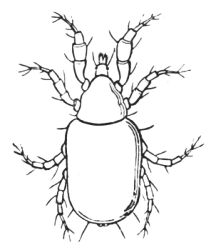
Fig. 77.—The Acarus domesticus.
Ah! you exclaim, what a frightful creature! These long sharp ciliæ seem to be so many lancets covering the whole body, and especially the legs; its head, like that of the harvest-bug, protrudes and recedes under a transparent carapace; thus communicating to the animal something of the aspect of a turtle. In all other respects its form exactly resembles the harvest-bug; only its body is more elongated towards the anterior extremity than that of the latter. While the harvest-bug makes us think of a spider, the body of the Acarus has a greater likeness to an insect's. (Fig. 77.) Yet the Acarus has eight legs, like a spider, and the harvest-bug six, like an insect. Attempt, then, to establish your absolute rules!
Let us continue our observation of this cheese-worm. The well-defined thorax forms nearly one-third of the fore-part of the body, which is of a shining whitish-red or reddish-white. The proboscis, shaped like a conical tube, is armed with two projecting mandibles, which, like true pincers, can be brought close together, or moved wide apart, thrust forward singly or simultaneously. Our animal, which a small lens makes very distinct, has been more than once confounded with the Sarcoptes scabiei.
Let us resume. Our cheese-dust, which to all appearance walks alone, encloses legions of mites; the old you may detect by their eight feet, the young by having six. The germs, or eggs, whence they spring, are found mixed among the excrements of the living, and the débris of the dead.
It is in this way that a crust of cheese offers us a true, a vivid image of the terrestrial crust. So may we learn to compare small things with great.
How many Animal Species are there Distributed over the Surface of the Globe?
In the present condition of scientific knowledge, no satisfactory answer can be given to this important and most interesting question.
The truth is, that what we may call Geographical Zoology is as yet in its very infancy. The few works which have been published on the subject have been published within the last eighty or ninety years; and they embrace only the vertebrate animals, notably the mammals, birds, and reptiles, or amphibia. We shall attempt to place before the reader an outline of the results that have so far been obtained.
Of all the Vertebrata, we are best acquainted with the mammals. And yet our zoologists differ very widely in respect to the number of their species, though the calculations have been made at very short intervals. For instance, in 1829, Minding computed that the globe contained 1230 species of mammals. In 1832, Charles Bonaparte reduced the total to 1149. Oken estimates it at 1500; and this last figure would seem to be the most probable.
Nothing is more curious than the distribution of these 1500 species of mammals, according to the different regions and climates of the globe.
Man, according to the best-considered data of science, forms a single family, a single genus, a single species. He alone possesses the power of adapting himself to every climate, and of taking possession of countries the most widely opposite in character. We find him among the snows of the North Pole; we find him under the blazing sun of the Tropics. We find him in the palm-fringed islands of Southern Seas, and in the barren burning waste of the inhospitable Sahara. Considered as an animal who feeds and reproduces himself, he forms alone the order of Bimana; so named in opposition to the Quadrumana, or apes, who make use of their fore-feet as we do of our two hands. Deprive man of his progressive and transmissible intellect—of those mysterious powers which we call the mind and the soul—and he would become at once the most useless and the most wretched member of the animal world.
The warm regions of the old and new continents are the true home and haunt of the apes. They are not sufficiently developed to be able to frequent the temperate or frigid zone. In our European menageries the specimens nearly all die of consumption. The Quadrumana form about one-fourteenth of the whole number of species of Mammalia.
The Carnivora, characterised by the development of their canine teeth, are spread over the whole globe. They are found in greater numbers in the torrid, however, than in the frigid zone. Their species compose at least one-third of the Mammalia.
The Rodentia, characterised by the development of the incisors, are wanting in Polynesia, and are rare in Australia. They are found in their maximum number in the torrid zone. Like the Carnivora, they form about one-third of the Mammalia.
The Ruminantia, remarkable for the development of their digestive apparatus, are distributed into 165 species, representing something less than one-ninth of the Mammalia. Africa, of all the continents, is richest in the Ruminants.
The Marsupialia, so strangely distinguished by the membranous pouch in which they enclose their young, belong to America, and especially Australia. At present about 123 species are known, or a little more than one-thirteenth of the Mammalia.
The Edentata, so named on account of their incomplete dentition, inhabit the tropical regions of the Old and New
World. They are distributed into 32 species, 19 of which belong to America. The Edentata, therefore, do not form more than one-fiftieth of the Mammalia.
The Pachydermata, which owe their name to the thickness of their skin or hide, almost exclusively belong to the Old World. None are found in Australia. The number of their species is 38, of which 5 only belong to Southern and Central America. The Pachyderms form, therefore, nearly one-thirty-seventh of the Mammalia.
The Cetaceæ,—which the naturalists of antiquity ranked among the fishes, though the females bear their young alive, and are furnished with a mammary apparatus,—chiefly frequent the Northern waters, but some of their species are found in the South Pacific. They represent, it may be assumed, about a one-hundredth part of the Mammalia.
The Birds, by their feather-clad bodies, and by the transformation of their two fore-limbs into wings, form the best-characterised class in the whole animal kingdom. But naturalists can no more agree as to the number of their species than as to the number of species composing the Mammalia. Some, taking as a foundation the rich ornithological collection in the Berlin Museum, allow for 6000 species being distributed over the surface of the globe; others, like Lessen, increase the total to 6266; while Dr Gray, no mean authority, raises it to at least 8000.
The majority of the Raptores, or birds of prey (vulture, falcon, eagle), as well as nearly all the Waders (stork, crane, heron), and Palmipedes (duck, goose, water-hen), are cosmopolitan birds. The other orders, such as the Scansores (parrot, parroquet, magpie), the Passeres (comprising nearly all the singing birds), and the Gallinaceæ (pheasant, pintado), prefer, as a general rule, the warm temperate regions. They are not found in the extreme north, nor in the equatorial climes, except in limited numbers.
Summary of the Mammalia.
Assumed total, 1600 species.
Bimanaform 1species.
Quadrumana"105 (?)"
Carnivora"510 (?)"
Rodentia"508 (?)"
Ruminantia"165"
Marsupialia"123"
Edentata"152"
Pachydermata"38"
Cetaceæ"18 (?)"
——
1600
[Of course, the foregoing is but an approximative estimate, but it will provide the reader with a tolerably accurate notion of the proportion borne by the different classes of Mammalia.]
About 5000 species of birds have been classified. By Cuvier's system they are divided into six orders:—
1. Raptores, or birds of prey.
2. Passerine birds, now generally called Insessores, or Perching-birds.
3. Scansores, or Climbing, frequently called Zygodactyli or Zygodactylous birds.
4. Gallinaceæ, now more frequently known as Rasores.
5. Grallatores, Waders, or Stilt birds.
6. Palmipedes, or Web-footed birds, now more generally recognised as Natatores, or Swimmers.
It has been proposed to separate the Brevipennes, or short-winged birds, from the Grallatores, and erect them into a separate order.
The Reptiles, of which the majority possess the faculty of living upon land and in water,—whence their name of Amphibia,—never pass beyond the limits of warm and temperate climates: their blood, which has the same temperature as the medium wherein they live—whence their name of "cold-blooded animals"—does not circulate where the mean annual temperature descends below freezing-point. Yet frogs and salamanders have been met with in Greenland, and on the banks of the Mackenzie River, in North America, under 67° latitude.
Linnæus was not acquainted with more than 215 species of Amphibia, divided into four orders:—the Chelonians, or tortoises; the Saurians (as the lizard and crocodile); the Ophidians (serpents); and the Batrachians (frogs). In 1789, Lacépède raised the total to 303; in 1820, Merrem estimated it at 677. At present, the number of species of Reptilia classified and described amounts to 2000, and the four orders into which they are distributed are—
1. Ophidia, or Serpents.
2. Sauria, or Lizards.
3. Loricata, or Crocodiles.
4. Chelonia, or Tortoises.
According to Sching, there are 7 tortoises, 33 serpents, and 35 lizards.
Fishes are the least known of those superior animals whose skeleton and vertebral column are situated in the interior of the body, and which are thence named Vertebrata. The richest collections, such as those of the British Museum, and those of the Museum of Natural History in Paris, which contain about 3000 species, do not represent probably more than a fourth of the existing total, including fresh-water and salt-water fish. How many rivers and streams in both hemispheres still remain to be explored! How far we are from a knowledge of the fishes which people the different strata of the great ocean.
Agassiz divides this great class of vertebrated animals into the four orders of Cycloid, Ctenoid, Placoid, and Ganoid, according to the character of their scales. Cuvier, into Osseous fishes (with true bones), and Cartilaginous; subdividing the former into Acanthopterygii and Malacopterygii.
The difficulty of the problem we are here considering increases when we come to the inferior animals. Who would pretend to determine the number of species of Mollusca which inhabit the earth, the fresh waters and the salt? This much is certain, that it cannot be less than that of the Vertebrates.
In the vast aggregate of the Articulata, the inquirer finds himself utterly astray and bewildered. This great division is not divided into those which have, and those which have not, articulated members.
The first subdivision includes Insects, Arachnida, Crustacea, and Myriapoda; the second, Annelida and Entozoa.
Some naturalists, be it said, rank the Cirrhopoda as intermediate between the two; others place them among the Mollusca. Others, again, include the Rotifera in the second subdivision.
We shall in this place confine our remarks to the Insects. According to the most distinguished entomologists, the average number of species at present, described or not described, and preserved in entomological collections, is between 150,000 and 170,000.
This estimate is obviously below the truth. Take only the Coleoptera, which forms but one, though, it is true, the most numerous order of insects. Thirty years ago the most complete collections contained about 7000 species. In 1850, the museum at Berlin, according to Alexander von Humboldt, contained nearly 32,000. We would here call the reader's attention to the just remarks of the author of the "Natural History of the Coleoptera," an entomologist of great authority, whom a long residence in America had peculiarly qualified to pronounce an opinion on the subject before us:—
"If we remember," says the Count de Castelnau, "that there are immense regions in Asia and the two Americas of which we do not possess a single coleoptera; if we reflect that the interior of the vast continent of New Holland is, from this standpoint, entirely unknown, and that most of the archipelagoes of the great ocean have never been entomologically explored, we may conclude, without any fear of mistake, that the number of existing coleopteras exceeds one hundred thousand. However frightful this number may appear, it will seem less so if we examine only the species discovered in the neighbourhood of Paris, within a radius of twelve to fifteen leagues; and we do not hesitate to say, that in a few years the Parisian fauna alone will present material for a considerable work, which shall not treat of less than 3000 to 4000 species of Coleoptera."[84]
If we admit that the other orders of insects, the Lepidoptera, the Hemiptera, the Hymenoptera, the Neuroptera, the Orthoptera, the Diptera, the Strepsiptera, comprise, taken altogether, at least the same number of species as the Coleoptera alone, we shall gain, for the class of insects, a total of 200,000. And we shall certainly keep within the truth if we assign the same number of species to the Annelida, the Crustacea, the Arachnida, the Myriapoda, and the Monomorpha, to which, with some modification, we may apply the remarks already called forth by the Coleoptera.
Let us recapitulate. The four classes of Vertebrate Animals include approximatively:—
1,600species Mammals.
5,000 " Birds.
2,000 " Reptiles.
12,000 " Fishes.
———
20,600
If we add to these 20,600 species of Vertebrate Animals, 200,000 species of Articulata, and 22,000 Mollusca (a minimum), we shall have a total of 242,600.
But to complete the grand whole of beings "who grow, and live, and feel" (the definition of animals laid down by Linnæus), we must add the Intestinal Worms, the Echinodermata, the Acalephæ (or Sea-nettles), and the Polypes. The history of these singular creatures, which apparently form the transition between the animal and vegetable kingdom, and have thence been designated Zoophytes, leaves much, very much, to be desired before it will be possible to indicate, even approximatively, the number of their species.
And, finally, what shall we say of the Infusoria? These microscopic forms of life seem, by their extreme multiplicity, to animate all nature. It is in studying these that the inquirer needs to be constantly on his guard, that he may not mistake transitory conditions—or larvæ—for actual species, and it behoves him to understand thoroughly the difficult delimitation of specific characters. It would be far easier to ascertain the exact number of human beings who at present people the terrestrial surface, than to fix the total of the species of Infusoria now in existence; assuredly it exceeds 250,000. What an infinite variety of design is here! What a picture it presents of the inexhaustibility of the Creative Mind!
Add, then,—let us say, in conclusion,—to this last great total the aggregate of the Vertebrates, the Articulates, and the Molluscs, and for our grand whole we have a minimum of half a million of animal species! This is the very figure, observe, at which we arrived as representing the lowest limit of the totality of vegetable species, living and moving, flourishing, and dying, and reproducing, on the surface of the globe.
We leave the reader to meditate—as meditate he surely must—on the sublime thoughts, the overpowering ideas of Power and Wisdom which these considerations suggest.
What is Chlorophyll?
We are drawing towards the close of autumn; we shall soon be in sight of the "melancholy days of the year;" when, for a while, the "voice of the turtle" will cease in the leafless groves, and the banks and braes will be sadly bare of their floral garniture. As yet, however, the trees retain their glorious vesture, though streaked and varied with the gorgeous colours of decay; and in the sheltered corners of the woods, on the sunny southern slope of the grassy hill, and beneath the covert of the still fragrant hedgerow, many a blossom appeals to our souls with its promptings of sweet images and tender fancies. The arum still raises its clusters of deep-scarlet berries, and spreads its spotted leaf—
"Armed with keen tortures for the unwary tongue;"
the blue-bells hang their delicate cups among the thick herbage; and the wild marigold contrasts its yellow splendour with all this crimson and azure magnificence. The daisy, too, has not forsaken us—sweet shield of silver, embossed with gold!—but brightens still the pleasant meadow and the sloping bank.
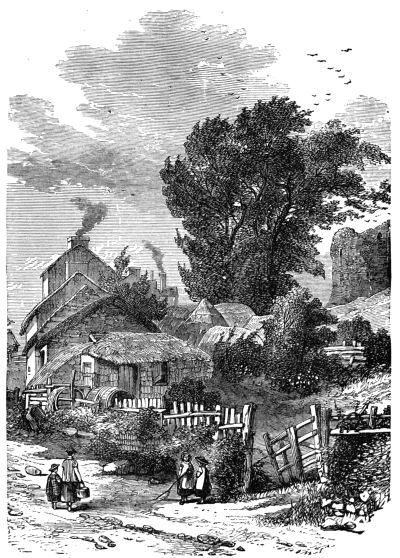
Fig. 78.—"As yet, the trees retain their glorious vesture."
"The rose has but a summer reign, The daisy never dies;"
and though it first makes its appearance in the merry spring-time, and is truly a child of the early year, it lingers on to become a precious ornament of our scanty autumn wreaths. Sweet flower of song!—dearer to the poet than even lily or violet!—who does not remember, and remembering feel, all the pathos of the dying exclamation of poor Keats,—"I feel the daisies already growing over me!" They heighten the commonest and cheer the saddest corners of the earth, and are ever ready, in their simple loveliness, to awaken thoughts of grateful tenderness and love—
"So glad am I when in the daisy's presence, That I am fain to do it reverence."
To what do the leaves, now changing their hues so rapidly, and varying through all the tints of purple, brown, and yellow,—to what do they owe their normal colour, the fresh, vivid, beautiful green?
To a substance called chlorophyll—(χλωρὸς, green, and φυλλον, a leaf).
Well, what is chlorophyll?
The colouring matter of plants, which, accompanied by grains of starch, floats like very minute seeds in the fluid of their cells. In some respects it is analogous to wax; it will not dissolve in water, but is easily affected by ether or alcohol.
Chlorophyll is dependent upon the action of light, if not for its formation, at all events for its development. Keep a plant in a dark room or cellar, and it will become blanched and sickly; the colouring matter dries up, and the white, wan tissue of the leaf is all that survives. The more a plant is exposed to the light, the deeper will be its green. In a shrubbery you may notice that the brown leaves of any particular ever-green or bush, if so situated as to lose the direct action of the sun's rays, will soon change colour. Instead of their natural brightness of tint, they assume a sickly greenish-yellow hue, and are said to be suffering from chlorosis. The formation of the chlorophyll is obstructed, or takes place too slowly. Of course, this peculiar condition will frequently arise from bad soil, or a long continuance of damp weather; but it is also the result of a want of light.
It should be observed that young leaves are always of a lighter green than old; simply because the latter have been exposed for a longer time to the light. And so the leaf goes on deepening and deepening in colour, until the sad days of autumn come, and the green gives way to yellow and brown and red, owing to the influence of the changing season on the chlorophyll of the plant.
In reference to this interesting subject,—which deserves to be more closely investigated,—we may place before the reader the results of certain recent experiments.[85]
MM. Prillieux, Brongniart, and Roze (Comptes Rendus, Jan. 3 and 17) have made some important observations on the apparently spontaneous movements of the grains of chlorophyll within the leaves of plants. These had been observed by Böhm to congregate under the direct action of the sun; Famitzin, confirmed by Borodine, had also recorded very marked movements in the leaves of a moss under the influence of light. This class of plants offer great facilities for these observations, inasmuch as the movements can be observed in them under the microscope without dissection. M. Prillieux kept a moss in the dark for several days, when the cells presented the appearance of a green network, between the meshes of which was a clear transparent ground. All the grains of chlorophyll were applied to the walls which separate the cells from one another; there were none on the upper or under walls which form the surfaces of the leaf. Under the influence of light the grains change their position from the lateral to the superficial walls; under favourable circumstances this change takes place in about a quarter of an hour. On attaining their new position, the grains do not remain absolutely immovable, but continually approach and separate from one another. If again darkened, they leave their new position and return to the lateral walls. Artificial light produces the same effect as daylight. M. Brongniart further observed that this movement of the chlorophyll, under the influence of light, does not consist in the change of position of isolated grains, but of masses of network, each containing a certain number of grains. In addition, M. E. Roze states that, besides the grains of chlorophyll which coat the walls of the cell, each cell is lined with a transparent mucous plasma formed of very fine threads, the extremities of which unite together the grains of chlorophyll. This protoplasm exhibits, under a high magnifying power, a very slow motion, and carries the grains of chlorophyll along with it. M. Roze believes, therefore, that the motion is a plasmic one, the protoplasm being the vital and animating part of the cell.
Carnations and Pinks.
Among the latest flowers of the autumnal garden are those old favourites, the "July-flowers," or Carnations, which, because they were "fair and sweet and medicinal," Jeremy Taylor preferred to "the prettiest tulips, that are good for nothing." I remember a time when they were among the best-prized ornaments of our parterres, and very delicious it was to inhale the balmy breath that rose into the warm air of an autumn evening from rich masses of carnations and pinks. The carnations were also called—sub consule Planco—in the merry days when I haunted the green lanes of a pretty Devonshire village, carnations, and clove July-flowers or gilliflowers; and an ancient name for the pink was that of sops-in-wine, because they were infused in the wine-cups of our much-drinking ancestors. So Drayton says:—
"Bring hither the pink and purple columbine, With gilliflowers; Bring coronations, and sops-in-wine, Worn of paramours."
The same poet alludes to them under their more modern appellations:—
"The brave carnation, then, of sweet and sovereign power (So of his colour called, although a July flower), With the other of his kind, the speckled and the pale;— Then the odoriferous pink, that sends forth such a gale Of sweetness, yet in scents as various as in sorts."
The scientific name of this beautiful family of plants, whose rich dyes are not less conspicuous than their Sabæan odours, is Dianthus, or "Flower of God." They form a genus of the natural order Carophyllaceæ; the calyx is tubular, and five-toothed; there are five petals, which at the throat of the corolla are lightened (as it were) into a linear "claw." The stamens are double the number of the petals; the capsule is of a cylindrical outline, and one-celled.
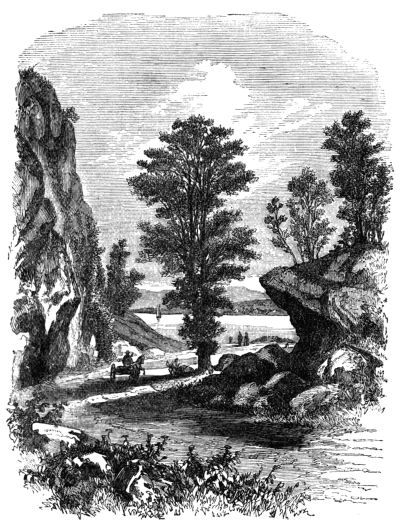
Fig. 79.—"When I haunted the green lanes of a Devonshire village."
I am quite prepared to agree with a sympathetic writer on flowers that, during summer, and far into the autumn months, the greatest beauty of our gardens is the varied tribe of Carnations, while their exquisite, subtle, yet potent aroma is not to be excelled, I think, or, at all events, is not far surpassed, in strength and sweetness, by the much-lauded rose. A carnation seems, to my humble taste, the very embodiment, as it were, of the favourite qualities so insisted upon by Mr Matthew Arnold, "sweetness and light." And even in winter, when its radiant petals have disappeared, there is something graceful to the eye in the long slender leaves of the pink, covered with their sea-green powdery bloom.
The two species commonly grown in gardens are, the garden pink (Dianthus hortensis) and the carnation proper (Dianthus caryophyllus); both of which are generally referred to one original, the castle-pink, July-flower, or clove-gilliflower. The carnation, as a garden flower, was originally brought into England from Germany, where it has always been a favourite object of cultivation.
There are several hundred varieties of it, which are arranged into three principal divisions: flakes, which are diversified by broad stripes of two colours only; bizarres, which are of several colours, and very irregularly streaked; and picotees (from piquetté, spotted), whose flowers are besprinkled with different colours, and their petals fringed or serrated.
In England, the native species of pink are five in number, but they are mostly rare, or, when abundant, are found in very limited habitats.
The commonest kind is the little Deptford Pink (Dianthus Armeria), which sometimes grows in thick clusters among the meadow grass. In shape, its blossom resembles that of the garden pink; in size, it is about equal to that of the sweet william; and its flowers grow in a very similar manner. It is a scentless pink, however, with serrated or notched petals, and its rose-coloured petals curiously besprinkled with tiny spots of white.
A very pretty species is the Maiden Pink (Dianthus deltoides), which some botanists think to have been the original of our garden favourite; and a kind deserving notice for its large and fragrant flowers is the Dianthus superbus.
The maiden pink, I should add, has delicate rose-coloured blossoms, daintily touched with silver, and a white eye encircled by a deep purple ring. It is not unworthy of its fanciful and highly suggestive name.
A rare British variety is the Clustered Pink, or Childing Pink (Dianthus prolifer), which produces its flowers in plentiful clusters, but is only allowed a season's sunshine.
The India or China Pink (Dianthus chinensis) is a native of Eastern Asia, but has now become a frequent denizen in our English gardens.
One wild species, the Mountain Pink (Dianthus cœsius), it has never been my fortune to gather in its native home. It is described as a large handsome flower, and it loves to breathe the "difficult air" of the lofty mountain-top. "Never," we are told, "is it found in plain or valley; but it is one of those blossoms whose beauty gladdens the mountaineer, or bids the traveller wonder that so lovely a flower should be blushing on the lone summit, scarcely accessible to his footstep; or cheering a rock, where only the yellow lichen, or the verdant or gray moss, reminds him of vegetation. Such a sight might bid one think of the old motto, which accompanied a wild flower, 'I trust only in Heaven.' How beautiful is it in its loneliness! Scarce an eye meets it but that of the towering bird, as he dashes through the air above it, yet is it as full of lustre as the flowers we daily see and admire. Surely it should arrest the eye and the thoughts of the traveller as certainly as would a monument of human skill on such a spot. Like a lone ruin, it is a page of story, telling not only of the past, but the present, and reminding us of a Being who has reared it there, where it stands a memento of power and goodness."
"Thanks to the human heart by which we live, Thanks to its tenderness, its joys and fears, To me the meanest flower that blows can give Thoughts that do often lie too deep for tears." —Wordsworth.
Of greater interest, however, because a native species, and more easily attained, is the Castle Pink, to which brief reference has already been made. Its perfume is like that of precious spices, and after a shower of rain, the air, for some distance, is actually interpenetrated with it. As its name indicates, it loves to grow upon the shattered walls of
"Chiefless castles breathing stern farewells;"
Fig. 80.—"On the time-worn ruins of an ancient minster."
and it may be found, unless swept away by barbarous "improvements," adorning the gray old masonry of Sandown Castle, and on ruins in the neighbourhood of Norwich. On the walls of Rochester's stately keep it grows at a height which defies the spoiler's hand; and on the time-worn ruins of an ancient minster, it shines, in the summer-noon, "with a flush of flowers." It blossoms in July, and there are not, it is said, more than half-a-dozen spots in England where it may be found wild.
To this dainty and beautiful tribe belongs that common but handsome and most fragrant flower, the Bearded Pink or Sweet William (Dianthus barbatus),—a native of central Europe and southern France, with long lanceolate leaves, bearded petals, ornamental bracts, and dense clusters or tufts of crimson or rose-coloured blossoms. It has long been a favourite with the cottager, for it is so hardy that it will grow in any soil, and will flourish even in the odd corner known as the "children's garden." Its popular name, "long, long ago," was "London tuftes;" and it owes its specific appellation of barbatus, or "bearded," to the nature of its calyx. That quaintest of quaint old botanists, delightful Gerarde, lavishes encomiums upon its beauty, and pronounces it meet "to deck up the bosoms of the beautiful, and garlands and crowns for pleasure." I suspect that now-a-days it seldom figures in a posy.
To the same order as the Dianthi—that is, to the Caryophyllaceæ—belong many wild flowers of lowly growth but abounding interest; as, for example, the corn-cockle, whose lilac-coloured petals, soaring conspicuously among the tall waving corn, have procured for it the right royal appellation of Agrostemma, or "the crown of the field." So, too, the numerous species of campion and catchfly (Silene), with their singular expanded calices; and those handsome flowers, the white and rosy lychnises, which love to air their charms by the side of running waters. The cottony down upon these plants was wont to be much used for the wicks of lamps.
Then, too, the whole tribe of chickweeds are included in the Caryophyllaceæ. They are spring flowers, with pearly white blossoms, five-petalled, like a five-rayed star, and long slender drooping leaves. Their resemblance to a star has suggested their scientific name, Stellaria; and they are truly the "stars of the earth," glistering among the thick herbage with a modest beauty. The Stellaria media supplies our song-birds with an abundant and a wholesome provision.
A handsome wild plant of this order is the Soapwort (Saponaria officinalis). It is common in Kent, and some of the neighbouring shires, but in many parts of England is never seen. Its full cluster of rose-hued blossoms is rather larger, and more loosely set together, than those of the sweet william; which, however, it much resembles in its leaves, these being opposite to each other, and nearly sheathing or surrounding the stalk at their bases.
"The juice of the soapwort," says Miss Pratt, "is one of those vegetable substances which, by making a lather with water, will cleanse linen, and remove grease as effectually as soap. It grows more generally in the neighbourhood of villages than in any other situation, as if providence had placed it there especially for the service of the cottager; yet it is very little used, either from ignorance of its properties, or because it would require some cultivation to render it sufficiently plentiful for household purposes. It needs the addition of ashes to make it a good soap for washing linen; but it is of much service to the shepherds on the Alps, who wash their flocks, previously to shearing them, with soapsuds made by boiling this plant in water. The large fruit of the horse-chestnut has similar cleansing properties, and may be used by cutting it into small pieces, or scraping it into water. It has even been suggested that if the nuts were reduced to powder, and made into balls, with some unctuous substance, they would answer all the purposes of our manufactured soap; and yet numbers of poor people see these nuts lying decaying in their neighbourhood, and have no idea of making them of any service."
On the Continent, however, the peasantry are wiser, and not only provide themselves with chestnuts for soap, but gather the beech-leaves to stuff their mattresses.
Returning to the Caryophyllaceæ, we may add that some of the plants of this order have poisonous qualities, which are due to the principle called saponine existing in many of the species of Saponaria, Silene, Lychnis, and Dianthus.
According to Lindley, the order includes no less than 53 genera, and 1055 species. They inhabit chiefly temperate and cold regions, and are ranked in three sub-orders,—Alsineæ, Sileneæ, and Mollugineæ.
The Eglantine and the Convolvulus.
What plant do our poets mean by the eglantine? What by the woodbine? Are they one and the same, or are they different?
We cannot answer those questions until we have referred to three or four passages in which they are introduced. And, first, let us take an example from Spenser:—
"And over him, art striving to compare With nature, did an arbour green dispread, Framèd of wanton ivy, flowering fair, Through which the fragrant eglantine did spread His pricking arms, entrailed with roses red, Which dainty odours round about them threw, And all within with flowers was garnishèd, That when wild Zephyrus amongst them blew, Did breathe out bounteous smells, and painted colours shew."
And now from Milton:—
"Through the sweetbriar, or the vine, Or the twisted eglantine."
The following is from Sir Walter Scott:—
"On the hill Let the white heath-bell flourish still, Cherish the tulip, prune the vine, But freely let the woodbine twine, And leave untrimmed the eglantine."
From Burns:—
"The woodbine I will pu' when the evening star is near, And the diamond draps of dew shall be her een sae clear."
From Michael Drayton:—
"The azured harebell next with them they neatly mixt: T' allay whose luscious smell they woodbine placed betwixt ... The columbine amongst they sparingly do set, And now and then among, of eglantine a spray."