Book 4 — CHAPTER II. WHAT MAY BE SEEN UPON THE EARTH. (continued 2)
Reading edition
And lastly, from Shakespeare:—
"And leaf of eglantine, whom not to slander, Out-sweetened not thy breath."
There is evidently some confusion here, and the eglantine of one poet is not the eglantine of another. Sir Walter Scott, we take it, is thinking of the wild clematis or virgin's bower, when he wishes the eglantine to remain untrimmed. And Milton undoubtedly refers to the honeysuckle, which, twisting round the framework of a cottage-porch, tempts the neighbouring bees to rifle its calyxes of their honeyed sweets. But the true eglantine of our earlier poets seems to have been the prickly sweetbriar, formerly called Rosa eglantina; now known as Rosa rubiginosa. No plant is of greater value for a garden hedge, owing to the delicious fragrance exhaled not only by its flowers but by its leaves.
On the other hand, the "lush woodbine," which so often finds honourable mention in our poets, is none other than the honeysuckle, the "twisted eglantine" of Milton. Its botanical name is Caprifolium.
The eglantine and the woodbine, therefore, though occasionally confounded by careless writers, are two entirely distinct plants; the former being the sweetbriar of modern gardens, and the latter the honeysuckle.
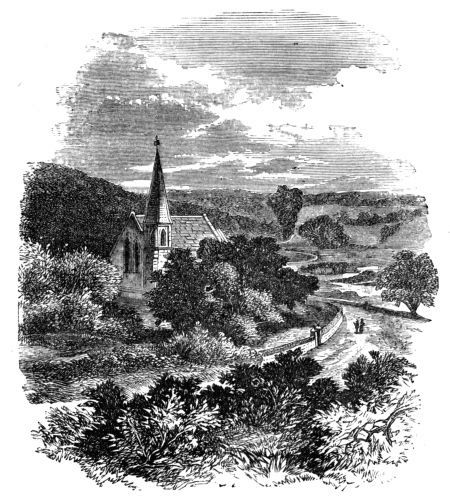
Fig. 81.—"Our leafy hedgerows."
It has been justly said by a writer (whom we have already quoted), that of all the flowers which, towards the end of summer and the beginning of autumn, adorn our pastoral scenery, "filling the air with fragrance, and the earth with beauty," none are more generally attractive than the wild climbing plants of our leafy hedgerows. By interlacing their delicate boughs, covered with foliage and flowers,—or with berries bright and sparkling,—or, as in the wild clematis, crowned with the lightest, feathery seeds,—they wind about the trees and bushes in festoons and wreaths of the utmost elegance,—and contribute in no slight degree to the aspect of richness and beauty which the landscape exhibits at this time of the year. As their stems are so slender and delicate that they would be crushed by the burthen of their flowery clusters and numerous leaves, or rent and uprooted by the wind, unless they found support from other plants, we see them hanging by their tendrils, or by their pliant arms, about the trunks of aged trees,—the ancestral elms, or "those green-robed senators of mighty woods, tall oaks,"—like a frail maiden to the sturdy arm of some strong-shouldered brother, or, it may be, of some one "nearer and dearer still."
In reference to those climbing plants, one curious circumstance deserves to be noted.
Some of them follow the sun's apparent course, that is, from east to west,—and always twine around the stem which supports them in the direction of left to right. Such is the case with the common black briony, so common in our woods and groves.
Others invariably twine contrary to the sun, or from right to left; as is the case with the convolvulus, or large white bindweed.
This singular tendency, be it observed, is always constant in each individual of the species, and if you endeavour to train one of these plants in a different direction, you will infallibly kill it.
The convolvulus will not grow from left to right, and the black briony will not grow from right to left. Crede experto.
The convolvulus, or white bindweed (Convolvulus sepium, or Calystegia sepium), is one of the most elegant, though one of the commonest climbing plants which festoon our willows, or creep over our grassy banks, or wind in and about our hedges. Its large white bells, which the country people unpoetically call "old men's nightcaps," are remarkable for their purity of hue and exquisite beauty of outline; and the leaves, which are heart-shaped, equally claim our admiration. Like the pink field-convolvulus (Convolvulus arvensis), or the rosy-hued seaside bindweed (Calystegia soldanella), it is very tenacious of life, and if it once secures a footing, is eradicated with difficulty. Hence it is dearer to the poet and artist than to the farmer and gardener, each of whom pursues it with a determined hostility.
The Convolvulaceæ form a distinct family or order, containing forty-five genera, and upwards of seven hundred species. They are found in temperate and tropical countries; and include the dodder, sweet potato, scammony, spomœa, and the jalap plant.
Metamorphosis.—A Physico-Philosophical Meditation.[86]
If we are to understand by the term metamorphosis simply "a change," it is evident that everybody undergoes metamorphosis, is changed or transformed; nothing is, all becomes.
The water which flows on for ever, but never twice washes the same pebbly bed, will afford us an apt image of this perpetual "to become."
But even the said pebbly bed, like the hardest rock, like the seemingly everlasting granite, must and does change. The compact, chrystalline, azoic rock, without a trace of life in its dense mass, would eventually decompose if constantly assailed and affected by the moving waves of that gaseous ocean whose bed is formed by the terrestrial crust. If the rock is found covered by more or less stratified layers, its presence in the bosom of the earth will attest to passing generations the primordial incandescence of our planet at some epoch when life as yet was not,—when the liquid element, hurled far away into space under the form of vapour, exhibited the aspect of a "bearded meteor," or a comet, with blazing nucleus and incandescent tail. Many the changes which since that distant epoch have taken place upon the earth, and many more must occur before our planet ceases to contribute its strain to the grand harmony of the spheres. Our world will end as surely as it once had a beginning: its duration, though it be computed by hundreds of thousands of years, is nothing, will be nothing, compared with that of the revolution of yonder sun, circling, with its wondrous train of planets, around some mysterious centre as yet unknown. And in this period, hitherto incalculable, what chances of perturbation will necessarily arise?
Let us suppose that the centre around which oscillates, on the one part, the moon while drawing near and receding from the earth; on the other, the earth while drawing near and receding from the sun: let us suppose that these centres oscillate in the same manner around other centres as yet undetermined,—and this hypothesis is very rational, since it is based on the principle that everything moves or changes,—it may happen that in these periodical oscillations, one or more of the circulating masses will eventually fall into their focus of attraction, or will start so widely astray that the wheelwork of our world, the various parts of our planetary system, will separate,—not to be annihilated, for nothing in the universe can be annihilated,—but to be metamorphosed, and group themselves elsewhere in a different order.[87]
It is thus that in chemistry, which I would call the astronomy of atoms, it is shown that bodies are only so far decomposed as to admit of their recombination in new forms; the end of one is the beginning of another.
Now, that which is true of the systems of the elementary bodies composing terrestrial matter, is, in all probability, true also—why should it not be?—of the systems of the celestial bodies.
Differences of magnitude, of space, and of time, which overwhelm our feeble imaginations, vanish before the unity of plan of the Creator's thought. A crystalline molecule, which will not affect the finest balance, is a world, with an equator and poles of its own, and its central atom round which atomic satellites gravitate. Whether these atoms are infinitely small or infinitely great, whether the time of their revolutions is measured by thousandths of a second or by myriads of years, is of little importance so far as their gravitation (ponderation, or poising) is concerned. For this ponderation is absolutely identical, whether we call it affinity,—when speaking of the atomic movements of chemically decomposable matter; or gravitation or attraction, when referring to those atoms of the great whole which we call stars, and whose metamorphic scale is far beyond the range of beings planted on the surface of one of the stellar atoms. However profound may be the researches of our astronomers, they will never attain to a knowledge of the metamorphoses of worlds. The spectacle of celestial spheres rising anew from their ashes, like "the Arabian bird" of fable, will be as impossible for them as the knowledge of the decompositions and recompositions of our material bodies would be for chemists, planted on the surface of an atom of carbon. How, from such a standpoint, could they contemplate the manifold forms of matter, and embrace at a glance all its changes?... Well, we are relatively as powerless as these imaginary denizens of an atom of matter, rooted as we are to the crust of a planet,—a molecule suspended in the eternal ocean.
What shall we now say of the forms and movements of living matter?
In the first place, that they are infinitely more varied and more changeful than those of inanimate nature. Next, that the difference between their metamorphoses is very wide. The eye can follow the transformations of a rock exposed to the decomposing action of the agents which surround us on every side. This action is calculable, and the elements which it has dissociated may be determined and weighed. The effects of the force, called either affinity or attraction, which maintains these elements united, are not beyond the range of our observation; tables of affinity, and of atomic weights, have been constructed, which enable the chemist to dominate over matter, just as the astronomer embraces the stars, the atoms of the world, by the law of universal gravitation.
But no sooner is matter interpenetrated by that mysterious force which we call life, than our most potent means of investigation suddenly cease to be efficient. Undoubtedly, you may analyse the seed before you sow it, and thus may ascertain that it consists of carbon, hydrogen, oxygen, and azote. But with the same elements attempt to recompose your seed, using exactly the same proportions as those you discovered in it; and if you think that your synthesis has been successful, ensure that your grain, once confided to the earth, shall become a focus of divers movements, giving birth below to the ramifications of the root, terminated by the spongioles,—above, to the ramifications of the stem, garnished with leaves, flowers, and fruits; finally, ensure that this aggregate of organs, multiplying millions of times the weight and volume of the seed, shall always and exactly reproduce the same type or the same species.
If, with your apparatus,—if, with the means at the disposal of humanity,—you should succeed in achieving all these marvels of nature; then perhaps you might settle the great problem of what life is,—whether an independent force, or a simple modification of an universal force, of which heat, light, electricity, and magnetism, will be but different modes of manifestation.
And yet, even in such a case, you must not boast too loudly of your power; for you will find it necessary to turn and return the term you have arrived at, in every direction; nor will it furnish you with the relation or the cause of the formidable progression whose alpha and omega, whose beginning and end, escape us so absolutely.
Whence, in all its interminable metamorphoses, whence comes life? Whither goes it? Were our world to perish, its ruins would not cease, in their apparently disordered movements, to obey the law of universal gravitation: they would so group themselves as to form other worlds, resembling the system of which they were anteriorly the framework. But this force in no wise tells you why, when, and how life will make its appearance on these spheroids of revolution, which, in their state of ponderation, are attracted in the direct ratio of their masses and in the inverse ratio of the square of their distances.
This is not all. Man justly plumes himself on having arrived, by a process of experiment, at the following irrefragable axiom: that "the matter which serves for the movements of life renews itself, while the mould or form remains." You may even affirm, without appearing too adventurous, that the innumerable whirling globules which enter into the composition of the human blood are so many microscopical individuals, each with its own proper life,—infinitesimal forms which are born, and move to and fro, and disappear, and are renewed, without the individual—whose aggregate they perform—having any consciousness of all this activity.
Thus it is that the collective integral being which we call humanity, lives and is developed through the removal of the individuals composing it,—ephemeral creatures, each of whom thinks himself a god!
Must we stop there? That would be to declare humanity the last term of a progression whose commencement and end, according to our own acknowledgment, completely escape us: it would be at once a contradiction and a flagrant violation of the great law of infinite continuity which reigns everywhere.
To suppose that beyond humanity there is only nothingness, would be to enunciate an hypothesis as puerile as that which pretended the earth was not only the centre of our system, but the sole inhabited or inhabitable point in the immensity of space, and that the stars of the firmament were created for the service and pleasure of mortals. Suppose that this absurd belief were true; of what use, I ask you, would be all our agitations, all our flutterings, all our conceptions, all our conquests, all our glories, all our memories, when the end of the world would sweep away and annihilate our race? It was well worth the trouble, truly, of being born, of living, and of suffering, to terminate, after all, in so inglorious a fashion!... Adhere to your hypothesis, materialist, if you have the courage; surely, no man of sense can accept it!
Let us now resume the thread of our meditations.
The end of our system has come at last: the sun, the planets, and their satellites form but one chaotic igneous mass,—a brilliant fugitive luminary, new-born to the inhabitants of worlds which have escaped intact.
The dust of our extinguished world will not be scattered hap-hazard; the molecules of matter, indissolubly linked together by universal gravitation, will so arrange themselves as to constitute a new, and perhaps a more perfect world. But in the constitution of this new world, balanced like the old, our human bones, our ashes united with those of our ancestors, may have, as far as they are matter, their due share. As for the Thought which makes the true power of humanity, which gives to man all his value,—Thought, perfectible and transmissible,—it will contribute nothing, because it is absolutely imponderable and impassible. Will it then be lost for ever?
If the world is to last for ever, you may justly regard as immortal the indefinite transmission of Thought, and the perpetuity of the memory of certain great men. But will all this avail, if the world must perish?
The world will never end, you say; it is eternal.
But how do you know this? If it has had a beginning, as geology and astronomy prove,[90] it will also have an end. This end, however, will not be an annihilation; it will simply be, as we have already pointed out, a transformation of matter. As for the problems, whether nature itself was created, and whether it is eternal, let us leave them to the discussion of heated theoricians, who are too blind to perceive that some questions it is wisest neither to affirm nor deny, but to know how to ignore.
The error, then, which we have been considering, destroys itself through its consequences. Let us admit, in effect, that our world—such as it is, just as it is—will last for ever. In that case what becomes of the power and travail of humanity? All they have accomplished are some slight changes of the terrestrial crust, barely sufficient, here and there, to modify the influences of climate. A limited number of men labour, it is true, for the progress and full development of transmissible thought. But even supposing that, in the course of centuries, humanity succeeds in comprehending, it can only grow through the development of the faculties of all its members, and the due balance of all the social forces by means of liberty. Supposing that reason, united to science and conscience, should finally combine in one family the various tribes and peoples scattered over the earth's broad surface; do you indulge yourself in the hope of crossing the limits of the human organization, and establishing the royalty of man "through the interpretation and imitation of Nature?"
Do you cherish the idea of penetrating, through the perfect union of all your intellectual forces, the mysteries of creation?
No; you would never dare to form such a hope, to nourish such an idea, at least unless you felt that the earth (which you must first demonstrate) comprehends in itself the whole universe, that the humanity swarming on its surface is eternal, that every other creature is absolutely subordinate to it: in a word, that Man is all!
But we know how limited is human power. We are not masters even of the mechanism of the body; the movements of organic life are independent of our will; we can neither command the stomach, the lungs, nor the heart: that marvellous process of absorption and elimination, that perpetual movement hither or thither which constitutes the essence of the assimilative function, goes on in us—as in all living beings, animal or vegetable—completely outside our sphere of activity. Then, without quitting our planet, how numerous are the movements which still escape the human will!
It is quite different when we lift up our eyes to examine the face of heaven. We have no grasp whatever of the incommensurable spiraloids of innumerable worlds to which our own belongs; we have no means of communicating with the inhabitants of other planets; we cannot establish any interchange of thought with the men (if there be any) of Mercury, Venus, Mars, Jupiter, Saturn,—who form, perhaps, like the men of the earth, the most elevated circle of material life, varying under an infinity of forms upon each of their floating domiciles.... I see you smiling, reader, because you do not believe that these other earths—satellites of the sun, like our own—are inhabited by beings analagous to our human race. You are at liberty not to believe it. But then, to be in agreement with yourselves, you ought to declare in favour of the Science of the Past, though demonstrated to be false, against the Science of the Present. Will you do so? Certainly not. But then, of two things, one: either you will be obliged to make the earth an unique exception, a kind of monstrosity in the midst of the other mechanism of the universe, which will be to throw yourself back upon the erroneous science of the ancients; or you must perforce admit that the earth is not specially privileged, and that the other planets, its companions, have also their human inhabitants.
Is this all? Alas, all this is nothing! The other worlds whose suns appear to us under the form of scintillating points or stars, will, undoubtedly, in like manner, possess their systems of planets and satellites. Why should they divaricate from the general plan of the universe? Now, multiply the number of the stars—who has counted them?—with the probable number of their planets, and you will gain, if this be permitted you, the number of humanities who people yonder star-sown space. And it is not only with these we must be able to correspond, but with the humanities of all the nebulæ of all the firmaments—for remember our starry heaven itself is but a nebula—that we must establish an interchange of ideas, if you would have your power, and civilisation, and intellectual royalty, something more than a mere optical illusion of your pride.
You do not cease to proclaim as an axiom that "there are no abrupt intervals in Nature;" that Nature never ventures upon sudden leaps or bounds ("in natura non datur saltus"), and yet you would make an exception for the world of thought—a world which no more lies outside the laws of nature than does the physical world. The former ought even to secure our preference; it is there only that we are free, that we can become true creators, by creating for ourselves our own happiness; that we can grow great before our own eyes, by following, not the tyrannous will of the brute, but the tender voice of the angel; by listening to conscience—that pure and infallible counsellor—conscience, the foundation of all justice, the latent force of generations passing away and coming, the universal gravitation of our species as of all the ultra-terrestrial humanities.
But how can the humanities, with which we suppose the universe to be peopled,—how can they communicate with one another?
The law of attraction comprehends not only the celestial bodies, but also their intervals, the intersidereal spaces. Do these spaces present a void to the thinking beings who probably people the stars?
Everything, force and matter, testifies to an entire unity of plan or thought, and the mind which is powerful enough to rise above all the attractions and influences of the body, the mind which, by its continuous labour, alone renders life and man of any importance, the mind once detached from the animal nature which it drags behind it like a prisoner to the chariot of his conqueror, shall it be inferior to inert matter? shall it be less than a ship without its compass? Continuous here, shall that continuity be elsewhere broken up? Surely this is impossible.
But how are we to recognise this continuity of essence in a spirit which, like man's, appears unavoidably fixed, like a parasite, to the surface of a planet?
Here lies the whole difficulty of the question; a question all the more perplexing because, in the search after scientific truth, the mind walks surely and steadily, except when resting upon the senses,—which are the backbone, so to speak, of the experimental method.
Answers, indeed, are not wanting, for each religion has its own. Every creed attempts to solve the problem. But then, faith is required to accept the answer or solution, and alas! faith is not implanted in every soul. It is useless, therefore, to wish that it might be the gift of those who, to the authority of tradition and long-established dogmas, prefer the liberty of discussion and the axioms of science. Are our bigots actually aware of what they do when they seek to compel into their circle of belief those minds which tend to escape from it at a tangent? We assert that in so doing they are guilty of an act of iniquity, of a veritable blasphemy.
Some explanation is necessary here. You believe, we hope, in the majesty, power, wisdom, and mercy of God, in the revelations He has vouchsafed to man, in the immortality of the soul. These are great problems, however; the greatest problems a mortal can venture to discuss. Already I see the bigot frowning; he professes to be shocked by the word "problem," he would fain substitute for it that of "certainty" or "truth." Well, through faith we accept them as truths; but, metaphysically speaking, they may be regarded as problems which the All-wise has submitted to man's earnest consideration. In fact, the God in whom you and we believe, in whom you and we put all our trust, has surrounded them with something of uncertainty, has invested them with so much of doubtfulness as may test our faith.
Yes, in doing so, He has had a purpose to fulfil. Let us think of a geometrician—and an ancient writer said that God, by creating the world, created geometry—for the sake of exercising the minds of his pupils, his children, giving them a problem to be solved.
If at the same time, he placed before them the solution, he would assuredly fail in his object. No means would remain of distinguishing the capable from the incapable, the studious from the indifferent, the idler from the worker, if they all found the question answered beforehand!
True, if the problem is too difficult, if the solution lies beyond the faculties of those whom he wishes to test and put to the proof, the master will not fail to furnish them with all the elements necessary for their guidance, whether they consider it from without, or whether they consider it with the help of their own inner consciousness.
But science and conscience stand in need of an equally difficult task; the first, that it may learn to observe clearly, the latter that it may learn to act purely. And it is here, above all, that the two-fold nature of man becomes a perplexity and a stumbling-block. On the one hand, man creates theories, in order to disembarrass himself of the science which calls for the exercise of powerful and laborious observation; on the other, he creates dogmas, which he hopes may lull to sleep that ever active, ever restless conscience, which demands fertile and beneficial actions, and rejects barren or deceitful phrases.
It is true that to many minds the discussion of the questions at which we have hinted seems a sorry work, because the time given for their discussion is necessarily so limited. What is life? they say. What can be effected in so short an interval? What can man hope to accomplish in the few short years that intervene between manhood, when the mind is mature, and old age, when the intellect grows enfeebled? These are the men who echo the old poet's mournful cry:—[91]
"A good that never satisfies the mind, A beauty fading like the April flowers, A sweet with floods of gall that runs combined, A pleasure passing ere in thought made ours, An honour that more fickle is than wind, A glory at opinion's frown that lowers, A treasury which bankrupt Time devours, A knowledge than grave ignorance more blind, A vain delight our equals to command, A style of greatness in effect a dream, A swelling thought of holding sea and land, A servile lot, decked with a pompous name; Are the strange ends we toil for here below, Till wisest death make us our urns know."
But the poet, while taking this despondent view of life, forgets—not only that it is an opportunity, but—that it is the first stage of an eternal existence, and that the progress begun now shall be continued hereafter, when the mind, freed from its material clogs, shall enter upon the full fruition of its wondrous powers. And however brief it may be, is it not better it should be devoted to noble work than to ignoble idleness? Is it not better to use it as a time of preparation than to waste it in empty pleasures? To the despairing wail of the poet just quoted we would oppose, as far worthier of a gallant spirit, Ben Jonson's admirable conclusions:—
"It is not growing like a tree In bulk, doth make men better be; Or standing long an oak, three hundred year, To fall a log at last, dry, bald, and sere. A lily of a day Is fairer far in May, Although it fall and die that night; It was the plant and flower of light. In small proportions we just beauties see, And in short measure life may perfect be."
This is the true philosophy; to make our life as perfect as our faculties will permit, and to look upon it as the introduction to a grander life, where the problems here discussed shall find a satisfactory solution.
"Oh for the time when in our seraph wings We veil our brows before the Eternal Throne— The day when, drinking knowledge at its springs, We know as we are known."
Let us beware, however, when we devote our life to the pursuit of wisdom, that we do not make a false start. Do not let us diverge into the narrow way of bigotry and dogma. It is the property of exclusive and intolerant error to dominate and to reign alone. For this reason we systematically refuse and reject all control; and it is thus men have been fatally led to lay a rash hand upon intellectual liberty,—liberty, which the All-wise Himself has refrained from touching! Such is the early taint of our race, the moral situation of humanity.
But retribution has followed close upon this violation of all that is most sacred in our human world. The schools of philosophy, and the infallible creeds, founded upon authority to the exclusion of all mental and spiritual freedom, have never ceased to be at war with one another, and instead of labouring for that union which is strength,—that union so necessary to the happiness and advancement of humanity,—they have everywhere sown irreconcilable antipathies and bloody discords. Such is the religion of those who, under a pretence of worshipping God, worship only themselves! History affords us abundant illustrations of this melancholy truth.
Finally, let us return to our metamorphosis. The butterfly, which the Greeks designated by the same word as the soul, ψυχή, springs, like every living creature, from an egg. But see what a transformation this egg undergoes! It becomes a caterpillar—a transitory form of animal life, remarkable for its voracity; this caterpillar is in its turn transformed; it grows into a chrysalis,—a temporary tomb, and whence issues the winged insect, alone adapted to the discharge of all the functions of a perfect animal. Gluttonous and greedy of enjoyment, the caterpillar lived for itself. So the caterpillar has no sex; while the butterfly hovers from flower to flower, has to seek therein its own nourishment, there to find the companion with whom its being is to be united.
This metamorphosis impresses the observer; principally because its periods are so distinct, and are so plainly marked by stages, which have all the appearance of veritable species. But he would greatly err if he thought it confined to a certain class of insects. All insects,—nay, more, all animals, including man himself,—undergo certain transformations in the course of their lives. Metamorphosis plays an important part in the unity of the general scheme of Creative Thought. If it is not always recognised, the reason is, that its phases are not boldly marked, that the periods blend into one another, that the various stages are effaced in the continuousness of the transformation.
But let not this continuity prevent the observer from detecting or discerning in that which is, that which is to come. In the caterpillar he must learn to see the chrysalis; in the chrysalis he must be ready to recognise the future butterfly. And in all these changes the thoughtful mind may acknowledge a significant emblem of that immortality of the soul, that final transformation of humanity, which the Word of God has promised to us:—
"Child of the sun! pursue thy rapturous flight, Mingling with her thou lov'st in fields of light; And, where the fields of Paradise unfold, Quaff fragrant nectars from their cups of gold. There shall thy wings, rich as an evening sky, Expand and shut with silent ecstasy! Yet wert thou once a worm, a thing that crept On the bare earth, then wrought a tomb and slept. And such is man; soon from his cell of clay To burst a seraph in the blaze of day."[92]
To assure ourselves by observation that, in living matter, there are organs irrevocably destined to decay or disappear, while others incline and grow towards perfection, is certainly one of the noblest studies imaginable. If philosophers, instead of employing their time in profitless speculations, devoted themselves to the examination of the great Book of Nature, God's second revelation, they would long ago have discovered what they are still seeking.
And we should now know how to distinguish, in man as in the insect, the rudimentary condition of his future life; and the belief in the immortality of the soul would not only be the creed of the Christian, but a scientific truth.