ETHNOLOGY OF THE UNGAVA DISTRICT, HUDSON BAY TERRITORY. (continued 5)
Reading edition
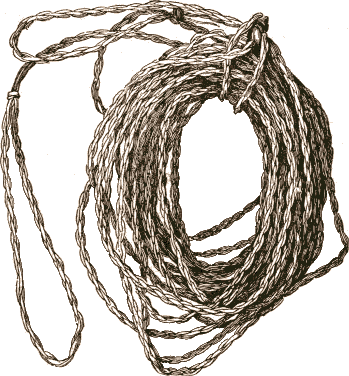
Fig. 140.—Reindeer snare. Nenenot.
When a herd of deer is discovered in a favorable locality the people of the vicinity are informed and hasty preparations are made.
The effort is to cause the deer to pass through a narrow defile containing bushes. The snares are then placed in position by tying the free end of the line to a suitable tree and suspending the noose where the heads or antlers will become entangled. Some are placed so that when the foot is lifted the noose is carried along and tightens on it.
The people surround the animals, and at a given signal shout and create the greatest din, to confuse the creatures, which plunge toward the place where the snares are set. One or two hunters concealed in that locality appear suddenly and further confuse the now panic-stricken animals, which rush in every direction before their foes. They become immeshed in the nooses and are held until their throats are cut or they are choked by the cord.
It frequently happens that two deer will be caught in a single snare. The Indians assert that it is a most ludicrous sight to witness two sturdy bucks caught by the antlers in a single snare. They appear to accuse each other of the misfortune, and struggle terribly to free themselves. In the animals which are strangled by the noose the congested blood distends the veins and renders the flesh very dark.
Previous to the general use of guns the snaring method was of greater importance than at the present day. Even now the Indian does not lose any opportunity of employing the snare.
Some of the snares are made of tanned skin, which is softer and is often ornamented with strands of beads attached to the end of the line. Some of them are colored red, with a mixture of vermilion and hematite earths, thinned with water.
HUNTING.
I have already described the methods of hunting the reindeer and of capturing small game.
The beaver is not plentiful in the Ungava district, and not until the headwaters of the Koksoak and the lakes near the source of George’s river are reached are they to be found at all, excepting occasional stragglers.
The Indians have few of the skins of this animal to sell at the trading post of Fort Chimo.
The methods of capture differ in some respects from those elsewhere employed.
The habits of the beaver are so well known that a statement of their manner of life is unnecessary.
The food supply north of latitude 55° is so limited in quality and quantity that the scarcity of the animals is due entirely to the absence of the food necessary for their existence.
When the dams and structures made by the beaver are discovered the people devise means to capture it.
If it is convenient to get at the holes leading to the structure, which are always under water so deep that it will not freeze to the bottom, they are closed with a stick of wood and an opening made in the top of the hut. The animal is then caught by the hind legs or tail and lifted out. It seldom attempts to defend itself at first. As soon as the hunter can do so he jerks the animal out, and with a blow on its head kills it. If he should pause for an instant from the time the hand is put on the animal until the death blow is given, that very instant he certainly will be bitten with teeth so sharp and powerful that the fingers may be snipped from the hand as though with a pair of shears. The wound thus inflicted is often very severe and difficult to heal, as the bite is not only cutting but crushing.
Where the water can be drained from the pond or lake in which the beavers’ hut is built, the Indians often leave it high and dry by damming off the supply and allowing the water to drain away. As soon as the house is out of water the occupant emerges and is killed. Beavers are sometimes shot while sporting on the water during moonlight nights.
Some of the animals are captured by means of a net of peculiar construction. This net is of fine deerskin thongs netted into a circle nearly 2 feet in diameter, with meshes about an inch square. The meshes in the outer row are threaded upon a stout thong of deerskin, in length about four times the diameter of the net. This thong is now tied at the ends, and over one end thus tied is slipped a ring made of spruce root and wound with sinew to strengthen it. This ring is about an inch in diameter, only sufficient to allow freedom of the ends of the line. It is fastened to one of the meshes of the net in order to keep its place.
Where the water is too deep and only a single beaver is in the lodge the net is carefully spread over the mouth of the exit so placed as to form a purse into which the head and neck of the animal will be thrust as it leaves the hut. The mouth of the purse now tightens from the ring slipping along the string, and thus strangles the animal or else causes it to drown as it struggles to escape from the tightening cord.
The net is said to be a very effective means of capturing the beaver and will succeed when it has become too wary to be shot on the surface of the water.
The flesh of the beaver is considered valuable food by these people. They prize it highly and prefer the flesh of the female to that of the male.

Fig. 141.—Crooked knife, Nenenot.
MISCELLANEOUS IMPLEMENTS, TOOLS, ETC.
One of the most important tools used by the Nenenot is the “crooked” knife (Fig. 141). These instruments are made from steel files or knife blades. They are of various sizes depending on the amount of material at hand. The Indian takes a piece of metal and grinds one side of it flat and smooth; the other is edged like a drawing knife. The blade is now heated and bent to the desired curve. Some are more bent than others and some have only the point bent to one side. The few left-handed persons have the blade formed to suit themselves. It is set in a handle curved from the user and bent upward like the blade. At the end of the handle is generally to be found a thong on which a wooden button is placed for attachment to the belt, as no man ever goes off on a journey without this knife, however short may be the distance.
The handle is held in the hand at right angles or across the body and invariable drawn toward the user. It is employed for all purposes of whittling or shaving wood and one would be surprised to observe what large strips will separate when started with this apparently frail blade. The strips and slats of canoes, paddles, snowshoes, and in fact everything that can be cut from wood, are made with this knife. It requires much skill to guide the blade so as to cut the wood evenly; and to this end the thumb, which is placed upon the outer extremity of the handle, must steady the blade. The strain of the blade upon the handle is very great, and it must be securely held by means of stout thongs wrapped around it.
The crooked knife is a form of instrument in use among the Indians and Eskimo alike, and one of the few implements which those widely differing people have in common.
Awls (Fig. 142) are made of steel or iron. The back or spring of a pocketknife or a portion of a small file appears to be the favorite material for forming them. They are usually chisel-shaped and have rectangular corners. The handle into which the metal is fastened is generally of deer horn. The shape of the handle varies from a Y shape to that of a crescent.
These tools are constantly required for piercing holes in the various woods used in manufacture. Articles of simple construction the Indian prefers to make for himself, rather than pay an extortionate price to the trader. He is able to accomplish remarkable results with rude tools of his own make.
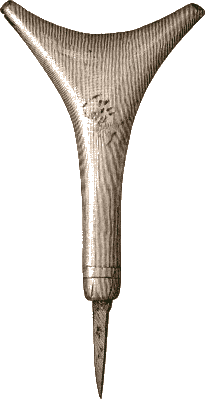
Fig. 142.—Awl, Nenenot.

Fig. 143.—Snow shovel, Nenenot.
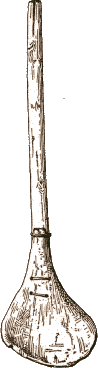
Fig. 144.—Ice-scoop, Nenenot.

Fig. 145.
Snow shovels are made of wood and are much used, for during the winter, when the snows are constantly accumulating around the camps, the occupants necessarily remove some to form a pathway from the door of their tent, and as snow forms an admirable protection, it is thrown or banked up around their tents to prevent the wind from blowing under. In the spring nearly all the aged people carry one of the wooden shovels to clear away a path or as a help to walk while the slushy snow is so treacherous. Fig. 143 represents a common form of wooden snow shovel. These are often painted with vermillion or indigo.
Fig. 144 shows a special form of snow shovel designed for cleaning the ice from the holes through which the people fish. It usually has a blade made from the brow antler or one of the broad palms from the horns of the reindeer. The horn portion is attached to the wooden shaft or handle by means of thongs running through holes bored for that purpose.
The ice-picks (Fig. 145) used in times gone by were pieces of reindeer horn or bone, shaped like a narrow mortising chisel and attached to staffs of wood. The chisel or pick was fastened to the staff by means of stout thongs to prevent a side movement from the groove into which it was set. The upper end of the staff was at times shod with bone or horn so as to be available for a walking staff.
The ice-pick of the present day has a piece of iron or steel substituted for the horn or bone; but, being heavy, it is not so often carried from place to place. An Indian will in an incredibly short time pierce a hole through 3 feet thickness of ice with it. A white man can not equal them in this work.
Combs for the hair are purchased from the traders. They are highly prized and are kept in little birchbark bags. For cleaning out the dirt which collects on the comb the tail of a porcupine is used. The needles or spines are picked out of the tail, leaving the stiff, coarse hairs, which serve the purpose of cleaning the comb quite well. This tail is usually appended to the comb-case.
The natives sometimes make wooden combs like the one shown in Fig. 146, in imitation of those purchased.
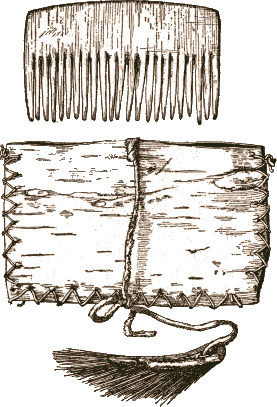
Fig. 146.—Comb, with birchbark case and cleaner.
After a woman’s hair has been combed half of it is collected on each side of the head and rolled or wound up on small pieces of board (Fig. 147) similar in shape to the “winders” on which darning or knitting cord is wrapped. Strands of beads are now placed upon these to hold the hair in place.
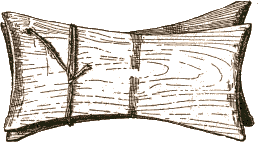
Fig. 147.—Boards for woman’s hair.
A remarkable object is shown in Fig. 148. It is one of a pair of boards procured from one of the Little Whale river Indians, by whom they are used to assist in swimming. One board is held in each hand and used as a paddle to push the swimmer along. Indians able to swim are scarce. I have not seen these boards in use, and am not able personally to speak concerning their alleged function.
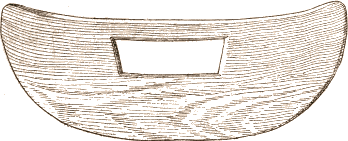
Fig. 148.—Swimming board.
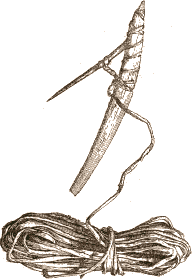
Fig. 149.—Fishhook and line.
The fish-hook shown in Fig. 149 has a barb of steel or iron. It is on the smaller hooks made of one of the ribs of the larger trout.
AMUSEMENTS.
The boys have no consideration for the females of their own age, but treat them as inferiors and fit for nothing but to be subjects of almost constant annoyance and persecution. When a number of boys collect they are sure to maltreat the women, even those advanced in years, and appear to delight in any opportunity to subject them to the rudest mischief. If a woman ventures to peep from the tent in summer a shower of water is sure to be flung on her by some boy. In winter snowballing is equally annoying, and when parties of women go to the woods to get fuel the pack of boys is sure to waylay them as they return. If the boys can separate the women their fun is complete; their dresses are torn and their bundles of fuel scattered. They often retaliate, however, and strip the clothing from some unfortunate boy who is compelled to return to camp in a nude condition, much to the amusement of the people. This form of disgrace appears to be the most severe which can be inflicted upon a male; and the jokes to which he is afterward subjected keep him the object of ridicule for many days.
Besides practical jokes upon women, running, jumping, wrestling, and practicing with the bow and other weapons suited to their age, appear to be the principal amusements of the boys. The girls have never been observed to play at games of any kind. Their chief occupation is to keep away from the boys. While walking out the girls generally toss stones or chips in the air and strive to keep at least two of them up at once. The Eskimo often practice this also, and, as it appears to be a general source of amusement among the Innuit, I suspect that the Indian borrowed it from them. Wrestling appears to be the principal test for physical strength and severe contests often engage the stronger individuals. They wrestle in the Eskimo fashion, and frequently indulge in trials of strength with these people. As would be expected, the stronger Eskimo are always the victors. All these contests, whether among themselves or with the Eskimo, are carried on with the best of good humor.
FESTIVALS.
Feasts are given now and then to celebrate success in hunting and similar achievements.
In 1883 I was invited to attend a feast of furs to be given by one of the most energetic of the Indians. We repaired to the tents spread on the top of a high wall of rock a few rods from my house. As I approached the scene I observed a tent of different construction. It was nearly oval at its base and had a diameter of about 18 feet and a length of about 25 feet. The top was drawn to an apex resembling the common roof of a house. The entrance to the structure faced southeast. On a pole, supported with one end on the apex of the tent and the other resting on a post, were numbers of skins of various animals—wolves, wolverine, beaver, otter, foxes, and muskrat, together with a number of the finest reindeer skins. The sound of the drum was heard within the structure and as I approached the door the noise ceased. I paused and was invited to enter. Immediately two old men next the drummer moved to one side and motioned me to sit down on the pile of deerskins reserved for me. It was evident that the feast had been in progress for some time. Around the interior of the structure groups of men were idly disposed, some reclining and others standing. Not a word was spoken for some time, and this gave me opportunity to look around. The floor was covered with boughs from the neighboring spruce trees, arranged with unusual care, forming a soft carpeting for those seated within. I saw a number of piles of deerskins and several small heaps covered with cloth. To break the silence I inquired if the drum was tired. A smile greeted the inquiry. Immediately an old man came forward, tightened the snare of the drum, and arranged the string, suspending it from one of the tent poles at the proper height for use. He then dipped his fingers into a vessel of water and sprinkled a few drops on the membrane of the drum-head to prevent it from breaking under the blows to be delivered. The performer then seized the drumstick with the right hand and gave the membrane a few taps; the transverse cord of twisted sinew, holding the small cylinders of wood attached to it, repeated the vibration with increased emphasis. A song was begun and the drum beaten in rhythm to the monotonous chant of o-ho, o-ho, etc. Three songs with tympanic accompaniment followed. The songs appeared alike and were easily learned. In the meanwhile the guests were treated to a strange-looking compound which had lain hidden beneath one of the cloths and is known as “pemmican.” I was solicited to accept a piece. The previously assembled guests had either brought their own bowls and saucers to eat from or else appropriated those available. Not to be at a loss, one of the young men remarked that he would find one. From among the accumulated filth around one of the center poles supporting the structure a bowl was produced. The man coolly took the handkerchief which was tied around his forehead to keep his matted hair from his face and wiped out the interior of the bowl, and placing a piece of the pemmican within it, handed it to the attendant whose duty it was to offer it to me.
I, however, found it quite inedible. Other guests constantly arrived and some departed, made happy by their share of this compound of rancid tallow and marrow with a due admixture of pounded dry meat of the reindeer. I soon departed, and attempted to take the remnant of the pemmican with me. This was instantly forbidden, and information given me that by so doing I should cause all the deer to desert the vicinity, and thus make the people starve. I explained that such was not my desire, and after wishing continued prosperity and enjoyment, I made my way out. I was then informed that the feast would continue for a time, and wind up with an invitation to the women, who had hitherto been excluded, to come and eat the remnants left by the men. At the end of two days thereafter the feast concluded and a dance took place. In this performance there was nothing remarkable. The men sang songs and kicked up their heels, while the women shrugged their shoulders as they swayed their bodies from right to left, and assumed various other postures, although their limbs were apparently kept in a rigid position, occasionally uttering their plaudits as the men made humorous compliments to their generous host.
This feast was given by one who had been unusually successful in the capture of fur-bearing animals, and, to prove his wealth, displayed it before the assemblage and gave a feast in consideration of his ability. Other feasts of a similar character occur, and differ from this in no special feature.
The principal source of amusement with the men is the game of draughts or checkers. While the men are in the tent or on the hillsides awaiting the approach of bands of deer their idle moments are employed over this game. Neither hunger nor the sight of game is sufficient to distract them, so intently are they absorbed.
The game is played as in civilization, with only slight differences. I am not aware that wagers are laid upon its issue. Some of the men are so expert that they would rank as skillful players in any part of the world.
Small boards that may be carried in the hunting bag are used on trips to while away the tedium of the long winter evenings with only the light of the flickering fire of the dry limbs of spruce. Far into the night the players engage, and are only disturbed when one of their tired companions starts from his sleep to relate a wondrous dream and have it expounded by the listeners, who sit aghast at the revelations.
They also have a game corresponding to “cup and ball,” but it is played with different implements from what the Eskimo use, as may be seen by referring to Fig. 150. The hollow cones are made from the terminal phalanges of the reindeer’s foot. The tail tied to the end of the thong is that of a marten or a mink. The player holds the peg in one hand, and tossing up the bones tries to catch the nearest bone on the point of the peg. The object of the game is to catch the bone the greatest possible number of times. It is in no sense a gambling game.
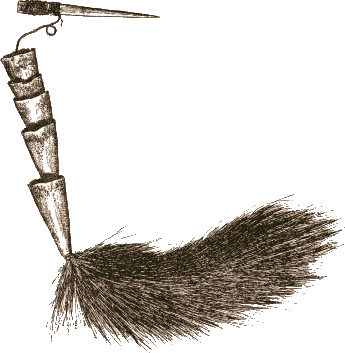
Fig. 150.—Cup-and-ball, Nenenot.
The only musical instrument used by these people is the drum or tambourine, which is of the form shown in Fig. 151. These drums vary in diameter from 22 to 26 inches, and are constructed as follows: The barrel is made of a thin slat of spruce, bent into a hoop, with the ends joined in a lap, spliced nearly a foot long, which length is sewed by four perpendicular seams. The stitches are made with deerskin thread put through perforations, near together, made with an awl. The next operation is to prepare for a head a thin reindeer skin, which has been tanned. The skin is moistened and sewed so that all holes in it are closed. A narrow hoop of a size to fit tightly over the barrel of the drum is made and the moist skin stretched over it. The edges of the skin are turned inward, and within this hoop is placed the barrel of the drum.
A second hoop, two or three times as wide as the first, is prepared and fitted over the barrel and head. It is pushed down as far as the elasticity of the membrane will allow, or about half the width of the top hoop. Through the outer hoop have been made a number of holes and corresponding but alternate holes made in the farther edge of the barrel of the drum.
Through these holes a stout thong is threaded and passing from the edge of the barrel to the outer hoop is drawn so tightly as to push the inner hoop along the outer circumference of the barrel and thus tighten the membrane to the required degree. The outer hoop now projects an inch or more beyond the membrane and thus protects it from injury by careless handling.
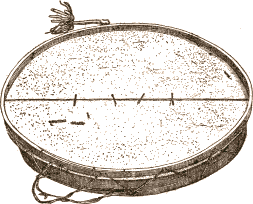
Fig. 151.—Drum, Nenenot.
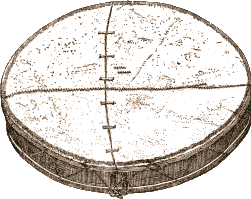
Fig. 152.—Drum, Little Whale river.
Across the membrane is stretched a sinew cord on which are strung, at right angles to the cord, a number of barrels made from the quills of the wing feathers of the willow ptarmigan. Across the underside of the membrane is stretched a similar cord with quills. These serve the purpose of a snare on the drum. The stick used for beating the drum consists of a piece of reindeer horn cut so as to have a thin and narrow handle a foot in length and terminating in a knob more than an inch long and as thick as the portion of horn permits. The drum is suspended from the poles of the tent by means of thongs. The performer tightens the snares, and sprinkles a few drops of water on the drumhead lest the blows cause it to split under the strain. Nothing is done, nothing contemplated without sounding the drum. It is silent only when the people are asleep or on a tramp from one locality to another.
If a person is ill the drum is beaten. If a person is well the drum is beaten. If prosperous in the chase the drum is beaten; and if death has snatched a member from the community the drum is beaten to prevent his spirit from returning to torment the living.
The drumbeat is often accompanied with singing which is the most discordant of all sounds supposed to be harmonious.
The drums used by the Little Whale river Indians (Fig. 152, No. 3223) differs greatly in construction from those made by the Ungava Indians. The size is rarely so great, seldom exceeding 22 inches. These drums have two heads or membranes fitted on the barrel and secured by means of a single hoop for each head. The two hoops are then connected by the tightening strings.
The membranes are invariably made of deer skin in the parchment condition and not of tanned skins. The snares or thongs across the heads are finer and have pieces of wood instead of quills as “rattlers.” The drumstick is a piece of reindeer horn cut as before described; or else, as if to add to the din, a gun-cap box is pierced through from side to side and a few pebbles or shot placed within. A stick is then inserted in the hole through the box and the whole covered with buckskin to prevent separation of the lid and box. This makes a distracting noise.
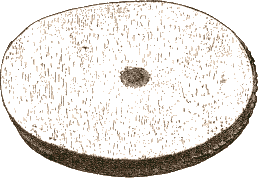
Fig. 153.—Rattle, Nenenot.
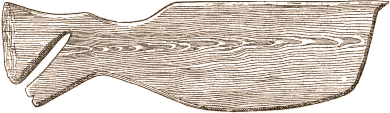
Fig. 154.—Target, reindeer, buck.
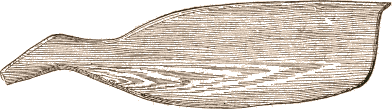
Fig. 155.—Target, reindeer, doe.
Rattles for the children (Fig. 153) are made of a hoop of wood bent to a circular form and covered with two heads or membranes. Within it are placed a few pebbles or shot, to produce a rattling sound when the membranes are dry. A cord attached to the circumference enables the rattle to be suspended from the tent-pole in front of the child for whose amusement it is intended. Other toys are made for the children, but they were not easy for us to obtain. Pl. XLIII represents a doll, dressed in a woman’s full suit of clothes. The boys amuse themselves by shooting with blunt arrows at images of reindeer, bucks, does, and fawns, cut out of flat boards stuck up in the snow (Figs. 154, 155).
BUREAU OF ETHNOLOGY ELEVENTH ANNUAL REPORT PL. XLIII
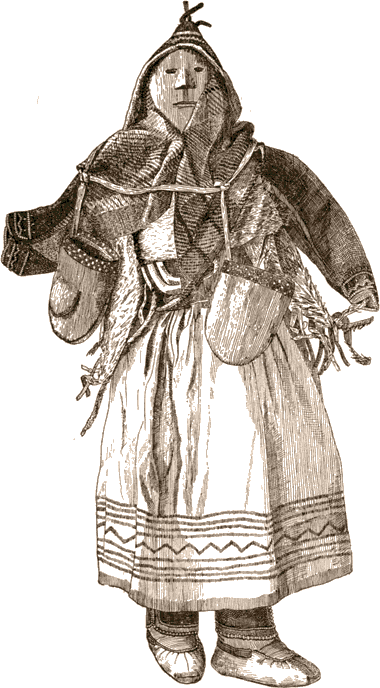
DOLL, INDIAN WOMAN, FULL DRESS, NENENOT.
FOLKLORE.
During the long winter nights or during the periods of cold or inclement weather in which the Indians may not venture out, they sit around the fire and relate stories intended for the instruction as well as entertainment of the younger people. The older men have a great stock of these stories, and many of the women are noted for their ability in entertaining the children, who sit, with staring eyes and open mouth, in the arms of their parents or elders.
The following stories came to me directly and not through the medium of another white person, and probably I am the only white person who has heard some of them. I have endeavored to give them as nearly in the form of the original as the differences between the English and the Indian languages will permit.
Story of the wolverene and the brant.—
A wolverene calling all the birds together addressed them thus: “Do you not know that I am your brother? Come to me and I will dress you in feathers.” After having dressed them up he made wings for himself and said: “Now, brothers, let us fly.” The brant told the wolverene, “You must not look below while we are flying over the point of land when you hear a noise below. Take a turn when we take a turn.”
The first turn they took the wolverene did not look below, but at the second turn they took, when they came over the point of land, the animal looked below when he heard the noise of the shouting Indians and down he came like a bundle of rags.2
All the Indians ran up to him and exclaimed “There is a brant fallen down.” One of the old Indian women got hold of him and began to pluck his feathers off, then to disembowel him. She of course smelled the horrible stench and exclaimed, “This goose is not fit to eat as it is already rotten!” She gave the carcass to one of the children to throw away. Another old woman came up and inquired, “Where did you throw the brant goose to? How could it be rotten? It is not long since it was killed.” The former old woman replied to her, “Go and see, if you do not believe.” She went and found nothing but the dead wolverene.
Story of the wolverene.—
A wolverene was running along the seashore and perceived a number of geese, brant, ducks, and loons sitting in the water a short distance off. The wolverene addressing them said, “Come here, brothers. I have found a pretty bees’ nest. I will give it to you if you will come on shore and have a dance.” All the birds went on land. The wolverene said, “Let us have a dance and I will sing. Shut your eyes and do not open them until we are done dancing.” He began to sing, “A-ho´u-mu-hou-mu´-mu´-hŭm´.” The last word was so often repeated (accompanied with the act of the wolverene snipping off the heads of the birds) that the loon opened one eye and saw the headless ducks kicking. The loon ran to the water and exclaimed, “Our brother has killed us!” The wolverene ran after the loon but the loon dived under the water and came up a distance off and cried out, “A ho ho ho ho ho ho!” The wolverene screamed, “Hold your tongue, you red-eyed fowl.” The wolverene returned to where the ducks had been killed; plucked their feathers off and cleaned them; put them into a large kettle and boiled them.
While attending to the cooking he saw a whisky-jack (Us´ ka tcon) (Perisoreus canadensis) flying about. The wolverene took a firebrand and threw it at the bird, exclaiming, “You will be telling on me, you long-tongued bird!” The jay flew away and told the Indians that “Our brother (wolverene) has killed a lot of ducks and has them cooked,” adding, “I think he is sleeping. I’ll show you where he is if you will come.” The Indians replied, “We will go, for we are very hungry.” They went and found the wolverene asleep alongside the pot. The Indians ate all of the meat of the ducks. After they had finished the meat they put the bones back into the kettle and went away. The wolverene awakened after a time, took his dish and said to himself, “Now, I shall have my dinner.” He poured all the broth into his dish and found nothing but the bones remaining. In his surprise he said, “Surely, I have been sleeping a long time; the meat is all boiled away.” The jay told him that he had told the Indians. The wolverene said, “Why did you tell? you stupid bird; I was keeping a nice piece of fat for you.3 You will not, now, get it for your impudence.”
The deer and the squirrel.—
A reindeer called all the mammals and birds together and announced that he would give names to all of them. When he came to name the squirrel he inquired of the little creature what name it would prefer. The squirrel replied that it would like to have the same name as the black bear. The reindeer smiled and informed the squirrel that it was too small to have the name of the bear. The squirrel began to cry and wept so long that his lower eyelids became white.
The young man who went to live with the deer.—
A young man one morning told his old father that he had dreamed the night before that a deer had asked him to come and live with them. The old father replied, “That is a good sign; you will kill many deer after that dream.” The young man went away to hunt, and while out he saw a large herd of deer. A young doe from the band ran up toward him, and he was about to fire at her when she said to him, “Do not fire, for my father has sent me to you. Please put up your arrows.” She came nearer and informed him that her father had sent her to ask him to come and live with the deer forever.
The young man inquired, “How could I live with you when it is upon deer that I live? I live in a tent and can not live outside. I can not live without fire. I can not live without water.” The doe replied, “We have plenty of fire, water, and meat; you will never want; you will live forever. Your father will never want, as there will be enough deer given to him.” The man consented to go with them. The doe pointed to a large hill and said, “That is our home.” She told him to leave his deerskin mantle, snowshoes, and arrows on the ground, but to keep the bow. As they were walking along they came to a big valley. She informed him that that was their path. The two went toward the steep hillside and found the ground to be covered with deer. Some of the deer were frightened when they saw the man coming, and started to run. The doe’s father said to the frightened deer, “Do you not pity the poor Indians who have to hunt for their living while we do not?” When the young man and the doe came up, the father of the doe addressed the young man, asking if he was hungry. The man replied, “Yes.” The father then gave him a piece of nice meat and some fat. After the man had finished eating the father inquired, “Is your father also hungry?” The son replied, “Yes.”
The old buck informed the young man that they would give the son’s father some deer to-morrow. After the young man had slept out one night his father, in the morning, went out to look for his son, but found only his mantle, snowshoes, and arrows, which had been cast aside the day before, and also found the tracks in the valley leading to the home of the deer under the hill. The old man returned to his tent and told the other Indians that his son had gone away to live with the deer. The old man then said, “Let us make snares and we will yet take him, as he can not run as fast as the deer.” The Indians prepared a number of snare nooses and went to the valley to set them among the bushes on the path. The father of the young doe saw what was going on in the valley and told the rest, “Let us go and give the old man some deer.” He told the young man to come with them. The man replied that he could not accompany them, as he would be left behind in no time while they were running. The old buck instructed the young man to keep among the rest of the deer and he would not be left behind them. All the deer then went out to the valley. The young man kept among them; and as they were going through the bushes he heard the shouts of the Indians who were concealed behind them. The deer saw the snares and some of the animals fell into the nooses and were caught. The remainder, with the young man, were soon beyond the snares. The Indians began to kill the deer which had been taken in the nooses, and when they had finished they found they had not captured the young man. They consulted together and decided to search among the tracks of the escaped deer to ascertain whether his foot-prints were among them. They found his track and also the mark of his bow as he had dragged it along in the snow.
The young man’s father then said, “Let him go if he thinks he is able to live with the deer;” and the people returned to their tents.
The wolf’s daughter going to seek her lover.—
An old mother wolf one morning said to her daughter, “You must go and look for your lover or else we shall all starve to death, as your brothers can not kill any deer.” The daughter inquired of her mother, “Who is my lover?” The mother replied, “The otter is your lover. He lives in the water. If you go to the narrows of the lake you will find him.” The daughter said she would go. So early in the morning she started off, and as she was going along the shore of the lake she saw an open hole in the ice, and in the water the otter was sitting. The wolf went up to the otter, but the otter swam away and was going to dive, when the wolf said, “Do not dive and go away. My mother says you are my lover.” The otter asked, “How can I be your lover when I live in the water?” The wolf replied, “You can live on the land as well as in the water.” The otter answered back, “I will not live on the land.” The wolf retorted, “You will have to live on the land, and if you do not come out I shall smother you in the water.” The otter said, “You can not smother me, for I have a number of holes made in the lake ice.” The otter dove into the water and disappeared. The wolf began to howl dismally when the otter vanished. The wind began to blow and drifted the snow furiously. The snow fell into the otter’s breathing holes and filled them with slushy snow, which soon froze and completely stopped all the holes in the ice but one where the wolf was sitting. This hole was kept clear of snow and ice by the wolf scraping it out as fast as it collected. Soon she heard the otter going to the holes for breath, but when he came near the hole where the wolf was sitting she could hear him snuffing for air, and she stood with open jaws ready to seize him when he should appear. The otter was nearly exhausted, so the wolf went off a little distance, and the otter came up to the surface of the water nearly out of breath. He crept out of the water and rolled himself in the dry snow to take the water off of his coat of fur and exclaimed to the wolf, “I will live with you; I will live with you.” The wolf then addressed her lover and said, “Did I not tell you I would smother you?” The otter did not reply to this, but asked her, “Have you got a piece of line? Give it to me, and I will go to catch some fish for you if you will go and prepare a tent.” The wolf drew out a piece of fishing line and handed it to the otter. The otter went down into the same hole in the ice whence he had come. He was gone some time, and in the meantime the wolf was busy making the tent, which was completed before the otter returned. Soon after, however, the otter came back to the hole with a long string of fish which he had killed and had them all strung on the line. He left the string of fish in the hole in the ice with one end of it fastened to the ice. The otter rolled himself in the snow to remove the water from his fur, and then went to the tent to tell his wife to go and get the fish which he had left in the hole in the ice. The wolf went and hauled up the line, which was full of fish, and began to devour so many that soon she could scarcely move. She hauled the remainder of the fish home to the tent.
The otter was sleeping when she returned. She proceeded to clean the fish and put on a large kettle full of the fish to boil for supper. She then crept into bed with her husband, and the next morning she was delivered of a young otter and a young wolf. After the father and mother had taken their breakfast the latter sat with her head hanging down and seemed to be in a miserable mood. The otter inquired of the wife wolf, “What is the matter with you that you sit so quietly?” The wolf answered: “I wish I had some deerskins with which to make clothing for the children. How nicely I should dress them!” The otter replied: “Open the door and I will show you where I get the deer.” It was yet early, and the otter went away to seek the deer. The otter saw a band of thirty deer, but had no gun with which to kill them, so he frightened them, and as they were running away he sprang at them each, and jumped through them from end to end. He killed all of them in this manner and then rolled in the snow to cleanse himself. After that was done he wended his way home, and on arriving informed his wife (for it was then a little after sunset) that on the morrow she should go to bring home the deer he had killed, adding that she could follow his track, and thus find them. The wife had a big pot of fish cooked for him when he returned, and when he had finished his supper he went to bed. As soon as the wife suspected her husband to be asleep she went after the deer, and by hauling four at a time she soon had them all brought, and laid them before the tent. When that was finished she went to bed. In the morning the otter told her to get up and make a fire, as she would have to go for the carcasses of the deer which he had killed the day before. The wife replied: “I have already brought them all home.” The otter asked her: “How could you bring them home in the dark?” The wife answered: “Look out through the door if you do not believe me.” The otter looked and saw the thirty deer all piled up before the door. He turned and looked at his wife, but made no remark. The wolf asked him: “Why do you look at me, so hard?” The otter said: “I was wondering how you could get them home in such a short time.” The wolf said: “Come, and take your breakfast, for you will have to help me skin the deer.” After they had finished eating their breakfast they began to skin the deer, and soon had them done. The wolf told her husband to make a stage or scaffold for the meat, adding that she would clean the skins. The otter prepared the stage, which in a short time was completed. The meat was placed on the stage and the skins hung up to dry around the tent. They then went in to take their supper. The wife was not in a talkative mood, and soon went to bed. The next morning the wolf hung her head down, and the otter seeing her again in such mood, inquired what was the matter with her that she should be so quiet. The wolf replied: “I am thinking of my poor father and mother and brothers; I suppose they will all be starved to death. My old father told me to tell you to put a mark on the middle of the lake so they would know where I am.” The otter went to the middle of the lake and erected a pile as a mark by which the wolf’s relations should know it. The brothers of the otter’s wife were on the hill looking for the mark set up by their sister’s husband, and when they saw it they exclaimed: “Our sister has saved us! our sister has saved us!” and ran back to their old father’s home to give him the joyful intelligence that they had seen the mark put up by the husband of their sister. The old wolf then told his family that they would go and seek their sister and daughter to live with her and her husband. They all went to the hill by the lake, and from the top of it they saw the mark, and from it they followed the track of the otter until they saw the tent in the edge of the woods. They exclaimed: “There is our sister’s tent, for the deerskins are hanging outside.” They raised such a joyful shout at the prospect before them, that the noise frightened some young otters (for the family had now become larger) which were playing outside. The little ones scampered in and hid themselves behind their father’s back. The father inquired, “What is the matter, that you are so frightened?” The little ones replied: “We are running from the Hunger” (for that was the name they applied to the wolves). The mother replied: “Perhaps they see my father, mother, and brothers coming.” The otter told his wife to go out and see. She complied, and when she opened the door they saw a row of gaunt wolves; nothing but skin and bones. The newcomers immediately fell to, and began to devour the meat which was on the stage. The otter’s wife remonstrated, and said: “Do not be so greedy; my husband is not a stingy man. I take my meals when he is sleeping, and pretend not to eat much during the day.” They all went into the tent and the otter soon went to bed. When they thought he was asleep, they began to eat all the raw meat and fish, and soon finished it. In the morning when the otter had awakened, he remarked to his wife: “I think your brothers will make a fool of me.” The wife asked: “What makes you think so?” The otter replied: “They look at me so hard, that I do not know where to turn my eyes.” After breakfast the otter and his wolf brothers went away to look for deer. They soon came upon a band of them, and the otter told the wolves to go and kill them. The wolves ran after the deer, but got only one of them. After the deer were frightened by the wolves, the otter sprang after the deer and soon killed every one of them in the same manner he had killed the others. He then cleaned himself in the dry snow and returned home. The wolves had started for the tent before the otter, so when the latter returned they asked the otter: “How many deer did you kill?” The otter replied: “I killed all that were in the band,” adding, “In the morning you will have to go for the deer.” So everything was got ready for an early start and they all retired to bed. When they awakened in the morning, one of the wife’s brothers said to another: “Look at our otter brother; he has a white mouth.” The otter turned to his wife and said to her: “Did I not tell you that your brothers would make a fool of me?” The otter then took his two otter children in his arms, and told his wife that she would have to make her living as best she could, as he would not live with her any more, that he was going away to leave her. He darted off to the lake, and disappeared under the ice, and was never seen again.
The devil punishing a liar.—
A bear (mackwh) had two young cubs which she did not want to let know that summer had come, but kept them in the den and would not let them go out. The young ones continually inquired if the summer had come, and repeated the question every time the mother returned from the outside. She invariably answered, “No.” Some days after she fell asleep, when she had returned from one of her trips, and while sleeping her mouth opened wide. The young ones said to each other: “Surely the summer is come, for there are green leaves in our mother’s mouth.” The mother had told her children how beautiful was the summer time, how green the trees, how juicy the plants, and how sweet the berries; so the cubs, impatient, while longing for summer that they might enjoy what was outside of their den, knew by the leaves in their mother’s mouth that she had deceived them. The older cub told the younger that they would slip out at the top of the den and go out while their mother was yet sleeping. They crept out and found the weather so fine and the surroundings so pleasant that they wandered some distance off by the time she wakened from her sleep. She ran out and called loudly for her children, seemingly surprised, and exclaimed: “My sons, the summer has come; the summer has come.” The cubs hid when they heard their mother’s voice. She called to them until nightfall. The older cub said to his brother: “I wish the devil (A-qan´) would hear her and kill her for telling us the summer had not come, and keeping us in the house so long when it was already pleasant outside.”
The mother bear soon screamed to her sons: “The devil has heard me and is killing me.”
The cubs heard the devil killing their mother with a stone, pounding her on the head.
They became frightened and ran-away.
A wolverene destroys his sister.—
A wolverene having wandered far, for several days without food, suddenly came upon a bear. The former, feeling very hungry, conceived the plan of destroying his larger prey by stratagem. The wolverene cautiously approached the bear and exclaimed: “Is that you, sister?” The bear turned around and saw the wolverene, but in a low tone, which the wolverene did not hear, said to herself: “I did not know that I had a brother,” so ran quickly away. The wolverene continued to scream: “Come here, sister, our father has sent me to look for you. You were lost when you were a little girl out picking berries.” Thus spoken to, the bear approached the supposed brother, who informed her that he knew of a place, on the hill there, where a lot of nice berries were ready for eating, saying: “Do you not see the berries growing on that hill, sister?” The bear answered: “I cannot see so great a distance.” So the two went up the hillside where the berries grew. When they arrived at the place, and it was some distance off, the bear asked: “How is it that your eyes are so good?” The wolverene replied: “My father mashed a lot of cranberries into my eyes and put me into a sweat house.” The bear said: “I wish my eyes were as good as yours.” The wolverene answered: “I will make your eyes as good as mine if you will gather a lot of cranberries while I prepare a sweat house.” The bear went to gather berries while the other prepared the house during her absence. The wolverene selected a stone having a sharp edge, which she concealed under the moss in the sweat house, while she procured a larger stone for the pillow.
After the sweat house was completed the wolverene cried out: “Sister, the sweat house is finished!” The bear returned, bringing a quantity of berries. They both went into the sudatory, whereupon the wolverene instructed the bear to lie with her head upon the stone pillow, while he prepared the crushed berries to put in her eyes. He then said to her: “Now, sister, do not move; you may find the berries will hurt the eyes and make them very sore, but they will be better soon.” The wolverene filled the bear’s eyes full of the sour berries, which made her exclaim: “Brother, they are making my eyes very sore.” The wolverene answered: “You will find them the better for that. After I get your eyes full of the berries I will blow my breath on them.” After the eyes of the bear were full of berries the wolverene said: “You are too good to be a sister,” so he struck her on the head with the sharp-edged stone and cleft her skull between the eyes and killed her.
The rabbit and the frog.—
One day a rabbit was wandering among the hillsides, and at a short distance from him he observed a tent belonging to some Indians. Being timid he crept up to the side of the tent and peeped through a small hole, and saw inside of it a frog sitting near the fire. The rabbit seeing no danger accosted the frog thus: “Brother, what are you doing?” The frog replied: “I am playing with the ashes. My brothers have gone off hunting and I am here as I have a very sore leg and can not go far.” The rabbit rejoined, “come with me and I will keep you?” The frog answered, “I can not walk as my leg is too sore.” The rabbit offered to carry the frog on his back. The rabbit took the frog and giving him a toss threw him on his back and said: “This is the way I will carry you.” So they started for the home of the rabbit, where, upon arriving, the rabbit placed the frog inside of the tent while the former went out to look for something to eat. While seeking food the rabbit suddenly spied a smoke curling from among the willows which grew along the branch of the creek. He became frightened and started to run homeward exclaiming, “I have forgotten my crooked knife and I must go quickly to get it.” (This part, or what the rabbit says to himself, is sung as a song; with an attempt at imitation of the rabbit’s voice.) The rabbit ran hurriedly home and sprang into the tent, whereupon the frog observing the fright of the other inquired, “Brother, what is the matter that you are so excited?” The rabbit answered, “I saw a large smoke.” “Where is it?” inquired the frog. The rabbit replied, “It is from among the willows along the creek that runs near by.” The frog began to laugh at the foolish fear of the rabbit and answered him that the smoke proceeded from the lodge of a family of beavers, and taunted the rabbit for being afraid of such a timid creature as a beaver when they are good to eat, adding that his own (frogs) brothers often carried him to the beavers’ houses to kill them when they were out of food; although his brothers could never kill any of them.
The rabbit was pleased to hear the frog was such a great hunter, and gladly offered to carry the frog to the lodge of the beavers that some food could be procured. The frog accepted the offer and was carried to the creek bank. The rabbit then built a dam of stakes across the stream and below the lodges in order that the beavers should not escape. The frog then directed the rabbit to break into the top of the lodge so that the frog might get at the beavers to kill them. While the rabbit was breaking into the lodge of the beavers, the frog purposely loosened some of the stakes of the weir below in order to allow the beavers to escape, hoping that the rabbit would become angry at him for so doing. When the rabbit saw what mischief the frog had done, he took the frog and roughly shoved him under the ice into the water. This did not harm the frog as it could live under water as well as on land, but the rabbit did not know that, so he believed he had drowned his brother the frog. The rabbit then returned to his home, regretting he had acted so harshly and began to cry for his brother. The frog in the meanwhile, killed all of the beavers and tied them together on a string, then slowly crawled to the rabbit’s home with his burden on his back. The frog crept up to the tent but was afraid to enter so he began to play with the door flap of the tent to make a noise to attract the attention of the rabbit within. Finally he cried out to the rabbit, “Brother, give me a piece of fire for I am very cold.” The rabbit did not recognize the tired, weak voice of his brother frog, and, afraid lest it be some enemy endeavoring to entice him from his home, picked up a piece of dead coal which had no fire on it and flung it outside. The frog then said, “Brother, there is no fire on this piece and I can not cook my beavers with it.” The rabbit then ran out quickly and tenderly carried the frog inside, and immediately the latter began to moan and appear to suffer so much that the rabbit inquired what was the matter and asked if the beavers had bitten him. The frog said, “No, it was you who gave me such a hard push that you have hurt me in the side.” The rabbit assured the frog that the injury was unintentionally caused. The frog then directed the rabbit to prepare and cook the beavers. The rabbit went out to fetch them but he began to eat and did not stop until they were all devoured. After having finished eating them the rabbit went for a walk. Ere long he noticed a huge smoke curling from the farther end of a valley and becoming greatly frightened he exclaimed, “I have forgotten my crooked knife and I must go quickly to get it.” He dashed into his door in a terrible state of mind. The frog coolly inquired, “What is the matter that you are so scared?” The rabbit said, “I have seen a great smoke at the farther end of the valley through which the creek runs.” The frog laughed loudly at his fear and said, “They are deer; my brothers often had me to kill them, as they could not kill any, when we had no meat.” The rabbit was delighted at that so he offered to carry the frog toward the place. The frog directed the rabbit to make a snowshoe for the one foot of the frog. The rabbit soon had it made and gave it to his brother. The frog then said, “Carry me up towards the smoke.” The rabbit slung the frog on his back and away they went in the direction of the deer. The frog then told the rabbit to stand in one place and not to move while he (the frog) would work at the deer, and when he had finished he would call him up to the place.
The frog killed all the deer in a very short time, skinned them, and stuck the head and neck of one of the deer into the snow so that it would be looking toward the place whence the rabbit would come. The frog then took the lungs of one of the deer and put it out to freeze. The cold turned the lungs white as tallow. The frog shouted for his brother rabbit to come quickly. When the rabbit came bounding near he saw the eyes of the deer’s head staring at him in a queer manner; he was so much alarmed that he exclaimed to the frog, “Brother, he sees me.” The frog smiled and said, “I have killed him; he is dead; come on; I have a nice piece of fat saved for you.” (It was the frozen lungs of the deer.) So he gave the rabbit a large piece and told him to eat it all and quickly, as it was better when frozen and fresh from the deer’s back. The rabbit greedily swallowed large portions and did not observe the deception. After a time they built a lodge or tent for the night. Some few hours after the tent was made the frozen deer lungs which the rabbit had eaten began to thaw and it made the rabbit so violently ill that he vomited continually the entire night. The frog had served him this trick as a punishment for having eaten all of the beaver meat two days before.
The wolverene and the rock.—
A wolverene was out walking on the hillside and came upon a large rock. The animal inquired of the rock, “Was that you who was walking just now?” The rock replied, “No, I can not move; hence I can not walk.” The wolverene retorted that he had seen it walking. The rock quickly informed the wolverene that he uttered a falsehood. The wolverene remarked, “You need not speak in that manner for I have seen you walking.” The wolverene ran off a little distance and taunted the rock, challenging it to catch him. The wolverene then approached the rock and having struck it with his paw, said, “See if you can catch me.” The rock answered, “I can not run but I can roll.” The wolverene began to laugh and said, “That is what I want.” The wolverene ran away and the rock rolled after him, keeping just at his heels. The animal finally began to tire and commenced to jump over sticks and stones until at last the rock was touching his heels. At last the wolverene tripped over a stick and fell. The rock rolled over on him and ceased to move when it came upon the hind parts of the wolverene. The animal screamed, “Get off, go away, you are hurting me; you are breaking my bones.” The rock remained motionless and replied, “You tormented me and had me run after you, so now I shall not stir until some one takes me off.”
The wolverene replied, “I have many brothers and I shall call them.” He called to the wolves and the foxes to come and remove the rock. These animals soon came up to where the rock was lying on the wolverene and they asked him, “How came you to get under the rock?” The wolverene replied, “I challenged the rock to catch me and it rolled on me.” The wolves and foxes then told him that it served him right to be under the rock. They endeavored, after a time, to displace the rock but could not move it in the least. The wolverene then said, “Well, if you cannot get me out I shall call my other brother, the lightning and thunder.” So he began to call for the lightning to come to his aid. In a few moments a huge dark cloud came rushing from the southwest, and as it hurried up it made so much noise that it frightened the wolves and foxes, but they asked the lightning to take off the coat of the wolverene but not to harm, his flesh. They then ran away. The lightning darted back to gather force and struck the rock, knocking it into small pieces and also completely stripped the skin from the back of the wolverene, tearing the skin into small pieces. The wolverene stood naked, but soon began to pick up the pieces of his coat and told the lightning, “You need not have torn my coat when you had only the rock to strike.”
The wolverene gathered up his pieces of coat and said he would go to his sister, the frog, to have her sew them together. He repaired to the swamp where his sister dwelt and asked her to sew them. She did so. The wolverene took it up and told her she had not put it together properly and struck her on the head and knocked her flying into the water. He took up the coat and went to his younger sister, the mouse. He directed her to sew his coat as it should be done. The mouse began to sew the pieces together and when it was done the wolverene carefully examined every seam and said, “You have sewed it very well; you will live in the tall green grass in the summer and in grass houses in the winter.” The wolverene put on his coat and went away.
Creation of people by the wolverene and the muskrat.—
As a wolverene was wandering along the bank of a river he saw a muskrat swimming in the edge of the water. He accosted the latter animal with the inquiry, “Who are you? Are you a man or a woman?” The muskrat answered, “I am a woman.” The wolverene informed her that he would take her for a wife. The muskrat replied, “I live in the water; how can I be your wife?” The wolverene told her that she could live on the land as well as in the water. The muskrat went up on the bank to where the wolverene was standing. They selected a place and she began to prepare a home for them. They ate their suppers and retired. Soon after a child was born. The wolverene informed his wife that it would be a white man and father of all the white people. When this child was born it made a natural exit. In due time a second child was born which the wolverene decreed should be an Indian and the father of their kind. This child was born from its mother’s mouth. After a time a third child was born, and the wolverene announced it to be an Eskimo and father of its kind. This child was born ab ano. In the natural course of events a fourth child was born, and the wolverene decided it to be an Iroquois and father of its kind. This child was born from its mother’s nose. After a time a fifth child was born and the wolverene decreed it should be a Negro and father of its kind. This child was born from its mother’s ears. These children remained with their parents until they grew up. Their mother then called them together and announced to them that they must separate. She sent them to different places of the land, and, in parting, directed them to go to the white men whenever they were in need of anything, as the whites would have everything ready for them.
Origin of the whitish spot on the throat of the marten.—
A man had a wife whom a marten fell in love with and endeavored to possess. Whenever the man would go away from his home the marten would enter, sit by the woman’s side, and endeavor to entice her to leave her husband and go to live with him. One day the man returned unexpectedly and caught the marten sitting by the side of his wife. The marten ran out. The man inquired of his wife what the marten wanted there. The woman replied that the marten was striving to induce her to desert him and become his own wife.
The next time the man went off he told his wife to fill a kettle with water and put it on the fire to boil. The man went outside and secreted himself near the house. He soon saw the marten go into the house.
The man stole quietly to the door of the house and listened to the marten, which was talking to his wife. The man sprang into the house and said: “Marten, what are you doing here, what are you trying to do?” The man seized the kettle of hot water and dashed it on the breast of the animal. The marten began to scratch his burning bosom and ran out into the woods; and because he was so severely hurt he now keeps in the densest forests, away from the sight of man.
The Indian and his beaver wife.—
One day an Indian was hunting along the bank of a stream and in the distance saw a beaver’s house. In a moment he perceived a beaver swimming toward him. He drew up and was on the point of shooting it when the animal exclaimed, “Do not shoot, I have something to say to you.” The Indian inquired, “What is it you have to say?” The beaver asked him, “Would you have me for a wife?” The Indian replied, “I can not live in the water with you.” The beaver answered, “You will not know you are living in the water, if you will follow me.” The Indian further remarked that he could not live on willows and other woods like a beaver. The beaver assured him that when eating them he would not think them to be willows. She added, “I have a nice house to live in.” The man replied, “My brother will be looking for me if I come in and he will not know where I am.” The beaver directed the man to take off his clothing and leave them on the bank and to follow her. The Indian did as he was instructed. As he was wading through the water he did not feel the water touching him; so they presently began to swim and soon reached the home of the beaver. The beaver told him as she pointed ahead, “There is my home, and you will find it as good and comfortable as your own tent.” They both entered and she soon set before him some food which he did not recognize as willow bark. After they had slept two nights his brother became alarmed and went to search for him, and soon found his track. In following it up his brother came to where he had left his clothing on the bank of the stream.
The brother was distressed at finding such things, so went sorrowfully back to the tent thinking that his brother had been drowned, and so told the other Indians when he arrived. With a heavy heart he went to bed and in the morning he awakened and told his wife that he had dreamed his brother was living with a beaver. He told his wife to make some new clothing for the lost brother as he would go and seek the haunts of the beavers to discover his brother. The man occupied himself in making a pair of snowshoes, while the wife prepared the clothing. The next day she had the clothing done and he directed her to make them into a small bundle as he would start on the search early the next morning. Other young men desired to accompany him on the search, but were advised to remain at home as their presence would prevent him from reaching the beaver’s retreat. Early in the morning he started off, taking the clothes and snowshoes with him. After some time he found the place where the beaver had her house and in which he suspected his brother to be living. He went to work to make a dam across the stream so as to decrease the depth of water around the beaver’s house. The wife had borne two children to the husband by this time, and when the father had seen the water going from their house he told the children: “Your uncle is coming and he is certain to kill you.” The water had soon gone down sufficiently to enable the man to cross the stream to where the house was situated.
On arriving there he began pounding at the mud walls. The father told the children to go out or else the house would fall on them. The man outside quickly killed the two young ones. The wife knew she would soon be killed also, and after they had heard the deathblows given to their children she said to her husband, “If you are sorry that I am killed and ever want to see me again, keep the right hand and arm of my body; take off the skin and keep it about you.” In a few minutes the brother had begun again to tear out the sides of the lodge. The husband told her to go out, and that his love for her would make him keep her right hand. She then went out and was quickly killed with a stick. When this was done and the husband had heard it all he was very sorry for his wife. Again the man began to destroy the rest of the house and soon had a large hole in the wall of one side. The husband then said to him, “What are you doing? You are making me very cold.” The brother replied, “I have brought some warm clothing for you and you will not feel cold.” “Throw them in,” said the husband, “for I am freezing.” He put on the clothes, and while he was doing it the brother noticed the hairs which had grown on the other’s back, but said nothing about it. The husband then sat in his house until the other was near freezing to death. The brother then said to him, “Come with me; you can not stay here.” The husband demanded, as a condition of returning, that the brother should never say anything to him to make him angry if he went back. The brother promised him not to do so. They then started to return, the brother taking the bodies of the children and mother on his back, the husband walking ahead. They soon arrived at the home of their people. The brother threw down the beavers and directed his wife to skin them. The husband of the beaver asked for the right hand and arm of the beaver who had been his wife. It was given to him. He got one of the other women to skin it, and told her to dry the skin and return it to him. Three nights after their return to their people a great many beavers were killed and a large kettle full of flesh was boiled for food. The people pressed the runaway brother to eat of the flesh of the beavers. He informed them that if it was the flesh of a female beaver he would not eat it. They told him that the flesh of the male beavers was all finished long ago. They forced him to eat a large piece of meat, and when he had swallowed it they gave him more of it. The second piece was no sooner down his throat than a large river gushed from his side. The Indian jumped into the river, while the rest ran away in terror and, as these latter looked down the river, they saw the man swimming by the side of his wife who had been a beaver.
The venturesome hare.—
A hare, which had lost his parents, lived with his grandmother. One day, feeling very hungry, for they were extremely poor, he asked his grandmother if he could set a net to catch fish. The old woman laughed at the idea of a hare catching fish, but to humor him, she consented, for she was indulgent to him because he was her only charge and looked forward to the time when he should be able to support her by his own exertions, and not to rely on the scanty supplies which she was able to obtain. These were very meager, as she was infirm, and dreaded exposure. She then told him to go and set the net, but added that she had no fire to cook them with, even if he should catch any. The hare promised to procure fire if he caught the fish. He went to set the net in a lake where he knew fish to be plentiful. The next morning he went to the net and found it to be so full of fish that he was unable to take it up. He lifted one end and saw there was a fish in every mesh of the net. He shook out some of the fish and then drew out the net. Part of the fish were buried, and a large load taken home. He put the fish down outside of the tent, and went in. He told the old woman to clean the fish and that he would go across the river to the Indians’ tent and get the fire with which to cook them. The old woman was speechless at such proposed rashness, but as he had been able to catch so many fish she refrained remarking on his contemplated project of obtaining fire in the face of such danger. While the old woman was cleaning the fish he went back after the net which he had put out to dry on the shore of the lake.
He folded it up, placed it under his arm, and ran to the edge of the river which was far too wide to jump over. He used his cunning and assembled a number of whales. These animals came puffing up the stream in obedience to his command. He ordered them to arrange themselves side by side across the stream so that he could walk across on their backs. He most dreaded the Indians, but jumped into the water to wet his fur. This being done he sprang from one whale to another until he was safe on the opposite shore. He then laid down in the sand and bade the whales to disperse. Some Indian children soon came playing along the sandy bank and saw the hare lying there. One of the children picked up the hare and started home with it. When the boy arrived and told how he had obtained the hare he was directed to put it in the iron tent (kettle) where there was a bright fire crackling.
The child put down the hare, upon which an old man told the boy to kill the hare. The hare was terribly frightened, but opened a part of one eye to ascertain whether there was any place of exit beside the door. In the top of the tent he observed a large round hole. He then said to himself: “I wish a spark of fire would fall on my net.” Instantly the brands rolled and a great spark fell on the net and began to burn it. The hare was afraid of the fire, so he sprang out of the hole in the apex of the tent. The Indians saw they had been outwitted by a hare, and began to shout and pursue the animal, which attained such speed that when he came to the bank of the river he had not time to recall the whales. He gave an extraordinary leap and cleared the entire expanse of the water. He examined the net and found the fire smouldering. On arrival at his own home he said to his grandmother: “Did I not tell you I would get the fire?” The old woman ventured to inquire how he had crossed the river. He coolly informed her that he had jumped across.
The spirit guiding a child left by its parents.—
An Indian and his wife had but one child, which was so infested with vermin that when the parents contemplated going to the tents of some distant friends the father advised the mother to leave the child behind. The next morning after the mother had taken down the tent the little boy asked her “Mother, are you not going to put on my moccasins?” the mother replied, “I shall put them on after I have put on my snow-shoes.” The little boy said, “Surely you are not going to leave me!” She said, “No;” but took hold of her sled and started off. The little boy cried out, “Mother, you are leaving me,” and endeavored to overtake her in his bare feet; but the mother soon was out of sight. The little boy began to cry and retraced his steps to the tent place. There he cried until the spirit of a dead man came to him and asked, “Where is your mother?” The boy replied, “She has gone away and left me.” “Why did she leave you?” asked the old man. “Because I was so covered with lice,” replied the boy. The spirit said it would remove all of the lice but three. So it began to pick them off. After this was done the spirit asked, “Where did your mother go?” The boy pointed out her track. The spirit then said to the boy, “Would you like to go to your mother?” The boy answered, “Yes.” The spirit put the boy on his back and started in the path made by the sled of his mother. After a while they came to a tree and in looking at it the boy saw a porcupine sitting among the branches. The boy greatly desired to have the animal. So he said, “Grandfather, I wish you would kill the porcupine.” The old man answered, “It will make too much smoke for me to kill it.” After a time they came across a hare which the boy again desired to have. To this the man assented. So he put the boy down in the snow and soon caught the hare and killed it. It was now becoming dark, so they made their camping place for the night. The spirit gave the boy the hare and told him to cook it. After the meat was cooked the boy asked the old man what parts of the animal he preferred. The old man said “Give me the lungs and kidneys.” The boy gave him those parts and consumed the remainder himself. They laid down to sleep and in the morning they again started on the sled track. About noon they came to the tents of the Indians, and among them was the tent of the father and mother of the little boy. The spirit placed the boy down on the outside near the door of the mother’s tent and told him to go in. The boy entered and saw his father and mother sitting near the fire. The mother in astonishment said, “Husband, is this not our little boy whom we deserted at our late camp?” The husband asked the boy, “Who brought you here?” The little boy answered, “My grandfather.” The mother inquired, “Who is your grandfather?” The father asked, “Where is he now?” The boy replied, “He is sitting outside.” The father asked his wife to look outside and see if any one was there. The woman did so and informed him that “I see someone sitting there, but I do not know who it is.” The spirit replied, “You should call me somebody when you are no one to leave your child to perish.” The husband directed his wife to invite the old man into the tent.
The spirit declined to enter. The father then asked the son to tell him to come in. The boy went out and conducted the old man within the tent. The latter seated himself across the fire (this is intended to mean opposite the door but on the other side of the fire). They slept in the tent that night, and when the little boy awakened he found all the people preparing to snare deer. The people asked the little boy to accompany them. He did so, and when he was ready to start he asked the old man what part of the deer he should bring home for him. The old man replied that he would enjoy the lungs better than any other part. The boy promised to bring a quantity for him on his return in the evening. Toward evening the boy returned loaded with choice bits for the old man who had conducted him to his father and mother. While outside of the tent he called to the old man, saying that he had brought home some food for him. Hearing no reply he entered the tent, and not seeing the man he inquired of his mother where the person was. The mother announced that he had departed, but did not know where he had gone. It was late, but the boy resolved to rise early and follow his track. He was up at daybreak, and finding the track followed it until he observed the spirit crossing a large lake which was frozen over. The boy cried out to the old man to wait for him. The spirit awaited his approach. The boy said to him, “Why did you go away when I had promised you some choice food?” The spirit replied that it could not dwell among living people, as it was only a spirit and that it was returning to its abode. The old man advised the boy to return to his people. The boy did so, but the next morning the desire to see the good old man seized the boy, and again he started to find him. The other people then tied the boy to a tree and he soon forgot his benefactor.
Fate of two Indian men.—
Two Indian men who had gone off for the fall and winter’s hunt were living by themselves. They were very unsuccessful in procuring furs and food, so that when the depths of winter had approached and the cold was intense they resolved to seek the camp of their friends. They were provided with nothing but bows and arrows. The next morning they started off and tramped all day without seeing a living thing. They made their camp and lamented they had no food. They finally prepared to sleep, when one of them remarked to the other, “To-night I shall dream of porcupines.” They slept, and in the morning the one related that he had seen a lot of porcupines around the tent while he was dreaming. They determined to proceed, but the one finally thought if they would stop there for the day and succeeding night they would have all the porcupine meat they would want. They remained there that day, and in the middle of the night they were aroused by a noise which proved to be porcupines gnawing the bark from the tent poles. The one man said, “Slip out and kill some with a stick;” but added, “Go out in your bare feet.” He went out barefooted and killed two or three, and dashed back into the tent with his feet nearly frozen. He stuck his feet into the hot ashes and told the other man to bring in the animals. The other man did so, and began to prepare the flesh for cooking. They ate one of the porcupines, and by daylight were ready to begin their journey. They went idly along, shooting their arrows in sport at anything they could see. They continued this amusement until near sunset, when one exclaimed, “My arrow has struck something; see, it is moving;” The other replied, “What can it be, when it is sticking only in the snow?” The other said he would try and find out what it was. He cautiously examined, and found when he began to dig it out that the arrow had entered the den of a bear. So they scratched away the snow and soon saw a long, black hair sticking out of the hole. He jumped back and exclaimed, “It is some sort of animal with black hair.” The other replied, “Let us try and get it out. It may be good to eat.” They finally drove the bear out and soon killed it. They began to skin it, which was soon done. One of the men then said, “It is too big and ugly to eat; let us leave it.” The other, however, cut off a large piece of fat and put it on the sled. They then prepared their camp, and when morning came they started off and traveled all day. When night came they made their camp and soon had a huge fire burning. One of the men hung the piece of fat over the fire and the oil soon dripped into the fire. It created such a nice smell that one of them said, “Let us taste the fat; it may be good to eat.” They tasted it and found it so good that they rated each other soundly for being so foolish as to leave such nice flesh so far behind them. They resolved to return for it. So they returned for the carcass of the bear, which was far behind them, and as it had tasted so good they determined to lose no time in starting. They went immediately, although it was now dark and very cold. They came to the place where it had been left and discovered that the wolves and foxes had eaten all the meat, leaving nothing but the bones. They were very angry, and began to lay the blame each on the other for having left it. They regretted they had left such meat for wolves and foxes. They determined to proceed to where they had camped the third time. On the way they became very thirsty, and, stopping at a creek to drink, they drank so long that their lips froze to the ice of the water hole, and they miserably perished by freezing.
The starving wolverene.—
On the approach of winter a wolverene, which had been so idle during the summer that he had failed to store up a supply of provisions for himself, his wife, and children, began to feel the pangs of hunger. The cold days and snowstorms were now at hand. The father one day told his wife that he would go and try to discover the place where his brothers, the wolves, were passing the winter and from them he would endeavor to procure some food. The wife desired him not to remain away long, else the children would starve to death. He assured her that he would be gone no longer than four days, and made preparations to start early on the succeeding morning. In the morning he started and continued his journey until near night-fall, when he came to the bank of a river. On looking at the ice which covered its surface he descried a pack of wolves ascending the river at a rapid rate. Behind these were four others, which were running at a leisurely gait. He soon overtook the latter group, and was perceived by one of these old wolves, which remarked to the others, “There is our brother, the wolverene, coming.” The animal soon joined the wolves and told them that he was starving, and asked for food. The wolves replied that they had none, but that the wolves in advance were on the track of some deer and would soon have some. The wolverene inquired where they would camp for the night. They told him to continue with them on the track of the others until they came to a mark on the river bank. The wolves, accompanied by the wolverene, continued their way until one of the old wolves called attention to the sign on the bank and proposed they should go up to it and await the return of the others. They went up and began to gather green twigs to make a clean floor in the bottom of the tent. This was no sooner done than the young wolves (the hunters) returned and began to put up the tent poles. The old wolves said they themselves would soon have the tent covering in place. The wolverene was astonished at what he saw and wondered whence they would procure the tenting and fire. The old wolves laughed as they observed his curiosity, and one of them remarked, “Our brother wonders where you will get the tent cover from.” The wolverene replied, “I did not say that; I only said my brothers will soon have up a nice and comfortable tent for me.” The wolves then sent him off to collect some dry brush with which to make a fire. When he returned the tent was already on the poles. He stood outside holding the brush in his arms. One of the wolves told him to bring the wood inside the tent. He entered and gave the brush to one of the young wolves (the leader of the hunters). The leader placed the brush in position to create a good fire, and while that was being done the wolverene wondered how they would start the fire. One of the old wolves remarked, “Our brother wonders where and how you will get the fire.” He made no reply, as one of the young wolves (the leader) took up a kettle and went outside to get some snow to melt for water, and returned with it full of snow. He set the kettle down and sprang quickly over the pile of brush and it started into a blaze in an instant. It was now an opportunity for the wolverene to wonder whence should come the supply of meat to boil. One of the old wolves said, “Our brother wonders where you will get some meat to cook for supper.” One of the young wolves went out and brought in a brisket of deer’s meat. As soon as the wolverene saw the meat he asserted that he did not wonder about the source of the supply of meat, but that he only wished there was some meat ready for cooking. The meat was cut up and placed in the kettle and when it was ready it was served out. The choicest portions were selected for the wolverene and placed before him with the injunction to eat all of it. He endeavored to consume it, but the quantity was too great even for him. He, having finished his meal, was about to place the remainder on one of the poles when a wolf, observing his action, told him not to place it there or else the meat would change into bark. He then laid it down on a piece of clean brushwood and when he suspected the eyes of the wolves were not turned toward him he stealthily inserted the portion of meat between the tenting and the pole. The wolves saw his action and in a few minutes the wolverene became very sleepy and soon retired. One of the wolves carefully displaced the meat from the pole, where the wolverene had put it, and thrust in its stead a piece of bark. In the morning when the wolverene awakened his first thought was of the remnant of food. He reached up for it and found nothing but the piece of bark. The wolves were on the alert and one of them said, “Did I not tell you it would change into bark if you put the meat in that place?” The wolverene hung his head and answered, “Yes,” and again laid down to sleep. By the time he awakened the wolves had a second kettle of meat cooked. They desired the wolverene to arise and eat his breakfast. The leader told him to hasten with his meal, as he had discovered some fresh deer tracks. The wolverene thought he would watch how they broke camp and see where they put the tentings. He went off a few steps and while his back was turned the tent disappeared and he failed to discover where it was secreted. The animals then started off, the young ones taking the lead while the four old ones and the wolverene followed leisurely behind. After they had crossed the river the wolverene began to wonder where they would halt for the night. One of the old wolves told him they must follow the track of the leader and they would come to the sign made for the site of the camp. They continued for the entire day, but just before sundown they came across the bones of a freshly killed deer from which every vestige of meat had been removed, apparently eaten by wolves; so the wolverene thought he would stand a poor chance of getting a supper if that was the way they were going to act. The party continued on the track and soon came upon the mark for the tent site. The wolverene was glad to rest, but sat down and began to look ahead in the distance for the returning hunters. After a few minutes he looked around and saw the tent standing there. The wolves then sent the wolverene for dry brush, while they gathered green branches for the tent floor. He brought so small a quantity that it would not suffice. The young wolves returned at the same time and they directed him to again procure some brush. When he returned he found they had stripped all the fat off of the deer meat, although, he had not seen them bring any when they returned, and placed it around the inside edges of the tent. The brush was put down and again the leader jumped over it and a bright, crackling fire started up. The wolves then said to themselves in a low tone of voice: “Let us go outside and see what our brother will do when he is left alone with the fat.” They went outside and immediately the wolverene selected the nicest and largest piece of fat and began to swallow it. The wolves at the same moment inquired of him: “Brother, are there any holes in the tent cover?” His mouth was so full, in his haste to swallow the fat, that it nearly choked him. They repeated their inquiry and the wolverene gasped out the answer, “yes.” The wolves then said: “Let us go inside.” The wolverene sprang away from the fat and sat down by the fire. They put on a large kettle of meat and soon had their supper ready. They gave the wolverene all the fattest portions they could find. Having eaten so much of the frozen fat he became so violently ill, when the hot food melted the cold fat in his stomach, that he vomited a long time, and was so weak that he became chilly and shivered so much that he could not sleep. He asked for a blanket, but one of the wolves placed his own bushy tail on the body of the wolverene to keep him warm. The wolverene shook it off and exclaimed: “I do not want your foul-smelling tail for a blanket.” So the wolf gave him a nice and soft skin blanket to sleep under. When he awakened he announced his intention to return to his family, as they would soon be dead from hunger. One of the old wolves directed the younger ones to make up a sledload of meat for the wolverene to take home with him. The wolf did so, but made the load so large and long that the wolverene could not see the rear end of the sled. When it was ready they told him of it, and, as he was about to start, he requested they would give him some fire, as he could not make any without. The leader asked how many nights he would be on the journey homeward. He answered, three nights. The wolf told him to lie down in the snow. He did so and the wolf jumped over his body three times, but strictly enjoined upon him not to look back at the sled as he was going along. The wolverene promised he would comply with his instructions. After the animal had started and got some little distance from the camp of the wolves he thought of the peculiarly strange things he had witnessed while among those animals; and, to test himself, he concluded to try the method of making a fire. He stopped, gathered a quantity of dry brush and placed it as he had seen the wolves arrange it. He then sprang over it and a huge blaze gave evidence of the power within him. He was so astonished that he resolved to camp there. He melted some snow and drank the water and retired to rest, without having looked at the sled. The next morning he started early and made his camp before sunset, as he was very tired. He gathered some brush and made the fire by jumping over the pile of fuel. His supper was only some melted snow which he drank and retired. In the morning he started to continue his journey homeward and still had not seen the sled which he was dragging. As he was ready to start he was so confident of his ability to create fire that he threw away his flint and steel. He traveled all day until toward sunset he was so fatigued that he concluded to make his camp for the night. He was so elated with his newly acquired faculty of making fire that he eagerly gathered a great quantity of dried twigs and branches, until a large heap was before him. He jumped over it, and turned round to see the flames creep up and watch the sparks fly. There was not a sign of a blaze or a spark to meet his gaze. He again jumped over it, and again, until he was so exhausted that he could not clear the top of the pile, and at last he knocked the top of it over, as his failing strength did not enable him to avoid it. The only thing left for him to do was to return for his flint and steel, which he had so exultingly thrown aside. The animal berated himself soundly for having done such a silly trick. Not having seen the sled he was surprised to find how quickly he regained the site of the camp of the previous night. Having recovered his flint and steel he returned, and soon had a fire started; but it was now near daylight. He resolved to start on his journey as soon as he had some water melted for a drink. He began to think how quickly he had made the trip for his flint and steel, and concluded that the great length of the sled had been purposely made to cause him unnecessary fatigue, as it could not be so very heavy, or else that he must be extraordinarily strong. He determined to examine it, and did so. He could not see the farther end of the load. He flattered himself that he was so very strong, and concluded to continue his journey. He attempted to start the sled, and found he could not move it in the least. He upbraided himself for permitting his curiosity to get the better of his sense. He removed a portion of dry meat and a bundle of fat, and made them into a load to carry on his back. He placed the remainder on a stage, and was about ready to start homeward to his wife and children, whom he believed must be by this time nearly dead from starvation.