ETHNOLOGY OF THE UNGAVA DISTRICT, HUDSON BAY TERRITORY. (continued 2)
Reading edition
As I have already said, everything in the world is believed to have its attendant spirit. The spirits of the lower animals are like those of men, but of an inferior order. As these spirits, of course, can not be destroyed by killing the animals, the Eskimo believe that no amount of slaughter can really decrease the numbers of the game.
A great spirit controls the reindeer. He dwells in a huge cavern near the end of Cape Chidley. He obtains and controls the spirit of every deer which is slain or dies, and it depends on his good will whether the people shall obtain future supplies. The form of the spirit is that of a huge white bear. The shaman has the power to prevail upon the spirit to send the deer to the people who are represented as suffering for want of food. The spirit is informed that the people have in no way offended him, as the shaman, as a mediator between the spirit and the people, has taken great care that the past food was all eaten and that last spring, when the female deer were returning to him to be delivered of their young, none of the young (or fœtal) deer were devoured by the dogs. After much incantation the shaman announces that the spirit condescends to supply the people with spirits of the deer in a material form and that soon an abundance will be in the land. He enjoins upon the people to slay and thus obtain the approval of the spirit, which loves to see good people enjoy an abundance, knowing that so long as the people refrain from feeding their dogs with the unborn young, the spirits of the deer will in time return again to his guardianship.
Certain parts of the first deer killed must be eaten raw, others discarded, and others must be eaten cooked. The dogs must not be allowed to taste of the flesh, and not until an abundance has been obtained must they be allowed to gnaw at the leg bones, lest the guardian spirit of the deer be offended and refuse to send further supplies. If by some misfortune the dogs get at the meat, a piece of the offending dog’s tail is cut off or his ear is cropped to allow a flow of blood.
Ceremonies of some kind attend the capture of the first slain animal of all the more important kinds. I unfortunately had no opportunity of witnessing many of these ceremonies.
As a natural consequence of the superstitious beliefs that I have described, the use of amulets is universal. Some charms are worn to ward off the attacks of evil-disposed spirits. Other charms are worn as remembrances of deceased relatives. These have the form of a headless doll depending from some portion of the garment worn on the upper part of the body.
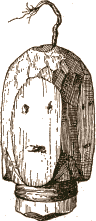
Fig. 28. Eskimo woman’s amulet.
As many of their personal names are derived from natural objects, it is usual for the person to wear a little image of the object for which he is named or a portion of it; for example, a wing of the bird, or a bit of the animal’s skin. This is supposed to gratify the spirit of the object. Strange or curious objects never before seen are sometimes considered to bring success to the finder.
Two articles selected from my collection will illustrate different forms of amulets. The first, No. 3018, is a little wooden model of a kaiak. The other (3090, Fig. 28) was worn on the back of a woman’s coat. It is a small block of wood carved into four human heads. These heads represent four famous conjurers noted for their skill in driving away diseases. The woman, who came from the eastern shore of Hudson’s bay, was troubled with rheumatism and wore this charm from time to time as she felt the twinges of pain. She assured me that the pain always disappeared in a few hours when she wore it. It was with the greatest difficulty that I persuaded her to part with it. She was, however, about to return home, and could get another there.
OUTDOOR LIFE.
The Eskimo acquire an extended knowledge of the country by early accompanying their parents on hunting trips, and as they have to rely upon memory alone, they must be observant and carefully mark the surroundings from all the views afforded. The faculty of memory is thus cultivated to an astonishing degree, and seldom fails, even in the most severe weather, to insure safety for the individual. I knew a native stick his ramrod in the ground among scattered stalks of grass which attained the height of the rod, yet after several hours he found the spot again without the least hesitation. Every rise of land, every curve of a stream, every cove in the seashore, has a name descriptive of something connected with it, and these names are known to all who have occasion to visit the place. Though the aspect of the land is entirely changed by the mantle of snow which covers all the smaller objects, a hunter will go straight to the place where the carcass of a single deer was cached many months before on the open beach. The Eskimo are faithful guides, and when confidence is shown to be reposed in them they take a pride in leading the party by the best route. In traveling by night they use the north star for the guide. Experience teaches them to foretell the weather, and some reliance may be placed on their predictions.
Their knowledge of the seasons is also wonderful. The year begins when the sun has reached its lowest point, that is, at the winter solstice, and summer begins with the summer solstice. They recognize the arrival of the solstices by the bearing of the sun with reference to certain fixed landmarks.
The seasons have distinctive names, and these are again subdivided into a great number, of which there are more during the warmer weather than during the winter. The reason for this is obvious: so many changes are going on during the summer and so few during the winter. The principal events are the return of the sun, always a signal of joy to the people; the lengthening of the day; the warm weather in March when the sun has attained sufficient height to make his rays less slanting and thus be more fervent; the melting of the snow; the breaking up of the ice; the open water; the time of birth of various seals; the advent of exotic birds; the nesting of gulls, eiders, and other native birds; the arrival of white whales and the whaling season; salmon fishing; the ripening of salmonberries and other species of edibles; the time of reindeer crossing the river; the trapping of fur-bearing animals and hunting on land and water for food. Each of these periods has a special name applied to it, although several may overlap each other. The appearance of mosquitoes, sand-flies, and horseflies are marked by dates anticipated with considerable apprehension of annoyance.
In order to sketch the annual routine of life, I will begin with the breaking up of the ice in spring. The Koksoak river breaks its ice about the last of May. This period, however, may vary as much as ten days earlier and twenty days later than the date specified. The ice in Ungava bay, into which that river flows, must be free from the greater portion of the shore ice before the river ice can push its way out to sea. The winds alone influence the bay ice, and the character of the weather toward the head waters of the river determines its time of breaking.
The Eskimo has naturally a keen perception of the signs in the sky and is often able to predict with certainty the effects of the preceding weather. When the season has sufficiently advanced all the belongings of each family are put together and transported down the river on sleds to where the ice has not yet gone from the mouth of the river. It is very seldom that the river ice extends down so far. To the edge of the ice the tent and dogs, with the umiak, kaiak, and other personal property, are taken and then stored on shore until the outside ice is free.
The men wander along the beach or inland hunting for reindeer, ptarmigan, hares, and other land game. The edge of the water is searched for waterfowl of various kinds which appear earliest. Some venturesome seals appear. In the course of a few days the ice in the river breaks up and the shore ice of the bay is free; and if there is a favorable wind it soon permits the umiak to be put into the water, where, by easy stages, depending on the weather, the quantity of floating ice, and the food supply, the hunters creep alongshore to the objective point, be it either east or west of the Koksoak. Sometimes the party divide, some going in one direction and others in another.
The men seek for seals, hunting in the kaiak, the women and children searching the islets and coves for anything edible. As soon as the season arrives for the various gulls, eiders, and other sea birds to nest the women and children are in high glee. Every spot is carefully examined, and every accessible nest of a bird is robbed of its contents. By the 25th of June the people have exhausted the supply of eggs from the last situations visited and now think of returning, as the birds have again deposited eggs and the seals are becoming scarcer.
The Eskimo arrange to assist the company to drive white whales when the season arrives. This is as soon as they appear in the river at a sufficient distance up to warrant that the measures pursued will not drive them out of the fresh water, for if they left they would not soon return. The date usually fixed upon is about the 12th of July. The natives are summoned, and a large sailboat or the small steam launch is sent along the coast to the place where the people were expected to arrive the 5th of the month. The natives are brought to the whaling station, where they encamp, to await the setting of the nets forming the sides of the inclosure into which the whales are to be driven.
The natives spear the whales in the pound, drag them ashore, skin them, and help take the oil and skins to the post, some eight miles farther up the river.
The same natives who engaged in the whaling are employed to attend the nets for salmon, which arrive at variable dates from the 25th of July to the 1st of September. Two or more adult male Eskimo, with their relatives, occupy a certain locality, generally known by the name of the person in charge of that season’s work. The place is occupied until the runs of the fish are over, when it is time for the natives to be up the river to spear reindeer which cross the river.
This hunting lasts until the deer have begun to rut and the males have lost the fat from the small of the back. The season is now so far advanced that the ice is already forming along the shore, and unless the hunter intends to remain in that locality he would better begin to descend the river to a place nearer the sea. The river may freeze in a single night and the umiak be unable to withstand the constant strain of the sharp-edged cakes of floating ice.
The head of the family decides where the winter is to be passed and moves thither with his party at once. Here he has a few weeks of rest from the season’s labors, or spends the time constructing a sled for the winter journeys he may have in view. The snow has now fallen so that a snow house may be constructed and winter quarters taken up. A number of steel traps are procured to be set for foxes and other fur-bearing animals. The ptarmigans arrive in large flocks and are eagerly hunted for their flesh and feathers. The birds are either consumed for food or sold to the company, which pays 6¼ cents for four, and purchases the body feathers of the birds at the rate of 4 pounds of the feathers for 25 cents.
The Eskimo soon consume the amount of deer meat they brought with them on their return and subsist on the flesh of the ptarmigan until the ice is firm enough to allow the sleds to be used to transport to the present camp meat of animals slain in the fall.
The traps are visited and the furs are sold to the company in exchange for flour, tea, sugar, molasses, biscuit, clothing, and ammunition. Hunting excursions are made to various localities for stray bands of deer that have become separated from the larger herds.
The white men employés of the company have been engaged in cutting wood for the next year’s fuel, and the Eskimo with their dog teams are hired to haul it to the bank, where it may be floated down in rafts when the river opens.
Thus passes the year in the life of the Eskimo of the immediate vicinity of Fort Chimo. Some of the Koksoagmyut do not engage in these occupations. Some go to another locality to live by themselves; others do not work or hunt, because it is not their nature to do so.
In all undertakings for themselves they deliberate long, with much hesitation and apparent reluctance, before they decide upon the line of action. They consult each other and weigh the advantages of this over that locality for game, and speculate on whether they will be afflicted with illness of themselves or family. When the resolution is finally made to journey to a certain place, only the most serious obstacles can thwart their purpose.
At all seasons of the year the women have their allotted duties, which they perform without hesitation. They bring the wood and the water, and the food from the field, if it is not too distant, in which case the men go after it with the dog teams. The women also fashion the skins into clothing and other articles, and do the cooking. After a hunt of several days’ duration the husband’s appearance is anxiously awaited, as is indicated by the family scanning the direction whence he is expected. The load is taken from the sled or boat and the incidents of the chase recited to the ever ready listeners.
In the early spring the women are busily engaged in making boots for summer wear. The skins of the seals have been prepared the fall before and stored away until wanted. The method of tanning the skins is the same for each species, differing only in its size and weight.
Certain large vessels made of wood or metal, chiefly the latter, as they are easily procured from the traders, are used to hold a liquid, which is from time to time added to. When a sufficient amount is collected it is allowed to ferment. During the interval the skin of the seal is cleansed from fat and flesh. The hair has been removed by shaving it off or by pulling it out. The skin is then dressed with an instrument designed for that purpose, made of ivory, deerhorn, stone, or even a piece of tin set in the end of a stout stick several inches long. The skin is held in the hand and the chisel-shaped implement is repeatedly pushed from the person and against a portion of the skin until that part becomes pliable and soft enough to work. It is further softened by rubbing between the hands with a motion similar to that of the washerwoman rubbing clothing of the wash. Any portion of the skin which will not readily yield to this manipulation is chewed with the front teeth until it is reduced to the required pliability. After this operation has been completed the skin is soaked in the liquid, which has now ripened to a sufficient degree to be effective. In this it is laid for a period lasting from several hours to two or three days. The skin is now taken out and dried. The subsequent operation of softening is similar to that just described, and is final. It is now ready to be cut into the required shape for the various articles for which it is intended. If it is designed for boots for a man, the measure of the height of the leg is taken. The length and width of the sole is measured by the hand, stretching so far and then bending down the long or middle finger until the length is measured. The width of one, two, or more fingers is sometimes used in addition to the span. The length is thus marked and the skin folded over so as to have it doubled. The knife used in cutting is shaped like the round knife used by the harness-maker or shoemaker.
There is in our collection a wooden model of this form of knife (No. 3022), which nowadays always has a blade of metal. Formerly slate, flint, or ivory was used for these blades.
The instrument is always pushed by the person using it. The eye alone guides the knife, except on work for a white man, and then greater care is exercised and marks employed indicating the required size. This round knife is called úlo.
Another important duty of the women is taking care of the family boots. When a pair of boots has been worn for some time, during a few hours in warm weather they absorb moisture and become nearly half an inch thick on the soles. When taken off they must be turned inside out and dried, then chewed and scraped by some old woman, who is only too glad to have the work for the two or three biscuit she may receive as pay. Any leak or hole is stitched, and when the sole has holes worn through it, it is patched by sewing a piece on the under side. The thread used in sewing the boots is selected from the best strips of sinew from the reindeer or seal.
Some women excel in boot-making, and at some seasons do nothing but make boots, while the others in return prepare the other garments. When the time comes in spring for making sealskin clothes, the women must not sew on any piece of deerskin which has not yet been sewed, lest the seals take offense and desert the locality which has been selected for the spring seal hunt, to which all the people look forward with longing, that they may obtain a supply of food different from that which they have had during the long winter months. As there can be no harm in killing a deer at this season, the flesh may be used, but the skin must be cast away.
As before stated, the entire family accompany the expeditions; and as the females are often the more numerous portion of the population, they row the umiak at their leisure, now and then stopping to have a few hours’ run on shore and again embarking. While thus journeying they are at times a sleepy crowd, until something ahead attracts attention; then all become animated, pursuing the object, if it be a half-fledged bird, until it is captured. Great amusement is thus afforded for the time, after which they relapse until some excitement again arouses them from their apparent lethargy. At the camp the men go in quest of larger game, leaving the women and children, who search the shore for any living creature they may find, destroying all that comes in their way. Smoking, eating, and sleeping occupy them until they arrive at a locality where food is abundant. There they earnestly strive to slay all that comes within reach, and thus often obtain much more than they require, and the remainder is left to putrefy on the rocks. The women do the skinning of the seals and birds obtained on this trip. The skins of birds are removed in a peculiar manner. The wings are cut off at the body, and through the incision all the flesh and bones are taken out. The skin is then turned inside out. The grease is removed by scraping and chewing. The skin is dried and preserved for wear on the feet or for the purpose of cleansing the hands, which have become soiled with blood or other offal in skinning large game.
When the season arrives for hunting the reindeer for their skins, with which to make clothing for winter, the women help to prepare the flesh and bring the wood and water for the camp, while the men are ever on the alert for the herds of deer on the land or crossing the water. The women hang the skins over poles until the greater portion of the animal matter is dry, when they roll them up and store them away until the party is ready to return to the permanent camp for the winter. Here the skins collected are carefully examined and suitable ones selected for winter garments.
The skins are moistened with water and the adherent fleshy particles are removed with a knife. They are then roughly scraped and again wetted, this time with urine, which is supposed to render them more pliable. The operation is practically the same as that of tanning sealskins. The hair is, of course, left on the skin. When the skins are finally dry and worked to the required pliability, they are cut into shape for the various articles of apparel. The thread used in sewing is simply a strip of sinew of the proper size. The fibers are separated by splitting off a sufficient amount, and with the finger nail the strip is freed from all knots or smaller strands which would prevent drawing through the needle holes. The thread for this purpose is never twisted or plaited. The needle is one procured from the trader. Small bone needles, imitations of these, are sometimes used. In former years the bone needle was the only means of carrying the thread, but this has now, except in the rarest instances, been entirely superseded by one of metal.
The thimble is simply a piece of stiff sealskin sewed into a ring half an inch wide to slip on the first finger, and has the same name as that member. In sewing of all kinds the needle is pointed toward the operator. The knife used in cutting skins is the same as that previously described. Scissors are not adapted to cutting a skin which retains the fur. So far as my observations goes, scissors are used only for cutting textile fabrics procured from the store.
In the use of a knife women acquire a wondrous dexterity, guiding it to the desired curve with much skill, or using the heel of the blade to remove strips which may need trimming off.
TATTOOING.
In former years the women were fancifully tattooed with curved lines and rows of dots on the face, neck, and arms, and on the legs up to mid-thigh. This custom, however, fell into disuse because some shaman declared that a prevailing misfortune was the result of the tattooing. At present the tattooing is confined to a few single dots on the body and face. When a girl arrives at puberty she is taken to a secluded locality by some old woman versed in the art and stripped of her clothing. A small quantity of half-charred lamp wick of moss is mixed with oil from the lamp. A needle is used to prick the skin, and the pasty substance is smeared over the wound. The blood mixes with it, and in a day or two a dark-bluish spot alone is left. The operation continues four days. When the girl returns to the tent it is known that she has begun to menstruate. A menstruating woman must not wear the lower garments she does at other times. The hind flap of her coat must be turned up and stitched to the back of the garment. Her right hand must be half-gloved, or, in other words, the first two joints of each finger of that hand must be uncovered. The left hand also remains uncovered. She must not touch certain skins and food which at that particular season are in use.
CLOTHING.
Like most Eskimo, the Koksoagmyut are clothed almost entirely in the skins of animals, though the men now wear breeches of moleskin, duck, jeans, or denim procured from the trading store. Reindeerskin is the favorite material for clothing, though skins of the different seals are also used. The usual garments are a hooded frock, of different shapes for the sexes, with breeches and boots. The latter are of various shapes for different weather, and there are many patterns of mittens. Rain frocks of seal entrail are also worn over the furs in stormy weather. Some of the people are very tidy and keep their clothing in a respectable condition. Others are careless and often present a most filthy sight. The aged and orphans, unless the latter be adopted by some well-to-do person, must often be content with the cast-off apparel of their more fortunate fellow-beings.
The hair of the skins wears off in those places most liable to be in contact with other objects. The elbows, wrists, and knees often are without a vestige of hair on the clothing. The skin wears through and then is patched with any kind of a piece, which often presents a ludicrous appearance.
The young boys and girls are dressed alike, and the females do not wear the garments of the adults until they arrive at puberty. It is a ludicrous sight to witness some of the little ones scarcely able to walk dressed in heavy deerskin clothing, which makes them appear as thick as they are tall. They exhibit about the same amount of pride of their new suits as the civilized boy does. They are now able to go out into the severest weather, and seem to delight in rolling around in the snow.
Infants at the breast, so small as to be carried in the mother’s hood, are often dressed in skins of the reindeer fawns. The garment for these is a kind of “combination,” the trousers and body sewed together and cut down the back to enable the infant to get them on. A cap of calico or other cloth and a pair of skin stockings completes the suit.
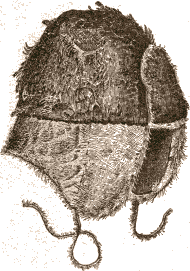
Fig. 29. Eskimo birdskin cap.
Both men and women wear, as an additional protection for their feet in cold weather, a pair or two of short stockings, locally known as “duffles,” from the name of the material of which they are made. These “duffles” are cut into the form of a slipper and incase the stockings of the feet. Over these are worn the moccasins, made of tanned and smoked deerskin. The Eskimo women are not adepts in making moccasins; a few only can form a well-fitting pair. They often employ the Indian women to make them, and, in return, give a pair of sealskin boots, which the Indian is unable to make, but highly prizes for summer wear in the swamps.
The Koksoagmyut do not wear caps, the hood of the frocks being the only head covering. There is, however, in my collection a cap obtained from one of the so-called “Northerners,” who came to Fort Chimo to trade. This cap (No. 3242, Fig. 29) was evidently copied from some white man’s cap. The front and crown of the cap are made of guillemot and sea-pigeon skins, and the sealskin neckpiece also is lined with these skins, so that when it is turned up the whole cap seems to be made of bird skins.
We may now proceed to the description of the different garments in detail.
The coat worn by the men and boys, and by the girls until they arrive at womanhood, has the form of a loose shirt, seldom reaching more than 2 or 3 inches below the hips, and often barely covering the hips. The neck hole is large enough to admit the head into the hood, which may be thrown back or worn over the head in place of a cap.
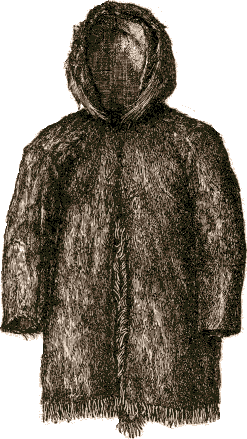
Fig. 30. Eskimo man’s deerskin coat (front).
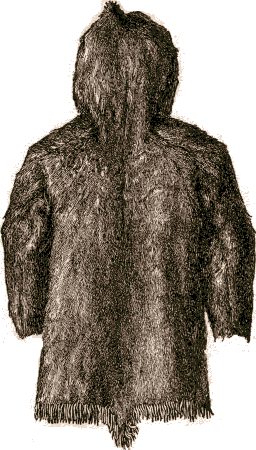
Fig. 31. Eskimo man’s deerskin coat (back.)
The Innuit of the southern shore of the western end of Hudson Strait often cut the coat open in front as far up as the breast (Figs. 30 and 31, No. 3224). The favorite material for these coats is the skin of the reindeer, three good-sized skins being required to make a full-sized coat for a man. Coats made of light summer skins are used as underclothing in winter and for the only body clothing in summer. The skin of the harp seal (Phoca grœnlandica) is also used for coats, but only when the supply of reindeerskin runs short, or when a man can afford to have an extra coat to wear in wet weather. It is not a very good material for clothing, as the skin is roughly tanned, and no amount of working will render it more than moderately pliable. Figs. 32 and 33 represent a sealskin coat. These coats are often trimmed round the edges with fringes of deerskin 2 or 3 inches wide, or little pendants of ivory.
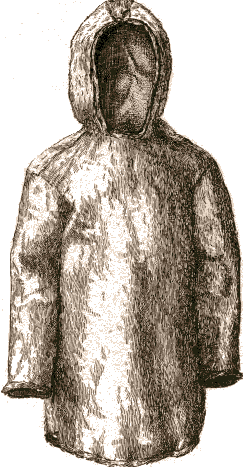
Fig. 32. Eskimo man’s sealskin coat (front).
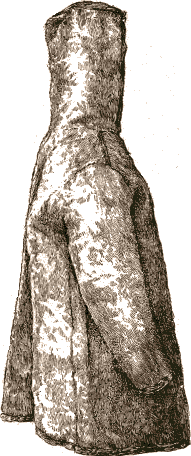
Fig. 33.—Eskimo man’s sealskin coat (side).
The collection contains eleven of these coats, Nos. 3221, 3498-3500, and 3558 of deerskin, and Nos. 3228, 3533-3537 of sealskin.
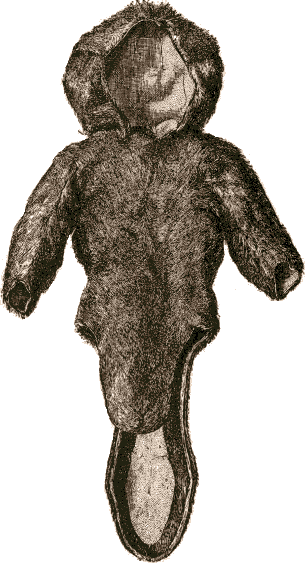
Fig. 34. Eskimo woman’s deerskin coat.
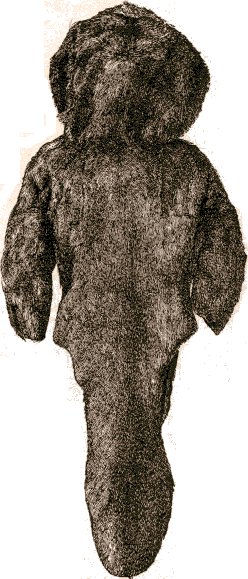
Fig. 35. Eskimo woman’s deerskin coat.
The peculiar shape of the woman’s coat is best understood by reference to the accompanying figures (Figs. 34, 35, 36, 37 and 38). The enormous hood is used for carrying the infant. When sitting, the female usually disposes the front flap so that it will lie spread upon the thighs, or else pushes it between her legs, while the hind flap is either thrown aside or sat upon.
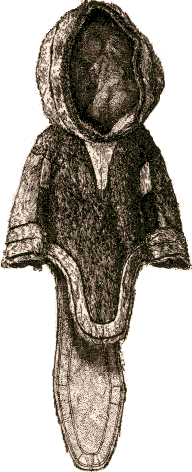
Fig. 36. Eskimo women’s deerskin coat.
It is not unusual for the women to display considerable taste in ornamenting their garments, using the steel-gray pelt of the harp seal to contrast with the black of the harbor seal, and so on. The edges of the hood and sleeves are frequently trimmed with skin from a dark colored young dog; or a strip of polar bear skin, whose long white hairs shed the rain better than those of any other mammal.
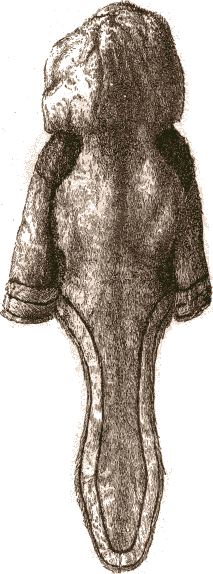
Fig. 37. Eskimo women’s deerskin coat (back).
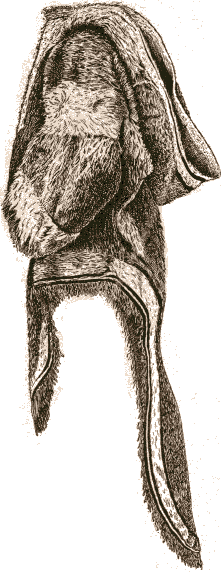
Fig. 38.—Eskimo woman’s deerskin coat (side).
It is not rare to find loops of sinew or of sealskin attached to the breast or back of a woman’s garments. These are for tying small articles, such as a needle case or a snuff-bag, to the clothing for convenience and to prevent loss.
A peculiar style of ornamentation is shown in Fig. 39 and 40, No. 3005, a woman’s coat from Fort Chimo. The front of the skirt is fringed with little lead drops, bean-shaped in the upper row and pear-shaped in the lower, and pierced so that they can be sewed on. These lead drops are furnished by the trader at the price of about a cent and a half each, in trade. The trimming of this frock cost, therefore, about $4. The four objects dangling from the front of the frock are pewter spoon-bowls. Across the breast is a fringe of short strings of different colored beads, red, black, yellow, white, and blue. Jingling ornaments are much prized.
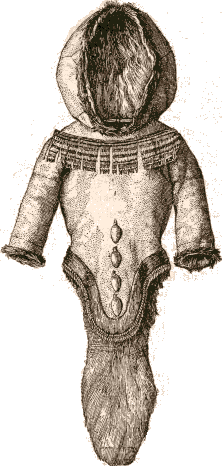
Fig. 39.—Eskimo woman’s deerskin coat.
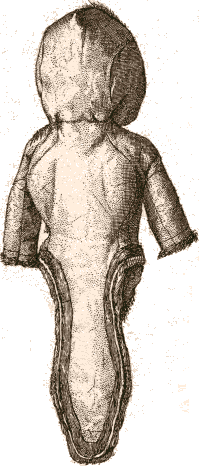
Fig. 40. Backside of same.
The tin tags from plug tobacco are eagerly sought for, perforated and attached in pendant strands 3 or 4 inches long to sealskin strips and thus serve the place of beads. I saw one woman who certainly had not less than a thousand of these tags jingling as she walked. I have also seen coins of various countries attached to the arms and dress. One coin was Brazilian, another Spanish, and several were English. Coins of the provinces were quite numerous. These were all doubtless obtained from the sailors who annually visit the place, in exchange for little trinkets prepared by the men and women.
The collection contains five of these coats, Nos. 3005, 3225-3227 of deerskin, and 3504 of sealskin. The last is a very elaborate garment, made of handsomely contrasted pieces of the skin of two kinds of seals, the harbor seal and the harp seal, arranged in a neat pattern.
It is not common to come across a garment of this kind, as the skins of the proper or desired kinds are sometimes hard to obtain. The woman may be several years in getting the right kind and may have effected many exchanges before being suited with the quality and color. The darkest skins of the Ka sig yak (harbor seal) are highly prized by both sexes. The women set the higher value upon them. The men wear two styles of leg covering, namely, breeches like a white man’s, but not open in front, and reaching but a short distance below the knees, or trousers ending in stocking feet. Sometimes in very cold weather these trousers may be worn under the breeches. Both breeches and trousers are very short-waisted. Long stockings of short-haired deerskin with the hair in are also worn. The women in winter wear breeches made of deerskin fastened around the hips by means of a drawstring and extending down the legs to where the tops of the boots will cover them a few inches. Some of the women wear trousers which reach only to the upper part of the thighs and are continuous with the boot which covers the foot, though in that case a pair of half-boots are added to protect the feet. The hips are covered with breeches which descend low enough on the thigh to be covered by the leggings. This style of apparel for the lower portion of the body is often extravagantly patched with various colored pieces of white and dark strips of skin from the abdomen and sides of the reindeer. When new and not soiled they are quite attractive and often contrast well with the tastefully ornamented coat.
The long boots or leggings are removed when dirty work is to be done. Thus, skins to be scraped and dressed are held against the bare leg.
The leggings also serve as pockets to hold various kinds of little things, like knives, tobacco, and so on.
A person rarely owns more than a single pair of breeches; consequently I was unable to obtain any for the collection.
The boots and shoes are of different materials and somewhat different patterns for different seasons of the year. All have moccasin soles of stout material turned up an inch or two all round the foot, a tongue covering the top of the foot, joined to a broad heel band which passes round behind the ankle. Then the legs are either made long enough to reach to the knee or else almost to the ankle. These half-boots are worn over the fur stockings in warm weather, or outside the long boots in very severe weather. Indian moccasins are also worn, sometimes over a pair of inside shoes and sometimes as inside shoes.
For thick waterproof soles the skin of the beaver or the harp seal is used. The former wears the better. White whale skin is also used for indoor shoes, or for shoes to be worn in cold dry weather; the skins of the smaller seals are used, sometimes with the flesh side out and the hair in, sometimes with the grain side out. These thinner skins are comparatively waterproof if the black epidermis is allowed to remain on. The beautiful creamy-white leather, made by allowing the skin to ferment until hair and epidermis are scraped off together and then stretching the skin and exposing it to dry cold air, does not resist water at all, and can only be used for soles in perfectly dry weather.
Buckskin soles are also used to enable the wearer to walk better with snowshoes on, as the feet are not so liable to slip or clog with snow as they would be if the footing were of sealskin. This latter has also another serious disadvantage. If it is very cold it does not permit the moisture from the feet to pass out as it freezes, rendering the boot stiff and slippery on the snowshoe, while the buckskin is porous and readily allows the moisture to escape.
The tongue and heel band are generally made of tanned sealskin, contrasting colors being often used. The legs are of sealskin, with the hair on, or of reindeer skin.
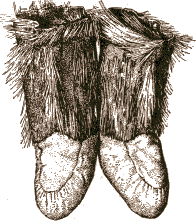
Fig. 41. Eskimo boots.
The figures represent a pair of sealskin boots with buckskin feet (Fig. 41) and a pair of half boots with white sealskin soles, black sealskin tongue and heelstrap, and buckskin tops (Fig. 42). The tanned and smoked reindeer skin for these tops was purchased from the Nascopie Indians.
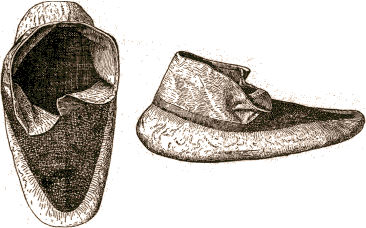
Fig. 42. Eskimo shoes.
A peculiar style of shoe (Fig. 43), of which I collected four pairs, is used by the so-called “Northerners,” who derive most of their subsistence from the sea in winter, and who constantly have to travel on the ice, which is often very slippery. To prevent slipping, narrow strips of sealskin are sewed upon a piece of leather, which makes an undersole for the shoe, in the manner shown in the figure.
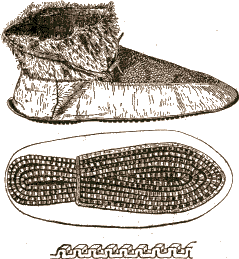
Fig. 43. Ice-shoes, Hudson strait Eskimo.
One end of the strip is first sewed to the subsole and the strip pushed up into a loop and stitched again, and so on till a piece is made big enough to cover the sole of the shoe, to which it is sewed. These ice shoes are worn over the ordinary waterproof boots.
As I have already said, these boots are all made by the women. The sole is cut out by eye and is broadly elliptical in shape, somewhat pointed at the toe and heel. The leg is formed of a single piece, so that there is but one seam; the tongue or piece to cover the instep may or may not be a separate piece. If it is, the leg seam comes in front; if it forms one piece with the leg piece, the seam is behind. When the leg is sewed up and the tongue properly inserted the sole is sewed on. It is tacked at the heel, toe, and once on opposite sides of the foot, to the upper. The sewing of the sole to the upper is generally begun at the side of the seam and continued around. Perpendicular creases at the heel, and more numerously around the toes, take up the slack of the sole and are carefully worked in. The making of this part of the shoe is most difficult, for unless it is well sewed it is liable to admit water. The creases or “gathers” are stitched through and through with a stout thread, which holds them in place while the operation proceeds, and which besides has a tendency to prevent the gathers from breaking down. The heel, which comes well up the back of the boot, is stiffened by means of several threads sewed perpendicularly, and as they are drawn shorter than the skin, they prevent the heel from falling and thus getting “run down.”
The seams of the boots, which are turned inside out during the operation, are so arranged on the edges that one will overlap and be tacked with close stitches over the rest of the seam. This is done not only for comfort when the boot becomes dry and hard while being worn, but also to take the strain from the stitches which hold the edges together. The value of a pair of boots depends much on the care bestowed in tanning and in sewing.
The hands are protected by mittens of different materials. Fur or hair mittens are worn only in dry weather, as the hair would retain too much moisture.
Among the Innuit the mammals are divided into two classes: the noble and the inferior beasts. The skins of the former are used, though not exclusively, by the men, while the latter may be worn only by the women. No man would debase himself by wearing a particle of the fur of the hare or of the white fox; the skins of these timid creatures are reserved for the women alone. Either sex may wear the skins of all other mammals, except at certain times, under restrictions imposed by superstition.
The women wear mittens of hare or fox skin, with palms of sealskin or Indian-tanned bird’s skin. Reindeer skin with the hair on is also used for mittens. The heavy skin from the body is selected for the sake of warmth. When these mittens are to be used when driving dogs the palm is made of sealskin, to enable the wearer to get a firm grasp on the whip handle. The skin of the deer’s forelegs, which has hair of a different character from that on the body, also makes excellent mittens, specially suited for handling snow in building the snow huts. Mittens are sometimes fringed round the wrist with a strip of white bearskin to keep out the wind.
All mittens have such short thumbs that they are very inconvenient for a white man, who habitually holds his thumb spread away from the palm, whereas the Innuit usually keep the thumb apposed to the palm. The wrists of the mitten also are so short that considerable of the wrist is often exposed. The sleeves of the jacket are generally fringed with wolf or dog skin to protect this exposed portion of the wrist.
Similar mittens of black sealskin are also worn by the men during damp weather, or when handling objects which would easily soil a pair of furred mittens. I have never seen a woman wear this kind of covering for the hand. It appears to be exclusively worn by the men.
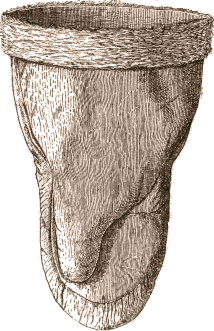
Fig. 44. Long waterproof sealskin mitten.
The men who engage in the late fall seal hunting protect their hands with waterproof gauntlets, which reach well up over the forearm. These keep the hands from being wet by the spray and by the drip from the paddle. Fig. 44, No. 90074, represents one of these long mittens, made of black tanned sealskin, and edged with a strip of hairy sealskin over an inch wide. The back or upper portion of the mitten is made of a single piece of black skin, the edge of which is crimped and turned under to protect the fingers. The palm is a separate piece, joined to the backpiece, and on it is a projecting part to form the inner half of the thumb. The outer half of the thumb and the under side of the forearm are made of a single piece, stitched to the palm portion and that which covers the back of the hand and arm, so that, including the edging of hairy skin, there are only four pieces of skin entering into the make of a pair of these mittens. They are worn only by the men, and only when they are engaged in work where the hands would be immersed in water during cold weather. As the skin from which they are made is the same as that used for water-tight boots, it is obvious that no moisture can touch the skin of the hand.
For protection from rain and wet they wear over their other clothes a waterproof hooded frock (Fig. 45) made of seal entrails, preferably the intestines of the bearded seal (Erignathus barbatus). The intestines of animals killed in October are considered the best for this purpose. They then are not so fat and require less dressing to clean them. The contents are removed and they are filled with water and thoroughly washed out. The fat and other fleshy matter adhering are removed by means of a knife used as a scraper. This being done, the intestine is inflated with air and strung along the tops of the rocks to dry. When dry it is carefully flattened and rolled into tight bundles, like a spool of ribbon, and laid away until wanted.
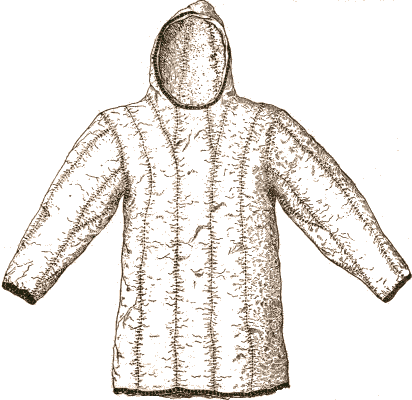
Fig. 45. Waterproof gutfrock.
When required for use it is split longitudinally, and when spread open is of variable width from 3 to 5 inches, depending on the size of the animal. The edges of the strips are examined and any uneven portions are cut off, making the strip of uniform width. There are three separate pieces in a garment—the body and hood as one and the sleeves as two. Sometimes the sleeves are made first and sometimes the body is sewed first, and of this latter portion the hood is first formed. Strips are sewed edge to edge with the exterior of the intestine to form the outside of the garment. The edge is turned down, so as to leave a width of a third of an inch, and turned to the right; the other strip is similarly folded, but turned to the left and laid on the other strip. Sinew from the back of a reindeer or from a seal is made into threads a yard or more in length and of the thickness of medium-sized wrapping cord. The needle is usually of a number 3 or 4 in size or of less diameter than the thread in order that the thread shall the more effectually fill up the hole made by the needle. The two strips are then sewed with stitches about nine to the inch, through and through, in a manner, I believe, termed running stitches. When a sufficient length is obtained a third strip is added, and so on until the required number of perpendicular strips form a sufficient width to surround the body. The outer edges are then joined and the body of the garment is complete. Portions are cut out and the hood assumes the desired shape, resembling a nightcap attached to the body of a nightgown. The sleeves are sewed in a similar manner and affixed to the body of the garment. The seams run perpendicularly and not around the body in a spiral manner as in garments made by the natives of Alaska for similar purposes. The edge of the hood, the wrists, and the bottom of the garment are strengthened by means of thin strips of sealskin sewed on the outside of those parts where they are most liable to be torn. The garment is worn during wet weather or while in the kaiak traveling on a rough sea. The bottom of the garment is tied around the hoop of the kaiak in which the wearer sits and thus effectually sheds the water from the body, except the face, and keeps it from entering the kaiak.
Sometimes a drawstring closes the hood tightly around the face and prevents the spray from entering. The string is usually tied at the top of the hood, in which case it is rather difficult to untie.
When not in use the material must be well oiled and rolled up or it will become so stiff that it can not be worn until it has been relaxed by dipping in water. The sinew with which it is sewed swells when wet and tightens the seams.
There is great difference in the length of the garments worn by the eastern and the western Eskimo as well as in the manner of arranging the strips of which they are made. The one worn by the people of Hudson strait scarcely reaches to the hips of the wearer and is long enough only to tie around the hoop of the kaiak. The ones worn by the Eskimo of Northern sound, Alaska, falls to the knees, and those made by the Aleuts are so long that they interfere with the feet in walking. The material prepared by the eastern natives is not so good, as it is coarser and stiffer than that of the sea lion (Eumatopias stelleri), used by the natives of Alaska.
The weight of one of these garments when dry scarcely exceeds 6 or 7 ounces.
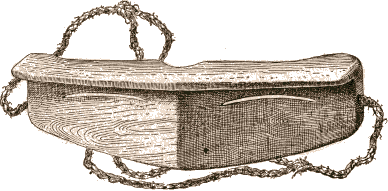
Fig. 46. Snow goggles—front.
To protect the eyes from the glare of the snow, which is especially trying when the sun is still low in early spring, snow goggles are worn made to admit the light only through a narrow slit. (Figs. 46, and 47.) Nos. 3186, 3187, 3188, 3189, 3190, 3191, 3192, 3193, 3197, 3198, 3199, 3200, and 3201 in the collection show such snow goggles made of wood. A somewhat curved piece of wood is fashioned to fit the face over the eyes; a notch is fitted for the nose to rest in. The lower side is about half an inch thick, forming a flat surface. The front is perpendicular and blackened with soot or gunpowder mixed with oil and applied to darken the front surface to absorb the light of the sun’s rays. Above this is a ledge of half an inch projecting over the narrow longitudinal slit through which the wearer may look. This projection is sometimes not blackened on the underside, and where wood is scarce it is left off altogether. Within, on the side next to the eyes, it is usually gouged out to allow the eyelashes free movement. A piece of sealskin is affixed at each end and either tied in a knot over the head to hold the wood in position, or else a wider strip of skin is slit and one portion worn on the top of the head while the other fits the back of the head to prevent the goggles from falling off when the wearer stoops down.
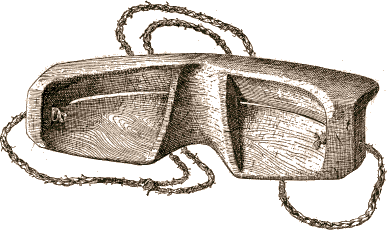
Fig. 47. Snow-goggles—rear.
DWELLINGS.
The winter dwellings of the Eskimo of Hudson strait consist of the usual form of snow house. In this connection I may as well state that the popular impression that the snow house described by Arctic travelers is the only thing to be called an iglu is quite erroneous. The word “iglu” is as fully generic in the Eskimo language as the word “house” is in the English language. The correct term, as applied by the Eskimo, to the snow house used as a dwelling is “ig lú ge ak” (Fig. 48.)
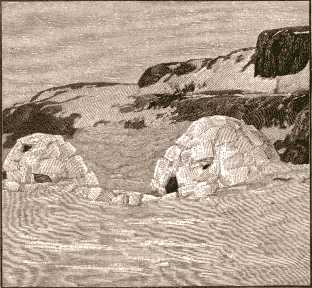
Fig. 48. Deserted Eskimo snow houses, near Fort Chimo.
The first requisite for a snow house is snow. It must be of sufficient depth and possess certain well-defined qualities. The snow may fall, but until it has acquired sufficient depth for the size of blocks required and firmness enough for strength to withstand the superposed weight of the structure it is useless. An instrument termed snowknife (pŭnŭk), shaped like a short sword, is used for the purpose of cutting the blocks. The Eskimo seeks a place where the insertion of the knife into the bed of snow will prove that the snow is in the proper condition. He must then cut out a block of a size convenient to be lifted. This is usually rejected as it may be irregular or broken. Additional blocks, in size from 8 to 10 inches thick, 2 feet wide, and slightly more in length are cut by a motion much resembling the act of sawing, cutting the depth of the blade. The knife then cuts the bottom off squarely and the block is lifted out, the builder standing where the first blocks were cut from. The blocks are arranged on the bank of snow around the pit in which the man stands. The first block usually is somewhat triangular in shape for a purpose hereafter mentioned. The second block is cut out and placed near the first, the end clipped with the knife to allow the first joint to be close together. A third block is cut and placed by the end of the second. It will now be seen that the line of blocks is not straight, but curved concavely within. Additional blocks are cut and placed end to end with each other until the first one laid is reached. Here a longer block is cut to lay upon the inclined side of the triangular-shaped block first used and so placed as to “break” the joints, and thus render the structure more stable. Additional blocks are placed on the first row, and as the operation proceeds it will be seen that the blocks lie in a spiral form, gradually drawing in as the structure rises, forming a dome-shaped wall of snow. The key block at the top is carefully cut to fit the aperture and inserted from the outside by the assistance of another person. All the joints are carefully stopped up with spawls of snow or with snow crushed between the hands and forced within the crevices.
The floor of the snow house is the bed of snow from which the building material was taken. The door is cut by taking blocks of snow from under the bottom row of the foundation blocks. A trench is made, and along the side of it the blocks are placed. An arched covering of the material forms a sheltered passageway to the door.
When the snow house is to be occupied for a considerable time the doorway may have walls of snow blocks piled as high as the shoulders, with the top left open. This shields the entrance from wind and drifting snow. Various forms of entrance are constructed, often very tortuous; and when made a refuge by the numerous dogs they are not pleasant paths along which to creep on hands and knees, for a panic may seize some cowardly canine and all the dogs struggle to get suddenly out into the open air. Vicious animals often wait until a white man gets about half way through the entry and then make a sudden assault on him.
The interior of the house is arranged according to the number of persons inhabiting it.
A raised bed, on which to sit during the day and sleep during the night, is formed either by leaving a part of the snow-bank or else by bringing in blocks and arranging them as a solid mass. On this are spread bows of spruce, or dry grass, if obtainable, otherwise fine twigs of willow or alder, and over these heavy reindeer or bear skins are thrown. On these bed-skins are laid other softer skins of reindeer, with which to cover the person on retiring to sleep. A window is sometimes set in the side of the structure toward the sun. This is simply a piece of thick, clear ice, from a lake, set in the wall of the dome. It admits light, although it is generally light enough during the day within the snow-house unless the walls be built particularly thick, but great thickness in certain situations becomes necessary lest the winds and drifting snow wear away the sides of the structure, causing it to admit the cold or tumble down. Around the outside of the hut is sometimes built a protecting wall of snow blocks, two or three feet high, to prevent the drifting snow from wearing away the side of the dwelling. A storm of a single night’s duration is often sufficient to destroy a house.
The interior walls, in severe weather, become coated with frost films from the breath, etc., condensing and crystallizing on the inside of the dome and often presenting by the lamplight a brilliant show of myriads of reflecting surfaces scintillating with greater luster than skillfully set gems.
If the roof is not carefully shaped it is liable to cave in from the heat within softening the snow, especially in moderate weather, and then the entire structure falls.
Where the owner of the house has considerable possessions which must be protected from the dogs and the weather, a similar structure is prepared alongside of the dwelling and often connected with it by means of a communicating passage-way. An exterior opening may be made and closed with a block of snow. The larger articles, such as bags of oil and bundles of skins, are put inside before the walls are up, if intended to be stored for some time.
As I have slept in these snow-houses I can assert that, while very uncomfortable, they afford a protection which can not be dispensed with. When the doorway is open they soon become very cold, and when closed upon several persons the heat becomes intolerable. Odors from the food remain long after the remnants are disposed of, and where one has been occupied for a long period the accumulation of refuse becomes so great that a new structure is indispensable in order to get rid of it. All the work of the different members of the family is performed within the walls. The skins of animals are dressed and tanned there. The offal of game and the hair from dressed skins mingle in one mass, which soon putrefies and creates such a stench that only an Eskimo with most obtuse sense of smell could inhabit the place.
When spring comes the huts begin to melt and in the course of a few warm days fall down. If the weather is too inclement to permit a skin tent to be occupied, the first hole in the wall may be patched with a deerskin, but this will afford very limited protection from the cold of nights, for, however warm the days, the nights will, until late in May, be so cold that only the older individuals withstand the cold.
When the structure falls, melted by sun or rain, the miserable occupants must erect temporary shelter of deerskin or cloth on the bare rocky ridges. Those too poor to own a skin tent have often but a blanket of deerskin, stretched over three or four poles, set to shelter them from the chilly northerly winds usually prevailing at that season.
Here they must sojourn until the ice breaks from the shores of the coves and bays, enabling the hunters to procure seals from the sea. Along the shores one may often find camping sites of these poor wanderers searching through the day for food and at night camping under the lee of a wall of rock with little other covering than that worn during the day and this often soaked with spray or rain.
Improvidence and indolence result in the most cruel privations toward the end of winter. Many who are too weak and emaciated from lack of food to pursue the chase to gain a living starve before reaching the sea and are left to perish.
When the season is more advanced, and the weather warm enough, those who are industrious and provident enough to be the possessors of sealskin tents, move into them for the season.
The skin tent (Pl. XXXVII) is usually made of the skins of the largest square flipper seals, those too heavy for any other purpose or not necessary for other uses.
BUREAU OF ETHNOLOGY ELEVENTH ANNUAL REPORT PL. XXXVII
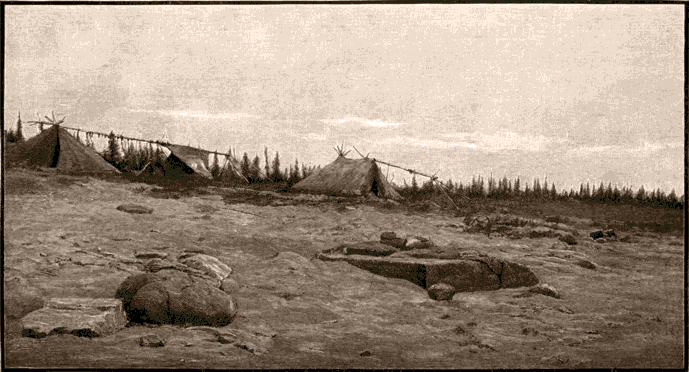
ESKIMO TENT.
The number of skins necessary to form a tent varies with the size required. Generally as many as ten to fifteen are used, and such a tent will accommodate a good sized family.
The hair is seldom removed from the skin, which is simply stretched as it comes from the animal and freed from fat and fleshy particles. The edges are trimmed and a sufficient number of skins are sewed together to form a length for one side of the tent. The length of the individual skins makes the height of the tent. A similar width is prepared for the opposite side. The two pieces meet at the rear of the structure and are there tied to the poles. A separate piece forms the door and may be thrown one side when a person enters or goes out. The poles of the tent are arranged as follows: Two pairs of poles are joined near the ends with stout thongs and erected with the lower ends spread to the proper width, forming the ends of the tent, on which the ridgepole is laid. A single pole is now placed near each end of the ridgepole, resting on the upright pairs, to prevent lateral motion. Two more such braces are placed on each side and spread so as to give a somewhat rounded end to the tent. Near the middle of the ridgepole is a pair of shorter poles leaning against it to prevent the weight of the sides from bending the ridgepole. It will be seen that eleven poles are necessary to support a long tent, as the skins are very heavy. The skins and poles can be transported when the umiak is able to carry them.
In case of continued rains the skins are placed so as nearly to meet over the ridge and additional skins cover the space left between the edges. When the tent is to be taken down the two widths are folded over, each by itself, and then rolled into a compact bundle by beginning at each end and folding toward the center, leaving sufficient space between the rolls for a person to get his head and shoulders in. Two persons, one for each roll, now assist the carrier, who kneels, bows his head, and places the load on his head and shoulders. The two assist him to rise and the heavy load is taken to the umiak and placed in the bottom for ballast. The shorter poles are first laid in on the ribs of the boat to keep the skins from the water should any seep through the seams. The second bundle of tenting is laid on the first.
The tent of skins is the usual shelter during the season from the first rain until a sufficient fall of snow occurs in the early winter from which to construct an iglu gheak.
The interior of the skin tent is necessarily quite roomy on account of the number of occupants. The farther end often has a stick of timber laid across the floor, and behind this is the bedding for the owner, his wives, and children. A man who is able to own a tent of this character is also wealthy enough to have two or more wives. Along the remainder of the sides within lie the other occupants, either in groups or singly, depending on the degree of relationship existing between them. Guests and others temporarily abiding with the host are assigned any portion of the tent that the host may choose to select, usually, if great honor is to be shown, the place lately occupied by himself. The central portion is reserved for a fireplace for cooking and heating purposes. In this structure is carried on all manner of work incidental to the season. The tent is taken from place to place by means of the umiak when the food supply of a locality is exhausted or another region promises greater abundance.
All these summer occupations require a number of persons to successfully prosecute them, hence the number dwelling in one tent is not often detrimental, as the adults walk along the shore to drag the boat or relieve it from their weight.
The owner of a tent is considered an important individual, and his favor is retained by every means. A period of illness may cause him to lose all his belongings and then on recovery he has to start life anew. Several seasons may elapse before a sufficient number of skins will be procured for him to make a tent, and this is immovable without a boat to transport it, for when a sled might be used for that purpose there is always enough snow from which to erect a shelter.
During the winter the skins are stored away on posts erected for the purpose, or on piles of rocks where the various species of small animals will not destroy them by eating holes in the oily skin. Mice and ermines are very destructive to these skins, often causing sad havoc in a short time. By the spring the owner may be miles away from the scene of the previous autumnal hunt and be unable to go after the tent, which, with the summer rain and decay, becomes useless, imposing the severe task of collecting skins for a second tent.
In former times these people inhabited permanent winter houses like those used by the Eskimo elsewhere, as is shown by the ruins of sod and stone houses to be seen in various parts of the country. These appear to have had walls of stone built up to support the roof timbers, with the interstices filled up with turf or earth. From the depression remaining in the inside of these ruins, the floor seems to have been excavated to a greater or less depth.
The present inhabitants relate that their ancestors dwelt in these huts, but can not explain why they were deserted, or why such structures are not erected at the present day.
HOUSEHOLD ARTICLES.
There is very little in these dwellings that can be called furniture, besides the bed places already referred to. The other articles requisite for housekeeping consist of a lamp of soapstone, kettles to hang over it, a frame suspended above the lamp for drying various articles, and sundry wooden bowls, buckets, and cups, besides similar vessels made of sealskin.
The lamp (poqíla), which is the only source of heat and light in the snow house, is, roughly speaking, a large shallow bowl of soapstone filled with oil, which is burned by means of a wick of moss, arranged round one edge of the bowl.
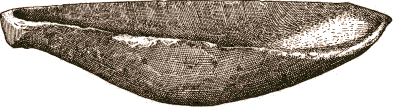
Fig. 49. Soapstone lamp, Koksoagmyut.
The material from which these lamps are made occurs in isolated bowlders on the surface of the ground at various places in the region. These bowlders are often of great size.
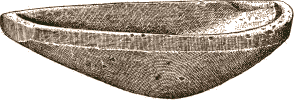
Fig. 50. Soapstone lamp, Koksoagmyut.
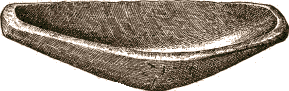
Fig. 51. Soapstone lamp, Koksoagmyut.
The general form of these lamps, which will be best understood from the figures (Figs. 49, 50, 51), is nearly always the same, the variations being apparently due to the lack of material. The cavity for holding the oil varies in capacity, according to the size of the lamp, from half a pint to nearly three quarts. It is, however, never filled to the brim, for fear it should run over. The consumption of oil depends upon the number of wicks lighted at once, and also on the character of the wick.
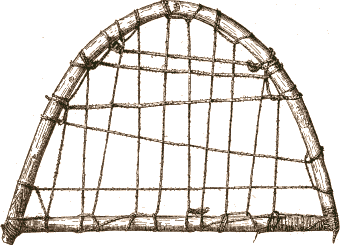
Fig. 52. Frame for drying mittens.
The wick in general use is prepared from a kind of moss, which grows in large patches close to the ground, the stalks rising perpendicularly, and the whole so matted together that it may be cut into any desired form. From these patches pieces are cut an inch or two wide, a third of an inch thick and two or three inches in length, and laid away to dry. When one of these is to be used the woman squeezes the fibers together with her teeth, trims it, and sets it in the oil, and lights it. The light from one of these wicks is nearly equal to that of an inch wick fed with a good quality of kerosene. The heat is very great. For cooking, a larger wick is used, or two of the smaller ones set side by side. Over the lamp is placed a frame for drying wet boots, mittens, and such things. Fig. 52 represents one of these (No. 3048), which is a semicircle or bow of wood with the ends fastened to a straight piece of wood. Across these strands of sinew or sealskin forms a sort of netting having large meshes. On this rests the article to be dried. Under this is a support formed of two sharp-pointed pegs which are stuck into the snow forming the side of the hut. On the outer end of these is fastened, or laid across them, a piece of wood. The shape of the support is that of a long staple with square corners. In some instances the pegs form only a wide V-shape, and the frame for supporting the articles laid directly on this. A block of wood hollowed out to receive the convex bottom of the lamp is sometimes used to support the latter.
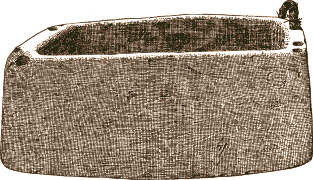
Fig. 53. Soapstone kettle.
In former times cooking over these lamps was universally performed in kettles of soapstone, in which cooking was also done by putting heated stones into the water. These soapstone kettles are, however, quite superseded by utensils of civilized manufacture. I, however, succeeded in collecting two full-sized stone kettles, and one little one, made for a child’s toy. The figures (Figs. 53, 54) show the shape of these vessels sufficiently well. The handles are made of strips of whalebone. The larger kettle (No. 3179) is nearly 13 inches long, and will hold nearly a gallon. They were made of different capacities in former times, varying from about a pint to a full gallon.
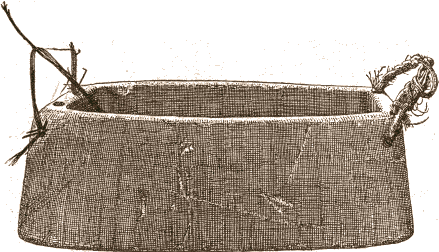
Fig. 54. Soapstone kettle.
Oblong shallow dishes (pu-ghu´-tak) for holding oil or food are carved from larch knots. The figure (Fig. 55) represents a model of one of these. Buckets and cups of various sizes for holding water and other fluids are made of tanned seal skin sewed with sinew. The sides of the bucket are a strip of seal skin bent into a ring, with a round piece of seal skin sewed on for a bottom. Sometimes a seal-skin bail is added, or a wooden handle sewed to the lips of the cup, making it into a dipper (Figs. 56, 57.) Wooden baskets are made in a similar fashion. A strip of spruce wood is bent nearly circular. The ends of the strip are fastened with fine iron wire. The bottom is a separate piece and has a rim or edge for the upper part to set on, and is held in place by means of small wooden pegs driven through and into the bottom.

Fig. 55. Wooden dish.
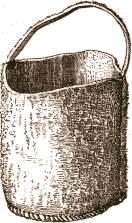
Fig. 56. Sealskin bucket.
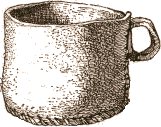
Fig. 57. Sealskin cup.
The capacity of these vessels is seldom more than a couple of quarts, and generally less. They are principally used to ladle water into the cooking kettles. All these vessels of native manufacture are being rapidly displaced by tin cups and small kettles.
FOOD AND ITS PREPARATION.
Under certain conditions a great portion of their food is eaten raw, but it is invariably cooked when it conveniently can be. Frozen food is consumed in great quantities. I have seen them strip and devour the back, fat, and flesh from the body of a deer while the fibers were yet quivering. The entrails of many species of birds are taken from the body and, while yet warm, swallowed much after the manner of swallowing an oyster. The eggs which have been incubated to an advanced degree are as eagerly devoured as those quite fresh.
The deer meat, killed the previous fall and frozen for three or four months, is cut into huge chunks and gnawed with as much satisfaction as though it was the finest pastry. On such occasions I have seen the person appointed to chop up the frozen meat scatter the pieces among the expectant crowd with as little ceremony as that of throwing ears of corn to the hogs in a pen. For a change the frozen pieces of meat are sometimes warmed or thawed before the fire.
The blood of the deer is often mixed with the half-digested mass of food in the stomach of the animal, and the stomach, with its contents, with the addition of the blood, eaten raw or boiled. Sometimes it is laid aside to ferment and then frozen and eaten in this condition.
Strips of fat from a seal and the blood of the animal are put into a kettle and heated. The oily liquid is eaten with the greatest relish. Seal oil is used for food in about the same manner as we use syrups. Years of almost daily intercourse with these people have failed to show the ability of any person to drink seal or whale oil without illness resulting. They never drink pure oil under any circumstances, except as a laxative. The statement often made that these people drink oil as food is simply preposterous. Such statements doubtless arose from seeing other preparations of food having an abundance of oil upon them. Lean flesh is often dipped into oil and then eaten. If partaken of without oil in as great quantities as these people require, a torpid condition of the liver and alimentary canal results, and they thus employ the pure oil to relieve themselves.
Vegetable food is little used except in the vicinity of the trading stations. Those accustomed to the use of flour, bread, peas, beans, and rice are very fond of them, and often express regret that they will be deprived of them when on their hunting expeditions.
Native plants afford little help as food. During the season when the various berries are ripe all the people gorge themselves. They have a special fondness for the akpik (Rubus chœmomorus). The sun scarcely reddens the side of these berries, locally known as “bake apple,” before the children scour the tracts where they grow, and eat of the half-ripened fruit with as much relish as the civilized boy does the fruit purloined from a neighbor’s orchard. Other berries contribute their share as food.
When on trips the women often gather a few green herbs and put them in a kettle of water and make an infusion in lieu of tea. They are fond of tea, coffee, and sugar. Molasses is eaten alone or with something dipped in it.
The Eskimo drink often and astonishing quantities of water at a time. If the weather be very cold they often drink the water which has been heated on a fire, asserting that the hot water does not weaken them as much as cold water would do.
When a seal has been killed and is being brought to camp, the hunter signifies his success from a distance, and those in camp raise a joyous shout. The animal is drawn ashore and skinned. The flesh is devoured raw as the process goes on, or may be divided, certain portions being given the different persons. The blood is collected, and when the meat is boiled it is mixed with the hot liquid and forms a nutritious dish, eagerly devoured by both adults and young. The children revel in this dish to a sacrifice of cleanliness.
The feast is continued until the flesh has been devoured and the people gorged to their utmost capacity. Stories are told and general good humor prevails. The different species of fish which frequent the shallow waters of the bays are used as food.
TOBACCO AND SNUFF.
All the adults are addicted to the use of tobacco, both for smoking and chewing and in the form of snuff, although it is not everyone that uses tobacco in all three ways.
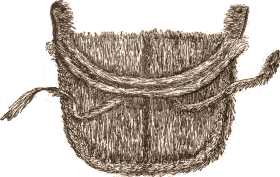
Fig. 58. Tobacco pouch.
The plug tobacco, used for smoking and chewing, is carried in a small pouch of seal skin attached to the belt, which keeps it from being dampened by perspiration or rain. Watches are also carried in the same receptacle. Fig. 58 (No. 74485) is such a bag, made of hairy seal skin. The edges alone are trimmed with lighter colored strips of seal skin. A string holds the mouth of the bag together after it is rolled up. A loop at one corner enables the bearer to affix it to his belt when traveling to avoid the necessity of opening the bag in which he usually carries such small things.
Leaf tobacco is preferred for the preparation of snuff, but as this is not always to be had plug is often used. This is shredded up and dried, and when dry enough is reduced to a powder by inclosing a quantity in a fold of seal skin and pounding it with a stone or stick.
Snuff is kept in a purse-shaped bag, closed at the mouth with a thong. To it is attached a little spoon made of ivory. Various forms of this implement are made. The general appearance is that of a common spoon, of which the ends and sides of the bowl are cut off. At the end of the handle is a slight depression for containing the snuff, which is held firmly against the orifice of the nostril and inhaled by a sudden indrawing of the breath while the thumb of the other hand closes the opposite nostril.
The old women appear more addicted to the use of snuff than any of the men. The effect of inhaling the strong snuff is quickly shown in the face. It seems to affect people more than the use of tobacco in any other way.
MEANS OF TRANSPORTATION.
BY WATER.
The principal means of conveyance by water with the Eskimo of Hudson strait, is the umiak, referred to by most writers as the woman’s boat. This appellation is not more applicable than would be the term family boat. The women use the boat alone only on rare occasions, and then in quiet water and for short distances. Men are nearly always in it, and under the guidance of one of these, the boat is used for long journeys.
The form of the umiak, in the region under consideration, differs greatly from that of the Eskimo of Bering sea. (See Fig. 59, from a model.)
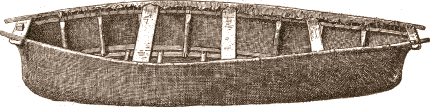
Fig. 59. Eskimo umiak.
The size of the boat is variable according to the means of the builder and the size of the family to be conveyed in it. The length of the keel is from 10 to 25 feet. Over all the length is 1 or 2 feet greater than on the keel. It will be thus seen that the ends are nearly perpendicular. It is difficult to determine at the first glance which is the bow and which the stern, so nearly alike are they. They only differ in the former being somewhat wider at the upper edge or rail.
The keel is a straight piece of wood hewed from a single stick, nearly 4 inches square. The stem and stern posts are nearly alike, the latter having but little slope, and are cut from curved or crooked stems of trees. A tree may be found, which, when hewed, will form the sternpost and keel in one length. Otherwise the fore and aft posts have places cut out for the insertion of the respective ends of the keel, and are fastened firmly by stout thongs of sealskin thrust through holes bored in the wood and ingeniously lashed. As the bottom of the umiak is flat the sides of the bottom are formed of square rails of sufficient length and given the desired spread. They are held at the ends by being joined to the keel. Crosspieces notched at the ends separate the bottom rails and are steadied in position by being notched so as to sit on the square keel. On the ends of the crosspieces is laid a second rail which prevents them from rising and serves to strengthen the ends of the ribs, which are set alternately with the crosspieces of the keel. The ribs are attached to the lower or bottom rail by means of sealskin lashing. Along the upper ends of the ribs is placed a longer rail of smaller diameter and usually shaved round. This rail is usually set half its diameter into rounded notches of the upper ends of the ribs and fastened by thongs. Within and below the top rail is a shorter rail, generally smaller than the upper, tied by thongs to the ribs and posts fore and aft. A wide board projecting several inches on each side of the stern serves as a seat for the steersman. The ends of the top rails are laid over this board and attached to it. A similar board is placed at the forward end or bow, but is, of course, longer as that end is the wider of the two.
Three to five thwarts, serving as seats for the occupants, are placed at proper intervals, having their ends resting on the inside top rail. One of these thwarts also serves to steady the mast, which is stepped into the keel and lashed to the thwart.
On the side of the boat and resting on the top rail are pieces of wood firmly lashed. A notch, or rowlock, is cut into them to serve as rests for the heavy oars. The oars are held into the notch by means of loops of stout thong, the ends of the loops passing each other, one from forward and the other from aft, and through both of the loop ends the inner end of the oar is thrust. The loops serve to hold the oar when not in use, otherwise it would float away; yet the position of them allows the oars to lie alongside in the water. The oars are heavy and as much as 10 feet long for a large umiak. The women generally run the boat and are assisted by the younger men of the party who may not be walking along the shore. Two or more females sit side by side and if they be insufficient a third person faces them and assists in the labor. It is a favorite place for a young man with his sweetheart. The steersman sits on the after board and attends to the helm and sail when the latter is in use. The sail is a nearly square sheet of cloth spread by a yard across the top. The lower corners have each a rope which the helmsman holds. A fair wind only can be used to advantage as the oomiak, from its flat bottom, is unable to go to windward. With a breeze nearly aft they can be made to sail at a good speed.
The covering of the umiak is made of skins of the largest seals. The skins are freed from hair and all adhering flesh and fat, and stretched to their utmost tension.
They are then cut into the proper shape and sewed together. The edge of one skin overlaps that of the other and the lap is then tacked over the shorter edge and attached to the other skin so as to form two seams at each junction.
Those portions which are to cover the bottom are sewed with special care, as the seams are liable to be strained in shoving the boat over the oars when it is taken from the water at each camp. When skins are sewed side to side in sufficient number to fit the length of the frame they are lifted around it and temporarily placed in position. The superfluous portions are cut out or additional pieces put in until it fits properly on the frame. Holes, 3 or 4 inches apart, are cut in the edges of the skin and stout thongs are passed through these and over the top rail to the inner rail. All the strength of the individual is now applied to draw the skin over the top rail. Being wet it readily stretches, and when the entire covering is drawn sufficiently tight the lashing around the rail is permanently fastened. The boat is then turned keel up to dry. If the skin has been properly cut and stretched it sounds like a drum when struck.
When in use the greatest care must be exercised to prevent contact with rocks, but in shallow water it frequently happens that a hole is cut in the skin of the boat, when the rent must be patched with a piece of skin. During the winter months the umiak is placed on staging of posts to protect it from the ravages of mice and other animals.
Journeys of considerable length are undertaken in these boats. A large family, or two or more families, may remove to a distance to try their fortunes. They always stop at night and during bad weather, and the journey is accomplished by easy stages. All the portable possessions of the family are taken in these boats, which are often loaded to such a degree that the older people have to walk along the shores and only go into the umiak to relieve some one who desires to walk. Where the beach is good a tracking line is attached to the bow and those on shore drag the boat along. The dogs which accompany the party are sometimes harnessed and made to pull. The tracking line is called into requisition whenever a trip is made up a river to the hunting grounds for reindeer.
The kaiak or skin canoe used by the Eskimo of Hudson strait belongs to the Greenland type. It is quite different from that used by the natives of Alaska. These boats vary from 18 to 26 feet in length; the greatest width, one-third of the distance aft the hole where the rower sits, being one-seventh to one-ninth of the entire length of the kaiak. The ends are sharp, the prow much more acute than the stern. The bottom is quite flat and the frame for the keel and sides at the bottom is arranged similarly to that of the umiak. The prow is simply an extension of the keel and slopes above the water to a height nearly double that of the stern. The slope of the stern is gradual and short. The side timbers at the bottom have the upper surface gouged so as to allow the lower ends of the nearly perpendicular ribs to rest in the groove. The ribs extend across the bottom, resting on the side timber and keel. Their upper ends are inserted in the upper rail, which extends the entire length of the kaiak. The upper rails are held apart by crosspieces of different lengths, according to position. On the top of these upper crosspieces is laid a piece which extends to the nose of the kaiak. A similar, but shorter one, is laid from the hole where the rower sits to the stern of the kaiak. The hole for his body is placed between a pair of crossbars where the equilibrium will be best maintained. The hoop of wood which outlines the hole is variable in shape, but resembles half of a short ellipse, the posterior of which is slightly curved to fit the back of the rower. Just forward of the seat the upper surface of the canoe is somewhat elevated by the curvature of the crossbars, and it thus enables the rower to have greater freedom for his limbs than he otherwise would. This particular part, the elevation just forward of him, alone resembles any portion of the kaiaks used by the Alaskan Eskimo, and of these, only the sub-tribes in the vicinity of Bering strait [and thence to Point Barrow.—J. M.] have that part of the kaiak so fashioned. With that exception the top of the Hudson strait kaiak is flat on the top. Just forward of the hatch, two or three stout thongs are sewed to the outer edge of each side of the boat and extend across the top. A similar thong is placed behind. Under these thongs are placed the paddle, also the spears, and other hunting gear. Small game is sometimes tied to these.
The outfit, consisting of spears and their appurtenances, properly belongs with the kaiak. Of these implements, there are different kinds, depending on the game and the season of the year. As the kaiak is used only during the seasons of open water it is laid aside during the winter.
I remember an instance occurring opposite Fort Chimo. A kaiak had been left until the ice in the river was firm enough to enable the vessel to be brought over on it to the station. One day a woman declared that she could see a wolf tearing the skin from the frame. It was scarcely credited, but in the course of half an hour the wolf started across towards the post. It was met and showed some disposition to attack, but was shot. I watched to see where the men went to look at the kaiak, and when they reached the place I was astounded that the woman could discern even the kaiak at such a distance.
The spear used for white whales and large seals consists of a wooden shaft of 6 or 8 feet in length, having a projection on the side, made of ivory and shaped like the fin of a fish. This fin-shaped piece rests against the forefinger, while the remainder of the hand grasps the shaft. The lower end of the shaft terminates in a piece of bone or ivory of 1 to 1⅓ inches in diameter. (Fig. 67.) A socket is made in the end of the bone portion, and the wooden shaft is nicely fitted into it and fastened either by thongs or rivets. At the farther end of the bone head is a thimble-shaped hole gouged out, and into this a short piece of straight bone or ivory is fitted, having the ends so shaped that they will work smoothly into the hole at the end of the bone head of the spear. The farther end of this bone shaft is so shaped that it will work into the bone or ivory portion of the piece into which the spear point is fastened. The point is shown in the accompanying figure (Fig. 68) and is not much varied in general shape. There are two joints between the spear point and the bone shaft head. This enables the spear-point to become easily detached when the game is pierced. If this were not so, the bone or ivory would soon break with the violent motions of the animal, and the implement would be rendered useless until repaired. Thongs connect the various parts together, also connecting them with the main shaft of the spear. A long line, usually left lying in a coil just in front of the hunter, gives ample scope for play until the animal is exhausted. If the sea is rough or the hunter unable to cope with the quarry, the float, to be described below, is thrown over and the seal or whale allowed to take its course, the hunter following and endeavoring to harass the animal as much as possible, giving it a stab with the hand spear whenever occasion offers.
In addition to the whale or seal spear, the hand spear, float, and paddle, the kaiaker may have a wooden shaft, on the end of which are three prongs of barbed iron, each prong 8 to 10 inches long, and set in the form of a divergent trident. With this implement, small seals and the white-coated young are killed. Birds, too, are sometimes speared with this trident.
The hand board, or implement with which certain spears are hurled, is a piece of wood of such shape that a description will give but little idea of its form. It is about 14 inches long, flat, and has a groove on one side into which the rear end of the spear shaft rests, and is supported by the three fingers of the hand while the index finger fits into a hole cut through the board, of the shape to accommodate that digit. The tip of the finger rests against the shaft of the spear. Other notches are cut along the side of the board to enable the three fingers to lie in position to give a firm grasp on the end or handle of the board. The thumb turns over so as to lie directly on the spear, to steady it, while the other fingers give the spear the necessary straight motion when the arm is drawn back and raised nearly perpendicularly. When it reaches that position the motion is arrested and the fingers release the implement held along the groove. The hand board or thrower is retained and the spear recovered if the object has not been struck. If the aim was good the spear remains attached to the struggling animal, and the hand board is quickly placed under one of the thongs stretched across the top of the kaiak. The paddle is held in the left hand and ready for instant use.
The paddle is quite heavy and of variable length, having long, narrow blades, which are alternately dipped into the water. The use of the paddle requires some practice before one becomes accustomed to it. When in use the paddle rests on the edge of the hoop, forming the rim of the hatch, and moves along it in the motion of propulsion.
As the paddle dips into the water the dripping often causes the clothing to become wet. To obviate this, these people use a piece of plaited rope or skin to slip nearly to the beginning of the blade. This causes the dripping to fall outside of the kaiak; and in cold weather is very necessary, unless heavy mittens of tanned sealskin be worn.
An implement used for hooking into the body of a sunken seal or whale is made in the following manner: A piece of wood is prepared about 8 feet long and three-fourths of an inch thick, having a width of an inch and a half. The lower end of this has a strong hook made of stout iron set into it. Along the inner edge of the wooden shaft two or three notches are cut. The end near the person has a V-shaped notch cut into it. This is used for all the purposes of a boat hook, and also to retrieve a sunken animal. A weight is attached to near the hook end to keep the shaft perpendicular in the water. A line of sufficient length is attached to it. The hunter has marked the locality, and with the hook “feels” the bottom for the game. When found the hook is jerked into the skin and the object brought to the surface. The staff is very necessary while the kaiak is being moved through narrow channels among the ice fields. It is, in fact, available in many instances where the paddle would, from its length, be useless. The kaiak outfit would be incomplete without the hook.
A young man starts out in life with a gun and ammunition with which to procure game. If he has the energy to become a successful hunter he will soon be able to make a kaiak, and thus procure the marine mammals whose skins will afford a covering for an umiak and in the course of time additional skins for a tent. These possessions usually come in the order laid down, and when they are all procured he is generally able to have others under his direction assist in transporting them from place to place; and thus he becomes the head of a gens or family, including his brothers and sisters with their husbands, wives, and children. These usually move in a body wherever the head may dictate, and all their possessions accompany them on the journey. Brothers often live together and own the tent and umiak, the remainder of the household affairs being considered as individual property and not to be used by all without permission.