ETHNOLOGY OF THE UNGAVA DISTRICT, HUDSON BAY TERRITORY. (continued 4)
Reading edition
These mementos are procured with great difficulty from the hunter who has risked his life in the struggles attending the capture of the beasts, for the barren-ground bear of that region is not a timid creature like the black bear; and unless the hunter is well prepared for the animal he would do well to let it alone.
The occupations of the sexes are so numerous that a detailed account alone would suffice, as the various seasons have their regular routine labors besides those unexpectedly appearing. In the spring the Indians of both sexes come to the post of Fort Chimo to trade their winter’s hunt of fur-bearing animals. About the middle of March word is brought that the camp of old men and women with a number of children, left from the parties scattered in all directions during the previous fall, are slowly approaching the post. They come by easy stages, camping here and there for a day or two, but striving to be near about the time that the earlier parties come in to trade. These latter straggle along from the middle of April to the last of May, those who had ascended the streams to the headwaters often not arriving until after the breaking of the ice in the river, which may be as late as the 15th of June. When they collect at the post they have an opportunity to meet after a separation of months and enjoy a period of rest. The trading of their furs and other articles continues slowly until the parties have made their selections of guns, ammunition, tobacco, and cloths, a quantity of flour, biscuit, peas, beans, rice, and sugar. Molasses is purchased in enormous quantities, a hogshead of 90 gallons sufficing for only three or four days’ trade. Other articles of varied character, from needles and beads to calico and cloth, are bought by the women.
The parties receive the allowance given in advance for the prosecution of the ensuing winter’s hunt, after which they are relied on to raft down the supply of wood cut by the white men for the next winter’s supply of fuel. This consumes the season until the middle of July. Stragglers are out even later. The men, meantime, select the locality where they will remain for the summer and fall. The winter is to be occupied in getting furs. Each head of a party announces his intended location and the parties gradually leave the post for their destination. Some of the Indians in former years were employed to assist the salmon fishing, but they proved to be unreliable, either through fear of the turbulent waters of the Koksoak or inattention to their task. They were easily allured from the nets by the appearance of any game, and as the tides in that river do not wait even for an Indian, serious losses resulted from carelessness. Hence their places in later years are filled by Eskimo, who are better adapted to the work.
The various parties disperse in different directions in order that the entire district may afford its products for their benefit. The Indians know the habits of the animals in those regions so well that they are sure, if they go to a particular locality, to find the game they are in quest of.
The reindeer provides them with the greater part of their food and the skins of these animals afford them clothing.
Although their food consists of reindeer, ptarmigan, fish, and other game, the deer is their main reliance, and when without it, however great the abundance of other food, they consider themselves starving.
The deer are procured in several ways, the principal of which is by the use of the lance or spear. In the months of September and October they collect from various directions. During the spring the females had repaired to the treeless hills and mountains of the Cape Chidley region to bring forth their young on those elevations in early June or late May. After the young have become of good size the mothers lead them to certain localities whither the males, having gone in an opposite direction, also return. They meet somewhere along the banks of the Koksoak river, usually near the confluence of that river with the North or Larch. While thousands of these animals are congregated on each bank small herds are continually swimming back and forth, impelled by the sexual instinct. The hair of the young animals is now in excellent condition for making skin garments. The females are thin, not yet having recovered from the exhaustion of furnishing food for their young and material for the new set of antlers, which appear immediately after the birth of the fawns. The skin is, however, in tolerable condition, especially in late October. The back of the male is now covered with a large mass of fat known as “back fat.” This deposit is about 1 to 1½ inches thick by 2 feet broad and 20 inches long. The males are full of vigor and in the best possible condition at this season, as the antlers have become dry and cease to draw upon the animal for material to supply their immense growth.
The hunting parties, always on the alert for the herds of deer which are hastening to the assembling place, follow them up, and in the course of time conjecture at what point they will congregate. Here they establish camps and intercept the deer when crossing the streams. The canoes are held in readiness, while the hunters scan the opposite hillsides for deer filing along the narrow paths through the forests and bushes towards the river bank. Arrived there, the deer, after a moment’s pause, eagerly take to the water, boldly swimming as they quarter down stream with the current. The animals swim high in the water, scarcely more than a third of the body immersed. They move compactly, in a crowd, their antlers appearing at a distance like the branches of a tree floating with the current. The Indian crouches low and speeds for the canoe. Silently it is pushed into the water, and two or three rowers take their places within. Rapid but noiseless strokes given by sturdy arms soon bring the boat below and to the rear of the body of deer, who are now thrown into the greatest consternation as they perceive their most dreaded foe suddenly by their side. The deer endeavor to retreat, but the men are between them and the shore. The occupants of the canoe now drive the deer quartering up stream and toward the shore where the camp is situated. Should they, by some mistake on the part of the hunters, start downstream, they are certain to be separated, and swim so rapidly that unless there be two canoes they will, for the most part, escape. If the herd is well kept together they may be driven at the will of the pursuer. He strives to direct them to such spot that when the thrust with the spear is given only sufficient vitality will be left to enable the stricken animal to regain the shore. When the spear touches the vital part, the animal plunges forward and the instrument is withdrawn. A hurried thrust pierces another victim, until all the herd, if small, may be slain. The wounded animal now feels the internal cavity filling with blood, and seeks the nearest land whereon its ebbing strength scarcely allows it to stand. A few wistful turns of the head to the right or left, a sudden spreading of its limbs to support the swaying body, a plunge forward—the convulsive struggles that mark the end. If the band is large, some generally escape. Some may be so wounded that they plunge into the bushes perhaps but a few yards and there lie and die, furnishing food for the beasts and birds of prey.
The carcases of the deer are stripped of skins and fat and the viscera are removed. The fat is laid one side, that from the intestines being also reserved for future rendering.
The skins are taken to the camps and piled up. Those which are not to be tanned immediately are hung over poles to dry, the flesh side turned upwards.
The meat is stripped from the bones and taken to the tents, where it is exposed to the smoke and hot air over the fire and quickly dried. Some of the Indians are so expert in stripping the flesh from the skeleton that the exact form or outlines of the animal are preserved in the process of drying. The drying flesh acquires a very dark brown color from the smoke and blood left within the tissues. Certain portions of the dry meat, especially those from the flanks and abdominal walls, are quite palatable; they are crisp, and have a rich nutty flavor. The intercostal muscles are also choice portions, while some of the flesh from the haunches is dry and nearly tasteless. The back fat is often dried and smoked, but acquires a disagreeable rancid taste.
The long bones are cracked and the marrow extracted. This substance is the most highly prized portion of the animal, and in seasons of plenty the deer are often slaughtered for the marrow alone. The fat is placed in pots or kettles and rendered over a fire. It is then poured into another vessel to cool, and forms a valuable article of trade and a necessity for food, and is also required in the process of tanning the skins.
The bones containing the marrow are cracked and placed in a kettle, hung over a slow fire, and the substance melted. The marrow brings a higher price than the tallow, and is esteemed a choice article of food. The heads are thrown to one side until the decomposing brain is wanted to be mixed with the semi-putrid liver for the purpose of tanning the skins. When the flesh has dried sufficiently it is taken down and put into packages of about thirty pounds weight each. These bundles are enveloped in the parchment like subcutaneous tissue, and stored away until they are needed for food. A species of mold attacks the flesh if it is not frequently inspected and dried, but as it is harmless, it does not injure the meat. Indians for weeks at a time subsist entirely on this dried meat. They also have a season of plenty when the female deer and the bucks of less than two years are on their way to the Cape Chidley region. Here the females bring forth their young unmolested by the old bucks and also less annoyed by the myriads of mosquitoes which throng the lower parts of the country.
The crossing place of the females and young bucks is at or near Fort Chimo at least each alternate year. About the 5th to the 10th of May the assembled Indians anxiously await the coming of the game. In the course of a few days the welcome cry of “Deer!” is heard, and the camp immediately becomes a scene of great excitement—men hurrying to get their guns and ammunition, women shouting the direction of the game, and children running to the higher eminences to watch the herds.
The men endeavor to occupy a narrow defile, where the herd will pass between the hills to the level land beyond. Some station themselves at the top of the ravine, while the swiftest runners hasten to the head of the defile to lie in ambush until the deer, urged from behind, rush past, to be met with a volley of balls from all sides. Panic seizes the animals, and wherever they turn an Indian confronts them. Until the deer recover from their paralysis, and once more obey their instinct to escape, numbers of them stand quietly waiting to be slaughtered; others walk unconcernedly about, seemingly deprived of the power of flight. The Indians hurriedly close upon them, and in a few minutes the entire herd is destroyed or dispersed in all directions.
The guns used on this occasion are the cheapest kind of muzzle-loading single-barreled shotguns. The balls used are of such size that they will drop to the bottom of the chamber. No patching is used, and a jar on the ground is deemed sufficient to settle the ball upon the powder. The employment of a ramrod would require too much time, as the Indian is actuated by the desire to kill as many as possible in the shortest time. They do not use the necessary care in loading their guns, and often the ball becomes lodged in the chamber and the gun bursts when fired. When shooting downhill the ball often rolls out. It is surprising that so few fatal accidents occur. A quantity of powder is poured directly into the gun from its receptacle, the ball dropped down, and a cap taken from between the fingers, where it was placed for convenience. Hunters often practice the motions of rapid loading and firing. They are remarkably expert, surpassing the Eskimo in this, though the Eskimo is far the better marksman.
A third method pursued is that of snaring the deer.
A plan adopted to capture deer in the winter is as follows: A herd of deer is discovered, and men and women put on their snowshoes. The deer are surrounded and driven into a snowbank many feet deep, in which the affrighted animals plunge until they nearly bury themselves. The hunters, armed with the lance, pursue them and kill them. This means of procuring deer is only adopted when the herd is near a convenient snowbank of proper depth. The snow falling in the winter collects in gullies and ravines, and only in seasons where there has been an abundance of snow will it attain sufficient depth to serve the purpose.
Smaller game, such as ducks, geese, ptarmigan, hares, rabbits, porcupines, beavers, and an occasional lynx, afford variety of food. Ptarmigan are slaughtered by thousands. Hundreds of pounds of their feathers annually purchase small trinkets for the Indian women, and during this season it is unusual to see a woman without some feathers of these birds adhering to her clothing or hair.
The women and men annually destroy thousands of the eggs and young of these birds. Rabbits and hares, too, fall beneath the arrow or shotgun. Porcupines are more common toward the sources of the streams falling into Hudson Strait. They are found in trees, from which they gnaw the bark and terminal portions of the branches for food. The porcupine must be carefully cleaned lest the flesh be unfit for food. The hair and spines are removed by scorching or by pouring hot water over the body.
Of the carnivorous mammals the lynx only is eaten, and this when other food is scarce. Bears are so rare that they form but an unimportant portion of the Indian’s diet. Wolverines, wolves, and foxes are never eaten.
Fish of various kinds are plentiful. The lakes and streams abound with salmon in summer, and trout, white fish, suckers, and a few less common species are eagerly sought for food. Fish are caught with the hook or net. Fishing through holes in the ice affords an ample supply of fine trout, and the net set along the shore upon the disappearance of the ice is sure to reap a rich haul of white fish, suckers, and trout.
In the preparation of the food little care is exercised to prevent its coming in contact with objectionable substances. The deer meat is laid upon the stones of the beach and particles of grit imbed themselves in the substance. The flesh for cooking is often dropped into the vessels in which the tallow or marrow is being rendered. Neither children nor adults have any regular periods of eating, but appear to be always hungry. It is thus not unusual to see a filthy child thrust its hand into the cooling fat to obtain a choice portion of meat as it settles to the bottom.
The dry meat is often pounded into a coarse powder by means of stone or metal pestles. The meat is placed upon a smooth, hard stone for this purpose. The ligaments are picked out, and when a sufficient quantity has been prepared it is put into baskets or bags and stored away for future use. The cracked bones from which the marrow was extracted are calcined and reduced to powder and used as an absorbent of the fat from the skins in the process of tanning.
The unborn young of the reindeer, taken from the mother in the spring, are considered a prime delicacy by Indians, as well as Eskimo. The eggs of various species of birds are eagerly sought for, and it matters little whether they are fresh or far advanced in incubation. The embryo bird, with the attached yolk of the egg, is swallowed with infinite gusto. The Indian seldom eats raw flesh unless dried meat be excepted.
Enough has been written concerning the reindeer to show that without it the very existence of the Indian would be imperiled. Both food and clothing, the prime necessities of life, are obtained from the animal, and its numbers do not seem to decrease with the merciless or thoughtless slaughter. Hundreds of carcases are never utilized. I counted 173 carcases on one side of the river in going a distance of about 80 miles, and when I came to their camps I saw incredible piles of meat and skins going to waste. The winter months are occupied by men in hunting the various fur-bearing animals, the principal of which are white, red, cross, and black or silver foxes, martens, minks, wolverines, wolves, muskrats, and beavers: these are abundant. Few lynxes and bear are obtained. A considerable number of others are found in this region and afford fine skins.
Steel traps are generally set, various sizes of traps being used for the different animals. A great number of otter and beaver are shot in the water. Deadfalls consisting of a log of wood set upon figure-4 triggers rarely fail to kill mink and marten. The lynx is usually taken by means of a snare with the loop over a circle of low pegs surrounding the tongue of the figure-4 set of triggers. The spring, usually a lithe sapling, is strong enough to lift the forelegs of the animal from the ground when the noose encircles its neck.
The Indian conceives the wolverine to be an animal embodying all the cunning and mischief that can be contained in the skin of a beast. To its cunning is added great bodily strength, enabling this medium-sized animal to accomplish destruction apparently much beyond its strength.
Every other animal in the forests where it dwells prefers to give it the path rather than engage in struggle with it. When seized in a trap a wolverine offers a sturdy resistance. Even a famished wolf, to my personal knowledge, will stand and look at it, but not attempt to cope with it. In this particular instance, however, the wolf may have considered the predicament of the wolverine another means of strategy employed by that animal to entrap the wolf, and so deemed it wise to remain at a respectful distance.
Every form of torture which the Indian mind is capable of conceiving is inflicted upon this animal when it is captured. All manner of vile names and reproaches are applied to it. The Indian enjoys relating how he singed its fur off, broke its bones, and tormented it in many ways, as it slowly expired under his hand.
CLOTHING.
The apparel worn by the Ungava Indians is quite distinct for the different sexes. The method of preparing the skins for the manufacture of garments is the same, but the forms of the garments for the sexes are so different as to require special consideration.
The garments worn by the men differ somewhat according to the season of the year, for the extremes of climate are very great. The clothing of the men consists of a coat, breeches, leggings, moccasins, gloves or mittens, and cap or headdress.
The coat consists of the skins of the reindeer tanned into a thoroughly pliable condition by the process to be described presently.
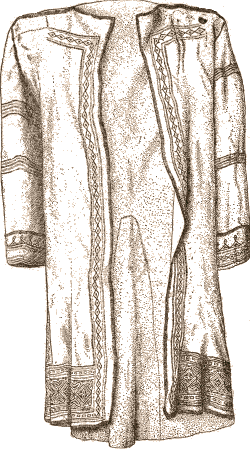
Fig. 87.—Indian buckskin coat, man’s (front).
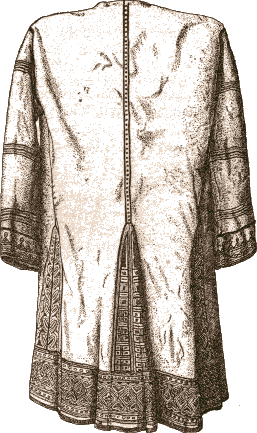
Fig. 88.—Indian buckskin coat, man’s (back).
The shape of the garment worn in summer (Figs. 87 and 88) is somewhat similar to that of a frock coat, but without the tails. The back is cut from a single skin and the skirt cut up from below. Into this is inserted a piece of sufficient width to allow movement of the lower limbs. The sides are from the second skin, split down the middle of the back and sewed to the skin, forming the back of the garment. The back skin forms the covering for the top of the shoulders and extends to the collar seam. The side skins form the front and neck of the garment. The sleeves are made of a third skin, and frequently have a roll or cuff to increase the length, if necessary. The collar is merely a strip of skin sewed to the neck. It is usually turned down. The front is usually open, and if made to be closed it is held in position by a belt or gaudily colored scarf of woolen or cotton purchased from the trader.
The seams of the clothing are always sewed with sinew like that used by the Eskimo. There are but two seams which run the entire length of the coat, and these are the side seams. The seam at the skirt, the armhole, sleeve, and collar are the shorter ones. The coat is always more or less ornamented with extravagant painted designs. The colors and other materials used for painting these designs will be described in another connection, as well as the manner of applying them.
The patterns of these designs will be best understood by reference to the figures, which show some of them in detail (Figs. 89, 90).
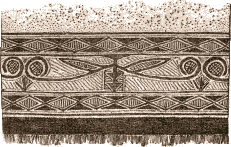
Fig. 89.—Detail of pattern painted on Indian garments.
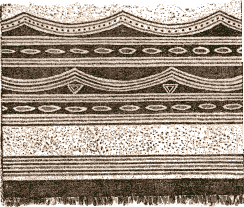
Fig. 90.—Detail of pattern printed on deerskin robe.
The colors used often present startling combinations of red, blue, yellow, and brown. The portions of the garments upon which these colors are placed are the front edges of the opening of the coat, the wrists, and rings around the arms or sleeves, the skirt and pyramid-shaped designs over the hips. The piece intended to widen the skirt behind is always entirely covered with a design of some kind. Over the outside of the seams a line of paint is always applied, nearly always of a red or brown color.
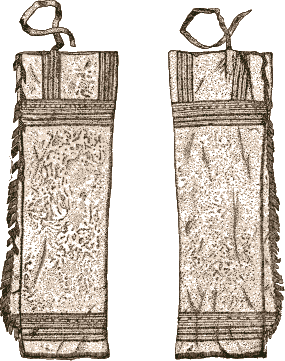
Fig. 91.—Indian buckskin leggings.
Frequently a series of quadrate blotches or squares produced by variously colored lines runs from the apex of the piece inserted in the skirt to the collar.
The length of the coat is such as to reach to the middle of the thigh. The coverings for the lower limbs and for the hips are quite distinct. For the hips the garment is a sort of breeches of which the legs are so short as only to cover the upper portion of the thigh. The breeches are held in place by means of a drawstring in front.
A pair of these breeches is never ornamented with paint, as they are usually not exposed to view.
A pair of leggings extends from the upper portion of the thigh to the ankles. The leggings (Fig. 91) are each made of a single piece somewhat in the form of a narrow bag open at each end. They are held in position by means of a string attached in front and fastened to the upper portions of the breeches. The seam is on the outer side of the leggings and along it is sewed a strip of deerskin having the edges cut into fringe. The leggings are painted in much the same fashion as the coat.
The moccasins (Fig. 92) are rarely ornamented, except with beads on the tongue or else with a strip of red, blue, or black cloth.
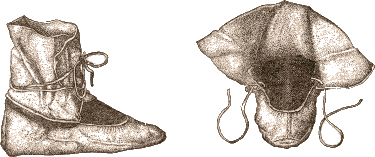
Fig. 92.—Indian moccasins.
In the construction of a moccasin the measure of the foot is taken if it is intended for a person of importance or if the maker attempts to do skillful work. The sole is cut out first in the shape of a parallelogram. The edges are turned up and creases made around that portion of the deerskin which surrounds the toes and a part of the side of the foot. The creases are made perpendicular in order to take up a portion of the slack of the skin. They are held in position by a stout sinew thread run through each one and around to the other side to prevent them from separating and thus “bagging” over the toes. This is the most particular part of the work and on these stitches depend the skill of the maker. The sides of the foot and heel are not creased as the heel-seam takes up the slack for the posterior portion of the moccasin.
The tongue of the moccasin is a piece cut into a shape resembling that member with the tip of it over the toes. This is sewed to the edges of the creases, and between it and the creases is often sewed a narrow welt of skin or cloth. The superfluous edges of the slipper-shaped shoe are now trimmed off, and the top, or portion to cover the ankle, is sewed on. This portion is a long narrow strip of inferior skin of sufficient size to overlap in front and to come well above the ankles. It is left open like the tops of laced shoes. Just below, or at the edge of the tops, a long thong of deerskin is inserted through several holes, which allows it to pass around the heel and below the ankles, bringing the ends in front over the tongue. The ends of the tops are laid carefully over one another and wrapped round by the ends of the thongs which hold the moccasins on the feet.
Certain portions of the skin make better footwear than other parts. The neck skin is too thick and stiff to allow the creases around the toes to be properly made; the flanks are too thin; while the neck is useful for the tongues, the sides for the bottoms, and the flanks and portions of the back, scarred by the grubs infesting the animal, for the tops and strings.
Moccasins for young children often have a seam parallel with the toes and the creasing is thus obviated. Those for wearing in the tent or in the dry vicinity of the camp have no tops and are held to the foot by means of a drawstring.
As most of the strain in walking comes upon the tongue, and this portion is usually ornamented, it is necessary that it should be of a good quality of leather. A piece of black, blue, or red cloth is generally laid over the tongue for ornament. There is sometimes bead work on this portion, but as these people are not skillful in the art of disposing the many colored beads they are not much used for that purpose.
A single deerskin will make five to seven pairs of moccasins for an adult, and as they last but two or three weeks as many as fifteen to twenty-five pairs are necessary for each adult.
The hands are protected with mittens (Fig. 93) made of smoked deerskin. The skin is folded, and along the fold the shape of the mitten is cut so as to leave a part by which the two pieces are joined, and the edges formed in the cutting are sewed together. The thumb is made as follows: A tongue-shaped piece is cut out of the palm and the base of that piece is left as the part to form the under or inner covering for the thumb. A piece is now trimmed that will fit the place cut out and the two parts sewed together.
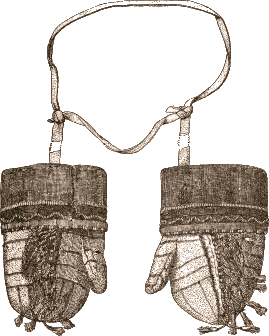
Fig. 93.—Indian mittens.
The thumb of the Indian is, as a rule, shorter than that of the white man, and a pair of native-made mittens are quite uncomfortable until the thumb portion has been recut and sewed. The wrists of the mittens are often gaudily ornamented with strips of red or black cloth. Designs of simple character, such as lines and cross lines producing lattice-work figures, are frequently painted on the back of the mitten. Beads in rows and zigzag lines ornament the wrist, and strands of beads are pendant from the outside seams. The strands are often tipped with tassels of variegated woolen threads. The mittens intended for severe weather are often lined with the thin skin of a fœtal reindeer, which has short, soft hair. Great exertion often causes the hands to perspire and moisten the hair, and this freezes the instant the mitten is removed from the hand, and is liable to freeze the fingers within it.
The head-dress of the men for the summer is often a large cotton handkerchief wound turban-fashion around the head to prevent the long hair from blowing over the face. These handkerchiefs are of the most gaudy patterns, and if they are not worn a simple thong of deerskin serves the purpose. The girls and newly married wives often make bands of beads, some of which are quite attractively designed, for their lovers or husbands. These bands are about an inch wide and several inches long. The ends are lengthened with strips of skin. The band is placed over the forehead and tied by the strings behind. These headbands are generally the most intricate designs of bead work which these Indians display (Fig. 94).
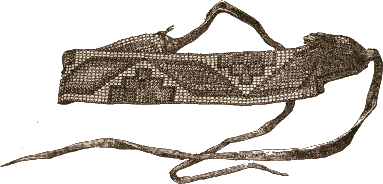
Fig. 94.—Beaded headband. Nenenot.
A cap of deerskin is often worn, but it always seems to be in the way, and is used mostly in wet weather. A piece of stiff deerskin is sometimes made into the shape of a visor of a cap and worn over the eyes during the spring when the glare of the sun on the snow produces such distressing inflammation of the eyes. It is fastened to the head by means of straps tied behind. The greater part of the men prefer to go without head covering. Some who are able and love a display of fancy colors have a cap made of red cloth and ornamented with beads worked into extravagant patterns. The cap is a high conical affair, and from the weight of beads upon it often falls to one side of the head.
The winter coat (Figs. 95, 96) worn by the males is of different pattern from that worn in summer, and is made of skins with the hair inside.
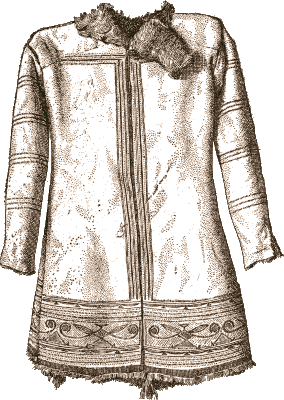
Fig. 95.—Man’s winter coat (front).
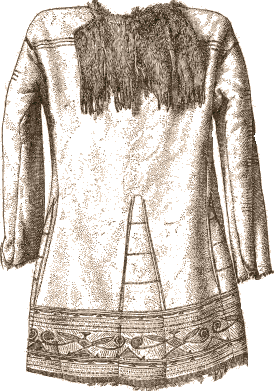
Fig. 96.—Man’s winter coat (back).
Two skins, one of which forms the back of the coat the other the front, are sewed by side seams running from the armpit to the bottom of the skirt. On the shoulder a seam runs to the neck on each side, the back skin extending high enough to form the neck while the other skin reaches to the neck in front. Here it is slightly cut out or slit for a distance of several inches to allow the insertion of the head through the neck hole.
Sometimes a V-shaped piece is inserted into the slit at the front of the neck. To widen the skirts a similar shaped piece is let into the middle of the back skin; or it may be put between the side seams for the same purpose. The bottom of the skirt is decorated. (Fig. 97.)
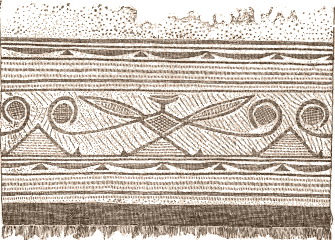
Fig. 97.—Detail of ornamentation.
At the back of the neck a piece about 8 inches square is attached to the garment. This sometimes serves as a collar, and sometimes it gives additional protection by a double thickness to the shoulders, very often the first part to feel the effect of the piercing winds.
A few of the coats for winter have a hood attached to them (Fig. 98, 99) sewed on the back of the neck, which when drawn over the head serves at once as cap and protection.
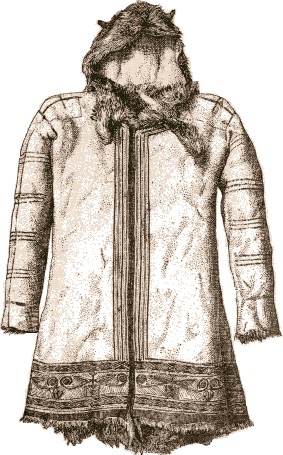
Fig. 98.—Man’s winter coat, with hood.
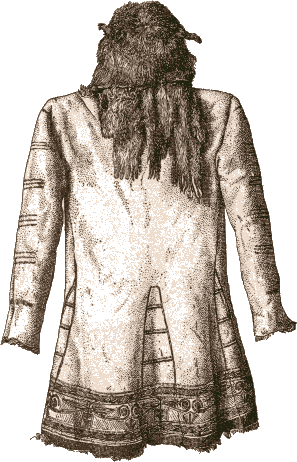
Fig. 99.—Man’s winter coat, with hood.
The collar and hood are invariably made from the skins on the sides of the head of the deer. If two or more head skins are required they are sewed into the form of the deer’s head. The collar is ornamented with fringes cut from the edges of the skin. Sometimes the interscapular protection is cut into three or four points, each one of which is the cheek skin of a deer, and sewed only a portion of the length, the remainder being left free and terminating with a series of long strands or fringes. The sleeves of these garments have nothing peculiar about them.
As the Indian is always in the vicinity of the herds of deer it is an easy matter for him to obtain the skins when in best condition, and from the finer skins superior garments are made. The shape of the Indian’s coat is not so well adapted to afford protection as that of the Eskimo; hence, the white men in this region invariably adopt the clothing of the latter in cold weather.
Indians eagerly accept any cast off garment which a white man has worn, and they often procure the clothing offered for trade. Trousers are in much demand. Coats are deemed great prizes, especially in the wet seasons when the moisture would certainly ruin their own clothing by causing the hair to fall off or totally destroy the shape of the tanned skin garments. For underclothing the Indian man uses an additional suit of ordinary clothing or else dons a shirt procured from the trader. Drawers are rarely worn.
That these people are little susceptible to the effects of cold may be inferred from the fact that I have seen them come to the trading post of Fort Chimo in the middle of winter when the thermometer had not registered higher than 20° below zero for weeks, with no protection for their legs except a pair of old buckskin leggings so short that the bottom did not reach within 3 or 4 inches of the dilapidated moccasins. The feet were, so far as could be ascertained, chiefly protected by a wrapping of old baling cloth covered with a pair of moccasins which no white man would have been seen wearing. I observed also that no additional clothing was purchased for the return trip.
The garments worn by the women in the warmer season consists of thin dresses of calico purchased from the traders. Thin shawls serve to protect the head and shoulders. The feet are incased in moccasins. Some of the women are able to purchase dresses of cloth, and these are cut into a semblance of the dresses worn by the women of civilized countries. It is not rare to see a woman wearing a skirt made from the tanned skin of the deer. The lower portions of the skirt are often fancifully ornamented with lines and stripes of paint of various colors, extending entirely around the garment. A piece of baling cloth is often fashioned into a skirt and worn.
The females appear to be less susceptible to the sudden changes of the summer weather than the men. At least they exhibit less concern about the thickness of their apparel. It is not unusual to see a woman whose only clothing appears to be a thin dress of calico. During the winter the women dress in the most comfortable skins (Fig. 100), blankets, shawls, comforts, leggings, and moccasins. During exceptionally severe weather, they appear as traveling wardrobes, doubtless carrying their all on their back, and in some instances presenting a most comical appearance as, loaded with clothing of most miscellaneous character, they waddle over the snow. The winter cap is similar to that worn by the men, but is not so peaked. It is an object on which they expend a great amount of labor. The material is usually a kind of cloth locally known as Hudson bay cloth, either red, dark blue, light blue, or black. The caps of the men and women are usually made from the better grades of this cloth, while the dresses of the women and the leggings of the men are of the inferior grades.
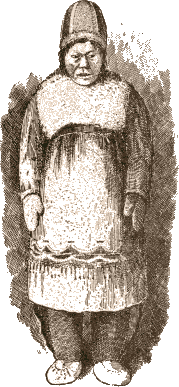
Fig. 100.—Nenenot woman in full winter dress.
If the cap is to be all one color, in which case it is always red, the cloth is cut in two pieces only, and put together so as to produce a cup-shape. Sometimes five or six pieces are cut from two or three different colors of cloth and the strips sewed together. Over the seams white tape is sewed to set off the colors. In the center of the strip is a rosette, cross, or other design worked with beads, and around the rim rows of beads variously arranged.
The body is covered with a heavy robe made of two deerskins sewed together. This robe is often plain, and when ornamented designs are painted only on the bottom of the skirt. These robes are always of skins with the hair on. The flesh side is often rubbed with red ocher while the extreme edge may be painted with a narrow stripe of the same mixed with the viscid matter obtained from the roe of a species of fish. The edge stripe of paint is always of a darker brown than the other colors from the admixture of that substance with the earth.
This garment is put upon the body in a manner impossible to describe and difficult to understand even when witnessed. It is held together by small loops of sinew or deerskin. A belt around the waist keeps it up.
The women also wear in winter a sleeveless gown reaching little below the knees and as high as the chin. The sleeves are put on separately, like leggings. They are usually made of red or black cloth.
The gown is often extravagantly decorated with paint. The flesh side of the skin is rubbed with red ocher, on which are painted in describable designs. A strip of deerskin dotted with beads borders the gown, and from the edge of the strip hang strings of these ornaments, terminating in variously colored tassels of thread.
The leggings of the women differ from those of the men. They extend higher and the bottoms cover the tops of the moccasins. They are made of skin or cloth, the latter black or red. To cut out a pair of leggings requires skill. The cloth is doubled and then cut nearly in a circular form. A size sufficient to fit the limb is sewed up leaving the crescent-shaped remainder a flapping ornament. The “wings” are often edged with cloth of a different color and on the outer border rows of beads complete the decoration. The two crescents are left free, and as the wind separates them they flap most fantastically. They are always worn so as to be on the outer side of the legs. The bottoms of the leggings are heavily loaded with numerous rows of fancy beads.
Moccasins are alike for both sexes.
As additional protection from cold the shoulders are covered with a mantle of soft skins from young deer. Blankets purchased from the traders are also sometimes thrown over the shoulders or around the waist.
Children are clad like adults, excepting that their apparel is less carefully made and they often present a disgusting appearance, with their clothing glazed with filth and glistening with vermin.
Infants usually have their garments made in the “combination” form. The cap forms a separate piece and is fitted so closely that it is not removed until the growth of the head bursts the material of which the cap is made.
When traveling men and women smoke or snuff a good deal. Tobacco and a few other necessary articles are carried in a bag known as “fire bag.” These are made of cloth and trimmed with beads, and are often quite tastefully ornamented.
The detailed figures which I have presented show much better than any description the designs used in ornamenting their clothing. Some of the patterns are rude copies of the designs found upon cheap handkerchiefs, scarfs, and other printed fabrics.
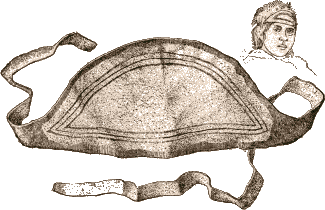
Fig. 101.—Sealskin headband. Nenenot.
I have already spoken of the headbands worked for the men by their wives and sweethearts. Such a headband, made of sealskin procured from the Eskimo, is shown in Fig. 101 (No. 3449). The headband is used to support the weight of a load carried on the back, relieving the strain on the shoulders and making it easier to breathe. The band passes over the forehead to the back, where it is attached to the load. Various forms of these headbands or portage straps are made. Sometimes a piece of birch bark is placed under the strap where it touches the forehead. It is said that the bark does not become wet from the moisture induced by the severe exertion and thus burn the head.
PREPARATION OF THE SKINS FOR CLOTHING.
Having now given a general description of the clothing of the Nenenot, I may proceed to describe the process of preparing the skins of which this clothing is made. The skins of the deer, which are to be converted into buckskin and parchment, are laid to one side in a heap, just as they came from the bodies of the animals or after they have gone through a process to be subsequently described.
When the skins have laid in this heap for several days decomposition sets in and loosens the hair so it will readily pull out. When the pelt is ready for scraping it is thrown over a round stick of wood some 3 or 4 inches in diameter and 3 or 4 feet long, one end of which rests on the ground while the other is pressed against the abdomen of the woman who is doing the work. Then she takes a tool like a spoke shave (Figs. 102, 103, No. 3162) made from the radius of the deer, by cutting a slice off the middle part of the back of the bone, so as to make a sharp edge while the untouched ends serve for handles, and with this scrapes off the loosened hair.
The sharp edge of the bone instrument coming against the hairs pushes or pulls them out but does not cut the skin.

Fig. 102.—Skin scraper (front). Nenenot.
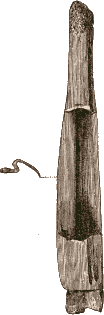
Fig. 103.—Skin scraper (back). Nenenot.
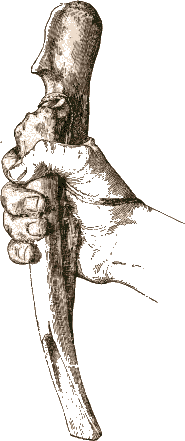
Fig. 104.—Skin-cleaning tool. Nenenot.
The flesh side of the pelt is now worked to free it from particles of flesh and blood, together with as much of the moisture in the skin as may be hastily done, for if the person has a great number of skins to attend to she must work rapidly lest they decompose too much and putrefy.
Where the hunter has great success in killing deer many of the skins are left untouched because there is no one to attend to them and they are thus wasted.
When the pelts of the deer or other large animals have been taken from the carcass they are allowed to dry with the adherent flesh, fat, and ligaments until a convenient opportunity occurs to remove those portions from the skin, which must be moistened to permit them to be more readily scraped off. If the fresh skins are to be cleaned immediately, they are operated upon in the same manner as those previously dried. All the skins of fur-bearing animals and those furnishing skins for clothing and other purposes must be scraped, otherwise they would soon be soiled by the infiltration of the fat among the hairs.
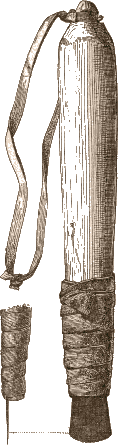
Fig. 105.—Skin-cleaning tool, iron-bladed. Nenenot.
To remove the adherent particles on the flesh side of the skin a peculiar instrument has been devised. The tibia, or large bone of the hind leg of the reindeer, is used for this purpose (Fig. 104). The peculiar shape of the bone renders it particularly well adapted to form a combination of saw, chisel, and gouge at the same time. The lower portion of the bone is cut squarely off. A part of one side of the remainder is cut so as to leave one side (the inner side of the bone) in the shape of a chisel, having either a straight edge or else slightly rounded. On this edge are cut a number of fine notches, which give the edge of the instrument a serrated form. Some of the bones have a spatula-shaped piece of iron or steel cut with the serrations upon it and the metal piece set in the cavity of the bone. If the leg of a deer is not convenient a wooden handle shaped like the long handle of a mortising chisel is fashioned, and to it is affixed the metal point by means of stout lashings (Fig. 105). Around the upper portion of the wooden shaft a notch or groove is cut, and in this is tied a stout thong in such manner as to form a loop to prevent the hand from slipping down the smooth bone when the blow is struck.
The manner of using this instrument is peculiar and effective. The skin is thrown, with the flesh side up, over a stake 2 or 3 feet high driven firmly into the ground. The person kneels down before the stake, and when the skin is placed so as to afford a convenient portion to begin upon, an edge is taken between the fingers of the left hand and lifted slightly from the ground. A blow is given with the tool which separates the subcutaneous tissue, and by rightly directed blows this may be separated from the skin entire. The skin is then laid aside for further working. The subcutaneous tissue is washed and dried, after which it is used for a variety of purposes, such as coverings for bundles of dried meat and other articles.
The skin is worked over with this instrument to free it from a portion of its moisture and is now ready to receive the tanning material which consists of a mixture of putrefying brain, liver, and fat. They sometimes soak the skin in wine, which is reputed to add greatly to the lasting qualities of the leather, but the odor of that liquid lasts as long as the skin.
The tanning material is laid on the flesh side of the skin in a thin layer and by rubbing with the hands it is well worked in. Several hours or days elapse and the superfluous matter is scraped off. The skin is then scraped and rubbed between the hands, the harder portions with a scraper resembling a small scoop, until all the skin is worked into a pliable condition. If the skin is yet too oily a quantity of powdered chalk, clay, calcined bone, or even flour, is thoroughly rubbed over it to absorb any fatty matter yet remaining.
The skins having the hair on, for clothing, or those intended for buckskin, are treated in this manner. Those intended for parchment are simply rubbed with a quantity of fat, and then allowed to dry in that condition, being of a yellowish or pale glue color.
Where a great number of skins have to be prepared, and some of the more energetic men have as many as two or three hundred buckskins and parchment skins for the spring trade, a constant application to this labor is necessary in order to prepare them in season. This, in a manner, accounts for the number of wives which an energetic or wealthy man may have in order that the products of the chase falling to his share may be promptly attended to.
When the skins intended for sale are selected they are bundled up and covered with parchment skins or the subcutaneous tissue.
The skins intended for use among themselves are generally inferior grades, such as those cut in the skinning process, or else those obtained in the earlier or the later part of the season.
A species of gad fly infests the deer, puncturing the skin on both sides of the spine, and depositing within the wound an egg which in time is transformed into a grub or larva. These larvæ attain the size of the first joint of the little finger, and at the opening of the spring weather work their way through the skin and fall to the ground, where they undergo metamorphoses to become perfect insects.
A single animal may have hundreds of these grubs encysted beneath the skin, which, on their exit, leave a deep suppurating cavity, which heals slowly. The skin forming the cicatrices does not have the same texture as the untouched portions.
When the skin is dressed it reveals these scars, and of course, the value of the skin is diminished according to their number. The Indian often endeavors to conceal them by rubbing flour or chalk over them.
The season when the skins are in the best condition is from September to the middle of December. The freshly deposited eggs have not yet produced larvæ of sufficient size to injure the skin, and the wounds produced by those dropping out in the month of May have healed and left the skin in condition.
Certain skins intended for special purposes must be smoked. The process of smoking tends to render it less liable to injury from moisture. The pyroligneous vapors act as antiseptics and thus at least retard decomposition of those articles most exposed to wet. The tents and foot wear are always tanned with the smoke and this process is always subsequent to that of bringing the skins into the pliable condition.
The process adopted by these Indians in smoking the deerskins is as follows: The woods are searched for rotten wood of a special character. It must be affected with a kind of dry rot which renders the fibers of a spongy nature. This is procured and thoroughly dried. The skins to be smoked are selected and two of nearly the same size and condition are chosen, and sewed into the form of a bag with the hairy side within. The after portions of the skin are suspended from a convenient pole and the head and neck portions left free or open. To the edges of these is sewed a cloth, usually a piece of baling cloth, and this is also left open. The rotten wood is placed in a pan or vessel and as it smolders, never burning into a blaze, the pale, blue, pungent smoke is allowed to ascend within the cavity of the deerskin bag. The cloth is merely to form a conduit for the smoke as the skin should not be too near the fire.
As the process continues the skins are inspected between the stitches of the sewing and when the operation has progressed sufficiently they are taken down. It will now be found that the surface has assumed a pale, clear brown color, the shade of which depends on the length of the exposure to the smoke.
The cloth is removed and the skins are immediately folded, with the smoked side within, and laid away for several days to season. If, however, the skin be left to the influence of the air the coloring matter immediately disappears leaving it of a color only slightly different from what it was before it was smoked.
The scars, made by the larvæ of the insects, do not “take” the smoke as well as the healthy portions and so present a pitted or scaly appearance. From the skins having an abundance of the scars are made the tents and inferior grades of moccasins and the tops of the better class of footwear.
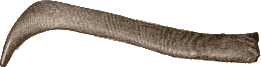
Fig. 106.—Paint stick. Nenenot.
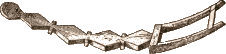
Fig. 108.—Paint stick, Nenenot.
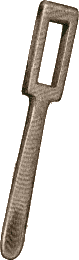
Fig. 107.
The paints used for decorating the buckskin garments are applied by means of bits of bone or horn of a peculiar shape best understood from the figures (Figs. 106-110).
Those with two, three or four tines are used for making the complicated patterns of parallel lines, and are always made of antler, while the simple form is sometimes of wood.
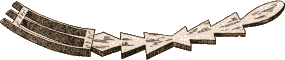
Fig. 109.—Paint stick. Nenenot.
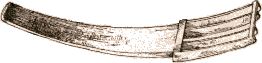
Fig. 110.—Paint stick. Nenenot.
A block of wood with one or more bowl-shaped cavities cut in it (Fig. 111) serves to hold the mixed paints, especially when several colors are to be used in succession.

Fig. 111.—paint cup. Nenenot.
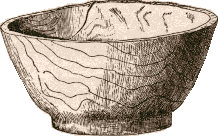
Fig. 112.—paint cup. Nenenot.
Small wooden bowls are also employed. (Figs. 112-113.)
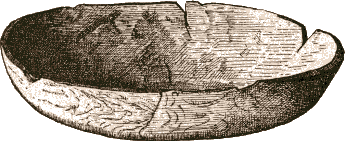
Fig. 113.—Paint cup. Nenenot.
The pigments used are procured from different sources. From the traders are obtained indigo in the crude condition or in the form of washing blue, vermilion in small buckskin bags, and a few other colors. An abundance of red earth occurs in several localities. The pigments are reduced to the finest possible condition and kneaded with the fingers until ready for the addition of water often mixed with a slight quantity of oil or tallow. A favorite vehicle for the paint is the prepared roe of a sucker (Catastomus) abounding in the waters of the district. The female fish are stripped of the mass of ova which is broken up in a vessel and the liquid strained through a coarse cloth. The color is a faint yellow which becomes deeper with age. The fluid is allowed to dry and when required for use is dissolved in water. It has then a semiviscid consistence and in this condition is mixed with the various pigments. When a yellowish color is desired the fish-egg preparation is applied alone. The albumen gives sufficient adhesive quality to the paint and produce a rich glaze, giving a good effect to the otherwise dull colors.
The process of preparing the crude mineral colors is quite tedious as the attrition is produced by rubbing the substance between two smooth stones, a little water occasionally being added to hold the particles together. The prepared paints are put in the vessels already described, and when ready for use a quantity is taken with the finger and placed in the palm of the hand while the other fingers hold the instrument by which it is to be applied. The paint stick is carefully drawn through the thin layer of paint spread on the other palm and a quantity, depending on the thickness of the layer, adheres to the edges of the appliance and by a carefully guided motion of the hand the lines desired are produced. The eye alone guides the drawing, however intricate it may be. The artist frequently attempts to imitate some of the delicate designs on a gaudy bandana handkerchief or some similar fabric. The principal source of the hematite is a lake near the headwaters of George’s river where it occurs as a mass of disintegrated rock along the margin. The water has by freezing split great quantities from the mass and when there is a strong wind from the opposite direction the water is often lashed into a blood-red foam.
DWELLINGS.
The Nenenot live, both in summer and in winter, in deerskin tent, (see Fig. 114), which are constructed in the following manner: A sufficient number of small poles cut from the woods are deprived of their branches and brought to the camp site. A location is selected and the poles are erected in a circle, with tops leaning toward the center so as to form a cone 10 to 14 feet in height, having a diameter at its base of from 10 to 18 feet. The skins forming the cover are those of the reindeer, and those selected for this purpose are usually of an inferior grade. A sufficient number are sewed together to form a strip long enough to reach around the poles when set up. As the tents differ in size according to the number of people who occupy them, the skins sewed together may be from eight to twelve. The first strip is made for the lower part of the poles and is attached to them by means of strings fastened within. A second strip is made to go around the upper part of the poles, and is, of course, correspondingly shorter. It is placed last so as to overlap the lower breadth and thus prevent rain and snow from blowing in. The door is usually made of one large skin or two smaller ones. It is tied to the poles at the upper corners and at the lower has a small log of wood as a weight to prevent it from flapping. The poles at the apex are not covered and through them the smoke from the fire built in the center within ascends and finds exit.
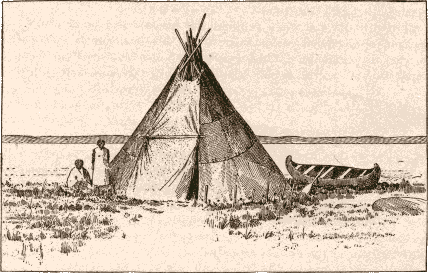
Fig. 114.—Nenenot Indian tent.
The interior of the tent is arranged to suit the occupants. The floor is usually covered with the branches of young spruce, and when carefully laid these form an admirable protection from the cold ground and a soft carpeting.
The women who lay this flooring display great taste, and certain of them are noted for their skill in disposing the branches. The center of the tent is reserved for the fire which is built there among a few stones.
The occupants arrange themselves according to the importance of the place they occupy in the family. The owner or head man is always to be found on the side opposite the fire. This is considered a place of honor, to which all guests who are to be complimented are invited to a seat.
The other members of the group arrange themselves along the sides of the tent, and those who have been adopted into the family occupy positions next the doorway.
Over the fire may be poles reaching across the tent, and on these will be suspended kettles and pots obtained from the traders. The cooking utensils are few in number, one vessel serving various purposes.
The hunting gear and the skins of animals, together with the articles belonging to the females may be seen suspended from various portions of the interior. Around the edges are the blankets of deerskin, and those bought from the traders, lying in disorder. The outer edge of the interior is slightly raised above the center, and affords a convenient slope for those who desire to sleep. The occupants always sleep with their feet toward the fireplace, around which there is no brush, lest it be set on fire during sleep and destroy the tent.
They have regular hours for sleeping, but as these are only for a period of short duration, it is not unusual to find half the inmates asleep at any time a tent is visited.
The preparation of the food appears to go on at all times, and there are no regular hours for partaking of their meals, as each person eats when convenient. The food is taken directly from the pot or kettle, and each one helps himself. Forks are not used, and the food is divided with a knife or torn with the fingers.
SWEAT HOUSES.
The Nenenot are in the habit of taking steam baths, for which purpose they use a sudatory or sweat house, constructed as follows: A number of flexible poles of small size, usually willow or alder, which grow to sufficient size along the banks of the streams, are bent to form a hemispherical or dome-shaped structure, which is covered with tent skins. A sandy locality is selected or one free from snow in winter, and a fierce fire is built. When it is well under way a number of stones are thrown into the fire to heat. When the heat is sufficient the fire is removed and the structure is quickly erected over the hot stones and some one from the outside fastens down the edges of the tenting with stones to prevent the loss of heat. A kettle of water previously placed within the bath house is used to pour over the stones, when heat rises to a suffocating degree and produces the desired perspiration. Water is not used to bathe in, though sometimes a slight quantity is poured upon the head only. The bather remains within the hut until the heat has nearly exhausted him.
These baths are frequently taken, and often when he has just started on a journey the head of the family will be seized with a desire to have a bath. Everything must await this operation before the journey is resumed.
An amusing incident occurred at Fort Chimo in the spring of 1882. That season the reindeer were extremely numerous at that place, as they were crossing to go to the northeast to drop the fawns. Often when the herds or bands were panic stricken they rushed among the Indian tents, the houses of the station, and, in fact, everywhere, with yelping dogs and screaming women and children at their heels. An old man and wife were in the sweat house at a time when a very large drove of the deer, in their frantic endeavors to escape their pursuers, headed directly for the bath. Some one screamed to the occupants to look out for the deer. The man and wife made their exit just as a score or more of the animals reached the spot. The man tore up the tenting of the bath house and whirled it in the air, while the old woman cut the most astonishing antics. The whole population witnessed the occurrence and did not fail to help increase the tumult. Signs of former sudatories are quite common along the paths where the Indians have traveled for many years.
HOUSEHOLD UTENSILS, ETC.
Each household is supplied with sundry wooden vessels of various sizes (Fig. 115) which serve for buckets for holding water and for drinking cups. They are made of strips of thin boards cut from spruce or from larch trees, the wider strips being as much as six inches wide and one-third of an inch thick. They are steamed and bent into ovoid or circular forms and the ends of the strip overlapping. Then they are sewed with split roots from those trees. A groove is cut near the lower edge and into it is placed a dish-shaped piece of wood for a bottom.
These vessels are identical in shape and function with those manufactured by the Yukon river Indians of Alaska.
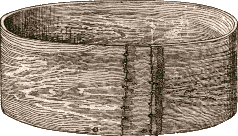
Fig. 115.—Wooden bucket, Nenenot.
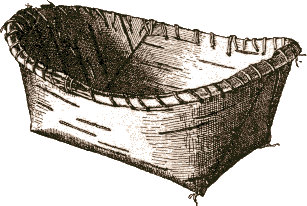
Fig. 116.—Birchbark basket, Nenenot.
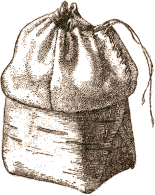
Fig. 117.—Birchbark basket, Nenenot.
They also use berry-dishes or baskets like Fig. 116 made from the bark of the spruce peeled in the spring of the year. At this time the bark is quite flexible and may be bent into the desired shape. The corners are sewed with coarse roots from the same tree and the rim is strengthened by a strip of root sewed over and around it by means of a finer strand. These baskets serve a good purpose when the women are picking berries, of which they are inordinately fond; and during that season it is a rarity to see a woman or man without a mouth stained the peculiar blue color which these berries impart.
Baskets of this shape frequently have a top of buckskin sewed to them, closed with a drawstring, as shown in Fig. 117 (No. 3485). Such things serve to hold trinkets and other small articles.
Large objects are carried in bags, either long or basket-shaped, made of the skins of deer legs. The leg skins are scraped and worked to a moderate degree of pliability and their edges sewed together until a sufficient number have been joined to make the bag of the required size. This bag is used to hold the clothing, furs, and other valuables. When on a trip they are invariably carried. If the journey be performed on foot the two ends are tied with a thong and the bag thrown over the shoulder.
In preparing food stone pestles of various sizes were formerly used of the shape shown in Fig. 118. These pestles are now mostly out of date and superseded by cast-iron ones with steel faces, procured from the traders. The metal pounders, however, are so heavy that they are objectionable to people who have to make their burdens on the portages as light as possible.
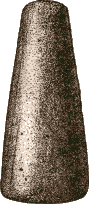
Fig. 118.—Stone pestle, Nenenot.
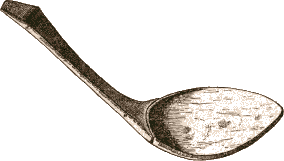
Fig. 119.—Wooden spoon or ladle, Nenenot.
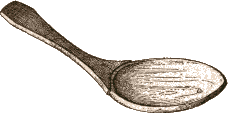
Fig. 120.—Wooden spoon or ladle, Nenenot.
Spoons to lift pieces of floating meat from the hot liquor in which it is cooked, are made of reindeer antler and of wood. The pattern of these spoons is shown in the figures (Fig. 119). One shape (No. 3351, Figs. 120, 121, 122), was perhaps copied from a civilized ladle. Pots are suspended over the fire with pothooks of reindeer antler hung up by a loop of thong. These pothooks are also made of wood.
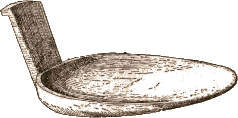
Fig. 121.—Wooden spoon or ladle, Nenenot.
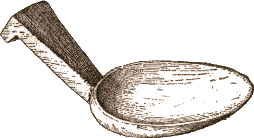
Fig. 122.—Wooden spoon or ladle, Nenenot.
TOBACCO AND PIPES.
Like all other Indians, these people are inordinately fond of tobacco for smoking, chewing, and snuff; the latter, however, is used only by aged individuals, especially the females, whose countenances show the effect in a manner quite disgusting. The men consider a supply of tobacco of as much importance as the supply of ammunition for the prosecution of the chase. The first request upon meeting an Indian is that you furnish him with a chew or a pipe full. Little satisfactory intercourse can be had with him until he is mollified by a gift of tobacco. The first thing that an Indian receives when arriving at the trading post is a clay pipe and a plug of tobacco. The pint of molasses and the three or four hard biscuit (which have received the local name of ‘Canadian padlock,’ doubtless because they are so difficult to open), are of secondary consideration. When the spring arrivals are camped at the station it is not unusual for several to contribute a number of plugs of tobacco and a gallon of molasses. These are boiled together and then water is added to the mixture. This villainous compound is drunk until a state of stupefaction ensues. The muddled creature under the influence of that liquor seems like an idiot. The effect is terrible and does not wear away for several days. The pipes used for smoking are made of stone obtained from river pebbles, usually a fine-grained compact sandstone. The color of this stone varies from a dark reddish brown nearly the color of clotted blood to a lighter shade of that color. The red stones often have spots of every size and shape of a yellowish drab which form a strange contrast with the darker colors. The darker the stone the less spotting it will have. The best of all the pipes and those most valued are of greenish sandstone having strata of darker colors which appear as beautiful graining when the pipe is cut into form and polished.
BUREAU OF ETHNOLOGY ELEVENTH ANNUAL REPORT PL. XXXVIII
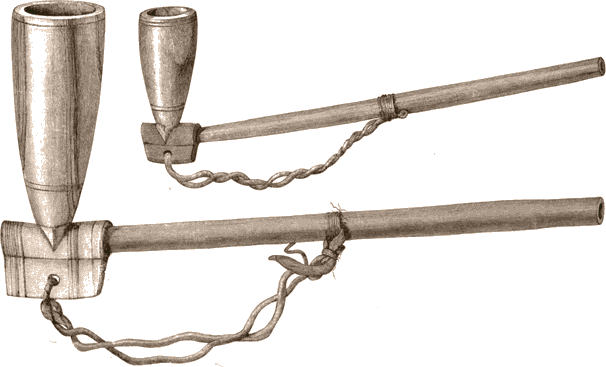
STONE TOBACCO PIPES.
Other pipes are of hard slate and very dark without markings. All the material is hard and the effect of the fire within renders them harder and liable to crack if used in very cold weather. These pipes vary but little in shape (I have figured three—Pl. XXXVIII and Fig. 123—to show the pattern), but there is considerable difference in size. The largest ones are made of the green stone, while the smaller ones are made of other stones. The stem is of spruce wood and is prepared by boring a small hole through the stick lengthwise and whittling it down to the required size. It is from 4 to 8 inches long and is often ornamented with a band of many colored beads.
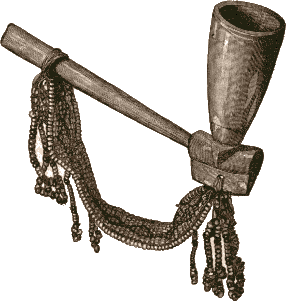
Fig. 123.—Stone tobacco pipe.

Fig. 124.—Pipecleaner, Nenenot.
The rough stone for a pipe is selected and chipped into crude form. The successive operations of wearing it down to the desired size are accomplished by means of a coarse file or a harder stone. The amount of labor bestowed upon a pipe consumes several days’ time before the final polish is given.
The value set upon these pipes is according to the color of the stone, as much as the amount of labor expended in making them. They are always filthy, partly on account of the bad quality of tobacco used. The ashes and other accumulations within are removed by means of a bodkin-shaped instrument of bone or horn. The back of a broken horn comb is a favorite material for making a decorated pipe-cleaner (Fig. 124). The ornamentations consist of cruciform and quadrate figures on the handle. The tobacco used for smoking is the commonest black plug of very inferior quality, soaked with molasses and licorice. This moist tobacco is cut into pieces and a coal of fire placed upon it. They prefer this quality, and purchase the lighter and drier kinds only to serve as kindling for the darker sort.
They do not know how to brew or ferment liquors of any kind, and as the importation of intoxicants is wisely prohibited, the native has no opportunity to indulge in his craving for liquors, the supply of which was plentiful in former years. A spruce beer is made by the servants of the company for the holidays, and a taste is sometimes given to a favorite Indian, who is so easily affected that a pint of this mild beer will send him reeling and happy to his tent, where it soon becomes known that beer is to be had. The importunities for drink are now so frequent, that the barrel must be emptied of its contents in order to avoid the constant beggings for it.
MEANS OF TRANSPORTATION.
BY WATER.
All the Indians of this region use birch-bark canoes, of the pattern shown in the figure (Pl. XXXIX, from a photograph; the collection also contains six wooden models of these canoes). The style of canoe used by the Little Whale river Indians of the eastern side of Hudson bay has very much more sheer at the bow and stern than those used in the valley of the Koksoak. The canoe of each individual differs from others according to the personal taste or need of the maker. The requirements are that the canoe shall be able to transport himself and family, together with the household property, whenever it is desired to change camps. Some of the canoes are small, others large, often possessed by two or more individuals in common.
BUREAU OF ETHNOLOGY ELEVENTH ANNUAL REPORT PL. XXXIX
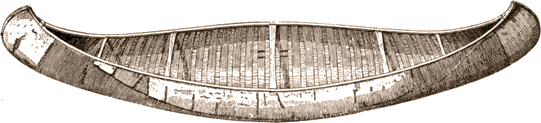

BIRCH-BARK CANOE, NENENOT, KOKSOAK RIVER PATTERN.
These canoes are constructed in the following manner: Trees are selected which when split will afford a number of straight-grained slats free from knots. These slats are shaved to the required thickness and laid aside to season. They are 3 or 4 inches wide and less than one-third of an inch in thickness. The exterior or longitudinal strips are placed so that their edges will touch each other. The inside strips or ribs are placed about their own width apart, and of course are placed at right angles to the longitudinal slats. They are thinner than the side strips and become almost like shavings at the bow and stern. The two layers of slats form a kind of shell upon which the skin of bark fits tightly. The first process with the bark is to free it from the outside scaling layers; the next is to soak it for several days in fresh water to soften it; otherwise, when dry it would crack like an eggshell. When it has macerated a sufficient time it is taken out and laid over a form of clay or other earth, which has previously been roughly molded to the shape of the interior of the canoe. The bark is now sewed along the edges of the strips with roots of the spruce tree. These are long and tough, and resemble splits of rattan when properly prepared for the purpose by splitting and shaving with a knife. Various sizes of these roots are used for the different portions. The threads are also soaked in water until they become so flexible that they may be tied into a knot without breaking.
When the bark skin rudely conforms to the shape of the mold of earth, the rails or round strips of wood along the inner edge of the canoe are placed in position and the ends of the bark strips laid over it and sewed. A second rail is now laid upon the first and drawn down to it by means of the root thongs. A piece of wood is shaped for the bow and one for the stern and inserted in position, and the end seams of the canoe are sewed over these pieces.
The interior is then ready for the longitudinal strips, which are placed at the bottom first and gradually built up on each side until the rails are reached. The ribs or transverse strips are next placed in position. Five or more crosspieces, or thwarts, are fastened to the side rails to give stiffness to the sides and to prevent collapsing, and they may be set either below or above the rail. The greatest care must be exercised to give to both sides of the canoe the same shape and to have the keel evenly balanced. This is rudely regulated by the eye during the process of construction. After all the strips are put in, the boat is allowed to season and dry. This causes the bark to shrink, and while drying the whole is frequently inspected to discover any splits or cracks in the bark. The Indian often wets the canoe, lest it dry too rapidly and split under the tension. When the form and make are satisfactory the seams are smeared with a mixture of spruce gum (or resin bought from the traders), mixed with seal oil to render it less easily broken. This mixture is while hot laid upon the dry surface with a small paddle.
After the gum has seasoned for a day or so the canoe is put upon the water and tested for its speed and seaworthiness. All leaks and needed repairs are immediately attended to, and it is at length ready for use.
Many persons have not the skill needed to construct a canoe, and they employ those who have had experience and are known to build an excellent boat.
There are two kinds of canoes in use among those Indians, differing only in the shape of the stern and prow. The original form was nearly flat along the rails and had the bow and stern but little turned up. Of later years intercourse with some of their neighbors has induced them to modify the nearly straight edge canoe into an intermediate shape between their own and that of the East Main Indians, whose canoes are very much turned up, and are acknowledged to be far superior vessels to those of the Ungava Indians.
As the forests in the vicinity of Fort Chimo do not contain birch trees, and none are found until the headwaters of the Koksoak are reached, where they are too small to afford bark of sufficient size and thickness, the Indians are compelled to procure the bark from the traders, who import it from the St. Lawrence river and gulf stations to Fort Chimo. It comes in bundles large enough to cover a single canoe of moderate size. If a canoe is to be very large two bundles are required. The value of a black fox skin purchases a bundle of bark.
During the spring months, while the weather is somewhat warm, the men are engaged in preparing the strips and bark for the canoe which is to convey them up the river when the ice breaks and the river is open for navigation.
The paddle has a single blade with a handle scarcely more than half the length of the paddle. It is used with both hands, the strokes being given on alternate sides as it glides through the water.

Fig. 125.—Spoon for applying grease to canoe.
When it is necessary that a portage be made the voyager takes the canoe upon his shoulders by letting one of the center thwarts rest on the back of the neck. The hands are thrown backward to hold up the end of the canoe from the ground. A headband, such as I have already described, of birch bark or cloth, often fancifully ornamented with beads, fits over the forehead and is attached to the sides of the canoe by means of thongs, which prevent the canoe from slipping off the shoulders as the porter quickly traverses the narrow pathway through the trees and bushes. The ground is often so uneven and rough that long detours have to be made by the porter, while the rest of the party may go a shorter path to the place where the canoe will again be placed in the water. A part of the necessary equipments for a trip in a canoe are pieces of bark, root threads, and gum to repair any damage resulting from an accidental contact with a stone or snag.
Without the birch-bark canoe the Indian would have difficulty in obtaining his living, as it is even more necessary than the sled, and nearly as useful as the snowshoe.

Fig. 126.—Toboggan, Nenenot, side view.

Fig. 127.—Toboggan, Nenenot, from above.
The paddles used with these canoes are about 5 feet long, having a blade about 30 inches long and 4½ wide. The handle terminates in a sort of knob. The paddle referred to, for applying the gum and grease to the seams of the canoe, has the shape of a flattened spoon with rounded bowl (Fig. 125). The gum is heated, and while hot is poured along the seams and pressed into the interstices of the stitches with the paddle. When a patch is to be applied over a fracture or broken place in the bark, it may be made to adhere by the sticky properties of the gum alone, if the distance to be traveled is not great. A fire is then made and the wax heated; the piece of bark is edged with the gum and pressed firmly over the rent. A second coat is applied over the edges of the bark, after the first has become cold. A few minutes suffice to repair an apparently alarming hole.
BY LAND.
For carrying loads over the snow all the Indians of this region use large sleds (Figs. 126, 127) called tá-bas-kán, which is a word equivalent to the well known name “toboggan.” These sleds, as used among the Indians under consideration, differ very greatly in size according to the use for which they are designed.
The method of construction is as follows: A tree is selected as free from knots as possible and two boards of less than an inch in thickness are hewed or split from it. These boards are further dressed to the required thickness and width. The final operation consists in shaving them down with a “crooked knife” to little more than half an inch in thickness. One edge of each board is then straightened and the two edges placed together. The length is rarely more than 13 feet. The front end is steamed or heated in a kettle of hot water until the boards become flexible. The ends are turned up to the desired curve and then bent over at the end, where they are held in position by a transverse bar of wood. This bar is slightly concave on the side next the sled and gives the nose a curved shape. The curved portion of the front may rise as much as 18 inches above the surface over which the sled travels. At the place where the curve begins a second transverse bar is placed, and at a distance behind it a third, fourth, and fifth bars are fastened. Sometimes an additional bar is to be found on the upper side of the bottom. These bars are all fastened to the two bottom boards by means of thongs of parchment deerskin, and run through holes on the bottom boards. On the under side the thongs are let into places cut out between the two holes, so that the thongs will not be worn when passing over the snow. They are usually fastened in four places, one at each end of the bar and one on each side of the crevice between the edges of the two boards. From the nose of the first bar run a pair of very stout thongs or else twisted sinew, which are drawn tight enough to prevent the nose and curve from straightening out. From the end of the first bar to the last one on the heel of the sled is run a stout twisted thong under the end of each bar, which there has a notch cut on the under side for the line to pass through. This line serves to strengthen the sides and prevent the two boards from slipping past each other when passing over inequalities of the ground. At the ends of the first bar and connected with the side lines are two long stout thongs of twisted skin, often 25 feet long. These are used as traces, by which the sled is dragged. The shape of the bottom is often fashioned after all the remainder of the work has been done. The width of the nose is rarely more than 9 inches; at the first bar it is about 14 inches and as much as 18 inches between the first and second bars. From the widest part to the heel it gradually narrows to a width of 5 to 7 inches.
Two boards are used, as one of sufficient width could not be obtained from the forests of that region. Besides, a single board would certainly split, while two obviate this danger and render the sled less stiff. In passing over rough places the sled must bend to conform to inequalities or else it would break. In the construction of this vehicle the Indian displays much skill and a perfect knowledge of the requirements of the case. The load is placed so as to dispose the weight on that portion which will bear chiefly on the ground. The great length of the sled enables the person to guide it more readily.
BUREAU OF ETHNOLOGY ELEVENTH ANNUAL REPORT PL. XL
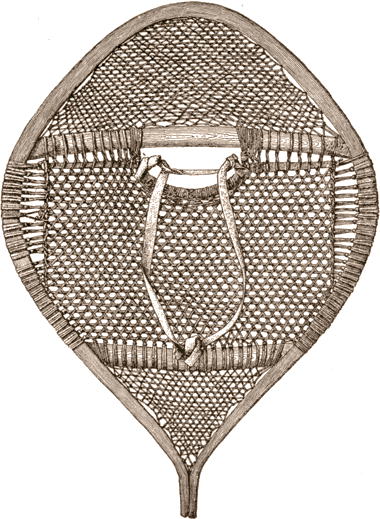
NENENOT SNOWSHOE—“SWALLOW-TAIL.”
When on a journey the younger women and the men drag it along. When the men return to the station to trade they alone drag it. A small dog is sometimes hitched to it by a thong, but as the animal is so small and light, it affords but little assistance. The animal, however, would certainly wander off in search of game along the track, and by being hitched to the sled is kept within bounds.
All the household effects, consisting of tent, cooking utensils, clothing, and other articles are placed on the sled when the people are changing camp.
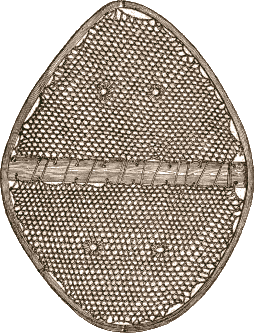
Fig. 128.—Nenenot snowshoe, single bar.
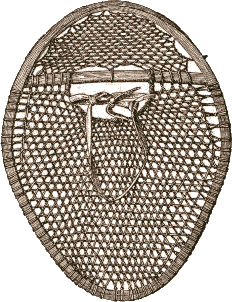
Fig. 129.—Nenenot snowshoe, single bar.

Fig. 130.— Snowshoe needle, Nenenot.
The Nenenot are skilled in the manufacture and use of snowshoes, of which four styles are used, viz: The “swallow-tail,” “beaver-tail,” “round-end,” and “single-bar” (Figs. 128, 129). The frame is of wood, nearly an inch wide and half an inch thick, usually in two pieces, joined by long lap splices wrapped with deerskin thongs, either at the sides or ends of the shoe. In the single-bar shoe the frame is on one slip, spliced at the toe. Birch is the favorite material for snowshoes, but is rarely to be had except by those Indians who ascend the Koksoak to its headwaters, so that spruce and larch are generally used.
The arrangement of the toe and heel bars of the snowshoes will be best understood from the figures. They are usually placed within the frame, and set in mortises in the inner side of the frame, before the wrapping of the ends of the frames has been drawn together; otherwise the bars could not be placed in the holes to receive them.
The netting is made of deerskin, with the hair removed, and allowed to dry into a condition usually known as parchment. This is cut into strips of variable width, depending on the particular use for which it is wanted.
A needle of bone, horn, or iron (Fig. 130) is used for netting the snowshoes. The shape of the implement is flat and rounded at each point, to enable the needle to be used either backward or forward. The eye which carries the line is in the middle. Various sizes of needles are used for the different kinds of netting, of which the meshes differ greatly in size.
The line is generally 10 to 20 feet in length, and when the netting is completed it somewhat resembles the seating of a cane-bottomed chair. Each individual varies his work according to fancy, but as the netting between the bars is made of coarser line, more compactly woven, there is less difference there than at the toe or heel.
The netting of the toe is of finer line and meshes than the middle or between the bars; while that between the heel bar and heel of the snowshoe is finest of all.
The netting between the bars holds the joints of the frames where they lap over each other.
The toe and heel spaces of netting are held in place by the line passing under the threads which are wrapped around the bars from the netting between them, and again are fastened or slipped through loops of thread or line which are let through the frame of the snowshoe.
Near the center of the toe-bar is a space left in the netting between the bars to admit the toes of the wearer and allow them free action while walking. This space is semicircular and is inclosed by several strands of line passing over the toe-bar and forming loops, which have the diagonal lines of the netting passed around them and drawn tight.
BUREAU OF ETHNOLOGY ELEVENTH ANNUAL REPORT PL. XLI
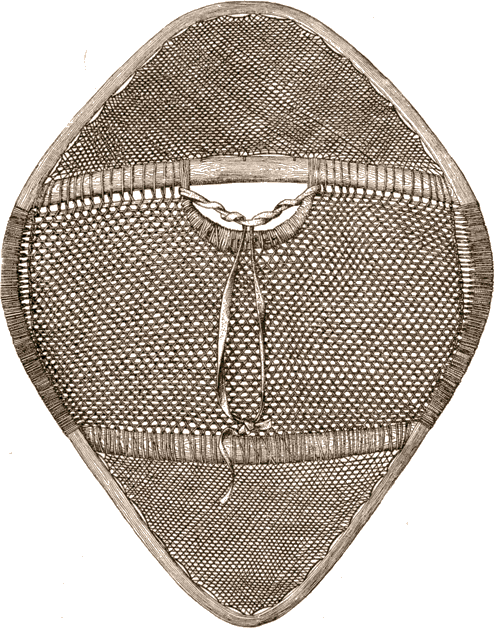
NENENOT SNOWSHOE—“BEAVER-TAIL.”
The snowshoe is held to the foot by a wide buckskin thong attached at the semicircular space back of the toe-bar. The ends must be far enough apart to admit the width of the foot as far as the toes, and must be then drawn down to prevent the foot from pushing too far forward and striking against the toe-bar. The loop passing over the toes must be slack enough to allow free movement of the foot. When the strap suits the foot it is passed around the heel of the wearer and tied sufficiently tight to give ease and comfort. If too tight, the weight soon presses the tendon of the heel. If too loose, it drops down and the toe slips from under the toe band.
The single-bar snowshoes are not much used, because they are somewhat difficult to make. They are of two styles. One has the bar directly under the center of the foot. It is wide, and should be strong enough to sustain the weight of any wearer. The other style is where the single bar is at the front of the toes, which pattern differs from the “beaver-tail” style only in the absence of the heel bar. This pattern is considered the easiest of all to wear and walk in when once learned. The foot straps are exactly like those of the common kinds.
The single bar in the middle of the snowshoe renders it a matter of great discomfort until one is accustomed to it, as the straps are simply loops for the toe and heel. This pattern has been already figured. The largest snowshoes measure as much as 28 inches across and 3 feet in length.
BUREAU OF ETHNOLOGY ELEVENTH ANNUAL REPORT PL. XLII
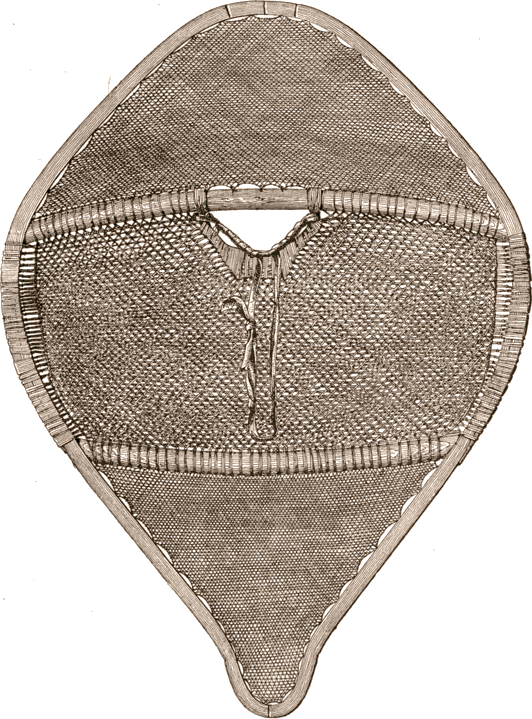
NENENOT SNOWSHOE—“ROUND-END.”
Some of the Indians acquire great expertness in the use of these snowshoes, and are able to run quite rapidly with them. The width of the shoes causes one to straddle widely to allow one snowshoe to pass above and over the other. Care must be exercised that while bringing the rear foot forward the frame does not strike the ankle and produce a serious bruise. In ascending a hill the toe must elevate the snowshoe to avoid a stumble. In descending the body must be thrown well back or a pitch heels over head ensues, and sometimes the frames strike the back of the head.
To put them on the feet the foot must enter the loop from forward toward the rear, and when the loop is on the foot the latter must be turned within the loop and then passed under the toe band.
Everybody wears snowshoes—men, women, and children. Without them travel in winter would be an impossibility, and as the capture of furs is made in winter and the ground to be hunted over must of necessity be of great area, the snowshoe becomes a necessity as much as the canoe in summer.
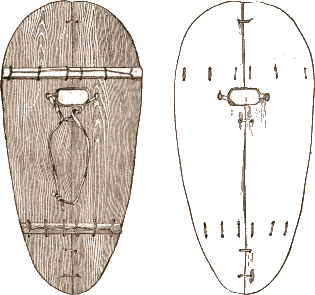
Fig. 131.—Wooden snowshoe, Little Whale river.
I collected two peculiar pairs of snowshoes, made of flat spruce boards (Fig. 131). They are shaped exactly like netted snowshoes of the “beaver tail” pattern, and the arrangement of the foot strap is the same as usual.
They came from the Little Whale river Indians, who informed me that they were worn on soft snow.
In the spring of the year, when the snow is rapidly melted by sun, the netted snowshoes become clogged with slush, rendering the weight very fatiguing. Wooden snowshoes are admirably adapted for that season of the year, and may be made in a few hours, while the netted ones require several days’ assiduous labor. The Indians of the Koksoak valley do not use the wooden snowshoes.
WEAPONS.
In former times these Indians used the bow and arrow exclusively, but they have now nearly discarded these weapons for the guns which they procure from the traders.

Fig. 132.—Bow, Nenenot.
The bow and arrow is, however, still used to kill ptarmigan, hares, and rabbits. The bow (Fig. 132) consists of a piece of larch or spruce wood of 4 to 6 feet in length. It is only slightly narrower and thinner at the ends, and nearly an inch thick and an inch and a half wide at the central portions. But little ingenuity is displayed in the construction of these weapons. They have considerable elasticity, and if broken it is easy to obtain a piece of wood from the forest and fashion another. The string is a strand of deerskin, twisted or rolled. It is rare to find a bow that has a single string.
The arrows are usually 2 feet or 30 inches long, and feathered with three ptarmigan feathers. (Figs. 133-136.) The head is usually an egg-shaped knob, terminating in a slender point which soon breaks off.
This weapon is used for small game, as the cost of ammunition is too great to spend it upon game as readily procured by this cheaper method. The Indian is very expert in the use of the bow and arrow, and is able to knock over a ptarmigan or crouching hare every time at 25 yards. The force with which the arrow is projected is astonishing. I have seen a ptarmigan rolled for many yards amid a perfect cloud of feathers when struck by the arrow. It often tears the entire side out of the bird.
In former years the arrow did great execution among the deer in the water or deep snow banks among which they floundered when driven into them by the Indian who, on snowshoes, was able to travel where the deer sank nearly out of sight.

Fig. 133.— Arrow, Nenenot.

Fig. 134.— Arrow, Nenenot.

Fig. 135.— Arrow, Nenenot.

Fig. 136.— Arrow, Nenenot.
Among the Indian boys it is yet a favorite amusement to shoot small birds with the bow and arrow. Small crossbows also are used by children. They have doubtless been made after those brought by some white man. The children have great sport with these bows.
The spear, already referred to, for killing the swimming reindeer, is shown in Fig. 137. The wooden shaft is 6 feet long, and the steel point, which is made of a flat file beaten down to a quarter of an inch square, is 11 inches long. It is set into the end of the shaft and fastened by a whipping of sinew.
The weapon is held by the hand in a manner peculiar as well as uncomfortable. The closed hand over the butt end of the weapon is so placed as to have the fingers upward and the outside of the hand toward the point, this rather awkward grasp enables the person to let go of the weapon in case of threatened disaster resulting from a misdirected thrust. The collection also contains three models of deer spears, Nos. 3205-3207. These are often also used as arrows to shoot at larger game when the Indian is out hunting ptarmigan, hares, and rabbits. A hungry wolverene or a famished wolf would prove troublesome to kill with the blunt arrows. These models differ from the larger spear only in size.

Fig. 137.— Deer lance, Nenenot.
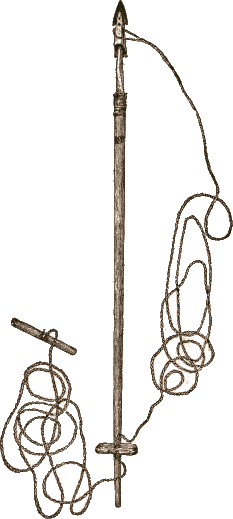
Fig. 138.—White whale spear, Little Whale river.
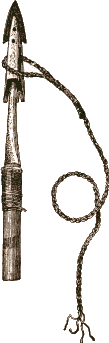
Fig. 139.—Point of white whale spear enlarged.
The Little Whale river Indians use a peculiar spear for killing white whales. (Figs. 138, 139). It is modeled after the Eskimo harpoon, but has no “loose shaft,” or rather, the fore shaft and loose shaft are in one piece, and has a circular wooden disk fitted to the butt of the shaft, which takes the place of the bladder float, and serves to impede the motions of the animal when struck. Reindeer antler is substituted for the ivory of the Eskimo weapon. The blades are of copper or iron and riveted in. These spears are 8 or 10 feet long.
The snare (Fig. 140) forms one of the less important methods of procuring these animals. It is of parchment made from the skin of the reindeer cut into thin narrow thongs. Several of these strands, usually three, are plaited together to form a layer; and of these layers three are plaited together to form the snare line. It often is made, however, of three single strands cut somewhat wider and creased so that they will lie well when the three are plaited. The more strands the greater the flexibility of the line, but as there must be a certain amount of stiffness to hold it in position the many strands must be woven more tightly together. The length varies from 10 to 20 feet, and at the end is a loop formed by turning the strands back and splicing them. Through the loop the other end is passed, and the noose is made.