CHAP. V. THE IMPORTANCE OF NATURAL HISTORY; OF INSECTS IN GENERAL, AND OF THEIR CONSTITUENT PARTS. (continued 2)
Reading edition
The insect then casts off the spoils of its former state, wakes from a death-like inactivity, breaks as it were the inclosures of the tomb, throws off the dusky shroud, and appears in its imago or perfect form; for it has now attained the state of organical perfection, which answers to the rank it is to hold in the corporeal world: the structure of the body, the alimentary organs, and those of motion, are materially changed. It is now furnished with wings magnificently adorned, soars above and despises its former pursuits, wafts the soft air, chooses its mate, and transmits its nature to a succeeding race. Those members, which in the preceding state were wrapped up, soft, and motionless, now display themselves, grow strong, and are put in exercise. The interior changes are as considerable as those of the exterior form, and that in proportion as the first state differs from the last; some organs acquire greater strength and firmness, others are rendered more delicate; some are suppressed, and some unfolded, which did not seem to exist in the former stages of its life.
OF THE LARVA STATE OF INSECTS.
As the larvæ or caterpillars of the moth and butterfly[63] form the most numerous family among the tribe of insects, I shall first describe them, and their various changes from this state to their last and perfect form, and then proceed to those insects which differ most from the caterpillar in one or all of their various changes.
The greater part of those insects which come forth in spring or summer, perish or disappear at the approach of winter; there are very few, the period of whose life exceeds that of a year; some survive the rigours of winter, being concealed and buried under ground; many are hid in the bark of trees, and others in the chinks of old walls; some, like the caterpillar of the brown-tailed moth,[64] at the approach of winter not only secure and strengthen the web in which the society inhabit, and thus protect themselves from impertinent intruders, but each individual also spins a case for itself, where it rests in torpid security, notwithstanding the inclemency of the season, till the spring animates it afresh, and informs it, that the all-bountiful Author of nature has provided food convenient for it. Many that are hatched in the autumn retire and live under the earth during the winter months, but in the spring come out, feed, and proceed onward to their several changes; while no small part pass the colder months in their chrysalis or pupa state: but the greater number of the caterpillar race remain in the egg, being carefully deposited by the parent fly in those places where they will be hatched with the greatest safety and success; in this state the latent principle of life is preserved till the genial influences of the spring call it into action, and bring forth the young insect to share the banquet that nature has provided.
All caterpillars are hatched from the egg, and when they first proceed from it are generally small and feeble, but grow in strength as they increase in size. The body is divided into twelve rings; the head is connected with the first, and is hard and crustaceous. No caterpillar of the moth or butterfly has less than eight, or more than sixteen feet; the six first are crustaceous, pointed, and fixed to the three first rings of the body; these feet are the covering to the six future feet of the moth; the other six feet are soft and flexible or membranaceous; they vary both in figure and number, and are proper only to the larva state; with respect to their external figure, they are either smooth or hairy, soft to the touch, or hard like shagreen, beautifully adorned with a great variety of the most lively teints; on each side of the body nine little oval holes are placed, which are generally considered as the organs of respiration. There are on each side of the head of the caterpillar five or six little black spots, which are supposed to be its eyes. These creatures vary in size, from half an inch long to four and five inches.
The caterpillar, whose life is one continued succession of changes, often moults its skin before it attains its full growth; not one of them arrives at perfection, without having cast its skin at least once or twice. These changes are the more remarkable, because when the caterpillar moults, it is not simply the skin that is changed; for we find in the exuvia, the skull, the jaws, and all the exterior parts, both scaly and membranaceous, which compose its upper and under lip, its antennæ, palpi, and even those crustaceous pieces within the head, which serve as a fixed basis to a number of muscles; we further find in the exuvia, the spiracula, the claws, and sheaths of the anterior limbs, and in general all that is visible of the caterpillar.
The new organs were under the old ones as in a sheath, so that the caterpillar effects the changes by withdrawing itself from the old skin, when it finds itself lodged in too narrow a compass. But to produce this change, to push off the old covering, and bring forward the new, is a work of labour and time. Those caterpillars who live in society, and have a kind of nest or habitation, retire there to change their skins, fixing the hooks of the feet, during the operation, firmly in the web of their nest. Some of the solitary species spin at this time a slender web, to which they affix themselves. A day or two before the critical moment approaches, the insect ceases to eat, and loses its usual activity; in proportion as the time of change advances, the colour of the caterpillar becomes more feeble, the skin hardens and withers, and is soon incapable of receiving those juices by which it was heretofore nourished and supported. The insect may now be seen, at distant intervals, to elevate its back, and stretch itself to its utmost extent; sometimes to lift up the head, move it a little from side to side, and then let it fall again; near the change, the second and third rings are seen to swell considerably; by these internal efforts the old parts are stretched and distended as much as possible, an operation which is attended with great difficulty, as the new parts are all weak and tender. However, by repeated exertions, all the vessels which conveyed the nourishment to the exterior skin are disengaged, and cease to act, and a slit is made on the back, generally beginning at the second or third ring; the new skin may now be just perceived, being distinguished by the freshness and brightness of its colour; the caterpillar then presses the body like a wedge into this slit, by which means it is soon opened from the first down to the fourth ring; this renders it large enough to afford the insect a passage, which it soon effects in a very curious manner. The caterpillar generally fasts a whole day after each moulting, for it is necessary that the parts should acquire a certain degree of consistency, before it can live and act in its usual manner; many also perish under the operation. The body having grown under the old skin, till the insect was become too large for it, it always appears much larger after it has quitted the exuvia: now as the growth was gradual, and the parts soft, the skin pressed them together, so that they lay in a small space; but as soon as the skin is cast off, they are as it were liberated from their bonds, and distend themselves considerably. Some caterpillars, in changing their skin, from smooth, become covered with fine hair; while others, that were covered with this fine hair, have the last skin smooth.[65] The silk-worm, previous to its chrysalis or pupa state, casts its skin four times; the first is cast on the tenth, eleventh, or twelfth day, according to the nature of the season; the second, in five or six days after; the third in five or six days more, and the fourth and last in six or seven days after the third.
Before we describe the change of the larva into the pupa state, it will be necessary to give the reader an account of those names by which entomologists distinguish the different appearances of the insect in its pupa state. It is called Coarctata, when it is straitened or confined to a case of a globular form, without the smallest resemblance to the structure of the insect it contains, as in the diptera. It is called Obtecta, disguised or shrouded, when the insect is inveloped in a crustaceous covering, consisting of two parts, one of which surrounds the head and thorax, the other the abdomen. It is termed Incompleta, when the pupa has perceptible wings and feet, but cannot move them, as in most of the hymenoptera. Semicompleta; these can walk or run, but have only the rudiments of wings. The difference between the pupa and the larva of this class is very inconsiderable, as they eat, walk, and act, just as they did in their primitive state; the only remarkable difference is a kind of case which contains the wings that are to be developed in their fly state. Completa; those designed by this name take their perfect form at their birth, and do not pass, like other insects, through a variety of states, though they often change their skin.
It is a general rule, that all winged insects pass through the larva and pupa state, before they assume their perfect form: there are also insects which have no wings, and yet undergo similar transformations, as the bed bug, the flea, &c. Other insects, which have no wings, and which always remain without them, never pass through the pupa state, but are subject to considerable changes, as well with respect to the number, as the figure of their parts; thus mites have four pair of feet, and two smaller ones at the fore part of the body, near the head; yet some of these are born with only three pair of feet, the fourth is not perceived till some time after their birth.[66] The figure of the monoculus quadricornis of Linnæus (Fauna Suecica, edit. Stockholm, 1761, No. 2049) changes considerably after its birth.[67] The julus is an insect with a great number of feet, some species having an hundred pair and upwards. M. De Geer has given a description of one with more than two-hundred pair,[68] and yet these at their birth have only three pair, the rest are not perceived till some time after.
OF THE CHANGE FROM THE LARVA TO THE PUPA STATE.
I shall now return to the caterpillar, and take notice of the care and provision it makes to pass from the larva state into that of the pupa or chrysalis; which is, in general, a state of imperfection, inactivity, and weakness, through which the insect, when it has obtained a proper size, must pass; and in which it remains often for months, sometimes for a whole year, exposed, without any means of escaping, to every event; and in which it receives the necessary preparations for its perfect state, and is enabled once more to appear upon the transitory scene of time. During its passage from one state to the other, as well as when it is in the pupa form, the microscopical observer will find many opportunities of exercising his instrument.
The transitions of the caterpillar from one state to another, are to it a subject of the most interesting nature; for in passing through them, it often runs the risk of losing its life, that precious boon of heaven, which is ever accompanied with a degree of delight, proportioned to the state in which the creature exists, and the use it makes of the gift it has received. If the caterpillar could therefore foresee the efforts and exertions it must make to put off its present form, and the state of weakness and impotence under which it must exist while in the pupa state, it would undoubtedly choose the most convenient place, and the most advantageous situation, for the performance of this arduous operation; one where it would be the least exposed to danger, at a time when it had neither strength to resist, nor swiftness to avoid the attack of an enemy. All these necessary instructions the caterpillar receives from the influence of an all-regulating Providence, which conveys the proper information to it by its own sensations: hence, when the critical period approaches, it proceeds as if it knew what would be the result of its operations. Different species prepare themselves for the change different ways, suited to their nature and the length of time they are to remain in this state.
When the caterpillar has attained to its full growth, and the parts of the future butterfly are sufficiently formed beneath its skin, it prepares for its change into the pupa state; it seeks for a proper place in which to perform the important business: the different methods employed by these little animals to secure this state of rest, may be reduced to four: 1. Some spin webs or cones, in which they inclose themselves. 2. Others conceal themselves in little cells, which they form under ground. 3. Some suspend themselves by their posterior extremity; 4. While others are suspended by a girdle that goes round their body. I shall describe the variety in these, as well as the industry used in constructing them, after we have gone through the manner in which the caterpillar prepares itself for, and passes through the pupa state.
Preparatory to the change, it ceases to take any food, empties itself of all the excrementitious matter that is contained in the intestines, voiding at the same time the membrane which served as a lining to these and the stomach. The intestinal canal is composed of two principal tubes, the one inserted into the other; the external tube is compact and fleshy, the internal one is thin and transparent; it is the inner tube, which lines the stomach and intestines, that is voided with the excrement before the change. It generally perseveres in a state of rest and inactivity for several days, which affords the external and internal organs that are under the skin an opportunity of gradually unfolding themselves. In proportion as the change into the pupa form approaches, the body is observed often to extend and contract itself; the hinder part is that which is first disengaged from the caterpillar skin; when this part of the body is free, the animal contracts and draws it up towards the head; it then liberates itself in the same manner from the two succeeding rings, consequently the insect is now lodged in the fore part of its caterpillar covering; the half which is abandoned remains flaccid and empty, while the fore part is swoln and distended. The animal, by strong efforts, still forcing itself against the fore part of the skin, bursts the skull into three pieces, and forms a longitudinal opening in the three first rings of the body; through this it proceeds, drawing one part after the other, by alternately lengthening and shortening, swelling and contracting the body and different rings; or else, by pushing back the exuvia, gets rid of its odious reptile form.
The caterpillar, thus stripped from its skin, is what we call the pupa, chrysalis, or aurelia, in which the parts of the future moth are inclosed in a crustaceous covering, but are so soft, that the slightest touch will discompose them. The exterior part of the chrysalis is at first exceedingly tender, soft, and partly transparent, being covered with a viscous fluid; this soon dries up, thickens, and forms a new covering for the animal, capable of resisting external injuries; a case, which is at the same time the sepulchre of the caterpillar, and the cradle of the moth; where, as under a veil, this wonderful transformation is carried on.
The pupa has been called a chrysalis, or creature made of gold, from the resplendent yellow colour with which some kinds are adorned. Reaumur has shewn us whence they derive this rich colour; that it proceeds from two skins, the upper one a beautiful brown, which lies upon or covers a highly polished and smooth white skin: the light reflected from the last, in passing through, gives it the golden yellow, in the same manner as this colour is often given to leather; so that the whole appears gilt, although no gold enters into the tincture. The chrysalis of the common white butterfly furnishes a most beautiful object for the lucernal opake microscope.
Those who are desirous to discover distinctly the various members of the moth in the pupa, should examine it before the fore-mentioned fluid is dried up, when it will be found to be only the moth with the members glued together; these, by degrees, acquire sufficient force to break their covering, and disengage themselves from the bands which confine them. While in this state, all the parts of the moth may be traced out, though so folded and laid together, that it cannot make any use of them; nor is it expedient that it should, as they are too soft and tender to be used, and pass through this state merely to be hardened and strengthened.
To examine the moth concealed under the skin of a caterpillar, one of them should be taken at the last change; when the skin begins to open, it should be drowned in spirit of wine, or some strong liquor, and be left therein for some days, that it may take more consistency and harden itself; the skin of the caterpillar may then be easily removed: the chrysalis, or feeble moth, will be first discovered, after which the tender moth may be traced out, and its wings, legs, antennæ, &c. may be opened and displayed by an accurate observer.
The parts of the moth or butterfly are not disposed exactly in the same manner in the body of the caterpillar, as when left naked in the chrysalis. The wings are longer and narrower, being wound up into the form of a cord, and the antennæ are rolled up on the head; the tongue is also twisted up and laid upon the head, but in a very different manner from what it is in the perfect animal, and different from that which it lies in within the chrysalis; so that it is by a progressive and gradual change, that the interior parts are prepared for the pupa and moth state. The eggs, hereafter to be deposited by the moth, are also to be found, not only in the chrysalis, but in the caterpillar itself, arranged in their natural and regular order.
While in this state, the creature generally remains immoveable, and seems to have no other business but patiently to attend the time of its change, which depends on the parts becoming hard and firm, and the transpiration of that humidity which keeps them soft; the powers of life are as it were absorbed in a deep sleep; the organs of sensation seem obliterated, being imprisoned by coverings more or less strong, the greater part remains fixed in those situations which the caterpillar had selected for them till their final metamorphosis; some, however, are capable of changing place, but their movements are slow and painful.
The time, therefore, which the moth or butterfly remains in the pupa state is not always the same, varying in different species, and depending also upon the warmth of the weather, and other adventitious circumstances; some remain in that situation for a few weeks; others do not attain their perfect form for eight, nine, or eleven months: this often depends on the season in which they assume the pupa form, or rather on the time of their birth. Some irregularities are also occasioned by the different temperature of the air, by which they are retarded or accelerated, so as to be brought forward in the season best suited to their nature and the ends of their existence. I have heard of an instance, where the pupa, produced from caterpillars of the same eggs, nourished in the same manner, and which all spun up within a few days of each other in the autumn, came into the fly state at three different and distant periods; viz. one-third of them the spring following their change, one-third more the succeeding spring, and the remainder the spring after, making three years from their first hatching; a further and manifest proof of the beauty and wisdom of the laws of Divine order, which are continually operating for the best interests of all created beings. As the transformation of insects is retarded by cold, and accelerated by heat, the ordinary period of these changes may sometimes be altered, by placing them in different degrees of heat or cold; by these they may be awakened sooner to a new state of existence, or kept in one of profound sleep.[69]
There are some caterpillars which remain in their cone eight or nine months before they acquire the complete pupa state; so that their duration in that form is much shorter than it naturally appears to be.
OF THE PREPARATION OF THE CATERPILLAR FOR THE METAMORPHOSES.
The industry of the caterpillar, in securing itself for its change into the chrysalis, must not be passed by; not only because it naturally leads the reader to consider and admire that divine agency, by which the insect is informed, but because the different modes it makes use of cannot be properly investigated, without the assistance of glasses, it therefore consequently becomes a proper subject for the microscope; we shall select from a great variety, a few instances, to animate the reader in these researches.
Some caterpillars, towards the time of their change, suspend themselves from the branch of a tree, with the head downwards; in this position they assume the pupa form, and from thence immerge a butterfly or moth. In order to secure itself in this position, the insect covers with threads that part of the branch from which it means to suspend itself; it places these in different directions, and then covers them with other threads, laying on several successive thicknesses, each new layer being smaller in size than that which preceded it; forming, when finished, a little cone or hillock of silk, as will be found when examined by the microscope. The caterpillar hooks itself by the hinder feet to this hillock, and when it has found by several trials that it is strongly fixed thereto, throws itself forward, letting the body fall with the head downwards. Soon after it is thus suspended, it bends the fore part of the body, keeping this bent posture for some time, then straitening the body, again in a little time bending it, and so on, repeating this operation till it has formed a slit in the skin upon the back; part of the pupa soon forces itself through this, and extends the slit as far as the last crustaceous feet; the pupa then forces upwards the skin, as we would push down a stocking, by means of its little hooks and the motion of the body, till it has slipped it off to that part from which the caterpillar had suspended itself. But the pupa has still to disengage itself from this small packet, to which the exuvia is now reduced: here the observer will find himself interested for the little animal, anxious to learn how the pupa will quit this skin, and how it will be enabled to fix itself to the hillock, as it has neither arms nor legs. A little attention soon explains the operation, and extricates the observer from his embarrassment. It seizes the exuvia by the rings of the body, and thus holds itself as it were by a pair of pincers; then, by bending the tail, it frees itself from the old skin, and by the same method soon suspends itself to the silken mount; it lengthens out the hinder part of the body, and clasps, by means of its rings, the various foldings of the exuvia, one after another; thus creeping backward on the spoils, till it can reach the hillock with the tail; which, when examined by the microscope, will be found to be furnished with hooks to fix itself by. It is surprizing to see with what exactness and ease these insects perform an operation so delicate and dangerous, which is only executed once in their lives; and nought else can account for it, but the consideration that HE, who designed that the caterpillar should pass through these changes, had provided means for that end, regularly connecting the greater steps by intermediate ones, the desire of extending their species forming and acting upon the organization, till the purposes of their life are completed. Different kinds of these insects require variety in the mode of suspension; some fix themselves in an horizontal position, by a girdle which they tie round their body; this girdle appears to the naked eye as a single thread; when examined with the microscope, it will be found to be an assemblage of fine threads, lying close to each other, so fixed as to support the caterpillar, and yet leave it in full freedom to effect the changes. Like the preceding kind, it fixes the girdle to the branch of a tree; in this situation it remains for some time motionless, and then begins to bend, move, and agitate its body in a very singular manner, till it has opened the exterior covering, which it pushes off and removes much in the same manner as we have described in the preceding article, and yet with such dexterity, that the pupa remains suspended by the same girdle.
OF THE IMAGO OR FLY STATE OF INSECTS.
As soon as the moth acquires sufficient strength to break the bonds which surround it, and of which it is informed by its internal sensations, it makes a powerful effort to escape from its prison, and view the world with new-formed eyes. The moth frees itself from the pupa with much greater ease than the pupa from the caterpillar; for the case of the pupa becomes so dry, when the moth is near the time of throwing off its covering, that it will break to pieces if it be only gently pressed between the fingers; and very few of the parts will be found, on examination, to adhere to the body. Hence, when the insect has acquired a proper degree of solidity, it does not require any great exertion to split the membrane which covers it. A small degree of motion, or a little inflation of the body, is sufficient for this purpose; these motions reiterated a few times, enlarge the hole, and afford the moth room to escape from its confinement. The opening through which they pass is always at the same part of the skin, a little above the trunk, between the wings, and a small piece which covers the head; the different fissures are generally made in the same direction. If the outer case be opened, it is easy to discover the efforts the insect makes to emancipate itself from its shell; when the operation begins, there seems to be a violent agitation in the humours contained in the little animal; the fluids seem to be driven with rapidity through all the vessels, and it is seen to agitate its legs, &c. as it were struggling to get free; these efforts soon break its brittle skin. The loosening the exterior bands of the pupa is not the only difficulty many moths have to encounter with; it has often also to pierce the cone or case in which it has been inclosed, and that at a time when its members are very feeble, when it is no longer furnished with strong jaws to pierce and cut its way through; but by the regular laws of divine order, means are furnished to every creature of attaining the end for which it was produced: thus, in the present case, some of these insects are provided with a liquor with which they soften and weaken the end of the cone; some leave one end feeble, and close it only with a few threads, so that a slight effort of the head enables the moth to burst the prison doors, and immerge into day.
When the moth first sees the day, it is humid and moist; but this humidity soon evaporates, the interior parts dry and harden as well as the exterior; the wings, which are wrinkled, being thick and small, then extend themselves, strengthen and harden insensibly, and the fibres which were at first flexible, become hard and stiff; so much so, that Malpighi considered them as bones: in proportion as these fibres harden, the fluid which circulates within them, and extends the wings, loses its force; so that if any extraneous circumstance prevent the motion of this fluid, at the first instant of the moth’s escape from its former state, the wings will then become ill-shaped; often expanding with such rapidity, that the naked eye cannot trace their unfolding. The wings, which were scarce half the length of the body, acquire in a few minutes their full size, so as to be nearly five times as large as they were before: nor is it the wings only which are thus increased; all their spots and colours, heretofore so minute as to be scarce discernible, are proportionably extended, so that what before appeared as only so many unmeaning and confused points, become distinct and beautiful ornaments; and those that are furnished with a tongue or trunk, curl and coil it up. When the wings are unfolded, the tongue rolled up, the moth sufficiently dried, and the different members strengthened, it takes its flight. Most of them, soon after they have attained their perfect state, void an excrementitious substance; Reaumur thinks that they eject very little, if any, during the rest of their lives.
In the progress of these insects, such changes take place, as we could have formed no conception of, if the great Author of these wonders had not been pleased to reward the industrious naturalist with the discovery.
If the moth be opened down the belly, and the unctuous parts which fill it, be removed, the gross artery, which has been called the heart, will be visible, and the contractions and dilatations, by which it pushes forward the liquor it contains, may be easily observed. One of the most remarkable circumstances is, that the circulation of this fluid in the moth is directly contrary to that which took place in the caterpillar; in this, the liquor moved from the tail to the head, whereas in the moth, it moves from the head to the tail; so that the fluid which answers the purposes of the blood in the moth, goes from the superior, towards the inferior parts, but in the voracious sensual caterpillar, the order is inverted, it proceeds from the inferior towards the superior parts; all its members, formerly soft, inactive, and folded up under an envelope, are expanded, strengthened, and exposed to observation.
The food of the caterpillar is gross and solid, and even this it is obliged to earn with much labour and danger; but, when freed as it were from the jaws of death, and arrived at its perfect form, the purest nectar is its potion, and the air its element. It was supplied with coarse food, in the first state, by the painful operation of its teeth, which was afterwards digested by a violent trituration of the stomach. The intestines are now formed in a more delicate manner, and suited to a more pure and elegant aliment, which nature has prepared for its use from the most fragrant and beautiful flowers. Many internal parts of the caterpillar disappear in the chrysalis, and many that could not be perceived before, are now rendered visible: the interior changes are not less surprizing than those of the exterior form, and are, properly speaking, creative of them; for it is from these the exterior form originates, and with these it always corresponds. In a word, the creature that heretofore crept upon the earth, now flies freely through the air; and far from creating our aversion by its frightful prickles and foul appearance, it attracts our notice by the most elegant shape and apparel, and, from being scarce able to move from one shrub to another, acquires strength and agility to tower far above the tallest inhabitant of the forest.
OF THE SILK-WORM.
The industry of those that spin cones or cases, in which they inclose themselves, in order to prepare for their transformation in security, is more generally known, as it is from one species of these that we derive so many benefits, namely from the silk-worm, whose works afford an ornament for greatness, and add magnificence to royalty. All caterpillars undergo similar changes with it, and many in the butterfly state greatly exceed it in beauty: but the golden tissue, in which the silk-worm wraps itself, far surpasses the silky threads of all the other kinds; they may indeed come forth with a variety of colours, and wings bedecked with gold and scarlet, yet they are but the beings of a summer’s day; both their life and beauty quickly vanish, and leave no remembrance after them; but the silk-worm leaves behind it such beneficial monuments, as at once record the wisdom of its Creator, and his bounty to man.[70]
The substance of which the silk is formed, is a fine yellow transparent gum, contained in two reservoirs that wind about the intestines, and which, when they are unfolded, are about ten inches long; they terminate in two exceeding small orifices near the mouth, through which the silk is drawn, or spun to the degree of fineness which its occasions may require. This apparatus has been compared to the instrument used by wire-drawers, and by which gold and silver is drawn to any degree of minuteness. From each of these reservoirs proceeds a thread, which are united afterwards; so that if it be examined by the microscope, it will be found to consist of two cylinders or threads glued together, with a groove in the middle; a separation may sometimes be perceived.
When the silk-worm has found a convenient situation, it sets to work, first spinning some random threads, which serve to support the future superstructure; upon these it forms an oval of a loose texture, consisting of what is called the floss-silk; within this it forms a firm and more consistent ball of silk, remaining during the whole business within the circumference of the spheroid that it is forming, resting on its hinder parts, and with its mouth and fore legs directing and fastening the threads. These threads are not directed in a regular circular form, but are spun in different spots, in an infinite number of zig-zag lines; so that when it is wound off, it proceeds in a very irregular manner, sometimes from one side of the cone, then from the other. This thread, when measured, has been found to be about three-hundred yards long, and so fine, that eight or ten are generally rolled off into one by the manufacturers. The silk-worm usually employs about three days in finishing this cone; the inside is generally smeared with a kind of gum, that is designed to keep out the rain: in this cone it assumes the pupa form, and remains therein from fifteen to thirty days, according to the warmth of the climate. When the moth is formed, it moistens the end of this cone, and by frequent motions of the head loosens the texture of the silk, so as to form a hole without breaking it.
When the silk-worm has acquired its perfect growth, the reservoirs of silk are full, and it is pressed by its sensations to get rid of this incumbrance, and accordingly spins a cone, the altitude and size of which are proportioned to its wants: by traversing backwards and forwards, it is relieved, and attains by an innate desire the end for which it was formed; and thus a caterpillar, whose form is rather disgusting to the human unphilosophic eye, becomes a considerable object of manufacture and trade, a source of wealth, and, from the extensive employment it affords, a blessing to thousands. The size of the cone is not always proportioned to that of the caterpillar; some that are small construct larger cones than others which exceed them in bulk.
There is a caterpillar which forms its silken cone in the shape of a boat turned bottom upwards, whence it is called by Reaumur the “coque en batteau;” the construction is complicated, and seems to require more art than is usually attributed to this insect. It consists of two principal parts, shaped like shells, which are united with considerable skill and propriety; each shell or side is framed by itself, and formed of an innumerable quantity of minute silk rings; in the fore part there is a projection, in which a small crevice may be perceived, which serves, when opened, for the escape of the moth; the sides are connected with so much art, that they open and shut as if framed with springs; so that the cone, from which the butterfly has escaped, appears as close as that which is still inhabited.
Those caterpillars which are not furnished with a silky cone, supply that want with various materials, which they possess sufficient skill to form into a proper habitation, to secure them while preparing for the perfect state; some construct theirs with leaves and branches, tying them fast together, and then strengthening the connection; others connect these leaves with great regularity; many strip themselves of their hairs, and form a mixture of hair and silk; others construct a cone of sand, or earth, cementing the particles with a kind of glue; some gnaw the wood into a kind of saw-dust, and glue it together; with an innumerable variety of modes suited to their present and future state.
OF THE BEETLE.
To make the reader more fully acquainted with a subject which affords such abundant matter for the exercise of his microscope, I shall proceed to describe, in as concise a manner as I am able, the changes of a few insects of different classes, beginning with the beetle.
The beetle is of the first or coleopterous class, having four wings. The two upper ones are crustaceous, and form a case to the lower ones; when they are shut, there is a longitudinal suture down the back: this formation of the wings is necessary, as the beetle often lives under the surface of the earth, in holes which it digs by its own industry and strength. These cases save the real wings from the damage which they might otherwise sustain, by rubbing or crushing against the sides of its abode; they serve also to keep the wings clean, and produce a buzzing noise when the animal rises in the air. The strength of this insect is astonishing; it has been estimated that, bulk for bulk, their muscles are a thousand times stronger than those of a man!
The beetle is only an insect disengaged from the pupa form; the pupa is a transformation in like manner from the worm or larva, and this proceeds from the egg; so that here, as in the foregoing instances, one insect is exhibited in four different states of life, after passing through three of which, and the various inconveniences attendant on them, it is advanced to a more perfect state. When a larva, it trains a miserable existence under the earth; in the pupa form it is deprived of motion, and as it were dead; but the beetle itself lives at pleasure above and under ground, and also in the air, enjoying a higher degree of life, which it has attained by slow progression, after passing through difficulties, affliction, and death.
If we judge of the rank which the beetle holds in the scale of animation, from the places where they are generally found, from the food which nourishes them, from the disgusting and odious forms of many, from their antipathy to light, and their delight in darkness, we shall not form great ideas of the dignity of their situation. But as all things are rendered subservient to the laws of divine order, it is sufficient for us to contemplate the wonders that are displayed in this and every other organ of life, for the reception of which, from the FOUNTAIN AND SOURCE OF ALL LIFE, each individual is adapted, and that in a manner corresponding to the state of existence it is to enjoy, and the energies it is called forth to represent.
The egg of the rhinoceros beetle[71] is of an oblong round figure, of a white colour; the shell thin, tender, and flexible; the teeth of the worm that is within the shell come to perfection before the other parts; so that as soon as it is hatched, it is capable of devouring, and nourishing itself with the wood among which it is placed. The larva or worm is curiously folded in the egg, the tail resting between the teeth, which are disposed on each side the belly; the worm in proper time breaks the shell, in the same manner as a chicken, and crawls from thence to the next substance suitable for its food. The worm, when it is hatched, is very white, has six legs, and a wrinkled naked body, but the other parts are all covered with hair; the head is then also bigger than the whole body, a circumstance which may be observed in larger animals, and which is founded on wise reasons.[72] If the egg be observed from time to time while the insect is within it, the beating of the heart may be perceived.
The eggs of the earth-worm, the snail, and the beetle, will afford many subjects for the microscope, and will be found to deserve a very attentive examination. Swammerdam was accustomed to hatch them in a dish, covered with white paper, which he always kept in a moist state. To preserve these and similar eggs, they must be pierced with a fine needle; the contained liquors must be pressed out, after which they should be blown up by means of a small glass tube, and then filled with a little resin dissolved in oil of spike.
The worm of the rhinoceros beetle, like other insects in the larva state, changes its skin; in order to effect which, it discharges all its excrement, and forms a convenient hole in the earth, in which it may perform the wonderful operation; for it does not, like the serpent, cast off merely an external covering, but the throat, a part of the stomach, and the inward surface of the great gut, change at the same time their skin: as if it were to increase the wonder, and to call forth our attention to these representative changes, some hundreds of pulmonary pipes cast also each its delicate skin, a transparent membrane is taken from the eyes, and the skull remains fixed to the exuvia. After the operation, the head and teeth are white and tender, though at other times as hard as bone; so that the larva, when provoked, will attempt to gnaw iron. For an accurate anatomical description of this worm, I must refer the reader to Swammerdam; he will find it, like the rest of this author’s works, well worthy of his attentive perusal. To dissect it, he first killed it in spirit of wine, or suffocated it in rain water rather more than lukewarm, not taking it out from thence for some hours. This preparation prevents an improper contraction of the muscular fibres.
When the time approaches for the worm to assume the pupa form, it generally penetrates deeper into the ground,[73] or those places where it inhabits, to find a situation that it can more easily suit to its subsequent process. Having found a proper place, it forms with the hinder feet a polished cavity, in this it lies for sometime immoveable; after which, by voiding excrementitious substances, and by the evaporation of humidity, it becomes thinner and shorter, the skin more furrowed and wrinkled, so that it soon appears as if it were starved by degrees. If it be dissected about this period, the head, the belly, and the thorax may be clearly distinguished. While some external and internal parts are changing by a slow accretion, others are gently distended by the force of the blood and impelled humours. The body contracting itself, while the blood is propelled towards the head, forces the skull open in three parts, and the skin in the middle of the back is separated, by means of an undulating motion of the incisions of the back; at the same time the eyes, the horns, the lips, &c. cast their exuvia. During this operation, a thin watery humour is diffused between the old and new skin, which renders the separation easier. The process going on gradually, the worm is at last disengaged from its skin, and the limbs and parts are, by a continual unfolding, transformed into the pupa state; after which, it twists and compresses the exuvia by the fundament, and throws it towards the hinder part under the belly. The pupa is at this time very delicate, tender, and flexible; and affords a most astonishing appearance to an attentive observer. Swammerdam thinks it is scarce to be equalled among the wonders which are displayed in the insect part of the creation; in it the future parts of the beetle are finely exhibited, so disposed and formed, as soon to be able to serve the creature in a more perfect state of life, and to put on a more elegant form.
The pupa[74] of this insect weighs, a little after its change, much heavier than it does in its beetle state; this is also the case with the pupa of the bee and hornet. The latter has been found to weigh ten times as much as the hornet itself; this is probably occasioned by a superabundant degree of moisture, by which these insects are kept in a state of inactivity, which may be compared to a kind of preternatural dropsy, till it is in some measure dissipated; in proportion as this moisture is evaporated, the skin hardens and dries: some days are required to exhale this superfluous moisture. If the skin be taken off at this time, many curious circumstances may be noted; but what claims our attention most is, that the horn, which is so hard in the male beetle when in a state of maturity, that it will bear to be sharpened against a grindstone,[75] in the pupa state is quite soft, and more like a fluid than a solid substance. How long the scene of mutation continues is not known; some remain during the whole winter, more particularly those which quit the larva state in autumn, when a sudden cold checks their further operations, and consequently they remain in a torpid state, without any food, for several months. Some species of the beetle tribe go through all the stages of their existence in a season, while others employ near four years in the process, and live as winged insects a year.
When the proper time for the final change arrives, all the muscular parts grow strong, and are thus more able to shake off their last integuments, which is performed exactly in the same manner as in the passage of the insect from the larva to the pupa state; so that in this last skin, which is extremely delicate, the traces of the pulmonary tubes, that have been pulled off and turned out, again become visible. All parts of the insect, and more particularly the wings and their cases, are at this period swelled and extended by the air and fluids which are driven into them through the arteries and pulmonary tubes; the wings are now soft as wet paper, and the blood issues from them on the least wound; but when they have acquired their proper consistency, which in the elytra is very considerable, they do not exhibit the least sign of any fluid within them, though cut or torn almost asunder. The pupa being disengaged from its skin, assumes a different form, in which it is dignified with the name of a beetle, and acquires a distinction of sex, being either male or female. The insect now begins to enjoy a life far preferable to its former state of existence; from living in dirt and filth, under briars and thorns, it raises itself towards the skies, plays in the sun-beam, rejoices in its existence, and is nourished with the oozing liquors of flowers.
OF THE MUSCA CHAMÆLEON.
I shall now proceed to illustrate the nature of the different transformations in insects, by giving an account of the musca chamæleon. In the worm or larva condition it lives in the water, breathes by the tail, and carries its legs within a little snout near its mouth. When the time arrives for its pupa state, it goes through the change without casting off the skin of the larva. Lastly, in the imago, or fly state, it would infallibly perish in the water, that element which had hitherto supplied it with life and motion, was not the larva by nature instructed where to choose a suitable situation for its approaching transformation.
This insect is characterized by Linnæus as “Musca chamæleon. Habitat larva in aquis dulcibus; musca supra aquam obambulare solet.” In a former edition of the Fauna Suecica he called it oestrus aquæ; but on a more minute examination, he found it was a musca; besides, the larvæ of all known oestri are nourished in the bodies of animals. The larva of this insect appears to consist of twelve annular divisions, see Plate XI. Fig. 1. by these it is separated into a head, thorax, and abdomen; but as the stomach and intestines lie equally in the thorax and abdomen, it is not easy to distinguish their limits until the insect approaches the pupa state. The parts most worthy of notice are the tail and snout. The tail is furnished with an elegant crown or circle of hair b, disposed quite round it in an annular form; by means of this the tail is supported on the surface of the water, while the worm or larva is moving therein, the body in the mean while hanging towards the bottom; it will sometimes remain in this situation for a considerable time, without the least sensible motion. When it is disposed to sink to the bottom by means of its tail, it generally bends the hairs of that part towards each other in the middle, but much closer towards the extremity; by these means a hollow space is formed, and the bladder of air pent up in it looks like a pearl, Fig. 2. Plate XI. It is by the assistance of this bubble, or little balloon, that the insect raises itself again to the surface of the water. If this bubble escape, it can replace it from the pulmonary tubes; sometimes large quantities of air may be seen to arise in bubbles from the tail of the worm to the surface of the water, and there mix with the incumbent atmosphere. This operation may be easily seen by placing the worm in a glass full of water, where it will afford a very entertaining spectacle. The snout is divided into three parts, of which that in the middle is immoveable; the two other parts grow from the sides of the former; these are moveable, vibrating in a very singular manner, like the tongues of lizards and serpents. The greatest strength of the creature is fixed in these lateral parts of the snout; it is on these that it walks when it is out of the water, appearing, as it were to walk on its mouth, using it to assist motion, as a parrot does its beak to climb, with greater advantage.
We shall now consider the external figure of this worm, as it appears with the microscope. It is small toward the head, larger about those parts which may be considered as the thorax; it then again diminishes, converging at the abdomen, and terminates in a sharp tail, surrounded with hairs in the form of the rays of a star.
This worm, the head and tail included, has twelve annular divisions, 1, 2, 3, 4, 5, 6, 7, 8, 9, 10, 11, 12, Fig. 3. Plate XI. Its skin resembles the covering of those animals that are provided with a crustaceous habit, more than it does that of naked worms or caterpillars; it is moderately hard, and like the rough skin called shagreen, being thick set with a number of grains, evenly distributed. The substance of the skin is firm and hard, and yet very flexible. On each side of the body are nine spiracula or holes, for the purpose of respiration; there are no such holes visible on the tail ring a, nor on the third ring counting from the head; for at the extremity of the tail there is an opening for the admission and expulsion of air; in the third ring the spiracula are very small, and appear only under the skin, near the place where the embryo wings of the future fly are concealed. It is remarkable that caterpillars, in general, have two rings without these spiracula; perhaps, because they change into flies with four wings, whereas this worm produces a fly that has only two. The skin has three different shades of colour; it is adorned with oblong black furrows, with spots of a light colour, and orbicular rings, from which there generally springs a hair, as in the figure before us, only the hair that grows on the insect’s side is represented; besides this, there are here and there some other larger hairs, c c. The difference of colour in this worm arises from the quantity of grains in the same space; for in proportion as there is a greater or lesser quantity of these, the furrows and rings are of a deeper or paler colour. The head d is divided into three parts, and covered with a skin, the grains on which are hardly discernible. The eyes are rather protuberant, and lie forwards near the snout. It has also two small horns i i, on the fore part of the head. The snout is crooked, and ends in a sharp point as at f; but what is altogether singular and surprizing, though no doubt wisely contrived by the great and almighty Architect, is, that this insect’s legs are placed near the snout, between the sinuses, in which the eyes are fixed. Each of these legs consists of three joints, the outermost of which is covered with hard and stiff hairs like bristles. From the next joint there springs a horny bone h h, which the insect uses as a kind of thumb; the joint is also of a black substance, between bone and horn in hardness; the third joint is of the same nature. To distinguish these particulars, the parts that form the upper sides of the mouth and the eyes must be separated by means of a small fine knife; you may then, by the assistance of the microscope, perceive that the leg is articulated, by means of some particular ligaments, with that portion of the insect’s mouth which answers to the lower jaw in the human frame. We may then also discern the muscles which serve to move the legs, and draw them up into a cavity that lies between the snout and those parts of the mouth which are near the horns i i.
This insect not only walks with these legs at the bottom of the water, but even moves itself on land by means of them; it likewise makes use of them to swim, while it keeps its tail on the surface contiguous to the air, and hangs downward with the rest of the body in the water: in this situation no motion is perceived in it, but what arises from its legs, which it moves in a most elegant manner. It is reasonable to conclude from what has been said, that the principal part of the creature’s strength lies in these legs; nor will it be difficult for those who are acquainted with the nature of the ancient hieroglyphics, which are now opening so clearly, to fix the rank of this insect in animated life, and point out those orders of being, and the moral state through which it receives its form and habits of life.
The snout is black and hard, the back part is quite solid, and somewhat of a globular form, whereas the front f, is sharp and hollow; on the back part three membranaceous divisions may be observed, by means of which, and the muscles contained in the snout, the insect can at pleasure expand or contract it.
The tail is constructed and planned with great skill and wisdom. The extreme verge or border, is surrounded by thirty hairs, and the sides adorned with others that are smaller; here and there the large hairs branch out into smaller ones, which may be reckoned as single hairs. These hairs are all rooted in the outer skin, which in this place is covered with rough grains, as may be seen by cutting it off, and holding it up, when dry, against the light, upon a thin plate of glass. By the same mode you will find, that at the extremities of the hairs there are also grains like those of the skin; in the middle of the tail there is a small opening, within it are minute holes, by which the insect inhales and expels the air it breathes. The hairs are very seldom disposed in so regular a manner as they are represented in Fig. 3. Plate XI. except when the insect floats with the body in the water, and the tail with its hairs a little lower than the surface, for they are then displayed exactly as delineated in the plate. The least motion downward of the tail produces a concavity in the water, and it then assumes the figure of a wine-glass, wide at the top, narrow at the bottom. The tail serves the larva both for the purposes of swimming and breathing, and it receives through the tail that which is the universal principle of life and motion in animals. By means of the hairs it can stop itself at pleasure when swimming, or remain suspended quietly in the water for any length of time. The motion of the insect in swimming is very beautiful, especially when it advances with its whole body floating on the surface of the water; after filling itself with air by the tail. To set out, it first bends the body to the right or left, and then contracts it in the form of the letter S, and again stretches it out in a strait line: by thus alternately contracting and then extending the body, it moves along on the surface of the water. It is of a very quiet disposition, and not to be disturbed by handling.
These larvæ are generally to be found in shallow standing waters, about the beginning of June, sooner or later, as the summer is more or less favourable; in some seasons they are to be found in great numbers, while in others, it is no easy matter to meet with them. They love to crawl on the plants and grass which grow in the water, and are often to be met with in ditches, floating on the surface of the water by means of their tail, the head and thorax at the same time hanging down; and in this situation they will turn over the clay and dirt with their snout and feet in search of food, which is generally a viscous matter that is common in small ponds and about the sides of ditches. This worm is very harmless, contrary to the opinion one might form at first sight, from the surprizing vibratory motion of the legs, which resembles the brandishing of an envenomed tongue or sting. They are most easily killed for dissection in spirit of turpentine.
After a certain period they pass into the pupa form; when they are about to change, they betake themselves to the herbs that float on the surface of the water, and creep gently thereon, till at length they lie partly on the dry surface, and partly on the water; when in the larva or pupa state, they can live in water, but can by no means inhabit there when changed into flies: indeed, man also, whilst in the uterus, lives in water, which he cannot do afterwards. When these worms have found a proper situation, they by degrees contract themselves, and in a manner scarce perceptible lose all power of motion. The inward parts of the worm’s tail now separate from the outmost skin, and become greatly contracted; this probably gives the insect considerable pain: by this contraction, an empty space is left in the exterior skin, into which the air soon penetrates.
Thus this insect passes into the pupa state under its own skin, entirely different from that of the caterpillar, which casts off the exterior skin at this time; this change may often be observed to take place in the space of ten or twelve hours, but in what manner it is performed we are ignorant, as it is effected in a hidden unknown way, inwardly within the skin, which conceals it from our view.
Whilst the larva is changing under the skin, the body, head, and tail, separate insensibly from their outward vesture. The legs at this time, and their cartilaginous bones, are, on account of the parts which are withdrawn from them, left empty; the worm loses also now the former skull, the beak, together with the horny bones belonging thereto, which remain in the skin of the exuvia. It is worthy of notice, that the optic nerves separate also from the eyes, and no more perform their office. The muscles of the rings in like manner, and a great part of the pulmonary points of respiration, are separated from the external skin. Thus the whole body contracts itself by degrees into a small compact mass. At this time the gullet and the pulmonary tubes cast a coat within the skin. To make this evident, it is necessary to open the abdomen, when the pupa, its parts, together with the cast off pulmonary pipes, may be clearly seen.
An exact account of all the changes of the interior parts is to be found in Swammerdam’s Book of Nature. These changes are best examined by taking the pupa out of the skin, or outside case, when it begins to harden; for as it has not then quite attained the pupa form, and the members are somewhat different from what they will be when in that state, it is more easy to observe their respective situation, than when the pupa is some days older, and has lost the greatest part of the superfluous humours. The pupa is inclosed in a double garment; the interior one is a thin membrane, which invests it very closely; the other, or exterior one, is formed of the outermost hard skin of the larva, within which it performs its changes in an invisible manner: it is this skin which gives it the appearance of the larva while in the pupa state.
When the time approaches that the hidden insect, now in the pupa form within its old covering, is to attain the imago, fly, or perfect state, which generally happens in about eleven days after the preceding change, the superfluous humours are evaporated by insensible perspiration. The little pupa is contracted into the fifth ring of the skin, and the four last rings of the abdomen are filled with air, through the aperture in the respiratory orifice of the tail. This may be seen by exposing the pupa for a short space to the rays of the sun, and then putting its tail in water, when you will find it breathe stronger than it did before, and, by expressing an air bubble out of its tail, and then sucking it in again, will manifestly perform the action of inspiration and expiration. The anterior part of the pupa is drawn back from the skin, and having partly deserted it, with the beak, head, and first ring of the breast, the little creature lies still, until its exhaling members have acquired strength to burst the two membranes which surround it.
If the exterior case be opened near this period, a wonderful variety of colour may be perceived through the thin skin which invests the pupa. The colours of many of the different parts are now changed; some parts from aqueous become membranaceous, some fleshy, and others crustaceous. The whole body becomes insensibly shaggy, the feet and claws begin to move: the variations may be accurately observed by opening a pupa every day until the time of change. For this purpose they should be laid on white paper in an earthen dish; they should also be made somewhat moist, and be kept under a glass: the paper serves the pupa to fix its claw to, when they come forth in the form of a fly. A little water should be poured into the dish, to keep the pupa from drying and suffocation.
When the fly begins to appear, the exterior skin is seen to move about the third and fourth anterior ring; the insect then uses all its efforts to promote its escape, and to quit the interior and exterior skin at one and the same time. The exterior skin is divided into four parts; the insect immediately afterwards breaks open its inner coat, and casting it off, escapes from the prison in which it was entombed, in the form of a beautiful fly. It is to be observed here, that there is nothing accidental in the breaking of the outermost skin, being perfectly conformable to the rule ordained, always happening in the same manner in all these changes: the skin also is, in those places where it is broke open, so constructed by the Author of nature, as if joined together by sutures. Having now acquired its perfect state, the little creature which lived before in water and mud, enters into a new scene of life, visits the fields and meadows, is transported through the air on its elegant wings, and sports in the wide expanse with unrestrained jollity and freedom.
The larva a queue de rat,[76] musca pendula, Lin. is also transformed under the skin, which hardens, and forms a case or general covering to the pupa: two horns are pushed out, while it is in this state, from the interior parts; they serve the purpose of respiration: this larva will be more particularly described in a subsequent part of this chapter.
According to Reaumur, the insects in this class, that is, those that pass into the pupa state under the skin of the larva, go through a change more than the caterpillar, a transformation taking place while under their skin, before they assume the pupa form.
The aquatic larva of the musca chamæleon retains its form to the last; but there are many insects that are transformed under their skin, which forms a cone or case for the pupa. In these the larva loses first its length; the body becoming shorter, assumes the figure of an egg; and the skin forms a hard and crustaceous case or solid lodging for the embryo insect.
OF THE LIBELLULA OR DRAGON FLY.
In the libellula we have an instance of those insects which are termed in the pupa state, semicompleta, that is, such as proceed from the egg in the figure which they preserve till the time arrives for assuming their wings; and who walk, act, and eat as well before that period as afterwards.
Of all the flies which adorn or diversify the face of nature, there are few, if any, more beautiful than the libellulæ: they are almost of all colours, green, blue, crimson, scarlet, and white; some unite a variety of the most vivid teints, and exhibit in one animal more different shades than are to be found in the rainbow. It is not to colour alone that their beauty is confined, it is heightened by the brilliancy of their eyes, and the delicate texture and wide expansion of their wings. The larva of the libellula is an inhabitant of the water, the fly itself is generally found hovering on the borders thereof.
These insects are produced from an egg, which is deposited in the water by the parent; the egg sinks to the bottom, and remains there till the young insect finds strength to break the shell. The larva is hexapode, and is not quite so long as the fly; on the trunk are four prominences or little bunches, which become more apparent, in proportion as the larva increases in size and changes its skin. These bunches contain the rudiments of the wings, which adorn the insect when in its perfect state.
The head of the larva is exceedingly singular, the whole fore part of it being covered with a mask, which fits it more exactly than the common mask does the human face, having proper cavities within to suit the different prominences of the face; it is of a triangular form, growing smaller towards the bottom; at this part there is a knuckle which fits a cavity near the neck, on this it turns as on a pivot. The upper part of this mask is divided into two pieces or shutters, which the insect can open or close at pleasure; it can also let down the whole mask whenever it pleases. The edges of the shutters are jagged like a saw. It makes use of the mask to seize and hold its prey. There is a considerable difference in the shape of these masks in different species of the libellula, some having two claws near the top of it, which they can thrust out or draw in, as most convenient; these render it a very formidable instrument to the insects on which they feed.
These animals generally live and feed at the bottom of the water, swimming only occasionally: their manner of swimming, or rather moving in the water, is curious, being by sudden jerks given at intervals; but this motion is not occasioned by their legs, which at this time are kept immoveable and close to the body; it is by forcing out a stream of water from the tail that the body is carried forward; this may be easily perceived, by placing them in a flat vessel, in which there is only just water enough to cover the bottom. Here the action of the water squirted from their tail will be very visible; it will occasion a small current, and give a sensible motion to any light bodies that are lying on the surface thereof. This action can only be effected at intervals, because after each expulsion the insect is obliged to inhale a fresh supply of water. The larva will sometimes turn its tail above the surface of the water, and eject a small stream from it as from a little fountain, and that with considerable force.
The pupa differs but very little from the larva, the bunches containing the wings grow large, and begin to appear like four short thick wings. It is full as lively as the larva, seeking and enjoying its food in the same manner: when it is arrived at its full growth, and is nearly ready to go through its last change, it approaches the edge of the water, or comes entirely out of it, fixing itself firmly to some piece of wood or other substance, by its acute claws. It remains for some time immoveable; the skin then opens down the back, and on the head; through this opening is exhibited the real head and eyes, and at length the legs; it then creeps gradually forward, drawing its wings, and then the body out of the skin. The wings, which are moist and folded, now expand themselves to their real size; the body is also extended till it has gained its proper dimensions, which extension is accomplished by the propelling force of the circulating fluids. When the wings and limbs are dry, it enters on a more noble state of life: in this new scene it enjoys itself to the fullest extent, feasts on the living fragrance issuing from innumerable openings, sports and revels in delight, and, having laid the foundation for its future progeny, sinks into an easy dissolution.
The dragon fly is of a ferocious and warlike disposition, hovering in the air like a bird of prey, in order to feed on and destroy every species of fly; its appetite is gross and voracious, not confining itself to small flies only, but the large flesh-fly, moths, and butterflies, are equally subjected to its tyranny. It frequents marshy grounds, where insects mostly abound.
The female of the CYNIPS or GALL INSECT, which has no wings, passes through no transformation; while the male, which has four wings, passes through the pupa state before it becomes a fly. The only change, though a considerable one, which takes place in the female gall insect, is this, that after a certain time it fixes itself to the branch of a tree, without being able to detach itself; it afterwards increases much in size, and becomes like a true gall; the female, by remaining thus fixed for the greater part of her life, to the place where she was first seen, has very little the appearance of an animal; it is in this period of their life that they grow most and produce their young, while they appear a portion of the branch they adhere to; and what is more singular, the larger they grow, the less they appear like animals, and whilst they are employed in laying thousands of eggs, seem to be nothing but mere galls. The genera of gall insects are very extensive; they are to be found on almost every shrub and tree.
The APHIDES or PLANT LICE, to arrive at their respective state, pass through that of the semicomplete pupa, and their wings do not appear till they have quitted their pupa state; but as in all the families of the pucerons there are many which never become winged, we must not forget to observe, that these undergo no transformation, remaining always the same, without changing their figure, though they increase in size and change their skin. It is remarkable, that amongst insects of the same kind, some individuals should be transformed, while others are not at all changed. These insects will be considered more fully in another part of this chapter.
Reaumur[77] has shewn that the SPIDER FLY, hyppobosca equina, Lin. lays so large an egg, that the fly which proceeds from it is as big as the mother, though the egg does not increase the least in size from the time it is first laid. The insect proceeds also from the egg in the imago or fly state; it is probably transformed in the egg, for Reaumur has found it in the pupa state therein, and having boiled some of their eggs which had been laid for some days, he found the insect in the form of an oval ball, similar to that in which the pupa of flies with two wings are generally found. De Geer is of opinion that the egg itself is a true larva, which, when it is born, has only to disengage its limbs, &c. from the shell which covers it; and he thinks this the more probable, because there is no embryo seen in this egg, but it is entirely filled with the insect; he has also perceived a contracting and dilating motion in the egg, while it was in the belly of the mother, and immediately after it was laid; circumstances which do not agree with a simple egg.
As M. Bonnet[78] has attempted to give a theory of these various changes, the following extract from it will, I hope, prove agreeable to the reader; it will at least tend to render his ideas of this wonderful subject clearer, and will probably open to his mind many new sources of contemplation.
An insect that must cast off its exuvia, or moult five times before it attains the pupa state, may be considered as composed of five organized bodies, inclosed within each other, and nourished by common viscera, placed in the center: what the bud of the tree is to the invisible buds it contains, such is the exterior part of the caterpillar to the interior bodies it conceals in its bosom. Four of these bodies have the same essential structure, namely, that which is peculiar to the insect in its larva or caterpillar state: the fifth body is that of the pupa. The respective state of these bodies is in proportion to their distance from the center of the animal; those that are farthest off have most consistence, or unfold themselves soonest. When the exterior body has attained its full growth, that interior one which is next in order is considerably unfolded; it is then lodged in too narrow a compass, therefore it stretches on all sides the sheath which covers it; the vessels which nourish the external covering, are broken by this violent distension, and ceasing to act, the skin wrinkles and dries up; at length it opens, and the insect is cloathed with a new skin, and new organs. The insect generally fasts for a day or two preceding each change; this is probably occasioned by the violent state in which it then is, or it may be necessary to prevent obstructions, &c. let this be as it may, the insect is always very weak after it has changed its skin, the parts being as yet affected by the exertions they have gone through. The scaly parts, as the head and legs, are almost entirely membranaceous, and imbrued with a fluid that insinuates itself between the two skins, and thus facilitates their separation; this moisture evaporates by degrees, all the parts acquire a consistence, and the insect is then in a condition to act.
The first use that some caterpillars which live on leaves make of their new form, is to devour greedily their exuvia: sometimes they do not wait till their jaws have acquired their full strength; some have been seen to gnaw the shell from which they proceeded, and even the eggs of such caterpillars as have not been hatched.
When we have once formed the idea that all the exterior parts are inlaid, or included one within the other, the production of new organs does not appear so embarrassing, being nothing more than a simple developement; but it is more difficult to form any conception of the changes that happen in the viscera before and after the transformation, the various modifications they undergo eluding our researches. We have already observed, that a little before the change the caterpillar rejects the membrane that lines the intestinal bag: this bowel has hitherto digested only gross food, whereas it must hereafter digest that which is very delicate: a fluid that circulates in the caterpillar from the hind part towards the head, circulates a contrary way after transformation. Now if this inversion is as real as observation seems to indicate, how amazing the change the interior parts of the animal must have undergone? When the caterpillar moults, small clusters of the tracheal vessels are cast off with the exuvia, and new ones are substituted in their room; but how is this effected, and how are the lungs replaced by other lungs? The more we endeavour to investigate this subject, the more we find it is enveloped in darkness.
Whilst the powers of life are employed conformable to the laws of Divine Providence, to change the viscera, and give them a new form, they are also unfolding divers other organs, which were useless to the insect while in the larva state, but which are necessary to that which succeeds. That these interior operations of life may be carried on with greater energy, the animal is thrown into a kind of sleep; during this period, the corpus crassum is distributed into all the parts, in order to bring them to perfection, while the evaporation of the superfluous humours makes way for the elements of the fibres to approach each other, and unite more closely. The little wounds in the inside, which have been occasioned by the rupture of the vessels, are gradually consolidated; those parts which had been violently exercised, recover their tone, and the circulating fluids insensibly find their new channel. Lastly, many vessels are effaced, and turned into a liquid sediment, which is rejected by the perfect insect.
When these various changes are considered, we are surprized at the singularity of the means the Author of nature has made choice of, in order to bring the different species of animals to perfection; and are apt to ask, why the caterpillar was not born a moth? why it passes through the larva and pupa state? why all insects that are transformed do not undergo the same change? These, and a variety of questions that may be started concerning the constituent substances of those existences which appear before us, derive their solution from the general system which is unknown to us. If all were to arrive at perfection at once, the chain would be broken, the creature unhappy, and man most of all. Let us also consider what riches we should have been deprived of, if the silk-worm had been born in its perfect state.
Amongst insects, some are produced in the state in which they will remain during their whole lives; others come forth inclosed in an egg, and are hatched from this into a form that admits of no variation; many come into the world under a form which differs but little from that which they have when arrived at an age of maturity; some again assume various forms, more or less remote from that which constitutes their perfect state; lastly, some go through part of these transformations in the body of the parent, and are born of an equal size with them. By these various changes, a single individual unites within itself two or three different species, and becomes successively the inhabitant of two or three worlds: and how great is the diversity of its operation in these various abodes!
Since it has been shewn that the larva or caterpillar is really the moth, crawling, eating, and spinning, under the form of the worm, and that the pupa is only the moth swathed up, it is clear that they are not three beings, but that the same individual feels, tastes, sees, and acts by different organs, at different periods of its life, having sensations and wants at one time, which it has not at another; these always bearing a relation to the organs which excite them.
OF THE RESPIRATION OF INSECTS.
As respiration is one of the most important actions in the life of every animal, great pains have been taken by many naturalists to investigate the nature of this action in insects; to prove its existence, and explain in what manner it is carried on. Malpighi, Swammerdam, Reaumur, and Lyonet have discovered in the caterpillar two air-vessels placed the whole length of the insect, these they have called the tracheæ; they have also shewn that an infinite number of ramifications proceed from these, and are dispersed through the whole body; that the tracheal vessels communicate with particular openings on the skin of the caterpillar, termed spiracula; there are nine of these on each side of the body. These vessels seem calculated for the reception of air; they contain no fluids, are of a cartilaginous nature, and when cut preserve their figure, and exhibit a well-terminated opening. Notwithstanding this discovery, respiration has not been proved to exist in many species of insects, and the mechanism thereof is very obscure in all; nor is the absence of it more surprising in the caterpillar or embryo state of insects, than in that of other animals, where we find that respiration is by no means necessary to existence previous to their birth, though indispensably so afterwards.
Reaumur thought that the air entered by the spiracula into the trachea, but was not expelled by the same orifice, and consequently that the respiration of insects was carried on in a manner totally different from that of other animals; that the air was expired through a number of small holes or pores which are to be found in the skin of the caterpillar, after having been conducted to them through the extremities of the finer ramifications of the tracheal vessels; whereas Bonnet, in consequence of a great variety of experiments, supposed that the inspiration and expiration of the air was through the spiracula, and that there was no expiration of air through the pores of the skin. These experiments were made either by plunging the caterpillars into water, or anointing them with fat and greasy substances, some all over, others only partially. The number of small bubbles which are observed to cover the surface of their bodies, when they are immerged in water, does not arise from the air which is included within, and then proceeding from them, but they are formed by the air which is lodged near the surface of their bodies, in the same manner that it is about all other substances. To render the experiments more accurate, and prevent the air from adhering to the skin, before he plunged the caterpillars in water he always brushed them over with an hair pencil; after this, very few air bubbles were found on their bodies when immerged in water. Caterpillars will remain a considerable time under water, without destroying the principle of life; and they also recover, in general, soon after they are taken out. To know whether a few only of the spiracula might not be sufficient for the purposes of respiration, he plunged some partially in water, so that only two or more spiracula remained in the open air: in these cases the caterpillar did not become torpid as it did when they were all immerged in water. One caterpillar, upon which Bonnet made his experiments, lived eight days suspended in water, with only two of its anterior spiracula in the air; during this time he observed, that when the insect moved itself, little streams of bubbles issued from the anterior spiracula on the left side; from this, and many other experiments, it appeared to him, that amongst all the eighteen spiracula, the two anterior and the two posterior are of the greatest use in respiration.[79] Sometimes when the apertures of these have been stopped with oil, the caterpillar has fallen into convulsions. If the posterior part had been oiled, that part became paralytic. Notwithstanding these experiments, and many more which have been made, the subject is far from being decided, and many still doubt whether there is any respiration in insects similar to ours, at least at certain periods of their life. This opinion seems to be further confirmed by the experiments of M. Lyonet. He confined several large musk beetles under a glass for more than half an hour, exposed to the fumes of burning sulphur; and, though during their continuance there the vapour was so thick that he could not see them, yet on their being liberated, they did not seem at all effected thereby.[80]
Supposing respiration to be absolutely necessary to the existence of the pupæ of different insects, when we reflect on the great solidity of their cases or cones, it is not easy to conceive how they can live several months under the earth, in spaces so confined, and almost impervious to the air: and indeed if they did respire, the same situation seems to preclude a continuance of the operation, as the air would soon be corrupted, and unfit for the offices of life. As the tracheæ are divided and subdivided to a prodigious degree of minuteness, it has been conjectured by some writers, that they may act as so many sieves, which, by separations properly contrived, filtrate the air, and so furnish it to the body of different degrees of purity and subtilty, agreeable to the purposes and nature of the various parts. The experiments that have been made with the air-pump are by no means conclusive; the injury which the insect sustains when the atmospheric pressure is taken from the body, does not prove that it inspired and expired the air that we have removed; it only shews that an incumbent pressure is necessary to their comfortable existence, as it prevents the fluids from disengaging themselves in an aerial form, and as it counterbalances and re-acts on the principle of life, and, by keeping the action thereof in proper tone and order, confines and regulates its energies.
Though it is difficult to ascertain whether some insects respire, at least at certain periods of their existence, yet there are others to whom the inspiration and expiration of air seems absolutely necessary: there are many aquatic insects which are obliged to keep their tails suspended on the surface of the water for this purpose. To prove this, keep the tail under water, and you will perceive the insect to be agitated and uneasy, and to seek for some opening to expose this part to the air; if it find none, it soon goes to the bottom and dies. Some aquatic beetles resist the trial for a considerable time, while their larvæ can only support it for a few minutes. There is a circumstance which renders all experiments on this subject with insects doubtful and difficult, namely, the vast tenaciousness of the life principle in the lower orders of animated nature, and its dissemination through their whole frame.
Musschenbroeck inclosed the pupa of a moth in a glass tube, very little larger than the moth itself, and of the following figure.
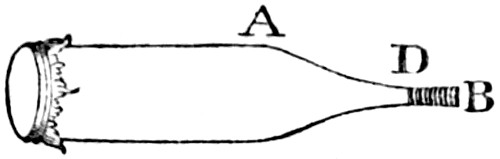
The end A of the tube was drawn out in a capillary form, the other end was covered with a piece of wet bladder to exclude the air; the capillary end B was then plunged in water, which rose to D. He placed the capillary part of the tube before a microscope, on a small micrometer, in order to observe any motion or change in the situation of the water; as it is evident the expiration or inspiration of air by the insect would make it rise or fall alternately. In the first experiment he observed a small degree of motion at distant intervals, not above two or three times in an hour; in a second experiment on another subject, he could observe no motion at all. He then placed some pupæ under the receiver of an air-pump, in water which he had previously purged of its air; on exhausting the air from the receiver, he observed one bubble to arise in a part near the tail, and a few near the wings. The pupæ did not swell under the operation; on the contrary, on letting in the air, it was found to be diminished in a small degree, but in less than a quarter of an hour it recovered its former figure. M. Martinet published at Leyden, in 1753, a dissertation, in which, it is said, he has clearly proved by a number of experiments that the pupæ of caterpillars and some other insects do not respire.
OF RESPIRATION IN THE LARVA OF THE MUSCA PENDULA.
Among the insects in which respiration seems to be most clearly proved, are the larvæ of the musca pendula, Lin. These, while in the worm state, live under water in the mud, to which they affix themselves; the respiration of fresh air in this situation is necessary to their existence; for this purpose they are furnished with a tail, which often appears of an excessive length comparatively with the body, as this is seldom more than three quarters of an inch in length, while the tail is frequently more than four inches; it is composed of two tubes, which run one into the other, something similar to the tubes of a refracting telescope. Besides this, the materials of which the tubes are composed are capable of a great degree of extension. When the tail is at its full length, it is exceeding small, not being larger near the extremity than a horse-hair; there is a little knob at the end, which is furnished with small hairs, to extend on the water, in some measure resembling those at the tail of the musca chamæleon.
In the body of the larva are two large tracheal vessels; these air-vessels extend from the head to the tail, terminate in the respiring tubes, and receive the air from them. The larva quits the water when the time of its transformation approaches, and enters into the earth, where the skin hardens and forms a case in which the pupa is formed; soon after the change, four tubes or horns are seen projecting from the case: these Reaumur supposes to be organs for communicating air to the interior parts of the insect; they are connected with little bladders which are found filled with air, and by which it is conveyed to the spiracula of the pupa. The larvæ of gnats, and other small aquatic insects of the same kind, are furnished with small tubes, that play on the surface of the water, and convey the air from thence to the insect. Many other singularities are to be found amongst the aquatic larvæ.
OF THE GENERATION OF INSECTS.
One of the greatest mysteries in nature is generation, or that power by which the various species of animals, &c. are propagated, enabling one single individual to give birth to thousands, or even millions of individuals like itself; all formed agreeable to proportions which are only known to that ADORABLE WISDOM which has established them. We shall never be able to form any adequate conception of this power, till we are acquainted with the principles of life, and can trace their various gradations in different orders of beings. Many ancient philosophers, from a misconception and perversion of the sentiments of the more ancient sages, imagined that insects were produced from corrupt and putrefied substances; that organized bodies, animated with life, and framed in a most wonderful manner, owed their origin to mere chance! Not so the most ancient sages; they taught that every degree of life must proceed from the fountain and source of all life, and that therefore, when manifested, it must be replete with infinite wonders; but then they also shewed, that if in its descent through the higher orders of being it was perverted, it would be manifested in loathsome forms, and with filthy propensities; and that according to the degree of reception of the Divine Goodness and Truth, or the perversion thereof, new forms of life would be occasionally manifested. The gloom of night still wraps this subject in obscurity; will the dawn of day ere long gild the horizon of the scientific world? or is the time of its breaking forth yet far from us? Be this as it may, insects will be found to conform to that general law of order which runs through the whole of animated nature, namely, that the conjunction of the male and female is necessary for the production of their offspring. Where we cannot ascertain causes, we must be content with facts.