Part 3 — CHAPTER III PILGRIMS AND PILGRIMAGES (continued 2)
Lucy Toulmin Smith translation
Such travellers were well received by the French King of Cyprus, of the famous Lusignan family; they brought him news of the outer world, with them came variety and hope; they also were sometimes able to actually assist him in his difficulties, which were ceaseless, and the king showed his pleasure in his letters. Thus James I of Lusignan, “King of Jerusalem and Cyprus,” writes from Nicosia, in 1393, to Richard II, that a knight has no need of a personal recommendation to be welcome in the island; his subjects always are. It was for him an honour and delight to be visited by “your noble relative the lord Henry Percy.”579 In the same manner the troop of French pilgrims, to which belonged the lord of Anglure, was welcomed in Cyprus, by the same king, in 1396. They reached the island on their way home, after a fearful storm, in which they nearly lost their lives.580 As soon as James heard of their having landed he sent to them {406} provisions in plenty: a hundred chickens, twenty sheep, two oxen, much good red wine and good white bread. Then he asked them to his Court, where they were delightfully entertained by him, by the queen, and their four sons and five daughters. Being himself a great huntsman, James asked them to go hunting with him, a pleasant offer after so many trials, and one not to be refused.
Combats, hunts, storms, encounters of all sorts, in a word, adventure, were thus associated with the idea of the voyage, the holiness of which sometimes disappeared in the midst of so many profane incidents. Well may one wonder whether Saint James was the real attraction, for a De Werchin, Seneschal de Hainaut, who, about to start on a pilgrimage to the shrine of this saint, in 1402, would make it publicly known that, “in the name of God, of our Lord St. George, and of his own lady,” he would accept during his whole journey the friendly combat of arms with any knight for whom he should not have to turn from his road more than 20 leagues. He announced his itinerary beforehand, so that any one might make ready.581
The strange man, Jean de Bourgogne by name, who chose to sign his book of travels “Jean de Mandeville,”582 {407} gives somewhat similar reasons to explain why he undertook his journey to the East in 1322 through perilous seas and countries—or rather, according to modern discoveries—through the books of his library. He started, or, anyhow, he studied and wrote, partly, says he, to sanctify himself, partly to know the world and its wonders, and to be able to speak of them; for many persons, he observes, are much pleased with hearing the marvels of distant regions described. The reason he publishes his impressions is, first, because numbers of people like stories of the Holy Land, and find great consolation and comfort in them; and, secondly, to make a guide, in order that small companies or caravans, like that of Boucicaut and others, may profit by his knowledge.
His ideas as to the road to be followed are not unreasonable. Thus, “to go the direct way” from England to Palestine, he advises the following itinerary: France, Burgundy, Lombardy, Venice, Famagusta in Cyprus, Jaffa, Jerusalem. Very often people went to Jerusalem by way of Egypt. It was a tradition of long standing that the greater part of the difficulties concerning the Holy Land had their root in Egypt; many tombs of saints also attracted the pilgrims there, so that crusaders, or mere pilgrims, often took that road to Jerusalem. “Mandeville” says he himself followed this itinerary. In 1422 Gilbert de Lannoy wrote, “at the behest of King Henry of England, heir and Regent of France,” that is, Henry V, a description in French of the places through which a crusade might be led against the infidels, for this prince, like his predecessors, continued dreaming of a crusade. Lannoy, a practical soldier and diplomat, who speaks only of what he has seen, gives a detailed account of all towns, stating which are protected by walls, {408} towers and ditches; he notices the Venetians’ warehouses for cotton at Acre, and the presence at Beirut of a great number of Christian merchants, Venetians, Genoese, Greeks, and others. He carefully mentions what sorts of provisions in wood, water, etc., may be found in each part of the country, in what plains an army can be easily arrayed, in what ports a fleet shall be safe. He pays the greatest attention to Egypt, and describes its several cities: “Item. There is Cairo, the chief town of Egypt, on the river Nile which comes from Paradise.”583 But the crusade, in anticipation of which he wrote, never took place, and the next military expedition to reach Syria through Egypt was destined to be a French one, headed by that extraordinary pilgrim, Bonaparte.
Besides his account of a journey to Egypt, Palestine, Syria, Central Asia, and China, “Mandeville” gives a description of a number of countries peopled by imaginary monsters. This fantastic part of his work, where he anticipated no less famous a traveller than Gulliver himself, did not diminish its success, quite the contrary; it was translated into several languages, and above three hundred MSS. of it now remain. But we, less confiding than our fathers, are loth to accept the excuse he gives as a guarantee of, at least, his good faith: “Things that are long past away from sight fall into oblivion, and the memory of man cannot all retain and comprehend.”584
Many books, beginning with that of Lannoy, came after his, more practical, less fantastic, and, of course, less famous.585 While the renewal of the crusades became {409} less and less probable, the number of individual pilgrimages was on the increase. The word of the priest which could no longer uproot and set on the move entire nations, still detached here and there little groups of pious men or adventure seekers, who went to visit the holy places under favour of the Saracen’s tolerant and practical spirit. For the mass of them no longer set out to fight the infidel, but to ask his permission to see Jerusalem, which was the more readily granted that it had to be paid for.
From the fourteenth century onwards, a regular service of transports existed at Venice for the use of pilgrims: “It is the rule,” says a traveller of the fourteenth century, “that the Venetians send every year five galleys to the Holy Land. They all reach Beirut, which is the port for Damascus in Syria; thence two of them bring the pilgrims to Jaffa, which is the port for Jerusalem.”586
Many particulars about this service of transports, the purchases to make before starting, and the provisions to take, are found in a book written in the following century by William Wey, Fellow of Eton College, an experienced pilgrim with a passion for such journeys. He recommended that the price of the passage be carefully settled before starting, and that a bed with its pillows, sheets, etc., be procured. This was bought at Venice, near St. Mark’s, and cost three ducats; after the journey the whole could be sold back to the vendor for a ducat {410} and a half: “Also when ye com to Venyse ye schal by a bedde by seynt Markys cherche; ye schal have a fedyr bedde, a matres, too pylwys, too peyre schetis and a qwylt, and ye schal pay iij dokettis; and when ye com ayen, bryng the same bedde to the man that ye bowt hit of and ye schal have a doket and halfe ayen, thow hyt be broke and worne.”587 Such settled customs and fixed prices show better than anything else the frequency of the intercourse.
William Wey is as obliging for his traveller as are modern guide-book makers; he devises mnemonics of names to remember, a vocabulary of the Greek words most important to know, and ready-made questions which our manuals still repeat in more correct language:
“Good morrow. Calomare.
Welcome. Calosertys.
Tel me the way. Dixiximo strata.
Gyff me that. Doys me tutt.
Woman, haue ye goyd wyne? Geneca esse calocrasse?
Howe moche? Posso?”
He does not omit a sentence which must have been, and still is, of especially frequent use: “I understond the not—Apopon kystys.” Wey also gives a table of the rate of exchange for moneys from England to Venice, Crete, Rhodes, Cyprus, and Syria; and a programme for the employment of time, as now very parsimoniously distributed; he only allows “thirteen or fourteen days” to see {411} everything and start back again, specifying what should be seen each day. Lastly, he gives a complete list of the towns to be traversed, with the distance from one to the other, a map of the Holy Land with all the remarkable places duly inscribed thereon,588 a considerable catalogue of the indulgences to be gained, and full details as to what is sacred or curious in Palestine, or on the way thither, not forgetting the dogs at Rhodes, who keep watch at night outside the castle, know perfectly how to distinguish a Turk from a Christian, and who, if one of their number “sleeps instead of taking his watch at night outside the castle, kill him themselves,”589 so great is their detestation of a slacker.
Wey foresaw all the disagreeables to which the boorishness of the captain of the galley might subject you; he recommends engaging a berth in the highest part of the boat, “for in the lawyst [stage] under hyt is ryght smolderyng hote and stynkynge.”590 You must not pay more than forty ducats from Venice to Jaffa, food included, and should stipulate that the captain stop at certain ports to take in fresh provisions. He is bound to give you hot meat at dinner and supper, good wine, pure water, and biscuit; but it is well besides to take provisions for private use, for even at the captain’s table there is great risk of having bad bread and wine. “For thow ye schal {412} be at the tabyl wyth yowre patrone, notwythstondynge, ye schal oft tyme have nede to yowre vytelys, bred, chese, eggys, frute, and bakyn, wyne, and other, to make yowre collasyun; for sum tyme ye schal have febyl bred, wyne and stynkyng water, meny tymes ye schal be ful fayne to ete of yowre owne.” It would even be prudent to take some poultry: “Also by yow a cage for half a dozen of hennys or chekyn to have with yow in the galey;” half a bushel of seed to feed them must not be forgotten, nor what you will want to fry your own bacon and drink your wine: “Also take with you a lytyl cawdren and fryyng pan, dysches, platerrys, sawserys of tre (wood), cuppys of glas, a grater for brede and such nessaryes.” You must also have remedies, “confortatyvys, laxatyvys, restoratyvys,” saffron, pepper, spices.591
On arrival at a port it is well to leap ashore one of the first, in order to get served before others, and not to have the leavings; this counsel of practical selfishness often recurs. On land heed must be taken as to the fruits: “beware of dyverse frutys, for they be not acordyng to youre complexioun, and they gender a blody fluxe (dysentery), and yf an Englyschman have that sykenes hyt ys a marvel and scape hyt but he dye thereof.”
Once in Palestine, one must be careful about robbers; beware of Saracens coming to talk familiarly with you: “Also take goyd hede of yowre knyves and other smal thynges that ye ber apon yow, for the Sarsenes wyl go talkyng wyth yow and make goyd chere, but they wyl stele fro yow that ye have and they may.” At Jaffa you must bestir yourself and be quick, in order to have the best donkey, “Also when ye schal take yowre asse at port Jaffe, be not to longe behynde yowre felowys; for and ye com by tyme ye may chese the beste mule, other asse, for ye schal pay no more fore the best then for the worst. And ye must yeve youre asman curtesy {413} a grot.”592 This last recommendation shows the high antiquity of “pourboires,” one of the best preserved of mediæval traditions. At last the caravan leaves the seaside and proceeds towards the Holy City; and then it is prudent not to straggle too far from your companions for fear of evildoers.
Worthy of notice is the fact that these visits to the Holy Land were in great part performed on donkeys; knights themselves did not disdain mounting these modest animals: “At this said inn did we dismount from our asses,” says the narrator of the travels of the lord of Anglure, who, as we have seen, visited Jerusalem at the end of the fourteenth century; which tends to show that if there was, as there still is, some danger of attacks by robbers, it was not very serious. If there had been any chance of real fight knights would hardly have ventured getting into it on donkey-back. In fact, many of those reports of travels in the Holy Land give the impression of mere tourists’ excursions, and what comes out most clearly from them is the before-mentioned spirit of tolerance, coupled with the spirit of profit, displayed by the Saracen. He did not forbid the entry into Palestine of all these pilgrims, who often came as spies and enemies, and he let their troops do very much as they liked, provided they did not forget to pay.593 The companions of the lord {414} of Anglure, and half a century later of William Wey, go where they will; returning when it is convenient, and making plans of excursions beforehand as they would do at present. They admire the beauty of the “muscas” or mosques, the quaint appearance of the vaulted streets with light coming from apertures at the top of the vault, and with shops for Saracen merchants on both sides, in other words, the bazaar; they are led by and receive explanations from their “drugemens;” at certain places they meet officers entrusted with the permit of the “Soudan,” as to all affairs concerning foreigners: these officers are called “consulles.” They find European merchants established and doing much trade in the ports of the infidel; they have, in fact, nothing to fear seriously but local wars (about which they were pretty sure to get timely information), or possibly calamitous encounters at sea. William Wey and his companions learn with much uneasiness on their return that a Turkish fleet with dubious purpose is ready to quit Constantinople, but happily they do not meet it.
A comparison between the experiences of both troops of pilgrims, the French and the English, is instructive, precisely because they are, in so many cases, similar. The lord of Anglure594 had no trouble in reaching Jerusalem, being provided with the proper authorization: “Shortly after, we started thence on foot, and with the license of the lieutenant of the Sultan we entered the holy city of {415} Jerusalem at the hour of vespers, and were all received and lodged in the hospital where it is customary now for pilgrims to stay.” Having bought tents, they travel by land without difficulty from Palestine to Egypt, crossing the desert, noticing the places where Moses performed his miracles, visiting Cairo, which deeply impresses them by its beauty, its greatness, its gardens and monuments, and the immense number of Saracens living there. They go partly by water, partly on camels, observing on their way “two great black-feathered ostriches trotting along,” to the places where St. Anthony had lived with his “porcellet,” and where churches and abbeys prosper under the rule of the unmeddling Saracen. They navigate the Nile, a large river which “comes from Paradise,” and where “live several serpents called cokatrices,” otherwise crocodiles, of which they see one “very great and hideous” that dived into the water when they came near. There only they have a rather narrow escape, being attacked in their boat by “Arab robbers,” and some of their troop are wounded with arrows, but none is killed.
Needless to say that, if Rome was full of relics, there was no want of them in Jerusalem. All the places named in the Gospel, and some others, had been identified with precision: “Item, continuing to go up towards this mountain on the right hand side, there is a house where the sweet Virgin Mary learnt at school.” Near the church of the Holy Sepulchre is a large square “with two big stones on the one of which our Lord used to sit when He preached to His disciples, and our Lady sat opposite on the other.” The place is shown “where St. John the Evangelist sang mass every day in the presence of our Lady after the Ascension of our Lord.” You may see, too, the spot where was roasted the paschal lamb; “even here was warmed the water with which our Lord washed the feet of His apostles.” There is also a cave or well “where King Herod had the Innocents {416} thrown, out of spite.” At Bethlehem is a church of St. Nicholas, “in which place the sweet Virgin Mary hid herself to draw her milk from her worthy breasts when she would fly to Egypt. In this same church is a marble column against which she leaned when she drew her worthy milk, and this pillar continues moist since the time she leaned against it, and when it is wiped, at once it sweats again; and in all places where her worthy milk fell, the earth is still soft and white and has the appearance of curded milk, and whoever likes takes of it, out of devotion.”—Hence the milk at Walsingham?
In Egypt, too, the wonders are numerous, but many are of a different order. Besides the churches and hermitages there are the “granaries of Pharaoh,” namely the pyramids, which seem to the lord of Anglure and his companions “the most marvellous thing they had yet seen in all their travels.” They are cut “in the shape of a fine diamond,” but inside they are full of animals, who stink horribly. Mandeville, who had seen them some years before, gives them the same origin, and utterly discards the belief that they might have been tombs of high personages. He mentions the hieroglyphics, about the only thing in all his book that he does not try to explain; he also has a word for the grim inhabitants of the pyramids: “Thei ben alle fulle of serpentes. And aboven the gernerers with outen ben many scriptures of dyverse languages. And sum men seyn that they ben sepultures of grete Lordes, that weren somtyme; but that is not trewe; for all the comoun rymour and speche is of alle the peple there, bothe far and nere, that thei ben the garneres of Joseph. And so fynden thei in here scriptures and in here cronycles. On that other partie, yif thei werein sepultures, thei scholden not ben voyd with inne. For yee may well knowe that tombes and sepultures ne ben not made of suche gretnesse ne of suche highnesse. Wherfore it is not to beleve that thei {417} ben tombes or sepultures.”595 This powerful mode of reasoning did not, however, convince such sceptics as Mariette and Maspéro.
Besides the pyramids, the companions of the Lord of Anglure notice and greatly praise the houses with their terraces, the mosques and their “fine lamps,” these same ornamented glass lamps which, after having been admired by our pilgrims in 1395 when they were fresh and new, can be seen now without going so far, in the Victoria and Albert Museum. The Egyptian animals, too, are noted by our travellers as being very striking; besides the crocodiles there are the long-necked giraffes, so tall that “they could well take their provender on the highest lances that it is the custom now to use,” and then the elephants. A very strange beast an elephant: “It could never bend to the ground to get its food on account of its great height, but it has in its snout something like a bowel, put at the further end of its snout,” and this bowel “hangs down almost to the ground,” and with it the beast “takes its food and carries it to its mouth.” He uses it also to drink, and “when he blows air through it the noise is greater than that of any buccina,” and the sound “is terrible to those unaccustomed.”
At last the time came when our pilgrims had seen everything, and they had to wend their way homewards. Twice did William Wey undertake the great journey, happy to have seen, fain to see again. When he came back to England for the last time he bequeathed to a chapel, built on the model of the Holy Sepulchre, the souvenirs which he had brought back, that is to say, a stone from Calvary, another from the Sepulchre itself, one from Mount Tabor, one from the place where the cross stood, and other relics. As for the French troop of pilgrims who had left Anglure-sur-Aube on July 16, {418} 1395, they came back in the following year, complete in their numbers but for Simon de Sarrebruck, who had died of fever in Cyprus during the journey home, and lies interred in a church there. “And on Thursday, the twenty-second day of June, and the day before the eve of the feast of St. John the Baptist, in the year of grace of our Lord, 1396, we found ourselves again dining in Anglure.”
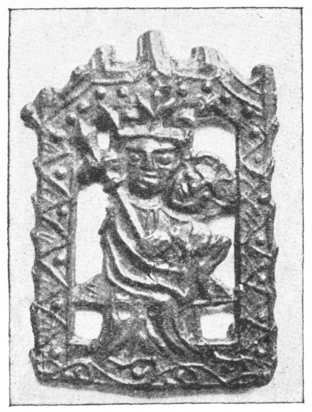
67. A PILGRIM’S “SIGN,” OUR LADY OF WALSINGHAM.
(Original in the British Museum.)

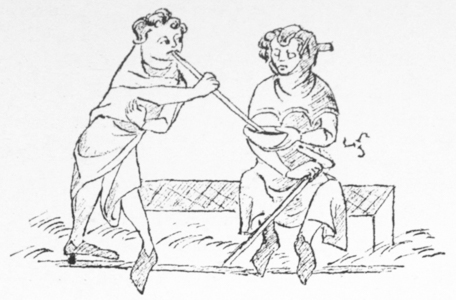
68. A BLIND BEGGAR CHEATED OF HIS DRINK BY HIS BOY.
(From MS. 10 E. IV.)
CONCLUSION
We have followed the race of roamers in many places: on the road, at the hostelry, in woods, in taverns, in churches; we have seen them exercising a host of different trades, a motley crew, minstrels, buffoons, quacks, messengers, pedlars, pilgrims, wandering preachers, beggars, friars, vagabonds of all sorts, labourers broken loose from the soil, pardoners, knights in search of adventure. We have accompanied them here and there over the highroads of England, and followed them to Rome itself, and the Holy Land; there we shall leave them. To the wandering class also belong the representatives of many other professions, such as scribes, tinkers, cobblers, masons, showers of animals or bearwards, like those whom Villard de Honnecourt visited one day in order to draw “al vif,” a lion. But the more important members are those above described.
The current of life represented by the multiplicity of these wayfarers is powerful; notice has been taken of the great though not very apparent part they played in the State. The labourer breaks the bonds which for centuries have attached him to the manor, and henceforward means {420} to be the master of his own person and of his service, to hire himself by the day if he chooses, and for a salary corresponding to the rise in prices and to the demand there may be for his work. The reform is an inevitable one, which will be realized by degrees, in spite of the laws and of the will of the authorities. There is none more important, and its how and wherefore are to be studied not only in the castle, but on the road and by-ways, in the brushwood, where armed bands meet together during church service, and on those unfrequented paths where the false pilgrim throws down his staff to take up his tools and look for work out of the reach of his hereditary master. These people promote by their example and success the emancipation which the wandering preachers justify in their discourses, showing it to be not simply desirable, but rightful.
The great questions of the age, social and religious, move towards their solution, partly on the road, through the influence of the wanderers, a direct influence from the sincere ones, indirect from the others. Begging friars go from door to door, pardoners grow rich, pilgrims live by alms and by the recital of their adventures, always on the way, always at work. What is this work? By constantly addressing the crowd, they in the end make themselves known for what they are, and cause their listeners to pass sentence upon them; by disabusing them they render reform inevitable. Thereby, too, will the rust and superstition of the middle ages drop away, and another step be made towards modern civilization.
Each of these strange types has, moreover, the advantage of showing, very apparent in his own person, some characteristic side of the tastes, the beliefs, and the aspirations of his time. Each of those groups corresponds to a need, an eccentricity, a vice, or a merit of the nation; through them we may examine, as it were, and reconstitute piecemeal the souls of the men of long ago, and have those {421} men stand before us, mind and body, complete, just as the nature of the soil may be guessed from the flora of a country.
The general impression is that the English people then underwent one of those profound transformations which present themselves to the historian’s view like the turning of a highway. Coming out from gorges and mountains the road suddenly leads to an opening, and the rich, sunny, fertile plain is perceived in the distance. It has not yet been reached, many hardships are still to be endured; it will disappear again from sight at intervals, but the traveller has seen it, and knows at least in what direction to tread in order to attain it. During the age which was then beginning the emancipated peasant was to enrich himself in spite of fierce wars especially deadly for the nobility, and the Commons were to be possessed of an instrument of control over the royal power, which would be used, according to the period, more or less well, but which is the best one invented up to our day. The Parliament sitting at Westminster now is in its essential elements identical with the one that, under the Plantagenets, drew up the statutes of the kingdom. In the fourteenth century, despite ultra severe judgments from some thinkers of fame (an age, says Stubbs, “of heartless selfishness and moral degradation”), mankind did not recede, witness the host of truly modern ideas which gained a hold on the mass of the people; among the upper classes under the influence of higher education and wider intercourse with foreign countries, which weakened the notion of the immutability of custom; among the lower classes through the effects of abuses long experienced by men who, though patient, were no weaklings; ideas made popular and rendered practical by the wayfarers, illiterate workmen, single-hearted preachers. All those mad freaks, all the extravagance of the religious spirit, those incessant revolts and follies which have been noticed, were sure to cause a reaction, and a longing for something nearer that {422} reign of reason which mankind, though less remote from the goal, still continues to look for in the far distance.
On a number of questions, whether as the promoter or the object of reform, as working man or as pardoner, whether an unconscious instrument or not, wanderers will always have much to teach whoever will question them. For good or evil it may be said that they acted in mediæval history as “microbes,” a numerous, scarcely visible, but powerful host. They will perhaps reveal the secret of almost incomprehensible transformations, which might have seemed to necessitate a total overturn, like the one that took place in France at the end of the eighteenth century, a new or rather a first contrat social. England, for many reasons, has not required this; one among those reasons is the action of the roamers which, exerting itself on a population temperamentally steadier than many others, more persistently resolute, and less constantly troubled by wars on its territory, united the people and, thanks to that union which made it strong, allowed it to snatch in time the necessary concessions. And as, however, the calmest changes cannot take place without some disturbance, as also among the English there have been, in the course of centuries, more than one bloody fray, the nomad may perhaps end by answering his interrogator in the words of a common proverb of certain, yet unhackneyed wisdom, which should prevent pessimism and lack of hope: “Le bois tortu fait le feu droit”—Crooked log maketh straight fire.
APPENDIX