Coats-of-Arms (continued 3)
Reading edition
[In Aristotelis de Coelo libros quatuor. Venetiis, 1598.]
John Rivers (born circ. 1579, died circ. 1651) was the son of Sir George Rivers, and grandson of Sir John Rivers, Lord Mayor of London. Mr. Rivers was educated at Oxford, and admitted to the Inner Temple in 1600. In 1621 he was created a Baronet.
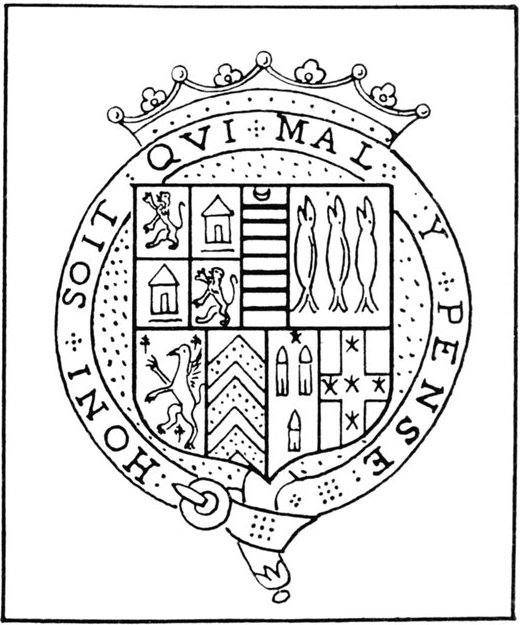
RUSSELL, FRANCIS, SECOND EARL OF BEDFORD
Arms.—Within the Garter. Quartered.
1. Quarterly; 1 and 4, arg., a lion rampant gu. Russell.
2nd and 3rd, az., a tower with cupola arg., door gu. De La Tour.
2. Barry of eight, or and az., a crescent for difference. Fitzalan.
3. Gu., 3 herrings hauriant in fess arg. Herringham.
4. Sa., a griffin segreant between 3 crosses crosslet fitchée arg. Froxmere.
5. Sa., 3 chevrons arg. Wyse.
6. Sa., 3 dovecotes arg., 2 and 1, a mullet for difference. Sapcote.
7. Arg. on a cross gu., 5 mullets arg., 1, 3, and 1. Bodenham.
Coronet.—That of an Earl.
[Prayers. Edinburgh, 1565.]
Francis Russell (born 1527, died 28th July 1585) was the son of John Russell, K.G., created Earl of Bedford in 1549. In 1554 Francis Russell succeeded to his father's earldom, and in 1546 he was made a Knight of the Bath. He was High Sheriff of Bedfordshire and Buckinghamshire, Member of Parliament for Northumberland, and Lord Lieutenant for Bucks.
Lord Bedford served as Ambassador to France on two occasions, and in 1564 he was made a Knight of the Garter. He also served as Chief Justice in Eyre south of Trent, and Lord Lieutenant of Dorset, Devon, and Cornwall. He was known as the "Good Earl of Bedford," and entertained Queen Elizabeth both at Chenies and at Woburn.
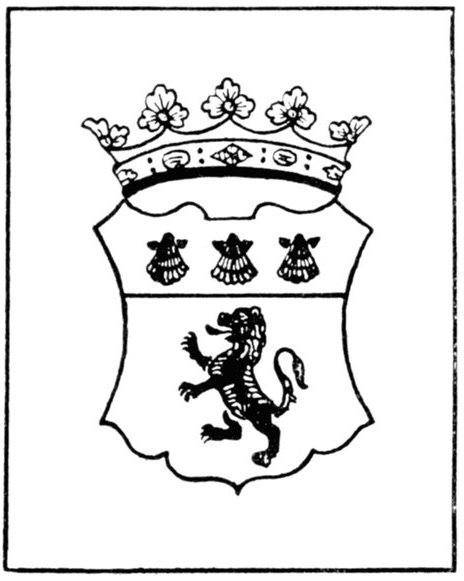
RUSSELL, WRIOTHESLEY, SECOND DUKE OF BEDFORD
Arms.—Arg., a lion rampant gu., on a chief sa., 3 escallops of the first.
Coronet.—That of a Duke.
[Knolles. Turkish History. London, 1701.]
Wriothesley Russell (born 1st November 1680, died 26th May 1711) was the son of William Russell, second son of William Russell, first Duke of Bedford. His mother was Rachel, daughter of Thomas Wriothesley, Earl of Southampton. In 1700 Wriothesley Russell succeeded to the Dukedom on the death of his grandfather the first Duke. He was educated at Oxford, and in 1701 was a Gentleman of the Bedchamber, and acted as Lord Lieutenant of Bedfordshire, of Cambridgeshire, and of Middlesex. He was Lord High Constable at the coronation of Queen Anne, on which occasion he was made a Knight of the Garter.
Through Rachel Wriothesley the Manors of Bloomsbury and St. Giles-in-the-Fields came into possession of the Russell family, and for a long time they lived at Bedford House, which occupied the site now forming the northern side of Bloomsbury Square.
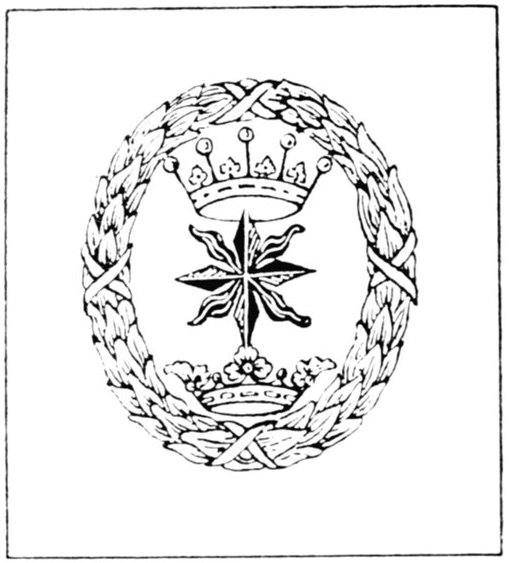
SACKVILLE, EDWARD, FOURTH EARL OF DORSET
Crest.—Out of an heraldic coronet ppr., an estoile of 8 points arg.
Coronet.—That of an earl.
[De Philotheia. Canticum canticorum, libri x. Friburgi Helvetiorum, 1609.]
Edward Sackville (born circ. 1590, died 17th July 1652) was the son of Richard Sackville, third Earl of Dorset. He was educated at Oxford, and succeeded his father in the Earldom in 1624. Mr. Sackville was Member of Parliament for Sussex, and in 1616 was made a Knight Commander of the Order of the Bath, and after his succession to the peerage he acted as Lord Lieutenant of Middlesex, and later of Sussex. In 1625 he was made a Knight of the Garter.
Lord Dorset carried one of the swords at the coronation of Charles I., and served as Chamberlain of the Household in 1644. He married Mary Curzon, governess to the king's children.
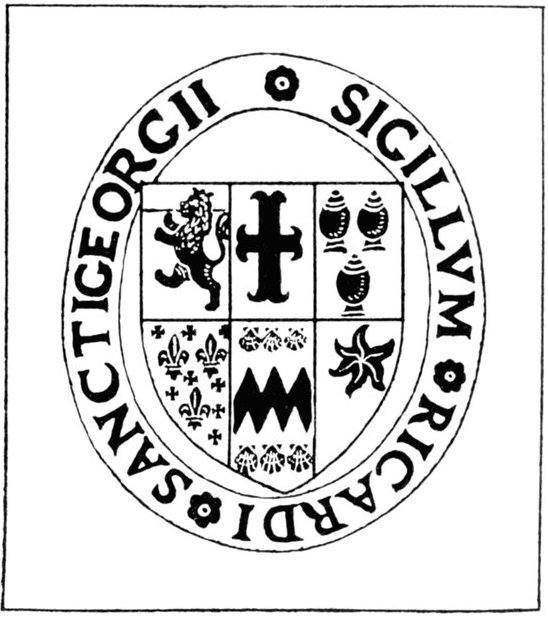
SAINT-GEORGE, SIR RICHARD, KNIGHT
Arms.—Quartered.
1. Arg., a chief az., over all a lion rampant gu., crowned or. St. George.
2. Arg., a cross flory gu. Trussell.
3. Gu., 3 covered cups or. Butler.
4. Arg., 3 fleurs-de-lys between 8 crosslets sa. Mortimer.
5. Az., a fess dancetty between 6 escallops arg. Dengayne.
6. Sa., an estoile arg. Ingleby.
Legend.—Sigillvm ricardi sancti georgii.
[Collection of Manuscript Tracts of the Seventeenth Century. Add. MS. 577, b. 5.]
Richard Saint-George (born circ. 1577, died 17th May 1635) was the son of Thomas Saint-George of Hatley Saint-George, Cambridge. He was always a great student of heraldry and genealogy. In 1602 he was made Berwick Pursuivant, and in 1603 Norroy King-of-Arms. He conducted visitations of Derbyshire, Yorkshire, Cheshire, Lancashire, and other counties. In 1616 he received the honour of Knighthood.
Sir Richard became Clarencieux King-of-Arms in 1623, and presently, with Sir John Borough, Norroy, he conducted several further visitations in the southern counties of England. He wrote several valuable genealogical works, many of which are among the manuscripts in the British Museum. Many of his writings have been published. His son Henry afterwards became Garter King-of-Arms.
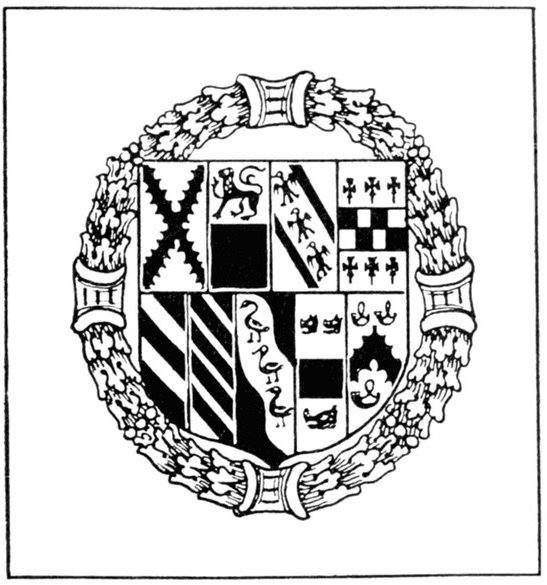
SALWEY, HUMPHREY
Arms.—Quartered.
1. Sa., a saltire engrailed or. Salwey.
2. Arg., on a chief az., a lion passant of the first. Aston.
3. Or, on a bend sa., 3 eagles displayed arg. Manley.
4. Gu., a fess compony, arg. and sa., between 6 crosses crosslet fitchée or. Boteler.
5. Arg., 2 bendlets sa. Bradshaw.
6. Bendy of 10, or and az. Montfort.
7. Arg., on a bend wavy az., 3 swans of the first. Dawes.
8. Arg., a fess az., between 3 boars' heads couped sa. Alyson.
9. Arg., a chevron engrailed between 3 bugle horns sa., stringed or. Wyerley.
[Hatcher. G. Haddoni lucubrationes. Londini, 1567.]
Humphrey Salwey (born circ. 1575, died December 1652) was educated at Oxford, and entered the Middle Temple in 1591. He took part in the Civil War on the side of Parliament. In 1644 he was appointed King's Remembrancer in the Court of Exchequer. In 1649 he was made a Judge, but never took his place as such. He was buried in Westminster Abbey.
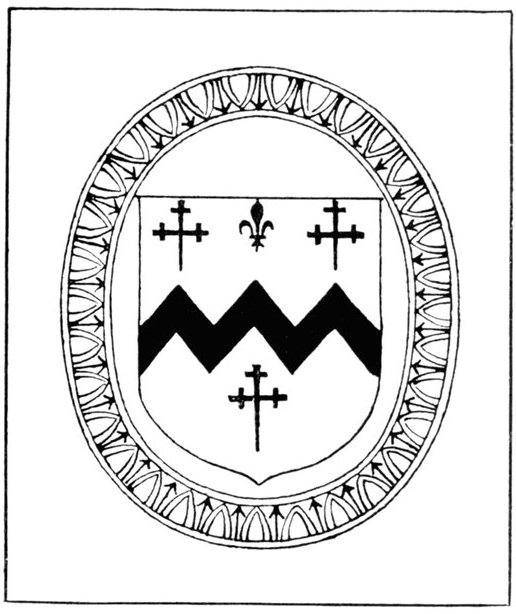
SANDYS, SIR THOMAS, KNIGHT
Arms.—Or, a fess dancetty between 3 crosses crosslet fitchée gu., a fleur-de-lys for difference. Sandys.
[Jacobus de Voragine. Legendario delle vite de' Santi. Venetia, 1607.]
Edwin Sandys (born 9th December 1561, died October 1642) was the sixth son of Edwin Sandys, Archbishop of York. He was educated at Merchant Taylors' and Oxford, and in 1589 entered the Middle Temple as a student. In 1586 Mr. Sandys represented Andover in Parliament, and afterwards sat for Plympton. He wrote some books on religious subjects during a visit to Paris. In 1603 he received the honour of Knighthood, and was Member of Parliament for Stockbridge.
Sir Edwin Sandys was conspicuous in Parliament, and got into trouble about his views as to the succession to the throne, and had to appear before the Council, but nothing was done further than that he had to give security for his appearance if wanted. He was an active member of the East India Company, and the Sandys group of islands in the Somers Islands was named after him. He also took a prominent part in the affairs of the Virginia Company, of which he was elected Treasurer in 1619, in succession to Sir Thomas Smythe. His administration, however, in the long-run, was no better than that of his predecessor, and in 1621 he was imprisoned in the Tower, but soon released.
Sir Edwin was returned to Parliament as Member for Sandwich, and afterwards for Penrhyn, but soon afterwards left public life, and devoted himself to his favourite East India Company. His political career was of much interest and importance.
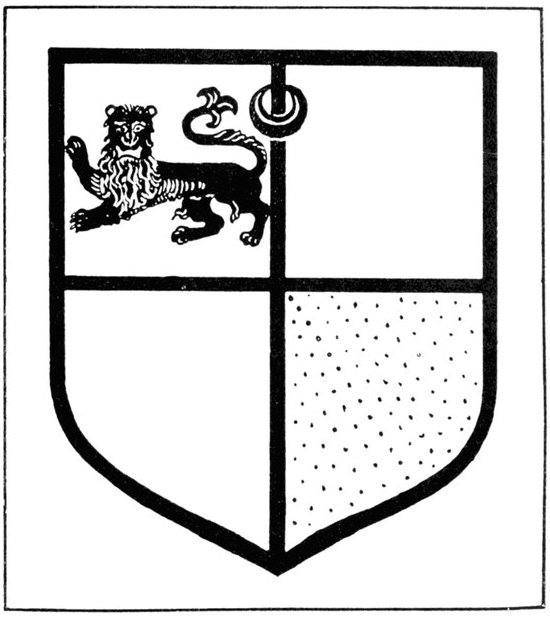
SAY, WILLIAM
Arms.—Quarterly, or and gu., in the first quarter a lion passant guardant az. A crescent for difference. Say.
[Dialogi sex. Antverpiae, 1566.]
William Say (born c. 1604, died c. 1666) was the second son of William Say of Ickenham, Middlesex. He was educated at Oxford, and was a Bencher of the Middle Temple. Mr. Say was a Member of Parliament for Camelford, and signed the death warrant of Charles I. For a time, in the absence of Speaker Lenthal, Say acted as Speaker in the House of Commons.
At the Restoration Say had to leave England, and found refuge in Holland, where he died.
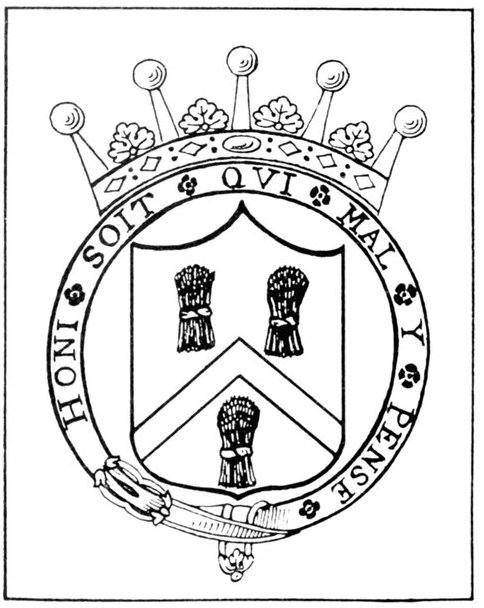
SHEFFIELD, JOHN, THIRD EARL OF MULGRAVE, AFTERWARDS DUKE OF THE COUNTY OF BUCKINGHAM.
Arms.—Within the Garter. Arg., a chevron between 3 garbs gu. Sheffield.
Coronet.—That of an Earl.
Note.—Used between 1674 and 1694.
[Cudworth. The Intellectual System of the Universe. London, 1678.]
John Sheffield (born 7th April 1648, died 24th February 1720) was the son of Edmund Sheffield, second Earl of Mulgrave, and succeeded his father in 1658. John Sheffield had an eventful military and naval career, the two professions being in his time curiously considered as one. As a sailor he took part in the fight at Solebay in 1672 under the Duke of York, and afterwards was Captain of the "Royal Catherine." As a soldier Lord Mulgrave was Colonel of the Holland Regiment, Governor of Hull, and commanded a force at Tangier. In 1674 he was made a Knight of the Garter. He was a member of the Privy Council and Lord Chamberlain of the Household. In 1694 he was made Marquis of Normandy, and in 1703, Duke of Normandy, and shortly afterwards Duke of the County of Buckingham. He was a book-lover, and an author of some repute in his own time.
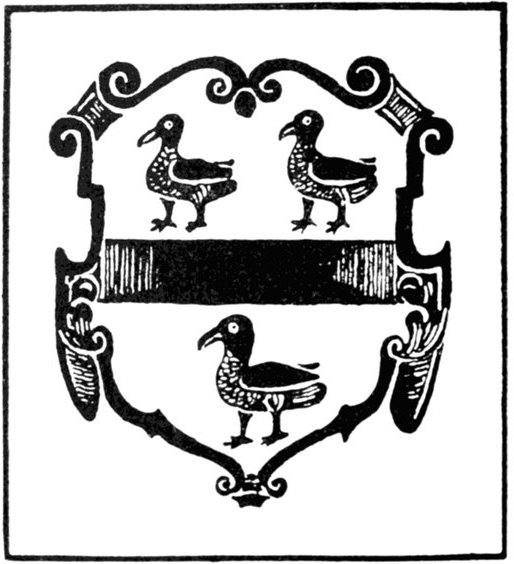
SHELDON, RALPH
Arms.—Sa., a fess arg., between 3 sheldrakes ppr. Sheldon.
[The Annals of Cornelius Tacitus. London, 1640.]
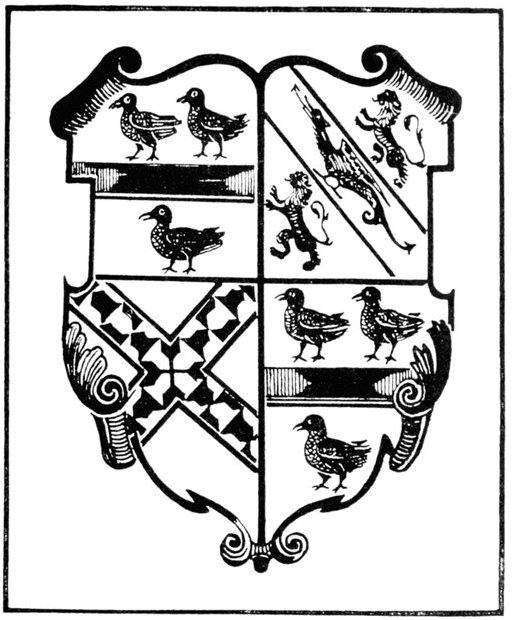
Variety.—Quarterly.
1st and 4th; sa., a fess arg., between 3 sheldrakes ppr. Sheldon.
2nd; arg., on a bend sa., between 2 lions rampant of the second, a wyvern, extended, of the first. Newport.
3rd; gu., a saltire vair. Wellington.
[Nostradamus. The True Prognostications, etc. London, 1672.]
Ralph Sheldon (born 1st August 1623, died 24th June 1684) was the son of William Sheldon of Beoley, Worcestershire, and an ardent collector of antiquities, particularly books and manuscripts. He collected a large library at his house "Weston," at Long Compton, Warwickshire, and bequeathed to the College of Arms a large number of the manuscripts of Augustine Vincent, Windsor Herald. Mr. Sheldon suffered persecution as a Catholic. He wrote several genealogical treatises, many of which are now kept at the College of Arms.
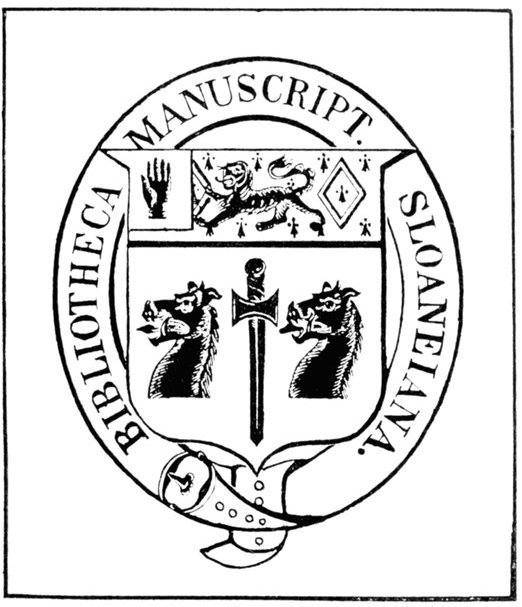
SLOANE, SIR HANS, BART.
Arms.—Gu., a sword in pale, point downwards, blade arg., hilted or, between 2 boars' heads couped at the neck of the third; on a chief erm., a lion passant of the first between 2 mascles sa. The Ulster hand gu., on an escutcheon arg., in the dexter chief.
Legend.—Bibliotheca manuscript. sloaneiana.
[State Papers, 1515-1525. Sloane MS. 3839.]
Hans Sloane (born 16th April 1660, died 11th January 1753) was the son of Alexander Sloane, a Scotchman who settled in Ireland as receiver-general of the estates of Lord Clanricarde.
When he was about eighteen Hans Sloane came to London to pursue his studies, particularly medicine, chemistry, and botany. In botany he became a great authority, and his botanical collections were of great importance. In 1683 he went to France to continue his scientific studies, and on his return to London he set up as a practising physician in England.
In 1687 Dr. Sloane went to the West Indies as physician to Christopher Monck, second Duke of Albemarle, who was Governor-General of the West Indian Colonies, and during the voyage the doctor made valuable collections, chiefly botanical, and also brought together a mass of material for his future use as an author. Dr. Sloane's botanical collections were largely increased by bequests from friends, particularly that of William Courten in 1702. In 1693 Dr. Sloane was Secretary to the Royal Society, and he was also Physician-in-Chief to George I., who in 1716 created him a Baronet. He was President of the College of Physicians in 1719 and of the Royal Society in 1727. Sir Hans Sloane lived in a house in Great Russell Street, and in 1741 he moved to more roomy quarters at the Manor House, Chelsea, where his collections could be better seen.
By his will Sir Hans Sloane bequeathed his natural history collections, antiquities of all sorts, manuscripts, and printed books to the British Nation, conditional on the payment to his family of £20,000, and after considerable negotiation the offer was accepted. In 1753 an Act (25th George II., chap. 22) was passed "for the purchase of the Museum or Collection of Sir Hans Sloane," and the collections were in time, with others, removed to Montagu House, which was opened to the public in 1759. The Sloane family is represented among the Family Trustees of the British Museum.
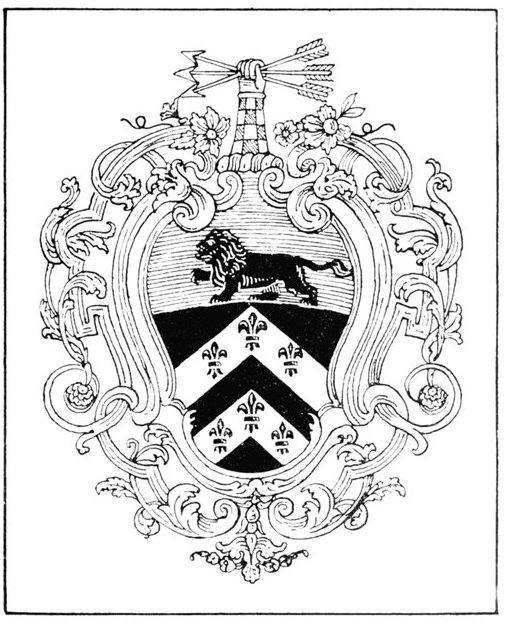
SMITH, JOSEPH, CONSUL
Arms.—Arg., 2 chevrons sa., each charged with 3 fleurs-de-lys of the first; on a chief gu., a lion passant or. Smith.
Crest.—A dexter arm erect, vested chequy, vert and or, holding in the hand a sheaf of 3 arrows of the last.
[Petrarch. Canzoniere. Venetiis, 1533.]
Joseph Smith (born circ. 1682, died 6th November 1770) went as a young man to Venice, and quickly became known as an ardent collector of books and objects of art generally. In 1740 he was appointed British Consul at Venice. In 1762 Smith's library was bought for George III., and formed the first important nucleus of His Majesty's splendid collection. It contained especially choice editions of the classics, and also many incunabula.
Mr. Smith continued to collect books after the king had made his purchase, and these were eventually sold by auction in 1773. George III. also acquired a fine collection of pictures, coins, and gems that had been brought together by Consul Smith.
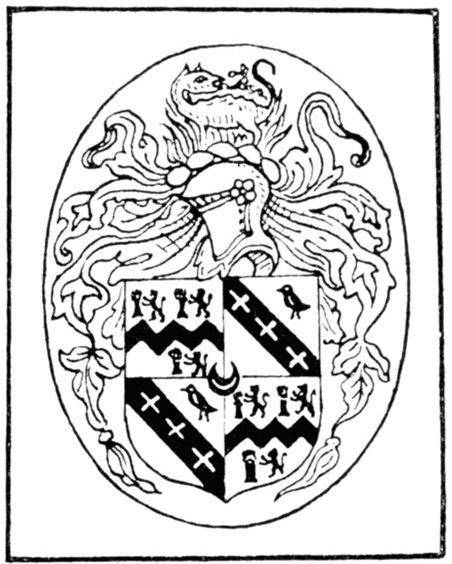
SMITH, SIR THOMAS, KNIGHT, OF HILL HALL, ESSEX
Arms.—Quarterly.
1st and 4th; sa., a fess dancetty arg., between 3 lioncels rampant of the second, each supporting an altar or, flaming ppr. Smith.
2nd and 3rd; arg., on a bend sa., 3 crosses of the first, a martlet for difference. Charnock.
In the centre point a crescent for difference.
Crest.—A Phœnix arg., issuing from flames ppr.
Helmet.—That of an Esquire.
[Short Introduction to Latin Grammar. London, 1609.]
Thomas Smith (born 23rd December 1513, died 12th August 1577) was the second son of John Smith of Saffron Walden, and Agnes Charnock.
He was educated at Cambridge, where he attracted attention by his ability and was given a special scholarship by Henry VIII. In 1531 Smith was made a Fellow of his College, and shortly afterwards University Orator. In 1544 he was made Regius Professor of Civil Law. He was Provost of Eton and Dean of Carlisle. Although in Orders, Smith presently came to Court and became Clerk of the Privy Council, and in 1548 he was made one of the Secretaries to the King, and shortly afterwards received the honour of Knighthood. He went as Ambassador to the Emperor Charles V., and with an Embassy to France in 1551.
On the accession of Queen Mary, Smith changed his crest, and adopted that of a salamander living in the midst of flames, alluding perhaps to the fact that he escaped free from the dangers of the time, he being a strong Protestant. The Smith crest before this had been an eagle holding a pen in his claw. Queen Elizabeth in turn favoured Sir Thomas, and made him Chancellor of the Order of the Garter, and soon afterwards Secretary of State. Sir Thomas Smith had a large library of books, which he bequeathed to one or other of the Colleges at Cambridge, or among private friends. He wrote several works, mostly political.
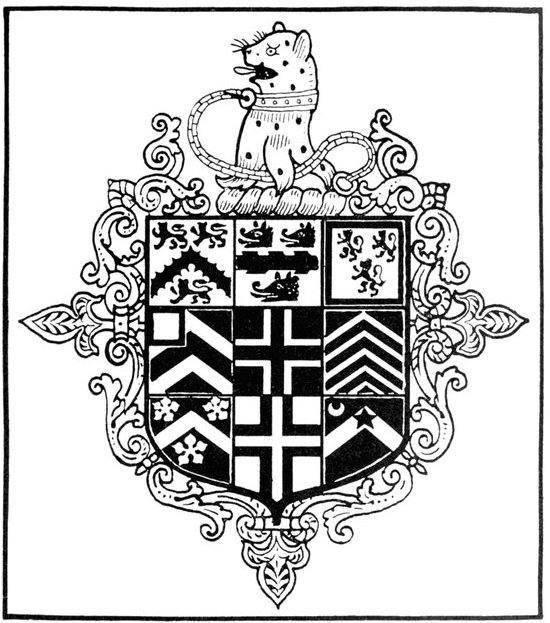
SMYTHE, THOMAS, VISCOUNT STRANGFORD
Arms.—Quartered.
1. Az., a chevron engrailed between 3 lions passant or. Smythe.
2. Gu., a fess raguly between 3 boars' heads couped arg. Judd.
3. Az., 3 lions rampant within a bordure arg. Chiche.
4. Arg., 2 chevrons az., a canton gu. Dexter.
5. Arg., a cross voided gu. Pilkington.
6. Arg., 5 chevrons sa. Sutton.
7. Or, a chevron between 3 cinquefoils gu. Chichele.
8. Arg., a cross voided sa. Duckenfield.
9. Or, on a chevron sa., a mullet arg., a crescent for difference. Mirfin.
Crest.—An ounce's head erased arg., collared and chained sa.
Note.—Used before 1628.
[Moulin. Anatomie of Melancholy. London, 1620.]
Thomas Smythe (born c. 1599, died 30th June 1635) was the son of Sir John Smythe of Ostenhanger and Ashford, High Sheriff of Kent in 1600. Thomas Smythe inherited a considerable fortune from his father, who was a son of Thomas Smythe, Farmer of the Customs to Queen Elizabeth, his mother being Alice Judd, daughter of Sir Andrew Judd, Lord Mayor of London and founder of Tunbridge School. In 1625, at the coronation of Charles I., Thomas Smythe was made a Knight Commander of the Order of the Bath, and three years later he was created Viscount of Strangford.
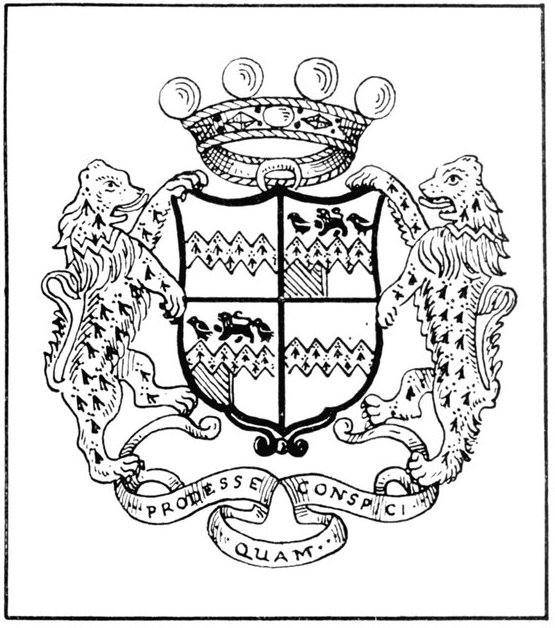
SOMERS, JOHN, BARON SOMERS
Arms.—Quarterly.
1st and 4th; vert, a fess dancetty erm. Somers.
2nd and 3rd; quarterly, vert and gu., a fess dancetty erm., in chief a lion passant between 2 hawks arg. Somers of Worcestershire.
Coronet.—That of a Baron.
Supporters.—2 lions erm., each charged on the neck with a fess dancetty vert.
Motto.—Prodesse quam conspici.
[Common Prayer. Oxford, 1700.]
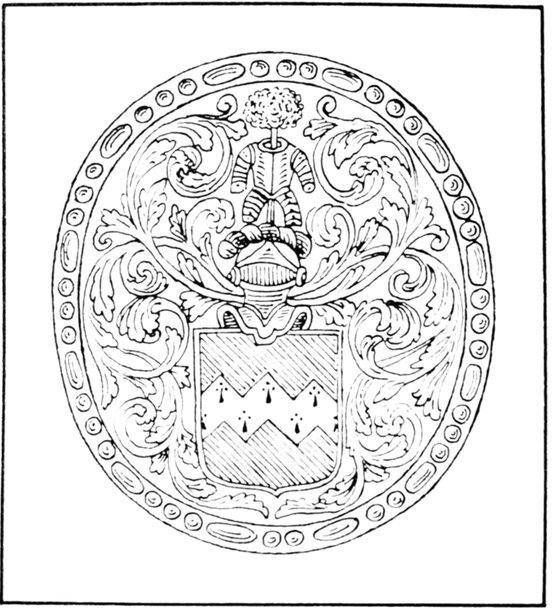
Variety.—Used between 1688 and 1697.
Arms.—Vert, a fess dancetty erm.
Crest.—A coat of mail hanging on a laurel tree ppr.
Helmet.—That of a Knight.
[Echard. Roman History. London, 1695.]
John Somers (born 4th March 1650, died 26th April 1716) was son of John Somers of Clifton-on-Severn. He was educated at Worcester and Oxford, and became a Bencher of the Middle Temple in 1689.
Mr. Somers became Solicitor-General in 1688, when he received the honour of Knighthood, and he represented Worcester in Parliament. Sir John was sworn of the Privy Council in 1693, and shortly afterwards was made Lord Keeper of the Great Seal, Speaker of the House of Lords, and Lord Chancellor. In 1697 he was created Baron Somers of Evesham. Lord Somers was President of the Royal Society. In 1701 he was impeached in the Commons for various supposed misdemeanours, but the charge was dismissed.
The Barony of Somers became extinct at John Somers' death in 1716, but it was revived in 1784 in the person of Charles Cocks of Castleditch, M.P. for Reigate, who was a descendant of a sister of the first Lord.
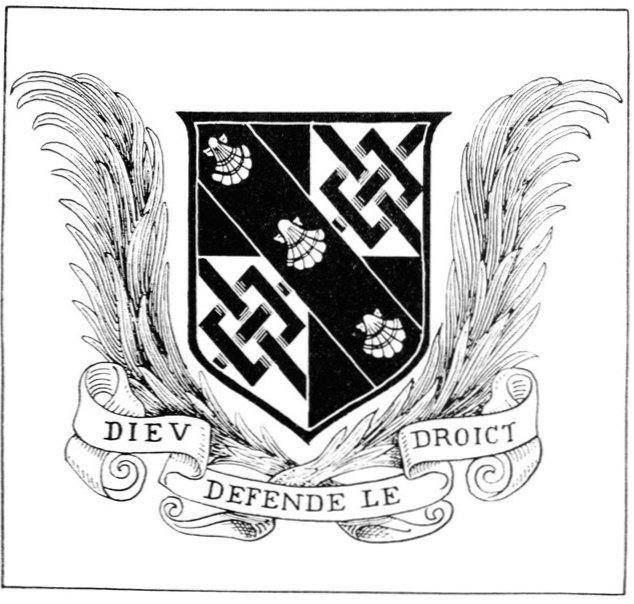
SPENCER, CHARLES, THIRD EARL OF SUNDERLAND
Arms.—Quarterly; arg. and gu., on the second and third quarters a fret or, over all on a bend sa., 3 escallops of the first. Spencer.
Motto.—Diev defende le droict.
Note.—Used before 1702.
[Camden. Britain. London, 1637.]
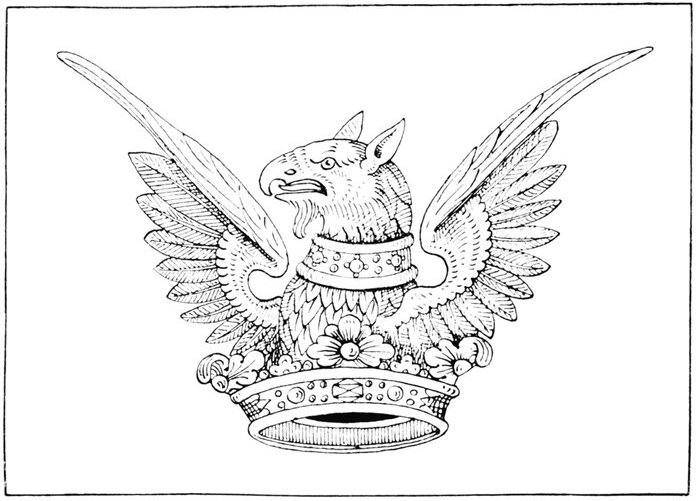
Crest.—Out of a ducal coronet or, a griffin's head arg., gorged gu., between 2 wings expanded of the second. Spencer.
Charles Spencer (born c. 1674, died 19th April 1722) was the son of Robert Spencer, second Earl of Sunderland, and succeeded his father in 1702. He was from an early age a great lover and collector of books, which he kept at Althorp.
In 1695 he was Member of Parliament for Tiverton; in 1706 he was a Secretary of State for the Southern Department, and became of much political importance as a Whig leader. He was appointed Lord Lieutenant of Ireland in 1714.
In 1715 Lord Sunderland was made Lord Privy Seal, and shortly afterwards Vice-Treasurer of Ireland. He also held the posts of Groom of the Stole and Gentleman of the Bedchamber to George I.
Lord Sunderland was a great book collector, and a rival in this respect to most of his contemporaries. He was a great gambler, and his library was at one time pledged to the Duke of Marlborough, and in 1749 it was removed to Blenheim. The library was sold in 1881, and the books belonging to it were widely dispersed.
Lord Sunderland's son Charles, who in 1729 became fifth earl, on the demise of his aunt Henrietta, by special Act of Parliament Duchess of Marlborough, in 1733 succeeded to the Dukedom of the celebrated John Churchill. The Earldom of Sunderland from that time has been merged in the Dukedom of Marlborough.
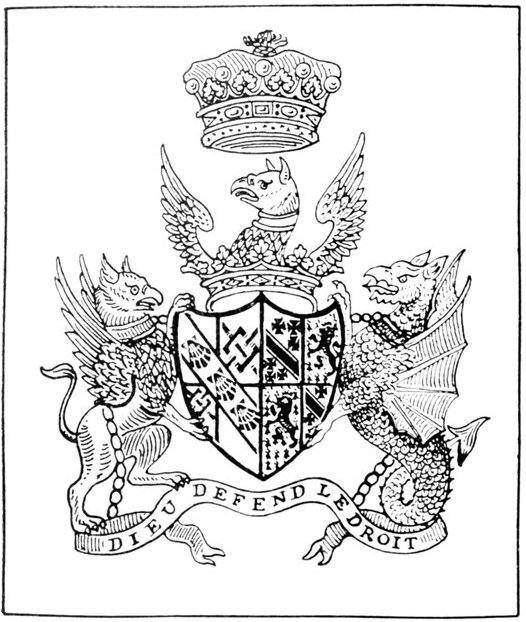
SPENCER, GEORGE JOHN, SECOND EARL SPENCER
Arms.—Impaled.
Dexter: Quarterly, arg. and gu., on the 2nd and 3rd quarters a fret or, over all on a bend sa., 3 escallops of the first. Spencer.
Sinister: Quarterly.
1st and 4th; az., a bend cotised between 6 crosses pattée or. Bingham.
2nd and 3rd; erm., a lion rampant ducally crowned or. Smith.
Crest.—Out of a ducal coronet or, a griffin's head arg., gorged with a bar gemelle gu., between 2 wings expanded of the second.
Coronet.—That of an Earl.
Supporters.—Dexter: A griffin, per fess erm. and erminois, gorged with a collar sa., the edges flory counterflory chained of the last (on the collar 3 escallops arg.).
Sinister: A wyvern erect on his tail erm., collared and chained as the griffin.
Motto.—Dieu defend le droit.
[Cicero. Tusculanae Disputationes. Romae, 1469.]
George John Spencer (born 1st September 1758, died 10th November 1834) was the son of John Spencer, Earl Spencer. In 1783 he succeeded his father in the family honours. He was educated at Harrow and Cambridge. In 1780 George Spencer was Member of Parliament for Northampton, and shortly afterwards became a Commissioner of the Treasury Board. He was also Lord Privy Seal and First Lord of the Admiralty. In 1806 he was made Secretary of State for the Home Department.
In 1781 Lord Spencer married Lavinia Bingham, daughter of Charles, Earl of Lucan, and in 1797 he was made a Knight of the Garter. Lord Spencer made a magnificent collection of books at Althorp Park, Northampton, and acquired several already celebrated libraries, particularly those of Count Reviczky and the Duke of Cassano-Serra. Several of Lord Spencer's books were bound for him by Charles Kalthoeber, a celebrated binder who worked also for George III., and closely imitated the work of Roger Payne, whose own work is also excellently represented in the library.
In 1892 the Althorp Library was purchased by Mrs. Rylands of Longford Hall, Manchester, and subsequently presented by her to the city of Manchester in memory of her husband, Mr. John Rylands.
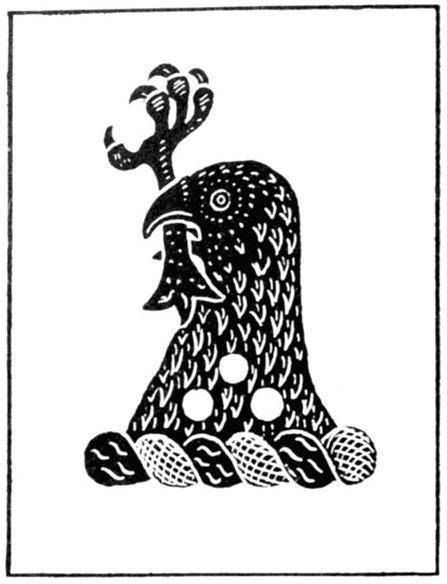
STANLEY, THOMAS
Crest.—An eagle's head couped arg., charged with 3 pellets, one and two, holding in his beak an eagle's leg erased a la cuise, gu. Stanley.
[Fioravanti. Della Fisica. Venetiis, 1582.]
Thomas Stanley (born circ. 1625, died circ. 1678) was the son of Sir Thomas Stanley of Cumberlow, Hertfordshire. He was educated at Cambridge, and occupied himself in literary pursuits from an early age.
Mr. Stanley wrote a number of poetical works, and also made several translations from Greek and Latin authors. In 1655 he published a History of Philosophy which during his lifetime enjoyed a great reputation. His edition of Æschylus was also very successful. Several of his manuscripts are now kept in the University Library at Cambridge.
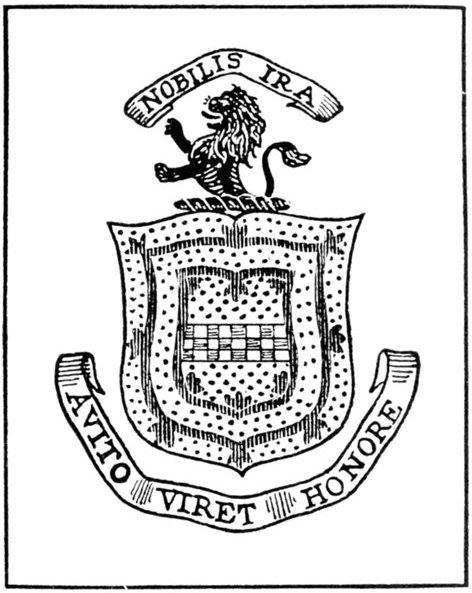
STUART, CHARLES, BARON STUART DE ROTHESAY
Arms.—Or, a fess chequy az. and arg., within a double tressure flory counterflory gu. Stuart.
Crest.—A demi lion rampant gu., and over it the motto Nobilis (est) ira (leonis).
Motto.—Avito viret honore. Used before 1812.
[Severim. Noticias de Portugal. Lisboa, 1740.]
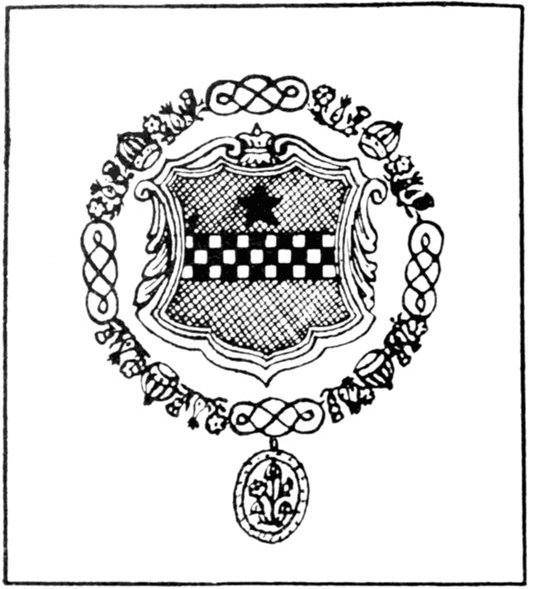
Variety.
Arms.—Or, a fess chequy az. and arg., within a double tressure flory counterflory gu. A mullet for difference. Stuart.
Within the collar of a Knight Grand Cross of the Order of the Bath, having the badge of the order dependent therefrom. Used after 1812.
[Perez del Pulgar. Coronica llamada Las dos Conquistas del Regno de Napoles. Cargoça, 1559.]
Charles Stuart (born 2nd January 1779, died 6th November 1845) was the son of General Sir Charles Stuart, K.C.B., son of the Earl of Bute. Mr. Stuart had an important diplomatic career, and filled several high posts. He was Chargé d'affaires at Madrid, Envoy to Portugal, Minister at the Hague, and Ambassador to Paris.
In 1812 he was made a Knight Grand Cross of the Order of the Bath, and in 1828 he was created Baron Stuart de Rothesay, a high honour, as the Barony of Rothesay is one of the hereditary honours of the Prince of Wales. Lord Stuart was afterwards Ambassador to St. Petersburg. He brought over from France the beautiful castle of Highcliffe, Hants, where the German Emperor recently stayed. He left no male heir, so his peerage became extinct at his death.
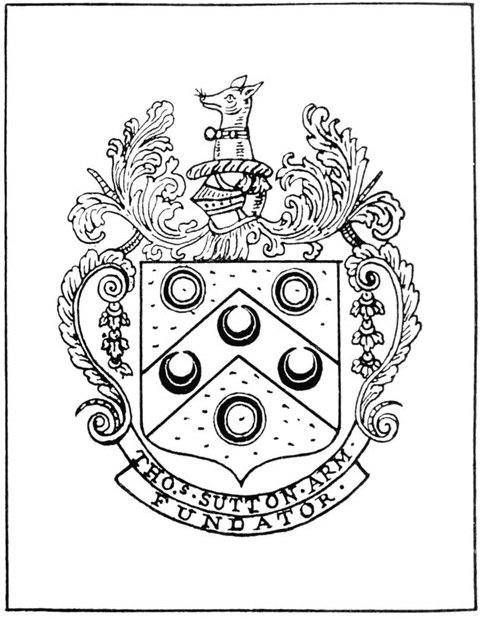
SUTTON, THOMAS
Arms.—On a chevron between 3 annulets gu., as many crescents of the field. Sutton.
Crest.—A greyhound's head couped erm., collared gu., garnished and ringed or, on the collar an annulet of the first.
Helmet.—That of an Esquire.
Legend.—Thos · sutton · arm · fundator.
Note.—The word fundator applies to Charterhouse School.
[Cæsar. C. Julii Cæsaris quæ extant. Lugduni Batavorum, 1635.]
Thomas Sutton (born circ. 1532, died 12th December 1611) was the son of Richard Sutton, Steward of the Courts of Lincoln. He is said to have been educated at Eton, and afterwards studied law at Lincoln's Inn. In early life Sutton was a soldier and saw active service, and in 1569 he was appointed Master of the Ordnance in the North.
While in the north Sutton acquired considerable possessions in land, and from these he drew a large fortune. One of the ships fitted out to resist the Spanish Armada was called the "Sutton." Sutton was very generous with his money, and in 1611 he purchased Charterhouse in Middlesex, where he founded the famous school of that name. The foundation of this school was originally intended for the benefit of forty boys of good birth and necessitous parents, but in time it came about that to be a foundation scholar, or gown boy, was a mark of distinction. Thackeray was a Charterhouse boy and was familiar with the surroundings there. Besides the school, there was a foundation or hospital at Charterhouse for "poverty-stricken gentlemen." The school was moved to Godalming in 1872, but the "hospital" still remains in Charterhouse Square. Sutton's tomb is in the Chapel at the Charterhouse.
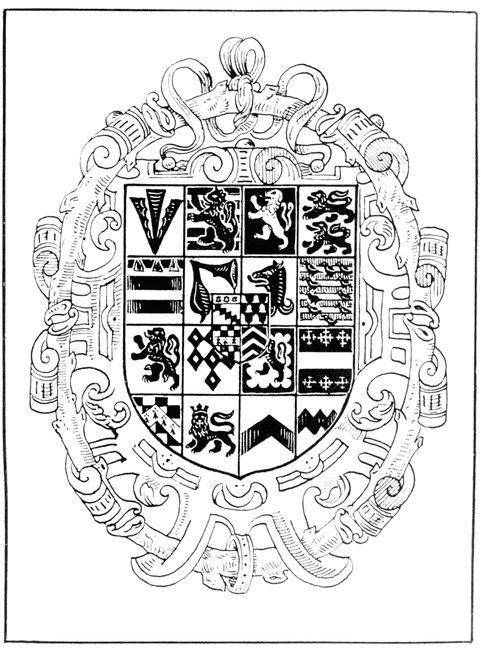
SYDNEY, ROBERT, EARL OF LEICESTER
Arms.—Quartered.
1. Arg., a pheon az. Sydney.
2. Barry of 10, arg. and gu., a lion rampant ducally crowned or. Brandon.
3. Or, a lion rampant az. Brabant.
4. Or, 2 lions passant az. Dudley.
5. Barry of 6, arg. and az., in chief a label of the first. Grey.
6. Arg., a maunch sa. Hastings.
7. Az., a wolf's head erased arg. Lupus.
8. Barry of 10, arg. and az., an orle of ten martlets gu. Valence, Earl of Pembroke.
9. A lion rampant.?
10. Gu., 7 mascles conjoined or, three, three, and one. Ferrers of Groby.
11. Az., a lion rampant arg., within a bordure engrailed or. Tyrrell.
12. Gu., a fess between 6 crosses crosslet or. Beauchamp.
13. Chequy, or and az., a chevron erm. Warwick.
14. Gu., a lion statant arg., crowned or. Lyle.
15. Arg., a chevron sa. Trelawney.
16. Arg., a fess dancetty gu. Dene.
On an escutcheon of pretence, being the arms of Barbara Gamage.
Quarterly.
1. Arg., a bend lozengy gu., on a chief az., 3 escallops arg. Gamage.
2. Vairy, arg. and gu. Nowers.
3. Chequy, or and arg., a fess erm. Calthrop.
4. Arg., 3 chevrons gu. Langton.
[Polydori Vergilii historiae, libri vigintiseptem. Basileae, 1570.]
Robert Sydney (born November 1563, died 13th July 1626) was the son of Sir Henry Sydney, K.G. He was educated at Oxford, and in 1584 became Member of Parliament for Glamorganshire, and afterwards for Kent. In 1586 he was knighted by the Earl of Leicester, and in 1603 he was created Baron Sydney of Penshurst, and two years afterwards Viscount L'Isle.
Lord L'Isle was made a Knight of the Garter in 1616, and in 1618 he was created Earl of Leicester. In 1584 he married Barbara Gamage of Coity, daughter of John Gamage. She died in 1621, and Lord Leicester married for his second wife Sarah, daughter of William Blount.
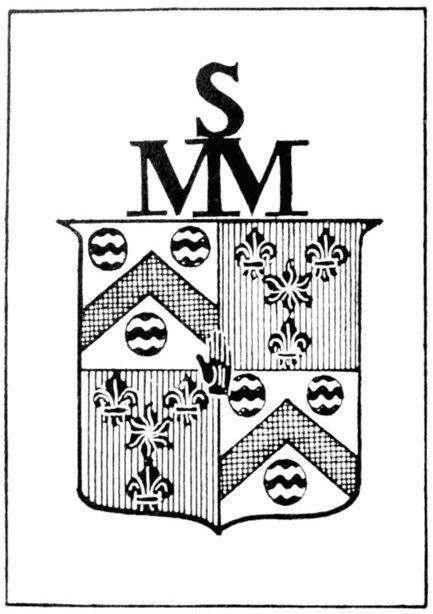
SYKES, SIR MARK MASTERMAN, BARONET
Arms.—Quarterly.
1st and 4th; arg., a chevron sa., between 3 sykes, or fountains, ppr. Sykes.
2nd and 3rd; gu., an estoile between 3 fleurs-de-lys arg. Masterman.
In the centre point the Ulster hand, gu. Above the shield are the letters M[ark] M[asterman] S[ykes].
Note.—Used after 1795.
[Valerius Maximus. Facta et Dicta Memorabilia, Mainz, 1471.]
Mark Sykes (born circ. 1771, died 16th February 1823) was the son of Sir Christopher Sykes, Baronet, of Sledmere, Yorks. He succeeded his father in the baronetcy in 1801. Mr. Sykes was educated at Oxford, and in 1795 was High Sheriff of Yorkshire. He represented York in Parliament for several years. He assumed the additional name of Masterman in 1795, on the occasion of his marriage to Henrietta, daughter and heiress of Henry Masterman of Settrington, Yorks, but he left no heirs and was succeeded by his brother Tatton.
Sir Mark Sykes possessed a magnificent library, rich in classics and incunabula, and also a valuable collection of antiquities and pictures. His collections were sold at his death, and his books and other treasures are widely distributed.
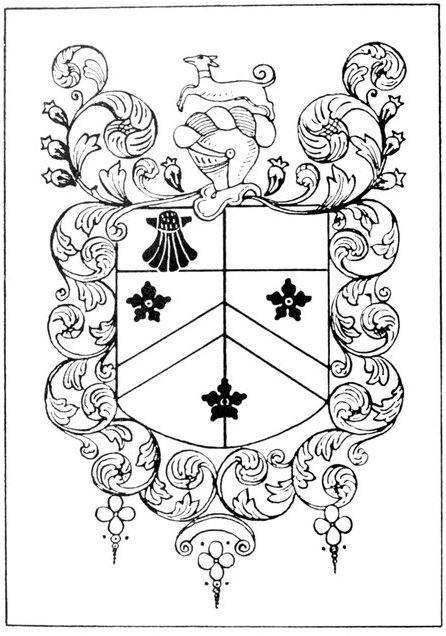
TASH, THOMAS
Arms.—Per pale, or and gu., a chevron between 3 cinquefoils counterchanged, on a chief per pale of the second and first (2) escallops counterchanged. Tash.
Crest.—A greyhound courant or.
[Tymme. A silver watch-bell. Aberdene, 1627.]
[W. E. Axon, Esq. Deansgate. Manchester.]
Thomas Tash, of London, was one of the Commissioners of Custom for England and Wales in 1752, but there appears to be no more known about him. There ought to be another escallop on the coat-of-arms illustrated, and according to the printed authorities the crest of Tash should be a demi greyhound.
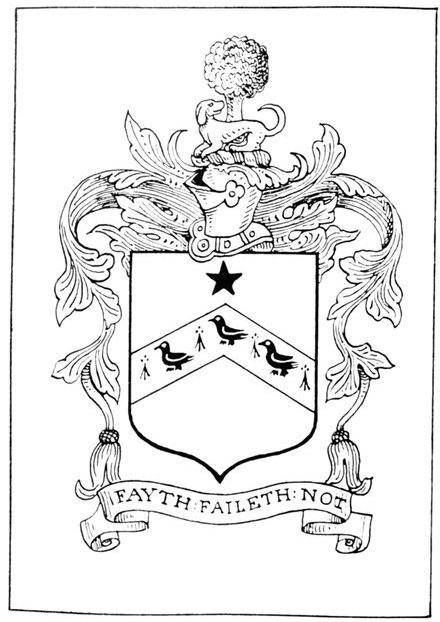
TOPSFIELD
Arms.—Gu., on a chevron erm., 3 martlets sa., in chief a mullet or. Topsfield.
Crest.—A talbot couchant guardant in front of a tree, all ppr.
Helmet.—That of an Esquire.
Motto.—Fayth faileth not.
[England. In this volume are conteined the statutes made ... from the time of King Henry the thirde unto ... Kyng Henry the VIII. London, 1564.]
This stamp belonged to a member of the old family of Topsfield, who owned the estate of Frisingfield, near Harleston in Norfolk, but I have as yet not been able to find out which particular member used it.
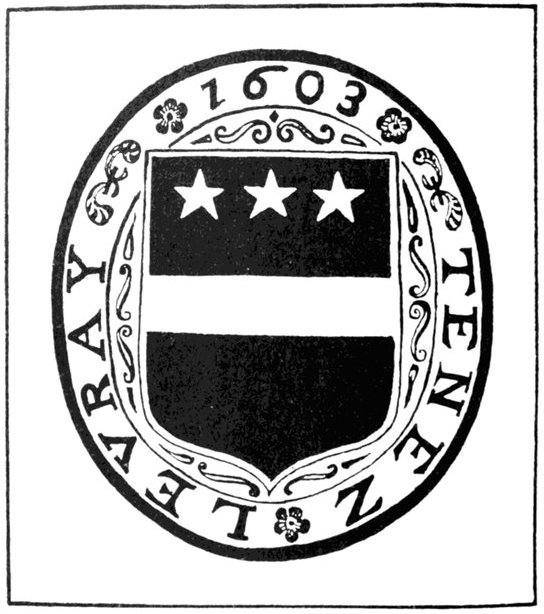
TOWNELEY, RICHARD
Arms.—Arg., a fess sa., in chief 3 mullets of the second. Towneley.
Motto.—Tenez le vray.
Date.—1603.
[The Hystory writtone by Thucidides the Athenyan of the warre which was betwene the Peloponesians and the Athenyans. London, 1550.]
The family of Towneley is one of ancient domicile in Lancashire. The member of it to whom the accompanying book-stamp probably belonged was Richard Towneley of Towneley Hall near Burnley, who lived there from about 1580 till about 1640.
His son Christopher was a well-known antiquary, but the most distinguished member of the family was Charles Towneley, who lived in the eighteenth century. He made a very important collection of ancient statuary and terra-cottas, which were purchased for the British Museum in 1805, and a member of the Towneley family is always represented on the Museum Board of Trustees.
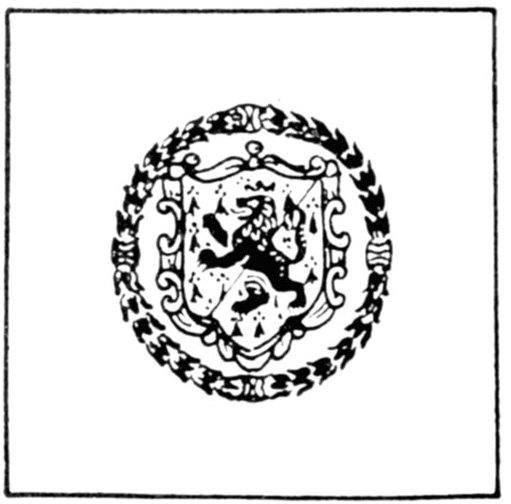
TREVOR, MARCUS, VISCOUNT DUNGANNON
Arms.—Per bend sinister erm. and erminois, a lion rampant or. Trevor.
[Beaulieu. Take heed of both extremes. London, 1675.]
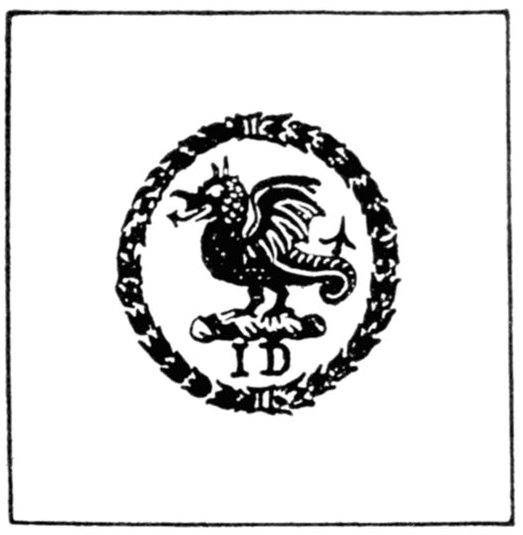
Crest.—A wyvern with wings addorsed, sa.
Initials.—I. D.
[Beaulieu. Take heed of both extremes. London, 1675.]
Marcus Trevor (born circ. 1620, died circ. 1683) belonged to the family of Trevor of Brynkinalt in Denbighshire. He was a strong Royalist, and took part in the struggle between Charles I. and the Parliamentarians. After the Restoration Charles II. made Colonel Trevor a peer, and in 1662 created him Baron Trevor and Viscount Dungannon, both of which peerages became extinct in 1706 on the death of his grandson Marcus. Lord Dungannon married twice; his first wife was a daughter of Sir Marmaduke Whitechurch, and his second wife was a daughter of John Lewis.
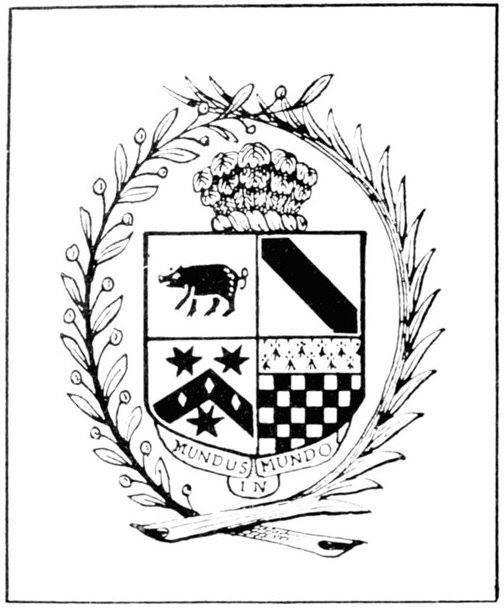
TREWARTHEN, FAMILY OF
Arms.—Quarterly.
1. Arg., a boar passant gu. Trewarthen.
2. Arg., a bend sa. Blackborne.
3. Az., on a chevron between 3 estoiles or, as many lozenges sa. Butts.
4. Chequy, or and az., on a chief arg., gutty de sang. Coleshill.
Crest.—A double plume of 5 ostrich feathers, arg.
[Austin. Devout Meditations. London, 1635.]
The family of Trewarthen is an old one belonging to the county of Cornwall, but to which particular member of the family this stamp belonged I have been unable to decide at present.
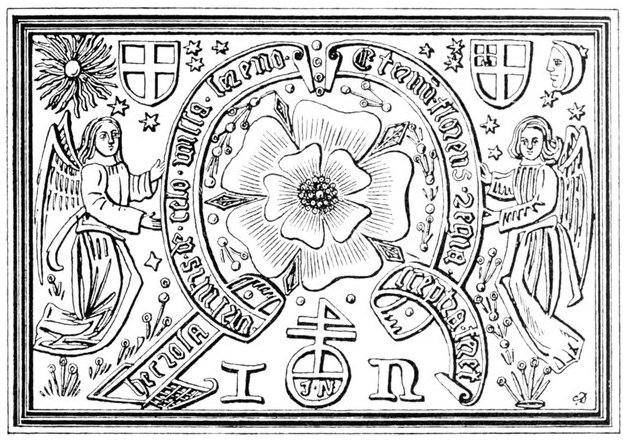
TUDOR ROSE
Device.—A Tudor Rose arg. and gu., seeded or and leaved vert, within a ribbon bearing the legend HEC ROSA VIRTUTIS DE CELO MISSA SERENO ETERNŪ FLORENS REGIA SCEPTRA FERET.
Supporters.—Two kneeling angels.
Badges.—In the dexter corner a sun in glory and the shield of St. George, arg., a cross gu.
In the sinister corner a half-moon with face, and the shield of the City of London, arg., a cross gu.; in the first quarter a sword in pale of the last, point upwards. In the sky stars.
Initials.—I.N., i.e. Ihon Norins, with his trade device.
[Cicero. Commentarii questionum Tusculanarum. Parhisii, 1509.]
This stamp is generally found in combination with one or other of the armorial stamps which I have figured and placed under the heading of Henry VIII. No doubt there was some authority given to use these Royal emblems, and although so far no reliable account of such authority is forthcoming, it is likely enough that members of the Stationers' Company may have been granted the privilege. On all these bindings the coat-of-arms of the City of London appears. On many of them are also initials which are very often those of well-known contemporary printers and binders. The original stamps were cut in latten, a form of brass—copper and zinc—and impressed on the leather in blind, that is without gold, the design showing in low relief.
The latten plates were probably attached to wooden blocks by means of two or more metal pins, and in many instances, by reason of irregular pressure, these pins, the tops of which were engraved in continuation of the general design, have been forced a little out of their normal level. The result is that they show very clearly as indented marks. The pressure necessary to make a good impression from one of these large stamps is considerable; it may have been done by a slow constant pressure or by quick pressure from hammer strokes, and the leather was in any case softened by water. Bindings with these stamps upon them were either of calf or sheep-skin.
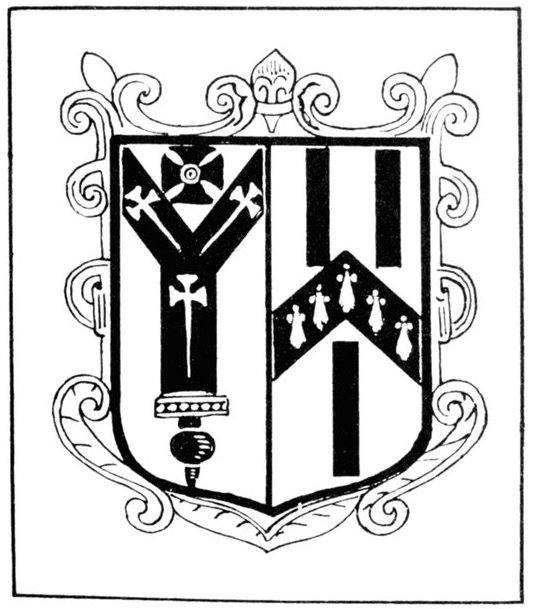
USHER, JAMES, ARCHBISHOP OF ARMAGH
Arms.—Impaled.
Dexter: Az., an archiepiscopal staff, headed with a cross pattée or, over all a pall arg., charged with 3 crosses pattée fitchée sa. See of Armagh.
Sinister: Az., a chevron erm., between 3 batons or. Usher.
[Usher. Britannicae Ecclesiae Antiquitates. Dublin, 1639.]
James Usher (born 4th January 1580, died 21st March 1656) was the son of Arnold Usher, Clerk of the Irish Court of Chancery. He was educated at Trinity College, Dublin, and in 1601 he took orders, and became a preacher of much note. In 1620 Dr. Usher was made Bishop of Meath and Clonmacnoise, and in 1624 he was consecrated Archbishop of Armagh.
Archbishop Usher wrote several very important theological works, and he took part in all the controversies of his time. He was a divine of much learning and a great scholar. His extensive library is for the greater part in Trinity College, Dublin, where it was sent as a gift by Charles II.
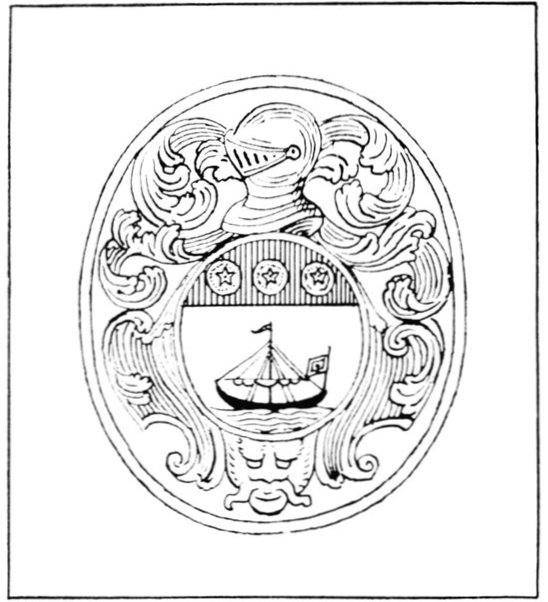
UTTERSON, EDWARD VERNON
Arms.—A Lymphad, with sail furled, on a sea in base ppr., at the poop a flag flying towards the bow, arg., fimbriated vert, charged with a pomme in fess; on a chief gu., 3 bezants, each charged with a mullet. Utterson.
[The Hystory of the two valyaunte brethren Valentyne and Orson ... translated from the French by H. Watson. London, 1565.]
Edward Vernon Utterson (born circ. 1775, died 14th July 1856) was the son of John Utterson of Fareham in Hampshire. He was educated at Eton and Cambridge, and in 1802 was called to the bar. He was all his life a great collector of books. Mr. Utterson set up a private press at Ryde, in the Isle of Wight, known as the Beldornie Press, and here he reprinted such of the early English plays and poems as pleased him. He also edited a number of reprints of important English books, some of which are very handsomely produced.
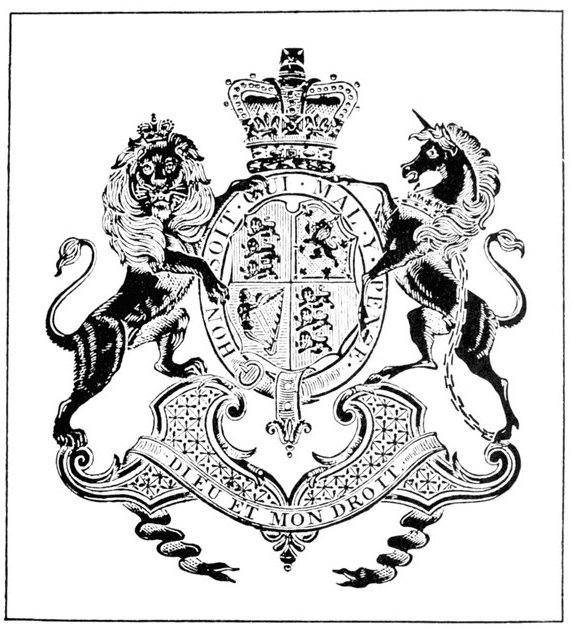
VICTORIA, QUEEN OF THE UNITED KINGDOM OF GREAT BRITAIN AND IRELAND, DEFENDER OF THE FAITH, EMPRESS OF INDIA.
Arms.—Within the Garter. Quarterly.
1st and 4th; England.
2nd; Scotland.
3rd; Ireland.
All coloured as used by James I. (q.v.) and ensigned by a Royal Crown.
Supporters.—The lion and the unicorn, as used by James I. (q.v.).
Motto.—Dieu et mon droit.
[Galerie Royale de Costumes. Paris, 1042.]
The Princess Victoria (born 24th May 1819, died 22nd January 1901) was the only child of Edward, Duke of Kent, fourth son of George III., and Victoria Marie Louisa of Saxe-Coburg-Saalfield. On the death of William IV., 18th June 1837, the Princess Victoria succeeded to the throne of England. Queen Victoria was crowned at Westminster on 20th June 1838, and on the 1st January 1877 Her Majesty was proclaimed Empress of India, at Delhi. On the 10th February 1840, Queen Victoria married her cousin Albert, the youngest son of Ernest, Prince of Saxe-Coburg-Gotha.
On the accession of Queen Victoria to the English throne, the Kingdom of Hanover became separated from England, in consequence of the operation of the Salic Law. The coat-of-arms of the dominions in Germany was accordingly left out of the Royal coat. The Duke of Cumberland, the Queen's uncle, became King of Hanover, which country is now part of the German Empire.
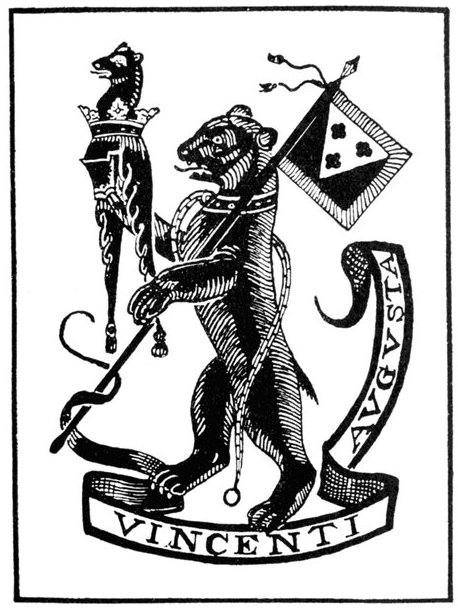
VINCENT, AUGUSTINE, WINDSOR HERALD
Arms.—Arg., on a pile az., 3 quatrefoils of the first. Vincent.
Crest.—Out of an heraldic coronet a bear's head ppr.
Helmet.—That of an Esquire.
Supporter.—A bear collared and chained ppr.
Legend.—Vincenti avgvsta.
[Chasseneux. Catalogus Gloriae Mundi. Francofurti, 1603.]
Augustine Vincent (born circ. 1584, died 11th January 1625) was the son of William Vincent. He showed antiquarian and heraldic tastes at an early age, and in 1615 was made Rouge Rose Pursuivant, and in 1624 Windsor Herald. Vincent collected valuable material concerning heraldic and genealogical matter, and his manuscripts are chiefly to be found either at the College of Arms or the Bodleian Library at Oxford.
In Vincent's time it was the custom to carry out the heraldic visitations by deputy. These visitations should have been made by the Heralds in person, and in 1619 there was much trouble about the matter, and strong complaints were made to the Earl Marshal by both Garter and Norroy. The difficulty was brought to a head by the appointment of Vincent, then Rouge Rose Pursuivant, to carry out the visitations of Northamptonshire and Rutlandshire as deputy for William Camden, Clarencieux Herald.
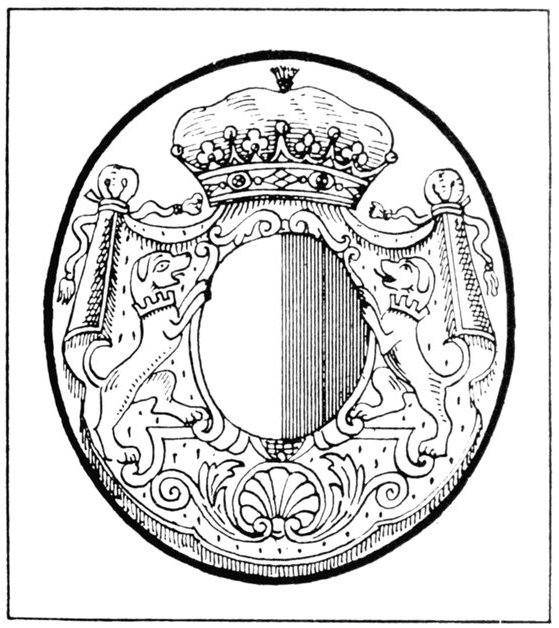
WALDEGRAVE, JAMES, SECOND EARL WALDEGRAVE
Arms.—Per pale, arg. and gu. Waldegrave.
Supporters.—Two talbots sa., eared or, each gorged with a mural crown, arg.
Coronet.—That of an Earl.
[Prevost d'Exiles. Memoirs d'un Homme de Qualité. Paris, 1732.]
James Waldegrave (born 4th March 1714, died 13th April 1763) was the son of James, first Earl Waldegrave, and succeeded his father in the Earldom in 1741. In 1752 Lord Waldegrave was Governor and Keeper of the Privy Purse to George, Prince of Wales. In 1757 he was made a Knight of the Garter and a Teller of the Exchequer. Lord Waldegrave wrote a book of Historical Memoirs from 1754 to 1757. He married a daughter of Sir Edward Walpole but had no son, and at his death the family honours devolved upon his brother John.
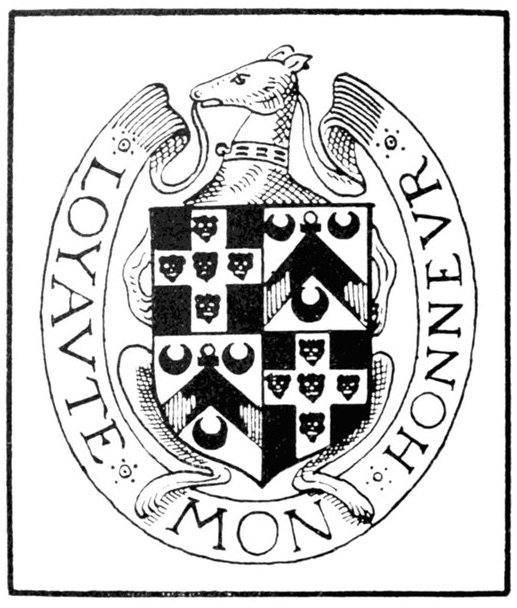
WALKER, SIR EDWARD, KNIGHT
Arms.—Quarterly.
1st and 4th; arg., on a cross of St. George gu., 5 leopards' faces or. Coat of Augmentation.
2nd and 3rd; arg., a chevron between 3 crescents sa., an annulet for difference. Walker.
Supporter.—A greyhound, collared.
Motto.—Loyavte mon honnevr.
[Indentures of Military Service, Edw. III.-Hen. VII. Stowe MS. 440.]
Edward Walker (born 24th January 1611, died 19th February 1676) was the son of Edward Walker of Roobers, Nether Stowey, Somerset. He joined the College of Arms as an official, and in 1635 he was made Blanch Lion Pursuivant, filling successively the positions of Rouge Croix Pursuivant and Chester Herald.
Walker took part with Charles I. in the war with the Roundheads, and served as Secretary-at-War, and was at Naseby. In 1644 he was created Norroy King-of-Arms, and in 1645 he succeeded Sir Henry St. George as Garter. In the same year he received the honour of Knighthood. In 1649 Sir Edward Walker was made Clerk of the Council in Ordinary, but in 1650 he got into trouble as a Royalist, and found refuge in Holland. After some trouble he invested William, Prince of Orange, with the Garter in 1653.
At the Restoration Walker superintended the arrangements for the coronation, and his remaining years seem to have been spent in quarrels with other members of the Heralds' College. Sir Edward Walker wrote a considerable number of historical and genealogical works, particularly an illustrated edition of the coronation of Charles II. Many of his manuscripts are in the British Museum, and others are at the Bodleian Library at Oxford.
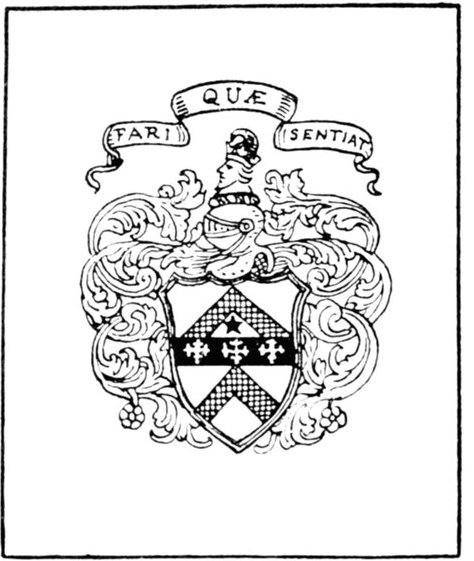
WALPOLE, HORACE, FOURTH EARL OF OXFORD
Arms.—Or, on a fess between 2 chevrons sa., 3 crosses crosslet of the first, a mullet for difference. Walpole.
Crest.—The bust of a man in profile couped, ppr., ducally coroneted or, and from the coronet, flowing forward, a long cap gu., tasselled or, charged with a Catherine wheel of the last.
Helmet.—That of an Esquire.
Motto.—Fari quæ sentiat.
[Watts. Memoirs of the Revolution in Bengal. London, 1764.]
Horace Walpole (born 5th October 1717, died 2nd March 1797) was a younger son of Robert Walpole, Earl of Oxford, for many years Prime Minister of England. He was educated at Eton and Cambridge, and as a young man studied law. For a time Mr. Walpole served in the office of the Exchequer, and represented Callington, Castle Rising, and King's Lynn in Parliament, where the chief thing he did seems to have been that he exerted himself to save the life of Admiral Byng.
In 1792 Mr. Walpole succeeded his nephew George in the Earldom, but never took his seat in the House of Lords. On his death without heirs most of his titles became extinct, but the Barony of Walpole devolved on his cousin Horatio.
At Strawberry Hill, near Twickenham, Walpole collected a splendid library, and also a number of pictures, antiquities, and treasures of all sorts. Here also he set up a private press, at which he printed many of his own works. Many of Walpole's books are now famous; among the best known are, perhaps, the Anecdotes of Painting and the Castle of Otranto. The Strawberry Hill Collection was sold in 1840.
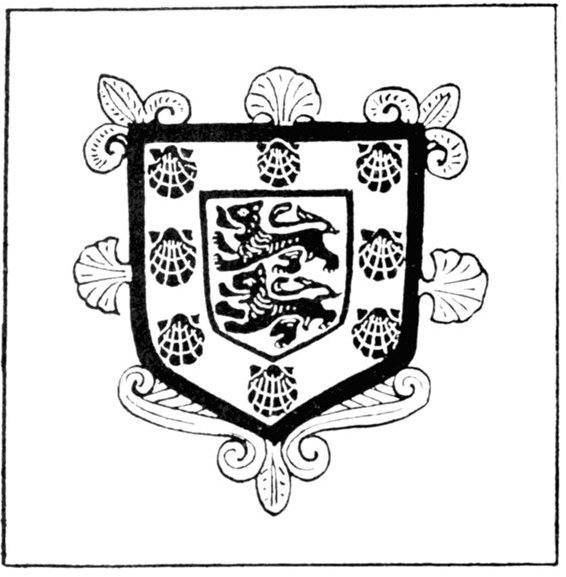
WARE, SIR JAMES, KNIGHT
Arms.—Or, 2 lions passant az., within a bordure of the second, charged with 8 escallops of the first, 3, 2, 2, and 1. Ware.
[Giraldus Cambrensis. De Topographia Hibernica. Add. MS. 33,991.]
James Ware (born 26th November 1594, died 1st December 1666) was the son of Sir James Ware of Dublin. He was educated at Trinity College, Dublin, and soon developed literary and antiquarian tastes, and became a collector of manuscripts and antiquities, particularly relating to Ireland. He was knighted in 1629 by the Lords Justices, and in 1632 became Auditor-General in Ireland, and in 1661 Member for the University of Dublin. Sir James was imprisoned in the Tower of London as a Royalist, and was afterwards a hostage for Ireland. Sir James Ware published some very valuable books on Irish antiquities, most of them in Latin, but a collection of his works has been translated into English.
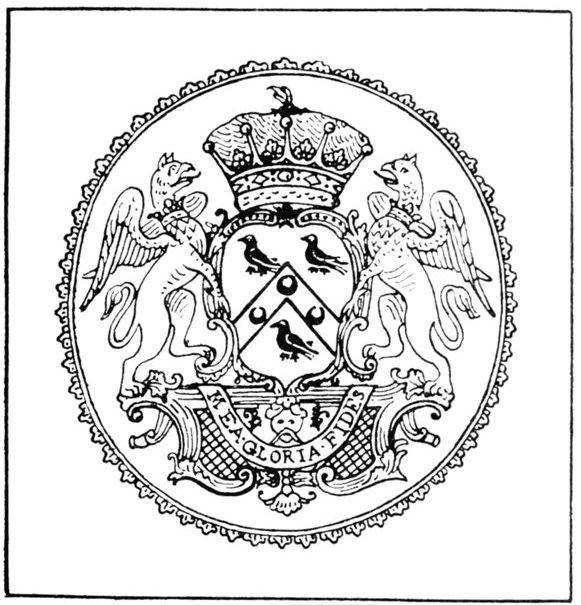
WATSON, LEWIS, EARL OF ROCKINGHAM
Arms.—Arg., on a chevron az., between 3 martlets sa., as many crescents or. Watson.
Supporters.—Two griffins az., ducally gorged or.
Coronet.—That of an Earl.
Motto.—Mea gloria fides.
[Poste da Roma. Roma, 1600?]
Lewis Watson (born 29th December 1655, died 19th March 1723) was the son of Edward Watson, Baron Rockingham, and succeeded to the Barony in 1689. In 1681 Mr. Watson represented Canterbury in Parliament, and afterward Higham Ferrers. In 1703, Lord Rockingham was Master of the Buckhounds, and he was also Lord Lieutenant of Kent. In 1714, besides other dignities, Baron Rockingham was created Earl of Rockingham. He also held the posts of Vice-Admiral of Kent and Deputy-Warden of the Cinque Ports. He married twice, his first wife being a daughter of George Sondes, Viscount Sondes and Baron Throwley, besides other titles, and these two peerages were revived in 1714 in the person of Lord Rockingham when he was created an Earl.
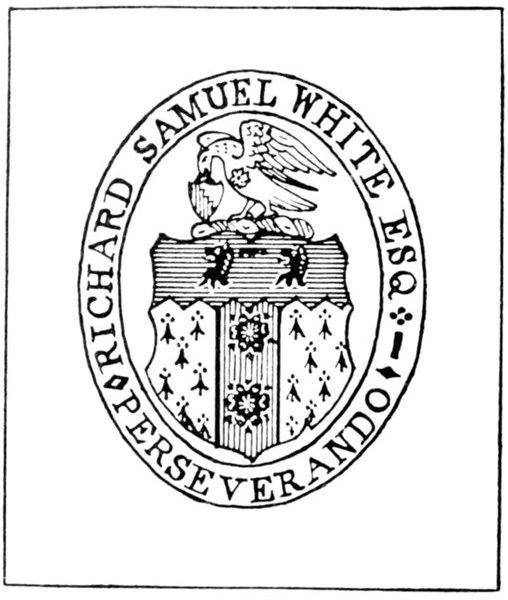
WHITE, RICHARD SAMUEL
Arms.—Erm., on a pale gu., 2 roses ppr., on a chief indented az., 2 leopards' heads erased arg. White.
Crest.—A falcon, wings extended erm., charged with a rose ppr., holding in his beak an escutcheon, bendy indented gu. and arg.
Motto.—Perseverando.
Legend.—Richard Samuel White, Esq.
[Sternhold and Hopkins. The whole booke of Psalmes collected into Englyshe Meter. London, 1564.]
Richard Samuel White may have been a descendant of Captain Samuel White who married Edith, daughter of John Watson of Charlton House, Dorset. I do not find his name in any of the ordinary lists, but some of the bearings in his coat-of-arms are similar to those used by the family of White of Charlton.
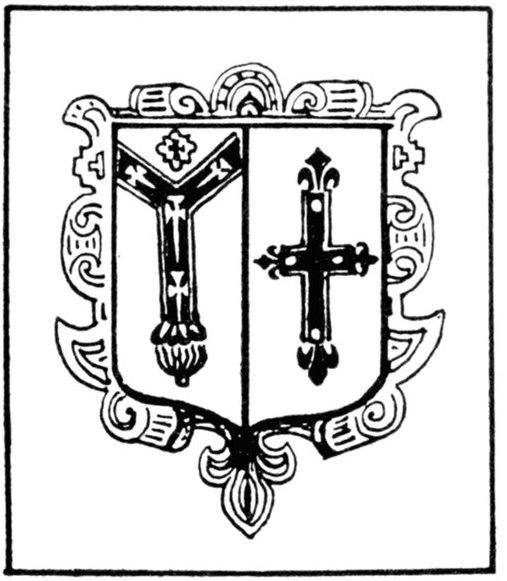
WHITGIFT, JOHN, ARCHBISHOP OF CANTERBURY
Arms.—Impaled.
Dexter: Az., an archiepiscopal staff headed with a cross pattée or, surmounted of a pall arg., charged with 4 crosses pattée fitchée sa., fringed and edged or. See of Canterbury.
Sinister: Arg., on a cross flory sa., 4 bezants. Whitgift.
[Dionysii Lebei Batillii Reg. mediomatricii Praesidis Emblemata. Francofurti ad Moen[=u], 1596.]
John Whitgift (born 1530, died 29th February 1603) was the son of Henry Whitgift of Great Grimsby in Lincolnshire. He was educated at Cambridge and took orders in 1560. He was an eloquent preacher and quickly made his name famous.
In 1567 he was made Regius Professor of Divinity, and took much interest and effected many reforms in the Government of the University. In 1571 he became Dean of Lincoln. Dr. Whitgift was made Bishop of Worcester in 1576, and in 1583 Archbishop of Canterbury. Archbishop Whitgift was a rich man, and was also a great favourite of Queen Elizabeth's. He was an excellent organiser and ruled church matters with a strong hand. He left a number of sermons and tracts, several of which have been published by the Parker Society, and others still remain in manuscript at Lambeth, the Bodleian, the Record Office, and the British Museum.
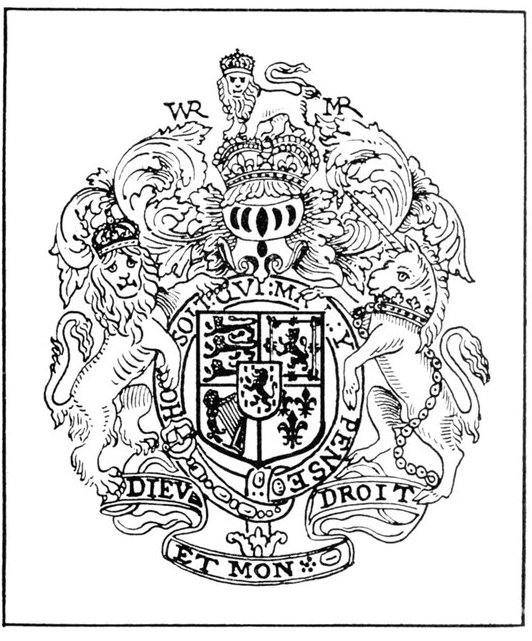
WILLIAM III. AND MARY II., KING AND QUEEN OF ENGLAND, FRANCE, AND IRELAND. AFTERWARDS WILLIAM III., KING OF GREAT BRITAIN, FRANCE, AND IRELAND.
Arms.—Within the Garter. Quarterly.
1st, England.
2nd, Scotland.
3rd, Ireland.
4th, France.
All coloured as used by James I. (q.v.). Over all on an escutcheon of pretence, az., semée of billets, a lion rampant or. Nassau.
Crest.—A Royal crown ppr., thereon a lion statant guardant or, crowned ppr.
Helmet.—That of a King.
Motto.—Diev et mon droit.
Initials.—WR (William Rex) and MR (Mary Regina).
[Common Prayer. Oxford, 1681.]
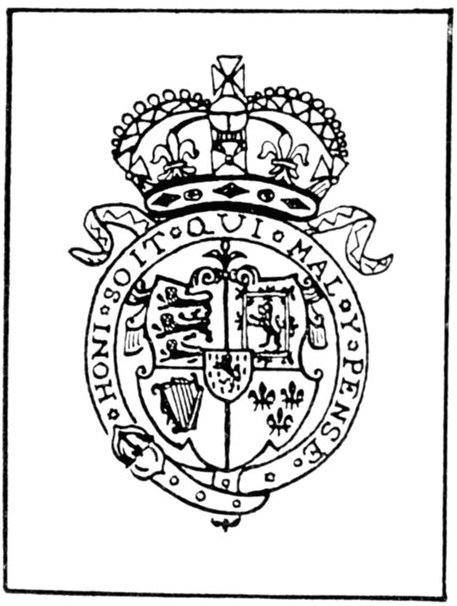
Variety.—Without supporters.
[Touchet. Memoirs of the Earl of Castlehaven. London, 1681.]
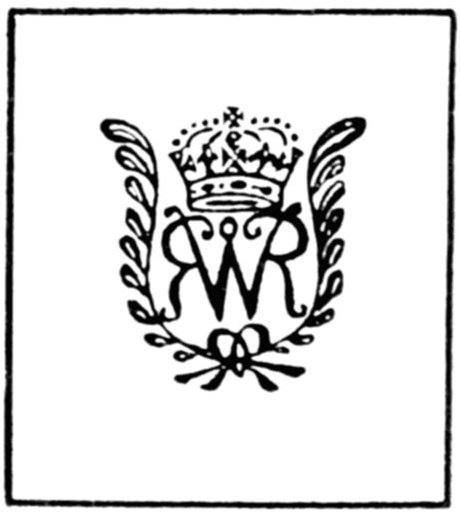
Initials.—WR (William Rex) within palm sprays and ensigned with a Royal Crown.
Used after 1694.
[Henri III., King of France. Le Divorce Satyrique. Paris.]
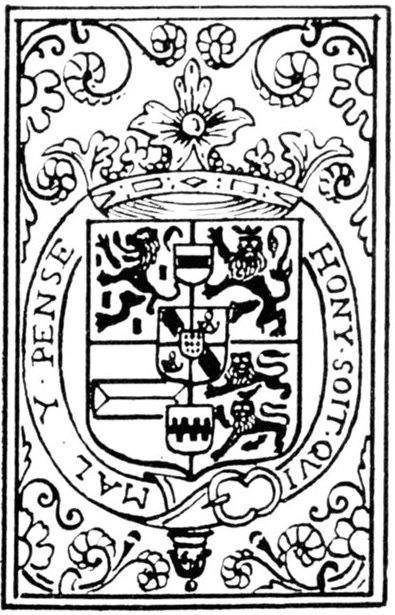
Arms.—As Prince of Orange. Within the Garter. Quarterly.
1. Az., semée of billets, a lion rampant or. Nassau.
2. Or, a lion rampant guardant gu., crowned az. Dietz.
3. Gu., a fess arg. Vianden.
4. Gu., 2 lions passant guardant or. Catsenelboge.
On an escutcheon of pretence on the centre point. Quarterly.
1st and 4th; gu., a bend or. Chalon.
2nd and 3rd; or, a bugle horn az., stringed gu. Orange.
Over all chequy, or and az. Geneva.
In the centre chief point on an escutcheon or, a fess gu. Moers.
In the base point on an escutcheon gu., a fess embattled arg. Buren.
Over all a Ducal coronet.
Note.—Used before 1689.
[Apologie pour la Maison de Nassau. Madril, 1664.]
Prince William (born 4th November 1650, died 8th March 1702) was the son of William Prince of Orange and the Princess Mary, eldest daughter of Charles I. Prince William married the Princess Mary, eldest daughter of James, Duke of York, afterwards James II., and Anne Hyde. The Prince of Orange deposed his father-in-law James II., in 1689, and was declared king in his stead. William and Mary were, however, joint sovereigns, and the crowns, sceptres, and orbs were all doubled for them, and on the Great Seal they are both represented, one hand of each resting on the orb.
Queen Mary died in 1694, and after that date King William reigned alone. The same coat-of-arms was used all through, but during the double reign the initials "WR" and "MR" are generally added. It is curious to note that William III. several times altered the place of the coat-of-arms of France on the English coat.
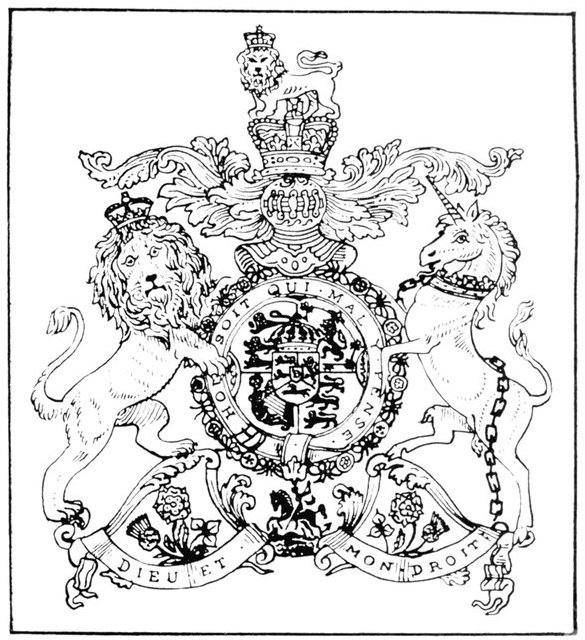
WILLIAM IV., KING OF THE UNITED KINGDOM OF GREAT BRITAIN AND IRELAND
Arms.—Within the Garter and with the collar and badge of the order. Quarterly.
1st and 4th, England.
2nd, Scotland.
3rd, Ireland.
And on an escutcheon of pretence, ensigned with the Royal Crown of Hanover, the arms of the Dominions in Germany, as used by George III. (q.v.) after 1816.
Crest.—A Royal crown ppr., thereon a lion statant or, crowned ppr.
Helmet.—That of a King.
Supporters.—A lion and a unicorn, as used by James I. (q.v.).
Motto.—Dieu et mon droit.
Badges.—Tudor Rose, Thistle, and Shamrock.
[Inventories of the various Services of Plate belonging to the Crown. London, 1832.]
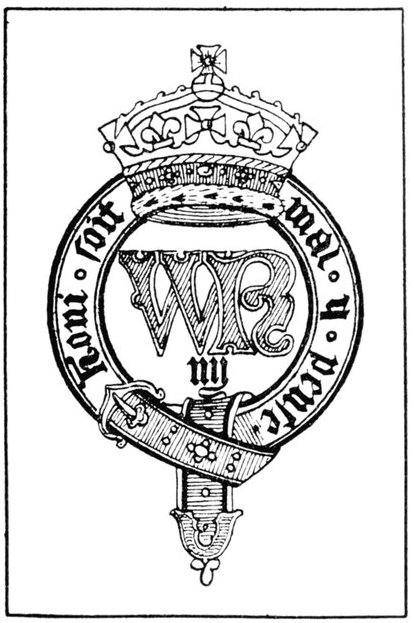
Variety.—The Royal Cypher "WR IIII." (William Rex IIII.) within the Garter and ensigned with a Royal Crown.
[Delpech. Iconographie des contemporains. Paris, 1832.]
William, Duke of Clarence (born 21st August 1763, died 20th June 1837), was the third son of George III., and succeeded his brother George IV. on the throne of England in 1830. He was parsimonious, and the economy used at his coronation was so marked that it was called a "Half Crown-ation." William IV. married Adelaide, daughter of George Frederick, Duke of Saxe-Meiningen, and their two daughters died as children.
The Royal Libraries were twice given to the Nation, once by George II., on the foundation of the British Museum, and again by George IV., after the death of his father. William IV. evidently thought that there had been enough generosity in this matter on the part of his predecessors, and he added to his will an autograph codicil, dated "Pavillion, Brighton, 30th November 1834," to the effect that "I further declare that all the Books, Drawings, and Plans collected in all the Palaces shall forever continue heirlooms to the Crown, and on no pretence whatever to be alienated from the Crown."
WILLIAMS, JOHN, BISHOP OF LINCOLN, AFTERWARDS ARCHBISHOP OF YORK
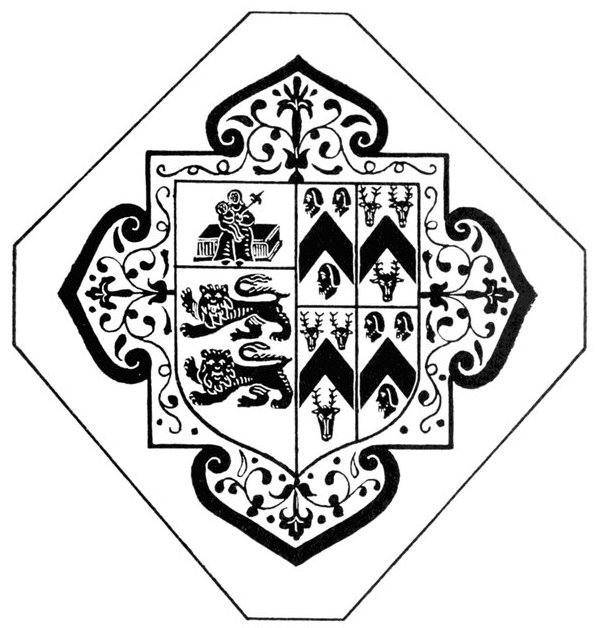
Arms.—Impaled.
Dexter: Gu., 2 lions passant guardant or, on a chief az., our lady sitting with her babe crowned and sceptred. See of Lincoln.
Sinister: Quarterly.
1st and 4th; gu., a chevron (erm.) between 3 human heads in profile, couped at the neck, ppr., hair and beards sa. 2nd and 3rd; gu., a chevron or, between 3 stags' faces arg., attired or. Williams.
[Hebrew Bible.]
John Williams (born 25th March 1582, died 25th March 1650) was the son of Edmond Williams of Conway, and was educated at Ruthin Grammar School and at Cambridge. In 1603 he was ordained, and he soon became known as an able preacher. After holding several minor ecclesiastical preferments and enjoying the favour of James I., he was made Dean of Salisbury in 1619. In 1620 Dr. Williams became Dean of Westminster, and in 1621 he was consecrated Bishop of Lincoln. In the House of Lords Bishop Williams took a very important part in the discussions and legislation concerning the power of the Sovereign in 1628.
In 1635 the Bishop's enemies succeeded in bringing him before the Star Chamber on a charge of subornation of perjury, and he was condemned to a heavy fine and loss of profits of his many benefices. He was imprisoned in the Tower until he was granted an unconditional release by the House of Lords in 1640. In 1641, with other Bishops, Williams was again committed to the Tower on a charge of high treason, but soon escaped, forfeiting his bail. He again took a leading part in the proceedings of the House of Lords, and was translated to the Archbishopric of York, where he was enthroned in 1642.
Archbishop Williams worked hard for the Royalist cause; he fortified Conway Castle and organised the militia. He was possessed of considerable wealth, and was liberal and charitable. Several of his sermons and speeches were published.
WINDSOR, THOMAS, SIXTH BARON WINDSOR
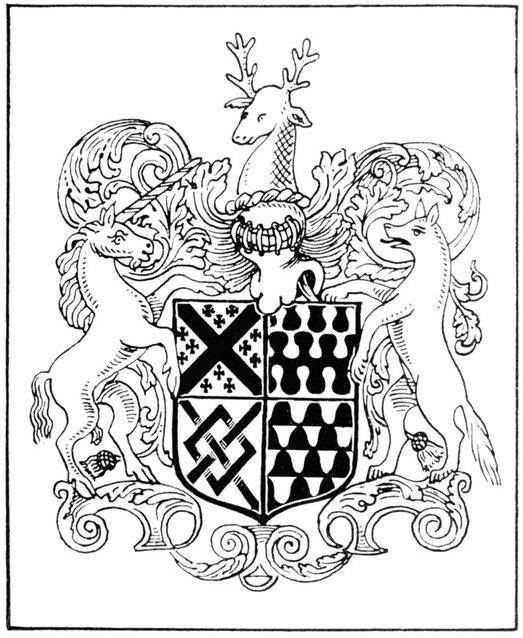
Arms.—Quarterly.
1. Gu., a saltire between 12 crosses pattée or. Windsor.
2. Barry nebuly or and sa. Blount.
3. Gu., a fret or. Audley.
4. Vairy, arg. and sa. Meynell.
Crest.—A buck's head affrontée, couped at the neck arg., attired or.
Helmet.—That of a Peer.
Supporters.—Dexter, a unicorn arg., armed, maned, and unguled or. Sinister, a fox ppr.
[Ossat. Lettres. Paris, 1627.]
Thomas Windsor (born circ. 1580, died 6th December 1642) was the son of Henry Windsor, fifth Baron Windsor. He succeeded his father in the Barony in 1605. In 1610 Lord Windsor was made a Knight Commander of the Order of the Bath, and was Rear-Admiral in the Navy. He commanded the fleet sent to Spain to bring back Prince Charles. Lord Windsor left no son, and his title was inherited by his nephew, Thomas Windsor-Hickman, the son of Elizabeth, daughter and heiress of the fifth Baron. He married Dixie Hickman of Kew, Surrey.
WODHULL, MICHAEL
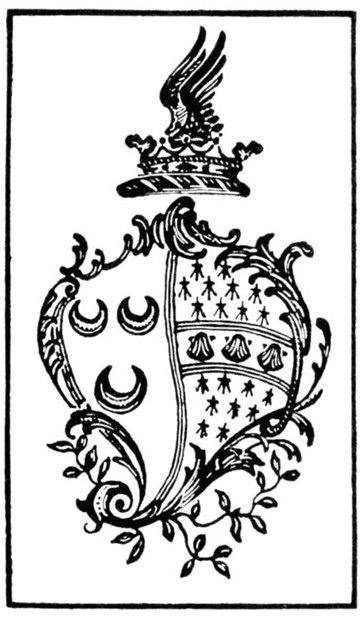
Arms.—Impaled.
Dexter: Or, 3 crescents gu. Woodhull.
Sinister: Erm., on a fess gu., 3 escallops or. Ingram.
Crest.—Out of an heraldic coronet 2 wings addorsed, arg.
[M. T. Ciceronis. Quaestionorum tusculanarum, libri quinq. Florentiae, 1514.]
Michael Wodhull (born 15th August 1740, died 10th November 1816) was the son of John Wodhull. He was educated at Winchester and Oxford. Mr. Wodhull married a Miss Ingram of Wolford in Warwickshire; he was a collector of books and an author and translator of the classics. At his library at his house at Thenford, Wodhull had an extensive collection of books, many of which were bound by Roger Payne, and among which were several fine historical bindings. These books were dispersed by sale, partly during Mr. Wodhull's lifetime, but mostly after his death. In 1783 he was High Sheriff of Northamptonshire.
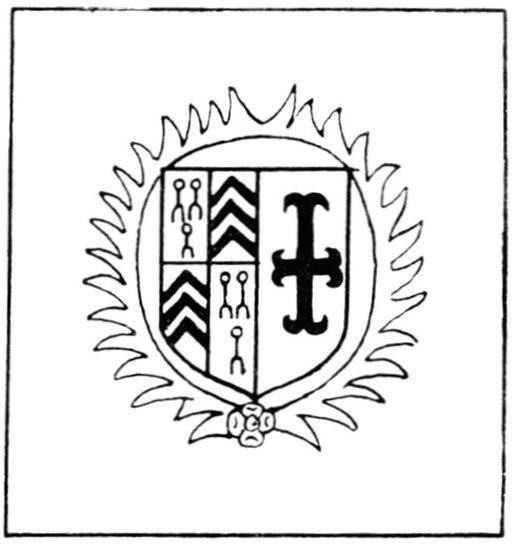
WORTHINGTON
Arms.—Impaled.
Dexter: Quarterly.
1st and 4th; arg., 3 dung-forks sa. Worthington.
2nd and 3rd; arg., 3 chevrons gu. Langton.
Sinister: Arg., a cross moline gu. Colvile.
[Calvin. A Harmonie upon the Gospels. Londini, 1610.]
The family of Worthington has been well known in several counties, but chiefly in Lancashire. Members of the family have also settled in Suffolk and in Cheshire.
I have not been able to decide to which member of the Worthington family this particular coat-of-arms belonged.
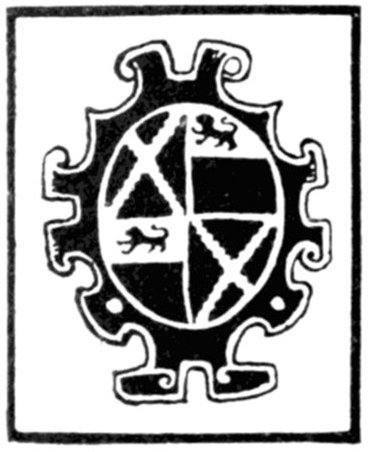
WOTTON, EDWARD, BARON WOTTON
Arms.—Quarterly.
1st and 4th; arg., a saltire engrailed sa. Wotton.
2nd and 3rd; arg., on a chief sa., a lion passant of the first. Rudston.
Note.—Used before 1602.
[Plinius Secundus. Historia Naturalis. Lugduni, 1548.]
Edward Wotton (born circ. 1548, died circ. 1626) was the son of Thomas Wotton by his first wife Elizabeth, daughter of Sir John Rudston, Lord Mayor of London. Mr. Wotton was a man of much learning and a great linguist, and in 1583 he was Member of Parliament for Kent. He was Elizabeth's emissary to James VI. concerning his marriage, and also about a treaty of alliance. In 1591 he received the honour of Knighthood, and in 1602 he was Comptroller of the Household. In the same year he was created Baron Wotton.
Lord Wotton was Lord Lieutenant of Kent, and Ambassador to France and Treasurer of the Household. He inherited his father's library, and in many cases added his own coat-of-arms impressed in silver to the beautiful bindings made for Thomas Wotton, "The English Grolier," on whose books occur the legend THOMAE WOTTONI ET AMICORUM.
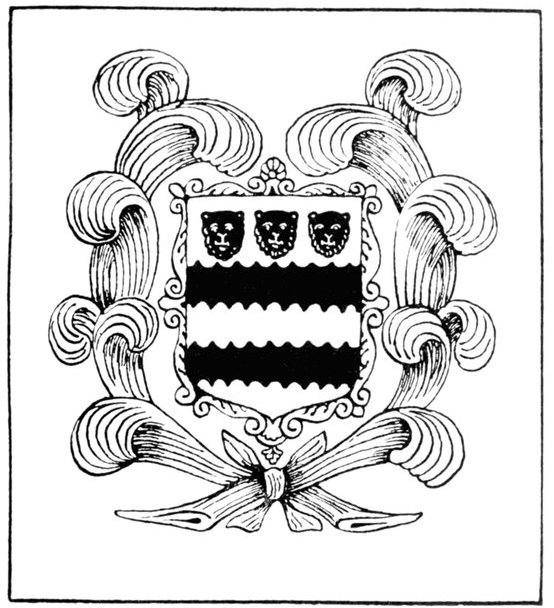
WRIGHT, JAMES
Arms.—Az., 2 bars engrailed arg., in chief as many leopards' heads or. Wright.
[Lambert. Chancery Collections. Stowe MS. 415.]
James Wright (born circ. 1643, died October 1713) was the son of Abraham Wright, of Oxfordshire. He was called to the Bar in 1672. His tastes were literary and antiquarian, and he possessed a considerable library, chiefly manuscripts. Wright wrote a number of works on antiquities, and others on the political matters of his time. The drama also had much fascination for him, and he wrote several poems, and made an epitome of Dugdale's Monasticon.
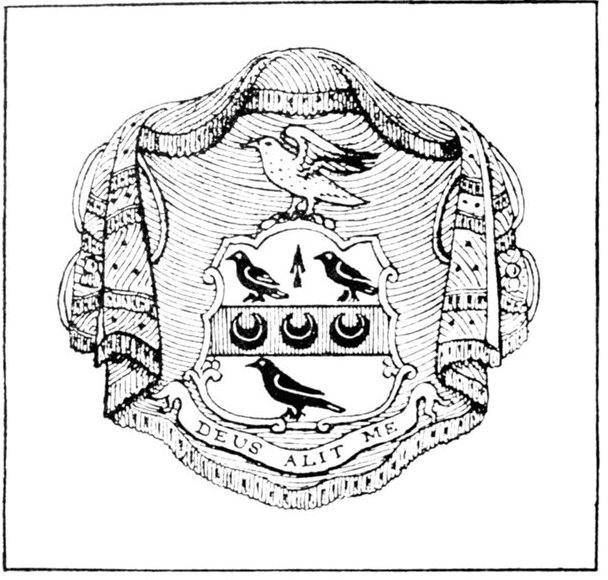
WYCLIFFE
Arms.—Arg., on a fess gu., 3 crescents of the first between 3 Cornish choughs ppr., in chief a spear-head of the second. Wycliffe.
Crest.—A Cornish chough, wings addorsed, ppr.
Motto.—Deus alit me.
[Groot. Defensio fidei Catholicae de Satisfactione Christi adversus Faustum socinum. Lugduni Batavorum, 1617.]
This stamp belonged to T. Wycliffe, probably a member of the Yorkshire family of that name, but I have not so far been able to identify the owner more particularly.
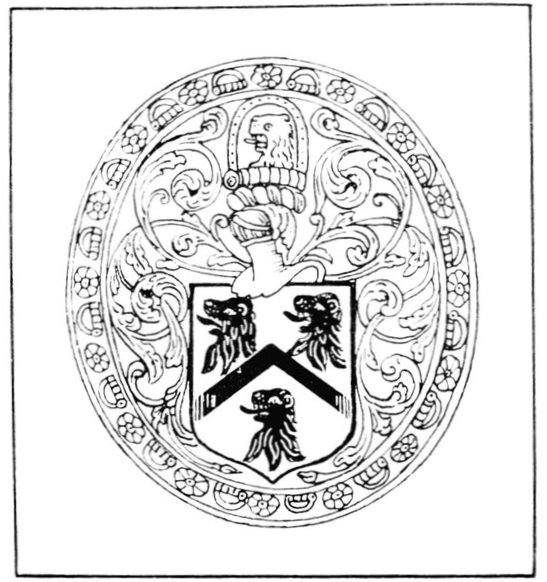
WYNDHAM, SIR HUGH, KNIGHT
Arms.—Arg., a chevron between 3 lions' heads erased or. Wyndham.
Crest.—A lion's head erased, within a fetterlock or.
[Olearius. The Voyages and Travels of J. Albert de Mandelslo. London, 1669.]
Hugh Wyndham (born circ. 1603, died 27th July 1684) was the son of Sir John Wyndham of Orchard-Wyndham, Somerset. He was educated at Oxford, and called to the Bar in 1629. In 1654 Mr. Wyndham was made a Serjeant-at-Law and a Judge on the Northern Circuit. In 1670 he was made a Baron of the Exchequer, and received the honour of Knighthood. He married three times.