VOLUME XVI SLICE V Letter to Lightfoot, John (continued 8)
Reading edition
Among the great libraries not under government control, the most important is the famous Biblioteca Ambrosiana at Milan, founded in 1609 by Cardinal Fed. Borromeo. It contains 230,000 printed vols. and 8400 MSS. Amongst the MSS. are a Ambrosiana. Greek Pentateuch of the 5th century, the famous Peshito and Syro-Hexaplar from the Nitrian convent of St Maria Deipara, a Josephus written on papyrus, supposed to be of the 5th century, several palimpsest texts, including an early Plautus, and St Jerome’s commentary on the Psalms in a volume of 7th-century execution, full of contemporary glosses in Irish, Gothic fragments of Ulfilas, and a Virgil with notes in Petrarch’s handwriting. Cardinal Mai Was formerly custodian here. In 1879 Professor C. Mensinger presented his “Biblioteca Europea,” consisting of 2500 vols., 300 maps and 5000 pieces, all relating to the literature and linguistics of European countries. The Melzi and Trivulzio libraries should not pass without mention here, although they are private and inaccessible without special permission. The former is remarkable for its collection of early editions with engravings, including the Dante of 1481, with twenty designs by Baccio Bandinelli. The latter is rich in MSS. with miniatures of the finest and rarest kind, and in printed books of which many are unique or nearly so. It consists of 70,000 printed vols. At Genoa the Biblioteca Franzoniana, founded about 1770 for the instruction of the poorer classes, is noteworthy as being the first European library lighted up at night for the use of readers.
The foundation of the monastery of Monte Cassino is due to St Benedict, who arrived there in the year 529, and established the prototype of all similar institutions in western Europe. The library of printed books now extends to about 20,000 Monte Cassino. vols., chiefly relating to the theological sciences, but including some rare editions. A collection of the books belonging to the monks contains about the same number of volumes. But the chief glory of Monte Cassino consists of the archivio, which is quite apart; and this includes more than 30,000 bulls, diplomas, charters and other documents, besides 1000 MSS. dating from the 6th century downwards. The latter comprehend some very early Bibles and important codices of patristic and other medieval writings. There are good written catalogues, and descriptions with extracts are published in the Bibliotheca Casinensis. The monastery was declared a national monument in 1866. At Ravenna the Biblioteca Classense has a 10th-century codex of Aristophanes and two 14th-century codices of Dante. At Vercelli the Biblioteca dell’ Archivio Capitolare, Vercelli. the foundation of which can be assigned to no certain date, but must be referred to the early days when the barbarous conquerors of Italy had become christianized, comprises nothing but MSS., all of great antiquity and value. Amongst them is an Evangeliarium S. Eusebii in Latin, supposed to be of the 4th century; also the famous codex containing the Anglo-Saxon homilies which have been published by the Ælfric Society.
The Biblioteca del Monastero della S. Trinità, at La Cava dei Tirreni in the province of Salerno, is said to date from the foundation of the abbey itself (beginning of the 11th century). It contains only some 10,000 vols., but these include a La Cava. number of MSS. of very great rarity and value, ranging from the 8th to the 14th century. Amongst these is the celebrated Codex Legum Longobardorum, dated 1004, besides a well-known geographical chart of the 12th century, over 100 Greek MSS., and about 1000 charters beginning with the year 840, more than 200 of which belong to the Lombard and Norman periods. The library is now national property, the abbot holding the office of Keeper of the Archives.
Not a few of the communal and municipal libraries are of great extent and interest: Bologna (1801), 191,000 vols., 5060 MSS.; Brescia, Civica Quiriniana, 125,000 vols., 1500 MSS.; Ferrara (1753), 91,000 vols., 1698 MSS., many Ferrarese rarities; Macerata, the Mozzi-Borgetti (1783-1835, united 1855), 50,000 vols.; Mantua, 70,000 vols., 1300 MSS.; Novara, Negroni e Civica (1847 and 1890), 75,000 vols.; Padua, 90,000 vols., 1600 MSS.; Palermo (1760), 216,000 vols., 3263 MSS., coins and Sicilian collection; Perugia (1852), founded by P. Podiani, 70,000 vols., 915 MSS.; Siena (1758), founded by S. Bandini, fine art collection, 83,250 vols., 5070 MSS.; Venice, Museo Civico Correr, 50,000 vols., 11,000 MSS.; Verona (1792, public since 1802), 180,000 vols., 2650 MSS.; Vicenza, Bertoliana (1708), local literature, archives of religious corporations, 175,000 vols., 6000 MSS.
Popular libraries have now been largely developed in Italy, chiefly through private or municipal enterprise; they enjoy a small state subvention of £1000. The government report for 1908 stated that 319 communes possessed biblioteche popolari numbering altogether 415. Of these, 313 were established by municipalities, 113 by individuals, 8 by business houses, 80 by working men’s societies and 15 by ministers of religion; 225 are open to the public, 358 lend books, 221 gratuitously, and 127 on payment of a small fee. In order to establish these institutions throughout the kingdom, a Bollettino has been published at Milan since 1907, and a National Congress was held at Rome in December 1908.
Information has been given for this account by Dr G. Staderini of the Biblioteca Casanatense, Rome. See also F. Bluhme, Iter Italicum (Berlin, 1824-1836); Notizie sulle biblioteche governative del regno d’ Italia (Roma, 1893); Le biblioteche governative Italiane nel 1898 (Roma, 1900); Statistica delle biblioteche (Roma, 1893-1896, 2 pts.); Le biblioteche popolari in Italia, relazione al Ministro della Pubb. Istruzione (Roma, 1898); Bollettino delle biblioteche popolari (Milano, 1907, in progress); E. Fabietti, Manuale per le biblioteche popolari (2da ediz., Milano); Le biblioteche pop. al 1o Congresso Naz. 1908 (Milano, 1910).
Latin America.
Much interest in libraries has not been shown in south, central and other parts of Latin America. Most of the libraries which exist are national or legislative libraries.
As the libraries of the republic of Cuba are more Spanish than American in character, it will be convenient to consider them here. Cuba. The chief libraries are in Havana, and the best are the Biblioteca Publica and the University Library. The Biblioteca Publica has within recent years been completely overhauled, and is now one of the most actively-managed libraries in Latin America.
Out of the twenty-nine states and territories of the Mexican republic about half have public libraries, and only a small proportion of the contents consists of modern literature. Many possess rare and valuable books, of interest to the bibliographer Mexico. and historian, which have come from the libraries of the suppressed religious bodies. There is a large number of scientific and literary associations in the republic, each possessing books. The Society of Geography and Statistics, founded in 1851 in Mexico City, is the most important of them, and owns a fine museum and excellent library. After the triumph of the Liberal party the cathedral, university and conventual libraries of the city of Mexico came into the possession of the government, and steps were taken to form them into one national collection. No definite system was organized, however, until 1867, when the church of San Augustin was taken and fitted up for the purpose. In 1884 it was opened as the Biblioteca Nacional, and now possesses over 200,000 vols. Two copies of every book printed in Mexico must be presented to this library. Most of the libraries of Mexico, city or provincial, are subscription, and belong to societies and schools of various kinds.
The importance of public libraries has been fully recognized in Argentina, and more than two hundred of them are in the country. They are due to benefactions, but the government in every case adds an equal sum to any endowment. A central Argentina. commission exists for the purpose of facilitating the acquisition of books and to promote a uniform excellence of administration. The most considerable is the Biblioteca Nacional at Buenos Aires, which is passably rich in MSS., some of great interest, concerning the early history of the Spanish colonies. There is also the Biblioteca Municipal with about 25,000 vols. There are libraries attached to colleges, churches and clubs, and most of the larger towns possess public libraries.
The chief library in Brazil is the Bibliotheca Publica Nacional at Rio de Janeiro (1807) now comprising over 250,000 printed vols. with many MSS. National literature and works connected with South America are special features of this Brazil. collection. A handsome new building has been erected which has been fitted up in the most modern manner. Among other libraries of the capital may be mentioned those of the Faculty of Medicine, Marine Library, National Museum, Portuguese Literary Club, Bibliotheca Fluminense, Benedictine Monastery, and the Bibliotheca Municipal. There are various provincial and public libraries throughout Brazil, doing good work, and a typical example is the public library of Maranhao.
The Biblioteca Nacional at Santiago is the chief library in Chile. Chile. The catalogue is printed, and is kept up by annual supplements. It possesses about 100,000 vols. There is also a University Library at Santiago, and a fairly good Biblioteca Publica at Valparaiso.
The Biblioteca Nacional at Lima was founded by a decree of the liberator San Martin on the 28th of August 1821, and placed in the Peru. house of the old convent of San Pedro. The nucleus of the library consisted of those of the university of San Marcos and of several monasteries, and a large present of books was also made by San Martin. The library is chiefly interesting from containing so many MSS. and rare books relating to the history of Peru in viceregal times.
Spain and Portugal.
Most of the royal, state and university libraries of Spain and Portugal have government control and support. In Portugal the work of the universities is to a certain extent connected up, and an official bulletin is published in which the laws and accessions of the libraries are contained.
The chief library in Spain is the Biblioteca Nacional (formerly the Biblioteca Real) at Madrid. The printed volumes number 600,000 with 200,000 pamphlets. Spanish literature is of course well represented, and, in consequence of the numerous accessions from the libraries of the suppressed convents, the classes of theology, canon law, history, &c., are particularly complete. There are 30,000 MSS., including some finely illuminated codices, historical documents, and many valuable autographs. The collection of prints extends to 120,000 pieces, and was principally formed from the important series bought from Don Valentin Carderera in 1865. The printed books have one catalogue arranged under authors’ names, and one under titles; the departments of music, maps and charts, and prints have subject-catalogues as well. There is a general index of the MSS., with special catalogues of the Greek and Latin codices and genealogical documents. The cabinet of medals is most valuable and well arranged. Of the other Madrid libraries it is enough to mention the Biblioteca de la Real Academia de la Historia, 1758 (20,000 vols. and 1500 MSS.), which contains some printed and MS. Spanish books of great value, including the well-known Salazar collection. The history of the library of the Escorial (q.v.) has been given elsewhere. In 1808, before the invasion, the Escorial is estimated to have contained 30,000 printed vols. and 3400 MSS.; Joseph removed the collection to Madrid, but when it was returned by Ferdinand 10,000 vols. were missing. There are now about 40,000 printed vols. The Arabic MSS. have been described by M. Casiri, 1760-1770; and a catalogue of the Greek codices by Müller was issued at the expense of the French government in 1848. There is a MS. catalogue of the printed books. Permission to study at the Escorial, which is one of the royal private libraries, must be obtained by special application. The Biblioteca Provincial y Universitaria of Barcelona (1841) contains about 155,000 vols., and that of Seville (1767) has 82,000 vols. Other cities in Spain possess provincial or university libraries open to students under various restrictions, among them may be mentioned the Biblioteca Universitaria of Salamanca (1254) with over 80,000 vols.
Among the libraries of Portugal the Bibliotheca Nacional at Lisbon (1796) naturally takes the first place. In 1841 it was largely increased from the monastic collections, which, however, seem to have been little cared for according to a report prepared Portugal. by the principal librarian three years later. There are now said to be 400,000 vols. of printed books, among which theology, canon law, history and Portuguese and Spanish literature largely predominate. The MSS. number 16,000 including many of great value. There is also a cabinet of 40,000 coins and medals. The Bibliotheca da Academia, founded in 1780, is preserved in the suppressed convent of the Ordem Terceira da Penitencia. In 1836 the Academy acquired the library of that convent, numbering 30,000 vols., which have since been kept apart. The Archivo Nacional, in the same building, contains the archives of the kingdom, brought here after the destruction of the Torre do Castello during the great earthquake.
The Biblioteca Publica Municipal at Oporto is the second largest in Portugal, although only dating from the 9th of July 1833, the anniversary of the debarcation of D. Pedro, and when the memorable siege was still in progress; from that date to 1874 it was styled the Real Biblioteca do Porto. The regent (ex-emperor of Brazil) gave to the town the libraries of the suppressed convents in the northern provinces, the municipality undertaking to defray the expense of keeping up the collection. Recent accessions consist mainly of Portuguese and French books. The important Camoens collection is described in a printed catalogue (Oporto, 1880). A notice of the MSS. may be found in Catalogo dos MSS. da B. Publica Eborense, by H. da Cunha Rivara (Lisbon, 1850-1870), 3 vols. folio, and the first part of an Indice preparatorio do Catalogo dos Manuscriptos was produced in 1880. The University Library of Coimbra (1591) contains about 100,000 vols., and other colleges possess libraries.
Netherlands.
Since 1900 there has been considerable progress made in both Belgium and Holland in the development of public libraries, and several towns in the latter country have established popular libraries after the fashion of the municipal libraries of the United Kingdom and America.
The national library of Belgium is the Bibliothèque Royale at Brussels, of which the basis may be said to consist of the famous Bibliothèque des ducs de Bourgogne, the library of the Austrian sovereigns of the Low Countries, which had Belgium. gradually accumulated during three centuries. After suffering many losses from thieves and fire, in 1772 the Bibliothèque de Bourgogne received considerable augmentations from the libraries of the suppressed order of Jesuits, and was thrown open to the public. On the occupation of Brussels by the French in 1794 a number of books and MSS. were confiscated and transferred to Paris (whence the majority were returned in 1815); in 1795 the remainder were formed into a public library under the care of La Serna Santander, who was also town librarian, and who was followed by van Hulthem. At the end of the administration of van Hulthem a large part of the precious collections of the Bollandists was acquired. In 1830 the Bibliothèque de Bourgogne was added to the state archives, and the whole made available for students. Van Hulthem died in 1832, leaving one of the most important private libraries in Europe, described by Voisin in Bibliotheca Hulthemiana (Brussels, 1836), 5 vols., and extending to 60,000 printed vols, and 1016 MSS., mostly relating to Belgian history. The collection was purchased by the government in 1837, and, having been added to the Bibliothèque de Bourgogne (open since 1772) and the Bibliothèque de la Ville (open since 1794), formed what has since been known as the Bibliothèque Royale de Belgique. The printed volumes now number over 600,000 with 30,000 MSS., 105,000 prints and 80,000 coins and medals. The special collections, each with a printed catalogue, consist of the Fonds van Hulthem, for national history; the Fonds Fétis, for music; the Fonds Goethals, for genealogy; and the Fonds Müller, for physiology. The catalogue of the MSS. has been partly printed, and catalogues of accessions and other departments are also in course of publication. There are libraries attached to most of the departments of the government, the ministry of war having 120,000 vols. and the ministry of the interior, 15,000 vols. An interesting library is the Bibliothèque Collective des Sociétés Savantes founded in 1906 to assemble in one place the libraries of all the learned societies of Brussels. It contains about 40,000 vols. which have been catalogued on cards. The Bibliothèque du Conservatoire royal de Musique (1832) contains 12,000 vols, and 6000 dramatic works. The popular or communal libraries of Brussels contain about 30,000 vols. and those of the adjoining suburbs about 50,000 vols., most of which are distributed through the primary and secondary schools. At Antwerp the Stadt Bibliothek (1805) has now 70,000 vols., and is partly supported by subscriptions and endowments. The valuable collection of books in the Musée Plantin-Moretus (1640) should also be mentioned. It contains 11,000 MSS. and 15,000 printed books, comprising the works issued by the Plantin family and many 15th-century books.
The University Library of Ghent, known successively as the Bibliothèque de l’École Centrale and Bibliothèque Publique de la Ville, was founded upon the old libraries of the Conseil de Flandres, of the College des Échevins, and of many suppressed religious communities. It was declared public in 1797, and formally opened in 1798. On the foundation of the university in 1817 the town placed the collection at its disposal, and the library has since remained under state control. The printed volumes now amount to 353,000. There are important special collections on archaeology, Netherlands literature, national history, books printed in Flanders, and 23,000 historical pamphlets of the 16th and 17th centuries. The main catalogue is in MS. on cards. There are printed catalogues of the works on jurisprudence (1839), and of the MSS. (1852). The Bibliothèque de l’Université Catholique of Louvain is based upon the collection of Beyerlinck, who bequeathed it to his alma mater in 1627; this example was followed by Jacques Romain, professor of medicine, but the proper organization of the library began in 1636. There are now said to be 211,000 vols. The Bibliothèque de l’Université of Liége dates from 1817, when on the foundation of the university the old Bibliothèque de la Ville was added to it. There are now 350,000 printed vols., pamphlets, MSS., &c. The Liége collection (of which a printed catalogue appeared in 3 vols. 8vo., 1872), bequeathed by M. Ulysse Capitaine, extends to 12,061 vols. and pamphlets. There are various printed catalogues. The Bibliothèques Populaires of Liége established in 1862, now number five, and contain among them 50,000 vols. which are circulated to the extent of 130,000 per annum among the school children. The Bibliothèque publique of Bruges (1798) contains 145,600 printed books and MSS., housed in a very artistic building, once the Tonlieu or douane, 1477. There are communal libraries at Alost, Arlon (1842), Ath (1842), Courtrai, Malines (1864), Mons (1797), Namur (1800), Ostend (1861), Tournai (1794, housed in the Hôtel des Anciens Prêtres, 1755), Ypres (1839) and elsewhere, all conducted on the same system as the French communal libraries. Most of them range in size from 5000 to 40,000 vols, and they are open as a rule only part of the day. Every small town has a similar library, and a complete list of them, together with much other information, will be found in the Annuaire de la Belgique, scientifique, artistique et littéraire (Brussels 1908 and later issues).
The national library of Holland is the Koninklijke Bibliotheek at Hague, which was established in 1798, when it was decided to join the library of the princes of Orange with those of the defunct government bodies in order to form a library for the States-General, to be called the Nationale Bibliotheek. In 1805 Holland. the present name was adopted; and since 1815 it has become the national library. In 1848 the Baron W. Y. H. van Westreenen van Tiellandt bequeathed his valuable books, MSS., coins and antiquities to the country, and directed that they should be preserved in his former residence as a branch of the royal library. There are now upwards of 500,000 vols. of printed books, and the MSS. number 6000, chiefly historical, but including many fine books of hours with miniatures. Books are lent all over the country. The library boasts of the richest collection in the world of books on chess, Dutch incunabula, Elzevirs and Spinozana. There is one general written catalogue arranged in classes, with alphabetical indexes. In 1800 a printed catalogue was issued, with four supplements down to 1811; and since 1866 a yearly list of additions has been published. Special mention should be made of the excellent catalogue of the incunabula published in 1856.
The next library in numerical importance is the famous Bibliotheca Academiae Lugduno-Batavae, which dates from the foundation of the university of Leiden by William I., prince of Orange, on the 8th of February 1575. It has acquired many valuable additions from the books and MSS. of the distinguished scholars, Golius, Joseph Scaliger, Isaac Voss, Ruhnken and Hemsterhuis. The MSS. comprehend many of great intrinsic importance. The library of the Society of Netherland Literature has been placed here since 1877; this is rich in the national history and literature. The Arabic and Oriental MSS. known as the Legatum Warnerianum are of great value and interest; and the collection of maps bequeathed in 1870 by J. J. Bodel Nyenhuis is also noteworthy. The library is contained in a building which was formerly a church of the Béguines, adapted in 1860 somewhat after the style of the British Museum. The catalogues (one alphabetical and one classified) are on slips, the titles being printed. A catalogue of books and MSS. was printed in 1716, one of books added between 1814 and 1847 and a supplementary part of MSS. only in 1850. A catalogue of the Oriental MSS. was published in 6 vols. (1851-1877). The Bibliotheek der Rijks Universiteit (1575) at Leiden contains over 190,000 vols.
The University Library at Utrecht dates from 1582, when certain conventual collections were brought together in order to form a public library, which was shortly afterwards enriched by the books bequeathed by Hub. Buchelius and Ev. Pollio. Upon the foundation of the university in 1636, the town library passed into its charge. Among the MSS. are some interesting cloister MSS. and the famous “Utrecht Psalter,” which contains the oldest text of the Athanasian creed. The last edition of the catalogue was in 2 vols. folio, 1834, with supplement in 1845, index from 1845-1855 in 8vo., and additions 1856-1870, 2 vols. 8vo. A catalogue of the MSS. was issued in 1887. The titles of accessions are now printed in sheets and pasted down for insertion. There are now about 250,000 vols. in the library.
The basis of the University Library at Amsterdam consists of a collection of books brought together in the 15th century and preserved in the Nieuwe Kerk. At the time of the Reformation in 1578 they became the property of the city, but remained in the Nieuwe Kerk for the use of the public till 1632, when they were transferred to the Athenaeum. Since 1877 the collection has been known as the University Library, and in 1881 it was removed to a building designed upon the plan of the new library and reading-room of the British Museum. The library includes the best collection of medical works in Holland, and the Bibliotheca Rosenthaliana of Hebrew and Talmudic literature is of great fame and value; a catalogue of the last was printed in 1875. The libraries of the Dutch Geographical and other societies are preserved here. A general printed catalogue was issued in 6 vols. 8vo., Amsterdam (1856-1877); one describing the bequests of J. de Bosch Kemper, E. J. Potgieter and F. W. Rive, in 3 vols., 8vo. (1878-1879); a catalogue of the MSS. of Professor Moll was published in 1880, and one of those of P. Camper in 1881. Other catalogues have been published up to 1902, including one of the MSS. The library contains about half a million volumes. There are popular subscription libraries with reading-rooms in all parts of Holland, and in Rotterdam there is a society for the encouragement of social culture which has a large library as part of its equipment. At Hague, Leiden, Haarlem, Dordrecht and other towns popular libraries have been established, and there is a movement of recent growth, in favour of training librarians on advanced English lines.
The library of the Genootschap van Kunsten en Wetenschappen at Batavia contains books printed in Netherlandish India, works relating to the Indian Archipelago and adjacent countries, and the history of the Dutch in the East. There are 20,000 printed vols. and 1630 MSS., of which 243 are Arabic, 445 Malay, 303 Javanese, 60 Batak and 517 on lontar leaves, in the ancient Kawi, Javanese and Bali languages, &c. Printed catalogues of the Arabic, Malay, Javanese and Kawi MSS. have been issued.
Scandinavia.
Owing largely to so many Scandinavian librarians having been trained and employed in American libraries, a greater approach has been made to Anglo-American library ideals in Norway, Sweden and Denmark than anywhere else on the continent of Europe.
The beginning of the admirably managed national library of Denmark, the great Royal Library at Copenhagen (Det Store Kongelige Bibliothek) may be said to have taken place during the reign of Christian III. (1533-1559), who took Denmark. pride in importing foreign books and choice MSS.; but the true founder was Frederick III. (1648-1670); to him is mainly due the famous collection of Icelandic literature and the acquisition of Tycho Brahe’s MSS. The present building (in the Christiansborg castle) was begun in 1667. Among notable accessions may be mentioned the collections of C. Reitzer, the count of Danneskjöld (8000 vols. and 500 MSS.) and Count de Thott; the last bequeathed 6039 vols. printed before 1531, and the remainder of his books, over 100,000 vols., was eventually purchased. In 1793 the library was opened to the public, and it has since remained under state control. Two copies of every book published within the kingdom must be deposited here. The incunabula and block books form an important series. There is a general classified catalogue in writing for the use of readers; and an alphabetical one on slips arranged in boxes for the officials. A good catalogue of the de Thott collection was printed in 12 vols. 8vo. (1789-1795); a catalogue of the French MSS. appeared in 1844; of Oriental MSS., 1846; of the Danish collection, 1875, 8vo. Annual reports and accounts of notable MSS. have been published since 1864. The library now contains over 750,000 vols.
The University Library, founded in 1482, was destroyed by fire in 1728, and re-established shortly afterwards. A copy of every Danish publication must be deposited here. The MSS. include the famous Arne-Magnean collection. There are now about 400,000 vols. in this library. The Statsbiblioteket of Aarhus (1902) possesses about 200,000 vols. and the Landsbókasafn Islands (National Library) of Reykjavik, Iceland, has about 50,000 printed books and 5500 MSS. In Copenhagen there are 11 popular libraries supported in part by the city, and there are at least 50 towns in the provinces with public libraries and in some cases reading-rooms. An association for promoting public libraries was formed in 1905, and in 1909 the minister of public instruction appointed a special adviser in library matters. About 800 towns and villages are aided by the above named association, the state and local authorities, and it is estimated that they possess among them 500,000 vols., and circulate over 1,000,000 vols. annually.
The chief library in Norway is the University Library at Christiania, established at the same time as the university, September 2nd, 1811, by Frederick II., with a donation from the king of many thousands of duplicates from the Royal Library at Norway. Copenhagen, and since augmented by important bequests. Annual catalogues are issued and there are now over 420,000 vols. in the collection. The Deichmanske Bibliothek in Christiania was founded by Carl Deichmann in 1780 as a free library. In 1898 it was reorganized, and in 1903 the open shelf method was installed by Haakon Nyhuus, the librarian, who had been trained in the United States. The library is partly supported by endowment, partly by grants from the municipality. It now contains about 85,000 vols., and is a typical example of a progressive library. The Free Library at Bergen (1872) has about 90,000 vols. and has recently been re-housed in a new building. A free library, with open shelves, has also been opened at Trondhjem. The library connected with the Kongellige Videnskabers Selskab at Trondhjem now contains about 120,000 vols. Owing to the absence of small towns and villages in Norway, most of the library work is concentrated in the coast towns.
The Royal Library at Stockholm was first established in 1585. The original collection was given to the university of Upsala by Gustavus II., that formed by Christina is at the Vatican, and the library brought together by Charles X. was destroyed by fire in 1697. Sweden. The present library was organized shortly afterwards. The Benzelstjerna-Engeström Library (14,500 printed vols. and 1200 MSS.) rich in materials for Swedish history, is now annexed to it. Natural history, medicine and mathematics are left to other libraries. Among the MSS. the Codex Aureus of the 6th or 7th century, with its interesting Anglo-Saxon inscription, is particularly noteworthy. The catalogues are in writing, and are both alphabetical and classified; printed catalogues have been issued of portions of the MSS. The present building was opened in 1882. The library now contains about 320,000 printed books and over 11,000 MSS. The Karolinska Institutet in Stockholm, contains a library of medical books numbering over 40,000.
The University Library at Upsala was founded by Gustavus Adolphus in 1620, from the remains of several convent libraries; he also provided an endowment. The MSS. chiefly relate to the history of the country, but include the Codex Argenteus, containing the Gothic gospels of Ulfilas. The general catalogue is in writing. A catalogue was printed in 1814; special lists of the foreign accessions have been published each year from 1850; the Arabic, Persian and Turkish MSS. are described by C. J. Tornberg, 1846. It now contains about 340,000 printed books and MSS. The library at Lund dates from the foundation of the university in 1668, and was based upon the old cathedral library. The MSS. include the de la Gardie archives, acquired in 1848. There are about 200,000 vols. in the library. The Stadsbibliotek of Gothenburg contains about 100,000 vols., and has a printed catalogue.
Russia.
The imperial Public Library at St Petersburg is one of the largest libraries in the world, and now possesses about 1,800,000 printed vols. and 34,000 MSS., as well as large collections of maps, autographs, photographs, &c. The beginning of this magnificent collection may be said to have been the books seized by the Czar Peter during his invasion of Courland in 1714; the library did not receive any notable augmentation, however, till the year 1795, when, by the acquisition of the famous Zaluski collection, the Imperial Library suddenly attained a place in the first rank among great European libraries. The Zaluski Library was formed by the Polish count Joseph Zaluski, who collected at his own expense during forty-three years no less than 200,000 vols., which were added to by his brother Andrew, bishop of Cracow, by whom in 1747 the library was thrown open to the public. At his death it was left under the control of the Jesuit College at Warsaw; on the suppression of the order it was taken care of by the Commission of Education; and finally in 1795 it was transferred by Suwaroff to St Petersburg as a trophy of war. It then extended to 260,000 printed vols. and 10,000 MSS., but in consequence of the withdrawal of many medical and illustrated works to enrich other institutions, hardly 238,000 vols. remained in 1810. Literature, history and theology formed the main features of the Zaluski Library; the last class alone amounted to one-fourth of the whole number. Since the beginning of the 19th century, through the liberality of the sovereigns, the gifts of individuals, careful purchases, and the application of the law of 1810, whereby two copies of every Russian publication must be deposited here, the Imperial Library has attained its present extensive dimensions. Nearly one hundred different collections, some of them very valuable and extensive, have been added from time to time. They include, for example, the Tolstoi Sclavonic collection (1830), Tischendorf’s MSS. (1858), the Dolgorousky Oriental MSS. (1859), and the Firkowitsch Hebrew (Karaite) collection (1862-1863), the libraries of Adelung (1858) and Tobler (1877), that of the Slavonic scholar Jungmann (1856), and the national MSS. of Karamzin (1867). This system of acquiring books, while it has made some departments exceedingly rich, has left others comparatively meagre. The library was not regularly opened to the public until 1814; it is under the control of the minister of public instruction. There are fine collections of Aldines and Elzevirs, and the numerous incunabula are instructively arranged.
The manuscripts include 26,000 codices, 41,340 autographs, 4689 charters and 576 maps. The glory of this department is the celebrated Codex Sinaiticus of the Greek Bible, brought from the convent of St Catherine on Mount Sinai by Tischendorf in 1859. Other important Biblical and patristic codices are to be found among the Greek, and Latin MSS.; the Hebrew MSS. include some of the most ancient that exist, and the Samaritan collection is one of the largest in Europe; the Oriental MSS. comprehend many valuable texts, and among the French are some of great historical value. The general catalogues are in writing, but many special catalogues of the MSS. and printed books have been published.
The nucleus of the library at the Hermitage Palace was formed by the empress Catherine II., who purchased the books and MSS. of Voltaire and Diderot. In the year 1861 the collection amounted to 150,000 vols., of which nearly all not relating to the history of art were then transferred to the Imperial Library. There are many large and valuable libraries attached to the government departments in St Petersburg, and most of the academies and colleges and learned societies are provided with libraries.
The second largest library in Russia is contained in the Public Museum at Moscow. The class of history is particularly rich, and Russian early printed books are well represented. The MSS. number 5000, including many ancient Sclavonic codices and historical documents of value. One room is devoted to a collection of Masonic MSS., which comprehend the archives of the lodges in Russia between 1816 and 1821. There is a general alphabetical catalogue in writing; the catalogue of the MSS. has been printed, as well as those of some of the special collections. This large and valuable library now contains close upon 1,000,000 printed books and MSS. The Imperial University at Moscow (1755) has a library of over 310,000 vols., and the Duchovnaja Academy has 120,000 vols. The Imperial Russian Historical Museum (1875-1883) in Moscow contains nearly 200,000 vols. and most of the state institutions and schools are supplied with libraries. All the Russian universities have libraries, some of them being both large and valuable—Dorpat (1802) 400,000 vols.; Charkov (1804) 180,000 vols.; Helsingfors (1640-1827) 193,000 vols.; Kasan (1804) 242,000 vols.; Kiev (1832) 125,000 vols.; Odessa (1865) 250,000 vols.; and Warsaw (1817) 550,000 vols. There are also communal or public libraries at Charkov (1886) 110,000 vols.; Odessa (1830) 130,000 vols.; Reval (1825) 40,000 vols.; Riga, 90,000 vols.; Vilna (1856) 210,000 vols. and many other towns. A text-book on library economy, based on Graesel and Brown, was issued at St Petersburg in 1904.
Eastern Europe.
At Athens the National Library (1842) possesses about 260,000 vols., and there is also a considerable library at the university. The Public Library at Corfu has about 40,000 vols. Belgrade University Library has 60,000 vols. and the University Library of Sofia has 30,000 vols. Constantinople University in 1910 had a library in process of formation, and there are libraries at the Greek Literary Society (20,000 vols.) and Theological School (11,000 vols.).
China.
Chinese books were first written on thin slips of bamboo, which were replaced by silk or cloth scrolls in the 3rd century B.C., paper coming into use in the beginning of the 2nd century. These methods were customary down to the 10th or 11th century. There were no public libraries in the western sense.
The practice of forming national collections of the native literature originated in the attempts to recover the works destroyed in the “burning of the books” by the “First Emperor” (220 B.C.). In 190 B.C. the law for the suppression of literary works was repealed, but towards the close of the 1st century B.C. many works were still missing. Hsiao Wu (139-86 B.C.) formed the plan of Repositories, in which books might be stored, with officers to transcribe them. Liu Hsiang (80-9 B.C.) was specially appointed to classify the literature and form a library. His task was completed by his son, and the resumé of their labours is a detailed catalogue with valuable notes describing 11,332 “sections” (volumes) by 625 authors. Similar national collections were formed by nearly every succeeding dynasty. The high estimation in which literature has always been held has led to the formation of very large imperial, official and private collections of books. Large numbers of works, chiefly relating to Buddhism and Taoism, are also stored in many of the temples. Chinese books are usually in several, and frequently in many volumes. The histories and encyclopaedias are mostly of vast dimensions. Collections of books are kept in wooden cupboards or on open shelves, placed on their sides, each set (t’ao) of volumes (pên) being protected and held together by two thin wooden or card boards, one forming the front cover (in a European book) and the other the back cover, joined by two cords or tapes running round the whole. By untying and tying these tapes the t’ao is opened and closed. The titles of the whole work and of each section are written on the edge (either the top or bottom in a European book) and so face outwards as it lies on the shelf. Catalogues are simple lists with comments on the books, not the systematic and scientific productions used in Western countries. There are circulating libraries in large numbers in Peking, Canton and other cities.
See E. T. C. Werner, “Chinese Civilisation” (in H. Spencer’s Descriptive Sociology, pt. ix.).
Japan.
The ancient history of libraries in Japan is analogous to that of China, with whose civilization and literature it had close relations. Since about 1870, however, the great cities and institutions have established libraries on the European model.
Perhaps the most extensive library of the empire is that of the Imperial Cabinet (1885) at Tokio with over 500,000 vols., consisting of the collections of the various government departments, and is for official use alone. The University Library (1872) is the largest open to students and the public; it contains over 400,000 vols. of which 230,000 are Chinese and Japanese. The Public Library and reading-room (Tosho-Kwan) at Ueno Park (1872) was formed in 1872 and contains over 250,000 vols., of which about one-fifth are European books. At Tokio are also to be found the Ohashi Library (1902) with 60,000 vols. and the Hibaya Library (1908) with 130,000 vols. and the Nanki Library (1899) with 86,000 vols. The library of the Imperial University of Kyoto contains nearly 200,000 vols., of which over 90,000 are in European languages. To this is attached the library of the Fukuoka Medical College with 113,000 vols. The Municipal Library of Kyoto (1898) contains 46,000 vols. Other important municipal libraries in Japan are those at Akita in the province Of Ugo (1899), 47,000 vols., at Mito, province of Hitachi (1908), 25,000 vols., Narita, province of Shimosa (1901), 36,000 vols., chiefly Buddhistic, Yamaguchi, province of Suó (1907), 23,000 vols. The libraries of the large temples often contain books of value to the philologist. Lending libraries of native and Chinese literature have existed in Japan from very early times.
Library Associations and Training
The first and largest association established for the study of librarianship was the American Library Association (1876). The Library Association of the United Kingdom was formed in 1877 as an outcome of the first International Library Conference, held at London, and in 1898 it received a royal charter. It publishes a Year Book, the monthly Library Association Record, and a number of professional handbooks. It also holds examinations in Literary History, Bibliography and Library Economy, and issues certificates and diplomas. There are also English and Scottish district library associations. The Library Assistants Association was formed in 1895 and has branches in different parts of England, Wales and Ireland. It issues a monthly magazine entitled The Library Assistant. There is an important Library Association in Germany which issues a year-book giving information concerning the libraries of the country, and a similar organization in Austria-Hungary which issues a magazine at irregular intervals. An Association of Archivists and Librarians was formed at Brussels in 1907, and there are similar societies in France, Italy, Holland and elsewhere. In every country there is now some kind of association for the study of librarianship, archives or bibliography. International conferences have been held at London, 1877; London, 1897; Paris (at Exhibition), 1903; St Louis, 1904; Brussels (preliminary), 1908; and Brussels, 1910.
Library Periodicals.—The following is a list of the current periodicals which deal with library matters, with the dates of their establishment and place of publication: The Library Journal (New York, 1876); The Library (London, 1889); Public Libraries (Chicago, 1896); The Library World (London, 1898); The Library Assistant (1898); The Library Association Record (1899); Library Work (Minneapolis, U.S., 1906); Bulletin of the American Library Association (Boston, 1907); Revue des bibliothèques (Paris, 1891); Bulletin des bibliothèques populaires (Paris, 1906); Courrier des Bibliothèques (Paris); Bulletin de l’institut international de bibliographie (Brussels, 1895); Revue des bibliothèques et archives de Belgique (Brussels, 1903); Tijdschrift voor boek- en bibliotheekwezen (Hague, 1903); De Boekzaal (Hague, 1907); Bogsamlingsbladet (Copenhagen, 1906); For Folke-og Barnboksamlinger (Christiania, 1906); Folkebibliotheksbladet (Stockholm, 1903); Zentralblatt für Bibliothekswesen (Leipzig, 1884); Blätter für Volksbibliotheken und Lesehallen (1899; occasional supplement to the above); Bibliographie des Bibliotheks- und Buchwesens (ed. by Adalbert Hortzschansky, 1904; issued in the Zentralblatt); Jahrbuch der Deutschen Bibliotheken (Leipzig, 1902); Minerva. Jahrbuch der gelehrten Welt (Strassburg, 1890); Mitteilungen des österreichischen Vereins für Bibliothekswesen (Vienna, 1896); Ceská Osvéta (Novy Bydzov, Bohemia, 1905); Revista delle biblioteche e degli archivi (Florence, 1890); Bollettino delle biblioteche popolari (Milan, 1907); Revista de Archivos, Bibliotecas y Museos Madrid (1907); The Gakuto (Tokio, Japan, 1897).
(H. R. T.; J. D. Br.)
1 See Menant, Bibliothèque du palais de Ninive (Paris, 1880).
2 Grote, History of Greece, iv. 37, following Becker.
3 Ritschl, Die alexandrinischen Bibliotheken, p. 22; Opusc. phil. i. § 123.
4 N.A. vi. 17.
5 De tranq. an. 9.
6 Parthey (Alexandrinisches Museum) assigns topographical reasons for doubting this story.
7 Some of the authorities have been collected by Parthey, op. cit.
8 The oldest catalogue of a western library is that of the monastery of Fontanelle in Normandy compiled in the 8th century. Many catalogues may be found in the collections of D’Achery, Martene and Durand, and Pez, in the bibliographical periodicals of Naumann and Petzholdt and the Centralblatt f. Bibliothekswissenschaft. The Rev. Joseph Hunter has collected some particulars as to the contents of the English monastic libraries, and Ed. Edwards has printed a list of the catalogues (Libraries and Founders of Libraries, 1865, pp. 448-454). See also G. Becker, Catalogi Bibliothecarum Antiqui (1885). There are said to be over six hundred such catalogues in the Royal Library at Munich. In the 14th century the Franciscans compiled a general catalogue of the MSS. in 160 English libraries and about the year 1400 John Boston, a Benedictine monk of Bury, travelled over England and a part of Scotland and examined the libraries of 195 religious houses (Tanner, Bibliotheca Brit. Hibern. 1748). Leland’s list of the books he found during his visitation of the houses in 1539-1545 is printed in his Collectanea (ed. Hearne, 1715, 6 vols.). T. W. Williams has treated Gloucestershire and Bristol medieval libraries and their catalogues in a paper in the Bristol and Gloucestershire Arch. Soc. vol. xxxi.
9 This subject has been specially treated by J. Willis Clark in several works, of which the chief is a masterly volume, The Care of Books (1901). See also Dom Gasquet, “On Medieval Monastic Libraries,” in his Old English Bible (1897).
10 Among the Arabs, however, as among the Christians, theological bigotry did not always approve of non-theological literature, and the great library of Cordova was sacrificed by Almanzor to his reputation for orthodoxy, 978 A.D.
11 Guide to Librarianship by J. D. Brown (1909).

LIBRATION (Lat. libra, a balance), a slow oscillation, as of a balance; in astronomy especially the seeming oscillation of the moon around her axis, by which portions of her surface near the edge of the disk are alternately brought into sight and swung out of sight.
LIBYA, the Greek name for the northern part of Africa, with which alone Greek and Roman history are concerned. It is mentioned as a land of great fertility in Homer (Odyssey, iv. 85), but no indication of its extent is given. It did not originally include Egypt, which was considered part of Asia, and first assigned to Africa by Ptolemy, who made the isthmus of Suez and the Red Sea the boundary between the two continents. The name Africa came into general use through the Romans. In the early empire, North Africa (excluding Egypt) was divided into Mauretania, Numidia, Africa Propria and Cyrenaica. The old name was reintroduced by Diocletian, by whom Cyrenaica (detached from Crete) was divided into Marmarica (Libya inferior) in the east, and Cyrenaica (Libya superior) in the west. A further distinction into Libya interior and exterior is also known. The former (ἡ ἐντός) included the interior (known and unknown) of the continent, as contrasted with the N. and N.E. portion; the latter (ἡ ἔξω, called also simply Libya, or Libyae nomos), between Egypt and Marmarica, was so called as having once formed an Egyptian “nome.” See Africa, Roman.
LICATA, a seaport of Sicily, in the province of Girgenti, 24 m. S.E. of Girgenti direct and 54 m. by rail. Pop. (1901) 22,931. It occupies the site of the town which Phintias of Acragas (Agrigentum) erected after the destruction of Gela, about 281 B.C., by the Mamertines, and named after himself. The river Salso, which flows into the sea on the east of the town, is the ancient Himera Meridionalis. The promontory at the foot of which the town is situated, the Poggio di Sant’ Angelo, is the Ecnomus (Eknomon) of the Greeks, and upon its slopes are scanty traces of ancient structures and rock tombs. It was off this promontory that the Romans gained the famous naval victory over the Carthaginians in the spring of 256 B.C., while the plain to the north was the scene of the defeat of Agathocles by Hamilcar in 310 B.C. The modern town is mainly important as a shipping port for sulphur.
LICENCE (through the French from Lat. licentia, licere, to be lawful), permission, leave, liberty, hence an abuse of liberty, licentiousness; in particular, a formal authority to do some lawful act. Such authority may be either verbal or written; when written, the document containing the authority is called a “licence.” Many acts, lawful in themselves, are regulated by statutory authority, and licences must be obtained. For the sale of alcoholic liquor see Liquor Laws.
LICHEN (lichen ruber), in medical terminology, a papular disease of the skin, consisting of an eruption in small thickly set, slightly elevated red points, more or less widely distributed over the body, and accompanied by slight febrile symptoms.
LICHENS, in botany, compound or dual organisms each consisting of an association of a higher fungus, with a usually unicellular, sometimes filamentous, alga. The fungal part of the organism nearly always consists of a number of the Discomycetes or Pyrenomycetes, while the algal portion is a member of the Schizophyceae (Cyanophyceae or Blue-green Algae) or of the Green Algae; only in a very few cases is the fungus a member of the Basidiomycetes. The special fungi which take part in the association are, with rare exceptions, not found growing separately, while the algal forms are constantly found free. The reproductive organs of the lichen are of a typically fungal character, i.e. are apothecia or perithecia (see Fungi) and spermogonia. The algal cells are never known to form spores while part of the lichen-thallus, but they may do so when separated from it and growing free. The fungus thus clearly takes the upper hand in the association.
Owing to their peculiar dual nature, lichens are able to live in situations where neither the alga nor fungus could exist alone. The enclosed alga is protected by the threads (hyphae) of the fungus, and supplied with water and salts and, possibly, organic nitrogenous substances; in its turn the alga by means of its green or blue-green colouring matter and the sun’s energy manufactures carbohydrates which are used in part by the fungus. An association of two organisms to their mutual advantage is known as symbiosis, and the lichen in botanical language is described as a symbiotic union of an alga and a fungus. This form of relationship is now known in other groups of plants (see Bacteriology and Fungi), but it was first discovered in the lichens. The lichens are characterized by their excessively slow growth and their great length of life.
Until comparatively recent times the lichens were considered as a group of simple organisms on a level with algae and fungi. The green (or blue-green) cells were termed gonidia by Wallroth, who looked upon them as asexual reproductive cells, but when it was later realized that they were not reproductive elements they were considered as mere outgrowths of the hyphae of the thallus which had developed chlorophyll. In 1865 De Bary suggested the possibility that such lichens as Collema, Ephebe, &c., arose as a result of the attack of parasitic Ascomycetes upon the algae, Nostoc, Chroococcus, &c. In 1867 the observations of Famintzin and Baranetzky showed that the gonidia, in certain cases, were able to live outside the lichen-thallus, and in the case of Physcia, Evernia and Cladonia were able to form zoospores. Baranetzky therefore concluded that a certain number, if not all of the so-called algae were nothing more than free living lichen-gonidia. In 1869 Schwendener put forward the really illuminating view—exactly opposite to that of Baranetzky—that the gonidia in all cases were algae which had been attacked by parasitic fungi. Although Schwendener supported this view of the “dual” nature of lichens by very strong evidence and identified the more common lichen-gonidia with known free-living algae, yet the theory was received with a storm of opposition by nearly all lichenologists. These workers were unable to consider with equanimity the loss of the autonomy of their group and its reduction to the level of a special division of the fungi. The observations of Schwendener, however, received ample support from Bornet’s (1873) examination of 60 genera. He investigated the exact relation of fungus and alga and showed that the same alga is able to combine with a number of different fungi to form lichens; thus Chroolepus umbrinus is found as the gonidia of 13 different lichen genera.
The view of the dual nature of lichens had hitherto been based on analysis; the final proof of this view was now supplied by the actual synthesis of a lichen from fungal and algal constituents. Rees in 1871 produced the sterile thallus of a Collema from its constituents; later Stahl did the same for three species. Later Bonnier (1886) succeeded in producing fertile thalli by sowing lichen spores and the appropriate algae upon sterile glass plates or portions of bark, and growing them in sterilized air (fig. 1). Möller also in 1887 succeeded in growing small lichen-thalli without their algal constituent (gonidia) on nutritive solutions; in the case of Calicium pycnidia were actually produced under these conditions.
The thallus or body of the lichen is of very different form in different genera. In the simplest filamentous lichens (e.g. Ephebe pubescens) the form of thallus is the form of the filamentous alga which is merely surrounded by the fungal hyphae (fig. 2). The next simplest forms are gelatinous lichens (e.g. Collemaceae); in these the algae are Chroococcaceae and Nostocaceae, and the fungus makes its way into the gelatinous membranes of the algal cells and ramifies there (fig. 3). We can distinguish this class of forms as lichens with a homoiomerous thallus, i.e. one in which the alga and fungus are equally distributed. The majority of the lichens, however, possess a stratified thallus in which the gonidia are found as a definite layer or layers embedded in a pseudo-parenchymatous mass of fungal hyphae, i.e. they are heteromerous (figs. 8 and 9). Obviously these two conditions may merge into one another, and the distinction is not of classificatory value.
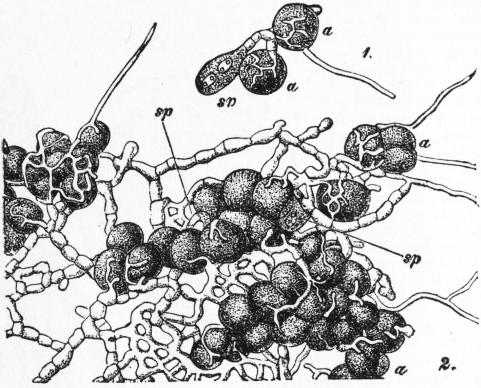
After Bonnier, from v. Tavel. From Strasburger’s Lehrbuch der Botanik, by permission of Gustav Fischer.
Fig. 1.—Xanthoria parietina. By the fusion of the hyphae in the middle of the mycelium a pseudo-parenchymatous cortical layer has begun to form.
1, Germinating ascospore (sp) with branching germ-tube applied to the Cystococcus cells (a). 2, Thallus in process of formation. sp, Two ascospores. p, Cystococcus cells.
In external form the heteromerous thallus presents the following modifications. (a) The foliaceous (leaf-like) thallus, which may be either peltate, i.e. rounded and entire, as in Umbilicaria, &c., or variously lobed and laciniated, as in Sticta, Parmelia, Cetraria (fig. 4), &c. This is the highest type of its development, and is sometimes very considerably expanded. (b) The fruticose thallus may be either erect, becoming pendulous, as in Usnea (fig. 5), Ramalina, &c., or prostrate, as in Alectoria jubata, var. chalybeiformis. It is usually divided into branches and branchlets, bearing some resemblance to a miniature shrub. An erect cylindrical thallus terminated by the fruit is termed a podetium, as in Cladonia (fig. 7). (c) The crustaceous thallus, which is the most common of all, forms a mere crust on the substratum, varying in thickness, and may be squamose (in Squamaria), radiate (in Placodium), areolate, granulose or pulverulent (in various Lecanorae and Lecideae). (d) The hypophloeodal thallus is often concealed beneath the bark of trees (as in some Verrucariae and Arthoniae), or enters into the fibres of wood (as in Xylographa and Agyrium), being indicated externally only by a very thin film (figs. 3, 4, 5, 6, 7 and 8). In colour also the thallus externally is very variable. In the dry and more typical state it is most frequently white or whitish, and almost as often greyish or greyish glaucous. Less commonly it is of different shades of brown, red, yellow and black. In the moist state of the thallus these colours are much less apparent, as the textures then become more or less translucent, and the thallus usually prevents the greenish colour of the gonidia (e.g. Parmelia Borreri, Peltidea aphthosa, Umbilicaria pustulata and pulverulent Lecideae).
The thallus may be free upon the surface of the substratum (e.g. Collema) or may be fixed more or less closely to it by special hyphae or rhizoids. These may penetrate but slightly into the substratum, but the connexion established may be so close that it is impossible to remove the thallus from the substratum without injury (e.g. Physcia, Placodium). In some cases the rhizoids are united together into larger strands, the rhizines.
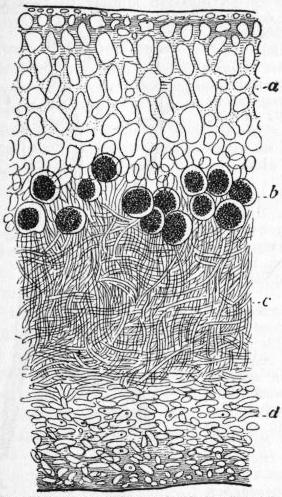
The typical heteromerous thallus shows on section a peripheral, thin and therefore transparent, layer, the cortical layer, and centrally a mass of denser tissue the so-called medullary layer, between these two layers is the algal zone or gonidial layer (figs. 8 and 9).
The term epithallus is sometimes applied to the superficial dense portion of the cortical layer and the term hypothallus to the layer, when specially modified, in immediate contact with the substratum; the hypothallus is usually dark or blackish. The cylindrical branches of the fruticose forms are usually radially symmetrical, but the flattened branches of these forms and also the thalli of the foliaceous form show a difference in the cortex of the upper and lower side. The cortical layer is usually more developed on the side towards the light, while in many lichens this is the only side provided with a cortical layer. The podetia of some species of Cladonia possess no cortical layer at all. The surface of the thallus often exhibits outgrowths in the form of warts, hairs, &c. The medullary layer, which usually forms the main part of the thallus, is distinguished from the cortical layer by its looser consistence and the presence in it of numerous, large, air-containing spaces.
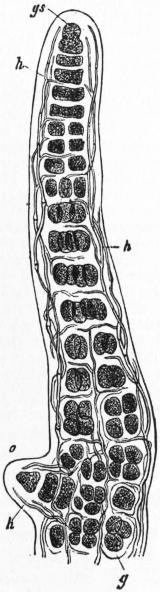
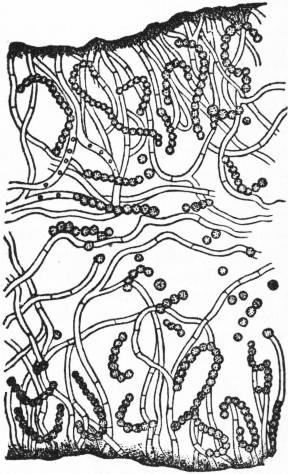
After Sachs, from De Bary’s Vergleichende Morphologie und Biologie der Pilze, Mycetozoen und Bacterien, by permission of Wilhelm Engelmann. Fig. 3.—Section of Homoiomerous Thallus of Collema conglomeratum, with Nostoc threads scattered among the hyphae.
Fig. 2.—Ephebe pubescens, Fr. A branched filiform thallus of Stigonema with the hyphae of the fungus growing through its gelatinous membranes. Extremity of a branch of the thallus with a young lateral branch a; h, hyphae; g, cells of the alga; gs, the apex of the thallus.
Gonidia.—It has been made clear above that the gonidia are nothing more than algal cells, which have been ensnared by fungal hyphae and made to develop in captivity (fig. 1). Funfstuck gives ten free living algae which have been identified as the gonidia of lichens. Pleurococcus (Cystococcus) humicola in the majority of lichens, e.g. Usnea, Cladonia, Physcia, Parmelia, Calicium, many species of Lecidea, &c., Trentepohlia (Chroolepus) umbrina in many species of Verrucaria, Graphidieae and Lecidea; Palmella botryoides in Epigloea; Pleurococcus vulgaris in Acarospora, Dermatocarpon, Catillaria; Dactylococcus infusionum in Solorina, Nephromia; Nostoc lichenoides in most of the Collemaceae; Rivularia rutida in Omphalaria; Lichina, &c., Polycoccus punctiformis in Peltigera, Pannaria and Stictina; Gloeocapsa polydermatica in Baeomyces and Omphalaria; Sirosiphon pulvinatus in Ephebe pubescens. The majority of lichens are confined to one particular kind of gonidium (i.e. species of alga) but a few forms are known (Lecanora granatina, Solorina crocea) which make use of more than one kind in their development. In the case of Solorina, for example, the principal alga is a green alga, one of the Palmellaceae, but Nostoc (a blue-green alga) is also found playing a subsidiary part as gonidia. In L. granatina the primary alga is Pleurococcus, the secondary, Gleococapsa.
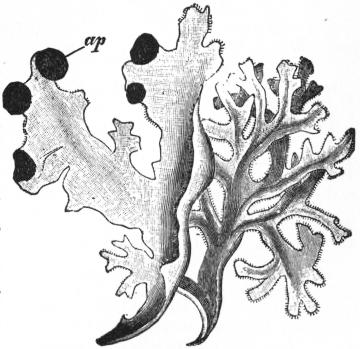
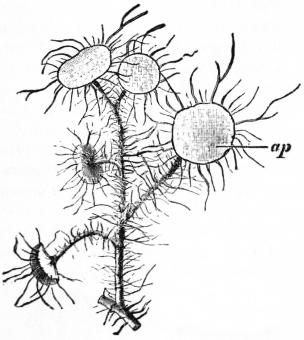
From Strasburger’s Lehrbuch der Botanik, by permission of Gustav Fischer. From Strasburger’s Lehrbuch der Botanik, by permission of Gustav Fischer.
Fig. 4.—Cetraria islandica. (Nat. size.) ap, Apothecium. Fig. 5.—Usnea barbata. (Nat. size.) ap, Apothecium.
Cephalodia.—In about 100 species of lichens peculiar growths are developed in the interior of the thallus which cause a slight projection of the upper or lower surface. These structures are known as cephalodia and they usually occupy a definite position in the thallus. They are distinguished by possessing as gonidia algae foreign to the ordinary part of the thallus. The foreign algae are always members of the Cyanophyceae and on the same individual and even in the same cephalodium more than one type of gonidium may be found. The function of these peculiar structures is unknown. Zukal has suggested that they may play the part of water-absorbing organs.
The exact relation of gonidia and hyphae has been investigated especially by Bornet and also by Hedlund, and very considerable differences have been shown to exist in different genera. In Physma, Arnoldia, Phylliscum and other genera the gonidia are killed sooner or later by special hyphal branches, haustoria, which pierce the membrane of the algal cell, penetrate the protoplasm and absorb the contents (fig. 11, C). In other cases, e.g. Synalissa, Micarea, the haustoria pierce the membrane, but do not penetrate the protoplasm (fig. 11, D). In many other cases, especially those algae possessing Pleurococcus as their gonidia, there are no penetrating hyphae, but merely special short hyphal branches which are in close contact with the membrane of the algal cell (fig. 3).
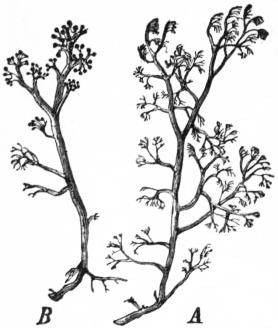
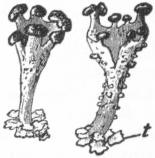
From Strasburger’s Lehrbuch der Botanik, by permission of Gustav Fischer. From Strasburger’s Lehrbuch der Botanik, by permission of Gustav Fischer.
Fig. 6.—Cladonia rangiferina. (Nat. size.) Fig. 7.—Cladonia coccifera. Podetia bearing apothecia. (Nat. size.)
A, Sterile. B, With ascus-fruit at the ends of the branches. t, Scales of primary thallus.
Reproduction.
There are three methods of reproduction of the lichen: by fragmentation, by soredia, by the formation of fungal spores. In the first process, portions of thallus containing gonidia may be accidentally separated and so may start new plants. The second method is only a special process of fragmentation. The soredia are found in a large number of lichens, and consist of a single gonidium or groups of gonidia, surrounded by a sheath and hyphae. They arise usually in the gonidial layer of the thallus by division of the gonidia and the development around them of the hyphal investment; their increase in number leads to the rupture of the enclosing cortical layer and the soredia escape from the thallus as a powdery mass (fig. 12). Since they are provided with both fungal and algal elements, they are able to develop directly, under suitable conditions, into a new thallus. The soredia are the most successful method of reproduction in lichens, for not only are some forms nearly always without spore-formation and in others the spores largely abortive, but in all cases the spore represents only the fungal component of the thallus, and its success in the development of a new lichen-thallus depends on the chance meeting, at the time of germination, with the appropriate algal component.
Conidia.—Contrary to the behaviour of the non-lichen forming Ascomycetes the lichen-fungi show very few cases of ordinary conidial formation. Bornet describes free conidia in Arnoldia minitula, and Placodium decipiens and Conidia-formation has been described by Neubner in the Caliciae.
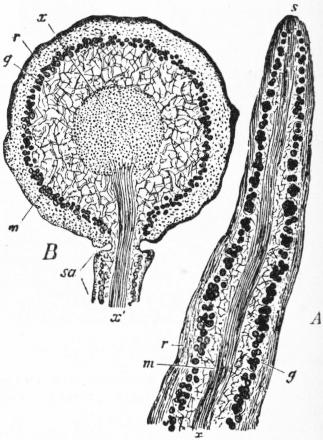
After Sachs, from De Bary’s Vergleichende Morphologie und Biologie der Pilze, Mycetozoen und Bacterien, by permission of Wilhelm Engelmann. From Beiträge zur Wissenschaftlichen Botanik.
Fig. 8.—Usnea barbata. (Mag. nearly 100 times.) Fig. 9.—Section of Heteromerous Lichen Thallus.
A, Optical longitudinal section of the extremity of a thin branch of the thallus which has become transparent in solution of potash. B, Transverse section through a stronger branch with the point of origin of an adventitious branch (sa). r, Cortical layer. m, Medullary layer. x, Stout axile strand. g, The algal zone (Cystococcus). s, Apex of the branch. a, Upper cortical layer. d, Lower cortical layer. c, Medullary layer. b, Gonidial layer.
Spermatia.—In the majority of genera of lichens small flask-shaped structures are found embedded in the thallus (fig. 13). These were investigated by Tulasne in 1853, who gave them the name spermogonia The lower, ventral portion of the spermogonium is lined by delicate hyphae, the sterigmata, which give origin to minute colourless cells, the spermatia. The sterigmata are either simple (fig. 13, C) or septate—the so-called arthrosterigmata (fig. 13, B). The spermogonia open by a small pore at the apex, towards which the sterigmata converge and through which the spermatia escape (fig. 13). There are two views as to the nature of the spermatia. In one view they are mere asexual conidia, and the term pycnoconidia is accordingly applied since they are borne in structures like the non-sexual pycnidia of other fungi. In the other view the spermatia are the male sexual cells and thus are rightly named; it should, however, be pointed out that this was not the view of Tulasne, though we owe to him the designation which carries with it the sexual significance. The question is one very difficult to settle owing to the fact that the majority of spermatia appear to be functionless. In favour of the conidial view is the fact that in the case of Collema and a few other forms the spermatia have been made to germinate in artificial cultures, and in the case of Calicium parietinum Möfler succeeded in producing a spermogonia bearing thallus from a spermatium. For the germination of the spermatia in nature there is only the observation of Hedlund, that in Catillaria denigrata and C. prasena a thallus may be derived from the spermatia under natural conditions. In relation to the view that the spermatia are sexual cells, or at least were primitively so, it must be pointed out that although the actual fusion of the spermatial nucleus with a female nucleus has not been observed, yet in a few cases the spermatia have been seen to fuse with a projecting portion (trichogyne) of the ascogonium, as in Collema and Physcia, and there is very strong circumstantial evidence that fertilization takes place (see later in section on development of ascocarp). The resemblance of the spermatia and spermogonia to those of Uredineae should be pointed out, where also there is considerable evidence for their original sexual nature, though they appear in that group to be functionless in all cases. The observations of Möller, &c., on the germination cannot be assumed to negative the sexual hypothesis for the sexual cells of Ulothrix and Ectocarpus, for example are able to develop with or without fusion. The most satisfactory view in the present state of our knowledge seems to be that the spermatia are male cells which, while retaining their fertilizing action in a few cases are now mainly functionless. The female sexual organs, the ascogonia, would thus in the majority of cases develop by the aid of some reduced sexual process or the ascocarps be developed without relation to sexual organs. A further argument in support of this view is that it is in complete agreement with what we know of the sexuality of the ordinary, free-living ascomycetes, where we find both normal and reduced forms (see Fungi).
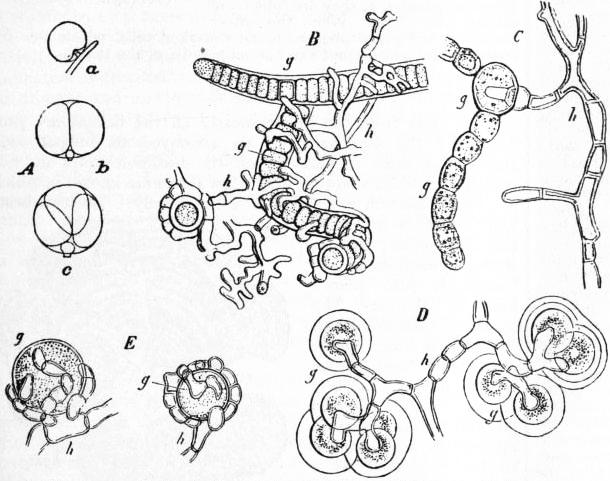
After Bornet, from De Bary’s Vergleichende Morphologie und Biologie der Pilze, Myceiozoen und Bacterien, by permission of Wilhelm Engelmann.
Fig. 11.—Lichen-forming Algae. (A, C, D, E mag. 950, B 650 times.) The alga is in all cases indicated by the letter g, the assailing hyphae by h.
A, Pleurococcus, Ag. (Cystococcus, Näg.) attacked by the germ-tube from a spore of Physica parietina. B, Scytonema from the thallus of Stereocaulon famulosum. C, Nostoc from the thallus of Physma chalazanum. D, Gloeocapsa from the thallus of Synalissa Symphorea. E, Pleurococcus Sp. (Cystococcus) from the thallus of Cladonia furcata.
Fruit Bodies.—We find two chief types of fruit bodies in the lichens, the perithecium and apothecium; the first when the fungal element is a member of the Pyrenomycetes division of the Ascomycetes, the second when the fungus belongs to the Discomycetes division. In the two genera of lichens—the Basidiolichens—in which the fungus is a member of the Basidiomycetes, we have the fructification characteristic of that class of fungi: these are dealt with separately. The perithecium is very constant in form and since the gonidia take no part in the formation of this organ or that of the apothecium it has the general structure characteristic of that division of fungi. The apothecia, though of the normal fungal type and usually disk-shaped, are somewhat more variable, and since the variations are of value in classification some more details may be added.
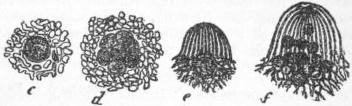
After Schwendener, from De Bary’s Vergleichende Morphologie und Biologie der Pilze Mycetozoen und Bacterien, by permission of Wilhelm Engelmann.
Fig. 12.—Usnea barbata. (Mag. more than 500 times.)
c, An isolated mature soredium, with an algal cell (Pleurococcus) in the envelope or hyphae. d, Another with several algal cells in optical longitudinal section. e, f, Two soredia in the act of germinating; the hyphal envelope has grown out below into rhizoid branches, and above shows already the structure of the apex of the thallus (see fig 9).
They present various shapes, of which the following are the principal: (a) peltate, which are large, rounded, without any distinct thalline margin1 (e.g. Usnea, Peltigera); (b) lecanorine, or scutelliform, which are orbicular and surrounded by a distinct, more or less prominent thalline margin (e.g. Parmelia, Lecanora), having sometimes also in addition a proper one¹ (e.g. Thelotrema, Urceolaria); (c) lecideine, or patelliform, which are typically orbicular, with only a proper margin (e.g. Lecidea), sometimes obsolete, and which are occasionally irregular in shape, angular or flexuose (e.g. Lecidea jurana, L. myrmecina), or complicated and gyrose (e.g. Gyrophora), and even stipitate (e.g. Baeomyces); (d) lirelliform, which are of very irregular figure, elongated, branched or flexuose, with only a proper margin (e.g. Xylographa, Graphis, &c.) or none (e.g. some Arthoniae), and often very variable even in the same species. In colour the apothecia are extremely variable, and it is but rarely that they are the same colour as the thallus (e.g. Usnea, Ramalina). Usually they are of a different colour, and may be black, brown, yellowish, or also less frequently rose-coloured, rusty-red, orange-reddish, saffron, or of various intermediate shades. Occasionally in the same species their colour is very variable (e.g. Lecanora metaboloides, Lecidea decolorans), while sometimes they are white or glaucous, rarely greenish, pruinose. Lecideine apothecia, which are not black, but otherwise variously coloured, are termed biatorine.
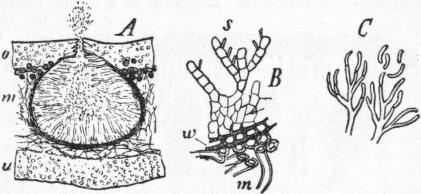
After Tulasne, from De Bary’s Vergleichende Morphologie und Biologie der Pilze, Mycetozoen und Bacterien, by permission of Wilhelm Engelmann.
Fig. 13.—A, B, Gyrophora cylindrica. (A mag. 90, B 390 times, C highly magnified.)
A, A vertical median section through a spermogonium imbedded in the thallus. o, Upper rind. u, Under rind. m, Medullary layer of the thallus. B, Portion of a very thin section from the base of the spermogonium. w, Its wall from which proceed sterigmata with rod-like spermatia (s). m, Medullary hyphae of the thallus. C, Cladonia novae Angliae, Delise; sterigmata with spermatia from the spermogonium.
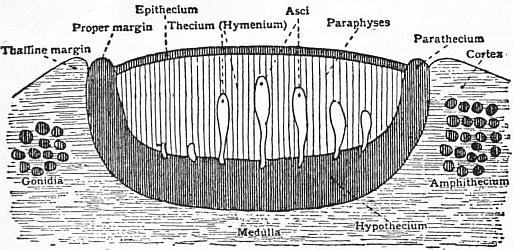
The two principal parts of which an apothecium consists are the hypothecium and the hymenium, or thecium. The hypothecium is the basal part of the apothecium on which the hymenium is borne; the latter consists of asci (thecae) with ascospores, and paraphyses. The paraphyses (which may be absent entirely in the Pyrenolichens) are erect, colourless filaments which are usually dilated and coloured at the apex; the apices are usually cemented together into a definite layer, the epithecium (fig. 14). The spores themselves may be unicellular without a septum or multicellular with one or more septa. Sometimes the two cavities are restricted to the two ends of the spore, the polari-bilocular type and the two loculi may be united by a narrow channel (fig. 15). At other times the spores are divided by both transverse and longitudinal septa producing the muriform (murali-divided) spore so called from the resemblance of the individual chambers to the stones in a wall. The very large single spores of Pertusaria have been shown to contain numerous nuclei and when they germinate develop a large number of germ tubes.
After Darbishire, from Berichte der deutschen botanischen Gesellschaft, by permission of Borntraeger & Co.
Fig. 14.—Diagram showing Apothecium in Section and surrounding Portion of Thallus, and special terms used to designate these parts.
Development of the Ascocarps.—As the remarks on the nature of the spermatia show, the question of the sexuality of the lichens has been hotly disputed in common with that of the rest of the Ascomycetes. As indicated above, the weight of evidence seems to favour what has been put forward in the case of the non-lichen-forming fungi (see Fungi), that in some cases the ascogonia develop as a result of a previous fertilization by spermatia, in other cases the ascogonia develop without such a union, while in still other cases the reduction goes still farther and the ascogenous hyphae instead of developing from the ascogonia are derived directly from the vegetative hyphae.
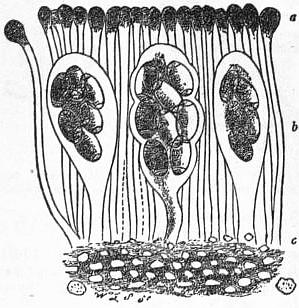
Fig. 15.—Vertical Section of Apothecium of Xanthoria parietina.
a, Paraphyses. b, Asci (thecae) with bilocular spores. c, Hypothecium.
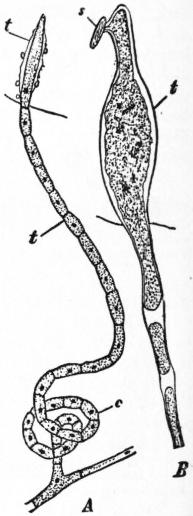
After E. Baur, from Strasburger’s Lehrbuch der Botanik, by permission of Gustav Fischer.
Fig. 16.—Collema crispum.
A, Carpogonium, c, with its trichogyne t. B, Apex of the trichogyne with the spermatium, s, attached.
The first exact knowledge as to the origin of the ascocarp was the work of Stahl on Collema in 1877. He showed that the archicarp consisted of two parts, a lower coiled portion, the ascogonium, and an upper portion, the trichogyne, which projected from the thallus. Only when a spermatium was found attached to the trichogyne did the further development of the ascogonium take place. From these observations he drew the natural conclusion that the spermatium was a male, sexual cell. This view was hotly contested by many workers and it was sought to explain the trichogyne—without much success—as a respiratory organ, or as a boring organ which made a way for the developing apothecium. It was not till 1898, however, that Stahl’s work received confirmation and addition at the hands of Baur (fig. 16). The latter showed that in Collema crispum there are two kinds of thalli, one with numerous apothecia, the other quite sterile or bearing only a few. The sterile thalli possessed no spermogonia, but were found to show sometimes as many as 1000 archicarps with trichogynes; yet none or very few came to maturity. The fertile thalli were shown to bear either spermogonia or to be in immediate connexion with spermogonia-bearing thalli. Furthermore Baur showed that after the fusion of the spermatium with the trichogyne the transverse walls of that organ became perforated. There was thus very strong circumstantial evidence in favour of fertilization, although the male nucleus was not traced. The further work of Baur, and that of Darbishire, Funfstuck and Lindau, have shown that in a number of other cases trichogynes are present. Thus ascogonia with trichogynes have been observed in Endocarpon, Collema, Pertusaria, Lecanora, Gyrophora, Parmelia, Ramalina, Physcia, Anaptychia and Cladonia. In Nephroma, Peltigera, Peltidea and Solorina a cogonia without trichogynes have been observed. In Collema and a form like Xanthoria parietina it is probable that actual fertilization takes place, and possibly also in some of the other forms. It is probable, however, that in the majority of cases the ascogonia develop without normal fertilization, as is necessarily the case where the ascogonia have no trichogynes or the spermatia are absent. In these cases we should expect to find some reduced process of fertilization similar to that of Humaria granulata among the ordinary Ascomycetes, where in the absence of the antheridia the female nuclei fuse in pairs. In other lichens we should expect to find the ascogenous hyphae arising directly from the vegetative hyphae as in Humaria rutilans among the ordinary fungi, where the process is associated with the fusion of vegetative nuclei. It is possible that Solorina saccata belongs to this class. Cytological details of nuclear behaviour among the lichens are, however, difficult to obtain owing to the slow growth of these forms and the often refractory nature of the material in the matter of preparation for microscopical examination.
Ejection of Spores.—The spores are ejected from the apothecia and perithecia as in the fungi by forcible ejaculation from the asci. In the majority of forms it is clear that the soredia rather than the ascospore must play the more important part in lichen distribution as the development of the ordinary spores is dependent on their finding the proper alga on the substratum on which they happen to fall. In a number of forms (Endocarpon pusillum, Stigmaatonima cataleptum, various species of Staurothele), however, there is a special arrangement by which the spores are, on ejection, associated with gonidia. In these forms gonidia are found in connexion with the young fruit; such algal cells undergo numerous divisions becoming very small in size and penetrating into the hymenium among the asci and paraphyses. When the spores are thrown out some of these hymenial gonidia, as they are called, are carried with them. When the spores germinate the germ-tubes surround the algal cells, which now increase in size and become the normal gonidia of the thallus.
Basidiolichens.
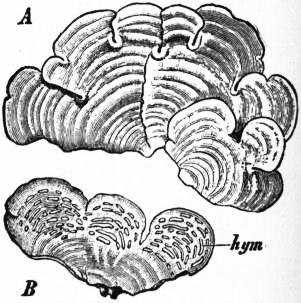
From Strasburger’s Lehrbuch der Botanik, by permission of Gustav Fischer.
Fig. 17.—Cora pavonia. A, Viewed from above; B, From below; hym, hymenium. (Nat. size.)
As is clear from the above, nearly all the lichens are produced by the association of an ascomycetous fungus with algae. For some obscure reason the Basidiomycetes do not readily form lichens, so that only a few forms are known in which the fungal element is a member of this family. The two best-known genera are Cora and Dictyonema; Corella, whose hymenium is unknown, is also placed here by Wainio. The so-called Gasterolichens, Trichocoma and Emericella, have been shown to be merely ascomycetous fungi. Clavaria mucida, however, has apparently some claims to be considered as a Basidiolichen, since the base of the fruit body and the thallus from which it arises, according to Coker, always shows a mixture of hyphae and algae.
The best-known species is Cora pavonia, which is found in tropical regions growing on the bare earth and on trees; the gonidia belong to the genus Chroococcus while the fungus belongs, apparently, to the Thelephoreae (see Fungi). This lichen seems unique in the fact that the fungal element is also found growing and fruiting entirely devoid of algae, while in the ascolichens the fungus portion seems to have become so specialized to its symbiotic mode of life that it is never found growing independently.
The genus Dictyonema has gonidia belonging to the blue-green alga, Scytonema. When the fungus predominates in the thallus it has a bracket-like mode of growth and is found projecting from the branches of trees with the hymenium on the under side. When the alga is predominant it forms felted patches on the bark of trees, the Laudatea form. It is said that the fungus of Cora pavonia and of Dictyonema is identical, the difference being in the nature of the alga.
Mode of Life.
Lichens are found growing in various situations such as bare earth, the bark of trees, dead wood, the surface of stones and rocks, where they have little competition to fear from ordinary plants. As is well known, the lichens are often found in the most exposed and arid situations; in the extreme polar regions these plants are practically the only vegetable forms of life. They owe their capacity to live under the most inhospitable conditions to the dual nature of the organism, and to their capacity to withstand extremes of heat, cold and drought without destruction. On a bare rocky surface a fungus would die from want of organic substance and an alga from drought and want of mineral substances. The lichen, however, is able to grow as the alga supplies organic food material and the fungus has developed a battery of acids (see below) which enable it actually to dissolve the most resistant rocks. It is owing to the power of disintegrating by both mechanical and chemical means the rocks on which they are growing that lichens play such an important part in soil-production. The resistance of lichens is extraordinary; they may be cooled to very low temperatures and heated to high temperatures without being killed. They may be dried so thoroughly that they can easily be reduced to powder yet their vitality is not destroyed but only suspended; on being supplied with water they absorb it rapidly by their general surface and renew their activity. The life of many lichens thus consists of alternating periods of activity when moisture is plentiful, and completely suspended animation under conditions of dryness. Though so little sensitive to drought and extremes of temperature lichens appear to be very easily affected by the presence in the air of noxious substances such as are found in large cities or manufacturing towns. In such districts lichen vegetation is entirely or almost entirely absent. The growth of lichens is extremely slow and many of them take years before they arrive at a spore-bearing stage. Xanthoria parietina has been known to grow for forty-five years before bearing apothecia. This slowness of growth is associated with great length of life and it is probable that individuals found growing on hard mountain rocks or on the trunks of aged trees are many hundreds of years old. It is possible that specimens of such long-lived species as Lecidea geographica actually outrival in longevity the oldest trees.
Relation of Fungus and Alga.
The relation of the two constituents of the lichen have been briefly stated in the beginning of this article. The relation of the fungus to the alga, though it may be described in general terms as one of symbiosis, partakes also somewhat of the nature of parasitism. The algal cells are usually controlled in their growth by the hyphae and are prevented from forming zoospores, and in some cases, as already described, the algal cells are killed sooner or later by the fungus. The fungus seems, on the other hand, to stimulate the algal cells to special development, for those in the lichen are larger than those in the free state, but this is not necessarily adverse to the idea of parasitism, for it is well known that an increase in the size of the cells of the host is often the result of the attacks of parasitic fungi. It must be borne in mind that the exact nutritive relations of the two constituents of the lichen have not been completely elucidated, and that it is very difficult to draw the line between symbiosis and parasitism. The lichen algae are not alone in their specialization to the symbiotic (or parasitic) mode of life, for, as stated earlier, the fungus appear in the majority of cases to have completely lost the power of independent development since with very rare exceptions they are not found alone. They also differ very markedly from free living fungi in their chemical reactions.
Chemistry of Lichens.
The chemistry of lichens is very complex, not yet fully investigated and can only be very briefly dealt with here. The wall of the hyphae of the fungus give in the young state the ordinary reactions of cellulose but older material shows somewhat different reactions, similar to those of the so-called fungus-cellulose. In many lichen-fungi the wall shows various chemical modifications. In numerous lichens, e.g. Cetraria islandica, the wall contains Lichenin (C6H10O5), a gummy substance which swells in cold water and dissolves in hot. Besides this substance, a very similar one, Isolichenin, is also found which is distinguished from lichenin by the fact that it dissolves in cold water and turns blue under the reaction of Iodine. Calcium oxalate is a very common substance, especially in crustaceous lichens; fatty oil in the form of drops or as an infiltration in the membrane is also common; it sometimes occurs in special cells and in extreme cases may represent 90% of the dry substance as in Verrucaria calciseda, Biatora immersa.
Colouring Matters.—Many lichens, as is well known, exhibit a vivid colouring which is usually due to the incrustation of the hyphae with crystalline excretory products. These excretory products have usually an acid nature and hence are generally known as lichen-acids. A large number of these acids, which are mostly benzene derivatives, have been isolated and more or less closely investigated. They are characterized by their insolubility or very slight solubility in water; as examples may be mentioned erythrinic acid in Roccella and Lecanora; evernic acid in species of Evernia, Ramalina and Cladonia; lecanoric acid in Lecanora, Gyrophora. The so-called chrysophanic acid found in Xanthoria (Physcia) parietina is not an acid but a quinone and is better termed physcion.
Colour Reactions of Lichens.—The classification of lichens is unique in the fact that chemical colour reactions are used by many lichenologists in the discrimination of species, and these reactions are included in the specific diagnoses. The substances used as tests in these reactions are caustic potash and calcium hypochlorite; the former being the substance dissolved in an equal weight of water and the latter a saturated extract of bleaching powder in water. These substances are represented by lichenologists by the signs K and CaCl respectively, and the presence or absence of the colour reactions are represented thus, K+, CaCl+, or K−, CaCl−. If the cortical layer should exhibit positive reaction and the medulla of the same species a negative reaction with both reagents, the result is represented thus, K±CaCl±. If a reaction is only produced after the consecutive addition of the two reagents, this is symbolized by K(CaCl)+. A solution of iodine is also used as a test owing to the blue or wine-red colour which the thallus, hymenium or spores may give with this reagent. The objection to the case of these colour reactions is due to the indefinite nature of the reaction and the doubt as to the constant presence of a definite chemical compound in a given species. A yellow colour with caustic potash solution is produced not only by atranoric acid but also by evernic acid, thamnolic acid, &c. Again in the case of Xanthoria parietina vulpinic acid is only to be found in young thalli growing on sandstone; in older forms or in those growing on another substratum it is not to be detected. A similar relation between oil formation and the nature of the substratum has been observed in many lichens. Considerations such as these should make one very wary in placing reliance on these colour reactions for the purposes of classification.
Economic Uses of Lichens.
In the arts, as food and as medicine, many lichens have been highly esteemed, though others are not now employed for the same purposes as formerly.
1. Lichens Used in the Arts.—Of these the most important are such as yield, by maceration in ammonia, the dyes known in commerce as archil, cudbear and litmus. These, however, may with propriety be regarded as but different names for the same pigmentary substance, the variations in the character of which are attributable to the different modes in which the pigments are manufactured. Archil proper is derived from several species of Roccella (e.g. R. Montaguei, R. tinctoria), which yield a rich purple dye; it once fetched a high price in the market. Of considerable value is the “perelle” prepared from Lecanora parella, and used in the preparation of a red or crimson dye. Inferior to this is “cudbear,” derived from Lecanora tartarea, which was formerly very extensively employed by the peasantry of north Europe for giving a scarlet or purple colour to woollen cloths. By adding certain alkalies to the other ingredients used in the preparation of these pigments, the colour becomes indigo-blue, in which case it is the litmus of the Dutch manufacturers. Amongst other lichens affording red, purple or brown dyes may be mentioned Ramalina scopulorum, Parmelia, saxatilis and P. amphalodes, Umbilicaria pustulata and several species of Gyrophora, Urceolaria scruposa, all of which are more or less employed as domestic dyes. Yellow dyes, again, are derived from Chlorea vulpina, Platysma juniperinum, Parmelia caperata and P. conspersa, Physcia flavicans, Ph. parietina and Ph. lychnea, though like the preceding they do not form articles of commerce, being merely used locally by the natives of the regions in which they occur most plentifully. In addition to these, many exotic lichens, belonging especially to Parmelia and Sticta (e.g. Parmelia tinctorum, Sticta argyracea), are rich in colouring matter, and, if obtained in sufficient quantity, would yield a dye in every way equal to archil. These pigments primarily depend upon special acids contained in the thalli of lichens, and their presence may readily be detected by means of the reagents already noticed. In the process of manufacture, however, they undergo various changes, of which the chemistry is still but little understood. At one time also some species were used in the arts for supplying a gum as a substitute for gum-arabic. These were chiefly Ramalina fraxinea, Evernia prunastri and Parmelia physodes, all of which contain a considerable proportion of gummy matter (of a much inferior quality, however, to gum-arabic), and were employed in the process of calico-printing and in the making of parchment and cardboard. In the 17th century some filamentose and fruticulose lichens, viz. species of Usnea and Ramalina, also Evernia furfuracea and Cladonia rangiferina, were used in the art of perfumery. From their supposed aptitude to imbibe and retain odours, their powder was the basis of various perfumes, such as the celebrated “Poudre de Cypre” of the hairdressers, but their employment in this respect has long since been abandoned.
2. Nutritive Lichens.—Of still greater importance is the capacity of many species for supplying food for man and beast. This results from their containing starchy substances, and in some cases a small quantity of saccharine matter of the nature of mannite. One of the most useful nutritious species is Cetraria islandica, “Iceland moss,” which, after being deprived of its bitterness by boiling in water, is reduced to a powder and made into cakes, or is boiled and eaten with milk by the poor Icelander, whose sole food it often constitutes. Similarly Cladonia rangiferina and Cl. sylvatica, the familiar “reindeer moss,” are frequently eaten by man in times of scarcity, after being powdered and mixed with flour. Their chief importance, however, is that in Lapland and other northern countries they supply the winter food of the reindeer and other animals, who scrape away the snow and eagerly feed upon them. Another nutritious lichen is the “Tripe de Roche” of the arctic regions, consisting of several species of the Gyrophorei, which when boiled is often eaten by the Canadian hunters and Red Indians when pressed by hunger. But the most singular esculent lichen of all is the “manna lichen,” which in times of drought and famine has served as food for large numbers of men and cattle in the arid steppes of various countries stretching from Algiers to Tartary. This is derived chiefly from Lecanora esculenta, which grows unattached on the ground in layers from 3 to 6 in. thick over large tracts of country in the form of small irregular lumps of a greyish or white colour. In connexion with their use as food we may observe that of recent years in Scandinavia and Russia an alcoholic spirit has been distilled from Cladonia rangiferina and extensively consumed, especially in seasons when potatoes were scarce and dear. Formerly also Sticta pulmonaria was much employed in brewing instead of hops, and it is said that a Siberian monastery was much celebrated for its beer which was flavoured with the bitter principle of this species.
3. Medicinal Lichens.—During the middle ages, and even in some quarters to a much later period, lichens were extensively used in medicine in various European countries. Many species had a great repute as demulcents, febrifuges, astringents, tonics, purgatives and anthelmintics. The chief of those employed for one or other, and in some cases for several, of these purposes were Cladonia pyxidata, Usnea barbata, Ramalina farinacea, Evernia prunastri, Cetraria ìslandica, Sticla pulmonaria, Parmelia saxatilis, Xanthoria parietina and Pertusaria amara. Others again were believed to be endowed with specific virtues, e.g. Peltigera canina, which formed the basis of the celebrated “pulvis antilyssus” of Dr Mead, long regarded as a sovereign cure for hydrophobia; Platysma juniperinum, lauded as a specific in jaundice, no doubt on the similia similibus principle from a resemblance between its yellow colour and that of the jaundiced skin; Peltidea aphthosa, which on the same principle was regarded by the Swedes, when boiled in milk, as an effectual remedy for the aphthae or rash on their children. Almost all of these virtues, general or specific, were imaginary; and at the present day, except perhaps in some remoter districts of northern Europe, only one of them is employed as a remedial agent. This is the “Iceland moss” of the druggists’ shops, which is undoubtedly an excellent demulcent in various dyspeptic and chest complaints. No lichen is known to be possessed of any poisonous properties to man, although Chlorea vulpina is believed by the Swedes to be so. Zukal has considered that the lichen acids protect the lichen from the attacks of animals; the experiments of Zopf, however, have cast doubt on this; certainly lichens containing very bitter acids are eaten by mites though some of the acids appear to be poisonous to frogs.
Classification.
The dual nature of the lichen thallus introduces at the outset a classificatory difficulty. Theoretically the lichens may be classified on the basis of their algal constituent, on the basis of their fungal constituent, or they may be classified as if they were homogeneous organisms. The first of these systems is impracticable owing to the absence of algal reproductive organs and the similarity of the algal cells (gonidia) in a large number of different forms. The second system is the most obvious one, since the fungus is the dominant partner and produces reproductive organs. The third system was that of Nylander and his followers, who did not accept the Schwenderian doctrine of duality. In actual practice the difference between the second and third methods is not very great since the fungus is the producer of the reproductive organs and generally the main constituent. Most systems agree in deriving the major divisions from the characters of the reproductive organs (perithecia, apothecia, or basidiospore bearing fructification), while the characters of the algal cells and those of the thallus generally are used for the minor divisions. The difference between the various systems lies in the relative importance given to the reproductive characters on the one hand and the vegetative characters on the other. In the system (1854-1855) of Nylander the greater weight is given to the latter, while in more modern systems the former characters receive the more attention.
A brief outline of a system of classification, mainly that of Zahlbruckner as given in Engler and Prantl’s Pflanzenfamilien, is outlined below.
There are two main divisions of lichens, Ascolichenes and Basidiolichenes, according to the nature of the fungal element, whether an ascomycete or basidiomycete. The Ascolichenes are again divided into Pyrenocarpeae or Pyrenolichenes and Gymnocarpeae or Discolichenes; the first having an ascocarp of the nature of a perithecium, the second bearing their ascospores in an open apothecium.
Pyrenolichenes
Series I. Perithecium simple not divided.
a. With Pleurococcus or Palmella gonidia. Moriolaceae, Verrucariaceae, Pyrenothamnaceae.
b. With Chroolepus gonidia. Pyrenulaceae, Paratheliaceae.
c. With Phyllactidium or Cephaleurus gonidia. Strigulaceae.
d. With Nostoc or Scytonema gonidia. Pyrenidiaceae.
Series II. Perithecia divided or imperfectly divided by cross-walls. Mycoporaceae with Palmella or Chroolepus gonidia.
Discolichenes
Series I. Coniocarpineae. The paraphyses branch and form a network (capillitium) over the asci, the capillitium and ejected spores forming a long persistent powdery mass (mazaedium).
Caliciaceae, Cypheliaceae, Sphaerophoraceae.
Series II. Graphidineae. Apothecia seldom round, usually elongated-ellipsoidal, no capillitium.
Arthoniaceae, Graphidiaceae, Roccellaceae.
Series III. Cyclocarpineae, Apothecium usually circular, no capillitium.
A. Spores usually two-celled, either with a strongly thickened cross-wall often perforated by a narrow canal or with cross-wall only slightly thickened. In the first case the spores are usually colourless, the second case always brown. Buelliaceae, Physciaceae.
B. Spores unicellular, parallel-multicellular or muriform, usually colourless, cross-walls usually thin.
α Thallus in moist state more or less gelatinous. Gonidia always belonging to the Cyanophyceae, Lichinaceae, Ephebaceae, Collemaceae, Pyrenopsidaceae.
β Thallus not gelatinous. Coenogoniaceae, Lecideaceae, Cladoniaceae, Lecanoraceae, Pertusariaceae, Peltigeraceae, Stictaceae, Pannariaceae, Gyrophoraceae, Parmeliaceae, Cladoniaceae, Usneaceae.
Basidiolichenes (Hymenolichenes)
Cora, Dictyonema (incl. Laudatea), Corella (doubtfully placed here as the hymenium is unknown).
Habitats and Distribution of Lichens.
1. Habitats.—These are extremely varied, and comprise a great number of very different substrata. Chiefly, however, they are the bark of trees, rocks, the ground, mosses and, rarely, perennial leaves. (a) With respect to corticolous lichens, some prefer the rugged bark of old trees (e.g. Ramalina, Parmelia, Stictei) and others the smooth bark of young trees and shrubs (e.g. Graphidei and some Lecideae). Many are found principally in large forests (e.g. Usnea, Alectoria jubata); while a few occur more especially on trees by roadsides (e.g. Physcia parietina and Ph. pulverulenta). In connexion with corticolous lichens may be mentioned those lignicole species which grow on decayed, or decaying wood of trees and on old pales (e.g. Caliciei, various Lecideae, Xylographa), (b) As to saxicolous lichens, which occur on rocks and stones, they may be divided into two sections, viz. calcicolous and calcifugous. To the former belong such as are found on calcareous and cretaceous rocks, and the mortar of walls (e.g. Lecanora calcarea, Lecidea calcivora and several Verrucariae), while all other saxicolous lichens may be regarded as belonging to the latter, whatever may be the mineralogical character of the substratum. It is here worthy of notice that the apothecia of several calcicolous lichens (e.g. Lecanora Prevostii, Lecidea calcivora) have the power of forming minute cavities in the rock, in which they are partially buried. (c) With respect to terrestrial species, some prefer peaty soil (e.g. Cladonia, Lecidea decolorans), others calcareous soil (e.g. Lecanora crassa, Lecidea decipiens), others sandy soil or hardened mud (e.g. Collema limosum, Peltidea venosa); while many may be found growing on all kinds of soil, from the sands of the sea-shore to the granitic detritus of lofty mountains, with the exception of course of cultivated ground, there being no agrarian lichens. (d) Muscicolous lichens again are such as are most frequently met with on decayed mosses and Jungermannia, whether on the ground, trees or rocks (e.g. Leptogium muscicola, Gomphillus calicioides). (e) The epiphyllous species are very peculiar as occurring upon perennial leaves of certain trees and shrubs, whose vitality is not at all affected by their presence as it is by that of fungi. In so far, however, as is known, they are very limited in number (e.g. Lecidea, Bouteillei, Strigula).