VOLUME XVI SLICE V Letter to Lightfoot, John (continued 10)
Reading edition
Maritime Liens.—Maritime lien differs from all the others yet considered, in its more elastic nature. Where a maritime lien has once attached to property—and it may and generally does attach without possession—it will continue to attach, unless lost by laches, so long as the thing to which it attaches exists, notwithstanding changes in the possession of and property in the thing, and notwithstanding that the new possessor or owner may be entirely ignorant of its existence; and even if enforced it leaves the owner’s personal liability for any balance unrealized intact (the “Gemma,” 1899, P. 285). So far as England is concerned, it must be borne in mind that the courts of admiralty were conducted in accordance with the principles of civil law, and in that law both the pledge with possession and the hypothecation without possession were well recognized. The extreme convenience of such a right as the latter with regard to such essentially movable chattels as ships is apparent. Strictly speaking, a maritime lien is confined to cases arising in those matters over which the courts of admiralty had original jurisdiction, viz. collisions at sea, seamen’s wages, salvage and bottomry, in all of which cases the appropriate remedy is a proceeding in rem in the admiralty court. In the first of these—collisions at sea—if there were no maritime lien there would frequently be no remedy at all. When two ships have collided at sea it may well be that the innocent ship knows neither the name nor the nationality of the wrongdoer, and the vessel may escape with slight damage and not have to make a port of refuge in the neighbourhood. Months afterwards it is ascertained that she was a foreign ship, and in the interval she has changed owners. Then, were it not a fact that a maritime lien invisible to the wrongdoer nevertheless attaches itself to his ship at the moment of collision, and continues to attach, the unfortunate owner of the innocent ship would have no remedy, except the doubtful one of pursuing the former owner of the wrong-doing vessel in his own country in a personal action where such proceedings are allowed—which is by no means the case in all foreign countries. The same reasons apply, though not possibly with quite the same force, to the other classes of cases mentioned.
Between 1840 and 1873 the jurisdiction of the admiralty court was largely extended. At the latter date it was merged in the probate, divorce and admiralty division of the High Court of Justice. Since the merger questions have arisen as to how far the enlargement of jurisdiction has extended the principle of maritime lien. An interesting article on this subject by J. Mansfield, barrister-at-law, will be found in the Law Quarterly Review, vol. iv., October 1888. It must be sufficient to state here that where legislation has extended the already existing jurisdiction to which a maritime lien pertained, the maritime lien is extended to the subject matter, but that where a new jurisdiction is given, or where a jurisdiction formerly existing without a maritime lien is extended, no maritime lien is given, though even then the extended jurisdiction can be enforced by proceedings in rem. Of the first class of extended jurisdictions are collisions, salvage and seamen’s wages. Prior to 1840 the court of admiralty only had jurisdiction over these when occurring or earned on the high seas. The jurisdiction, and with it the maritime lien, is extended to places within the body of a county in collision or salvage; and as to seamen’s wages, whereas they were dependent on the earning of freight, they are now free from any such limitation; and also, whereas the remedy in rem was limited to seamen’s wages not earned under a special contract, it is now extended to all seamen’s wages, and also to a master’s wages and disbursements, and the maritime lien covers all these. The new jurisdiction given over claims for damage to cargo carried into any port in England or Wales, and on appeal from the county courts over all claims for damage to cargo under £300, though it may be prosecuted by proceedings in rem, i.e. by arrest of the ship, yet confers no maritime lien; and so also in the case of claims by material men (builders and fitters-out of ships) and for necessaries. Even though in the latter case the admiralty court had jurisdiction previously to 1840 where the necessaries were supplied on the high seas, yet as it could not be shown that such jurisdiction had ever been held to confer a maritime lien, no such lien is given. Even now there is much doubt as to whether towage confers a maritime lien or not, the services rendered being pursuant to contract, and frequently to a contract made verbally or in writing on the high seas, and being rendered also to a great extent on the high seas. In these cases and to that extent the high court of admiralty would have had original jurisdiction. But prior to 1840 towage, as now rendered by steam tugs expressly employed for the service, was practically unknown, and therefore there was no established catena of precedent to show the exercise of a maritime lien. It may be argued on the one hand that towage is only a modified form of salvage, and therefore entitled to a maritime lien, and on the other that it is only a form of necessary power supplied like a new sail or mast to a ship to enable her to complete her voyage expeditiously, and therefore of the nature of necessaries, and as such not entitled to a maritime lien. The matter is not of academical interest only, for though in the case of an inward-bound ship the tug owner can make use of his statutory right of proceeding in rem, and so obtain much of the benefit of a maritime lien, yet in the case of an outward-bound ship, if she once gets away without payment, and the agent or other authorized person refuses or is unable to pay, the tug owner’s claim may, on the return of the ship to a British port, be met by an allegation of a change of ownership, which defeats his right of proceeding at all if he has no maritime lien; whereas if he has a maritime lien he can still proceed against the ship and recover his claim, if he has not been guilty of laches.
A convenient division of the special liens other than possessory on ships may be made by classifying them as maritime, statutory-maritime or quasi-maritime, and statutory. The first attach only in the case of damage done by collision between ships on the high seas, salvage on the high seas, bottomry and seamen’s wages so far as freight has been earned; the second attach in cases of damage by collision within the body of a county, salvage within the body of a county, life salvage everywhere, seamen’s wages even if no freight has been earned, master’s wages and disbursements. These two classes continue to attach notwithstanding a change of ownership without notice of the lien, if there have been no laches in enforcing it (the “Bold Buccleuch,” 1852, 7 Moo. P.C. 267; the “Kong Magnus,” 1891, P. 223). The third class, which only give a right to proceed in rem, i.e. against the ship itself, attach, so long as there is no bona fide change of ownership, without citing the owners, in all cases of claims for damage to ship and of claims for damage to cargo where no owner is domiciled in England or Wales. Irrespective of this limitation, they attach in all cases not only of damage to cargo, but also of breaches of contract to carry where the damage does not exceed £300, when the suit must be commenced in a county court having admiralty jurisdiction; and in cases of claims for necessaries supplied elsewhere than in the ship’s home port, for wages earned even under a special contract by masters and mariners, and of claims for towage. In all three classes the lien also exists over cargo where the suit from its nature extends to it, as in salvage and in some cases of bottomry or respondentia, and in cases where proceedings are taken against cargo by the shipowner for a breach of contract (cargo ex “Argos” and the “Hewsons,” 1873, L.R. 5 P.C. 134; the “Alina,” 1880, 5 Ex. D. 227).
Elsewhere than in England, and those countries such as the United States which have adopted her jurisprudence in maritime matters generally, the doctrine of maritime lien, or that which is substituted for it, is very differently treated. Speaking generally, those states which have adopted the Napoleonic codes or modifications of them—France, Italy, Spain, Holland, Portugal, Belgium, Greece, Turkey, and to some extent Russia—have instead of a maritime lien the civil-law principle of privileged debts. Amongst these in all cases are found claims for salvage, wages, bottomry under certain restrictions, and necessaries. Each of these has a privileged claim against the ship, and in some cases against freight and cargo as well, but it is a matter of very great importance that, except in Belgium, a claim for collision damage (which as we have seen confers a maritime lien, and one of a very high order, in Great Britain) confers no privilege against the wrong-doing ship, whilst in all these countries an owner can get rid of his personal liability by abandoning the ship and freight to his creditor, and so, if the ship is sunk, escape all liability whilst retaining any insurance there may be. This, indeed, was at one time the law of Great Britain; the measure of damage was limited by the value of the res; and in the United States at the present time a shipowner can get rid of his liability for damage by abandoning the ship and freight. A different rule prevails in Germany and the Scandinavian states. There claims relating to the ship, unless the owner has specially rendered himself liable, confer no personal claim at all against him. The claim is limited ab initio to ship and freight, except in the case of seamen’s wages, which do confer a personal claim so far as they have been earned on a voyage or passage completed prior to the loss of the ship. In all maritime states, however, except Spain, a provisional arrest of the ship is allowed, and thus between the privilege accorded to the debt and the power to arrest till bail is given or the ship abandoned to creditors, a condition of things analogous to the maritime lien is established; especially as these claims when the proper legal steps have been taken to render them valid—usually by endorsement on the ship’s papers on board, or by registration at her port of registry—attach to the ship and follow her into the hands of a purchaser. They are in fact notice to him of the incumbrance.
Duration of Lien.—So long as the party claiming the lien at common law retains the property, the lien continues, notwithstanding the debt in respect of which it is claimed becoming barred by the Statute of Limitations (Higgins v. Scott, 1831, 2 B. & Ald. 413). But if he takes proceedings at law to recover the debt, and on a sale of the goods to satisfy the judgment purchases them himself, he so alters the nature of the possession that he loses his lien (Jacobs v. Latour, 5 Bing. 130). An equitable lien probably in all cases continues, provided the purchaser of the subject matter has notice of the lien at the time of his purchase. A maritime lien is in no respect subject to the Statute of Limitations, and continues in force notwithstanding a change in the ownership of the property without notice, and is only terminated when it has once attached, by laches on the part of the person claiming it (the “Kong Magnus,” 1891, P. 223). There is an exception in the case of seamen’s wages, where by 4 Anne c. 16 (Stat. Rev. 4 & 5 Anne c. 3) all suits for seamen’s wages in the Admiralty must be brought within six years.
Ranking of Maritime Liens.—There may be several claimants holding maritime and other liens on the same vessel. For example, a foreign vessel comes into collision by her own fault and is damaged and her cargo also; she is assisted into port by salvors and ultimately under a towage agreement, and put into the hands of a shipwright who does necessary repairs. The innocent party to the collision has a maritime lien for his damage, and the seamen for their wages; the cargo owner has a suit in rem or a statutory lien for damage, and the shipwright a possessory lien for the value of his repairs, while the tugs certainly have a right in rem and possibly a maritime lien also in the nature of salvage. The value of the property may be insufficient to pay all claims, and it becomes a matter of great consequence to settle whether any, and if so which, have priority over the others, or whether all rank alike and have to divide the proceeds of the property pro ratâ amongst them. The following general rules apply: liens for benefits conferred rank against the fund in the inverse, and those for the reparation of damage sustained in the direct order of their attaching to the res; as between the two classes those last mentioned rank before those first mentioned of earlier date; as between liens of the same class and the same date, the first claimant has priority over others who have not taken action. The courts of admiralty, however, allow equitable considerations, and enter into the question of marshalling assets. For example, if one claimant has a lien on two funds, or an effective right of action in addition to his lien, and another claimant has only a lien upon one fund, the first claimant will be obliged to exhaust his second remedy before coming into competition with the second. As regards possessory liens, the shipwright takes the ship as she stands, i.e. with her incumbrances, and it appears that the lien for seaman’s wages takes precedence of a solicitor’s lien for costs, under a charging order made in pursuance of the Solicitors Act 1860, § 28.
Subject to equitable considerations, the true principle appears to be that services rendered under an actual or implied contract, which confer a maritime lien, make the holder of the lien in some sort a proprietor of the vessel, and therefore liable for damage done by her—hence the priority of the damage lien—but, directly it has attached, benefits conferred on the property by enabling it to reach port in safety benefit the holder of the damage lien in common with all other prior holders of maritime liens. It is less easy to see why of two damage liens the earlier should take precedence of the later, except on the principle that the res which came into collision the second time is depreciated in value by the amount of the existing lien upon her for the first collision, and where there was more than one damage lien, and also liens for benefits conferred prior to the first collision between the two collisions and subsequent to the second, the court would have to make a special order to meet the peculiar circumstances. The claim of a mortgagee naturally is deferred to all maritime liens, whether they are for benefits conferred on the property in which he is interested or for damage done by it, and also for the same reason to the possessory lien of the shipwright, but both the possessory lien of the shipwright and the claim of the mortgagee take precedence over a claim for necessaries, which only confers a statutory lien or a right to proceed in rem in certain cases. In other maritime states possessing codes of commercial law, the privileged debts are all set out in order of priority in these codes, though, as has been already pointed out, the lien for damage by collision—the most important in English law—has no counterpart in most of the foreign codes.
Stoppage in Transitu.—This is a lien held by an unpaid vendor in certain cases over goods sold after they have passed out of his actual possession. It has been much discussed whether it is an equitable or common-law right or lien. The fact appears to be that it has always been a part of the Law Merchant, which, properly speaking, is itself a part of the common law of England unless inconsistent with it. This particular right was, in the first instance, held by a court of equity to be equitable and not contrary to English law, and by that decision this particular part of the Law Merchant was approved and became part of the common law of England (see per Lord Abinger in Gibson v. Carruthers, 8 M. & W., p. 336 et seq.). It may be described as a lien by the Law Merchant, decided by equity to be part of the common law, but in its nature partaking rather of the character of an equitable lien than one at common law. “It is a right which arises solely upon the insolvency of the buyer, and is based on the plain reason of justice and equity that one man’s goods shall not be applied to the payment of another man’s debts. If, therefore, after the vendor has delivered the goods out of his own possession and put them in the hands of a carrier for delivery to the buyer, he discovers that the buyer is insolvent, he may re-take the goods if he can before they reach the buyer’s possession, and thus avoid having his property applied to paying debts due by the buyer to other people” (Benjamin on Sales, 2nd ed., 289). This right, though only recognized by English law in 1690, is highly favoured by the courts on account of its intrinsic justice, and extends to quasi-vendors, or persons in the same position, such as consignors who have bought on behalf of a principal and forwarded the goods. It is, however, defeated by a lawful transfer of the document of title to the goods by the vendor to a third person, who takes it bonâ fide and for valuable consideration (Factors Act 1889; Sale of Goods Act 1893).
Assignment or Transfer of Lien.—A lien being a personal right acquired in respect of personal services, it cannot, as a rule, be assigned or transferred; but here again there are exceptions. The personal representative of the holder of a possessory lien on his decease would probably in all cases be held entitled to it; and it has been held that the lien over a client’s papers remains with the firm of solicitors notwithstanding changes in the constitution of the firm (Gregory v. Cresswell, 14 L.J. Ch. 300). So also where a solicitor, having a lien on documents for his costs, assigned the debt to his bankers with the benefit of the lien, it was held that the bankers might enforce such lien in equity. But though a tradesman has a lien on the property of his customer for his charges for work done upon it, where the property is delivered to him by a servant acting within the scope of his employment, such lien cannot be transferred to the servant, even if he has paid the money himself; and the lien does not exist at all if the servant was acting without authority in delivering the goods, except where (as in the case of a common carrier) he is bound to receive the goods, in which case he retains his lien for the carriage against the rightful owner. Where, however, there is a lien on property of any sort not in possession, a person acquiring the property with knowledge of the lien takes it subject to such lien. This applies to equitable liens, and cannot apply to those common-law liens in which possession is necessary. It is, however, true that by statute certain common-law liens can be transferred, e.g. under the Merchant Shipping Act a master of a ship having a lien upon cargo for his freight can transfer the possession of the cargo to a wharfinger, and with it the lien (Merchant Shipping Act 1894, § 494). In this case, however, though the matter is simplified by the statute, if the wharfinger was constituted the agent or servant of the shipmaster, his possession would be the possession of the shipmaster, and there would be no real transfer of the lien; therefore the common-law doctrine is not altered, only greater facilities for the furtherance of trade are given by the statute, enabling the wharfinger to act in his own name without reference to his principal, who may be at the other side of the world. So also a lien may be retained, notwithstanding that the property passes out of possession, where it has to be deposited in some special place (such as the Custom-House) to comply with the law. Seamen cannot sell or assign or in any way part with their maritime lien for wages (Merchant Shipping Act 1894, § 156), but, nevertheless, with the sanction of the court, a person who pays seamen their wages is entitled to stand in their place and exercise their rights (the Cornelia Henrietta, 1866, L.R. 1 Ad. & Ec. 51).
Waiver.—Any parting with the possession of goods is in general a waiver of the lien upon them; for example, when a factor having a lien on the goods of his principal gives them to a carrier to be carried at the expense of his principal, even if undisclosed, he waives his lien, and has no right to stop the goods in transitu to recover it; so also where a coach-builder who has a lien on a carriage for repairs allows the owner from time to time to take it out for use without expressly reserving his lien, he has waived it, nor has he a lien for the standage of the carriage except by express agreement, as mere standage does not give a possessory lien. It has even been held that where a portion of goods sold as a whole for a lump sum has been taken away and paid for proportionately, the conversion has taken place and the lien for the residue of the unpaid purchase-money has gone (Gurr v. Cuthbert, 1843, 12 L.J. Ex. 309). Again, an acceptance of security for a debt is inconsistent with the existence of a lien, as it substitutes the credit of the owner for the material guarantee of the thing itself, and so acts as a waiver of the lien. For the same reason even an agreement to take security is a waiver of the lien, though the security is not, in fact, given (Alliance Bank v. Broon, 11 L.T. 332).
Sale of Goods under Lien.—At common law the lien only gives a right to retain the goods, and ultimately to sell by legal process, against the owner; but in certain cases a right has been given by statute to sell without the intervention of legal process, such as the right of an innkeeper to sell the goods of his customer for his unpaid account (Innkeepers Act 1878, § 1), the right of a wharfinger to sell goods entrusted to him by a shipowner with a lien upon them for freight, and also for their own charges (Merchant Shipping Act 1894, §§ 497, 498), and of a railway company to sell goods for their charges (Railway Clauses Act 1845, § 97). Property affected by an equitable lien or a maritime lien cannot be sold by the holder of the lien without the interposition of the court to enforce an order, or judgment of the court. In Admiralty cases, where a sale is necessary, no bail having been given and the property being under arrest, the sale is usually made by the marshal in London, but may be elsewhere on the parties concerned showing that a better price is likely to be obtained.
American Law.—In the United States, speaking very generally, the law relating to liens is that of England, but there are some considerable differences occasioned by three principal causes. (1) Some of the Southern States, notably Louisiana, have never adopted the common law of England. When that state became one of the United States of North America it had (and still preserves) its own system of law. In this respect the law is practically identical with the Code Napoleon, which, again speaking generally, substitutes privileges for liens, i.e. gives certain claims a prior right to others against particular property. These privileges being strictissimae interpretationis, cannot be extended by any principle analogous to the English doctrine of equitable liens. (2) Probably in consequence of the United States and the several states composing it having had a more democratic government than Great Britain, in their earlier years at all events, certain liens have been created by statute in several states in the interest of the working classes which have no parallel in Great Britain, e.g. in some states workmen employed in building a house or a ship have a lien upon the building or structure itself for their unpaid wages. This statutory lien partakes rather of the nature of an equitable than of a common-law lien, as the property is not in the possession of the workman, and it may be doubted whether the right thus conferred is more beneficial to the workman than the priority his wages have in bankruptcy proceedings in England. Some of the states have also practically extended the maritime lien to matters over which it was never contended for in England. (3) By the constitution of the United States the admiralty and inter-state jurisdiction is vested in the federal as distinguished from the state courts, and these federal courts have not been liable to have their jurisdiction curtailed by prohibition from courts of common law, as the court of admiralty had in England up to the time of the Judicature Acts; consequently the maritime lien in the United States extends further than it does in England, even after recent enlargements; it covers claims for necessaries and by material men (see Maritime Lien), as well as collision, salvage, wages, bottomry and damage to cargo.
Difficulties connected with lien occasionally arise in the federal courts in admiralty cases, from a conflict on the subject between the municipal law of the state where the court happens to sit and the admiralty law; but as there is no power to prohibit the federal court, its view of the admiralty law based on the civil law prevails. More serious difficulties arise where a federal court has to try inter-state questions, where the two states have different laws on the subject of lien; one for example, like Louisiana, following the civil law, and the other the common law and equitable practice of Great Britain. The question as to which law is to govern in such a case can hardly be said to be decided. “The question whether equitable liens can exist to be enforced in Louisiana by the federal courts, notwithstanding its restrictive law of privileges, is still an open one” (Derris, Contracts of Pledge, 517; and see Burdon Sugar Refining Co. v. Payne, 167 U.S. 127).
British Colonies.—In those colonies which before the Canadian federation were known as Upper Canada and the Maritime Provinces of British North America, and in the several Australasian states where the English common law is enforced except as modified by colonial statute, the principles of lien, whether by common law or equitable or maritime, discussed above with reference to England, will prevail; but questions not dissimilar to those treated of in reference to the United States may arise where colonies have come to the crown of Great Britain by cession, and where different systems of municipal law are enforced. For example, in Lower Canada the law of France prior to the Revolution occupies the place of the common law in England, but is generally regulated by a code very similar to the Code Napoleon; in Mauritius and its dependencies the Code Napoleon itself is in force except so far as modified by subsequent ordinances. In South Africa, and to some extent in Ceylon and Guiana, Roman-Dutch law is in force; in the island of Trinidad old Spanish law, prior to the introduction of the present civil code of Spain, is the basis of jurisprudence. Each several system of law requires to be studied on the point; but, speaking generally, apart from the possessory lien of workmen and the maritime lien of the vice-admiralty courts, it may be assumed that the rules of the civil law, giving a privilege or priority in certain specified cases rather than a lien as understood in English law, prevail in those colonies where the English law is not in force.
(F. W. Ra.)
1 This right, however, is not absolute, but depends on the custom of the port (Raitt v. Mitchell, 1815, 4 Camp. 146).

LIERRE (Flemish, Lier), a town in the province of Antwerp, Belgium; 9 m. S.E. of Antwerp. Pop. (1904) 24,229. It carries on a brisk industry in silk fabrics. Its church of St Gommaire was finished in 1557 and contains three fine glass windows, the gift of the archduke Maximilian, to celebrate his wedding with Mary of Burgundy.
LIESTAL, the capital (since 1833) of the half canton of Basel-Stadt in Switzerland. It is a well-built but uninteresting industrial town, situated on the left bank of the Ergolz stream, and is the most populous town in the entire canton of Basel, after Basel itself. By rail it is 9¼ m. S.E. of Basel, and 15¾ m. N.W. of Olten. In the 15th-century town hall (Rathaus) is preserved the golden drinking cup of Charles the Bold, duke of Burgundy, which was taken at the battle of Nancy in 1477. In 1900 the population was 5403, all German-speaking and mainly Protestants. The town was sold in 1302 by its lord to the bishop of Basel who, in 1400, sold it to the city of Basel, at whose hands it suffered much in the Peasants’ War of 1653, and so consented gladly to the separation of 1833.
LIEUTENANT, one who takes the place, office and duty of and acts on behalf of a superior or other person. The word in English preserves the form of the French original (from lieu, place, tenant, holding), which is the equivalent of the Lat. locum tenens, one holding the place of another. The usual English pronunciation appears early, the word being frequently spelled lieftenant, lyeftenant or luftenant in the 14th and 15th centuries. The modern American pronunciation is lewtenant, while the German is represented by the present form of the word Leutnant. In French history, lieutenant du roi (locum tenens regis) was a title borne by the officer sent with military powers to represent the king in certain provinces. With wider powers and functions, both civil as well as military, and holding authority throughout an entire province, such a representative of the king was called lieutenant général du roi. The first appointment of these officials dates from the reign of Philip IV. the Fair (see Constable). In the 16th century the administration of the provinces was in the hands of gouverneurs, to whom the lieutenants du roi became subordinates. The titles lieutenant civil or criminel and lieutenant général de police have been borne by certain judicial officers in France (see Châtelet and Bailiff: Bailli). As the title of the representative of the sovereign, “lieutenant” in English usage appears in the title of the lord lieutenant of Ireland, and of the lords lieutenant of the counties of the United Kingdom (see below).
The most general use of the word is as the name of a grade of naval and military officer. It is common in this application to nearly every navy and army of the present day. In Italy and Spain the first part of the word is omitted, and an Italian and Spanish officer bearing this rank are called tenente or teniente respectively. In the British and most other navies the lieutenants are the commissioned officers next in rank to commanders, or second class of captains. Originally the lieutenant was a soldier who aided, and in case of need replaced, the captain, who, until the latter half of the 17th century, was not necessarily a seaman in any navy. At first one lieutenant was carried, and only in the largest ships. The number was gradually increased, and the lieutenants formed a numerous corps. At the close of the Napoleonic War in 1815 there were 3211 lieutenants in the British navy. Lieutenants now often qualify for special duties such as navigation, or gunnery, or the management of torpedoes. In the British army a lieutenant is a subaltern officer ranking next below a captain and above a second lieutenant. In the United States of America subalterns are classified as first lieutenants and second lieutenants. In France the two grades are lieutenant and sous-lieutenant, while in Germany the Leutnant is the lower of the two ranks, the higher being Ober-leutnant (formerly Premier-leutnant). A “captain lieutenant” in the British army was formerly the senior subaltern who virtually commanded the colonel’s company or troop, and ranked as junior captain, or “puny captain,” as he was called by Cromwell’s soldiers.
The lord lieutenant of a county, in England and Wales and in Ireland, is the principal officer of a county. His creation dates from the reign of Henry VIII. (or, according to some, Edward VI.), when the military functions of the sheriff were handed over to him. He was responsible for the efficiency of the militia of the county, and afterwards of the yeomanry and volunteers. He was commander of these forces, whose officers he appointed. By the Regulation of the Forces Act 1871, the jurisdiction, duties and command exercised by the lord lieutenant were revested in the crown, but the power of recommending for first appointments was reserved to the lord lieutenant. By the Territorial and Reserve Forces Act 1907, the lord lieutenant of a county was constituted president of the county association. The office of lord lieutenant is honorary, and is held during the royal pleasure, but virtually for life. Appointment to the office is by letters patent under the great seal. Usually, though not necessarily, the person appointed lord lieutenant is also appointed custos rotulorum (q.v.). Appointments to the county bench of magistrates are usually made on the recommendation of the lord lieutenant (see Justice of the Peace).
A deputy lieutenant (denoted frequently by the addition of the letters D.L. after a person’s name) is a deputy of a lord lieutenant of a county. His appointment and qualifications previous to 1908 were regulated by the Militia Act 1882. By s. 30 of that act the lieutenant of each county was required from time to time to appoint such properly qualified persons as he thought fit, living within the county, to be deputy lieutenants. At least twenty had to be appointed for each county, if there were so many qualified; if less than that number were qualified, then all the duly qualified persons in the county were to be appointed. The appointments were subject to the sovereign’s approval, and a return of all appointments to, and removals from, the office had to be laid before parliament annually. To qualify for the appointment of deputy lieutenant a person had to be (a) a peer of the realm, or the heir-apparent of such a peer, having a place of residence within the county; or (b) have in possession an estate in land in the United Kingdom of the yearly value of not less than £200; or (c) be the heir-apparent of such a person; or (d) have a clear yearly income from personalty within the United Kingdom of not less than £200 (s. 33). If the lieutenant were absent from the United Kingdom, or through illness or other cause were unable to act, the sovereign might authorize any three deputy lieutenants to act as lieutenant (s. 31), or might appoint a deputy lieutenant to act as vice-lieutenant. Otherwise, the duties of the office were practically nominal, except that a deputy lieutenant might attest militia recruits and administer the oath of allegiance to them. The reorganization in 1907 of the forces of the British crown, and the formation of county associations to administer the territorial army, placed increased duties on deputy lieutenants, and it was publicly announced that the king’s approval of appointments to that position would only be given in the case of gentlemen who had served for ten years in some force of the crown, or had rendered eminent service in connexion with a county association.
The lord lieutenant of Ireland is the head of the executive in that country. He represents his sovereign and maintains the formalities of government, the business of government being entrusted to the department of his chief secretary, who represents the Irish government in the House of Commons, and may have a seat in the cabinet. The chief secretary occupies an important position, and in every cabinet either the lord lieutenant or he has a seat.
Lieutenant-governor is the title of the governor of an Indian province, in direct subordination to the governor-general in council. The lieutenant-governor comes midway in dignity between the governors of Madras and Bombay, who are appointed from England, and the chief commissioners of smaller provinces. In the Dominion of Canada the governors of provinces also have the title of lieutenant-governor. The representatives of the sovereign in the Isle of Man and the Channel Islands are likewise styled lieutenant-governors.
LIFE, the popular name for the activity peculiar to protoplasm (q.v.). This conception has been extended by analogy to phenomena different in kind, such as the activities of masses of water or of air, or of machinery, or by another analogy, to the duration of a composite structure, and by imagination to real or supposed phenomena such as the manifestations of incorporeal entities. From the point of view of exact science life is associated with matter, is displayed only by living bodies, by all living bodies, and is what distinguishes living bodies from bodies that are not alive. Herbert Spencer’s formula that life is “the continuous adjustment of internal relations to external relations” was the result of a profound and subtle analysis, but omits the fundamental consideration that we know life only as a quality of and in association with living matter.
In developing our conception we must discard from consideration the complexities that arise from the organization of the higher living bodies, the differences between one living animal and another, or between plant and animal. Such differentiations and integrations of living bodies are the subject-matter of discussions on evolution; some will see in the play of circumambient media, natural or supernatural, on the simplest forms of living matter, sufficient explanation of the development of such matter into the highest forms of living organisms; others will regard the potency of such living matter so to develop as a mysterious and peculiar quality that must be added to the conception of life. Choice amongst these alternatives need not complicate investigation of the nature of life. The explanation that serves for the evolution of living matter, the vehicle of life, will serve for the evolution of life. What we have to deal with here is life in its simplest form.
The definition of life must really be a description of the essential characters of life, and we must set out with an investigation of the characters of living substance with the special object of detecting the differences between organisms and unorganized matter, and the differences between dead and living organized matter.
Living substance (see Protoplasm), as it now exists in all animals and plants, is particulate, consisting of elementary organisms living independently, or grouped in communities, the communities forming the bodies of the higher animals and plants. These small particles or larger communities are subject to accidents, internal or external, which destroy them, immediately or slowly, and thus life ceases; or they may wear out, or become clogged by the products of their own activity. There is no reason to regard the mortality of protoplasm and the consequent limited duration of life as more than the necessary consequence of particulate character of living matter (see Longevity).
Protoplasm, the living material, contains only a few elements, all of which are extremely common and none of which is peculiar to it. These elements, however, form compounds characteristic of living substance and for the most part peculiar to it. Proteid, which consists of carbon, hydrogen, nitrogen, oxygen and sulphur, is present in all protoplasm, is the most complex of all organic bodies, and, so far, is known only from organic bodies. A multitude of minor and simpler organic compounds, of which carbohydrates and fats are the best known, occur in different protoplasm in varying forms and proportions, and are much less isolated from the inorganic world. They may be stages in the elaboration or disintegration of protoplasm, and although they were at one time believed to occur only as products of living matter, are gradually being conquered by the synthetic chemist. Finally, protoplasm contains various inorganic substances, such as salts and water, the latter giving it its varying degrees of liquid consistency.
We attain, therefore, our first generalized description of life as the property or peculiar quality of a substance composed of none but the more common elements, but of these elements grouped in various ways to form compounds ranging from proteid, the most complex of known substances to the simplest salts. The living substance, moreover, has its mixture of elaborate and simple compounds associated in a fashion that is peculiar. The older writers have spoken of protoplasm or the cell as being in a sense “manufactured articles”; in the more modern view such a conception is replaced by the statement that protoplasm and the cell have behind them a long historical architecture. Both ideas, or both modes of expressing what is fundamentally the same idea, have this in common, that life is not a sum of the qualities of the chemical elements contained in protoplasm, but a function first of the peculiar architecture of the mixture, and then of the high complexity of the compounds contained in the mixture. The qualities of water are no sum of the qualities of oxygen and hydrogen, and still less can we expect to explain the qualities of life without regard to the immense complexity of the living substance.
We must now examine in more detail the differences which exist or have been alleged to exist between living organisms and inorganic bodies. There is no essential difference in structure. Confusion has arisen in regard to this point from attempts to compare organized bodies with crystals, the comparison having been suggested by the view that as crystals present the highest type of inorganic structure, it was reasonable to compare them with organic matter. Differences between crystals and organized bodies have no bearing on the problem of life, for organic substance must be compared with a liquid rather than with a crystal, and differs in structure no more from inorganic liquids than these do amongst themselves, and less than they differ from crystals. Living matter is a mixture of substances chiefly dissolved in water; the comparison with the crystals has led to a supposed distinction in the mode of growth, crystals growing by the superficial apposition of new particles and living substance by intussusception. But inorganic liquids also grow in the latter mode, as when a soluble substance is added to them.
The phenomena of movement do not supply any absolute distinction. Although these are the most obvious characters of life, they cannot be detected in quiescent seeds, which we know to be alive, and they are displayed in a fashion very like life by inorganic foams brought in contact with liquids of different composition. Irritability, again, although a notable quality of living substance, is not peculiar to it, for many inorganic substances respond to external stimulation by definite changes. Instability, again, which lies at the root of Spencer’s definition “continuous adjustment of internal relations to external relations” is displayed by living matter in very varying degrees from the apparent absolute quiescence of frozen seeds to the activity of the central nervous system, whilst there is a similar range amongst inorganic substances.
The phenomena of reproduction present no fundamental distinction. Most living bodies, it is true, are capable of reproduction, but there are many without this capacity, whilst, on the other hand, it would be difficult to draw an effective distinction between that reproduction of simple organisms which consists of a sub-division of their substance with consequent resumption of symmetry by the separate pieces, and the breaking up of a drop of mercury into a number of droplets.
Consideration of the mode of origin reveals a more real if not an absolute distinction. All living substance so far as is known at present (see Biogenesis) arises only from already existing living substance. It is to be noticed, however, that green plants have the power of building up living substance from inorganic material, and there is a certain analogy between the building up of new living material only in association with pre-existing living material, and the greater readiness with which certain inorganic reactions take place if there already be present some trace of the result of the reaction.
The real distinction between living matter and inorganic matter is chemical. Living substance always contains proteid, and although we know that proteid contains only common inorganic elements, we know neither how these are combined to form proteid, nor any way in which proteid can be brought into existence except in the presence of previously existing proteid. The central position of the problem of life lies in the chemistry of proteid, and until that has been fully explored, we are unable to say that there is any problem of life behind the problem of proteid.
Comparison of living and lifeless organic matter presents the initial difficulty that we cannot draw an exact line between a living and a dead organism. The higher “warm-blooded” creatures appear to present the simplest case and in their life-history there seems to be a point at which we can say “that which was alive is now dead.” We judge from some major arrest of activity, as when the heart ceases to beat. Long after this, however, various tissues remain alive and active, and the event to which we give the name of death is no more than a superficially visible stage in a series of changes. In less highly integrated organisms, such as “cold-blooded” vertebrates, the point of death is less conspicuous, and when we carry our observations further down the scale of animal life, there ceases to be any salient phase in the slow transition from life to death.
The distinction between life and death is made more difficult by a consideration of cases of so-called “arrested vitality.” If credit can be given to the stories of Indian fakirs, it appears that human beings can pass voluntarily into a state of suspended animation that may last for weeks. The state of involuntary trance, sometimes mistaken for death, is a similar occurrence. A. Leeuwenhoek, in 1719, made the remarkable discovery, since abundantly confirmed, that many animalculae, notably tardigrades and rotifers, may be completely desiccated and remain in that condition for long periods without losing the power of awaking to active life when moistened with water. W. Preyer has more recently investigated the matter and has given it the name “anabiosis.” Later observers have found similar occurrences in the cases of small nematodes, rotifers and bacteria. The capacity of plant seeds to remain dry and inactive for very long periods is still better known. It has been supposed that in the case of the plant seeds and still more in that of the animals, the condition of anabiosis was merely one in which the metabolism was too faint to be perceptible by ordinary methods of observation, but the elaborate experiments of W. Kochs would seem to show that a complete arrest of vital activity is compatible with viability. The categories, “alive” and “dead,” are not sufficiently distinct for us to add to our conception of life by comparing them. A living organism usually displays active metabolism of proteid, but the metabolism may slow down, actually cease and yet reawaken; a dead organism is one in which the metabolism has ceased and does not reawaken.
Origin of Life.—It is plain that we cannot discuss adequately the origin of life or the possibility of the artificial construction of living matter (see Abiogenesis and Biogenesis) until the chemistry of protoplasm and specially of proteid is more advanced. The investigations of O. Bütschli have shown how a model of protoplasm can be manufactured. Very finely triturated soluble particles are rubbed into a smooth paste with an oil of the requisite consistency. A fragment of such a paste brought into a liquid in which the solid particles are soluble, slowly expands into a honeycomb like foam, the walls of the minute vesicles being films of oil, and the contents being the soluble particles dissolved in droplets of the circumambient liquid. Such a model, properly constructed, that is to say, with the vesicles of the foam microscopic in size, is a marvellous imitation of the appearance of protoplasm, being distinguishable from it only by a greater symmetry. The nicely balanced conditions of solution produce a state of unstable equilibrium, with the result that internal streaming movements and changes of shape and changes of position in the model simulate closely the corresponding manifestations in real protoplasm. The model has no power of recuperation; in a comparatively short time equilibrium is restored and the resemblance with protoplasm disappears. But it suggests a method by which, when the chemistry of protoplasm and proteid is better known, the proper substances which compose protoplasm may be brought together to form a simple kind of protoplasm.
It has been suggested from time to time that conditions very unlike those now existing were necessary for the first appearance of life, and must be repeated if living matter is to be constructed artificially. No support for such a view can be derived from observations of the existing conditions of life. The chemical elements involved are abundant; the physical conditions of temperature pressure and so forth at which living matter is most active, and within the limits of which it is confined, are familiar and almost constant in the world around us. On the other hand, it may be that the initial conditions for the synthesis of proteid are different from those under which proteid and living matter display their activities. E. Pflüger has argued that the analogies between living proteid and the compounds of cyanogen are so numerous that they suggest cyanogen as the starting-point of protoplasm. Cyanogen and its compounds, so far as we know, arise only in a state of incandescent heat. Pflüger suggests that such compounds arose when the surface of the earth was incandescent, and that in the long process of cooling, compounds of cyanogen and hydrocarbons passed into living protoplasm by such processes of transformation and polymerization as are familiar in the chemical groups in question, and by the acquisition of water and oxygen. His theory is in consonance with the interpretation of the structure of protoplasm as having behind it a long historical architecture and leads to the obvious conclusion that if protoplasm be constructed artificially it will be by a series of stages and that the product will be simpler than any of the existing animals or plants.
Until greater knowledge of protoplasm and particularly of proteid has been acquired, there is no scientific room for the suggestion that there is a mysterious factor differentiating living matter from other matter and life from other activities. We have to scale the walls, open the windows, and explore the castle before crying out that it is so marvellous that it must contain ghosts.
As may be supposed, theories of the origin of life apart from doctrines of special creation or of a primitive and slow spontaneous generation are mere fantastic speculations. The most striking of these suggests an extra-terrestrial origin. H. E. Richter appears to have been the first to propound the idea that life came to this planet as cosmic dust or in meteorites thrown off from stars and planets. Towards the end of the 19th century Lord Kelvin (then Sir W. Thomson) and H. von Helmholtz independently raised and discussed the possibility of such an origin of terrestrial life, laying stress on the presence of hydrocarbons in meteoric stones and on the indications of their presence revealed by the spectra of the tails of comets. W. Preyer has criticized such views, grouping them under the phrase “theory of cosmozoa,” and has suggested that living matter preceded inorganic matter. Preyer’s view, however, enlarges the conception of life until it can be applied to the phenomena of incandescent gases and has no relation to ideas of life derived from observation of the living matter we know.
References.—O. Bütschli, Investigations on Microscopic Foams and Protoplasm (Eng. trans. by E. A. Minchin, 1894), with a useful list of references; H. von Helmholtz, Vorträge und Reden, ii. (1884); W. Kochs, Allgemeine Naturkunde, x. 673 (1890); A. Leeuwenhoek, Epistolae ad Societatem regiam Anglicam (1719); E. Pflüger, “Über einige Gesetze des Eiweissstoffwechsels,” in Archiv. Ges. Physiol. liv. 333 (1893); W. Preyer, Die Hypothesen über den Ursprung des Lebens (1880); H. E. Richter, Zur Darwinischen Lehre (1865); Herbert Spencer, Principles of Biology; Max Verworm, General Physiology (English trans. by F. S. Lee, 1899), with a very full literature.
(P. C. M.)
LIFE-BOAT, and LIFE-SAVING SERVICE. The article on Drowning and Life-Saving (q.v.) deals generally with the means of saving life at sea, but under this heading it is convenient to include the appliances connected specially with the life-boat service. The ordinary open boat is unsuited for life-saving in a stormy sea, and numerous contrivances, in regard to which the lead came from England, have been made for securing the best type of life-boat.
The first life-boat was conceived and designed by Lionel Lukin, a London coach-builder, in 1785. Encouraged by the prince of Wales (George IV.), Lukin fitted up a Norway yawl as a life-boat, took out a patent for it, and wrote a pamphlet descriptive of his “Insubmergible Boat.” Buoyancy he obtained by means of a projecting gunwale of cork and air-chambers inside—one of these being at the bow, another at the stern. Stability he secured by a false iron keel. The self-righting and self-emptying principles he seems not to have thought of; at all events he did not compass them. Despite the patronage of the prince, Lukin went to his grave a neglected and disappointed man. But he was not altogether unsuccessful, for, at the request of the Rev Dr Shairp, Lukin fitted up a coble as an “unimmergible” life-boat, which was launched at Bamborough, saved several lives the first year and afterwards saved many lives and much property.
Public apathy in regard to shipwreck was temporally swept away by the wreck of the “Adventure” of Newcastle in 1789. This vessel was stranded only 300 yds. from the shore, and her crew dropped, one by one, into the raging breakers in presence of thousands of spectators, none of whom dared to put off in an ordinary boat to the rescue. An excited meeting among the people of South Shields followed; a committee was formed, and premiums were offered for the best models of a life-boat. This called forth many plans, of which those of William Wouldhave, a painter, and Henry Greathead, a boatbuilder, of South Shields, were selected. The committee awarded the prize to the latter, and, adopting the good points of both models, gave the order for the construction of their boat to Greathead. This boat was rendered buoyant by nearly 7 cwts. of cork, and had very raking stem and stern-posts, with great curvature of keel. It did good service, and Greathead was well rewarded; nevertheless no other life-boat was launched till 1798, when the duke of Northumberland ordered Greathead to build him a life-boat which he endowed. This boat also did good service, and its owner ordered another in 1800 for Oporto. In the same year Mr Cathcart Dempster ordered one for St Andrews, where, two years later, it saved twelve lives. Thus the value of life-boats began to be recognized, and before the end of 1803 Greathead had built thirty-one boats—eighteen for England, five for Scotland and eight for foreign lands. Nevertheless, public interest in life-boats was not thoroughly aroused till 1823.
In that year Sir William Hillary, Bart., stood forth to champion the life-boat cause. Sir William dwelt in the Isle of Man, and had assisted with his own hand in the saving of three hundred and five lives. In conjunction with two members of parliament—Mr Thomas Wilson and Mr George Hibbert—Hillary founded the “Royal National Institution for the Preservation of Life from Shipwreck.” This, perhaps the grandest of England’s charitable societies, and now named the “Royal National Life-boat Institution,” was founded on the 4th of March 1824. The king patronized it; the archbishop of Canterbury presided at its birth; the most eloquent men in the land—among them Wilberforce—pleaded the cause; nevertheless, the institution began its career with a sum of only £9826. In the first year twelve new life-boats were built and placed at different stations, besides which thirty-nine life-boats had been stationed on the British shores by benevolent individuals and by independent associations over which the institution exercised no control though it often assisted them. In its early years the institution placed the mortar apparatus of Captain Manby at many stations, and provided for the wants of sailors and others saved from shipwreck,—a duty subsequently discharged by the “Shipwrecked Fishermen and Mariners’ Royal Benevolent Society.” At the date of the institution’s second report it had contributed to the saving of three hundred and forty-two lives, either by its own life-saving apparatus or by other means for which it had granted rewards. With fluctuating success, both as regards means and results, the institution continued its good work—saving many lives, and occasionally losing a few brave men in its tremendous battles with the sea. Since the adoption of the self-righting boats, loss of life in the service has been comparatively small and infrequent.
Towards the middle of the 19th century the life-boat cause appeared to lose interest with the British public, though the life-saving work was prosecuted with unremitting zeal, but the increasing loss of life by shipwreck, and a few unusually severe disasters to life-boats, brought about the reorganization of the society in 1850. The Prince Consort became vice-patron of the institution in conjunction with the king of the Belgians, and Queen Victoria, who had been its patron since her accession, became an annual contributor to its funds. In 1851 the duke of Northumberland became president, and from that time forward a tide of prosperity set in, unprecedented in the history of benevolent institutions, both in regard to the great work accomplished and the pecuniary aid received. In 1850 its committee undertook the immediate superintendence of all the life-boat work on the coasts, with the aid of local committees. Periodical inspections, quarterly exercise of crews, fixed rates of payments to coxswains and men, and quarterly reports, were instituted, at the time when the self-righting self-emptying boat came into being. This boat was the result of a hundred-guinea prize, offered by the president, for the best model of a life-boat, with another hundred to defray the cost of a boat built on the model chosen. In reply to the offer no fewer than two hundred and eighty models were sent in, not only from all parts of the United Kingdom, but from France, Germany, Holland and the United States of America. The prize was gained by Mr James Beeching of Great Yarmouth, whose model, slightly modified by Mr James Peake, one of the committee of inspection, was still further improved as time and experience suggested (see below).
The necessity of maintaining a thoroughly efficient life-boat service is now generally recognized by the people not only of Great Britain, but also of those other countries on the European Continent and America which have a seaboard, and of the British colonies, and numerous life-boat services have been founded more or less on the lines of the Royal National Life-boat Institution. The British Institution was again reorganized in 1883; it has since greatly developed both in its life-saving efficiency and financially, and has been spoken of in the highest terms as regards its management by successive governments—a Select Committee of the House of Commons in 1897 reporting to the House that the thanks of the whole community were due to the Institution for its energy and good management. On the death of Queen Victoria in January 1901 she was succeeded as patron of the Institution by Edward VII., who as prince of Wales had been its president for several years. At the close of 1908 the Institution’s fleet consisted of 280 life-boats, and the total number of lives for the saving of which the committee of management had granted rewards since the establishment of the Institution in 1824 was 47,983. At this time there were only seventeen life-boats on the coast of the United Kingdom which did not belong to the Institution. In 1882 the total amount of money received by the Institution from all sources was £57,797, whereas in 1901 the total amount received had increased to £107,293. In 1908 the receipts were £115,303, the expenditure £90,335.
In 1882 the Institution undertook, with the view of diminishing the loss of life among the coast fishermen, to provide the masters and owners of fishing-vessels with trustworthy aneroid barometers, at about a third of the retail price, and in 1883 the privilege was extended to the masters and owners of coasters under 100 tons burden. At the end of 1901 as many as 4417 of these valuable instruments had been supplied. In 1889 the committee of management secured the passing of the Removal of Wrecks Act 1877 Amendment Act, which provides for the removal of wrecks in non-navigable waters which might prove dangerous to life-boat crews and others. Under its provisions numerous highly dangerous wrecks have been removed.
In 1893 the chairman of the Institution moved a resolution in the House of Commons that, in order to decrease the serious loss of life from shipwreck on the coast, the British Government should provide either telephonic or telegraphic communication between all the coast-guard stations and signal stations on the coast of the United Kingdom; and that where there are no coast-guard stations the post offices nearest to the life-boat stations should be electrically connected, the object being to give the earliest possible information to the life-boat authorities at all times, by day and night, when the life-boats are required for service; and further, that a Royal Commission should be appointed to consider the desirability of electrically connecting the rock lighthouses, light-ships, &c., with the shore. The resolution was agreed to without a division, and its intention has been practically carried out, the results obtained having proved most valuable in the saving of life.
On the 1st of January 1898 a pension and gratuity scheme was introduced by the committee of management, under which life-boat coxswains, bowmen and signalmen of long and meritorious service, retiring on account of old age, accident, ill-health or abolition of office, receive special allowances as a reward for their good services. While these payments act as an incentive to the men to discharge their duties satisfactorily, they at the same time assist the committee of management in their effort to obtain the best men for the work. For many years the Institution has given compensation to any who may have received injury while employed in the service, besides granting liberal help to the widows and dependent relatives of any in the service who lose their own lives when endeavouring to rescue others.
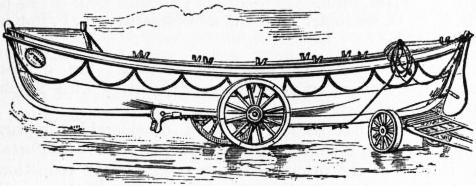
Fig. 1.—The 33-ft., Double-banked, Ten-oared, Self-righting and Self-emptying Life-boat (1881) of the Institution on its Transporting Carriage, ready for launching.
A very marked advance in improvement in design and suitability for service has been made in the life-boat since the reorganization of the Institution in 1883, but principally since 1887, when, as the result of an accident in December 1886 to two self-righting life-boats in Lancashire, twenty-seven out of twenty-nine of the men who manned them were drowned. At this time a permanent technical sub-committee was appointed by the Institution, whose object was, with the assistance of an eminent consulting naval architect—a new post created—and the Institution’s official experts, to give its careful attention to the designing of improvements in the life-boat and its equipment, and to the scientific consideration of any inventions or proposals submitted by the public, with a view to adopting them if of practical utility. Whereas in 1881 the self-righting life-boat of that time was looked upon as the Institution’s special life-boat, and there were very few life-boats in the Institution’s fleet not of that type, at the close of 1901 the life-boats of the Institution included 60 non-self-righting boats of various types, known by the following designations: Steam life-boats 4, Cromer 3, Lamb and White 1, Liverpool 14, Norfolk and Suffolk 19, tubular 1, Watson 18. In 1901 a steam-tug was placed at Padstow for use solely in conjunction with the life-boats on the north coast of Cornwall. The self-righting life-boat of 1901 was a very different boat from that of 1881. The Institution’s present policy is to allow the men who man the life-boats, after having seen and tried by deputation the various types, to select that in which they have the most confidence.
The present life-boat of the self-righting type (fig. 2) differs materially from its predecessor, the stability being increased and the righting power greatly improved. The test of efficiency in this last quality was formerly considered sufficient if the boat would quickly right herself in smooth water without her crew and gear, but every self-righting life-boat now built by the Institution will right with her full crew and gear on board, with her sails set and the anchor down. Most of the larger self-righting boats are furnished with “centre-boards” or “drop-keels” of varying size and weight, which can be used at pleasure, and materially add to their weather qualities. The drop-keel was for the first time placed in a life-boat in 1885.
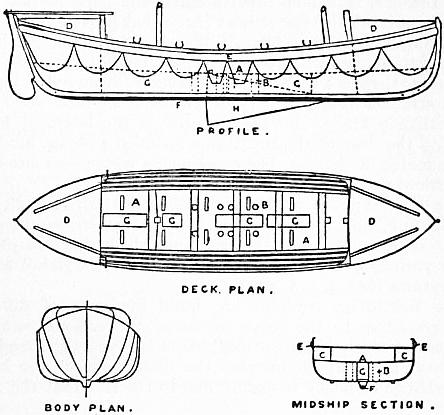
Fig. 2.—Plans, Profile and Section of Modern English Self-righting Life-boat.
A, Deck. B, Relieving valves for automatic discharge of water off deck. C, Side air-cases above deck. D, End air compartments, usually called “end-boxes,” an important factor in self-righting. E, Wale, or fender. F, Iron keel ballast, important in general stability and self-righting. G, Water-ballast tanks. H, Drop-keel.
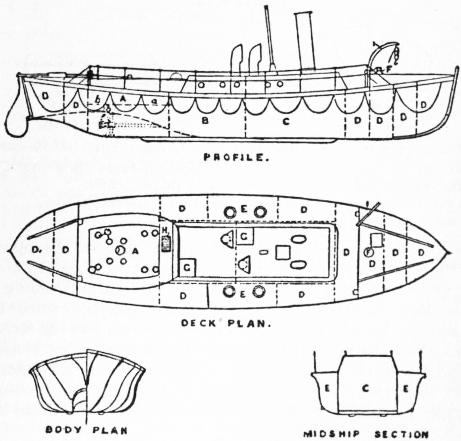
Fig. 3.—Plans, Profile and Section of English Steam Life-boat.
A, Cockpit. a, Deck. b, Propeller hatch. c, Relief valves. B, Engine-room. C, Boiler-room. D, Water-tight compartments. E, Coal-bunkers. F, Capstan. G, Hatches to engine and boiler rooms. H, Cable reel. I, Anchor davit.
Steam was first introduced into a life-boat in 1890, when the Institution, after very full inquiry and consideration, stationed on the coast a steel life-boat, 50 ft. long and 12 ft. beam, and a depth of 3 ft. 6 in., propelled by a turbine wheel driven by engines developing 170 horse-power. It had been previously held by all competent judges that a mechanically-propelled life-boat, suitable for service in heavy weather, was a problem surrounded by so many and great difficulties that even the most sanguine experts dared not hope for an early solution of it. This type of boat (fig. 3) has proved very useful. It is, however, fully recognized that boats of this description can necessarily be used at only a very limited number of stations, and where there is a harbour which never dries out. The highest speed attained by the first hydraulic steam life-boat was rather more than 9 knots, and that secured in the latest 9½ knots. In 1909 the fleet of the Institution included 4 steam life-boats and 8 motor life-boats. The experiments with motor life-boats in previous years had proved successful.
The other types of pulling and sailing life-boats are all non-self-righting, and are specially suitable for the requirements of the different parts of the coast on which they are placed. Their various qualities will be understood by a glance at the illustrations (figs. 4, 5, 6, 7 and 8).
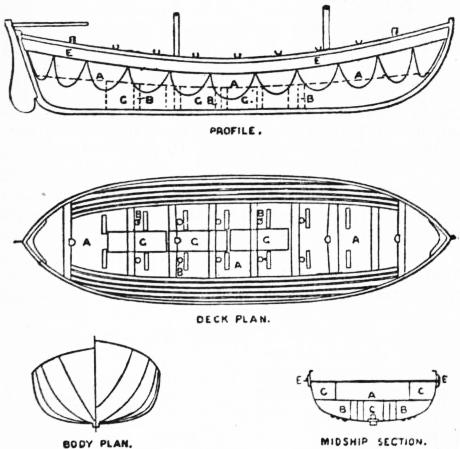
Fig. 4.—Plans, Profile and Section of Cromer Type of Life-boat.
A, Deck. B, Relieving valves for automatic discharge of water off deck. C, Side air-cases above deck. E, Wale, or fender. G, Water-ballast tanks.
The Institution continues to build life-boats of different sizes according to the requirements of the various points of the coast at which they are placed, but of late years the tendency has been generally to increase the dimensions of the boats. This change of policy is mainly due to the fact that the small coasters and fishing-boats have in great measure disappeared, their places being taken by steamers and steam trawlers. The cost of the building and equipping of pulling and sailing life-boats has materially increased, more especially since 1898, the increase being mainly due to improvements and the seriously augmented charges for materials and labour. In 1881 the average cost of a fully-equipped life-boat and carriage was £650, whereas at the end of 1901 it amounted to £1000, the average annual cost of maintaining a station having risen to about £125.
The transporting-carriage continues to be a most important part of the equipment of life-boats, generally of the self-righting type, and is indispensable where it is necessary to launch the boats at any point not in the immediate vicinity of the boat-house. It is not, however, usual to supply carriages to boats of larger dimensions than 37 ft. in length by 9 ft. beam, those in excess as regards length and beam being either launched by means of special slipways or kept afloat. The transporting-carriage of to-day has been rendered particularly useful at places where the beach is soft, sandy or shingly, by the introduction in 1888 of Tipping’s sand-plates. They are composed of an endless plateway or jointed wheel tyre fitted to the main wheels of the carriage, thereby enabling the boat to be transferred with rapidity and with greatly decreased labour over beach and soft sand. Further efficiency in launching has also been attained at many stations by the introduction in 1890 of pushing-poles, attached to the transporting-carriages, and of horse launching-poles, first used in 1892. Fig. 9 gives a view of the modern transporting-carriage fitted with Tipping’s sand- or wheel-plates.
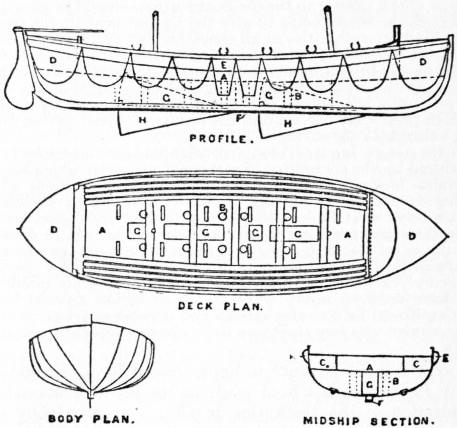
Fig. 5.—Plans, Profile and Section of Liverpool Type of Life-boat. A, B, C, E, G, as in fig. 3; D, end air-compartments; F, iron keel; H, drop-keels.
The life-belt has since 1898 been considerably improved, being now less cumbersome than formerly, and more comfortable. The feature of the principal improvement is the reduction in length of the corks under the arms of the wearer and the rounding-off of the upper portions, the result being that considerably more freedom is provided for the arms. The maximum extra buoyancy has thereby been reduced from 25 ℔ to 22 ℔, which is more than sufficient to support a man heavily clothed with his head and shoulders above the water, or to enable him to support another person besides himself. Numerous life-belts of very varied descriptions, and made of all sorts of materials, have been patented, but it is generally agreed that for life-boat work the cork life-belt of the Institution has not yet been equalled.
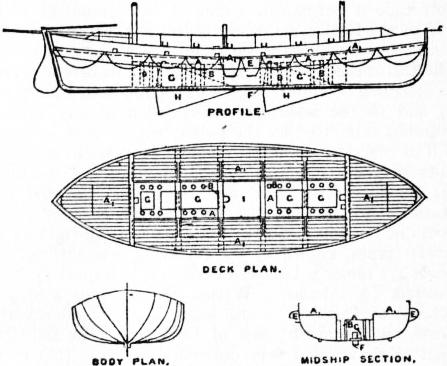
Fig. 6.—Plans, Profile and Section of Norfolk and Suffolk Type of Life-boat. A, B, E, F, G, H, as in fig. 4; A, side deck; I, cable-well.
Life-saving rafts, seats for ships’ decks, dresses, buoys, belts, &c., have been produced in all shapes and sizes, but apparently nothing indispensable has as yet been brought out. Those interested in life-saving appliances were hopeful that the Paris Exhibition of 1900 would have produced some life-saving invention which might prove a benefit to the civilized world, but so lacking in real merit were the life-saving exhibits that the jury of experts were unable to award to any of the 435 competitors the Andrew Pollok prize of £4000 for the best method or device for saving life from shipwreck.
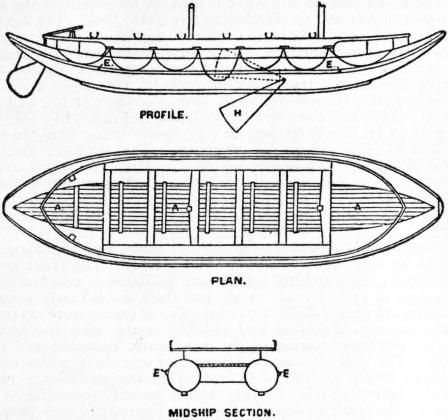
Fig. 7.—Plan, Profile and Section of Tubular Type of Life-boat. A, deck; E, wale, or fender; H, drop-keel.
The rocket apparatus, which in the United Kingdom is under the management of the coast-guard, renders excellent service in life-saving. This, next to the life-boat, is the most important and successful means by which shipwrecked persons are rescued on the British shores. Many vessels are cast every year on the rocky parts of the coasts, under cliffs, where no life-boat could be of service. In such places the rocket alone is available.
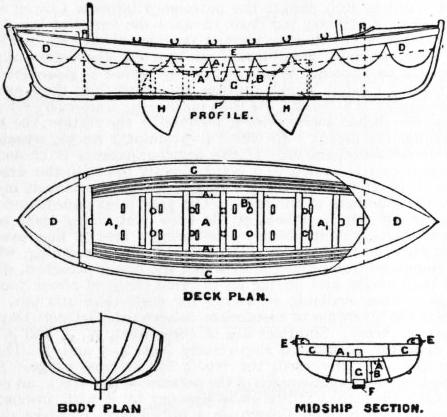
Fig. 8.—Plans, Profile and Section of Watson Type of Life-boat. Lettering as in fig. 5, but C, side air-cases above deck and thwarts.
The rocket apparatus consists of five principal parts, viz. the rocket, the rocket-line, the whip, the hawser and the sling life-buoy. The mode of working it is as follows. A rocket, having a light line attached to it, is fired over the wreck. By means of this line the wrecked crew haul out the whip, which is a double or endless line, rove through a block with a tail attached to it. The tail-block, having been detached from the rocket-line, is fastened to a mast, or other portion of the wreck, high above the water. By means of the whip the rescuers haul off the hawser, to which is hung the travelling or sling life-buoy. When one end of the hawser has been made fast to the mast, about 18 in. above the whip, and its other end to tackle fixed to an anchor on shore, the life-buoy is run out by the rescuers, and the shipwrecked persons, getting into it one at a time, are hauled ashore. Sometimes, in cases of urgency, the life-buoy is worked by means of the whip alone, without the hawser. Captain G. W. Manby, F.R.S., in 1807 invented, or at least introduced, the mortar apparatus, on which the system of the rocket apparatus, which superseded it in England, is founded. Previously, however, in 1791, the idea of throwing a rope from a wreck to the shore by means of a shell from a mortar had occurred to Serjeant Bell of the Royal Artillery, and about the same time, to a Frenchman named La Fère, both of whom made successful experiments with their apparatus. In the same year (1807) a rocket was proposed by Mr Trengrouse of Helston in Cornwall, also a hand and lead line as means of communicating with vessels in distress. The heaving-cane was a fruit of the latter suggestion. In 1814 forty-five mortar stations were established, and Manby received £2000, in addition to previous grants, in acknowledgment of the good service rendered by his invention. Mr John Dennett of Newport, Isle of Wight, introduced the rocket, which was afterwards extensively used. In 1826 four places in the Isle of Wight were supplied with Dennett’s rockets, but it was not till after government had taken the apparatus under its own control, in 1855, that the rocket invented by Colonel Boxer was adopted. Its peculiar characteristic lies in the combination of two rockets in one case, one being a continuation of the other, so that, after the first compartment has carried the machine to its full elevation, the second gives it an additional impetus whereby a great increase of range is obtained.
(R. M. B.; C. Di.)
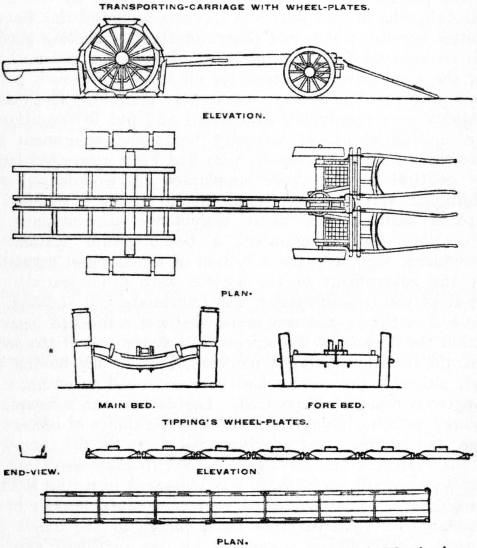
Fig. 9.—Life-boat Transporting-Carriage with Tipping’s Wheel-Plates.
United States.—In the extent of coast line covered, magnitude of operations and the extraordinary success which has crowned its efforts, the life-saving service of the United States is not surpassed by any other institution of its kind in the world. Notwithstanding the exposed and dangerous nature of the coasts flanking and stretching between the approaches to the principal seaports, and the immense amount of shipping concentrating upon them, the loss of life among a total of 121,459 persons imperilled by marine casualty within the scope of the operations of the service from its organization in 1871 to the 30th of June 1907, was less than 1%, and even this small proportion is made up largely of persons washed overboard immediately upon the striking of vessels and before any assistance could reach them, or lost in attempts to land in their own boats, and people thrown into the sea by the capsizing of small craft. In the scheme of the service, next in importance to the saving of life is the saving of property from marine disaster, for which no salvage or reward is allowed. During the period named vessels and cargoes to the value of nearly two hundred million dollars were saved, while only about a quarter as much was lost.
The first government life-saving stations were plain boat-houses erected on the coast of New Jersey in 1848, each equipped with a fisherman’s surf-boat and a mortar and life-car with accessories. Prior to this time, as early as 1789, a benevolent organization known as the Massachusetts Humane Society had erected rude huts along the coast of that state, followed by a station at Cohasset in 1807 equipped with a boat for use by volunteer crews. Others were subsequently added. Between 1849 and 1870 this society secured appropriations from Congress aggregating $40,000. It still maintains sixty-nine stations on the Massachusetts coast. The government service was extended in 1849 to the coast of Long Island, and in 1850 one station was placed on the Rhode Island coast. In 1854 the appointment of keepers for the New Jersey and Long Island stations, and a superintendent for each of these coasts, was authorized by law. Volunteer crews were depended upon until 1870, when Congress authorized crews at each alternate station for the three winter months.
The present system was inaugurated in 1871 by Sumner I. Kimball, who in that year was appointed chief of the Revenue Cutter Service, which had charge of the few existing stations. He recommended an appropriation of $200,000 and authority for the employment of crews for all stations for such periods as were deemed necessary, which were granted. The existing stations were thoroughly overhauled and put in condition for the housing of crews; necessary boats and equipment were furnished; incapable keepers, who had been appointed largely for political reasons, were supplanted by experienced men; additional stations were established; all were manned by capable surfmen; the merit system for appointments and promotions was inaugurated; a beach patrol system was introduced, together with a system of signals; and regulations for the government of the service were promulgated. The result of the transformation was immediate and striking. At the end of the year it was found that not a life had been lost within the domain of the service; and at the end of the second year the record was almost identical, but one life having been lost, although the service had been extended to embrace the dangerous coast of Cape Cod. Legislation was subsequently secured, totally eliminating politics in the choice of officers and men, and making other provisions necessary for the completion of the system. The service continued to grow in extent and importance until, in 1878, it was separated from the Revenue Cutter Service and organized into a separate bureau of the Treasury, its administration being placed in the hands of a general superintendent appointed by the president and confirmed by the senate, his term of office being limited only by the will of the president. Mr Kimball was appointed to the position, which he still held in 1909.
The service embraces thirteen districts, with 280 stations located at selected points upon the sea and lake coasts. Nine districts on the Atlantic and Gulf coasts contain 201 stations, including nine houses of refuge on the Florida coast, each in charge of a keeper only, without crews; three districts on the Great Lakes contain 61 stations, including one at the falls of the Ohio river, Louisville, Kentucky; and one district on the Pacific coast contains 18 stations, including one at Nome, Alaska.
The general administration of the service is conducted by a general superintendent; an inspector of life-saving stations and two superintendents of construction of life-saving stations detailed from the Revenue Cutter Service; a district superintendent for each district; and assistant inspectors of stations, also detailed from the Revenue Cutter Service “to perform such duties in connexion with the conduct of the service as the general superintendent may require.” There is also an advisory board on life-saving appliances consisting of experts, to consider devices and inventions submitted by the general superintendent.
Station crews are composed of a keeper and from six to eight surfmen, with an additional man during the winter months at most of the stations on the Atlantic coast. The surfmen are reenlisted from year to year during good behaviour, subject to a thorough physical examination. The keepers are also subject to annual physical examinations after attaining the age of fifty-five. Stations on the Atlantic and Gulf coasts are manned from August 1st to May 31st. On the lakes the active season covers the period of navigation, from about April 1st to early in December. The falls station at Louisville, and all stations on the Pacific coast, are in commission continuously. One station, located in Dorchester Bay, an expanse of water within Boston harbour, where numerous yachts rendezvous and many accidents occur, which, with the one at Louisville are, believed to be the only floating life-saving stations in the world, is manned from May 1st to November 15th. Its equipment includes a steam tug and two gasoline launches, the latter being harboured in a slip cut into the after-part of the station and extending from the stern to nearly amidships. The Louisville stations guard the falls of the Ohio river, where life is much endangered from accidents to vessels passing over the falls and small craft which are liable to be drawn into the chutes while attempting to cross the river. Its equipment includes two river skiffs which can be instantly launched directly from the ways at one end of the station. These skiffs are small boats modelled much like surf-boats, designed to be rowed by one or two men. Other equipments are provided for the salvage of property. The stations, located as near as practicable to a launching place, contain as a rule convenient quarters for the residence of the keeper and crew and a boat and apparatus room. In some instances the dwelling- and boat-house are built separately. Each station has a look-out tower for the day watch.
The principal apparatus consists of surf- and life-boats, Lyle gun and breeches-buoy apparatus and life-car. The Hunt gun and Cunningham line-carrying rocket are available at selected stations on account of their greater range, but their use is rarely necessary. The crews are drilled daily in some portion of rescue work, as practice in manœuvring, upsetting and righting boats, with the breeches-buoy, in the resuscitation of the apparently drowned and in signalling. The district officers upon their quarterly visits examine the crews orally and by drill, recording the proficiency of each member, including the keeper, which record accompanies their report to the general superintendent. For watch and patrol the day of twenty-four hours is divided into periods of four or five hours each. Day watches are stood by one man in the look-out tower or at some other point of vantage, while two men are assigned to each night watch between sunset and sunrise. One of the men remains on watch at the station, dividing his time between the beach look-out and visits to the telephone at specified intervals to receive messages, the service telephone system being extended from station to station nearly throughout the service, with watch telephones at half-way points. The other man patrols the beach to the end of his beat and returns, when he takes the look-out and his watchmate patrols in the opposite direction. A like patrol and watch is maintained in thick or stormy weather in the daytime. Between adjacent stations a record of the patrol is made by the exchange of brass checks; elsewhere the patrolman carries a watchman’s clock, on the dial of which he records the time of his arrival at the keypost which marks the end of his beat. On discovering a vessel standing into danger the patrolman burns a Coston signal, which emits a brilliant red flare, to warn the vessel of her danger. The number of vessels thus warned averages about two hundred in each year, whereby great losses are averted, the extent of which can never be known. When a stranded vessel is discovered, the patrolman’s Coston signal apprises the crew that they are seen and assistance is at hand. He then notifies his station, by telephone if possible. When such notice is received at the station, the keeper determines the means with which to attempt a rescue, whether by boat or beach-apparatus. If the beach-apparatus is chosen, the apparatus cart is hauled to a point directly opposite the wreck by horses, kept at most of the stations during the inclement months, or by the members of the crew. The gear is unloaded, and while being set up—the members of the crew performing their several allotted parts simultaneously—the keeper fires a line over the wreck with the Lyle gun, a small bronze cannon weighing, with its 18 ℔ elongated iron projectile to which the line is attached, slightly more than 200 ℔, and having an extreme range of about 700 yds., though seldom available at wrecks for more than 400 yds. This gun was the invention of Lieutenant (afterwards Colonel) David A. Lyle, U.S. Army. Shot lines are of three sizes, 4⁄32, 7⁄32 and 9⁄32 of an inch diameter, designated respectively Nos. 4, 7 and 9. The two larger are ordinarily used, the No. 4 for extreme range. A line having been fired within reach of the persons on the wreck, an endless rope rove through a tail-block is sent out by it with instructions, printed in English and French on a tally-board, to make the tail fast to a mast or other elevated portion of the wreck. This done, a 3-in. hawser is bent on to the whip and hauled off to the wreck, to be made fast a little above the tail-block, after which the shore end is hauled taut over a crotch by means of tackle attached to a sand anchor. From this hawser the breeches-buoy or life-car is suspended and drawn between the ship and shore of the endless whip-line. The life-car can also be drawn like a boat between ship and shore without the use of a hawser. The breeches-buoy is a cork life-buoy to which is attached a pair of short canvas breeches, the whole suspended from a traveller block by suitable lanyards. It usually carries one person at a time, although two have frequently been brought ashore together. The life-car, first introduced in 1848, is a boat of corrugated iron with a convex iron cover, having a hatch in the top for the admission of passengers, which can be fastened either from within or without, and a few perforations to admit air, with raised edges to exclude water. At wreck operations during the night the shore is illuminated by powerful acetylene (calcium carbide) lights. If any of the rescued persons are frozen, as often happens, or are injured or sick, first aid and simple remedies are furnished them. Dry clothing, supplied by the Women’s National Relief Association, is also furnished to survivors, which the destitute are allowed to keep.
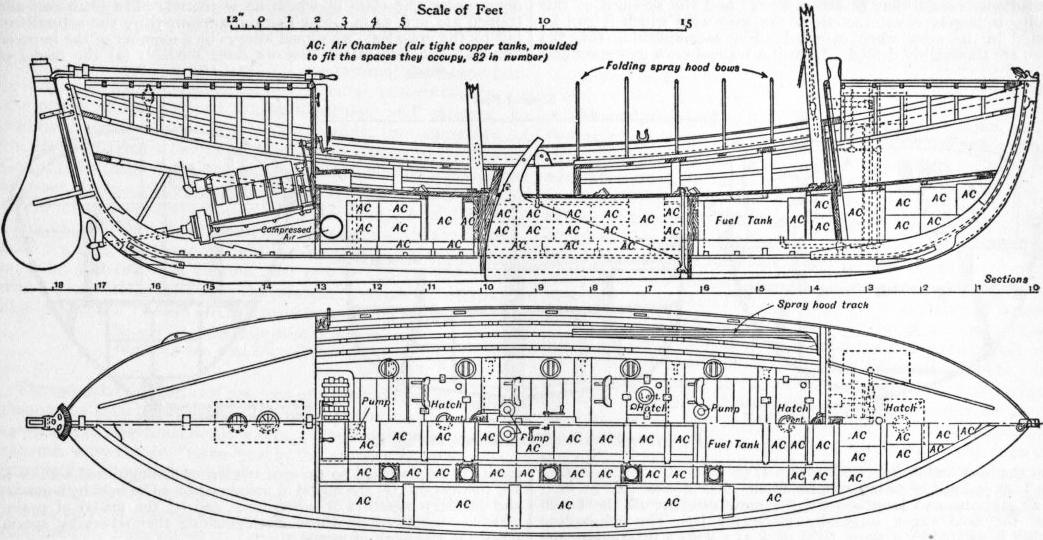
Fig. 10.—American Power Life-boat.
Several types of light open surf-boats are used, adapted to the special requirements of the different localities and occasions. They are built of cedar, from 23 to 27 ft. long, and are provided with end air chambers and longitudinal air cases on each side under the thwarts.
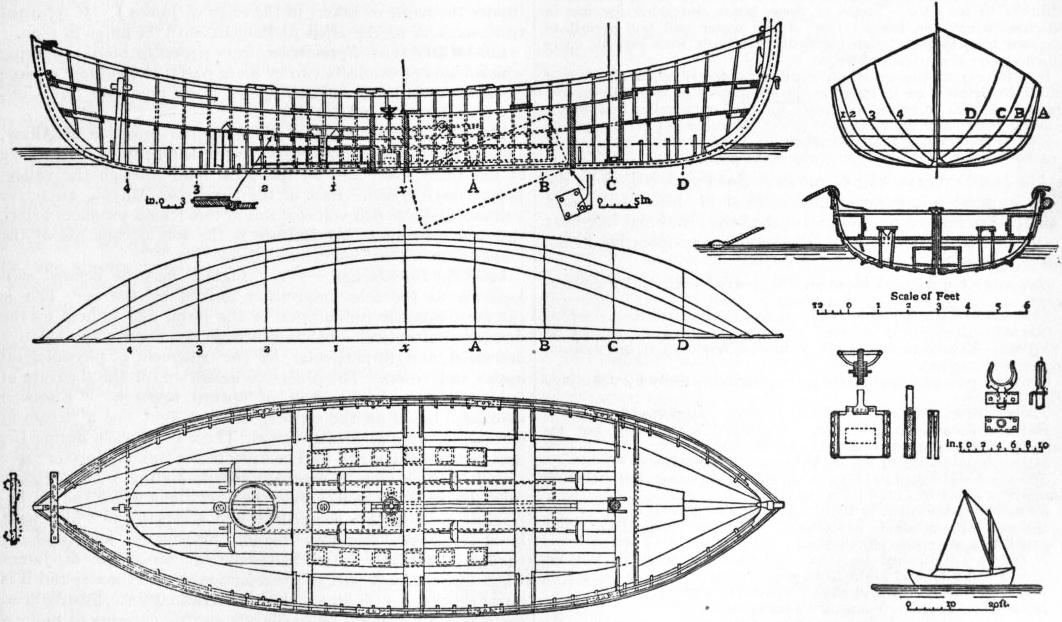
Self-righting and self-bailing life-boats, patterned after those used in England and other countries, have heretofore been used at most of the Lake stations and at points on the ocean coast where they can be readily launched from ways. Most of these boats, however, have now been transformed into power boats without the sacrifice of any of their essential qualities. The installation of power is effected by introducing a 25 H.P. four-cycle gasoline motor, weighing with its fittings, tanks, &c., about 800 ℔. The engine is installed in the after air chamber, with the starting crank, reversing clutches, &c., recessed into the bulkhead to protect them from accidents. These boats attain a speed of from 7 to 9 m. an hour, and have proved extremely efficient. A new power life-boat (fig. 10) on somewhat improved lines, 36 ft. in length, and equipped with a 35-40 H.P. gasoline engine, promises to prove still more efficient. A number of surf-boats have also been equipped with gasoline engines of from 5 to 7 H.P., for light and quick work, with very satisfactory results.
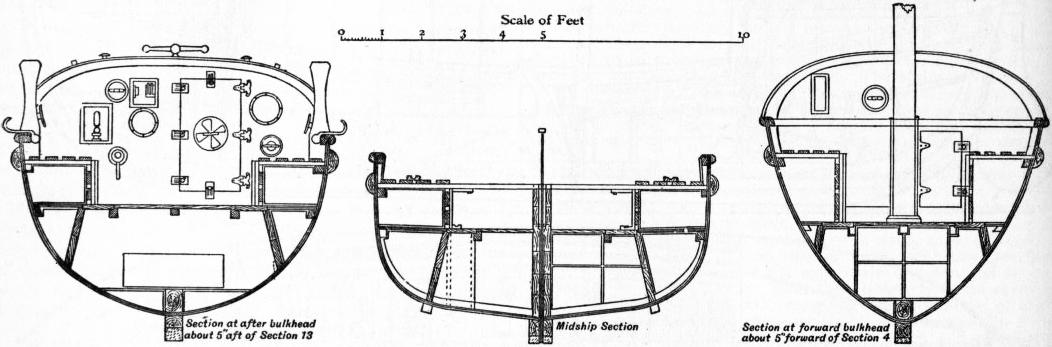
Fig. 12.—Details of boat shown in Fig. 10.
A distinctively American life-boat extensively used is the Beebe-McLellan self-bailing boat (fig. 11), which for all round life-saving work is held in the highest esteem. It possesses all the qualities of the self-righting and self-bailing life-boats in use in all life-saving institutions, except that of self-righting; and the sacrifice of this quality is largely counteracted by the ease with which it can be righted by its crew when capsized. For accomplishing this the crews are thoroughly drilled. In drill a trained crew can upset and right the boat and resume their places at the oars in twenty seconds. The boat is built of cedar, weighs about 1200 ℔, and can be used at all stations and launched by the crew directly off the beach from the boat-wagon especially made for it. The self-bailing quality is secured by a water-tight deck at a level a little above the load water line with relieving tubes fitted with valves through which any water shipped runs back into the sea by gravity. Air cases along the sides under the thwarts, inclining towards the middle of the boat, minimize the quantity of water taken in, and the water-ballast tank in the bottom increases the stability by the weight of the water which can be admitted by opening the valve. When transported along the land it is empty. The Beebe-McLellan boat is 25 ft. long, 7 ft. beam, and will carry 12 to 15 persons in addition to its crew. Some of these boats, intended for use in localities where the temperature of the water will not permit of frequent upsetting and righting drills, are built with end air cases which render them self-righting.
In addition to the principal appliances described, a number of minor importance are included in the equipment of every life-saving station, such as launching carriages for life-boats, roller boat-skids, heaving sticks and all necessary tools. Members of all life-saving crews are required on all occasions of boat practice or duty at wrecks to wear life-belts of the prescribed pattern.
(A. T. T.)
Life-boat Service in other Countries.—Good work is done by the life-boat service in other countries, most of these institutions having been formed on the lines of the Royal National Life-boat Institution of Great Britain. The services are operating in the following countries:—
Belgium.—Established in 1838. Supported entirely by government.
Denmark.—Established in 1848. Government service.
Sweden.—Established in 1856. Government service.
France.—Established in 1865. Voluntary association, but assisted by the government.
Germany.—Established in 1885. Supported entirely by voluntary contributions.
Turkey (Black Sea).—Established in 1868. Supported by dues.
Russia.—Established in 1872. Voluntary association, but receiving an annual grant from the government.
Italy.—Established in 1879. Voluntary association.
Spain.—Established in 1880. Voluntary association, but receiving annually a grant of £1440 from government.
Canada.—Established in 1880. Government service.
Holland.—Established in 1884. Voluntary association, but assisted by a government subsidy.
Norway.—Established in 1891. Voluntary association, but receiving a small annual grant from government.
Portugal.—Established in 1898. Voluntary society.
India (East Coast).—Voluntary association.
Australia (South).—Voluntary association.
New Zealand.—Voluntary association.
Japan.—The National Life-boat Institution of Japan was founded in 1889. It is a voluntary society, assisted by government. Its affairs are managed by a president and a vice-president, supported by a very influential council. The head office is at Tôkyô; there are numerous branches with local committees. The Imperial government contributes an annual subsidy of 20,000 yen (£2000). The members of the Institution consist of three classes—honorary, ordinary and sub-ordinary, the amount contributed by the member determining the class in which he is placed. The chairman and council are not, as in Great Britain, appointed by the subscribers, but by the president, who must always be a member of the imperial family. The Institution bestows three medals: (a) the medal of merit, to be awarded to persons rendering distinguished service to the Institution; (b) the medal of membership, to be held by honorary and ordinary members or subscribers; and (c) the medal of praise, which is bestowed on those distinguishing themselves by special service in the work of rescue.
LIFFORD, the county town of Co. Donegal, Ireland, on the left bank of the Foyle. Pop. (1901) 446. The county gaol, court house and infirmary are here, but the town is practically a suburb of Strabane, across the river, in Co. Londonderry. Lifford, formerly called Ballyduff, was a chief stronghold of the O’Donnells of Tyrconnell. It was incorporated as a borough (under the name of Liffer) in the reign of James I. It returned two members to the Irish parliament until the union in 1800.
LIGAMENT (Lat. ligamentum, from ligare, to bind), anything which binds or connects two or more parts; in anatomy a piece of tissue connecting different parts of an organism (see Connective Tissues and Joints).
LIGAO, a town near the centre of the province of Albay, Luzon, Philippine Islands, close to the left bank of a tributary of the Bicol river, and on the main road through the valley. Pop. (1903) 17,687. East of the town rises Mayón, an active volcano, and the rich volcanic soil in this region produces hemp, rice and coco-nuts. Agriculture is the sole occupation of the inhabitants. Their language is Bicol.
LIGHT. Introduction.—§ 1. “Light” may be defined subjectively as the sense-impression formed by the eye. This is the most familiar connotation of the term, and suffices for the discussion of optical subjects which do not require an objective definition, and, in particular, for the treatment of physiological optics and vision. The objective definition, or the “nature of light,” is the ultima Thule of optical research. “Emission theories,” based on the supposition that light was a stream of corpuscles, were at first accepted. These gave place during the opening decades of the 19th century to the “undulatory or wave theory,” which may be regarded as culminating in the “elastic solid theory”—so named from the lines along which the mathematical investigation proceeded—and according to which light is a transverse vibratory motion propagated longitudinally though the aether. The mathematical researches of James Clerk Maxwell have led to the rejection of this theory, and it is now held that light is identical with electromagnetic disturbances, such as are generated by oscillating electric currents or moving magnets. Beyond this point we cannot go at present. To quote Arthur Schuster (Theory of Optics, 1904), “So long as the character of the displacements which constitute the waves remains undefined we cannot pretend to have established a theory of light.” It will thus be seen that optical and electrical phenomena are co-ordinated as a phase of the physics of the “aether,” and that the investigation of these sciences culminates in the derivation of the properties of this conceptual medium, the existence of which was called into being as an instrument of research.1 The methods of the elastic-solid theory can still be used with advantage in treating many optical phenomena, more especially so long as we remain ignorant of fundamental matters concerning the origin of electric and magnetic strains and stresses; in addition, the treatment is more intelligible, the researches on the electromagnetic theory leading in many cases to the derivation of differential equations which express quantitative relations between diverse phenomena, although no precise meaning can be attached to the symbols employed. The school following Clerk Maxwell and Heinrich Hertz has certainly laid the foundations of a complete theory of light and electricity, but the methods must be adopted with caution, lest one be constrained to say with Ludwig Boltzmann as in the introduction to his Vorlesungen über Maxwell’s Theorie der Elektricität und des Lichtes:—